INTRODUCTION
In 2008, archaeologists discovered a fragment of an unusual copper-alloy artefact during excavation of an unstratified context between the east granary and the headquarters building of the third-century stone fort at Vindolanda.Footnote 2 Although the object cannot be dated contextually, it has received considerable attention from scholars interested in time and time-reckoning in the years since its discovery.Footnote 3 Until recently, however, it has been impossible to determine the original form and function of the complete artefact from which this small piece is derived.
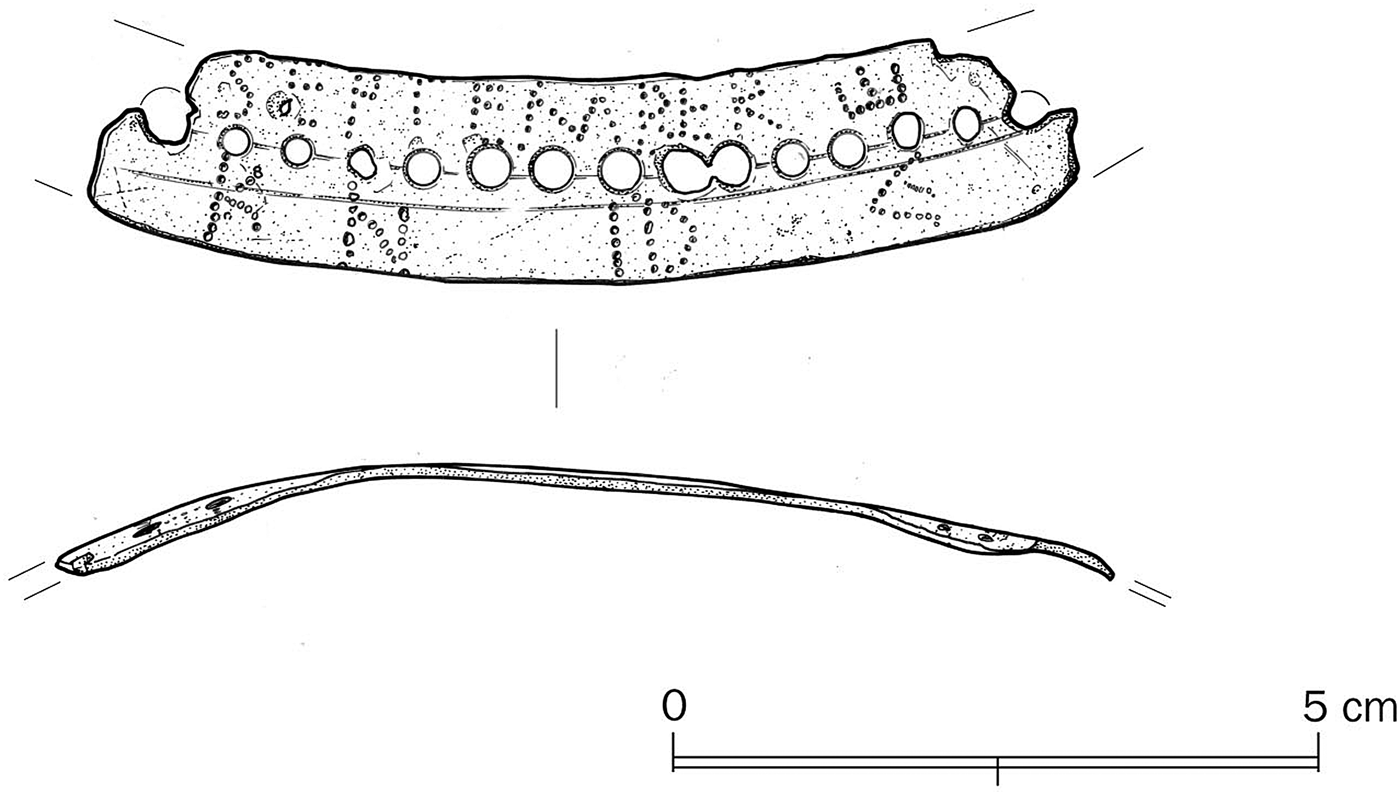
The Vindolanda fragment is an 83 by 21 mm portion of a flat copper-alloy annulus (fig. 1). In its entirety this artefact would have formed a circular band with a diameter of approximately 35 cm. The Vindolanda fragment is pierced by 13 small holes, approximately 2.5 mm in diameter, spaced about 5 mm apart (centre to centre). Above the line of holes appears the text SEPTEMBER. Below the holes appear the letters K, N and ID. Running perpendicular to the line of holes and the rest of the text are the letters AE. The letters on this artefact are formed by a series of shallow punches and range in height from 5 to 7 mm and in width from 1 to 8 mm.
The Vindolanda fragment. (© The Vindolanda Trust)

This text clearly identifies the fragment as a calendrical device. The name of the month September is complete, and the remaining letters are abbreviations for the Kalends, Nones and Ides, the first, fifth and thirteenth of the month. The AE inscribed perpendicularly to the rest of the text and the series of holes is an abbreviation for Aequinoctium, or Equinox. Once it is recognised that each of the holes through the fragment represents a two-day period, it is clear that this label aligns with the date of the equinox, which would have occurred between 22 and 25 September, depending on when the artefact was designed and/or produced.
When it was first uncovered, the excavators believed the Vindolanda fragment was part of a parapegmatic perpetual calendar.Footnote 4 Soon afterwards, however, Michael Lewis compared it to a passage from Vitruvius and artefacts from Salzburg (Austria) and Grand (France) to argue that it was part of a complicated time-keeping device known as an anaphoric water clock.Footnote 5 Subsequently, I argued that the Vindolanda fragment was not part of the same type of device as the Salzburg and Grand fragments, nor indeed that described by Vitruvius. I maintained that the fragment was part of a parapegmatic calendar and elaborated upon the use and significance of such an object on Rome's northern frontier.Footnote 6 Vindolanda, I argued, was isolated enough that it would have been important to keep track of the date in order to maintain a consistent chronological relationship with other sites, especially Rome, and to adhere to the demanding schedule of rites and festivals as prescribed by central authorities and recorded on documents such as the Feriale Duranum.Footnote 7 Furthermore, I argued that the existence of this calendar highlights the importance and difficulty of synchronising secular and religious calendars around the Empire.Footnote 8
In 2014 Kevin Birth further distinguished the Vindolanda fragment from the Salzburg and Grand fragments, while expanding the discussion to include parapegmata and fasti more broadly.Footnote 9 Birth demonstrated that while the Vindolanda fragment has more in common with parapegmata than it does with fasti, it does not fit neatly into either category. While it was clearly intended to receive a peg in order to track the date, the Vindolanda fragment does not demonstrate the concern with agricultural and pastoral practices generally associated with parapegmata. However, it also does not contain the details of official religion and festivals characteristic of fasti.Footnote 10 Furthermore, as Birth notes, ‘the problem with labelling the object as a parapegma is that its form is unlike any other parapegma. Instead, its form and contents are most like later equatoria or perpetual calendars, but the artefact from Vindolanda pre-dates known examples of these types of tools by centuries’.Footnote 11
Indeed, the uniqueness of the Vindolanda fragment and the lack of detailed evidence by which to date it made it impossible to take this analysis much further. There was general consensus that the Vindolanda fragment was some sort of time-keeping device (either a clock or a calendar), that it was associated with a Roman military site, and that its form, if not its purpose, was similar to a parapegma. Yet there was little agreement about the form the original artefact took. Lewis wanted to associate it with a complex time-keeping mechanism similar, if not identical, to that described by Vitruvius, while Birth maintained that ‘the counter-clockwise arrangement of the months combined with the evidence that the fragment was soldered in place may suggest that it formed part of a fixed base over which something else moved’.Footnote 12 Furthermore, he argued ‘the slight scratches that run between the holes and the edge support this conclusion. This is very much more consistent with an equatoria or an astrolabe than with a horologium hibernum’.Footnote 13 Birth was certainly correct to observe that the solder indicated that the annulus of which we have a fragment was attached to something,Footnote 14 but it was unclear how complicated the original device was. The study and interpretation of this artefact can now be advanced significantly by developments in 2016 and 2017.
NEW EVIDENCE FOR TIME-KEEPING IN NORTH-WEST EUROPE
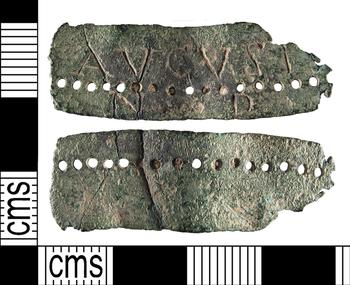
The first of these new developments was the discovery of a small piece of copper-alloy in a field near Hambledon, Hants., and its subsequent report to the Portable Antiquities Scheme (fig. 2).Footnote 15 This artefact is very similar to the Vindolanda fragment, suggesting that they are fragments of the same type of device. The Hambledon/PAS fragment is a strip of roughly rectangular shape that curves slightly as if it formed an annulus when intact. It has, like the Vindolanda fragment, been broken at both ends. The surviving fragment is 38.38 mm long and 12.9 mm wide. It has 16 holes punched in a line approximately 4 mm from the outer edge of the object. Each of these holes is approximately 1 mm in diameter. Inside (or above) the line of holes, the object is inscribed with AUGUS, in block capitals ranging in height from 4 to 6 mm and from 2.5 to 4 mm in width. The upright of a T and the base of a U/V are also visible, allowing us to restore with great certainty ‘Augustus’. This was, of course, the name given to the month Sextilis to honour Augustus and was equivalent to our August.Footnote 16 Outside (or below) the line of holes are the remains of an N and a D in letters 4.5 and 4 mm tall and 4 and 2 mm wide, respectively. The N is an abbreviation for Nones and the D helps to form an abbreviation for Ides.Footnote 17 The expansion of these abbreviations is reinforced by their positions relative to the holes above them. The inscription of AUGUS runs from the second to the fourteenth of the holes, as counted from left to right with the letters oriented upward. The N is placed below or outside the fifth and sixth holes and the D is centred under the twelfth. These holes then correspond roughly to the Nones and the Ides of August, that is the fifth and the thirteenth.
The Hambledon/PAS fragment. (© The Portable Antiquities Scheme)

This interpretation and the holes in the surviving fragment also allow us to estimate the size of the original object. Since the Nones of August were on the fifth of the month and the Ides were on the thirteenth it is clear that this fragment has a hole for almost every day of the month and that the days from the second to the seventeenth are preserved. Therefore, the circumference of the circle of holes in the annulus was approximately 82.5 cm and the diameter of the entire object was approximately 27 cm.
The Hambledon fragment, although similar to the Vindolanda fragment, is different in some significant ways. Both preserve a portion of one month of a calendrical device, have labels for the Nones and the Ides, include holes corresponding to the days of the month, and when complete, were annular in shape. However, the Vindolanda fragment has a label for the Kalends, and no such label is visible on the Hambledon fragment. The Vindolanda fragment also has a label for the autumnal equinox. While no corresponding label appears on the Hambledon fragment, there is no analogous astronomical event in August. The labels on the two objects were also executed differently; the text on the Hambledon fragment is incised, while that on the Vindolanda fragment is punched. In addition, the Hambledon fragment has a hole for almost every day of the month, while each hole in the Vindolanda fragment represents two days. As a result, the holes on the Hambledon fragment are much smaller. Finally, the Hambledon fragment was part of a much smaller object than the Vindolanda fragment. The Hambledon object had a diameter of just 27 cm compared to the Vindolanda object's diameter of approximately 35 cm.
It is clear that these fragments came from artefacts with the same general form and which served the same general function. The discovery of the Hambledon fragment also demonstrates that the Vindolanda fragment is not unique, but rather that this type of time-keeping device may have been relatively common. The details of the two fragments suggest that they were made in rough approximation of a similar archetype. However, the variations in size, writing technique, labelling and hole frequency indicate that they were not made by the same craftsman and do not conform to a single design. Rather, the variations between the two suggest the existence of discrete craftsmen or regional workshops.Footnote 18 Nevertheless, the relative abundance or scarcity of these objects is still very much debated.Footnote 19
Ultimately, the Hambledon fragment does little to answer questions about the true nature of the Vindolanda ‘calendar’. Pearce mentions no evidence of solder or any other attachment method on the Hambledon fragment, nor is any visible in the available photographs. Furthermore, there is no evidence of wear on the top of the artefact, such as Birth quite reasonably thought might have been indicative of rubbing between the fragment and another piece, perhaps a pointer to indicate the date.Footnote 20 These details bring into question Lewis’ suggestion that the Vindolanda fragment was part of a mechanical device as complicated as Vitruvius’ anaphoric water clock. Rather, it seemed until recently that this was another example of a relatively simple calendrical device that is, as Birth suggested, more akin to an astrolabe or equitoria.Footnote 21
None of the initial arguments regarding the details of the Vindolanda fragment's original form, however, explain the function of the Hambledon fragment. While a simple calendrical device makes sense in a military environment or even a civic context in which festivals, sacrifices and official business had to be tracked and performed at specified times, Hambledon is a rural site about 12 km north of Portsmouth. The precise nature of the site has yet to be determined; however, it is unlikely to have been either a military or an urban settlement. There are known villas in the general vicinity of Hambledon, but nothing is known about ancient habitation in the village.Footnote 22 Likewise, the unstratified context in which the Vindolanda fragment was found and its fragmentary state suggest that it may have been transported some distance before its deposition as scrap and it cannot be definitively associated with the military or civilian administration of the site.
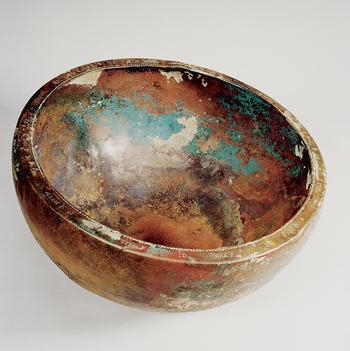
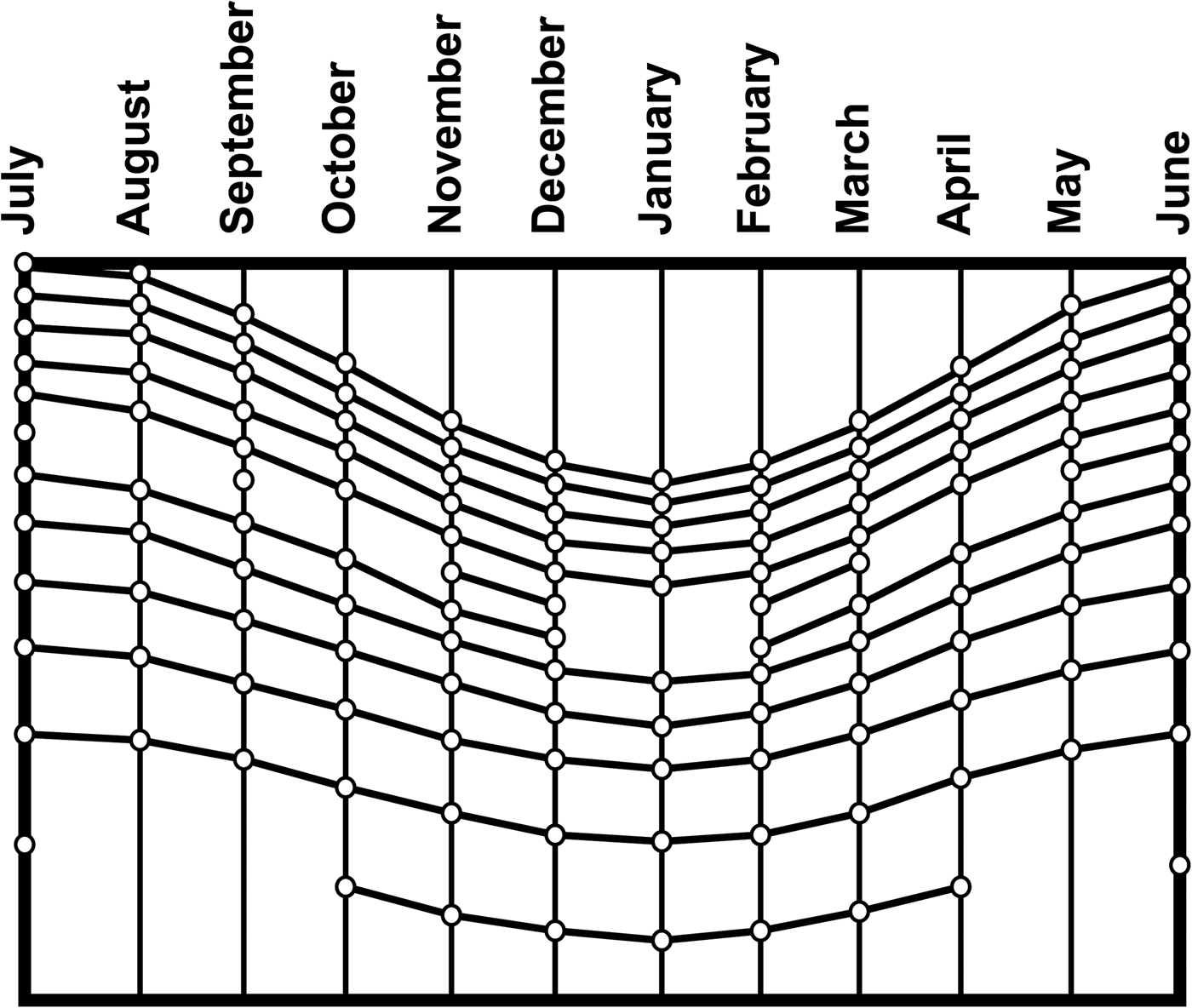
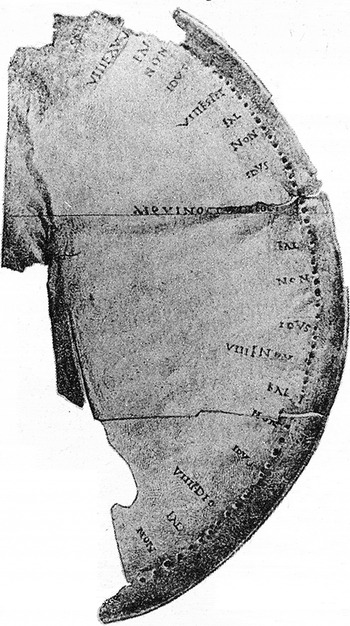
Fortunately, this ambiguity was largely resolved by Alexander Jones in 2016. Jones recognised that the Vindolanda fragment looks very much like the rim of an artefact that came into the possession of the Frankfurt Archaeological Museum from a private collection in 2000 (fig. 3).Footnote 23 This object is a bowl about 21 cm tall. Its diameter at the top varies from 36 to almost 40 cm, presumably as a result of damage after its creation, and its rim is incised with abbreviations for the names of the 12 months, the Kalends, Nones and Ides of each month, the equinoxes, the summer solstice (solstitium) and the winter solstice (brevitas).Footnote 24 These are identical to the markings that survive on the Vindolanda fragment, and differ from those of the Hambledon fragment only in the inclusion of the Kalends, which do not seem to appear (or at least are not visible) on the latter. In addition, the bowl of the device has a 1.7 cm hole at its base, and a 0.4 mm hole beside it. The smaller hole was drilled through a gold patch which had, temporarily, plugged a larger outlet. By drilling through the gold patch the outflow of this hole could be precisely regulated over a long period, since gold, unlike bronze, does not corrode. Also within the bowl are 12 series of up to 12 soldered dots descending from the rim and each corresponding to one of the 12 months as marked on the rim. These soldered points are then connected with lateral, curving lines (fig. 4). It is clear that this is a relatively simple outflow clepsydra.
The Frankfurt clepsydra. (© Archäologisches Museum Frankfurt)

Schematic drawing of the hour lines on the Frankfurt calendrical clepsydra (after Stutzinger Reference Stutzinger2001, 10 Abb. 5).
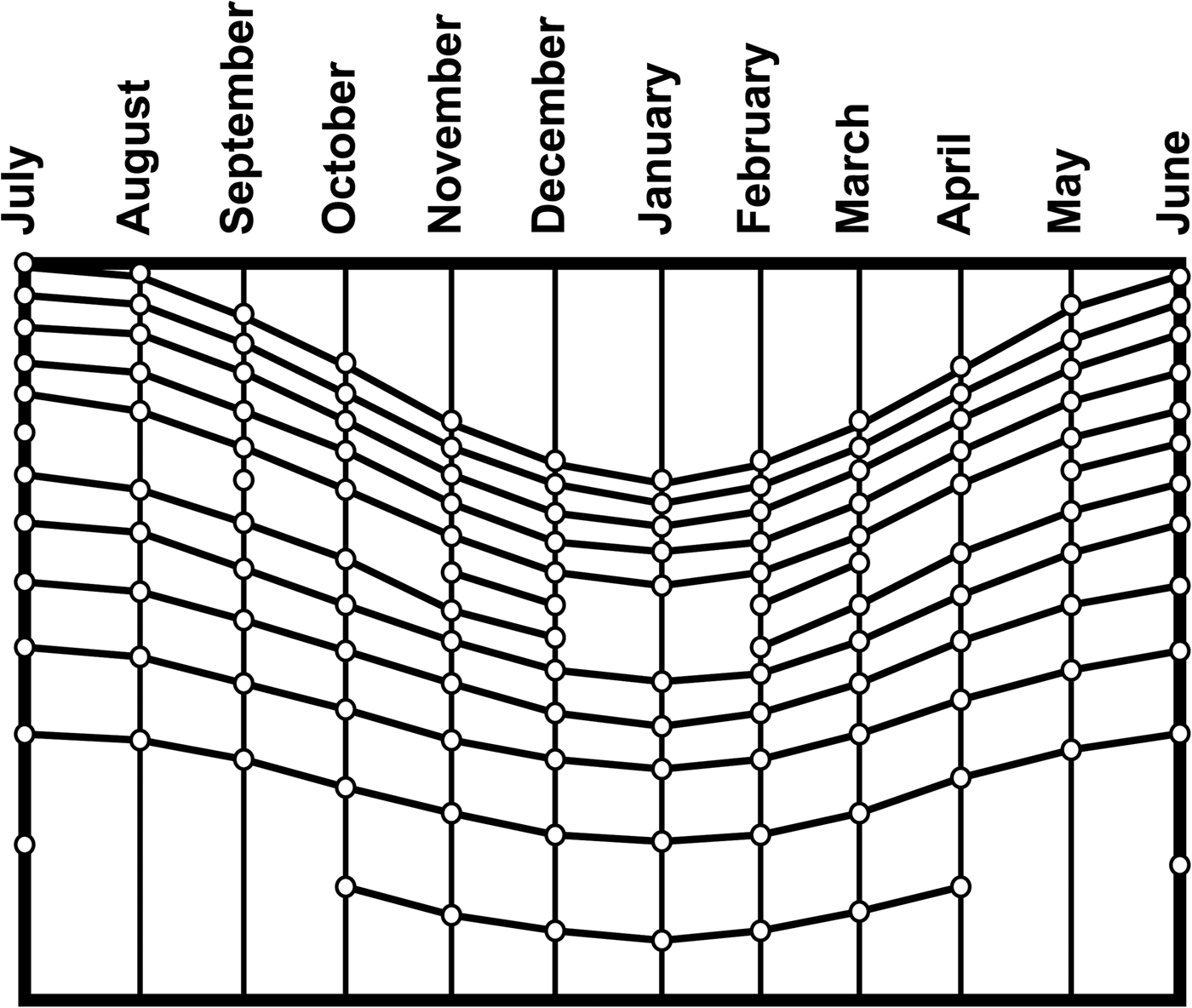
The operation of this device is quite simple. The large and small holes in the bottom of the bowl were plugged before filling the bowl with water up to the highest of the lines connecting the soldered dots below the appropriate date. Then the small hole was unstopped, allowing water to drain slowly from the bowl. The passing of temporal (seasonal) hours could then be read as the water level reached each subsequent horizontal line until, after 12 hours, the water level reached the small hole and water ceased to flow. Finally, the large hole in the bottom could be opened to drain the remaining water and clean the device.Footnote 25
The form and labelling of the rim of the Frankfurt clepsydra are nearly identical to the Vindolanda and Hambledon fragments in their original states. While no visible signs survive of the methods by which the Frankfurt clepsydra was made, metallurgical analysis has revealed that the bowl and the annulus (rim) of the Frankfurt clepsydra are made of different material and, in fact, some solder remains in two places.Footnote 26 This is significant because it explains the signs of solder on the Vindolanda fragment and the state of repair of both the Vindolanda and Hambledon fragments; the rims, which display calendrical information, have simply been separated from the bowls (clepsydrae) with which they were originally associated. This combination of calendrical devices and clepsydrae, which might be called calendrical clepsydrae, is novel.Footnote 27 No example was known before the discovery of the Frankfurt artefact but it is now possible to refer to the Vindolanda, Hambledon and Frankfurt objects as calendrical clepsydrae with confidence.
THE USE AND FUNCTION OF CLEPSYDRAE
Some significant differences between the artefacts and peculiarities about them raise questions about the contexts in which they were used. These three fragments all included holes representing the days of the year. However, while the Vindolanda calendrical clepsydra seems to have a hole for every two days of the calendar year, the Hambledon and Frankfurt artefacts have a hole for, nominally, every single day. However, the Frankfurt example includes 368 holes around its rim. This is two and three quarters more holes than the Julian calendar, or any solar calendar, specifies.Footnote 28 The Hambledon calendrical clepsydra has a similar problem. Close examination reveals that the dates (i.e. the holes) and labels (i.e. Nones and Ides) are not easily compatible. The inconsistency of time-reckoning in the Roman world is well summarised in Seneca's comment that ‘philosophers will agree more often than clocks’ (and here the Latin word is horologia), but this cannot be the case for calendrical devices.Footnote 29
Among these three, the Vindolanda fragment was the most accurate perpetual calendar, although it, too, is flawed. The Hambledon fragment is not even accurate for a single month and the Frankfurt device has too many days per year. Similarly, if each hole on the Vindolanda fragment is to represent two days, it would be difficult, if not impossible, to differentiate between 30- and 31-day months and to track a 365-day year. Not even leap years work very well because, though they have an even number of days (366), a 29-day February compounds the already difficult question of what to do with months with an odd number of days. Therefore, these devices would have been all but useless as scientific tools for tracking the sun or celestial movements. This is, of course, a surmountable problem. All that was required was someone with sufficient knowledge to correct the date as marked on these devices using a more precise calendar, which may have taken a form similar to the Fasti Praenestini or the Calendar of 354, though it need not have shared the medium or contained the level of detailed information of either.Footnote 30 Just such a person is mentioned in CIL 12, 2522, which records C. Blaesius Gratus’ gift of a horologium and a slave to attend to it in Talloires, France, about 40 km south of Geneva. However, problems of adherence to the solar calendar did not affect the primary function of calendrical clepsydrae. They were all certainly time-keeping devices but the context in which they were used is not immediately clear, except that the activities with which they were associated required limited precision.
The Frankfurt artefact may, however, resolve this problem. The lateral lines of the Frankfurt calendrical clepsydra mark differing lengths of time: intervals between lines 1–9 (top-to-bottom) measure half an hour each (hours being of varying lengths throughout the year), intervals between lines 9–11 represent 1 hour each, the interval between lines 11 and 12 measures 1.5 hours, and the remaining space between line 12 and the nozzle represents 4.5 hours (see fig. 4). This configuration creates a total of 12 hours of varying lengths.Footnote 31 The lines that mark these intervals of hours and fractions of hours are not straight. Rather, they rise and fall, and the intervening spaces widen and narrow. This is because they are meant to mark temporal (i.e. seasonal) hours, instead of fixed (i.e. equatorial) hours. Thereby every day of the year consisted of 12 daylight hours and 12 hours of darkness and the duration of those hours varied to fill days and nights as their lengths changed with the seasons. The lengths of the hours then correspond to the appropriate date on the calendrical elements of the devices. Furthermore, the Frankfurt device is designed to track daylight temporal hours, not nocturnal hours as one might expect from a scientific instrument related to celestial observation.
There is one more piece of evidence from the Frankfurt calendrical clepsydra that may indirectly help to explain these intervals. On the outside of the bowl is a dedicatory inscription from Mapilius Mapilianus, subprefect of the waters of Borvo. This inscription reads: ‘Mapil(ius) Mapilianus su(b)pr(a)efect(u)s aquarum dei Borvonis ex aere fracto excitatoriam f(ecit) ex voto s(olvit) l(ibens) m(erito).’Footnote 32 There are two words that are of particular interest in this dedication. The first is excitatoria, which seems to indicate some sort of signalling device, perhaps a bell that accompanied the calendrical clepsydra. The second is Borvo. Also known as Bormo, Bormanus and Bormanicus, Borvo was a Gallo-Celtic healing deity often associated with hot springs. Dedictions to Borvo appear at Bourbon-Lancy (Aquae Bormonis) in Lugdunensis, Bourbonne-les-Bains in Germania Superior and many other locations throughout the Gallic and German provinces.Footnote 33
As Stutzinger has pointed out, this association of Borvo with healing and springs may help to explain the Frankfurt artefact.Footnote 34 The apparently arbitrary markings for times on the inside of the Frankfurt calendrical clepsydra align closely with the schedule of access to baths that is preserved on the so-called Vipasca Tablets.Footnote 35 These tablets outline rules for the administration of a mining community in modern Portugal. Among other things, clauses in the text dictate that whoever wins the contract to manage the baths at Vipasca must keep them heated and open to women from dawn to the seventh hour, and to men from the eighth hour of the day to the second hour of the night.Footnote 36 Similarly, the author (or authors) of the Life of Hadrian in the Historia Augusta record that he reserved specific hours of the day for the sick to attend baths.Footnote 37 These, of course, need not have been the schedule for all baths, but are representative of the way baths were managed.Footnote 38
Lucian also maintains that clocks were integral to the ideal bath-house. In his Hippias, also known as The Bath or Balneum, he extolls the architectural expertise of Hippias and notes that the bath-house he designed and built had many admirable features including ‘two indicators of the time, one that bellows on account of water and one that shows the time by the sun’.Footnote 39 These two devices are clearly a water clock of some kind and a sundial. Lucian's inclusion of these time-keeping devices suggests that they were common and useful amenities in a bath, even if they were not ubiquitous. This source may also illuminate the meaning of excitatoria, the signalling device, in the inscription on the Frankfurt artefact. While there is no reason to believe that this device made the same type of noise as the device from Hippias’ bath, it makes sense that there would be a mechanism that communicated the passage of time. This would be particularly desirable in public baths and bathing shrines in order to delineate the periods allotted to different groups.
The connection between time-keeping devices and bath-houses is further reinforced by the clock fragment and astrological tablets discovered at Grand in France (fig. 5).Footnote 40 While the clock fragment comes from a different type of water clock, it may still be associated with a healing shrine. In antiquity Grand was known as Grannum, in reference to the Celtic healing-god Grannus, who was worshipped at the site in association with Apollo. At least three inscriptions mentioning Grannus confirm the connection between Apollo-Grannus and the cityFootnote 41 and suggest that Grand was one of the great centres of the healing cult of Apollo-Grannus in antiquity.Footnote 42 In fact, it was so important and renowned that Caracalla and Constantine visited the temple there in 213 and 309 c.e. respectively.Footnote 43 Given the importance of this cult centre and of bathing in Roman medical practice generally, it is logical to associate this clock with a bath of some kind.Footnote 44
The clock fragment from Grand, France (after Fröhner Reference Fröhner1888, pl. 43).

The link between Grand and healing is strengthened by the discovery there of two ivory diptychs of the second century c.e., inscribed with elaborate astrological charts.Footnote 45 Astrology was an important, though controversial, tool of ancient medicine.Footnote 46 It also required accurate knowledge of the movements of celestial objects which could be tracked by the use of calendars and clocks. Thereby, an instrument like the Vindolanda, Frankfurt and Hambledon calendrical clepsydrae could have been invaluable to medical practitioners who utilised astrology, although these specific devices were not accurate enough for scientific astronomy.
The tablets and the Borvo-Apollo and Grannus-Apollo connections strengthen the association of clocks with baths and healing shrines, suggesting that we should search for such a link at Vindolanda. While there is no direct means by which to connect Vindolanda to Apollo-Grannus, he is attested in Britain. A dedicatory inscription to him was erected at the fort in Inveresk, Scotland (known as Curia, Coria and/or Evidensca in antiquity),Footnote 47 by Quintus Lusius Sabinianus, a procurator Augusti during the occupation of the Antonine Wall (c. 140–c. 158 c.e.).Footnote 48 Neither the unit that garrisoned Inveresk nor the one that occupied Vindolanda in the Antonine period are known, but there may have been a connection between the two locations and thereby a direct transmission of the worship of Apollo-Grannus. For now, it is enough to recognise that Apollo-Grannus was worshipped in Britannia in the second century at least.
There is also plentiful evidence for baths at Vindolanda. The site boasts a first-century bath-house just off the south side of the fort plateau,Footnote 49 a third-century bath-house in the extramural settlement on the west side of the fortFootnote 50 and baths associated with commanders’ residences.Footnote 51 Furthermore, the Vindolanda writing-tablets hint at their importance to the garrison and its extramural settlement. The first-century baths are mentioned in tablet 155 (l. 1)Footnote 52 and perhaps 322 (l. 2n);Footnote 53 bath slippers (balnearia) are mentioned in tablet 197 (l. 2, n3) and perhaps 732;Footnote 54 and a balniator named Vitalis appears in tablet 181 (l. 8).Footnote 55 The tablets themselves are unique but do not reflect atypical practices on Roman military sites. The mention of the balniator is probably the most remarkable, but there is no reason to believe this position was unique to Vindolanda. Furthermore, while the writing-tablets, which date to the end of the first and beginning of the second century c.e., are probably at least a century removed from the time the Vindolanda calendrical clepsydra was created, there was certainly an active bath-house at Vindolanda when the device was in use.Footnote 56
The prominence of the extramural settlement at Vindolanda and the position of the third-century bath-house within it are tempting incitements to hypothesise that the Vindolanda calendrical clepsydra was used to enforce rules of segregated bathing as described in the Vipasca Tablets and the Historia Augusta. On the other hand, it is also possible to see connections between Vindolanda and a bath-shrine similar to the one suggested by the inscription on the Frankfurt calendrical clepsydra and reinforced by the evidence from Grand. While there is no trace of hot springs at Vindolanda, there are several fresh-water springs on the site. One of these springs, west of the third-century fort, is still flowing and was monumentalised with a stone water-tank connected to the third-century bath-house by a stone aqueduct.Footnote 57
Furthermore, this spring lies just 15 m east of a Romano-Celtic temple.Footnote 58 The proximity of the spring and temple might suggest their association with a water- or healing-related deity. This association was further strengthened in 2012 when a dedication by cohors I Tungrorum to the previously unattested goddess Ahvardva was discovered 12 m south of the temple, near another cistern.Footnote 59 Cohors I Tungrorum occupied the site from approximately 85 c.e to soon after 92 c.e. and again from 105 c.e. until it left for service in Scotland early in the reign of Antoninus Pius, though a veteran of the unit is attested at Vindolanda on a diploma of 146 c.e. After the abandonment of the Antonine Wall, the cohort was posted at Housesteads, very near Vindolanda.Footnote 60 The Tungrians’ origins along the banks of the Maas (Meuse) in Germania Inferior also bring them tantalisingly close to known locations of the worship of Borvo, while linguistic evidence indicates that Ahvardva was a Celtic or Germano-Celtic water divinity, not unlike Borvo.Footnote 61 The use of the same ‘distinctive soft yellow sandstone’ for the inscription, the temple and the water-tank suggests that the three are related,Footnote 62 but it would be overly ambitious to argue strenuously that the Romano-Celtic temple at Vindolanda was dedicated to Ahvardva; a small statue of FortunaFootnote 63 and an altar to either Hercules Magusanus or the Veteres were discovered near the temple in 2012 and may equally be associated with it.Footnote 64 In fact, it has also been suggested that the inscription adorned a hypothetical shrine adjacent to the water-tank.Footnote 65 Nevertheless, the temple, shrine and inscription provide tantalising connections between the Vindolanda calendrical clepsydra, the Frankfurt calendrical clepsydra, activities at Grand and healing divinities associated with water.
There is also another possible way in which Vindolanda and by extension the Vindolanda calendrical clepsydra may be connected to baths and healing cults. John Wallis, an antiquarian of the latter half of the eighteenth century, recorded that there were, in his time, sulphur springs in the Allen Valley just south of Vindolanda. Wallis wrote:
A quarter of a mile above the romantic ruin of Staward le Peel, on the edge of the river Allen, is a sulphur-spring, dedicated to St. Mary, called the Haly-Well. It is in the Sinus of a sloping freestone-rock, wherein are lodged large pellets of sulphur; the aperture and sides tinged by it with a silvery colour. It is of a nauseous foetid taste and smell. Being so near the Allen, the floods often encroach upon it, and force it to change its situation in the rock, breaking out again in some other aperture. The situation is extremely pleasant; a bank of tall oaks and other forest-trees on both sides of the river; an upright stone-pillar by it, fit to rest a book on; the river within a few yards forming a cascade, called Cyprus-Linn; under it a large and deep bason.Footnote 66
Staward Pele, as it is now known, was a fourteenth-century fortified tower about 6 km south of Vindolanda on a promontory overlooking the Allen Valley. Its remains are now in a sad state of repair, but when examining it in 1885, C.C. Hodges reported that:
He had long been aware of the presence of a large number of stones of Roman workmanship in the remains of the gateway to the Pele, but it was only on the 29th of August last that he observed a Roman altar in the upper portion of this ruin.Footnote 67
This altar was subsequently investigated by Eric Birley in 1937 who found it still perched precariously at the top of the ruins, but when he revisited it in 1947, two of the stones above it had fallen off. Subsequently, on 8 July 1949 a Trinity College, Oxford student named Michael de Lisle, who was staying with Birley, visited Staward Pele and found that the altar had fallen from the tower.Footnote 68 Further examination has yielded the following reading:Footnote 69
I(ovi) O(ptimo) M(aximo) | [c]oh(ors) IIII G[al]l(orum) | [cu]i p[r]ae(est) [Su]lpi|cius P̣uden|[s] pr[a]efect(us) [a]ram [p]osuit, | v(otum) [l(ibens)] m(erito) s(olvit).
To Jupiter, Best and Greatest, the Fourth Cohort of Gauls, under the command of their prefect Sulpicius Pudens, set up this altar and willingly and deservedly fulfilled its vow.
This would not be particularly remarkable, except that Sulpicius Pudens and the Fourth Cohort of Gauls are known to have been stationed at Vindolanda.Footnote 70 Furthermore, the size of the altar and the inaccessibility of the peel tower's site suggest that this altar was not transported from Vindolanda to be incorporated into the tower,Footnote 71 but rather that it was dedicated in a shrine on the site, a hypothesis that is further supported by the presence of other Roman stones in and around the remains of the tower.Footnote 72
This inscription, the other Roman stones and the site's strategic location above the river and within sight of Vindolanda on a clear day recommend a Roman presence at Staward Pele, near the site of Wallis’ spring. While there is no further evidence of Roman buildings in the valley, Wallis’ upright pillar may represent the scanty remains of a shrine, nymphaeum or bath beside the spring. Furthermore, additional activity in the valley is attested by the presence of a Roman-period altar at the church in Beltingham, near the confluence of the Allen and the South Tyne.Footnote 73 This altar was dedicated to an otherwise unattested local divinity named Satiada, Saitada, Saiiada or Sattada by the curia of the Textoverdi, the local inhabitants of this area.Footnote 74 This inscription is sometimes attributed to Vindolanda on the assumption that it was transported to the site in the seventeenth or eighteenth century. However, even the entry in RIB recognises that this may not have been the case. RIB states ‘Its place of origin is unknown; it may have been brought from Vindolanda, or it may have come from a local shrine’.Footnote 75 Indeed, the latter argument is more inviting.Footnote 76 Moving the stone from Vindolanda would have required transporting it about 5 km over rough terrain. On the other hand, the sites of Staward Pele and the spring reported by Wallis are between 3 and 4 km away along the gently sloping banks of the Allen and the course of a known Roman road. Furthermore, the name Satiada or Sattada may be related to the Celtic root sāti, meaning saturation and thereby refer to a water divinity; it has been observed that ‘Gallic analogies suggest that unknown feminine deities of local worship are usually stream or fountain nymphs’.Footnote 77 The connection to this deity and the ‘Roman’ population at Vindolanda and elsewhere in this area is strengthened by the use of Latin and a distinctly Roman altar type for this monument. These two inscriptions make it reasonably clear that there was religious activity related to the garrison from Vindolanda and the affiliated local population of the Allen Valley and provide a second possible context for use of the Vindolanda calendrical clepsydra.
CONCLUSIONS
There is significant evidence to connect calendrical clepsydrae of the type preserved at Vindolanda, Hambledon and Frankfurt with baths and healing shrines and this has a profound effect on the way we interpret the Vindolanda fragment and the community around the site. Of the four artefacts discussed in detail here, two have very clear connections to healing shrines.Footnote 78 One was discovered at Grand, a known centre for the worship of Apollo-Grannus, a healing god. Another, the Frankfurt calendrical clepsydra, has an inscription that connects it directly to baths and to Borvo, another healing divinity often synchretised with Apollo.
This leaves the Hambledon and Vindolanda calendrical clepsydrae. We have very little information about the context of the Hambledon fragment, but it does not appear to be associated with a military installation or a significant civilian settlement. Rather, the site may have been a villa or rural shrine. While it is tempting to ascribe a military function to the Vindolanda calendrical clepsydra, such as the measurement of night watches as proposed by Aeneas TacticusFootnote 79 in the fourth century b.c.e. and VegetiusFootnote 80 in the fourth century c.e., it is the only such device associated with the military and the only clepsydra of any kind ever discovered at a Roman military site, as far as I am aware. Furthermore, the fragmentary state of the Vindolanda calendrical clepsydra and its recovery from an unstratified context also allow speculation about its original use at some distance from the granary and headquarters building adjacent to which it was found. For these reasons it may be preferable to look for other contexts in which the calendrical clepsydra could be used. Large-scale public baths are known in Roman Britain at Bath/Aquae Sulis and Buxton/Aquae Arnemetiae,Footnote 81 and shrines for the worship of springs are also common in Roman Britain, most notably on the Hadrian's Wall frontier at Carrawburgh, where 14 inscriptions were erected in honour of the goddess Coventina and at least 13,487 coins were discovered in a stone enclosure meant to capture the outflow of a natural spring, which was in turn incorporated into a stone-built shrine.Footnote 82 This complex included elements similar to the spring, tank and Romano-British temple west of the stone forts at Vindolanda. Furthermore, Pudens’ inscription, the sulphur springs nearby and the inscription on the Frankfurt calendrical clepsydra provide an intriguing triangulation between the Vindolanda fragment, healing shrines and the Allen Valley. The recent discovery of the Hambledon fragment and the recognition that it and the Vindolanda fragment were parts of calendrical clepsydrae similar to that now housed in Frankfurt have opened new and exciting avenues for the study of these objects. Further discoveries are likely to propel this research in new directions, but it now seems likely that the Vindolanda and Hambledon calendrical clepsydrae were associated with water and healing deities.
ACKNOWLEDGEMENTS
I am very grateful to everyone who helped make this paper possible, including the excavation team at Vindolanda, who discovered the Vindolanda fragment, and the Vindolanda Trust for sponsoring those excavations and for allowing me access to the artefact. I am also indebted to Professor Anthony Birley and Dr Andrew Birley who read early drafts of this paper and provided many helpful comments. Special thanks are due to Professor Kevin Birth with whom I have had many fruitful conversations about time-keeping and who has been extremely generous with his time in those conversations and in reading drafts of this paper. Of course, any errors that remain are entirely my own.