INTRODUCTION
Recent years have witnessed sustained argument about what the proper role of religious convictions should be in American politics (Langerak Reference Langerak2007). Much of the most important work in liberal political theory has fairly direct implications for this topic. Robert Audi (Reference Audi1993; Reference Audi, Audi and Wolterstorff1997; Reference Audi2000; Reference Audi2011), Jürgen Habermas (Reference Habermas2006), Charles Larmore (Reference Larmore1987), Martha Nussbaum (Reference Nussbaum2008), John Rawls (Reference Rawls1993), and Richard Rorty (Reference Rorty1994), among many others, have defended some version of the claim that citizens should not support public policies for which they lack a public rationale — a rationale that is, or could be, accepted by the diversely committed citizenry of a pluralistic society such as the United States. By all accounts, a religious reason does not count as a public reason. In a diverse society, any religious reason will inevitably be unacceptable to at least a substantial proportion of the population, and so the only widely acceptable and therefore public reasons will be secular ones. Consequently, liberal political theorists (hereafter, political liberals) draw the conclusion that citizens ought not to endorse or advance arguments about coercive laws exclusively on the basis of their religious convictions. Otherwise put, they claim that responsible citizens will exercise due restraint by refraining from relying solely on religious reasons when supporting their favored public policies.
Political liberals differ among themselves as how best to understand the required restrictions on religious reasons. Some focus on public dialogue, arguing that citizens should not appeal solely to their religious convictions when publicly debating and discussing policy matters (Habermas Reference Habermas2006; Rorty Reference Rorty1994; Nussbaum Reference Nussbaum2008). We define this view as the “public political argument” model. Others, however, focus on the reasons that motivate citizens to vote for or against some particular policy — the basis on which citizens conclude that some particular public policy ought to be enacted (Audi Reference Audi2011; Reference Audi1993; Reference Audi, Audi and Wolterstorff1997; Reference Audi2000; Larmore Reference Larmore1987).Footnote 1 For example, citizens who vote in ballot initiatives to ban same-sex marriages solely because they take gay and lesbian relations to be “an abomination of Almighty God” fail to exercise the kind of restraint proper to a pluralistic democracy. This perspective can be thought of as the “political decision-making” model. Of course, the two models are compatible, and some theorists affirm both.
The doctrine of restraint is an important theoretical position and has been the subject of a great deal of academic debate among philosophers and public intellectuals. But to what extent is it actually violated in society? That is, how often, if at all, do citizens invoke exclusively religious reasons when debating public policies or voting for them? Despite the large body of social scientific research on religion and politics, very little is known about this topic. Occasionally, studies have investigated the “public political argument” model, finding that, mainly for strategic reasons, religious groups very rarely express their arguments in public solely in religious terms (Yamane Reference Yamane2000; Reference Yamane2005; Downs Reference Downs1989; Leon Reference Leon2004; Shields Reference Shields2009). They understand that to persuade others on policy matters requires framing arguments in culturally accepted language. As far as public debates and discussions go, the populace generally seems to follow the principles of political liberalism.
But the situation may be very different when citizens go behind closed curtains to vote for their favored laws and policies. Perhaps it is here that the doctrine of restraint is violated and that political liberals' fears are realized. To our knowledge, no existing research has assessed the “political decision-making” model. As a result, we can only guess as to how pervasive or limited violations are to it in the real world.
This article contributes to the scholarship on religion and politics by providing an empirical analysis of whether citizens abide by or violate the constraints on religious reasons that political liberals advocate when deciding to support or oppose one of the most important policy matters of the day: legalization of same-sex marriage. To do so, it draws on untapped data from a large nationally representative sample of U.S. adults and employs quantitative methods to address a series of research questions. First, to what extent is the American populace willing to support or oppose legalizing gay marriage solely on the basis of their religious convictions? Second, if some American citizens do violate the principles of political liberalism on this issue, which side is more susceptible to doing so? Are supporters or opponents of same-sex marriage legalization more likely to reject the doctrine of restraint? Finally, if there are violators of the doctrine of restraint for this issue, what is their profile? Are they religious conservatives — namely evangelical Protestants — as many political liberals assume? Or, are they members of more progressive faith communities (mainline Protestants, for example)? Just who are the offending parties? Before empirically evaluating these questions, we review important background information about the doctrine of restraint, including objections to it, as well as discuss existing social science research on religion and politics and how it has yet to evaluate the degree to which citizens violate the guidelines of the “political decision-making” model.
MAIN FEATURES OF THE DOCTRINE OF RESTRAINT
If we are to determine which citizens, if any, violate the doctrine of restraint, we must be clear about the kind of restriction political liberals want citizens to obey. While there is diversity in the types of models that theorists articulate, political liberals broadly (though not universally) agree on the following. First, the restriction on religious reasons is a moral, not a legal constraint. No political liberal argues that the state should force citizens to refrain from supporting coercive laws solely for religious reasons.Footnote 2 Apart from insuperable difficulties in enforcing any such policy, doing so would surely run afoul of the right to the freedom of conscience. Rather, political liberals advocate that citizens should voluntarily exercise restraint, just as they should voluntarily obey any number of other moral obligations attached to the social role of citizen, such as refraining from supporting coercive laws that they take to be detrimental to the common good.
Second, political liberals typically do not advocate a thoroughgoing privatization of religious belief. The restriction they advocate on the proper use of religious convictions in politics is fundamentally inclusive rather than exclusive. Their position is not that citizens should refrain from supporting coercive laws for religious reasons, but that citizens should also include secular reasons in their rationale for this support. Citizens are free to have religious reasons, and even to care most about them, but they must also have secular reasons for their favored public policies. The ban is on supporting coercive laws that lack any plausible secular justification. So political liberals claim that the only condition in which citizens should privatize their religious commitments is when they take those religious commitments to provide adequate reason for some coercive law but cannot complement that religious reason with a secular one (Gaus Reference Gaus, Dimovia-Cookson and Stirk2009). Privatization to be sure, but of a fairly constrained nature.
Although fairly constrained, political liberals' doctrine of restraint is nevertheless controversial. After all, it is somewhat mysterious why citizens should refrain from supporting a public policy they sincerely regard as morally and politically appropriate and for which they sincerely take there to be a compelling rationale — a religious rationale that they regard as conclusive. Surely the strong presumption should be that citizens may make political decisions in accord with the dictates of conscience, irrespective of whether the dictates of conscience arise from religious or secular considerations (Eberle Reference Eberle2002). So what reasons have political liberals articulated to overcome this presumption?
There are three central arguments (or better, categories of argument) for political liberals' doctrine of restraint. First, citizens who support coercive laws solely on religious grounds fail adequately to respect their compatriots. For a citizen to coerce other persons without providing any reason that they have a remote prospect of finding plausible is to fail to accord due moral weight to the fact that fellow citizens are autonomous persons who can and ought to decide for themselves how they ought to live their lives (Boettcher Reference Boettcher2007). Second, if citizens support coercive laws solely on religious grounds, they risk polarizing pluralistic societies and in so doing risk engendering the kind of inter-confessional conflict that afflicted Europe during the 16th and 17th centuries — a series of conflicts out of which was born the conviction that the state has no business imposing religious orthodoxy on a recalcitrant population. Third, even if a refusal to exercise restraint does not now harbor the prospect of inter-confessional conflict — a long shot by any reasonable account — it is surely divisive, and as such should be avoided by people of good faith and thus by citizens committed to living in harmony with their compatriots. For each of these reasons, political liberals have advocated that citizens exercise a kind of restrained restraint: they should always have a public (read: secular) reason for their favored coercive laws and thus must refuse to support coercive laws solely on religious grounds.
Such arguments, and the doctrine of restraint they are intended to support, have been on the receiving end of a good amount of criticism. Critics of political liberalism such as Christopher Eberle (Reference Eberle2002), Michael Perry (Reference Perry2003), Paul Weithman (Reference Weithman2002), Charles Taylor (Reference Taylor, Mendieta and Vanantwerpen2011), and Nicholas Wolterstorff (Reference Wolterstorff, Audi and Wolterstorff1997) have articulated a number of objections.Footnote 3 First, it is unclear why citizens who affirm their compatriots' dignity, who are willing to engage in critical analysis of the relevant considerations for and against their favored public policies, and who provide their fellow citizens with what they genuinely and sincerely take to be their best reasons for their favored public policies, but whose best and only reasons are religious, thereby disrespect their compatriots. Second, in a modern liberal democracy such as the United States, in which the right to religious freedom is deeply ensconced, the prospect of inter-confessional conflict is simply dystopian — there is no realistic prospect that, under current conditions, the population of the United States will enter into armed conflict over religious matters. Third, religious reasons are no more and no less controversial than secular reasons and so it is arbitrary to appeal to divisiveness as a basis for advocating restraint regarding religious reasons but not secular reasons (Taylor Reference Taylor, Mendieta and Vanantwerpen2011, 53). Fourth, there is no good reason to require religious citizens to make political decisions on secular grounds that is not equally good reason to require others to address religious citizens on religious grounds — a requirement that would have far-reaching implications for the tone and content of public debate. Last, there is no adequate way to distinguish between secular and religious reasons, and so the very formulation of the doctrine of restraint is suspect.
There is little doubt that participants in this normative debate about religion and responsible citizenship have their eye on the contemporary political scene. The participants seem to assume that there is some contact between the normative constraints they dispute and the activities of actual citizens in liberal democracies like the United States. More particularly, they assume that some citizens do, in fact, support coercive laws solely for religious reasons, and that there are a sufficient number of such citizens to make a difference to at least some political disputes of importance. Indeed, as one observer (Perry Reference Perry1997) has put it, the issue of abortion as it has been debated in the past 25 years in the United States provides the empirical backdrop to the more abstract normative debates about respect, conflict, and divisiveness. The assumption is that there are many citizens whose position on abortion decisively depends on their religious commitments.
The normative debate regarding the proper role of religious reasons in politics raises questions about what is actually going on in the American public. These are questions about matters of social and political fact — about the social and political practices of large numbers of American citizens. To answer these questions, we must exit the realm of political theory and normative reflection. Though theory and reflection can illuminate the expectations we legitimately have of our fellow citizens, they cannot tell us whether, and if so the extent to which, our compatriots are complying with them or not. For information regarding the role that religious reasons play in the lives of citizens as they debate and make decisions about laws and policies, political theorists have to rely on the resources of the social sciences. But have the social sciences provided us with the necessary empirical data and analyses?
THE LIMITS OF EXTANT RESEARCH ON RELIGION AND POLITICS
As previously mentioned, social scientific literature on religion and politics has devoted scant attention to investigating whether the normative debate about the proper role of religion in political life has any meaningful bearing on the actual practices of the citizens who are the subject of this debate. What little is known about this topic focuses exclusively on evaluating the “public political argument” model. Yamane (Reference Yamane2000) analyzed the content of testimony that religious activists gave before the Wisconsin State legislature in the 1990s on capital punishment, welfare reform, partial birth abortion, and same-sex marriage. He found that these activists were no more likely to invoke legitimations with some religious basis to them as they were to appeal to secular justifications. Importantly, it was also observed that religious activists very infrequently relied solely on religious reasoning when presenting their side of the issue (Yamane Reference Yamane2005). Moreover, in contrast to conventional wisdom, religiously conservative activists were considerably less likely to make arguments that contained some religious language to justify their policy positions in public relative to their religiously liberal counterparts. Based on this finding, Yamane (Reference Yamane2000, 186) posited that “politically-active, conservative religious groups in Wisconsin have followed the lead of the Christian Right on the national level in attempting to ground their public policy positions in more widely-acceptable, cultural arguments.” In other words, they act strategically in the public square (for more recent evidence, see Shields Reference Shields2009). Similar dynamics have been identified in other political campaigns such as those against eugenics and pornography (Downs Reference Downs1989; Leon Reference Leon2004). Given the goal of mobilizing the maximum number of supporters for these causes, it was found that religious activists publicly articulated non-religious arguments for their positions.Footnote 4
Switching to the “political decision-making” model, how has it fared in the real world? It is difficult to extract an answer from extant research on religion and politics. From quantitative studies in this area, we know that different dimensions of religion often have robust effects on citizens' political attitudes and actions. For example, scholarship generally finds that integration into religious congregations — especially politicized ones — is positively associated with voter turnout and other types of political activity (for example, see Beyerlein and Andrews Reference Beyerlein and Andrews2008; Djupe and Gilbert Reference Djupe and Gilbert2009). Additionally, studies observe that denominational affiliations, beliefs, and practices are important factors explaining variation in citizens' views on a range of policy issues, such as abortion, church-state relations, women's rights, and economic inequality (for example, see Davis and Robinson Reference Davis and Robinson1996; Kellstedt et al. Reference Kellstedt, Green, Guth, Smidt, Green, Guth, Smidt and Kellstedt1996; Wald and Calhoun-Brown Reference Wald and Calhoun-Brown2011).
As valuable as a contribution as such quantitative work has made to our understanding of how religion shapes politics, it does not align with the concerns and questions associated with the normative debate about the proper role of religious convictions in political decision-making. Although this work demonstrates that religion significantly influences citizens' political behaviors and opinions, it does not specify the kinds of reasons that citizens rely on when they make political decisions, such as voting for or against controversial ballot initiatives. It could be that religious factors motivate citizens to take a particular stand on a policy issue and to go to the polls in large numbers to vote on it, but that they rely heavily or even exclusively on secular reasons when doing so. Take, for example, the significant positive relationship observed between internal religiosity — devotion to a perceived sacred force — and political action (Harris Reference Harris1999). That such religiosity influences individuals to act politically is entirely consistent with their deciding to do so on the basis of secular reasons, or on the basis of secular and religious reasons, or on the basis of religious reasons alone. Observing that internal religiosity has a robust effect on political participation does not tell us which of these three possibilities is actualized, and thus whether anyone is violating political liberals' strictures on religious reasons.
Because qualitative studies of political activists typically focus on motivations, they are arguably better positioned to evaluate the “political decision-making” model. Studies based on this methodology tend to find that religious convictions are among the most important reasons people give for engaging in activism, including high-risk forms of it. For example, Smith (Reference Smith1996) documented that theological commitments to this-worldly activism on behalf of the poor and oppressed were nearly universal among religious people who were involved in the Central America peace movement. But such studies have not asked about activists' willingness to appeal to secular reasons as well as their importance relative to religious reasons. It is certainly possible that religious activists also have secular reasons for their involvement and that they even trump religious reasons. However, we have no way of knowing whether this is the case since this topic has not been part of qualitative studies of religious activists. Without exception, so far as we are aware, scholars studying religious-based activism through in-depth interviewing and related methodologies do not identify whether exclusively religious or a combination of religious and secular reasons motivate participants. Consequently, the extent to which religious activists violate the canons of good citizenship that political liberals lay out in the “political decision-making” model is unknown.
EXAMINING THE “POLITICAL DECISION-MAKING” MODEL: THE CASE OF SAME-SEX MARRIAGE LEGALIZATION IN THE UNITED STATES
Social scientists are increasingly studying the role religion plays in the positions that Americans take in the debate over legalizing same-sex marriage. Like the general research on religion and politics discussed above, this growing scholarship does not address the specific issue that animates the normative debate among political theorists about the proper role of religion in political decision-making. Nevertheless, it provides a starting point for thinking about what factors may explain who violates the doctrine of restraint when it comes to supporting or opposing marriage rights for same-sex couples. The more people participate in religious services and other aspects of organized religion, the more likely they are to oppose gay marriage (Sherkat et al. Reference Sherkat, Powell-Williams, Maddox and de Vries2011; Olson et al. Reference Olson, Cadge and Harrison2006). Greater religiosity — importance of religion in day-to-day living — also lowers support for gay marriage (Wilcox et al. Reference Wilcox, Brewer, Shames, Lake, Rimmerman and Wilcox2007) and voter intention to legalize it (Abrajano Reference Abrajano2010). Moreover, research shows that Biblical inerrancy and conservative Protestant affiliation increase opposition (Sherkat et al. Reference Sherkat, Powell-Williams, Maddox and de Vries2011; Wilcox et al. Reference Wilcox, Brewer, Shames, Lake, Rimmerman and Wilcox2007). Finally, a “born again” identity is among the strongest predictors of voting intention and actual voting for amendments in state elections that legally define marriage as “between one man and one woman” (Abrajano Reference Abrajano2010).
But whether highly religious people in general or conservative Protestants in particular refuse to abide by political liberals' strictures on religious reasons when they oppose legalizing same-sex marriage is an open question. Until we examine the basis of their reasons for denying marriage rights to gay and lesbian couples, we cannot know whether they violate the principles of political liberalism. No one doubts that religious reasons can and do guide believers to make political decisions, and with few exceptions (Rorty Reference Rorty1994), advocates of religious restraint have no problem with this reliance. The central normative question is not whether religious believers may rely on religious reasons. That is settled: they may. At issue is whether they may rely exclusively on them. That is not settled, as a normative matter, nor is it settled as an empirical matter. In the next section, we analyze data that allow us to describe the extent to which U.S. adults are willing to violate political liberals' doctrine of restraint when deciding to support or oppose same-sex marriage legalization as well as to identify the types of people who are most willing to violate this doctrine.
DATA, MEASURES, AND METHODS
Southern Focus Poll
The data for this article come from the Fall 1999 Southern Focus Poll. Conducted by the Odum Institute for Research in the Social Sciences at the University of North Carolina at Chapel Hill, this poll was a random-digit dial (RDD) sample of individuals aged 18 or older living in households with telephones in the United States. It contained an oversample of people from 13 Southern states.Footnote 5 A total of 1,249 telephone interviews were completed between September 22 and November 17, 1999. Of the completed interviews, 847 were with people living in one of the above Southern states, and 402 were with non-Southern state residents. In order to randomize respondents within households, interviewers asked to talk to the person with the next birthday.
Dependent Variable
Respondents were asked whether “in their opinion, it should be legal or not legal for homosexuals to marry.” They were then asked whether their support of or opposition to legalized same-sex marriage was based at all on their religious beliefs, such as what the Bible or church teaches. Those who answered “yes” were then asked whether their religious beliefs were one of several reasons or the only reason for their opinion about legalizing same-sex marriage.Footnote 6 Theoretically, respondents who support or oppose legalized same-sex marriage solely on the basis of their religious convictions violate the principles of the “political decision-making” model. However, as we show below, very few people who supported legalizing same-sex marriage did so for a combination of secular and religious reasons, and even fewer did so for religious reasons only. Consequently, for the multivariate analyses, a dichotomous measure was constructed that was coded as one if respondents opposed legalizing same-sex marriage for religious reasons alone and zero if their opposition was based on secular reasons alone or a combination of secular and religious reasons.
Religion Variables
We focus on three different measures of religion in our analyses. Religious tradition is the first one. Based on questions about people's religious and denominational affiliations, Steensland et al.'s (Reference Steensland, Park, Regnerus, Robinson, Wilcox and Woodberry2000) classification scheme was used to create separate dichotomous variables for the following religious traditions: black Protestants, evangelical Protestants, mainline Protestants, Catholics, other religions, and no religious affiliation.Footnote 7 How often respondents attended religious services was the next religion variable. This was an eight-point ordinal variable, ranging from never to several times a week. The final religion variable was importance of faith in day-to-day living. It was a four-point ordinal variable, ranging from not important to extremely important.
Control Variables
Given that previous studies have shown that demographic and political factors influence various attitudes about same-sex marriage (Olson et al. Reference Olson, Cadge and Harrison2006; Sherkat et al. Reference Sherkat, Powell-Williams, Maddox and de Vries2011; Wilcox et al. Reference Wilcox, Brewer, Shames, Lake, Rimmerman and Wilcox2007), we control for them to minimize the possibility of confounding effects. The following variables were included as controls: gender (female = 1); race (nonwhite = 1); marital status (married = 1); parental status (1 = have children); political party identification (1 = Republican); region (1 = South); residency type (1 = rural); education (1 = four-year college degree or more); household income (eight-point ordinal variable ranging from less than $20,000 to more than $80,000); and age (in years).
Statistical Model
Logistic regression was used to analyze the dichotomous outcome variable for opposition to same-sex marriage legalization for religious reasons alone. Coefficients from this model represent changes in terms of logits (log of the odds). Since changes in logits are not intuitive, we instead relied on odds ratios when substantively interpreting the results in the text. To account for missing data, multiple imputations (MI) was used (for example, see Rubin Reference Rubin1987; Schafer Reference Schafer1997; Schafer and Graham Reference Schafer and Graham2002).Footnote 8 MI avoids shortcomings of other commonly used techniques for dealing with missing data, such as listwise deletion, dummy variable adjustment, or mean imputation (Allison Reference Allison2002, 5–12). Moreover, MI assumes only that the data are missing at random rather than the more restrictive assumption that they are missing completely at random, which is a requirement of the other techniques. Five imputations were generated, each of which replaced cases with missing information with plausible values based on their predictive distributions. We ran identical logistic regression models for each of the five imputed datasets, using complete data on all variables. These results were then combined to produce overall estimates, standard errors, and significance levels that take into account uncertainty about missing data.
The univariate statistics that follow are based on weighted data to account for the oversample of respondents living in Southern states and household size. By applying this weight, we are able to present univariate statistics that are nationally representative. Following the recommendations of DuMouchel and Duncan (Reference DuMouchel and Duncan1983) and Winship and Radbill (Reference Winship and Radbill1994), we conducted diagnostic tests to check whether there was any misspecification errors related to household size or the Southern oversample in the multivariate logistic regression models. These tests revealed no such errors, so unweighted data were used for these models. Collinearity tests among our independent variables were also performed. No Variance Inflation Factor (VIF) exceeded 2, indicating that collinearity was not a cause for concern (Menard Reference Menard1995, 66).
RESULTS
Univariate
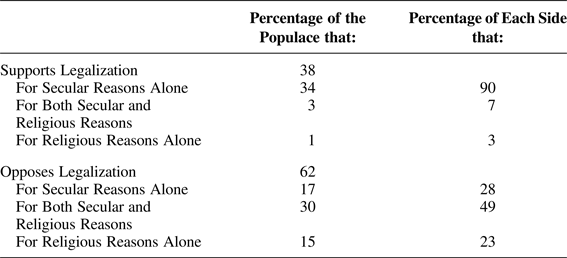
Table 1 presents the reasons that Americans give for supporting or opposing extending marriage rights to same-sex couples. The top half of this table shows that among supporters of this policy (38%), religious reasons play a very minimal role. Religious reasons alone and a combination of religious and secular reasons account for only 3% and 7%, respectively, of people's support for gay marriage legalization. At 90%, the vast majority of American adults support this legalization exclusively for secular reasons. Looking at the bottom half of Table 1, a very different picture emerges for opposition to legalizing gay marriage. Sixty-two percent of American adults oppose this policy, and nearly half of them do so for a combination of religious and secular reasons. Another 28% of the American public disapproves of legalizing same-sex marriage solely on secular grounds. Last, we see that almost one out of every four gay-marriage opponents cite religious reasons alone.
U.S. Citizens' Reasons for Supporting or Opposing Legalizing Same-Sex Marriage

At least for legalizing same-sex marriage, our results show that the majority of Americans follow the principles of the doctrine of restraint when making political decisions. Combining the “religious reasons alone” responses from both supporters and opponents, accounts for less than 20% of the populace's views. On the pro-gay marriage side, 97% of American adults make this decision for secular reasons alone or a combination of religious and secular reasons. Although the percentage is lower among gay-marriage opponents, almost 80% of people in this camp still report secular reasons alone or a combination of religious and secular reasons. Yet, it is noteworthy that roughly a quarter of Americans who oppose legalizing same-sex marriage violate the principles of political liberalism as they appeal exclusively to religious reasons when doing so. What are the characteristics of these violators? To answer this question, we turn to multivariate models predicting opposition to legalizing same-sex marriage solely for religious reasons.
Multivariate
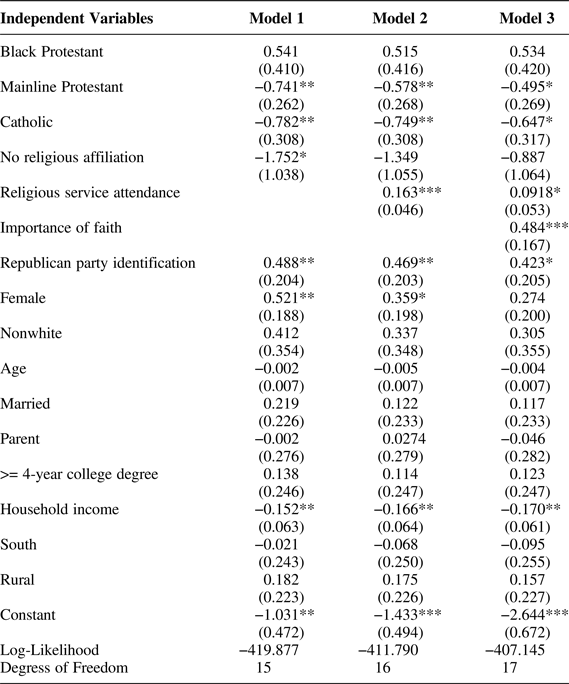
Looking at the first column in Table 2, we see that, holding Republican Party identification and demographic factors constant, mainline Protestants and Catholics are significantly less likely to violate the principles of political liberalism's political decision-making model compared to evangelical Protestants (the reference category). Concerning the magnitude of these effects, both mainline Protestant and Catholics decrease the odds of opposing same-sex marriage legalization for religious reasons alone by over 50% relative to evangelical Protestants (exp[−0.741] = 0.48 and exp[−0.782] = 0.46, respectively). Model 1 also shows that, not surprisingly, the religiously unaffiliated were significantly less likely to reject legalizing gay marriage solely for religious reasons than were evangelical Protestants.
Unstandardized Coefficients from Logistic Regression Models Predicting Opposition to Legalizing Same-Sex Marriage For Religious Reasons Alone

Note : Number of cases is 803; standard errors in parentheses.
***p < 0.01; **p < 0.05; *p < 0.1 (two-tailed tests)
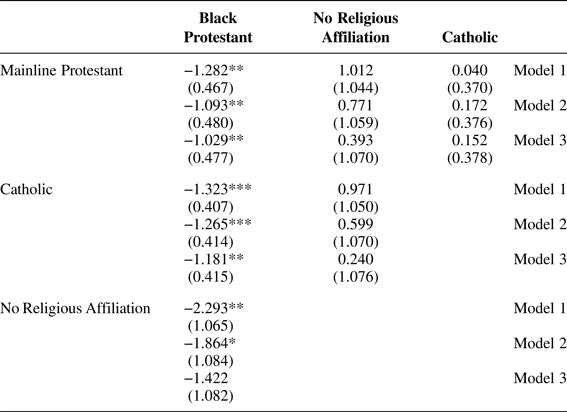
Similar results are observed when black Protestants serve as the reference category. The first column in Table 3 shows that both mainline Protestants and Catholics reduce the probability of violating the principles of political liberalism when they oppose making marriage legal between gay couples. The mainline Protestant and Catholic effects are somewhat stronger than those found in Table 2. When compared to black Protestants, mainline Protestants and Catholics decrease the odds of opposing same-sex marriage legalization exclusively on religious grounds by 72% (exp[−1.282] = 0.278) and 73% (exp[−1.323] = 0.267), respectively. A significant negative relationship between claiming no religious affiliation and violating the doctrine of restrain is identified when black Protestants are the reference category. Conversely, the religiously unaffiliated were not statistically different from mainline Protestants or Catholics concerning rejecting gay marriage legalization exclusively for religious reasons (see second column in Table 3). Nor did we find a significant difference between mainline Protestants and Catholics (see third column in Table 3).
Remaining Religious Tradition Contrasts for Opposition to Legalizing Same-Sex Marriage For Religious Reasons Alone: Reference Categories are on the Columns (Unstandarized Logistic Regression Coefficients)

Note: Number of cases is 803; standard errors in parentheses.
***p < 0.01; **p < 0.05; *p < 0.1 (two-tailed tests)
Model 2 adds the variable for frequency of religious service attendance. This variable has a significant positive effect on violating the principles of the political decision-making model. Net of other factors, for each unit increase in religious service attendance, the odds of rejecting marriage rights for same-sex couples exclusively on religious grounds increases by 18% (exp[0.163] = 1.177). Although there is a reduction in the size of the mainline Protestant and Catholic coefficients with the inclusion of religious service attendance as seen in Table 2, both remain statistically significant (the same pattern is found when black Protestants are the reference category [see the first column in Table 3]).
On the other hand, the coefficient for no religious affiliation drops from −1.752 to −1.349 and falls to nonsignificance (p = 0.203; two-tailed test) in the second model in Table 2. This suggests that the negative association between the religiously unaffiliated and holding critical opinions about same-sex marriage legalization solely for religious reasons is largely due to this group's lower levels of religious service attendance compared to evangelical Protestants.Footnote 9 Although still significant, the magnitude of the no religious affiliation effect in Table 3 also takes a considerable hit when religious service attendance is included (coefficient drops from −2.293 to −1.864).
In the final model in Table 2, we add the measure for importance of religious faith. Like religious service attendance, it increases the likelihood of violating the doctrine of restraint when making political decisions. For each unit increase in importance of faith, the odds of opposing legalized gay marriage for religious reasons alone increases by 62% (exp[0.484 = 1.623). With the addition of this religious variable, the mainline Protestant and Catholic coefficients are further attenuated in size, but they continue to be statistically significant (the first column in Table 3 shows the same pattern when the reference category is black Protestants). The religious service attendance effect also drops some in strength in Model 3, but is still a robust predictor of religious-only opposition to legalizing gay marriage. The final model in Table 3 shows that the religiously unaffiliated are no longer significantly different from black Protestants (see the bottom of the last column). Coupled with the gap in religious service attendance between these two groups, this suggests that lower levels of religiosity among those who claim no religious affiliation is what explains their reduced likelihood of violating the principles of the political decision-making model relative to black Protestants.Footnote 10
There are several noteworthy findings for the control variables. First, holding religious and demographic variables constant, the odds of Republicans opposing same-sex marriage legalization solely for religious reasons are 1.5 times that of non-Republicans (exp[0.423] = 1.527). Second, females are more likely to violate the principles of the political decision-making model than are males. In Model 1, the odds of females opposing marriage rights for gay couples exclusively on religious grounds are 1.7 times that of males (exp[0.521] = 1.684). But the introduction of the measures for religious service attendance and importance of religious faith cuts the size of the female coefficient almost in half (0.521 to 0.274) and renders it insignificant (p = 0.172; two-tailed test). This suggests that the female effect for gay-marriage opposition for religious reasons alone is largely indirect, mediated by religiosity.Footnote 11 Last, for each unit increase in household income, the odds of rejecting same-sex marriage legalization solely on religious grounds decreases by 16% (exp[−0.170] = 0.844), net of religious variables, political party identification, and other demographic factors.
DISCUSSION
Our study found that, ignoring the particular side of the issue, 15% of all American citizens are willing to violate political liberals' doctrine of restraint when deciding to support or oppose legalizing same-sex marriage. But since violations to the guidelines of the “political decision-making” model are not equally distributed across supporters and opponents, they take on greater significance depending on which group is the focus. Only 3% of supporters of extending marriage rights to same-sex couples rely on religious reasons alone, and thus they hardly figure into this group's political decision-making process.
By contrast, among Americans who oppose legalizing same-sex marriage, almost one out of every four does so solely on the basis of religious convictions. On the one hand, that this motive accounts for almost a quarter of the opposition's stance seems substantial. But judged against conventional wisdom that theocrats dominate the anti-gay movement, it is perhaps surprising that more opponents of gay marriage did not report appealing exclusively to religious reasons. While we can debate whether 23% is a large or small number, what is clear is that those willing to reject the doctrine of restraint when deciding about gay marriage legalization reside almost entirely in the opposed camp.
This finding has an important implication for normative debates about the proper role of religion in American politics. Critics charge that political liberals' strictures on religious reasons are unfair to religious citizens, as they impose burdens on religious citizens that are not correlated with similar burdens on secular citizens. After all, secular citizens by definition do not adhere to religious reasons, and so they cannot be burdened by a restriction on the use of religious reasons. At least with respect to legalizing same-sex marriage, our analyses indicate that the empirical assumption underlying this argument is generally true for only one side of the issue given the disparity in relying exclusively on religious reasons. Only 3% of U.S. adults who support gay marriage do so solely on the basis of their religious convictions, while this is the case for almost 25% of opponents. Consequently, for gay marriage legalization, political liberals' doctrine of restraint would not be equally unfair to both groups. Supporters, with few exceptions, follow this doctrine. Those guilty of violating it are found almost exclusively among anti-gay marriage opponents.
What types of citizens are most likely to reject political liberals' canons of good citizenship when they disapprove of extending marriage rights to gay and lesbian couples? As expected, the greater the level of religious service attendance and importance of religious faith, the higher the probability of opposing same-sex marriage exclusively on religious grounds. Furthermore, controlling for other factors, evangelical and black Protestants are much more likely to base their opposition solely on religious reasons relative to mainline Protestants and Catholics. Evangelical and black Protestants are also more likely to violate the doctrine of restraint when they object to gay marriage legalization compared to citizens who have no religious affiliation. Not surprisingly, this latter finding was mainly due to differences in frequency of religious service attendance and importance of faith.
These religious tradition effects partly undermine a perception that some proponents and critics have about the political consequences of obedience to the doctrine of restraint. Simply put, one might assume that political liberals' advocacy of restraint is more favorable to the political left than the political right, to Democrats rather than Republicans (Rorty Reference Rorty2003). The Christian Right is one of the most politically mobilized religious groups in the United States and their members are generally politically conservative. So restrictions on religious only motivations for political decisions, one might expect, will fall disproportionately on the members of this group — even though advocates of restraint typically portray it as politically neutral.
Confirming suspicion, we found that evangelical Protestants were more likely to violate the doctrine of restraint when opposing same-sex marriage legalization. It seems that while members of this religious tradition tend to appeal to secular or a combination or secular and religious language in public discussions as a way to mobilize broad support for their positions (Shields Reference Shields2009; Yamane Reference Yamane2000; Reference Yamane2005), theological reasons alone often motivate their personal decisions about what policies should be enacted. Importantly, evangelical Protestants were not the only religious actors to violate the “political decision-making” model. Black Protestants joined them. But this group of Protestants is overwhelmingly Democratic (78% in our data). Since we have no idea what the results of a similar investigation would be regarding other policy disputes — welfare reform, distribution of wealth, capital punishment, etc. — it is possible that the widespread obedience to the doctrine of restraint in political decision-making would affect a broader set of political actors than initially assumed.
Our study provides a first look at the extent to which actual citizens are willing to violate the doctrine of restraint when making political decisions and the profile of those willing to do so. It is not, however, without limitations. For one, as alluded to in the prior paragraph, the data on which we rely are narrow in scope, as they inform us about Americans' willingness to rely on secular and religious reasons about only one public policy matter of the day: legalization of same-sex marriage. We thus do not know the degree to which our findings about the role of religious and secular reasons in political decision-making generalize to other political topics. But public policy issues regarding gay marriage are just the sort for which we would expect religious reasons to be significant. So although the data on which we rely do not cover the full panoply of relevant public policies, they cover a central case — indeed, save perhaps for abortion, our data cover the case of interest to those involved in the normative debate about the proper role of religion in American politics.
Another limitation of our study is that the employed survey question did not ask respondents whether they voted to oppose or support legalizing marriage between gay and lesbian couples solely on the basis of religious convictions; only whether a religious-only mentality motivated their decision about which side of this policy should be enacted. Strictly speaking, then, what we have captured is the intent to violate the doctrine of restraint. But political liberals may not be overly concerned if the intent to do wrong lays dormant and is not voted on. While there are good reasons to believe that holding a critical opinion about legalizing same-sex marriage exclusively on religious grounds would carry over to the polls, it is implausible to think that everyone with this view would turn out to vote on election day.
An ideal second step of our analysis would thus have been to investigate the level of political engagement among respondents who disapproved of gay marriage exclusively on religious grounds. Unfortunately, the survey did not ask about voting behavior or other types of political participation. Other studies, however, identify that the same factors we found to increase the probability of opposing same-sex marriage solely on the basis of religious convictions also predict actual voting. For instance, drawing on exit poll data, Abrajano (Reference Abrajano2010) observed that, net of other variables, Californians who identified as born-again Christians — a core marker of evangelical Protestantism — were substantially more likely to vote in favor of Proposition 8 (restricting marriage rights to homosexual couples) than were non-born-again Christians. Piecing together such findings with those from our study, suggests that the pool of American citizens who espouse a critical opinion about legalizing gay marriage on the basis of religious convictions alone may be particularly politically active.
If true and if votes of citizens who violate the doctrine of restraint are disqualified, prior state gay marriage bans that passed by small margins would be called into question. Returning to California's Proposition 8, the overall vote was 52.2% to eliminate the right of same-sex couples to marry and 47.8% to uphold this right (California Secretary of State 2008). Recall that 23% of those disapproving of gay marriage in our survey did so exclusively on religious grounds. Of course, not all such people would have turned out and voted for this proposition. But if we assume that at least half of them did and we disallow their votes,Footnote 12 the outcome of Proposition 8 would have been reversed. In this scenario, it would have failed — 50.3% against and 49.7% for.Footnote 13 Assuming a greater turnout rate among religious-only opponents of gay marriage would have widened the margin of Proposition 8's defeat.
Given the challenges of collecting retrospective data, it would be difficult to test whether this conclusion holds with actual data on voters' motivations. With that said, more than a handful of states (Colorado and Oregon, for example) seem poised to introduce gay marriage ballot measures, referendums, or other legislative initiatives in upcoming elections. This constitutes a unique opportunity for future research to study directly the extent to which citizens base their votes for gay marriage solely on religious convictions. Because of the complexity of probing motivations and linking them to actions, qualitative methods seem best equipped for this task. One possibility would be to use exit poll data to sample voters who then could be interviewed about their reasons for voting the way they did. In doing so, researchers could build in checks to assess social desirability given that some interviewees may feel pressure to frame their decision to vote for or against gay marriage in culturally acceptable, non-offensive terms (Evans Reference Evans2010; Yamane Reference Yamane2000; Shields Reference Shields2009). Equally important, such a study would provide concrete evidence as to how severe violations to the doctrine of restraint are when citizens go to the polls and vote their opinions about policy issues and whether the disqualification of violators' votes would shift the outcomes of elections.
CONCLUSION
We began this article by referring to an ongoing debate among political theorists about the proper role of religious convictions in American politics. Although that debate is largely focused on what individuals should and should not do, social scientists have very rarely evaluated the extent to which actual citizens abide by or violate the doctrine of restraint. The small amount of research conducted on this topic has focused exclusively on the “political public argument” model. Scholars observe that religious activists tend to invoke a combination of religious and secular reasons to justify the positions they take in public discussions and debates rather than appealing exclusively to religious rationales. They have learned that successfully convincing others requires drawing on widely accepted cultural ideas (Downs Reference Downs1989; Leon Reference Leon2004; Yamane Reference Yamane2000; Shields Reference Shields2009). In other words, religious activists “play nice” in the public square, generally following the principles of political liberalism.
But as previously discussed, citizens may behave very differently when they are out of the “public eye” and need not be concerned about persuading their compatriots. To the best of our knowledge, no prior social scientific research has evaluated the “political decision-making” model of political liberalism. We thus did not know whether significant numbers of citizens were willing to violate political liberals' strictures on religious reasons when making political decisions, and if so, the profile of those willing to do so.
Our study provided answers to both of these questions, at least with respect to the important policy issue of same-sex marriage legalization in the United States. First, we found that a distinct minority of American citizens refuse to abide by the doctrine of restraint when deciding to support or oppose this policy, and that they are drawn almost without exception from the pool of people opposed to gay marriage. Second, evangelical and black Protestants are more likely to violate the principles of the “political decision-making” model than are mainline Protestants, Catholics, and the religiously unaffiliated; as are those with higher levels of religiosity.
Although our results provide answers to some important questions, they leave open a number of others for further investigation, the most important of which we take to be: what role do religious reasons play when citizens seek to enact laws and policies for issues other than same-sex marriage? What about the morality of the recent war in Iraq? Or healthcare policy? Or the fairness of taxation? With respect to these issues, and many others, we may put the same two questions we asked about the legalization of gay marriage: how many citizens comply with political liberals' doctrine of restraint when making political decisions and what is their profile? Since there is no a priori reason to believe the results of our inquiry will be replicated in studies that focus on other political issues, there is much more work to be done.