1 Introduction
Syllables show language-specific size restrictions that characterise upper limits on their constituents. Such restrictions have been characterised as syllable templates, defined by a frame such as moraic structure or CV skeletal slots. A variety of phenomena have been attributed to enforcement of a syllable template in numerous languages, including closed syllable vowel shortening, degemination, epenthesis and deletion (Clements & Keyser Reference Clements and Keyser1983, Itô Reference Itô1989, Archangeli Reference Archangeli1991, Zec Reference Zec1995).
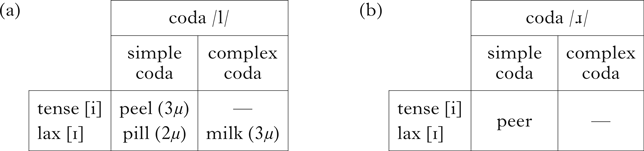
In General American English, this kind of syllable template has similarly served as a tool for understanding limits on syllable size and co-occurrence restrictions on tautosyllabic vowels and coda consonants. A template defined by a trimoraic maximum has been employed to explain the absence of bimoraic nuclei, i.e. tense vowels and diphthongs, in syllables with a complex coda (Hammond Reference Hammond1999, Hall Reference Hall2001, Reference Hall2002). These studies note that this restriction on nuclei is not observed with complex codas ending in a coronal obstruent, which may be non-moraic. Syllables with coda /l/ show the expected extent of maximum constituency, as illustrated in Table Ia with syllables containing high front vowels. Both tense and lax vowels are possible before a simple coda /l/, but before a complex coda with /l/ followed by a non-coronal consonant the vowel is necessarily lax (monomoraic). A syllable with a tense vowel and complex coda, such as *meelk, is excluded because it would amount to four moras. However, the possible vocalic nuclei in syllables with coda /ɹ/ show more extreme restrictions, as shown in (b). Tense/lax vowel contrasts among high front vowels are neutralised before a simple coda with /ɹ/, and all high front vowels are excluded before a complex coda containing /ɹ/ and a non-coronal consonant. In fact, before a complex coda with postvocalic /ɹ/ and a non-coronal coda, only two distinctive vowel qualities are possible in General American English: [ɑ], as in park, and [ɔ], as in pork.
High front vowels before (a) coda /l/ and (b) coda /ɹ/ (the mora count for the rhyme is given in parentheses).

These asymmetries in the phonotactics of syllables with coda liquids in General American English are the focus of this paper. While the neutralisation of tense/lax vowel contrasts before /ɹ/ in General American English is well-known, the motivation for this neutralisation has not been adequately accounted for in the context of the syllable template, nor is it well understood in general. Furthermore, while previous studies have suggested an articulatory basis for the vowel qualities that may precede a complex coda with /ɹ/ (Proctor & Walker Reference Proctor, Walker and Parker2012, Walker & Proctor Reference Walker and Proctor2013), the severe reduction of vowel contrasts in this context has not been situated in a comprehensive formal account. In this paper, we utilise the trimoraic syllable frame to understand why rhymes with coda /ɹ/ show these restrictions in comparison to coda /l/, despite overarching properties that are common to both liquids. We suggest that more extreme phonotactic restrictions on rhymes with coda /ɹ/ are connected to the combined complex structure of this consonant and its intrinsic high coarticulatory strength. We propose that when these characteristics are properly taken into account in the phonological representation, various restrictions on vowel contrasts in rhymes with coda /ɹ/ follow from a trimoraic maximum.
While our specific goal for this study is to understand the structure of syllables with postvocalic liquid consonants in General American English, our larger goal is to make a contribution on several key issues involving the phonological representation of consonants, vowels and quantity. As to the representation of complex segments, we recognise complexity on two fronts: spatial complexity, involving multiple place constrictions – corresponding to multiple subsegmental units, and temporal complexity, involving a controlled sequencing of those subsegments. Henceforth we will use ‘subsegments’ to refer to the atomic units of which segments are composed, corresponding to the level represented by gestures or features. In the case of coda liquids in General American English, a dorsal articulation precedes a coronal articulation (Sproat & Fujimura Reference Sproat and Fujimura1993, Browman & Goldstein Reference Browman, Goldstein, Bell-Berti and Raphael1995, Proctor et al. Reference Proctor, Walker, Smith, Szalay, Goldstein and Narayanan2018). This is an instance of temporal control, which more generally may take the form of abstract sequencing or synchrony over subsegments. Such control falls under the rubric of coordination relations, operating directly at the level of subsegments (Browman & Goldstein Reference Browman and Goldstein1986, Reference Browman, Goldstein, Bell-Berti and Raphael1995), rather than at the segmental level, as in approaches where root nodes govern temporal sequencing of segments and their dependent features (e.g. Clements Reference Clements1985, Sagey Reference Sagey1986). The assignment of moras to coda consonants in our account is computed over sequential coordination among subsegments, giving rise to the possibility that temporally complex segments may be bimoraic.
The coordination of subsegments can cause overlap, such that there are competing demands on articulators, as, for instance, in the case of overlap between the dorsal component of a coda liquid and that of a preceding vowel. We find support for a phonological organisation of subsegments in the syllable that is sensitive to the relative strength of these competing demands and the resulting predictions for realising vowel contrasts. We incorporate this property into the account by appealing to the concept of a specified blending strength of a subsegment, corresponding to its degree of coarticulatory dominance, as represented in a gestural approach to subsegmental representation (Saltzman & Munhall Reference Saltzman and Munhall1989, Fowler & Saltzman Reference Fowler and Saltzman1993). The degree of specified blending strength is informed by our articulatory study of liquids in General American English. We show that the coordination and strength of subsegments interact in critical ways in rhymes with coda liquids. This approach both differentiates the phonotactics of rhymes with postvocalic rhotics vs. laterals and incorporates what they share in common. In the larger picture, it provides a framework for representing complex segments and their potential for partial overlap with neighbouring segments.
The organisation of this paper is as follows. In §2 we discuss the trimoraic syllable template for General American English. We identify phonotactic predictions and where they appear to fall short for rhymes with postvocalic /ɹ/. In §3 we review background on the articulation of liquid consonants in General American English, present phonetic evidence from a study on the relative coarticulatory dominance of the rhotic vs. lateral and examine how rhotics and laterals coarticulate with vowels of different qualities in the rhyme. In §4 we present our analysis of rhymes with postvocalic liquids. Framed within gestural representations, our account posits that the nuclear vowel and the dorsal gesture of the lateral regularly overlap, while the organisation of the vowel and the dorsal gesture of the rhotic depends on the vowel and its degree of similarity to the rhotic posture. As a result, a coda lateral typically gives rise to a single mora, but a coda rhotic gives rise to a single mora in some contexts and two moras in others. In the latter contexts it produces stronger neutralising effects on the preceding vowel than other coda consonants. In §5 we discuss potential extensions to other patterns, and in §6 we present the conclusion.
2 The trimoraic maximum for General American English syllables
The dictates of a syllable template, together with assumptions about segments’ moraic contribution and sonority sequencing, play a large part in explaining intrasyllabic phonotactics in many accounts of syllable structure. Our focus is on General American English (GenAm), which refers to the majority of rhotic American English varieties, such as those spoken in the American Midwest and the western United States (Wells Reference Wells1982). Our discussion of phonotactic distributions in GenAm rhymes with postvocalic liquids is based chiefly on Hammond (Reference Hammond1999) and Proctor & Walker (Reference Proctor, Walker and Parker2012), and is confirmed by our consultation with native speakers. Additional sources are cited where applicable.
As mentioned above, it has been proposed that GenAm syllables allow a maximum of three moras. ‘Superheavy’ syllables, which contain the three-mora maximum, are positionally limited; Hall (Reference Hall2001, Reference Hall2002) characterises their distribution as final in the prosodic word. Our exemplification of phonotactic distributions concentrates on monosyllables, which is a context where the full range of phonotactic contrasts are evidenced. Moraic structure also has implications for stress assignment; see Hammond (Reference Hammond1999) for an analysis of English stress with syllables that may be maximally trimoraic.
For GenAm the standard assumptions are that lax vowels (/ɪ ε æ ʌ ʊ/) are monomoraic, while tense vowels (/i e u o/) and ‘true’ diphthongs (/aj aw ɔj/) are bimoraic (Halle & Mohanan Reference Halle and Mohanan1985, Hammond Reference Hammond1997). The vowels [ɑ] and [ɔ] show broader patterns of distribution, and may occur variously in certain contexts where only lax/short vowels are permitted or where only tense/long vowels are allowed (Halle & Mohanan Reference Halle and Mohanan1985, Green Reference Green2001a). Relevant for this study is that [ɑ] and [ɔ] show a distribution like that of monomoraic vowels in many closed syllable contexts of GenAm.
For consonants, the general assumption is that each coda consonant contributes a mora, with the exception of final coronal obstruents, which have the potential to be non-moraic (e.g. Hall Reference Hall2002). The special status of final coronal obstruents has been attributed to their capacity to belong to a non-moraic syllable-final appendix when the trimoraic frame is exhausted (Hall Reference Hall2002). Discussion of GenAm codas in this paper will refer only to those that do not end in a coronal obstruent, unless otherwise indicated. Nevertheless, in the future it would be valuable to examine the privileged status of coronal obstruents in light of the representations we employ here.
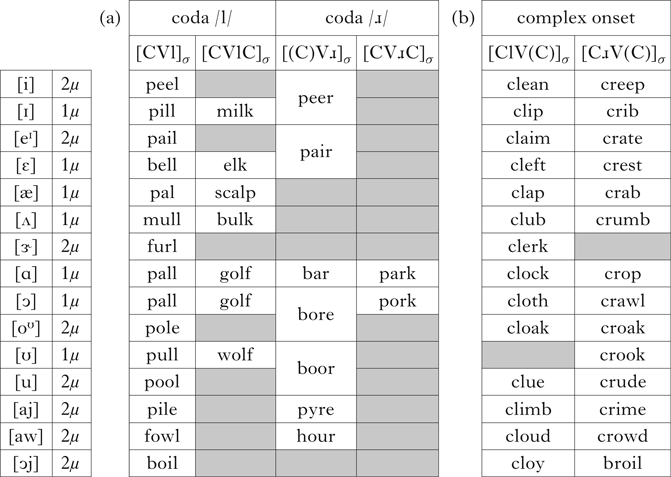
Apart from syllables that end in a coronal obstruent, the predictions for GenAm that emerge from the trimoraic maximum and hypothesised moraic contributions for vowels and consonants are that both monomoraic and bimoraic vocalic nuclei may occur in a rhyme with a simple coda, while only monomoraic vowels may occur in a rhyme with a complex coda. These predictions are generally borne out, as illustrated in Table IIa for codas containing /l/. All contrastive stressed vowels and falling diphthongs of GenAm are listed. Vowel transcriptions are based on Hammond (Reference Hammond1999) and the Carnegie Mellon University pronouncing dictionary for North American English (Weide Reference Weide1994), with edits and corrections by Bruce Hayes (henceforth CMUD).Footnote 1 We consider the rhyme in furl to be produced with /l/ preceded by a rhotic vowel [ɝ] or syllabic [ɹ̩] (e.g. Giegerich Reference Giegerich1992, Ladefoged & Johnson Reference Ladefoged and Johnson2015). Distributionally, [ɝ] patterns as bimoraic (Hammond Reference Hammond1999): it can occur before a singleton coda, as in furl or firm, but not before a final cluster (e.g. *firmp). Because there is not a detectable /Vɹ/ sequence here, we do not treat bimoraic [ɝ] as qualitatively decomposable, at least in its surface form. Shaded cells in Table IIa lack an attested form with the vowel quality in question. Where words are repeated in more than one cell, they are listed as variants in the CMUD. This is often the case for [ɑ] and [ɔ], whose contrast is weak and/or frequently neutralised in GenAm, especially in areas outside of the eastern United States (but including Pittsburgh) (Wells Reference Wells1982: 473). As expected, the full range of vocalic contrasts is attested before a simple coda containing /l/. In a rhyme with a complex coda, no vowel or diphthong that is expected to exceed one mora is attested.
Vocalic contrasts: (a) preceding coda liquids; (b) following a complex onset with a liquid. The number of moras for each nucleus is indicated.

Despite the success of the trimoraic syllable template in explaining the absence of various vocalic contrasts in rhymes with a complex coda, phonotactic restrictions on vowels in rhymes with /ɹ/ appear to be considerably underpredicted, and they are quite striking when compared with those with coda /l/. As shown in Table IIa, tense/lax contrasts are neutralised before a simple coda with /ɹ/. Before a complex coda with /ɹ/, only [ɑ] and [ɔ] are attested, a distributional restriction highlighted by Proctor & Walker (Reference Proctor, Walker and Parker2012) and Walker & Proctor (Reference Walker and Proctor2013). (We characterise the round vowel realisation in this context as [ɔ], because it is monophthongal.)
Transcription of the vowel quality before simple coda /ɹ/ varies across scholars (e.g. Wells Reference Wells1982, Giegerich Reference Giegerich1992, Hammond Reference Hammond1999, Ladefoged & Johnson Reference Ladefoged and Johnson2015). The phonetic characterisation of tense vs. lax vowels in English is a vexed issue (Halle Reference Halle1977). What is important for our aims is that the tense/lax contrast in GenAm correlates with a phonological distinction in quantity, and tense/lax neutralisation correlates with a lack of quantity contrast. We take up phonological representation in §4. Meanwhile, we use ‘tense’ and ‘lax’ as classificatory labels.
The vowel-neutralisation effects witnessed in GenAm before /ɹ/ cannot be attributed to /Vɹ/ sequences in general. While some reduction of vowel contrasts also occurs before intervocalic [ɹ], the most extreme reduction occurs preceding coda /ɹ/, with the strongest effect before complex codas. Contrast reduction before intervocalic [ɹ] is weaker and more variable across regions where GenAm is spoken. For instance, some GenAm speakers (a minority) maintain a three-way vowel contrast before /ɹ/ in [meɪɹi] Mary, [mεɹi] merry and [mæɹi] marry. Others neutralise the pre-rhotic vowel in the first two words to [ε], i.e. [mεɹi] corresponds to both Mary and merry. For still other speakers, all three words are homophonous (Wells Reference Wells1982: §6.1.5). Furthermore, /ɹ/ does not have the same effects across a morpheme boundary within a word or internal to a compound. For instance, the first vowel in de-restrict and key#ring is [i], distinct in quality from the neutralised high front vowel in the first syllable of clear-ing, where the vowel–/ɹ/ sequence is not separated by a morpheme boundary (Wells Reference Wells1982: 481, Reference Wells2008: 223). Prosodic organisation therefore appears to be an important factor in determining the contexts for restrictions on /Vɹ/. We focus on vocalic neutralisation before unambiguous coda consonants, where neutralisation is most severe.
A further observation is that liquids do not generally induce neutralising effects on a following vowel. Almost all vocalic contrasts are attested following a complex onset containing a liquid, as shown in Table IIb for onsets [kl] and [kɹ] ([bɹ] is used preceding [ɔj]). This pattern is consistent with the assumption that onset consonants in GenAm are not moraic. The neutralisations before coda /ɹ/, namely, (i) loss of tense/lax contrasts and (ii) greater neutralisation before a complex coda, are of the very kind we could expect from a template imposing a limit on syllable size. However, if coda /ɹ/ is monomoraic, a trimoraic upper limit does not predict vocalic neutralisation to the extent attested. Like rhymes with coda /l/, all vocalic contrasts would be expected to be possible before simple coda /ɹ/, while all monomoraic vowels would be expected before a complex coda. If coda /ɹ/ were instead bimoraic, neutralisation of tense/lax contrasts before simple coda /ɹ/ would be expected, assuming that the neutralised vowels are monomoraic. This is the approach that we will pursue here. Nevertheless, a twofold challenge for a bimoraic representation of /ɹ/ is to understand why syllables like park and pork do not exceed three moras, and why /ɹC/ codas are possible only with [ɑ] and [ɔ]. These are the chief questions that we tackle in this paper, along with why /ɹ/ would behave as bimoraic. We examine articulatory evidence to inform the phonological representation of GenAm rhymes with liquids, with the aim of understanding both why rhymes with /ɹ/ show these distributions and why those with /l/ are different.
A further issue is that rhymes with a true diphthong before a bimoraic coda /ɹ/ would amount to four moras. In fact, forms with a diphthong plus coda /ɹ/ are particularly prone to give rise to syllable-count judgements that amount to more than one syllable (Lavoie & Cohn Reference Lavoie, Cohn, Ohala, Hasegawa, Ohala, Granville and Bailey1999, Cohn & Tilsen Reference Cohn and Tilsen2015). Lavoie & Cohn refer to syllables with variable count judgements as ‘sesquisyllables’. Such judgements have been attributed to the presence of an extra mora in the rhyme (Lavoie & Cohn Reference Lavoie, Cohn, Ohala, Hasegawa, Ohala, Granville and Bailey1999, Cohn Reference Cohn2003), which could be consistent with a bimoraic approach to coda /ɹ/. However, sesquisyllables present complexities: judgements are variable, it is not clear whether sesquisyllabicity is a gradient characteristic, and similar effects are found with coda /l/. While sesquisyllables are not the focus of this paper, they show promise to fit within the general approach we propose, as we discuss in §5.
3 The articulation of liquids in General American English
Previous research on English /ɹ/ has revealed its complexity along two dimensions. It is spatially complex because it involves multiple constrictions, and it is temporally complex because these constrictions are not always synchronous.
The articulation of English rhotics shows considerable variation across individuals and environments (Delattre & Freeman Reference Delattre and Freeman1968, Zawadzki & Kuehn Reference Zawadzki and Kuehn1980, Westbury et al. Reference Westbury, Hashi and Lindstrom1998, Guenther et al. Reference Guenther, Espy-Wilson, Boyce, Matthies, Zandipour and Perkell1999, Zhou et al. Reference Zhou, Espy-Wilson, Boyce, Tiede, Holland and Choe2008, Mielke et al. Reference Mielke, Baker and Archangeli2016). Nevertheless, rhotic production typically involves three coordinated components: a labial constriction and two lingual constrictions, of which one is coronal and one pharyngeal. Our focus is on the lingual constrictions. The coronal constriction varies across (at least) three broad categories of execution, involving either retroflexion or tip-up or tip-down bunching (Espy-Wilson et al. Reference Espy-Wilson, Boyce, Jackson, Narayanan and Alwan2000, Gick et al. Reference Gick, Iskarous, Whalen, Goldstein, Palethorpe and Tabain2003), and ranges in location from alveolar to palatal (Alwan et al. Reference Alwan, Narayanan and Haker1997, Zhou et al. Reference Zhou, Espy-Wilson, Boyce, Tiede, Holland and Choe2008). The pharyngeal constriction engages either the posterior part of the tongue dorsum or the tongue root (Delattre & Freeman Reference Delattre and Freeman1968, Alwan et al. Reference Alwan, Narayanan and Haker1997, Gick Reference Gick2002). The magnitude and timing of articulations are sensitive to the position of the rhotic in the syllable. In a study of Canadian English speakers, Campbell et al. (Reference Campbell, Gick, Wilson and Vatikiotis-Bateson2010) found that in syllable-final rhotics the pharyngeal constriction preceded the coronal constriction, which had a reduced magnitude. In syllable-initial context, the coronal articulation preceded the pharyngeal constriction, and the lingual articulation in the pharyngeal region was reduced.
These asynchronous multi-constriction properties of coda /ɹ/ may bear on its potential to pattern as bimoraic in the syllable template; like bimoraic consonant clusters, /ɹ/ would involve a sequence of articulations. In turn, a weight-occupying articulatory sequence for coda /ɹ/ would enforce a monomoraic nuclear vowel, which would explain neutralisation of the quantity-related tense/lax contrast before /ɹ/. Nonetheless, sequential production of component lingual constrictions in a coda consonant does not always correlate with the expected pattern for bimoraic status in GenAm rhyme phonotactics. First, a complex coda with /ɹ/ is possible after [ɑ] and [ɔ] (as in park, pork), which seems to indicate that /ɹ/ adds only a single mora to rhymes with these vowels. In other words, it seems as if the weight contribution of coda /ɹ/ is sensitive to the quality of the preceding vowel. This could be related to the finding of Proctor & Walker (Reference Proctor, Walker and Parker2012) that the posterior articulation of /ɹ/ resembles that of [ɑ] and [ɔ]. Second, production of GenAm /l/ in coda also involves sequential lingual constrictions, but tense/lax vowel contrasts are maintained before coda /l/, suggesting that /l/ adds just one mora in these contexts.
English laterals resemble rhotics in their spatial and temporal complexity. Similar to /ɹ/, /l/ involves dual lingual constrictions: a coronal consonant-like tongue-tip raising and a vowel-like tongue-body retraction in the velar, uvular or pharyngeal region (Giles & Moll Reference Giles and Moll1975, Sproat & Fujimura Reference Sproat and Fujimura1993, Browman & Goldstein Reference Browman, Goldstein, Bell-Berti and Raphael1995, Gick Reference Gick1999a). In coda laterals, the formation of the tongue-body constriction precedes the tongue-tip constriction (Sproat & Fujimura Reference Sproat and Fujimura1993, Browman & Goldstein Reference Browman, Goldstein, Bell-Berti and Raphael1995, Krakow Reference Krakow1999, Gick et al. Reference Gick, Campbell, Oh and Tamburri-Watt2006, Scobbie & Pouplier Reference Scobbie and Pouplier2010). For some varieties of English, the coronal constriction of coda laterals is (variably) reduced in magnitude, so that the lateral may be ‘vocalised’ (Wells Reference Wells1982, Hardcastle & Barry Reference Hardcastle and Barry1989). Yet, despite these broad similarities in the organisation of multiple articulations in coda rhotics and laterals, they do not show identical patterning with respect to quantity-related neutralisation in the rhyme. Relevant to this, a qualitative comparison of rhotic and lateral production, based on a study of three speakers of GenAm, suggests that rhotics show more convergence in lingual posture across vowel and syllable contexts than laterals (Proctor & Walker Reference Proctor, Walker and Parker2012).
Summing up the discussion thus far, we find that the neutralising effects of lingual constriction sequencing in the rhyme vary with the particular liquid, as well as with the preceding vowel in question. Specifically, a greater propensity for vocalic neutralisation is found before /ɹ/ than /l/, and the weight contribution of coda /ɹ/ appears to be less following the vowels [ɑ] and [ɔ].
To shed more light on the surrounding issues, we conducted a real-time structural magnetic resonance imaging study to further investigate the articulatory properties of rhotics and laterals in different syllabic positions in GenAm (Proctor et al. Reference Proctor, Walker, Smith, Szalay, Goldstein and Narayanan2018). The findings of this investigation are important for our phonological analysis, because they inform us about the temporal and spatial properties of the vocal tract constrictions involved in GenAm liquids, as well as the coarticulatory interaction between vowels and different liquids in onsets and codas. Therefore, the study is briefly summarised here.
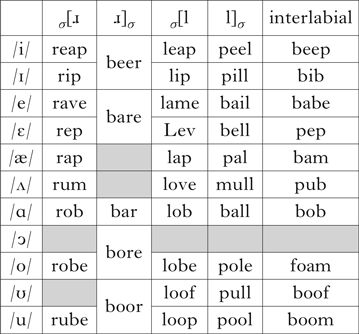
Rhotic and lateral consonants were elicited from four native speakers of GenAm in simple onsets and codas in CVC words. The experimental corpus included all phonotactically possible combinations of vocalic nuclei adjacent to a liquid in a syllable margin, as in Table III. In addition to words with a liquid onset or coda, the same vowels were elicited in monosyllabic contexts where both onset and coda were labial or labiodental.Footnote 2
Stimuli for experimental corpus.

The entire vocal tract was imaged in the midsagittal plane using real-time structural magnetic resonance imaging (Narayanan et al. Reference Narayanan, Nayak, Lee, Sethy and Byrd2004), while participants produced each word in the corpus. Tongue postures were compared at key articulatory landmarks: (i) rhotic coronal target, (ii) rhotic dorsal target, (iii) rhotic labial target, (iv) lateral coronal target, (v) lateral dorsal target, (vi) vowel target adjacent to each liquid and (vii) interlabial vowel target. Consonant targets were defined to be the image frame in which the maximal constriction was achieved by the articulators associated with the gesture of interest; vowel targets were located at the centre of the stable interval of dorsal articulation associated with the primary vocalic lingual goal. ‘Dorsal’ is used broadly here to include the posterior lingual articulation of the rhotic. We review three key sets of findings from this study: (i) articulatory coordination, (ii) tongue-dorsum posture in coda rhotics and preceding vowels and (iii) cross-positional stability and coarticulation.
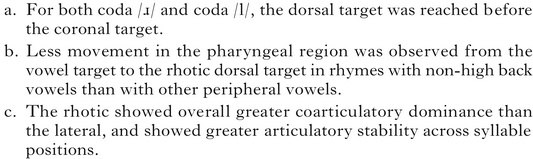
First, articulatory coordination in these liquids in large part followed the same patterns that have previously been reported. In coda rhotics, the dorsal target preceded the coronal target, and no evidence of a labial constriction was found. In onset rhotics, the labial target was reached prior to the coronal and dorsal targets, and the latter two targets were synchronous. In coda laterals, the dorsal target was achieved before the coronal target, but in onset laterals the reverse order was found. In coda laterals, tongue-tip closure was often not achieved, resulting in (semi-)vocalised productions. Despite these commonalities, both rhotic and lateral consonants showed speaker-specific postures: the specific location of the coronal and dorsal constrictions varied, as did the degree of bunching or retroflexion of the tongue in rhotics.
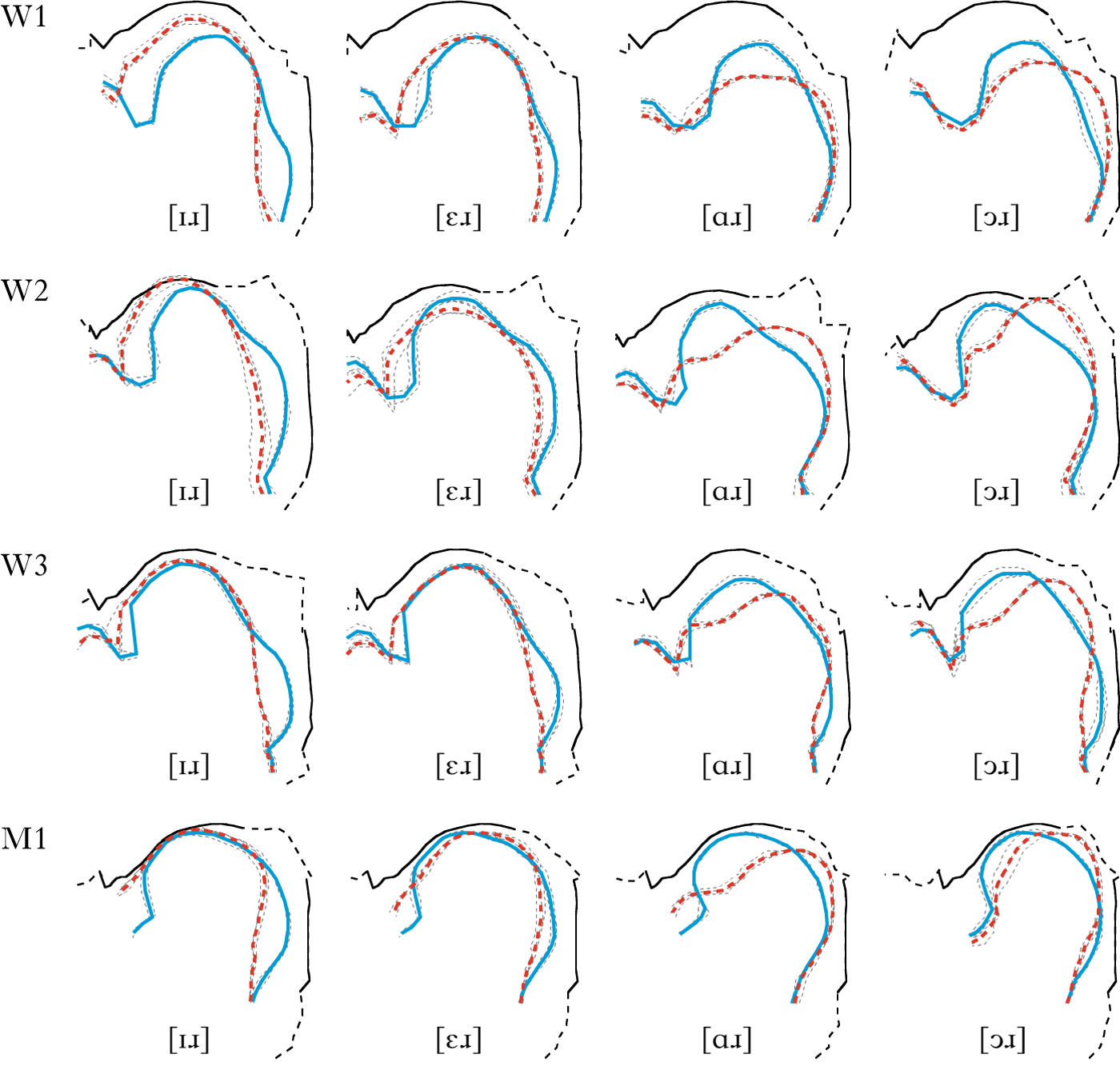
Second, lingual articulation for liquids was examined in different vowel contexts. Due to our focus on rhymes with /ɹ/, we concentrate here on the posture of the tongue in the pharyngeal region during coda rhotics and preceding vowels. Overall, less movement was observed from the non-high back vowels [ɑ] and [ɔ] into the pharyngeal constriction for the rhotic than from other peripheral vowels, confirming the observations of Proctor & Walker (Reference Proctor, Walker and Parker2012). However, some speaker-specific variation was found in the location of tongue-dorsum constriction in the rhotic and the vowel. Less movement between non-high back vowels and the rhotic pharyngeal constriction could be expected, because these vowels involve a pharyngeal constriction. These effects are illustrated qualitatively in Fig. 1, which shows vocal tract outlines corresponding to rhymes with coda /ɹ/, produced by each speaker.Footnote 3 Each panel superimposes the vocal tract outline for each pre-rhotic vowel target posture (dashed line) on the outline for the coda rhotic dorsal target (solid line) following that vowel. The outlines for the vowel and rhotic are closer in the region of the pharynx where the rhotic constriction is formed for [ɑɹ] and [ɔɹ] rhymes than for [ɪɹ] and [εɹ] rhymes. Outlines represent characteristic midsagittal postures for the targets in question, derived from mean tongue positions across three tokens. The location of greatest constriction in the pharynx for rhotics varies across speakers from low pharyngeal (W1) to mid-pharyngeal (W2, W3) to upper pharyngeal (M1).
Target postures for all four speakers of pre-rhotic vowels (dashed red lines: beer, bare, bar, bore), and coda rhotics following each vowel, captured at dorsal target (solid blue lines: beer, bare, bar, bore).

The third relevant area of findings from this study involves lingual stability across different syllable positions and coarticulatory behaviour. As to stability, greater consistency in lingual posture was found in rhotics than laterals across onset and coda contexts, consistent with previous research. Coda laterals showed greater retraction of the tongue dorsum than in onsets, and a lower front of the tongue dorsum. A difference in coronal articulation was observed for some speakers, with a tendency for vocalisation to occur in lateral coda contexts. Lesser differences were found in the articulation of rhotics in onset vs. coda position.
Two aspects of the coarticulatory dominance of liquids were examined: the degree of coarticulatory resistance of liquids to articulation of the neighbouring vowel (i.e. influence of vowel on liquid; Bladon & Al Bamerni Reference Bladon and Al-Bamerni1976, Recasens Reference Recasens1985), and the degree of coarticulatory aggression of liquids on articulation of the neighbouring vowel (i.e. influence of liquid on vowel; Farnetani Reference Farnetani, Hardcastle and Marchal1990, Recasens & Espinosa Reference Recasens and Espinosa2009). Coarticulatory resistance (cf. Recasens et al. Reference Recasens, Pallarès and Fontdevila1997) was quantified by measuring displacement in the midsagittal plane from the mean tongue posture for each liquid produced before and after a common set of context vowels. Coarticulatory aggression was quantified by measuring total lingual displacement of vowels produced adjacent to liquids, compared to the ‘intrinsic’ posture of the same vowels produced in interlabial environments. In codas, rhotics showed higher coarticulatory resistance to the diverse articulations of tautosyllabic vowels than laterals. The same was true for three of the four speakers for onset rhotics vs. laterals (one speaker showed the reverse effect in onsets). Furthermore, vowels were overall significantly more displaced adjacent to rhotics than to laterals. Greatest displacement was found in the context of coda rhotics, consistent with a coda rhotic having the greatest coarticulatory influence on a neighbouring vowel, compared to all other liquids in syllable margins.Footnote 4
In summary, the key findings for our investigation that emerge from this study are given in (1).
(1)

4 The structure of rhymes with postvocalic liquids
Our analysis centres on the phonological representation of rhymes with postvocalic liquids. We concentrate on three dimensions of the abstract representation: (i) specification of subsegmental units, (ii) temporal structure and (iii) quantity.
Our proposal aims to bring the apparently special properties of the phonotactics of rhymes with coda /ɹ/ in GenAm into line with the standard trimoraic template by making certain representational assumptions that are informed by the articulatory evidence described in the preceding section. In overview, we first posit that liquids are specified for both coronal and dorsal subsegments, represented as gestures. Second, we assume that phonological temporal organisation is represented at the subsegmental level in the form of coordination relations that govern overlap and ordering, and that the moraic contribution of consonants in the rhyme is tied to such relations. This assumption makes available the possibility that sequenced subsegments belonging to the same segment could give rise to a bimoraic status. Third, we hypothesise that the greater coarticulatory dominance of GenAm rhotics vs. laterals corresponds to a higher specified blending strength in the phonological representation for rhotics’ dorsal component. We propose that this stronger blending strength causes the dorsal gesture for /ɹ/ to be organised sequentially with respect to that of the nuclear vowel when the dorsal gestures are substantially different, but when the dorsal gestures of the rhotic and vowel are relatively similar, they overlap. We suggest that these differences in organisation give rise to the phonotactic restrictions on tautosyllabic /Vɹ/ sequences and their differences from those involving coda /l/.
Our account will thus make critical use of subsegmental coordination relations and blending strength in the phonological grammar. A general claim underscored by our study is that these are essential components of any theory of subsegmental representation – we will refer to this as the ‘coordination and strength’ approach (COAST). Our assumption of gestures as the atoms of representation is precisely because they encode both of these properties. They will be important both for representing the temporal complexity of liquids and for the outcome of overlap among the dorsal subsegments of liquids and vowels. In developing our account, we first detail our assumption of gestures as the representation of subsegmental units, and show how these representations encode coordination relations within and across vowels and consonants in the syllable. We next discuss how moraic assignment operates in these representations. In this context, we address the phonotactics of rhymes with a postvocalic liquid, showing how a difference in blending strength for /ɹ/ vs. /l/ can produce a difference in temporal organisation for subsegments in the rhyme. A constraint-based analysis is presented, demonstrating how these representations are obtained by the phonological grammar.
4.1 Gestural representations
The core of our proposal is that phonotactic properties of coda liquids are related to their coordination relations and differences in strength. We assume that the atomic units of phonological representation are gestures (e.g. Browman & Goldstein Reference Browman and Goldstein1986, Reference Browman, Goldstein, Bell-Berti and Raphael1995, Pouplier Reference Pouplier, Oostendorp, Ewen, Hume and Rice2011). Gestures are specified for various parameters, including a constricting organ and associated articulator set (lips, tongue tip, tongue body, tongue root, jaw, velum, glottis) and a goal articulatory state, defined in terms of a constriction location and constriction degree (e.g. tongue-tip closure at alveolar ridge, velum wide). Temporal structure is explicitly encoded both within gestures, which have an intrinsic duration, and between gestures, which may be in a synchronous or sequential coordinative relationship.
A key property of gestures is that they are specified for a blending strength, which can serve as a representation of differences in coarticulatory dominance (Saltzman & Munhall Reference Saltzman and Munhall1989, Fowler & Saltzman Reference Fowler and Saltzman1993). When two temporally overlapping gestures impose conflicting demands on an articulator, their goal states are blended. The blended outcome is the weighted average of the goal articulatory states, with the weighting for each based on their specified blending strength α, where a higher value for α corresponds to a higher coarticulatory contribution for that gesture (Iskarous et al. Reference Iskarous, McDonough and Whalen2012, Smith Reference Smith2018). The intrinsic temporal properties of gestures are determined by their interval of activation and stiffness k, which affects the speed of constriction formation and release. Vowel gestures have a lower stiffness than consonantal gestures, and different stiffness parameter settings may distinguish between other temporally contrastive gestures, such as vowels and glides (Browman & Goldstein Reference Browman and Goldstein1992). We will indicate a high consonant-like stiffness setting for a gesture with the label ‘C’, an intermediate glide-like stiffness setting with ‘G’ and a low vowel-like stiffness setting with ‘V’. In many cases, these settings will be predictable from a gesture's constriction degree, but they will be important for glides and liquids, which involve gestures at the cusp of the vocalic/consonantal boundary. The availability of three phonological stiffness settings is consistent with Padgett's (Reference Padgett2008) proposal (using features) for a three-way phonological distinction between vowels, semivocalic glides and consonantal glides.
We assume that the temporal coordination of gestures is governed by phonological grammar (see e.g. Gafos Reference Gafos2002, Davidson Reference Davidson2003, Smith Reference Smith2018). The level of representation that phonological grammar may manipulate is the linguistic gestural representation, or coupling graph, consisting of gestures with parametric specifications (for articulator set, goal articulatory state, blending strength and stiffness) and temporal coordination relations between them (synchronous or sequential). The temporal arrangement of gestures which results from these phonological specifications is represented in a gestural score, which specifies the duration for which each gesture is active, and its timing relationships with all other, possibly overlapping, gestures in the utterance. The gestural score forms the input to the task-dynamic model, which generates the articulatory trajectories. Our aim is to identify the appropriate linguistic representation for vowel–liquid rhymes in GenAm, including the gestures involved, their temporal coordination and the relation to moraic structure. Nonetheless, as we will discuss, other levels of computation in the model may factor into selection of the optimal linguistic gestural representation.
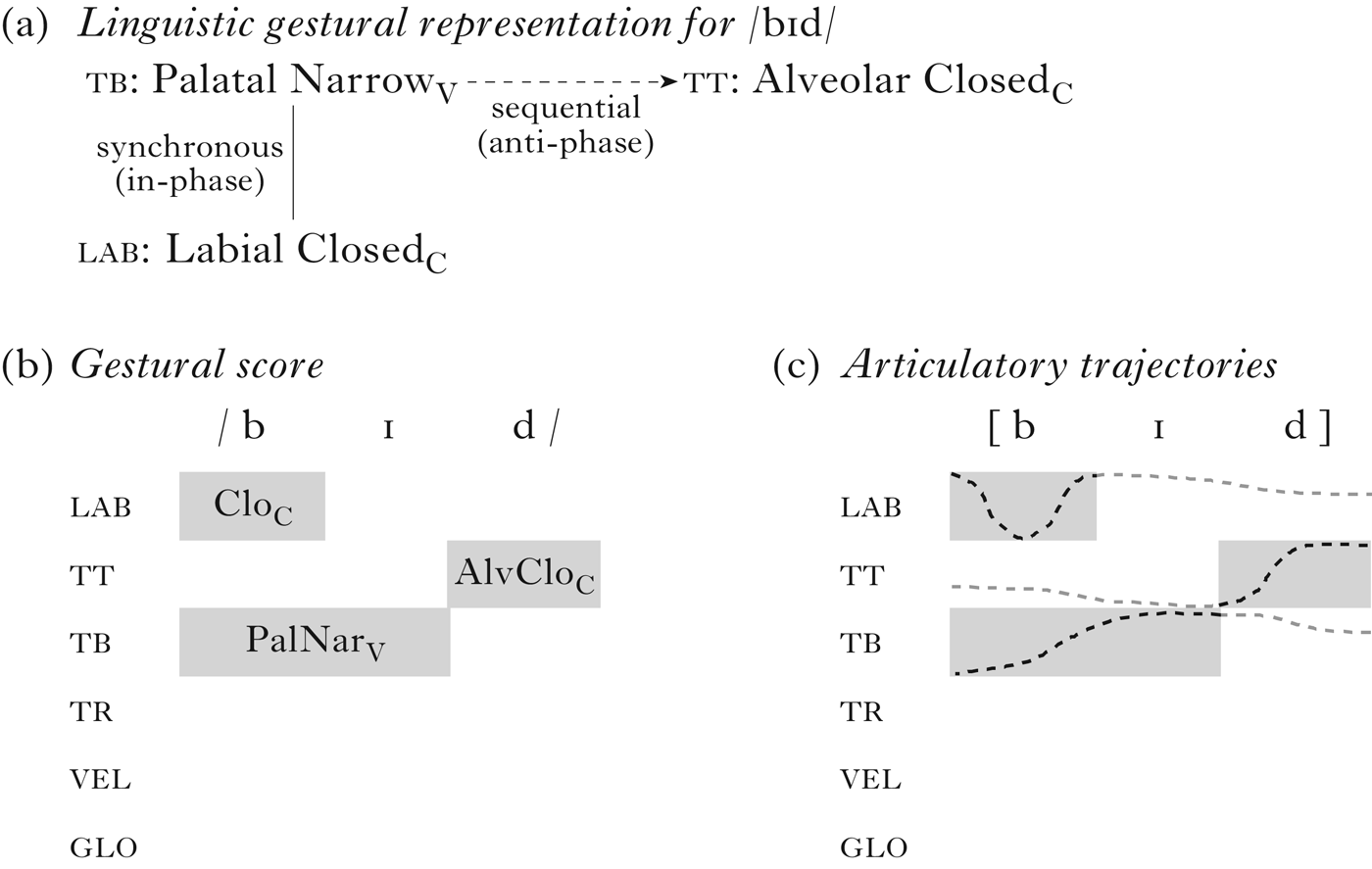
The different levels of gestural computation are illustrated in Fig. 2 for the word bid. The linguistic gestural representation in (a) consists of three gestures: (i) the labial closure associated with /b/, (ii) the palatal tongue-body (TB) approximation of /ɪ/ and (iii) the alveolar tongue-tip (TT) closure required for /d/. The labial and vocalic gestures are synchronously coordinated (in-phase, indicated by a solid line), while the TT gesture is sequentially coordinated with that of the vowel (anti-phase, indicated by a dashed arrow pointing to the gesture that follows). These coordinative relationships – synchronous onset consonant and vowel, but sequential vowel and coda consonant – define basic principles of temporal organisation within the syllable (Browman & Goldstein Reference Browman and Goldstein1988, Reference Browman and Goldstein2000, Nam et al. Reference Nam, Goldstein, Saltzman, Pellegrino, Marisco, Chitoran and Coupé2009). The gestural score in (b) indicates the interval of activation for each gesture, and the articulator set involved in executing it. Where boxes overlap, their respective gestures are simultaneously active. Possible resulting articulatory trajectories are also illustrated schematically in (c); the actual articulations used to realise any particulate utterance of bid would be a function not only of individual gestural specifications and their blending parameters, but also other factors, such as speech rate and prosodic context.
Three levels of gestural computation for the word bid: (a) linguistic gestural representation (coupling graph); (b) gestural score; (c) articulatory trajectories generated by the task-dynamic model.

Assuming the grammatical framework of Optimality Theory (OT; Prince & Smolensky Reference Prince and Smolensky2004), we follow Smith's (Reference Smith2018) assumption that Gen executes changes in the gestural representation at the level of the coupling graph, i.e. the linguistic gestural representation, and phonological constraints governing gestures are therefore enforced only through selection among candidates differing in their coupling graph and the presence or absence of gestures. Nevertheless, the outputs evaluated by constraints contain not only the coupling graph, but also information about the gestural score, articulatory trajectories and acoustic output that are calculated from it. For example, it is possible for phonological constraints to reference whether a given linguistic gestural representation will result in certain gestures being simultaneously active, but the grammar cannot directly govern a gesture's duration. The latter is a continuous variable that is not part of the linguistic representation, but rather is computed in the gestural score based on the gesture's parametric specifications. Similarly, a phonological constraint may reference the result of blending two overlapping gestures with specific blending strengths, but it cannot alter the computation of the blending outcome that is the product of those specifications. This understanding enables phonological markedness and contrast to be sensitive to the effects of gestural blending and to structure gestural overlap accordingly.
For the gestural representation of GenAm liquids, we assume two coordinated lingual gestures, and in the case of onset rhotics, also a labial gesture. Following Proctor et al. (Reference Proctor, Walker, Smith, Szalay, Goldstein and Narayanan2018), we posit a TT gesture and a TB gesture for GenAm rhotics and laterals. For the coronal articulation of /ɹ/, a glide-like TT gesture is specified for the constriction [Palatal] and constriction degree [Narrow].Footnote 5 Although the blade and even the front of the tongue may be involved in realising the coronal articulation in addition to the tongue tip, the abstract TT articulator is broadly interpreted. We suggest the TT articulator is most suitable for representing an articulation that may involve tip-up or tip-down bunching or retroflexion. For the pharyngeal articulation of /ɹ/, a glide-like TB gesture is specified for the constriction location [Pharyngeal] and constriction degree [Narrow]. We follow Browman & Goldstein (Reference Browman and Goldstein1989) in assuming that the TB articulator executes articulations extending even into the pharyngeal region. Onset rhotics will also have a vocalic [lab: Protruded Narrow] gesture. GenAm /l/ will consist of two gestures: consonantal [tt: Alveolar Closed] and glide-like [tb: Uvular Narrow].
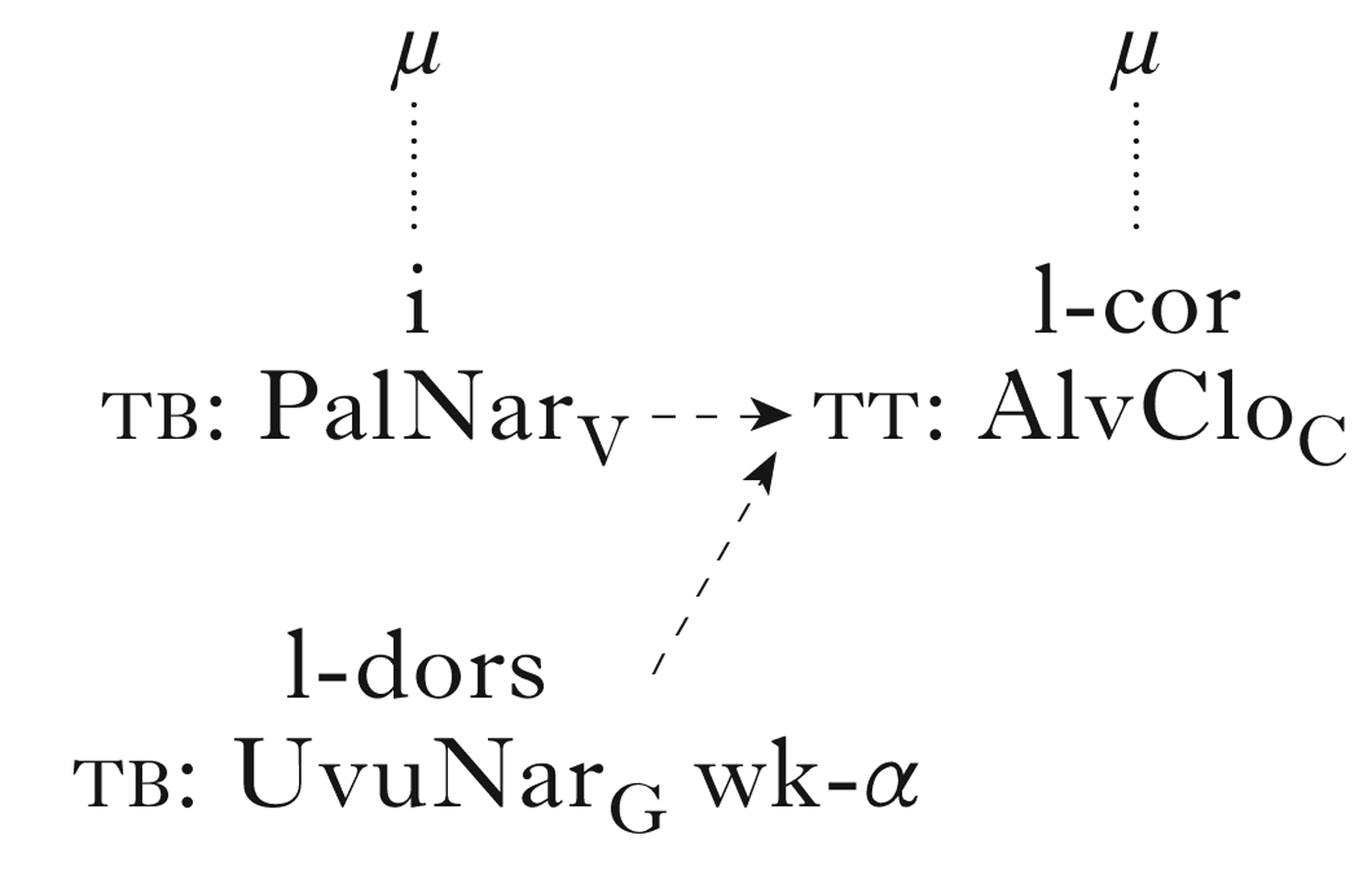
In coda context, the gestures of GenAm liquids will be in a sequential relation, with the TB gesture ordered before the TT gesture. The output linguistic gestural representations for the GenAm rhotic and lateral in coda are illustrated in Fig. 3. Note that the specifications in Fig. 3 characterise goals for the midsagittal tract configuration. In the case of the lateral consonant, for instance, it is possible that additional goal(s) govern activity in another plane. We assume that segments are defined as formal sets of gestures, where those sets are given in the input and may be modified in the output (Walker Reference Walker2017, Smith Reference Smith2018). Gestures belonging to the same segment will thus be identified by membership of the same set, rather than by hierarchical organisation under a root node. Particular coordination relations among gestures belonging to the same segment will be driven by grammatical constraints on phonological outputs; however, as is customary in OT, those constraints are ranked and violable.Footnote 6
Gestural representation of (a) a coda rhotic and (b) a coda lateral in GenAm.

4.2 Representation of quantity
As discussed in §2, the syllable template for GenAm has been framed in terms of moras. We assume a mora-based approach to quantity in the linguistic representation (Hyman Reference Hyman1985, Hayes Reference Hayes1989). Moras represent abstract units of weight, distinct from the continuous variable of duration, which is calculated in the gestural score.
The weight of vowels and consonants can be distinctive. Of relevance here is the representation of weight in tense/lax vowel pairs in GenAm. Building on previous work on GenAm syllable structure (see §2), we assume that contrasts among tense/lax vowel pairs primarily involve a phonological distinction in quantity. In contexts where tense and lax vowels contrast, tense vowels will be bimoraic in the input, and therefore long, while lax vowels will be monomoraic or lack a mora in the input, and are therefore represented as short in the phonological output, with one mora. In our analysis, we assume that the gestural specifications for a tense/lax (i.e. long/short) vowel pair will be the same in the linguistic representation, though their difference in moraic structure will have some effect on their quality realisation, such as diphthongisation of non-low long vowels, which we abstract away from here. This assumption is not crucial, however. If evidence were to support a difference in intrinsic gestural specification in tense/lax pairs, the phonological analysis would necessarily correlate this difference with a quantity difference.
Weight can be coerced in specific contexts. Coerced weight refers to moras whose presence in the output is predictably enforced by a constraint, rather than exhibiting a contrastive distribution. Weight-by-Position (WBP) is responsible for the assignment of moras to coda consonants (Hayes Reference Hayes1989, Morén Reference Morén2000). We assume a version of WBP where a mora is assigned to each gesture that is in a sequencing relation following the primary gesture of a vowel in a syllable (building on proposals of Browman & Goldstein Reference Browman and Goldstein1988, Reference Browman and Goldstein2000, Nam Reference Nam, Cole and Hualde2007). We will assume that the lingual gesture of a vowel is primary, though this is not crucial.
The moraic structures for two words, bid and bead, are illustrated in Fig. 4. Following Hall (Reference Hall2002), we assume that /d/ is moraic here, because it does not exceed the three-mora maximum. For bid, a mora will be enforced for the gesture for lax [ɪ] by constraint (see §4.4). In addition, WBP will enforce a mora for the TT gesture of the coda consonant, because it is sequenced after a vowel. The association of moras with gestures is indicated with dotted lines, to keep them distinct from intergestural coordination relations. In bead, the gesture for the tense vowel is associated with two moras (due to a bimoraic input), and the gesture for coda /d/ is assigned a mora through WBP. Since the distinction between the tense and lax vowels is encoded in terms of weight, we henceforth transcribe their phonemic contrast as involving quantity rather than quality, e.g. as /iː/ (bead) vs. /i/ (bid).
Linguistic gestural representation and moraic structure for (a) bid and (b) bead.

4.3 Representations: rhymes with a postvocalic liquid
We now return to answering the two central questions in (2) about the phonotactics of GenAm rhymes with /ɹ/ vs. /l/ – both spatially and temporally complex liquids.
(2)
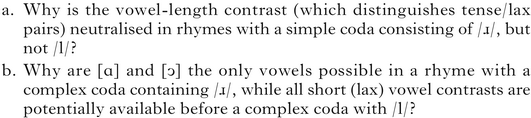
In addressing these questions, we present the temporal organisation of gestures that we propose for rhymes with postvocalic /ɹ/ vs. /l/, and the rationale that gives rise to them.
With respect to vowel-length contrasts, rhymes with postvocalic /l/ show phonotactics in conformity with the majority of GenAm consonants, so we begin with these structures. In rhymes with a simple coda /l/, quantity contrasts are preserved (e.g. peel, pill), while in rhymes with a complex coda containing postvocalic /l/, only short vowels are possible (e.g. milk, *meelk), but all short vowels are possible in this context. In all of these rhymes, /l/ patterns as monomoraic; therefore, a word like, ill [ɪl], with a short vowel, will have just two moras, while a word like eel [iːl], with a long vowel, will have three moras.
The output linguistic gestural representation that we propose for ill is shown in Fig. 5. For ease of interpretation, we have labelled the three gestures as follows: ‘i’ is the gesture for the nuclear vowel, realised as short [ɪ], ‘l-dors’ is the dorsal gesture of the lateral and ‘l-cor’ is the coronal gesture of the lateral. Relevant parameter settings for each are shown. A coda lateral in GenAm consists of l-dors [tb: Uvular NarrowG] sequenced before l-cor [tt: Alveolar ClosedC] (the α value for l-dors is discussed below). In addition, the gesture of the nuclear vowel will be in a sequential coordination relation with the coda lateral. We propose that this relation holds between the nuclear vowel and the consonantal l-cor gesture. Thus the gesture of the nuclear vowel and the glide-like l-dors gesture are coordinated to precede l-cor; however, no direct temporal coordination exists between the l-dors gesture and the vowel gesture. The lack of a sequencing relation between the vowel and l-dors gesture is important, because it means that a coda lateral will give rise to only one mora. The sequencing relation between the vowel and l-cor will cause a mora to be assigned to l-cor through WBP, but l-dors is not moraic, because it is not in a sequencing relation with the vowel.
Output linguistic gestural and moraic representations for ill.
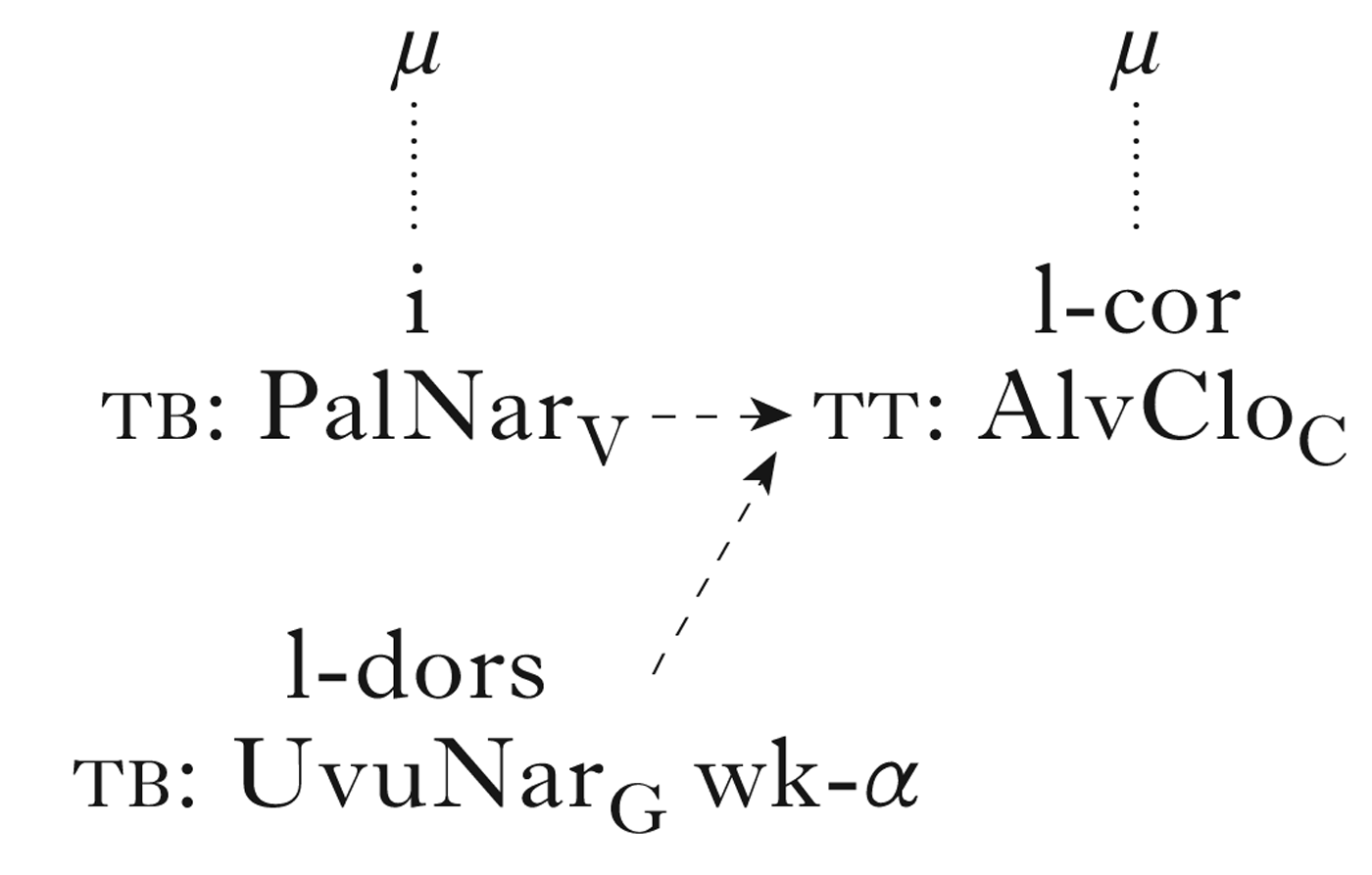
As a result of these coordination relations, the nuclear vowel and the TB gesture of the lateral will overlap. In the implementation of these relations, the release of the gesture of the vowel and of the TB gesture of the lateral will each be controlled to coincide with the target of the TT gesture. Studies of English laterals by Gick (Reference Gick, Ohala, Hasegawa, Ohala, Granville and Bailey1999b) and Krakow (Reference Krakow1999) provide related insights about the timing of component gestures of coda liquids, though the specific proposal here about the phonological structure of laterals is original, to the best of our knowledge. The form of overlap we propose between the vowel and the TB gesture of a coda lateral differs from synchronous gestures that are coordinated to begin in near-simultaneous fashion. A representation of this kind, which lacks direct coordination between a vowel and one of the gestures of a multi-gestural coda consonant, is likely not unique to GenAm laterals. Byrd et al. (Reference Byrd, Tobin, Bresch and Narayanan2009) tentatively propose a similar temporal coordination structure for a nuclear vowel and coda [n] in English, such that the vowel and velum-lowering gestures both precede the TT closure gesture.
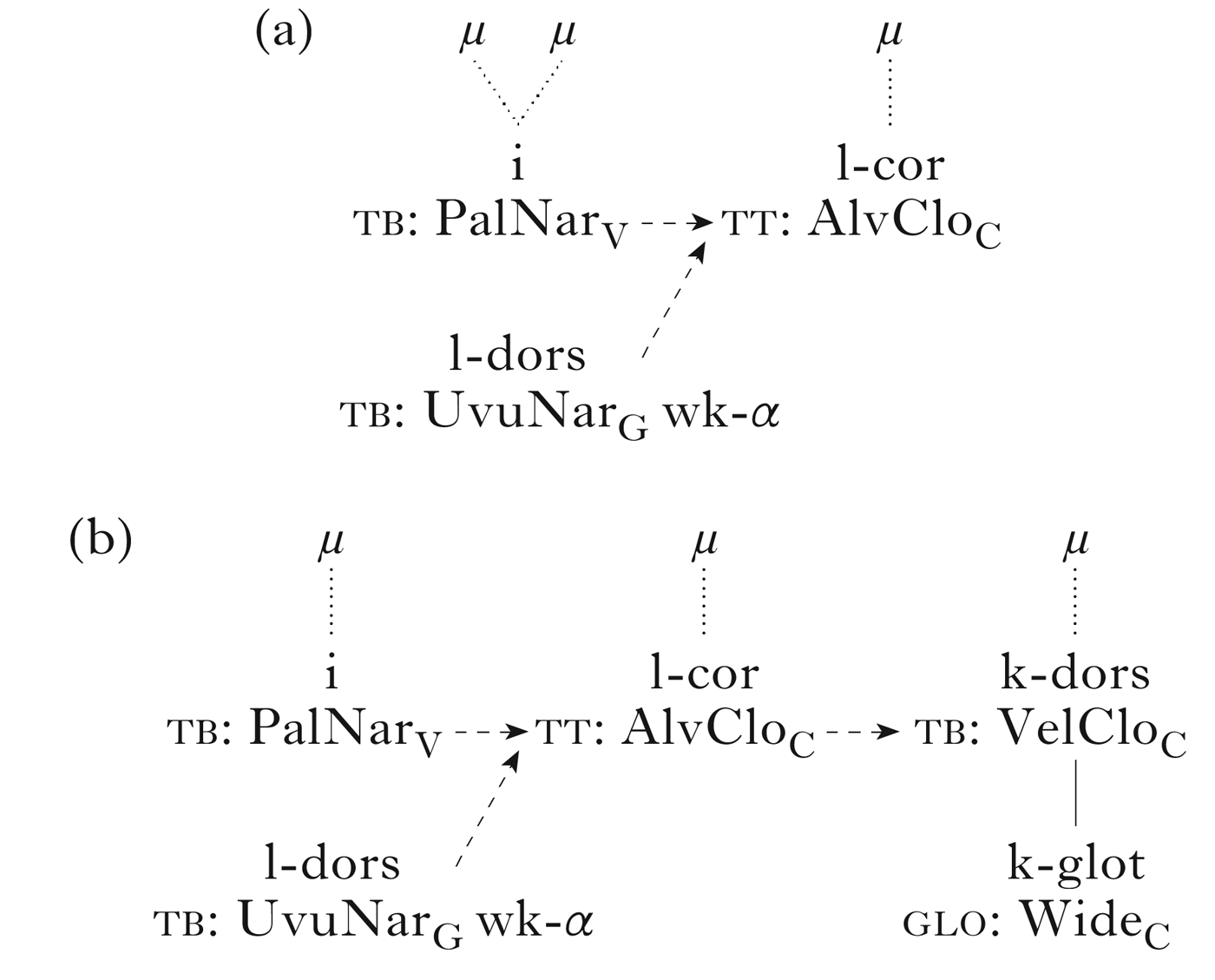
Because coda /l/ contributes only a single mora, distinctively long vowels are possible preceding a simple lateral coda. A word like eel [iːl], with a long vowel, will have three moras, two because of the vowel and one because of /l/ (Fig. 6a). A word like ilk [ɪlk], where postvocalic /l/ is part of a complex coda, will also have three moras. The short vowel contributes one mora, and WBP causes a mora to be assigned to each of l-cor and k-dors, the dorsal gesture for /k/ (Fig. 6b).Footnote 7 In a /VlC/ rhyme, long vowels are excluded, because the syllable would otherwise exceed the trimoraic maximum allowed for GenAm.
Output linguistic gestural and moraic representations for (a) eel and (b) ilk.

The question of partial overlap of a coda consonant and a nuclear vowel arises for /l/ but not /d/ (cf. Fig. 4), because multigestural /l/ has internal sequencing of its gestures but monogestural /d/ does not. During the period where l-dors and the vowel overlap, the goal states for these gestures will be blended, with the relative contribution of each gesture dictated by its specified α value. A key finding of the study by Proctor et al. (Reference Proctor, Walker, Smith, Szalay, Goldstein and Narayanan2018) is that GenAm laterals have a lower coarticulatory dominance than rhotics, which we interpret as corresponding to a lower specified blending strength (α value) for laterals than rhotics. We suggest that the lower blending strength of the lateral enables l-dors to overlap with the vowel without significantly compromising contrasts in vowel quality. However, in the case of /ɹ/, which has a higher blending strength, the implications for gestural overlap are different, as we discuss below. We will characterise the critical difference in blending strength of the liquids with the specification ‘weak’ (wk) for α in l-dors and ‘strong’ (str) for α in ɹ-phar (the dorso-pharyngeal gesture of /ɹ/ formed with the TB). We focus on the blending strength of these gestures in particular, because they are sequenced before the TT gesture in each liquid, and are therefore in a context for potential overlap with the vowel. Weak vs. strong specifications for gestural blending strength have been proposed to play a role in phonological patterning in other studies (Smith & Blaylock Reference Smith and Blaylock2017, Smith Reference Smith2018), supporting a distinction along these lines in the linguistic gestural representation.
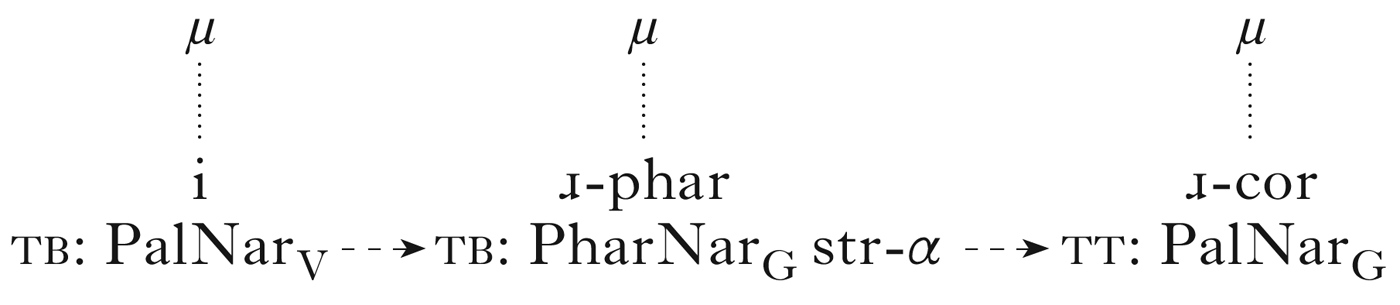
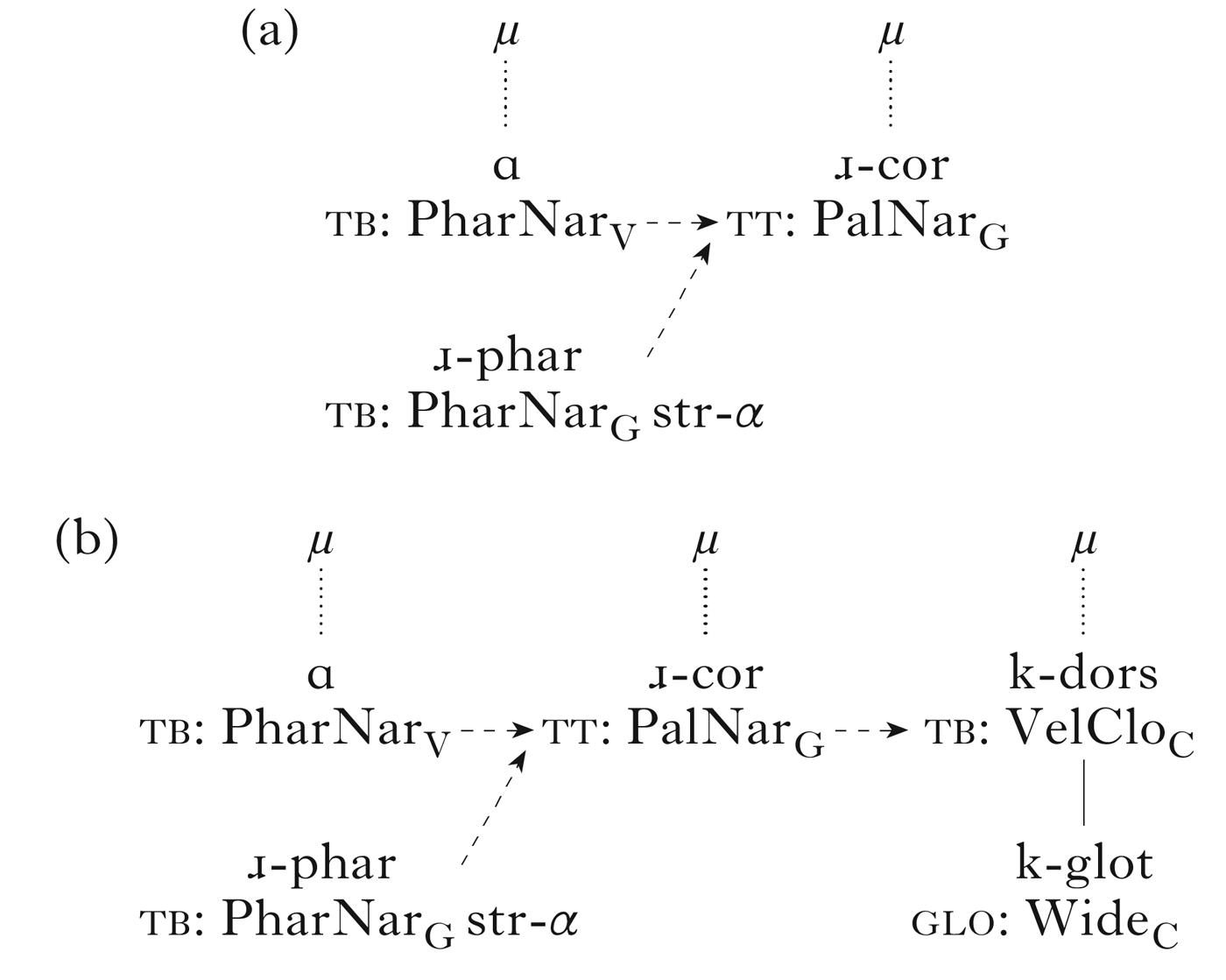
Like the lateral, the coda rhotic involves a sequence of two gestures (§4.1): ɹ-phar preceding ɹ-cor. When the nuclear vowel involves lingual control that differs significantly from that of ɹ-phar, the high blending strength of the ɹ-phar gesture has the potential to interfere with the distinctive quality of the vowel if it substantially overlaps with the vowel gesture. Such interference is avoided if ɹ-phar is sequenced to follow the gesture of the vowel, as shown for the word ear in Fig. 7. In this temporal organisation, the rhotic gives rise to two moras, one for ɹ-phar sequenced after the gesture for /i/ and one for ɹ-cor sequenced after ɹ-phar. Due to the trimoraic maximum in GenAm syllables, a vowel in this context must be phonologically monomoraic. This prediction is consistent with the neutralisation of vowel-quantity (tense/lax) contrasts preceding coda /ɹ/.
Output linguistic gestural and moraic representations for ear.

Nevertheless, in rhymes containing a non-high back vowel [ɑ] or [ɔ], postvocalic /ɹ/ may be part of a complex coda, and only with these vowels. The pharyngeal constriction for /ɹ/ was found to most closely resemble that of these peripheral vowels. Because of their similarity, we propose that [ɑ] and [ɔ] can significantly overlap with ɹ-phar without compromising distinctive quality, despite the high blending strength of the rhotic. This enables a representation for are in which ɹ-phar and the gesture for [ɑ] are both sequenced before ɹ-cor, but are not in a direct temporal relation with each other (Fig. 8a). Since ɹ-phar is not sequenced after the gesture for [ɑ], are will give rise to just two moras, one for the vowel and one for ɹ-cor. The potential for overlap between [ɑ]/[ɔ] and ɹ-phar thus makes possible an additional coda consonant, as shown for ark (Fig. 8b). In this case, the sequential relation between ɹ-cor and k-dors causes WBP to assign a third mora. By contrast, a complex coda is not possible with postvocalic /ɹ/ for other vowel qualities, because the sequencing of ɹ-phar after the vowel gesture – to avoid neutralising overlap – causes the /Vɹ/ sequence to occupy the maximal three moras.
Output linguistic gestural and moraic representations for (a) are and (b) ark.

A summary of our primary claims about the representation of rhymes with postvocalic liquids is provided in (3). In the COAST approach, differences in the organisation of rhymes with /ɹ/ vs. /l/ involve manipulation of coordination relations, largely driven by differences in the blending strength of their TB gestures.
(3)
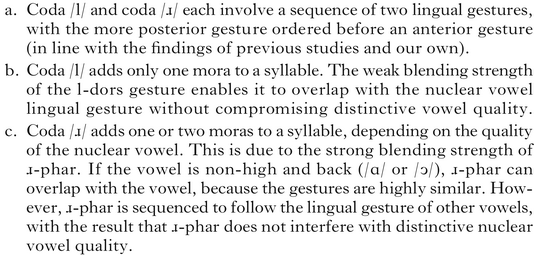
The representations that we propose are abstract and hypothetical, but they are grounded in research on the articulation of rhymes with postvocalic liquids, including the formation of constrictions for the vowel and liquid, the sequencing of lingual gestures that compose the liquid and the coarticulatory properties of liquid articulations. Our account makes predictions about the coordination of the nuclear vowel and gestures of postvocalic liquids that can be tested in future articulatory studies (cf. Marin & Pouplier Reference Marin and Pouplier2014).
Our proposal about the temporal organisation of liquids in rhymes has some affinity with previous work proposing that postvocalic liquids are high in sonority and form a diphthong with a preceding tautosyllabic vowel in the syllable nucleus (Harris Reference Harris1994, Green Reference Green2001b; see also related work by Botma et al. Reference Botma, Ewen and van der Torre2008 and Ewen & Botma Reference Ewen, Botma, Nasukawa and Backley2009). Our study of GenAm vowel–liquid phonotactics, contextualised in relation to articulatory research, suggests that a glide-like dorsal/pharyngeal component of liquids has the capacity to share temporal space with the nuclear vowel. However, different from prior analyses, details of overlap of the glide-like component of the liquid with the vowel or its diphthongal-like sequencing depend on specific articulatory properties of the liquid, namely its coarticulatory dominance, and its articulatory similarity to the nuclear vowel. As discussed by Proctor & Walker (Reference Proctor, Walker and Parker2012), articulatory factors contribute to understanding liquid- and vowel-specific restrictions in GenAm rhyme phonotactics, beyond a traditional diphthongal treatment of postvocalic liquids.
4.4 Constraint-based analysis
We now turn to an OT analysis that derives the gestural coordination relations and moraic assignment that we propose for GenAm rhymes. Numerous OT analyses have been proposed that represent grammars operating over gestural representations (Gafos Reference Gafos2002, Davidson Reference Davidson2003, Hall Reference Hall2003, Bradley Reference Bradley2007, Casserly Reference Casserly2012, Tejada Reference Tejada2012, Smith Reference Smith2016, Reference Smith2018), though with some differences, such as whether coordination is enforced at the level of the coupling graph or gesture-internal landmarks. As mentioned above, we follow Smith (Reference Smith2018) in broad-based assumptions about the nature of structure that may differ among candidates produced by Gen and the levels of computation available in the constraint evaluation. We also follow Smith in supposing that inputs may contain a linear ordering over segments (conceived of as sets of gestures; see §4.1), and that constraints select the appropriate coordination structure for gestures in the output.
We consider first the constraints and ranking involved in deriving the appropriate basic temporal coordination and assignment of moras for gestures within syllables of GenAm. The relevant faithfulness constraint is Max(gest)-IO, which penalises deletion of a gesture (in the formalism of McCarthy & Prince Reference McCarthy, Prince, Beckman, Dickey and Urbanczyk1995).Footnote 8 Three markedness constraints are defined in (4). On referencing the primary or head gesture in consonants and vowels, see Gafos (Reference Gafos2002) and Smith (Reference Smith2018).
(4)
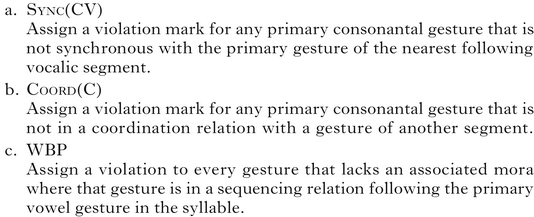
Sync(CV) enforces the synchronous coordination of an onset consonant and following vowel. The vowel follows the onset in that its peak stricture is computed to be reached after that of the consonant. This constraint is equivalent to Couple(C,V), proposed by Smith (Reference Smith2018). We have changed the constraint name here to highlight the type of coordination relation it enforces, namely a synchronous, as opposed to a sequential, relation. This constraint is violated in outputs in some languages, such as when the first consonant of an intervocalic cluster is not in a synchronous coordination relation with the following vowel, i.e. when VCCV is syllabified as VC.CV, with a coda, rather than V.CCV, with a complex onset. See Davidson (Reference Davidson2003) for discussion in connection with a constraint that is similar in spirit, Assoc-CV. Coord(C) enforces a coordination relation between a consonant and the gesture of another segment; it is essentially the equivalent of Davidson's Assoc(C). This constraint serves to syllabify a postvocalic consonant as a coda, i.e. coordinated as sequential to a preceding vowel, as a last resort. It comes into play when the consonant is word-final or cannot be syllabified into the onset of the following syllable by synchronous coordination with a following vowel. Possibly, this constraint should belong to Gen (Smith Reference Smith2018: 25). Finally, WBP is responsible for assignment of moras to gestures in coda contexts.
The operation of these constraints is demonstrated in (5) for bead. The input consists of three segments, in this case each consisting of a single gesture. These are numerically indexed for their linear order. To enhance interpretability, we represent the phonemic transcription in the tableau heading with numeric subscripts, which may be matched with the affiliated gestures in the input. In addition, we continue our practice of using short-form labels for the gestures, though we indicate their fuller specifications in the input.
(5)
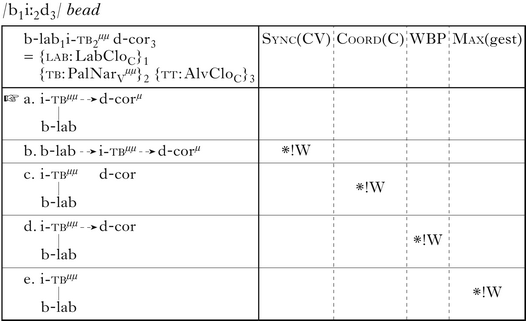
The input has two moras associated with the TB gesture of the vowel, because it is distinctively long. The gesture for /d/ has no mora in the input here. This is not crucial, but it enables illustration of how WBP enforces mora insertion for the coda consonant. Moras associated with gestures are shown with superscripted μ’s in tableaux. Candidate (a), [biːdμ], is the winner, with a moraic coda consonant. It obeys all the constraints shown. Following Campos-Astorkiza (Reference Campos-Astorkiza2004), we assume that moras inserted to represent non-geminate coda weight do not violate Dep(μ). All the other candidates violate one of the constraints shown. Candidate (b) violates Sync(CV), because i-tb is in a sequential relationship with b-lab. Coord(C) is violated in (5c), because d-cor is not in a coordination relation with another gesture. WBP is violated by (5d), where d-cor is in a sequential relation to the vowel gesture but is not moraic (∅): [biːd∅]. Candidate (e) bypasses violations of Coord(C) and WBP by deleting d-cor, which violates Max(gest), yielding [biː].
For a short vowel, as in bid, the TB gesture for the vowel will either have a single associated mora in the input, or no mora. The vowel will be guaranteed assignment of a mora in the output through the constraint V/μ, which assigns a violation to every primary vowel gesture that lacks an associated mora (Rosenthall Reference Rosenthall1994).
We assume the Linearity constraints in (6), which prevent the effects of metathesis (building on McCarthy & Prince Reference McCarthy, Prince, Beckman, Dickey and Urbanczyk1995).
(6)
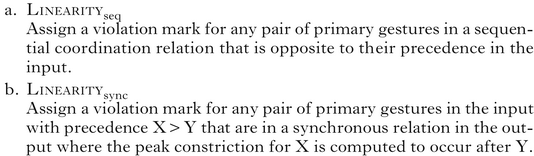
Linearityseq prevents gestures with an input precedence relation X > Y from being sequenced as Y > X in the output, but permits overlap of X and Y, as in the synchronous relation between a vowel and onset consonant in a syllable. Linearitysync prohibits a consonant gesture that is ordered after a vowel gesture in the input from being in a synchronous relation with that vowel gesture in the output, preventing a postvocalic consonant from becoming an onset to that vowel. These constraints are not violated in the candidates considered in the tableaux here, and they are assumed to be ranked in the top tier for the patterns under focus in GenAm.
Coda liquids in GenAm are complex segments, realised with internal sequencing of gestures. We propose two constraints relevant to this representation. Syncsubseg, in (7a), will enforce a synchronous beginning (directly or by transitivity) for gestures belonging to the same segment, as identified by membership in the same set. Conflicting with this constraint is Seqliq in (7b), which demands that the TT gesture of a coda liquid be sequenced after its TB gesture. A coda liquid can be defined as a liquid with a gesture that is in a sequential coordination relation with the preceding vowel.
(7)
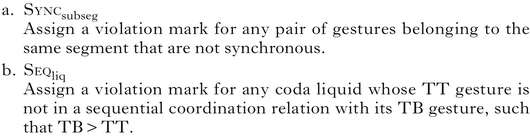
Seqliq must dominate Syncsubseg to obtain sequential coordination of the lingual gestures in a coda liquid. In tableaux to follow, only candidates with this coordination will be considered.
We demonstrate how the grammar selects appropriate structures, first for coda rhotics and then for laterals. The constraint 3μ, defined in (8a), enforces the trimoraic maximum in syllables (Hammond Reference Hammond1999, Hall Reference Hall2002). For rhymes with /ɹ/, Seq(Vɹ) in (8b) enforces sequencing between the TB gesture of coda /ɹ/ and that of a preceding non-pharyngeal vowel. Seq(Vɹ) is a cover constraint for constraints on contrast that penalise the insufficient distinction in quality between vowels with a pharyngeal TB gesture ([ɑ ɔ]) and that of other vowels when they phonologically overlap with ɹ-phar, due to the high blending strength of the pharyngeal gesture in the rhotic. Phonological overlap would arise if the vowel's TB gesture and the TB gesture of the rhotic were both in a sequential coordination relation with the TT gesture of /ɹ/, but were not directly coordinated with each other, as in Fig. 8 above. Dispersion-theoretic constraints can enforce contextual restrictions on contrast (Ní Chiosáin & Padgett Reference Ní Chiosáin, Padgett and Lombardi2001, Flemming Reference Flemming2002, Reference Flemming, Hayes, Kirchner and Steriade2004), and contextual effects can be affected by blending strength. For reasons of space, we do not elaborate the details of the constraint interactions that derive the effect of Seq(Vɹ).
(8)
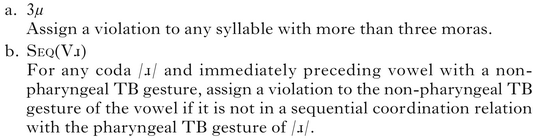
These constraints have the potential to conflict with Max(μ)-IO, which penalises deletion of a mora, as in the case of shortening a long vowel shown in the tableau for ear in (9). The hypothetical input here has bimoraic /iː/. To facilitate interpretation, an approximate phonetic realisation is given that includes the phonological weight of coda consonants.
(9)
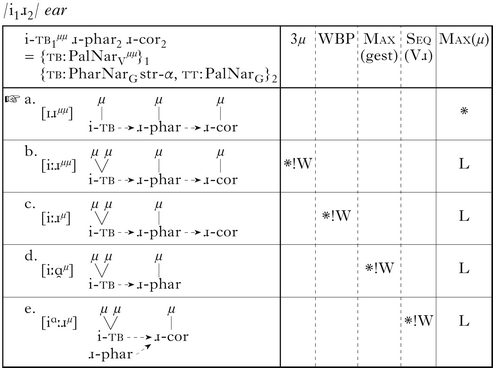
The winning candidate in (a) shortens the vowel by deleting a mora, earning a violation of Max(μ). This allows the ɹ-phar gesture of the coda rhotic to not overlap the vowel and still remain within the trimoraic syllable maximum. Candidate (b) is ruled out because it has four moras. In (c), WBP is violated, because ɹ-cor is not assigned a mora despite being sequenced after the vowel in the syllable. In (d), a violation of WBP is avoided by deleting ɹ-cor; however, this violates Max(gest). In this case, /ɹ/ would resemble a pharyngeal glide, which we represent as [a̯]. In (e), the pharyngeal gesture of /ɹ/ overlaps the vowel's TB gesture, indicated by [ɑ], which interferes with vocalic contrast maintenance. This is ruled out by Seq(Vɹ).
The tableau in (10) shows how a different coordination structure is selected for ark. The glottal gesture for /k/ is not shown here, since it is not relevant to the issues in focus. Again, the hypothetical input contains a bimoraic vowel.
(10)
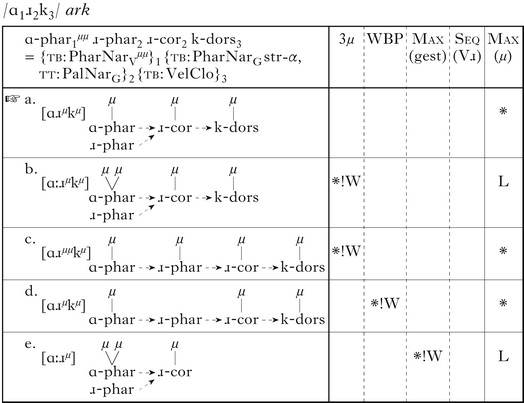
The vowel in ark is pharyngeal; therefore Seq(Vɹ) does not prohibit it from overlapping with ɹ-phar, as in the winner in (a). Here, coda [ɹ] contributes only a single mora. Nevertheless, to accommodate the weight contributed by two coda consonants, the vowel must become monomoraic; compare (b). If ɹ-phar instead were sequenced to follow [ɑ], the trimoraic maximum would be exceeded even with a shortened vowel, as in (c), or WBP would be violated, as in (d). Max(gest) ⪢ Max(μ) excludes (e), where a coda consonant is deleted to preserve a second mora in the vowel.
In words with a lateral coda, Seq(Vɹ) does not come into play. In the case of eel in (11a), a representation where l-dors overlaps the TB gesture of the vowel is optimal. This configuration does not violate any of the constraints under consideration. Each of the alternatives in (11) is ruled out by a violation of one of the constraints shown.Footnote 9
(11)
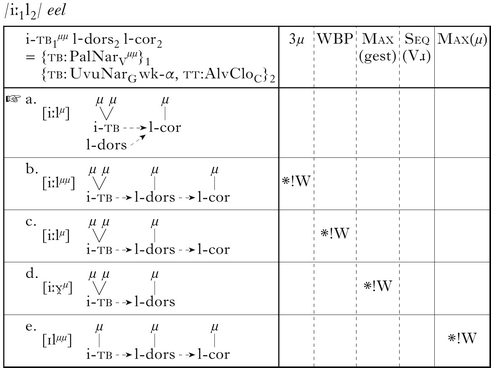
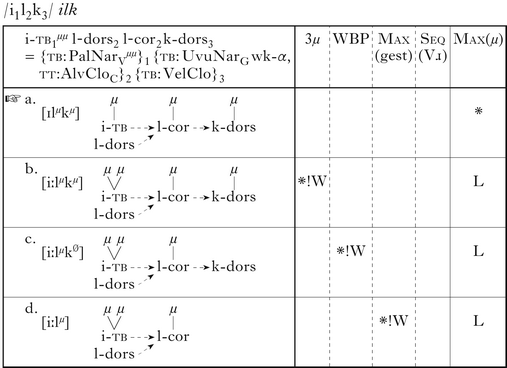
The case of ilk is shown in (12). The input in this tableau contains a hypothetical long vowel. Again, overlap between the vowel and l-dors is favoured; however, higher-ranking constraints drive a violation of Max(μ), because the vowel must become short to accommodate a second coda consonant.
The coordination and weight representations for rhymes with coda liquids thus are selected by a grammar in which 3μ, WBP, Max(gest) and Seq(Vɹ) dominate Max(μ), in concert with the additional constraint rankings discussed earlier in this section.
(12)
4.5 Summary
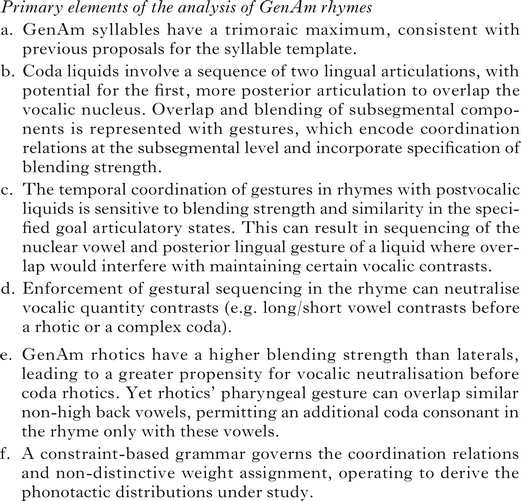
This concludes our account of the representation of rhymes with postvocalic liquids and the explanation it affords for understanding their phonotactics. In overview, our analysis involves the elements in (13), built around the COAST approach.
(13)
5 Extensions to other patterns
The ramifications of representing temporal structure at the subsegmental level rather than at the root node invite re-examination of various phonological phenomena, especially those involving complex segments and partial cross-segmental overlap. As an example, our investigation finds resonance with a study of ambisyllabic /l/ in British English by Scobbie & Pouplier (Reference Scobbie and Pouplier2010), who observe that separate gestures of /l/ enter into distinct syllabification and coordination relations, rather than behaving uniformly over the segment. Various other patterns may be amenable to an account along the lines we have proposed, both in English and in other languages. We highlight some of these here as directions for extending the application of subsegmental coordination and strength to phonotactics in the rhyme.
Within English, a few branches of inquiry are particularly promising: sesquisyllables and dialectal variation in vowels before liquids. We discuss these in turn, with particular attention to the first, since it is a characteristic common to GenAm. As mentioned in §2, sesquisyllables are forms with a liquid coda that are plausibly monosyllabic, but variably judged by native speakers as greater than one syllable. The study of sesquisyllables by Cohn & Tilsen (Reference Cohn and Tilsen2015) investigated syllable-count ratings for target stimuli with rhymes containing [aj ɑ i ɪ] (or a neutralised high front vowel contrast before /ɹ/). This study found that words most likely to be rated as having more than one syllable (>1σ) contain [aj] followed by a liquid (e.g. pile, pyre). A similar but considerably weaker effect was found for words with a liquid preceded by a high front vowel that is tense or where a tense/lax distinction is neutralised (e.g. peel, beer). For both rhymes with [aj] and high front vowels, variation in syllable-count judgement was found across participants, words and tasks. In contrast, forms with other vowels in a rhyme with a liquid coda are usually judged to be one syllable (e.g. pill [ɪ], ball [ɑ], par [ɑ]).
We speculate that these forms may receive an account in terms of our approach if the glide [j] in GenAm is represented with a higher blending strength than vowels, such as [i] or [ɪ]. We have not examined the blending strength of glides in diphthongs of GenAm, nor are we aware of any studies that have directly investigated this issue. Nevertheless, Recasens (Reference Recasens1985) found that the glides [j] and [w] in Catalan showed evidence of a high degree of articulatory constraint.
On the account we have proposed for the gestural organisation of coda /ɹ/, a rating of words with [ajɹ] rhymes as >1σ is unsurprising. The diphthong is expected to give rise to two moras, and coda /ɹ/ is expected to contribute two moras, because its pharyngeal gesture is not sufficiently similar to [j] to allow significant overlap. A count of four moras is consistent with the interpretation of Lavoie & Cohn (Reference Lavoie, Cohn, Ohala, Hasegawa, Ohala, Granville and Bailey1999) and Cohn (Reference Cohn2003) that sesquisyllables have an extra mora, exceeding a stable maximum for English. For [ajl] rhymes, it is conceivable that the dorsal gesture of [l] is likewise sequenced after the diphthong rather than overlapping it, yielding a four-mora rhyme. We speculate that this sequencing could occur if the glide in the diphthong has greater blending strength (corresponding with higher coarticulatory dominance) than the vowel [i]. Data from Gick (Reference Gick, Ohala, Hasegawa, Ohala, Granville and Bailey1999b) are suggestive that a sequencing account is on the right track. Gick's interpretation of measurements of the temporal lag between TB and TT gestures in [ajl] rhymes supports the notion that TB targets for /j/ and /l/ conflict with each other and delay achievement of the lateral's TB gesture (see also Gick & Wilson Reference Gick, Wilson, Goldstein, Whalen and Best2006).
As for rhymes with a high front vowel, Lavoie & Cohn (Reference Lavoie, Cohn, Ohala, Hasegawa, Ohala, Granville and Bailey1999: 111) observe that diphthongised tense vowels tend to lead to a disyllabic interpretation of sesquisyllables. A potential direction in terms of our approach is for variation in representation between [iːl] ~ [ijl] and [iɹ] ~ [ijɹ]. The diphthongal rhymes would be expected to correspond with a tendency for >1σ judgements and the others to correspond to =1σ judgements. The gestural organisation for [iːl] and [iɹ] rhymes, each amounting to three moras, was illustrated in §4.3. In the case of diphthongal [ijl] and [ijɹ], the glide in the diphthong could be sequenced before the TB gesture of the liquid. This representation would fit with Cohn & Tilsen's finding that rhymes with high front vowels and liquids that are associated with >1σ judgements are longer in mean rhyme duration than those associated with =1σ judgements.
Finally, we note that the lack of >1σ judgements for lax vowels and low vowels is consistent with our account, as these vowels are not expected to contribute more than a single mora to a rhyme, and do not generally have a diphthongal production available.
Further research is warranted to test our tentatively hypothesised representations for sesquisyllables, both in terms of coordination and blending strength. We see this as a promising direction to pursue, especially intersecting with dialect variation. Wells (Reference Wells1982: 484–485) notes reports of English varieties spoken in the American midland where [aj] undergoes monophthongisation before coda liquids. This can cause words like tire and tar to be identical, or they may be distinct, with tire pronounced as [taɹ] and tar as [tɑɹ]. Monophthongisation could potentially be understood as a means of modifying the rhyme structure so that it does not exceed three moras.
Another phenomenon in American English varieties that could receive an explanation in our approach is the reduction of vowel contrasts before coda /l/. A number of varieties show merger or near-merger of tense/lax contrasts in this context. For example, merger of [iː] and [ɪ] in word pairs like feel ~ fill has been found among speakers in regions of the southern United States, and merger of [uː] and [ʊ] in word pairs like fool ~ full is prevalent among speakers in western Pennsylvania (Labov et al. Reference Labov, Ash and Boberg2006). Near-mergers of F1/F2 contrasts for tense/lax vowel pairs before /l/ are reported for numerous other regions, including Albuquerque and the Salt Lake Valley (Di Paolo & Faber Reference Di Paolo and Faber1990, Labov et al. Reference Labov, Karen and Miller1991, Labov Reference Labov1994). Like the rhotic, the coda lateral has a TB gesture sequenced before a TT gesture. For GenAm, which maintains tense/lax contrasts before coda /l/, we have analysed l-dors as overlapping the TB gesture of the vowel in the rhyme. This overlap is permissible because the blending strength of l-dors is weaker than that of the rhotic's TB gestures, but /l/ will still produce coarticulatory effects on the vowel. Language varieties could differ in the perceptual distance enforced between vowels, with the result that significant overlap between the vowel and the TB gesture of the lateral is not tolerated, yielding a coordination structure like that of the rhotic following front and/or high vowels. It is also possible that the blending strength of the lateral's TB gesture differs across varieties, which likewise could give rise to sequencing between the TB gesture of the vowel and that of /l/ in cases where l-dors had a strong α specification.
In future work, it would also be fruitful to examine patterns involving vocalisation or loss of coda liquids in English varieties. Vocalisation of coda laterals is attested both historically and as a variable present-day pattern in a number of English dialects (e.g. Wells Reference Wells1982, Borowsky Reference Borowsky, Blair and Collins2001, Horvath & Horvath Reference Horvath and Horvath2001, Labov et al. Reference Labov, Ash and Boberg2006, Lin et al. Reference Lin, Beddor and Coetzee2014). Pre-rhotic breaking, along with vocalisation and loss of coda rhotics, occurred in sound changes in a number of English varieties (e.g. Wells Reference Wells1982). These patterns are potentially amenable to understanding in terms of final weakening, blending and differences in coordination among the components of the TB gesture of the liquid and the vowel in the rhyme, along the lines discussed by McMahon et al. (Reference McMahon, Foulkes and Tollfree1994) for rhotics. In another vein, our observation of the articulatory affinity of GenAm /ɹ/ and [ɑ]/[ɔ] is consistent with contexts for intrusive [ɹ] in certain non-rhotic dialects of English. In hiatus contexts, [ɹ] is inserted following [ɑ], [ɔ] or [ə], but [j] or [w] are inserted after high vowels, a pattern suggested to have an articulatory basis (Wells Reference Wells1982, McMahon et al. Reference McMahon, Foulkes and Tollfree1994, Gick Reference Gick1999a, Gick et al. Reference Gick, Kang and Whalen2002, Uffmann Reference Uffmann2007).
Other languages show patterns where vowel length is affected in the context of a postvocalic coda liquid. A number of dialects spoken in northern Italy show evidence of a sound change where stressed vowels lengthen before a coda liquid (Prieto-Vives Reference Prieto-Vives1994). In Dutch, the high vowels [i y u] are long when followed by a rhotic in the same foot (Gussenhoven Reference Gussenhoven, Hanson and Inkelas2009). Vowel lengthening in these contexts could potentially be understood in terms of the kind of analysis we have proposed as a phonological means of preserving vowel-quality contrasts in the context of a postvocalic liquid. Lengthening the vowel would increase the period in which the vowel quality was less influenced by the liquid, which might partially overlap with it. In the larger picture, nasal consonants are another type of complex segment whose phonological patterning in rhymes may benefit from further examination in light of these representations (Byrd et al. Reference Byrd, Tobin, Bresch and Narayanan2009).
6 Conclusion and further issues
Our account of the phonotactics of rhymes with a postvocalic liquid in GenAm has implications for phonological representation on two fronts: temporal structure and blending strength.
On the first point, our study supports representing temporal coordination relations directly between subsegmental units, rather than indirectly through a segmental root node. Sequencing of subsegments within a segment is necessary to characterise the sequential realisation of the dorsal(-pharyngeal) and coronal components of liquids in GenAm rhymes, which has the potential to give rise to two moras. Further, partial lack of sequencing across segments is crucial to characterise those contexts where a coda liquid gives rise to only a single mora, due to partial overlap with the preceding vowel. A segment-based view of temporal ordering predicts that the subsegments within a segment will be deployed uniformly, rather than showing evidence of independent coordination.
On the second point, our study finds support that subsegmental organisation can be impacted by the specified blending strength of a gesture, a representation corresponding to its degree of coarticulatory dominance. Avoidance of overlap involving a gesture with high blending strength promotes sequential ordering of the vowel's lingual gesture and the rhotic's TB gesture in GenAm. However, just in the case of non-high back vowels, where the lingual gesture of the vowel and the TB gesture of the rhotic are similar in location and degree of constriction, overlap is permissible. This understanding brings explanation to the variable weight contribution of coda /ɹ/ in GenAm: it contributes two moras when its TB gesture is sequenced after the vowel, as in the case of front and high vowels, but only a single mora when its TB gesture overlaps the vowel, as in the case of non-high back vowels.
The concepts of subsegmental coordination and blending strength are not new to this work; they have been supported by a variety of other studies (see §1, §4.1, Zsiga Reference Zsiga1997, Smith Reference Smith2018, etc.). Our study serves to underscore that they are essential to achieving a simple understanding of something as well studied as the phonological structure and phonotactics of GenAm rhymes. We envision that future work incorporating these properties in subsegmental representation can shed new light on other previously challenging phonological patterns.