Within the United States, Black individuals are more likely than non-Hispanic Whites to experience many leading causes of death including cardiovascular disease, diabetes, obesity, and stroke (Hasson, Apovian, & Istfan, Reference Hasson, Apovian and Istfan2015; Kurian & Cardarelli, Reference Kurian and Cardarelli2007; Wong, Shapiro, Boscardin, & Ettner, Reference Wong, Shapiro, Boscardin and Ettner2002). According to the CDC, as recently as 2011, the average life span for Black individuals was 4.5 years less than that of non-Hispanic Whites despite increasing attention to health disparities (Barr, Reference Barr2014; Case & Deaton, Reference Case and Deaton2015; Kochanek, Murphy, & Xu, Reference Kochanek, Murphy and Xu2015). This increase in morbidity and mortality risk in Black individuals likely arises early in development with significant research implicating alterations in the stress-response systems as part of the underlying biological mechanism. To date, few studies have examined race differences in biological pathways, such as the hypothalamic–pituitary–adrenal (HPA) axis, during these early critical developmental windows (Ross & Desai, Reference Ross, Desai, Gabbe, Niebyl, Simpson, Landon and Galan2012).
Correlates of Racial Inequity May Help Explain Physiological Roots of Health Disparities
Exploring the earliest development of race differences in HPA function is expected to provide data to support that alterations to stress physiology are one biological pathway underlying racial health disparities. Linking this stress biomarker with measures that capture racism may further elucidate how health disparities emerge. Racism is a stressor disproportionately experienced by minority populations (Clark, Anderson, Clark, & Williams, Reference Clark, Anderson, Clark and Williams1999). While racism comes in many forms, for the purpose of this paper, we endorse the vantage point that racism constitutes, “beliefs, attitudes, institutional arrangements, and acts that tend to denigrate individuals or groups because of phenotypic characteristics or ethnic group affiliation” (Black, Johnson, & VanHoose, Reference Black, Johnson and VanHoose2015; Clark et al., Reference Clark, Anderson, Clark and Williams1999; Jones, Reference Jones2000). Central to this conceptualization is the allocation of resources, given that a core process of racism is the categorization of populations and the use of this categorization to disproportionally allocate societal goods and resources to groups regarded as superior (Williams & Mohammed, Reference Williams and Mohammed2009). As such, racism constitutes an agglomerated web of processes that culminate in a group of individuals experiencing racial inequities. These racial inequities have physical and mental health consequences across the life course (Clark et al., Reference Clark, Anderson, Clark and Williams1999; Krieger, Reference Krieger1990; Merritt & Harrell, Reference Merritt and Harrell1998; Pascoe & Smart Richman, Reference Pascoe and Smart Richman2009; Williams, Neighbors, & Jackson, Reference Williams, Neighbors and Jackson2003). We focus on the core inequities of racial discrimination, socioeconomic status (SES), and urban life stress exposure in this investigation as they capture objective and perceived racial inequities disproportionately experienced by minority populations. To avoid a deficit model approach, we also investigate maternal racial socialization as a potential buffer (Valencia, Reference Valencia2010).
Discrimination is an integral component of racism that is foundational to the denigration of minority populations and a contributor to variance in adult and child health outcomes (Williams et al., Reference Williams, Neighbors and Jackson2003). Racial discrimination can be viewed as a cultural process resulting in the enactment of a cohesive network of values, symbols, and practices that are learned and transmitted across generations and serve the purpose of systematically excluding minority populations (Causadias, Reference Causadias2013). It is difficult to quantify racial discrimination as discrimination can vary over time and include single and/or chronic exposures. In addition, discrimination can vary on a spectrum from traumatic exposures to systemic and structural racism to microaggressions (Williams et al., Reference Williams, Neighbors and Jackson2003). Kressin, Raymond, and Manze (Reference Kressin, Raymond and Manze2008) reviewed 34 measures of discrimination and concluded that few measures were theoretically based and most assessed only general dimensions of racism. The impact of racial discrimination on health can be conceptualized according to a stress and coping model. Stressors high in unpredictability and uncontrollability are potent predictors of health consequences, and these are also core components of racial discrimination (Williams & Mohammed, Reference Williams and Mohammed2009). Effects of racial discrimination can be both cumulative and developmentally moderated such that exposure to discrimination during sensitive periods in development are the most likely to result in long-term physiological consequences (Doane, Sladek, & Adam, Reference Doane, Sladek, Adam, Causadias, Telzer and Gonzales2018). Thus, physical health outcomes associated with discrimination may be rooted in the role of discrimination as a potent stressor (Clark et al., Reference Clark, Anderson, Clark and Williams1999) impacting biological systems and leading to negative health and physiologic outcomes including alterations in cortisol and increased blood pressure (see Pascoe & Smart Richman, Reference Pascoe and Smart Richman2009, for a review).
Beyond the effect of discrimination, SES can impact the developing child. SES can interact with racism to impact health disparities across the life span (Schoenbaum & Waidmann, Reference Schoenbaum and Waidmann1997). SES refers to “a multidimensional construct comprising diverse socioeconomic factors (typically, economic resources, power, and/or prestige)” (Braveman et al., Reference Braveman, Cubbin, Egerter, Chideya, Marchi, Metzler and Posner2005). Like discrimination, this construct is inherently interactive, tied as it is to power, social hierarchy, and access to resources. There are multiple pathways by which SES may impact health, such as the link between SES and geographic segregation and isolation (Iceland & Wilkes, Reference Iceland and Wilkes2006) or the link between SES and stress pathways (Needham et al., Reference Needham, Smith, Zhao, Wang, Mukherjee, Kardia and Diez Roux2015). These SES pathways are contingent on other variables (e.g., discrimination) and are not limited to individual accumulated wealth but can operate at or across the level of the individual, the household, or the neighborhood. While there is variance in SES among all populations, Black individuals disproportionately experience low SES in the United States. According to 2016 data from the United States Federal Reserve Survey on Consumer Finances, Black families' median and mean net worth is less than 15% that of White families, at $17,600 and $138,200, respectively (Federal Reserve, 2018). SES accounts for some of the observed racial disparities in health, though disparities by race often persist even among individuals with equivalent levels of SES (Williams, Reference Williams1999). This makes sense given that race differences in SES capture relevant but limited aspects of the broader domain of racism (Williams, Mohammed, Leavell, & Collins, Reference Williams, Mohammed, Leavell and Collins2010). In sum, race/ethnicity and SES are intrinsically linked in the United States and the intersectionality of race and SES has a large impact on health (Williams, Priest, & Anderson, Reference Williams, Priest and Anderson2016).
Given the location of the parent study in a large urban environment, we also examined the impact of urban stressors. Urban stressors refer to subjective contextual community-level stressors as potential sources of psychological and emotional stress experienced by persons living in medium to large cities (Jaffee et al., Reference Jaffee, Liu, Canty-Mitchell, Qi, Austin and Swigonski2005). Like SES, stressor exposure is not limited to minority populations. Nonetheless, these types of stressors are disproportionately experienced by urban-dwelling Black individuals (Goldmann et al., Reference Goldmann, Aiello, Uddin, Delva, Koenen, Gant and Galea2011; Norris, Reference Norris1992; Williams et al., Reference Williams, Neighbors and Jackson2003) in part because this type of environmental context captures systematic neighborhood disadvantage. Thus, urban stressors likely impact health and behavior as a facet of stress exposure (Attar, Guerra, & Tolan, Reference Attar, Guerra and Tolan1994).
Racial socialization, the process by which parents address group disadvantage and the meaning of race and ethnicity with their children, is proposed to buffer the impact of racial inequity on health outcomes (Fischer & Shaw, Reference Fischer and Shaw1999), especially mental health (Hughes et al., Reference Hughes, Rodriguez, Smith, Johnson, Stevenson and Spicer2006). In this context, racial socialization represents a resilience factor (Brown, Reference Brown2008; Miller, Reference Miller1999; Miller & MacIntosh, Reference Miller and MacIntosh1999) with the potential to mitigate the impact of racial inequalities and discrimination. It is important to note that racial socialization, in this investigation, is a three-generation process. Racial socialization is measured in parents of infant offspring, and thus represents the amount of socialization grandparents engaged in with parents. Racial socialization may buffer infant stress response by increasing cultural pride and well-being in new parents, although it is also possible that greater exposure to racial socialization may indirectly index greater cumulative race-related stress, given that racial socialization and exposure to racism can be correlated (Stevenson & Arrington, Reference Stevenson and Arrington2009). That is, there may be a greater cultural need for racial socialization within contexts characterized by high levels of discrimination, so higher scores may reflect increased stress exposures.
Collectively, these experiences of racial discrimination, low SES, and urban life stressors contribute to the pervasive and recalcitrant racial disparities in health found in the United States. Increased racial socialization may buffer some of these effects. Each of these components of racial inequity can be thought of as operating, in part, through a stress framework. This impact may not be direct given that inequities often co-occur and the effects of SES, discrimination, and community-level events such as urban life stressors are intertwined. Nonetheless, because each of these components of racial inequity can be framed within a stress exposure model, it makes sense to examine them in conjunction with biological stress pathways.
Cortisol and Race
The HPA axis is a primary stress-response system that helps individuals mobilize resources in response to challenge and adapt to their environment and social context. The HPA axis begins with production of corticotropin-releasing hormone in the hypothalamus and ends with production of cortisol from the adrenal glands. Cortisol has been traditionally measured using diurnal rhythms (the change in cortisol concentration across the day), baseline cortisol (waking values), awakening response (the rapid increase in cortisol immediately after waking), as well as reactivity and recovery (the short-term rise and fall in cortisol through a proximal stressor). A recent meta-analysis by Adam et al. (Reference Adam, Quinn, Tavernier, McQuillan, Dahlke and Gilbert2017) demonstrated a relationship between diurnal cortisol slope and a wide range of mental and physical health problems with the general pattern for flatter slopes to predict poorer mental and physical health. Cortisol reactivity and recovery to acute stress are also linked to physical and mental health, with flattened recovery linked to depression (Burke, Davis, Otte, & Mohr, Reference Burke, Davis, Otte and Mohr2005) and reactivity linked to depression and behavior problems (Susman, Dorn, Inoff-Germain, Nottelmann, & Chrousos, Reference Susman, Dorn, Inoff-Germain, Nottelmann and Chrousos1997), health and weight (Epel, Lapidus, McEwen, & Brownell, Reference Epel, Lapidus, McEwen and Brownell2001; Epel et al., Reference Epel, McEwen, Seeman, Matthews, Castellazzo, Brownell and Ickovics2000; Gluck, Geliebter, & Lorence, Reference Gluck, Geliebter and Lorence2004), and heart disease (Hamer, O'Donnell, Lahiri, & Steptoe, Reference Hamer, O'Donnell, Lahiri and Steptoe2010). These findings are not ubiquitous given that flattened cortisol reactivity has also been associated with negative physical and mental health outcomes (Phillips, Ginty, & Hughes, Reference Phillips, Ginty and Hughes2013).
Alterations in HPA regulation manifest across the life span in individuals exposed to early life stressors associated with racial inequity (Lupien, King, Meaney, & McEwen, Reference Lupien, King, Meaney and McEwen2001; Maniam, Antoniadis, & Morris, Reference Maniam, Antoniadis and Morris2014; Miller, Chen, & Zhou, Reference Miller, Chen and Zhou2007). An extant literature demonstrates racial differences in cortisol levels in adolescents and adults. Korous, Causadias, and Casper (Reference Korous, Causadias and Casper2017) suggest that the relation between racial discrimination and cortisol output is nonlinear. Their meta-analysis of participants aged 15–55 reported pronounced acute cortisol reactivity in response to racial discrimination, and four of six reported studies demonstrated flattened cortisol diurnal rhythm in response to discrimination. Lower basal cortisol, diminished cortisol reactivity (Hostinar, McQuillan, Mirous, Grant, & Adam, Reference Hostinar, McQuillan, Mirous, Grant and Adam2014), and flattened cortisol diurnal decline across the day (Cohen et al., Reference Cohen, Schwartz, Epel, Kirschbaum, Sidney and Seeman2006; DeSantis et al., Reference DeSantis, Adam, Doane, Mineka, Zinbarg and Craske2007) have been observed in Black youth relative to White youth as general patterns. These race differences persist even when examining correlates of racial inequity such as SES, life stress, and adversity (Skinner, Shirtcliff, Haggerty, Coe, & Catalano, Reference Skinner, Shirtcliff, Haggerty, Coe and Catalano2011), suggesting many pathways by which the impact of racial inequity can manifest in altered HPA axis regulation. Altered HPA axis regulation has implications for racial disparities in health across the life span. These alterations are associated with negative health outcomes including cardiovascular disease, diabetes, obesity, and stroke, which also are more prominent in Black compared to White individuals (Broderick et al., Reference Broderick, Brott, Kothari, Miller, Khoury, Pancioli and Shukla1998; Hasson et al., Reference Hasson, Apovian and Istfan2015; Kurian & Cardarelli, Reference Kurian and Cardarelli2007; Rosmond & Björntorp, Reference Rosmond and Björntorp2000; Walker, Reference Walker2007; Wong et al., Reference Wong, Shapiro, Boscardin and Ettner2002). This vantage point culminates in a traditional formulation of a stress model by which racism constitutes a source of aversive experiences that eventually lead to poor health outcomes (Harrell et al., Reference Harrell, Burford, Cage, Nelson, Shearon, Thompson and Green2011). Each component of this framework is potentially a source of targeted, developmentally informed intervention, yet the cumulative factors that contribute to race differences in cortisol levels, as well as the earliest age when measurable differences arise, remains ambiguous.
Given the existence of race differences in the HPA axis later in development (Cohen et al., Reference Cohen, Schwartz, Epel, Kirschbaum, Sidney and Seeman2006; DeSantis et al., Reference DeSantis, Adam, Doane, Mineka, Zinbarg and Craske2007; Hostinar et al., Reference Hostinar, McQuillan, Mirous, Grant and Adam2014; Skinner et al., Reference Skinner, Shirtcliff, Haggerty, Coe and Catalano2011) and the known plasticity of the HPA axis during the first years of life, it is critical to investigate whether race-related differences in HPA axis reactivity are emerging in infancy. To our knowledge, only one previous study has directly tested race differences in infant stress responses. In this study, Japanese infants displayed increased cortisol reactivity relative to North American White participants (Lewis, Ramsay, & Kawakami, Reference Lewis, Ramsay and Kawakami1993). The detection of race differences within the first year of life has significant implications for the timing and targeting of interventions.
The Present Study
Cortisol reactivity may vary based on the type of stressor. Infants less than 24 months of age have primarily been studied using pain induction (e.g., vaccinations), discomfort paradigms (e.g., arm restraint), or novelty exposure (e.g., robot task). However, the HPA axis is socially responsive and the parent–infant relationship defines the infant social world (Gunnar & Donzella, Reference Gunnar and Donzella2002). Therefore, the targeted use of age-appropriate dyadic stressors may provide substantive information about the developmental patterns of HPA axis reactivity during the first year of life (Bowlby, Reference Bowlby2008; Tarullo & Gunnar, Reference Tarullo and Gunnar2006). The Face to Face interaction procedure, commonly referred to as the Still Face paradigm (Tronick, Als, Adamson, Wise, & Brazelton, Reference Tronick, Als, Adamson, Wise and Brazelton1978), induces a stress response by having a caregiver look at her infant for a short time without responding to the infant's social cues. In older infants, the Strange Situation procedure (Ainsworth, Blehar, Waters, & Wall, Reference Ainsworth, Blehar, Waters and Wall2015) uses separation–reunion episodes to characterize the organization of the infant's attachment behaviors toward the caregiver. In both the Still Face paradigm and the Strange Situation procedure, the mother's behavior deviates from the infant's expectation. The mother engages visually with her child in the Still Face paradigm, but without expected responsiveness, leading to physiological stress induction (Haley & Stansbury, Reference Haley and Stansbury2003). The induction of a physiologic stress response in the Strange Situation procedure occurs when the mother separates from her infant in an unfamiliar setting (Gunnar, Brodersen, Nachmias, Buss, & Rigatuso, Reference Gunnar, Brodersen, Nachmias, Buss and Rigatuso1996; Hertsgaard, Gunnar, Erickson, & Nachmias, Reference Hertsgaard, Gunnar, Erickson and Nachmias1995). In both paradigms, maternal behavior and sensitivity, as well as infant temperament, are thought to contribute to the behavioral and physiological responses of the infant.
Another challenge in the extant literature on infant development of the HPA axis is that the majority of HPA axis reactivity data are cross-sectional, precluding the ability to assess developmental changes (Gunnar, Talge, & Herrera, Reference Gunnar, Talge and Herrera2009; Jansen, Beijers, Riksen-Walraven, & de Weerth, Reference Jansen, Beijers, Riksen-Walraven and de Weerth2010). Gunnar, Brodersen, Kreuger, et al. (Reference Gunnar, Brodersen, Krueger and Rigatuso1996) found an overall dampening of cortisol reactivity from birth into the second year of life, suggesting that as infants age, the HPA axis becomes less reactive to inoculation stress. In a more recent study examining dyadic stressors, infants did not show reactivity at 7 months to the Still Face procedure but did show reactivity to the Strange Situation procedure at 16 months of age (Martinez-Torteya et al., Reference Martinez-Torteya, Muzik, McGinnis, Rosenblum, Bocknek, Beeghly and Abelson2015). These differential longitudinal patterns between painful and dyadic stressors underscore the need for studies that carefully consider the type and the timing of the stressor. Measuring longitudinal changes in the HPA axis is vital for understanding how infants biologically integrate the caregiving relationship and other early environmental cues, particularly during the first years of life when both the attachment relationship and the HPA axis are simultaneously developing.
A third challenge is that when looking at longitudinal stress-related physiological studies in infants, race differences remain largely unexplored. As described above, race differences in cortisol and health outcomes related to stress are robust when comparing White and Black adults (Brondolo, Reference Brondolo2015; Chong, Uhart, McCaul, Johnson, & Wand, Reference Chong, Uhart, McCaul, Johnson and Wand2008; Hajat et al., Reference Hajat, Diez-Roux, Franklin, Seeman, Shrager, Ranjit and Kirschbaum2010; Wagner, Lampert, Tennen, & Feinn, Reference Wagner, Lampert, Tennen and Feinn2015), young adults (Cohen et al., Reference Cohen, Schwartz, Epel, Kirschbaum, Sidney and Seeman2006; Skinner et al., Reference Skinner, Shirtcliff, Haggerty, Coe and Catalano2011), and adolescents (DeSantis et al., Reference DeSantis, Adam, Doane, Mineka, Zinbarg and Craske2007; Hostinar et al., Reference Hostinar, McQuillan, Mirous, Grant and Adam2014), but it is not yet known just how early race differences in HPA function can be detected and whether those early differences are explained by racial inequities. Because it is critical to move beyond contrasting race (Sen & Wasow, Reference Sen and Wasow2016), the impact of indices of racial inequity are considered within Black infants. This avoids the traps of a deficit approach in the consideration of race-related inequities and focuses the question on magnitude of impact within black participants.
To address these three challenges, the current study examined cortisol reactivity longitudinally at 4 and 12 months of age using two developmentally sensitive dyadic stress paradigms: the Still Face paradigm and the Strange Situation paradigm. We examined the following research questions:
Research Question 1: What is the effect of the Still Face paradigm and the Strange Situation procedure on cortisol output?
Research Question 2: Are there race differences in cortisol levels, reactivity, and recovery at the Still Face paradigm and the Strange Situation procedure?
Research Question 3: Do markers of racial inequity, including SES, experiences of discrimination, urban life stressors, and the buffer racial socialization, moderate racial differences in cortisol?
Research Question 4: What is the impact of racial inequity measures and cortisol trajectory within black infants?
Method
Participants
Participants included dyads recruited as part of an ongoing longitudinal cohort study in New Orleans, Louisiana, designed to examine the effect of cumulative maternal life course and prenatal stress on infant and child development. The longitudinal study sought to examine the impact of maternal life course adversity on infant stress responsivity and how the mother–infant relationship influences the development of infant stress-response systems. To achieve this goal, the study conducted age-appropriate dyadic stress paradigms at 4 months (i.e., Still Face paradigm) and at 12 months of age (i.e., Strange Situation procedure; Gray, Jones, Theall, Glackin, & Drury, Reference Gray, Jones, Theall, Glackin and Drury2017; Martinez-Torteya et al., Reference Martinez-Torteya, Muzik, McGinnis, Rosenblum, Bocknek, Beeghly and Abelson2015). A convenience sample of pregnant mothers, age 18 to 41, was recruited from prenatal and Women, Infant and Children clinics, as well as from other ongoing studies of maternal health and pregnancy outcomes at Tulane University. Mothers were excluded if they were less than 18 years of age. Data on 233 dyads were available for analysis. Of these, 144 (62%) infants were Black and 111 (48%) were female. Two hundred and seven individuals had data at 4 months and 129 individuals had data at 12 months, and 109 had full cortisol at both visits. The Tulane University Institutional Review Board approved this study.
Cortisol
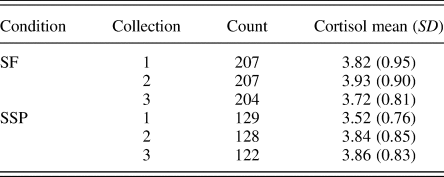
Cortisol was obtained contemporaneously with the Still Face paradigm (age 4 months) and the Strange Situation procedure (12 months) at the lab. Sample collection occurred 15 min after arrival at site, 15 min after peak stress, and 45 min after peak stress for each task to track reactivity. Saliva was collected via Salimetrics SalivaBio Children's Swab (Rodriguez et al., Reference Rodriguez, Huntington-Moskos, Johnson, Williams, Gulledge, Feeley and Rice2016). For both stressors, cortisol peak collection was timed based on the expected greatest dyadic stress point: the beginning of the Still Face paradigm episode in which the mother looks at her infant with a neutral expression for the Still Face paradigm and the second separation period for the Strange Situation procedure. Saliva was centrifuged out of the collection swab and stored immediately in Wheaton Cryovials at –80 °C until assayed. Assays were performed on samples in duplicate using commercially available, validated enzyme-immunoassays (www.salimetrics.com) kits. Samples with intra-assay coefficients of variation greater than 7% were reassayed. Plates with unreliable performance (e.g., standard curves with R 2 less than .996 or control samples that vary by 15% from standardized controls) were reassayed. Cortisol levels across the Still Face paradigm and Strange Situation procedure are available in Table 1.
Average cortisol by time point

Note: SF, Still Face procedure. SSP, Strange Situation procedure. Values are log transformed and windzorised and reported as mean (SD).
The Still Face paradigm
The Still Face paradigm is a validated interactive social stressor that has been used to evaluate an infant's stress response (Haley & Stansbury, Reference Haley and Stansbury2003; Lewis & Ramsay, Reference Lewis and Ramsay2005) and regulatory capacities in the context of the maternal relationship (Tronick et al., Reference Tronick, Als, Adamson, Wise and Brazelton1978). A trained research assistant conducted the Still Face paradigm. The following standard procedure was used with three distinct epochs: talking and interacting (2 min), maternal neutral face and no interaction (2 min), and resumption of talking and interaction (2 min). Twenty seconds of sustained distress resulted in the termination of the epoch. Infants were seated in an age-appropriate chair or car seat for the procedure, facing the mother at eye level. A research assistant was present but hidden from the infant throughout the procedure. To systematically examine infant stress response to the Still Face paradigm across all infants, the peak cortisol sample was collected 15 min after the start of the second epoch where the mother maintains a neutral expression. Peak cortisol was not estimated from infant affective distress real time due to the potential incongruency of affective distress and HPA axis activation. The mother was given careful instructions not to have physical contact with the infant during the entire procedure but to “play” with her child as she would normally during the first and third epochs.
The Strange Situation procedure
Ainsworth's Strange Situation procedure is an extensively studied laboratory assessment using a separation–reunion paradigm to classify the extent to which the child uses the parent as a secure base for exploration (Ainsworth et al., Reference Ainsworth, Blehar, Waters and Wall2015). Briefly, the Strange Situation procedure is a structured series of events that include interactions with the mother alone, involvement of a stranger, separation from the mother, and a reunion with the mother. The Strange Situation procedure is approximately 21 min in duration and consists of eight episodes. There are two separation episodes of the Strange Situation procedure. In the second separation, the child is left alone in a room, and this is considered the peak stressor event of the paradigm. The Strange Situation procedure has been found to elicit HPA axis activation in infants though developmental differences and differences by attachment classification occur (Gunnar et al., Reference Gunnar, Talge and Herrera2009; Gunnar, Brodersen, Krueger, et al., Reference Gunnar, Brodersen, Krueger and Rigatuso1996; Van Bakel & Riksen-Walraven, Reference van Bakel and Riksen-Walraven2004). The Strange Situation procedure was conducted by trained research assistants.
Measures
Mothers provided information about multiple levels of their health, behavior, and environment using an approximately 90-min interview-assisted computer survey completed by all participants, administered face-to-face at the research site or at prenatal clinics (Questionnaire Development System, QDS, Nova Research, Bethesda, MD) prior to delivery, and additional information was obtained at each subsequent study visit. Race-related inequity variables were utilized from the prenatal survey. Oral responses were recorded onto the computer by trained interviewers. Mean differences in covariates and control variables by race are available in Table 2.
Covariate means and standard deviations within Black participants

Note: EOD, experiences of discrimination. RS, racial socialization. SES, socioeconomic status. ULSS, urban life stressors as measured by the Urban Life Stressors Scale. Age represents gestational age of the child.
SES
Maternal report was used to measure SES, which reflected the family/household ecological level. A summary score of SES, generated in our laboratory, was indexed from education, employment, home ownership, income, savings, and government assistance status (range: 0–6). Education was scored “0” for less than high school and “1” for high school or greater. Employment was scored “0” for less than full time and “1” for full time. Home ownership was scored “0” for renting and “1” for ownership. Income was scored “0” for less than $24,999 annual income and “1” for greater than $25,000. Savings was scored “0” for less than $500 and “1” for $500 or greater. Government assistance was scored “0” for assistance and “1” for no assistance. A score of 6 represents the highest tier of SES.
Discrimination
The Experiences of Discrimination Scale was used to assess discrimination. This reliable and valid instrument (Krieger, Smith, Naishadham, Hartman, & Barbeau, Reference Krieger, Smith, Naishadham, Hartman and Barbeau2005) captures the degree to which mothers, in their lifetime, have been made to feel inferior, hassled, discriminated against, or prevented from doing something they wanted to do, or called derogatory terms based on race or gender. The Cronbach's α coefficient in this sample was 0.86. This survey is especially relevant as it was designed to predict health outcomes. At the prenatal assessment, mothers reported whether or not they worried about racial discrimination (1) as a child and (2) in the past year, (3) personally and (3) for their racial/ethnic group. Only race-related discrimination was utilized in this study. The total worry index ranged from 0 (did not endorsed worrying about discrimination) to 4 (endorsed worrying about discrimination on all four items).
Racial socialization
The measure developed by Hughes and Chen (Reference Hughes and Chen1997), specifically three items from the preparation for bias subscale, was used to assess racial socialization. These items asked whether the mother's own parent(s) talked to her about racism, the fight for equality, or told her that people may try to limit her because of her race (never = 0 to very often = 4). Items were summed to create an overall socialization scale that ranged from 0 to 12.
Urban life stressors
The Urban Life Stressor Scale (ULSS; Jaffee et al., Reference Jaffee, Liu, Canty-Mitchell, Qi, Austin and Swigonski2005) was used to capture urban life stressors. The ULSS is a 21-item instrument that is used to measure subjective contextual community-level stressors as potential sources of psychological and emotional stress experienced by persons living in medium to large cities. Each item on the ULSS is answered with reference to a 5-point scale ranging from 1 (no stress at all) to 5 (extremely stressful—more than I can handle). The total score reflects the level of stress associated with day-to-day life in an urban environment. The scale is intended to identify chronic life stress as opposed to acute event stress. The scale's reliability and validity have been established in African American and Latino groups (Sanders-Phillips, Reference Sanders-Phillips1996), and Cronbach's α in our sample was 0.87.
Gestational age
The difference between date of last menstrual cycle and date of delivery, in days and obtained from medical records or maternal report, was used as a measure of gestational age.
Analytic strategy
Cortisol samples were nested within individuals, which were nested within Still Face paradigm and Strange Situation procedure visits. To account for the inherent correlation within individuals within time points, data were analyzed using Multilevel Mixed Effects Models in R (Bates, Maechler, & Bolker, Reference Bates, Maechler and Bolker2012; Finch, Bolin, & Kelley, Reference Finch, Bolin and Kelley2014; R Core Team, 2013; Pinheiro & Bates, Reference Pinheiro and Bates2000). A base model of linear and quadratic time predicting cortisol was established to index the change in cortisol from baseline within individuals. Intercepts and slopes varied across all models. In this framework, cortisol as the outcome of interest was predicted by time across the stressor and the intercept represents the putative baseline cortisol level for that individual:
 $$Cortisol = {\rm \beta} _0 + {\rm \beta} _1 \times Time + {\rm \beta} _2 \times Time^2 + Error.$$
This model predicts the within-individual growth curve of cortisol over the tasks. Between-individual and between-time point differences in within-individual trajectory were assessed using higher order nesting of the model (e.g., between-individual effects of race can load on a second level):
 $${\rm \beta} _0 = \gamma _{00} + \gamma _{01} \times Race + Error$$
 $${\rm \beta} _1 = \gamma_{10} + \gamma _{11} \times Race + Error.$$
and these effects can vary by stress time point:
 $$\gamma _{00} = \rho _{000} + \rho _{001} \times Condition + Error$$
 $$\gamma _{01} = \rho _{010} + \rho _{011} \times Condition + Error$$
 $$\gamma _{10} = \rho _{100} + \rho _{101} \times Condition + Error$$
 $$\gamma _{11} = \rho _{110} + \rho _{111} \times Condition + Error.$$
This allows for an overall model that can answer global questions about the impact of between-individual differences such as race in the entire sample. Next, each time point was examined independently as a two-level model to further decompose race effects. Known correlates of racial inequity such as SES, experiences of discrimination, racial socialization, and urban life stressors were added as main effects to these models to examine the impact they have on race. Gestational age and sex are covaried for in all models, and continuous variables were centered. Because inequities related to minority race are not theoretically predicted to manifest in majority White individuals and measures are not known to be valid and reliable in White individuals, investigation within race was limited to Black infants (Sen & Wasow, Reference Sen and Wasow2016).
Results
Overall model of cortisol across both the Still Face paradigm and the Strange Situation procedure
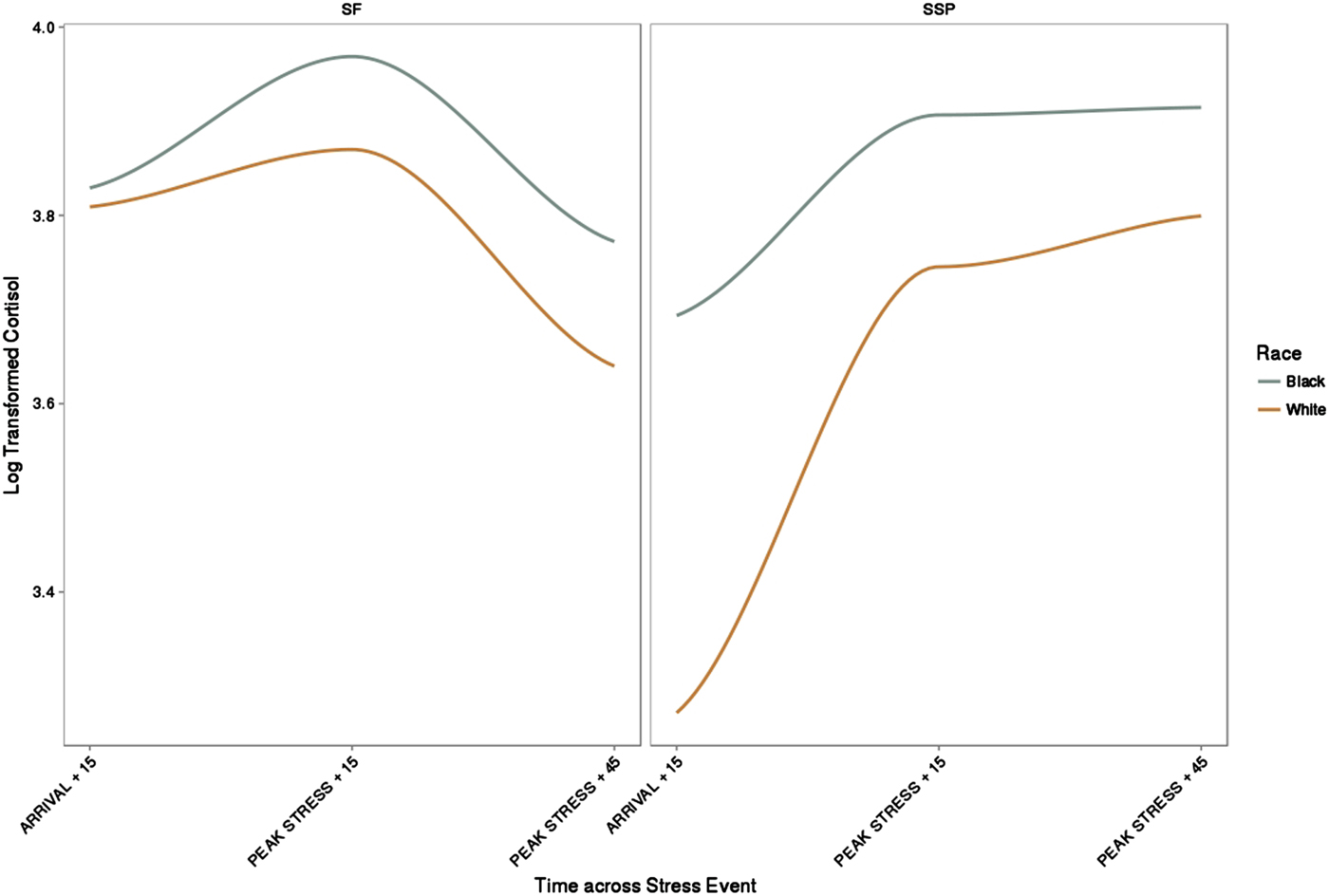
In an overall model of cortisol nested within individuals nested within visits, cortisol had an average log transformed, winsorized baseline value of 3.65. As time increased, cortisol increased across the stressors, β = 0.26, 95% confidence interval (CI) [0.10, 0.43], p < .001, until curving back toward baseline, β = –0.16, 95% CI [–0.46, –0.09], p < .001, in recovery. When cortisol was allowed to vary by visit and race, there was a Race × Visit interaction, which suggested that overall race effects differ by visit, β = –0.44, 95% CI [–0.83, –0.06], p = .025 (see Figure 1). This Race × Visit interaction is therefore decomposed below.
Cortisol differences by race across the 4-month Still Face procedure and the 12-month Strange Situation procedure.

Cortisol across the Still Face paradigm
At the Still Face paradigm, cortisol increased from baseline, β = 0.26, 95% CI [0.08, 0.44], p = .004, peaked, and curved downward in recovery, β = –0.16, 95% CI [–0.24, –0.08], p = .004. There was no effect of race on overall cortisol levels at this visit, β = –0.07, 95% CI [–0.29, 0.15], p = .004. Furthermore, race did not significantly moderate the trajectory of cortisol across the Still Face paradigm, β = –0.09, 95% [CI –0.45, 0.27], p = .63. The covariates infant sex and gestational age were not significant in this model.
Cortisol across the Strange Situation procedure
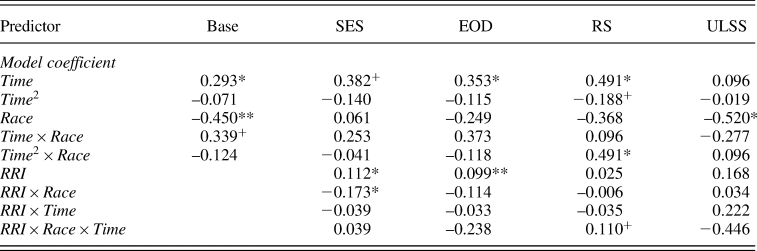
At the Strange Situation procedure visit, cortisol increased from baseline, β = 0.43, 95% CI [0.24, 0.62], p < .001, but this responsivity was qualified by a quadratic effect, β = –0.12, 95% CI [–.21, –0.03], p =.008; Figure 1 shows that cortisol levels rose and then remained flat across the Strange Situation procedure. Race exhibited a main effect such that White infants had lower overall cortisol levels, β = –0.362, 95% CI [–0.62, –0.10], p = .008. When race was allowed to moderate change in cortisol across time, race continued to predict lower peak cortisol for White infants, β = –0.45, 95% CI [–0.73, –0.17], p = .002. Neither sex nor gestational age exhibited main effects on cortisol responsivity in this or any subsequent models described below. Table 3 demonstrates overall race and race by time interactions for the SSP procedure.
Coefficients of racial inequity at the Strange Situation procedure visit

Note: RRI, the term for racial inequity loaded in the specific model. SES, socioeconomic status. EOD, experiences of discrimination. RS, racial socialization. ULSS, urban life stressors as measured by the Urban Life Stressors Scale. In the SES column, the RRI term represents the coefficient for SES and SES interactions; the same applies for EOD, RS, and ULSS. +p < .10. *p < .05. **p < .01.
Racial inequity models
To examine factors that could contribute to development of race differences that emerged by the Strange Situation procedure, a series of indices of racial inequity were added to the Strange Situation procedure race model, as both main effects and interaction terms with race. These models were subsequently run within Black infants, to move beyond contrasting between Black and White infants and avoid a deficit model.
SES
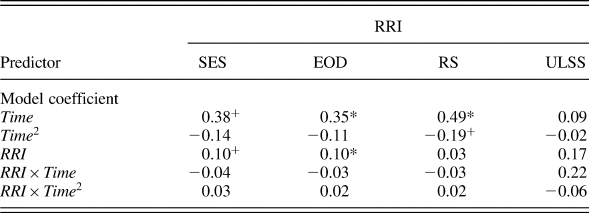
When SES was added to the 12-month Strange Situation procedure model, no effect of SES or SES × Race interaction was found on cortisol reactivity to the Strange Situation procedure (see Table 2), but there was a significant a Race × SES interaction observed on overall cortisol levels, β = –0.17, 95% CI [–0.33, –0.02], p = .033. To decompose the SES × Race interaction, SES was analyzed within Black infants. SES was not significant in Black infants, β = 0.10, 95% CI [–0.02, 0.22], p = .094, but trended toward the direction that greater SES was associated with higher overall cortisol levels.
Experiences of discrimination
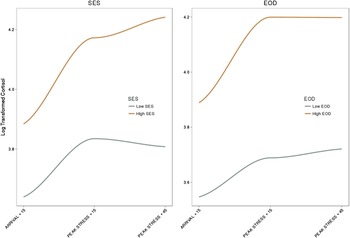
The addition of experiences of discrimination to the 12-month Strange Situation procedure model resulted in the loss of a significant association with race, β = –0.25, 95% CI [–0.56, 0.06], p = .121, and a direct significant effect of experiences of discrimination, β = 0.10, 95% CI [0.03, 0.17], p = .007, illustrating that experiences of discrimination accounted for some of the variance previously accounted for by race in cortisol trajectory across the Strange Situation procedure. When examined within Black infants, higher maternal report of her own experiences of discrimination predicted higher cortisol, β = 0.101, 95% CI [0.02, 0.18], p = .014 (see Figure 2; Table 4).
Cortisol differences by socioeconomic status and experiences of discrimination at the 12-month Strange Situation procedure.

Coefficients of racial inequity within Black infants at the Strange Situation procedure visit

Note: RRI, the term for racial inequity loaded in the specific model. SES, socioeconomic status. EOD, experiences of discrimination. RS, racial socialization. ULSS, urban life stessors as measured by the Urban Life Stressors Scale. In the SES column, the RRI term represents the coefficient for SES within races; the same applies for EOD, RS, and ULSS. +p < .10. *p < .05.
Racial socialization
When racial socialization was added to the 12-month Strange Situation procedure model, race was no longer a significant predictor of overall cortisol levels, β = –0.37, 95% CI [–0.81, 0.07], p = .102, and did not predict cortisol responsivity or recovery, linear β = –0.09, 95% CI [–0.71, 0.52], p = .766; quadratic β = 0.10, 95% CI [–0.19, 0.38], p = .516) Racial socialization was also not a significant predictor of overall cortisol or cortisol reactivity, levels β = 0.02, 95% CI [–0.01, 0.06], p = .208; linear β = –0.03, 95% CI [–0.09, 0.02], p = .226; quadratic β = 0.02, 95% CI [–0.01, 0.05], p = .134. The Racial Socialization × Race × Time, β = 0.11, 95% CI [–0.02, 0.24], p = .099, and Time2, β = –0.05, 95% CI [–0.11, 0.01], p = .086, interaction was not significant. When examined within Black infants, racial socialization was not significant for as a main effect, β = 0.03, 95% CI [–0.02, 0.07], p = .250, or as a cross-level interaction with time, β = –0.03, 95% CI [–0.09, 0.02], p = .223.
ULSS
When urban life stressors were added to the 12-month Strange Situation procedure model, race remained significant, β = –0.52, 95% CI [–0.99, –0.06], p = .03. The ULSS was not significant as a predictor of cortisol levels or cortisol responsivity to the Strange Situation procedure, levels β = 0.17, 95% CI [–0.05, 0.39], p = .142; linear β = 0.22, 95% CI [–0.10, 0.55], p = .185; quadratic β = –0.06, 95% CI [–0.22, 0.09], p = .443. When examined within race, urban life stressors were not significant overall for Black infants, β = 0.17, 95% CI [–0.08, 0.42], p = .175, and were not significant as a time interaction with Black infants, β = 0.22, 95% CI [–0.10, 0.55], p = .183.
Discussion
This is the first study, to our knowledge, to examine race as a possible moderator of cortisol reactivity to an age-appropriate dyadic stressor before and after the expected development of the attachment relationship in infancy. Our results suggest that by 12 months of age, race differences in cortisol output are apparent across the Strange Situation procedure, with Black infants exhibiting overall higher cortisol output, whereas no race differences were observed across the Still Face procedure at 4 months of age. A core observation motivating this investigation was that, later in life, many of the diseases, including cardiovascular disease, obesity, diabetes, and stroke, associated with altered HPA function exhibit significant race disparities. (Kurian & Cardarelli, Reference Kurian and Cardarelli2007; Wong et al., Reference Wong, Shapiro, Boscardin and Ettner2002). Our findings, when coupled with the broader literature, suggest that the earliest roots of race-related health disparities are emerging in the first year of life but, at least regarding cortisol reactivity, were not yet apparent by 4 months of age. This finding provides a critical window of opportunity for researchers aiming to reduce health disparities in stress-related disorders as it suggests that early preventative efforts, particularly those implemented in the first year of life, may mitigate the negative effects of maternal exposure to racism and biologically buffer the infant from future health risk.
Our results must be situated in a developmental and environmental context. We found elevated cortisol across the Strange Situation procedure for Black infants. Similar effects in the context of caregiving stress have been reported later in life such that Black women exhibit greater cortisol response to caregiving stress than White women (Wilcox, Bopp, Wilson, Fulk, & Hand, Reference Wilcox, Bopp, Wilson, Fulk and Hand2005). However, our results diverge from studies at later developmental time points. For example, Chong et al. (Reference Chong, Uhart, McCaul, Johnson and Wand2008) found blunted cortisol reactivity to a psychosocial stressor in Black adolescents relative to White adolescents, and Hostinar et al. (Reference Hostinar, McQuillan, Mirous, Grant and Adam2014) found Black adolescents had lower baseline cortisol at a psychosocial stressor than Whites. The lack of consensus in a clear pattern is likely a result of differences in developmental time point and choice of stressor. It is remarkable that, while reactive cortisol patterns may not be stable across development and context, clear cortisol patterns do manifest in infants as early as 4 months of age, and that race differences in cortisol levels emerge by 12 months. This suggests an early embedding of context, and the need for larger longitudinal studies to better delineate how individuals are changing across time and context.
To better understand the contributing factors underpinning racial differences, we used the frameworks suggested by Causadias, Telzer, and Lee (Reference Causadias, Telzer and Lee2017) and Doane et al. (Reference Doane, Sladek, Adam, Causadias, Telzer and Gonzales2018). Racial inequity indices helped shed light on the racial differences observed in physiological processes during infancy. Specifically, we found that, at 12 months of age, the interaction between cortisol and race was moderated by maternal report of SES during pregnancy. This suggests that the impact of poverty and SES on the developing HPA axis may not be equivalent for Black and White infants. Furthermore, markers of SES and potentially larger structural factors (e.g., structural racism) that lead to community disinvestment have been linked to stress reactivity in children (Hackman, Betancourt, Brodsky, Hurt, & Farah, Reference Hackman, Betancourt, Brodsky, Hurt and Farah2012). Neighborhood violence, often associated with concentrated poverty and disadvantage, has been shown to impact cortisol reactivity in an older, high-risk all Black sample (Theall, Shirtcliff, Dismukes, Wallace, & Drury, Reference Theall, Shirtcliff, Dismukes, Wallace and Drury2017). Although much of the current literature links inequalities in SES with potentiated racial inequality, our results suggest that SES as a component of racial inequality contributes to the development of physiological differences.
Urban life stressors did not influence race differences in cortisol patterns. However, experiences of discrimination and racial socialization resulted in changes to the relation between race and cortisol patterns. Experiences of discrimination in Black infants’ mothers accounted for a significant proportion of the variance in race differences in cortisol patterns, and higher maternal report of worry related to discrimination was associated with significantly higher cortisol levels providing the first data, to our knowledge, of a cross-generational impact of discrimination on infant physiology. This finding is in line with the framework suggested by Causadias (Reference Causadias2013) and Doane et al. (Reference Doane, Sladek, Adam, Causadias, Telzer and Gonzales2018), which suggest that race differences in physiological parameters manifest as a result of many different interacting pathways, of which racial discrimination often occupies a critical role. Cortisol output across the 12 month Strange Situation based on maternal report of discrimination further extends evidence provided by Korous et al. (Reference Korous, Causadias and Casper2017), who found racial discrimination to have a small and inconsistent effect on cortisol output across studies in a meta-analysis of adolescent and adult cohorts. This is the first study to investigate this effect in infants. The fact that race was not significant when discrimination was included in the model highlights the role of racial discrimination in the relationship between race and physiological parameters such as cortisol, even across generations.
Discrimination is a multidimensional phenomenon and can act as a potent stressor, though current measures of discrimination are limited (Williams & Mohammed, Reference Williams and Mohammed2009; Williams et al., Reference Williams, Neighbors and Jackson2003). The racial discrimination literature has begun to coalesce around the themes of daily hassles and life events (Williams & Mohammed, Reference Williams and Mohammed2009). The broader stress literature can offer insights into future paths for the assessment of discrimination. Several decades of research (Cohen, Kessler, & Gordon, Reference Cohen, Kessler and Gordon1997) track how stress physiologists have grappled with questions surrounding objective versus perceived impact of stressors, developmental timing of stressors, the duration and/or chronicity of stressful events, and the distinction between stress and coping responses. Specifically for cortisol, the types of stress exposures appear to shape physiological responses, with uncontrollability and social evaluative threat emerging as particularly potent characteristics of stressors (Dickerson & Kemeny, Reference Dickerson and Kemeny2004). Theoretical models posit that these contexts are stressful because they contain life-history relevant information about resource availability, extrinsic morbidity–mortality cues such as the presence of threats, and unpredictability or uncontrollability cues about the stability of the environment (Del Giudice, Ellis, & Shirtcliff, Reference Del Giudice, Ellis and Shirtcliff2011). This literature increasingly focuses on whether or not a stressful event occurred (Anda et al., Reference Anda, Felitti, Bremner, Walker, Whitfield, Perry and Giles2006) or whether the stress exposure was chronic and/or severe (McEwen, Reference McEwen2004).
We have employed the stress framework in our paper but acknowledge that this approach may inadvertently lead to a deficit model where, for example, being Black in the United States is contrasted with being a member of a majority group with presumably fewer stressors. Focusing on within-race analyses helps minimize the deficit model. We also explore acculturation factors that may broadly shape stress physiology in a protective manner. However, we also acknowledge race as a social categorization (American Anthropological Association, 1998; Jorde & Wooding, Reference Jorde and Wooding2004) and the limitations that examining race entails. Bolstered by stereotypes and false myths about human differences and group behaviors perpetuated over centuries, racial stratification in societal treatment, opportunities, and access to power and resources in the United States remains. Therefore, examining the impact of race is key to understanding and eliminating racial disparities in health across the life course.
A stress framework distinguishes between objective and perceived stress, generally finding that objective stressors exert a stronger impact on stress physiology than subjective experiences (Cohen et al., Reference Cohen, Kessler and Gordon1997) and that individual differences in appraisal and coping may be fruitful targets for mitigating the impact of stress exposure (Taylor, Reference Taylor2010). Within racial/ethnic minority populations, however, racial discrimination appears highly impactful. Discrimination largely revolves around power imbalances, and strategies geared toward racial socialization are employed when there is a perceived need for buffering the next generation from engendering feelings of powerlessness and inferiority based on these experiences. That race differences in HPA functioning in study after study persist even after accounting for objective and perceived stressors is a testament to the realities and complexities of what it means to be a racial/ethnic minority in the United States and supports the idea that inequalities tap into very real stressors that are unlikely to be mitigated through reappraisal or enhanced coping strategies. Our data suggests that these effects even span generations.
The physiological and biological information provided by measures like cortisol suggest that racial discrimination is impactful precisely because it is tapping into highly salient social cues. The stress-response system is calibrated by threats, including social evaluation and extrinsic morbidity–mortality cues, as well as unpredictable or uncontrollable contexts that inform the stability of the environment and availability of stress buffers (Del Giudice et al., Reference Del Giudice, Ellis and Shirtcliff2011). Exposure to racial discrimination is encountered with unfortunate ubiquity for members of racial/ethnic minority groups. The stress-response system may be attuned and highly capable of differentiating subtle cues about social threats and availability of stress buffers (i.e., at distinguishing the ill-informed microaggressions from hostile power displays of intimidation).
Contrary to our expectations, maternal exposure to racial socialization did not influence race differences, suggesting that the buffering impact of racial socialization in other domains may not be transmitted across generations, or at least may not reflect changes in cortisol during the first year. It is also possible that increased racial socialization between grandparents and parents may index greater exposure to racism and discrimination in caregivers overall.
The articles included in this Special Issue may include biological measures, but do not espouse biological essentialism, which has been used to perpetuate racial hierarchies (Causadias et al., Reference Causadias, Telzer and Lee2017; Hartigan, Reference Hartigan2010). This view of race can lead to “justification for a racially inequitable status quo and for the continued social marginalization of historically disadvantaged groups” (Williams & Eberhardt, Reference Williams and Eberhardt2008). This essentialist view of behavior is neither acceptable nor accurate. Human health and behavior is an interaction between biology and an individual's environment that varies through time and across contexts, shifting and adapting continuously to the ever-changing world. The mitigation of racial differences with the inclusion of experiences of discrimination, a well-established correlate of social inequity, strongly contradicts the biological essentialist viewpoint and highlights the importance of viewing the individual as a contextually adaptive organism moving and changing across time (Causadias, Reference Causadias2013; Causadias et al., Reference Causadias, Telzer and Lee2017; Del Giudice et al., Reference Del Giudice, Ellis and Shirtcliff2011). Cultural context and biology are in concert, not at odds.
This study also provides novel information about the developing HPA axis given the targeted use of a dyadic stressor in which the social and emotional cues from the infant's mother are ambiguous to the infant. This contrasts with much of the extant literature, which uses novelty or pain stimuli to induce a stress response which, as the infant develops, diminishes in intensity (Gunnar & Donzella, Reference Gunnar and Donzella2002; Gunnar et al., Reference Gunnar, Talge and Herrera2009; Loman, Gunnar, & Early Experience, Stress, and Neurobehavioral Development Center, Reference Loman and Gunnar2010). In this study, we found cortisol reactivity to both the Still Face paradigm and the Strange Situation procedure, paradigms that are distressing to the infant through the disruption of the putative safe haven that is mom. This brief, experimental disruption is a cause for alarm for the infant and warrants a physiological response to mobilize all the resources of the infant to attend and respond to this situation. Mobilization of the infant's stress-response systems ideally results in behavior patterns in both the infant and the mother that bring the dyad back in synchrony. The infant may be receptive to the mother's contingent responses, creating a synchronous dyadic pattern that is a prerequisite for future infant self-regulation and socioemotional development (Feldman, Reference Feldman2012; Feldman & Eidelman, Reference Feldman and Eidelman2009).
In the first years of an infants’ life, much of the world around them is novel; they are constantly experiencing and integrating new information. Stress is partly characterized by novelty and unpredictability (Dickerson & Kemeny, Reference Dickerson and Kemeny2004). To an infant newly experiencing the world, much will be novel and unpredictable. Stressors such as inoculation, hand restraint, or diaper change putatively tap into the stress of novelty and unpredictability. Despite this stress exposure, it may not be biologically adaptive to mount a dramatic stress response to novel, unpredictable, or even painful stimuli in a time period when much of the stimuli the infant encounters meet those criteria. The early caregiver–child relationship functions as a powerful buffer for infants and toddlers, protecting them from the continuous impact of novelty and unpredictability (Albers, Riksen-Walraven, Sweep, & de Weerth, Reference Albers, Riksen-Walraven, Sweep and de Weerth2008). The dyadic stressors used here may be more effective in eliciting HPA reactivity across infancy by involving the maternal caregiver as a source of stress and not allowing the infant to utilize the mother as a buffer. There is a proposed biological utility for the decreasing stress response to the environmental cues over the first years of life: to facilitate exploration without incurring the biological costs of a consistently hyperactive HPA axis.
Limitations
Several limitations to this study apply. Our findings are likely generalizable only to term infants. Table 1 showed that gestational period was shorter in Black infants, consistent with larger epidemiological studies, and no preterm infants were included in this analysis. However, our findings persist beyond the effects of gestational age, which, along with infant sex, was controlled for in all models. Although significant reactivity was observed to the Strange Situation procedure, we did not detect significant recovery. Although it is possible that this may be reflective of the developing HPA axis and the limited ability to recover in that time frame, an alternative explanation is that the remaining aspects of the visit continued to activate the HPA axis and recovery occurred at a later time point not captured with the collection timing and collecting more samples would have captured recovery. It is also possible that recovery is a function of attachment classification and that infants with a secure attachment relationship would exhibit the most robust recovery. Indices of racial inequity were chosen based on available data from our survey and are not exhaustive measures that meet the criteria of contributing to race-related differences in HPA activity or the broader social and cultural context of minorities in the United States. Due to power and sample size considerations, a formal test of mediation was not possible. Other potential covariates that are most often captured in daily diary format, or with older populations, such as sleep data, were not available for this sample given highly disordered sleep patterns of infants. It is also possible that differences between the Strange Situation and the Still Face procedures are due to the tasks themselves and not developmental considerations. We are limited to using tasks that are appropriate across development. Finally, the difference in availability of cortisol between the Still Face paradigm and the Strange Situation procedure samples is because some participants were not yet old enough to complete the Strange Situation procedure.
Conclusions and future directions
It is important for future studies to track the long-term implications of higher or lower cortisol levels beginning at this early age. It may be that the expected patterns that underlie resilience or risk differ by race and/or the environmental context in which the infant grows and develops. Studies in both typically developing and high-risk samples side-by-side that are adequately powered to test both between and within race are needed. Longitudinal studies that examine these trajectories in communities, and ideally large epidemiological samples, are needed to determine what pathways are adaptive and/or characteristic of resilience.
Although we cannot say that one pattern of stress reactivity or another is more adaptive, we can say that Black and White infants do not have the same HPA levels across a dyadic stressor at 12 months of age, and that this is informed by experiences such as racial discrimination within Black families. Our data suggest that in order to minimize disparities in health trajectories across the life span that are related to the stress-response systems, intervention strategies need to be employed as early as possible. Given the key relevance of the early parent–child relationship in shaping the stress-response systems, including the HPA axis, early interventions that focus on strengthening the biological buffering capacity of the attachment relationship represents an underutilized and likely powerful approach to addressing persistent health disparities.