I. INTRODUCTION
Giant magnetostrictive materials Terfenol-D have attracted considerable interest for applications in linear motors, precise actuators, and high-power underwater acoustic transducers.Reference Clark and Wohlfarth1–Reference Yang, Bao, Zhou, Wang, Ren, Matsushita, Katsuya, Tanaka, Kobayashi, Song and Gao5 In general, the giant magnetostriction originates mainly from the (Tb, Dy)Fe2 Laves phase. With the application of a uniaxial compressive prestress, the 〈110〉 or 〈112〉 oriented (Tb, Dy)Fe2 crystals possess improved magnetostrictive performance, which is the so-called “jump” effect.Reference Clark, Teter and McMasters6 The magnetostriction “jump” effect is ascribed to specific moment rotation processes. Under the uniaxial compressive stress, the magnetic moments orient along the 〈111〉 easy magnetization directions (EMDs), which are perpendicular to the crystal axis. As an external field is applied, the moments “jump” toward the nearest EMD, which lies only 19.5° from the 〈112〉 axis or 35.2° from the 〈110〉 axis, resulting in a significant improvement in axial magnetostriction.Reference Clark, Teter and McMasters6, Reference Zhao, Jiang, Zhang and Xu7 Alternatively, magnetic annealing can also redistribute the magnetic moments and control the magnetostrictive responses of Terfenol-D oriented crystals.Reference Ma, Zhang and Yan8–Reference Verhoeven, Ostenson, Gibson and McMasters12 When annealing under a magnetic field transverse to the rod axis, the magnetostrictive strain coefficient, d 33, of a Tb0.3Dy0.7Fe1.95 〈112〉 oriented crystal can be improved by 44%.Reference Galloway, Greenough, Jenner and Schulze9 Without applying any compressive prestress, saturation axial magnetostriction of a 〈110〉 oriented crystal Tb0.3Dy0.7Fe1.95 is significantly improved by 58% after annealing under a transverse magnetic field of 0.3 T.Reference Ma, Zhang, Zhang and Yan10 Previous investigation also demonstrates that both axial magnetostriction λ‖ and perpendicular magnetostriction λ⊥ of the 〈110〉 oriented crystal are significantly improved through transverse field annealing, while negative λ‖ and positive λ⊥ are found after annealing under a coaxial field of 0.3 T.Reference Ma, Yan, Zhang, Luo, Jiang and Xu11 Therefore, differential magnetostrictive responses can be achieved in the 〈110〉 oriented crystal through changing the annealing field direction. This work attempts to investigate the magnetostrictive behaviors of the 〈110〉 oriented crystal Tb0.3Dy0.7Fe1.95 after annealing under a noncoaxial field of 0.3 T, which was applied along the nearest EMD from the 〈110〉 axis.
II. EXPERIMENTAL PROCEDURES
The 〈110〉 oriented Tb0.3Dy0.7Fe1.95 rods were fabricated in a unidirectional solidification furnace specially designed for the ‘‘one-step’’ process.Reference Li, Yang, Yan, Yu, Ying and Zhang13, Reference Fang, Zheng, Li, Han, Li and Yu14 The consecutive process from melting to oriented condensation and further to heat treatment was accomplished on the same equipment. Microstructure studies revealed that the material was polycrystalline, and most grains were aligned with a 〈110〉 preferred orientation along the crystal growth direction.Reference Fang, Zheng, Li, Han, Li and Yu14 Specimens with 7 mm diameter and 40 mm length were cut from these rods and sealed in quartz tubes after pumping to 1 × 10⁻² Pa. One sample was subjected to field annealing under conditions similar to our previous work.Reference Ma, Zhang, Zhang and Yan10 The sample was heated to 500 °C, which was approximately 120 °C higher than its Curie temperature T C, and kept for 10 min, then furnace cooled to room temperature under an external field of 0.3 T. During field annealing, the sample rod was fixed with its axis 35° away from the field direction.
Crystal orientations of the untreated and field annealed specimens were checked by a Rigaku (Tokyo, Japan) D/MAX 2400 PC x-ray diffractometer with Cu Kα radiation. The specimen surfaces were carefully polished down to 0.35 μm diamond finish to observe microstructures and magnetic-domain structures. Morphologies were observed under an optical microscope. Magnetic force microscopy (MFM) observations were performed on the polished sample surfaces using a Digital Instruments (Philadelphia, PA) Dimension 3000 SPM, using silicon cantilevers with tips coated with high coercivity CoCr films. The MFM images were obtained using a tapping/lift mode. The tips were magnetized normally to the observation surface, with a typical lift height ranging from 10 to 100 nm. Here the effect of strain induced by mechanical polishing on the domain structures is neglected.
Magnetostrictions were measured the output of a 1 mm long × 1 mm wide strain gauge. Axial magnetic induction was detected using an integrating device with a pickup coil. Both the axial magnetostriction λ‖ and perpendicular magnetostriction λ⊥ of samples with a length of 40 mm were measured, respectively. The magnetization direction was parallel to the rod axis. The demagnetization field along the rod axis could be neglected because the aspect ratio of the specimen is larger than 3:1.
III. RESULTS AND DISCUSSION
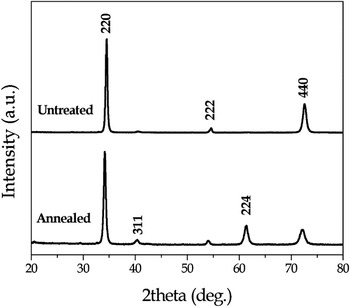
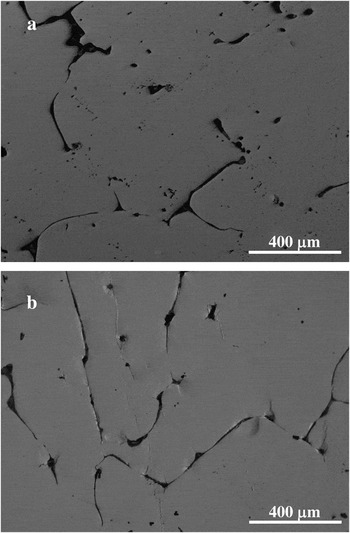
Influences of noncoaxial field annealing on the crystal orientation and morphologies of Tb0.3Dy0.7Fe1.95 were investigated by x-ray diffraction and optical microscopy, as shown in Figs. 1 and 2, respectively. On the transverse sections for both untreated and field annealed specimen, (220) peak was the strongest one among all diffraction peaks in Fig. 1, indicating that both specimens have a 〈110〉 crystal orientation along the rod axis. Meanwhile, both specimens exhibit a biphase microstructure with gray phase as the matrix and black noodlelike phase as precipitates, which are typical morphologies for Tb0.3Dy0.7Fe1.95 oriented crystals fabricated by the “one-step” method.Reference Li, Yang, Yan, Yu, Ying and Zhang13, Reference Fang, Zheng, Li, Han, Li and Yu14 Also, no obvious change in the morphologies can be observed after field annealing. In fact, the temperature at which the magnetic annealing starts is above T C, but is much lower than the eutectic reaction temperature in Tb–Dy–Fe system. Therefore, both the 〈110〉 crystal orientation and morphologies of Tb0.3Dy0.7Fe1.95 rod are retained after field annealing at 500 °C.
X-ray diffraction patterns for transverse sections of the untreated and field annealed Tb0.3Dy0.7Fe1.95 rods, respectively.

Typical optical micrographs for the transverse sections of the (a) untreated and (b) field annealed Tb0.3Dy0.7Fe1.95 rods, respectively. The 〈110〉 rod axis is perpendicular to the observation planes.

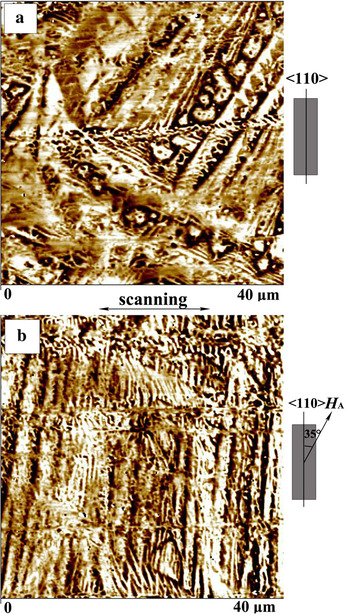
However, the magnetic domain configurations change remarkably, as illustrated in Fig. 3. For the untreated specimen, the magnetic force gradients distribute randomly in the longitudinal surface [Fig. 3(a)], reflecting that the spontaneous magnetization of each domain lies along different easy directions. After noncoaxial field annealing, most of the magnetic domains were arranged as arrays parallel to each other [Fig. 3(b)]. The regular distribution of domains reflects the favor of domain structure with the magnetization arranges along or close to one specific easy direction. Similar to the transverse or coaxial field annealing,Reference Ma, Zhang, Zhang and Yan10, Reference Ma, Zhang, Zhang, Tao and Yan15 the noncoaxial field annealing can also redistribute the magnetic moments in 〈110〉 oriented crystal Tb0.3Dy0.7Fe1.95. As suggested in previous work,Reference Galloway, Greenough, Schulze and Jenner16 the redistribution of moments is relatively easy because of the small magnetocrystalline anisotropy when the temperature decreases through T C under an external field. The moments tend to lie along particular directions under the external field until the temperature is reduced sufficiently for the magnetocrystalline anisotropy to take control. As a result, magnetic annealing changes the magnetocrystalline anisotropy through moment reorientation. It should be noted that the demagnetization field also influences the moment reorientation process during noncoaxial field annealing. However, more effort should be made to discover how it influences.
Magnetic force microscopy images for the longitudinal sections of the (a) untreated and (b) field annealed Tb0.3Dy0.7Fe1.95 rods, respectively. The inset details the crystal orientation and the annealing field direction schematically.

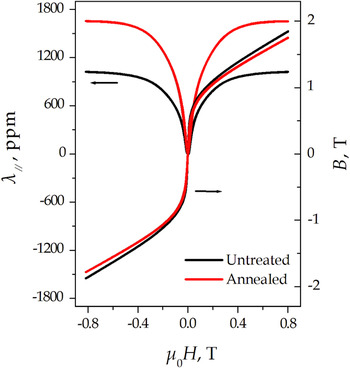
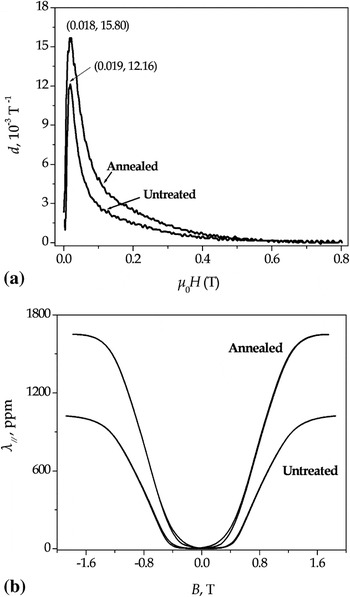
The redistribution of magnetic moments by field annealing leads to an obvious change in magnetostriction. Figure 4 displays the axial magnetostriction and magnetic induction of both untreated and field annealed Tb0.3Dy0.7Fe1.95 rods with 40 mm length. The magnetization direction is parallel to the rod axis for each specimen. It can be seen that axial magnetostriction λ‖ of each specimen saturates at 0.8 T. The saturation λ‖ is 1023 ppm for the untreated specimen and increases drastically to 1650 ppm for the field annealed specimen. The corresponding increment ratio is 61.3%. The magnetic induction B shows a slight decrease from B 0.8T = 1.84 T for the untreated specimen to B 0.8T = 1.75 T for the field annealed one, which should be ascribed to the induced additional anisotropy by magnetic annealing. Using the magnetostriction data in Fig. 4, we got the field dependence of magnetostrictive strain coefficient dλ‖/d(μ0H)(d 33) and the λ‖–B relation for both untreated and field annealed Tb0.3Dy0.7Fe1.95 rods, as illustrated in Fig. 5. The peak value in Fig. 5(a) displays the maximum magnetostrictive strain coefficient d 33 and the corresponding field H 33. The noncoaxial field annealing results in an increment of d 33 from 12.16 to 15.80 × 10⁻³ T−1 by 29.9%. The corresponding H 33 decreases slightly from 0.019 to 0.018 T. It indicates that after noncoaxial magnetic annealing optimum magnetostrictive performance can be achieved under a relatively lower external field besides the enhancement of magnetostriction value. In Fig. 5(b), obvious change occurs in the shape of λ‖–B curves after field annealing, especially at the initial stage. For the untreated specimen, the initial “flat” stage implies that the magnetization is contributed primarily by 180° wall movements, accompanied with no obvious magnetostriction. After the noncoaxial magnetic annealing, however, the initial “flat” stage becomes shorter, exhibiting much larger magnetostriction at the same magnetic induction, which means that non-180° wall movements at low external fields are favored. Therefore, the improvement in magnetostrictive performance at low fields can be ascribed to the favor of non-180° wall movements after magnetic annealing.
Axial magnetostriction λ‖ and magnetic induction of untreated and field annealed Tb0.3Dy0.7Fe1.95 rods.

(a) d 33 versus μ0H and (b) λ‖ versus B curves for untreated and field annealed Tb0.3Dy0.7Fe1.95 rods.

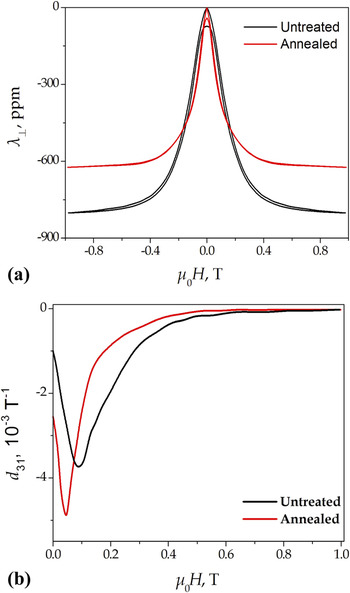
Figure 6(a) shows the perpendicular magnetostriction λ⊥ for both untreated and field annealed Tb0.3Dy0.7Fe1.95 rods. It can be seen that the perpendicular magnetostriction in both specimens reach the saturated state when the external field is 0.9 T. A drastic reduction can be observed in saturation magnetostriction, λ⊥s after noncoaxial field annealing, from −802 to −624 ppm. However, the magnetostrictive strain coefficient d 31 shows a different tendency with the saturation magnetostriction λ⊥s, as shown in Fig. 6(b). The maximum d 31 is 3.77 × 10⁻³ T−1 for the untreated specimen at 0.083 T and 5.00 × 10⁻³ T−1 for the field annealed one at 0.047 T. The noncoaxial annealing results in not only an increase in d 31, but also a decrease in the field for achieving optimum d 31, which is beneficial to obtain better magnetostrictive performance at lower magnetic fields. In addition, unlike the λ‖–μ0H curves, there are remnant magnetostrictive strains in λ⊥–μ0H curves for both specimens after slowly decreasing the external field to zero, which should be related to the shape anisotropy of the rod-shaped specimens. The remnant strain decreases after field annealing because the induced additional anisotropy by magnetic annealing can partially compensate for the shape anisotropy in the rod specimen.
(a) Perpendicular magnetostriction λ⊥ and (b) d 31 versus μ0H curves for untreated and field annealed Tb0.3Dy0.7Fe1.95 rods.

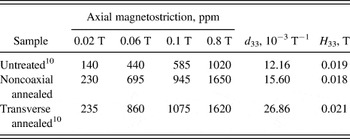
In our previous work, the 〈110〉 oriented Tb0.3Dy0.7Fe1.95 has been subjected to a 0.3 T transverse magnetic annealing,Reference Ma, Zhang, Zhang and Yan10 also exhibiting obvious improvement in magnetostrictive performance than the untreated state. Table I summarizes the axial magnetostriction λ‖ at 0.02, 0.06, 0.1, and 0.8 T, maximum d 33, and the field for obtaining maximum d 33 for the untreated, noncoaxial field annealed and transverse field annealed Tb0.3Dy0.7Fe1.95 specimens, respectively. Saturation magnetostriction λ‖s for the noncoaxial field annealed crystal is the highest among the three specimens. In comparison with the transverse field annealed specimen, although the increment ratio of d 33 was much lower, the corresponding field to obtain optimum d 33 decreases for the noncoaxial field annealed one. However, besides λ‖s, the axial magnetostriction at a certain field is always higher after transverse magnetic annealing than that of noncoaxial magnetic annealing. Therefore, the transverse magnetic annealing obtains better axial magnetostriction than the noncoaxial magnetic annealing in 〈110〉 oriented Tb0.3Dy0.7Fe1.95 at those field regions. In our previous investigation,Reference Ma, Yan, Zhang, Luo, Jiang and Xu11 the saturation perpendicular magnetostriction λ⊥s increases significantly after transverse magnetic annealing, which also shows an obvious difference from the noncoaxial magnetic annealing in the present work.
Magnetostrictive performance in 〈110〉 oriented crystals Tb0.3Dy0.7Fe1.95 with different magnetic annealing status.

IV. CONCLUSIONS
(i) The 0.3 T noncoaxial field annealing cannot change the preferred crystal orientation or morphologies of the 〈110〉 oriented Tb0.3Dy0.7Fe1.95, but results in obvious change of the magnetic domain configurations.
(ii) After noncoaxial field annealing, the 〈110〉 oriented Tb0.3Dy0.7Fe1.95 exhibited a remarkable enhancement in saturation axial magnetostriction but a reduction in saturation perpendicular magnetostriction.
(iii) The noncoaxial field annealing results in an increase of both maximum d 33 and d 31 for 〈110〉 oriented Tb0.3Dy0.7Fe1.95, accompanied with a decrease of the critical field for obtaining maximum d 33 and d 31, which is beneficial for low field applications.
ACKNOWLEDGMENTS
This work was supported by the Natural Science Foundation of China (Grant No. 50701039), the Foundation for the Author of National Excellent Doctoral Dissertation of P.R. China (Grant No. 201037) and the Fundamental Research Funds for the Central University (Grant No. 2010QNA4004).