Kadongo kamu is a Ugandan popular music genre, recognisable by its dense storytelling lyrics in Luganda language. The name ‘kadongo kamu’ means ‘one guitar’, with the prefix ka- implying ‘one little guitar’ or ‘lone guitar’ (Barrett-Gaines Reference Barrett-Gaines2012; Kiyimba Reference Kiyimba, Nannyonga-Tamusuza and Solomon2012). This refers to the kadongo kamu guitarist's feat of emulating the interlocking rhythms of traditional Kiganda baakisimba ensemble drumming on a single instrument (Nannyonga-Tamusuza Reference Nannyonga-Tamusuza, Palmberg and Kirkegaard2002). Kadongo kamu first emerged in the 1950s as part of a post-war flourishing of guitar-based genres throughout central and east Africa, some of which incorporated traditional stringed-instrument techniques (Kubik Reference Kubik1981). The half-century-old genre continues to be developed today, both by radio and television kadongo kamu celebrities and by guitar-wielding buskers on the streets. The name ‘lone guitar’ is evocative not just of the playing style but also of these wandering kadongo kamu street bards who go from bar to bar providing complete entertainment to patrons with their guitars and their wits. Together with the use of traditional dance rhythms, this bardic role, which reiterates an old KigandaFootnote 1 tradition of lyre and harp players, establishes kadongo kamu as a music symbolically tied to ‘tradition’, although it is generally not assigned to Uganda's ‘traditional music, dance, and drama’ category (Nannyonga-Tamusuza Reference Nannyonga-Tamusuza, Palmberg and Kirkegaard2002). The use of electric and digital instruments, together with a thematic focus on modern life in the city and country, makes kadongo kamu ‘modern’ in the popular imagination, although its particular modernity is considered outside of and alternative to the latest, hegemonic modernity of high-tech, globalised, consumer-capitalist culture. In keeping with Peter Manuel's (Reference Manuel1990) proposed definition of popular music, kadongo kamu is a music composed with mass-media dissemination in mind, even as it remains a music for live bardic performance on the streets and theatrical stage.
Although the name ‘kadongo kamu’ highlights guitar-playing, it is the storytelling that has become most essential to the genre's identity.Footnote 2 In some recent kadongo kamu recordings, the guitar has been dispensed with altogether in favour of synthesiser accompaniments, while narrative complexity remains the genre's defining feature. Kadongo kamu is understood to be a music for listening, not for dancing: at concerts, audiences watch attentively from benches, or spread out on the ground; at outdoor bars, kadongo kamu buskers serenade patrons at their tables, who pay in advance a certain number of shillings for a certain number of songs. On the radio and television, kadongo kamu tends to be broadcast during the more sedentary, meditative moments of the working day and week – Sunday afternoons, for example. Kadongo kamu's baakisimba-tinged beat is danceable enough, but fans prefer to sit still so as not to miss any of the lyrics, which are delivered rapidly and without repetition. An ideal espoused by artists is to ‘never repeat a word’ (Luyima and Mawanda 2010, personal communication).
In this article, I analyse and culturally contextualise aspects of kadongo kamu musical style, focusing on the interface between speech rhythm and musical rhythm. I use the term ‘flow’ to refer to the kadongo kamu artist's practice of fitting copious lyrics into a simple, relatively invariant rhythmic container. My research assistant, Michael Kayemba, helpfully suggested ‘flow’ as a translation for a Luganda verb one kadongo kamu artist used to discuss his process of rhythmically fitting lyrics to music: okugyirako (literally, ‘to fit (something) into’). ‘Flow’ is a term many readers will be familiar with from hip hop, where it is used to describe the virtuosic composition, or improvisation, of lyrics to fit an established groove or a certain number of bars. In hip hop, each rapper ideally has her/his own unique flow and the ability to flow in rap is taken as a metaphor for the streetwise ability to flow in life, through or around whatever obstacles an oppressive system may present (Krims Reference Krims2000). Rap connoisseurs do not just listen to rappers’ stories; they are equally attuned to the musical-poetic game of flow. That is to say, they are aware of the background rhythmic matrixes that constrain, and showcase, artists’ verbal creativity, and express admiration for those artists who are able to effortlessly and copiously flow within these structural constraints. I contend that kadongo kamu is based on a similar aesthetic of flow, which has its own metaphorical implications of cultural resilience under oppressive conditions. When they flow impressively, kadongo kamu artists demonstrate that Luganda – a vernacular language that was prohibited in missionary schools and otherwise scorned as less ‘educated’ – is, in fact, ‘deep’. The language's presumed potential for profound poetic expression is demonstrated not just in the artists’ erudite choices of words and phrases but in the specific ways those words and phrases are made to musically flow.
In order to illuminate the broader cultural significance of kadongo kamu's poetic–musical flow, whose rhythms I will analyse in detail, I first contextualise the genre within a historically evolved Luganda language ideology. Kadongo kamu fans appreciate the genre for the ‘education’ it provides them about their language, in its ‘depth’ or ‘richness’. I contend that the significance of kadongo kamu in Ugandan popular culture cannot be adequately grasped without an exploration of what Luganda language as a whole means to many of its Baganda speakers, and how this meaning developed historically, during and after the colonial encounter. The anthropological/sociolinguistic study of language ideologies typically focuses simultaneously on the thoughts and feelings people have come to harbour about their home languages, and on the ways these feelings are expressed and regenerated in the subconscious minutiae of everyday speech. Scholars pay close attention to the ways specific grammatical constructions, word choices and even phonological habits may be informed by an ideology speakers hold, subconsciously and/or consciously, about their language (Schieffelin et al. Reference Schieffelin, Woolard and Kroskrity1998). These close structural analyses have tended to stop, however, at the threshold of musical structure, despite the fact that language ideologies are often articulated most powerfully in song. This is an area where ethnomusicologists, with our specialised training in music-structural analysis, can make valuable contributions to a budding anthropological inquiry. Indeed, ethnomusicological studies have already illuminated much about how specific African cultures reify and enshrine languages, or special registers of language, by musical means (e.g. Agawu Reference Agawu1987; Villepastour Reference Villepastour2010). My analysis of a kadongo kamu song will illustrate some specific musical and poetic techniques by means of which Baganda listeners are stimulated to feel the presence of their home language with its special attributes of ‘depth’ and ‘grace’.
‘Deep Luganda’ language ideology
‘Language ideology’, a term taken up in cultural anthropology and sociolinguistics, refers to a people's cultivated meta-sense of the language they speak, as a cultural property with certain socially meaningful attributes (Schieffelin et al. Reference Schieffelin, Woolard and Kroskrity1998; Baumann and Briggs Reference Baumann, Briggs, Baumann and Briggs2003). Kathryn Woolard defines language ideology as ‘representations, whether explicit or implicit, that construe the intersection of language and human beings in a social world’ (Woolard Reference Woolard, Schieffelin, Woolard and Kroskity1998, p. 3).Footnote 3 Diverse linguistic practices are moulded by language ideologies and in turn reinforce and revise them – from everyday, subconcious manners of speech, to elevated expressions in poetry and song. In this section, I explore the character and history of a language ideology about Luganda, the Bantu language that is the native tongue of the Baganda people, who live in the southern part of Uganda and make up about 17% of the country's total population. Through various practices, including the production and consumption of kadongo kamu music, patriotic Baganda advance the claim that their language is exceptionally deep. That is, they contend that Luganda has a special abundance of ways of saying the same thing, in different, subtle ways, and that this verbal abundance is deep in the sense of being profoundly rooted in tradition. This is not in itself an unusual language ideology: many cultures similarly claim that their native tongues are deep, including many cultures in Africa, e.g. the Yoruba with their ‘deep Yoruba’ (ijinlee Yoruba, see Waterman Reference Waterman1990), and Ghanaian Twi speakers with their mmpanyin kasa ‘deep’ register of Twi (Plageman Reference Plageman2013). What is interesting about deep Luganda language ideology is the particular modern ethnic history that produced it, and the distinctive pop genre, rooted in pre-colonial Kiganda musical traditions, that it has inspired.
‘Deep Luganda’ is a term that often comes up in (English) conversations about kadongo kamu. The corollary Luganda phrase is oluganda olw'obuwangwa (‘traditional Luganda’). ‘Deep Luganda’ may be used to refer to specific word choices that signify an insider's thorough familiarity with the language. For example, the substitution of the word ensimbi (cowry shells) for today's more common word for money, ssente (from English ‘cents’) may be considered ‘deep’ (Ssenjovu 2006, personal communication; Kayemba 2013, personal communication). More broadly, ‘deep Luganda’ can be used to refer to a whole register of poetic speech, one laced with proverbs, metaphors and other puzzling and elegant circumlocutions. Confronted with a particular line of deep Luganda in kadongo kamu, three different listeners may well come up with three different interpretations. For example, in Paul Kafeero's Esaawa y'Okuzaawa (‘The Hour of Death’), he sings, ‘Lweruno olutuyigga engeri ya Ddungu, okutuwanika embegabega okuzaanamyanga’. This might be translated, most literally, as ‘Death hunts us like Ddungu [the hunter god], to hang us up by the shoulders, and splay us out [like a garment, pegged on a clothesline at two points]’. The uncommon verb okwanamya (‘to splay out’, here conjugated as okuzaanamyanga, ‘to then splay them out’) presented a challenge to the several Luganda speakers I asked about it. Some agreed with my proposition that, given the context, Kafeero's reference is to an animal, killed and hung up for skinning by a hunter (C. Kimuli 2015, personal communication). One interpreter suggested, however, that the reference here is instead to the effects of rigor mortis on a corpse – a hunching up of the shoulders (Kayemba 2010, personal communication). The translation provided in Barrett-Gaines's recently published collection of Kafeero's songs reads simply ‘death makes us thin’ (Barrett-Gaines Reference Barrett-Gaines2012, p. 223). Here the translator has drawn a connection to a colloquial saying that includes the word okwanamya: ‘onumizza enjala n'okwanamya n'onanamya’ (‘you make me hungry (by keeping me waiting) to the point that hunger is hanging me up’) (C. Kimuli 2015, personal communication). Whatever exact meanings Kafeero may have intended, his lyric would be considered by many to be an example of deep Luganda, simply because it is challenging to decipher, in a way that requires some background knowledge of traditional culture (i.e. knowledge about Ddungu the hunter god, the techniques of hunting, the effects of rigor mortis on a corpse) and/or familiarity with the colloquial saying about hunger.
Deep Luganda is an object of pride for many Baganda, essential to the on-going construction of ethnic identity. Luganda-language aphorisms and proverbs (ebisoko and engero) are regularly mulled over on local radio and television shows, as well as on internet forums. There are annual quiz shows in which Baganda contestants demonstrate their knowledge of the ‘deep’ meanings of arcane sayings (A. Kimuli 2007, personal communication). Traditional singing styles, performed at festivals and other public ceremonies, feature deep Luganda, as does, finally, kadongo kamu, in a pop music mode. Kadongo kamu artists claim that the point of their artistry is to ‘educate people’ (okuyigiriza abantu) (Barrett-Gaines Reference Barrett-Gaines2012; Luyima and Mawanda 2010, personal communication), and much of this education is about the Luganda language itself. As the kadongo kamu elder statesman Matiya Luyima put it in a conversation with my research assistant, Robert Mawanda:
Luyima: The language is rich in words. If you repeat, it means you are poor. And yet the intention for us is to teach people, to entertain them and to educate them on the meanings as well as in the language in which we are singing.
Mawanda: And to show that our language is inexhaustibly rich!
Luyima: Eh! That is the only purpose! But some people, you listen, they just sing … like you know, these days … s/he sings just one word: nkwagala, nkwagala, nkwagala [‘I love you, I love you, I love you.’] (Luyima and Mawanda 2010, personal communication)Footnote 4
From this can be extracted the prevailing Luganda language ideology, which is that the language as a whole is ‘inexhaustibly rich’ (lugagga telugwaayo): there is always more of it to be brought to the surface. Moreover, it is considered a matter of moral importance for a self-identified Muganda to have some command of this richness: one who does not know and revere the language in its depth is said to be mwavu mu bigambo, a ‘pauper in words’ (Luyima and Mawanda 2010, personal communication). In the global modern era, in which language ideologies have proliferated along with ethnic territorial stakes, most ethnic groups believe their respective languages to be special in one way or another (Baumann and Briggs Reference Baumann, Briggs, Baumann and Briggs2003). However, the Baganda's cultural commitment to the supposedly exceptional richness of their Luganda language is especially pronounced, in ways that are attributable to this people's particular colonial and postcolonial experience. Under British colonialism (c. 1890–1962), Luganda was privileged above other vernaculars as a language of Christian proselytisation and indirect rule, even as it was repressed in missionary schools. Early on, a ‘remarkable body of Luganda literature’ (Fallers Reference Fallers1961) was collaboratively produced by British missionaries and Baganda elites, including not just an early translation of the Bible, but also royal histories and collections of proverbs and folklore. The adoption of Luganda as a kind of colonial lingua franca in Uganda (winning out over Kiswahili in much of the country) became symbolic of the Baganda people's exceptional status under British rule, one that reproduced and enhanced the African kingdom's pre-colonial dominance in the region (Hansen Reference Hansen1984). In short, the colonial era saw significant collaborative ‘invention’ of Luganda as an ostensibly deep and ‘civilised’ language compared to neighbouring African vernaculars.Footnote 5 This occured even as Luganda was being repressed in schools and generally subordinated to English.
With Ugandan independence in 1962, the colonial-era political power of the Buganda kingdom precipitously declined and even more symbolic importance came to be attached to the Luganda language. Living for the first time under the rule of ethnic others from the North (who, notoriously, sent troops to occupy the palace of Buganda's kabaka, and chased him into exile), some Baganda increasingly looked for cultural self-assurance and continuity in deep Luganda. Notably, kadongo kamu, with its intentionally difficult Luganda, came to maturity during some of the most tyrannous and chaotic years of the Amin and Obote regimes (1971–1986). As Samuel Kasule recounts, in times of tyranny and warfare, kadongo kamu artists put on a kind of ‘guerilla theatre’ – roaming throughout the countryside with their troupes, singing songs in which ethnically patriotic and politically resistant messages were veiled in deep Luganda (Kasule Reference Kasule1998; Cooke and Kasule Reference Cooke and Kasule1999).
Since 1986, under the Museveni regime, kadongo kamu has continued to articulate a resistant, fugitive identity – not just for Baganda, but also for a class-rather than ethnicity-based imagined community of economically struggling Ugandans (Kasule Reference Kasule1998). It provides an alternative understanding of ‘inexhaustible richness’ – measurable in words and ideas, rather than shillings – in the face of a surging culture of consumerism and capitalism which many see to be threatening to ‘traditions’ and underclass life-worlds generally. Whereas today's mainstream Ugandan pop music videos tend to dwell on glossy fantasies of romantic love, entrepreneurial success and conspicuous consumption, kadongo kamu videos are shot in ordinary urban and rural locations and feature ordinary if comically stereotyped characters who deal with the familiar dilemmas of working and family life. Kadongo kamu holds up a mirror to the everyday world inhabited by most Ugandans, one increasingly ignored by the liberalised media's globalist pop-culture spectacle. This is part of what fans imply when they refer to kadongo kamu as ‘local’ music: it is not just a genre iconic of a particular locality, but one that realistically depicts the kind of local-scale, lower-class life that is otherwise banished from new media streams. Beyond merely representing this local life-world, kadongo ennobles it, by describing it in deep Luganda poetry. In a global ‘age of English’ (Mizumura Reference Mizumura and Yoshihara2015), kadongo kamu asserts a worldview that is uniquely possible within this living African vernacular.
In the late 1950s, Christopher Ssebaduka (b. 1929) was the first to compose difficult, deep Luganda-filled kadongo kamu songs for records and the radio, and is considered by many to be the father of the genre (although Elly Wamala, who in 1959 was the first to perform baakisimba rhythms on the guitar, also receives this credit). Perhaps the most beloved Kadongo Kamu singer to date has been the already mentioned Paul Kafeero (1970–2007), known for his especially deep lyrics. Kafeero was a celebrity representative for Uganda's struggling people, appearing on stage in his trademark quirky costumes – sometimes as an army officer, sometimes as a woman – and singing about personal and social problems like excessive drinking that lower-class Ugandans could relate to. If he was an everyman, Kafeero was also seen as a kind of mystical bard in touch with the deepest mysteries of human existence and mortality. His most famous song, ‘Walumbe Zaaya’ (roughly, ‘Walumbe, the Reaper’), symbolically connected the bereavements of the worst years of the HIV/AIDS epidemic to the origin myth of Baganda people, in which Walumbe introduces death to the world in retaliation for not receiving his due share of the patriarch Kintu's offspring (Barz Reference Barz2006). Long after his own untimely death, Kafeero's voice singing ‘Walumbe Zaaya’ continues to well up from PA systems at burials throughout southern Uganda, offering mourners a kind of bitter consolation grounded in traditional African eschatology.
Other artists important to kadongo kamu's historical development include Dan Mugula, Fred Masagazi, Bernard Kabanda, Herman Basudde, Livingstone Kasozi, Matiya Luyima, Sauda Batenda and Willy Mukabya. In the 1980s, Matiya Luyima played an especially important role in melding kadongo kamu's narrative song style with Uganda's hugely popular vernacular theatre tradition (Kasule 2010, personal communication). For over 30 years, Luyima has toured the country with his drama troupe, the Kadongo Kamu Super Singers, performing Uganda's longest and best-loved serial work of musical theatre, the 10-part sung radio drama Ssepiriya (also known as Nakakawa) (Mugambi Reference Mugambi1994). The comic characters of the Ssepiriya story, played by Luyima's wife Sauda Batenda and other members of his family, are beloved all over the Buganda region. As with vernacular theatre typically, audiences at concerts are not mere spectators, but are invited to participate as commentators and judges. By expressing their opinions, they were able to directly influence the decade-long unfolding of the Ssepiriya/Nakakawa plot (Mugambi Reference Mugambi, Grosz-Ngate and Kokole2014). The Kadongo Kamu Super Singers, with its roster of female as well as male stars, paved the way for more women to take up the genre.
Perhaps because of kadongo kamu's emphasis on vernacular-language lyrical complexity, none of the artists mentioned above has found much audience or industry support beyond Uganda and its diaspora, with the sole exception of Bernard Kabanda, who was signed by WOMAD and produced one solo album for this world music label, Olugendo. Kabanda, who died in 1999, is in fact little remembered by the Ugandan public because he was a street musician not a radio star. His influence on other artists, both street buskers and stars, is said nonetheless to have been considerable (Ngidaga 2010, personal communication; Luyima and Mawanda 2010, personal communication). Below, I will be analysing an excerpt of one of Kabanda's songs, ‘Abakazi b'Ekibuga’, because it is stylistically representative of the genre, and because it should be possible for readers to locate the WOMAD label's Olugendo disc.
Speech rhythms, flow aesthetics
The purpose of the music analysis that follows is to reveal some of the techniques that comprise typical kadongo kamu flow. I mean to show how an excerpt from Bernard Kabanda's song ‘Abakazi b'Ekibuga’ (‘Women of the City’) is structured within and against a consistent rhythmic matrix or ‘container’ that is clearly audible to listeners. For connoisseurs, part of the pleasure of kadongo kamu is in appreciating, consciously or subconsciously, the game of choosing words and phrases that fit into a given song's regular rhythmic pattern. The long and short syllables inherent in Luganda speech are a major factor in this rhythmic game. Artists must choose words and phrases whose internal speech rhythms fit into the established pattern of a song, or jostle against it in interesting ways. Although other phonological factors, such as rhyme and assonance, do occasionally shape kadongo kamu lyrics, it is arguably this play of syllable rhythms that is the main structural consideration in this style. This is an aspect of kadongo kamu flow that is not immediately apparent to non-Luganda speakers. For native speakers of Luganda, it is one most are likely to appreciate subconsciously rather than consciously. The artful and abundant composition of poetic phrases that fit into a constraining rhythmic matrix is part of what gives a kadongo kamu artistry an aura of elegance or depth, reinforcing the depth that is conjured at the level of semantics. This depth is then interpreted within the historical Luganda language ideology outlined above.
The artist Matiya Luyima discussed this rhythmic-fitting aspect of kadongo kamu flow, in his interview with me and Robert Mawanda:
Luyima: All the words, they go: ta … ta … ta [beating regular time with the side of his hand]. They go over the guitar pattern.
Mawanda: So they are not forced. Rather it comes, s/he listens to it and hears that it's right.
Luyima: Ah hah! It is pleasing when the guitar is there and the word is there with it.
Mawanda: And so the word flows instead of the word outpacing the guitar, or the music outpacing …
Luyima: For example, when I choose to sing, ‘Bw'obeera n'amaka obeera ku mutawaana’ [exaggeratedly grinding his jaw]. Can't you see how it doesn't work? ‘Bw'obeera n'amaka obeera ku muteero’: it fits in! Now, when you are composing you have to … we in kadongo kamu, the thing must go with the rhythm. Instead of going [grasps wildly at imaginary words swarming around his head].
Mawanda: Now you have to sit and compose a word that does not have to be forcefully inserted.
Luyima: [Nods] And the other thing is that, you cannot repeat a word. We kadongo kamu singers – that is to say, since long ago in kadongo kamu – to repeat means that you are a ‘pauper in words’.
Here Luyima highlights the rhythmic relationship between the words and a constant musical background, marked by the guitar (endongo). He describes having to choose words that ‘fit in’ to this background, and agrees with Mawanda's suggestion that words that do not fit will tend to sound ‘forcefully inserted’ (binyigamu binyizi), as opposed to ‘fitting’, or in Kayemba's translation, ‘flowing’ (bigyirako). As an illustration, he offers his word choice of muteero (‘trouble’), in the phrase ‘Bw'obeera n'amaka obeera ku muteero’ (‘If you have a household, you are in trouble’). Muteero – which is a rare synonym for mutawaana, the most common word for ‘trouble’ – was chosen for its inherent syllable rhythm – short–long-short – as opposed to mutawaana's short–short–long–short, which would not have fit into the musical pattern. We can thus see how, in kadongo kamu, rarer words of deep Luganda may often arise as solutions to rhythmic problems.
Luganda speech has long attracted the attention of linguists for its rhythmic regularity. While other Bantu-family languages have long and short syllables, in Luganda these syllable lengths are pronounced with a high degree of consistency, and in a durational ratio of close to 2:1. Another way of putting this is that, in Luganda speech, the rhythmic relationship of long to short syllables is roughly the same as that of quarter-notes to eighth-notes in music. For the linguist A.N. Tucker, this made Luganda an exceptionally ‘aesthetically satisfying’ language (Tucker Reference Tucker1962, p. 122). Tucker's observations about Luganda inspired later linguists to focus on ‘timing units’ as a phonological phenomenon in other African and world languages (Clements Reference Clements, Wetzel and Sezer1986).Footnote 6
Luganda speakers themselves sometimes conceive of the inherent rhythmic qualities of their language as aesthetically satisfying. This is most evident in the musical concept of amagono (‘melodic ornaments’, sing., eggono; Cooke and Micklem Reference Cooke and Kasule1999). Traditional Kiganda singing is highly melismatic, with certain syllables being drawn out and ornamented.Footnote 7 The rule of thumb is that amagano ornaments should be placed on grammatically long syllables of a lyric, not on short ones. Not all singers of traditional music are equally sensitive to this linguistic-rhythmic factor. Students in music classes who demonstrate an ability to sing amagono in the right places are rewarded with the lead singing parts (Jjombwe 2013, personal communication). I have heard Baganda praise singers’ attention to amagono not just in traditional styles but even in contemporary pop music (Nyanzi 2015, personal communication). These ornaments are an indicator of an artist's ‘grace’ (Ssenjovu 2006, personal communication) at the rhythmic intersection of speech and song.
Beyond the concept of amagono, artists trained in traditional-style Kiganda music are attentive to the long and short syllabic rhythms of their music in other ways, as we learn from the scholarship of an accomplished Muganda musician, James Makubuya. In his article on the endingidi fiddle, he discusses the composition of instrumental patterns based on three ‘basic rhythm motifs … derived from the verbal rhythm (flow) of the Luganda language’. These rhythms are learned by means of verbal mnemonics, such as ‘kyu–ku–kyu–ku, kya–ka–kya–ka–kya’ (Makubuya Reference Makubuya2000, pp. 150–51). This traditional practice of composing music to fit ‘basic rhythmic motifs’ foreshadows the practice of fitting I am concerned with in kadongo kamu. Indeed, the question arises of how the kadongo kamu style differs from the traditional Kiganda bardic styles, if indeed it substantially does. I would contend that kadongo kamu flow is in fact qualitatively different from traditional-style flow, in that the rhythmic matrixes which constrain kadongo kamu lyrics are far more explicit and on-the-surface than are those of traditional music. Kadongo kamu can sound rhythmically repetitive, even incessant – a quality that showcases the piling-up of the artist's poetic inventions, as well as her/his meaningful rhythmic micro-variations from the established pattern.Footnote 8
Unlike kadongo kamu flow, the flow of traditional kiganda singing takes place over dense, elaborate, instrumental, accompaniment patterns that seem to disguise the music's cyclicity, rather than highlighting it. As the Ugandan musicologist and composer Joseph Kyagambiddwa was the first to note, there is, in traditional Kiganda musical style, an element of mystery in the relationship between musical surface and musical structure. The song ‘mysteriously looms up’ out of a musical texture, whose internal patterning is not readily apparent to most listeners (Kyagambiddwa Reference Kyagambiddwa1955; see also Kubik Reference Kubik1960). As one can see in Cooke and Micklem's analysis of a performance by the royal harpist Temutewo Mukasa (Cooke and Micklem Reference Cooke and Kasule1999), the traditional-style singer's utterances are structurally relatable to the elaborate background, but this relation is hardly obvious to the average Muganda listener. Mukasa's voice seems to float with considerable rhythmic freedom over the traditional-style accompaniment pattern, or ‘tone bank’ (Cooke and Micklem Reference Cooke and Micklem1999), which is, in its formidable density and constant variation, to the average listener not so obviously a ‘pattern’ at all.
In kadongo kamu, by contrast, the repetitive melodic-rhythmic matrix tends to be obvious and comprehensible on the musical surface, and clearly constrains the poetic flow. This focuses attention on flow as a kind of game of fitting copious words and thoughts into an explicit, relatively static and limiting container. I would speculate that kadongo kamu's flow, which differs from traditional bardic flow in this way, may have been inspired by calypso, which was popular in urban Uganda during the early years of kadongo kamu's development (Batte 2010, personal communication). A similarly newsy, comedic and exhortational genre, with predictable, even singsong, rhythmic patterning, calypso has been characterised in terms of its ‘use of archaic and synthetic words, the cramming of many syllables into a smaller space, the importance of rhyming and free conception of rhyme’ (Harold Courlander, quoted in Van Dam Reference Van Dam1954). This description applies well to kadongo kamu, except that, in the Ugandan genre, rhyme is less important than other phonological considerations, the play of long and short syllables in particular.
Rhythmic analysis of Bernard Kabanda's ‘Abakazi b'Ekibuga’
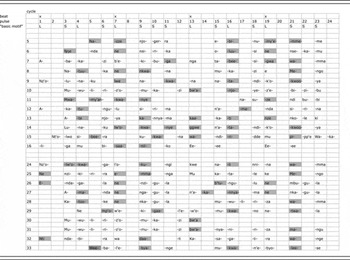
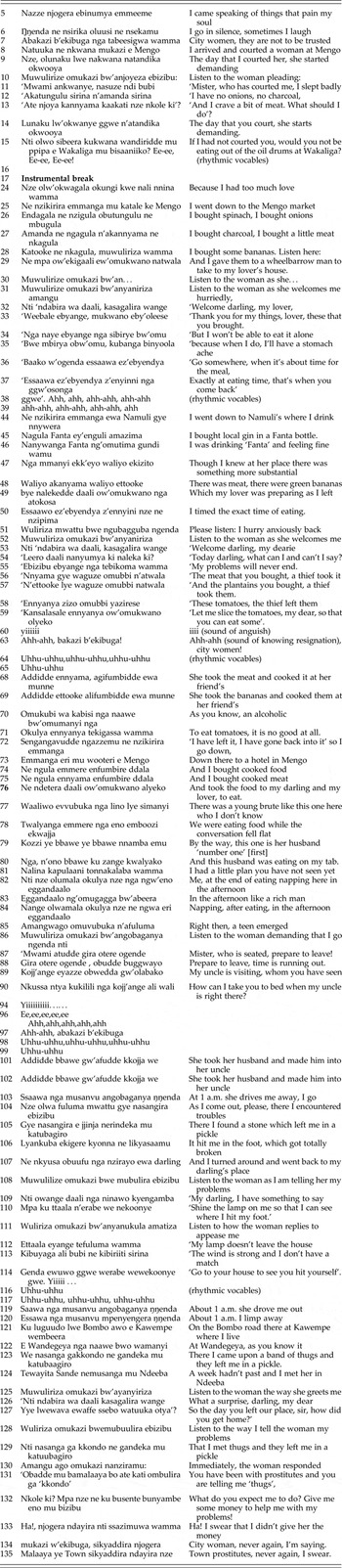
To illustrate the play of linguistic and musical rhythms that is typical of kadongo kamu, I have written in Table 1 a rhythmic transcription of an excerpt of the lyrics of a kadongo song, ‘Abakazi b'Ekibuga’ (‘City Women’) by Bernard Kabanda. This song, which is the first track on Kabanda's recording Olugendo (‘Journey’; Kabanda Reference Kabanda1999), is a farcical story about the narrator being sent repeatedly by his girlfriend (or wife) on shopping errands, while in his absence she carries on an affair. It deals with the everyday frustrations of making ends meet – which, according to a prejudice common among Ugandan men, are exacerbated by the demands of avaricious women, in particular those women who have moved to the city and supposedly jettisoned their ‘traditional’ respectfulness. At the end of the song, Kabanda dismisses the girlfriend, churlishly, as being one of the town bamalaaya (prostitutes).
Rhythmic transcription of an excerpt of the lyrics of a kadongo song, ‘Abakazi b'Ekibuga’ (‘City Women’) by Bernard Kabanda.

One can easily imagine Kabanda while still alive performing this song as a wandering busker for drinkers at Kampala's outdoor bars. In the lyrics, he pokes fun at himself for having gotten into this mess, thereby assuming the classic lowly role of the singing fool, unthreatening to his patrons and deserving of a few thousand shillings for the amusing and pathetic spectacle he provides.Footnote 9 At the same time, there is an air of wisdom and dignity behind the foolery, exemplified in the opening lines in which he sings of ‘things that pain my soul’. This is not a lyric that contains much deep Luganda, especially in comparison to the deep lyrics of an artist like Paul Kafeero. Kabanda's performance serves, however, as a good example of how in kadongo kamu clever and subtle musical flow can lend an aura of depth to a lyric that is relatively shallow in terms of its poetic content.
Table 1 shows how Kabanda articulates his syllables within a rhythmic cycle 24 fast pulses in duration. The lyrics of the complete song are translated in Table 2; Table 1 analyses only an excerpt from the song's opening. In the row labelled ‘pulses’, the fast pulses of the cycle are numbered from 1 to 24. In the row labelled ‘beat’, I have marked the reference beats, which Kabanda occasionally thumps with his elbow on the body of his guitar. In the column marked ‘cycle’, I track how many 24-pulse cycles have elapsed since the beginning of the performance. Since Kabanda does not start singing until four cycles have already been played on the guitar, the first row with lyrics is marked as cycle 5.Footnote 10
Lyrics transcribed from the original recording by Bernard Kabanda ‘Abakazi b'Ekibuga’. Written by Bernard Kabanda/Andy Cooke/Samuel Bakkabulindi. Taken from the album Olugendo released by Real World Records. Published by Real World Works. Translated from the Luganda with the assistance of Kenneth Jjombwe, Michael Kayemba, and Samuel Bakkabulindi.

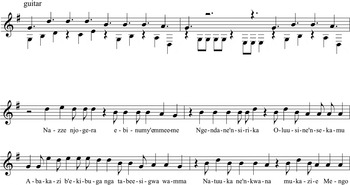
This 24-pulse cycle is first established in the guitar part, then reinforced in the singing (see Figure 1). One cycle is often subdivided by two phrases, separated by a caesura in a relationship of binary complementarity. Phrases occupying the first 12-pulse half often end on scale degree ^5, whereas phrases of the second half often resolve to ^1, or else land on ^2, anticipating immediate resolution to the tonic.Footnote 11 This tension-and-resolution melodic structure reinforces the sense of the 24-pulse cycle as a complete rhythmic container into which poetic lines are to be fitted. Indeed, Kabanda delivers his story in discrete poetic lines, each of which stays contained within the boundaries of the cycle. Only the last line of the first verse, which begins in cycle 15, carries over into the next cycle: ‘Olwo sibeera kukwana wandiridde mu pipp'e Wakaliga mu bisaaniiko’ (‘If I had not courted you, wouldn't you be eating out of the oil drums at Wakaliga?’). This break from the 24-pulse container punctuates the verse at its conclusion, and highlights the shift of narrative voice: up to this point the narrator has been speaking to the audience, now he is complaining directly to his girlfriend.
Guitar part and opening sung lines, showing 24-pulse cycle, and its binary division by two complementary phrases.

Within the 24-pulse cycle framework, Kabanda seems to be guided by a consistent rhythmic motif or motifs. One possible guiding motif that can be deduced from the overall rhythmic patterning is [LSLSLSSS], repeated twice in each cycle, with L and S symbolising ‘Long’ and ‘Short’. This is the rhythm of the phrase that serves as the title for the song: ‘Abakazi b'Ekibuga’, as it is sung in the first half of cycle 7. I have written this proposed basic rhythmic motif in one of the top rows of Table 1, so that the content of each cycle might be compared with it. I do not, of course, know for sure that this was the exact motif that the late Kabanda had in mind. We do know, however, that motifs like this play a structuring role in much Kiganda music; I have already mentioned Makubuya's discussion of three basic rhythmic motifs that underlie endingidi fiddle playing, and are remembered by means of verbal mnemonics. Nannyonga-Tamusuza, furthermore, has noted the use of the ‘abaakisimba’ verbal rhythm as an orienting motif for much kadongo kamu (Nannyonga-Tamusuza Reference Nannyonga-Tamusuza, Palmberg and Kirkegaard2002).
I have shaded in cells whose syllables I have determined to be grammatically long, i.e. syllables that would be typically pronounced with a duration of two or more fast pulses in ordinary speech, according to the subconscious rules of Luganda language. Determining the grammatical lengths of syllables is admittedly not an exact science, as there exists no comprehensive, easy-to-follow set of rules for determining grammatical syllable lengths.Footnote 12 My strategy has been to follow the basic rules of syllabic length determination laid out in Ashton's Luganda grammar (Ashton Reference Ashton1954), subsequently checking my analysis with my research assistant Michael Kayemba, a native Luganda speaker.Footnote 13 Note that gramatically long syllables tend to occur in the same columns cycle after cycle, and the same goes for gramatically short syllables. Just as significantly, when syllables that are grammatically short appear in otherwise ‘long’ columns, they are often artificially lengthened, and vice versa. The pattern [LSLSLSSS] seems to play a guiding function, which is not to say that Kabanda adheres to it rigidly.
This, then, is the kind of challenging rhythmic container that Kabanda sets for his poetic creativity. Not only should his lines fit one line per 24-pulse cycle, at fast tempo, but they are also to be shaped according to a consistent motif, which affects not just the rhythmic enunciation but also the selection of words according to their inherent syllabic structure. Over the six minute duration of the song (relatively brief, by kadongo kamu standards), Kabanda gets to showcase his ingenuity in poetically exploring these musical confines. As is often the case in kadongo kamu, one gets the sense of a virtuosic piling up of ideas, images, jokes, which seems to overflow the relatively simple, repetitive vessel in which they are contained.
The short excerpt I have transcribed offers some illustrative examples of significant rhythmic micro-variations from an established rhythmic container or poetic meter. I have already noted how, beginning in cycle 15, Kabanda exceeds the 24-pulse container in a way that highlights his shift in narrative voice, from telling a story to the audience to barking exasperatedly at his girlfriend. Earlier in this same verse, he breaks with the established pattern [LSLSLSSS], to show that he is adopting another voice – the voice of the girlfriend, as she nags him for gifts. In cycle 11, Her opening plea ‘Mwami akwanye’ (‘husband dearest’) is four grammatically long syllables [LLLL], rather than the [LSLS] that the basic motif would suggest. Kabanda sings these syllables long, and even lengthens the duration between final ’-nye’ and the next syllable, with the effect that the woman's request takes on a particularly plaintive, whining sound. Conversely, in cycle 13, when she asks for a bit of meat ‘ate njoya kannyama’, a syllable in ‘meat’ (kannyama) is artificially shortened, giving the sense that she is tacking on the meat – a costly item – as though it were a mere hurried afterthought on her shopping list. When Kabanda mentions the meat again, it is in a litany of expenses, which adheres consistently, indeed monotonously, to the basic figure. This later passage's sing-song regularity conveys the protagonist's exasperation with the incessant demands his mistress has placed upon him.
Such meaningful rhythmic gestures, at the conjuncture of speech-rhythm and musical pattern, are crucial in Kabanda's style, and in kadongo kamu generally. Indeed, they are the soul of the genre, brought into prominance by relatively simple, repetitive musical containers. Few listeners, I suspect, consciously take note of the specific ways an artist like Kabanda manipulates the inherent rhythms of words against a background rhythmic framework. They nonetheless appreciate these gestures, in a more general, impressionistic, way. They may, for example, receive the impression that Kabanda is elegant, witty or deep with his Luganda words, based not just on the word choices in themselves, but also on the way the artist makes them rhythmically flow – sometimes hurriedly, sometimes languidly, but always in keeping with the emotional events and character traits that are depicted in the sung narrative.
This kadongo kamu flow aesthetic is similar to, but also in important ways different from, the flow of traditional Kiganda bardic artistry – especially the sophisticated royal harpist's flow analysed by Cooke and Micklem (Reference Cooke and Kasule1999). It is true that a deep appreciation of both traditional Kiganda music music and kadongo kamu requires an attentiveness to the inherent syllabic rhythms of words. A connoisseur of traditional-style singing will be attuned to an artist's use of amagono, just as a kadongo kamu fan will be attentive, on some level, to Kabanda's clever play with syllable rhythms. The parameters of the kadongo kamu musical game are, however, distinctive from those of traditional singing styles. There is, in kadongo kamu, first of all, an insistence on verbal abundance and non-repetition, that is not found in Kiganda traditional singing. Kadongo kamu singers pride themselves on their ability to pack in copious words and thoughts into a finite period of time, whereas traditional-style singers prefer to luxuriate over their phrases, often repeating them in subtle melodic variations, so as to coax out their profundity. This difference in approach is probably reflective of the very different eras in which the two styles were born. Kadongo kamu, a product of the modern era, is expressive of this era's compression and commodification of time. Like calypso (to which I have suggested a historical connection), it is music for the age of news, in which there is a kind of virtuosity in being able to condense a great quantity of information into a short duration.
Additionally, kadongo kamu's combination of lyrical complexity with a relatively simple, easy-to-follow, musical pattern, seems tailored for the radio age, in which performers cannot always predict who their broadcast audiences will be, and what level of musical–poetic competence and attention those audiences will bring. Kiganda traditional singing styles were nurtured in a pre-colonial royal court, in which the king and his courtiers could be counted on as a knowledgeable, reasonably patient audience. Kadongo kamu, by contrast, has from its beginnings been broadcast across the radio waves, to thousands of dispersed listeners, at work or relaxing. There is thus much more incentive for artists to make their styles easily accessible, at least at the entry level. This may partly explain why kadongo kamu guitar accompaniment patterns are generally simpler and easier to follow than the complicated and subtle ‘tone banks’ of traditional Kiganda styles (Cooke and Micklem Reference Cooke and Micklem1999).
Conclusion
In this article, I have attempted to connect detailed matters of kadongo kamu musical style to the genre's meanings within modern Ugandan, and specifically Baganda, culture. I have suggested that the phrase ‘deep Luganda’, which commonly occurs in celebratory discourse about kadongo kamu, may be taken as a metonym for a larger, historical Luganda language ideology. Many self-identified Baganda are invested in the idea that their home language has a special abundance, historical depth and contemporary adaptability. Luganda language is reified as a cultural property that testifies to the exceptional character of the Baganda, who contend that their culture has exceptional depth in tradition, as well as a great capacity to absorb contemporary cultural influences. This language ideology, in its peculiar intensity, arose out of the specific historical experience of the Baganda, first as a pre-colonial regional power; then as a kingdom both subordinated to and privileged by colonial rule; then finally as a post-independence ethnic group whose political power was overtaken by rival ethnic factions. As the Baganda saw their regional dominance ebb away, their deep Luganda language register became even more important as a vehicle for identity formation. Kadongo kamu, which emerged in the independence period, has been one popular genre within which the concept of deep Luganda language and culture has been articulated. The possibility that a resilient, alternative, cultural space might be found in kadongo kamu music has been embraced not just by Baganda nationalists, but also by a trans-ethnic, struggling, economic class of Ugandans, who are sceptical about the heady promises of the ballooning culture of consumer capitalism, and worried about the erosion of indigenous-language culture under the influence of global English.
Scholarship on language ideologies has tended to focus on the minute, often subconscious, speech practices that reinforce these ideologies in everyday life. I have suggested that a close music-structural analysis of kadongo kamu can reveal specific techniques by which the Luganda language is musically rendered deep in fan's minds. My analysis shows how a certain phenomenon of language depth is achieved in kadongo kamu, not by word choice alone, but by the way words are made to musically ‘flow’. This flow entails a rhythmic articulation of phrases with attention to their inherent syllabic rhythms – rhythms that do not always have to be pronounced in Luganda speech for it to be comprehensible, but which are valued as graceful when they are correctly pronounced. The kadongo kamu style attunes listeners to this phenomenon of speech rhythm by setting poetry within a simple, repetitive, constraining, rhythmic container. The phenomenon of the explicit, repetitive rhythmic container also highlights the Luganda language's abundance, as a cornucopia of poetic possibilities is elegantly fitted to a song's predictable pattern.
Finally, I have made some tentative comparisons between kadongo kamu flow and the flow of other genres, especially the traditional-style Kiganda singing that is accompanied on the lyre, fiddle or harp. I have suggested that, compared with traditional singing, kadongo kamu's particular flow has distinctively modern, compressed, qualities, and that it may have been inspired, in this respect, by another, similar, modern African-diasporic genre, calypso, which was popular in Kampala around the time of kadongo kamu's innovation. Suggestively, both calypso and kadongo kamu were genres born in colonial conditions, in which black vernacular languages and cultures had been devalued and were felt to be under threat of deterioration. Both adopted trickster-tactics, showcasing verbal wit in a colonially subordinated tongue – patois in the case of calypso, Luganda in the case of kadongo kamu.
The fact that young artists continue to take up kadongo kamu, so many decades after its beginnings, suggests that this genre still marks out an important niche in Ugandan culture, somewhere between the imagined worlds of ‘tradition’ and the dominant, globalist ‘contemporary’. As globalisation has brought a surge of foreign pop culture – much of it celebrating consumer capitalism, much of it in English – Ugandans more than ever feel a need for artistic genres that ennoble what is ‘local’ and deep. People on the lower rungs of society, especially, have reason to fear that there is no place for their more local and traditional life-worlds in the new entrepreneurial euphoria. Of what value, they are compelled to ask themselves, is a vernacular language like Luganda in an age in which global capitalism and Anglophone culture increasingly dominate the nation's developmental priorities? Kadongo kamu, with its elegant flow redolent of both tradition and modernity, reminds listeners that in the poetry and music of one's home language there can still be an inexhaustible richness that no foreign culture can dilute and no money can buy.