I. INTRODUCTION
An amphiphilic polymer usually contains both hydrophilic and hydrophobic chains. Reference Upadhyay, Agrawal, Upadhyay, Schatz, Le Meins, Misra and Lecommandoux1 Their self-assembly behavior can be attributed to the microphase separation, Reference Ikkala and Ten Brinke2 competing hydrophilic and hydrophobic interactions, and complementary physical interactions. Normally, solution self-assembly of amphiphilic polymers can afford structural hierarchies and various nanostructured phases, such as layered, core–shelled, cylindered ones, and so on. Reference Yu and Eisenberg3−Reference Zhang and Eisenberg5
Sensitive polymers can change their structures and properties according to external stimuli. Reference Schild6 They have been extensively investigated recently as smart materials for various applications such as biomedicine, optics, electronics, and so on. Reference Rodriguez-Hernandez, Chécot, Gnanou and Lecommandoux7 Most of the stimuli-responsive systems are driven by four fundamental forces, namely ionic, hydrophobic, hydrogen bonding, and van der Waals interactions. Reference Soppimath, Aminabhavi, Dave, Kumbar and Rudzinski8 All of these forces are responsible for the ability of smart system to interconvert between two phases. In one case, the environmental stimulus enhances the attractive forces and the system collapses by expelling out the solvent. In the other case, the environmental stimulus strengthens the repulsive forces, thus expanding the system by absorbing solvent. These variations can then cause the changes in the bulk phase or the liquid phase behavior of the colloidal dispersion, which provides its functionality.
pH-sensitive copolymers often contain polyweakacid or polyweakbase components and therefore are capable to respond to pH change. Reference Pinkrah, Snowden, Mitchell, Seidel, Chowdhry and Fern9–Reference He, Zhao, Guo, Guo, Chen, Zhuang, Liu and Jing11 The amphiphilicity of the copolymers with ionizable groups can be finely tuned by changing the pH value. Poly(4-vinylpyridine) (P4VP) Reference Ayres, Cyrus and Brittain12,Reference Zhang, Shi, Ma, An, Xu and Wu13 is an important poly(base) with pH sensitivity. When the pH of the solution is higher than 5, P4VP is deprotonated and hydrophobic. When the pH is lower than 5, P4VP is protonated and hydrophilic. Thus the aggregation behavior of block copolymers with P4VP changes significantly with pH. Meanwhile, polyacrylic acid (PAA) Reference Pottier, Morandi, Dulong, Souguir, Picton and Le Cerf14 is a polyweakacid. PAA is in ionization state at a high pH value. But, the protonated state of PAA is achieved at low pH value. In a similar way, the morphology of the aggregates containing PAA can also be easily adjusted by adjusting pH.
Compared to the polymeric micelles formed from a single kind of copolymer, mixed micelle is a potential candidate to tackle more problems. The stimuli responsiveness behavior can be adjusted both by turning the ratio of the component and by altering the structure of each copolymer. Additionally, it is also more convenient to endow one system with multiple functionalities by verifying the two copolymers. Li et al. Reference Li, Shi, Ma, An and Huang15 constructed mixed micelles from the self-assembly of poly(tert-butyl acrylate)-block-poly-(N-isopropylacrylamide) (PtBA-b-PNIPAM) and poly(tertbutyl acrylate)-block-poly(4-vinylpyridine) (PtBA-b-P4VP) diblock copolymers. The resulting assemblies comprised a PtBA core and a mixed PNIPAM/P4VP shell. The system was pH and temperature responsive, and the self-assembly behavior could be turned conveniently.
The major difficulty for the construction of mixed micelles is to guarantee the stability of the system without weakening the capacity of encapsulating guest molecules. Reference Lee, Ishii, Cabral, Kim, Seo, Nishiyama, Oshima, Osada and Kataoka16 Several noncovalent interactions including hydrophobic interaction, stereo complexation, hydrogen bonding, and electrostatic interaction have been developed for the formation of mixed micelles. Among them, the electrostatic interaction Reference Kuo, Tung, Lai, Jeong and Chang17–Reference Attia, Ong, Hedrick, Lee, Ee, Hammond and Yang21 has become the most used one. On this occasion, the mixed micelles are formed from co-assembly of neutral–ionic copolymers with oppositely charged species in aqueous solution, which renders them the advantage in incorporating ionic species, such as DNA and some proteins. Reference Wu, Ma, He, Zhao, Gao, An and Shi22 Although much attention has been paid on mixed micelles formed by electrostatic interaction, examples on this kind of micelles based on organic–inorganic hybrid copolymers have not been reported. Polyhedral oligomeric silsesquioxane (POSS) is a hybrid molecule which is frequently used to prepare organic–inorganic hybrid copolymers. It can endow the copolymers with superior mechanical properties, thermal properties, oxidation resistance, and reduced flammability. Reference Hussain, Tan, Mya, Liu, He and Davis23–Reference Zheng, Wang, Yu and Zheng25 Furthermore, POSS molecule is also a promising material in biological fields due to its biodegradability. Reference Alves and Nischang26 In our previous work, we reported the synthesis of poly(methacrylisobutyl-POSS)-b-poly(4-vinylpyridine) and poly(methacrylisobutyl-POSS)-b-polystyrene-b-poly(4-vinylpyridine) and investigated the response of the self-assembly behavior to pH. Reference Xu, Chen, Xie, Li, Yang, Deng, Yuan, Chang and Dai27
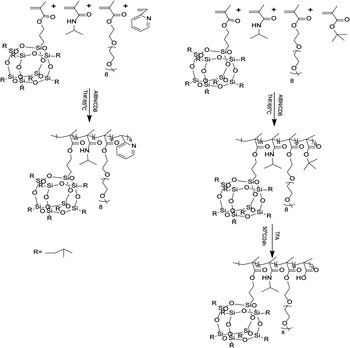
In this work, we report the fabrication of a new kind of mixed micelle with two POSS based random copolymer, poly(methacrylate isobutyl POSS-co-N-isopropylacrylamide-co-oligo(ethylene glycol)methyl ether methacrylate-co-2-vinylpyridine) (P(MAPOSS-co-NIPAM-co-OEGMA-co-2VP)) and poly(methacrylate isobutyl POSS-co-N-isopropylacrylamide-co-oligo(ethylene glycol) methyl ether methacrylate-co-acrylic acid) (P(MAPOSS-co-NIPAM-co-OEGMA-co-AA)). The incorporation of NIPAM in this random copolymer is to achieve a temperature-sensitivity. As we all know, PNIPAM undergoes a coil-to-globule transition at its lower critical solution temperature (LCST) around 32 °C in water. Furthermore, because of the electrostatic interaction between 2-vinylpyridine and acrylic acid units, mixed micelle can be fabricated by mixing the two kinds of micelles. Last but not the least, in this work, we synthesized random copolymers, which are more easy to be disassembled for their aggregates in solution in response to some stimulus. It endows the mixed micelle more excellent performance in its application in drug delivery, encapsulation technologies, and so on. The pH-sensitive behaviors and self-assembly morphologies of aggregates were investigated. The importance of electrostatic interaction to form the mixed micelles was addressed (Scheme 1).
Synthetic route of poly(MAPOSS-co-NIPAM-co-OEGMA-co-2VP) and poly(MAPOSS-co-NIPAM-co-OEGMA-co-AA) random copolymer via RAFT polymerization.

II. EXPERIMENTAL
A. Materials
Methacrylate isobutyl POSS (MAPOSS) was obtained from Hybrid Plastic Co. without further purification. 2-Vinylpyridine (2VP, 98%, stabilized with TBC) was obtained from TCI Co without further purification. N-isopropylacrylamide (NIPAM, 98%, Aladdin Co.) was purified by recrystallization from hexane prior to use. Oligo(ethylene glycol)methyl ether methacrylate (OEGMA, M = 475 g/mol) (97%, Aladdin Co.) and tert-butyl methacrylate (tBA) were purified by basic alumina columns prior to use. Cumyl dithiobenzoate (CDB) was synthesized according to the literature method, Reference Chiefari, Chong, Ercole, Krstina, Jeffery, Le, Mayadunne, Meijs, Moad and Moad28 the concrete schematic synthetic process and characterization by 1H-NMR (nuclear magnetic resonance) of CDB are shown as Figs. S1 and S2 in the supporting information, respectively. 2,2′-Azoisobutyronitrile (AIBN) was recrystallized from ethanol. Tetrahydrofuran (THF) was dried by refluxing over sodium and distilled prior to use. Other chemicals such as diethyl ether, petroleum ether, and hydrochloric acid were purchased from market and used as received. A lipophilic fluorescence resonance energy transfer (FRET) pair, 3,3′-dioctadecyloxacarbocyanine perchlorate (DiO, donor), and 1,1′-dioctadecyl-3,3,3′,3′-tetramethylindocarbocyanine perchlorate (DiI, acceptor), was purchased from Aladdin Co.
B. Synthesis of P(MAPOSS-co-NIPAM-co-OEGMA-co-AA)
1. Synthesis of P(MAPOSS-co-NIPAM-co-OEGMA-co-tBA) by reversible addition-fragmentation chain transfer (RAFT) polymerization
P(MAPOSS-co-NIPAM-co-OEGMA-co-tBA) with monomer mol ratio of MAPOSS:NIPAM:OEGMA:AA = 2.5:80:20:40 was synthesized by RAFT polymerization using CDB as chain transfer agent. In a typical experiment, MAPOSS (0.1187 g, 0.125 mmol), NIPAM (0.4521 g, 4.0 mmol), OEGMA (0.44 mL, 1.0 mmol), tBA (0.28 mL, 1.0 mmol), CDB (0.0136 g, 0.05 mmol), AIBN (1.64 mg, 0.01 mmol), and 2.0 mL of THF were charged in a Schlenk tube. The mixture was deoxygenated through five freeze–pump–thaw cycles. Then it was filled with argon and kept in an oil bath at 65 °C for 48 h. The reaction was stopped by quenching in liquid nitrogen. The crude product was precipitated with excessive diethyl ether and petroleum ether (volume ratio = 1:1). This precipitation procedure was repeated three times. The obtained powder product was dried overnight under vacuum at room temperature. The molecular weight and molecular weight distribution of this P(MAPOSS-co-NIPAM-co-OEGMA-co-tBA) (tBA (40) for short) random copolymer were determined by gel permeation chromatography (GPC). 1H-NMR (CDCl3, ppm, TMS): 3.88 (t, CH2 next to COOCH2 group), 3.63 (t, CH2 in the oligo(ethylene glycol) side chain), 3.36 (s, OH in OEGMA units), 2.15 (m, CH of isobutyl group), 1.33–1.98 (m, CH2 and CH in backbone), 1.45 (s, CH3 of tert-butyl in tBA), 1.07 (s, CH3 in copolymer), and 0.60 (m, CH2 next to silicon). Fourier transform infrared spectroscopy (KBr, cm−1): 3295, 2953, 2871, 1731, 1660, 1550, 1466, 1416, 1368, 1107, 993, 948, 822, 769.
2. Preparation of P(MAPOSS-co-NIPAM-co-OEGMA-co-AA)
A round-bottom flask (25 mL) with a magnetic stir bar was charged with tBA (40) (0.74 g, 2 mmol of tBA unit) followed by the addition of dichloromethane (10 mL). The mixture was stirred for 15 min to ensure the dissolving of polymer. After the addition of trifluoroacetic acid (TFA; 1.5 mL, 20 mmol), the mixture was allowed to stir at room temperature for 24 h. After the removal of dichloromethane and TFA using rotary evaporation, a yellow solid poly(MAPOSS-co-NIPAM-co-OEGMA-co-AA) (P-A for short) was gained and dried under vacuum at 50 °C.
C. Synthesis of P(MAPOSS-co-NIPAM-co-OEGMA-co-2VP)
The synthesis of P(MAPOSS-co-NIPAM-co-OEGMA-co-2VP) with monomer mol ratio of MAPOSS:NIPAM:OEGMA:2VP = 2.5:80:20:40 (P-C for short) by RAFT polymerization and their self-assemble behavior has been reported by previous work. Reference Xu, Xie, Chen, Yuan, Pan, Cheng, Luo, Zeng and Dai29 The FTIR and 1H-NMR are shown as FIG. S3. and FIG. S4. Experimental conditions and results of the random copolymerization of 2VP(40) in THF at 65 °C have been summarized in Table I.
Experimental conditions and results of the random copolymerization of 2VP(40) and tBA(40) using CDB as chain transfer agent in THF at 65 °C.

a The feed molar ratio of monomers, the chain transfer agent and initiator.
b The composition ratio in copolymer chains determined from 1H-NMR spectra by the integral areas of characteristic peak relevant to every structural unit. For example, The composition ratio of tBA(40) was calculated as [MAPOSS]:[NIPAM]:[OEGMA]:[tBA] = A 0.6/2:A 1.15/6:A 3.38/3:A 1.43/9, in which A was areas for short.
c Yield was determined from 1H NMR spectra. It was calculated as the areas of double bond peaks in the materials divided by that in the product without further purification with the areas of methylene combined with silicon (Si-CH2, 0.3–0.68 ppm) in POSS as a standard.
d M n (theo) = (m MAPOSS + m NIPAM + m OEGMA + m 2VP) × x/n CDB + M CDB, where m MAPOSS, m NIPAM, m OEGMA, and m 2VP are the initial mass of MAPOSS, NIPAM; x is the yield; n CDB is the initial mole number of CDB; M CDB is the molecular weight of CDB.
D. Preparation of P-A, P-C random copolymer micelle solution and their mixed micelles in aqueous solution
P-A random copolymers were first dissolved in THF which is a good solvent for the hybrid copolymers, followed by diluting the solution slowly with a certain volume of deionized water at a speed of 1 mL/min. In a typical process, 5 mg of copolymer was dissolved in 0.5 mL THF, followed by the addition of 5 mL deionized water at a speed of 0.5 mL/min. The solution was stirred for 24 h or longer time to completely remove THF at room temperature. Other micelle solutions with different concentrations can be prepared by the same process. P-C micelle solution was prepared by the same process. The mixed micelles were obtained by mixing P-A and P-C micelle solution (5 mg/mL) with different volume ratios and stirring for 24 h.
E. Micelle encapsulated dye (DiI/DiO) preparation
A stock solution of dye (3 mg/mL) in acetone was taken (5 µL) in a vial and the solvent was evaporated by a blow of argon gas. A 3 mL solution of the micelles (0.5 mg/mL) was added and the solution was sonicated for 30 minutes to encapsulate the dye. Insoluble DiI/DiO was removed by filtration.
F. Micelles encapsulated dye mixing
A solution of micelle containing DiI (0.5 mL) was added to a solution of micelle containing DiO (0.5 mL).
G. Characterization
1. FTIR characterization
FTIR measurements were conducted on an AVATAR 360 FTIR (Nicolet Instrument, Thermo Fisher Scientific, Waltham, Massachusetts) at room temperature (25 °C) by mixing the polymer with KBr and pressing into small flakes.
2. 1H-NMR characterization
1H-NMR spectra were recorded on a Bruker AV300 MHz NMR spectrometer (Bruker Corporation, Karlsruhe, Germany).
3. Molecular weight measurement
Molecular weight determinations for polymers were made using GPC analyses performed in THF using a series of Waters styragel HR2, HR4, and HR5. The eluent was THF at a flow rate of 1.0 mL/min. A series of low polydispersity polystyrene standards were used for the GPC calibration.
4. Optical transmittance measurement
The optical transmittance of P-C, P-A and their mixed solution at various temperatures was measured at 500 nm using a UV-2550 spectrometer (Shimadzu Corp., Tokyo, Japan). Sample cells were thermo stated in a water bath at different temperatures for 3 min prior to the measurements, and the heating rate was set as 1 °C/min.
5. Zeta potential, the aggregate size, and size distribution measurement
The zeta potential and dynamic light scattering (DLS) measurements were performed on a Zetasizer NanoZS Instrument (Malvern Instruments, Malvern, United Kingdom) at a scattering angle of 90° and analyzed by Malvern Zetasizer Software version 6.20. The heating rate of measurements at different temperatures was set as 1 °C/min.
6. Transmission electron microscopy (TEM) observation
TEM analysis was performed on a JEM2100 transmission electron microscope (JEOL USA Ltd., Peabody, Massachusetts) with an accelerating voltage of 200 kV. One drop of aggregate solution (at a concentration of 5 mg/mL) was placed on a copper-mesh coated with carbon and then air-dried before measurement.
7. Fluorescence measurements
The fluorescence measurements were detected by a FLS920 fluorescence lifetime and steady state spectrometer (Edinburgh Instruments, Livingston, United Kingdom). In FRET based experiment, the fluorescence intensity of mixed micelles encapsulated dye changing with time was traced at 450 nm excitation wave length. The fluorescence was traced each hour. We traced as long as four hours until there was an obvious variation trend.
III. RESULTS AND DISCUSSION
A. Synthesis of P-A by RAFT polymerization
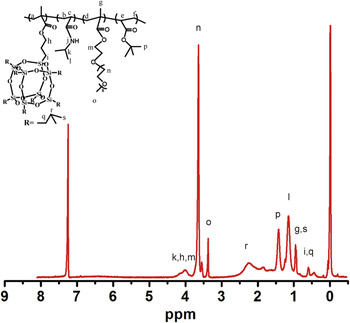
tBA(40) was synthesized by RAFT polymerization using CDB as chain transfer agent. Table I summarizes experimental conditions and results of the random copolymerization of tBA(40) in THF at 65 °C. The yield of the reaction was calculated by comparing the areas of double bond peaks after reaction with that before reaction. In detail, the areas of double bond peaks in the materials divided by that in the product without further purification was calculated with the areas of methylene combined with silicon (Si-CH2, 0.3–0.68 ppm) in POSS as a standard. 1H-NMR was used to characterize the structure of tBA(40) (Fig. 1). 1H-NMR: 3.88 (CH2 next to COOCH2 group), 3.63 (CH2 in the oligo(ethylene glycol) side chain), 3.38 (CH3 in OEGMA units), 2.15 (CH of isobutyl group), 1.33–1.98 (CH2 and CH in backbone), 1.43(CH3 of tertiary butyl in tBA), 1.15(CH3 of isopropyl in NIPAM), 1.07 (CH3 in copolymer), and 0.60 (CH2 next to silicon). The composition ratio of copolymers was determined from 1H-NMR spectra by the integral areas of characteristic peak relevant to every structural unit. For example, The composition ratio of tBA(40) was calculated as [MAPOSS]:[NIPAM]:[OEGMA]:[tBA] = A 0.6/2:A 1.15/6:A 3.38/3:A 1.43/9, in which A was areas for short. The molecular weight distributions of the samples are narrow (PDI 1.21).
1H-NMR spectra of tBA(40) (CDCl3).

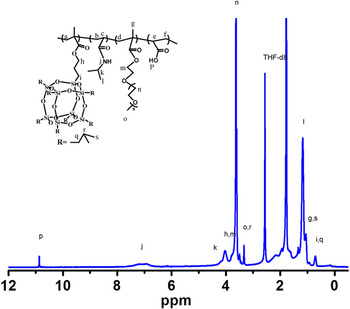
Figure 2 is the 1H-NMR spectra of P-A. When comparing the 1H-NMR spectra of the precursor tBA(40) in CDCl3 to the goal copolymer P-A in THF-d8, we come to the conclusion that the tert-butyl groups (δ = 1.45 ppm) were completely removed with the appearance of new signal at δ10.84 ppm, which is attributed to the proton of carboxylic group.
1H-NMR spectra of P-A (THF-d8).

FTIR (Fig. S5) was used to further certify the successful synthesis of this copolymer. Peaks at 1000–1100 cm−1 are attributed to stretching vibration of Si–O–Si. A peak at 1731 cm−1 is attributed to C=O stretching vibration of ester group in copolymer. A peak at 1368 cm−1 attributed to the C–H deformation vibration of CH(CH3)2 indicates that tBA has been introduced into the copolymer. Compared with the result of the polymer before hydrolysis, the FTIR spectrum in Fig. S5 of the hydrolysis product indicated that the strength of the methyl absorption peak 1368 cm−1 lowered almost equal to that of PMAPOSS with the removal of PtBA domains and the carbonyl stretching vibration absorption peak broaden out (1705–1731 cm−1). Besides, there is an increase in IR intensity at 3500 cm−1 that could be associated with the deprotection of PAA.
B. Formation of mixed micelles from P-A and P-C
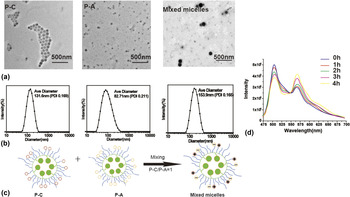
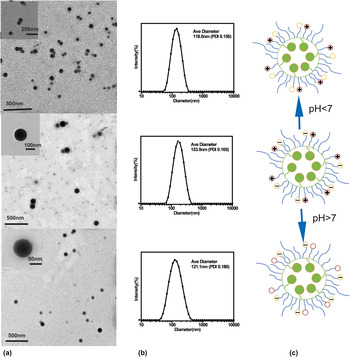
The morphology of aggregates is observed by TEM. The typical TEM images of P-A, P-C, and their mixed micelles (1 mg/mL, 25 °C, pH 7.0) are presented in Fig. 3. The aggregates of P-A display a well-defined spherical shape with a narrow size distribution ranging from 32.8 to 62.4 nm. DLS was also used to determine the size and size distribution of aggregates. From DLS data measured by a Zetasizer, the average size of aggregates is 82.7 nm with a narrow size distribution. The difference between the sizes measured by DLS and determined by TEM can be attributed to the fact that the sizes measured by the DLS are based on the swollen aggregates in aqueous solutions, and the sizes observed by TEM are derived from the dried aggregates. The aggregates of P-C also display a well-defined spherical shape with a narrow size distribution ranging from 62.3 to 100.0 nm in TEM image. As can be seen in the TEM image, the aggregates of the mixed micelles possess a diameter ranging from 112.3 nm to 126.5 nm [as illustrated in Fig. 3(a)], which is larger than the aggregates formed by P-A or P-C, smaller than the sum of them. The results are in accordance with that of DLS, which demonstrates the fabrication of mixed micelles.
TEM images of the formation of complex micelles 2VP/AA between 2VP(40) micelles and AA(40) micelle (pH 7.0, 1/1, vol%) (a); aggregate size and size distribution measured from the DLS (b); schematic illustration of the formation of complex micelles (c); fluorescence spectra of mixed micelles encapsulated DiI/DiO in FRET (excitation of DiO at 450 nm) (d).

Because of the electrostatic interaction between 2-VP and acrylic acid, the mixed micelles can be fabricated by mixing the two kinds of micelles formed by P-A and P-C with certain concentrations, respectively. The reasons for which the mixed micelles can form are proposed as follows. First, the driving force of the mixed micellization is the strong electrostatic attraction between 2VP and acrylic acid. Second, the structure of random copolymer makes it easy for the link exchanging between the two kinds of micelles.
A simple Förster resonance energy transfer (FRET) based technique was recently developed, Reference Jiwpanich, Ryu, Bickerton and Thayumanavan30 and here we use it to guarantee the formation of mixed micelles. DiI and DiO are two common dyes in a FRET experiment, for the reason that when we excite the donor (DiO), the emission of the donor will then lead to the exciting of the acceptor (DiI). As a result, we will observe the decrease in the donor emission and increase in the acceptor's emission. This is the so-called FRET phenomenon. If the mixed micelles are not formed, there will be no exchange between dye molecules loaded in P-A and P-C and we will not observe any FRET when exciting the donor dye. However, if the mixed micelles are formed, it will cause the interaction between P-A and P-C, which will certainly lead to the exchange of dye molecules between the two containers, leading to the decrease in the donor's (DiO) emission and increase in the acceptor's emission (DiI). In detail, aqueous solutions of P-A and P-C containing 1 wt% DiO or 1 wt% DiI were prepared by in situ loading which were referred as P-A-DiO and P-C-DiI, respectively, and then were mixed in water. Fluorescence from the DiO excitation (450 nm) was traced over time. The obvious decrease in the donor (DiO) emission and increase in the acceptor's emission (DiI) have been traced as long as 4 hours and are presented in Fig. 3(d). Mixed micelles are proved to be formed.
C. The effect of pH on the self-assembly behavior of the mixed micelles
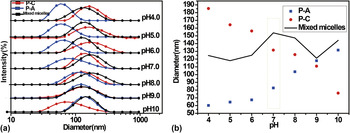
The pH dependence of the size of mixed micelles in water solution (5 mg/mL, 25 °C) is examined by DLS. An interesting result is revealed in Fig. 4 that the change in size undergoes two stages with the variation of pH under the same concentration of 5 mg/mL. When the value of pH is lower than 7.0, the size is bigger than those of the aggregates formed by P-A and smaller than those of the aggregates formed by P-C. If the solution pH is increased from 7.0 to 10.0, the size becomes bigger than those of both P-A and P-C. The mixed micelles possess the biggest size at a pH of 7.0. TEM was also used to confirm the size change. The TEM images shown in Fig. 5 indicate the existence of the mixed micelles. Meanwhile, the aggregate size also undergoes two stages with the variation of pH value which is in good agreement with the results from DLS. We attributed this size variation to the difference of the electrostatic attraction. The biggest size of the mixed micelles at pH 7.0 can be derived from the fact that the pyridine unites have the highest degree of protonation and the carboxylic groups have the highest degree of deprotonation and therefore reaches the strongest electrostatic attraction. On the other hand, either the protonation degree of the pyridine unites or the deprotonation degree of the carboxylic group is weakened at other pH. In detail, the size increase of the mixed micelles was attributed to the fact that the strong electrostatic attraction enhanced the attractive forces. At pH = 7.0, the anions and cations coexist in the micelles, which attribute strong intermolecular electrostatic attraction within the micelles. As a result, the micelles are formed by more polymer chains and the size of the micelles will increase.
DLS results of the formation of complex micelles P-C/P-A (1/1, vol%) under different pH (a); differences among the diameters of P-A, P-C and 2VP/AA according to DLS results (b).

TEM images, DLS data, and schematic illustration of complex micelles P-C/P-A (1/1, vol%) under different pH:pH 5.0 (a), pH 7.0 (b), and pH 9.0 (c).

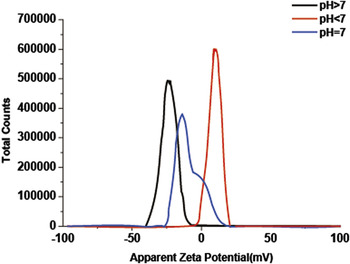
To further investigate the surface charges corroborating the discussions above, the zeta potential was detected. As was shown in Fig. 6, the zeta potential of the mixed micelles is −29.5 mV when pH was higher than 7.0, and it is 9.37 mV with pH value lower than 7.0. The zeta potential is −3.78 mV with pH 7.0, which is in accordance with above proposal.
Variation of zeta potential with different pH.

D. The effect of electrostatic attraction variation on the thermo-responsive properties of the mixed micelles
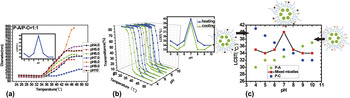
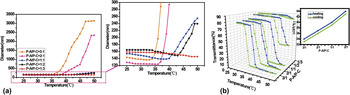
The effect of electrostatic attraction variation on the thermo-responsive properties of the mixed micelles was also characterized. As illustrated in Fig. 7(a), the LCST of the mixed micelles reaches the highest value at pH 7.0, which is 6 °C higher than that at other pH value. However, differences of LCST among the mixed micelles at other pH are small. The transmittance variation of the mixed micelle solution accords well with the results from DLS. In addition, the result shown in Fig. 4(b) demonstrates that the mixed micelle aggregates undergo an association/disassociation cycle with the heating and cooling of solution.
Variation of size distribution and optical transmittance at 500 nm with temperature from 25 °C to 50 °C for mixed micelle(P-A/P-C = 1:1) solution with a concentration of 5 mg/mL, and under different pH(a and b); LCST for P-C, P-A and complex micelles of 2VP/AA (1/1, vol%) under different pH (c).

To further investigate the effect of electrostatic on the LCST, the LCST of the P-A, P-C, and their mixed micelles at different pH values are compared. According to Fig. 7(c), we consider that the LCST of the mixed micelles reaches the highest value when the pH value is 7.0. In this case, the LCST of the mixed micelles is higher than that of both P-A and P-C. Meanwhile, the LCST of the mixed micelles is lower than that of P-C and higher than that of P-A at other pH values. The significant impact of pH on the phase transition temperature can be attributed to the change in the ionization-degree of 2VP and AA unites. When the pH reaches 7.0, most pyridine groups of the 2VP unites are protonated, while most AA unites are deprotonated, thus leading to the strongest electrostatic interaction. As a result, the mixed micelles are most hydrophilic in aqueous media with pH at 7.0. Hence it needs more enthalpy to disrupt the hydrogen bonds to accomplish the phase transition. In this way, the LCST is shifted to the highest value.
E. The effect of micelle composition on the thermo-responsive properties of the mixed micelles
By means of adjusting the volume of the two kinds of micelles, mixed micelles with different compositions can be formed. DLS and UV-vis transmittance are used to determine the effect of micelle composition on the thermo-responsive properties of the mixed micelles as well. Results from DLS show that the LCST of the mixed micelles increases with the increasing addition of P-C [Fig. 8(a)]. When a more hydrophilic monomer participate the copolymerization with NIPAM, the LCST will increase. Reference Dinarvand and D'Emanuele31 Accordingly, vinyl pyridine containing micelles contributed more to the increase of LCST by forming more hydrogen bonding, and thus increasing content of vinyl pyridine containing micelles increases LCST.
Variation of size distribution (a) and optical transmittance at 500 nm (b) with temperature from 25 °C to 50 °C for complex micelles resulting from different ratio of P-A and P-C micelles at pH 7.0.

To be specific, mixed micelles derived from 3:1(vol%) and 1:2(vol%) of AA/2VP have LCST value of 34 °C and 44 °C, respectively. However, when AA/2VP is 1:3(vol%), no LCST was observed at temperature from 25 to 50 °C. The same tendency is also traced by UV-vis[Fig. 8(b)]. At the same time, the UV-vis also shows the mixed micelle aggregates undergo an absolutely reversible association/disassociation cycle with the heating and cooling of solution.
IV. CONCLUSIONS
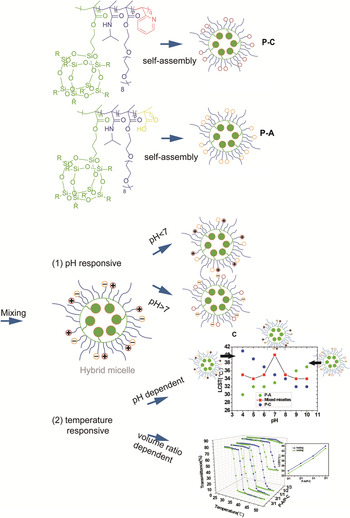
Novel mixed micelle was successfully fabricated by mixing the solution of P-A and P-C, which was further proved by a simple FRET based technique. Investigation on the effect of pH variation on the self-assembly behavior of the mixed micelle reveals that it possesses the biggest size at pH 7.0. This size variation with pH is induced by the electrostatic interaction between the two kinds of micelles. The zeta potential was detected to further investigate the surface charges corroborating the discussions. DLS and UV-vis were applied to trace the tendency of the LCST changing with different pH values, the results show that the mixed micelle reaches the highest LCST at pH 7.0. By simply adjusting the composition of the two kinds of micelles, we can tune the size of the mixed micelle. When increasing the volume of P-C, the size of the mixed micelle increases. However, it decreases with the reduction of the P-A volume. Furthermore, the thermo-responsive behavior of the mixed micelles is absolutely reversible. As a novel kind of mixed micelle fabricated from two kinds of chemically different amphiphilic random copolymers by the electrostatic interaction between them, these mixed micelles may be of particular interest in endowing a single system with multiple functionalities without complicated synthetic procedure. Also, the novel mixed micelle with thermo and pH responsive behavior is potentially used for biomedicine, catalysis, bioseparations, biosensors, and fundamental investigation (Fig. 9).
The schematic diagram of the work.

Supplementary Material
To view supplementary material for this article, please visit http://dx.doi.org/10.1557/jmr.2016.226.
ACKNOWLEDGMENTS
This work was financially supported by the National Natural Science Foundation of China (51273164, 51541307 and U1205113), the Scientific and Technological Innovation Platform of Fujian Province (2014H2006) and NCETFJ.