Psoriasis is a chronic, relapsing, inflammatory skin disease characterised by erythematous, scaly skin, with major symptoms including pain, itching and bleeding(Reference Szepietowski and Reich1,Reference Griffiths, Armstrong and Gudjonsson2) . Psoriasis not only affects the skin, but is also associated with a variety of co-morbidities, including psoriatic arthritis, CVD and metabolic syndrome(Reference Piaserico, Orlando and Messina3–Reference Wu, Kavanaugh and Lebwohl5), which have a serious impact on patients’ quality of life, and at the same time bring a heavy socio-economic burden. Epidemiologic data show that the global prevalence of psoriasis is about 1–3 %, and the number of patients is on the rise(Reference Parisi, Iskandar and Kontopantelis6). Despite the progress of existing treatments such as biologics and phototherapy, the problems of large individual differences in efficacy, side effects of long-term medication and high recurrence rates have not been fundamentally solved, which highlights the urgent need to explore new mechanisms of the disease and preventive strategies(Reference Lee and Kim7–Reference Lwin, Snowden and Griffiths9).
Oxidative stress is a phenomenon resulted from a mismatch between reactive oxygen species (ROS) production and cellular clearance mechanisms, and its role in chronic inflammatory diseases has become a hot research topic in recent years(Reference Pizzino, Irrera and Cucinotta10). It has been shown that oxidative stress markers are heightened in psoriasis and are related to the course and severity of the disease and that the concentration of oxidative stress markers is affected by anti-psoriasis therapy(Reference Dobrică, Cozma and Găman11). When the body’s oxidative–antioxidant system is imbalanced, excess ROS can activate pro-inflammatory pathways and lead to tissue damage(Reference Hussain, Tan and Yin12,Reference Pleńkowska, Gabig-Cimińska and Mozolewski13) . In psoriasis, aberrant activation of TNF-α and neutrophil infiltration of the epidermis produce large amounts of ROS(Reference Baek, Byamba and Wu14–Reference Chiang, Cheng and Korinek16). There are several key gaps in current research on the oxidative stress-psoriasis interplay in disease mechanisms. First, most studies have used a single biomarker (e.g., malondialdehyde or superoxide dismutase) to assess oxidative stress status, which fails to comprehensively reflect the body’s oxidative–antioxidant balance(Reference Bakić, Klisić and Kocić17–Reference Zeng, Yan and Zhang19). Second, the available evidence has paid insufficient attention to intervenable factors such as diet and lifestyle, which may influence the disease process by modulating oxidative stress(Reference Quintanilha, Reis and Duarte20,Reference Zheng, Sun and Miao21) .
In this study, we innovatively adopted the oxidative balance score (OBS) as a comprehensive evaluation index to systematically quantify the balance of oxidative stress and antioxidant capacity in individuals via systematic synthesis of sixteen nutrient intake parameters and four behavioural determinants(Reference Lei, Xu and Chen22,Reference Zhang, Peng and Chen23) . Compared with a single biomarker, OBS can reflect the oxidative stress load of the organism more comprehensively. Previous studies have demonstrated significant associations between OBS and a number of chronic diseases which include diabetes, CVD and cancer(Reference Cheng, Han and Jiang24–Reference Li, Zhang and Liu26). In the field of psoriasis, although several studies have suggested that oxidative stress may be involved in disease development(Reference Dobrică, Cozma and Găman11), epidemiologic evidence on the association between OBS and psoriasis is still very limited. Moreover, the results of existing studies are inconsistent, especially in terms of population heterogeneity, which has been significantly under-explored.
In this study, based on data from the National Health and Nutrition Examination Survey (NHANES), we applied multiple models and analytic methods to explore the strength and pattern of the correlation between OBS and psoriasis in American adults. The focus is on addressing three key scientific questions: first, to clarify the association of OBS as a whole and its dietary and lifestyle components with psoriasis risk; second, to evaluate variation in OBS–psoriasis relationships among population subgroups stratified by socio-demographic factors and finally to delineate potential threshold effects through non-linear exposure-response analyses. We hope that the systematic analysis can advance personalised therapeutic strategies for psoriasis through mechanistic insights derived from integrated biomarker profiling.
Materials and methods
Study design and data sources
NHANES is an ongoing survey conducted biennially by the National Center for Health Statistics to collect nutrition and health data from a nationally representative USA population. The survey uses a stratified multistage probability sampling method and covers multidimensional data on demographics, health behaviours, dietary intake and clinical testing. The NHANES study protocol was approved by the National Center for Health Statistics Ethics Review Committee, with documented consent secured through standardised participant agreements. This study integrated data from five cycles spanning 2003–2006 and 2009–2014 to conduct two rounds of analysis examining the association between OBS and psoriasis. A total of 18 023 adult participants were recruited, comprising 512 individuals diagnosed with psoriasis and 17 511 non-psoriatic controls.
A total of 32 915 participants in 2003–2006 and 2009–2014 were excluded (1) participants with missing data on psoriasis (n 24 895), (2) participants with >4 missing dietary and lifestyle components for calculating OBS (n 2714), (3) participants aged ≤20 years or ≥85 years (n 2318), (4) participants lacking complete records for key confounders including education, marital status and the family income-to-poverty ratio (PIR) (n 1487), (5) participants with irrational energy intake (men: <800 kcal/d or >4200 kcal/d, women: <500 kcal/d or >3500 kcal/d) (n 1302) and (6) participants missing data on hypertension, diabetes and lipid-related conditions (n 199). Finally, a total of 18 023 individuals participated in this study (Figure 1).
Participant inclusion/exclusion criteria applied to NHANES survey cycles 2003–2006 and 2009–2014. NHANES, the National Health and Nutrition Examination Survey.

Assessment of variables
Psoriasis: diagnosis based on self-reported physician diagnosis. 2003–2006 cycle usage question DEQ053: ‘Have you ever been told by a health care provider that you had psoriasis (sore-eye-asis)?’, 2009–2014 cycle question MCQ070: ‘Have you ever been told by a doctor or other health care professional that you had psoriasis (sore-eye-asis)?’, with participants answering ‘Yes’ classified as having psoriasis.
OBS: Sixteen dietary nutrients and four lifestyle factors were selected to form the OBS, including fifteen antioxidants and five pro-oxidants(Reference Zhang, Peng and Chen23). Dietary fibre, carotenoids, riboflavin, niacin, vitamin B6, total folate, vitamin B12, vitamin C, vitamin E, Ca, Mg, Zn, Cu, Se, total fat and Fe comprised the dietary OBS (DOBS), and data for these sixteen dietary nutrients were in the 24-h dietary recall interviews. Physical activity, BMI, alcohol consumption and smoking comprised the LOBS, where weekly metabolic equivalents were derived using self-reported physical activity logs captured through standardised household surveys, with quantification based on 30-day retrospective recall protocols; BMI is weight divided by height squared; alcohol consumption data were obtained from the 24-h dietary recall interviews; smoking data were expressed as serum cotinine and were used to evaluate active and passive smoking. Total fat, Fe, BMI, alcohol consumption and smoking were considered prooxidants, and the rest were considered antioxidants.
Participants were stratified into three distinct alcohol consumption categories based on standardised criteria: heavy drinkers (≥15 g/day for females and ≥30 g/day for males), moderate drinkers (0–15 g/day for females and 0–30 g/day for males) and non-drinkers. These categories were numerically coded as 0, 1 and 2 respectively, following established methodology(Reference Zhang, Peng and Chen23). The other components were grouped by gender and categorised into three groups according to their trichotomous scores, in which antioxidants were assigned in groups 1 to 3 as 0 to 2 and pro-oxidants were assigned as 2 to 0 in groups 1 to 3(Reference Zhang, Peng and Chen23). An OBS was constructed from the combined assessment of antioxidant and pro-oxidant factors, with higher total scores indicating greater antioxidant status. The OBS was categorised by quartiles from Q1 (lowest) to Q4 (highest). We included subjects with ≥16 OBS constituent components, and for subjects with missing OBS constituent components, the score corresponding to the missing portion was designated as 0 (Table 1).
Implementation scheme for oxidative balance scoring

OBS, oxidative balance score; A, antioxidant; P, prooxidant; MET, metabolic equivalent.
Covariates included gender, age, education level, income, racial groups, marital conditions, 24-h energy expenditure, hypertension, diabetes and hyperlipidaemia. Gender was categorised as male and female; age subgroups were 20–40, 40–60 and 60–80; education was categorised as less than high school, high school graduate and college and beyond and race was categorised as Mexican American, non-Hispanic black, non-Hispanic white, other Hispanic and other race. Marital status was categorised as divorced/separated/widowed, married/living with a partner, never married, and income was stratified by household income-to-poverty-line ratio (≤1·3, 1·3–3·5 and >3·5). Energy intake data were obtained from 24-h dietary recall interviews. Hypertension was diagnosed in respondents meeting any one of the following criteria: (1) Mean systolic/diastolic blood pressure >140/90 mmHg during physical examination; (2) self-reported history of hypertension diagnosis and (3) self-reported current use of antihypertensive medication(Reference Mahemuti, Jing and Zhang27). Type 2 diabetes was diagnosed if at least one of the following criteria was met: glycated haemoglobin ≥6·5 %, fasting blood glucose ≥ 7·0 mmol/L (126 mg/dL), self-reported physician diagnosis of diabetes or self-reported insulin use(Reference Mahemuti, Jing and Zhang27). Hyperlipidaemia was diagnosed if at least one of the following criteria was met: total cholesterol ≥200 mg/dL, TAG ≥150 mg/dL, HDL-cholesterol <40 mg/dL in males or <50 mg/dL in females or LDL-cholesterol ≥130 mg/dL(28). Alternatively, individuals reporting use of cholesterol-lowering medication were also categorised as having hyperlipidaemia(Reference Qi, Sun and Rong29).
Statistical analysis
Given that NHANES utilises a stratified multistage probability sampling design, the primary analysis used WTDRD1 (dietary day one sample weight) for weighted analyses to correct for sample selection bias, nonresponse and noncoverage bias and to make sure that the results are truly representing the entire USA population. The WTDRD1 weights integrate the sampling probability on the first day of the dietary survey, household nonresponse adjustment and post hoc stratification calibration. In descriptive analyses, baseline characteristics were described as weighted means (standard deviations) or weighted frequencies (percentages) and comparative assessments incorporated weighted parametric tests (continuous data) alongside nonparametric χ 2 analyses (discrete variables).
WTDRD1 weights were incorporated into the logistic regression model and sampling design variables (primary sampling unit PSU, stratification variable STRATA) were also specified for complex sampling analysis using the R language survey package. Multi-model logistic regression was divided into model 1 (unadjusted for covariates), model 2 (adjusted for gender, age, race, education and income) and model 3 (further adjusted for energy intake, hypertension, diabetes and hyperlipidaemia based on model 2). Statistical outcomes were presented using OR with 95 % CI, employing the first quartile (Q1) as the referent category. In stratified analyses, subgroup analyses by gender, age and ethnicity were conducted to assess the heterogeneity of OBS, DOBS and LOBS. Meanwhile, nonlinear relationship test was performed to analyse the dose–response relationship between OBS and psoriasis using restricted cubic spline (RCS) model, and non-linear trend (NL-P value) was assessed by likelihood ratio test. Given that the second-day dietary data were obtained through telephone follow-up, resulting in sample loss and reduced data reliability, we employed the data incorporating the second-day dietary intake for replication analysis to validate the robustness of the primary analysis.
All statistical analyses were performed in R software (version 4.4.1). All statistical tests were two-tailed and to balance the risk of Type I errors arising from subgroup analyses, we applied FDR correction to the P values of subgroup analysis results. With P < 0·10 was considered suggestive of significance, and P < 0·05 was deemed statistically significant.
Results
Baseline characteristics
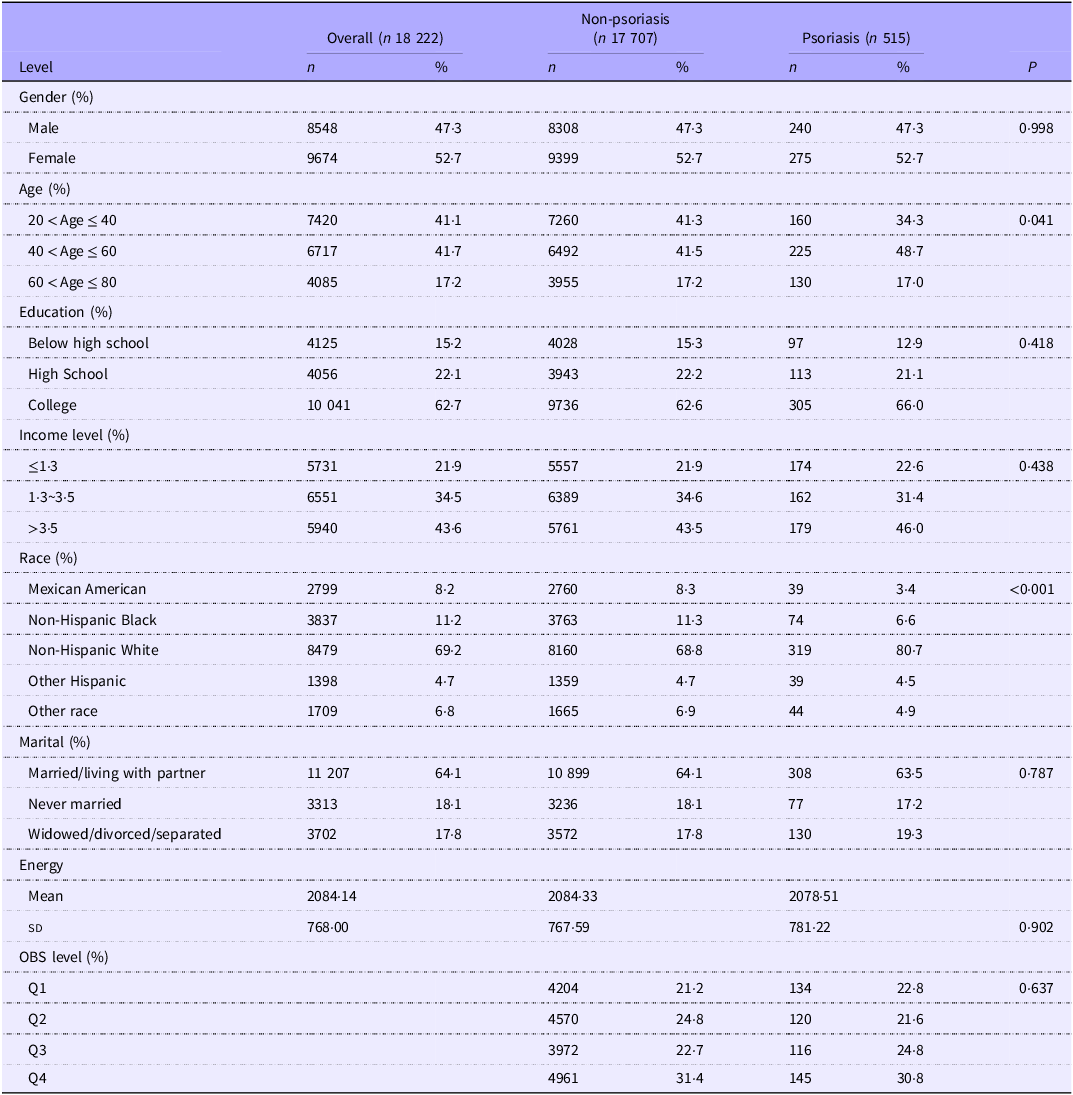
The primary analysis cohort comprised 18 023 participants, including 8453 males and 9570 females, weighted to represent a population of 168 604 063 Americans. Participants’ baseline information is displayed in Table 2, with a weighted prevalence of psoriasis of 3·14 %, and no significant differences between the psoriasis group and the non-psoriasis group in terms of gender (P = 0·969) and marital status (P = 0·775), although the age distribution of the psoriasis group was more centred in the age range of 40–60 years (48·9 % v. 41·7 %, P = 0·043). Differences in psoriasis prevalence by race were significant, with non-Hispanic whites (80·8 % v. 69·0 %, P < 0·001) being more heavily represented in the psoriasis group and Mexican Americans (3·4 % v. 8·2 %) and non-Hispanic blacks (6·4 % v. 11·2 %) being less heavily represented. The incidence of hypertension among psoriasis patients is higher compared with the control group (44·6 % v. 35·0 %, P = 0·002). Other variables such as education, income, energy intake, diabetes and hyperlipidaemia were not statistically different between groups (P > 0·05).
Baseline characteristics of participants

OBS, oxidative balance score.
Multi-model logistic regression analysis of the overall population
The association of OBS with psoriasis in the overall population is shown in Table 3. In model 1 with only OBS as the exposure and no adjustment for other covariates, using Q1 as the reference, grades Q2 and Q4 showed a negative association between OBS and psoriasis (OR < 1), but this correlation was insignificant (P > 0·05). After correcting for the different covariates, the OR for Q4 grade OBS were 0·84 (0·57–1·25) and 0·86 (0·52–1·41) in models 2 and 3, respectively, which were not statistically significant (P > 0·05), consistent with the results of univariate analysis. After dividing the OBS into DOBS and LOBS, the results of the multi-model analysis showed a non-significant negative association between DOBS and psoriasis consistent with total OBS. The association between LOBS and the risk of psoriasis, on the other hand, was higher in the Q2 and Q3 grades (OR > 1) and declined in the Q4 grades, but this correlation was statistically insignificant (P > 0·05).
Results of multi-model analysis of OBS on psoriasis

OBS, oxidative balance score; DOBS, dietary oxidative balance score; LOBS, lifestyle oxidative balance score.
Non-linear association between oxidative balance score and psoriasis
As shown in Figure 2, the non-linear associations between overall OBS and DOBS and psoriasis were not significant (NL-P > 0·05), despite a trend of decreasing followed by increasing. However, LOBS and psoriasis showed a significant nonlinear association (NL-P = 0·013), with the risk of psoriasis increasing with elevated LOBS below the threshold, and changing to a decreasing trend after a certain threshold. This is consistent with previous analyses in which the OR for LOBS was higher for grades Q2 and Q3 and lower for grade Q4.
Non-linear relationship between OBS, DOBS, LOBS and psoriasis. OBS, oxidative balance score; DOBS, dietary OBS; LOBS, lifestyle OBS.

Stratification and replication analysis
We stratified the population according to sex, age and ethnicity to further assess the association of OBS with psoriasis in populations with different characteristics (Table 4). In men, Q3 grade OBS was linked to elevated risk of psoriasis (OR: 1·31 [0·75–2·28]), with its counterpart LOBS showing the same association (OR: 1·99 [1·03–3·81]) and suggestive significance. In the age subgroups, OBS in Q2–Q4 was significantly negatively associated with psoriasis risk in 60–80 year olds with OR of 0·27 (0·15–0·49), 0·35 (0·18–0·67) and 0·32 (0·14–0·74), respectively, and this association remained statistically significant after P value adjustment. DOBS in Q2 and Q3 grades were also significantly associated with reduced psoriasis risk with OR of 0·43 (0·20–0·91) and 0·39 (0·21–0·73), respectively. After correction, the Q3-grade DOBS remained statistically significant. Among Other Hispanic, FDR-corrected LOBS at different levels showed suggestive associations with significantly reduced OR for psoriasis risk, with values of 0·33 (0·11–1·03), 0·23 (0·06–0·89) and 0·33 (0·09–1·13), respectively. Another noteworthy point is that OBS was negatively associated with psoriasis risk as a whole, whereas in the Other Race group, although not significant, the OR for total OBS were >2·0 for the different grades.
Results of model 3 after stratifying analysis by age, gender and race

OBS, oxidative balance score; DOBS, dietary oxidative balance score; LOBS, lifestyle oxidative balance score.
Following the primary analysis, we replicated the multi-model analysis using two 24-h dietary records to ensure the robustness of the results of the survey, and the results are presented in the Supplementary Tables. Replication analysis indicated that the relationship of OBS to psoriasis remained insignificant (P > 0·05) in the overall population. But in stratified analyses, OBS continued to demonstrate an association with reduced risk of psoriasis in the elderly cohort after P value adjustment (P < 0·05), consistent with our primary analysis.
Discussion
Our investigation pioneers the comprehensive evaluation of linkages connecting OBS and psoriasis through multi-modal analytical strategies based on the NHANES database. OBS, as a comprehensive assessment of oxidative stress and antioxidant capacity, integrates pro-oxidant and antioxidant factors in diet and lifestyle and is able to provide a more comprehensive reflection of the oxidative homeostasis state of the organism(Reference Zhang, Peng and Chen23). Through large-sample cross-sectional analyses and rigorous multivariate adjustments, we found that although OBS was insignificantly connected with psoriasis in the overall population, it showed a protective effect in the elderly population and in specific ethnic subgroups, which provides new epidemiological evidence for understanding the mechanisms of oxidative stress in psoriasis.
Our study found strong population heterogeneity in the relationship of OBS to psoriasis risk. While population-wide analyses revealed null effects, higher OBS levels (Q2–Q4) were significantly demonstrated protective effects against psoriasis among seniors aged 60–80 years (OR from 0·27 to 0·35, P < 0·05). This finding is consistent with the age-related oxidative stress imbalance reported in previous studies and may reflect altered redox homeostasis specific to the elderly population(Reference Blackburn, Epel and Lin30,Reference Luo, Mills and le Cessie31) . Compromised catalytic efficiency of native redox-balancing proteins including superoxide dismutase and glutathione peroxidase enzyme complexes, along with mitochondrial dysfunction leading to ROS accumulation with ageing make the elderly population more sensitive to oxidative damage(Reference Luo, Mills and le Cessie31,Reference Kudryavtseva, Krasnov and Dmitriev32) . Antioxidants may act as scavengers of ROS and maintain biological redox balance(Reference Dai, Chiao and Martin33). With age, the function of the body’s antioxidant defense system declines, which may make the protective effects of antioxidant interventions more prominent(Reference Huang, Zhang and Qiu34). The significant association observed between OBS in the elderly and reduced psoriasis risk (Q2 OR = 0·27) may imply that ageing-associated oxidative damage is an important causative factor in psoriasis.
The world is currently facing a serious ageing problem, while concerns about the physical and mental health of the elderly are increasingly emphasised. The threshold effect of lifestyle OBS revealed by restriction cubic spline analysis (P = 0·013) suggests that protective effects may only occur when lifestyle improvements attain a specific intensity. Previous studies have also found that both LOBS and DOBS are significantly negatively correlated with sarcopenia, while the preservation of muscle strength contributes to increased activity levels in older adults(Reference Xu, Mu and Wang35). Experimental studies have shown that the Nrf2-ARE pathway needs to reach a certain intensity of stimulation to effectively activate the expression of downstream antioxidant enzymes(Reference Liu, Pi and Zhang36). Moreover, the systemic chronic inflammatory state induced by obesity leads to elevated levels of IL-6 and TNF-α alongside reduced levels of adiponectin, with these alterations playing a key role in the pathogenesis of psoriasis(Reference Barros, Duran and Vera37). Smoking and alcohol consumption are commonly regarded as risk factors for psoriasis, as they can influence autoimmune diseases through mechanisms such as affecting systemic immune cell responses and gut microbiota(Reference Wang, Zhang and Peng38). Our data further indicate that dietary OBS (Q2–Q4, OR = 0·39–0·46) exhibits a stronger negative correlation with psoriasis than the protective effect of lifestyle OBS in the elderly population, which may be attributed to the low activity level and lifestyle constraints such as physical fitness in the elderly. This finding supports the use of dietary interventions as a prioritised strategy for psoriasis prevention in older adults.
Of note, our stratified analysis revealed a potential protective effect of lifestyle OBS among Other Hispanic (OR = 0·23), a finding that may be related to genetic backgrounds (e.g., polymorphisms in the GSTM1 gene, e.g., polymorphisms in antioxidant enzymes) and patterns of environmental exposures specific to this population(Reference Wang, Yang and Zheng39). Researchers have also reported that genetic predictors of CVD are associated with an increased risk of psoriasis(Reference Ramessur, Saklatvala and Budu-Aggrey40). These results suggest that antioxidant intervention strategies for specific populations may have more clinical value than universal programs. Significant differences exist between the effects of DOBS and LOBS on psoriasis risk. Among Other Hispanic, LOBS have a more significant relationship with disease than DOBS. In addition, although the relationship of OBS to psoriasis was statistically insignificant in the Other Race group, its OR, which was generally greater than 2, further exemplified the differences between the races. It is noteworthy that these findings focus on mixed populations with non-single ancestry, whose complex genetic characteristics warrant further detailed investigation.
In most of our results, the negative association between DOBS and psoriasis is more pronounced than LOBS, suggesting that dietary factors play a more central antioxidant role in moderating the risk of psoriasis. DOBS contains fifteen antioxidant nutrients (e.g., vitamins C, E and Se) and one pro-oxidant (Fe), and its composite score provides a more direct reflection of the dynamic balance of the body’s oxidative stress/antioxidant system more directly. Dietary antioxidants can attenuate the characteristic inflammatory response of psoriasis through suppression of the NF-κB signalling axis and downregulation of key pro-inflammatory mediators such as IL-17/IL-23(Reference Shi, Wu and Yu41–Reference Xu, Wang and Zhong44). Dietary OBS components such as Zn can reduce systemic inflammation levels by modulating the composition of the intestinal flora and decreasing the entry of enteric-borne endotoxins into the bloodstream(Reference Wu, Tian and Zhao45). Animal studies have confirmed that high antioxidant diets increase the abundance of anti-inflammatory bacteria such as intestinal Akkermansia, a mechanism that may be a unique protective pathway not covered by LOBS(Reference Ma, Liu and Gao46). Dietary fibre and vitamin D enriched in high DOBS diets may synergistically improve the pathological process of psoriasis. The antioxidant effect of the diet is more direct than LOBS, which covers only four lifestyle indicators and whose antioxidant mechanisms may be diluted by confounding factors (e.g., differences in exercise intensity and depth of smoking).
There are some limitations of the present study that need to be accounted for. First, single time-point analyses inherently restrict causal inference in OBS–psoriasis interactions, which calls for a longitudinal cohort design in future studies to validate the temporal association. Second, psoriasis diagnosis is based on patient self-report, which may miss subclinical cases and introduce recall bias, and the use of zero-point assignment for missing values in the OBS may underestimate the actual level of exposure. In addition, conclusions drawn in specific races are challenged in terms of generalisability given the heterogeneity between races. Concurrently, among the study participants, the sample sizes for older adults and ethnic minorities were smaller, necessitating further research to explore the robustness of these findings. These methodological limitations suggest that future studies should incorporate prospective cohort design and dynamic monitoring of oxidative stress biomarkers to more accurately assess the predictive value of OBS.
Conclusion
This study, through analysis of large-scale sample data, provides new evidence for the association between OBS and psoriasis, particularly observing a significant reduction in psoriasis risk among elderly populations and Hispanic individuals. These findings provide new epidemiologic evidence for understanding the mechanisms of oxidative stress in psoriasis and suggest that antioxidant interventions targeted to specific populations may have preventive value. Future studies should further validate the potential for clinical application of the OBS score by incorporating dynamic monitoring metrics, multicentre cohorts and molecular mechanism explorations, ultimately providing a more reliable evidence-based basis for precision prevention strategies in psoriasis.
Supplementary material
For supplementary material/s referred to in this article, please visit https://doi.org/10.1017/S0007114525106107.
Acknowledgements
Thanks to the NHANES and providers of all the datasets used in the study.
The author(s) declare financial support was received for the research, authorship and publication of this article. This work was supported by grants from the National Natural Sciences Foundation of China (K.M., grant no. 81972935) and the Natural Science Basis Research Plan in Shaanxi Province of China (P.L., grant no. 2023JC-YB-665). Neither the National Natural Sciences Foundation of China nor the Natural Science Basis Research Plan in Shaanxi Province of China had any role in the design, analysis, or writing of this article.
All authors made significant contributions to the design and implementation of this study. L.P. and J.W. conceived the study. L.P. and J.W. performed the data analysis, L.P. wrote the first draft of the manuscript. P.L. and K.M. supervised all the analyses and are responsible for the interpretation of the data. C.G., Y.Y. and X.D. performed the validation analyses. L.P. and J.W. performed data organisation. All authors reviewed the draft manuscript.
The authors declare none.
The data supporting the findings from this study are available within the manuscript. This study was conducted using the NHANES resource (https://wwwn.cdc.gov/nchs/nhanes/Default.aspx).
This manuscript was written without the use of AI.