Introduction
Faced with ageing populations, many European countries are grappling with the issue of how to meet the care needs of the older population at a cost that is acceptable to society. In many countries where the state traditionally carried the main responsibility for the provision of care to older persons in need, such as Norway (Daatland Reference Daatland and Companje2015), Sweden (Ulmanen Reference Ulmanen2013), Finland (Kröger and Leinonen Reference Kröger and Leinonen2012) and the Netherlands (Da Roit Reference Da Roit2012), an increasingly strong appeal to the family to take on support tasks has developed in the last decades. The Dutch case is illustrative for this development.
Half a century ago, the Dutch introduced a comprehensive universal social insurance scheme covering long-term care (LTC) for all persons in need, and in the decades that followed they expanded its scope (Companje Reference Companje and Companje2015). Since the mid-1980s, financial constraints have led to reforms. Initially, cost-containment was mainly pursued through supply regulation and budgetary restrictions (Schut and Van den Berg Reference Schut and Van den Berg2010). As we will discuss in further detail later, reforms enacted in the 21st century mainly aimed to encourage potential informal care-givers – in particular family members – to provide support to those in need.
In this article, we sketch the LTC reforms that have taken place in Europe, and specifically in the Netherlands, over the last decades. Next, we assess how the provision of household support by adult children of impaired older persons has changed in the wake of Dutch LTC reforms. We estimate multinomial logistic regression models on longitudinal Netherlands Kinship Panel Study data, and focus on household support because the most drastic changes brought about by recent LTC reforms in the Netherlands and other universalistic countries concern the provision of lighter forms of state-supported LTC services. The state still takes on a large responsibility for the provision of care services for those with severe needs, e.g. those in need of long-term personal care or nursing care, but for lighter forms of support, such as household help, informal care-givers – and in particular family members – are increasingly being called upon.
Long-term care reforms in Europe
Residual model and universalistic model
Compared to risks like illness or unemployment, the need for LTC has only quite recently been recognised by European countries as a specific social risk requiring welfare policy intervention (Daatland Reference Daatland and Companje2015; Österle and Rothgang Reference Österle, Rothgang, Castles, Leibfried, Lewis, Obinger and Pierson2010; Ranci and Pavolini Reference Ranci and Pavolini2015). People with care needs have traditionally relied on family networks, and, to some extent, on charitable sources or local social assistance. Particularly in countries in Southern Europe, but also in, for instance, Germany and France, the reliance on informal and charity networks remained largely unchanged because of persistent institutional and cultural traditions (Daatland Reference Daatland and Companje2015; Österle and Rothgang Reference Österle, Rothgang, Castles, Leibfried, Lewis, Obinger and Pierson2010; Pavolini and Ranci Reference Pavolini and Ranci2008; Swartz Reference Swartz2013). Until recently, these countries had limited provisions of state-supported services for those in need. Some cash transfers were available to meet part of the supplementary costs associated with dependency. Persons in need of care had to organise ways of having their care needs met themselves, typically by relying on their families and social networks (Pavolini and Ranci Reference Pavolini and Ranci2008). Following Ranci and Pavolini (Reference Ranci and Pavolini2015), we use the term residual LTC model for this way of organising LTC. Other labels used for this approach are informal care-led model (Pavolini and Ranci Reference Pavolini and Ranci2008) and family care model (Anttonen and Sipilä Reference Anttonen and Sipilä1996).
A radically different approach to organising LTC was taken in a set of countries in North-Western Europe. In some cases as early as in the 1940s, Norway, Sweden, Denmark and Finland started providing universal tax-funded LTC services (Colombo Reference Colombo, Costa-Font and Courbage2012; Österle and Rothgang Reference Österle, Rothgang, Castles, Leibfried, Lewis, Obinger and Pierson2010; Swartz Reference Swartz2013). In the Netherlands, the Exceptional Medical Expenses Act (Dutch: Algemene Wet Bijzondere Ziektekosten; AWBZ) came into effect in 1968. The AWBZ was a universal social insurance scheme. When the AWBZ was introduced, it entitled every Dutch citizen to nursing care, personal care and medical help in recognised hospitals and institutions. In 1970, extramural care, i.e. care not provided in institutions, was added to the AWBZ and in the following decades the Act's scope continued to expand (Companje Reference Companje and Companje2015; Schut and Van den Berg Reference Schut and Van den Berg2010). The extensive provision of services lightened the family's caring responsibilities in these countries (cf. Lister Reference Lister, Baldwin and Falkingham1994). Ranci and Pavolini (Reference Ranci and Pavolini2015) use the label universalistic LTC model for this approach to LTC. Other terms used include services-led model (Pavolini and Ranci Reference Pavolini and Ranci2008) and the Scandinavian model of public services (Anttonen and Sipilä Reference Anttonen and Sipilä1996).
Convergence
Since the 1990s, the differences in the approach to LTC between the countries that adopted a residual model and those that adopted a universalistic model have become less clear-cut than before (Daatland Reference Daatland and Companje2015; Pavolini and Ranci Reference Pavolini and Ranci2008; Österle and Rothgang Reference Österle, Rothgang, Castles, Leibfried, Lewis, Obinger and Pierson2010; Ranci and Pavolini Reference Ranci and Pavolini2015; Rostgaard Reference Rostgaard2002; Swartz Reference Swartz2013). The main driver for convergence was demographic change. As a result of low fertility and longer life expectancy, the number of older people increased in absolute terms and as a proportion of the total population. Concomitantly, the need for care grew, despite the healthier status of more recent cohorts of older adults (Organisation for Economic Co-operation and Development (OECD) 2011). The residual LTC model as well as the universalistic LTC model encountered problems in facing increasing care needs.
In countries with a residual LTC model, families were facing ever-greater difficulties meeting the rising demand for care (Pavolini and Ranci Reference Pavolini and Ranci2008; Ranci and Pavolini Reference Ranci and Pavolini2015). In addition to population ageing, the rising female labour participation contributed to making a purely residual LTC model unfeasible (Daatland Reference Daatland and Companje2015; Costa-Font, Gori and Santana Reference Costa-Font, Gori, Santana, Costa-Font and Courbage2012). Women – who had traditionally taken on the bulk of the care tasks – more often had paid work obligations, making care-giving less self-evident. Many countries started to acknowledge, rather than take for granted, family care-giving. This recognition, which ‘care feminists’ had been pleading for since the 1980s (O'Connor Reference O'Connor1996; Waerness Reference Waerness1987), came, for instance, in the form of cash-for-care benefits and the introduction of measures to support caring families (Pavolini and Ranci Reference Pavolini and Ranci2008). By expanding the coverage of LTC services, countries with LTC systems that could previously be characterised as residual shifted towards a model in which the responsibility to provide care for those in need was shared between state and family (Ranci and Pavolini Reference Ranci and Pavolini2015; Rostgaard Reference Rostgaard2002; Rostgaard et al. Reference Rostgaard, Glendinning, Gori, Kröger, Österle, Szebehely, Theobald, Timonen and Vabø2011; Swartz Reference Swartz2013).
Similar to countries with traditionally residual LTC models, countries that had adopted universalistic LTC models also felt the urge to reform. Concerns about the financial sustainability of their LTC systems against the backdrop of ageing populations were the driving force, rather than concerns about the ability to meet the rising demand of care (Ranci and Pavolini Reference Ranci and Pavolini2015). In many countries service levels were frozen, care services were increasingly targeted to those with the most severe needs and reimbursements for care providers were restricted in order to contain costs (Karlsson, Iversen and Øien Reference Karlsson, Iversen, Øien, Costa-Font and Courbage2012; Kröger and Leinonen Reference Kröger and Leinonen2012; Larsson Reference Larsson2006; Österle and Rothgang Reference Österle, Rothgang, Castles, Leibfried, Lewis, Obinger and Pierson2010; Pavolini and Ranci Reference Pavolini and Ranci2008; Ranci and Pavolini Reference Ranci and Pavolini2015; Swartz Reference Swartz2013; Trydegård and Thorslund Reference Trydegård and Thorslund2010). In addition, a stronger emphasis was placed on home-based care services rather than on care provided in institutions (Anxo and Fagan Reference Anxo, Fagan and Bosch2005; Karlsson, Iversen and Øien Reference Karlsson, Iversen, Øien, Costa-Font and Courbage2012; Österle and Rothgang Reference Österle, Rothgang, Castles, Leibfried, Lewis, Obinger and Pierson2010; Pavolini and Ranci Reference Pavolini and Ranci2008; Rostgaard Reference Rostgaard2002; Rostgaard et al. Reference Rostgaard, Glendinning, Gori, Kröger, Österle, Szebehely, Theobald, Timonen and Vabø2011; Swartz Reference Swartz2013). Co-payments from persons with less severe care needs were increased (Pavolini and Ranci Reference Pavolini and Ranci2008; Rostgaard et al. Reference Rostgaard, Glendinning, Gori, Kröger, Österle, Szebehely, Theobald, Timonen and Vabø2011; Swartz Reference Swartz2013). Local governments – which are often responsible for the organisation of home-care services – scaled down the provision of lighter forms of care, such as household help, or removed these services from the scope of home care altogether (Kröger and Leinonen Reference Kröger and Leinonen2012; Rostgaard et al. Reference Rostgaard, Glendinning, Gori, Kröger, Österle, Szebehely, Theobald, Timonen and Vabø2011; Trydegård and Thorslund Reference Trydegård and Thorslund2010). The changes described here led to a de facto reduction of universalism (cf. Da Roit Reference Da Roit2012; Szebehely and Trydegård Reference Szebehely and Trydegård2012; Trydegård and Thorslund Reference Trydegård and Thorslund2010).
The case of the Netherlands
Situation around the turn of the century
The AWBZ was still in effect in the Netherlands at the beginning of the twenty-first century. Since its introduction in 1968, the AWBZ had entailed universal entitlement to LTC in nursing homes (Schut and Van den Berg Reference Schut and Van den Berg2010), which is reflected in the relatively high share of the older population living in residential care settings in the Netherlands (Anxo and Fagan Reference Anxo, Fagan and Bosch2005; Saraceno Reference Saraceno2010). Even though de-institutionalisation had been promoted from the early 1980s onwards (Da Roit Reference Da Roit2012), the availability of beds in LTC institutions was still high in the year 2000, with 78 beds available per 1,000 persons aged 65 and older (OECD 2017a). Compared to other OECD countries, this number was second only to Sweden (99 beds per 1,000 persons aged 65+). The availability of beds in residential care settings was lower in other universalistic countries, such as Denmark (58 beds per 1,000 persons aged 65+), Norway (63 beds per 1,000 persons aged 65+ in 2002) and Finland (45 beds per 1,000 persons aged 65+).
Since 1970, the AWBZ had also guaranteed universal entitlement to state-supported home-care services (Companje Reference Companje and Companje2015). The wide availability of state-supported home-care services for persons in need around the turn of the century is illustrated by OECD statistics on receipt of LTC at home. In 2004, the first year in the twenty-first century for which information on home-care use in the Netherlands was available, 15.4 per cent of persons aged 65 and older received LTC at home (OECD 2017b). Compared to the Netherlands, LTC receipt at home among people aged 65 and older was somewhat lower in other universalistic countries, such as Denmark (12.8%), Norway (11.5%), Sweden (10.1%) and Finland (7.5%).
Twenty-first-century reforms
Since the turn of the century, several LTC reforms happened in the Netherlands which, taken together, implied a move away from the universalistic LTC model adopted by the country since the introduction of the AWBZ in 1968 and the subsequent expansion of its scope. The de-institutionalisation of LTC, which had already started in the early 1980s, continued in the first decade of the twenty-first century. Whenever possible, care preferably had to be provided at home, rather than in residential care settings (Companje Reference Companje and Companje2015; Da Roit Reference Da Roit2012). This shift fitted changing ideas about autonomy and independence, but was also a cost-containment strategy, because care provided at home was less expensive than institutional care (Companje Reference Companje and Companje2015; Da Roit Reference Da Roit2012). The de-institutionalisation, which the Netherlands shared with other universalistic countries such as Norway (Daatland Reference Daatland and Companje2015), Sweden (Trydegård and Thorslund Reference Trydegård and Thorslund2010; Ulmanen and Szebehely Reference Ulmanen and Szebehely2015) and Denmark (Schulz Reference Schulz2010), is reflected in OECD statistics on the availability of beds in residential care settings. In 2012, there were 66 beds in LTC institutions per 1,000 persons aged 65 and older, down from 78 in 2000 and 101 in 1990 (OECD 2017a). Consequently, admittance rates for care in LTC institutions dropped, particularly among older persons with lighter care needs (Alders, Comijs and Deeg Reference Alders, Comijs and Deeg2017; De Meijer et al. Reference De Meijer, Bakx, Van Doorslaer and Koopmanschap2015).
Like in Norway (Daatland Reference Daatland and Companje2015), Sweden (Larsson Reference Larsson2006; Trydegård and Thorslund Reference Trydegård and Thorslund2010) and Finland (Kröger and Leinonen Reference Kröger and Leinonen2012), access to state-supported home-care services became increasingly restricted in the Netherlands. Needs assessors increasingly considered the availability of informal care when determining eligibility for AWBZ services (Grootegoed, Duyvendak and Van Barneveld Reference Grootegoed, Duyvendak and Van Barneveld2015; Jörg et al. Reference Jörg, Boeije, Huijsman, De Weert and Schrijvers2002; Morée, Van der Zee and Struijs Reference Morée, Van der Zee and Struijs2007). Since 2003, certain forms of care were labelled as usual care (Dutch: gebruikelijke zorg). The usual care concept was launched in 2003 and subsequently modified and formalised in a protocol, with the explicit intention of limiting the formal support prescribed and thereby containing costs (Morée, Van der Zee and Struijs Reference Morée, Van der Zee and Struijs2007). Usual care was defined as ‘the normal, daily care that nuclear family members or other people who share a household can be expected to provide to one another’ (CIZ 2012: 9, authors’ translation). The usual care protocol was crucial in determining entitlement to specific benefits under the AWBZ. The protocol applied to AWBZ provision of household support (e.g. cleaning the home; until 2007), social participation support (e.g. help with mobility issues that would hamper family visits) and, insofar as assessment officers did not expect dependency to last for more than three months, personal care (e.g. help with washing and dressing). When older persons in need of care shared a household with a partner or spouse or, in some cases, a child they were typically not eligible for state-supported services for these forms of care. Moreover, co-payments for LTC services – which had been relatively low until that time – were increased substantially in 2004, particularly for home-based services (Da Roit Reference Da Roit2012; Schut and Van den Berg Reference Schut and Van den Berg2010). Consequently, these services became less attractive, particularly for persons with higher incomes (cf. Plaisier, Verbeek-Oudijk and De Klerk Reference Plaisier, Verbeek-Oudijk and De Klerk2017).
The personal budget (Dutch: Persoonsgebonden Budget, PGB), introduced in 1995, was expanded in 2003. For most types of LTC, users could now choose a cash benefit instead of care in kind. Apart from the obligation to demonstrate that the money was spent on care delivered by a professional or informal care-giver, recipients were largely free as to how they might spend the PGB (Mot Reference Mot2010). The PGB scheme was introduced to increase independence, autonomy and choice for persons with care needs. It was, however, also designed as a cost-containment measure, because PGB benefits were typically 25 percent lower than expenses for care in kind (Da Roit Reference Da Roit2012). By 2001, all who had been approved for home care for at least three months were eligible for a PGB (Da Roit Reference Da Roit, Ranci and Pavolini2013). The impact of the PGB scheme on the Dutch LTC system was limited, however (Da Roit and Le Bihan Reference Da Roit and Le Bihan2010). The PGB was more popular among younger persons with care needs than among older persons (Mot Reference Mot2010). As a cost-containment measure, the PGB was not very effective. Its set-up created a demand: persons who would not have applied for home-care services applied for a PGB to recompense previously unpaid informal care-givers (Da Roit Reference Da Roit, Ranci and Pavolini2013; Schut and Van den Berg Reference Schut and Van den Berg2010). As such, the PGB scheme could be seen as a form of recognition of the value of informal care (cf. Pavolini and Ranci Reference Pavolini and Ranci2008). Another, smaller, measure illustrative of the increased recognition of informal care-giving was the so-called ‘informal care compliment’ (Dutch: Mantelzorgcompliment) introduced in 2007. It was a lump-sum payment of €250 per year for persons providing informal care to people officially assessed as being in need of care.
With the introduction of the Social Support Act (Dutch: Wet maatschappelijke ondersteuning, Wmo) in 2007, municipalities’ role in supporting older persons with care needs has increased. Municipalities now have the obligation to support informal care-givers through the provision of information, advice and guidance, emotional support, education, practical help, financial support and material support (De Klerk, Gilsing and Timmermans Reference De Klerk, Gilsing and Timmermans2010). Evaluators from the Netherlands Institute for Social Research noted an increase among municipalities in the attention for the support of informal care-givers in the years after the introduction of the Wmo (Kromhout et al. Reference Kromhout, Feijten, Vonk, De Klerk, Marangos, Mensink, Den Draak and De Boer2014).
The introduction of the Wmo also meant that municipalities became responsible for the provision of household services, e.g. cleaning the home. Given that municipalities receive a non-earmarked budget for household services (Mot Reference Mot2010), they have an incentive to limit spending. Within boundaries prescribed by law, municipalities have increased their efforts to reduce expenses related to the Wmo. A common strategy is to better verify which informal sources of support are potentially available (Kromhout et al. Reference Kromhout, Feijten, Vonk, De Klerk, Marangos, Mensink, Den Draak and De Boer2014). Rising numbers of municipalities, for instance, organise so-called ‘kitchen table conversations’ in which a consultant, in line with the ideology behind the Wmo, makes an inventory of the extent to which a Wmo applicant's problems can be resolved within his/her family and social network (Dijkhoff Reference Dijkhoff2014). Unlike the universal AWBZ scheme, the Wmo is based on the principle of subsidiarity:
ideally, citizens should take responsibility themselves in matters of social assistance … When this is not sufficient, they can apply to the local council, which has a great degree of freedom in making its own policy and responding to local circumstances. (Mot Reference Mot2010: 17)
The introduction of the Wmo implied a split between, on the one hand, care and support services that remained in the AWBZ and to which people were legally entitled, and, on the other hand, services that no longer fell under a strong legal entitlement. The transfer of household services from the AWBZ to the Wmo is arguably the most substantial element of a Dutch reform strategy that Da Roit (Reference Da Roit, Ranci and Pavolini2013) calls ‘hollowing’: moving elements of social protection from the scope of the universal AWBZ scheme to schemes that respond to different logics and have other entitlement structures. In 2015, this trend culminated in the replacement of the AWBZ by the Long-Term Care Act (Dutch: Wet Langdurige Zorg, Wlz). The Wlz is a universal social insurance scheme, like the AWBZ, but its scope is much more limited, only covering care to people who need support 24 hours per day. Lighter forms of nursing care and personal care services have been transferred to the Health Insurance Act (Dutch: Zorgverzekeringswet, Zvw) and the Wmo. As a consequence, municipalities are now responsible for a broader range of services, and they are encouraged to manage and provide them according to the principle of subsidiarity that underlies the Wmo.
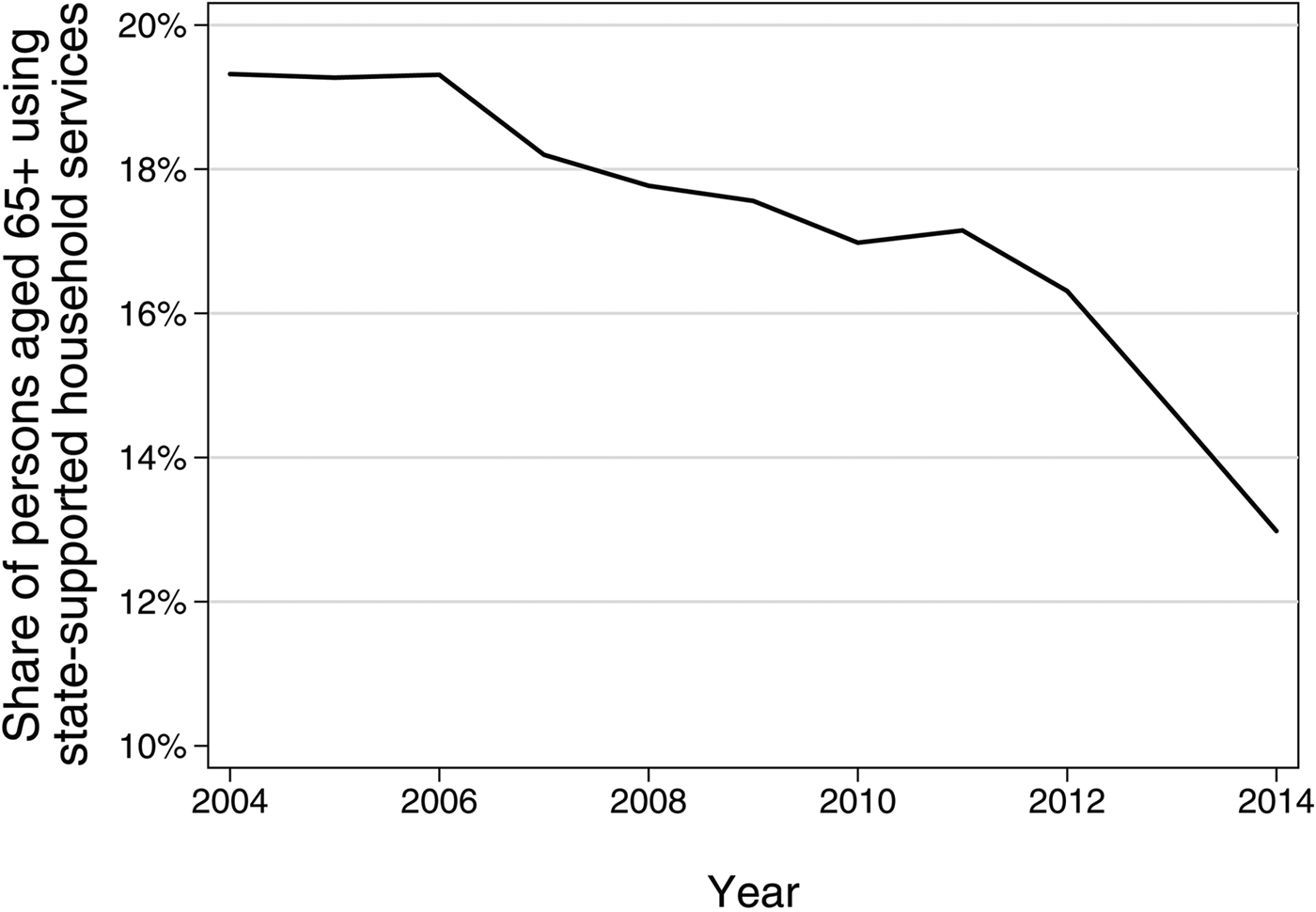
Ranci and Pavolini (Reference Ranci and Pavolini2015) have argued that in many European countries the relationship between the state and the family has been recast. This observation clearly applies to the Netherlands. The scope of services to which the Dutch are entitled has been reduced. Informal care-givers – mainly family members – have been increasingly encouraged to support those in need. On the one hand, services have been developed and expanded to support care-givers in need and recognition for the work of informal care-givers has grown, for instance through the expansion of the PGB scheme and the introduction of the informal care compliment. On the other hand, access to lighter forms of services, such as household help, has been restricted through increased co-payments and stricter needs assessment that takes into account the presence of potential informal support providers. This is illustrated in Figure 1, which shows that the use of state-supported household services as a share of the population aged 65 and older decreased sharply between 2004 and 2014.
Use of state-supported household services in the Netherlands.

Theoretical background and hypotheses
Saraceno (Reference Saraceno2010) has developed a classification for country differences in the allocation of caring responsibilities between families and the state. She identified three patterns: familialism-by-default, supported familialism and de-familialisation. The first pattern refers to a situation where family members have few alternatives but to provide care because state-supported LTC services are not available. In the supported familialism pattern, family involvement in care-giving is fostered through support (leave and financial transfers) for families in keeping up their caring responsibilities. De-familialisation refers to a situation where family members are freed from the obligation to care for relatives in need, because social rights, for instance entitlements to care services, are individualised.
As in other universalistic countries (Kröger and Leinonen Reference Kröger and Leinonen2012), levels of de-familialisation have been reduced in the Netherlands, for instance through decreases in the availability of residential care beds and through stricter eligibility criteria for LTC services. Levels of supported familialism have, in turn, been increased, for instance through the introduction of the obligation for municipalities to support informal care-givers, and the increased recognition of informal care-giving through the expansion of the PGB scheme and the introduction of the informal care compliment. Given this shift from de-familialisation to supported familialism, we expect that, in the Netherlands in the early 21st century, adult children increasingly provided household support to impaired parents (Hypothesis 1).
The implications of the shift from de-familialisation to supported familialism in the Netherlands may very well differ between daughters and sons of parents in need of care. Daughters are known to provide more support to parents than sons (Knijn and Liefbroer Reference Knijn, Liefbroer, Dykstra, Kalmijn, Knijn and Komter2005; Van den Broek and Dykstra Reference Van den Broek and Dykstra2016), and Saraceno (Reference Saraceno2010) argues that the recourse to the family when levels of de-familisation are low amplifies such gender differences. Consistent with this reasoning, gender differences in care for older persons appear to be larger in countries with lower care services coverage (Haberkern, Schmid and Szydlik Reference Haberkern, Schmid and Szydlik2015; Schmid, Brandt and Haberkern Reference Schmid, Brandt and Haberkern2012). It is therefore not surprising that scholars have expressed concerns about the potentially gendered consequences of Dutch LTC reforms (Schenk et al. Reference Schenk, Dykstra, Maas and Van Gaalen2014; Van den Broek Reference Van den Broek2013; Van Hooren and Becker Reference Van Hooren and Becker2012; cf. Grootegoed, Duyvendak and Van Barneveld Reference Grootegoed, Duyvendak and Van Barneveld2015). Following the previous considerations, we hypothesise that daughters’ involvement in the provision of household support showed a stronger increase than did sons’ (Hypothesis 2).
Particularly with regard to lighter forms of care services, levels of defamilialisation have declined in the Netherlands. As illustrated in Figure 1, access to state-supported household services became increasingly restricted in the 21st century. The substitution model by Greene (Reference Greene1983) posited that persons in need less often receive informal care when they receive formal home care. With this model, Greene aimed to shed light on the potential implications of social welfare expansion for care provided informally. Johansson, Sundström and Hassing (Reference Johansson, Sundström and Hassing2003) coined the term ‘reverse substitution’ for the opposite pattern. They found that family support to older persons in need increased in Sweden in response to cutbacks of state-supported care services (cf. Jegermalm and Jeppsson Grassman Reference Jegermalm and Jeppsson Grassman2012; Szebehely and Trydegård Reference Szebehely and Trydegård2012; Ulmanen and Szebehely Reference Ulmanen and Szebehely2015). Taking the previous arguments together, we hypothesise that adult children's increased provision of household support is attributable to changes in parents’ receipt of state-supported household services (Hypothesis 3).
Data and methods
Data
Our data are from the public release file of the Netherlands Kinship Panel Study (NKPS) (Dykstra et al. Reference Dykstra, Kalmijn., Knijn, Komter, Liefbroer and Mulder2005, Reference Dykstra, Kalmijn., Knijn, Komter, Liefbroer and Mulder2012; Hogerbrugge et al. Reference Hogerbrugge, De Hoon, Dykstra, Komter, Liefbroer and Mulder2015; Merz et al. Reference Merz, Dykstra, Hogerbrugge, Komter, Liefbroer and Mulder2012). In the first wave, 8,161 men and women aged 18–80, and living in private households, were interviewed. The overall response rate in Wave 1 was 45 per cent. Data collection of the first wave took place between 2002 and 2004, and the data for subsequent waves were collected in 2006–2007, 2011 and 2014, respectively. The numbers of respondents in follow-up interview rounds were, respectively, 6,091 (Wave 2), 4,390 (Wave 3) and 2,920 (Wave 4). In all waves, the NKPS sample differed somewhat from the Dutch population at large. Most notably, women, middle-aged persons and higher-educated persons were over-represented (for more details, see Dykstra et al. Reference Dykstra, Kalmijn., Knijn, Komter, Liefbroer and Mulder2005, Reference Dykstra, Kalmijn., Knijn, Komter, Liefbroer and Mulder2012; Hogerbrugge et al. Reference Hogerbrugge, De Hoon, Dykstra, Komter, Liefbroer and Mulder2015; Merz et al. Reference Merz, Dykstra, Hogerbrugge, Komter, Liefbroer and Mulder2012).
We restricted our analyses to primary respondents aged 50–80 who had adult children and were in need of care, i.e. who reported that they had one or more prolonged illnesses, health disorders or handicaps that restricted them lightly or severely in their daily activities (cf. Walker, Pratt and Eddy Reference Walker, Pratt and Eddy1995). Across waves, 2,770 interviews were conducted with 1,637 different respondents who met these criteria at the time of data collection. For the 692 primary respondents who met the inclusion criteria during multiple interviews, we only used one randomly selected interview. Respondents with missing values on any of the parent-level variables of our interest (N = 40) were dropped.
In each wave of the NKPS, parents were asked to provide information on up to two children who were randomly chosen when data for Wave 1 were collected. The focus on two randomly selected children, rather than, for instance, the two oldest children or two children selected by the parent, has the benefit that the generalisability of our findings is not restricted to specific groups of children. We deleted 139 parents who did not provide any information on their children. The remaining parents provided at least partial information on 2,662 children. After list-wise deletion of observations with missing values on relevant child characteristics, observations of 2,197 children from 1,310 parents remained in the final sample.
Weights
Weighting was applied to adjust for potential bias in our estimates due to selective non-response and attrition. In the NKPS, weights are supplied that, for each wave, make primary respondents representative for the non-institutionalised adult population (in 2003) with regard to sex, age, household type, region and level of urbanisation. It is important to note (a) that our unit of analysis was not the older parent in need of care (i.e. primary respondents who met our selection criteria), but the parent–child dyad, and (b) that multiple parent–child dyads could be nested within the parent. This implies that the supplied weights, which were applicable to primary respondents, were too small for parent–child dyads from larger families and too large for parent–child dyads from small families. We therefore adjusted the supplied weights based on the respondent's number of living children and the number of parent–child dyads nested within the respondent present in the sample. All analyses were repeated with unweighted data (results are available on request). The results of these analyses did not differ substantially from the results presented in this article.
Measures
The dependent variable in this study was household support provided by the adult child. For each of the up to two randomly selected children, respondents were asked whether this child provided help with housework, such as preparing meals, cleaning, fetching groceries and doing the laundry during the last three months. The question allowed occasional and frequent household support to be distinguished by answering using the categories (1) ‘not at all’, (2) ‘once or twice’ and (3) ‘several times’.
We captured the changing Dutch LTC context with an indicator for the wave number. The intervals between rounds of data collection were largely equal, with roughly four years between waves. As described above, a notable shift from de-familialisation to supported familialism has been taking place in the Netherlands between Wave 1 (2002–2004) and Wave 4 (2014).
The use of state-supported household services – the supposed mediator of the change over time in our third hypothesis – was measured with a dummy variable indicating whether or not respondents reported using household services from a home-care organisation. We also considered possible suppressors of the time effects. Potential suppressors are alternative solutions for people with care needs to cope with the declining levels of de-familialisation, net of which the increase in children's provision of household support over time may be larger. Particularly, spouses and partners of persons in need may have become more involved in household tasks, or persons in need may have used out-of-pocket paid household services. For parents living with a spouse or partner, we therefore distinguished those who reported that their spouse or partner did at least half of the tidying and cleaning tasks from those with less-active spouses and partners. To capture use of out-of-pocket paid household services, we included a dummy variable indicating whether or not respondents reported using paid domestic help from a private party.
To minimise bias in the estimation of our time effects further, we controlled for a range of parent and child characteristics that are known predictors of intergenerational support (Blomgren et al. Reference Blomgren, Breeze, Koskinen and Martikainen2012; Brandt, Haberkern and Szydlik Reference Brandt, Haberkern and Szydlik2009; Kalmijn and Saraceno Reference Kalmijn and Saraceno2008; Knijn and Liefbroer Reference Knijn, Liefbroer, Dykstra, Kalmijn, Knijn and Komter2005; Ogg and Renaut Reference Ogg and Renaut2006; Vlachantoni et al. Reference Vlachantoni, Shaw, Evandrou and Falkingham2015). Parent characteristics included in the models were gender, coded as 1 for mothers and 0 for fathers, age, number of children and number of siblings. A dummy variable captured whether or not the parent was divorced. We distinguished three categories of parents’ educational attainment: low (lower secondary education degree or less), intermediate (higher secondary education degree or a vocational degree) and high (bachelor, master or post-graduate degree). To measure the level of need, we included a dummy variable distinguishing parents who reported that their health problems restricted them severely in their daily activities (coded as 1) from those who reported being only lightly restricted (coded as 0).
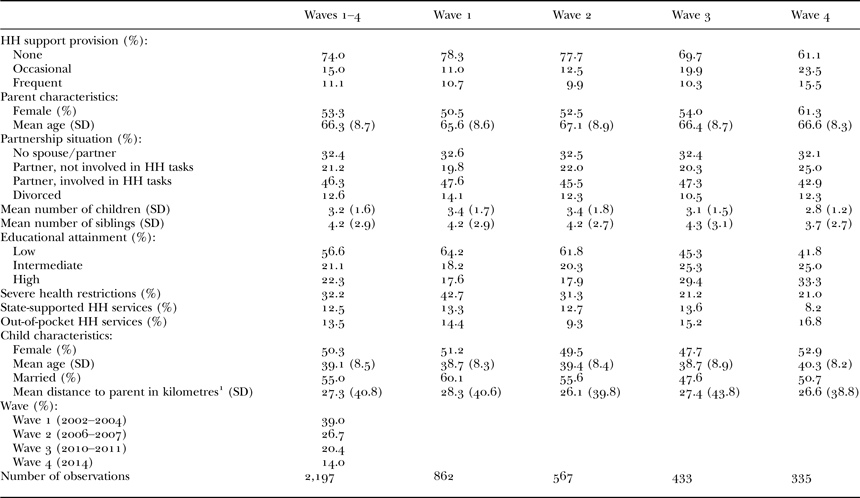
Child characteristics in the model included gender, coded as 1 for daughters and 0 for sons, and age. We further included a dummy variable capturing whether or not children were married. Geographic proximity to the parent was measured as the natural logarithm of the distance to the parent in kilometres. Descriptive statistics of our sample are presented in Table 1.
Descriptive statistics

Notes: HH: household. SD: standard deviation. Data are weighted. 1. Values represent scores before log transformation.
Source: Netherlands Kinship Panel Study, Waves 1–4.
Method
Given that the main focus of the current study is on the trend over time in the household provision by adult children of impaired older persons, we adopted a repeated cross-sectional design (Steel Reference Steel and Lavrakas2008; cf. Johansson, Sundström and Hassing Reference Johansson, Sundström and Hassing2003; Plaisier, Verbeek-Oudijk and De Klerk Reference Plaisier, Verbeek-Oudijk and De Klerk2017). We estimated a series of multinomial regression models to predict adult children's occasional and frequent provision of household support to ageing parents. In preliminary analyses we also estimated ordinal logistic regression models, but Brant tests (Brant Reference Brant1990) indicated that the parallel regression assumption underlying such models was violated. In other words, the correlates of occasional and frequent household support differed, and therefore multinomial models were preferable. We used Karlson, Holm and Breen's KHB decomposition method to test whether parental receipt of state-supported household services significantly explained the changes in children's provision of household support over time (Kohler, Karlson and Holm Reference Kohler, Karlson and Holm2011).
For each of the continuous explanatory variables in our models (parent age, parent's number of children, parent's number of siblings, child age and parent–child distance), we estimated models in which squared terms were included and omitted and subsequently compared the Bayesian Information Criterion (BIC) fit statistics of the models to determine the optimal specification (Schwarz Reference Schwarz1978). These analyses indicated that a curvilinear specification of the effect of child age and linear specifications for the other continuous variables provided the best fit. Our data have a nested structure, with observations of up to two children nested in parents. We accounted for potential heteroscedasticity due to the non-independence of the observations by estimating models with robust standard errors (White Reference White1980).
Results
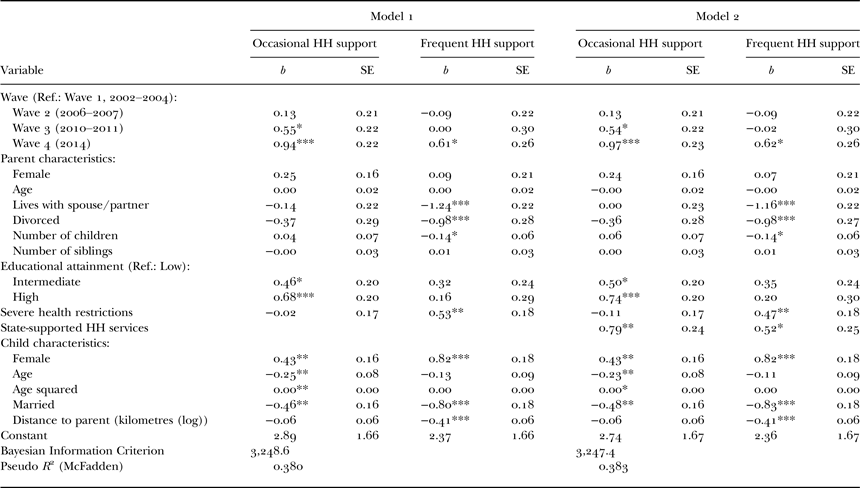
Results of our multinomial logistic regression analyses are presented in Table 2. In this table, no household support is the reference outcome. Consistent with our first hypothesis, Model 1 shows an increase in adult children's provision of household support over time. In Wave 3 (2010–2011) and Wave 4 (2014) adult children of impaired parents were more likely than in Wave 1 (2002–2004) to provide occasional household support (i.e. once or twice during the last three months) relative to no household support. Moreover, frequent household support (i.e. several times during the last three months) relative to no household support was also more likely in Wave 4 than in Wave 1.
Results of multinomial logistic regression models of household (HH) support

Notes: Models estimated with robust standard errors. Data are weighted. No HH support is the reference outcome. N = 2,197. Ref.: Reference category.
Source: Netherlands Kinship Panel Study, Waves 1–4.
Significance levels: *p < 0.05, **p < 0.01, ***p < 0.001.
The model further shows that children were less likely to provide frequent household support relative to no household support when the parent lived with a spouse or partner, when the parent was divorced and when the parent had a larger number of children. Intermediate and high, as opposed to low, levels of parental educational attainment were associated with higher odds of occasional household support provision relative to no household support. When parents’ health restrictions were severe, adult children were more likely to provide frequent household support relative to no household support.
Daughters were more likely than sons to provide occasional or frequent household support relative to no household support. Compared to their counterparts who were not married, married children were less likely to provide occasional or frequent household support relative to no household support. Older age of adult children was associated with lower odds of providing occasional household support relative to no household support, but with increasing age the negative effect of each additional year weakened. Greater geographic distance between parent and child was associated with lower odds of proving frequent household support relative to no household support.
We estimated an additional model to test our hypothesis positing that increases in the likelihood of providing household support were greater among daughters than sons (results not shown in Table 2). In this model, we allowed the changes in household support provision by wave to vary as a function of child gender through the inclusion of an interaction term. This addition did not yield an improvement of the model fit (BIC = 3,286.4; full results are available on request). Our analyses thus did not support our second hypothesis. Although daughters were more likely than sons to provide occasional and frequent household support relative to no household support, the increase in, particularly occasional, household support provision over time did not significantly differ between daughters and sons.
In Model 2, parental receipt of state-supported household services was included. A comparison of BIC statistics indicated an improvement in model fit with this addition. The increase over time in, particularly occasional, household support remained statistically significant after adjusting for parental receipt of state-supported household services and the magnitude of the effects of waves – and of those of the other independent variables in the model – did not change substantially between Models 1 and 2. It is, therefore, not surprising that a formal test of mediation using the KHB decomposition procedure yielded no significant results. No support was thus found for our third hypothesis positing that adult children's increased provision of household support could be attributed to changes in parents’ receipt of state-supported household services.
We estimated an additional model in which supposed suppressors of the time trend – out-of-pocket paid household services and support by spouses or partners – were included (results not shown in Table 2). A comparison of BIC scores indicated that the model with these additions did not fit our data better than the more parsimonious Model 2 presented in Table 2 (BIC = 3,272.3; full results are available on request). The effects for the presence of a partner who did at least half of the tidying and cleaning tasks did not differ substantially from those of the presence of a less-active partner. We also found no significant effects for out-of-pocket household services.
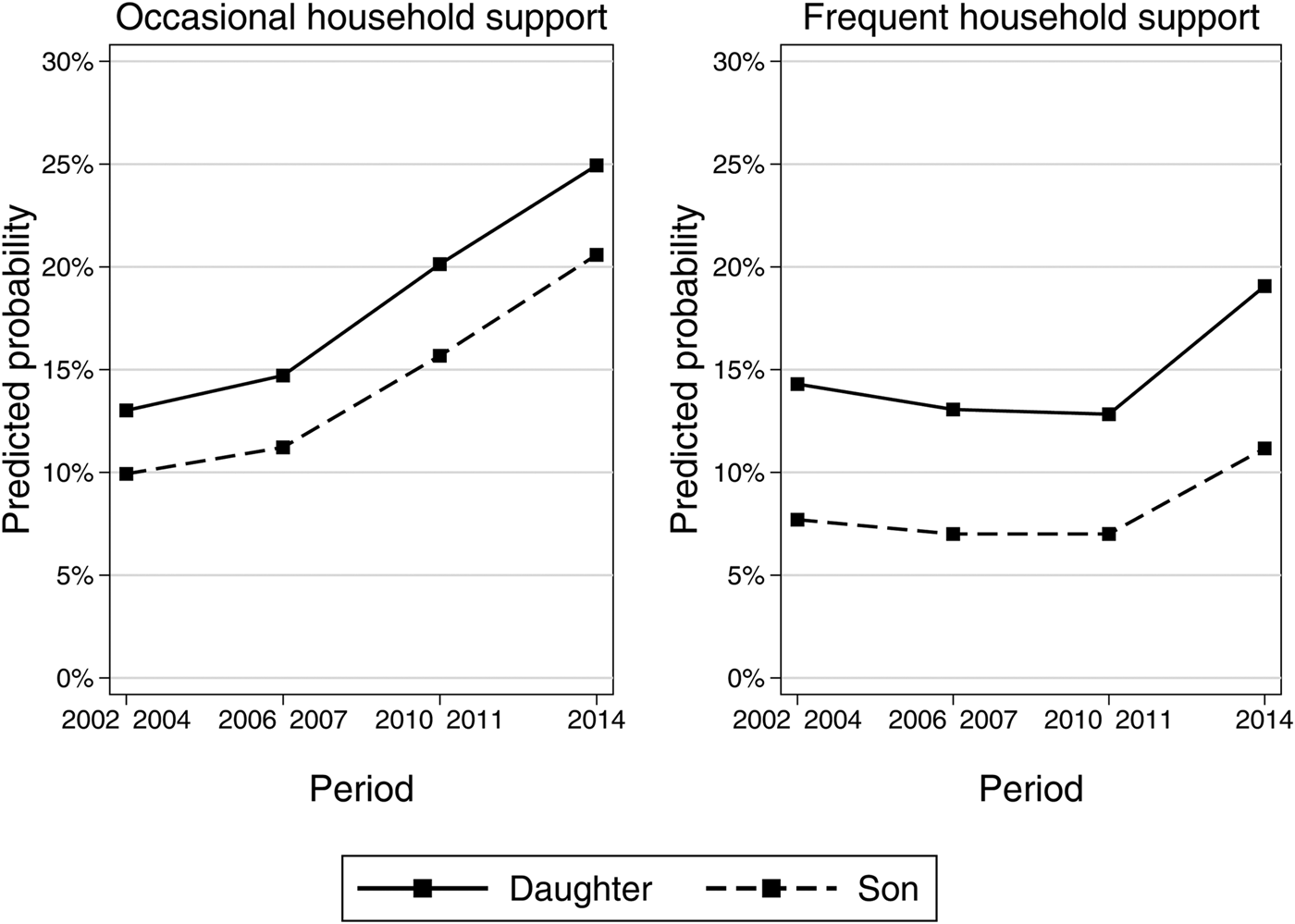
To grasp how adult children's provision of household support increased between 2002 and 2014, we plotted average predicted probabilities for sons and daughters. These predicted probabilities, which were calculated based on Model 2, are presented in Figure 2. The figure shows that the increase in adult children's provision of, particularly occasional, household support was most pronounced in the second half of the period under investigation.
Predicted probabilities of household support provision.

Discussion
Many countries where the state traditionally carried the main responsibility for the provision of care to older persons in need, such as Norway (Daatland Reference Daatland and Companje2015), Sweden (Ulmanen Reference Ulmanen2013), Finland (Kröger and Leinonen Reference Kröger and Leinonen2012) and the Netherlands (Da Roit Reference Da Roit2012), have in the last decades made an increasingly strong appeal to the family to take on support tasks. They did so by placing restrictions on services provision and encouraging greater family involvement in care-giving tasks, particularly for lighter forms of support, such as household support. The Dutch case is illustrative for this change in approach. Drawing on the work of Saraceno (Reference Saraceno2010), the LTC reforms in the Netherlands could be perceived as shift away from de-familialisation and towards supported familialism.
Our analyses suggest that the shift from de-familialisation to supported familialism encouraged children to take on household support tasks. In the period studied (2002–2014), the predicted probability for children of parents in need of care to provide, particularly occasional, household support rose substantially. The rise in adult children's provision of household support was most pronounced in the second half of the period under investigation, which roughly corresponds with the era after the introduction of the Wmo (in 2007). The underlying principle of this act was subsidiarity, i.e. the idea that the state should only take on support tasks which are beyond the capacity of individuals or private groups acting independently. This is in stark contrast with the pre-2007 situation when entitlements to a much more comprehensive range of care services were, in line with the principle of universalism, still individualised.
Our analyses showed that daughters more often provided household support to parents than did sons. We did not find, however, that this gender gap increased over time. Thus, our study does not substantiate Saraceno's (Reference Saraceno2010) concerns that declines in levels of de-familialisation might amplify gender inequalities in how care tasks are shared.
The odds that adult children provided occasional or frequent household support relative to no household support were higher when the parent received state-supported household services. These findings are consistent with Chappell and Blandford's (Reference Chappell and Blandford1991) complementarity model, which holds that state-supported services encourage, rather than discourage, family members to help parents in need. When interpreting this result, potential endogeneity should be considered, i.e. the possibility of an unobserved factor associated with parents’ receipt of state-supported household services as well as with children's provision of household support. Unmeasured differences in need for care may, for instance, be such a factor. Using an instrumental variable approach, Bonsang (Reference Bonsang2009) has argued that there is substitution between informal care and formal care, particularly with regard to household support. We did not find, however, that the increase in children's provision of household support was attributable to changes in the use of state-supported household services.
The current study has some limitations. Our analyses were limited to household support because the NKPS had no information on other types of support, such as help with personal care. We believe, however, that a study specifically about household support is valuable, because, as described above, LTC reforms in universalistic countries specifically aimed to encourage family involvement in lighter care tasks. Furthermore, household support provided by friends or siblings could not be included in our models, because this information was not collected in the most recent waves of the NKPS. Descriptive statistics from NKPS Wave 1 data show that persons with health limitations rarely received household support from friends and siblings, however.
We did not have information on children's normative beliefs about where the responsibility for the care for older persons lies. Should there have been a shift over time towards greater endorsement of family responsibilities, then this may offer an alternative explanation for why Dutch adult children became more likely to provide household support to impaired parents in the early 21st century. Recent work suggests, however, that the Dutch are more and more likely to espouse that the state is primarily responsible for elder-care and that caring responsibilities should not be imposed on family members (Van den Broek, Dykstra and Van der Veen Reference Van den Broek, Dykstra and Van der Veen2015). Nevertheless, we cannot rule out the possibility that adult children are responsive to government appeals to take on responsibility, because they do not wish their ageing parents to be forsaken.
In the last years of the studied period, the economic crisis of 2008 hit the Netherlands. The unemployment rate rose from 3.7 per cent in 2007 to 7.4 per cent in the peak year 2014 (OECD 2017c). The rise in unemployment may have meant that for more people the opportunity costs of providing care to a parent with health limitations were relatively low, because they were not or no longer engaged in paid work. Unfortunately, information on adult children's employment status was not available in the NKPS. It should be noted, however, that longitudinal studies have shown that women's engagement in informal care-giving results in reduced work hours or dropping out of paid work altogether, but employment status does not affect the likelihood of taking on care-giving (Berecki-Gisolf et al. Reference Berecki-Gisolf, Lucke, Hockey and Dobson2008; Pavalko and Artis Reference Pavalko and Artis1997). Given the unidirectionality of the association between care-giving and employment, it is unlikely that the trend in children's household support found in this study can be attributed to rising levels of unemployment. When new data collected in the post-economic crisis period become available, future research can assess the persistence of the increase in adult children's provision of household support as reported in the current study.
Another development that has taken place in the period under investigation is the rise in technological literacy among older persons (Zickuhr and Madden Reference Zickuhr and Madden2012) and the emergence of initiatives to develop information and communication technologies (ICT) to support care-givers. A recent review of such initiatives has shown that ICT-based services for informal care-givers have the potential to improve the quality of life of persons caring for older persons with health limitations, mainly by enabling them to reconcile care and work better (Carretero, Stewart and Centeno Reference Carretero, Stewart and Centeno2015). Although this potential quality of life gain for informal care-givers is valuable in and of its own right, we believe that it is unlikely that the emergence of experiments with ICT-based services for informal care-givers can explain the increase in adult children's provision of household support, given that, as pointed out above, there is little evidence to suggest that engagement in paid work makes people less likely to take on care tasks in the first place.
Regardless of the limitations discussed here, the current study provides valuable insights on the implications of the increasingly strong appeal to the family to take on support tasks that, as in several other universalistic countries, has emerged in the Netherlands in the last decades. A recent study by Plaisier, Verbeek-Oudijk and De Klerk (Reference Plaisier, Verbeek-Oudijk and De Klerk2017) suggested that Dutch policy efforts to slow down the growth in the use of state-supported care services have been successful. Much remained unknown, however, about the implications of the Dutch LTC reforms for the involvement in particularly lighter forms of family care-giving. In 2013, the Netherlands Institute for Social Research conducted a literature review about informal care provision in the Netherlands for the Dutch Ministry of Health, Welfare and Sport (De Boer and De Klerk Reference De Boer and De Klerk2013). The report concluded that around one-fifth of the Dutch adult population provided informal care to handicapped and frail friends and relatives, and suggested there might be an increase in informal care provision over time (cf. De Boer Reference De Boer2017). As a more general trend, interactions in intergenerational families appear to be increasing in the Netherlands. Geurts et al. (Reference Geurts, Van Tilburg, Poortman and Dykstra2015) showed, for instance, that child care by grandparents has increased between 1992 and 2006, despite the rising employment rate of grandparents. Van der Pas, Van Tilburg and Knipscheer (Reference Van der Pas, Van Tilburg and Knipscheer2007) found that more recent cohorts of older parents have more contact and support exchanges with their children than earlier cohorts. Our main finding of an increase over time in adult children's provision of household help to ageing parents is in line with this general trend of intensification of intergenerational support and with what LTC reforms aimed for.
Acknowledgements
Financial support for this paper comes from the European Research Council “Families in Context” project (grant agreement No. 324211); The research leading to these results has received funding from the European Union's Seventh Framework Programme (FP7/2007-2013) under grant agreement no. 320116 for the research project FamiliesAndSocieties; The research leading to these results has received funding from the European Research Council under the European Union's Seventh Framework Programme (FP7/2007-2013)/ ERC grant agreement no. 324055 (FAMHEALTH); The development of an enterprise like the Netherlands Kinship Panel Study requires investments that clearly surpass the financial means of individual institutions. The authors gratefully acknowledge the financial support from the ‘Major Investments Fund’ (grant 480-10-009) and the ‘Longitudinal Survey and Panel Fund’ (grant 481-08-008) of the Netherlands Organization for Scientific Research (NWO). Financial and institutional support for the NKPS also comes from The Netherlands Interdisciplinary Demographic Institute (NIDI), the Royal Netherlands Academy of Arts and Sciences (KNAW), the Faculty of Social Sciences (Utrecht University), the Faculty of Spatial Sciences (University of Amsterdam), the Faculty of Social Sciences (Tilburg University), and the Faculty of Social Sciences (Erasmus University Rotterdam). No ethical approval was required.