INTRODUCTION
Contemporary spirituality is eclectic and pluralistic, encompassing the religious, ethnic, and demographic heterogeneity that is characteristic of modern Western countries. Dying, it is argued widely, inevitably raises spiritual and existential issues (MacLeod, Reference MacLeod and Lloyd-Williams2003; McCord et al., Reference McCord, Gilchrist and Grossman2004; Steinhauser et al., Reference Steinhauser, Christakis and Clipp2000; Sulmasy, Reference Sulmasy2002) and may offer the opportunity for spiritual growth (Cobb, Reference Cobb and Lloyd-Williams2003) to patients, their families (Murray et al., Reference Murray, Kendall and Boyd2004), and those caring for them. However, studies show that these spiritual needs are not always met (Balboni et al., Reference Balboni, Vanderwerker and Block2007; Phelps et al., Reference Phelps, Lauderdale and Alcorn2012). New Zealand's quality of death has been rated third in a group of 40 countries (Murray, Reference Murray2010, p. 11), but little is known about New Zealand's spiritual aspects of care—such as beliefs, practices, and needs at the end of life. There are some published studies about spirituality (Lambie et al., Reference Lambie, Egan and Walker2015; Perkins, Reference Perkins2015; Taylor & Brander, Reference Taylor and Brander2013), but they do not address the focus of our study. However, a recent national survey demonstrated that a third of healthy respondents (34%) consider spirituality to be of high or very high importance in their lives (MacLeod et al., Reference MacLeod, Thompson and Fisher2012).
Christina M. Puchalski (Reference Puchalski2012) highlighted the potential of spirituality to assist patients throughout the cancer trajectory and asserted that unresolved spiritual distress may lead to poorer quality of life and poorer health outcomes. This was affirmed by the cross-sectional study conducted by McClain and colleagues (Reference McClain, Rosenfeld and Breitbart2003), which found an association between spiritual well-being and hopelessness at the end of life. In a review of spirituality in supportive and end-of-life care, Breitbart proposed that “symptoms relating to psychological distress and existential concerns are even more prevalent than pain and other physical symptoms” at the end of life (Breitbart, Reference Breitbart2002, p. 272). Astrow and colleagues (Reference Astrow, Wexler and Texeira2007) showed that patients who reported unmet spiritual needs also reported lower ratings of quality of care and satisfaction with the care they received. Puchalski (Reference Puchalski2012) emphasized the need for qualified chaplains and clinicians to address patients' spiritual issues as part of an integrated patient-centered treatment plan involving all members of the interdisciplinary team (Puchalski et al., Reference Puchalski, Lunsford and Harris2006).
Our baseline study reports on the key findings of the first nationwide study of hospices to examine spiritual beliefs, practices, and needs from the perspectives of patients, their families, and staff.
METHODS
A mixed-methods approach, explained in more detail elsewhere (Egan et al., Reference Egan, MacLeod and Jaye2011), included an extensive literature review and two discrete studies undertaken between 2006 and 2008. Study One purposively sampled (Patton, Reference Patton2002) patients, family, and staff at seven hospice sites across New Zealand and one hospital oncology site. The generic qualitative approach included semistructured interviews, transcription, member checking, and thematic analysis (Morgan, Reference Morgan2008). Study Two was a survey of patients, family, and staff at New Zealand's hospices. The quantitative arm of the study employed a cross-sectional mailed survey, with questions based on the results from Study One, relevant literature, and demographics. Ethics approval was obtained from the Multi-Region Ethics Committee of New Zealand (no. 9MEC/06/04/042).
RESULTS
Study One
Study One involved 52 participants at 7 hospice sites and 1 hospital oncology site (patients n = 24, family members n = 9, staff n = 8, chaplains n = 8, Māori experts n = 3). There were 24 men and 28 women participants. Some 88% of participants were European/pākehā; the majority (73%) were married; and 59% were affiliated with a Christian religion, while 28% had no affiliation. Almost half (47%) the participants had some university qualifications, 26% had graduated from a trade school, and 28% had secondary school qualifications. Where relevant in this paper, participant details have been assigned to quotes in order to aid the reader's understanding; pseudonyms are used; and age and type of participant are coded: patient (P), person with cancer (cancer), family member (FM), chaplain, and healthcare professional.
Study Two
Study Two surveyed 78% of New Zealand's hospices (n = 25, response rate = 59%, with 642 returned surveys). The Spirituality in NZ Hospice/Palliative Care Survey was a self-reported, cross-sectional mailed survey of staff (n = 364), patients (n = 141), and family members (n = 137).
The mean age of patients was 67 years (SD = ± 10 years). There was relative ethnic homogeneity (89% NZ/European, 4% Māori), which either suggests that ethnicities other than European/pākehā did not fill out the survey or, more likely, that other ethnicities are poorly represented in the staff and patient numbers in New Zealand hospices (Naylor, Reference Naylor2011).
Religious affiliation yielded a Christian majority (71%), higher than the 2006 Census figures for the whole population (57%) (Statistics New Zealand, 2006). Some 9% of the total surveyed population named the highest qualification option, “last year of secondary school.” The results were dominated by female responses, particularly for staff (male 11%, female 89%) and family members (male 30%, female 70%). Nurses dominated staff responses (63%), as might be expected (Nursing Council of New Zealand, 2012). In contrast, patient percentages showed a reasonable gender balance (male 45%, female 55%). Staff returns included doctors (8%) and social workers (7%); 73% of surveyed staff had worked in the setting for three or more years.
The key results are reported in three subsections: spiritual definitions, spiritual beliefs and practices, and, finally, spiritual needs.
Spiritual Definitions
The spiritual definitions data and discussion are reported elsewhere. Suffice it to say that both studies affirmed an inclusive understanding across the three populations, drawing on both existential and religious understandings. For example, responses in Study One ranged from “It extends to my whole being, relationships, and where I am in this world” (Ida, 45, hospice nurse) to “I think being spiritual is being a good Christian” (Aida, 65, hospitality, FM). From the definition question in Study Two, with 20 descriptors available, in the top five choices for both patients and family members were “meaning” (P: 33%, 95% confidence interval (CI 95%) = 25, 41; FM: 42%, CI 95% = 33, 50); “purpose” (P: 33%, CI 95% = 25, 41; FM: 45%, CI 95% = 37, 54); “beliefs” (P: 46%, CI 95% = 38, 55; FM: 49%, CI 95% = 40, 58), “values” (P: 47%, CI 95% = 38, 55; FM: 50%, CI 95% = 41, 58); and “faith” (P: 43%, CI 95% = 35, 52; FM: 47%, CI 95% = 39, 46). We formulated a summative definition of spirituality (Egan et al., Reference Egan, MacLeod and Jaye2011) based on the findings of the two studies.
Spiritual Beliefs and Practices
Understanding spiritual needs necessitates an awareness and examination of spiritual beliefs and practices, and so these issues were considered in both studies. Spiritual beliefs regarding God were high: the survey showed that across patients, family members, and staff groups, 71% (CI 95% = 67, 74) believed in God, with “love” or “all loving” most often nominated as the descriptor for “God.” Beliefs in an afterlife and paranormal experiences were high in both studies, as illustrated in the survey, with 82% (CI 95% = 79, 85) reporting that they believed in some form of the afterlife, and many reporting believing in paranormal events (59%; CI 95% = 56, 63).
Some 90% (CI 95% = 87, 93) of staff and 76% (CI 95% = 69, 83) of patients indicated that they “believe” in something (the options were none, other, religious, spiritual, and both). About a quarter of patients and family members identified as having “no particular beliefs.” Overall, 90% (CI 95% = 87, 93) of staff surveyed had a “set of beliefs,” and more than half the staff surveyed (54%) said that their beliefs had changed since dealing with cancer issues.
Staff were asked about the importance of spirituality from both their personal point of view and in consideration to their workplace. The results showed that 84% of staff considered spiritual issues “very” or “extremely” important in their own lives or experience. In contrast, 60% of staff considered spiritual issues “very” or “extremely” important in the workplace setting. A 24% “institutional gap” is suggested here.
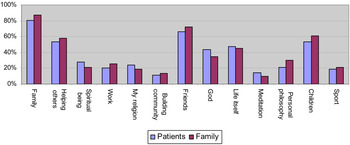
In response to the survey question “Do you feel life has meaning?” (illustrated in Figure 1), “family” was cited more than any other option as giving life meaning. “Family,” “friends,” “helping others,” “children,” and “life itself” were the top five priorities for giving life meaning. Less than a quarter of patients or family members named “work” as giving life meaning. The interviews revealed similar sentiments.
What gives life meaning.

Spiritual practices in these samples, as a component of need, were primarily broad in nature. Interview participants highlighted meditation, prayer, and domestic rituals as spiritual practices that gave life meaning. For example, Barry (72), who had lived with cancer for 13 years, had two cups of tea each morning with his wife before they got out of bed to start the day. For him, meaning in his life was centered on this relationship with his wife and this tea ritual—“that's our daily ritual.” For family members and patients, creating space and a place to be, to reflect, or to get away to was important, particularly when upset.
On average, 22% (CI 95% = 17, 26) of patient and family participants reported attending a religious service weekly, which increased to 27% (CI 95% = 21, 32) when the monthly figure was added. Some 23% (CI 95% = 19, 28) of staff attended weekly services, which increased to 30% (CI 95% = 25, 35) when the monthly figure was added.
Spiritual Needs
The populations studied had high spiritual needs, as suggested by the 69% (CI 95% = 65, 73) response from all groups who said they wanted spiritual care. Spiritual care was affirmed as a critical component of the process of dying by a majority of the interviewees, as suggested by one participant:
I think it's important, but especially important in the situation I'm in. It would be very difficult if I didn't have any sense of spirituality. (Fran, 62, cancer)
Spiritual concerns varied in complexity and intensity. At one end of the spectrum, a number of patients attributed their spiritual pain to such things as profound regret and existential angst, while others related it to contemplation of the perceived inevitability of death. For example, Paul expressed an initial dissolution of self following his diagnosis:
I went through a cycle where I would drop right away to where I thought I am just useless. I am just— The self-esteem is gone. I didn't know who I was or what I represented, to a gradual regrowth to a position where I'm just— I feel okay. (Paul, 58, cancer)
There was a suggestion made by two staff members that a number of people come to the hospice with spiritual issues already resolved. However, when this question was asked in the survey, more than 83% (CI 95% = 77, 85) of staff said that patients' spiritual issues were “sometimes” or “never” dealt with before contact with the hospice. One hospice nurse put it this way:
There are not many people that have got it all together when they die. (Ida, 45, hospice nurse)
“Peace of mind” was a phrase that participants often expressed as a hope or goal, though many had also experienced it to some degree. Henry said,
I like the idea of peace of mind. I have it occasionally, but most of the time I am thinking about something that is not particularly peaceful. (Henry, 76, cancer)
A hospice nurse said,
People often die as they live … I can often tell when somebody comes in after a couple of days of getting to know the little bits about them how they will die. It is interesting, whether they are going to fight or be peaceful. (Karen, 52, hospice nurse)
Lack of peace of mind was often expressed as pertaining to relational issues, as mentioned by one family member: “Relationships, they are completely just turned upside down,” and in a doctor's words, “If there is a tension within the family, then obviously that impacts on the patient” (Joan, 29, doctor). A chaplain similarly observed, “Your dying can be very troubled because suddenly [there is a] realization of unfinished conversations, things not said” (Winsome, 58).
Barriers to achieving peace of mind and potential causes of spiritual pain came from a range of unresolved issues related to, among other things, religion, anger, fear, regret, worry, and guilt. A chaplain recognized spiritual distress as
A deep guilt. Fear, yeah, fear— I think of various colors. Anger, residual anger and guilt—borne guilt that has never been well managed or dealt with within the person's life. Piled or stacked-up grief. (Phillip, 60, chaplain)
Ray, a palliative care medical specialist, suggested that an illness can create a crisis for some with faith, prompting them to ask, “Why is something bad happening to me?” or “Is it possible to be forgiven?” (Ray, 49). One hospice chaplain highlighted the danger for some patients or family with “rah-rah faith that says God can do this and their whole hanging out for a complete miraculous physical healing” (Phillip, 60, chaplain). He went on to explain that
Sometimes it is “egged” on by their church, and I have heard a pastor in here praying that kind of fervent prayer in a last-minute sort of a situation. … I actually think it robs people blind.
Another chaplain said he was
appalled, personally, at the number of people who think cancer is a punishment, or [that] at death they are going to face the big fellow and he is going to go smack, smack. (Leon, 52)
Religious spirituality may become a significant burden insofar as some people perceive their disease as divine retribution.
Uncertainty appeared to be a defining element in participants' experience of the “cancer world.” One patient said, “[What] you have to come to terms with is the uncertainty, every day, every month” (Fran, 62, cancer). Further, a staff member commented, “It is often that uncertainty, that uncertainty—‘Well what is tomorrow going to bring?’—that brings pain and anxiety, and for some a spiritual challenge” (Mia, 71, hospice nurse). Uncertainty about life after death was widespread. Cathy, a hospice counselor (aged 56) who had experienced cancer herself, suggested that one of the most common existential or spiritual issues patients face is “What is going to happen to me when I die?”
Related to the idea of uncertainty, some staff suggested that common spiritual distress often arose from feelings of grief, loss, despair, or fear. For example, Mike, a very “together” man of 73 with cancer, broke down in tears when his driver's license was not renewed: “It is just something else that I have lost,” representing much more than the ability to drive. Another staff member suggested that “cancer is a pretty big frightener” and “a lot of them who know they are dying are frightened at the end of life” (Karen, 52, hospice nurse). From a patient's point of view, Barbara said simply, “I'm scared” (69, cancer), and Paul expressed, lucidly,
It terrifies me, the whole process. I remember when I was going to have this stem cell harvest, and I just felt I was on the brink of an abyss. I felt I was about to fall in. (Paul, 58, cancer)
Fear of death appears central to the terminal experience. Barbara expressed this clearly:
One thing I dread is being on my own. I am not frightened to die, but I am frightened of dying, I don't want to go through all this pain. (Barbara, 69, cancer)
Related to the fear of death is the fear or grief about leaving one's partner, children, and friends, and/or leaving things unresolved.
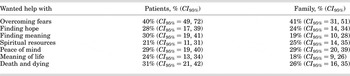
We employed Moadel and coworkers' (Reference Moadel, Morgan and Fatone1999) seven spiritual/existential needs items to illustrate the results from the quantitative arm of our study, as presented in Table 1. Regarding fears, hope, and meaning, of note, 28–40% of all patients and 19–41% of all family members surveyed wanted some help with one of these areas of need. With regard to peace of mind, meaning in life, and death and dying, 24–31% of patients and 18–29% of family members surveyed wanted to talk to someone about these issues.
Spiritual needs of patients and family members

Existential needs focused on participants making meaning within and along the cancer continuum. Staff, including chaplains and spiritual carers, suggested that patients typically ask, “Why me? Why now?” (Joan, hospice GP, 29). A terminal diagnosis may induce an existential crisis or crisis of faith. As one hospice chaplain noted,
We have to be with people and sit with them, as they stare into the abyss … and not look away, not withdraw from them. (Phillip, 60, chaplain)
Interviews with family members and others suggested that the spiritual needs of family members were often sublimated or “put on hold” and that relationships were “turned upside down.” A hospice counselor commented that “a lot” of patients accept the terminal diagnosis better than their family members (Sophia, 66). One patient said that, while he had experienced some high points in his wife's cancer journey, his wife had not. There was anger expressed by some family members. One man in particular was furious with God for taking his wife before her time. Study Two affirmed these needs, with, for example, family members having the highest reported needs regarding the need for help with peace of mind and overcoming fears. Some family members believed that looking after their own spirituality was important, and this had grown as a result of finding meaning in their caregiver role. The desire for a good death for their dying family member was expressed by some, as was the worry about suffering at death, as one daughter said of her dying father,
I want to feel that I can help father with that [his dying], and that is the goal to be peaceful and to feel safe. (Sarah, 40)
In Study Two, there was a response from 21% of staff saying that they personally did not have spiritual support at their hospice. Most chaplains interviewed reported that their role included the spiritual support of staff but that time seldom allowed them to fulfill this responsibility. Staff found that working with the dying inevitably raised spiritual issues and that reprioritization of life's values, needs, and foci was common.
DISCUSSION
Our study supports international research in demonstrating that patients, staff, and patients' family members possess an eclectic range of spiritual beliefs and practices (Cobb et al., Reference Cobb, Dowrick and Lloyd-Williams2012; Murray et al., Reference Murray, Kendall and Boyd2004; Puchalski, Reference Puchalski2012; Sinclair et al., Reference Sinclair, Pereira and Raffin2006). Spiritual beliefs related to God were high, with 71% of all participants believing in God, while a quarter of patients and family members identified as having “no particular beliefs.” Such diversity in values and beliefs illustrates the need to address spirituality from a broad, patient-centered position, one that allows for an intersection between spiritual, physical, social, and psychological aspects (Doyle et al., Reference Doyle, Hanks and Cherny2004).
Within the palliative care literature, there is almost universal agreement that “spiritual concerns are important to many patients, particularly at the end of life” (Sulmasy, Reference Sulmasy2002). This correlates with the 69% response from members of all the groups in our study who said they wanted spiritual care. However, it remains that almost a third (31%) of the participants sampled identified as not having spiritual needs, reinforcing the assertion that spiritual care is conditioned on the individual and their perceived needs (Phelps et al., Reference Phelps, Lauderdale and Alcorn2012; Rumbold, Reference Rumbold2007). Many of the staff interviewed similarly held that care should be led by patients' needs and were opposed to staff imposing their own views. Rumbold (Reference Rumbold and Rumbold2002) challenged the ethics of raising spiritual issues with those who have not considered them before, when there is the potential to create unnecessary angst, much of which may not be able to be resolved before death. This was affirmed by the number of hospice staff in our study who suggested that for some people spiritual issues were raised for the first time when coming to hospice, so that such an examination was new and could be frightening.
Our study offered a perspective from staff and family members of patients—two groups whose spiritual beliefs and needs are often underrepresented in the literature. The spiritual needs of patients have tended to dominate the research (Doyle et al., Reference Doyle, Hanks and Cherny2004; Kellehear, Reference Kellehear2000; Sinclair et al., Reference Sinclair, Pereira and Raffin2006), though some scholars note the importance of examining and attending to the spiritual needs of family members (Lin & Bauer-Wu, Reference Lin and Bauer-Wu2003; Milstein, Reference Milstein2008) and staff (Joint Commission on Accreditation of Healthcare Organizations., 2005; Mahoney & Graci, Reference Mahoney and Graci1999, p. 522). In their study of carers' spiritual needs, Murray and colleagues (Reference Murray, Kendall and Boyd2004) found that carers “were also challenged spiritually by suffering and had their own spiritual needs.”
Our study showed high and unmet spiritual needs among family members. What available research there is on family members' experiences positively correlates spiritual well-being with bereavement and grief resolution, reinforcing the importance of attending to the spiritual needs of family members (Walsh et al., Reference Walsh, King and Jones2002). Clearly, these needs are currently not well met and remain underresearched (Adams et al., Reference Adams, Mosher and Cannady2014). As was the case in our study, the research suggests that family and friends provide the majority of spiritual care for family members with cancer (Hanson et al., Reference Hanson, Dobbs and Usher2008). With this in mind, the challenge becomes how best to equip family and friends to support their dying family members' spirituality in a hospice setting, especially when their own spiritual needs are unmet.
The interviews from Study One revealed participants' search for meaning and peace of mind within the cancer world—a central theme found in the palliative care literature (Bregman, Reference Bregman2006; Doyle & Woodruff, Reference Doyle and Woodruff2004; Jim et al., Reference Jim, Purnell and Richardson2006; Murata, Reference Murata2003; Puchalski et al., Reference Puchalski, Vitillo and Hull2014). McGrath (Reference McGrath2003) found that those with a terminal illness had significant hardships related to “sadness, frustration, and to some degree fear, rather than meaninglessness.” Murata (Reference Murata2003) noted that loss of control and uncertainty are part of what might precipitate spiritual pain. Kernohan and colleagues (Reference Kernohan, Mary and Caroline2007) distinguished six spiritual needs that might be considered central to the search for peace of mind and meaning: “to have the time to think; to have hope; to deal with unresolved issues; to prepare for death; to express true feelings without being judged; to speak of important relationships” (Kernohan et al., Reference Kernohan, Mary and Caroline2007, p. 519). These needs were a recurrent theme in our study.
The limitations of our study included the fact that the Māori voice was not captured in the interviews of patients and their family members because the lead researcher did not have the tikanga (derived from the Māori tika, meaning “right” or “correct,” generally taken to mean “the Māori way of doing things”) or te reo (Māori language) skills to support such an undertaking. Of note, there was relative ethnic homogeneity (89% NZ/European, 4% Māori) in Study Two, which either suggests that members of ethnicities other than European/pākehā did not fill out the survey or, more likely, that other ethnicities are poorly represented in staff and patient numbers in New Zealand hospices. Findings from the Palliative Care Council support the latter scenario for patient representation: Māoris were more likely to die in a private residence or hospital and were less likely to die in residential care or a hospice than Europeans/pākehā (Naylor, Reference Naylor2011).
Further regarding limitations, the interviewees were a purposively selected group, and our findings are not readily generalizable to other patient, family, or staff groups in a hospice setting. Ideally, we would have liked a more even distribution of numbers across the three groups. As it was, patients in Study One dominated the interview numbers while in Study Two staff participants were far greater in number than patient and family respondents. Further, the numbers of healthcare professionals other than nurses were very low, or, in the case of some allied healthcare professionals, nil. However, it may be that this reflects the reality of the staffing mix in some New Zealand hospice services.
CONCLUSIONS
It is important that hospices develop a consistent and comprehensive approach to spiritual care professional development in order to better equip staff to deal with this essential aspect of care for the dying, those who are near the end of life. In fact, Hospice New Zealand has, since and because of this study, developed a national spirituality professional development program (Morgan et al., Reference Morgan, MacLeod and Schumacher2015). The adoption of such an approach will have a major impact on improving spiritual care for those patients and their families being cared for in New Zealand's hospices. Our next paper (about the third arm of this study) will include some of the challenges and the successes of this aspect of care from the perspectives of patients and their families.
CONFLICTS OF INTEREST
The authors hereby state that they have no conflicts of interest to declare.
ACKNOWLEDGMENTS
This work was supported by the Genesis Oncology Trust.