Introduction
In the wake of widespread anthelmintic resistance in ruminant livestock, residues in food, environmental degradation and consumer demand for chemical-free food and food products (Waller, Reference Waller1993), work on alternative strategies to control nematode parasites of grazing livestock has been initiated the world over; biological control by nematode-trapping fungi is one of them. The most promising candidate appears to be Duddingtonia flagrans, work on which, initially undertaken in Scandinavian countries (Gronvold et al., Reference Gronvold, Wolstrup, Larsen, Henriksen and Nansen1993; Larsen, Reference Larsen2000), has also been initiated successfully in India (Sanyal, Reference Sanyal2005). These aerobic nematode-trapping fungi are effective as inundative-augmentative-applied biocontrol agents (Larsen, Reference Larsen2000) by targeting developing nematode larvae in the faeces and on pasture. Therefore, to be effective, the fungi should pass through the gastrointestinal tract of the host without loss of viability. Duddingtonia flagrans used in the present study was isolated from a manure heap at Durg, Chhattisgarh, India, had the ability to produce profuse thick-walled chlamydospores that could withstand gastrointestinal transit both in monogastric and polygastric animals, and could effectively control gastrointestinal nematode parasites of pigs and goats by reducing the number of infective larvae on pasture (Sanyal et al., Reference Sanyal, Sarkar, Patel, Mandal and Palin press).
Before application of the biocontrol agent in the field, it is essential to generate data that could provide answers to the following questions:
(1) Is the activity of D. flagrans density dependent?
(2) What would be the influence of the nematode-trapping fungus, following deposition of chlamydospores in the faeces, on larval translation on the pasture?
(3) What would be the minimum effective dose of chlamydospores required for effective control of caprine parasitic gastroenteritis?
(4) What would be the strategic time of application of the biocontrol agent in the agroclimate of Chhattisgarh plain, India?
The present study aimed to answer these questions by conducting in vitro and in vivo trials in goats.
Materials and methods
Fungal chlamydospores
A wild strain of D. flagrans isolated from Durg, Chhattisgarh, India, was established on 2.5% corn meal agar (CMA) Petri plates (90 mm disposable and radiation sterilized) containing 0.02% tetracycline (w/v) to prevent bacterial growth (added after autoclaving of the media) and maintained at 26°C. The fungus was then grown in solid substrate (barley grains) for the production of chlamydospores (Sanyal, Reference Sanyal2000): a piece of corn meal agar medium containing fungal growth was put into a flask containing autoclaved barley grains and incubated at 26°C for 4 weeks, the flask being shaken twice weekly for 2 weeks to get uniform growth. Aliquots of chlamydospores were then harvested in water by vigorous washing and sieving (Larsen et al., Reference Larsen, Faedo, Waller and Hennessy1998) and their numbers counted through a Neubeur haemocytometer chamber and expressed as number of chlamydospores g− 1 of grains.
Animals
Local goats maintained in the Goat Unit, College of Veterinary Science and Animal Husbandry, Anjora, Durg were used for the study without disturbing normal husbandry practices. They were maintained exclusively on grazing during the daytime with the provision of night shelter. They were given no supplementary food concentrate.
Faecal egg counts and coproculture assay
Pooled faecal samples were collected from the local goats and were subjected to faecal egg counts by modified McMaster technique (Skerman & Hillard, Reference Skerman and Hillard1966). The faeces were also subjected to coproculture and the harvested infective third-stage larvae were identified by morphology and morphometry and expressed as the percentage of species present (Skerman & Hillard, Reference Skerman and Hillard1966). Interactions between the free-living stages of caprine gastrointestinal nematodes and D. flagrans chlamydospores were evaluated through coproculture assay. The assay consisted of three levels of worm eggs g− 1 faeces (Level 1 (100), Level 2 (500) and Level 3 (1000)) and four levels of chlamydospores g− 1 of faeces (Level 1 (0), Level 2 (1000), Level 3 (10,000) and Level 4 (100,000)). Different worm egg levels were prepared by diluting infected faeces with those of uninfected goats. Chlamydospores harvested from the grain culture were air dried and thoroughly mixed with the faeces at the desired levels. Coprocultures were set up using 10 g of faeces at all levels, with five replicates in each series, and incubated for 1 week at 28°C. Larvae were then harvested by conventional techniques and counted.
Faecal deposition of fungal chlamydospores vis-à-vis larval translation
Pooled faeces were collected separately from the floor of night pens of uninfected goats and goats naturally infected with gastrointestinal nematodes. A final concentration of 500 eggs g− 1 of faeces was prepared by diluting the infected faeces with those of uninfected goats. Chlamydospores of D. flagrans harvested from grain cultures were mixed with the faeces of uninfected goats at a concentration of 10,000 chlamydospores g− 1 of faeces.
On four different 2 m2 pasture plots (in replicates of three), goat faeces and D. flagrans chlamydospores were deposited in the following design:
Plot 1: Faeces (1 kg) containing fungal chlamydospores followed 1 week later by faeces (1 kg) from worm-infected goats.
Plot 2: One kilogram each of faeces from worm-infected goats and faeces containing fungal chlamydospores deposited simultaneously.
Plot 3: Faeces (1 kg) from worm-infected goats followed 1 week later by faeces (1 kg) containing fungal chlamydospores.
Plot 4: Faeces (1 kg) from worm-infected goats.
Herbage samples (of around 10 cm height) were clipped as close to the ground as possible in the morning at 08.00 hours from each plot weekly for 7 weeks and larvae of parasitic nematodes were counted and expressed as larvae kg− 1 dry matter.
Chlamydospore dose titration
Twenty goats subclinically infected with gastrointestinal nematodes used for this study were divided randomly into five groups of four animals each and maintained indoors separately in groups. They were fed on grasses (by a cut and carry method) top dressed with the following dose rates of D. flagrans chlamydospores:
Group 1: 1 × 10³ chlamydospores kg− 1 body weight for 10 days;
Group 2: 1 × 10⁴ chlamydospores kg− 1 body weight for 10 days;
Group 3: 1 × 10⁵ chlamydospores kg− 1 body weight for 10 days;
Group 4: 1 × 10⁶ chlamydospores kg− 1 body weight for 10 days;
Group 5: 1 × 10⁷ chlamydospores kg− 1 body weight for 10 days.
Pooled faeces (1 kg) obtained from the group pen in the morning 1 week after the initiation of fungal spore feeding, were spread uniformly on 2 m2 plots, in two replicates. Following faecal deposition, herbage samples (250 g) from each plot were clipped as close to the ground as possible between 08.00 and 09.00 hours by traversing the plot in a predetermined ‘W’ shaped pattern, twice weekly for 1 month from day 3 of contamination, for enumerating pasture larval burden expressed as larvae kg− 1 dry matter (Sanyal & Gour, Reference Sanyal and Gour1984). After 1 month of sampling, a further 1 kg of pooled faeces from each group of animals was again deposited on the same plots and pasture larval burden was monitored.
Epidemiology of caprine parasitic gastroenteritis
To understand the seasonality of infection and to obtain baseline data on the epidemiology of nematode parasites of small ruminants on Chhattisgarh plain, 12 goats of similar age and sex, randomly selected from the flock maintained in the Goat Unit, College of Veterinary Science and Animal Husbandry, Anjora, Durg, were monitored every month for faecal nematode egg counts by modified McMaster technique (Skerman & Hillard, Reference Skerman and Hillard1966) for a period of 1 year (February 2006 to January 2007). Pooled coprocultures were also made every month to identify nematode parasites up to generic level from the infective third-stage larvae. Simultaneously, monthly pasture larval burden data were also generated from the pastures grazed by these goats.
Statistical analysis
The data were analysed by analysis of variance using GraphPad Prism 4 software (Version 4.02, 2004, GraphPad Software Inc., San Diego, California, USA).
Results
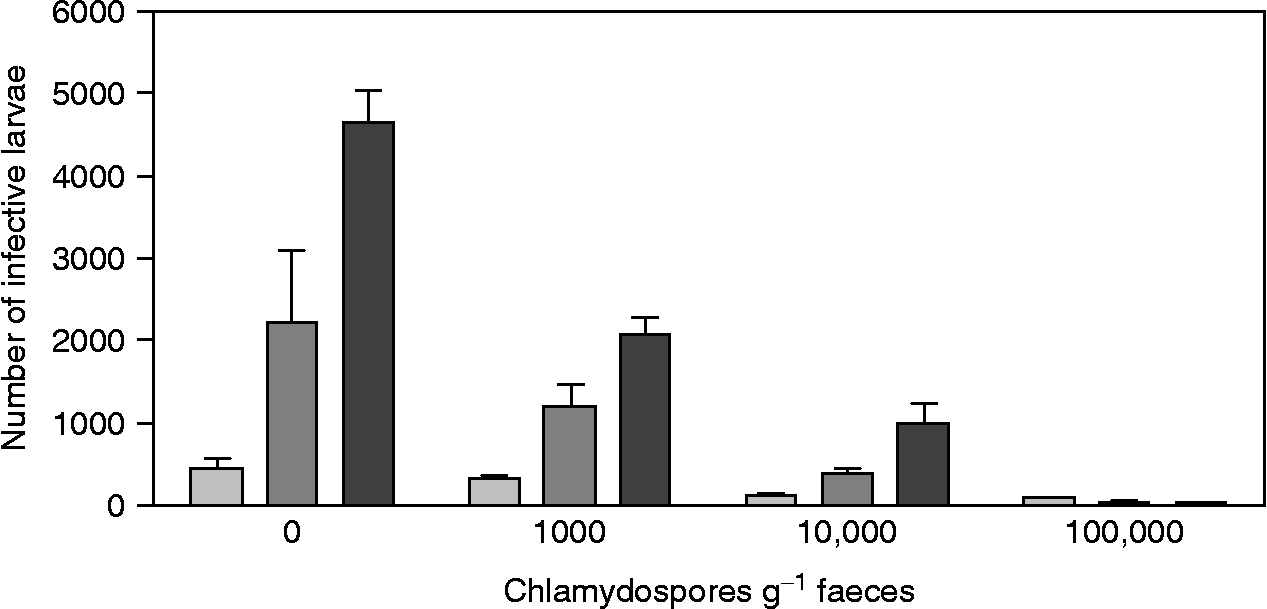
Identification of third-stage larvae following coproculture revealed 90% Haemonchus sp., 5% Cooperia sp. and 5% Trichostrongylus sp. The numbers of infective larvae recovered from the coproculture assay are presented in fig. 1. Larval yield increased with the corresponding increase in worm egg levels in the control cultures. However, the yield was correspondingly decreased with the increase in chlamydospore levels.
Number of infective larvae (mean ± SEM) harvested from coprocultures of 100 ( ), 500 (
 ) and 1000 (
 ) eggs per gram of faeces mixed with different concentrations of Duddingtonia flagrans chlamydospores.

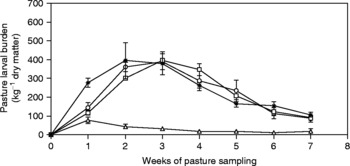
The numbers of infective nematode larvae recovered from herbage over a period of 7 weeks from the day of deposition are presented in fig. 2. A generalized non-significant increase of larval numbers with time to a peak of 2–4 weeks post-deposition could be observed in the Plots 1, 3 and 4 (P>0.05). However, Plot 2 had significantly low larval numbers throughout the observation period (P < 0.01). A rapidly increasing trend in larval availability on pasture was observed within a couple of weeks in Plots 1, 3 and 4 as more larvae hatched, moulted and developed into infective larvae, and migrated onto the surrounding herbage. When worm eggs and chlamydospores were deposited at the same time on the pasture plot (Plot 2), the number of infective larvae reached its peak at week 1 followed by a steady decrease in numbers (fig. 2). Interestingly, when the chlamydospores were deposited a week before and a week after deposition of faeces containing worm eggs, the results were strikingly different from that of Plot 2 and closely similar to the control plot (Plot 4).
Number of infective nematode larvae (mean ± SEM) recovered from herbage of pasture Plot 1 ( ), Plot 2 (
 ), Plot 3 (
 ) and Plot 4 (
 ) contaminated with faeces containing worm eggs and chlamydospores of Duddingtonia flagrans.

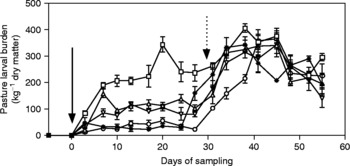
The number of infected third-stage larvae of nematodes recovered from pasture clippings of different plots where faecal pellets of different groups of animals were deposited are presented in fig. 3. Minimum numbers of larvae were recovered up to the 28th day from plots where faeces of goats that received 1 × 10⁶ and 1 × 10⁷ chlamydospores kg− 1 body weight were deposited. Fairly low larval availability was also observed from the plots where faeces of goats that received 1 × 10⁴ and 1 × 10⁵ chlamydospores kg− 1 body weight were deposited. Larval availability was much higher in the plot contaminated by the faeces of goats receiving 1 × 10³ chlamydospores kg− 1 body weight. As the faeces of the same groups were again deposited on the same pasture when no chlamydospores were excreted by the goats, no separate group of animals that had not been fed the fungus (control) was kept in the experiment. The results indicated a rise in pasture larval burden of all the plots, resulting in the surge of larval availability from the 35th day onwards, when fungal intervention was not in operation on the pasture.
Numbers (mean ± SEM) of infective nematode larvae recovered from pasture plots contaminated with faeces of parasitized goats of Group 1 (), Group 2 (), Group 3 ( ), Group 4 () and Group 5 () fed on grasses top dressed with 1 × 10³, 1 × 10⁴, 1 × 10⁵, 1 × 10⁶ and 1 × 10⁷ chlamydospores kg− 1 body weight, respectively, following worm egg contamination with (
 ) or without (
 ) chlamydospores.

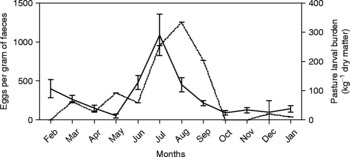
June–August are the months with higher egg counts in the host, while July–September were the months of higher pasture larval burden (fig. 4). The typical tropical surge of nematode parasites in the host and on the pasture during monsoon months (June–September) was very much apparent. Haematophagous nematode (Haemonchus sp.) was the dominant nematode observed throughout the period, with the occasional presence of Cooperia, Trichostrongylus and Bunostomum spp. during the rainy season.
Monthly faecal data (mean ± SEM) of worm egg counts of goats ( ) and pasture larval burden kg− 1 dry matter (
 ) of pastures grazed by them.

Discussion
Parasitic gastroenteritis is regarded as a major obstacle to profitable ruminant production. The haematophagous abomasal parasite Haemonchus sp. is the dominant species in both small and large ruminants in India. The degree of infection is more in grazing livestock than in tethered animals and use of anthelmintics is the dominant form of nematode control option in ruminants (Sanyal, Reference Sanyal1996). In recent decades, the dependence on anthelmintics has led to the development of anthelmintic resistant parasite strains, pest resurgence, environmental pollution, drug residues in food and food products and uneconomic animal production (Sanyal, Reference Sanyal1998). The need of the hour is to adopt technologies to make the worm control programme sustainable. The simple choice is to give susceptible worms an overwhelming advantage over resistant individuals in contributing to subsequent generations (farming with good worms). The main challenge is to develop ways for overcoming the practical problems concerned with excessive build-up of worms on pasture when techniques such as strategic drenching cannot be resorted to without losing sustainability. To become sustainable, parasite control schemes need to be based on the principles of integrated pest management (Waller, Reference Waller1993). Towards this objective, significant advances have recently been made in the development of biological control exploiting nematode-trapping fungi (FAO, 2002).
The results on the influence of chlamydospore concentrations on faecal worm egg density in goats (fig. 1) re-established the fact that the nematode-trapping activity of the deuteromycetes is density dependent and provided indirect information on the amount of chlamydospores required for effective parasite control. Similar density-dependent behaviour of the Gujarat isolate of D. flagrans has been demonstrated against nematode parasites of sheep (Sanyal, Reference Sanyal2004). The results also provided information on the optimum amount of nematode eggs and the resultant pre-parasitic larvae required for stimulating trapping activity of D. flagrans. The density dependent behaviour could be exploited in determining the timing of inundative biocontrol interventions required for integrated management of caprine parasitic gastroenteritis.
Faecal presence of chlamydospores and nematode larval translation (fig. 2) provided information on the fate of the fungus in the environment, and could answer queries such as: whether the fungus has the ability to go beyond the faecal environment to trap infective larvae that have migrated on pasture; and/or whether the fungus could grow quickly enough to prevent migration of larvae onto pasture; and/or the influence of fungistasis (Faedo et al., Reference Faedo, Larsen and Thamsborg2000). The study revealed that D. flagrans could deliver desired predatory activity on pre-parasitic stages only when the development of worm eggs and the growth of the fungus occurred simultaneously. In other words, D. flagrans would best work as a biocontrol agent against larval stages of caprine gastrointestinal nematodes when chlamydospores are administered to goats at a time when they are likely to be excreting the maximum number of eggs. This information could be exploited for determining the timing of biocontrol interventions required to control caprine parasitic gastroenteritis.
The study demonstrated that chlamydospores obtained from barley grain cultures could significantly reduce the number of infective larvae of gastrointestinal nematodes of goats at a dose rate of 1 × 10⁴ and 1 × 10⁵ chlamydospores g− 1 faeces and above. However, maximum inhibition was observed at a chlamydospore dose rate of 1 × 10⁶ kg− 1 body weight and above. Although various cereal grains, viz., maize, wheat, sorghum, lupins, and unmilled rice, could be used for production of chlamydospores of D. flagrans (Waller et al., Reference Waller, Knox and Faedo2001), our studies demonstrated barley grain as the best substrate (Sanyal et al., Reference Sanyal, Sarkar, Patel, Mandal and Palin press). In a similar study, Sanyal & Mukhopadhyaya (Reference Sanyal and Mukhopadhyaya2003) demonstrated effective containment of ovine gastrointestinal nematode larvae on pasture following feeding of desiccated chlamydospores of the Gujarat isolate of D. flagrans to sheep at a dose rate of 1 × 10⁶ chlamydospores kg− 1 body weight. The results provided valuable information on the effective fungal dose required for reducing the seasonal peaks of caprine nematodes.
On plots with the fungal-treated faeces of goats fed 2.5 × 10⁵ chlamydospores kg− 1 body weight, a significant reduction in grass infectivity was reported for Teladorsagia cicumcincta and Trichostrongylus colubriformis, ranging from 50–60% in May, July and November deposits, to 80–90% in the September deposit in France, with no difference recorded between fungus and control plots for the March deposit (Chartier & Pors, Reference Chartier and Pors2003). They suggested that such variations in pasture larval availability from fungus-treated plots were due to meteorological factors. Conversely, results from plot studies with sheep nematodes were variable. Faedo et al. (Reference Faedo, Barnes, Dobson and Waller1998) indicated a 43% reduction in grass infectivity with 100,000–125,000 chlamydospores kg− 1 body weight on H. contortus, whereas with 1 × 10⁶ chlamydospores kg− 1 body weight, a reduction of 78% (Githigia et al., Reference Githigia, Thamsborg, Larsen, Kyysgaard and Nansen1997) and as high as 80–90% (Faedo et al., Reference Faedo, Larsen and Thamsborg2000) on Teladorsagia and Trichostrongylus spp. were recorded. The present study revealed that the maximum reduction of pasture infectivity in an Indian tropical climate was at a chlamydospore dose rate of 1 × 10⁶ kg− 1 body weight and above.
The basic objective of an alternative, non-therapeutic method of controlling parasites, such as biological control, is to reduce seasonal peaks in the larval availability on pasture, rather than to eliminate larvae. The results of nematode parasite epidemiology provided information on seasonality of caprine gastrointestinal nematodes in the host and on the pasture (fig. 4). These in turn, would help in determining the best month(s) for applying biocontrol agents and how best they could be integrated with other nematode control options in goats. The present observations reinforce the strategy to be adopted for nematode parasite control by applying biocontrol options at the onset of the monsoon (Sanyal, Reference Sanyal2005).
Acknowledgements
This research was the result of the Department of Biotechnology, Government of India supported project on ‘Biological control by nematode-trapping fungi as a tool for integrated management of parasitic gastroenteritis in livestock’. Facilities provided by the Dean, College of Veterinary Science and Animal Husbandry, Anjora, Durg are thankfully acknowledged.