Sometime in the latter half of the second century, Bishop Dionysios of Corinth began writing letters to Christian communities around the eastern Mediterranean. Of these letters, which remain only as fragments and summaries in Eusebius's Ecclesiastical History, we know of eight, including one addressed to a woman named Chrysophora.Footnote 1 Though Dionysios is not often mentioned in histories of second-century Christianity, he was famous enough in his own day that his advice was requested from as far as the Black Sea and his letters were tampered with by those seeking to lend his authority to their theological positions. When Dionysios has been discussed by historians of early Christianity, his work has been mined for what it can tell us about early Christian letter collections, for the names of other second century bishops, and for fights over various early Christian heresies.Footnote 2 Though I draw on these studies, I am here concerned with examining Dionysios's surviving letters as political rhetoric within what Loveday Alexander has called the “social networks” of early Christianity.Footnote 3 Rather than focusing on questions of episcopal succession or early Christian letter collections, I consider how Dionysios's letters functioned as political instruments that knit together early Christian communities as they made their way to and from Corinth aboard merchant ships and overland caravans, moving amongst the myriad of people and goods that flowed through Roman trade routes in the eastern Mediterranean.Footnote 4
I begin by offering a general view of Dionysios's correspondence and by outlining the trade routes that took his letters throughout the Mediterranean. Then I offer a detailed discussion of Dionysios's letter to the Roman church.Footnote 5 I will focus particularly on how the letter acted as a form of kinship diplomacy in response to a financial gift and a theological challenge from the Roman church and its “minister of external affairs,” Soter. Dionysios's response uses common markers of ethnic identity to foster economic, social, and theological interdependence between Rome and Corinth while also asserting the independence of Corinth's theological traditions and its political standing among early Christian churches.
Dionysios's Letters and Their Collection
Though we no longer remember him, Dionysios of Corinth was a well-regarded bishopFootnote 6 in the second century.Footnote 7 This was largely due to his standing as the bishop of Corinth, the administrative capital of Achaia and the site of one of the major Pauline churches. In addition, Eusebius seems to think that his theological and rhetorical skills were of the first rate, calling the content of his letters “divinely inspired learning.”Footnote 8 His letters, and thus his influence, were in demand in the emerging politics of heresy and orthodoxy in the second century.Footnote 9
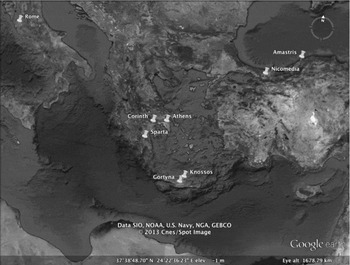
Over the course of his career as bishop, the duration of which we do not know,Footnote 10 Dionysios preserved seven of his letters to various cities: Sparta, Athens, Nicomedia, Gortyna, Amastris, Knossos, and Rome (plotted on Figure 1). Eusebius also found two other letters in the collection available to him: a response to Dionysios penned by Pinytos, the bishop of Knossos, and a letter from Dionysios to a woman named Chrysophora. The means by which the letters were collected has been debated in the scholarship on Dionysios, beginning with the observation by Lawlor that the verb ἐγκατείλεκται (Hist. eccl. 4.23.7) suggests that, when Eusebius found these letters, they were already in a collection.Footnote 11 Dionysios himself probably brought his letters together into a collection, which he labeled as “catholic.”Footnote 12 Dionysios was prompted to do this, he claims, because people he believed to be “apostles of the devil”Footnote 13 had either adulterated his letters or quoted them out of context for polemical gain. Dionysios thus gathered his personal copies of his correspondence and published them as a collection in order to displace what he viewed as false versions circulating in his name.Footnote 14
The Destinations of Dionysios's Letters

Corinthian Trade and Early Christian Communication
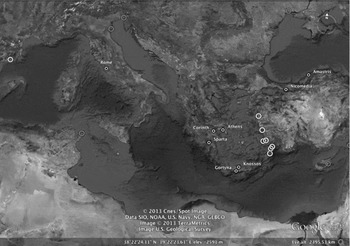
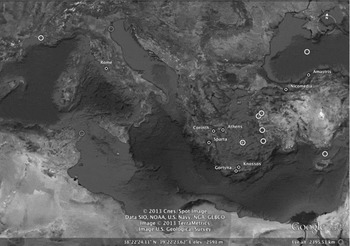
What is interesting, if not entirely surprising, about the communities with which Dionysios was in contact is how closely they map onto the trade routes that connected Corinth to other parts of the Roman Empire. Recent work by Kathleen Slane on the pottery of Corinth has allowed us to sketch the trade routes that moved through Corinth.Footnote 15 Pottery is a useful way of mapping trade routes both because many forms of pottery can be connected to particular regions and times and because pottery, as a non-elite commodity, was parasitic on larger trade patterns that were governed by elite consumption.Footnote 16 Using Slane's work, I have plotted the origins of ceramic imports to Corinth, which include amphorae, cooking ware, lamps, and fine ware, in two phases that bracket Dionysios's career in Corinth. In Figure 2 we can see the origins of pottery imports to Corinth at around 125 c.e.Footnote 17 In Figure 3 we see a similar plotting for pottery imports between 200 and 250 c.e.Footnote 18 Unfortunately, pottery evidence from the latter half of the second century is not well attested in the pottery that Slane has examined, but some observations can be made.
Sources of Corinthian Ceramic Imports ca. 125 CE

Sources of Corinthian Ceramic Imports ca 200–225/50 CE

First, the data show a decrease in the volume and the diversity of imports making their way to Corinth from the early second to the early third century. Between the two periods there is a decrease in the diversity of sources for the pottery in Corinth.Footnote 19 This decrease in the geographic spread of ceramic imports is also accompanied by a decrease in the diversity of individual pottery forms.Footnote 20 This suggests a changing economic context in Corinth that, at a macro level, marked the period of Dionysios's work in Corinth.
Second, when we look at the dispersion of ceramic imports to Corinth from Slane's research, we can develop a rough idea of the trade routes that would have brought them to Corinth.Footnote 21 Those goods arriving from the western Mediterranean, whether amphorae from Spain and Gaul, fine wares from Italy or North Africa, or giallo antico from Carthage, arrived in Corinth via an intermediary port in Italy or Sicily.Footnote 22 Ephesos and Pergamon appear to be two cities of origin for trade moving east and west between Corinth and Asia Minor.Footnote 23 There was probably also a route coming down from the Black Sea, bringing both ceramics and Proconnesian marble. The marble was used to construct, for example, the Great Bath on the Lechaion road in the late second or early third century c.e.Footnote 24 The importation of Proconnesian marble to Corinth is of interest to us here because this trade was probably managed from Nicomedia, the destination of one of Dionysios's letters.Footnote 25 The route from the Black Sea probably drew in ceramics from Assos or Çandarli in Asia Minor before moving west around the southern tip of Attica.Footnote 26 Finally, there was also a route coming from the southeast corner of the Aegean. Goods were likely collected at Antioch, with overland routes bringing in eastern goods and coastal routes bringing goods north from the Levant.Footnote 27 The route then moved west over the north coast of Crete before continuing on to Italy or branching off to Corinth.Footnote 28
This suggests that the communication between Dionysios and the churches to which he wrote was made possible by the particular trade routes upon which Corinth sat.Footnote 29 These trade routes, which were largely the production of elite consumption of luxury goods and building materials, created opportunities for the production of non-elite social networks through which goods, people, and communication could travel across large geographic expanses. They thus afford us access to something like a non-elite geography of the Roman Empire. Along these routes and the communication and mobility they afforded, early Christians created their own social networks along which various Christianities spread and across which were built new institutional and inter-communal relationships.Footnote 30 The trade routes that brought Paul to Corinth in the middle of the first century also carried his letters throughout the eastern Mediterranean, enabling the formation of fragile lines of communication between and among what would become early Christian communities.Footnote 31 It was also along these lines that Dionysios's letters traveled back over the regions to which the Christian message had spread, creating new linkages between existing Christian communities.
Dionysios's Correspondence with the Roman Church
The lines of communication and trade offered Dionysios the ability to speak to and intervene in the theological and political affairs of churches throughout the eastern Mediterranean. In this respect he follows the example of other early Christian letter writers, from Paul to 1 Clement to Ignatius of Antioch.Footnote 32 These letters served as “political instruments designed to organize and to maintain the social fabric and financial affairs of these communities.”Footnote 33 This was also the case with Dionysios, whose letters addressed questions of the readmission of sinners, attacked the spread of Marcion's theology, promoted the authority of nearby bishops, and criticized bishops of other cities, notably Bishop Pinytos of Knossos, who had come to argue for a strict stance on celibacy.Footnote 34 His letters cultivated a unified set of practices related to sexuality, the readmission of sinners, and ecclesial hierarchy. As such, they were political instruments aimed at enforcing theological and political unity in churches connected by the social networks made possible by international trade.
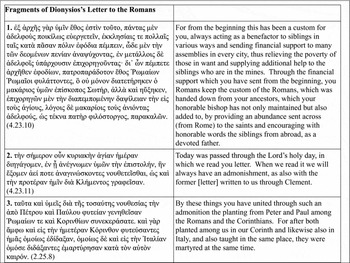
To see something of the politics of Dionysios's letters, we turn to the correspondence between Dionysios and the church in Rome, which took place when Bishop Soter was, in Peter Lampe's phrase, the “minister of external affairs” (166–175 c.e.).Footnote 35 Eusebius includes three quotations from this letter, which I have laid out in Figure 4. Dionysios's letter was written as a response to a letter received in Corinth from Soter and the Roman church. Along with the letter came a financial gift to the Corinthian community. In what follows I explore what we can know about the context in which this gift was offered and how Dionysios's response to the Roman church fit within the politics of letter writing that we have discussed so far. I show that Dionysios's letter walks a careful line between the obligations of patronage and diplomacy, while also staking out Corinth's apostolic authority and independence from Rome.
Fragments of Dionysios's Letter to the Romans

The Context of the Roman Correspondence
From the fragments and the summaries provided by Eusebius, we can reconstruct some of the context in which the letter to the Roman church was written.Footnote 36 As I noted above, Dionysios intervened in a number of communities around issues of celibacy and the readmission of sinners. It is possible that one of these bishops, perhaps Palmas of Amastris, Pinytos of Knossos, or one of their later followers, wrote to the Roman church complaining of Dionysios's theological laxity and his interventions in the politics of other churches. Dionysios's opponent(s) may have quoted from Dionysios's letters, either taking them out of context or adulterating them (Hist. eccl. 4.23.12). When an opportunity arose to help the Corinthian church with a financial gift, which I will discuss below, a letter was included with the gift offering both encouragementFootnote 37 in the face of hardship and admonishmentFootnote 38 for Dionysios's behavior.Footnote 39 Dionysios's letter in response to the Roman church was thus written from a position in which his community bore the Romans a financial debt and in which he had been criticized for intervening with dangerous theology in the affairs of other churches. Such are the hints of the political context that we can infer from Dionysios's letters.
We can imagine other possibilities, however, based on archaeological evidence from Corinth that tells us about the economic context that may have given rise to a need for financial assistance for the Christian community there. The evidence from Corinth offers a complicated economic picture. Because the data are themselves fragmentary and haphazard, we can only offer a very tentative assessment of the conditions that pertained during the period in which the Corinthians received a gift from the Roman church. The evidence suggests that Corinth may have struggled economically around the time in which the Roman gift and letter arrived in Corinth.Footnote 40
The evidence for a potential economic slowdown comes from a number of sources. First, as we have seen above, the evidence from pottery analysis suggests that from the early second to the early third century there was a drop in the diversity of origins and forms of pottery imports.Footnote 41 A further piece of evidence can be derived from the relative volume of pottery imports found at Corinth in the excavations east of the Theater.Footnote 42 The volume of imports to Corinth spikes in the early part of the second century c.e.Footnote 43 The subsequent decline in imported fine wares corresponds to a larger drop in the total fine wares (imported and local) during the second and third centuries c.e.Footnote 44 Thus, we see a drop off in the relative volume of imported and local luxury items to a level that remains stable until the fourth century c.e.Footnote 45 This drop in Corinthian imports dovetails with evidence for a larger slowdown in economic growth in the empire beginning around 140 c.e.Footnote 46
If we compare the drop in fine wares to the volume of amphorae, which are completely dominated by imports,Footnote 47 we see that, by contrast, the percentage of amphorae in the pottery assemblage remains relatively stable through the late first and early second century.Footnote 48 This suggests that Corinth's role as a middleman in international trade remained relatively stable, even as there was a drop in local consumption.Footnote 49 But even so, the correction in the Corinthian economy may have brought with it a good deal of hardship among the craftsmen and other non-elites of Corinth, who would have been the most directly affected by an economic downturn.Footnote 50
Justin Meggitt has argued that those unskilled and skilled laborers who made up the vast majority of the urban population would have been constantly on the verge of losing their ability to support themselves and their families.Footnote 51 Alciphron, writing in the late second century c.e.,Footnote 52 offers a stark portrait of poverty in Corinth and the callousness of the local elite. Writing as a parasite named Χασκοβούκης (“Stuff-Cheek”), a stock character in Roman and Greek comedy, he describes how he observed young men in the Corinthian suburb of Craneion hanging around the shops selling bread and fruit in order to obtain the scraps. Having observed this sorry sight, the author concludes that Hunger (Λιμός), and not Aphrodite, must be the patron deity of the men of the city (24.3).Footnote 53
Some of the changes in the Corinthian economy may have resulted from the larger effects of the Antonine plague, which appeared in the empire between 165 and 180.Footnote 54 That the plague may have had an effect on Corinth is suggested by the appearance of images of Asklepios and Hygeia on Corinthian coinage for the first time during the period in which the plague arrived in the empire.Footnote 55 Further, we also have evidence for the dedication of a statue of Hygeia in honor of the “Healing Savior” by Secundus, an imperial freedman, from a mutilated Greek inscription dated “no earlier than the middle of the second century” by Kent (no. 64).Footnote 56 Also, from the recent excavations of a domus in the Panayia Field we have a painted figure of a seated Asklepios that dates from the second half of the second century.Footnote 57 Similarly, it is at this time that the first inscription honoring a doctor in Corinth, Gaius Vibius Euelpistus, has been found.Footnote 58 Taken together, this evidence suggests that Corinth may have either been directly affected by the plague or at least been concerned with its appearance. As Mary Walbank has noted, Corinth was a likely site for an outbreak as it sat along a well-trafficked set of trade routes that would have facilitated the spread of the plague.Footnote 59
Christians, because they were a small minority group, might become scapegoats for the plague in some places, which may be the reason for the persecution in Athens that Dionysios claims took the life of their Bishop Publius (Hist. eccl. 4.23.2–3).Footnote 60 Economic and social instability that might arise out of an outbreak of the plague could have put marginal communities like the Christians in danger. Although we might question the size and scope of the plague, even the fear of its arrival may have provoked social unrest.
From this evidence it is possible to imagine a very tentative context in which the Roman church's gift to Corinth was received. The Corinthian church, which at this point was still made up largely of those living near subsistence level and working as craftsmen,Footnote 61 found that many of its members were suffering from the economic slowdown that developed in the second half of the second century.Footnote 62 This may have been caused or exacerbated by the appearance of the Antonine plague and its aftereffects. The Roman church, which had a tradition of supporting Corinth and other churches, sent a financial giftFootnote 63 to the Corinthians.Footnote 64 Indeed, it may have been Dionysios himself who sent an earlier letter to Soter and the Romans asking for economic assistance.Footnote 65 Alongside the gift, Soter sent a letter from the whole Roman church expressing disagreement with Dionysios's theology and actions.Footnote 66
The Rhetoric of Ethnicity and the Letter to the Roman Church
Going back to Paul's interactions with the Philippians and the Corinthians, questions of money, patronage, and authority often created complications between and among communities and their leaders. This was doubly so in Dionysios's case, since the gift from the Romans brought with it a letter critical of his own behavior, theology, and authority. Dionysios's letter must then tread a fine line between praise of the Roman church's actions and a defense of Dionysios's own teachings.Footnote 67
In keeping with the focus of this paper on trade and communication, I will analyze the fragments of Dionysios's letter to the Roman church as a piece of diplomatic correspondence, specifically focusing on the ways in which it draws on traditions of kinship diplomacy that were commonly used in the ancient world.Footnote 68 Kinship diplomacy refers to a style of diplomatic communication that relied on appeals to ethnicity and kinship as arguments in favor of particular political, military, and economic outcomes.Footnote 69 These arguments used such elements as common descent, custom, history, and cult, the invocation of which “proved” certain kinds of political affiliation between cities and peoples.Footnote 70
Dionysios's letter to the Roman church is replete with references drawn from the realm of kinship diplomacy, and by analyzing these we can see the strategies by which he navigated the complicated political situation which the Roman gift and letter created for him. In what follows, I will show how Dionysios's use of kinship diplomacy serves three rhetorical goals. First, Dionysios constructs an ancient and characteristic Roman ethos (ἔθος) of benefaction as a means of justifying their financial gift to the Corinthians. Second, Dionysios invokes an ethnic and familial affiliation between the Roman and Corinthian communities through recourse to metaphors of kinship and the possession of a shared history. This affiliation reinforces and justifies the interdependence between the two communities. Finally, Dionysios turns his account of the shared history between the two communities to his political advantage by using it to buttress his authority as bishop of a city with dual apostolic founders. In each case, Dionysios draws from the realms of kinship and ethnicity to navigate the complicated political landscape with which he was confronted.
As we have seen, the receipt of money from the Roman church put Dionysios in a difficult position. Dionysios and the Corinthians were now in their debt, a position that the Roman letter used to its advantage by offering an admonition about Dionysios's theological and political behavior.Footnote 71 By giving money to Corinth, the Romans saw themselves as patrons and the Corinthians as their clients, and this perception of the situation helps to explain why they also included an admonition of Dionysios.Footnote 72 In his response, Dionysios attempts to defuse the debt that he and the Corinthians owe to the Romans by rooting their action in the ancient ethos of the Roman community, thus skirting a framework of patronage and dependence.
According to Dionysios, the Romans have “from the beginning” (ἐξ ἀρχῆς and ἀρχῆθεν) acted as benefactors (εὐεργετεῖν) to many of their “siblings” (ἀδελϕοί) in other cities (Hist. eccl. 4.23.10). The language of benefaction places the Roman collection within the discourse of patronage, but Dionysios quickly moves to shift the discussion to a Roman ethos. The phrases ἐξ ἀρχῆς and ἀρχῆθεν root the benefactions of the Roman church in its origins and show it to be a continuing practice that defines the community's relationship to other Christian communities. These disparate communities, spread out over the geography of the empire, are linked together by Roman benefaction. Their financial links are described in the language of kinship, particularly the term “siblings” (ἀδελϕοί), which Dionysios uses three times for emphasis.Footnote 73 Though a common label in early Christian writings, the title of siblings implies a measure of equality between the Corinthians and the Romans. The Romans have given not just to the Corinthians but to siblings throughout the world, and they have done so, not out of particular political interests, but because this is what they have always done.
This ancient practice of Roman benefaction is presented as an ἔθος of the Roman community, a custom that defines their identity. As such, by giving money to the Corinthians, the Romans “have guarded the custom of the Romans handed down from their ancestors.”Footnote 74 The work that Bishop Soter, as minister of external affairs, put into organizing the collection has added to (ηὔξηκεν) this legacy,Footnote 75 making him analogous to an affectionate father with his children,Footnote 76 a clever reference to 1 Cor 3:6–7 and 4:15.Footnote 77 The ancestral custom of the Romans dictates that they must give to their siblings in need, making the Corinthian gift one of many acts of euergetism that the Romans are obligated to perform.
Dionysios thus praises the Roman church and its bishop, while also suggesting that such economic interdependencies should remain a normal and regular function of the Roman church's identity among the various Christian communities. What appears as flattery is a subtle insinuation that the Roman church ought to continue to give such financial assistance if it wants to be in conformity with the traditions that its fathers handed down from the beginning. Though the Romans may play the part of patrons to Corinth and many other communities, their euergetism is not patronage but a regular gift to other siblings and a practice rooted in the traditions of their particular forebears.
Having argued for the appropriateness of the economic interdependence between Corinth and Rome through an invocation of the founding Roman ethos, Dionysios constructs a shared history of the Roman and Corinthian communities as a means of reinforcing this interdependence. At the same time, Dionysios uses this shared history as a means of asserting the importance of his see vis-à-vis the Roman bishop. He writes:
By these things you have joined together through such an admonition the planting which was created by Peter and Paul among both the Romans and the Corinthians. For also both, having planted in our Corinth, equally taught us, and equally also, having taught in the same place in Italy, they were martyred at the same time.Footnote 78 (Hist. eccl. 2.25.8)
In this passage Dionysios constructs a shorthand account of the legendary founding of the Corinthian and Roman communities by Paul and Peter, which he no doubt draws from the suggestions in 1 Cor 1:12, 3:22, and 9:5 that the Corinthians were familiar with Peter's ministry.Footnote 79 Drawing on Paul's image of the planter in 1 Cor 3:6–8, Dionysios stresses the unity of Peter and Paul in their founding of the Corinthian community and in the teaching that they offered there. It is this same teaching that was delivered later by both Paul and Peter in Italy before their martyrdoms. As for many mythic origin stories, Dionysios claims both communities were founded by wandering heroes who passed on traditions that are kept by both communities.Footnote 80
The communication between the Roman and Corinthian communities, which for Dionysios includes the reception of 1 Clement, is akin to the “renewal” of kinship common in ancient diplomacy.Footnote 81 It was common in proclamations of the συγγένεια (kinship) between cities to “prove” kinship through recourse to common cults.Footnote 82 The focus on teaching and doctrine, which, for the Christians is a crucial part of their cult and identity, serves a similar role here.Footnote 83 The proof of their kinship is in their common ancestors and in the common teaching that both received and guarded.
This construction of the apostolic history of both Corinth and Rome is politically useful for Dionysios in a number of ways. First, this retelling gives Corinth a more ancient claim to apostolic priority, since Peter and Paul taught in Corinth first before going to Rome.Footnote 84 Second, Dionysios suggests that the Roman church's criticism of Dionysios's theology is misguided, since both communities have received the same teaching from Peter and Paul. Dionysios claims that it was actually the nefarious editing of the apostles of Satan (Hist. eccl. 4.23.12) that brought about the impression that his theology had deviated into heresy. Finally, the passage asserts the authoritative status of Corinth with respect to Rome.Footnote 85 Though each community shares the same legendary founders, Corinth was founded by Peter and Paul, while Rome was the site of their martyrdoms. The repetition, almost at the expense of coherence, of the language of equality and sameness is striking.Footnote 86 Dionysios, though remaining respectful of the Roman bishop's position, places Corinth and Rome at least on equal footing as apostolic sees, if not giving Corinth the advantage between the two.Footnote 87
On the one hand, this rhetoric explains the affiliation between the two communities across geographic distance. Because they have both been taught by the same apostolic teachers, they ought always to remain in relationship. This relationship may, in keeping with the Roman ethos of benefaction, involve the exchange of financial assistance. But, on the other hand, this relationship is one of equals, each with their own apostolic credentials. Taken together with Dionysios's praise of Roman euergetism, his political strategy becomes clear. Though the Romans have given the Corinthians a gift of money, this does not thereby diminish Corinth's standing, since this is exactly the role that the Roman church has always fulfilled according to its ethos. Equally, Corinth's standing as one of the preeminent apostolic sees gives its bishop the authority of one descended from the apostles, an authority that makes it perfectly appropriate for him to intervene in the affairs of other Christian communities. As Nautin has rightly argued, Dionysios's letter is full of “subtle nuances and insinuations” that both affirm a connection to Rome while asserting Corinth's own right to be governed by its own traditions.Footnote 88
Conclusion
In this paper I have argued that the letters of Dionysios of Corinth can be best understood within the economic and political context to which they were addressed. I have argued that it was Corinth's position as a hub of international commerce that made possible certain lines of communication between Dionysios and other Christian communities in the eastern Mediterranean. Along the lines of international trade moved Dionysios's letters, capitalizing on the possibilities of such trade as a means of intervening in political disputes around celibacy, heresy, and ecclesial authority. Dionysios's letters, like those of other early Christian letter writers, were thus political instruments deployed to create and to reinforce unity of theological and ecclesial structures in the nascent Christian communities around the Mediterranean. Taking seriously the idea that early Christian letters acted as political instruments, I have read the surviving fragments of Dionysios's letter to the Romans as examples of kinship diplomacy. Dionysios's letter offers a window onto the complicated political relationships among bishops in the second century. Dionysios confronts the financial gift of the Romans and their criticism of his theology by arguing both for the interdependence of the two apostolic sees and for the authority of Corinth itself.