School climate, defined as the quality and character of school life (Cohen, McCabe, Michelli, & Pinkeral, Reference Cohen, McCabe, Michelli and Pickeral2009), has gained significant attention as a way to promote safer and more supportive schools. School climate is based on patterns of student, parent, and school personnel experiences and reflects norms, goals, values, interpersonal relationships, teaching and learning practices, and organisational structures (Thapa, Cohen, Guffey, & Higgins-D'Alessandro, Reference Thapa, Cohen, Guffey and Higgins-D'Alessandro2013). While different models of school climate have been proposed, common dimensions include safety, relational (e.g., adult and student support), and environmental components (e.g., school connectedness; Thapa et al., Reference Thapa, Cohen, Guffey and Higgins-D'Alessandro2013).
Positive school climate is associated with a range of outcomes, including motivation to learn (Eccles, Barber, Stone, & Hunt, Reference Eccles, Barber, Stone and Hunt2003), decreased absenteeism (e.g., Gottfredson & Gottfredson, Reference Gottfredson and Gottfredson1989), lower levels of aggression and violence (Gregory et al., Reference Gregory, Cornell, Fan, Sheras, Shih and Huang2010), and lower suspension rates (Lee, Cornell, Gregory, & Fan, Reference Lee, Cornell, Gregory and Fan2011). In light of these outcomes, school climate reform has been identified as an important strategy for bully and dropout prevention in the United States (Centers for Disease Control and Prevention, 2009; Thapa et al., Reference Thapa, Cohen, Guffey and Higgins-D'Alessandro2013).
Research has linked school climate with individual, classroom, and school-level factors (Koth, Bradshaw, & Leaf, Reference Koth, Bradshaw and Leaf2008; National School Climate Council, 2015). For example, factors such as race, gender, teacher-student ratio, and school size have been linked to school climate. A focus on these different levels of the school environment and different settings within the school has helped to advance our understanding of school climate. Taking into account the various activities that students are involved in through their schools may yield additional nuance to our understanding of school climate.
Extracurricular Activities
School-based extracurricular activities provide additional experiences and have received increased attention as a way of supporting positive youth development (Ramey & Rose-Krasnor, Reference Ramey and Rose-Krasnor2012). Extracurricular activity participation has also been identified as a strategy to promote school connectedness (Centers for Disease Control and Prevention, 2009), a construct that overlaps with school climate and school belonging (Anderman, Reference Anderman2011). Yet, scant research has examined how different types of extracurricular activities are associated with distinct dimensions of school climate.
According to the United States National Center for Education Statistics (2012), sports are the most common type of extracurricular activity, with 44% of high school seniors reporting participation in some type of sport. In addition, 21% of students participate in music activities (band, orchestra or choir), as well as clubs, such as academic (21%), hobby (12%; e.g., photography, chess), and vocational clubs (16%; e.g., DECA, Future Farmers of America, Skills USA). Overall, extracurricular activities are associated with a range of positive outcomes, such as higher grades and test scores, decreased school dropout, and greater educational attainment (Farb & Matjasko, Reference Farb and Matjasko2012). Other studies have noted that the positive relationship between participation in extracurricular activities and academic outcomes may not apply across all activities (Farb & Matjasko, Reference Farb and Matjasko2012). For example, Fredricks and Eccles (Reference Fredricks and Eccles2008) found that participation in school clubs was related to higher grades; whereas, sports participation was related to less valuing of the school. Lleras (Reference Lleras2008) found that participation in academic and sports activities was associated with higher educational attainment and job earnings, while fine arts participation was associated with lower job earnings. Fredricks and Eccles (Reference Fredricks and Eccles2008) suggest that these differences are a function of the unique ecological contexts consisting of distinct characteristics and relationships with peers and adults. For example, student athletes are more likely to have a higher social status (Barber, Eccles, & Stone, Reference Barber, Eccles and Stone2001) and associate with peers who drink alcohol (Eccles & Barber, Reference Eccles and Barber1999). Sports have also been associated with opportunities to develop initiative, while school clubs have been associated with experiences related to identity formation and prosocial norms (Hansen, Larson, & Dworkin, Reference Hansen, Larson and Dworkin2003; Larson, Hansen, & Moneta, Reference Larson, Hansen and Moneta2006). Thus, extracurricular activities afford students with different developmental opportunities, and research that examines extracurricular participation in relation to dimensions of school climate is needed.
Measurement of Extracurricular Activity Involvement
Early research focusing on extracurricular activities suggested that participation in more activities is associated with more favorable outcomes; however, questions were raised about the importance of the number of activities versus the combination of activities (Feldman & Matjasko, Reference Feldman and Matjasko2005). Participation in qualitatively different activities may increase exposure to different opportunities (Feldman & Matjasko, Reference Feldman and Matjasko2005), increasing the positive effects and compensating for negative associations of individual activities and developmental outcomes. Examining participation in extracurricular activities grouped together may mask the true relationship between specific extracurricular activities and specific student outcomes.
Research focusing on breadth of participation has grown in recent years and has supported the notion that more activities, up to a point, across different activity domains is better (Bohnert, Fredricks, & Randall, Reference Bohnert, Fredricks and Randall2010; Farb & Matjasko, Reference Farb and Matjasko2012). However, these studies do not yield information about student participation in different combinations of activities, such as participation in sports and clubs, as compared to participation in arts and clubs (Linver, Roth, & Brooks-Gunn, Reference Linver, Roth and Brooks-Gunn2009). Given that students participate in different extracurricular activities throughout the school year, and these activities are often integral to the school community, different extracurricular activities may be associated with distinct outcomes.
School Climate and Extracurricular Activities
Thapa and colleagues (Reference Thapa, Cohen, Guffey and Higgins-D'Alessandro2013) highlight four main dimensions of school climate: safety, relational, teaching and learning, and environmental. A review of the research on extracurricular activities suggests that various activities may support positive school climates. However, some extracurricular activities may support specific dimensions of school climate more so than others. Below, we focus specifically on the safety, interpersonal relations, and school environment dimensions of school climate.
Safety
Safety refers to social, emotional, and physical feelings of security within the school setting. Safe schools are characterised by low rates of verbal abuse, teasing, social exclusion, and physical violence (Cohen et al., Reference Cohen, McCabe, Michelli and Pickeral2009). Threats to safety can lead students to skip school (Centers for Disease Control and Prevention, 2009), which can undermine students’ ability to learn. While scant research has examined the relation between extracurricular activities and perceptions of safety, Fleming and colleagues (Reference Fleming, Catalano, Mazza, Brown, Haggerty and Harachi2008) found that participation in extracurricular activities was related to less school misbehaviour and delinquency. Moreover, Peguero (Reference Peguero2008) found that students who participated in classroom-related extracurricular activities (band, student government, yearbook, newspaper) were more likely to be bullied, as compared to student athletes. Thus, participation in certain types of activities may contribute to different treatment from peers, affecting their experiences and perceptions of school safety.
Interpersonal relations
The relational component of school climate involves interactions between people and how connected individuals feel (Thapa et al., Reference Thapa, Cohen, Guffey and Higgins-D'Alessandro2013). Support from teachers and peers is associated with higher self-esteem and grades, as well as psychological wellbeing (Jia et al., Reference Jia, Way, Ling, Yoshikawa, Chen, Hughes and Lu2009). Extracurricular activities can contribute to positive student outcomes by allowing students to develop relationships with like-minded peers and supportive adults (Mahoney, Larson, Eccles, & Lord, Reference Mahoney, Larson, Eccles, Lord, Mahoney, Larson and Eccles2005). However, scant research has examined the ways in which specific types of extracurricular activities may contribute to these interpersonal dimensions of school climate, such as supportive or collaborative relationships with peers and adults.
School environment
The environmental dimension of school climate includes feeling cared for and as though one is part of the school community (McNeely, Nonnemaker, & Blum, Reference McNeely, Nonnemaker and Blum2002). School connectedness and school belonging have been used interchangeably within the research literature (Allen & Bowles, Reference Allen and Bowles2012; Guo, Choe, & D'Alessandro, Reference Guo, Choe and Higgins-D'Alessandro2011; Libbey, Reference Libbey2004). However, we use the term school connectedness in this study. Research on school connectedness has found that schools with higher rates of participation in extracurricular activities report higher levels of school connectedness (Blum, McNeely, & Rinehart, Reference Blum, McNeely and Rinehart2002). Using cluster analysis, Linver et al. (Reference Linver, Roth and Brooks-Gunn2009) examined five activity clusters — sports only, sports and other activities, little or no involvement, primarily school-based, and primarily faith-based activities. This study found that students who participated in the sports-only cluster reported higher levels of connectedness, but the study did not differentiate between specific types of school activities such as clubs or arts-based activities. Sports activities have been most extensively studied in the extracurricular literature, possibly because it is the most popular activity among high school (Grades 9–12) students in the United States (National Center for Educational Statistics, 2012). However, given that students participate in other activities, such as clubs and arts, research is needed that examines how participation in multiple activities relates to student perceptions of school connectedness and belonging.
Current Study
The purpose of the current study was to examine the relationship between participation in three types of extracurricular activities (sports, clubs, and arts) and multiple dimensions of school climate (i.e., safety [social-emotional security], interpersonal relationships [adult support, student support], and school environment [school connectedness]) while controlling for student and school-level characteristics. We tested main effects in order to understand how each extracurricular activity is associated with perceptions of school climate. We also tested interaction effects in order to examine how different combinations of extracurricular activities are associated with school climate.
Method
Participants
Participants consisted of 15,004 grade 9–12 students from 28 high schools across 11 states in the United States. The majority were 9th-grade students (27%) followed by 10th- (25.6%), 11th-(25.1%) and 12th-grade (22.3%) students. A slightly higher percentage of participants were female (51.5%). Regarding race/ethnicity, the majority of students self-identified as White (68.6%), followed by African American (10.3%), Latino (8.4%), multiracial (6.1%), Asian (4.7%), and American Indian/Alaska Native (1.5%). Most students participated in sports (54.1%), followed by clubs (37%) and arts (22.6%). Approximately one fourth of the students in this sample were not involved in an extracurricular activity. The majority of schools were public (96.3%) and suburban (67.9%), followed by urban (25%) and rural (7.1%) settings. The average percentage of students across schools displaying financial need was 36.2% (data available for 24 schools).
Measures
Independent variables
We examined students who participated in sports, clubs, and art-related extracurricular activities. Each of these categorical variables consisted of binary measurement (1 = participated in the extracurricular activity; 0 = did not participate in the extracurricular activity). Students who did not participate in the extracurricular activity served as the reference group. Students who participated in arts consisted of students who reported involvement in music and performing arts (e.g., drama, acting).
Control variables
We controlled for three individual-level variables: gender (females as reference group), race/ethnicity (non-White as reference group), and grade-level (9th grade as reference group). We also included an aggregated school-level variable to account for extracurricular involvement at the respective schools, given school variation in extracurricular offerings and involvement. This variable is a percentage, which was computed by dividing the total number of students who reported involvement in at least one extracurricular activity by the total number of students sampled from that school.
Outcome variables
The four outcome variables in this study were drawn from the Comprehensive School Climate Inventory (CSCI-V3.0). The CSCI evaluates student, parent, and school staff perceptions of school climate, and in this study we focused on student perceptions. Additionally, we focused on three of the four major CSCI domains of safety, interpersonal relationships, and institutional environment. Items on the CSCI are assessed using a 5-point Likert scale (1 = strongly disagree, 5 = strongly agree), with higher scores reflecting more favourable perceptions of school climate. The CSCI has good construct validity and internal consistency (Clifford, Menon, Gangi, Condon, & Hornung, Reference Clifford, Menon, Gangi, Condon and Hornung2012; Guo et al., Reference Guo, Choe and Higgins-D'Alessandro2011).
Safety: Social-emotional security
Social-emotional security refers to the extent to which students feel safe from verbal abuse, teasing, and exclusion within the school. This subscale consists of six items and is one of the three subscales within the safety domain of the CSCI. A sample item is ‘Adults in the school stop students if they see them insulting, teasing, and making fun of others’. This scale demonstrated good internal consistency (α = .85).
Interpersonal relationships: Adult social support
Adult social support is defined as the pattern of supportive and caring adult relationships for students, including high expectations for students’ success, willingness to listen to students and to get to know them as individuals, and personal concern for students’ problems. This subscale consists of eight items and is one of the three subscales within the interpersonal relationships domain of the CSCI. A sample item is ‘Adults who work in my school treat students with respect’. This scale demonstrated good internal consistency (α = .86).
Interpersonal relationships: Student social support
Student social support refers to the pattern of supportive peer relationships for students, including friendships for socialising, problems, academic help, and for new students. This subscale consists of five items and is one of the three subscales within the interpersonal relationships domain of the CSCI. A sample item is ‘Students have friends at school they can trust and talk to if they have problems’. This scale demonstrated acceptable internal consistency (α = .73).
Institutional environment: School connectedness
School connectedness refers to positive identification with the school, and norms for broad participation in school life for students, staff, and families. This subscale consists of eight items and is one of the two subscales within the environment domain of the CSCI. A sample item is ‘I feel like I belong at my school’. This scale demonstrated good internal consistency (α = .82).
Analysis
Due to the nested structure of these data, we used multilevel regression modelling to test our hypotheses, through four simultaneous models in which social-emotional security, adult social support, student social support, and school connectedness served as the outcome variables. The level 1 (student-level) predictor variables included gender (female vs. male); race/ethnicity (White vs. non-White); grade; and participation in sports, clubs, and arts. One school-level predictor variable, school-level extracurricular involvement, was included. Regarding extracurricular activities, the main effects compared students who participated in the activity (e.g., sports) versus students who did not participate in the activity, while accounting for participation in other extracurricular activities (arts and clubs). These main effects answer questions such as ‘Do students participating in sports report higher levels of school connectedness, as compared to students not participating in sports, while taking into account participation in arts and clubs?’
Students can participate in multiple extracurricular activities (sports and arts), and therefore we incorporated interaction effects between the different types of extracurricular activities (sports × arts; sports × clubs; arts × clubs; sports × arts × clubs) to test how involvement in combinations of activities are associated with dimensions of school climate. Due to the multiple interaction effects, we set the critical value to .001. These interaction effects were all level-1 variables.
Results
Due to the focus of this study, in this section we report main effects and interactions related to extracurricular involvement. Results for all other independent variables are listed in Table 1.
Main Effects and Interactions

Safety: Social-Emotional Security
The results revealed significant main effects for gender, grade, and participation in sports (see Table 1). Students who participated in sports (M = 2.92) reported more social-emotional security than students who did not participate in sports (M = 2.83).
Interpersonal Relationships
Adult social support
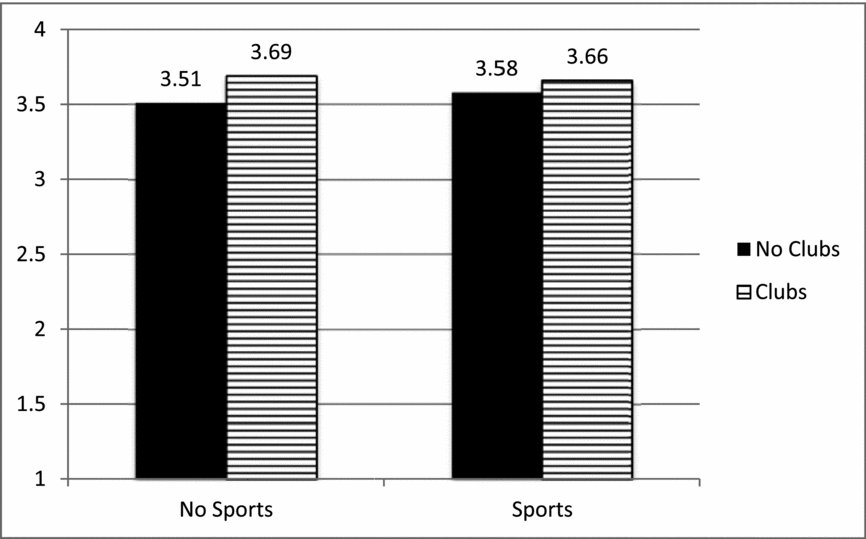
Results revealed significant main effects for race/ethnicity, grade, participation in sports, and participation in clubs (see Table 1). Students who participated in sports (M = 3.61) reported higher levels of adult social support than students who did not participate in sports (M = 3.57). Further, students who participated in clubs (M = 3.67) reported higher levels of school adult social support than students who did not participate in clubs (M = 3.55). The results also revealed an interaction effect between sports participation and participation in clubs (see Figure 1). While participation in clubs (M = 3.69) was associated with higher levels of adult support in comparison to students who were not involved in sports or clubs (M = 3.51); when students participated in sports, clubs (M = 3.66) no longer contributed to more adult support.
Adult support: Interaction of sports and clubs.
Student social support
Results revealed significant main effects for race/ethnicity and participation in sports, clubs, and arts (see Table 1). Students who participated in sports (M = 3.72) clubs, (M = 3.73) and arts (M = 3.73) reported more student social support than their counterparts who were not involved in these activities (no sports, M = 3.59; no clubs, M = 3.64, no arts, M = 3.62).
Institutional Environment: School Connectedness
Results revealed significant main effects for race/ethnicity, grade, sports, clubs, and arts (see Table 1). Students who participated in sports (M = 3.50), clubs (M = 3.52), and arts (M = 3.45) reported higher levels of school connectedness than their counterparts (no sports, M = 3.35; no clubs, M = 3.38; no arts, M = 3.43).
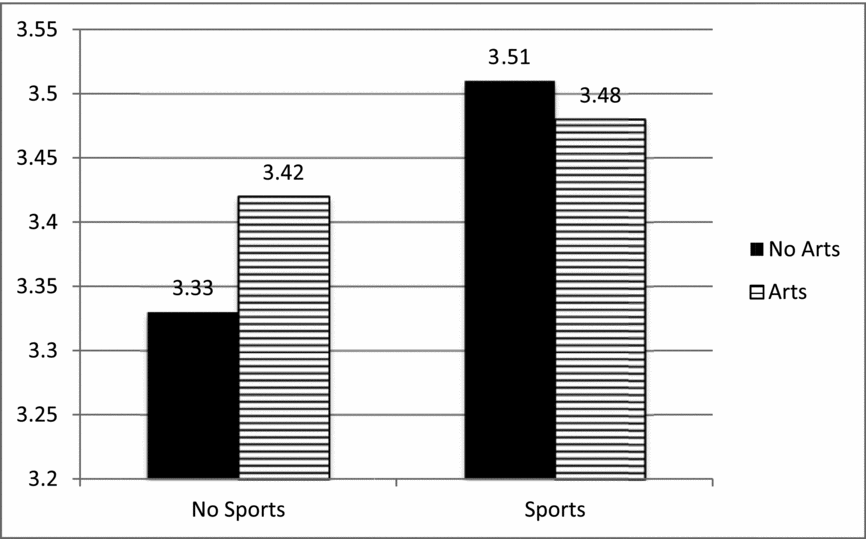
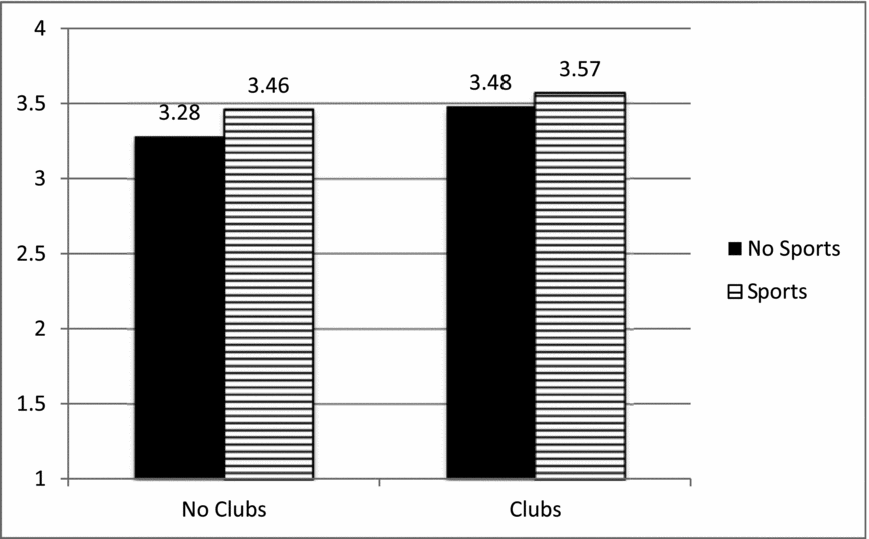
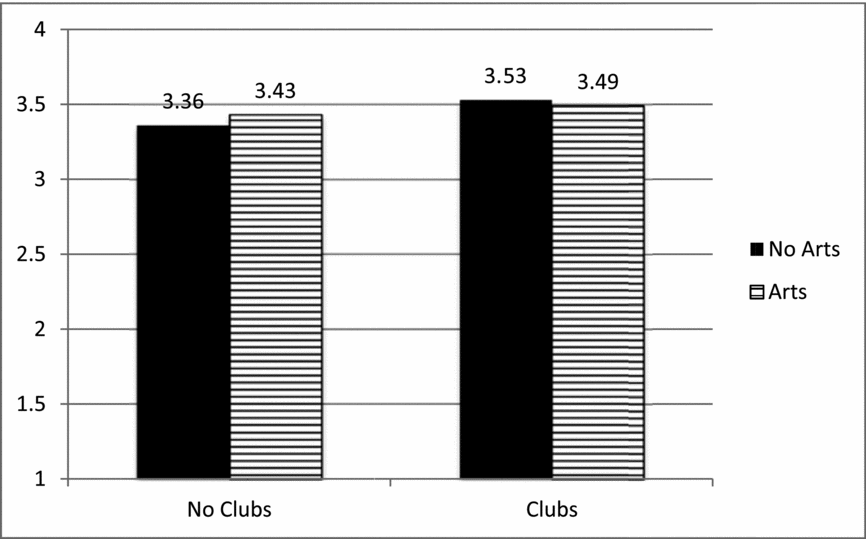
Results also revealed three interaction effects. A sports × arts interaction revealed that participation in arts was associated with higher levels of school connectedness (M = 3.42) in comparison to students who were not involved in arts or sports (3.33) (see Figure 2). However, when students participated in sports, arts (M = 3.48) no longer contributed to more school connectedness. The sports × clubs interaction revealed that participation in sports (M = 3.46) was associated with higher levels of school connectedness in comparison to students who were not involved in sports or clubs (M = 3.28); however, among students participating in clubs, sports (M = 3.57) no longer contributed to more connectedness (see Figure 3). Finally, the clubs × arts interaction revealed that participation in arts (M = 3.43) was associated with higher levels of school connectedness in comparison to students who were not involved in arts or clubs (M = 3.36) (see Figure 4). However, when students participated in clubs, arts (M = 3.49) no longer contributed to more school connectedness.
School connectedness: Interaction of sports and arts.
School connectedness: Interaction of sports and clubs.
School connectedness: Interaction of clubs and arts.
Discussion
This study examined how involvement in different types of extracurricular activities (sports, clubs, arts) is associated with students’ perceptions of school climate, namely social-emotional security, student support, adult support, and school connectedness. This investigation extends this body of research by linking extracurricular involvement to school climate, a construct that has not been fully explored within this body of work. Whereas previous studies have focused on specific activities and/or breadth of extracurricular participation, this study highlights how different extracurricular activities interact and are associated with different dimensions of school climate.
Social-Emotional Security
We found that involvement in sports was the only activity associated with social-emotional security. Athletic participation is often associated with higher social status in the school context (Shakib, Veliz, Dunbar, & Sabo, Reference Shakib, Veliz, Dunbar and Sabo2011). Given their higher social status, athletes may feel more socially and emotionally safe because they are less likely to be teased, ridiculed, or excluded relative to students who participate in other activities. Indeed, participation in sports has been associated with less social isolation (Barber et al., Reference Barber, Eccles and Stone2001) and less bullying victimisation (Peguero, Reference Peguero2008). In contrast, participation in arts has been linked to decreased popularity and bullying victimisation (O'Neill, Reference O'Neill, Mahoney, Larson and Eccles2005). Thus, sports offer a unique opportunity by allowing students to be socialised into a more popular peer group where students are safe from teasing and social exclusion. Nevertheless, these findings also suggest that students who participate in arts and clubs feel similar levels of social-emotional safety as students who are not involved in extracurricular activities. The connection between extracurricular involvement and perceptions of school safety warrants further investigation.
Adult Support
Being connected to a caring adult is commonly cited as promoting positive development (Mahoney et al., Reference Mahoney, Larson, Eccles, Lord, Mahoney, Larson and Eccles2005). Sports and club participation were linked to higher levels of adult social support. However, the interaction effects reveal a more complex picture. Participation in clubs contributes to more meaningful adult support among students who do not participate in sports. One explanation is that forging meaningful student-adult relations necessitates more time than is typically possible for students who are sports involved, given the time commitment (e.g., sport practices and competitions). Thus, any involvement in clubs, in addition to sports, may be limited to minimal involvement or certain off-season times of the school year, resulting in fewer and potentially sporadic interactions with adults.
Student Support
We found main effects for involvement in sports, arts, and clubs. A key feature of extracurricular activities is the opportunity to build supportive relationships with peers that are characterised by warmth, closeness, caring, and respect (Mahoney, Eccles, & Larson, Reference Mahoney, Eccles and Larson2004). Extracurricular activities link students to other school peers, and the more time students spend in an activity, the more likely they are to develop connections and draw friends from the activity (Eccles et al., Reference Eccles, Barber, Stone and Hunt2003). From a practical standpoint, the higher level of student support among students who participate in sports, arts, and clubs is encouraging and suggests that participation in general, regardless of activity type, can foster positive student relations. However, it is noteworthy that these three activities are linked to positive peer relations, but as previously discussed, only sports was associated with social-emotional security. Thus, more positive student relations associated with extracurricular activities may not necessarily lead students to feel socially and emotionally safe.
School Connectedness
Our findings indicate that participation in extracurricular activities may be particularly important for fostering school connectedness. Participation in the three respective extracurricular activities was associated with higher levels of school connectedness. These findings are in line with research showing that participation in extracurricular activities is associated with greater school attachment (McNeely et al., Reference McNeely, Nonnemaker and Blum2002). However, unique combinations of extracurricular involvement seem to qualify these effects.
We found that participating in sports and clubs, separately and combined, was associated with higher levels of school connectedness than not participating in these activities; however, participating in sports did not yield greater feelings of school connectedness among students participating in clubs. Thus, there does not appear to be a ‘stacked effect’ in which participation in combinations of activities precipitates higher levels of school connectedness. According to the Centers for Disease Control and Prevention (2009), students who report having friends from several peer groups also report feeling more connected to school, and our findings do not appear to align with this notion. In addition, school clubs tend to consist of larger student groups, and the academic orientation of many clubs often connects students with the academic mission of schools (Feldman & Matjasko, Reference Feldman and Matjasko2005). As a result, participating in sports, in addition to clubs, may not bring forth a substantially meaningful added value in relation to school connectedness.
Finally, while students who participated in arts activities reported higher levels of school connectedness than students who did not, arts participation appeared to undermine the positive effects of being involved in sports. The decreased popularity and increased bullying associated with participation in art activities may partly explain these negative effects (O'Neill, Reference O'Neill, Mahoney, Larson and Eccles2005). For example, in a qualitative study of sports and arts participation, Patrick and colleagues (Reference Patrick, Ryan, Alfeld-Liro, Fredricks, Hruda and Eccles1999) found that participation in sports and arts provided students with opportunities to develop friendships. However, only students who participated in arts activities reported negative reactions from their peers, such as being labelled as ‘strange’ or teased. Thus, although arts activities allow students to build relationships with like-minded peers, negative reactions may undermine students’ connectedness with the larger school context. These findings further underscore how unique combinations of these extracurricular activities qualify these effects, and how participation in more activities does not necessarily lead to higher levels of school connectedness or belonging.
Implications for Research and Practice
Researchers have posited that greater breadth of participation is associated with more positive developmental outcomes. This study suggests that the effects of participation in multiple extracurricular activities depend on the types of activity combinations and that the most notable gains exist when students participate in an extracurricular activity as compared to no participation. Further, some activities are more likely to align with and reinforce the values of the school community than others. Thus, theory should not only consider the characteristics of activities that shape development, but also how activities fit into the overall school milieu. Characteristics of the school, such as a mission or school culture that values sports or arts or academic rigor, may shape the significance and quality of these extracurricular experiences. Future work should also examine specific characteristics of these extracurricular activities, such as quality, whether they are mandatory or optional, and time of operation (i.e., during the school day or during out-of-school-time hours).
Longitudinal studies are needed that examine how changes in participation are associated with changes in perceptions of school climate. Further, in light of the association between school climate and student outcomes, research can examine the extent to which school climate has a mediating or moderating affect in promoting academic success. Extracurricular activities may promote positive academic outcomes by fostering positive school climates, or through the development of neurophysiological pathways, as has been found with music participation (Kraus et al., Reference Kraus, Slater, Thompson, Hornickel, Strait, Nicol and White-Schwoch2014). Rigorous methodological techniques are needed that can isolate these different associations and pathways contributing to academic success.
This study has implications for educational, developmental, and community psychologists working with schools, as well as other researchers and practitioners seeking to foster positive school climates. Participation in extracurricular activities may be one way to promote a positive school climate, and schools should consider practices that promote student involvement in at least one activity. Moreover, infusing practices within extracurricular activities that emphasise individual strengths and talents, teamwork, and skill development could further enhance the quality of these settings, interpersonal relations, and school belonging (Siperstein, Glick, & Parker, Reference Siperstein, Glick and Parker2009). Extra-curricular activities may also serve as vehicles to infuse social-emotional related interventions. A burgeoning body of implementation science research has given attention to the conditions that allow for successful implementation of school-based interventions, and some extracurricular activities may be poised as viable contexts (Forman, Olin, Hoagwood, Crowe, & Saka, Reference Forman, Olin, Hoagwood, Crowe and Saka2009).
Strengths and Limitations
This study possesses several limitations. Foremost, as this study was cross-sectional, directionality cannot be determined, and fluctuations in involvement across time are not accounted for. Second, the schools were not randomly selected. Third, it is likely that students self-select into extracurricular activities, and there may be a variety of personal characteristics that lead students to join specific types of activities. These characteristics may also contribute to perceptions of school climate. We did control for ethnicity and gender, which are related to self-selection.
Despite these limitations, this study possesses several strengths. First, this study is strengthened by the large sample size of students across multiple schools. Second, this study examines individual activities as well as combinations of activities. Third, the use of multilevel modelling adds to the rigor of our analyses, taking into account individual and school-level effects. Last, this study examines extracurricular activities in relation to multiple dimensions of school climate. Given the importance of school involvement and school climate, future research should continue to explore how extracurricular activities relate to school climate and how this relationship changes over time.
Conclusion
A recent commentary by the National School Climate Center (2015) in the United States indicates that efforts to improve school climate, including interpersonal relations and school belonging, should include three components. These include systemically engaging all members of the school community, focusing on instruction that promotes prosocial development (e.g., collaboration, co-leadership), and meaningful relationships. Extracurricular activities serve as vehicles that can engage a broad cross-section of school community members (e.g., teachers, coaches, parents), incorporate prosocial instruction, and enhance relationships among students and across stakeholders at different social-ecological levels. Ultimately, extracurricular activities can ignite students’ inclination to become involved in school life and promote school belonging.
Acknowledgments
None.
Financial Support
This research received no specific grant from any funding agency, commercial, or not-for-profit sectors.
Conflicts of Interest
None.
Ethical Standards
The authors assert that all procedures contributing to this work comply with the ethical standards of the relevant national and institutional guides on the care and use of laboratory animals.