In a recent article Karol Berger describes what he calls ‘the two types of da capo aria’ in Bach's St Matthew Passion.Footnote 1 In fact, the two types occur throughout Bach's vocal works. One type is the standard da capo aria, ubiquitous in eighteenth-century European vocal music. The other is what English-speaking Bach scholars have learned to call the modified da capo aria. In both types of aria, the text comprises two segments, of which the first is repeated after both are heard in succession. In the standard da capo aria, the musical setting of the first segment is repeated verbatim. This requires that the music for the first segment begin and end in the tonic key. In the so-called modified da capo form, on the other hand, the first A section ends in a foreign key, usually the dominant, and the second A section is written out in ‘modified’ form so as to end in the tonic.
It took much more time and trouble to write this sort of aria, and Bach, characteristically, did so with a frequency apparently unique among eighteenth-century composers. Why he did so is a puzzle that a number of scholars have investigated, with no conclusive results. But his use of this form, far from being an abstruse detail, is a distinctive aspect of his style, already in place in his Weimar cantatas, from 1714 or a bit earlier. Any explanation for this must reflect the place of da capo arias in general in Bach's work and in his environment.
Like concerto ritornello form, da capo aria form has become so much a part of modern music historiography that we overlook the fact that the textbook version became standardized only during the course of the eighteenth century, and not simultaneously across Europe. Therefore arias, concertos, sonatas and other early eighteenth-century works that we might single out as normal or paradigmatic did not necessarily appear that way to the young Bach. In setting texts to music, including texts whose poets specified that these were to be treated in the manner of Italian da capo arias, Bach, at Weimar or before, did not necessarily know or care that a simple ternary form was already the routine way of treating such a text elsewhere. For him, the so-called modified design was a normal procedure, or rather one of several equally valid options, none of which ever became standard or routine within his output. Rather than thinking of Bach as writing ‘two types’ of da capo arias, it may be more accurate to imagine a continuum of aria forms that share certain features, such as the da capo and other species of recapitulation, to varying degrees.
Among those for whom da capo form had become routine well before 1714 was the youthful Handel. The expression modified da capo form has also been used in recent writings about Handel to describe a type of aria that appears to be similar to Bach's. But Handel's arias of this type are few in number and date from late in his career. Moreover, at least three examples by Handel originated as normal da capo arias that he then literally modified; I know of no evidence that any examples by Bach originated in this way.
In German, Bach's arias of this type are described as ‘free’ da capo forms, the ordinary da capo aria being designated ‘strict’. But these terms have been rejected by most anglophone writers, perhaps because they suggest a false dichotomy: nothing by Bach is ‘strict’ in the sense of adhering to some simple routine or template. Miriam Whaples, who has made several important contributions to the study of such arias, refers to them as ‘recapitulation arias’. This reflects their association with sonata form, though she relates them rather to the concerto, sometimes designating them more specifically as ‘concerto-recapitulation’ arias.Footnote 2 Daniel Freeman has described them similarly as ‘concerto arias’,Footnote 3 but I do not find any particular affinity to the genre of the concerto, which, as I have argued elsewhere, had no specific formal implications during Bach's first two decades as a composer.Footnote 4 Another student of these works, Stephen Crist, has refrained from introducing new terminology.Footnote 5
BACH'S ARIA FORMS
In place of the existing terms, I propose the expression through-composed da capo form. By retaining the element ‘da capo’ I mean to indicate that most of these arias remain settings of poetry that was conceived in regular ternary form, and a return to the opening or head (capo) of the music remains an important formal crux. Yet Bach chose to write music that is through-composed, at least in the sense that everything apart from the opening ritornello is written out, little else being repeated verbatim. With the term through-composed I also wish to suggest that Bach followed no one scheme in these arias. Indeed, his arias in general, like his concertos and other works, show far less consistency in matters of form than is suggested by textbook accounts, and this is especially true in the works under consideration here.
To be sure, the majority of Bach's arias from throughout his career are ordinary da capo forms, even if these do not numerically overwhelm other types, as they do in the vocal works of his Italian and German contemporaries. Printed librettos of the time are inconsistent in their inclusion of the rubric Da capo at the ends of aria texts. But any competent composer would have recognized the expectation of a musical setting in ternary or ABA form for a text comprising two short stanzas, both forming distinct sentences but linked by a common rhyme. This had emerged as the standard poetic form for Italian arias by the early eighteenth century, and it is the most common one in Bach's works. Yet the librettos set by Bach also contain many arias clearly not of this type. Moreover, many of his aria texts incorporate written-out reprises of one or occasionally two lines; whether the poets expected these lines to be set as musical reprises is unclear, but Bach dealt with them in various ways.
There is no universally accepted terminology for the poetic and musical forms of eighteenth-century arias.Footnote 6 But recent German- and English-language writings on Bach's cantatas agree on the general outlines of Bach's three most commonly used aria designs. These are summarized on the first three lines of Table 1, where capital letters A and B indicate textual units that are each associated with distinctive musical material. Thus a conventional da capo aria is an ABA aria, whereas a through-composed da capo aria can be represented as ABA′. An aria that has two distinct textual and musical sections but does not repeat the first of these can be described as a bipartite or AB aria. One can similarly identify occasional tripartite arias by Bach in which three successive textual and musical sections occur (ABC), as distinct from the rounded form of a da capo or ternary design. These bipartite or multi-part arias are also distinct from what Whaples and Crist call ‘parallel’ (German hälftig) forms, comprising two sections, each of which presents the complete text of the aria.Footnote 7 This yields the form AA′, which I would describe as binary, reflecting its use in binary-form dances and other late baroque instrumental movements.Footnote 8
Common late baroque aria designs

In general these aria forms were determined by the poet, not the composer, who ostensibly, in keeping with fundamental principles of baroque musical rhetoric, merely followed cues embedded in the poetic text. Nowadays it is unfashionable to pay attention to the formal structure of poetry (or, for that matter, of music), but detailed knowledge of the verse forms of modern German as well as ancient Greek and Latin poetry was undoubtedly expected of Bach's librettists. Readers as well as composers must have paid close attention to details of rhyme scheme and syllabification, appreciating the poets' ingenuity in fitting conventional sentiments and moral lessons to a great variety of poetic forms, even if they did not necessarily know the learned descriptions of these given by writers such as Opitz and later Gottsched.Footnote 9
In so far as late baroque writers and musicians continued to adhere to the aesthetic of music as servant to poetry, Bach's through-composed da capo arias represent a significant departure from convention, as they disregard a textual cue pointing towards a musical parallelism. A second departure is the unprecedented significance of the ritornello, which in many of his arias not only contains the main musical material but even serves as a sort of cantus prius factus: vocal matter is not freely composed but is superimposed on the ritornello as an extra contrapuntal layer through the procedure known as Einbau.Footnote 10 That Bach, from almost the start of his composing of vocal music, should have employed these two forms of musical elaboration may suggest an instrumentalist's disregard for the rhetorical function of vocal music. Yet, at least in his earlier works, Bach is, if anything, more sensitive than most contemporaries to the meaning and form of his texts. Scholars have struggled to explain why Bach sometimes chose standard da capo design and sometimes the ‘modified’ one in setting texts that are identical in poetic form. Crist, for example, showed that, at least for part of his career, Bach tended to associate through-composed da capo forms with particular rhyme schemes.Footnote 11 But Whaples has demonstrated that over the span of Bach's entire career no such associations can be upheld.Footnote 12
In fact, Bach's contemporaries also exercised considerable discretion in their settings of da capo texts. For instance, the texts of the individual A and B sections may or may not be repeated in the course of each section. Sometimes a textual repetition occurs within a musically unitary section; in other cases a stanza may be repeated only after a full cadence and ritornello that articulate a musically autonomous section. With Bach, the latter sort of articulation usually coincides with, or rather confirms, a modulation. In particular, the first section of an ABA design is often divided in half by a modulation to the dominant, with a substantial ritornello confirming the arrival. In such cases, the A section is a self-contained binary form, parallel in design to many dances and sonata movements of the early eighteenth century, though without a central double bar.
As previous scholars have observed, binary-form A sections are far less numerous in Bach's through-composed da capo arias than in his conventional ones. Whereas the A section of the latter resembles a sonata form, in a through-composed da capo aria it is the entire aria that approaches sonata design. The simple, as opposed to binary, structure of the first A section in such an aria is as important a feature of this design as is the presence of a modulation over the course of the A section; indeed, the two features must be linked, even though some ordinary da capo arias also have unitary A sections.Footnote 13 Conversely, one also encounters binary-form A sections in a few through-composed da capo arias.Footnote 14 But in most cases if the A text is repeated within the first section of a through-composed da capo, the initial statement concludes with a half cadence or other relatively weak articulation.Footnote 15 Even this is rare before Bach's Leipzig period. Any ritornello at the midpoint of these A sections is extremely abbreviated.
One might describe the result as a shortened A section, as compared with that of a regular da capo aria. But Whaples was more to the point in observing: ‘In the da-capo aria the “B” section is stranded, detached at both ends from a closed principal section which has already resolved its harmonic affairs and ended’.Footnote 16 To put it more positively, a through-composed aria is a more fully integrated musical form, and for this reason the A section is not usually a self-contained, tonally closed binary form.
It was this feature of the modified da capo aria that led Edward T. Cone and Malcolm Boyd, among others, to observe the resemblance of this type of aria to sonata form.Footnote 17 In the early type of sonata form found, for example, in Bach's chamber and keyboard music, one cannot yet speak of exposition, development and recapitulation, each with its own distinctive functions, nor does the exposition always articulate so-called first and second themes.Footnote 18 But the first section does present thematic material that recurs in subsequent sections, and this section usually modulates to the dominant; the final section usually begins by restating the opening material in the tonic, and it ends in that key. Hence the final section is indeed a recapitulation in a general sense, closing in the tonic with material previously heard in the dominant. But because the final section is not a verbatim restatement of the first one, this design, unlike that of a strict da capo form, involves some degree of reinterpretation of returning material in the final section. This is one of the features that, as Charles Rosen has repeatedly argued, gave sonata form the potential to become a sort of dramatization of basic tonal and motivic procedures, hence distinct in character from the more static geometry of a straightforward ternary form. This potential, in his view, was achieved in certain works of Haydn, Mozart and Beethoven, but Bach seems to have discovered the underlying principle independently, as will be argued below.Footnote 19 That he employed it less frequently and less consistently than the Viennese classical composers reflects, among other things, the fact that only subsequently has Western aesthetics tended to favour drama over geometry, dynamic over static forms. Dynamic or asymmetrical designs are not inherently better or more valuable than static or symmetrical ones, and Bach, living during a period of transition, appears to have used both types without favouring one over the other.
Considerations of formal construction in arias would be arid and inconsequential if Bach did not relate the design of each movement to the rhetoric of its poetry. His musical rhetoric comprises not only superficial elements, such as the use of representational motives and melismas, but the precise disposition of each aria text: how the music articulates it into segments; the relative weightiness or length with which each poetic segment is treated musically; whether, and how literally, the music of the first section is later restated. In all these matters Bach made considered choices rather than thoughtlessly following prescribed routines. His decisions were not necessarily dictated by anything in the poetry, even if, like any good composer of the time, he believed that the purpose of his settings was to serve a pre-existing verbal text. In a hierarchical society, where respect for convention was taken for granted, a composer did not question such things, especially if the texts were handed to him by a senior court official.Footnote 20 But to understand the nature of his choices, as well as possible sources for his ideas, it will be helpful to begin by examining examples of so-called modified da capo arias by other composers.
THROUGH-COMPOSED DA CAPO FORMS BY HANDEL AND OTHERS
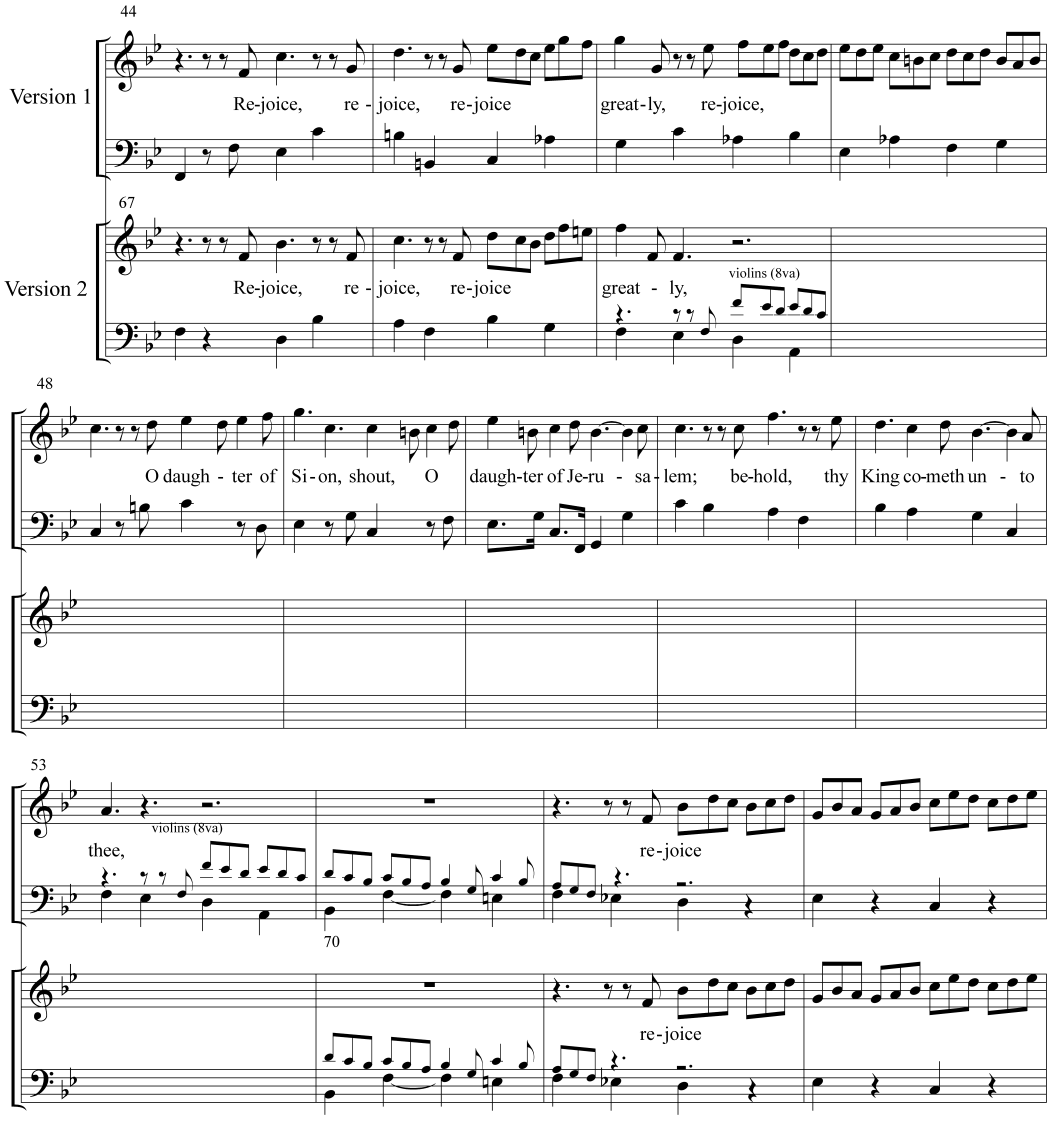
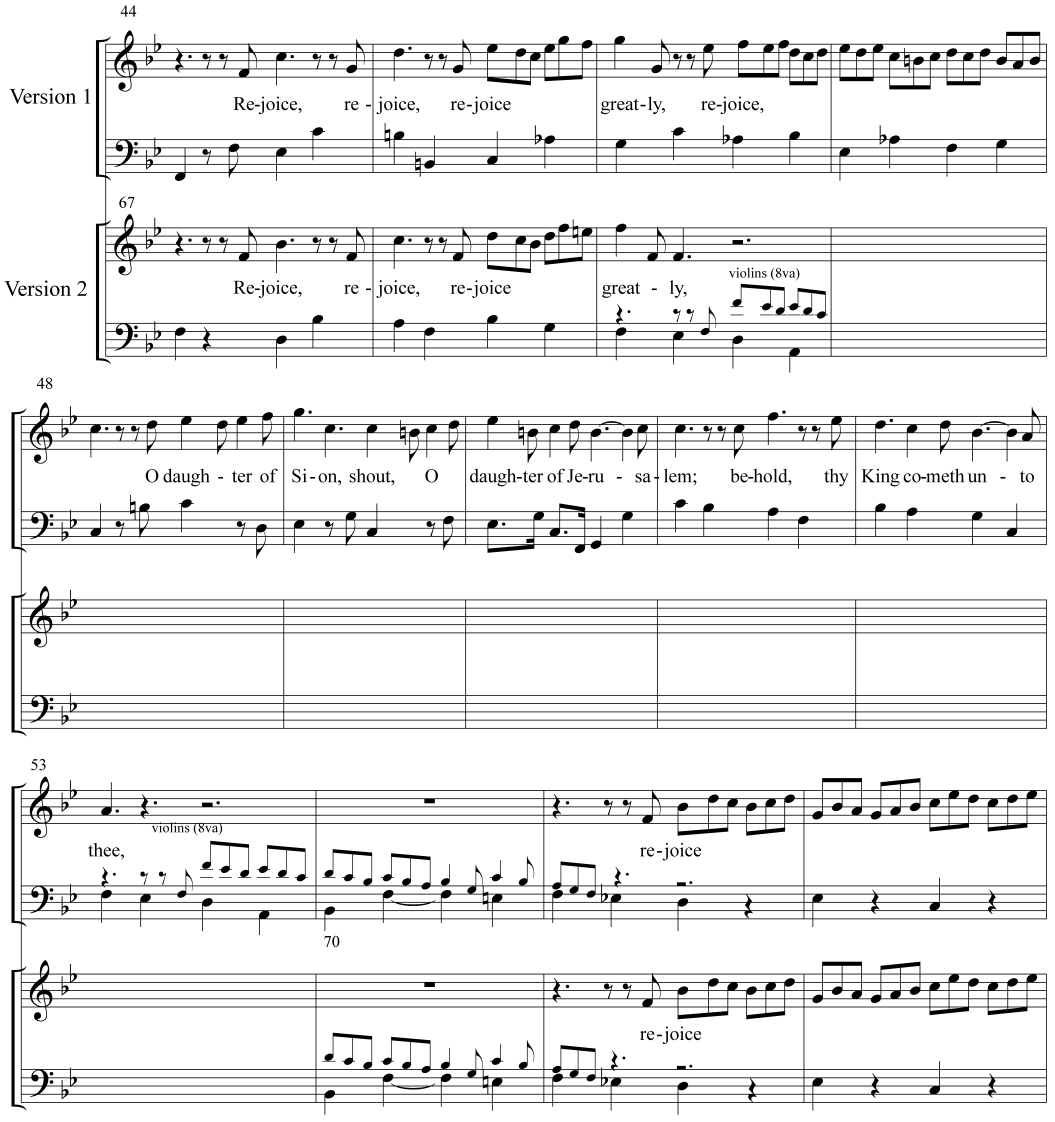
‘Rejoice greatly’ from Handel's Messiah was first composed in da capo form, as shown in Table 2. The A section is a self-contained binary form, repeating its text after a cadence in the dominant; this cadence is confirmed by a ritornello. After composing the aria in full, Handel in effect excised the portions shown in boldface, leaving a design similar to that of Bach's so-called modified da capo forms (see Example 1). Actually, in this version the aria is not only a modified da capo but also a dal segno aria. Handel's modifications involved two separate steps: first he abbreviated the restatement of the opening ritornello, then he in effect moved most of the a′ section to the recapitulation.Footnote 21
Handel, ‘Rejoice greatly’, from Messiah (1741)
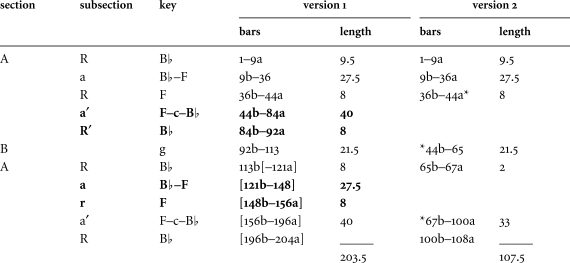
* small modifications of beginning or end of the passage in version 1
George Frideric Handel, ‘Rejoice greatly’, from Messiah, hwv56 (1741), corresponding passages in versions 1 (bars 44ff) and 2 (bars 67ff), unison violins omitted. London, British Library, R.M. 20.f.2 (autograph; facsimile in G. F. Händels Werke, volume 45a (Leipzig: Breitkopf & Härtel, 1892))
Messiah dates from 1741; three years later Handel applied a somewhat similar procedure to two arias in his oratorio Belshazzar.Footnote 22 Handel scholars assume that the alterations in all three cases were undertaken in order to shorten the arias, thereby quickening the drama,Footnote 23 but this cannot be the reason for Handel's adoption of a comparable design in three short arias within the secular oratorio Semele, composed in 1743.Footnote 24 In any case, these and several other examples are exceptional compositions from a brief period in Handel's career. Moreover, the two through-composed da capo arias in Belshazzar are quite different from Bach's, as in each case the second A section actually restates very little music from the first A.Footnote 25
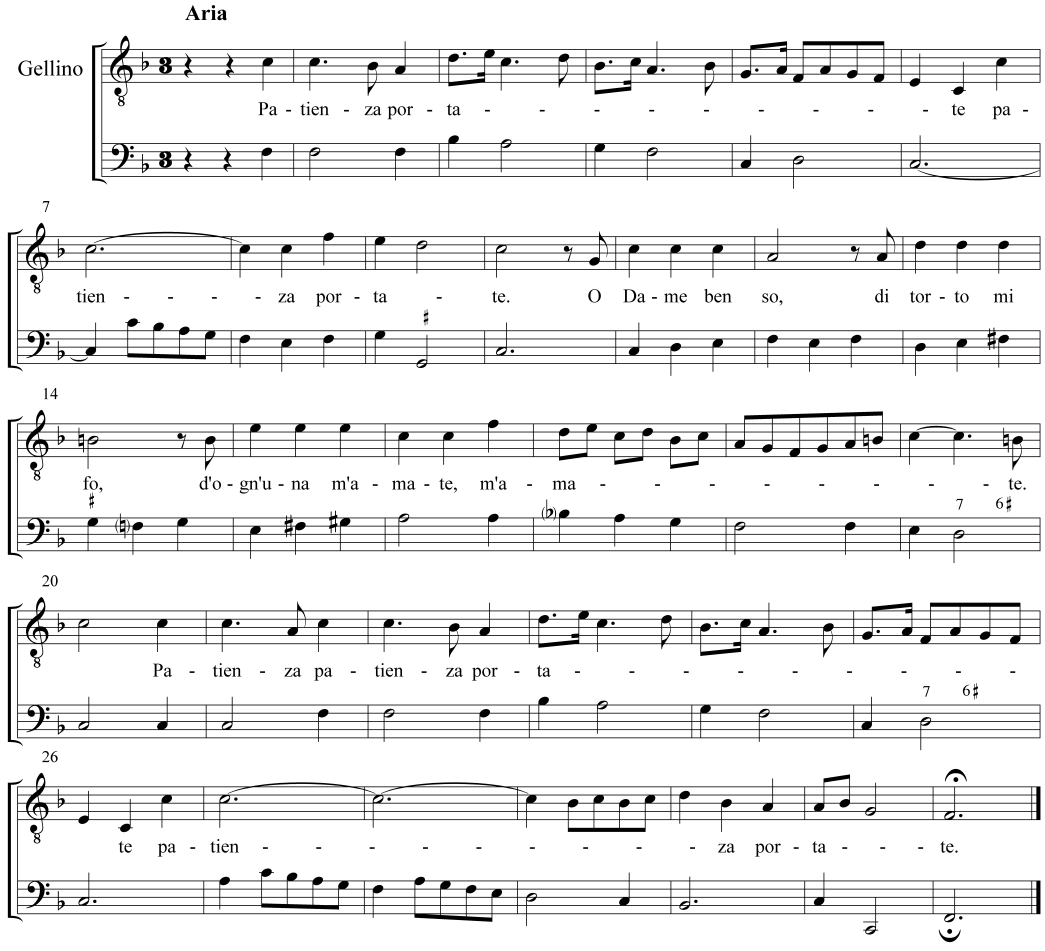
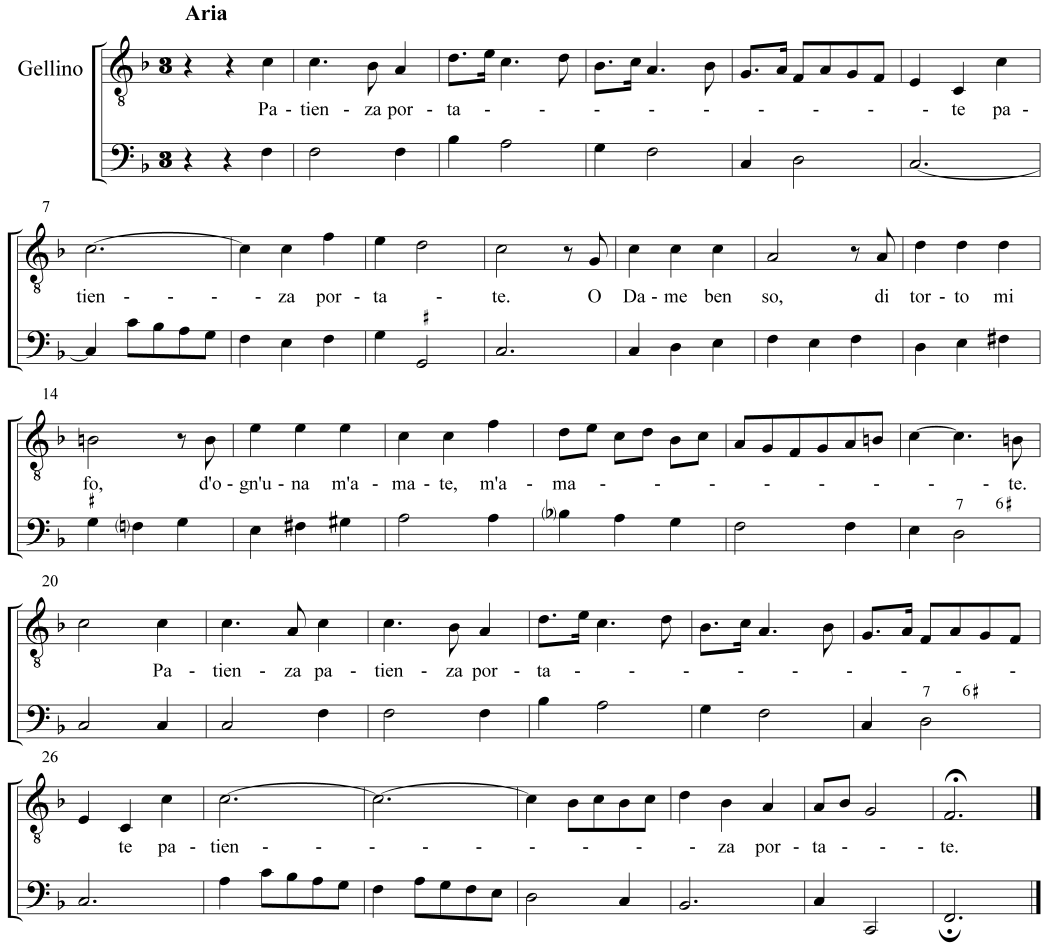
Boyd has pointed to much earlier instances of so-called modified da capo form, citing a type of aria that the Venetian composer Carlo Pallavicino ‘used throughout his career’.Footnote 26 Examples of arias by the latter seen here are short by later standards, and the A text is a single line of poetry: a few words comprising an exhortation or exclamation, as in Example 2. In this instance the first A section nevertheless concludes in, or at least on, the dominant, and the second A accordingly is modified to end in the tonic (with an additional “Patienza” prefixed for added rhetorical effect, in bar 21).
Carlo Pallavicino, ‘Patienza portate’, from Demetrio (1666), Act 1 Scene 23. Venice, Biblioteca Nazionale Marciana, MS It. IV 408 (9932)
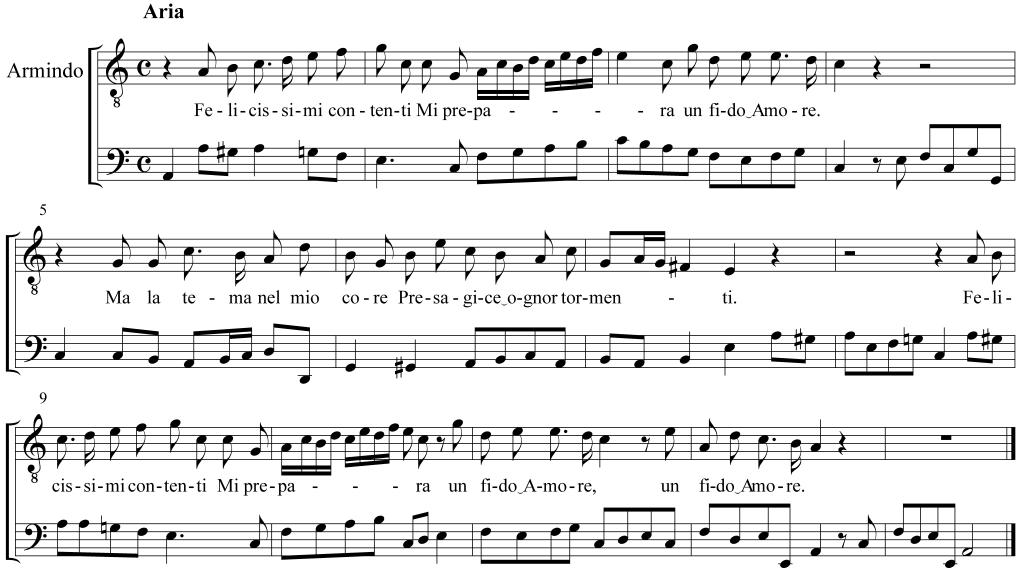
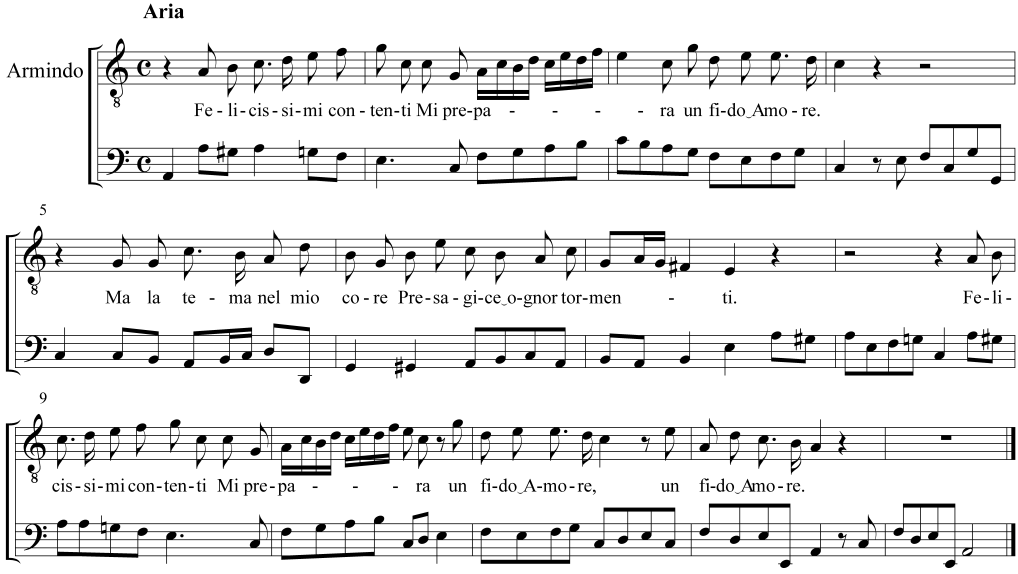
Boyd pointed to modified da capo designs that are equally ‘embryonic’ – his word – in Alessandro Scarlatti's 1679 opera Gli equivoci nel sembiante.Footnote 27 Its arias come somewhat closer to later ideas of da capo form: most are ternary in design and many include ritornellos for the strings. But the music of each aria is still entirely written out, as in Example 3, indicating that the notational convention of the da capo was not yet established. Some of the da capo arias are also strophic, the entire ternary design being repeated for a second stanza. Ten of the twenty-nine da capo arias are of various through-composed types. Their presence is possibly a holdover from an older, more ad hoc approach to aria composition that seems to disappear in Scarlatti's subsequent operas.Footnote 28 Nevertheless, that Scarlatti grasped the tonal design that would become basic to the through-composed da capo aria is evident from the only fully fledged example in Act 3: this aria is in the minor and the first A section ends in the relative major.Footnote 29 This sort of short through-composed da capo aria had not yet vanished by the time Bach started composing: an example occurs in Agrippina, Handel's Venetian opera of 1709.Footnote 30
Alessandro Scarlatti, ‘Felicissimi contenti’, from Gli equivoci nel sembiante (1679), Act 3 Scene 4, string parts omitted, after the edition by Frank A. D'Accone in The Operas of Alessandro Scarlatti, volume 7 (Cambridge, MA: Harvard University Department of Music, 1982; distributed by Harvard University Press). Used by permission
THROUGH-COMPOSED DA CAPO ARIAS IN BACH'S EARLIER WORKS
I have not systematically searched through early eighteenth-century operas from Hamburg and elsewhere in Germany for similar arias. But although Bach is unlikely to have known the examples I have mentioned so far, it would be surprising if he had not run across comparable arias in other works. Certainly the poetic forms and rhetoric seen in earlier Italian works recur in the German texts set by Bach. And the variable, even ad hoc character of the aria forms in these works recurs in Bach's early cantatas, albeit in movements of greater complexity and monumentality. This is not surprising when one considers that Bach wrote his first arias just a few decades after those Italian works by Pallavicino and Scarlatti. Although the compositional procedures of the latter composers might have hardened into fast routines by 1700 or so, the same cannot have been true for younger musicians north of the Alps.
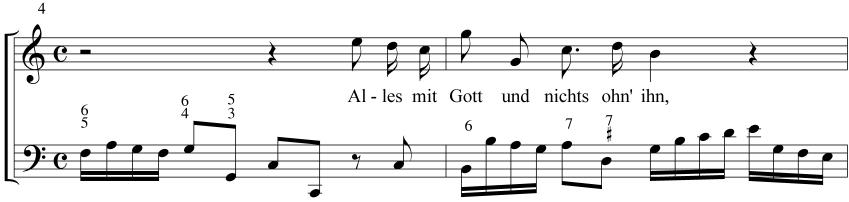
It is therefore striking that one of Bach's earliest datable arias, the recently discovered bwv1127, incorporates features familiar from these earlier Italian works.Footnote 31 Composed for the birthday of Duke Wilhelm Ernst of Weimar in 1713, the aria is in strophic form.Footnote 32 As in earlier Italian and German strophic arias, each stanza concludes with a ritornello for strings and continuo that is formally independent of the vocal section, though employing similar motivic material.Footnote 33 Yet the music for each stanza incorporates a musical and textual reprise (or quasi-reprise) that articulates a free da capo design. I use the term ‘free’ advisedly in this case, as the two A sections, though not identical, both conclude in the tonic (see Table 3). Moreover, poetic lines 1 and 2 are restated in reverse order at the end. Hence this is not the same as later through-composed da capo forms, and indeed it departs from what was becoming standard da capo form in order to conclude with a repetition of the duke's personal motto, or Devise (see Example 4). Yet the musical design is clearly that of older operatic arias, and it even incorporates passages for continuo alone that today would be designated ritornellos, with another such passage for strings played at the conclusion of each strophe (the passages labelled ‘ritornello’ in Table 3 are the ones for continuo alone).
Alles mit Gott und nichts ohn' ihn, bwv 1127 (Weimar, 1713), design of each stanza (vocal portion)

(Line 1 is unchanged through all twelve stanzas; the remaining lines contain new text. The dash means ‘modulating to’; the letter V signifies the dominant of the previously indicated tonality.)
J. S. Bach, Alles mit Gott und nichts ohn' ihn, bwv1127 (1713), Devise (bars 4–5), from the edition by Michael Maul (Kassel: Bärenreiter, 2005). Used by permission

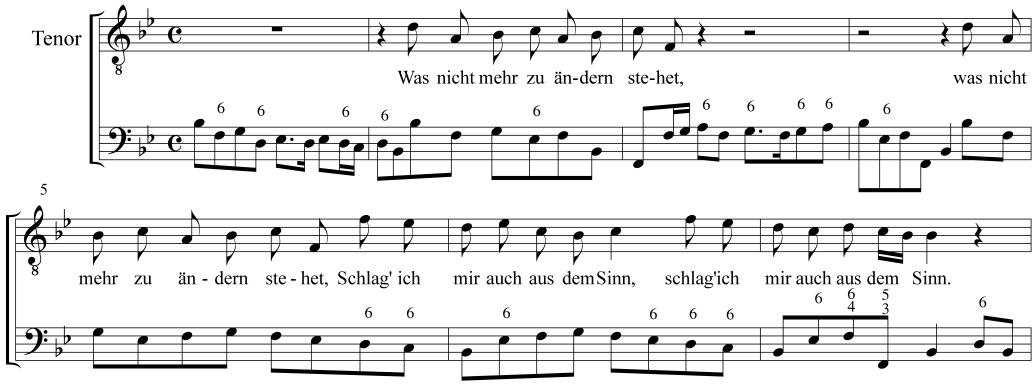
Whether or not Bach knew of similar music in earlier Italian works, a more immediate model is furnished by two strophic arias in the second volume of the Harmonische Freude musicalischer Freunde of Philipp Heinrich Erlebach, published just three years earlier. Although smaller in scale, ‘Nicht Jedermann ist es gegeben, der Liebe stets zuwider streben’ (No. 23) and ‘Was einmal geschehen, mag immerhin gehen’ (No. 24) each comprise a vocal section in a self-contained da capo form followed by a ritornello for strings (here in five parts, with two violas, though the violins play in unison in No. 24). Like Bach's aria, moreover, each contains a motto entrance (Devise) for the singer; in No. 24 this is preceded by a short continuo solo. The similar rhythm and straightforward syllabic setting of the first vocal phrase, ending on the dominant, in No. 24 and bwv1127 might reflect only a general commonality of style or the similar prosody of their texts (Example 5). But Erlebach's songs, some of which derive from his lost operas, represent a plausible inspiration for Bach intermediate between the simple, folk-like strophic lieder of earlier German composers and the fully fledged virtuoso arias of later Italianate opera.
Philipp Heinrich Erlebach, ‘Was einmal geschehen’, A section, No. 24 in Harmonische Freude (Nuremberg, 1710), after the edition by Otto Kinkeldey (Denkmäler deutscher Tonkunst, volume 47 (Leipzig: Breitkopf & Härtel, 1913))
Whatever its models, bwv1127 resembles other early arias of Bach above all in its failure to conform exactly to any known prototype. Its formal design corresponds to a specific rhetorical or formal feature of the poem, in this case the incorporation of the Duke's personal motto within a strophic form. The same can be said of the many arias in Bach's early cantatas whose designs are unusual by the standards of contemporary works or even his own later arias.
The dating of some of the vocal works that Bach composed for Weimar remains uncertain. Therefore I will refrain from making assertions about chronological developments within this repertory. Yet these works are striking for the number of arias that are ‘irregular’, in the sense that they fail to conform with modern textbook ideas of aria design as established in later works. Among arias I include choruses and duets based on rhyming madrigalesque poetry, though these are not always designated as arias in printed librettos. Bach's readiness to invent his own musical forms may have been to some degree a response to the ingenuity of the court poet Franck, whose texts display considerable variety in terms of versification. But it also suggests that Bach at Weimar, although aware of current formal conventions in Italianate vocal music, aimed at a musical rhetoric that was as faithful as possible to the poetic rhetoric of the texts he was setting. In their formal construction, these arias, no less than his instrumental compositions, have some of the ad hoc freedom characteristic of the previous century, as opposed to the geometric symmetry favoured by eighteenth-century rationalism.
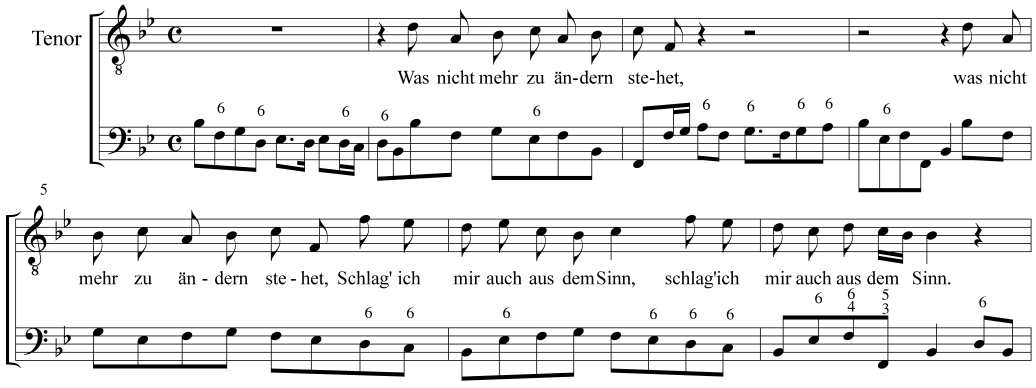
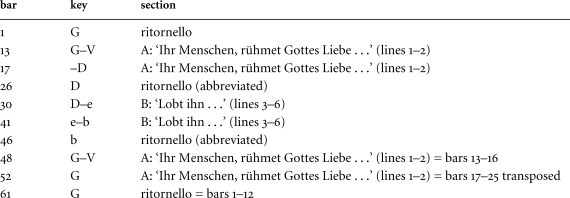
Some of these arias do approach the quite regular through-composed design seen in Table 4, which shows an aria composed early during Bach's first year at Leipzig (bwv167/1). Although the A text (lines 1–2) is repeated in both outer sections, giving each of the latter a binary design, the first statement concludes on a half cadence; no ritornello follows until the end of the complete A section. On the other hand, the second part of the initial A section, which originally restates lines 1–2 in the dominant (bars 17–25), is recapitulated in the tonic in the final section (bars 52–60). This aspect of the design is particularly reminiscent of early sonata form.Footnote 34
‘Ihr Menschen, rühmet Gottes Liebe’, bwv167/1 (Leipzig, 1723)

Bach's through-composed da capo arias from Weimar

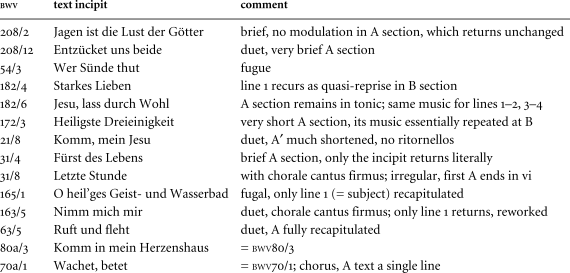
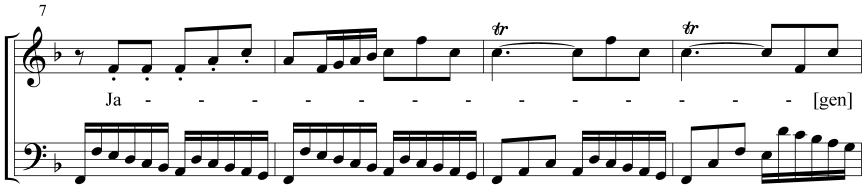
Most of Bach's earlier da capo arias of this type incorporate far less verbatim restatement in their final section, whether at the original pitch or transposed. Some are perhaps better described as free than as modified or through-composed da capo forms.Footnote 35 Table 5 lists Bach's Weimar arias of this type in their likely chronological order.Footnote 36 Of special note are the examples listed from bwv208, the so-called Hunt Cantata. Commentators have noted how in this early work Bach seems to have already mastered the conventions of the Italian serenata or dramma per musica while impressing on it his own style. The short opening aria for Diana (bwv208/2) is a variety of the old type of short da capo aria with written-out reprise. This is not, however, a through-composed da capo aria in the later sense, for the entire poem of the brief aria is stated within the first vocal section, which concludes rather surprisingly in the subdominant. The A text comprises two short lines, and only a small portion of their musical setting, little more than the phrase shown in Example 6, is recapitulated verbatim. Formally the aria is essentially bipartite, the B text being heard only within the first half.
J. S. Bach, ‘Jagen ist die Lust der Götter’, bwv208/2 (c1713), bars 7–10 (two horns omitted), after the edition by Paul Graf Waldersee (Johann Sebastian Bach's Werke [BG], volume 29 (Leipzig: Breitkopf & Härtel, 1881))

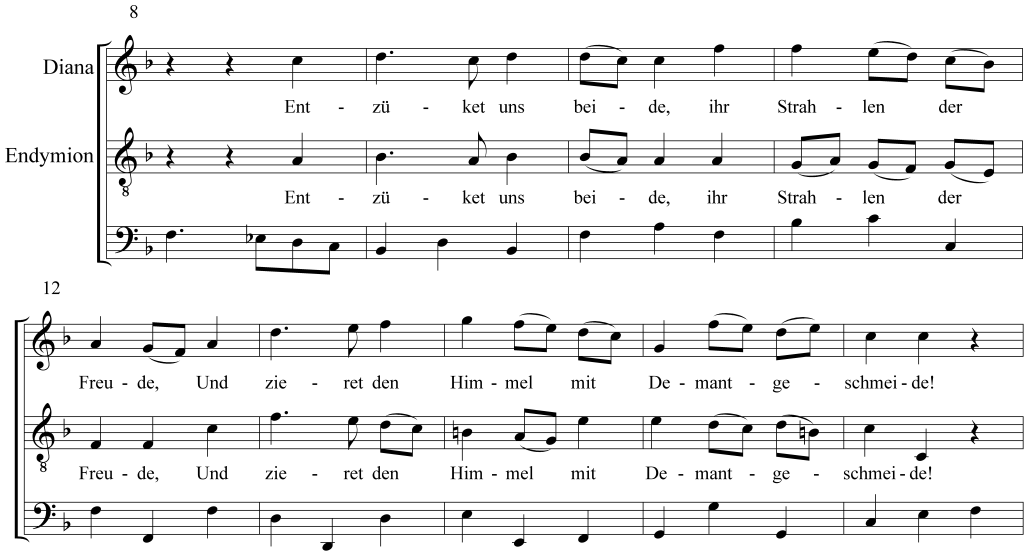
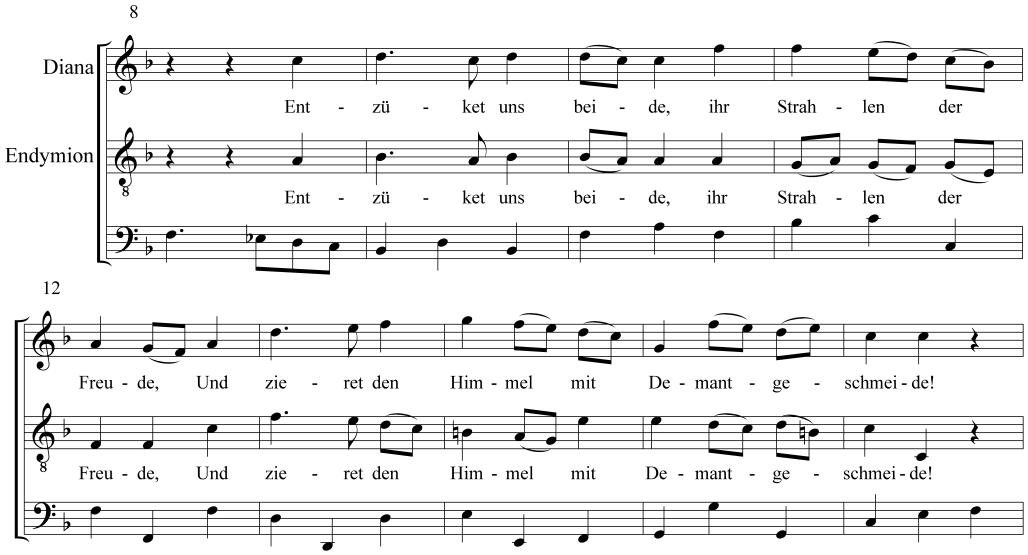
Of the Hunt Cantata's movements in da capo form, only in the duet ‘Entzücket uns beide’ (bwv208/12) does the first A section conclude firmly in the dominant, but this section is little more than a single recurring phrase (Example 7). Similar designs occur with the duet in the early Cantata 21 and in some of the other Weimar vocal works, which perhaps should not be considered da capo forms at all, despite the presence of a reprise that modulates to the dominant or another key in its first statement. In this instance, both the brevity of the returning passage and the absence of any substantial musical contrast within the movement give it the character of a relatively simple dance or rondeau, in any case resembling more the seventeenth-century examples seen earlier than the larger da capo forms that would become typical of the eighteenth century.
J. S. Bach, ‘Entzüket uns beide’, bwv208/12, bars 8–16 (violin solo omitted), after the edition by Paul Graf Waldersee (Johann Sebastian Bach's Werke [BG], volume 29 (Leipzig: Breitkopf & Härtel, 1881))
Yet a firm distinction between ‘true’ and ‘false’ da capo forms is hard to maintain in the face of the great variety of textual and musical reprises in these works. A single opening line of poetry, often containing an exhortation, may recur at the end of an aria, constituting the complete text of the concluding section; the returning line may also be the complete text of the opening section (as in bwv70a/1), or it may be only a part of it (as in bwv152/2), in which case we might speak of a ‘quasi-reprise’. Another sort of quasi-reprise occurs when the recurring line or lines are repeated as part of a later section of an aria, without constituting a self-contained unit. Thus in bwv70a/2 (= bwv70/3) the first two, exhortatory, lines are repeated to conclude the final section; a quasi-reprise may even occur internally, when an opening line or textual motto recurs at the outset of the B section (as occurs twice in bwv182, in Nos 2 and 4).
In these latter cases the underlying rhetorical gesture is clear: a pleading or exhortatory exclamation gains pathos or insistence through repetition. That da capo form almost automatically makes this rhetorical gesture must have been one of its original attractions; Example 2 (by Pallavicino) provides an instance, and it is easy enough to find many more, particularly if one adds brief epithets or proverbs to the list of things expressed in a one-line A section, as in the aria “Non è amante chi non spera” (He is no lover who does not hope) from the same opera by Pallavicino. By the early eighteenth century, however, this conception was being set aside as the A section expanded to become a self-contained poetic and musical sentence or paragraph. Bach's arias nevertheless adhere sometimes to this older rhetorical idea, despite his use of much more expansive musical forms than those found in seventeenth-century da capo arias. Those forms also reveal unprecedented variety in their details, as Bach makes the rhetoric insistent in ways doubtless unanticipated by his librettists.
Among the solo arias composed at Weimar and later, a significant number incorporate one-line textual reprises; whether poets expected these to be associated with musical reprises is unclear, but Bach treated them variously. Thus in the the two arias of bwv152, composed late in 1714, Bach treats the opening line in each aria as a sort of reprise.Footnote 37 But only in the first of these arias does the initial verse return in the final section with its original musical material. The concluding aria of bwv185 reprises its first line even more freely, inserting it repeatedly, and at one point lines 2 and 3 as well, into the main body of the aria, though in the published form of the text Franck repeats line 1 only at the end. The musical effect of Bach's treatment of the text is somewhat like that of a rondo, as line 1 usually retains its original melody, thus serving as a refrain: ‘Das ist der Christen Kunst’ (such is the craft of a Christian). Today only the first aria in bwv152 would be considered a da capo form, and in our existing terminology it is a highly modified one. But, as with the second aria of bwv152 and the concluding one of bwv185, this movement might better be understood as a unique through-composed form, invented as a response to a particular musical-rhetorical situation.
The conception of the A text as a short reprise recurs at Leipzig. The first two cantatas that Bach performed after his arrival there (bwv75 and 76) include solo arias as well as closing choruses whose da capo forms each conclude with a one-line reprise. The cantata texts later published by Picander also employ this design with some frequency, and it occurs as well in the two extant Passions, most famously in the aria ‘Es ist vollbracht’ from the St John Passion, where the voice repeats the opening words at the end of the final ritornello.Footnote 38 More conventional is ‘Geduld’ from the St Matthew Passion (bwv245/35), where the initial word also closes the final vocal entry; a continuo aria, it is somewhat archaic in the quasi-ostinato character of its bass line. The old-fashioned style and rhetoric support suggestions that it could be a parody of a Weimar-era aria.
More extensive textual reprises also elicited some unusual through-composed designs at Weimar. In bwv54/3 the two lines of the A text are set as the two subjects of a double fugue, a type of construction that would become typical of Bach's biblical choruses composed at Leipzig.Footnote 39 Bach repeated the idea of a fugal A section in bwv165/1, another through-composed da capo aria; here the reprise comprises a single line, but the music of the B section draws on the same musical material. The two following arias of bwv165 likewise repeat the musical material of the A section for subsequent verses, a practice seemingly at odds with the highly rhetorical character of Bach's music in other Weimar arias. In some cases the use of recurring music for new text is readily explained by features of the latter. For instance, bwv182/6 is a sort of bar form, the music of lines 1–2 recurring for lines 3–4. The two pairs of lines have the same prosody and express no contradiction in meaning or affect.Footnote 40 Only lines 1–2 return at the end of the aria, and then with music that, although drawing on the same material, is substantially extended, its affect heightened by the insertion at one point of a dramatic fermata. Bach would use fermatas in a similar way in several later through-composed arias.
THROUGH-COMPOSED DA CAPO ARIAS IN BACH'S LATER WORKS
Although he would continue to compose many exceptional movements, Bach seems to have arrived at something resembling a routine through-composed da capo design by his Cöthen period, that is, from late 1717 to early 1723. But it is again difficult to be sure of chronology here, given the likelihood of lost works as well as revised works whose early forms are lost. For instance, three large-scale cantatas composed at Weimar for the Advent season in 1716 had already introduced formal innovations. The opening movement in the series, bwv70a/1, has been identified by Alfred Dürr as Bach's first substantial use of Choreinbau, the contrapuntal combination of choral parts with a previously heard ritornello.Footnote 41 But it is equally notable as Bach's earliest surviving choral aria in through-composed da capo form. A new version of the latter design occurs in the opening chorus of Bach's next cantata, bwv186a: a rondeau or double da capo form, ABABA, which Bach would repeat in subsequent choral arias. Only in bwv186a does Franck's printed libretto call for a (single) reprise, indicating the repetition of line 1 at the end of the movement.Footnote 42
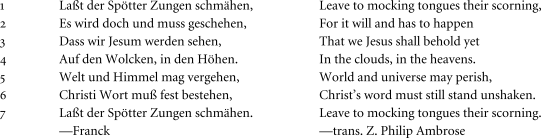
The forms of the solo arias in these three cantatas (bwv70a, 186a and 147a) are notable as well; this could reflect the unusual character of their librettos, which lack recitatives and therefore focus on inventive and vivid aria verses.Footnote 43 But, as in the opening choruses, the music – which hardly ever corresponds formally with textbook forms of any type – reveals a rhetorical inventiveness on the composer's part going beyond what the printed text would suggest. For instance, Franck's text for bwv70a/3 (= bwv70/5) indicates a single-line reprise; Bach sets it as a through-composed da capo form with both lines 1 and 2 returning at the end. This is to reinterpret Franck's syntax, in which line 2 initiates a clause that concludes only with line 4 (see Text 1).Footnote 44 bwv147a/4 (= 147/5) is not a da capo aria in either Franck's libretto or in Bach's setting. Although the initial verse might again have been treated as a one-line reprise, Bach sets all four lines as a unit, repeating them in each of the three main sections of the aria, whose musical form resembles the sonata-like design found in later through-composed da capo arias.Footnote 45
On the whole, Bach's inventiveness in these late Weimar cantatas suggests that he was not yet ready to adopt anything like a routine approach to formal design. This is not to say that his forms would ever become truly routine – but greater formal consistency does become evident in subsequent works, perhaps reflecting a shift in focus from local musical rhetoric to a more global or monumental conception of each movement, or even of the work as whole. Accompanying this apparent shift is another innovation in aria design visible in the surviving remnants of Bach's vocal production at Cöthen. Perhaps reflecting Prince Leopold's interest in French music, dances such as the minuet, gavotte and sarabande insinuate themselves into many arias, which incorporate not only the characteristic rhythms but also the relatively straightforward phrasing and binary form typical of dance movements. Dance arias, especially for chorus, continue to appear in later works, frequently at the end, as in the Coffee Cantata, where they recall the brief choruses, sometimes using dance rhythms, at the ends of contemporary Italian operas.Footnote 46
bwv70a/3 (=bwv70/5)

Although these dance arias, like the rondeau choruses, incorporate textual and musical reprises, none employs through-composed da capo form. Perhaps this reflects a tendency to reserve the latter for relatively serious movements. Dance and rondeau arias, on the contrary, are usually relatively light in character, though at Leipzig Bach used such designs for serious texts as well, as in the concluding choral arias of the St John and St Matthew Passions. These choruses are a reminder that dance was serious business in baroque life. Perhaps what was paramount in these more serious movements was the formal, geometric character of baroque dance; its regularity and predictability might provide a sort of solace or a sense of completion after more turbulent music.
Through-composed da capo form is, in principle, a more open type of design. Whereas ordinary da capo forms are clearly articulated into three discrete sections, through-composed examples are (as suggested above) more integrated. The A section is not closed tonally and therefore is not so sharply divided from the B section as in a regular da capo form. Yet Bach tends to integrate the two sections of even a regular da capo form by using the same material throughout; sharply contrasting B sections, as in the so-called two-tempo aria, are rare in his work. Moreover, unlike the sometimes cursory middle sections in arias by his contemporaries, the B sections in Bach's da capo arias of both types usually equal, if they don't exceed, the length and elaboration of the A sections. Hence, whatever the differences in principle between Bach's ordinary da capo arias and his through-composed examples, in practice the two types tend to be assimilated.
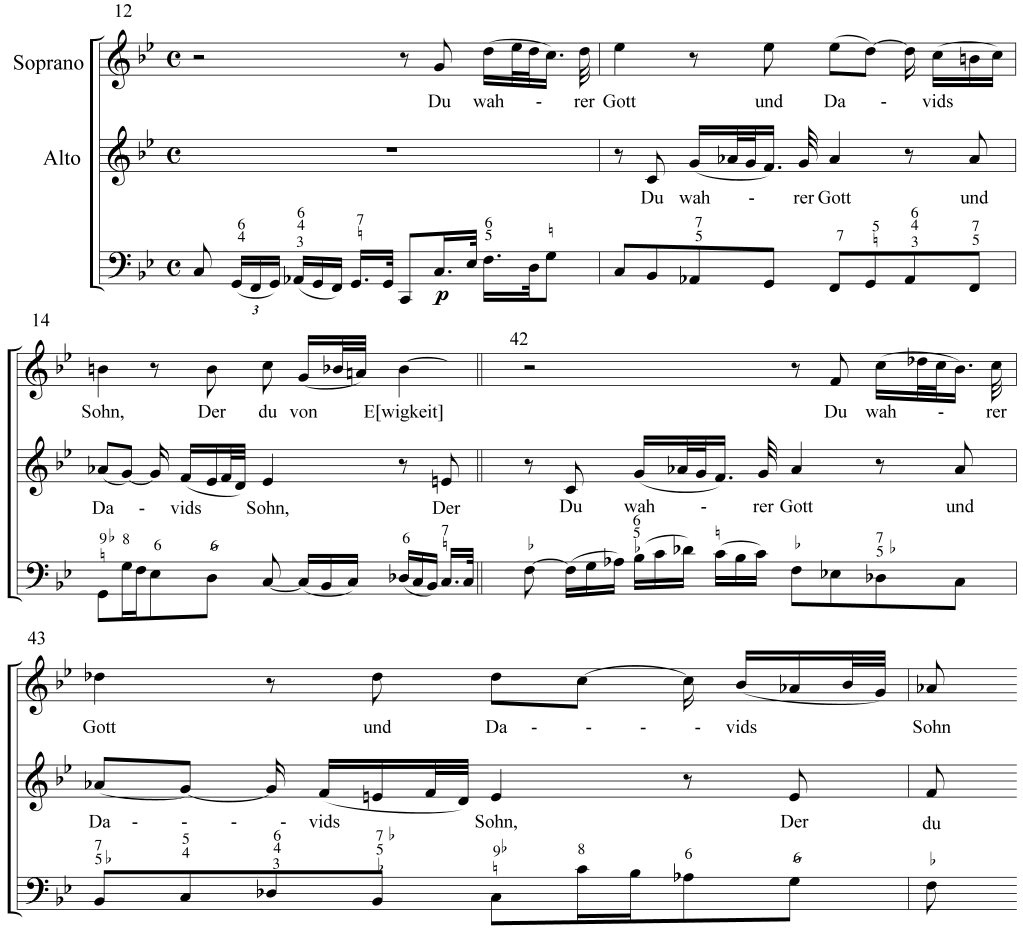
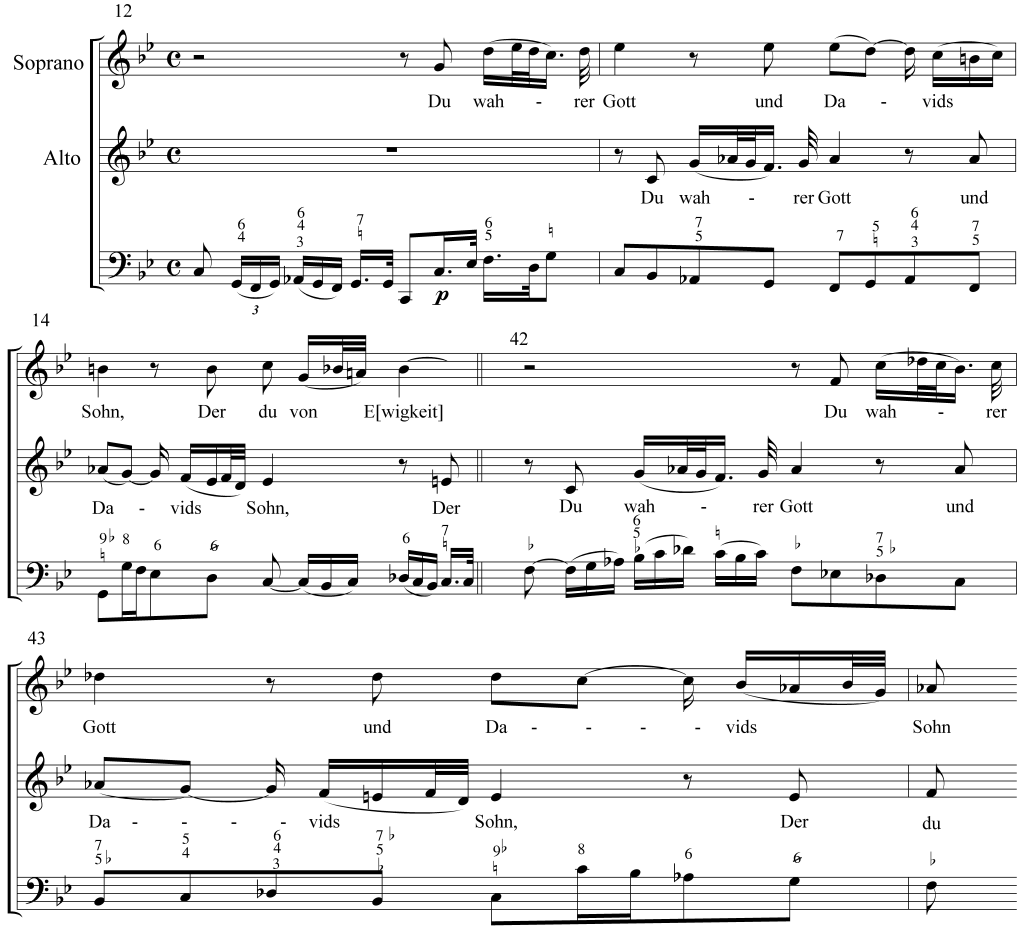
Apparently among the inventions of Bach's Cöthen years is a special type of through-composed da capo form in which the second A section begins in the subdominant. Boyd pointed to what is ‘possibly the earliest example’ in the duet aria that opens bwv23, one of the two test pieces (Probestücke) that Bach, visiting from Cöthen, performed in 1723 during the search for a new Leipzig Thomaskantor (Example 8).Footnote 47 Schubert, among others, would use a comparable version of sonata form in many instrumental works.Footnote 48 In bwv23/1 the device facilitates the exchange of the two vocal parts in the recapitulation, where, as in other imitative works, transposition by fifth or fourth keeps the material within a convenient tessitura for both voices. Thus it is possible in the recapitulation of this duet for the two vocal parts to restate the first A section almost verbatim a fifth lower (or a fourth higher). But only a few solo arias, all later, use this ‘subdominant’ recapitulation – better described as a subdominant return, as only the opening portion of the recapitulation is not in the tonic. Symmetry as precise as in bwv23/1 – or as in the examples by Schubert – does not seem to recur.Footnote 49 More typical in its inexact symmetry is the great opening chorus of the St Matthew Passion, which alludes to the through-composed da capo design with subdominant recapitulation even as it joins an aria text to a chorale cantus firmus in bar form.Footnote 50 It can hardly be a coincidence that the movement opening part 2 of the same work, although quite different in many respects, is again a dialogue between the two choruses that incorporates allusions to the subdominant return.Footnote 51
MUSIC, TEXT AND SONATA FORM IN BACH'S ARIAS
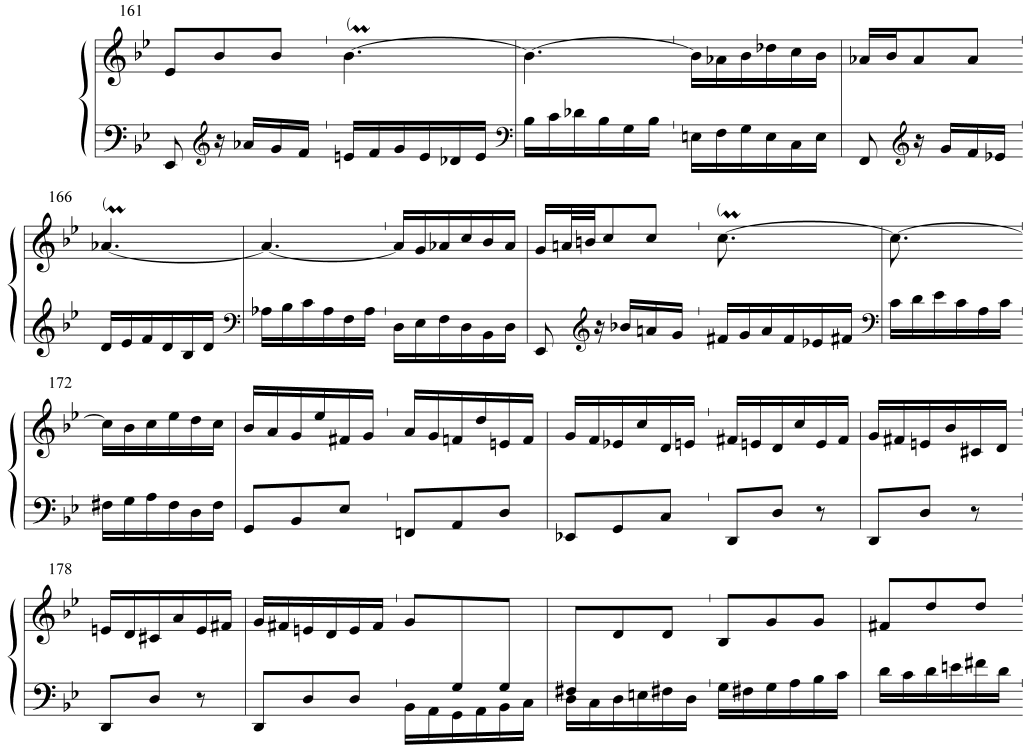
The subdominant return is a way of finessing the transition from the foreign key of the middle or B section back to the tonic. It is rare in the sonata forms of Haydn, Mozart and Beethoven precisely for that reason: it eliminates the possibility of a climactic return of the original thematic material in the original key. In their instrumental music, the dramatic high point of a movement is often the bridge passage or retransition that joins the end of the middle (development) section to the beginning of the recapitulation. Early sonata forms do not usually make so much of the return, yet Bach and his contemporaries employ distinct retransition passages in some works, and these on occasion generate significant dramatic tension. A striking example from Bach's instrumental music occurs in the Prelude of the Third English Suite, at bars 161–180; that Bach was aware of the potential for special import in the passage here is evident in his rewriting of it, the one small bit in any of the six English Suites for which autograph material survives (Example 9).
J. S. Bach, ‘Du wahrer Gott und Davids Sohn’, bwv23/1 (1723), bars 12–14 and 42–44 (oboes omitted), after the edition by Wilhelm Rust (BG, volume 5, 1855)
J. S. Bach, English Suite No. 3 in G minor, bwv808 (c1715?), Prelude, bars 161–183, after the edition by Ernst Naumann (BG, volume 45.1, 1895)

Equally dramatic retransition passages are hard to find in Bach's vocal works. But distinct treatment of the retransition occurs already at Weimar, sometimes with evident rhetorical intention. For instance, in bwv147a/4 (= bwv147/5) the complete four-line text is used for all three main sections, but only lines 2–4 recur in the retransition (bars 28b–30a). The latter, although distinctly articulated – it is set off by abbreviated ritornellos – is therefore subordinate to the three other sections. This merely illustrates that the retransition is distinct from the other, more substantial, sections in which the complete text is stated. But in bwv161/5, a tripartite choral aria, the first of two lines comprising the final segment of the text is set aside for the retransition (see Table 8 below). It made rhetorical sense to give this invocational line alone in its initial statement (‘Jesu, komm und nimm mich fort’ – Jesus, come and take me away), and doing so also avoided repeating the final line, with its reference to ‘mein letztes Wort’ (my last word).
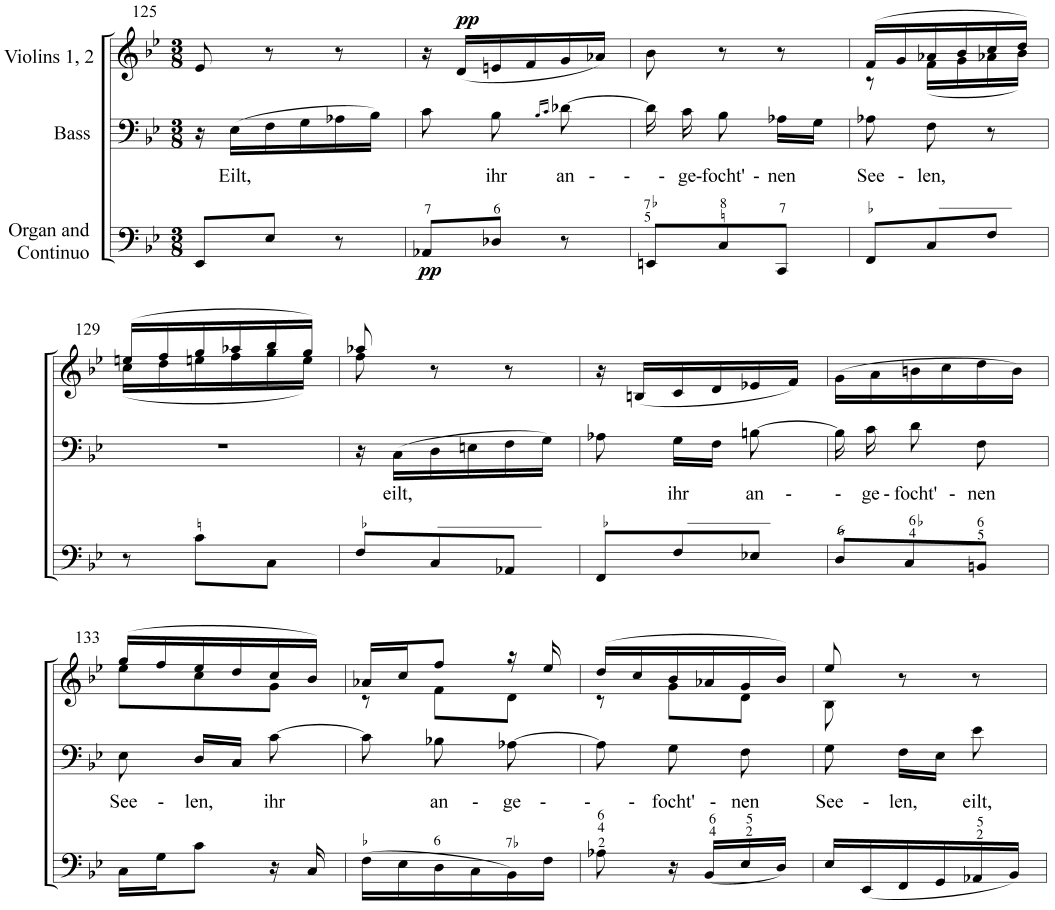
A number of through-composed da capo arias from the Passions and other Leipzig sacred works are particularly notable for what happens at the end of the B section – that is, after the complete text has been presented and the aria turns back to the text and music of the opening section. Distinct retransition passages occur in ‘Von den Stricken’ (bwv245/7, at bar 70), ‘Eilt, ihr angefocht’nen Seelen' (bwv245/24, at bar 125) and (less clearly) in ‘Erbarme dich’ (bwv244/39, at bar 31). In each case the retransition elides what would, in a conventional da capo form, be the clear articulation separating the end of the B section from the return of the A section. In ‘Eilt’ this elision takes the form of a quasi-sequential passage in which close imitation of the aria's ascending principal motive between voice and strings, together with an ‘ascending’ modulation from F minor to C minor, reinforces the textual exhortation ‘hurry’ (Example 10).Footnote 52
J. S. Bach, ‘Eilt, ihr angefocht’nen Seelen', bwv245/24 (1724), bars 125–136, after the edition by Wilhelm Rust (BG, volume 12, 1863)

bwv11/4

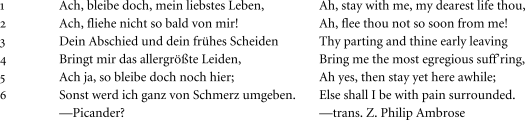
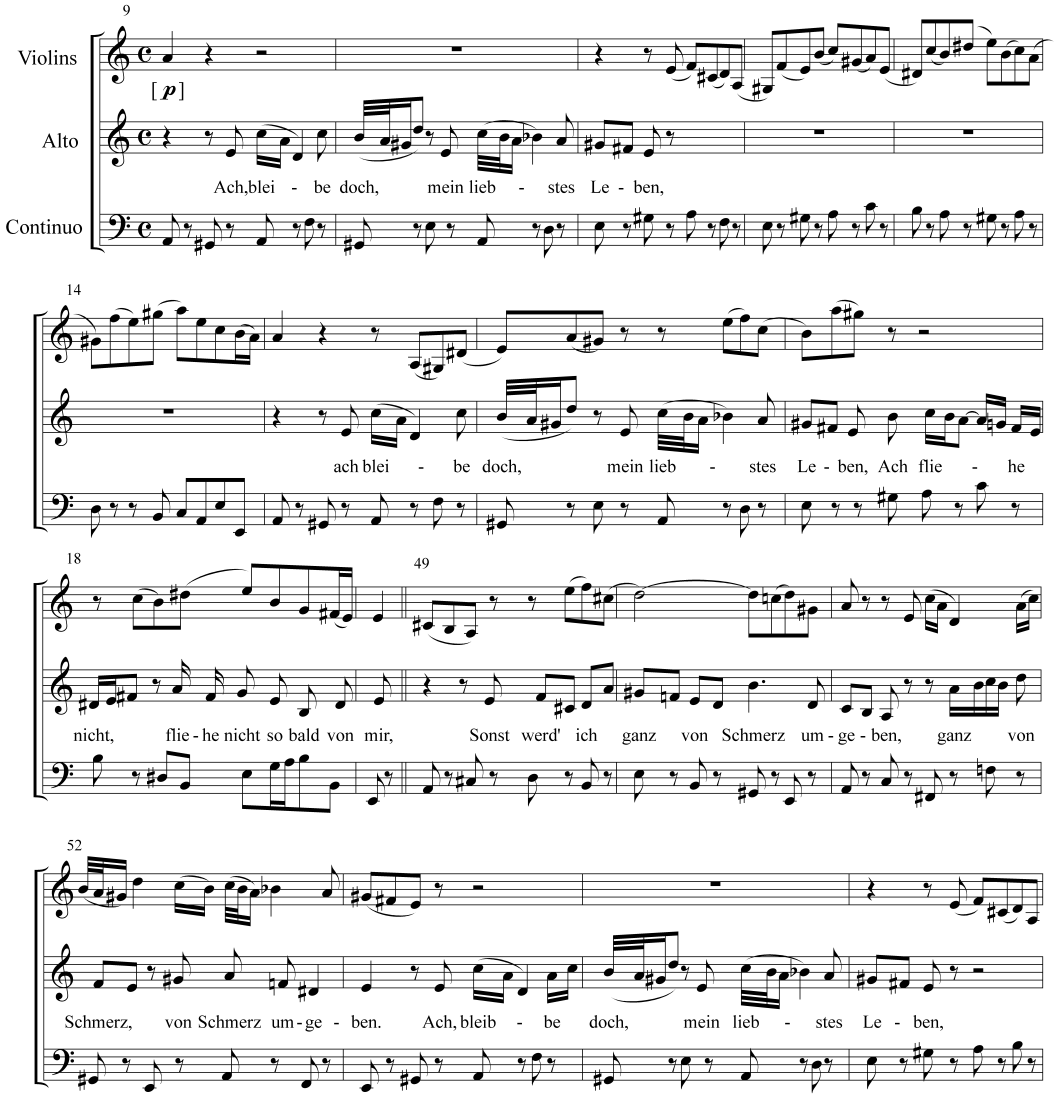
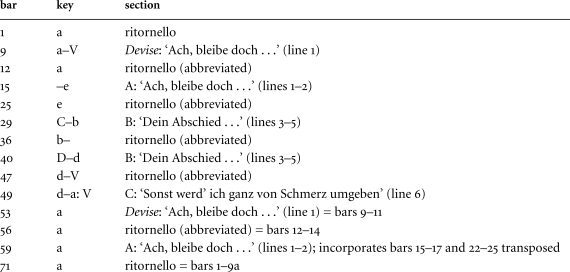
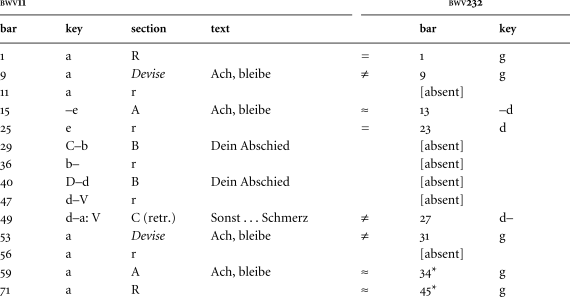
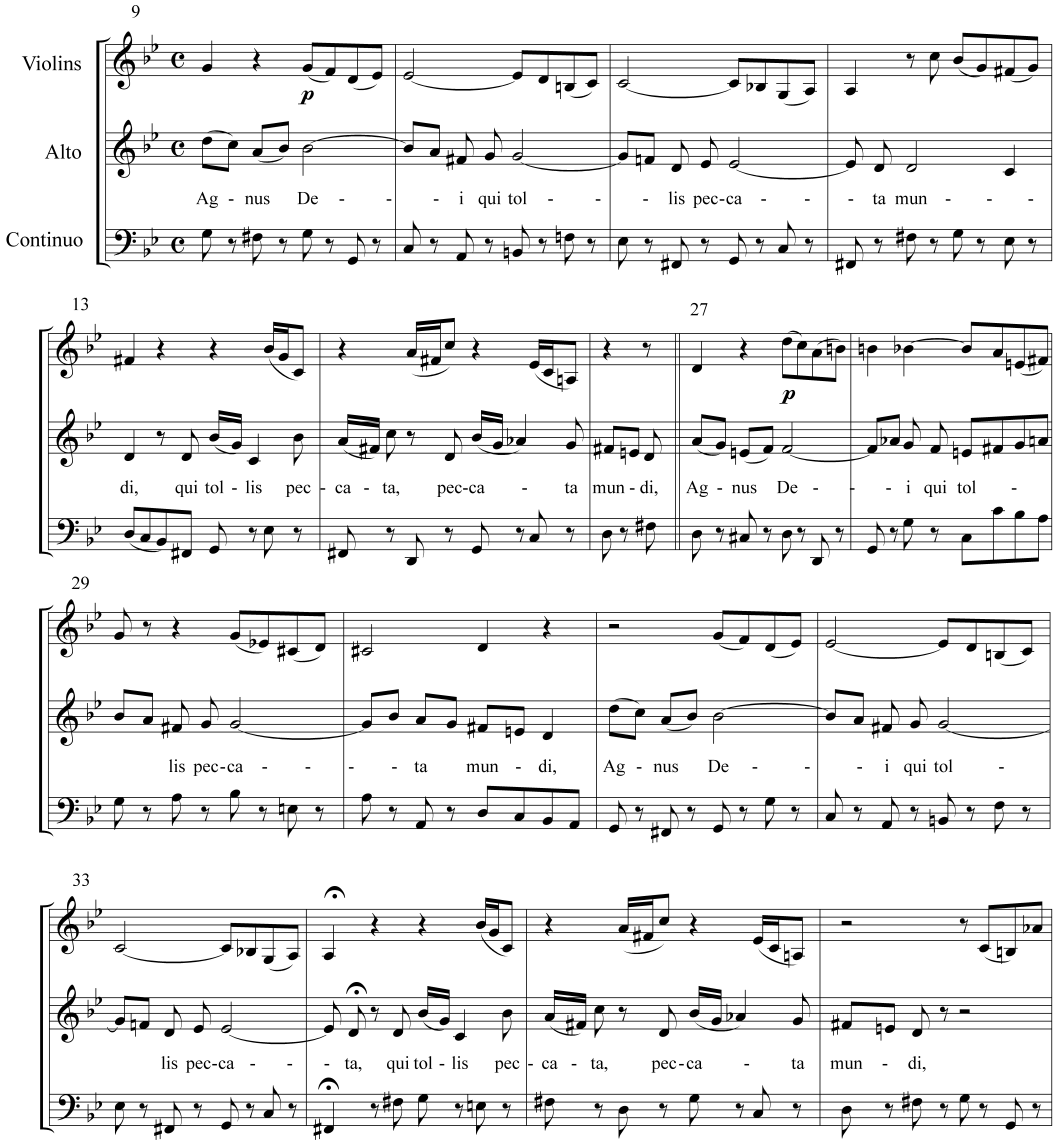
Music-rhetorical reasons for an aria's formal design are not always so apparent as in Example 10. In some cases this may be because the original musical rhetoric has been obscured by the use of parody technique. How parody might affect the design of such a movement is suggested by the alto aria ‘Ach, bleibe doch’ (bwv11/4) from the Ascension Oratorio (Example 11); the aria recurs in altered form as the first Agnus Dei of the B minor Mass (Example 12). Both versions are apparently independent parodies of an aria from a lost serenata. The text of the aria has six lines, of which the first two constitute the A section, as shown in Table 6 (see also Text 2). Lines 3–5 are then set as the B section, which actually occurs twice, in parallel sections, both ending with full cadences. Line 6 receives its own, much briefer setting, as a distinct retransition passage that ends with a half cadence on the tonic; the modified da capo follows immediately. The separate setting of line 6 must have been inspired by the text, which moves here to thoughts of ‘Schmerz’ (sadness); Christoph Wolff argues plausibly that the latter is the central idea not only of the two extant versions of the aria but of their lost common model in the serenata, whose text placed the same word at the end of the same line.Footnote 53
J. S. Bach, ‘Ach, bleibe doch’, from the Ascension Oratorio, bwv11 (1735), bars 9–19 and 49–55, after the edition by Carl Ferdinand Becker (BG, volume 2, 1852)

J. S. Bach, Agnus Dei I from the B minor Mass, bwv232 (c1749), bars 9–13 and 27–35, after the edition by Julius Rietz (BG, volume 6, 1856)
‘Ach, bleibe doch’, from the Ascension Oratorio, bwv11 (1735)

In recasting this aria as a mass movement, Bach dispensed with the B section, as the Latin liturgical text lacked anything corresponding to lines 3–5 of the German aria poem. But because the first A section modulates to the dominant, the musical form still required a retransition of some sort to prepare the return of the tonic in the second A. Bach wrote this anew (bars 27–30), using motivic material previously heard in the A section (see Table 7). In addition, he shortened the recapitulation, while also inserting a fermata within it (at bar 34, corresponding to bar 12 in the opening section); the latter becomes the dramatic crux of the movement.
Comparison of ‘Ach, bleibe doch’, bwv11/4, and Agnus Dei I from the B minor Mass, bwv232iv/3

* abbreviated
(‘retr.’ = retransition; the symbol = means that the passages are musically identical, ≈ that they are similar and ≠ that they are distinct)
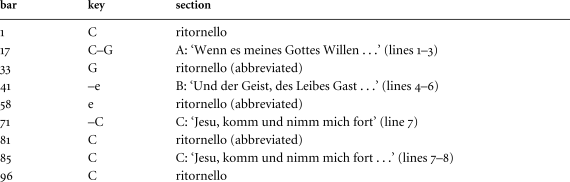
To what degree the Agnus Dei still shares the dynamic of a sonata movement is debatable. So weakly articulated is the return (bar 31) that one can easily disregard it as a significant point in the movement, hearing the principal divisions instead at the beginning of the retransition (bar 27) and at the fermata (bar 34).Footnote 54 But clear sonata-form parallels are plentiful elsewhere among Bach's arias, and not only those in through-composed da capo form. The tripartite choral aria bwv161/5, composed at Weimar, has already been mentioned; its text, which Bach sets for four voices, falls into groups of three, three and two lines respectively, as shown in Table 8. The three textual units correspond to the three main sections of a sonata form, to which is added a retransition setting line 7 alone (bars 71–80).
‘Wenn es meines Gottes Willen’, bwv 161/5 (1715)

Virtually the same form occurs in the next two arias that Bach wrote, both to similarly disposed texts by Franck. But in bwv162/1 the final section, which functions musically as a recapitulation, is composed through Einbau, the accompanying strings rather than the voice articulating the musical return. The same probably occurred in bwv162/3, where, however, the apparent loss of one or two obbligato instrumental parts obscures what was probably an Einbau passage.Footnote 55 The third aria of bwv162 is again of the binary or through-composed type, yet it too gains a sonata-form element through the recurrence of line 1 as a quasi-reprise in the final section, albeit not in its original key. Yet another variation on this design occurs in an aria from the next cantata that Bach composed: bwv163/3 lacks a textual reprise, yet the last two lines of the poem, which constitute a sort of punch line, correspond with a sonata-style musical return, restating the original thematic material in the original key.
Similar forms occur throughout the Leipzig period, raising a question that has been alluded to already: at what point does the musical homogeneity or integration characteristic of early eighteenth-century sonata form, with its parallel sections, become antithetical to the presence of new text for each section? To put it another way, how well does the form of a sonata-form aria, particularly one with distinct texts in its outer sections, reflect its poem?
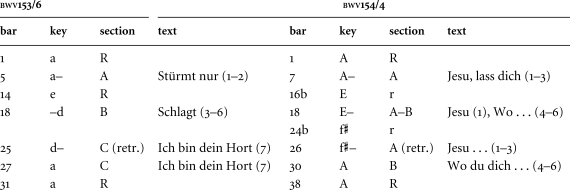
For instance, in bwv153/6, a tripartite aria, the first of its three textual segments is introduced in Einbau, then immediately repeated in a passage that concludes the opening section in the dominant (see Table 9) . The second textual segment is set as a modulating passage that ends in the subdominant, like the middle section of many early sonata forms. The aria text concludes with a single line that is set first as a brief retransition phrase, then in Einbau that recapitulates the musical material of the initial vocal section. This sonata design is arguably at odds with that of the text, for the final line of the poem – ‘I am your shield and redeemer’ – forms a stark antithesis with the opening one: ‘Storm on, troubled weather!’ Yet Bach sets both lines to music essentially identical in character.
‘Stürmt nur, ihr Trübsalswetter’, bwv153/6 (1724), compared with ‘Jesu, lass dich finden’, bwv154/4 (1724)
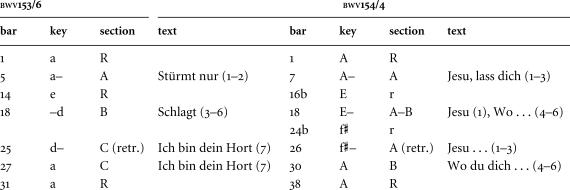
(R = ritornello; r = ritornello (abbreviated); retr. = retransition. Numerals in parentheses are poetic verse (line) numbers.)
A week later, in bwv154/4, Bach set a text whose rhyme scheme and syntax seem to presuppose a bipartite setting. Yet this aria falls into essentially the same sonata design, though disposing the text quite differently. In this case the musical design makes sense rhetorically if one understands the poem as comprising a single sentence. But one could also argue that at this point, in the midst of Bach's his first yearly cycle of Leipzig cantatas, considerations of musical design or construction were beginning to prevail over the more strictly rhetorical impulse of the Weimar years. That is to say, by the mid-1720s Bach was growing less interested in arias whose plans were specially designed to reflect some aspect of their text, perhaps recognizing that no particular musical form can ever be uniquely appropriate to the form or content of a given poem – even if a clever analyst can always demonstrate the same to his own satisfaction.
The same trend is evident already in bwv155/4 of 1716 – for the Epiphany season, like bwv153 and 154. This aria, too, is musically in a sort of sonata form, but the final section combines the B text – already introduced in the previous middle and retransition sections – with Einbau, the latter giving the effect of a recapitulation. Perhaps the sonata design of this aria reflects the absence of any strong contrast between the two halves of its bipartite text. The same might be said of the arias ‘Ach mein Sinn’ and ‘Eilt’ from the St John Passion, of which only the latter has a da capo text, though both are set as sonata forms. In both, moreover, the musical design is articulated by recurring Einbau segments (a feature that perhaps points to an early origin). But whereas the rounded musical form reinforces the verbal rhetoric of ‘Eilt’, this is less clear in ‘Ach mein Sinn’.
No one would dispute the appropriateness of Bach's music in ‘Ach mein Sinn’ (bwv245/19) with respect to the general emotional character of the text. Nor is there any question about the beauty and craftsmanship of the music. But this aria would rarely be considered one of the high points of the St John Passion. One reason could lie in the failure of the subdominant return at bar 63 to set new text (‘Bei der Welt ist gar kein Rat’) with contrasting music – unlike the situation at the corresponding moment in ‘Eilt’, where returning words receive a heightened setting of returning music.
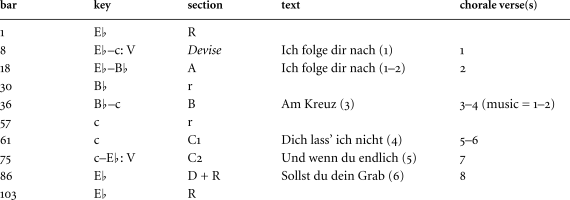
Nevertheless, other instances of sonata-like designs do seem justified on music-rhetorical grounds. Some of Bach's most sophisticated and subtle uses of sonata design occur in arias from 1727 to 1729 on texts by Picander, such as bwv145/3, 157/2 and 4, and 159/4. In these arias, single-line quasi-reprises coincide with sonata-style recapitulations, though without corresponding exactly to any conventional aria or sonata form. Even a chorale aria – an aria that incorporates a chorale cantus firmus – can show sonata elements, as in bwv159/2. Despite the bar form of the cantus firmus – the so-called ‘Passion’ chorale that is also used in the opening movement of the St Matthew Passion – the free parts of this aria are newly composed for the repetition of the Stollen (the second A in the AAB bar form, section B in Table 10). The tonal ambiguity of the chorale melody makes it possible for the first section to modulate from tonic to dominant, whereas the second section, set against the same two cantus firmus phrases, moves from dominant to relative minor, as in the second section of many sonata movements. The final line of the aria poem, moreover, is articulated musically as a return: although the vocal melody at this point is new, it is sung over a complete restatement of the ritornello by the continuo (the sole accompaniment) in the tonic – the first since the opening of the aria.Footnote 56
‘Ich folge dir nach’, bwv159/2 (1729?)

(R = ritornello; r = ritornello (abbreviated). Numerals in parentheses are poetic verse (line) numbers.)
A number of Bach's relatively late arias with flute show particularly interesting uses of sonata-like design. Possibly this was conditioned by the use of the transverse flute, which at the time was becoming a popular instrument and therefore the subject of increasing numbers of sonatas, including at least two late examples by Bach. The flute is employed in these arias alongside elements of what we know as galant style, including triplets and expressive appoggiaturas or sigh motives. Certainly the form of the text in certain of these arias seems almost irrelevant to the musical design in which it was set.
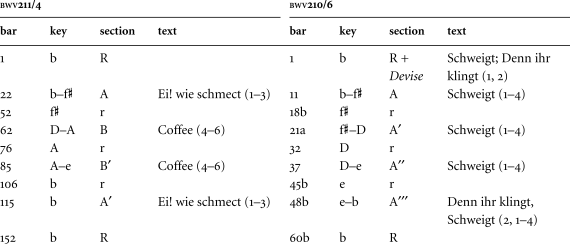
For instance, Lieschen's aria ‘Ei! wie schmect der Coffee süß’ in the Coffee Cantata (bwv211/4) could serve as a textbook example of through-composed da capo form; the formal design is rendered readily audible by the use of a prominent fermata in both A sections. An association of fermatas with love and longing is evident in other arias, such as ‘Aus Liebe’ from the St Matthew Passion (bwv244/49). But in the Coffee Cantata the device is part of a satirical effect, expressing a passionate desire merely for caffeine. The same expressive character, presumably intended without irony, recurs in ‘Schweigt, ihr Flöten’, the sixth movement in the late wedding cantata bwv210. Reflecting its text, the latter has the voice interrupt the opening ritornello twice with Devise-like vocal entrances. Nevertheless, the overall musical designs of the two secular arias are similar, although in ‘Schweigt’ the entire four-line text is stated within each of the first three sections (Table 11). In ‘Schweigt’, moreover, the two opening lines alone are reprised in the final section. The latter contains no exact musical restatement of the opening section, however, and the fermata occurs only here. This climactic fermata (at bar 52) is the culmination of a process that began in the ritornello, which is interrupted by the singer after just one bar; the idea is, of course, a dramatic response to the word schweigt (silence!).
‘Ei! wie schmect der Coffee süß’ (bwv211/4, c1734) compared with ‘Schweigt, ihr Flöten, schweigt, ihr Töne’ (bwv210/6, c1738–1741?)

(R = ritornello; r = ritornello (abbreviated). Numerals in parentheses are poetic verse (line) numbers.)
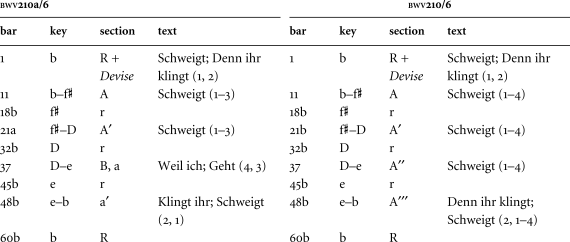
As a setting of the text this is unexceptionable. And it is entirely appropriate, in a wedding cantata, that Bach buries line 4, with its reference to ‘Graberuft’ (the repose of the grave), in a brief phrase that is omitted from the final section. Some oddities in the setting can also be explained, as in the Agnus Dei of the B minor Mass, by the fact that the aria is a parody. Yet in this case the earlier version shares the essential features of the later version (see Table 12).Footnote 57
‘Schweigt, ihr Flöten, schweigt, ihr Töne’, versions of bwv210a/6 and bwv210/6 compared (c1738–1741?)

(R = ritornello; r = ritornello (abbreviated); a = partial restatement of A text. Numerals in parentheses are poetic verse (line) numbers.)
In neither version could the four-line text have been conceived for a da capo setting, as it falls into two closed rhyming couplets. But already in the earlier version Bach had departed from the bipartite setting implied by such a text, giving the music a sonata-like design. This was much the same form that would be heard in a through-composed da capo aria, albeit with the text distributed over the first three sections in a very different way. Nor is there a clearly articulated return or a complete restatement of the A text: line 2 returns before line 1, and line 3, sung within the first A section, is never recapitulated. This might have been a response to the sad phrases ‘geht ihn, ihr armen Lieder’ (line 3) and ‘weil ich so verlassen bin’ (line 4) of the original text. Lines 1–3 of this text are set in the first section, whereas line 4 receives a contrasting musical setting in the third vocal section. The latter therefore sounds like the beginning of the B section of a da capo aria.Footnote 58 But line 4 is heard only twice before line 3 is recapitulated; here, as in the parody, Bach in effect suppressed the final line of the poem, with its negative connotations. The sonata-like design helped make this possible, though there is virtually no literal recapitulation anywhere in this final section.
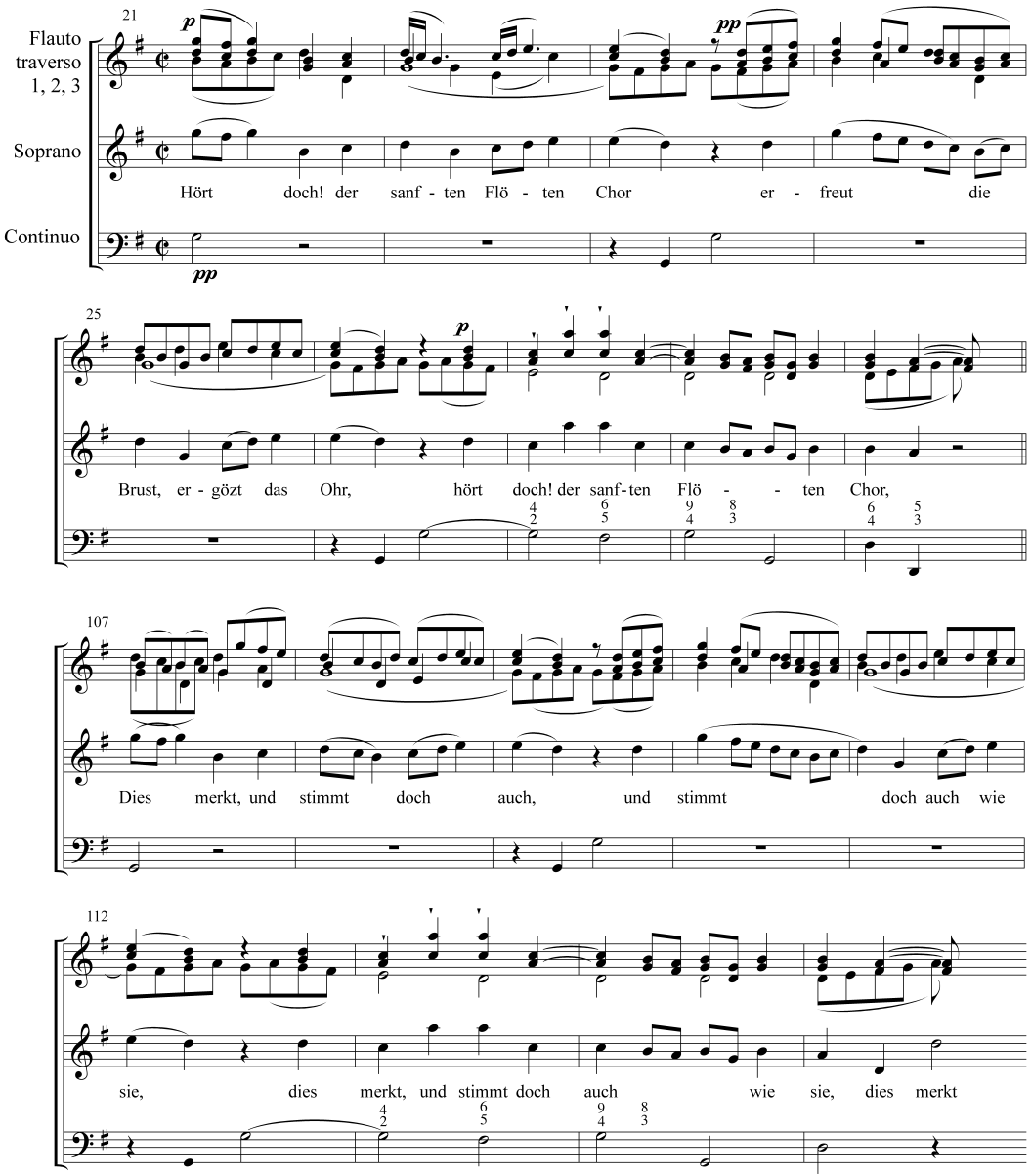
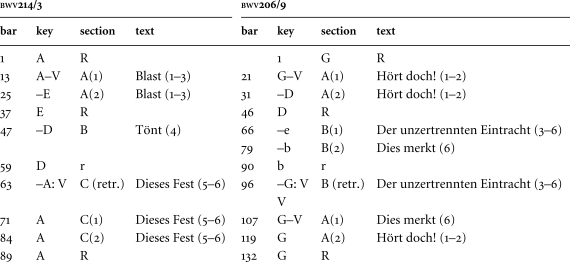
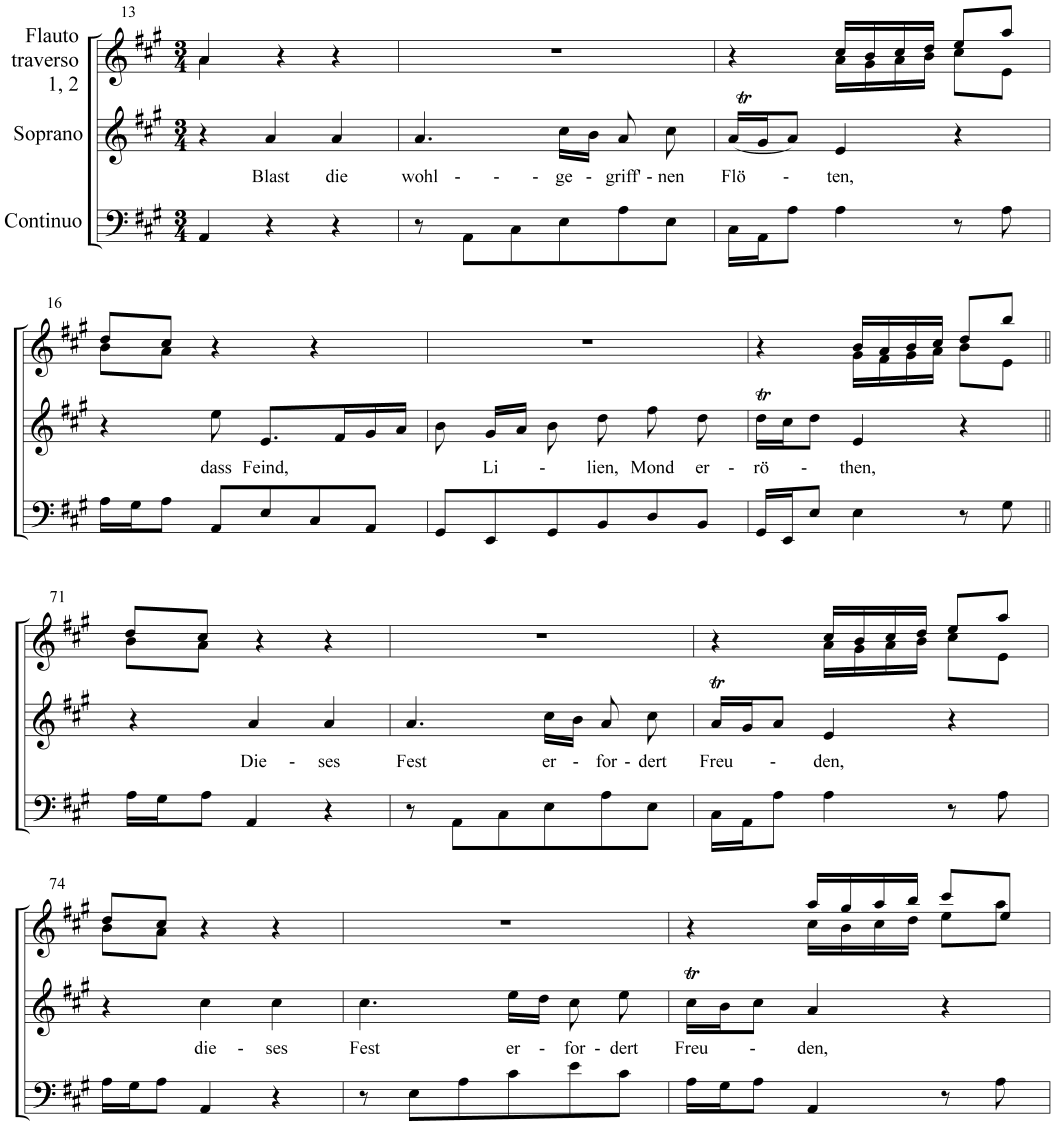
Two further arias whose texts explicitly mention flutes are again set in sonata-like forms. Both are from secular cantatas or serenatas composed in the 1730s, and in both cases the musical design is at odds with that implied by the text. The text of bwv206/9, with its reference to a flute choir, is expressed accordingly, and uniquely for Bach, with three flutes (Example 13). The poem is in two unequal stanzas, and Bach therefore sets it as a through-composed da capo form. Yet when the recapitulation begins, the voice continues to sing the B text, reverting to the opening stanza only in the latter part of the recapitulation – that is, in the portion of the A section that was originally in the dominant (labelled a2 in Table 13). bwv214/3, with two flutes, takes essentially the same musical form, that is, sonata form (Example 14). But its text is that of a bipartite aria, and in Bach's setting the A portion never returns. Nevertheless, the final section opens with a sonata-style return of the original vocal and instrumental material, though at this point we hear a line from the second half of the text, repeated from the preceding retransition phrase. Only a small portion of the music from the A section is literally recapitulated (bars 71–74 = bars 13–17). But the remainder of the aria uses the same motivic material, scored in the same way, with an unusual intermittent doubling of voice and first flute.
J. S. Bach, ‘Hört doch! der sanften Flöten Chor’, bwv206/9 (1736), bars 21–29 and 107–115, after the edition by Wilhelm Rust (BG, volume 11.2, 1862)

‘Blast die wohlgegriff’nen Flöten', bwv214/3 (1733), compared with ‘Hört doch! der sanften Flöten Chor’, bwv206/9 (1736)

(R = ritornello; r = ritornello (abbreviated); retr. = retransition. Numerals in parentheses are poetic verse (line) numbers.)
J. S. Bach, ‘Blast die wohlgegriff’nen Flöten', bwv214/3 (1733), bars 13–18 and 71–76, after the edition by Paul Graf Waldersee (BG, volume 34, 1887)

In these two arias did purely musical considerations – that is, a predilection for sonata form – trump the implications of the formal and rhetorical designs of the poems? If so, the decision might have been conditioned by the novelty of writing for two or even three flutes, a decision obviously inspired by the subject of both texts. Perhaps, too, the use of sonata style was a reference to the flute sonatas that by this date were well established in the repertory of nearby Dresden.
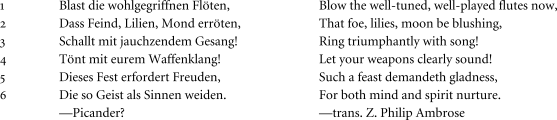
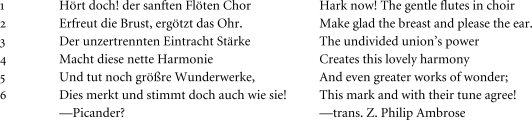
Even if there is a disjunction between their musical and poetic forms, these arias are hardly insensitive to their texts. Line 4 in bwv214/3 is a self-contained exclamation that sits somewhat awkwardly at the beginning of the second half of the poem; Bach sets it by itself as the middle section, in effect dividing the aria textually into three parts (see Text 3). The concluding line of the B section in bwv206/9 (line 6) is likewise a self-contained exclamation, or rather an exhortation (see Text 4). Bach first presents this line together with the preceding three lines, then in a distinct subsection on its own. The entire B text is then repeated in a passage that serves as the retransition, and line 6 is then repeated, once more on its own, in the tonic at the beginning of the recapitulation. There it is sung to the returning music originally used for line 1, a musical parallelism that reinforces the rhetorical parallelism of the poem's opening and closing lines. In short, Bach's irregular musical form points out that in this text the A and B stanzas, far from contrasting with one another, open and close respectively with similar third-person plural imperatives.
bwv214/3

bwv206/9

In closing I can only restate my agreement with previous commentators who have found no simple explanation for Bach's aria forms. This itself tells us something. Bach's musical designs are complex; simple formulations like those shown in Table 1 accurately represent only a few actual arias. In each work unique features of the music – the detailed form of individual subsections, the precise manner in which material is restated or recapitulated – correlate with unique features of the poem. Yet the poetry and music remain to some degree independent of one another; not every element of the poem can be reflected in the music, which follows its own autonomous logic, even, or especially, with Bach. More generally, the principle of vocal music as servant of poetry cannot have been understood in the same way by every baroque composer, nor is it always manifested by the same music-rhetorical devices. During Bach's lifetime his oldest son Friedemann was already writing church works that suggest a significant modification of those principles; although sometimes employing traditional baroque text painting, these compositions show diminishing reliance on concrete word-to-tone relationships, which grow even fainter later in the eighteenth century with Haydn and Mozart.Footnote 59
Sebastian Bach's constant originality in aria design, his continuing ad hoc approach to text setting, was one aspect of the incessant striving for perfection for which he has always been noted. But it was also an outcome of his having been formed as a composer in a time and place that presented a broad range of potential models, some older, some newer, some foreign, some domestic. To a degree that may have been unique among members of his generation, he continued to draw on all those models throughout his career, without falling into routines dictated by fashion or habit, and without ever repeating himself.