INTRODUCTION
Communication about palliative care and advance care planning is critically important to improving care at the end of life, as it ensures that persons with serious diseases are well prepared to make informed decisions that align with their personal values and life priorities. Clinical guidelines recommend advance care planning for all patients with a chronic life-limiting illness (de Vleminck et al., Reference de Vleminck, Pardon and Beernaert2014). Care planning improves alignment of patient care with patient wishes (Pew Research Center, 2006; Silveira et al., Reference Silveira, Kim and Langa2010; Tobler et al., Reference Tobler, Greutmann and Colman2012), increases patient and family satisfaction, and reduces surviving family stress and depression (Detering et al., Reference Detering, Hancock and Reade2010). Optimally, care planning begins prior to the onset of disease, well before the end of life. Plans of care are developed through close collaboration between provider and patient, over multiple conversations (Silveira et al., Reference Silveira, Kim and Langa2010), grounded in a careful exploration and understanding of patient values, life priorities, and care preferences. These plans cover a wide range of needs specific to each patient and family, including pain and symptom control, psychosocial, spiritual, and practical needs, and emotional health (Shalowitz et al., Reference Shalowitz, Garrett-Mayer and Wendler2006).
Unfortunately, this ideal is not often accomplished in practice. There is a growing body of literature that describes patients with chronic illness who want to participate in discussions and decisions about their care and to have these discussions (Johnston et al., Reference Johnston, Pfeifer and McNutt1995; Steinhauser et al., Reference Steinhauser, Christakis and Clipp2001; California Health Care Foundation, 2012; Pardon et al., Reference Pardon, Deschepper and Vander Stichele2012; Tobler et al., Reference Tobler, Greutmann and Colman2012; Morrison, Reference Morrison2013). Yet studies show that providers frequently fail to invite patients to explore advanced disease care preferences (Anonymous, 1995; Tulsky et al., Reference Tulsky, Fischer and Rose1998; Steinhauser et al., Reference Steinhauser, Christakis and Clipp2000; Earle et al., Reference Earle, Neville and Landrum2004; Detering et al., Reference Detering, Hancock and Reade2010; Keating et al., Reference Keating, Landrum and Rogers2010; Agledahl et al., Reference Agledahl, Gulbrandsen and Forde2011; Nelson et al., Reference Nelson, Gay and Berman2011; Heyland et al., Reference Heyland, Barwich and Pichora2013; Wright et al., Reference Wright, Zhang and Keating2014) or life goals. When family members are placed in the stressful situation of speculating about what a loved one might want, these predictions have been shown to be incorrect approximately one third of the time (Unutzer et al., Reference Unutzer, Katon and Callahan2002). Thus, many patients' values and goals go undocumented and patient care preferences remain unknown (Earle et al., Reference Earle, Neville and Landrum2004; Detering et al., Reference Detering, Hancock and Reade2010; Boustani et al., Reference Boustani, Sachs and Alder2011).
There are many barriers to advance care planning. Providers, trained to cure disease, may be reluctant to discuss death and dying (Institute of Medicine, 2014). Many providers have inadequate training in communicating about difficult subjects and in advance care planning (Greutmann et al., Reference Greutmann, Tobler and Colman2013). Health systems may lack a clear protocol regarding who should initiate advance care planning and in what setting (Gott et al., Reference Gott, Gardiner and Small2009) and may lack structural support for planning, such as repositories for documentation, or support to allow providers time to explore patient values, priorities, and preferences (Institute of Medicine, 2014). Patients and families may feel uncomfortable bringing up the topics of advanced disease and death. A recent Institute of Medicine report, “Dying in America: Improving Quality and Honoring Individual Preferences Near the End of Life” (2014), calls for research to improve the models, processes, and technologies of advance care planning to increase patient, family, and provider participation in the planning process (Katon et al., Reference Katon, Schoenbaum and Fan2005).
As the American population continues to age, there is a growing need to improve the process and technologies of advance care planning for older adults with chronic disease to ensure that the care they receive is aligned with their personal preferences, priorities, and values (Sherbourne & Stewart, Reference Sherbourne and Stewart1991; Bernard, Reference Bernard1994; Crabtree & Miller, Reference Crabtree and Miller1999; Kroenke & Spitzer, Reference Kroenke and Spitzer2002; Horsman et al., Reference Horsman, Furlong and Feeny2003; Bakitas et al., Reference Bakitas, Stevens and Ahles2004; Patel et al., Reference Patel, Sinuff and Cook2004; Callahan et al., Reference Callahan, Kroenke and Counsell2005; Katon et al., Reference Katon, Schoenbaum and Fan2005; Austrom et al., Reference Austrom, Hartwell and Moore2006; Callahan et al., Reference Callahan, Boustani and Unverzagt2006; Spitzer et al., Reference Spitzer, Kroenke and Williams2006; Counsell et al., Reference Counsell, Callahan and Clark2007; Department of Health, 2008; Counsell et al., Reference Counsell, Callahan and Tu2009; Glaser & Strauss, Reference Glaser and Strauss2009; Baughman et al., Reference Baughman, Aultman and Hazelett2012; Working Group on Health Outcomes for Older Persons with Multiple Chronic Conditions, 2012; Cottingham et al., Reference Cottingham, Alder and Austrom2014; Kirolos et al., Reference Kirolos, Tamariz and Schultz2014).
From 2012 until 2015, the Walther Cancer Foundation funded an education team (the Walther Education Team) to provide education and coaching to individuals, health providers, and organizations across the state of Indiana to facilitate conversation about, documentation of, and honoring of the individual life goals and preferences for care during the final stage of life. In this paper, we describe that work and the lessons learned.
METHODS
The Walther team was comprised of four educators (DKL, AHC, WG, SI) and one evaluator (TI) selected for the project based on their previous work in community health education, interprofessional team education, communication skills development, personal and professional renewal, and organizational change. The team grounded its work in the recognition that the end of life is an important stage of life. Individuals in this phase face concerns related to health as well as relational, spiritual, emotional, and practical issues—all of which may influence the goals of care.
Advance thought and planning enable individuals to identify and articulate personal priorities and preferences and better achieve individual life and healthcare goals. The team provided education to community members, healthcare providers, and health systems to improve participant comfort and facilitate discussion of end-of-life issues; to improve knowledge of healthcare choices, including palliative and hospice care; and to prepare all participants to explore and document personal values, life goals, and priorities as well as the goals of care in order to help each individual achieve her/his highest possible quality of life.
Cultivating Willing Partners
The team's statewide educational strategy targeted both community members and healthcare professionals with a goal to activate both patients and providers to initiate conversations about life priorities and goals of care. Surprising to us, while many of the community organizations and health teams and systems we approached in the first year agreed that education in this area would be highly important for their constituents, very few were initially eager to present the topic to their patients. Most shared concerns that individuals would not want to participate in conversations related to the end of life. With persistence, the first few sessions were scheduled. The team was able to rely on these early successes and identification of “best-fit” venues to engage additional partners. Demand grew each year.
Educational Strategy
The team created a core of educational sessions that could be customized to meet the specific educational needs and schedules of each audience. All learning experiences were grounded in adult learning theory (Bransford et al., Reference Bransford, Brown and Cocking2001) and were interactive as well as case-based. We intentionally created learning experiences that participants would find relevant and immediately useful. Stories written by providers and patients about their real-life experiences were the foundation of each session, accompanied by prompts and discussions designed to foster quick translation of new knowledge, skills, and attitudes gained into the daily practice of participants. Many sessions included narrative writing strategies to foster the development of participant self-awareness and prepare providers to invite patients to take part in end-of-life care conversations, which might initially feel uncomfortable for both provider and patient. The length of sessions varied from 1-hour mini-sessions to multiple-day events.
Overview of Educational Sessions
Community-Focused Learning Experiences
Community presentations and workshops were designed to help participants: (1) to better understand the importance of identifying personal priorities and planning for care at the end of life or at a time when they may not be able to articulate their own healthcare preferences; (2) to begin to think about a wide range of life priorities, goals, and preferences for care that they may want to address in this later stages of life; and (3) to understand and begin to complete the specific processes involved in documenting and communicating preferences for life and for care. Participants were introduced to the Conversation Project Starter Kit (Institute for Healthcare Improvement, 2015) and learned to use decks of Go Wish cards (Coda Alliance, 2015; http://gowish.org/) to define and begin prioritizing their preferences for care. They also received copies of and instructions for completing Indiana Advance Care Planning legal forms, including “Appointing a Healthcare Representative” (which required one witness), a Healthcare Power of Attorney (one witness plus a notary's witness signatures required), a Living Will Declaration (two witnesses' signatures required), and an Indiana Advance Directive (two witnesses' signatures required; if individual wants his/her healthcare representative to have additional powers, like a Medical Power of Attorney, then one witness must be a notary). They also received copies of and instructions for completing Indiana legal forms and a list of key advance care planning websites and resources. (Please see the Appendix).
Healthcare Provider Learning Experiences
Provider presentations and workshops focused on the importance of communicating with patients about the end of life and exploring patient life priorities and goals of care and communication skills and strategies that could facilitate these conversations. Grand rounds, noon presentations, webinars, and similar events introduced key topics and provided a context for the importance of planning. Half-day advanced communication skills workshops were conducted for providers and teams who wanted to enhance their ability to communicate with patients and families about topics related to the end of life and care planning. These included: (1) disclosure of prognosis; (2) responding to patient and family emotion; (3) exploring patient values and life priorities; (4) describing palliative and hospice care options along with curative treatment; (5) helping patients identify goals of care; and (6) exploring providers' personal beliefs and perspectives that may impact conversations on these topics. The workshops presented both broad communication strategies for initiating and facilitating conversations over time as well as skills specific to effective interpersonal dialogue. Events were attended by a wide variety of healthcare providers, including primary care providers, specialty care providers, social workers, chaplains, physical therapists, music and art therapists, medical, nursing, social work, and physician-assistant trainees, as well as members of the palliative care team.
Taking Planning to the Home: Educating Community Health Workers
The team recognized that a wide range of individuals could successfully accomplish end-of-life planning. Members had been recently working to educate a team of 20 community health workers (called Care Coordinator Assistants [CCAs]) to provide in-home education and coaching for patients and caregivers, and realized that these individuals were capable and well positioned to initiate conversations about goals of care, life priorities, and other topics related to advance care planning with patients and families. We developed a series of five four-hour workshops for these providers, implemented over a five-month period. The educational sessions were reinforced through 13 two-hour follow-up case conferences. The training prepared CCAs to identify the level of patient readiness for discussing life priorities and goals of care and conduct a series of guided conversations to help patients: (1) identify appropriate healthcare representative candidates; (2) review prior experiences of health, illness, and hospitalization as a framework for considering current care preferences; (3) consider what brings most meaning to their lives and what might be most important for them to maintain, achieve, or avoid in the future (e.g., relationships with family, connections with church, maintenance of a home, family financial security, etc.); and (4) identify specific preferences for care.
During this time, we also worked with electronic health record (EHR) programmers to create and test a custom-built clinical decision support (CDS) tool, added to our internally built Aging Brain Center EHR, to support the work of the CCAs with patients. This CDS tool included prompts for gathering and assessing bio-psycho-social-spiritual history, needs, and care preferences, healthcare representative/power of attorney and physician orders for scope of treatment (POST) forms, and other key information. Interest in home-based advance care planning spread to Area Agencies on Aging (AAAs) around the state, and the Walther team conducted training sessions ranging from two to eight hours in length for community health workers employed by the AAA.
Institutionalizing Planning
Several healthcare organizations requested facilitation of organizational strategic planning to develop the institutional infrastructure that would support expanded and routine goals of care discussions and advance care planning. These events provided an overview of current innovations at institutions around the country designed to foster a culture of conversation, planning, and documentation of patient preferences for care and life priorities and goals. Each session included time for institutional administrative leaders and key providers to chart long- and short-term initiatives to create a “conversation-ready” culture in their own institution.
The Courage to Care
Recognizing that caring for patients with advanced diseases can be challenging for providers, and in response to early provider requests, the team adapted a series of provider renewal retreats entitled “Courage to Care: Honoring Our Patients' Preferences.” Courage to Care is based on Parker Palmer's Courage to Teach programs and consists of a series of four seasonal retreats (some teams have requested more than four) focused on personal and professional renewal that foster reflection on the connection between the world of inner experience and the outer world of caring for patients with advanced disease. In large-group, small-group, and solitary settings, participants explore the “courage to care” using stories from their own journeys, and insights from poets, storytellers, and diverse wisdom traditions.
Evaluation
Evaluation includes continuing education-style survey data completed by participants immediately following each of the events. Additionally, we included narrative reflective writing pieces, which were completed over a 3- to 12-month period following the education sessions to evaluate what providers were actually incorporating into their practice and mindset as part of our communication skills and retreat sessions. The narratives were collected and de-identified for qualitative analysis, looking for themes and changes in themes with groups who are participating in multiple events over time.
A variety of evaluation instruments were employed to characterize the impact and quality of the educational engagement with target audiences. On some occasions (e.g., in the “conversation-starter events”), the instrument used was designed by the Walther Education Team itself. In other circumstances (e.g., in grand rounds and noon conference style events), the instrumentation employed was that mandated by the host institution. In the results that follow, efforts were made to integrate the evaluation metric across the diverse repertoire of educational events, often using a comment on the various instruments' five-point evaluation scales used to assess the merit of the activity.
RESULTS
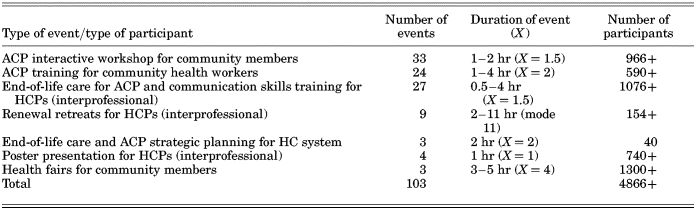
The Walther team conducted more than 100 events and served close to 5,000 participants in Indiana over a 2½-year period (see Table 1). Participants' ratings of the quality and perceived usefulness of the events ranged from 4 to 5 (using 5-point Likert-type scales, with 5 = most effective) on post-event surveys. Where sessions were reiterated over time, ratings increased in later sessions to near-perfect scores. A more detailed summary of quantitative and qualitative evaluations by event type follows.
Summary of Walther education events: January 2013 to June 2015

ACP = advance care planning; HC = healthcare, HCP = healthcare professional; X = mean.
“Conversations with Our Loved Ones” and Other Lay Community Learning Experiences
The whole program was wonderful. I was able to open my mind to areas I had not thought about before.
— community member, 2014Thirty-three 1- to 2-hour community workshops were held between April 4, 2013 and May 14, 2015. The individuals who participated in these workshops were most often lay citizens from various communities in Indiana, but also included hospital-based professional education teams, physician-assistant students, and senior center personnel. The small discussion groups in these communication-starter events were uniformly successful, received well, and characterized as useful. Participants across all events were grateful for the opportunity for dialogue, for education on choosing a healthcare representative and back up, as well as for the resources provided to assist participants in defining their own preferences for care. Favorable comments emphasized the relevance of Go Wish cards as a useful technology for prioritizing palliative care–supported activities near the end of life. In the view of participants, the sessions provided practical suggestions and featured good resources for use after the sessions.
Overall, it is clear that these public education workshops were very favorably received. Whatever initial organizational reticence there might have been to engage the public in discourse around the topics of palliative care, advance directives, and care near the end of life disappeared over time. Acknowledging that it might be difficult to open “conversations” about such matters, even within families, while providing resources to utilize opening and subsequent questions about advance care preferences, was clearly key.
Introductory Sessions in Advance Care Planning for Healthcare Providers
The sessions helped improve my understanding of palliative care and the patient's view of end of life, and provided helpful ways to have conversations about these with patients.
— provider, 2014Fourteen introductory sessions (including grand rounds, noon conferences, and panel discussions) were held between January 30, 2013, and November 11, 2014. Evaluations of these activities were highly favorable, ranging from 4.2 to 5 (5 = excellent) on the typical 5-point scale rating session quality and usefulness. Qualitative evaluative responses to these sessions featured favorable commentary on the use of teaching stories, recognition of the critical importance of communication behaviors, appreciation for education on palliative and hospice care, and the relevance of the presented information and tools to participants' professional needs.
Communication Skills Training Workshops for Healthcare Providers and Teams
I will make a more conscious effort to validate each patient's feelings and identify what is important to them.
— health team member, 2014Thirteen communication skills workshops ranging from 2 to 4 hours in length were conducted between January 24, 2013, and April 9, 2015. These workshops were clearly extremely well received, receiving ratings of “excellent” or “very good” from over 97% of participants. The themes from the qualitative analysis of open-ended evaluation responses included the interprofessional educational approach, which focused on health teams, with participants expressing appreciation for gaining greater understanding of the perspectives of different disciplines, as well as appreciation for education and training emphasis on talking with patients about palliative and hospice care. Participants also identified planned changes in future practice based on enhanced knowledge, skills, or attitudes facilitated by the workshop. Themes included plans to explore patient health and life priorities, to spend more time eliciting and listening to patient thoughts and concerns, and to implement new skills in responding to patient emotions and negotiating family conflict around goals of care.
Advance Care Planning Communication Training for Community Health Workers
A total of 10 1- to 8-hour advance care planning training sessions and 14 case conferences were conducted for community health workers. The Likert-scale overall evaluation ratings of these sessions by 16 participants were high, averaging 4.7 on a scale of 1 to 5. Scores averaged 4.8 on a 1–5 subscale evaluating the education as “excellent and important in my work.” Themes in qualitative analysis of text comments on the sessions included strong allusions to the importance of developing trusting relationships with patients and family members, the importance of having these discussions in home settings where patients and family are in familiar surroundings and comfortable, the complexity of interactions with frail/sick/demented patients and their family members, the need to spend time listening carefully, the need to establish an understanding of the differences between a power of attorney and healthcare representative documents, the need to take time to decide on who will serve as a healthcare representative, the necessity for community health worker persistence and respect for those they serve, the helpfulness of such resource materials as Go Wish cards, and the importance of sharing and learning from problematic situations encountered with team members.
In the three 2015 Area Agency on Aging workshops, evaluations included “action items.” After the February 19th workshop, 86% of respondents reported that they were “better able to explain potential advance care treatments such as CPR, intubation, artificial hydration, and nutrition.” After the March 19th workshop, 96.8% of respondents affirmed that “I will use the communication skills I learned to begin conversations about advance care planning with my clients.” Among the same respondents, 92.6% affirmed that “I will explore clients' personal life priorities and preferences and use those to guide our conversation about advance care planning.” These same items were responded to affirmatively after the May 4th workshop by 100% of participants.
Provider Renewal Retreats: “Courage to Care: Honoring Our Patients' Preferences”
The question this retreat raises for me is: How can I touch this tender, human, rejuvenated place on a regular basis?
— team memberSix 1½-day retreats and three brief retreats for palliative care teams were held between May 2, 2013, and October 1, 2015. The purpose of these retreats was to foster professional development and personal formation to facilitate the growth of “mindful practitioners,” individuals capable of integrating personal awareness with their professional role. The evaluation approach emphasized narrative journaling rather than quantitative ratings. These reflections highlighted the importance of developing the inner capacity to be open to others in this work. One participant commented, “How can I continue to use my own brokenness to open myself to greater empathy?” Participants shared a recognition that their own personal histories resonated with the suffering, healing, and brokenness of their patients. They noted the challenge of needing to be fully present with patients and each other as well as being committed to specific tasks in the busy life of a practitioner. Others noted the importance of creating “safe spaces” to “go deep,” and the need for time and situations that permit self-care as well as quietness and centering.
Narrative journaling also provided the opportunity for reflection specifically on participants' experiences with patients. In their journaling, providers reflected on caring for persons in life circumstances very different from their own, including persons they might disdain in other circumstances. These reflections revealed an ability to form strong relationships across such differences, learn from these individuals, teach other members of these patients' families things they didn't often know about their own loved ones, use this information and these relationships to provide guidance and facilitation for care near the end of life, contribute to funerals, facilitate reunions that joined patients and children with whom they had lost contact, and even support celebration of anniversaries or birthdays near the end of life. On the basis of their own experience, practitioners learned to not pass judgment on others and to be open to what they as practitioners might contribute to all patients. Again and again, participant reflections on their work in palliative care affirmed the importance of recognizing patients as unique persons but also “stepping out of my comfort zone” as a provider to join with these individuals and their families while remaining open to their needs and holding in abeyance the practitioner's own expectations or judgments.
One team engaged in a sequence of retreats over multiple years. Reflections from this team suggest progressive learning over time. The qualitative evaluation of narratives was noteworthy for the development as a new “natural language” within the team from the retreats themselves (e.g., increasingly common use of terms such as “going deep”) and the acceptance of shared concepts (e.g., “self-care and self-knowledge are important to my ability to care for patients and their families”—not merely as respite but as a foundation for professional growth and maturation).
DISCUSSION
The Walther team learned a lot during this statewide education initiative—from the initiative's processes, its evaluation, and in our own reflections on the activity. While the lay press and medical literature frequently describe the importance of advance care planning, palliative care, and careful attention to eliciting patient end-of-life goals, we quickly discovered major initial resistance to putting the good idea of having “the conversation about end-of-life care” into action. In our localities, and among all stakeholders, there remains a high level of discomfort in our culture related to talking about advanced disease care and death. Healthcare providers (HCPs), in particular, expressed anxiety that talking about poor prognoses, terminal illness, and preparing for death, even when death was imminent, might “take away hope.” In the natural language of providers, “hope” alludes to aspirations for a biomedically framed disease cure rather than hope for bio-psycho-social-spiritual well-being in the broader framework of care.
Early in our work, we decided that we needed to focus on opening conversations among patients and families and all other stakeholders involved in care, not about dying, but about what “hope” might mean to individuals with advanced disease as they transition into a late stage of their life. In this reframing, each person's story was to be understood and uniquely situated within their ring of loved ones, who are often inextricably linked to the individual's interests, pleasures, dreams, hopes, and understanding of their current state of health and well-being. Our work became centered on aspirations expressed in Dame Cicely Saunders's (founder of the modern hospice movement) famous quote: “We will do all we can, not only to help you die peacefully, but to also live until you die.” Our team goal became one of using educational and training methods to move this aspiration into action by helping individuals involved in the process of care to begin to clarify patients' personal goals for “living well until you die.” To do this work comprehensively, we decided that we needed to establish a broad frontier for education, one in which we engaged with all stakeholders in this care process—lay citizens, healthcare providers, community health workers, and palliative care teams. In the complex responsive web of end-of-life care, to affect one of these communities and not others seemed unlikely to systemically advance the prospects of palliative and person-centered care.
Among lay community members, we learned that normalizing the process of reflecting on advanced disease goals of care began with building conversations into comfortable, routine activities, such as a card game at a senior citizens' event, and revisiting perfunctory paperwork completed years ago to make sure these documents reflect current goals and decisions. We found that community members can have conversations about end-of-life care without being overly somber. While using the Go Wish cards to identify preferences for care, we were surprised to hear laughter as participants tried to narrow their list of most important goals to their top 10 preferences. Typically, we also heard animated conversations among participants as they compared their preference lists. In the process, we discovered that most participants had not completed any documentation prior to our workshop, or had completed forms “years ago” that in many cases named powers of attorney and healthcare representatives long since deceased or estranged. At the end of each workshop, we asked each person to write down what actions they needed to undertake next as part of their personal plan of action.
In our engagements with healthcare professionals, we were quickly reminded that they are accustomed to helping patients and their families through the stages of health maintenance, acute illness, and chronic disease management relatively comfortably until their patients are approaching the end of life. Little is taught or modeled in many health professional schools about how providers can help patients transition to “a new normal” and identify new, stage-appropriate goals for living and for care near the end of life. Many providers, even those who most frequently care for patients near the end of life, were uncomfortable about openly exploring noncurative care options with patients, and were unsure about how to approach or facilitate conversations about patient life priorities at this stage of life. We found that using provider and patient stories of end-of-life experiences, both rewarding and disappointing, resonated instantly with most participants and provided helpful examples for handling difficult and emotionally charged interactions with patients. We also found that many providers lacked basic skills in interpersonal communication, as well as more advanced skills in facilitating difficult conversations. Having the opportunity to practice and get feedback in a safe space gave them the opportunity to try out different approaches and find a style that worked well for them. Another benefit we observed was the opportunity for providers to hear about the approach used by their colleagues from different professions. Physicians, chaplains, nurses, and social workers all heard the somewhat distinct languages used by each profession and were able to appropriate words and concepts with which to create their own personal approach.
We also found that an important method for normalizing and sensitizing HCPs about the “felt” importance of their role in having “conversations” with their patients was to be immersed in the same sessions we had community members attend. Couched as training, HCPs experienced the emotional and cognitive challenges of going through a parallel process of thinking about and prioritizing goals for living and identifying someone to speak for them when they might not be able to speak for themselves. Conversations often turned to thinking about these issues for their aging parents and the potential consequences that avoiding these conversations could have in producing family conflict and pain and psychological suffering. Even when willing and trained to have these conversations, however, HCPs often remained unable to find the time or “proper” setting for these conversations with their patients during busy outpatient clinics, frantic emergency department visits, and hospital stays triggered by episodes of acute medical decompensation.
Knowing that there are too few health professional providers to attend to advance care planning, especially since these discussions might most comfortably take place in the homes of patients and not a “once-and-it's-done” event but rather a series of conversations, we imagined that community health workers (CHWs) given the skills and practice needed to engender their self-confidence could develop trusting relationships with patients and family over time, making substantial progress in conducting “conversations” in less-hurried and caring ways. Training CHWs who are caring for patients in both medical and home settings proved instrumental in creating a culture in which soliciting and honoring patients' preferences for their end-of-life care was considered routine standard of care.
The CHWs were initially hired to care for elderly patients and their caregivers and were at first reluctant to take on the role of initiating “the conversation.” As they grew in experience in their roles, they moved well beyond feeling that advance care planning was “not in their job description” to commenting positively on their growing confidence in their ability to use their new skills. They expressed their surprise that patients were eager to have these conversations and that, once trust was established, how willingly patients shared their hopes, wishes, and dreams. Certain tools (e.g., Go Wish cards) were particularly helpful in opening this door. Documenting what had been accomplished in the electronic EHR was important to help ensure that wishes were available at various points of care (e.g., in the emergency department, hospital, clinics), although more work on interoperability among EHRs is still needed. More specifically, documentation of officially appointed healthcare representatives, living wills, preferences about artificial nutrition, and goals of living facilitated medical decision making during hospital admissions and emergency.
Finally, palliative care team members and others deeply engaged in end-of-life care also benefited from education and training. The importance of self-awareness and self-care stood out as essential for sustaining oneself in the deeply engaging and intimate work of helping patients and families to clarify their goals for living, and for personalizing this process. Self-awareness work came to be recognized by these teams as critical to achieving and maintaining selfless, empathic care of patients who often might be very different from and from walks of life different from that of their HCPs. Our work seemed to allow providers to grow with their patients through shared consciousness-raising and skill-building work.
IN CLOSING
We learned that a comprehensive stepwise approach to promoting end-of-life conversations was facilitated by a reframing of the conversation as goals for living well near the end of life. Any effort to influence cultural change requires attention to the many important stakeholders and identifying key change nodes, such as: addressing providers' fears and anxiety, and helping providers and patients to clarify the broader meaning of “hope” and to develop the communication skills and confidence needed to initiate these difficult conversations. Advancing the prospects for palliative care near the end of life may include training a new workforce who can develop trusting relationships with patients, especially in home-based services. In the broad territory of education, fostering self-awareness and self-care among palliative care providers who can then more deeply grow into their work is important. Activating community organizations and their lay members to help “normalize” the difficult conversation about end-of-life priorities and care, while empowering them to articulate their goals for living and end-of-life preferences with family, friends, and healthcare providers, is a foundation for all these efforts. As next steps, we are currently working to train healthcare providers employed by our statewide Area Agencies on Aging to build trusting relationships with their elderly and disabled clients during repeated home visits. Our EHR and clinical decision support tools, with built-in support for guiding and documenting advance care planning conversations, have been made available to all AAA staff for their use.
After listening to my patient talk about her siblings and what they went through when they died, I knew it was the right time to talk about advanced directives. I started with the “Go Wish” activity and then worked with her to identify a healthcare representative and then complete a living will document. This occurred during two visits.
— community health worker, 1 year post--trainingACKNOWLEDGMENTS
The Walther Cancer Foundation Inc. (Indianapolis, Indiana) and the Office of Behavioral and Social Science of the National Institute of Arthritis and Musculoskeletal and Skin Diseases (grant 5R25AR060994) supported this project.
FUNDING
Funded by the Walther Cancer Foundation.
APPENDIX
Helpful References for The Conversation
-
■ www.TheConversationProject.org. The Conversation Project's homepage. Free access to “The Starter Kit,” stories, etc.
-
■ www.prepareforyourcare.com. A user-friendly online advanced care planning tool (including several videos). You can view this website with friends and family.
-
■ www.agingwithdignity. Homepage: access to “Five Wishes” package. ($5 to print or use online.) This is a very helpful workbook to complete, but it is not recognized by Indiana as an official advance directive.
-
■ www.PracticalBioethics.org. Homepage: access to “Caring Conversations” workbook. Is not recognized by Indiana as an official advance directive but is a good guide to use in planning.
-
■ www.abanet.org/aging. Free access to “Consumer Tool Kit for Health Care Advance Planning.” Videos to explain legal terms, etc.
-
■ www.centerforhospice.org/document.doc?id=11. The “Appointment of Health Care Representative” form.
-
■ http://www.in.gov/isdh/25880.htm. Official site for the Indiana Advance Directive as well as other forms related to planning for your own healthcare.
-
■ http://www.iupui.edu/~irespect/POST.html. Information specifically on the new POST form.
-
■ www.CaringInfo.org. Free resources from Caring Connections. Check out free brochures. Review their community outreach and their Speak4me campaign.
-
■ http://gowish.org. Play the Go Wish card game online at this website. Go to this site, scroll down until you see “Try It Free,” click on this, and play the game. When you are finished arranging the cards, you can print out a copy of your selection/arrangement.
-
■ http://www.mydirectives.com. Platform for completing and storing your advance directive. Free.