Introduction
Selective browsing by herbivores can alter the species composition of plant communities and influence the success of exotic plant species. Higher preference by herbivores for introduced species has been hypothesized to prevent invasion (the biotic resistance hypothesis, or BRH). The enemy release hypothesis (ERH) conversely attributes the success of invasives to the lack of native predators or pathogens. For invasive plants, this could mean less herbivory (e.g., lower preference) from both generalist and specialist herbivores (Colautti et al. Reference Colautti, Ricciardi, Grigorovich and MacIsaac2004). (Box 1)
Management Implications
Based on previous findings, white-tailed deer browse heavily on an invasive shrub, Lonicera maackii (Amur honeysuckle), in some forests. We tested whether this is due to high preference by deer for L. maackii, low availability of preferred browse, or L. maackii serving as an important browse in early spring before native woody plants have leafed out. By comparing browse intensity on, and preference for, L. maackii across sites with different woody understories, we found support for the third hypothesis. Specifically, the proportion of L. maackii twigs browsed by deer was greater where abundance of this shrub was lower, suggesting deer browse it preferentially, but mainly during a brief period of the year
Our findings could inform management decisions concerning L. maackii and other invasive shrubs that leaf out early and are browsed preferentially in that season, when other resources are at low availability. In areas with low invasive shrub density and high deer populations, deer browse may be sufficient to curb the growth of the invasives. But in heavily invaded areas, management should focus on reducing deer populations before reducing invasive shrubs, in order to facilitate growth of native woody species. We did find a negative relationship between L. maackii density and deer browse on a less-preferred species, black cherry (Prunus serotina Ehrh.). Removal of invasive shrubs as a source of browse or possible cover could result in higher browse on such less-preferred species.
Herbivory by wild ungulates is now recognized as a strong component of ecological change (Augustine and McNaughton Reference Augustine and McNaughton1998; Kie and Lehmkuhl Reference Kie and Lehmkuhl2001; Riggs et al. Reference Riggs, Tiedemann, Cook, Ballard, Edgerton, Vavra, Krueger, Hall, Bryant, Irwin and Delcurto2000). Many wild ungulate populations, including deer in North America and Europe, are now elevated above historical levels (Côté et. al 2004). Deer populations increased primarily through extirpation of natural predators, restrictions on hunting, and the spread of human-influenced landscapes. The concern for browse impacts has reversed the management of deer populations from sustaining game populations to managing overabundance.
The white-tailed deer (Odocoileus virginianus Zimmermann, henceforth referred to as “deer”) is a generalist ungulate abundant in many parts of the eastern and midwestern United States, with foraging patterns that impact forest composition (Bradshaw and Waller Reference Bradshaw and Waller2016; Côté 2004; Horsley et al. Reference Horsley, Stout and DeCalesta2003; Kraft et al. Reference Kraft, Crow, Buckley, Nuartz and Zasada2004; McCabe and McCabe Reference McCabe and McCabe1997; McCullough Reference McCullough1979, Reference McCullough1997; McShea Reference McShea2012). Human-modified landscapes have increased deer populations by providing supplemental browse from ornamentals, crops, and increased habitat edges (McShea Reference McShea2012). Plants of greater palatability decline even at deer densities below levels at which deer are limited by plant productivity (McShea Reference McShea2012). This allows less palatable plants, such as ferns or grasses, to flourish and further inhibit the establishment of tree seedlings and native herbs (e.g., Horsley et al. Reference Horsley, Stout and DeCalesta2003). By indirectly preventing the establishment of preferred species, deer can alter forest regeneration and succession (Côté et al. Reference Côté, Rooney, Tremblay and Waller2004; Horsley et al. Reference Horsley, Stout and DeCalesta2003).
Whether deer may limit (BRH) or promote (ERH) invasion depends on their preference for each introduced species. A meta-analysis found a general trend for native herbivores to prefer invasive over native plant species (Parker et al. Reference Parker, Burkepile and Hay2006). Deer, however, appear to browse less on invasive plants than native species within the same genus (Schierenbeck et al. Reference Schierenbeck, Mack and Sharitz1994). Eschtruth and Battles (Reference Eschtruth and Battles2008) found positive relationships between deer density and the abundances of three invasive species, garlic mustard [Alliaria petiolata (M. Bieb.) Cavara & Grande], Japanese stiltgrass [Microstegium vimineum (Trin.) A. Camus], and Japanese barberry (Berberis thunbergii DC.), and suggested this was due to competitive release due to deer browse on native species. Similarly, Knight et al. (Reference Knight, Dunn, Smith, Davis and Kalisz2009) attributed greater cover of M. vinimeum and A. petiolata in deer access versus exclosure plots to lower preference by deer. Averill et al. (Reference Averill, Mortenson, Smithwick and Post2016) found that deer did not consistently favor native species over invasive species, but some invasive species, including Morrow’s honeysuckle (Lonicera morrowii A. Gray), were highly preferred.
The preference of deer for individual species also shifts seasonally (Smith Reference Smith2013). During the winter, deer browse on leafless twigs, which are less nutritious than leafy twigs (Martinod and Gorchov Reference Martinod and Gorchov2017; Mattson Reference Mattson1980). Leafy twigs have more nitrogen (%N), indicating higher crude protein, which is an important nutrient for deer during the spring and summer (Berteaux et al. Reference Berteaux, Crête, Huot, Maltais and Ouellet1998; Dostaler et al. Reference Dostaler, Ouellet, Therrien and Côté2011). Certain species of nonnative plants exhibit extended leaf phenology (ELP)—leafing out earlier in spring and retaining leaves later in the fall (Smith Reference Smith2013). Early expansion of leaves during the springtime could thus reduce starvation of pregnant does and result in stronger fawns (Moen Reference Moen1978; Perkins et al Reference Perkins, Smith and Mauts1998).
The invasive shrub, Amur honeysuckle [Lonicera maackii (Rupr.) Herder, Caprifoliaceae], exhibits ELP (McEwan et al. Reference McEwan, Birthfield, Schoergendorfer and Arthur2009; Wilfong et al. Reference Wilfong, Gorchov and Henry2009) and is an important component of the deer diet (Martinod and Gorchov Reference Martinod and Gorchov2017). In the Miami University Natural Areas (MUNA) in southwestern Ohio, L. maackii was estimated to comprise 14% to 47% of annual deer diet, based on measurements of deer browse and estimated deer food consumption from the literature (Martinod and Gorchov Reference Martinod and Gorchov2017). Consistent with the hypothesis that ELP species are important for spring browse (Smith Reference Smith2013), Martinod and Gorchov (Reference Martinod and Gorchov2017) found browse on L. maackii was highest during early spring, but was also high in late summer. Additionally, the %N of leafy L. maackii twigs was higher than winter twigs of common woody species (Martinod and Gorchov Reference Martinod and Gorchov2017). Whether the high percentage of deer diet in MUNA composed of L. maackii is due to its relatively high nutritional value before native woody plants leaf out in the spring, the high abundance of L. maackii at these sites, or depletion of higher-quality browse due to chronic high deer density, is not known.
We tested three hypotheses for the substantial deer browse on L. maackii: (1) deer prefer to browse on L. maackii versus other woody plants; (2) L. maackii is not preferred, but is consumed where preferred foods are unavailable; and (3) L. maackii serves as an important food resource for deer during early spring, a season of scarcity. To test these hypotheses, we recorded proportions of twigs browsed for each woody species in each of eight sites and used these proportions to calculate deer preference using an index of electivity. The prediction from hypothesis 1 is that L. maackii has a positive electivity (is preferred) at all sites. Higher electivity where more-preferred species are less abundant would support hypothesis 2. Having a higher proportion of L. maackii twigs browsed where it is less abundant would support hypothesis 3. This last prediction is based on the reasoning that L. maackii will not be browsed beyond the quantity needed to satiate deer during a brief period (early spring), leading to lower percentage browse proportions in areas of higher L. maackii density.
Materials and Methods
Study Species
Lonicera maackii is one of several Eurasian bush honeysuckle species invasive in the United States (Webster et al. Reference Webster, Jenkins and Jose2006). It is native to East Asia and was introduced for landscaping and erosion control in 1898 (Luken and Thieret Reference Luken and Thieret1996). Lonicera maackii escaped from cultivation across the central and eastern United States and is currently regulated in eight of those states (EDDMapS 2017).
Characteristics of L. maackii that contribute to invasiveness have been reviewed by McNeish and McEwan (Reference McNeish and McEwan2016). Of specific relevance to this study, L. maackii exhibits ELP—earlier leaf out in spring (McEwan et al. Reference McEwan, Birthfield, Schoergendorfer and Arthur2009) and retention of leaves later in the fall (Wilfong et al. Reference Wilfong, Gorchov and Henry2009)—compared with native deciduous species.
Insect herbivory on L. maackii is low, with damage steadily accumulating throughout the growing season (Lieurance and Cipollini Reference Lieurance and Cipollini2011). However, deer browse on L. maackii is high, at least in some sites in southwestern Ohio; Guiden et al. (Reference Guiden, Gorchov, Nielsen and Schauber2015) found that 60% of branches showed evidence of browse during a 3-mo period from late fall to early winter, and Martinod and Gorchov (Reference Martinod and Gorchov2017) found 22% to 32% of L. maackii twigs were browsed in a 1-yr span.
Study Sites
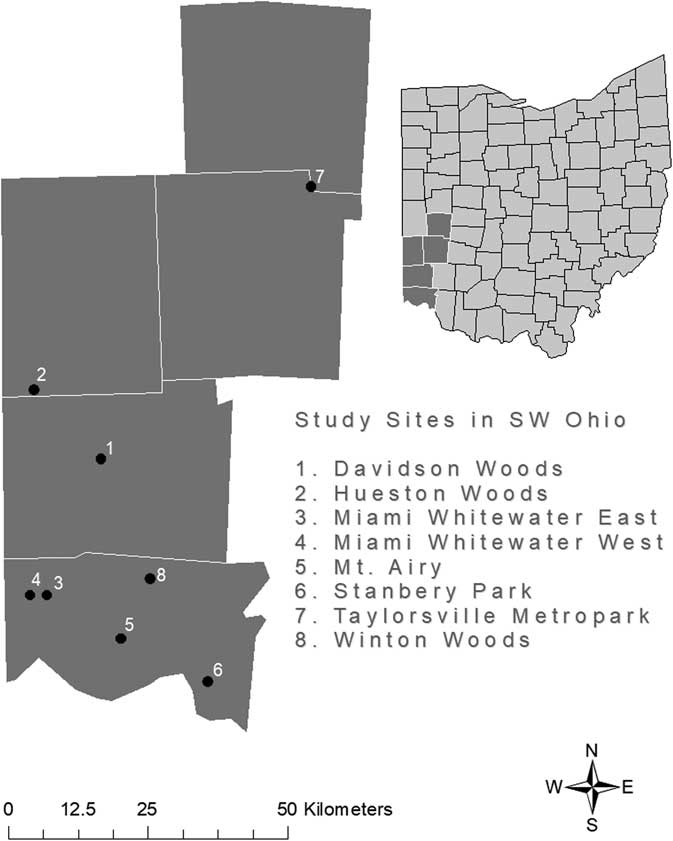
Eight sites in southwestern Ohio were selected based on low-to-moderate abundances of L. maackii, high densities of other woody understory plants, and (where information was available) high deer abundances (Figure 1; Table 1). Of the sites with lower L. maackii density, some had not yet been extensively invaded and others had abundance of this shrub reduced by management.
Study site locations in southwestern Ohio.

Study sites with abbreviations, park systems (Butler County, State of Ohio, GreatParks of Hamilton County, Cincinnati Metroparks, and Five Rivers Metroparks), contiguous forest size, dimensions of plots for twig counts, twig densities in browse layer (0.3–1.7 m), basal area and density of trees >10-cm diameter at breast height, density of deer harvested fall 2016 to winter 2017 (number killed divided by area hunted), and density from most recent aerial infrared survey (AIS) where available.Footnote a

a For twig density and L. maackii twig density, SDs based on values from n=4 transects are provided in parentheses. *The two sites in Miami Whitewater Forest (MWE, MWW) are within the same block of contiguous forest and deer management unit, so values for these in their entirety are listed.
We selected sites with ≥7.7 deer km−2, the density considered to be the ecological carrying capacity for an eastern broadleaf deciduous forest and often used for park management (Horsley et al. Reference Horsley, Stout and DeCalesta2003; Ristau et al. Reference Ristau, Royo, Stout, Stoleson, Adams and Moser2012). Our reason for using sites with high deer densities was to get a better indication of which species are preferred where browse is more intensive. Three sites had deer densities estimated by aerial infrared survey (AIS) (Great Parks of Hamilton County 2013; Cincinnati Park Board 2014) (Table 1). AISs have low bias, but consistently underestimate deer populations by approximately 30% (Beaver et al. Reference Beaver, Harper, Kissell, Muller, Basinger, Goode, Van Manen and Kennedy2014; DeCalesta Reference DeCalesta2013). We also calculated deer harvest density for sites that provided counts of deer harvested fall 2016 to winter 2017 (all but HW) by dividing this count by the area of management units where hunting was carried out; this is expected to correlate with density during the 2016 field season (Table 1). At one site (TM), an indicator of deer density, browse on red oak (Quercus rubra L.) sentinel seedlings, was estimated to be 44%; red oak browse damage >15% was considered to reflect deer density >7.7 deer km−2 (Van Clef Reference Van Clef2008).
The tree canopy at these sites was dominated by sugar maple (Acer saccharum Marshall); this species had the highest stand density and frequency at all sites and the highest basal area at seven of the sites (based on point-quarter sampling of trees >10 cm in diameter at breast height; Wright Reference Wright2017). At the other site, HW, northern red oak (Quercus rubra L.) had greater basal area than A. saccharum. At most sites, the genus Quercus (mostly Q. rubra, white oak [Quercus alba L.], bur oak [Quercus macrocarpa Michx.], and chinquapin oak [Quercus muehlenbergii Engelm.]) was second in importance (based on relative density, frequency, and basal area summed by genus). At DW and MWE Carya spp. (shagbark hickory [Carya ovata (Mill.) K. Koch] and bitternut hickory [Carya cordiformis (Wangenh.) K. Koch]) were of secondary importance. At MWW, American beech (Fagus grandifolia Ehrh.) was of secondary importance, and this species was present at most sites, as were Fraxinus spp. (Wright Reference Wright2017).
Understory Woody Species Composition
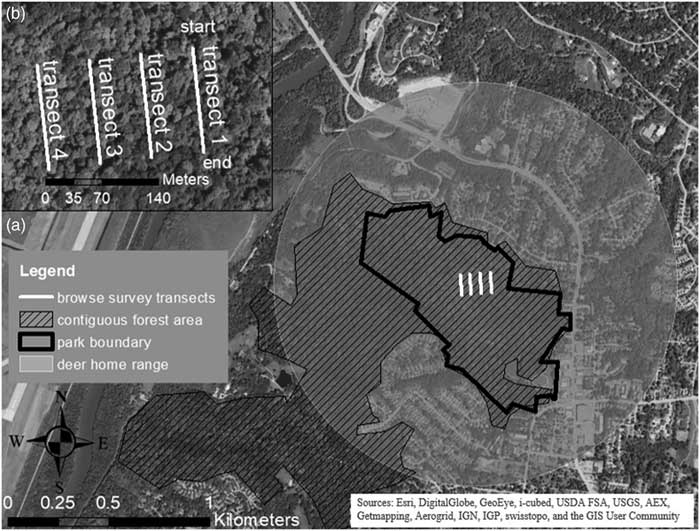
In summer 2016 we quantified the twig density of L. maackii and other woody plant species in the browse layer in each site. We defined the browse layer (twigs accessible to deer) as 0.3 to 1.7 m; the minimum was based on Frelich and Lorimer (Reference Frelich and Lorimer1985) and the maximum on Martinod and Gorchov’s (Reference Martinod and Gorchov2017) finding that minimal deer browse on L. maackii occurred above 1.7 m. Using a geographic information system, we located four 100-m parallel transects, 50 m apart, in an interior forest area (Figure 2). The starting point of the first transect was a randomly selected point between 100 and 120 m from the forest edge. The direction of this transect was randomly generated, constrained within a 179° range centered on the direction away from the forest edge. The three parallel transects were located on the side of the first transect that faced the forest interior.
One of the eight study sites, Stanbery Park, with (A) overview of site layout, including contiguous forest area, park boundaries, browse survey transects, and 1-km radius centered on those transects to approximate the size of a deer home range; and (B) close-up of browse survey transects (100 m each).

We sampled twigs in plots at 10-m intervals along each transect (N=44 plots site−1). Plot sizes varied depending upon the frequency of woody species at each site (Table 1). At four sites, plots were 2 by 1 m. At three sites, woody species were sparse, so plots were extended to 4 by 1 m. At one site where L. maackii was scarce, plots were increased to 6 by 1 m. To assess twig abundance and percent of twigs browsed, we counted in each plot both the total number of twigs, and the number of twigs browsed by deer, for each woody species (Supplementary Table A.1). To ensure that only current-year browse was counted, we scored only new-growth twigs—twigs that leafed out during the spring 2016. Deer browse was distinguished by the shredded appearance of twigs (Swift and Gross Reference Swift and Gross2008). All twig counts were done July 19 to August 12, 2016, enabling us to encompass browse that occurred from the beginning through the middle part of that growing season.
From these twig counts we calculated deer preference for L. maackii and the other focal woody species at each site using Vanderploeg and Scavia’s (Reference Vanderploeg and Scavia1979) electivity index (E i ) (Supplementary Table A.2). The electivity index calculates an herbivore’s preference for a species based on the relative amount of consumption composed of that species in relationship to its relative frequency, and was considered to be the best of several measures of feeding preference in an analysis by Lechowicz (Reference Lechowicz1982). Electivity rates herbivore preference from a value of −1 (avoidance) to +1 (preference), with 0 indicating a species is browsed in proportion to its abundance. Electivity was calculated using Equation 1.
 $$E_{i}{\equals}W_i {\minus}{\rm }{{{1 \over n}} \mathord{\left/ {\vphantom {{{1 \over n}} {Wi{\plus}{\rm }{1 \over n}}}} \right. \kern-\nulldelimiterspace} {W_i{\plus}{\rm }{1 \over n}}}{\rm }$$
where Wi is the electivity coefficient (Equation 2),
 $$W_{i} {\equals}{{{{r_{i} } \over {p_{i} }}} \mathord{\left/ {\vphantom {{{{r_{i} } \over {p_{i} }}} {\mathop{\sum}\limits_i^n {{{r_{i} } \over {p_{i} }}} }}} \right. \kern-\nulldelimiterspace} {\mathop{\sum}\limits_i^n {{{r_{i} } \over {p_{i} }}} }}$$
where r i is the ratio of species i consumed divided by total consumption, p i is the proportional abundance of species i, and n is the total number of species in the sample (Vanderploeg and Scavia Reference Vanderploeg and Scavia1979). For each site we used the proportion of the number of twigs browsed to calculate r i values (using twigs browsed of species i divided by total twigs browsed), p i as the number of twigs of species i divided by the total number of twigs at the site, and n as the number of woody species in the data set for the site.
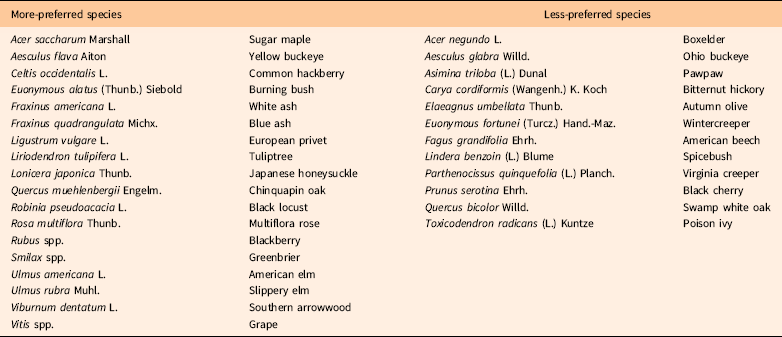
Once the electivities were calculated, species were sorted into more-preferred species (MPS) or less-preferred species (LPS) categories based on their electivity relative to L. maackii (Table 2; Supplementary Table A.2).
List of more- and less-preferred species.Footnote a

a Species were sorted based on their electivities compared with L. maackii electivity (Supplementary Table A.2).
Land Cover Proportions
We quantified land cover at each site to explore whether access to alternative browse had any relationship with L. maackii electivity or proportion browsed. Though herbivores may select browse at finer scale (e.g., within a forest patch), large herbivores may be responding to coarser scales of vegetation due to landscape configuration (Royo et al. Reference Royo, Kramer, Miller, Nibbelink and Stout2017; Weisberg et al. Reference Weisberg, Coughenour and Bugman2006). These differing spatial patterns might provide alternative sources of graze or browse within the home range (Hurley et al. Reference Hurley, Webster, Flaspohler and Parker2012). Herbivores may focus foraging within a preferred, highly productive habitat (e.g., cornfield), resulting in diminished pressure on an adjacent forest understory (Takimoto et al. Reference Takimoto, Iwata and Murakami2009). Hurley et al. (Reference Hurley, Webster, Flaspohler and Parker2012) found that sites with more interspersed perennial habitats (shrublands, wetlands, and early successional habitat) within a deer’s home range had higher herb cover in the forest understory, indicating per capita rates of deer herbivory were lower where these perennial habitats provide additional browse. Similarly, Royo et al. (Reference Royo, Kramer, Miller, Nibbelink and Stout2017) found that across stands in the same stage of forest management, the impacts of deer on plant cover and richness were less negative in landscapes with greater percent of “forage-producing habitat” (recently managed forest, agriculture, and herbaceous habitats).
To approximate the influence of land cover composition within deer home ranges, we quantified landscapes in ArcMap using 30-m resolution land cover basemaps that used decision-tree classification of 2011 satellite data to distinguish 16 land cover types (Homer et al. Reference Homer, Dewitz, Yang, Jin, Danielson, Xian, Coulston, Herold, Wickham and Megown2015; U.S. Geological Survey 2014). This information was restricted to a 1-km radius buffer (3.14 km2) centered on the browse transects (Figure 2) to approximate the area within the home range of an individual doe that foraged in the area covered by the transects, based on literature estimates of home range size (Hewitt Reference Hewitt2011; Nixon et al. Reference Nixon, Hansen, Brewer and Chesvig1991; Tierson et al. Reference Tierson, Mattfeld, Sage and Behrend1985; Vercauteren and Hygnstrom Reference Vercauteren and Hygnstrom1998; Walter et al. Reference Walter, VerCauteren, Campa, Clark, Fischer, Hygnstrom, Mathews, Nielsen, Schauber, Van Deelen and Winterstein2009; Webb et al. 2007).
The 16 categories from the land cover map were grouped into five broader categories: pasture/row crop, perennial (herb cover and shrubland/scrubland), open water, forest, and developed areas. The total area of each category was then found by the calculate geometry function in ArcMap. The total areas were converted to proportions of total land area, not including open water (Supplementary Table A.3). These proportions were then used as predictors in analyses of L. maackii electivity and browse proportions.
Data Analysis
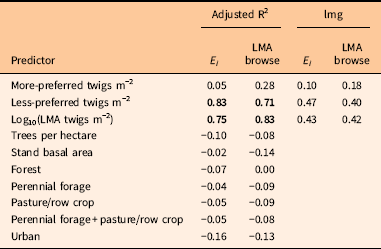
Two response variables, the proportion of L. maackii twigs browsed and electivity of L. maackii, were regressed on each predictor variable: density of LPS twigs, density of MPS twigs, density of L. maackii twigs, stand basal area, and percentage of each land cover type in the buffer (Table 3). Analysis of residuals of these regressions revealed that one of these predictors, density of L. maackii twigs, did not meet normality assumptions. We therefore log transformed this predictor (logLONM) and used this value instead in subsequent analyses. For each response variable, we selected the three predictors with the highest adjusted R2 (LPS, MPS, and logLONMA twig densities) and included these in a multiple regression. Because logLONMA was correlated with each of the other two predictors, we supplemented the regression with “relative importance analysis” (Grömping Reference Grömping2007; Tonidandel and LeBreton Reference Tonidandel and LeBreton2011), which quantifies the contribution of each predictor to the explanatory capacity of a model for all combinations of predictors. We used the unweighted average (lmg) of these contributions as the measure of relative importance (contribution of each predictor to R2); these were obtained with the calc.relimp function in the ‘relaimpo’ package in R (Grömping Reference Grömping2006).
Adjusted R2 values for univariate linear regressions of each of the two response variables, electivity (E i ) of Lonicera maackii and L. maackii twigs browsed/total L. maackii twigs (LMA browse) on single predictor variables among the eight sites, and unweighted average contribution (lmg) to R2 of the three predictors used in multiple regression with relative importance analysis.Footnote a

a The last five predictor variables refer to the proportion of the land cover in the 1-km radius buffer. Bolded values indicate P-value<0.05 in univariate regression.
For each of the three native species that were present at most sites, we regressed the proportion of twigs browsed on L. maackii density to find whether abundance of L. maackii had any impact on browse of other species.
Spring Browse Study
Analyses of these data revealed substantial deer browse on L. maackii, so we did an additional study to quantify how much of this occurs in early spring. This was done in an old-growth stand at Hueston Woods State Nature Preserve (HWSNP), where the canopy is dominated by A. saccharum and F. grandifolia, stand basal area is 35.1 m2 ha−1 (Runkle Reference Runkle2013), and the understory has low density of L. maackii. We quantified density of new-growth L. maackii twigs 0.3 to 1.7 m and the number of these browsed along four parallel 100 by 2 m transects, and density and number browsed of new-growth twigs of other shrub and tree species in ten 2 by 2 m quadrats spaced at 10-m intervals on the same transects. Sampling was done May 21–24, 2018, when species with the latest leaf expansion (e.g., pawpaw [Asimina triloba (L.) Dunal]) were still expanding, but about 5 wk after the midpoint of L. maackii leaf expansion.
Results and Discussion
Composition of the Browse Layer
Among the eight sites there was some variation in the woody species composition in the browse layer and in the twig densities of these species (Supplementary Table A.1). Lonicera maackii, A. saccharum, and white ash (Fraxinus americana L.) were present at all sites, with L. maackii accounting for the majority of twigs in the browse layer at all sites but two (MWW, WW). Other species present in most sites included P. serotina, American elm (Ulmus americana L.), and common hackberry (Celtis occidentalis L.). Quercus spp., typically favored by deer (Averill et al. Reference Averill, Mortenson, Smithwick and Post2016), were sparse in the browse layer at all sites.
Proportion of Twigs Browsed
The total twig density at each site ranged from 11 twigs m−2 at MWW to 54 twigs m−2 at DW (Table 1). The percentage of total twigs that were L. maackii varied among sites from 7% (<1 twig m−2) at MWW to 86% at DW (47 twigs m−2) (Table 1).
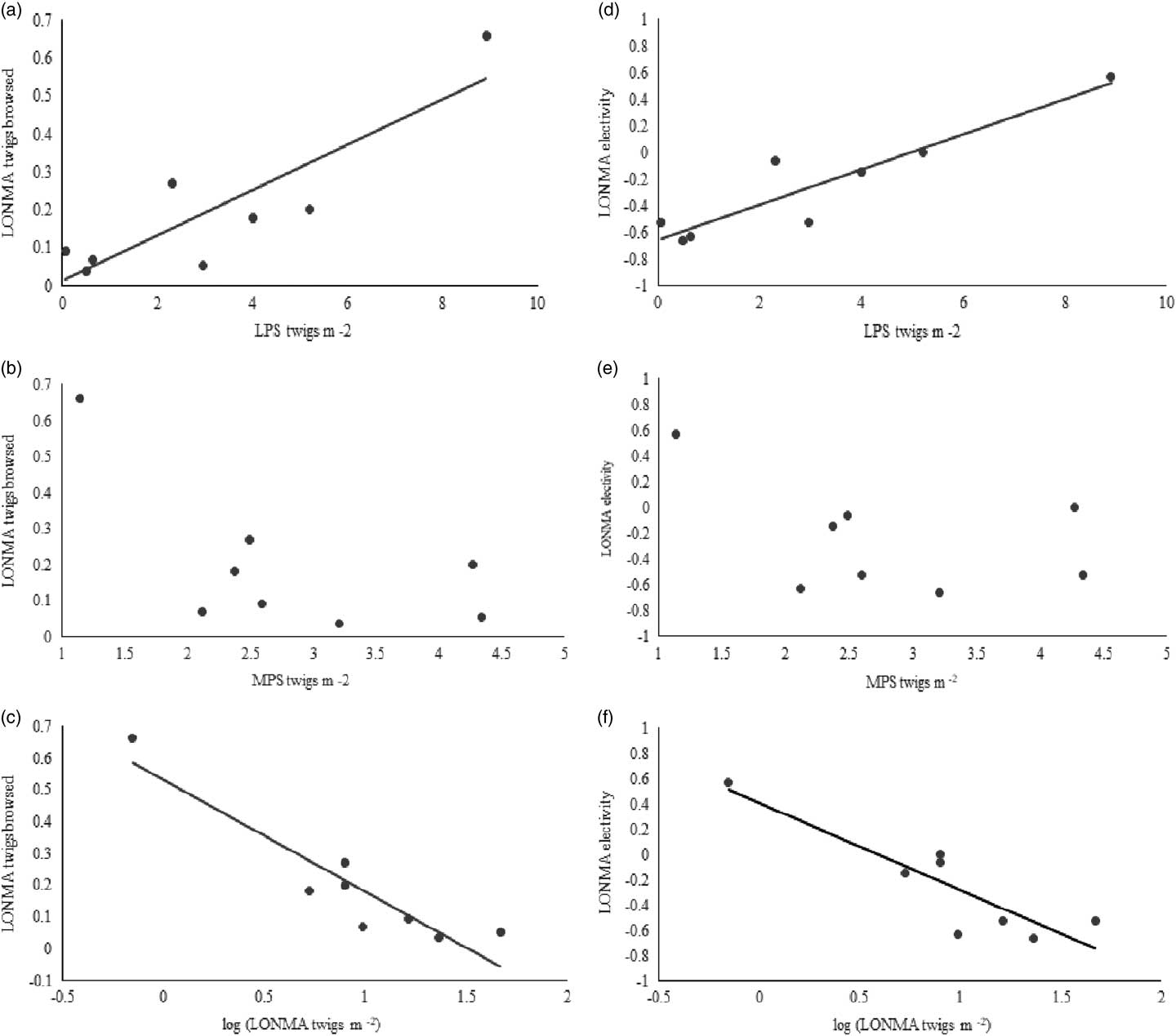
The proportion of L. maackii twigs that were browsed (from early through mid-growing season) ranged from 4% to 66% among the eight sites (Table 4). This browse proportion was positively related to the density of LPS twigs among the sites (regression P=0.005; Figure 3A) and negatively related to the log-transformed density of L. maackii twigs (logLONMA) (P=0.0007, Figure 3C) (Table 3). There was a trend of a negative association between the proportion of L. maackii twigs browsed and MPS twig density, but this was not significant (P=0.10; Figure 3B). The other predictors, including the proportions of different land covers within a 1-km buffer, overstory tree density, and stand basal area, had no relationship with the proportion of L. maackii twigs browsed (P-values>0.05; Table 3).
Scatter plots of (A–C) Lonicera maackii (LONMA) proportion browsed and (D–F) L. maackii electivity at each of the eight sites vs. twig densities with fitted linear regression lines where significant. Independent variables are (A, D) less-preferred species (LPS), (B, E) more-preferred species (MPS), and (C, F) L. maackii (log10 transformed). Equations for significant regressions are (A) Y=0.060x+0.012, R2=0.75; (C) Y=−0.352x+0.530, R2=0.85; (D) Y =0.131x+0.645, R2=0.85; and (F) Y=−0.693x+0.411, R2=0.78.

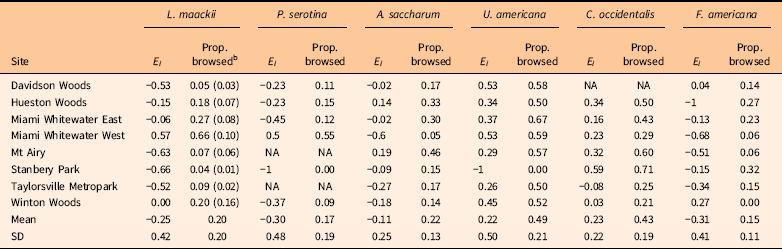
Electivity (E i ) values and proportion of twigs browsed (Prop. browsed) for Lonicera maackii and other common woody species at each of the study sites, and means and SDs for the eight values for each species.Footnote a

a NA, not applicable, species not sampled in plots.
b For the proportion of L. maackii browsed, the SD (based on values from four transects) for each site is in parentheses.
The three best univariate predictors of the proportion of L. maackii twigs browsed (LPS twig density, log LONMA twig density, and MPS twig density) were included in our multiple regression (multiple R2=0.92; adj.R2=0.87). In relative importance analysis, two variables accounted for most of the R2: logLONMA (42%) and LPS (40%) (Table 3). Only 18% was explained by MPS.
Our analysis of residuals of the univariate regressions revealed that one site (MWW) was influential. Repeating the multiple regression without this site reduced its explanatory power (multiple R2=0.65; adj.R2=0.30). However, there was no change direction of the relationships (signs of the coefficients) or the relative importance of the predictors (logLONMA [55%], LPS [36%], MPS [10%]).
Electivities
Electivity of L. maackii ranged from −0.66 to +0.57 at the sites (Table 4) and was strongly positively correlated with the proportion of L. maackii twigs browsed (r=0.97, P<0.0001), suggesting they both measure the same underlying phenomenon of deer browse intensity on this invasive shrub. At seven of the sites, electivity values ranged from −0.66 to 0, indicating a range from deer avoiding L. maackii to browsing in proportion to its abundance. Only at MWW was the electivity positive (E i =+0.57), indicating L. maackii was preferred by deer.
Regressions revealed a positive linear relationship between L. maackii electivity values and the density of LPS twigs (P=0.001; Figure 3D; Table 3). There was no trend between electivity and MPS twig density (P=0.29; Figure 3E; Table 3). Lonicera maackii electivity had a negative relationship with logLONMA (P=0.004, Figure 3F; Table 3). The other predictors, including land cover types and forest overstory parameters, had no relationship with electivity of L. maackii (P>0.05; Table 3).
The multiple regression of L. maackii electivity on the same three predictors as for browse proportion (MPS, LPS, and logLONMA) resulted in a multiple R2=0.93 and adjusted R2=0.87). Relative importance analysis revealed that two variables accounted for most of the R2: LPS (47%) and logLONMA (43%) (Table 3). MPS explained only 10% of R2.
Evaluation of the Hypotheses
Our first hypothesis, that L. maackii is preferred by deer, was not supported, because the electivity of L. maackii was not positive at most sites. Lonicera maackii was “preferred” at MWW, but at the other seven sites, the values of L. maackii electivity were negative or close to 0, indicating L. maackii was of low preference compared with the other woody species present at the same site. While some invasive species are low-preference foods for deer, no consistent preference pattern emerged from cafeteria experiments involving several native and invasive species (Averill et al. Reference Averill, Mortenson, Smithwick and Post2016). While L. maackii was not included in those experiments, closely related L. morrowii was highly preferred (positive electivity).
The second hypothesis, that L. maackii is not preferred compared with other woody species but consumed where preferred browse is depleted, generated our prediction of a negative relationship between the other response variable, L. maackii electivity, and the density of twigs of more-preferred species (MPS), but we found no such relationship. However, both electivity and the proportion of L. maackii twigs browsed were greatest at the site that had the lowest MPS (MWW). This suggests there may be some threshold level of availability of preferred foods, and only below that threshold do deer shift to L. maackii. Support for this idea comes from our finding that MWW was an influential point in univariate regressions of proportion of L. maackii browsed, and when it was removed from analysis, the relative importance of MPS was even lower.
Our third hypothesis, that L. maackii serves as an important browse in early spring, led us to predict low L. maackii browse proportions at sites that had high L. maackii twig densities. Consistent with this prediction, there was a negative relationship between L. maackii browse proportion and log-transformed L. maackii twig density, and the latter variable had the highest relative importance in explaining variation in L. maackii browse among the sites. The finding that log transformation improved the linearity of this relationship reflects the fact that the L. maackii browse proportion declined from low to moderate L. maackii density, but remained low across moderate to high density. (The very high browse percentage at the site with the lowest L. maackii density [MWW] is a manifestation of this same pattern.) This pattern suggests that this inverse density-dependent effect on browse intensity on L. maackii is greatest at lower L. maackii densities. However, even when MWW was excluded from analysis, logLONMA remained the most important predictor of the percent L. maackii browsed, and the relative importance of this predictor was a bit greater. An alternative explanation, that L. maackii browse proportion is related to overall browse scarcity, is not supported: there was no relationship between L. maackii browse proportion and total twig density among sites (adj. R2=0.08).
We argue that the special food source that L. maackii provides is a function of its ELP (Fridley Reference Fridley2012; Smith Reference Smith2013), specifically, leaf expansion earlier in the spring than native woody plants (McEwan et al. Reference McEwan, Birthfield, Schoergendorfer and Arthur2009). Smith (2103) argued that leafy twigs of many invasive plants provide more nutrition to deer than leafless twigs of native plants in early spring. Indeed, leafy L. maackii twigs cut to match nearby deer bites in May, before leaf out of native plants, had 2.07% nitrogen (12.9% crude protein), much greater than literature values for leafless twigs of native trees (Martinod and Gorchov Reference Martinod and Gorchov2017). Many other invasive woody species expand leaves earlier in the spring than most native plants in deciduous forests of eastern North America and may provide a comparable resource (Smith Reference Smith2013), although on average nonnative woody species do not expand leaves earlier than natives (Fridley Reference Fridley2012). In early spring, ELP shrubs in forest understory (e.g., L. maackii at our sites) are strikingly visible to humans, and we suggest to deer as well, enabling deer to find these shrubs when they are sparse.
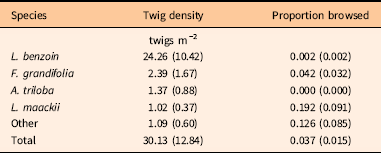
Evidence that this finding of inverse density-dependent browse on L. maackii was due to early spring foraging comes from our follow-up study of early spring browse at HWSNP. The proportion of L. maackii twigs browsed at HWSNP was 0.19 (Table 5), comparable to the mean of the other eight study sites (0.20; Table 1), consistent with our argument that deer browse on this invasive occurs mostly in early spring. The proportion of new twigs browsed was higher for L. maackii than for other woody species (Table 5).
Density of new-growth twigs and proportion of these browsed in early spring (before census in late May 2018) in Hueston Woods State Nature Preserve.Footnote a

a SDs, based on values from four transects, are in parentheses.
Other ELP invasives might be expected to experience similar patterns of inverse density-dependent deer browse in early spring, warranting further research. Use of ELP invaders by deer and other generalist herbivores during periods of scarcity of native foods would be expected to elevate herbivore populations, and under a range of conditions negatively impact native plants via apparent competition (Martinod and Gorchov Reference Martinod and Gorchov2017; Smith and Hall Reference Smith and Hall2016).
Our finding that both L. maackii percent browsed and electivity were positively related to LPS was not anticipated. This pattern is consistent with “neighbor contrast susceptibility,” wherein a palatable plant is attacked more by an herbivore if it is growing among unpalatable plants (Alm Bergvall et al. Reference Alm Bergvall, Rautio, Kesti, Tuomi and Leimar2005). The importance of this phenomenon, as well as the converse (“associational defense” or “associational avoidance”; Milchunas and Noy-Meir Reference Milchunas and Noy-Meir2002), wherein a plant suffers less herbivory in the neighborhood of unpalatable plants, likely depends on the scale of patchiness versus foraging decisions, and has been little studied for deer (but see Alm Bergvall et al. Reference Alm Bergvall, Rautio, Kesti, Tuomi and Leimar2005).
Alternative Factors Influencing Browse on Lonicera maackii
One site (MWW) had a much lower density of L. maackii and a much higher proportion of this shrub’s twigs browsed than the other sites (Figure 3C). Although this site was not an outlier in the univariate regression, we did explore whether factors other than low L. maackii density might alternatively account for its high browse at this site. As noted earlier, the very low density of MPS twigs may have been below some threshold where deer shift to L. maackii. Another explanation, higher deer density, was ruled out, as MWW did not have higher density than several other sites, based on aerial surveys, harvest data (Table 1), or fecal pellet counts (Wright Reference Wright2017).
Alternatively, the high browse on L. maackii at MWW might be explained by the very low density/low availability of other (e.g., non-woody) foods. Our exploration into whether differences in land cover proportions, as surrogate measures of other foods (e.g., fields providing perennial herb forage), affected browse on L. maackii revealed no role for these predictors, although their importance has been documented in other studies (Hurley et al. Reference Hurley, Webster, Flaspohler and Parker2012; Royo et al. Reference Royo, Kramer, Miller, Nibbelink and Stout2017). However, we did not measure herbaceous plants within each forested site. Herbs comprise a large portion of deer diets during spring and summer (Crawford Reference Crawford1982; Halls and Crawford Reference Halls and Crawford1960; Kohn and Mooty Reference Kohn and Mooty1971) and have reduced cover in deer access areas versus exclosures (Kalisz et al. Reference Kalisz, Spiglera and Horvitz2014; Peebles-Spencer et al. Reference Peebles-Spencer, Gorchov and Crist2017). Years of deer browse pressure could have reduced the abundance of spring ephemerals, such as Trillium spp., that are preferred by deer (Anderson Reference Anderson1994; Augustine and DeCalesta Reference Augustine and DeCalesta2003; Augustine and Frelich Reference Augustine and Frelich1998; Augustine and Jordan Reference Augustine and Jordan1998; Rooney and Waller Reference Rooney and Waller2001), resulting in more intense browse on woody species with ELP.
Effect of Lonicera maackii on Browse of Other Woody Species
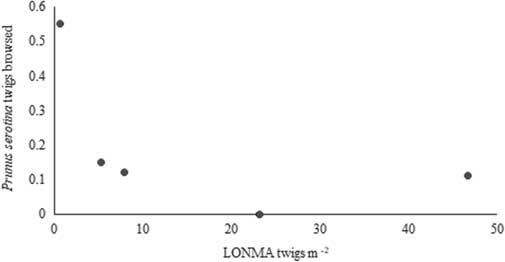
Based on counts of browsed twigs, L. maackii comprised the largest portion of overall browse (r i ) at each site, except MA, where it was the second largest (Supplementary Table A.1). Three other woody species were sufficiently abundant at most sites so that we could explore how the proportion of their twigs that were browsed related to L. maackii twig density. One of these species, P. serotina, was less preferred than L. maackii, and its browse percentage was negatively associated with L. maackii twig density (Figure 4). The other two species, U. americana and A. saccharum, were more preferred than L. maackii and showed no trend between proportion browsed and L. maackii density (Wright Reference Wright2017). The negative relationship between L. maackii density and deer browse on P. serotina suggests that removal of L. maackii as a management practice could result in higher browse on species such as P. serotina. Under some circumstances, similar browse impacts may manifest on preferred species: A. saccharum seedlings experience less browse and show higher survival and growth when planted under rather than next to L. maackii shrubs (Peebles-Spencer and Gorchov Reference Peebles-Spencer and Gorchov2017).
Scatter plot of proportion of Prunus serotina twigs browsed vs. Lonicera maackii (LONMA) twig density among the six sites where P. serotina was present.

Conclusions
The findings of this study best support hypothesis 3, that L. maackii serves as an important food in early spring. We think that deer seek L. maackii in early spring, when its leaves have expanded but those of native woody species have not, but do not prefer it at other times of year. Thus, for a brief period, deer browse is likely focused on this invasive shrub, and where it is sparse, this herbivory can impact a majority of the twigs. At sites with abundant L. maackii, the abundance of leafy twigs greatly exceeds this early spring consumption by deer, manifesting in low proportional browse.
Our research also reveals a limitation of quantifying herbivore preference based on the proportion of each species eaten or electivity. These two measures were correlated in our study, both when comparing values for L. maackii across sites and when comparing the six most common species (Table 4) (r=0.98). However, either measure could be misleading in cases in which a species is preferred only during a particular season, or its density leads to an overabundance of food. To determine whether deer browse more heavily on L. maackii twigs versus other species during the early spring, future research should focus on measuring deer browse on these species during this season.
Acknowledgments
We thank Devon Smith, Anna Bowen, Kevin Lash, Kendra Peterson, Katja Diekgers, and Bekah Duquette for assistance in the field; Michael R. Hughes for data analysis advice; Thomas Crist and Richard Moore for constructive criticism on project design and earlier drafts of this article; and Donald Waller and the anonymous reviewers for valuable comments. We also thank the staff at Five Rivers Metroparks, Butler County Metroparks, Cincinnati Parks, Great Parks of Hamilton County, and Ohio Department of Natural Resources (Hueston Woods State Park and Division of Natural Areas and Preserves) for providing information and granting permission to conduct research in the park areas. We additionally thank Great Parks of Hamilton County for financial support for this research. No conflicts of interest have been declared.
Supplementary materials
To view supplementary material for this article, please visit https://doi.org/10.1017/inp.2018.30