



1 Introduction
One of the most important and challenging problems in number theory is the enumeration of number fields of a fixed degree with respect to discriminants or conductors. Bhargava’s monumental works [Reference Bhargava2, Reference Bhargava3] provide the asymptotic count for the number of
 $S_4$
-fields, which are quartic fields with
 $S_4$
Galois closure, and also for the number of
 $S_5$
-fields, which are quintic fields with
 $S_5$
Galois closure, when they are ordered by discriminants. Belabas, Bhargava, and Pomerance [Reference Belabas, Bhargava and Pomerance1] established a power-saving error term for counting
 $S_4$
-fields, and Shankar and Tsimerman [Reference Shankar and Tsimerman8] obtained a power-saving error term for counting
 $S_5$
-fields. However, the enumeration of the number fields of degree greater than 5 remains largely open.
In the case of abelian extension, we have a good understanding of how many number fields there are. Let G be an arbitrary finite abelian group. Wright [Reference Wright11] obtained the asymptotic result for counting Galois extensions over a global field with Galois group isomorphic to G when ordered by discriminants. When the base field is the field of rational numbers, Mäki [Reference Mäki5] was able to count such abelian extensions over
 $\mathbb {Q}$
with a power-saving error term when ordered by conductors.
In this work, we focus on a very specific abelian extension. Let
 $G=\mathbb {Z}/\ell \mathbb {Z}$
be the cyclic group of prime degree
 $\ell>2$
. We count cyclic extensions L of degree
 $\ell $
over
 $\mathbb {Q}$
satisfying a finite number of local conditions. For a cyclic extension L over
 $\mathbb {Q}$
of prime degree
 $\ell $
, a prime p has the three types of decomposition in L. A prime p can be totally split, inert, or totally ramified in the field L. Let us denote the corresponding decomposition types of p by
 $TS_p$
,
 $IN_p$
, and
 $TR_p$
, respectively. We call them the local conditions at prime p. Let
 $S=\{p_1, p_2, \dots , p_k\}$
be a finite set of prime numbers,
 $\mathcal {LC}_S=\{ LC_{p} | p \in S , LC_{p}=TS_p, IN_p, \text { or } TR_p \}$
be a finite collection of local conditions.
Define
 $$ \begin{align*} N({\mathbb{Z}}/\ell {\mathbb{Z}}, X, \mathcal{LC}_S) = \left|\{ L : \operatorname{\mathrm{Gal}}(L/\mathbb{Q})\cong {\mathbb{Z}}/\ell{\mathbb{Z}}, {L \text{ satisfies } LC_p \ \forall p \in S}, f(L) \leq X \} \right|, \end{align*} $$
where
 $f(L)$
is the conductor of the field L, which is the smallest positive integer n such that the n-th cyclotomic field
 $\mathbb {Q}(\zeta _n)$
contains L. In particular, if L is a cyclic extension of degree
 $\ell $
over
 ${\mathbb {Q}}$
, then the
 $(\ell -1)$
-th power of
 $f(L)$
equals the discriminant of the field L. From the work of Wood [Reference Wood10], we know the asymptotic behavior of
 $N({\mathbb {Z}}/\ell {\mathbb {Z}}, X, \mathcal {LC}_S)$
. We need to be careful to interpret the result in [Reference Wood10], where Wood counted G-extensions over a field K. We define a G-extension of a field K to be a Galois extension
 $L/K$
with an isomorphism
 $\psi : G \rightarrow \operatorname {\mathrm {Gal}}(L/K)$
. Hence, if
 $G={\mathbb {Z}}/\ell {\mathbb {Z}}$
, one Galois extension
 $L/{\mathbb {Q}}$
with Galois group G corresponds to
 $(\ell -1)$
G-extensions of
 ${\mathbb {Q}}$
.
In this work, we find a power-saving error term of
 $N({\mathbb {Z}}/\ell {\mathbb {Z}}, X,\mathcal {LC}_{S})$
by analyzing the generating series in [Reference Wood10]. Let
 $$ \begin{align*} \mathfrak{C}_{\ell}=\frac{1}{\ell}\left( 1+ \frac{\ell-1}{\ell^{2}} \right) \prod_{p \equiv 1 \text{ mod } \ell} \left( 1+ \frac{\ell-1}{p}\right)\left( 1- \frac{1}{p}\right) \prod_{p \not\equiv 1 \text{ mod } \ell}\left( 1- \frac{1}{p}\right), \end{align*} $$
 $$ \begin{align*} \left|TR_q \right|=\begin{cases} \frac{\ell-1}{\ell^2+\ell-1} & \text{ if } q=\ell,\\ \frac{\ell-1}{q+\ell-1} & \text{ if } q\equiv 1 \text{ mod } \ell, \\ 0 & \text{otherwise,} \end{cases} \quad \left|TS_q \right|=\begin{cases} \frac{\ell}{\ell^2+\ell-1} & \text{ if } q=\ell,\\ \frac{q}{\ell(q+\ell-1)} & \text{ if } q\equiv 1 \text{ mod } \ell, \\ \frac{1}{\ell} & \text{otherwise,} \end{cases} \end{align*} $$
and
 $\left |IN_q\right |=(\ell -1)\left |TS_q \right |$
.
Theorem 1.1 Let
 $N({\mathbb {Z}}/\ell {\mathbb {Z}},X,\mathcal {LC}_{S})$
be the number of cyclic extensions L of degree
 $\ell $
over
 ${\mathbb {Q}}$
with conductor less than X that satisfy the local conditions in
 $\mathcal {LC}_{S}$
.
-
(1) Under GRH, we have
where $$ \begin{align*} N({\mathbb{Z}}/\ell {\mathbb{Z}},X,\mathcal{LC}_{S}) =\prod_{p \in S} |LC_p|\mathfrak{C}_\ell X+O_{\ell,\epsilon}\left( 2^{|S|} (\ell-1)^{I_{S}} (\ell+1)^{R_{S}} (\prod_{p\in S} p)^\epsilon \dot X^{\frac{1}{2}+\epsilon} \right), \end{align*} $$
$I_S$
is the number of primes p in S such that
$\text {LC}_p=\text {IN}_p$
, and
$R_{S}$
is the number of primes p in S such that
$\text {LC}_p=\text {TR}_p.$
-
(2) Unconditionally, we have
$$ \begin{align*} & N({\mathbb{Z}}/\ell {\mathbb{Z}},X,\mathcal{LC}_{S}) =\prod_{p \in S} |LC_p|\mathfrak{C}_\ell X \\ & \quad + O_{\ell,\epsilon}\left( 2^{|S|} (\ell-1)^{I_{S}} (\ell+1)^{R_S} \left[(\prod_{p \in S}p)^{ \frac{\ell-1}{6} + \epsilon} X^{\frac{\ell+2}{\ell+5}+\epsilon} + (\prod_{p \in S}p)^{\frac{\ell-1}{4}}X^{\frac{1}{2}+\epsilon} \right] \right). \end{align*} $$


The major obstacle for obtaining the power-saving error terms in Theorem 1.1 is the analytic continuation of a certain Dirichlet series. This is overcome in Lemma 2.1. The second named author will extend this result to arbitrary abelian groups in a forthcoming work.
There are many applications of Theorem 1.1. One of them is studying the distribution of L-values in the critical strip. Let
 $F({\mathbb {Z}}/\ell {\mathbb {Z}})$
be the family of cyclic extensions of degree
 $\ell $
over
 ${\mathbb {Q}}$
. From the family
 $F({\mathbb {Z}}/\ell {\mathbb {Z}})$
, we have the corresponding family
 $D_{\ell }$
of Dirichlet characters. There is an
 $(\ell -1)$
to 1 correspondence between the set of cyclic extensions
 $L/{\mathbb {Q}}$
of degree
 $\ell $
with conductors
 $\leq X$
and the set of primitive
 $\ell $
-th order Dirichlet characters with conductors
 $\leq X$
as follows:
 $$ \begin{align*} D_\ell(X) &:=\{ \chi: \chi:\text{primitive, }\chi^\ell=\chi_0, f(\chi) \leq X \} \longrightarrow F({\mathbb{Z}}/\ell {\mathbb{Z}}, X) \\ &:=\{ L : \operatorname{\mathrm{Gal}}(L/\mathbb{Q})=\mathbb{Z}/\ell\mathbb{Z}, f(L) \leq X \} \\ \chi, \chi^2, \dots, \chi^{\ell-1} & \longrightarrow L(s,\rho_{L}):=\zeta_L(s)/\zeta(s)=L(s,\chi)L(s,\chi^2)\dots L(s,\chi^{\ell-1}). \end{align*} $$
We can determine the value
 $\chi (p)$
by the decomposition of the prime p in the extension L. In other words,
 $\chi (p)$
is
 $1$
if p splits completely in L, some power of the
 $\ell $
-th root of unity
 $\xi _\ell $
if p is inert in L, and
 $0$
if p is totally ramified in L. With this observation, we computed the moment of the L-values
 $L(s, \chi )$
for
 $\operatorname {Re}(s)> \frac 12$
under GRH and unconditionally in some cases. We introduce some results under GRH first.
Theorem 1.2 Assume GRH. Let
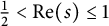 $\frac {1}{2} < \operatorname {Re}(s) \leq 1$
. Then, every moment of the values
 $L(s, \chi )$
for the family
 $D_\ell $
exists.
 $$ \begin{align*} \lim_{X \rightarrow \infty} \frac{1}{N_\ell(X) }\sum_{\chi \in D_\ell(X)} L^m(s,\chi)= \prod_{p} \left( 1 + \sum_{e=1}^\infty \frac{\tau_m(p^{\ell e})\ell|TS_p|}{p^{\ell e s}}\right), \end{align*} $$
where
 $\tau _m$
is the m-fold divisior function.
Theorem 1.3 Assume GRH. Let
 $\frac 12<\sigma \leq 1$
. Then, every moment of the values
 $L(\sigma ,\rho _{L})$
for the family
 $F({\mathbb {Z}}/\ell {\mathbb {Z}})$
exists.
 $$ \begin{align*} \lim_{X \rightarrow \infty}\frac{1}{N({\mathbb{Z}}/ \ell {\mathbb{Z}}, X)}\sum_{L \in F({\mathbb{Z}}/\ell {\mathbb{Z}}, X)} L^m(\sigma,\rho_L)=\prod_{p}\left( 1+ \sum_{e=2}^\infty \frac{g_m(p,e)}{p^{ e \sigma}}\right), \end{align*} $$
where
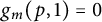 $g_m(p,1)=0$
,
 $g_m(p,e)=\tau _{(\ell -1)m}(p^e)|TS_p| + \beta _{m,e}|IN_p|$
,
 $\beta _{m,e}=\sum _{e_1+e_2+\dots +e_m=e}\beta _{e_1}\beta _{e_2}\dots \beta _{e_m}$
, and
 $$ \begin{align*} \beta_e=\begin{cases} -1 & \text{ if } e\equiv 1 \text{ mod } \ell, \\ 0 & \text{ if } e\equiv 2,3,\dots,\ell-1 \text{ mod } \ell, \\ 1 & \text{ if } e\equiv 0 \text{ mod } \ell. \end{cases} \end{align*} $$
Let
 $$ \begin{align*} r_m(\sigma)=\prod_{p}\left( 1+ \sum_{e=2}^\infty \frac{g_m(p,e)}{\left(p^{\sigma}\right)^e}\right). \end{align*} $$
Under GRH,
 $L(\sigma , \rho _L)$
is positive for
 $1/2 < \sigma \leq 1$
. Let
 $N({\mathbb {Z}}/\ell {\mathbb {Z}},X,a)=\left | \{ L \in F({\mathbb {Z}}/\ell {\mathbb {Z}},X) : L(\sigma ,\rho _L)\geq a \}\right |$
for a positive constant a. Then, we have
 $$ \begin{align*} \frac{ N({\mathbb{Z}}/\ell {\mathbb{Z}},X,a)}{ N({\mathbb{Z}}/\ell {\mathbb{Z}},X)} \leq \frac{1}{a^m}\frac{1}{N({\mathbb{Z}}/\ell {\mathbb{Z}}, X)}\sum_{L \in F({\mathbb{Z}}/\ell {\mathbb{Z}}, X)} L^m(\sigma,\rho_L). \end{align*} $$
By sending X to infinity, we have the following.
Corollary 1.4 Assume GRH. For
 $1/2 < \sigma \leq 1$
, the probability for L-value
 $L(\sigma ,\rho _L)$
for
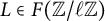 $L \in F({\mathbb {Z}}/\ell {\mathbb {Z}})$
to satisfy
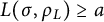 $ L(\sigma ,\rho _L)\geq a$
is
 $$ \begin{align*} \leq \frac{r_m(\sigma)}{a^m}. \end{align*} $$
We also have some unconditional results. The first unconditional theorem is quite surprising. If Carleman’s condition
 $\sum _{m=1}^\infty \frac {1}{r_{2m}(\sigma )^{1/2m}}=\infty $
holds, then the probability distribution of the L-values
 $L(\sigma , \rho _L)$
is uniquely determined. It seems that Carleman’s condition is not satisfied. However, using probability theory, we obtained the existence of the probability distribution. Thanks to Theorem 1.1, we can follow a work of Mine [Reference Mine6] and establish the following theorem.
Theorem 1.5 Let
 $\sigma>9/11$
. Then, there exists a non-negative function
 $C_{\sigma ,\ell }\in C^{\infty }(\mathbb {R})$
such that
 $$ \begin{align*} \lim_{X\rightarrow\infty}\frac{\#\{L\in F({\mathbb{Z}}/\ell {\mathbb{Z}}, X)\mid L(\sigma,\rho_{L})\leq e^{a}\}}{N({\mathbb{Z}}/\ell{\mathbb{Z}},X)}=\int_{-\infty}^{a}C_{\sigma,\ell}(x)\frac{dx}{\sqrt{2\pi}}, \end{align*} $$
holds for any
 $a\in \mathbb {R}$
.
To prove Theorem 1.5, we need to compute the z-moment of L-values
 $L(\sigma , \rho _L)$
for complex numbers z of a certain order of magnitude, and compare it with that of a certain random Euler product
 $L(\sigma ,\mathcal {X})$
. For the z-moment of L-values
 $L(\sigma , \rho _L)$
, it is crucial that
 $L(s,\rho _L)$
has a broad zero-free region near
 $s=1$
. Using Kowalski and Michel’s zero-density theorem [Reference Kowalski and Michel4], most L-functions
 $L(s, \rho _L)$
associated with cyclic fields L in
 $F({\mathbb {Z}}/\ell {\mathbb {Z}}, X)$
enjoy such a zero-free region (See Lemma 4.2). The estimation of the z-moment for the random Euler product
 $L(\sigma ,\mathcal {X})$
is relatively standard and is explained in detail in Section 4.
Unconditionally, we can also compute the first moment of the L-values
 $L(1,\chi )$
for the family
 $D_\ell $
,
 $\ell =3, 5$
. When
 $\ell \geq 7$
, the size of the unconditional error term in Theorem 1.1(2) prevents us from obtaining the average L-value.
Theorem 1.6 Let
 $\ell =3$
or
 $5$
. The first moment of the L-values
 $L(1,\chi )$
for Dirichlet characters of order
 $\ell $
exists:
 $$ \begin{align*} \lim_{X \rightarrow \infty} \frac{1}{N_{\ell}(X)}\sum_{\chi \in D_{\ell}(X)} L(1,\chi)= \prod_{p} \left( 1 + \sum_{e=1}^\infty \frac{\ell |TS_p|}{p^{\ell e}}\right). \end{align*} $$
For cyclic cubic fields L, we compute the average residue of the Dedekind zeta functions
 $\zeta _L(s)$
.
Theorem 1.7 The average residue of the Dedekind zeta functions for the family
 $F({\mathbb {Z}}/3{\mathbb {Z}})$
exists, which has the following expression:
 $$ \begin{align*} \lim_{X \rightarrow \infty} \frac{1}{N({\mathbb{Z}}/3{\mathbb{Z}},X)}\sum_{L \in F({\mathbb{Z}}/3{\mathbb{Z}}, X)} L(1,\rho_L)=\prod_{p}\left( 1 + \sum_{e=2}^\infty \frac{g(p,e)}{p^e} \right). \end{align*} $$
Note that for a field
 $L \in F({\mathbb {Z}}/3{\mathbb {Z}})$
,
 $L(1,\rho _L)=|L(1,\chi _L)|^2=|L(1,\chi _L^2)|^2$
. This implies that
 $$ \begin{align*} \frac{1}{N_3(X)}\sum_{ \chi \in D_3(X)}|L(1,\chi)|^2 = \frac{1}{N({\mathbb{Z}}/3{\mathbb{Z}},X)}\sum_{L \in F({\mathbb{Z}}/3{\mathbb{Z}}, X)} L(1,\rho_L). \end{align*} $$
Let
 $N_3(X,a)=\left | \{ \chi \in D_3(X) : |L(1,\chi )|\geq a \}\right |$
for a positive constant a. Then, we have
 $$ \begin{align*} \frac{N_3(X,a)}{N_3(X)} \leq \frac{1}{a^2}\frac{1}{N({\mathbb{Z}}/3{\mathbb{Z}}, X)}\sum_{L \in F({\mathbb{Z}}/3{\mathbb{Z}},X)} L(1,\rho_L). \end{align*} $$
By sending X to infinity, we have the following.
Corollary 1.8 The probability for L-value
 $L(1,\chi )$
with
 $\chi \in D_3$
to satisfy
 $|L(1,\chi )|\geq a$
is
 $$ \begin{align*} \leq \frac{1}{a^2}\prod_{p}\left( 1+ \sum_{e=2}\frac{g(p,e)}{p^e} \right). \end{align*} $$
For
 $\operatorname {Re}(\tau )>1$
, the Dirichlet series
 $L^m(\tau ,\chi )$
and
 $L^m(\tau ,\rho _L)$
converges absolutely. It is easy to see that the analogs of the Theorems above hold unconditionally. For example, we have the following theorem.
Theorem 1.9 For
 $\sigma>1$
, we have
 $$ \begin{align*} \lim_{X \rightarrow \infty}\frac{1}{N({\mathbb{Z}}/\ell {\mathbb{Z}},X)}\sum_{L \in F({\mathbb{Z}}/\ell {\mathbb{Z}},X)} L^m(\sigma,\rho_L)=\prod_{p}\left( 1+ \sum_{e=2}^\infty \frac{g_m(p,e)}{p^{e\sigma}}\right). \end{align*} $$
Remark 1.10 Under GRH, Theorem 1.5 holds for
 $1/2<\sigma \leq 1$
. By [Reference Mine6, Theorem 2.2], for
 $\frac 12<\sigma \leq 1$
, we have the following identity:
 $$ \begin{align*} r_m(\sigma)=\int_{-\infty}^\infty e^{mx}C_{\sigma,\ell}(x)\frac{dx}{\sqrt{2\pi}}. \end{align*} $$
In Section 2, we prove Theorem 1.1 by analyzing the work of Wood [Reference Wood10] and establishing the analytic continuation of a certain Dirichlet series to the half plane
 $\left \{ s \in \mathbb {C} : \operatorname {Re}(s)>\frac 12 \right \}$
. In Section 3, we study the moment of L-values in the critical strip and prove Theorems 1.2, 1.3, 1.6, and 1.7. In Section 4, we show the existence of the probability density function for the L-values
 $L(\sigma ,\rho _L)$
.
2 Counting cyclic extensions of degree
$\ell $

We can count abelian extensions with respect to discriminants. However, it is necessary to count abelian extensions with conductors if we want to see that the local conditions at different primes are independent.
By counting characters of idele class groups
 $\chi :J/{\mathbb {Q}}^{\times } \rightarrow \mathbb {Z}/\ell \mathbb {Z}$
, we can count the corresponding
 $\mathbb {Z}/\ell \mathbb {Z}$
-extensions. In Section 2.2, we enumerate cyclic extensions of degree
 $\ell $
over
 ${\mathbb {Q}}$
by counting the number of
 ${\mathbb {Z}}/\ell {\mathbb {Z}}$
-extensions that satisfy a finite set of local conditions and then dividing this count by
 $(\ell -1)$
. We define the conductor of an idele class character to coincide with the corresponding field’s conductor. For this purpose, we introduce some notations and definitions in [Reference Wood10]. Throughout this section, G denotes the cyclic group
 ${\mathbb {Z}}/\ell {\mathbb {Z}}$
.
Let
 $c_G: G \rightarrow {\mathbb {Z}}_{\geq 0}$
be a function such that
 $c_G(1)=0$
and
 $c_G(g)=1$
for all non-trival element of G. For all places q dividing
 $\ell $
or infinite, let
 $$ \begin{align*} c_q:\{ \text{isometry classes of } G\text{-structured } {\mathbb{Q}}_q\text{-algebras} \} \rightarrow {\mathbb{Z}}_{\geq 0} \end{align*} $$
such that
 $$ \begin{align*} c_q(\Sigma_q)=\begin{cases} 0 & \text{ if } q=\ell \text{ is unramified,} \\ 2 & \text{ if } q=\ell \text{ is ramified,} \\ 1 & \text{ if } q=\infty. \end{cases} \end{align*} $$
With
 $c_G$
and
 $c_q$
, we define
 $$ \begin{align*} c:\{ \text{isometry classes of } G\text{-structured } {\mathbb{Q}}_q\text{-algebras} \} \rightarrow {\mathbb{Z}}_{\geq 0} \end{align*} $$
by
 $$ \begin{align*} c(\Sigma_q)=\begin{cases} c_G(y_q) & \text{ if } q \nmid \ell \dot \infty, \text{ where } \Sigma_q=Ind_H^G M, \text{ and } M/{\mathbb{Q}}_q \text{ a field extension, } \\ & \text{and } y_q \text{ is any generator of tame inertia in } Gal(M/{\mathbb{Q}}_q) \subset G; \\ c_q(\Sigma_q) & \text{ if } q \mid \ell \dot \infty. \end{cases} \end{align*} $$
For a
 ${\mathbb {Z}}/\ell {\mathbb {Z}}$
-extension
 $L/{\mathbb {Q}}$
, we define
 $C(L)=\prod _{q} q^{c(L_q)}$
so that it agrees with the conductor of the field L.
Let
 $\chi : J/{\mathbb {Q}}^{\times } \rightarrow G$
be a continuous surjective homomorphism corresponding to the G-extension
 $L/{\mathbb {Q}}$
. We view a generator of tame inertia
 $y_q$
as an element of
 ${\mathbb {Q}}_q^{\times }$
and define
 $c(\chi _q)$
to be
 $c_G(\chi _q(y_q))$
for a finite prime
 $q \neq \ell $
. For a prime q infinite or
 $\ell $
, define
 $c(\chi _q)$
to be
 $c_q(L_q)$
. By defining
 $$ \begin{align*}C(\chi)= \prod_{q} q^{c(\chi_q)}, \end{align*} $$
we have
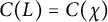 $C(L)=C(\chi )$
. Recall that
 $\Sigma $
is a collection of choices of
 ${\mathbb {Z}}/\ell {\mathbb {Z}}$
-structured
 ${\mathbb {Q}}_q$
-algebras at the places
 $q\in S$
. Similarly, we define for
 $\phi $
to be a collection of choices
 $\phi _q : {\mathbb {Q}}_q \rightarrow {\mathbb {Z}}/\ell {\mathbb {Z}}$
for all the places
 $q \in S$
. We say that
 $\phi $
corresponds to
 $\Sigma $
if each
 $\phi _q$
corresponds to
 $\Sigma _q$
by [Reference Wood10, Lemma 2.6].
2.1 Generating functions
We define the generating functions using the counting function C defined above.

If
 $\phi $
corresponds to
 $\Sigma $
, we have
 $N(s,\Sigma )=N(s,\phi )$
. Without imposing the condition that
 $\chi $
is surjective, we define
 $$ \begin{align*} F(s, \phi)=\sum_{\substack{ \chi:J/{\mathbb{Q}}^{\times} \rightarrow G \\ \forall q \in S \, \chi_q =\phi_q}} \frac{1}{C(\chi)^s}. \end{align*} $$
Since
 $G={\mathbb {Z}}/\ell {\mathbb {Z}}$
, there is only one non-surjective homomorphism
 $\chi $
, and we have
 $N(s,\phi )=F(s,\phi )$
unless
 $\phi _q$
is trivial for all
 $q\in S$
. Hence, our problem reduces to estimating
 $F(s,\phi )$
.
For a finite set S of primes, let
 $J_S$
be the group of ideles which have components in
 ${\mathbb {Z}}_q^{\times }$
for all
 $q \notin S$
and
 $o_S$
be the ring of S-integers in
 ${\mathbb {Q}}$
. From now on, we assume that S contains the prime
 $\ell $
. Let
 $\mathcal {A}:=o_S^{\times }/o_S^{\ell }$
. For a character
 $\chi : J_S \rightarrow G$
, and an
 $a \in \mathcal {A}$
, we define
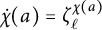 $\dot{\chi }(a)=\zeta _\ell ^{\chi (a)}$
, where
 $\chi (a)$
is evaluated using the natural map
 $o_S^{\times } \rightarrow J_S$
and
 $\zeta _\ell =e^{\frac {2 \pi i }{\ell }}$
. For
 $a \in \mathcal {A}$
, we define
 $$ \begin{align*} F(s, a, \phi)=\sum_{\substack{ \chi:J_S \rightarrow G \\ \forall q \in S \, \chi_q =\phi_q}}\frac{\dot{\chi}(a)}{C(\chi)^s}. \end{align*} $$
Then, by [Reference Wood10, Corollary 2.9], we have
 $$ \begin{align*} F(s,\phi)=\frac{1}{\ell^{|S|}} \sum_{ a \in \mathcal{A}}F(s, a, \phi)=\frac{1}{\ell^{|S|}}\sum_{a\in\mathcal{A}}\prod_{q\notin S}\left(\sum_{\chi_{q}:\mathbb{Z}_{q}^{\times}\rightarrow G}\frac{\dot{\chi_q}(a)}{q^{c(\chi_q)s}}\right)\prod_{q\in S}\frac{\dot{\phi}_{q}(a)}{q^{c(\phi_q)s}}. \end{align*} $$
The second equality in the above comes from the Euler product of
 $F(s,a,\phi )$
in [Reference Wright11, (3.4)]. Therefore, the above equation implies that each
 $F(s,a,\phi )$
gives the information about
 $F(s, \phi )$
.
Let
 $F(s)$
be the generating series without any local condition: that is,
 $$ \begin{align} F(s)=\sum_{\substack{\text{Galois extension } L/\mathbb{Q} \\ \mathrm{Gal}(L/{\mathbb{Q}})\cong G}}\frac{1}{C(L)^{s}}=\frac{1}{\ell-1}\left(1+\frac{\ell-1}{\ell^{2s}}\right)\prod_{p\equiv 1\text{ mod } \ell}\left(1+\frac{\ell-1}{p^{s}}\right)-\frac{1}{\ell-1}. \end{align} $$
Then, we have
 $$ \begin{align*} F(s,1,\phi) &= \prod_{q \notin S} \left( \sum_{\chi_q: \mathbb{Z}_q^\times \rightarrow G} \frac{1}{q^{c(\chi_q)s}} \right) \prod_{q \in S} \frac{1}{q^{c(\phi_q)s}} \\& = \prod_{\substack{q \notin S \\ q\equiv 1 \text{ mod }\ell}} \left( 1 + \frac{\ell-1}{q^s} \right) \prod_{q \in S} \frac{1}{ q^{c(\phi_q)s}} \\ &= (\ell-1)\prod_{q \in S} \left\{ \frac{1}{q^{c(\phi_q)s}}\cdot \frac{1}{F_q(s)}\right\} \cdot \left\{F(s)+\frac{1}{\ell-1}\right\} \end{align*} $$
where
 $$ \begin{align*} F_q(s)=\begin{cases} 1+ \frac{\ell-1}{\ell^{2s}} & \text{ if } q=\ell,\\ 1+ \frac{\ell-1}{q^s} & \text{ if } q\equiv 1 \text{ mod } \ell, \\ 1 & \text{otherwise.} \end{cases} \end{align*} $$
Note that the congruence condition on the primes is due to the fact that there is no non-trivial homomorphism
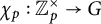 $\chi _p: {\mathbb {Z}}_p^{\times } \rightarrow G$
unless
 $p\equiv 1$
mod
 $\ell $
. Similarly, we have
 $$ \begin{align*} F(s,a, \phi)=\prod_{ \substack{p \notin S \\ p\equiv 1 \text{ mod } \ell }}\left( \sum_{\chi_p: {\mathbb{Z}}_p^{\times} \rightarrow G} \frac{\dot{\chi}_p(a)}{p^{c(\chi_p)s}}\right) \prod_{q \in S}\frac{\dot{\phi}_q(a)}{q^{c(\phi_q)s}} \end{align*} $$
for
 $a\neq 1$
. From above, we see that
 $F(s,1,\phi )$
has a simple pole at
 $s=1$
. We will show that
 $F(s,a,\phi )$
with
 $a\neq 1$
, is essentially a Hecke L-function over the field
 $\mathbb {Q}(\zeta _\ell )$
.
Now, we assume
 $p\equiv 1 \text { mod } \ell $
. Let r be a primitive root modulo p. If
 $k=\mathrm {ind}_{r}a$
and
 $\chi _{p}(r)=m\neq 0$
in
 ${\mathbb {Z}}/\ell {\mathbb {Z}}$
, we have
 $$ \begin{align*} \sum_{\substack{\chi_{p}:\mathbb{Z}_{p}^{\times} \rightarrow G \\ \text{nontrivial}\, \chi_{p}}}\dot{\chi_{p}}(a)=\sum_{m=1}^{\ell-1}\zeta_{\ell}^{mk}=\begin{cases} \ell-1 & \text{ if } \ell \mid k, \\ -1 & \text{ if } \ell \nmid k. \end{cases} \end{align*} $$
Note that
 $\ell \mid k$
means that a is a
 $\ell $
-th power modulo p. Since p is congruent to 1 modulo
 $\ell $
, we have the following identity by using a
 $\ell $
-th power residue symbol:
 $$ \begin{align} \sum_{\substack{\chi_{p}:\mathbb{Z}_{p}^{\times} \rightarrow G \\ \text{nontrivial }\chi_{p}}}\dot{\chi}_{p}(a)=\sum_{\omega\mid p}\left( \frac{a}{\omega}\right)_\ell. \end{align} $$
Here,
 $\omega $
denotes a prime ideal of the ring of the integers of
 $\mathbb {Q}(\zeta _{\ell })$
over p. From (2.2), we can obtain the analytic continuation of
 $F(s,a,\phi )$
for
 $\operatorname {Re}(s)>\frac {1}{2}$
. For convenience, we define a Hecke character
 $\chi _a(\frak {n})$
over
 $\mathbb {Q}(\zeta _\ell )$
by
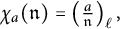 $\chi _a(\frak {n})=\left ( \frac {a}{\frak {n}}\right )_\ell ,$
for any ideal
 $\frak {n}$
coprime to
 $\ell $
.
Lemma 2.1
 $$ \begin{align*} \prod_{ \substack{p \notin S \\ p\equiv 1 \;\mathrm{mod}\;\ell} }\left( \sum_{\chi_p: {\mathbb{Z}}_p^{\times} \rightarrow G} \frac{\dot{\chi}_p(a)}{p^{c(\chi_p)s}}\right)=L(s,\chi_a) \times H(s), \end{align*} $$
where
 $H(s)$
is a Dirichlet series which converges absolutely for
 $\operatorname {Re}(s)> \frac {1}{2}$
.
Proof Note that a prime
 $p\neq 2$
is totally split in
 ${\mathbb {Q}}(\zeta _{\ell })$
precisely when
 $p\equiv 1 \text { mod } \ell $
. Therefore,
 $$ \begin{align*} & \prod_{\substack{p \notin S \\ p\equiv 1 \text{ mod }\ell}}\left( \sum_{\chi_p: {\mathbb{Z}}_p^{\times} \rightarrow G} \frac{\dot{\chi}_p(a)}{p^{c(\chi_p)s}}\right) \\ &\quad =\prod_{\substack{p \notin S \\ p\equiv 1 \text{ mod } \ell}}\prod_{\omega \mid p}\left(1-\frac{\chi_{a}(\omega)}{N{\omega}^{s}}\right)^{-1}\times H_{1}(s)\\ &\quad =L(s,\chi_a) \times \prod_{p\not\equiv1\text{ mod }\ell}\prod_{\omega\mid p}\left(1-\frac{\chi_{a}(\omega)}{p^{f_{p}s}}\right) \times\prod_{\substack{p \in S \\ p \equiv 1 \text{ mod } \ell}}\prod_{\omega \mid p}\left(1-\frac{\chi_{a}(\omega)}{p^{s}}\right) \times H_1(s)\\ &\quad = L(s,\chi_a) \times \prod_{p\not\equiv1\text{ mod } \ell}\prod_{\omega\mid p}\left(1+O\left(\frac{1}{p^{2s}}\right)\right) \times \prod_{\substack{p \in S \\ p \equiv 1 \text{ mod } \ell}}\prod_{\omega \mid p}\left(1-\frac{\chi_{a}(\omega)}{p^{s}}\right) \times H_1(s)\\ & \quad = L(s,\chi_a) \times H(s), \end{align*} $$
where
 $H_{1}(s)$
and
 $H(s)$
are absolutely convergent series for
 $\operatorname {Re}(s)>\frac {1}{2}$
.
Hence, Lemma 2.1 implies that
 $F(s,a,\phi )$
has a simple pole at
 $s=1$
when
 $a=1$
, and is analytic otherwise. Next, let L be the splitting field of
 $x^\ell -a$
over
 $K=\mathbb {Q}(\zeta _\ell )$
. The conductor of the Hecke character
 $\chi _a(\frak {n})$
is that of the conductor of the abelian extension
 $L/K$
.
Lemma 2.2 Let L is the splitting field of
 $x^\ell -a$
over
 $K=\mathbb {Q}(\zeta _\ell )$
. Then, the conductor of
 $L/K$
is
 $$ \begin{align*} \frak{l}^2 \prod_{ \substack{ \nu | a \\ \nu\neq \frak{l}}} \nu, \end{align*} $$
where
 $\frak {l}$
and
 $\nu $
are prime ideals of the ring of integers of
 $\mathbb {Q}(\zeta _{\ell })$
lying over
 $\ell $
and a, respectively.
Proof The abelian extension
 $L/K$
has
 $\ell -1$
primitive Hecke characters of order
 $\ell $
whose conductors are equal to the conductor of the extension
 $L/K$
. The conductor has the prime ideals which are the divisors of
 $\ell \dot a$
because
 $x^\ell -a\equiv x^\ell $
modulo the prime ideal
 $\nu $
dividing a and
 $\ell x^{\ell -1}\equiv 0$
modulo
 $\frak {l}$
which is the only prime ideal lying over the prime number
 $\ell $
. If
 $\nu \neq \frak {l}$
,
 $\nu $
is tamely ramified, hence its exponent in the conductor is one. It is left to determine the exponent of
 $\frak {l}$
. Since
 $$ \begin{align*}O_{\frak{l}}^{\times}/(1+\pi_{\frak{l}}^2O_{\frak{l}}) \cong (\mathbb{Z}/\ell^2\mathbb{Z})^{\times} \cong \mathbb{Z}/(\ell-1)\mathbb{Z} \times \mathbb{Z}/\ell\mathbb{Z} ,\end{align*} $$
there is a primitive
 $\ell $
-th order Hecke character with conductor
 $\frak {l}^2$
. Hence, exponent of
 $\frak {l}$
in the conductor is two.
Under GRH, by Lemmas 2.1 and 2.2, we have
 $$ \begin{align*} F\left(\frac{1}{2}+\epsilon +it,a,\phi \right) &\ll_{\ell,\epsilon} \left[\prod_{q \in S}\frac{1}{q^{c(\phi_{q})(\frac{1}{2}+\epsilon)}}\right]\bigg|L\left(\frac{1}{2}+\epsilon+it,\chi_{a}\right)H\left(\frac{1}{2}+\epsilon+it\right)\bigg|\\ &\ll_{\ell,\epsilon} 2^{|S|}(a\dot(1+|t|))^{\epsilon}\text{ for all } a \in \mathcal{A}. \end{align*} $$
This implies that
 $$ \begin{align*} \frac{1}{2 \pi i} \int_{1/2+\epsilon-iT}^{1/2+\epsilon +iT} F(s,a, \phi) X^s \frac{ds}{s} \ll_{\ell,\epsilon} 2^{|S|} \left( a \dot T \right)^{\epsilon} X^{\frac{1}{2}+\epsilon}. \end{align*} $$
Recall that
 $$ \begin{align*} F(s,\phi)=\frac{1}{|\mathcal{A}|} \sum_{ a \in \mathcal{A}}F(s, a, \phi). \end{align*} $$
Hence,
 $$ \begin{align*} \frac{1}{2 \pi i} \int_{1/2+\epsilon-iT}^{1/2+\epsilon+iT}F(s, \phi)X^s \frac{ds}{s} &= \frac{1}{|\mathcal{A}|} \sum_{a \in \mathcal{A}} \frac{1}{2 \pi i} \int_{1/2+\epsilon-iT}^{1/2+\epsilon+iT} F(s, a, \phi)X^s \frac{ds}{s} \\ &\ll_{\ell,\epsilon} 2^{|S|}\cdot \left( \prod_{p \in S} p \cdot T \right)^{\epsilon} X^{\frac{1}{2}+\epsilon}. \end{align*} $$
In general case, by [Reference Söhne9], we have
 $$ \begin{align*} L\left( \frac 12+\epsilon+it, \chi_a \right) \ll_{\ell,\epsilon} \left( \prod_{p \in S} p (1+|t|) \right)^{\frac {\ell-1}{6} +\epsilon} + \left( \prod_{p\in S} p \right)^{\frac{\ell-1}{4}}. \end{align*} $$
Therefore, we have
 $$ \begin{align*} \frac{1}{2 \pi i} \int_{1/2+\epsilon-iT}^{1/2+\epsilon+iT}F(s, \phi)X^s \frac{ds}{s} \ll_{\ell,\epsilon} 2^{|S|} X^{\frac{1}{2}+\epsilon} \left [\left( \prod_{p\in S} p \dot T \right)^{\frac{\ell-1}{6}+\epsilon} + \left( \prod_{p\in S} p \right)^{\frac{\ell-1}{4}} \log T\right] \end{align*} $$
unconditionally.
2.2 Proof of Theorem 1.1
Let
 $F(s, \phi )=\sum _{n=1}^\infty \frac {a(n,\phi )}{n^s}$
. Then, the summatory function
 $S(\phi , X)=\sum _{ n \leq X} a(n,\phi )$
is the number of
 ${\mathbb {Z}}/\ell {\mathbb {Z}}$
-extensions L with conductors
 $f(L) \leq X$
and the local conditions corresponding to
 $\phi $
are satisfied. Each cyclic extension L corresponds to
 $(\ell -1)$
 ${\mathbb {Z}}/\ell {\mathbb {Z}}$
-extensions by choosing an isomorphism of
 $\mathbb {Z}/\ell \mathbb {Z}$
onto Galois group
 $\mathrm {Gal}(L/\mathbb {Q})$
. Therefore, the number of cyclic extensions L of degree
 $\ell $
with conductors
 $f(L) \leq X$
and the local conditions corresponding to
 $\phi $
is
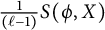 $\frac {1}{(\ell -1)}S(\phi ,X)$
.
By Perron’s formula,
 $$ \begin{align*} \frac{1}{(\ell-1)}S(\phi,X)&= \frac{1}{(\ell-1)}\cdot \frac{1}{2\pi i} \int_{1+\epsilon-iT}^{1+\epsilon+iT}F(s, \phi )\frac{X^s}{s}ds+ O_{\ell,\epsilon}\left(\frac{X^{1+\epsilon}}{T} \right) \end{align*} $$
and
 $$ \begin{align*} & \frac{1}{2\pi i} \int_{1+\epsilon-iT}^{1+\epsilon+iT}F(s,\phi)\frac{X^s}{s}ds \\ &\quad =\mathrm{Res}_{s=1}(F(s,\phi))X +\frac{1}{2\pi i} \left[ \int_{1/2+\epsilon-iT}^{1/2+\epsilon+iT}+\int_{1/2+\epsilon+iT}^{1+\epsilon+iT}+ \int_{1+\epsilon-iT}^{1/2+\epsilon-iT}\right]F(s,\phi)\frac{X^s}{s}ds. \end{align*} $$
Therefore, we have
 $$ \begin{align*} \frac{1}{(\ell-1)}S(\phi,X)=\frac{1}{(\ell-1)} \text{Res}_{s=1}(F(s,\phi))X+ O_{\ell,\epsilon}\left(2^{|S|}( \prod_{ p\in S} p\dot T)^{\epsilon}X^{\frac{1}{2}+\epsilon} +\frac{X^{1+\epsilon}}{T} \right) \end{align*} $$
under GRH. Since
 $$ \begin{align*} F(s,1,\phi) &= \prod_{\substack{p \notin S \\ p\equiv 1 \text{ mod $\ell$}}} \left( 1 + \frac{\ell-1}{p^s} \right) \prod_{q \in S} \frac{1}{ q^{c(\phi_q)s}} \\ &= (\ell-1)\prod_{q \in S}\frac{1}{q^{c(\phi_q)s}\cdot F_q(s)} \cdot \left\{ F(s) +\frac{1}{\ell-1} \right\}, \end{align*} $$
and
 $F(s,a,\phi )$
is analytic for
 $\operatorname {Re}(s)>\frac {1}{2}$
when
 $a \neq 1$
, we get
 $$ \begin{align*} \text{Res}_{s=1}F(s,\phi)=\frac{\ell-1}{\ell^{|S|}}\prod_{q\in S} \frac{1}{q^{c(\phi_q)}F_q(1)} \cdot\text{Res}_{s=1}F(s). \end{align*} $$
Hence, by taking
 $T=X^{\frac {1}{2}}$
, we have
 $$ \begin{align} \frac{1}{(\ell-1)}S(\phi,X)= \frac{1}{\ell^{|S|}}\prod_{q\in S} \frac{1}{q^{c(\phi_q)}F_q(1)} \mathfrak{C}_\ell X+ O_{\ell,\epsilon}\left( 2^{|S|}(\prod_{p \in S} p)^\epsilon X^{\frac{1}{2}+\epsilon} \right). \end{align} $$
Unconditionally, we can take
 $T=X^{\frac {3}{\ell +5}}$
. Then,
 $$ \begin{align*} \frac{1}{(\ell-1)}S(\phi,X)&= \frac{1}{\ell^{|S|}}\prod_{q\in S} \frac{1}{q^{c(\phi_q)}F_q(1)} \mathfrak{C}_\ell X \\ &\quad + O_{\ell,\epsilon} \left( 2^{|S|}(\prod_{p \in S}p)^{ \frac{\ell-1}{6} + \epsilon} X^{\frac{\ell+2}{\ell+5}+\epsilon} + 2^{|S|}(\prod_{p \in S}p)^{\frac{\ell-1}{4}}X^{\frac{1}{2}+\epsilon}\right). \end{align*} $$
Now, we want to count cyclic extensions of degree
 $\ell $
with a finite number of local conditions. From (2.3), we define the probabilities of the local conditions.
 $$ \begin{align} \left|TR_q \right|=\begin{cases} \frac{\ell-1}{\ell^2+\ell-1} & \text{ if } q=\ell,\\ \frac{\ell-1}{q+\ell-1} & \text{ if } q\equiv 1 \text{ mod } \ell, \\ 0 & \text{otherwise,} \end{cases} \quad \left|TS_q \right|=\begin{cases} \frac{\ell}{\ell^2+\ell-1} & \text{ if } q=\ell,\\ \frac{q}{\ell(q+\ell-1)} & \text{ if } q\equiv 1 \text{ mod } \ell, \\ \frac{1}{\ell} & \text{otherwise,} \end{cases} \end{align} $$
and
 $\left |IN_q\right |=(\ell -1)\left |TS_q \right |$
because if the prime q is inert in a cyclic extension L of degree
 $\ell $
,
 $L_q$
are isomorphic to one of the
 $(\ell -1)$
G-structured
 $\mathbb {Q}_p$
algebras (See [Reference Wood10, Corollary 2.3]). Note that
 $\left |TR_q \right |=1-\left |IN_q\right |-\left |TS_q \right |$
for every p, and this observation indicates that (2.4) are well-defined as the probabilities.
Proof of Theorem 1.1
Since the approaches for (1) and (2) in Theorem 1.1 are the same, we only give a proof of (1) here. First, we assume that the local condition
 $\Sigma _q$
at each prime
 $q\in S$
is either
 $\text {IN}_q$
or
 $\text {TS}_q$
. Let
 $I_{S}$
be the number of indexes i such that
 $LC_{q_i}=IN_{q_i}$
. Since there are
 $(\ell -1)^{I_S}$
 $\phi $
’s which covers the set
 $\mathcal {LC}_{S}$
of local conditions and
 $c(\phi _q)=0$
for those local conditions, we have
 $$ \begin{align} N({\mathbb{Z}}/\ell{\mathbb{Z}}, X, \mathcal{LC}_{S}) =\prod_{q \in S} |LC_q|\mathfrak{C}_\ell X+O\left( 2^k \dot (\ell-1)^{I_S} \dot (\prod_{ q_i \in S} q_i)^\epsilon X^{\frac{1}{2}+\epsilon} \right). \end{align} $$
Now, we assume that for some q,
 $LC_q=TR_q$
. Without loss of generality, we can assume that there is an integer
 $j < k$
such that
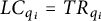 $LC_{q_i}=TR_{q_i}$
for all
 $i>j$
. Define
 $\mathcal {LC}_j=\{LC_{q_1}, LC_{q_2}, \dots , LC_{q_j}\}$
and
 $\text {R}(\mathcal {LC}) = \{ j+1, j+2, \dots , k \}$
. Further, for a subset A of
 $\text {R}(\mathcal {LC})$
, we define
 $$ \begin{align*} \mathcal{LC}_A=\{ TS_{q_i}+IN_{q_i} | i \in A \}, \end{align*} $$
where
 $ TS_{q_i}+IN_{q_i}$
is a local condition that the prime
 $p_i$
ought to be split or inert. Then, by (2.5), we have
 $$ \begin{align*} N({\mathbb{Z}}/\ell{\mathbb{Z}}, X, \mathcal{LC})&= \sum_{A \subset \text{R}(\mathcal{LC})} (-1)^{|A|}N({\mathbb{Z}}/\ell{\mathbb{Z}}, X, \mathcal{LC}_j \cup \mathcal{LC}_A) \\ &= \prod_{q \in S} |LC_q|\mathfrak{C}_\ell X + \left( 2^{|\mathcal{LC}|} (\ell-1)^{I_S} (\ell+1)^{R_S} (\prod_{ q_i \in S} q_i)^\epsilon \dot X^{\frac{1}{2}+\epsilon} \right). \end{align*} $$
The proof of the unconditional result is identical to that of the conditional result.
3 L-values in the critical strip
3.1 Moments of Dirichlet L-values
$L(s,\chi )$

Let s be a complex number with
 $\operatorname {Re}(s)> \frac {1}{2}$
, and m be a positive integer. In this section, we compute the m-th moment of L-values
 $L(s, \chi )$
under GRH. First, we obtain the average value of Dirichlet characters.
Lemma 3.1 Let
 $n=p_1^{e_1}p_2^{e_2}\dots p_k^{e_k}$
. We have
 $$ \begin{align} & \sum_{\chi \in D_\ell(X)} \chi(n) = (\ell-1)\cdot J(n) \cdot \prod_{i=1}^k \ell |TS_{p_i}|\cdot \frak{C}_\ell X \\&\quad +\begin{cases}O_{\epsilon,\ell} \left( (2\ell)^k \cdot \prod_{i=1}^k p_i^\epsilon \cdot X^{\frac 12+\epsilon} \right) & \text{under GRH,} \\O_{\epsilon, \ell}\left( (2\ell)^k \left[ \prod_{i=1}^k p_i^{\frac{\ell-1}{6}+\epsilon} \cdot X^{\frac{\ell+2}{\ell+5} + \epsilon} + \prod_{i=1}^k p_i^{\frac{\ell-1}{4}} \cdot X^{\frac{1}{2}+\epsilon} \right] \right) & \text{unconditionally,} \nonumber \end{cases} \end{align} $$
where
 $J(n)$
is
 $1$
if n is a
 $\ell $
-th power full, and zero otherwise.
Proof Let
 $\chi _L$
be a primitive Dirichlet character corresponding to a field L. Suppose that primes
 $p_1,p_2, \dots ,p_k$
are unramified in the field L. If
 ${\chi _L(n){\kern-1pt}={\kern-1pt}\chi _L(p_1^{e_1}p_2^{e_2}\dots p_k^{e_k}){\kern-1pt}={\kern-1pt}1}$
, then
 $\sum _{j=1}^{\ell -1}\chi _L^j(p_1^{e_1}p_2^{e_2}\dots p_k^{e_k})=(\ell -1)$
and it becomes
 $-1$
otherwise. We need to determine exactly when
 $\chi _L(n)$
becomes one. Let
 $I=\{ i : \ell \mid e_i \}$
and
 $J=\{ j : \ell \nmid e_j \}$
. If J is empty, the values
 $\chi (n)$
are always one. There are, under GRH,
 $$ \begin{align*} \prod_{i=1}^k \ell|TS_{p_i}|\cdot \frak{C}_\ell X+O_\epsilon \left( (2\ell)^k \cdot \prod_{i=1}^k p_i^\epsilon \cdot X^{\frac 12+\epsilon} \right) \end{align*} $$
extensions L with the primes
 $p_1,p_2,\dots ,p_k$
unramified. Since each field corresponds to
 $(\ell -1)$
characters, in this case, we have
 $$ \begin{align*} \sum_{\chi \in D_\ell(X)} \chi(n)= (\ell-1)\prod_{i=1}^k \ell|TS_{p_i}|\frak{C}_\ell X+ O_{\epsilon,\ell} \left( (2\ell)^k \dot \prod_{i=1}^k p_i^\epsilon \dot X^{\frac 12+\epsilon} \right). \end{align*} $$
When J is non-empty,
 $$ \begin{align*}\chi_L( p_1^{e_1}p_2^{e_2}\dots p_m^{e_m}p_{m+1}^{e_{m+1}} \dots p_k^{e_k}) = \prod_{j \in J }\chi_L(p_j)^{e_j}=\prod_{m \in J }\zeta_j^{a_j\dot e_j} \end{align*} $$
for some
 $0 \leq a_j \leq (\ell -1).$
The number of combinations
 $(a_{j})_{j \in J }$
with
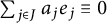 $\sum _{j \in J }a_{j}e_{j} \equiv 0$
mod
 $\ell $
is
 $\ell ^{|J |-1}$
, and the number of
 $(a_{j})_{j \in J }$
with
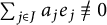 $\sum _{j \in J }a_{j}e_{j} \not \equiv 0$
mod
 $\ell $
is
 $(\ell -1)\ell ^{|J |-1}$
. We note that the choice of
 $a_j$
is the choice of
 $\Sigma _{p_j}$
at the place
 $p_j$
.
With the observations above, we count number fields L with
 $f(L)\leq X$
and
 $\chi _L(n)=1.$
The main term of the number of such fields is
 $$ \begin{align*} \left( \prod_{i \in I} \ell|TS_{p_i}| \right) \left( \frac{1}{\ell}\prod_{j \in J}\ell|TS_{p_j} | \right)\frak{C}_\ell X=\left( \frac{1}{\ell} \right) \left( \prod_{i \in I} \ell|TS_{p_i}| \right) \left( \prod_{j \in J}\ell|TS_{p_j} | \right)\frak{C}_\ell X. \end{align*} $$
Since each such L has
 $(\ell -1)$
characters
 $\chi _L$
with
 $\chi _L(n)=1$
, the main term of contribution from such fields L is
 $$ \begin{align} \left( \frac{\ell-1}{\ell} \right)\left( \prod_{i \in I} \ell|TS_{p_i}| \right) \left( \prod_{j \in J}\ell|TS_{p_j} | \right) \frak{C}_\ell X. \end{align} $$
By a similar argument, the main of the number of fields L with
 $\chi _L(n) \neq 1$
is
 $$ \begin{align*} \left( \prod_{i \in I} \ell|TS_{p_i}| \right) \left( \frac{\ell-1}{\ell}\prod_{j \in J}\ell|TS_{p_j} | \right)\frak{C}_\ell X = \left( \frac{\ell-1}{\ell} \right) \prod_{i \in I} \ell|TS_{p_i}| \prod_{j \in J} \ell|TS_{p_j}|\frak{C}_\ell X. \end{align*} $$
Since
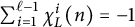 $\sum _{i=1}^{\ell -1}\chi _L^i(n)=-1$
for such a field L, the main term of contribution from such fields L is
 $$ \begin{align} -\left( \frac{\ell-1}{\ell} \right) \prod_{i \in I} \ell|TS_{p_i}| \prod_{j \in J} \ell|TS_{p_j}|\frak{C}_\ell X. \end{align} $$
Finally, the sum of (3.2) and (3.3) gives zero.
It is clear that the error term is
 $O_{\ell ,\epsilon }\left ( (2\ell )^k \dot \prod _{i=1}^k p_i^\epsilon \dot X^{\frac 12 + \epsilon } \right )$
under GRH and
 $O_{\ell ,\epsilon }\left ( (2\ell )^k \left [ \prod _{i=1}^k p_i^{\frac {\ell -1}{6}+\epsilon } \dot X^{\frac {\ell +2}{\ell +5} + \epsilon } + \prod _{i=1}^k p_i^{\frac {\ell -1}{4}} \dot X^{\frac {1}{2}+\epsilon } \right ] \right )$
unconditionally.
In what follows, we assume GRH.
Proposition 3.2 Assume GRH. Let
 $s=1/2+\delta +it$
for
 $0 < \delta \leq 1/2$
, and m be a positive integer. For a sufficiently small
 $\epsilon>0$
, we have
 $$ \begin{align*} L^m(s,\chi)&=\sum_{ n \leq X^{\frac{2\epsilon}{\delta}}} \frac{\tau_m(n)\chi(n)}{n^s }+O_{\epsilon,t}\left( \frac{1}{\log X}\right) \end{align*} $$
for any Dirichlet character
 $\chi $
. Here,
 $\tau _m(n)$
is the m-fold divisor function.
Proof Let
 $x=X^{\frac {2\epsilon }{\delta }}$
. By the standard Perron argument, we have
 $$ \begin{align*} \sum_{n<x}\frac{\tau_m(n)\chi(n)}{n^s} = \frac{1}{2 \pi i}\int_{\alpha-iT}^{\alpha+iT}L^m(s+z,\chi)\frac{x^{z}}{z}dz+ O_\epsilon\left( \frac{x^{\alpha + \frac{\epsilon}{2}}}{T} \right), \end{align*} $$
where
 $\operatorname {Re}(s)+ \alpha =1 + \frac {1}{\log X}$
. On the other hand, for some constant a in the range
 $1/2 < a + \operatorname {Re}(s) <1 $
,
 $$ \begin{align*} &\frac{1}{2 \pi i}\int_{\alpha-iT}^{\alpha+iT}L^m(s+z, \chi)\frac{x^{z}}{z}dz\\ &\quad = L^m(s,\chi) + \frac{1}{2 \pi i} \left[ \int_{\alpha-iT}^{a-iT} L^m(s+z, \chi)\frac{x^{z}}{z}dz+ \int_{a-iT}^{a +iT}L^m(s+z, \chi)\frac{x^z}{z}dz \right.\\ &\qquad \left. + \int_{a+iT}^{\alpha+iT} L^m(s+z, \chi)\frac{x^z}{z}dz \right]. \end{align*} $$
Let
 $f(\chi )$
be the conductor of
 $\chi $
. Under GRH, we have
 $$ \begin{align} L^m(\beta + it, \chi) \ll_\epsilon \left[ |f(\chi)|(1+|t|)\right]^\epsilon \end{align} $$
for
 $\frac 12 \leq \beta < 1$
, and (3.4) implies
 $$ \begin{align*} \int_{a-iT}^{a +iT}L^m(s+z, \chi )\frac{x^z}{z}dz \ll_{\epsilon,t} (X T) ^{\epsilon} x^a. \end{align*} $$
Also, it is easy to show that, again by (3.4),
 $$ \begin{align*} \int_{\alpha-iT}^{a-iT} L^m(s+z, \chi)\frac{x^z}{z}dz, \, \int_{a+iT}^{\alpha+iT} L^m(s+z, \chi)\frac{x^z}{z}dz \ll_{\epsilon,t} \frac{(XT)^{\epsilon} x^{\alpha}}{T}. \end{align*} $$
Therefore, by taking
 $T=x^{\frac {1}{2}-\delta +2\epsilon }$
,
 $a=-(1-\epsilon )\delta $
, we obtain the claim.
Now we compute the average value of the main term in Proposition 3.2.
 $$ \begin{align*} &\frac{1}{N_\ell(X)}\sum_{\chi \in D_\ell(X)} \sum_{n \leq X^{\frac{2\epsilon}{\delta}}}\frac{\tau_m(n)\chi(n)}{n^s }=\frac{1}{N_\ell(X)}\sum_{n \leq X^{\frac{2\epsilon}{\delta}}} \frac{\tau_m(n)}{n^s}\sum_{\chi \in D_\ell(X)} \chi(n)\\ &=\sum_{ (p_1^{e_1}\dots p_k^{e_k})^\ell \leq X^{\frac{2\epsilon}{\delta}}} \prod_{i=1}^k \frac{\ell|TS_{p_i}|\tau_m(p_i^{e_i})}{p_i^{e_i \ell s}} + O_{\epsilon,\ell}\left( X^{-\frac 12 + \epsilon} \sum_{n \leq X^{\frac{2\epsilon}{\delta}}}(2\ell)^{\omega(n)}\frac{\tau_m(n)}{n^{\frac{1}{2}+\delta}} n^\epsilon \right), \end{align*} $$
where we applied Lemma 3.1 for the second equality. Let
 $\omega (n)$
be the number of distinct prime divisors of a natural number n, which is bounded by
 $\frac {3\log n}{\log \log n}$
. Also note that
 $\tau _m(n)$
is the n-th coefficient of
 $\zeta (s)^m$
and
 $\zeta (s)^m$
has a pole of order m at
 $s=1$
. Then, we have
 $\sum _{ n < M}\tau _m(n) \sim \ C_m M \log ^{m-1} M$
for some positive constant
 $C_m$
by Tauberian Theorem. From these, we have
 $$ \begin{align*} X^{-\frac 12 + \epsilon} \sum_{n \leq X^{\frac{2\epsilon}{\delta}}}(2\ell)^{\omega(n)}\frac{\tau_m(n)}{n^{\frac{1}{2}+\delta}} n^\epsilon \ll_m \frac{\epsilon}{\delta} \log X \dot X^{-\frac 12 + \epsilon + \frac{2\epsilon}{\delta}\left(\frac 12 -\delta +\epsilon \right)} \dot X^{\frac{\frac{6\epsilon}{\delta}\log (2\ell)}{\log\log X}}, \end{align*} $$
which vanishes as X increases by taking
 $\epsilon $
sufficiently small compared to
 $\delta $
. Since
 $$ \begin{align*} \sum_{n=1}^\infty \frac{\tau_m(n^\ell)}{n^{\ell(1/2+\delta)}} \ll_\epsilon \sum_{n=1}^\infty \frac{n^{\ell(m-1)\epsilon}}{n^{\ell(1/2+\delta)}} \ll_\epsilon 1 \end{align*} $$
converges absolutely, we can obtain Theorem 1.2.
3.2 Moments of Artin L-values
$L(\sigma ,\rho _L)$

For any
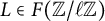 $L\in F({\mathbb {Z}}/\ell {\mathbb {Z}})$
, we define the following Artin L-function and its m-th power.
 $$ \begin{align*} L(s,\rho_L)=\zeta_L(s)/\zeta(s), \quad L^m(s,\rho_{L})=\sum_{n=1}^\infty \frac{\lambda_{m,L}(n)}{n^s}. \end{align*} $$
The Dirichlet coefficients
 $\lambda _{m,L}(p^e)$
is also determined by the prime decomposition of p in L as follows.
 $$ \begin{align} \begin{array}{c|c|c} \text{Splitting type} & p\mathcal O_{L} &\lambda_{m,L}(p^e)\\ \hline TS & \frak{p}_1\frak{p}_2\frak{p}_3 \dots \frak{p}_{\ell-1} & \tau_{(\ell-1)m}(e) \\ IN &\frak{p}_1 &\beta_{m,e} \\ TR &\frak{p}_1^{\ell-1} &0 \\ \end{array} \end{align} $$
Here,
 $\tau _{m}(e)=\sum _{e_1+e_2+\dots +e_{m}=e}1$
,
 $\beta _{m,e}=\sum _{e_1+e_2+\dots +e_m=e}\beta _{e_1}\beta _{e_2}\dots \beta _{e_m}$
and
 $$ \begin{align*} \beta_e=\begin{cases} -1 & \text{ if } e\equiv 1 \text{ mod } \ell, \\ 0 & \text{ if } e\equiv 2,3,\dots, \ell-1 \text{ mod } \ell, \\ 1 & \text{ if } e\equiv 0 \text{ mod } \ell. \end{cases} \end{align*} $$
Using the table (3.5) and Theorem 1.1, we can show the following lemma.
Lemma 3.3 Let
 $n=p_1^{e_1}p_2^{e_2}\dots p_{k}^{e_k}$
and
 $\delta>0$
. Under GRH, we have
 $$ \begin{align*} & \frac{1}{ N({\mathbb{Z}}/\ell {\mathbb{Z}},X)}\sum_{ L \in F({\mathbb{Z}}/\ell{\mathbb{Z}},X)} \frac{\lambda_{m,L}(n)}{n^{\frac{1}{2}+\delta} } \\ &\quad =\prod_{i=1}^k\frac{g_m(p_i,e_i)}{\left(p_i^{e_i}\right)^{\frac{1}{2}+\delta}} + O_{\epsilon}\left( (4\ell)^k \prod_{i=1}^k \tau_{(\ell-1)m}(e_i) p_i^{\epsilon-e_i(1/2+\delta)} \dot X^{-\frac 12 +\epsilon} \right) , \end{align*} $$
where
 $g_m(p,e)=\tau _{(\ell -1)m}(e)|TS_p| + \beta _{m,e}|IN_p|$
and
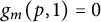 $g_m(p,1)=0$
.
Proof We observe that
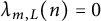 ${\lambda }_{m,L}(n)=0$
unless all of
 $p_i$
are unramified in L. For any local conditions
 $\mathcal {LC}=\{LC_{p_i}\mid LC_{p_i}\in \{TS_{p_i},IN_{p_i}\}\}$
on
 $\{p_i\}_{1\leq i\leq k}$
, let
 $F({\mathbb {Z}}/\ell {\mathbb {Z}},X,\mathcal {LC})$
be the set of
 $L\in F({\mathbb {Z}}/\ell {\mathbb {Z}},X)$
which satisfies all the local conditions in
 $\mathcal {LC}$
. Then, by Theorem 1.1, we have
 $$ \begin{align*} &\frac{1}{N({\mathbb{Z}}/\ell{\mathbb{Z}},X)}\sum_{ L \in F({\mathbb{Z}}/\ell{\mathbb{Z}},X)} \frac{\lambda_{m,L}(n)}{n^{\frac{1}{2}+\delta} } \\ &\quad =\frac{1}{N({\mathbb{Z}}/\ell{\mathbb{Z}},X)}\sum_{\mathcal{LC}}\sum_{L\in F({\mathbb{Z}}/\ell{\mathbb{Z}},X,\mathcal{LC})}\frac{\lambda_{m,L}(p_1^{e_1}p_2^{e_2}\dots p_k^{e_k})}{(p_1^{e_1}p_2^{e_2}\dots p_k^{e_k})^{\frac{1}{2}+\delta} }\\ & \quad =\prod_{i=1}^k\frac{g_m(p_i,e_i)}{\left(p_i^{e_i}\right)^{\frac{1}{2}+\delta}}+ O_{\ell.\epsilon}\bigg((4\ell)^{k}\prod_{i=1}^{k}\tau_{(\ell-1)m}(e_i)p_{i}^{\epsilon-e_i(1/2+\delta)}\dot X^{-\frac{1}{2}+ \epsilon}\bigg) \end{align*} $$
under GRH.
Using Perron’s formula, we can express
 $L^m(1/2+\delta ,\rho _{L})$
for
 $0<\delta \leq 1/2$
as a short finite sum.
Proposition 3.4 Assume GRH. Let
 $0 < \delta \leq 1/2$
, and m be a positive integer. For a sufficiently small
 $\epsilon>0$
, we have
 $$ \begin{align*} L^m\left(\frac{1}{2}+\delta,\rho_L\right)=\sum_{ n \leq X^{\frac{2\epsilon}{\delta}}} \frac{\lambda_{m,L}(n)}{n^{\frac{1}{2}+\delta} }+O_{\epsilon}\left( \frac{1}{\log X}\right). \end{align*} $$
Proof Let
 $x=X^{\frac {2\epsilon }{\delta }}$
. By the standard Perron argument, we have
 $$ \begin{align*} \sum_{n<x}\frac{\lambda_{L,m}(n)}{n^{\frac{1}{2}+\delta}} = \frac{1}{2 \pi i}\int_{\alpha-iT}^{\alpha+iT}L^m\Big(\frac{1}{2}+\delta+s,\rho_L\Big)\frac{x^s}{s}ds+ O_\epsilon\left( \frac{x^{\alpha + \frac{\epsilon}{2}}}{T} \right), \end{align*} $$
where
 $\frac {1}{2}+\delta + \alpha =1 + \frac {1}{\log x}$
. On the other hand, for some constant a in the range
 $1/2 < \frac {1}{2}+\delta +a <1 $
,
 $$ \begin{align*} &\frac{1}{2 \pi i}\int_{\alpha-iT}^{\alpha+iT}L^m \left(\frac{1}{2}+\delta+s, \rho_L\right)\frac{x^s}{s}ds \\ &\quad = L^m \left(\frac{1}{2}+\delta, \rho_L\right) + \frac{1}{2 \pi i} \left[ \int_{\alpha-iT}^{a-iT} L^m\left(\frac{1}{2}+\delta+s, \rho_L\right)\frac{x^s}{s}ds \right. \\ &\qquad \left. + \int_{a-iT}^{a +iT}L^m\left(\frac{1}{2}+\delta+s, \rho_L\right)\frac{x^s}{s}ds + \int_{a+iT}^{\alpha+iT} L^m\left(\frac{1}{2}+\delta+s, \rho_L\right)\frac{x^s}{s}ds \right]. \end{align*} $$
Using (3.4), we have
 $$ \begin{align*} \int_{a-iT}^{a +iT}L^m\left(\frac{1}{2}+\delta+s, \rho_L\right)\frac{x^s}{s}ds \ll_\epsilon (X T) ^{\epsilon} x^a \end{align*} $$
and
 $$ \begin{align*} \int_{\alpha-iT}^{a-iT} L^m\left(\frac{1}{2}+\delta+s, \rho_L\right)\frac{x^s}{s}ds, \, \int_{a+iT}^{\alpha+iT} L^m\left(\frac{1}{2}+\delta+s, \rho_L\right)\frac{x^s}{s}ds \ll_\epsilon \frac{(XT)^{\epsilon} x^{\alpha}}{T}. \end{align*} $$
Finally, we take
 $T=x^{\frac {1}{2}-\delta +2\epsilon }$
and
 $a=-(1-\epsilon )\delta $
. If
 $\epsilon $
is sufficiently small compared to
 $\delta $
, the error terms vanish, and our claim follows.
Proof of Theorem 1.3
By Proposition 3.4, it is enough to check that the contribution of the error term in Lemma 3.3 vanishes. Let
 $\sigma =1/2+\delta $
. The contribution is
 $$ \begin{align*} \ll_\epsilon X^{-\frac{1}{2}+ \epsilon}\sum_{ n < X^{\frac{2\epsilon}{\delta}}} (4\ell)^{\omega(n)} n^{\epsilon -1/2-\delta} \ll_\epsilon X^{-\frac{1}{2}+ \epsilon} \dot X^{\frac{\frac{6\epsilon}{\delta}\log(4\ell)}{\log\log X}} \dot X^{\frac{2\epsilon^2}{\delta}+\frac{\epsilon}{\delta}-2\epsilon}, \end{align*} $$
which vanishes as X increases by choosing sufficiently small
 $\epsilon $
.
3.3 Unconditional results
Even without assuming GRH, we can give some unconditional results on the line
 $\operatorname {Re}(s)=1$
. From the previous sections, we can see that it is enough to have the lemmas below to prove Theorems 1.6 and 1.7.
Lemma 3.5 Let
 $\chi $
be a primitive Dirichlet character with the conductor
 $f(\chi ) \leq X$
, and
 $s=1+it$
be a complex number. For sufficiently small
 $\epsilon>0$
, we have
 $$ \begin{align*} L(s,\chi)=\sum_{n < X^{\frac{1}{3}+\epsilon}} \frac{\chi(n)}{n^{s}}+o_t(1). \end{align*} $$
Proof By the standard Perron argument, we have
 $$ \begin{align*} \sum_{n<x}\frac{\chi(n)}{n^{s}} = \frac{1}{2 \pi i}\int_{\alpha-iT}^{\alpha+iT}L(s+z,\chi)\frac{x^z}{z}dz+ O_\epsilon\left( \frac{x^{\alpha + \frac{\epsilon}{2}}}{T} \right), \end{align*} $$
where
 $\alpha =\frac {1}{\log X}$
. On the other hand, for some constant a in the range
 $1/2 < a + \operatorname {Re}(s) <1 $
,
 $$ \begin{align*} &\frac{1}{2 \pi i}\int_{\alpha-iT}^{\alpha+iT}L(s+z, \chi)\frac{x^z}{z}dz \\ &\quad = L(s,\chi) + \frac{1}{2 \pi i} \left[ \int_{\alpha-iT}^{a-iT} L(s+z, \chi)\frac{x^z}{z}dz+ \int_{a-iT}^{a +iT}L(s+z, \chi)\frac{x^z}{z}dz \right. \\ &\qquad \left. + \int_{a+iT}^{\alpha+iT} L(s+z, \chi)\frac{x^z}{z}dz \right]. \end{align*} $$
By the subconvexity bound of Dirichlet L-functions established by Petrow and Young [Reference Petrow and Young7], we have
 $$ \begin{align} L(\beta + it, \chi ) \ll_\epsilon \left[ X(1+|t|)\right]^{\frac{1-\beta}{3}+\epsilon} \end{align} $$
for
 $\frac 12 \leq \beta \leq 1$
, and (3.6) implies
 $$ \begin{align} \int_{a-iT}^{a +iT}L(s+z, \chi )\frac{x^z}{z}dz \ll_{\epsilon,t} (XT)^{\epsilon}\left( \frac{x}{(XT)^{\frac{1}{3}}}\right)^{a}. \end{align} $$
Further, we assume that
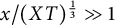 $x/(XT)^{\frac {1}{3}} \gg 1$
. By the subconvexity bound (3.6) and the trivial bound on
 $L(s,\chi )$
for
 $\operatorname {Re}(s)>1$
, we have
 $$ \begin{align} \int_{a+iT}^{\alpha+iT} L(s+z, \rho_L)\frac{x^z}{z}dz &= \int_{a+iT}^{0+iT} L(s+z, \rho_L)\frac{x^z}{z}dz + \int_{0+iT}^{\alpha+iT} L(s+z, \rho_L)\frac{x^z}{z}dz \\ & \ll_{\epsilon,t} \frac{(XT)^\epsilon }{T}\int_{a}^0 \left( \frac{x}{(XT)^{\frac{1}{3}}}\right)^\sigma d\sigma + \frac{(XT)^\epsilon }{T} \int_0^\alpha x^\sigma d\sigma \nonumber \\ &\ll_{\epsilon,t} \frac{(XT)^\epsilon }{T} \nonumber, \end{align} $$
and this bound is also true for
 $\int _{\alpha -iT}^{a-iT} L(s+z, \rho _L)\frac {x^z}{z}dz$
.
Now, we choose suitable a, T, and x so that all assumptions in the above hold, and the error terms (3.7) and (3.8) vanish. Let
 $T=x^c$
and
 $X=x^m$
for some positive constants c and m. If m, c, and a satisfy
 $$ \begin{align*} c \geq 3\epsilon, \quad m+c=3-\delta < 3, \quad a < -\frac{9\epsilon}{\delta}, \end{align*} $$
all assumptions in the proof hold, and the error terms (3.7) and (3.8) vanish. For example, we can take
 $c=3\epsilon $
,
 $\delta =900\epsilon $
, and
 $a=-0.011$
.
By Lemmas 3.1 and 3.5, we have
 $$ \begin{align*} &\frac{1}{N_{\ell}(X)}\sum_{\chi\in D_{\ell}(X)}L(s,\chi) \\&\quad =\frac{1}{N_{\ell}(X)}\sum_{\chi\in D_{\ell}(X)}\sum_{n\leq X^{\frac{1}{3}+\epsilon}}\frac{\chi(n)}{n^{s}}+o(1)=\sum_{(p_1^{e_1}\dots p_k^{e_k})^{\ell}\leq X^{\frac{1}{3}+\epsilon}}\prod_{i=1}^{k}\frac{\ell|\mathrm{TS}_{p_i}|}{p_i^{e_i \ell s}}\\&\qquad +O_{\ell,\epsilon}\left(X^{\frac{\log(2\ell)}{\log\log X}}\left[ X^{-\frac{3}{\ell+5}}\dot\sum_{n\leq X^{\frac{1}{3}+\epsilon}}\frac{(p_1\dots p_k)^{\frac{\ell-1}{6}+\epsilon}}{n}+X^{-\frac{1}{2}}\dot \sum_{n\leq X^{\frac{1}{3}+\epsilon}}\frac{(p_1\dots p_k)^{\frac{\ell-1}{4}+\epsilon}}{n}\right]\right)\\&\quad =\sum_{(p_1^{e_1}\dots p_k^{e_k})^{\ell}\leq X^{\frac{1}{3}+\epsilon}}\prod_{i=1}^{k}\frac{\ell |\mathrm{TS}_{p_i}|}{p_i^{e_i \ell s}}+O_{\ell,\epsilon}\left(X^{-\frac{3}{\ell+5}+\frac{\ell-1}{18}+\epsilon}+X^{-\frac{1}{2}+\frac{\ell-1}{12}+\epsilon}\right). \end{align*} $$
Hence, the error term vanishes only in the case
 $\ell =3,5$
, and we obtain Theorem 1.6.
Now, we prove Theorem 1.7. As before, we express the values of Artin L-functions on the line
 $\operatorname {Re}(s)=1$
as a short sum.
Lemma 3.6 Let L be a cyclic cubic field with conductor less than X. For sufficiently small
 $\epsilon>0$
, we have
 $$ \begin{align*}L(1+it,\rho_L)=\sum_{n <X^{\frac 23 +\epsilon}} \frac{\lambda_L(n)}{n^{1+it}}+o_t(1), \end{align*} $$
where
 $\lambda _{L}(n)$
denotes the n-th coeffcient of
 $L(s,\rho _{L})$
.
Proof By the standard Perron argument, we have
 $$ \begin{align*} \sum_{n<x}\frac{\lambda_L(n)}{n^{1+it}} = \frac{1}{2 \pi i}\int_{\alpha-iT}^{\alpha+iT}L(1+it+s,\rho_L)\frac{x^s}{s}ds+ O_\epsilon\left( \frac{x^{\alpha + \frac{\epsilon}{2}}}{T} \right), \end{align*} $$
where
 $\alpha =\frac {1}{\log X}$
. On the other hand, for some constant a in the range
 $1/2 <1+a <1 $
,
 $$ \begin{align*} &\frac{1}{2 \pi i}\int_{\alpha-iT}^{\alpha+iT}L(1+it+s, \rho_L)\frac{x^s}{s}ds \\ & \quad = L(1+it,\rho_L) + \frac{1}{2 \pi i} \left[ \int_{\alpha-iT}^{a-iT} L(1+it+s, \rho_L)\frac{x^s}{s}ds \right. \\ &\qquad \left. + \int_{a-iT}^{a +iT}L(1+it+s, \rho_L)\frac{x^s}{s}ds + \int_{a+iT}^{\alpha+iT} L(1+it+s, \rho_L)\frac{x^s}{s}ds \right]. \end{align*} $$
The subconvexity bound of Dirichlet L-functions [Reference Petrow and Young7] implies
 $$ \begin{align} L(\beta + it, \rho_L) \ll_\epsilon \left[ X^2(1+|t|^2)\right]^{\frac{1-\beta}{3}+\epsilon} \end{align} $$
for
 $\frac 12 \leq \beta < 1$
. Using (3.9), we have
 $$ \begin{align} \int_{a-iT}^{a +iT}L(1+it+s, \rho_L )\frac{x^s}{s}ds \ll_{\epsilon, t} (XT)^{\epsilon}\left( \frac{x}{(XT)^{\frac{2}{3}}}\right)^{a}. \end{align} $$
If we assume
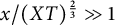 $x/(XT)^{\frac {2}{3}}\gg 1$
, we can show the following estimates using the argument in the proof of Lemma 3.5:
 $$ \begin{align} \int_{\alpha-iT}^{a-iT} L(1+it+s, \rho_L)\frac{x^s}{s}ds, \, \int_{a+iT}^{\alpha+iT} L(1+it+s, \rho_L)\frac{x^s}{s}ds \ll_{\epsilon, t} \frac{(XT)^{\epsilon}}{T}. \end{align} $$
Let
 $T=x^c$
and
 $X=x^m$
for some positive constants c and m. If m, c, and a satisfy
 $$ \begin{align*} m+c=\frac{3}{2}-\delta<\frac{3}{2},\quad c\geq \frac{3}{2}\epsilon,\quad a<-\frac{9\epsilon}{4\delta}, \end{align*} $$
all assumptions in the proof hold, and the error term (3.10) and (3.11) vanish. For example, we take
 $c=\frac {3}{2}\epsilon $
,
 $\delta =\frac {900}{4}\epsilon $
, and
 $a=-0.011$
,
The following lemma is the unconditional version of Lemma 3.3, and we skip its proof.
Lemma 3.7 Let
 $n=p_1^{e_1}p_2^{e_2}\dots p_k^{e_k}$
such that
 $\left (\prod _{i=1}^{k}p_i \right )\ll X^{3/4}$
. We have
 $$ \begin{align*} \frac{1}{N({\mathbb{Z}}/3{\mathbb{Z}},X)}\sum_{L \in F({\mathbb{Z}}/3{\mathbb{Z}},X)} \lambda_L(n)=\prod_{i=1}^k g(p_i,e_i) + O_{\epsilon}\left( (12)^k \prod_{i=1}^k \tau(p_i^{e_i})p_i^{\frac{1}{3}+\epsilon} \dot X^{-\frac{3}{8} +\epsilon} \right), \end{align*} $$
where
 $g(p,e)=(e+1)|TS_p|+\beta _{e}|IN_p|$
and
 $g(p,1)=0$
.
By Lemmas 3.6 and 3.7, we have
 $$ \begin{align*} & \frac{1}{N({\mathbb{Z}}/3{\mathbb{Z}},X)}\sum_{L\in F({\mathbb{Z}}/3{\mathbb{Z}},X)}L(1,\rho_{L}) \\ &\quad =\frac{1}{N({\mathbb{Z}}/3{\mathbb{Z}},X)}\sum_{L \in F({\mathbb{Z}}/3{\mathbb{Z}},X)} \sum_{n <X^{\frac 23 +\epsilon}} \frac{\lambda_L(n)}{n}+o(1)\\ &\quad = \sum_{n <X^{\frac 23 +\epsilon}} \left[ \prod_{p^e||n}\frac{g(p,e)}{p^{e}} + O_\epsilon\left( X^{-\frac 38 +\epsilon}\prod_{p^e||n}\frac{12(e+1)p^{\frac{1}{3}+\epsilon}}{p^{e}} \right)\right]\\ &\quad =\sum_{n <X^{\frac 23 +\epsilon}} \prod_{p^e||n}\frac{g(p,e)}{p^{e}} + O_{\epsilon}\left( X^{-\frac 38 +\epsilon} \sum_{n <X^{\frac 23 +\epsilon}} \frac{n^{\frac 13 + 2\epsilon}}{n} \right)\\ &\quad =\sum_{n <X^{\frac 23 +\epsilon}} \prod_{p^e||n}\frac{g(p,e)}{p^{e}} + O_\epsilon\left( X^{-\frac{11}{72}+3\epsilon }\right). \end{align*} $$
Hence, the error term vanishes, and we obtain Theorem 1.7.
4 The existence of the probability distribution function of L-values
$\boldsymbol{L(\sigma ,\rho _{L})}$

In this section, as an application of Theorem 1.1, we prove the existence of the probability distribution function of the values of Artin L-function associated with the family
 $F({\mathbb {Z}}/\ell {\mathbb {Z}})$
.
Theorem 4.1 (Theorem 1.5)
Let
 $\sigma>9/11$
. Then, there exists a non-negative function
 $C_{\sigma ,\ell }\in C^{\infty }(\mathbb {R})$
such that
 $$ \begin{align*} \lim_{X\rightarrow\infty}\frac{\#\{L\in F({\mathbb{Z}}/\ell {\mathbb{Z}},X)\mid L(\sigma,\rho_{L})\leq e^{a}\}}{ N({\mathbb{Z}}/\ell {\mathbb{Z}},X)}=\int_{-\infty}^{a}C_{\sigma,\ell}(x)\frac{dx}{\sqrt{2\pi}} \end{align*} $$
holds for any
 $a\in \mathbb {R.}$
To prove Theorem 1.5, we follow much of Mine’s work [Reference Mine6]. He showed Theorem 1.5 for the Artin-L function which is associated with
 $L_{3}^{\pm }(X):=\{K|K \text { is a non-Galois cubic field with } 0<\pm d_{K}<X\}$
, where
 $d_{K}$
is the discriminant of K. Since we make only slight modifications to the proof process in [Reference Mine6], some details will be omitted for brevity.
4.1 Artin L-functions associated with cyclic extensions of degree
$\ell $

For every
 $L\in F({\mathbb {Z}}/\ell {\mathbb {Z}},X)$
, the Dedekind zeta function
 $\zeta _{L}(s)$
is factorized as
 $$ \begin{align*} \zeta_{L}(s)=\zeta(s)\prod_{i=1}^{\ell-1}L(s,\chi_{L}^{i})=\zeta(s)L(s,\rho_{L}), \end{align*} $$
where
 $\chi _{L}$
is a primitive Dirichlet characters of order
 $\ell $
associated with L. In section 1, we denoted the decomposition type of a prime by
 $TS$
,
 $IN$
, and
 $TR$
. For each local condition
 $LC\in \{TS,IN,TR\}$
, we define a diagonal matrix
 $M_{LC}\in M_{\ell -1}(\mathbb {C})$
as
 $$ \begin{align*} M_{LC}=\begin{cases} \mathrm{diag}(1,\dots,1) & \text{ if } LC=TS,\\ \mathrm{diag}(\omega,\dots,\omega^{\ell-1}) & \text{ if } LC=IN,\\ \mathrm{diag}(0,\dots,0) & \text{ if } LC=TR, \end{cases} \end{align*} $$
where
 $\omega $
be a primitive
 $\ell $
-th root of unity. Then, we can associate each
 $L\in F({\mathbb {Z}}/\ell {\mathbb {Z}},X)$
and prime p with
 $M_{LC}$
by
 $M_{p}(L)=M_{LC_{p}}$
if p has decomposition type
 $LC_{p}$
in L. By this correspondence,
 $L(s,\rho _{L})$
for
 $\mathrm {Re}(s)>1$
has the Euler product
 $$ \begin{align} L(s,\rho_{L})=\prod_{p}\mathrm{det}(I-p^{-s}M_{p}(L))^{-1}, \end{align} $$
where
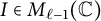 $I\in M_{\ell -1}(\mathbb {C})$
is the identity matrix. Unfortunately, it is quite hard to study the distribution of L-values
 $L(s,\rho _{L})$
directly. Thus, we introduce independent random variables
 $\mathcal {X}=(\mathcal {X}_{p})_{p}$
on
 $M_{LC}$
which are easier to handle and reflect these Arin L-functions. One of remarkable points is that the probability that p has given spliting type
 $LC_{p}$
in
 $L\in F({\mathbb {Z}}/\ell {\mathbb {Z}},X)$
has a limit as
 $X\rightarrow \infty $
. According to Theorem 1.1, it is natural to define
 $\mathbb {P}(\mathcal {X}_{p}=M_{LC})=|LC_{p}|$
. The random Euler product
 $L(s,\mathcal {X})$
is defined as
 $$ \begin{align*} L(s,\mathcal{X})=\prod_{p}\mathrm{det}(I-p^{-s}\mathcal{X}_p)^{-1}. \end{align*} $$
We will study this random Euler product in more detail in Section 4.3.
In the proof of Theorem 1.5, we deal with
 $\log {L(s,\rho _{L})}$
instead of
 $L(s,\rho _{L})$
itself. From (4.1),
 $\log {L(s,\rho _{L})}$
is represented by
 $$ \begin{align*} \log{L(s,\rho_{L})}=\sum_{p}\sum_{m=1}^{\infty}\frac{\mathrm{tr}(M_{p} (L)^{m})}{m}p^{-ms}=\sum_{n=1}^{\infty}\frac{\Lambda_{L}(n)}{\log{n}}n^{-s} \end{align*} $$
for
 $\mathrm {Re}(s)>1$
. Here,
 $\Lambda _{L}(n)$
is defined as
 $$ \begin{align*} \Lambda_{L}(n)=\begin{cases} \mathrm{tr}(M_{p}(L)^{m})\log{p} &\text{if } n=p^{m} \text{ for some } p \text{ and } m\geq1,\\ 0 &\text{otherwise.} \end{cases} \end{align*} $$
Since
 $\mathrm {tr}(M_{LC}^{m})\leq \ell -1$
for every
 $m\geq 1$
, we have —
 $\Lambda _{L}(n)|\leq (\ell -1)\Lambda (n)$
, where
 $\Lambda (n)$
is the von Mangoldt function. Moreover, we would like to extend the region where
 $\log {L(s,\rho _{L})}$
is holomorphic on. Let D be the half plane
 $\mathrm {Re}(s)>1/2$
. We define

where
 $\rho $
runs through all zeros of
 $L(s,\rho _{L})$
with
 $\mathrm {Re}(\rho )>1/2$
. Then, we extend
 $\log {L(s,\rho _{L})}$
for
 $s=\sigma +it\in G_{L}$
as
 $$ \begin{align*} \log{L(s,\rho_{L})}=-\int_{\sigma}^{\infty}\frac{L'}{L}(\alpha+it,\rho_{L})\,d\alpha. \end{align*} $$
and this makes
 $\log {L(s,\rho _{L})}$
a holomorphic function on
 $G_{L}$
.
The main result in this section is to give a zero-density estimate for
 $L(s,\rho _{L})$
. However, it is more effective to treat
 $L(s,\chi _{L}^{i})$
rather than
 $L(s,\rho _{L})$
itself. For each
 $L(s,\chi _{L}^{i})$
, we define the complele L-function
 $$ \begin{align*} \Lambda(s,\chi_{L}^{i})=\mathfrak{f}(L)^{s/2}\gamma(s)L(s,\chi_{L}^{i}), \end{align*} $$
where
 $\mathfrak {f}(L)$
is the conductor of L and
 $\gamma (s)={\pi }^{-s/2}\Gamma (s/2)$
is the gamma factor. It is well known that
 $\Lambda (s,\chi _{L}^{i})$
has the functional equation
 $\Lambda (s,\chi _{L}^{i})=W(\chi _{L}^{i})\Lambda (1-s,\chi _{L}^{i})$
, where
 $|W(\chi _{L}^{i})|=1$
.
Lemma 4.2 Let
 $N(\alpha ,T;\rho _{L})$
be the number of zeros
 $\rho $
of
 $L(s,\rho _{L})$
with multiplicity satisfying
 $\mathrm {Re}(\rho )\geq \alpha $
and
 $|\mathrm {Im}(\rho )|\leq T$
. Let
 $X\geq 1$
and
 $T\geq 2$
. For any
 $B>7/2$
and any
 $\alpha \geq \frac {9}{11}$
, we have
 $$ \begin{align*} \sum_{L\in F({\mathbb{Z}}/\ell {\mathbb{Z}},X)}N(\alpha,T;\rho_{L})\ll_{\ell,B} T^{A_{\ell}}X^{B(1-\alpha)/(2\alpha-1)}, \end{align*} $$
where
 $A_{\ell }>0$
is an absolute constant depending only on
 $\ell $
.
Proof Let
 $N(\alpha ,T;\chi )$
be the number of zeros of
 $L(s,\chi )$
with multiplicity satisfying
 $\mathrm {Re}(\rho )\geq \alpha $
and
 $|\mathrm {Im}(\rho )|\leq T$
. Then,
 $$ \begin{align*} \sum_{L\in F({\mathbb{Z}}/\ell {\mathbb{Z}},X)}N(\alpha,T;\rho_{L})=\sum_{\chi\in D_{\ell}(X)}N(\alpha,T;\chi) \end{align*} $$
and we show the sum on the right hand side satisfies the claimed inequality. We apply the zero-density theorem by Kowalski and Michel [Reference Kowalski and Michel4, Theorem 2] to the family
 $D_\ell (X)$
. We note that primitive characters are viewed as cuspidal automorphic representations of
 $GL_1(A_{\mathbb {Q}})$
, the gamma factor for
 $L(s,\chi )$
for
 $\chi $
in
 $D_\ell (X)$
is
 $\gamma (s)$
, and
 $$ \begin{align*} \left|D_\ell(X) \right| \ll X, \quad \mathrm{Cond}(\chi) \leq X \quad \forall \chi \in D_\ell(X). \end{align*} $$
Hence, we can apply [Reference Kowalski and Michel4, Theorem 2] to
 $D_{\ell }(X)$
with
 $n=A=d=1$
, and the claimed inequality follows.
For any
 $\sigma>9/11$
, we can choose
 $\delta _\sigma>0$
and
 $B_{\sigma }>7/2$
such that
 $B_{\sigma }(1-\sigma )/(2\sigma -1)<1-\delta _{\sigma }$
. By Lemma 4.2, we have
 $$ \begin{align*} \sum_{L\in F({\mathbb{Z}}/\ell{\mathbb{Z}},X)}N(\sigma,(\log{X})^{3};\rho_{L})\ll_{\ell,\sigma} X^{1-\delta_{\sigma}} \end{align*} $$
for any
 $\sigma>9/11$
and
 $X\geq 3$
.
Choose any
 $9/11{\kern-1pt}<{\kern-1pt}\sigma _{0}{\kern-1pt}<{\kern-1pt}1$
and a suitable
 $\delta {\kern-1pt}:={\kern-1pt}\delta _{\sigma _{0}}{\kern-1pt}>{\kern-1pt}0$
such that
 $B_{\sigma _{0}}(1-\sigma _0)/(2\sigma _0-1) <1-\delta $
for some
 $B_{\sigma _{0}}>7/2$
. For any
 $\sigma \geq \sigma _{0}$
, we define
 $E_{\sigma ,\ell }(X)$
as
 $$ \begin{align*} E_{\sigma_{0},\ell}(X)=\bigg{\{}L \in F({\mathbb{Z}}/\ell {\mathbb{Z}},X)\,\mid\, \begin{matrix}\text{There exists a zero } \rho \text{ of } L(s,\rho_{L}) \text{ such that}\\ \mathrm{Re}(\rho)\geq \sigma_{0} \text{ and } |\mathrm{Im}(\rho)|\leq (\log{X})^{3} \end{matrix} \bigg{\}} \end{align*} $$
and
 $$ \begin{align*} E_{\sigma,\ell}(X)=\begin{cases} E_{\sigma_{0},\ell}(X) &\text{if } \sigma_{0}<\sigma<1,\\ \phi & \text{if } \sigma\geq1. \end{cases} \end{align*} $$
By the choice of
 $\sigma _{0}$
, we have
 $\# E_{\sigma ,\ell }(X)=O(X^{1-\delta })$
for any
 $\sigma \geq \sigma _{0}$
. Also, we can obtain the following lemma using the same argument in the proof of [Reference Mine6, Lemma 3.2].
Lemma 4.3 Choose any
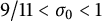 $9/11<\sigma _{0}<1$
. Let
 $s=\sigma +it$
, where
 $\sigma \geq \sigma _{0}+2(\log {\log {X}})^{-1}$
and
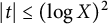 $|t|\leq (\log {X})^{2}$
. Then, the inequality
 $$ \begin{align*} \log{L(s,\rho_{L})}\ll_{\ell}(\log{\log{X}})(\log{X})^{(1-\sigma)/(1-\sigma_{0})}+\log{\log{X}} \end{align*} $$
holds for any  .
Let
 $H_{r}(z)$
be the coefficient of the Taylor expansion of
 $(1-\omega )^{-z}$
:
 $$ \begin{align} (1-\omega)^{-z}=\sum_{r=0}^{\infty}H_{r}(z){\omega}^{r} \end{align} $$
for
 $z\in \mathbb {C}$
and
 $|\omega |<1$
. We can directly check that
 $H_{0}(z)=1$
and
 $$ \begin{align*} H_{r}(z)=\frac{1}{r!}z(z+1)\dots (z+r-1) \end{align*} $$
for
 $r\geq 1$
. Note that we have a trivial bound
 $|H_{r}(z)|\leq (|z|+1)^{r}$
by definition. Also, we define
 $d_{z}(n)$
as the Dirichlet coefficient of
 $\zeta (s)^{z}$
for any
 $z\in \mathbb {C}$
and
 $\mathrm {Re}(s)>1$
:
 $$ \begin{align*} \zeta(s)^{z}=\sum_{n=1}^{\infty}d_{z}(n)n^{-s}. \end{align*} $$
By its definition,
 $d_{z}(n)$
is the multiplicative function such that for each p,
 $d_{z}(p^{r})=H_{r}(z)$
holds. Similarly, we define
 $H_{r}(z;LC)$
and
 $d_{z}(n,\rho _{L})$
as before. Let
 $H_{r}(z;LC)$
as the coefficient of the Taylor expansion of
 $\mathrm {det}(I-\omega M_{LC})^{-z}$
 $$ \begin{align*} \mathrm{det}(I-\omega M_{LC})^{-z}=\sum_{r=0}^{\infty}H_{r}(z;LC){\omega}^{r} \end{align*} $$
for
 $z\in \mathbb {C}$
and
 $|\omega |<1$
. If we denote
 $\alpha _{1(LC)},\dots ,\alpha _{(\ell -1)(LC)}$
be the eigenvalues of
 $M_{LC}$
, we have the relation between
 $H_{r}(z)$
and
 $H_{r}(z;LC)$
 $$ \begin{align} H_{r}(z;LC)=\sum_{\substack{j_{i}\geq0 \\ j_{1}+\dots+j_{\ell-1}=r}}\prod_{i=1}^{\ell-1}H_{j_{i}}(z)\alpha_{i(LC)}^{j_{i}} \end{align} $$
from (4.2). Let
 $d_{z}(n,\rho _{L})$
as the Dirichlet coefficient of
 $L(s,\rho _{L})^{z}$
for
 $z\in \mathbb {C}$
and
 $\mathrm {Re}(s)>1$
:
 $$ \begin{align*} L(s,\rho_{L})^{z}=\sum_{n=1}^{\infty}d_{z}(n,\rho_{L})n^{-s}. \end{align*} $$
Similar to
 $d_{z}(n)$
,
 $d_{z}(n,\rho _{L})$
can be thought as the multiplicative function such that for each p,
 $d_{z}(p^{r},\rho _{L})=H_{r}(z;LC)$
if p has a splitting type
 $LC$
in L. Lemmas 3.5 and 3.6 in [Reference Mine6] give bounds on
 $d_{z}(n)$
, and the following lemma gives an upper bound on
 $d_{z}(n,\rho _{L})$
. Since the following lemma is a slight modification of [Reference Mine6, Lemma 3.7], we omit its proofs.
Lemma 4.4 Let
 $z\in \mathbb {C}$
and
 $k=\lfloor |z| \rfloor +1$
. Then
 $|d_{z}(n,\rho _{L})|\leq d_{(\ell -1)k}(n)$
for any
 ${L\in F({\mathbb {Z}}/\ell {\mathbb {Z}},X)}$
and
 $n\geq 1$
.
4.2 Other preliminaries
Lemmas 3.8–3.12 in [Reference Mine6, Lemmas 3.8 and 3.12] are general results from probability theory and play a crucial role in proving Theorem 1.5. We refer the reader to [Reference Mine6, Section 3.2] for these results. We conclude this section by introducing the following lemma.
Lemma 4.5 Let
 $1/2<\sigma \leq 1$
. Then, for any
 $x\in \mathbb {R}$
,
 $\epsilon>0$
, and
 $y\in \mathbb {N}$
, there exist an integer
 $k=k(x,\sigma ,y,\epsilon )\geq y$
and
 $c_{n}\in \{-1,\,\ell -1\}$
for
 $y\leq n\leq k$
such that the inequality
 $$ \begin{align*} \bigg|x-\sum_{y\leq n\leq k}\frac{c_{n}}{p_{n}^{\sigma}}\bigg|<\epsilon \end{align*} $$
holds. Here,
 $p_{n}$
indicates the n-th prime number.
Proof We define a partial summation sequence
 $(S_{x,y}(m))_{m\geq -1}$
as
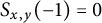 $S_{x,y}(-1)=0$
and
 $$ \begin{align*} S_{x,y}(m)=\begin{cases} S_{x,y}(m-1)+\frac{\ell-1}{p_{y+m}^{\sigma}} & \text{if } x-S_{x,y}(m-1)\geq 0 \\ S_{x,y}(m-1)+\frac{-1}{p_{y+m}^{\sigma}} & \text{if } x-S_{x,y}(m-1)<0 \\ \end{cases} \end{align*} $$
for
 $m\geq 0$
. Then,
 $S_{x,y}(m)$
can be written as
 $$ \begin{align*} S_{x,y}(m)=\sum_{n=0}^{m}\frac{c_{y+n}}{p_{y+n}^{\sigma}}, \end{align*} $$
where
 $c_{y+n}\in \{-1,\ell -1\}$
for
 $n\geq 0$
. Since
 $\sum _{n=1} 1/p_n^{\sigma }$
diverges for any
 $1/2<\sigma \leq 1$
, by iterating this process, there is a sequence
 $(m_i)_{i\geq 1}\subseteq \mathbb {N}$
such that
 $c_{y+m_{i}}\neq c_{y+m_{i}-1}$
. Such sequence satisfies
 $$ \begin{align*} \big|x-S_{x,y}(m_{i}-2)\big|\leq\frac{|c_{y+m_i-1}|}{p_{y+m_i-1}^{\sigma}}\leq\frac{\ell-1}{p_{y+m_{i}-1}^{\sigma}}, \end{align*} $$
and lemma holds if we choose sufficiently large
 $m_{i}$
such that
 $(\ell -1)/p_{y+m_i-1}^{\sigma }<\epsilon $
.
4.3 The density function
$C_{\sigma ,\ell }$

Recall that we defined the independent random variables
 $\mathcal {X}=(\mathcal {X}_{p})_{p}$
and its Euler product
 $L(s,\mathcal {X})$
in Section 4.1. Now, we are in position to prove the following theorem, which confirms the existence of the distribution function of
 $\log {L(\sigma ,\mathcal {X})}$
.
Theorem 4.6 For
 $\sigma>1/2$
, there exists a non-negative
 $C^{\infty }$
-function
 $C_{\sigma ,\ell }$
such that
 $$ \begin{align*} \mathbb{P}(\log{L(\sigma,\mathcal{X})}\in A)=\int_{A}C_{\sigma,\ell}(x)\frac{dx}{\sqrt{2\pi}} \end{align*} $$
holds for all
 $A\in \mathcal {B}(\mathbb {R})$
. Here,
 $\mathcal {B}(\mathbb {R})$
indicates the Borel
 $\sigma $
-algebra of
 $\mathbb {R}$
. Moreover, it satisfies the following properties:
-
1. If
$1/2<\sigma \leq 1$
, the support of
$C_{\sigma ,\ell }$
is
$\mathbb {R}$
. This means that
$C_{\sigma ,\ell }(x)$
is not identically zero in any interval on
$\mathbb {R}$
. -
2. If
$\sigma>1$
, then
$C_{\sigma ,\ell }$
has compact support. -
3. For any
$\sigma>1/2$
and
$a>0$
, the integral is finite.
$$ \begin{align*} \int_{-\infty}^{\infty}e^{ax}C_{\sigma,\ell}(x)\frac{dx}{\sqrt{2\pi}} \end{align*} $$


In Sections 4.3 and 4.4, we will show that the distribution of
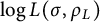 $\log {L(\sigma ,\rho _{L})}$
is approximated by that of
 $\log {L(\sigma ,X)}$
. The proof is essentially the same as [Reference Mine6, Section 4], and we skip some details. Before proving Theorem 4.6, we first verify that
 $L(s,\mathcal {X})$
is actually a random variable.
Proposition 4.7 Let
 $s=\sigma +it$
be a fixed complex number. If
 $\sigma>1/2$
, then
 $L(s,\mathcal {X})$
converges almost surely.
Proof See [Reference Mine6, Proposition 4.1] for details. The indispensable point in the proof is to obtain the two upper bounds
 $$ \begin{align} \mathbb{E}[\mathrm{tr}(\mathcal{X}_{p})]\ll p^{-1}\;\;\text{ and }\;\; \mathbb{E}[|\mathrm{tr}(\mathcal{X}_{p})|^{2}]\ll 1. \end{align} $$
We can check (4.4) holds with a simple calculation:
 $$ \begin{align*} \mathbb{E}[\mathrm{tr}(\mathcal{X}_{p})]=\sum_{LC\in \{TS,IN,TR\}}|LC_{p}|\mathrm{tr}(\mathcal{X}_{p})=0, \end{align*} $$
and
 $$ \begin{align*} \mathbb{E}[|\mathrm{tr}(\mathcal{X}_{p})|^{2}]=\sum_{LC\in\{TS,IN,TR\}}|LC_{p}|| \mathrm{tr}(\mathcal{X}_{p})|^{2}=\begin{cases} \ell-3+\frac{6\ell-4}{\ell^{2}+\ell-1} & \text{if } p=\ell,\\ \frac{(\ell-1)p}{(p+\ell-1)} & \text{if } p\equiv1 \text{ mod } \ell,\\ \ell-1 & \text{otherwise.} \end{cases} \end{align*} $$
Proposition 4.7 implies that
 $L(s,\mathcal {X})$
is a random variable for
 $\mathrm {Re}(s)>1/2$
. In a similar way to
 $\log {L(s,\rho _{L})}$
, we define the logarithm of
 $L(s,\mathcal {X})$
as
 $$ \begin{align*} \log{L(s,\mathcal{X})}=\sum_{p}\sum_{m=1}^{\infty}\frac{\mathrm{tr}(\mathcal{X}_{p}^{m})}{m}p^{-ms} \end{align*} $$
for
 $\mathrm {Re}(s)>1/2$
, which is also a random variable. Hence, for a fixed
 $\sigma>1/2$
, we can define the probability measures
 $\bar {\mu }_{\sigma ,\ell }$
and
 $\bar {\mu }_{\sigma ,\ell ,p}$
as
 $$ \begin{align*} \bar{\mu}_{\sigma,\ell}(A)&=\mathbb{P}(\log{L(\sigma,\mathcal{X})}\in A),\\ \bar{\mu}_{\sigma,\ell,p}(A)&=\mathbb{P}(\log{\mathrm{det}(I-p^{-\sigma}\mathcal{X}_{p})^{-1}}\in A) \end{align*} $$
for
 $A \in \mathcal {B}(\mathbb {R})$
and a prime p. For
 $\xi \in \mathbb {R}$
, let
 $\hat {\phi }_{\sigma ,\ell }(\xi )$
be
 $$ \begin{align*} \bar{\phi}_{\sigma,\ell}(\xi)=\int_{\mathbb{R}}e^{ix\xi}\,d\bar{\mu}_{\sigma,\ell}(x) \end{align*} $$
the characteristic function of
 $\bar {\mu }_{\sigma ,\ell }$
. If
 $\hat {\phi }_{\sigma ,\ell }$
satisfies the condition in [Reference Mine6, Lemma 3.11], the main statement of Theorem 4.6 holds. We use the z-moment of
 $L(s,\mathcal {X})$
to check this condition. The following two Propositions describe the behavior of the z-moment of
 $L(s,\mathcal {X})$
.
Proposition 4.8 Let
 $s=\sigma +it$
and z be complex numbers. If
 $\sigma>1/2$
, the expected value
 $$ \begin{align*} F_{s,\ell}(z)=\mathbb{E}[\mathrm{exp}(z\log{L(s,\mathcal{X}})] \end{align*} $$
is finite, and represented as the infinite product
 $$ \begin{align*} F_{s,\ell}(z)=\prod_{p}F_{s,\ell,p}(z), \end{align*} $$
where
 $F_{s,\ell ,p}(z)=\mathbb {E}[\mathrm {det}(I-p^{-s}\mathcal {X}_{p})^{-z}]$
. Furthermore, this product converges uniformly for
 $\sigma \geq \sigma _{0}$
and
 $|z|\leq R$
with any
 $\sigma _{0}>1/2$
and
 $R>0$
.
Proof See [Reference Mine6, Proposition 4.2 (i)].
Proposition 4.9 Let
 $s=\sigma +it$
and z be complex numbers. If
 $1/2<\sigma <1$
or
 $\sigma>3/2$
, then there exists an absolute constant
 $c_{\ell }>0$
such that
 $$ \begin{align*} |F_{s,\ell}(z)|\leq \mathrm{exp}\left(\frac{c_{\ell}}{(2\sigma-1)(1-\sigma)}\frac{(|z|+3)^{1/\sigma}}{\log{(|z|+3)}}\right) \text{ for } 1/2<\sigma<1 \end{align*} $$
and
 $$ \begin{align*} |F_{s,\ell}(z)|\leq \mathrm{exp}(c_\ell(|z|+3)) \text{ for } \sigma>3/2. \end{align*} $$
Proof Since
 $|\alpha _{1(LC)}|,\dots ,|\alpha _{(\ell -1)LC}|\leq 1$
for any
 $LC\in \{TS,IN,TR\}$
, we have
 $$ \begin{align*} |H_{r}(z;LC)| &\leq \sum_{\substack{j_{i}\geq 0 \\ j_{1}+\dots+j_{\ell-1}=r}} \prod_{i=1}^{\ell-1}|H_{j_{1}}(z)|\leq {}_{\ell-1}H_{r}(|z|+1)^{r}={}_{\ell-2+r}C_{r}(|z|+1)^{r} \\ &\leq(r+1)^{\ell-2}(|z|+1)^{r}. \end{align*} $$
Hence, there is a sufficiently large constant
 $C_{\ell }$
depending only on
 $\ell $
such that
 $$ \begin{align} &|\mathrm{det}(I-\omega M_{LC})^{-z}-H_{0}(z;LC)-H_{1}(z;LC)\omega|\\ &=|\mathrm{det}(I-{\omega}M_{LC})^{-z}-1-z\mathrm{tr}(M_{LC})\omega|\leq \sum_{r=2}^{\infty}|H_{r}(z;LC)||\omega|^{r}\leq 3^{\ell}(|z|+1)^{2}|\omega|^{2}\nonumber \end{align} $$
holds for
 $|\omega |\leq (C_\ell |z|+C_\ell )^{-1}$
. Let
 $Q_{\ell }=(C_\ell |z|+C_\ell )^{1/\sigma }$
and
 $p\geq Q_{\ell }$
. Then,
 $|p^{-s}|=p^{-\sigma }\leq (C_\ell |z|+C_\ell )^{-1}$
, and (4.5) yields
 $$ \begin{align*} |\mathrm{det}(I-p^{-s}M_{LC})-1-z\mathrm{tr}(M_{LC})p^{-s}|\leq 3^{\ell}(|z|+1)^{2}p^{-2\sigma}. \end{align*} $$
for
 $p\geq Q_{\ell }$
. For such p, we have
 $$ \begin{align*} F_{s,\ell,p}(z)=\sum_{LC \in \{TR,TS,IN\}}|LC_{p}|\mathrm{det}(I-p^{-s}M_{LC})^{-z}=1+E_{\ell,p}, \end{align*} $$
where
 $|E_{\ell ,p}|\leq 3^{\ell }(|z|+1)^{2}p^{-2\sigma }$
. From this, we deduce
 $$ \begin{align*} \prod_{p\geq Q_{\ell}}|F_{s,\ell,p}(z)|\leq\prod_{p\geq Q_{\ell}}(1+|E_{\ell,p}|)\leq \prod_{p\geq Q_{\ell}}\exp{(|E_{\ell,p}|)}=\exp{\bigg(3^{\ell}(|z|+1)^{2}\sum_{p\geq Q_{\ell}}\frac{1}{p^{2\sigma}}\bigg)}. \end{align*} $$
By the prime number theorem, we have
 $$ \begin{align} \prod_{p\geq Q_{\ell}}|F_{s,\ell,p}(z)|\leq\exp{\bigg(\frac{c_{1\ell}}{2\sigma-1}\frac{(|z|+3)^{1/\sigma}}{\log{(|z|+3)}}\bigg)}. \end{align} $$
for some constant
 $c_{1\ell }>0$
depending only on
 $\ell $
. When
 $p<Q_{\ell }$
, we have
 $$ \begin{align*} \log{\mathrm{det}(I-p^{-s}M_{LC})}^{-1}=\sum_{i=1}^{\ell-1}\log{(1-\alpha_{i(LC)}p^{-s})}\ll_{\ell} p^{-\sigma}. \end{align*} $$
Therefore, there exists
 $c_{\ell }^{\prime }>0$
depending only on
 $\ell $
such that
 $$ \begin{align*} |F_{s,\ell,p}(z)|\leq \sum_{LC \in \{TR,TS,IN\}}|LC_{p}||\mathrm{det}(I-p^{-s}M_{LC})^{-z}|\leq \mathrm{exp}(c_{\ell}^{\prime}|z|p^{-\sigma}). \end{align*} $$
Again, by the prime number theorem, we obtain
 $$ \begin{align} \prod_{p<Q_\ell}|F_{s,\ell,p}(z)|\leq \begin{cases} \exp{\left(\frac{c_{2\ell}}{1-\sigma}\frac{(|z|+3)^{1/\sigma}}{\log{(|z|+3)}}\right)} &\text{ if } \frac{1}{2}<\sigma<1,\\ \exp{(c_{2\ell}(|z|+3))} &\text{ if } \sigma>\frac{3}{2} \end{cases} \end{align} $$
for some constant
 $c_{2\ell }>0$
depending only on
 $\ell $
. Combining (4.6) and (4.7), we show that there exists an absolute constant
 $c_{\ell }$
, depending only on
 $\ell $
, such that
 $$ \begin{align*} |F_{s,\ell}(z)|=\prod_{p}|F_{s,\ell,p}(z)|\leq \begin{cases} \exp{\left(\frac{c_\ell}{(2\sigma-1)(1-\sigma)}\frac{(|z|+3)^{1/\sigma}}{\log{(|z|+3)}}\right)} &\text{ if } \frac{1}{2}<\sigma<1,\\ \exp{(c_{\ell}(|z|+3))} &\text{ if } \sigma>\frac{3}{2}. \end{cases} \end{align*} $$
Using the notations
 $F_{\sigma ,\ell }(s)$
and
 $F_{\sigma ,\ell ,p}(s)$
in Proposition 4.8, we have
 $$ \begin{align*} \bar{\phi}_{\sigma,\ell}(\xi)=F_{\sigma,\ell}(i\xi)=\prod_{p}F_{\sigma,\ell,p}(i\xi). \end{align*} $$
Hence, using the techniques in the proof of Proposition 4.9, one can show that
 $\hat {\phi }_{\sigma ,\ell }(\xi )$
is rapidly decreasing as
 $|\xi |\rightarrow \infty $
.
Proposition 4.10 Let
 $\sigma>1/2$
be a real number. There exists a positive constant
 $c_{\ell }(\sigma )$
depending only on
 $\sigma $
and
 $\ell $
such that
 $$ \begin{align*} |\bar{\phi}_{\sigma,\ell}(\xi)|\leq \exp{\left(-c_{\ell}(\sigma)\frac{|\xi|^{1/\sigma}}{\log{|\xi|}}\right)} \end{align*} $$
holds for any
 $\xi \in \mathbb {R}$
with
 $|\xi |\geq 3$
.
Proof From (4.3), we can check that
 $$ \begin{align*} H_{2}(z;LC)=\frac{z}{2}\mathrm{tr}(M_{LC}^{2})+\frac{z^{2}}{2}\mathrm{tr}(M_{LC})^{2}=\frac{z}{2} \mathrm{tr}(M_{LC})+\frac{z^{2}}{2}\mathrm{tr}(M_{LC})^{2}. \end{align*} $$
In a similar way to (4.5), there is a sufficiently large constant
 $C_{\ell }^{\prime }>\ell -1$
depending only on
 $\ell $
such that
 $$ \begin{align} &\bigg|\mathrm{det}(I-\omega M_{LC})^{-z}-1-z\mathrm{tr}(M_{LC})\omega-\frac{z}{2}\mathrm{tr}(M_{LC}){\omega}^{2}- \frac{z^{2}}{2}\mathrm{tr}(M_{LC})^{2}{\omega}^{2}\bigg|\\ & \leq \sum_{r=3}^{\infty}|H_{r}(z;LC)||\omega|^{r}\leq 4^{\ell}(|z|+1)^{3}|\omega|^{3}\nonumber \end{align} $$
holds for
 $|\omega |\leq (C_{\ell }^{\prime }|z|+C_{\ell }^{\prime })^{-1}$
. If we let
 $Q_{\ell }^{\prime }=(C_{\ell }^{\prime }|\xi |+C_{\ell }^{\prime })^{1/\sigma }$
, then
 $p^{-\sigma }\leq (C_{\ell }^{\prime }|\xi |+C_{\ell }^{\prime })^{-1}$
for
 $p\geq Q_{\ell }^{\prime }$
. For such p, we deduce from (4.8)
 $$ \begin{align*} F_{\sigma,\ell,p}(i\xi)&=\sum_{LC\in \{\text{TR,TS,IN}\}} |LC_{p}|\mathrm{det}(I-p^{-\sigma}M_{LC})^{-i\xi}=1-\mu_{\ell,p}+E_{\ell,p}, \end{align*} $$
where
 $$ \begin{align*} \mu_{\ell,p}=\begin{cases} \frac{{\xi}^{2}}{2}p^{-2\sigma}\left(\ell-3+\frac{6\ell-4}{\ell^{2}+\ell-1}\right) & \text{if } p=\ell,\\ \frac{{\xi}^{2}}{2}p^{-2\sigma}\left(\frac{(\ell-1)p}{(p+\ell-1)}\right) & \text{if } p\equiv1 \text{ mod } \ell,\\ \frac{(\ell-1){\xi}^{2}}{2}p^{-2\sigma} & \text{otherwise,} \end{cases} \end{align*} $$
and
 $|E_{\ell ,p}|\leq 4^{\ell }(|\xi |+1)^{3}p^{-3\sigma }$
. Since
 $\frac {{\xi }^{2}}{2}p^{-2\sigma }\leq \mu _{\ell ,p}\leq \frac {(\ell -1){\xi }^{2}}{2}p^{-2\sigma }<1$
for
 $p\geq Q_{\ell }^{\prime }$
,
 $$ \begin{align*} \prod_{p\geq Q_{\ell}^{\prime}}|F_{\sigma,\ell,p}(i\xi)|&\leq\prod_{p\geq Q_{\ell}^{\prime}}(1-\mu_{\ell,p}+|E_{\ell,p}|)\leq\prod_{p\geq Q_{\ell}^{\prime}}\exp{(-\mu_{\ell,p}+|E_{\ell,p}|)}\\ &\leq\prod_{p\geq Q_{\ell}^{\prime}}\exp{\left(-\frac{{\xi}^{2}}{2}p^{-2\sigma}+4^{\ell}(|\xi|+1)^{3}p^{-3\sigma}\right)}\\ &\leq\prod_{p\geq Q_{\ell}^{\prime}}\exp{\left(-\frac{{\xi}^{2}}{4}p^{-2\sigma}\right)}, \end{align*} $$
where the last inequality holds for sufficiently large
 $C_{\ell }^{\prime }$
. Thus, by the prime number theorem, we have
 $$ \begin{align*} \prod_{p\geq Q_{\ell}^{\prime}}|F_{\sigma,\ell,p}(i\xi)|\leq \exp{\left(-c_{\ell}(\sigma)\frac{|\xi|^{1/\sigma}}{\log{|\xi|}}\right)}, \end{align*} $$
where
 $c_{\ell }(\sigma )$
is a positive constant depending only on
 $\sigma $
and
 $\ell $
. Note that for every prime p,
 $$ \begin{align*} |F_{\sigma,\ell,p}(i\xi)|\leq\sum_{LC\in\{ TR,TS,IN \}}|LC_{p}||\mathrm{det}(I-p^{-\sigma}M_{LC})^{-i\xi}|=1. \end{align*} $$
Combining these, the desired result for
 $|\bar {\phi }_{\sigma }(\xi )|$
holds.
Proof of Theorem 4.6
Proposition 4.10 states that
 $$ \begin{align*} \int_{-\infty}^{\infty}|\xi|^{k}|\bar{\phi}_{\sigma,\ell}(\xi)|\,d\xi<\infty \end{align*} $$
holds for all
 $k\geq 0$
and
 $\sigma>1/2$
. Therefore, we apply Lemma [Reference Mine6, Lemma 3.11] to
 $\bar {\mu }_{\sigma ,\ell }$
, and there exists a non-negative function
 $C_{\sigma ,\ell }\in C^{\infty }(\mathbb {R})$
such that
 $$ \begin{align*} \bar{\mu}_{\sigma,\ell}(A)=\int_{A}C_{\sigma,\ell}(x)\frac{dx}{\sqrt{2\pi}} \end{align*} $$
holds for all
 $A\in \mathcal {B}(\mathbb {R})$
. Furthermore, by [Reference Mine6, (3.17)], the function
 $C_{\sigma ,\ell }$
can be expressed as
 $$ \begin{align*} C_{\sigma,\ell}(x)=\int_{-\infty}^{\infty}\bar{\phi}_{\sigma,\ell}(\xi)e^{-ix\xi}\frac{d\xi}{\sqrt{2\pi}}. \end{align*} $$
It is left to prove the properties listed in Theorem 4.6. For this, we consider
 $C_{\sigma ,\ell }$
as an infinite convolution of Schwartz distributions. For each p, we define
 $$ \begin{align*} C_{\sigma,\ell,p}(x)=\sqrt{2\pi}\sum_{LC\in\{TS,IN,TR\}}|LC_{p}|\delta\left(x-\log{\det{(I-p^{-\sigma}M_{LC}}})^{-1}\right), \end{align*} $$
where
 $\delta $
is the Dirac delta function. Indeed,
 $C_{\sigma ,\ell ,p}$
is the distribution function of
 $\log {\det {(I-p^{-\sigma }\mathcal {X}_{p}})^{-1}}$
. Let
 $p_n$
be the n-th prime number. By direct calculation, we can check that the convolution
 $C_{\sigma ,\ell ,p_1}*\dots *C_{\sigma ,\ell ,p_n}$
is the distribution of
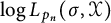 $\log {L_{p_n}(\sigma ,\mathcal {X})}$
, where
 $$ \begin{align*} \log{L_{p_n}(\sigma,\mathcal{X})}=\sum_{i=1}^{n}\log{\det{\left(I-p_{i}^{-\sigma}\mathcal{X}_{p_i}\right)^{-1}}}. \end{align*} $$
Hence, by letting
 $n\rightarrow \infty $
, we have
 $$ \begin{align*} C_{\sigma,\ell}=\lim_{n\rightarrow \infty}(C_{\sigma,\ell,p_1}*\dots*C_{\sigma,\ell,p_n}), \end{align*} $$
and we denote the right-hand term by
 $*_{p}C_{\sigma ,\ell ,p}$
.
Let
 $\sigma>1/2$
. In a similar way to the convolution of
 $(C_{\sigma ,\ell ,p})$
, we have
 $$ \begin{align*} \bar{\mu}_{\sigma,\ell,p_1}*\dots *\bar{\mu}_{\sigma,\ell,p_n}(A)=\mathbb{P}(\log{L_{p_n}(\sigma,\mathcal{X})}\in A). \end{align*} $$
Since
 $$ \begin{align*} \bar{\mu}_{\sigma,\ell}=\lim_{n\rightarrow \infty}(\bar{\mu}_{\sigma,\ell,p_1}*\dots *\bar{\mu}_{\sigma,\ell,p_n}) \end{align*} $$
by Proposition 4.7, we apply [Reference Mine6, Lemma 3.10] so that
 $$ \begin{align} \mathrm{supp}\,\bar{\mu}_{\sigma,\ell}=\lim_{n\rightarrow \infty}(\mathrm{supp}\,\bar{\mu}_{\sigma,\ell,p_1}+\dots+\mathrm{supp}\,\bar{\mu}_{\sigma,\ell,p_n}). \end{align} $$
We remind that
 $C_{\sigma ,\ell }$
and
 $C_{\sigma ,\ell ,p}$
are the distribution functions for
 $\bar {\mu }_{\sigma ,\ell }$
and
 $\bar {\mu }_{\sigma ,\ell ,p}$
. This implies
 $\mathrm {supp}\,C_{\sigma ,\ell }=\mathrm {supp}\,\bar {\mu }_{\sigma ,\ell }$
and
 $\mathrm {supp}\,C_{\sigma ,\ell ,p}=\mathrm {supp}\,\bar {\mu }_{\sigma ,\ell ,p}$
, respectively. Hence, to prove (1) in Theorem 4.6, it is sufficient to show that the right-hand side of (4.9) is
 $\mathbb {R}$
.
Assume
 $1/2<\sigma \leq 1$
and
 $\epsilon>0$
. Since
 $p_{n}\sim n\log {n}$
for
 $n\geq 2$
, we have
 $$ \begin{align*} \sum_{n=k}^{N}\sum_{m=2}^{\infty}\frac{\ell-1}{m}p_{n}^{-m\sigma}\leq B_{\sigma,\ell}k^{1-2\sigma} \end{align*} $$
for any
 $N\geq k\geq 2$
, where
 $B_{\sigma ,\ell }$
is a constant depending only on
 $\ell $
and
 $\sigma $
. Thus, we can choose an integer
 $k=k(\sigma ,\ell ,\epsilon )\geq 2$
such that
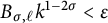 $B_{\sigma ,\ell }k^{1-2\sigma }<\epsilon $
. Let
 $x\in \mathbb {R}$
be any real number, By Lemma 4.5, there is a positive integer
 $N=N(x,\sigma ,\epsilon ,k)\geq k$
and
 $c_{k},\dots ,c_{N}\in \{-1,\ell -1\}$
such that
 $$ \begin{align} \Bigg|\left(x-\sum_{n=1}^{k-1}\sum_{m=1}^{\infty}\frac{\ell-1}{m}p_{n}^{-m\sigma}\right)- \sum_{n=k}^{N}c_{n}p_{n}^{-\sigma}\Bigg|<\epsilon \end{align} $$
holds. Now, we associate the left-hand side of (4.10) with
 $M_{LC}$
as follows. Choose the n-th local condition for
 $1\leq n \leq N$
as
 $$ \begin{align*} LC_{p_n} =\begin{cases} TS &\text{if either } 1\leq n\leq k-1 \text{ or } c_{n}=\ell-1 \text{ for } k\leq n \leq N,\\ IN &\text{if } k\leq n \leq N \text{ and } c_{n}=-1. \end{cases} \end{align*} $$
Then, (4.10) is written as
 $$ \begin{align*} \Bigg|x-\sum_{n=1}^{k-1}\sum_{m=1}^{\infty}\frac{\mathrm{tr}(M_{LC_{p_n}}^{m})}{m}p_{n}^{-m\sigma}- \sum_{n=k}^{N}\mathrm{tr}(M_{LC_{p_n}})p_{n}^{-\sigma}\Bigg|<\epsilon. \end{align*} $$
Hence, by our choice of k and N,
 $$ \begin{align*} &\bigg|x-\sum_{n=1}^{N}\log{\mathrm{det}\left(I-p_{n}^{-\sigma}M_{LC_{p_n}}\right)}^{-1}\bigg|\\ &=\Bigg|x-\sum_{n=1}^{k-1}\sum_{m=1}^{\infty}\frac{\mathrm{tr}(M_{LC_{p_n}}^{m})}{m}p_{n}^{-m\sigma} -\sum_{n=k}^{N}\mathrm{tr}(M_{LC_{p_n}})p_{n}^{-\sigma}-\sum_{n=k}^{N}\sum_{m=2}^{\infty} \frac{\mathrm{tr}(M_{LC_{p_n}}^{m})}{m}p_{n}^{-m\sigma}\Bigg|\\ &<\epsilon+\sum_{n=k}^{N}\sum_{m=2}^{\infty}\frac{\ell-1}{m}p_{n}^{-m\sigma}<2\epsilon. \end{align*} $$
Since every
 $x\in \mathbb {R}$
is in
 $\lim _{N\rightarrow \infty }(\mathrm {supp}\,\bar {\mu }_{\sigma ,\ell ,p_{1}}+\dots + \mathrm {supp}\,\bar {\mu }_{\sigma ,\ell ,p_{N}})$
, we conclude that
 $\mathrm {supp}\,\bar {\mu }_{\sigma ,\ell }=\mathbb {R}$
.
When
 $\sigma>1$
, we can check that
 $$ \begin{align} \bigg|\sum_{p}\log{\det{(I-p^{-\sigma}M_{LC_{p}})}}\bigg|\leq\sum_{p}\sum_{m=1}^{\infty} \frac{|\mathrm{tr}(M_{LC_{p}}^{m})|}{m}p^{-m\sigma}\leq (\ell-1)\log{\zeta(\sigma)} \end{align} $$
for any choice of
 $(LC_{p})_{p}$
. Since
 $\mathrm {supp} \,\bar {\mu }_{\sigma ,p}=\{\log {\det {(I-p^{-\sigma }M_{LC})}}\mid LC\in \{TS,IN,TR\}\}$
, we have
 $$ \begin{align*} \lim_{n\rightarrow \infty}(\mathrm{supp}\,\bar{\mu}_{\sigma,\ell,p_{1}}+\dots+\mathrm{supp}\,\bar{\mu}_{\sigma,\ell,p_{n}})\subseteq [-(\ell-1)\log{\zeta(\sigma)},(\ell-1)\log{\zeta(\sigma)}] \end{align*} $$
by (4.11), and the claim follows.
4.4 Complex moments of
$L(\sigma ,\rho _{L})$

We define the z-th moment of
 $L(\sigma ,\rho _{L})$
as

for
 $z\in \mathbb {C}$
. In this section, we calculate
 $M_{z,\sigma ,\ell }(X)$
explicitly and show that it has an asymptotic formula in conductor aspect. To do this, we need to get the asymptotic formula for
 $L(\sigma ,\rho _{L})^{z}$
first. Recall that
 $L(s,\rho _{L})^{z}$
is a well-defined holomorphic function on
 $s\in G_{L}$
and
 $$ \begin{align*} L(s,\rho_{L})^{z}=\sum_{n=1}^{\infty}d_{z}(n,\rho_{L})n^{-s} \end{align*} $$
holds for
 $\mathrm {Re}(s)>1$
. From now on, we denote
 $$ \begin{align*} c=\max{\{1-\sigma,0\}}+\frac{1}{\log{\log{X}}}\;\;\; \text{and}\;\;\; \kappa=\frac{1}{\log{\log{X}}} \end{align*} $$
for
 $\sigma>1/2$
and
 $X\geq 3$
. Next, we set the two contours
 $L^{\pm }$
as follows. Let
 $L^{+}$
be the line
 $\mathrm {Re}(s)=c$
and
 $L^{-}=L_{1}+\dots +L_{5}$
be the contour which connects the points
 $c-i\infty $
,
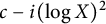 $c-i(\log {X})^{2}$
,
 $-\kappa -i(\log {X})^{2}$
,
 $-\kappa +i(\log {X})^{2}$
,
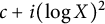 $c+i(\log {X})^{2}$
,
 $c+i\infty $
in order. Then, we define the two functions
 $$ \begin{align*} L(s,\rho_{L};Y)^{z}_{\pm}=\frac{1}{2\pi}\int_{L^{\pm}}L(\sigma+\omega,\rho_{L})^{z} \Gamma(\omega)Y^{\omega}\,d\omega. \end{align*} $$
for
 $Y\geq 1$
. Proposition 4.11 demonstrates that it suffices to consider
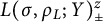 $L(\sigma ,\rho _{L};Y)^{z}_{\pm }$
in order to study
 $L(\sigma ,\rho _{L})^{z}$
. Since its proof is identical to that of [Reference Mine6, Proposition 5.1], we omit it.
Proposition 4.11 Let
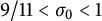 $9/11<\sigma _{0}<1$
and
 $\sigma>\sigma _{0}+\kappa $
. Then the equality
 $L(\sigma ,\rho _{L})^{z}=L(\sigma ,\rho _{L};Y)^{z}_{+}-L(\sigma ,\rho _{L};Y)^{z}_{-}$
holds for any
 ,
 $z\in \mathbb {C}$
, and
 $Y\geq 1$
.
The next step is to derive estimates for
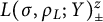 $L(\sigma ,\rho _{L};Y)^{z}_{\pm }$
. The proofs of Propositions 4.12 and 4.13 are almost identitcal to those of [Reference Mine6, Propositions 5.2 and 5.3], with the only difference being the use of Lemmas 4.4 and 4.3 in place of [Reference Mine6, Lemmas 3.7 and 3.3].
Proposition 4.12 Let
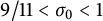 $9/11<\sigma _{0}<1$
and
 $\sigma>\sigma _{0}$
. Let L be a field in
 $ F({\mathbb {Z}}/\ell {\mathbb {Z}},X)$
. Then,
 $$ \begin{align*} L(s,\rho_{L};Y)^{z}_{+}=\sum_{n=1}^{\infty}d_{z}(n,\rho_{L})n^{-\sigma}e^{-n/Y} \end{align*} $$
for any
 $z\in \mathbb {C}$
and
 $Y\geq 3$
. Moreover, if
 $Y=X^{\eta }$
for some
 $\eta>0$
, then we obtain
 $$ \begin{align*} L(\sigma,\rho_{L};Y)^{z}_{+}\ll_{\sigma,\eta,\ell}X^{\eta} \end{align*} $$
for any
 $z\in \mathbb {C}$
such that
 $|z|\leq R_{\sigma }(X)$
. Here,
 $R_{\sigma }(X)$
is defined as
 $$ \begin{align} R_{\sigma}(X)=\begin{cases} (\log{X})(\log{\log{X}})^{-2} &\text{if } \sigma\geq1,\\ (\log{X})^{(\sigma-\sigma_{0})/(1-\sigma_0)}(\log{\log{X}})^{-2} &\text{if } \sigma_{0}<\sigma<1, \end{cases} \end{align} $$
and the implied constant depends only on
 $\sigma $
,
 $\eta $
, and
 $\ell $
.
Proposition 4.13 Let
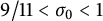 $9/11<\sigma _{0}<1$
,
 $\sigma \geq \sigma _{0}+3\kappa $
. Let
 . If
 ${Y=X^{\eta }}$
for some
 $\eta>0$
, then there exists a constant
 $b_{\ell }(\eta )>0$
which depends only on
 $\eta $
,
 $\ell $
such that
 $$ \begin{align*} L(\sigma,\rho_{L};Y)^{z}_{-}\ll \exp\left(-\frac{\eta}{2}\frac{\log{X}}{\log{\log{X}}}\right) \end{align*} $$
holds for any
 $|z|\leq b_{\ell }(\eta )R_{\sigma }(X)$
, where
 $R_{\sigma }(X)$
is defined as (4.13). The implied constant is absolute.
As a consequence of Propositions 4.11, 4.12, and 4.13, we have the following asymptotic formula for
 $L(s,\rho _{L})^{z}$
.
Corollary 4.14 Let
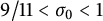 $9/11<\sigma _{0}<1$
and
 $\sigma>\sigma _{0}$
. Choose any field
 . If
 $Y=X^{\eta }$
for some
 $\eta>0$
, then there exists a constant
 $b_\ell (\eta )>0$
which depends only on
 $\eta $
and
 $\ell $
such that
 $$ \begin{align} L(\sigma,\rho_{L})^{z}=\sum_{n=1}^{\infty}d_{z}(n,\rho_{L})n^{-\sigma}e^{-n/Y}+O_{\sigma,\eta} \left(\exp{\left(-\frac{\eta}{2}\frac{\log{X}}{\log{\log{X}}}\right)}\right) \end{align} $$
holds for any
 $|z|\leq b_\ell (\eta )R_{\sigma }(X)$
, where
 $R_{\sigma }(X)$
is defined as (4.13). The implied constant depends only on
 $\sigma $
and
 $\eta $
.
The remaining work is to calculate
 $M_{z,\sigma ,\ell }(X)$
by inserting (4.14) to (4.12). Using the following proposition, we can determine the main term of
 $M_{z,\sigma ,\ell }(X)$
.
Proposition 4.15 For
 $z\in \mathbb {C}$
, define
 $\lambda _{z}(n)$
and
 $\mu _{z}(n)$
be the multiplicative functions such that for each prime p and
 $r\geq 0$
,
 $$ \begin{align*} \lambda_{z}(p^{r})=\sum_{LC\in\{TS,IN,TR\}} |LC_{p}|H_{r}(z;LC)\;\text{ and }\;\nu_{z}(p^{r})=\sum_{LC\in\{TS,IN,TR\}}|H_{r}(z;LC)|. \end{align*} $$
Then, we have the asymptotic formula
 $$ \begin{align} &\sum_{L\in F({\mathbb{Z}}/\ell {\mathbb{Z}},X)}d_{z}(n,\rho_{L})=\frak{C}_{\ell}X\lambda_{z}(n)+O_{\epsilon,\alpha,\ell} \left(X^{\frac{\ell+2}{\ell+5}+\epsilon}\nu_{z}(n)n^{\alpha}\right) \end{align} $$
for any
 $\epsilon>0$
and
 $\alpha>(\ell -1)/4$
. The implied constant depends only on
 $\epsilon $
,
 $\ell $
and
 $\alpha $
.
Proof When
 $n=1$
, Proposition 4.15 is just Theorem 1.1(2) with
 $S=\phi $
. Thus, it is sufficient to show that (4.15) holds for
 $n>1$
. Let
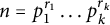 $n=p_{1}^{r_1}\dots p_{k}^{r_k}$
be the prime factorization of n, and
 $S=\{p_{1},\dots ,p_{k}\}$
. Since there are three local conditions for every
 $p\in S$
, there are
 $3^{k}$
distinct sets of local conditions on the primes in S. Label each of these sets of local conditions as
 $(\mathcal {LC}_{S}^{i})_{1\leq i\leq 3^{k}}$
. Also, we write
 $\mathcal {LC}_{S}^{i}=(LC_{p_{j}}^{i})_{1\leq j\leq k}$
, where
 $LC_{p}$
means a local condition at
 $p\in S$
. A field
 $L\in C_{\ell }(X)$
satisfies exactly one certain local condition at each prime in S, and we have
 $$ \begin{align} \sum_{L\in F({\mathbb{Z}}/\ell {\mathbb{Z}},X)}d_{z}(n,\rho_L)=\sum_{i=1}^{3^{k}}\sum_{L\in F({\mathbb{Z}}/\ell {\mathbb{Z}}, X, \mathcal{LC}_{S}^{i})}d_{z}(n,\rho_{L}). \end{align} $$
Recall that
 $d_{z}(n,\rho _{L})$
is the multiplicative function such that
 $d_{z}(p^{r},\rho _{L})=H_{r}(z,LC_{p})$
for each p and
 $r\geq 1$
, where
 $LC_{p}$
is the local condition of p in L. Thus, (4.16) becomes
 $$ \begin{align} \sum_{L\in F({\mathbb{Z}}/\ell {\mathbb{Z}},X)}d_{z}(n,\rho_L)&=\sum_{i=1}^{3^{k}}N({\mathbb{Z}}/\ell{\mathbb{Z}},X,\mathcal{LC}_{S}^{i})\prod_{j=1}^{k}H_{r_j}(z;LC_{p_j}^{i})\\ &=\frak{C}_{\ell}X\sum_{i=1}^{3^k}\prod_{j=1}^{k}|LC_{p_j}^{i}|H_{r_j}(z;LC_{p_j}^{i}) \nonumber \\ &\quad + O_{\ell,\epsilon}\left((2\ell)^{k}\sum_{i=1}^{3^{k}}\prod_{j=1}^{k}|H_{r_j}(z;LC_{p_j}^{i})|p_j^{\frac{\ell-1}{4}} X^{\frac{\ell+2}{\ell+5}+\epsilon}\right)\nonumber \end{align} $$
by Theorem 1.1(2). However, every finite set S of primes satisfies
 $$ \begin{align} (2\ell)^{|S|} \ll_{\ell,\alpha} \prod_{p\in S} p^{\alpha} \end{align} $$
for any
 $\alpha>0$
, where the implied constant depends only
 $\ell $
and
 $\alpha $
. From (4.18), we rewrite (4.17) as
 $$ \begin{align*} \sum_{L\in F({\mathbb{Z}}/\ell {\mathbb{Z}},X)}d_{z}(n,\rho_L) &=\frak{C}_{\ell}X\sum_{i=1}^{3^k}\prod_{j=1}^{k}|LC_{p_j}^{i}|H_{r_j}(z;LC_{p_j}^{i}) \\ &\quad +O_{\ell,\epsilon,\alpha}\left(\sum_{i=1}^{3^{k}}\prod_{j=1}^{k}|H_{r_j}(z;LC_{p_j}^{i})|p_j^{\frac{\ell-1}{4}+\alpha} X^{\frac{\ell+2}{\ell+5}+\epsilon}\right). \end{align*} $$
After rearranging the term of
 $\lambda _{z}(n)$
and
 $\nu _{z}(n)$
, we have
 $$ \begin{align*} \lambda_{z}(n)&=\prod_{j=1}^{k}\left(\sum_{LC_{p_j}\in\{TS,IN,TR\}}|LC_{p_j}|H_{r_j}(z;LC_{p_j})\right) =\sum_{i=1}^{3^k}\prod_{j=1}^{k}|LC_{p_j}^{i}|H_{r_j}(z;LC_{p_j}^{i}),\\ \nu_{z}(n)&=\prod_{j=1}^{k}\left(\sum_{LC_{p_j}\in\{TS,IN,TR\}}|H_{r_j}(z;LC_{p_j})|\right) =\sum_{i=1}^{3^{k}}\prod_{j=1}^{k}|H_{r_j}(z;LC_{p_j}^{i})|, \end{align*} $$
and we see that (4.15) holds for
 $n>1$
.
Recall that in Proposition 4.8, we defined the functions
 $F_{s,\ell }(z)$
and
 $F_{s,\ell ,p}(z)$
as follows:
 $$ \begin{align*} F_{s,\ell}(z)=\mathbb{E}[\exp{(z\log{L(s,\mathcal{X}}))}]\;\;\text{ and }\;\;F_{s,\ell,p}(z)=\mathbb{E}[\det{\left(I-p^{-s}\mathcal{X}_{p}\right)^{-z}}]. \end{align*} $$
Note that
 $F_{s,\ell ,p}(z)$
can also be expressed in terms of
 $\lambda _{z}(n)$
, as defined in Proposition 4.15:
 $$ \begin{align*} F_{s,\ell,p}(z)=\sum_{LC\{TS,IN,TR\}}|LC_{p}|\det{\left(I-p^{-s}M_{LC}\right)^{-z}}= \sum_{r=0}^{\infty}\lambda_{z}(p^{r})p^{-rs}. \end{align*} $$
Since
 $F_{s,\ell }(z)=\prod _{p}F_{s,\ell ,p}(z)$
by Proposition 4.8, we have an explicit form of
 $F_{s,\ell }(z)$
as
 $$ \begin{align*} F_{s,\ell}(z)=\prod_{p}\left(\sum_{r=0}^{\infty}\lambda_{z}(p^{r})p^{-rs}\right)= \sum_{n=1}^{\infty}\lambda_{z}(n)n^{-s}. \end{align*} $$
Hence, by Theorem 4.6, we have
 $$ \begin{align} F_{\sigma,\ell}(z)=\mathbb{E}[\exp{(z\log{L(\sigma,\mathrm{X})})}]=\int_{-\infty}^{\infty}e^{zx}C_{\sigma,\ell}(x)\,dx=\sum_{n=1}^{\infty}\lambda_{z}(n)n^{-\sigma} \end{align} $$
for
 $\sigma>1/2$
. In the proof of the following theorem, we observe that (4.19) gives the main term of
 $M_{z,\sigma ,\ell }(X)$
, and this implies that the z-moments of
 $L(s,\rho _{L})$
and
 $L(s,\mathrm {X})$
are almost identical.
Theorem 4.16 Choose any
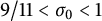 $9/11<\sigma _{0}<1$
. Then, there exists an absolute constant
 $\delta '>0$
such that
 $$ \begin{align} M_{z,\sigma,\ell}(X)=\frak{C}_{\ell}X\int_{-\infty}^{\infty}e^{zx}C_{\sigma,\ell}(x)\frac{dx}{\sqrt{2\pi}}+O_{\sigma,\ell}\left(X\exp{\left(-\delta'\frac{\log{X}}{\log{\log{X}}}\right)}\right) \end{align} $$
holds for any
 $\sigma>\sigma _{0}$
and
 $z\in \mathbb {C}$
satisfying
 $|z|\leq b_{\sigma ,\ell }R_{\sigma }(X)$
, where
 $b_{\sigma ,\ell }>0$
and
 $R_{\sigma }(X)$
is defined as (4.13). The implied constant depends only on
 $\sigma $
and
 $\ell $
.
Proof Let
 $Y=X^{\eta }$
for some
 $\eta>0$
. From (4.14), there is a constant
 $b_{\ell }(\eta )>0 $
which depends only on
 $\eta $
,
 $\ell $
such that
 $M_{z,\sigma ,\ell }(X)$
can be represented by

for
 $|z|\leq b_{\ell }(\eta )R_{\sigma }(X)$
. To deal with the double sum on the right-hand side of (4.21), we consider the following two sums
 $$ \begin{align*} S_{1}(X)&=\sum_{L\in F({\mathbb{Z}}/\ell {\mathbb{Z}},X)}\sum_{n=1}^{\infty}d_{z}(n,\rho_{L})n^{-\sigma}e^{-n/Y},\\ S_{2}(X)&=\sum_{L\in E_{\sigma_0,\ell}(X)}\sum_{n=1}^{\infty}d_{z}(n,\rho_{L})n^{-\sigma}e^{-n/Y}. \end{align*} $$
We verify that
 $S_{1}(X)$
and
 $S_{2}(X)$
contributes the main term and error term of
 $M_{z,\sigma ,\ell }(X)$
, respectively. From Proposition 4.15, we express
 $S_{1}(X)$
as
 $$ \begin{align} S_{1}(X)&=\sum_{n=1}^{\infty}n^{-\sigma}e^{-n/Y}\sum_{L\in F({\mathbb{Z}}/\ell {\mathbb{Z}},X)}d_{z}(n,\rho_{L})\\ &=\frak{C}_{\ell}X\left(\sum_{n=1}^{\infty}\lambda_{z}(n)n^{-\sigma}e^{-n/Y}\right)+O_{\epsilon,\ell,\alpha}\left(X^{\frac{\ell+2}{\ell+5}+\epsilon}\sum_{n=1}^{\infty}\nu_{z}(n)n^{-\sigma+\alpha}e^{-n/Y}\right) \nonumber \end{align} $$
for any
 $\epsilon>0$
and
 $\alpha>(\ell -1)/4$
. Moreover, we obtain
 $$ \begin{align} \sum_{n=1}^{\infty}\lambda_{z}(n)n^{-\sigma}e^{-n/Y}&=\frac{1}{2\pi i}\sum_{n=1}^{\infty}\lambda_{z}(n)n^{-\sigma}\int_{\mathrm{Re}(\omega)=c} \Gamma(\omega)\left(\frac{n}{Y}\right)^{-\omega}\,d\omega \\ &=\frac{1}{2\pi i}\int_{\mathrm{Re}(\omega)=c}F_{\sigma+\omega, \ell}(z)\Gamma(\omega)Y^{\omega}\,d\omega, \nonumber \end{align} $$
for
 $c>0$
. Here,
 $F_{s,\ell }(z)$
is given by (4.19). We remind that
 $F_{s,\ell }(z)$
is a holomorphic function in s on the half plane
 $\mathrm {Re}(s)>\frac {1}{2}$
by Proposition 4.8. Thus, if we choose
 $\kappa _{\sigma }(X)$
as
 $$ \begin{align*} \kappa_{\sigma}(X)=\begin{cases} (\log{\log{X}})^{-1}&\text{ if } \sigma_0 < \sigma<1,\\ \sigma-k+(\log{\log{X}})^{-1} &\text{ if } k\leq \sigma < k+1 \text{ for some } k\in \mathbb{N}, \end{cases} \end{align*} $$
 $\kappa _{\sigma }(X)$
satisfies
 $0<\kappa _{\sigma }(X)<1$
and
 $$ \begin{align*} \begin{cases} \frac{1}{2}<\sigma-\kappa_{\sigma}(X)<1&\text{ for } \sigma_{0}<\sigma<2,\\ \frac{3}{2}<\sigma-\kappa_{\sigma}(X) & \text{ for } \sigma\geq 2. \end{cases} \end{align*} $$
After shifting the contour
 $\mathrm {Re}(\omega )=c$
in (4.23) to
 $\mathrm {Re}(\omega )=-\kappa _{\sigma }(X)$
, we have
 $$ \begin{align*} \sum_{n=1}^{\infty}\lambda_{z}(n)n^{-\sigma}e^{-n/Y}&=\frac{1}{2\pi i}\int_{\mathrm{Re}(\omega)=c}F_{\sigma+\omega,\ell}(z)\Gamma(\omega)Y^{\omega}\,d\omega\\ &=F_{\sigma,\ell}(z)+\frac{1}{2\pi i}\int_{\mathrm{Re}(\omega)=-\kappa_{\sigma}(X)}F_{\sigma+\omega,\ell}(z)\Gamma(\omega)Y^{\omega}\,d\omega. \end{align*} $$
Proposition 4.9 implies the following upper bounds on
 $F_{\sigma +\omega ,\ell }(z)$
 $$ \begin{align*} F_{\sigma+\omega,\ell}(z)\ll \exp\left(c_{\ell}(\sigma)(\log{\log{X}})\frac{(|z|+3)^{1/(\sigma-\kappa_{\sigma}(X))}}{\log{(|z|+3)}}\right) \text{ for } \sigma_{0}<\sigma<2 \end{align*} $$
and
 $$ \begin{align*} F_{\sigma+\omega,\ell}(z)\ll\exp{(c_{\ell}(\sigma)(|z|+3))} \text{ for } \sigma\geq 2 \end{align*} $$
on the line
 $\mathrm {Re}(\omega )=-\kappa _{\sigma }(X)$
, where a constant
 $c_{\ell }(\sigma )>0$
depends only on
 $\sigma $
and
 $\ell $
. Therefore, if we choose a sufficiently small positive constant
 $b_{\sigma ,\ell }(\eta )$
less than
 $b_\ell (\eta )$
, then
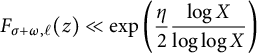 $$ \begin{align*} F_{\sigma+\omega,\ell}(z)\ll \exp\left(\frac{\eta}{2}\frac{\log{X}}{\log{\log{X}}}\right) \end{align*} $$
for
 $|z|\leq b_{\sigma ,\ell }(\eta )R_{\sigma }(X)$
and
 $\mathrm {Re}(\omega )=-\kappa _{\sigma }(X)$
. Also, we have a bound for
 $Y^{\omega }$
as
 $$ \begin{align*} Y^{\omega}\ll_{\sigma,\eta} \exp{\left(-\eta\frac{\log{X}}{\log{\log{X}}}\right)} \end{align*} $$
on the line
 $\mathrm {Re}(\omega )=-\kappa _{\sigma }(X)$
. Finally, the contour integral of
 $\Gamma (\omega )$
on the line
 ${\mathrm {Re}(\omega )=-\kappa _{\sigma }(X)}$
is estimated as
 $$ \begin{align*} \frac{1}{2\pi i}\int_{\mathrm{Re}(\omega)=-\kappa_{\sigma}(X)}\Gamma(\omega)\,d\omega\ll_{\sigma} \log{\log{X}}. \end{align*} $$
Hence, by (4.19), we have
 $$ \begin{align*} \sum_{n=1}^{\infty}\lambda_{z}(n)n^{-\sigma}e^{-n/Y}&=F_{\sigma,\ell}(z)+O_{\sigma,\eta}\left(\exp{\left(-\frac{\eta}{2}\frac{\log{X}}{\log{\log{X}}}\right)}\right)\\ &=\int_{-\infty}^{\infty}e^{zx}C_{\sigma,\ell}(x)\frac{dx}{\sqrt{2\pi}}+O_{\sigma,\eta}\left(\exp{\left(-\frac{\eta}{2}\frac{\log{X}}{\log{\log{X}}}\right)}\right) \end{align*} $$
for
 $|z|\leq b_{\sigma ,\ell }(\eta )R_{\sigma }(X)$
. Next, we estimate the error term in (4.22). From Lemma 4.4, we already have
 $|\nu _{z}(p^{r})|\leq 3d_{(\ell -1)k}(p^{r})$
for every prime p and
 $r\geq 0$
with
 ${k=\lfloor |z|\rfloor +1}$
. If
 $\omega (n)$
indicates the number of primes dividing n, it has a trivial bound
 $\omega (n)\leq \log {n}/\log {2}$
. Thus, we have
 $$ \begin{align*} |\nu_{z}(n)|\leq 3^{\omega(n)}d_{(\ell-1)k}(n)\leq n^{\log{3}}d_{(\ell-1)k}(n). \end{align*} $$
We apply [Reference Mine6, Lemma 3.6] to the error term in (4.22) so that
 $$ \begin{align*} \sum_{n=1}^{\infty}\nu_{z}(n)n^{-\sigma+\alpha}e^{-n/Y}&\ll\sum_{n=1}^{\infty}d_{(\ell-1)k}(n)n^{-\sigma+\alpha+\log{3}}e^{-n/Y}\\ &\ll_{\sigma_{0}}\left(Y^{\alpha+1+\log{3}-\sigma}+1\right)(C\log{Y})^{(\ell-1)k+1}\\ &\ll_{\sigma,\ell,\eta} X^{(\alpha+1+\log{3})\eta} \end{align*} $$
for
 $\sigma>\sigma _{0}$
,
 $\alpha>(\ell -1)/4$
, and
 $|z|\leq b_{\sigma ,\ell }(\eta )R_{\sigma }(X)$
. If we choose any
 $\eta>0$
such that
 $\left (\alpha +1+\log {3}\right )\eta <\frac {3}{2(\ell +5)}$
and
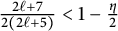 $\frac {2\ell +7}{2(2\ell +5)}<1-\frac {\eta }{2}$
, then
 $$ \begin{align*} X^{\frac{\ell+2}{\ell+5}+\epsilon}\sum_{n=1}^{\infty}\nu_{z}(n)n^{-\sigma+\frac{\ell-1}{4}}e^{-n/Y}\ll X\exp{\left(-\frac{\eta}{2}\frac{\log{X}}{\log{\log{X}}}\right)}. \end{align*} $$
By combining these estimates,
 $S_{1}(X)$
becomes
 $$ \begin{align*} S_{1}(X)=\frak{C}_{\ell}X\int_{-\infty}^{\infty}e^{zx}C_{\sigma,\ell}(x) \frac{dx}{\sqrt{2\pi}}+O_{\sigma}\left(X\exp{\left(-\frac{\eta}{2}\frac{\log{X}}{\log{\log{X}}}\right)}\right) \end{align*} $$
for
 $\sigma _{0}<\sigma $
and
 $|z|\leq b_{\sigma ,\ell }(\eta )R_{\sigma }(X)$
. We have completed the proof of (4.20) for
 $\sigma \geq 1$
, where
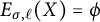 $E_{\sigma ,\ell }(X)=\phi $
. For the case
 $\sigma _{0}<\sigma <1$
, where
 $E_{\sigma ,\ell }(X)=E_{\sigma _0,\ell }(X)$
, we have to obtain the following estimate:
 $$ \begin{align*} S_{2}(X) \ll_{\sigma,\ell} X\exp{\left(-{\eta}'\frac{\log{X}}{\log{\log{X}}}\right)} \end{align*} $$
for some absolute
 ${\eta }'>0$
. It follows from Proposition 4.12 that
 $$ \begin{align*} \sum_{n=1}^{\infty}d_{z}(n,\rho_{L})n^{-\sigma}e^{-n/Y}\ll_{\sigma,\ell,\eta} X^{\eta} \end{align*} $$
holds for any
 $L\in F({\mathbb {Z}}/\ell {\mathbb {Z}},X)$
,
 $\sigma>\sigma _{0}$
, and
 $|z|\leq R_{\sigma }(X)$
. By the choice of
 $\sigma _{0}$
in Section 4.1,
 $$ \begin{align*} S_{2}(X)\ll \#E_{\sigma_{0},\ell}(X) \dot X^{\eta}\ll X^{1-\frac{\delta}{2}} \end{align*} $$
if we choose any
 $\eta <\delta /2$
. By gathering the above estimates of
 $S_{1}(X)$
and
 $S_{2}(X)$
together, we conclude that (4.20) holds for
 $\sigma _{0}<\sigma <1$
and
 $|z|\leq b_{\sigma ,\ell }(\eta )R_{\sigma }(X)$
.
Remark 4.17 Theorem 4.16 yields the integral form of z-th moment of
 $L(\sigma ,\rho _{L})$
, which is written as
 $$ \begin{align*} \lim_{X\rightarrow \infty}\frac{1}{N({\mathbb{Z}}/\ell{\mathbb{Z}},X)}\sum_{L\in F({\mathbb{Z}}/\ell {\mathbb{Z}},X)}L(\sigma,\rho_{L})^{z}=\int_{-\infty}^{\infty}e^{zx}C_{\sigma,\ell}(x)\frac{dx}{\sqrt{ 2 \pi}} \end{align*} $$
for any
 $\sigma>9/11$
and
 $z\in \mathbb {C}$
. Especially, by combining with Theorem 1.3, we have
 $$ \begin{align*} \int_{-\infty}^{\infty}e^{mx}C_{\sigma,\ell}(x)\frac{dx}{2\sqrt{\pi}}=\prod_{p}\left(1+\sum_{e=2}^{\infty}\frac{g_{m}(p,e)}{p^{\sigma e}}\right) \end{align*} $$
for
 $m\in \mathbb {N}$
and
 $\sigma>9/11$
, where
 $g_{m}(p,e)$
is defined in Lemma 3.3.
Before completing the proof of Theorem 1.5, we state the following corollary of Theorem 4.16. Its proof is essentially identical to that of [Reference Mine6, Corollary 6.1], and we omit it.
Corollary 4.18 Let
 $k\in \mathbb {Z}_{>0}$
and
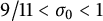 $9/11<\sigma _{0}<1$
. Then, there exists an absolute constant
 $\delta _{\ell }>0$
such that

holds for any
 $\sigma>\sigma _{0}$
The implied constant depends only on k,
 $\ell $
, and
 $\sigma $
.
4.5 Completion of the proof
Now we are ready to complete the proof of Theorem 1.5. We define the probability measures
 $\mu _{\sigma ,\ell }$
and
 $\nu _{\sigma ,\ell }$
as

for
 $A\in \mathcal {B}(\mathbb {R})$
. Let
 $\phi _{\sigma ,\ell }(\xi )$
and
 $\psi _{\sigma ,\ell }(\xi )$
be the characteristic function of
 $\mu _{\sigma ,\ell }$
and
 $\nu _{\sigma ,\ell }$
.
 $\phi _{\sigma ,\ell }(\xi )$
is written as

since
 $\#E_{\sigma ,\ell }(X)\ll X^{1-\delta }$
for
 $\sigma>\sigma _{0}$
. We note that
 $\psi _{\sigma ,\ell }(\xi ) $
has the form
 $$ \begin{align*} \psi_{\sigma,\ell}(\xi) =\int_{-\infty}^{\infty} e^{i\xi x}C_{\sigma,\ell}(x)\frac{dx}{\sqrt{2\pi}}. \end{align*} $$
Theorem 4.16 implies
 $$ \begin{align*} \phi_{\sigma,\ell}(\xi)-\psi_{\sigma,\ell}(\xi)\ll \exp_{\sigma,\ell}{\left(-\delta\frac{\log{X}}{\log{\log{X}}}\right)} \end{align*} $$
for
 $|\xi |\leq b_{\sigma ,\ell }R_{\sigma }(X)$
. We apply Lemma [Reference Mine6, Lemma 3.12] to
 $\mu _{\sigma ,\ell }$
and
 $\nu _{\sigma ,\ell }$
. Let
 $R=b_{\sigma ,\ell }R_{\sigma }(X)$
and
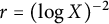 $r=(\log {X})^{-2}$
. Then, we have
 $$ \begin{align*} \int_{r}^{R}\bigg|\frac{\phi_{\sigma,\ell}(\xi)-\psi_{\sigma,\ell}(\xi)}{\xi}\bigg|\,d\xi\ll\exp{\left(-\delta\frac{\log{X}}{\log{\log{X}}}\right)}\int_{r}^{R}\frac{1}{\xi} d\xi \ll \exp{\left(-\frac{\delta}{2}\frac{\log{X}}{\log{\log{X}}}\right)}. \end{align*} $$
Similarly, we have
 $$ \begin{align*} \int_{-R}^{-r}\bigg|\frac{\phi_{\sigma,\ell}(\xi)-\psi_{\sigma,\ell}(\xi)}{\xi}\bigg|\,d\xi \ll \exp{\left(-\frac{\delta}{2}\frac{\log{X}}{\log{\log{X}}}\right)}. \end{align*} $$
Let
 $-r<\xi <r$
. Since
 $e^{i\theta }=1+O(|\theta |)$
for
 $\theta \in \mathbb {R}$
, where the implied constant is absolute, we obtain the following approximation of
 $\phi _{\sigma ,\ell }(\xi ):$

by the Cauchy–Schwarz inequality and Corollary 4.18 with
 $k=2$
. By the same reasoning, we have the approximation of
 $\phi _{\sigma ,\ell }(\xi )$
as
 $$ \begin{align*} \psi_{\sigma,\ell}(\xi)=1+O\left(|\xi|\left(\int_{-\infty}^{\infty}x^{2}C_{\sigma,\ell}(x) \frac{dx}{\sqrt{2\pi}} \right)^{\frac{1}{2}}\right). \end{align*} $$
From these estimates we see that
 $\phi _{\sigma ,\ell }(\xi )-\psi _{\sigma ,\ell }(\xi )\ll |\xi |$
, which yields
 $$ \begin{align*} \int_{-r}^{r}\bigg|\frac{\phi_{\sigma,\ell}(\xi)-\psi_{\sigma,\ell}(\xi)}{\xi}\bigg|\,d\xi\ll(\log{X})^{-2}. \end{align*} $$
Therefore, we obtain
 $$ \begin{align*} \int_{-R}^{R}\bigg|\frac{\phi_{\sigma,\ell}(\xi)-\psi_{\sigma,\ell}(\xi)}{\xi}\bigg|\,d\xi=\left[\int_{-R}^{-r}+\int_{-r}^{r}+\int_{r}^{R}\right]\bigg|\frac{\phi_{\sigma,\ell}(\xi)-\psi_{\sigma,\ell}(\xi)}{\xi}\bigg|\ll(\log{X})^{-2}. \end{align*} $$
Let
 $F_{\sigma ,\ell }(t)=\mu _{\sigma ,\ell }((-\infty ,t])$
and
 $G(t)=\nu _{\sigma ,\ell }((-\infty ,t])$
. By [Reference Mine6, Lemma 3.12], we derive
 $$ \begin{align*} \sup_{t\in \mathbb{R}}|F_{\sigma,\ell}(t)-G_{\sigma,\ell}(t)| &\ll \frac{1}{R_{\sigma}(X)}\sup_{x\in\mathbb{R}}C_{\sigma,\ell}(x)+(\log{X})^{-2} \\ &\ll_{\sigma,\ell} \frac{1}{R_{\sigma}(X)}+(\log{X})^{-2}\ll_{\sigma,\ell} \frac{1}{R_{\sigma}(X)}. \end{align*} $$
Here, the implied constant depends only on
 $\sigma $
and
 $\ell $
. We denote the error term in Theorem 1.5 by
 $D_{\sigma ,\ell }(X,a)$
. Then,
 $D_{\sigma ,\ell }(X,a)$
is represented as
 $$ \begin{align*} D_{\sigma,\ell}(X;a) &=\frac{\#\{L\in F({\mathbb{Z}}/\ell {\mathbb{Z}},X)\mid L(\sigma,\rho_{L})\leq e^{a}\}}{N({\mathbb{Z}}/\ell {\mathbb{Z}},X)}-\int_{-\infty}^{a} C_{\sigma,\ell}(x)\frac{dx}{\sqrt{2\pi}} \\ &=F_{\sigma,\ell}(a)-G_{\sigma,\ell}(a)+E, \end{align*} $$
where

Since
 $\# E_{\sigma ,\ell }(X)\ll X^{1-\delta }$
, we have
 $E\ll X^{-\delta }$
, and this implies
 $$ \begin{align*} \sup_{a\in\mathbb{R}}\big|D_{\sigma,\ell}(X;a)\big|\ll\sup_{a\in\mathbb{R}}| F_{\sigma,\ell}(a)-G_{\sigma,\ell}(a)|+X^{-\delta}\ll\frac{1}{R_{\sigma}(X)}. \end{align*} $$
By letting
 $X\rightarrow \infty $
, we obtain Theorem 1.5.



