It has been established that adults and children both make use of morphological constituents (e.g., joukkue “team” and henki “spirit”) when processing morphologically complex words (e.g., joukkuehenki “team spirit”). For both groups evidence for the role of morphology in processing complex words has been found across tasks, languages, and readers of different ability (e.g., Bertram & Hyönä, Reference Bertram and Hyönä2003; Bertram, Laine, & Virkkala, Reference Bertram, Laine and Virkkala2000; Burani, Marcolini, De Luca, & Zoccolotti, Reference Burani, Marcolini, De Luca and Zoccolotti2008; Carlisle, Reference Carlisle2000; Feldman, Rueckl, DiLiberto, Pastizzo, & Vellutino, Reference Feldman, Rueckl, DiLiberto, Pastizzo and Vellutino2002; Frost, Deutsch, & Forster, Reference Frost, Deutsch and Forster2000; Giraudo & Grainger, Reference Giraudo and Grainger2001; Rabin & Deacon, Reference Rabin and Deacon2008). For third-grade and sixth-grade elementary school children, for instance, Bertram, Laine, et al. (Reference Bertram, Laine and Virkkala2000) found that low-frequency derived words are easier to define than their monomorphemic counterparts. Burani et al. (Reference Burani, Marcolini, De Luca and Zoccolotti2008) reported that both adults and dyslexic and normal children were better in reading pseudowords aloud when they contained morphological constituents than when they did not. Colé, Royer, Hilton, Marec, and Gombert (Reference Colé, Royer, Hilton, Marec, Gombert, Jaffré, Pellat and Fayol2005) demonstrated that morphologically complex target words are read faster by good first grade readers when preceded by morphologically related primes in comparison to orthographic or unrelated controls. Feldman et al. (Reference Feldman, Rueckl, DiLiberto, Pastizzo and Vellutino2002) and Rabin and Deacon (Reference Rabin and Deacon2008) showed that children from the first grade to the fifth grade often generate words in a fragment completion task (e.g., need after being presented with ne_ _) that were morphologically related to words they were exposed to in a study phase (e.g., needs, needy). If words in the study phase were only orthographically related (e.g., needle), children more often generated words that did not correspond to the initial letters of the word (e.g., neat). All in all, it seems that elementary school children from the first grade onward can make use of morphemes when processing morphologically complex words.
For adults, a wealth of evidence suggests that readers are able to make use of morphemes when processing morphologically complex words. For instance, several priming studies show that processing complex words is facilitated when preceded by morphologically related primes, and that processing stem morphemes is facilitated when preceded by morphologically related complex words (Meunier & Longtin, Reference Meunieur and Longtin2007; Rastle, Davis, & New, Reference Rastle, Davis and New2004). Similarly, Bertram and Hyönä (Reference Bertram and Hyönä2003) showed in a sentence reading study that adults process long Finnish compounds words like joukkuehenki “team spirit” much faster when the first constituent (joukkue) is of high frequency than when that constituent is of low frequency, an indication that the first constituent is a functional processing unit in processing compounds (for similar evidence with respect to the second constituent, see also Hyönä & Pollatsek, Reference Hyönä and Pollatsek1998; Pollatsek, Hyönä, & Bertram, Reference Pollatsek, Hyönä and Bertram2000). Other researchers found similar morpheme frequency effects for inflections (Bertram, Schreuder, & Baayen, Reference Bertram, Schreuder and Baayen2000; Taft, Reference Taft1979), derivations (Vannest & Boland, Reference Vannest and Boland1999) and compounds (Juhasz, Starr, Inhoff, & Placke, Reference Juhasz, Starr, Inhoff and Placke2003).
In contrast, it has been argued that as reading skill improves children as well as adults may develop whole-word representations that contribute to or dominate the access of morphologically complex words. For instance, Burani et al. (Reference Burani, Marcolini, De Luca and Zoccolotti2008) observed that skilled sixth-grade and adult readers were equally fast in reading aloud familiar morphologically complex and monomorphemic words, which was taken as evidence for whole-word access for both types of words. Moreover, Bertram and Hyönä (Reference Bertram and Hyönä2003) demonstrated that for adults processing time of short seven- to eight-letter compounds is a function of the frequency of the whole word rather than of the frequency of the first constituent. Other studies with adults showed that reaction/reading times on morphologically complex words decrease as whole-word frequency increases (Andrews, Miller, & Rayner, Reference Andrews, Miller and Rayner2004; Bertram, Baayen, & Schreuder, Reference Bertram, Baayen and Schreuder2000; Vannest, Bertram, Järvikivi, & Niemi, Reference Vannest, Bertram, Järvikivi and Niemi2002), which has been taken as evidence that whole-word representations are used in recognizing such words.
To capture these results pointing to the contribution of both morphological and whole-word units in complex word processing, several processing architectures have been proposed. For instance, Taft and Forster (Reference Taft and Forster1976) proposed a model of compound word processing in which the first constituent is thought to be the access unit through which the whole compound word is retrieved. Taft and Ardasinski (Reference Taft and Ardasinski2006) propose the same for derivations, but hold that for inflections only the morphological constituents are activated without subsequent activation of whole-word representations. The supralexical model of Giraudo and Grainger (Reference Giraudo and Grainger2001) proposes that a complex word is accessed as a whole, after which the morphemic units are activated. Finally, more dynamic models such as the dual-route model of Baayen and Schreuder (Reference Baayen and Schreuder1999) as well as the multiple source model PROMISE of Kuperman, Bertram, and Baayen (Reference Kuperman, Bertram and Baayen2008) allow for simultaneous activation of both whole-word and morpheme-based representations in combination with the assumption that different factors like frequency and word length modulate the contribution of whole-word and morpheme-based information during complex word processing.
In the current study, we examined whether the use of whole-word units in short compound processing increases with development of reading skill. In order to do so, we tested children from the second, fourth, and sixth grade by having them read sentences containing relatively short seven- to nine-letter compound words while their eye movements were recorded. Our working hypothesis was that children in the early stages of reading development may have to rely mostly on morphemic units in processing short compounds, whereas whole-word units may come to aid when reading becomes more fluent. This hypothesis in line with the findings mentioned above (e.g., Burani et al., Reference Burani, Marcolini, De Luca and Zoccolotti2008; Colé et al., Reference Colé, Royer, Hilton, Marec, Gombert, Jaffré, Pellat and Fayol2005) and ties in with the idea that the development of stable whole-word representations takes time and repetitive exposure to morphologically complex words.
We investigated the role of morphology in reading short compounds by pitting hyphenated compounds against concatenated compounds. In Finnish, when the first constituent of a compound ends with the same vowel as the second constituent begins, it is mandatory to insert a hyphen between the constituents (e.g., ulko-ovi “front door”) in order to prevent giving a misleading phonological cue (ulkoovi is phonologically quite different from ulko-ovi). We hypothesized that hyphenation may enhance morpheme-based processing and disrupt whole-word processing, because the hyphen provides an excellent cue as to where the constituent boundary is and with that it may come to aid in identifying the constituents. Furthermore, the hyphen divides a compound into two visual units (or “blobs”), which is likely to affect the way visual attention is allocated in the words. That is, when processing hyphenated compounds attentional focus is initially likely to be on the first constituent (i.e., on a visually distinct object), whereas it is more likely to stretch out over the whole word in case of concatenated compounds. In case a reader tries to make contact with the whole-word representation of a hyphenated compound, whether it is immediately or via the access of the first constituent, the initial focus on the first constituent would delay its retrieval in comparison to the retrieval of the whole-word representation of a concatenated compound. Thus, we predicted that less-developed readers would benefit from hyphenation, because they are more likely to identify compounds via their constituent morphemes rather than via the whole-word representation. If this would be the case, one would expect to find benefits in the eye movement record for hyphenated compound processing in an early measure such as first fixation duration as well as in a later measure like second fixation duration. For more skillful readers, in contrast, hyphenation may be detrimental for the retrieval of the whole-word representation, and hence we may expect that concatenated compound words are processed faster than hyphenated ones.
The issues discussed above lead to the following predictions. We expect that second graders process relatively short compounds (seven–nine letters) via morphemes. Consequently, we expect the presence of a hyphen at the morpheme boundary signaling morphological structure to benefit second graders, which would be in line with earlier research showing that second graders make use of and benefit from morphological units when processing complex words (e.g., Burani et al., Reference Burani, Marcolini, De Luca and Zoccolotti2008; Colé et al., in press). With regard to sixth graders, we expect that they will be disrupted by hyphenation in short compounds. This is likely because it has been shown that adults are disrupted by hyphenation in short compounds as well (Bertram & Hyönä, Reference Bertram and Hyönä2011), and sixth graders resemble adults in many respects in reading, most notably in the size of their perceptual span (Häikiö, Bertram, Hyönä, & Niemi, Reference Häikiö, Bertram, Hyönä and Niemi2009; Rayner, Reference Rayner1986). Furthermore, as noted above, sixth graders seem to make use of whole-word representations in processing complex words (Burani et al., Reference Burani, Marcolini, De Luca and Zoccolotti2008). Finally, it may be hypothesized that fourth graders are in a transition period, so that perhaps no effect of hyphenation is observed.
It should be noted, however, that Finnish children learn to read quickly. Seymour, Aro, and Erskine (Reference Seymour, Aro and Erskine2003) showed that this is largely related to the shallow orthography of Finnish. Therefore, it is possible that whole-word representations start to develop at an earlier stage than suggested above, due to which detrimental effects of hyphenation may also be observed at an early stage already. Note that there is considerable variation within each age group when it comes to reading development in Finnish (as in other languages probably). To investigate whether differences in reading proficiency within the same grade affect the role of hyphenation and the way compound words are processed, we included reading proficiency (as assessed by reading speed) as an additional factor in the analyses.
METHOD
Participants
Seventy-one children (34 second graders [14 boys, 20 girls], 17 fourth graders [7 boys, 10 girls], and 19 sixth graders [11 boys, 8 girls]) were included in the analyses. The participants were elementary school children recruited from two schools in Turku and Lieto (southwest of Finland). The second graders were on average 8 years, 7 months (8;7) old, the fourth graders were on average 10;10, and the sixth graders were on average 12;10. Half of the second graders were tested in the spring and the other half in the fall. At the time of testing in April and October 2008, the second graders had received approximately 1 year, 8 months, and 1 year, 2 months of reading instruction, respectively.Footnote 1 The children received candy as reward for their participation. None of the participants had participated in an eye movement experiment before. All participants had normal vision or vision corrected to normal. Permission from the participants’ parents was acquired prior to the test.
Prior to the experiment proper, the children's reading skill was tested to screen out the weakest readers of each age group. The second graders were tested with a sentence comprehension task of ALLU (Lindeman, Reference Lindeman1998), a standardized reading test in Finnish for elementary-school aged children, and the fourth and sixth graders were tested with a word chain task of ALLU (Lindeman, Reference Lindeman1998). In the sentence comprehension task, children saw a picture (e.g., people sailing) and had to choose which of the four sentences (e.g., “They swim,” “They dive,” “They sail,” and “They dance”) corresponded to the picture. There was a time limit of 120 seconds, and 1 point was awarded for each correctly chosen sentence. In the word chain test, children had to separate out words from a string of letters (e.g., catcomputerprincessstone) by drawing a vertical line at word boundaries (cat|computer|princess|stone) as quickly as possible. There was a time limit of 210 s, and 1 point was awarded for each correctly placed vertical line. For each grade, the weakest readers (according to the test norms) were excluded from the experiment. For second graders, this was done in order to assure that the task was not too hard for the participants and prevent that some participants would lose their motivation while participating in the experiment.Footnote 2 For the other grades the weakest readers were screened out in order to obtain comparable groups to the second grade participants.
Apparatus
Eye movements were recorded with an EyeLink 1000 eyetracker manufactured by SR Research Ltd. (Mississauga, ON, Canada). The eyetracker is an infrared video-based tracking system combined with hyperacuity image processing with a spatial resolution of 0.4 degrees. A remote table-mounted model was used, and the recording was monocular. An infrared illuminator for illuminating the eye is placed next to the eye movement camera. The camera samples pupil location, pupil size, and corneal reflection at the rate of 1000 Hz. Recording is performed by placing the camera and the infrared light source approximately 50 cm away from the eye. A chin and forehead rest was used to minimize head movements. The texts were presented on a 20-in. View Sonic G225f computer screen with a refresh rate of 150 Hz.
Materials
Nineteen adult members of the University of Turku community rated the age of acquisition (AoA) of a list of potential target compounds on a 7-point scale (1 = 0–2 years, 2 = 3–4 years, 3 = 5–6 years, 4 = 7–8 years, 5 = 9–10 years, 6 = 11–12 years, 7 = >12 years). On the basis of these ratings, we selected 13 hyphenatedFootnote 3 and 13 concatenated compounds for the experiment proper (average AoA rating = 3.45). Eighteen compounds were rated by at least half of the raters with 4 or lower and had on average a rating below 4 (i.e., acquired before 7 years of age). However, eight compounds had on average a slightly higher AoA rating than 8 years (maximum = 5.68), but our estimation was that this was due to these words having become popular only relatively recently (e.g., autopeli “racing game”). Hence, six 8-year-old children who did not take part in the actual experiment were asked to define the eight potential target compounds alongside filler compounds that were to our estimation unknown to second graders and that were rated to be acquired relatively late (average AoA rating = 6.0). Whereas the latter compounds were largely unknown to the children, at least five out of six children could give a proper definition for the eight potential target compounds and hence we included them in the experiment proper.
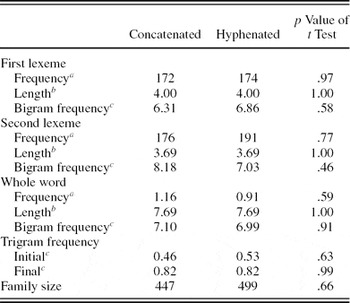
The 13 hyphenated compound words were matched with the 13 concatenated compounds (see Table 1) on word length, left and right lexeme length, whole-word frequency, first lexeme and second lexeme frequency, average bigram frequency, initial trigram frequency, final trigram frequency, and left lexeme family size (i.e., the number of derived and compound words starting with the same left lexeme as the target words). All values were extracted from a newspaper corpus containing 22.7 million word forms (Laine & Virtanen, Reference Laine and Virtanen1999). The items are presented in Appendix A.
Lexical statistics of the two compound type conditions used in the experiment

aPer million.
bIn characters.
cPer thousand.
One may claim that hyphenated compounds are orthographically somewhat peculiar, because in adult texts hyphens only appear within compounds with two identical vowels spanning the constituent boundary. In addition, or perhaps consequently, bigram and trigrams including a hyphen are not all that frequent. However, beginning Finnish readers are exposed in the first grade to words that are hyphenated at the syllable level (e.g., ta-lo “house,” ka-me-li “camel”). The hyphens are then gradually removed from the ABC books and textbooks, but they are preserved in long and difficult words to some extent until the end of the second grade. In other words, children are used to being exposed to hyphenated words. Second, we took great care that, apart from the hyphen, the orthographic structure of the hyphenated compounds is similar to that of concatenated compounds. This is evident because average bigram frequency, initial trigram frequency, and final trigram frequency did not differ between the compound types.
The target compounds were embedded in sentence frames. Each hyphenated compound word was paired with a concatenated compound word, and a sentence that was identical up to word N + 1 was constructed for each pair. The target word never appeared in the beginning or end of the sentence. The context in which the sentences were presented differed between the two testing periods due to material from other experiments appearing as fillers. In the first period (April), each participant (half of the second graders, all fourth and sixth graders) read a total of 160 sentences. In the second period (October), each participant (the other half of the second graders) read a total of 102 sentences. The sentences were divided in two blocks, and the block order was counterbalanced across participants. The order of sentences was pseudorandomized. A typical sentence pair can be seen in the example below. The target word is in bold; a literal and free English translation is presented between parentheses.
Hyphenated: Isän ostama vara-auto oli väriltään punainen.
(Literal: Father's bought extra car was colored red; Free: The extra car father bought was red.)
Concatenated: Isän ostama autopeli oli oikein hauska.
(Literal: Father's bought car game was very enjoyable; Free: The racing game father bought was very enjoyable.)
The sentences were presented in Courier font so that each character position was of equal width. With a viewing distance of about 60 cm, three character spaces subtended approximately 1 degree of visual angle. With respect to the vertical axis, sentences were always presented halfway between the top and the middle of the screen. Sentences were all single-line sentences with a maximum of 79 characters on a line.
Procedure
Prior to the experiment proper, the eyetracker was calibrated using a three-point horizontal calibration grid that extended over the entire computer screen. Before each sentence the participant had to fixate on a calibration point at the left side between the top and the middle of the screen. When the participant was fixating the calibration point, the experimenter pushed a button, which caused the sentence to appear on the screen starting at the same position as where the calibration point was presented.
Participants were instructed to read the texts silently for comprehension at their own pace, as they would read a magazine or a book. They were further told that after varying intervals they would be presented with a statement about the last sentence, to which they had to answer yes/no by pressing a corresponding button on a game-pad. There were 20 or 16 statements in total for the first and second testing periods, respectively. A practice session containing six sentences preceded the first experimental block.
RESULTS
Only participants whose success rate on responding to the yes/no statements was equal to or higher than 75% were included in the analyses. The 75% cutoff point was used to ensure that the participants had a good understanding of what they were reading. For participants with lower comprehension scores it is hard to make straightforward interpretations as to what the eye movement measures reflect. For the remaining participants, trials in which the target word was initially skipped were excluded from the analyses (0.2%, 0.2%, and 1.0% of trials for the second, fourth, and sixth grade, respectively). Furthermore, for all measures values more than 2 standard deviations above the grand participant mean were excluded, apart from the number of fixations, where 3 standard deviations was used as the cutoff point in order not to exclude too many cells. To render the estimates of the condition means normally distributed and standard deviations more comparable with each other, a logarithmic transformation was computed for each duration measure. In cases where the Mauchly's sphericity test became significant, multiple analyses of variance and Greenhouse–Geisser corrected analyses of variance (ANOVAs) were also conducted. However, the effects were the same as in the uncorrected ANOVAs, which are reported below.
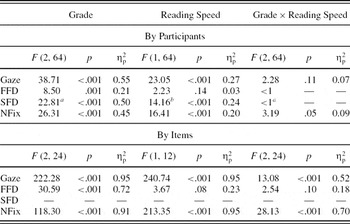
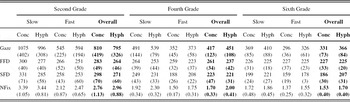
The ANOVAs included three factors: compound type (concatenated vs. hyphenated), grade (second vs. fourth vs. sixth), and reading speed (slow vs. fast). A median split based on overall reading speed observed in the experiment was conducted separately for each grade to form reading speed groups. For grade level and reading speed, we were not interested in the main effects (which were obviously present in practically all measures) but in interactions with compound type. However, the main effects of grade and reading speed as well as Grade × Reading speed interactions are presented in Table 2.Footnote 4 If an interaction involving compound type and grade was significant, we computed separate analyses for each grade, including pairwise t tests for each reader group. The means for each measure broken down by the three factors can be found in Table 3 (nontransformed means are presented).
Main effects of grade and reading speed and Grade × Reading Speed interactions for each measure

Note: FFD, first fixation duration; SFD, second fixation duration; NFix, number of fixations.
aDegrees of freedom = (2, 46).
bDegrees of freedom = (1, 46).
Means (standard deviations) for each eye movement measure as a function of grade, reading speed, and compound type

Note: Conc, concatenated; Hyph, hyphenated; FFD, first fixation duration; SFD, second fixation duration; NFix, number of fixations. The overall scores are in bold.
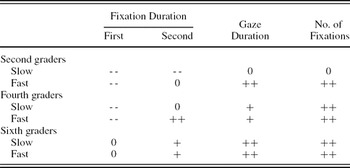
The following measures were used as dependent variables: gaze duration, number of fixations for the first pass reading, first fixation duration, and second fixation duration. Gaze duration indexes the overall processing time of the word, whereas the other fixation duration measures index the relative time course of processing so that first fixation duration indexes an early effect, whereas second fixation duration reflects a relatively more delayed effect. The ANOVAs were performed by treating both participants (F 1) and items (F 2) as the random factor, except for second fixation duration, for which there were too many empty cells for an item analysis apart from the second grade. We have summarized the effect of compound type for each reader group in Table 4.
The effect of compound type for each reader group

Note: - = hyphenated compounds read faster than concatenated compounds or more fixations in concatenated than hyphenated compounds; 0 = no difference between hyphenated and concatenated compounds; + = concatenated compounds read faster than hyphenated compounds or more fixations in hyphenated than concatenated compounds; - -/++ = significant effect; -/+ = marginal effect.
Gaze duration
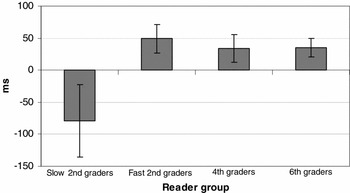
The main effect of compound type was significant in the participant analysis, F 1 (1, 64) = 6.41, p = .01, η2p = 0.09, but only marginal in the item analysis, F 2 (1, 12) = 3.52, p = .09, η2p = 0.23. Gaze duration was shorter in concatenated than hyphenated compounds. The Compound Type × Grade interaction was marginal in the item analysis, F 2 (2, 24) = 2.73, p = .09, η2p = 0.19, but not in the participant analysis, F1 (2, 64) = 1.67, p = .20, η2p = 0.05. The Compound Type × Reading Speed interaction was not significant (both ps > .15), but the Compound Type × Reading Speed × Grade interaction was significant, F 1 (2, 64) = 4.26, p = .02, η2p = 0.12; and F 2 (2, 24) = 6.24, p < .01, η2p = 0.34. We illustrate the nature of this interaction in Figure 1. To assess the significant interactions in more detail, we performed separate analyses for each grade. For the second grade, there was a significant Compound Type × Reading Speed interaction, F 1 (1, 32) = 7.01, p = .01, η2p = 0.18; and F 2 (1, 12) = 9.88, p < .01, η2p = 0.45. The fast children had longer gaze durations in hyphenated than concatenated compounds (p 1 = .03, p 2 = .06). For slow second graders, the pattern was numerically reversed. However, it was not significant (p 1 = .15, p 2 = .16). For the fourth grade, there was a tendency for a main effect of compound type, F 1 (1, 15) = 2.98, p = .11, η2p = 0.17; and F 2 (1, 12) = 4.25, p = .06, η2p = 0.26, hinting at longer gaze durations in hyphenated than concatenated compounds. For the sixth grade, there was no Compound Type × Reading Speed interaction (Fs < 1). The main effect of compound type (p 1 = .03, p 2 = .02) reflects that gaze duration was shorter in concatenated than hyphenated compounds.
The size of the hyphenation effect (gaze duration on hyphenated compounds minus gaze duration on concatenated compounds). Error bars denote standard errors.

Number of fixations for the first pass reading
The main effect of compound type was significant, F 1 (1, 64) = 12.39, p = .001, η2p = 0.16; and F 2 (1, 12) = 10.18, p < .01, η2p = 0.46. Readers made more fixations on hyphenated than concatenated compounds. Separate analyses for each grade showed that for second grade there was a significant Compound Type × Reading Speed interaction in the item analysis, F 1 (1, 32) = 1.80, p = .19, η2p = 0.05, F 2 (1, 12) = 6.44, p = .03, η2p = 0.35. This reflects that fast second graders had more fixations in hyphenated than concatenated compounds (p 1 = .01, p 2 = .04), whereas for slow second graders there was no difference between compound types (both ps > .5). For both fourth and sixth graders there were no Compound Type × Reading Speed interactions (all Fs < 1). There were significantly more fixations in hyphenated than concatenated compounds for both fourth and sixth graders (all ps < .04).
First fixation duration
There was a significant main effect of compound type, F 1 (1, 64) = 10.34, p < .01, η2p = 0.14, and F 2 (1, 12) = 16.68, p < .01, η2p = 0.58. First fixation duration was shorter in hyphenated than concatenated compounds. The Compound Type × Grade interaction was marginal in the participant analysis, F 1 (2, 64) = 2.54, p = .09, η2p = 0.07, and significant in the item analysis, F 2 (2, 24) = 5.12, p = .01, η2p = 0.30. There were no other interactions involving compound type (all ps > .15). The main effect of compound type was significant for the second graders, F 1 (1, 32) = 6.48, p = .02, η2p = 0.17, and F 2 (1, 12) = 4.26, p = .06, η2p = 0.26, as well as for the fourth graders, F 1 (1, 15) = 8.59, p = .01, η2p = 0.36, F 2 (1, 12) = 29.56, p < .001, η2p = 0.71. First fixation duration was longer in concatenated than hyphenated compounds for both grades. For the sixth graders, there was no main effect of compound type (Fs < 1).Footnote 5
Second fixation duration
The main effect of compound type was not significant (F 1 < 1). The Compound Type × Reading Speed interaction was significant, F 1 (1, 46) = 4.86, p = .03, η2p = 0.10, as was the Compound Type × Grade interaction, F 1 (2, 46) = 7.89, p = .001, η2p = 0.26. There were no other significant interactions (all Fs < 1). For the second grade, there was no difference between concatenated and hyphenated compounds for the fast readers (p 1 > .2, p 2 = .07). For the slow second graders, second fixation in hyphenated compounds was shorter than in concatenated compounds (p 1 < .005, p 2 = .01). This trend could also be observed in a Compound Type × Reading Speed interaction, which was marginal in the participant analysis, F 1 (1, 27) = 2.98, p = .10, η2p = 0.10, but not in the item analysis (F 2 < 1). For the fourth grade, there was a significant Compound Type × Reading Speed interaction, F 1 (1, 12) = 5.14, p = .04, η2p = 0.04. Second fixation duration of the fast readers was shorter in concatenated than hyphenated compounds (p 1 = .05). For the slow fourth graders there was no difference between compound types (p 1 > .3). For the sixth graders, there was no Compound Type × Reading Speed interaction (F 1 < 1). The main effect of compound type, p 1 = .06, was due to the sixth graders making longer second fixations in hyphenated than concatenated compounds.
DISCUSSION
To summarize the results (see also Table 4), we found that for the fast second graders, all fourth graders, and all sixth graders hyphenated compounds elicited longer gaze durations than concatenated compounds. For the slow second graders we found an opposite pattern: gaze durations for hyphenated compounds were shorter than for concatenated compounds even though this difference failed to reach significance. However, first and second fixation durations were significantly shorter in hyphenated compounds than concatenated compounds for slow second graders. For fast second graders and all fourth graders first fixation durations were shorter in hyphenated than concatenated compounds, whereas for sixth graders there was no difference between compound types. In contrast to the results obtained for slow second graders, concatenated compounds elicited either equally fast (fast second graders and slow fourth graders) or faster (fast fourth graders and all sixth graders) second fixation durations than hyphenated compounds. Finally, for slow second graders there was no difference in the number of fixations between concatenated and hyphenated compounds, whereas for all the other groups there were fewer fixations in concatenated than hyphenated compounds.
Taken together, the pattern of results distinguishes the slow second graders from all other participant groups. More precisely, for slow second graders all measures indicate that hyphenation is not disruptive to compound reading. Individual fixation durations indicate that for them it is easier to process hyphenated compounds than concatenated ones. For all other participant groups there is at least one measure that indicates that hyphenation disrupts compound processing. Most important, for all groups but slow second graders gaze durations for concatenated compounds were shorter than for hyphenated compounds. How can this different pattern of results for slow second graders in comparison to the other participant groups be explained?
We think that slow second graders do not make use of whole-word representations but instead rely solely on morphemes in processing compound words. Because morphological structure is explicitly signaled in hyphenated compounds but not in concatenated compounds, the former type of compounds is easier to process. More precisely, because the constituent boundary is not explicitly marked in concatenated compounds, extra processing effort is needed to decide where the first constituent ends and the second begins. This extra processing effort is reflected in significantly longer first and second fixation durations. The type of morpheme-based processing slow second graders resort to is not hampered by hyphenation, or, to put it differently, by the role a hyphen may play in initially restricting attention to the first constituent. That is, for a reader who reads a compound via its morphological constituents, initial focus on the first constituent should enhance rather than hamper the ease of processing.
All other participant groups read concatenated compounds faster than hyphenated ones, implying that it is unlikely that both types of compounds are processed solely via morphemes. A possible explanation for this difference is that hyphenated compounds are processed via morphemes and concatenated compounds via whole-word representations. If this is the case, processing concatenated compounds would be faster, because decomposed access as such is likely to be slower than direct access via whole-word representations because that one has to go through more processing stages in the former case. That is, one needs to access two representations instead of one and also to assemble the decomposed parts together, which requires additional processing time.
Another possibility is that whole-word representations are involved in processing hyphenated compounds only after activation of the first constituent. The idea of whole-word representations being activated via the first constituent was introduced by Taft and Forster (Reference Taft and Forster1976) for all compounds but is perhaps most likely for compounds where the first constituent is visually distinct as is the case for hyphenated compounds. If this is the case, it would mean that there is an additional processing stage for hyphenated compounds in comparison to concatenated compounds that would manifest in longer processing times for the former type of compounds. In sum, the finding that gaze durations are faster for concatenated than hyphenated compounds is in line with either hyphenated compounds being processed solely via morphemes or by activating the whole-word representation via the first constituent morpheme, whereas concatenated compounds are directly accessed via whole-word representations.
One question that remains still is why in the initial stages, indexed by first fixation duration, hyphenated compounds are either processed equally fast or even faster than concatenated ones even though in the end they are processed slower by five out of six participant groups. We would again like to argue that the presence of a hyphen affects the allocation of attention within a compound; more precisely, a hyphen causes the reader to restrict his/her attention to the first constituent. In case of concatenated compounds it is not clear from the beginning where the first constituent ends or even whether the word in question is a compound or not, and therefore attention is likely to stretch over the whole word. Because the attentional focus is restricted to a smaller (and also more frequent) lexical unit in the former situation, initial processing is more favorable for hyphenated compounds than concatenated compounds.
Our hypothesis was that hyphenation would only disrupt compound reading for the sixth graders, but to our surprise, hyphenation was already disruptive in the early elementary school years. In the Introduction we noted that Finnish elementary school children develop reading skills very quickly. This is partly due to the shallow orthography of written Finnish, which enables beginning Finnish readers to perform tasks such as reading familiar words and nonwords with better accuracy and speed than beginning readers of many other languages (Seymour et al., Reference Seymour, Aro and Erskine2003). We think that this quick development of reading skill may have led to the situation that already at the second grade many Finnish children are able to identify at least relatively short familiar compound words (seven to nine letters) via whole-word representations.
Note that we screened out the weakest readers prior to the experiment, which may have shifted the balance of the results somewhat. Especially for the second grade the inclusion of weaker readers could have led to a positive main effect of hyphenation. It is likely that explicitly signalling morphological structure by means of a hyphen is beneficial for other less proficient readers as well, for instance, for first graders or for dyslexic readers. The study of Harley and O'Mara (Reference Harley and O'Mara2006) supports this claim. They found that their phonological dyslexic patient JD read aloud morphologically complex words like needless and paranormal very well (85% correct) once hyphens were included at the morpheme boundary (need-less, para-normal). In contrast, JD was not able to read any of the 20 concatenated complex words aloud when they were written in concatenated format.
Thus far we have discussed the use of morphological and whole-word information with respect to reading skill. However, recent studies have indicated that several other factors such as constituent frequency, whole-word frequency, family size of the left constituent, and word length affect the extent to which different sources of information are used in processing morphologically complex words. We should also note that these kinds of factors may interact with each other (Bertram & Hyönä, Reference Bertram and Hyönä2003; Kuperman et al., Reference Kuperman, Bertram and Baayen2008; Kuperman, Bertram, Schreuder, & Baayen, in press; Niswander-Klement & Pollatsek, Reference Niswander-Klement and Pollatsek2006). For example, Bertram and Hyönä (Reference Bertram and Hyönä2003) and Niswander-Klement and Pollatsek (Reference Niswander-Klement and Pollatsek2006) demonstrated that adults make more use of morphological information in case of long words. The authors argued that this finding is caused by degraded visibility of the letters in the end of long words. Accordingly, Bertram and Hyönä proposed the visual acuity hypothesis, which holds that readers initially process the first constituent morpheme of a complex word if they do not perceive enough of the latter part of that word. In line with the visual acuity hypothesis, Bertram and Hyönä (Reference Bertram and Hyönä2011) found that adult readers benefit from hyphenation when reading long (12–14 letters) hyphenated compounds but are disrupted by hyphenation when reading short (7–9 letters) hyphenated compounds. Bertram and Hyönä argued that when a word is long, hyphenation facilitates reading because the reader will initially access the first constituent in long compounds anyway and a hyphen visually marks the lexeme boundary thus enhancing the identification of this constituent. However, in case of short and familiar compounds, practically all letters fall within the foveal span on the first fixation, enhancing direct whole-word access. In this case, hyphenation is detrimental, because it enforces initial focus on the first constituent, which either encourages the reader to use decomposition or leads to delayed access of the whole-word representation.
We may argue that for slow second graders the seven- to nine-letter compounds used in this study are still relatively long and thus would encourage morpheme-based processing, whereas for fast second graders and older children they are sufficiently short so that these readers rely on access via whole-word representations. This ties in with the findings of Häikiö et al. (Reference Häikiö, Bertram, Hyönä and Niemi2009), who observed that the letter identity span of fast second graders and older children is at least seven letters to the right of fixation. This means that in the present study, the entire word (seven to nine letters) usually falls within their letter identity span, even if the initial fixation is in the very beginning of the word (for the fast second graders, the initial fixation falls on average on the third letter of the word). However, for slow second graders, Häikiö et al. (Reference Häikiö, Bertram, Hyönä and Niemi2009) found that the letter identity span is only five letters to the right of fixation. This implies that for the target compounds of this study, the letter identity span of slow second graders fairly often does not cover the whole compound (for the slow second graders, the initial fixation falls on the second letter of the word on average). Taken together, the results imply that the visual acuity hypothesis of Bertram and Hyönä (Reference Bertram and Hyönä2003) may explain the results obtained for slow second-grade readers.
We would still like to point out that we do not claim that Finnish children only make use of morphological structure relatively early in reading development or when morphologically complex words are of considerable length. After all, the explosive vocabulary growth that takes place during elementary school years is largely morphologically driven (Anglin, Reference Anglin1993). In addition, as mentioned above, Finnish is morphologically very productive, and consequently a Finnish speaker or reader is confronted daily with several new morphological formations, in addition to shorter ones. Related to this, one may consider that in Finnish, a verb may appear in approximately 13,000 inflectional forms and a noun or adjective can combine with inflectional suffixes, so that about 2,000 different inflectional variants of the same noun could be realized (Karlsson & Koskenniemi, Reference Karlsson and Koskenniemi1985). In addition, derivation and compounding is very productive in Finnish, so that the family size of a given word—the number of derivational and compound descendants of a given word—outnumbers to a great extent the family size in other languages like Dutch for instance (see Moscoso del Prado Martin, Bertram, Häikiö, Schreuder, & Baayen, Reference Moscoso del Prado Martín, Bertram, Häikiö, Schreuder and Baayen2004). In other words, throughout the elementary school years (and throughout his/her entire life) a Finnish reader will have to resort to morpheme-based processing, if it were only to deal with the uncountable new morphologically complex words.
Our results add to the growing body of evidence that morphological models should be flexible, allowing for different sources of information to contribute to complex word processing depending on the circumstances (Bertram & Hyönä, Reference Bertram and Hyönä2003; Kuperman et al., Reference Kuperman, Bertram and Baayen2008). Here we found that reading proficiency is one factor that modulates the contribution of morphological information during complex word processing. Models like the supralexical model of Giraudo and Grainger (Reference Giraudo and Grainger2001) claiming that whole words are activated before morphological constituents, or decomposition models proposing that morphological constituent activation precedes whole-word activation (e.g., Longtin & Meunier, Reference Longtin and Meunier2005; Rastle et al., Reference Rastle, Davis and New2004; Taft & Ardasinski, Reference Taft and Ardasinski2006) lack this kind of flexibility. In contrast, more flexibility is incorporated in dual-route models (Baayen & Schreuder, Reference Baayen and Schreuder1999) as well as in the multiple source model PROMISE of Kuperman et al. (Reference Kuperman, Bertram and Baayen2008), which allow for simultaneous activation of both whole-word and morpheme-based representations in combination with the assumption that different factors like frequency and word length modulate the contribution of whole-word and morpheme-based information during complex word processing.
In sum, the current study suggests that slow second graders process both concatenated and hyphenated seven to nine-letter compound words via morphemes without making use of whole-word representations. Hyphenation comes to aid in signaling the morphological structure of compound words; hence, the faster fixation durations on hyphenated than concatenated compounds. To put it differently, the results imply that slow second graders prefer to process short seven- to nine-letter compound words via units that are easily digestible given their reading skill. For fast second graders as well as for all fourth and sixth graders the results imply that concatenated compounds are accessed via whole-word representations, whereas hyphenated compounds are accessed morpheme by morpheme or via whole-word representations activated by the first constituent. It seems to us that this type of decomposition or delayed access of the whole-word representations is linked to the role of hyphen, causing initial attentional focus to be mainly on the first constituent.
APPENDIX A
Items used in the experiment

ACKNOWLEDGMENTS
This study was financially supported by the Academy of Finland (Grant 118404 to R.B.).