Implications
The introduction of quantitative locomotion research in pigs presents an objective and accurate alternative to traditional subjective assessment methods, decreasing the potential for bias. Gait analysis can detect subtle changes hidden to the human eye and, in contrast to X-ray and sensor placement into tissue, is a non-invasive means to examine the musculoskeletal system offering much potential for the pig industry to exploit. Factors believed to have an impact on musculoskeletal health need to be better understood and arguments for or against husbandry practises should be evidence-based and underpinned by data. This study provides a novel perspective to address the ongoing uncertainty about the role of floors and identifies important gait variables for further research.
Introduction
Despite the general pursuit of problem control in the modern swine industry, lameness remains an unresolved challenge and affects to some degree 10% to 20% of the pigs on commercial farms (KilBride et al., Reference KilBride, Gillman, Ossent and Green2009). In the United Kingdom it has been estimated that lameness may account for £5 million per annum (extrapolating from BPEX, 2012 and Willgert, Reference Willgert2011), a figure which takes account of the cost of initial treatment, veterinary visits and replacement of breeding females. Reduced growth performance in lame growers and finishers can cause delayed market weight achievement and entail carcass downgrading (Correa et al., Reference Correa, Faucitano, Laforest, Rivest, Marcoux and Gariépy2006). Persistent conditions may necessitate euthanasia due to European legislation prohibiting transport of lame animals. Furthermore, the welfare of lame animals is seriously compromised, which is unacceptable within the modern standards of pig production (Jensen et al., Reference Jensen, Bonde, Kongsted, Toft and Sorensen2010).
The common causes for lameness are genetic predisposition to weakness of the musculoskeletal system (Jørgensen and Andersen, Reference Jørgensen and Andersen2000), infections (Nielsen et al., Reference Nielsen, Nielsen and Friis2001), injuries, nutrient deficiencies and systemic diseases which target musculoskeletal components (Straw, Reference Straw, Zimmermann, DʼAllaire and Taylor2006). One of the predisposing factors to lameness in modern pig production is considered to be the type of floor on which the animals are housed (Mouttotou et al., Reference Mouttotou, Hatchell and Green1999). In the last decade, there has been increasing interest in the effect of floor type on the prevalence of lameness and lesions of the legs and claws (Scott et al., Reference Scott, Chennells, Campbell, Hunt, Armstrong, Taylor, Gill and Edwards2006; KilBride et al., Reference KilBride, Gillman, Ossent and Green2009). In addition, although some papers have shown that selection for rapid weight gain has lead to increased lameness problems (Simonsen, Reference Simonsen1993; Busch and Wachmann, Reference Busch and Wachmann2011), other investigators could not confirm this growth rate association (Stern et al., Reference Stern, Lundeheim, Johansson and Andersson1995; Ytrehus et al., Reference Ytrehus, Carlson and Ekman2007).
Leg weakness describes clinical deficiencies of leg posture (conformation) and locomotion considered to arise from problems in the musculoskeletal system (Fan et al., Reference Fan, Onteru, Mote, Serenius, Stalder and Rothschild2009). Assessment protocols have been developed for the evaluation of leg weakness symptoms and lameness which rely on visual, clinical scoring of the animal (van Steenbergen, Reference van Steenbergen1989; Jørgensen and Andersen, Reference Jørgensen and Andersen2000; Main et al., Reference Main, Clegg, Spatz and Green2000). Studies have then reported elevated clinical levels of leg weakness on fully slatted floors compared with straw-bedded floors (Jørgensen, Reference Jørgensen2003; KilBride et al., Reference KilBride, Gillman, Ossent and Green2009). However, this was not the case for lesions of osteochondrosis, a degenerative joint disease, in the same pigs although this has been considered as the most important underlying factor of leg weakness (van Grevenhof et al., Reference van Grevenhof, Heuven, van Weeren and Bijma2012). KilBride et al. (Reference KilBride, Gillman, Ossent and Green2009) also found increased lameness in finishing pigs housed on solid concrete with sparse bedding and partly slatted surfaces compared to pigs kept on deep straw-bedded floors.
One of the major shortcomings of most studies conducted on lameness and/or leg weakness is their reliance on subjective, qualitative assessment which implies a potential for bias (Dalmau et al., Reference Dalmau, Geverink, Van Nuffel, van Steenbergen, Van Reenen, Hautekiet, Vermeulen, Velarde and Tuyttens2010). Several repeatability studies reported unfavourable results for subjective lameness assessment (Petersen et al., Reference Petersen, Enøe and Nielsen2004; Quinn et al., Reference Quinn, Keuler, Lu, Faria, Muir and Markel2007; Waxman et al., Reference Waxman, Robinson, Evans, Hulse, Innes and Conzemius2008). This may be expected to be worse in on-farm situations where individual pig assessment is impeded within a pen with other pigs. Previous quantitative studies have investigated the instantaneous gait adjustment of pigs on slippery and non-slippery surfaces by means of gait analysis with force plates and 2D video kinematics (Thorup et al., 2008; von Wachenfelt et al., Reference von Wachenfelt, Pinzke and Nilsson2009). However, there appears to be no longitudinal study quantifying the gait and gait variability of pigs exposed to different commercial floor types for an extended part of their development.
The aim of this study was to investigate and present quantitative gait data of pigs followed through an important growth stage, spent on one of three commonly used floor types: fully slatted concrete, partly slatted/partly solid concrete or a deep straw-bedded floor. A multiple camera-based 3D motion capture technique with markers placed near joint centres was chosen. From the data obtained by the camera system, a comprehensive selection of gait parameters was calculated. Some of these gait parameters were previously successful in differentiating between normal/abnormal gait and changes in gait over time in dogs (Bockstahler et al., Reference Bockstahler, Henninger, Muller, Mayrhofer, Peham and Podbregar2007), cows (Flower et al., Reference Flower, Sanderson and Weary2005) and horses (Back et al., Reference Back, Barneveld, Schamhardt, Bruin and Hartman1994).
There were two hypotheses. (1) Pigs housed on softer surfaces such as straw show fewer gait problems and less gait variation than pigs growing on harder surfaces, with a potential differentiation between partly slatted and fully slatted floors. To test this, it was assumed that gait problems would be reflected in at least one of the measured gait parameters, representing a variety of geometric features of movement. (2) Fast growing pigs have a more cumbersome gait and weak pasterns due to greater body mass acting on the passive tendon/ligament structures in the lower leg. To test this, the gait of fast, intermediate and slow growing pigs as present in this study was compared.
Material and methods
Animals, management and experimental housing
All procedures on animals were in accordance with institution guidelines and UK animal welfare regulations. The experimental population consisted of 12 entire male and 12 female clinically healthy growing pigs of a commercial crossbred genotype (Large White×Landrace damline and Pietrain×Duroc sireline; Hermitage Genetics, Kilkenny, Ireland), weighing 37 kg (s.d. 3 kg) at date of entry. The pigs were randomly selected from three double-litter groups previously housed on plastic slatted flooring at the Newcastle University pig unit. Only pigs with no signs of lameness were included, that is they showed no signs of stiffness or limping when moving along a walkway and had no visible body surface abnormalities. Initially all pigs scored 0 according to the scoring system described by Main et al. (Reference Main, Clegg, Spatz and Green2000). Lameness was visually assessed on all pigs during all motion captures. The pigs were divided into groups comprising four males and four females, with groups then randomly assigned to one of three pens within the same room in an experimental building with a controlled climate. Pens were 3.0×3.2 m and had one of the following floor types: fully slatted concrete (20 mm gap width and 80 mm slat width), partly slatted (3.0×2.5 m solid concrete and 3.0×0.7 m slatted, with 20 mm gaps and 80 mm wide slats) or deep straw-bedded. The straw-bedded pen was continuously covered with a regularly renewed layer of 5 to 10 cm straw bedding. Pigs had ad libitum access to concentrate feed and water. Five weeks followed during which pigs were familiarised with separation from pen mates, close human contact, marker application and walking training. Pigs learned to follow a target led by a human operator to obtain a treat, in this case a small piece of apple, when movement was acceptable. Successful pigs walked with regular and continuous strides without distraction and without changes in walking speed.
Data collection
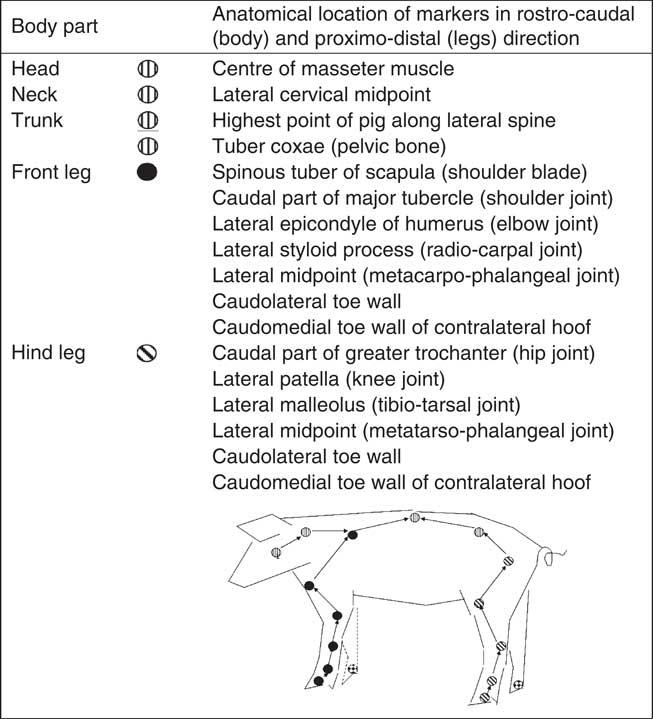
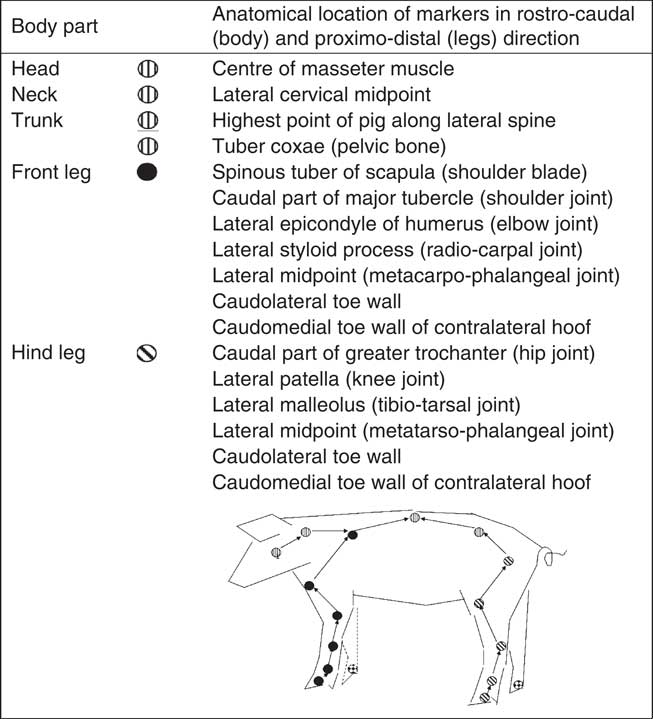
A neighbouring building with a solid concrete floor contained the motion capture area comprising a motion capture walkway, measuring 3.5 m long×2 m wide, together with preparation and waiting areas, each measuring 3.8×2.27 m. Pigs were moved to the waiting area before the filming session. Starting at mean BW 63 kg (s.d. 7 kg), every 7 to 10 days pigs were subjected to the bilateral application of 34 circular, reflective markers over key anatomical landmarks as described in Figure 1. Markers were attached with double-sided, adhesive tape (Supa Brands, Worsley, Manchester, UK). A uniplanar, linear kinematic model was used (Thorup et al., Reference Thorup, Laursen and Jensen2008; Torres et al., Reference Torres, Punke, Fu, Navik, Speas, Sornborger and Budsberg2010). The method was previously validated for gait parameter repeatability in a study by Stavrakakis et al. (Reference Stavrakakis, Guy, Warlow, Johnson and Edwards2013a) with 1.4 to 3.8° and 1.7 to 4.8° mean differences between repeated marker placements for elbow and knee angle measures, respectively. Mean differences for step and stride lengths, as defined in Table 1, were 6 to 13 mm.
Anatomical positions of markers with schematic illustration.
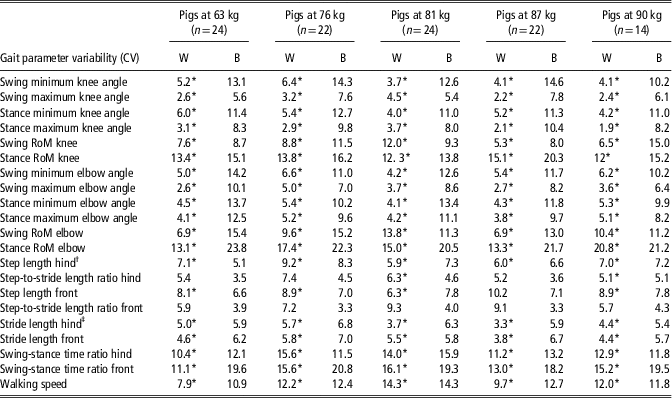
Average CV within- and between-pigs per capture

W=within-pig; B=between-pig; RoM=range of motion.
Columns represent motion captures one to five, respectively. Pig weight is average liveweight at motion capture.
*A star accompanies parameters for which pig effect within capture was significant at P⩽0.050, that is within-pig variability usually smaller than between pig variability.
†The step length is the length of a rectangle drawn using the same ground contact points of left and right hoofs of a pair as the diagonal of the rectangle (Whittle, Reference Whittle2003).
‡The stride length is the distance measured between the same ground contact points of two consecutive contacts of the same hoof (Whittle, Reference Whittle2003).
One pig at a time was moved away from its group in the waiting area and prepared with markers while it could freely move in the preparation pen. Pigs became habituated to the procedure and allowed palpation of the landmarks without crate confinement. Once all markers were in position, which took on average 30 min, the current pig was moved into the motion capture area and filmed while following the operator at walking speed. The motion capture system comprised six infrared cameras (T20; Vicon, Oxford, UK) set up in an array flanking the walkway at a 3 m distance to the centre. This system was connected to a computer and movements on the walkway were captured with motion capture software (Nexus v.1.7.1; Vicon); the sampling rate was 125 Hz. At least two acceptable sequences of three to four strides in each direction (i.e. four trials including both sides; multiple trials constitute a session) were captured by the cameras on each occasion. When pigs achieved market weight of ~90 kg liveweight, they were slaughtered at a local abattoir. The motion capture period lasted 6 weeks allowing five captures for most pigs. Pigs that achieved market weight earlier (n=8) were not included in the fifth capture. Rarely, pigs could not be motivated to move along the walkway or their films had to be discarded later because of poor marker visibility, and therefore not all captures include all 24 pigs.
Data processing
For stride event detection, parameter calculation and time normalisation, data were imported into Matlab (R2010b; Mathworks©, Natick, USA). The timing of toe-on and toe-off stride events was automatically determined from the vertical velocity graph of each toe marker (vertical velocity close to 0 m/s) and confirmed through visual examination of the toe marker vertical position graph. The toe-on timing was used to define the beginning of a gait cycle of an individual hoof, that is a gait cycle lasted from one toe-on to the next toe-on of the same hoof. Toe-off points were used to define swing and stance time durations for individual hoofs. If at least one of the four hoof displacement graphs was incomplete, for example due to marker occlusion, the complete trial was rejected. Only continuous sequences of strides were included, usually containing three consecutive strides. Pigs had already undertaken several strides when they entered the camera view field and continued to walk after leaving it. Therefore it was assumed that the strides filmed by the cameras were equal and not influenced by initial propulsion or terminal braking events.
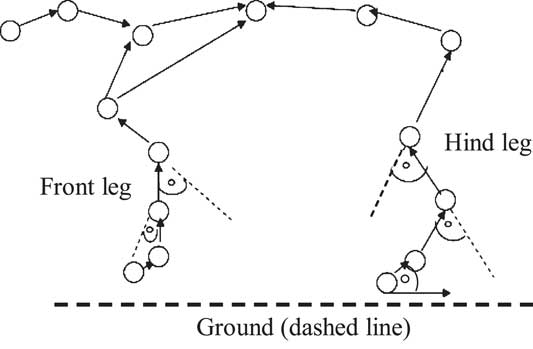
Figure 2 shows five selected angles of interest, namely the carpal and elbow angle in the front leg, the hind pastern, knee and tarsal angle in the hind leg. Angle values were normalised for time and all angle graphs were plotted as a function of gait cycle time and visually examined for the presence of enough data points to compose a smooth curve. Both maximum and minimum values and the range of motion during stance and swing were obtained only from well-defined angle curves. In this analysis, a selection of angular, linear and temporal kinematics is presented. Angular kinematics are represented by the elbow joint angle in the front leg and the knee joint angle in the hind leg. Linear kinematics include the step lengths of front and hind leg pairs, the front and hind stride lengths and the step-to-stride length ratio (Whittle, Reference Whittle2003; see Table 2). Temporal gait parameters are represented by the swing-stance time ratio, while walking speed is presented as a spatiotemporal parameter. Additionally, the front and hind pastern angles were included in the analysis of the effect of weight gain on gait. To account for possible morphological scaling differences between pigs, leg length was calculated as the sum of the four segments constituting the legs. This length was then tested for differences across floor groups.
Vector skeleton model. Two markers defined each anatomically relevant segment with the vector between them. Vectors all pointed centrally allowing the angles between segments to be calculated in degrees of flexion. Note that the floor vector points opposite to direction of travel. Angle examples in this figure are (from distal to proximal) in the hind leg: hind pastern angle, tarsal and knee angle. In the front leg: carpal and elbow angle.

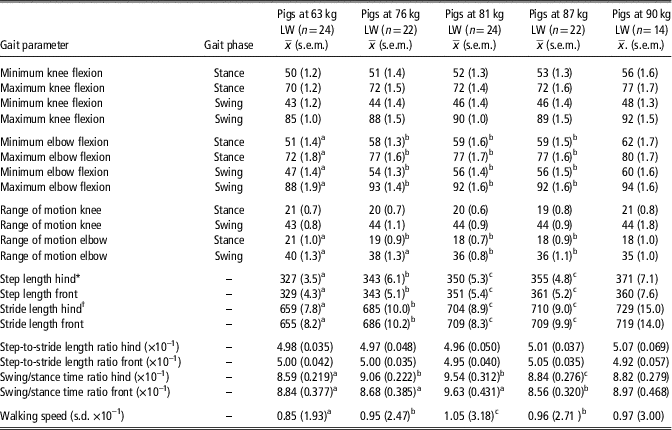
Changes in gait measured over time

Mean gait parameter values at different motion capture time points. Last capture values are reported without statistical comparisons (due to reduced number of participants left, this capture was excluded from the repeated measures analysis). Columns represent motion captures one to five, respectively. Angles are in degrees flexion, linear parameters in mm, speed in m/s.
a–cMeans within a row followed by a different superscript differ significantly at P⩽0.050.
–, These are unidimensional parameters, measured only once per gait cycle.
*The step length is the length of a rectangle drawn using the same ground contact points of left and right hoofs of a pair as the diagonal of the rectangle (Whittle, Reference Whittle2003).
†The stride length is the distance measured between the same ground contact points of two consecutive contacts of the same hoof (Whittle, Reference Whittle2003).
Data analysis
Within-subject means and standard deviations were calculated for every gait parameter and capture, and were weighted for number of strides when originating from more than one trial. With the exception of the effect of weight gain on gait, in this analysis all results are based on measures obtained from the right side. Left side data were also collected for a follow-up paper on pathology-based asymmetry. An initial analysis, before within-subject averaging, was performed to test for stride-to-stride variability and between-pig variability by calculating the CVs. The within-pig CV was obtained by averaging the data of usually two different trials. The significance of the pig effect on gait, both within capture and between captures (one to five), was tested in a one-way ANOVA (Minitab v.16, State college, Pennsylvania, USA) with pig as a fixed factor and within-pig gait parameter values as a response. To test whether growth rate had an effect on gait, pigs were classified into slow (600 to 700 g/day), intermediate (700 to 900 g/day) and fast growing animals (900 to 1090 g/day) and these categories used as fixed factors with gait parameters as a response in one-way ANOVAs for every capture. The floor effect on pig gait variability was investigated for every capture separately in a one-way ANOVA with floor as a fixed factor and individual pig CVs as a response. Differences between floor groups in factors potentially affecting gait were tested for every capture in a one-way ANOVA with floor as a fixed factor and leg length, walking speed and BW as a response. For the first capture, the gait parameters of two pigs were excluded since their walking speed was substantially greater than all other pigs. This measure was taken to avoid walking speed causing differences in the walking pattern and compromising the detection of a potential floor effect (Walker et al., Reference Walker, Pfau, Channon and Wilson2010). A repeated measures ANOVA (SPSS Statistics v.17.0) was used to test gait parameters for differences between captures and to investigate whether gait characteristics of pigs on different floors changed in a different way over time. Floor was a between-pig factor and capture was a within-pig factor in the latter analysis. Deviations from normality were assessed using an Anderson–Darling test in Minitab (v.16), and where appropriate Kruskal–Wallis and Mann–Whitney tests replaced parametric statistics. P-values ⩽0.050 were considered significant in all analyses. Tukey’s tests were used for post-hoc analysis after significant overall effects.
Results
Gait variability
Within-pig and between-pig variability. Within all individual captures, the effect of pig on most measured parameters was significant (Table 1). Between the five different captures, a similar pattern was found and the pig effect was significant in all parameters, except the minimum elbow flexion both during the stance and swing phases. These findings demonstrate consistency in the measurements obtained from individual animals.
Floor effect on gait variability. Floor type appeared to play no role in the variability of the pig’s gait (all parameters measured in this study) during any of the five motion captures.
Weight gain effect on gait
The swing-to-stance ratio in front legs was smaller (P=0.045; 0.86 v. 0.96) in fast growing pigs compared to slow growing pigs at the last motion capture before slaughter at ~90 kg liveweight. The minimum front pastern angle showed a trend (−7°; P=0.06) to be smaller in fast growing pigs compared to slow growers at this same time point. However, it has to be noted that of 14 pigs left at this capture point, only two were fast growing, 10 were intermediate and two were slow growers according to the aforementioned definition. In this case only data from left side trials were analysed to reconfirm the finding and the same picture was obtained, with the minimal front pastern angle being significant for this data set (−7°; P=0.011). Walking speed and leg length were not significantly different among the pigs in all cases.
Differences between floors and captures in factors known to affect gait
There were no significant differences in the front and hind leg length of the pigs in different groups at any of the five motion capture occasions. Total leg length of both front and hind legs significantly grew from the first to the second motion capture and then again from the second to the third. After the third motion capture the total leg length remained unchanged. Pig liveweight was significantly increased at all motion capture time points, but did not differ at any time point between flooring groups. There was a significant floor×time interaction between the first and second capture, when pigs on straw-bedded flooring grew significantly faster compared with the other groups (P<0.001;+5 kg). Walking speed (Table 2) was not different between floor groups at any motion capture, except the first, when two outlier pigs from the fully slatted floor group walked faster than all other pigs (+0.18 m/s, group mean 0.84 m/s s.d. 0.084 m/s). Data from these pigs were excluded.
Floor and time effect on gait parameters
Knee joint angle
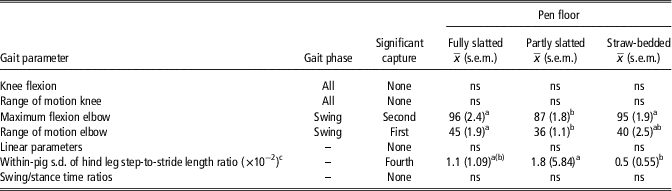
No significant changes were detected at the knee joint for pigs from different floors or for different time points (Tables 2 and 3).
Differences in measured gait between pigs growing on different pen floors

ns=not significant.
Mean gait parameter values of all pigs within a group at time points when a significant difference was observed. Angles are in degrees flexion (deg).
a,bMeans (medians for step-to-stride ratio s.d.) within a row followed by a different superscript differ significantly at P⩽0.050. (b) Indicates tendency, where P=0.061.
cA Kruskal–Wallis test was applied, hence medians and interquartile ranges are reported.
Elbow joint angle
A significant increase was observed between the first and the second motion capture for all measured flexion values and all pigs (Table 2). Pig average liveweight during this period rose from 63 to 76 kg. P-values for the effect of time/growth on minimum and maximum elbow flexion during stance and swing phases were P<0.001, P=0.042, P<0.001 and P=0.010, respectively. The range of motion during the stance phase decreased over time, with a significant decrease from the first to the second capture (P=0.013). The swing phase range of motion at the elbow joint also decreased gradually over time, and was significant between the second and third capture (P=0.003). For floor group differentiation, see Table 3.
Linear parameters
The hind step length numerically showed a gradual increase over time, which was significant from the first to the second (P=0.009) and the second to the third capture (P=0.042). The front step length showed an identical pattern to this, with differences occurring between the first and second (P=0.034) and the second and third (P=0.043) capture. Pen floor had no influence on this development.
The stride length of the hind legs gradually increased, with significant differences occurring between first and second (P=0.035) and second and third captures (P=0.004), after which it remained similar. The stride length of the front legs showed a similar pattern to the hind legs with changes between the first and second (P=0.008) and the second and third capture (P=0.013). There was no effect of floor on this development nor was there a floor×time interaction.
The ratios
Overall the step-to-stride length ratio in the front and hind legs did not differ between any of the captures. However, there was a significant floor effect on the within-pig standard deviation of the hind step-to-stride ratio, with pigs on straw showing less deviation from 0.5 (maximal symmetry) at capture four compared with pigs on partly slatted concrete flooring (P=0.012) and, by tendency, also compared with pigs on fully slatted flooring (P=0.061) (Table 3). The swing-to-stance time ratio in the hind legs increased from the first to the second (P=0.05) capture, was similar during second and third and then decreased again from the third to the fourth capture (P=0.026). The swing-to-stance time ratio in the front legs decreased between capture three and four (P=0.011). No floor differences or floor×time interactions were present.
Walking speed
Pig walking speed was increased at the second capture (P=0.009) and there was a further significant increase at the third capture (P=0.026). After the third capture, walking speed was reduced again at capture four (P=0.017), which did not differ from the walking speed during the second capture.
Discussion
The purpose of this study was to investigate and present quantitative gait data of pigs followed through an important growth stage on one of three commercial floor types. Although fully slatted and partly slatted concrete floors are regarded as less beneficial to the healthy musculoskeletal development of pigs (Jørgensen, Reference Jørgensen2003; van Grevenhof et al., Reference van Grevenhof, Heuven, van Weeren and Bijma2012), results of this study showed no indication of detrimental effects on gait development over time. However, compared to previously conducted studies with similar objectives using subjective assessment, a compromise of the present detailed study is the smaller number of subjects.
In marker-based kinematic studies, there are some sources of error within the methodology, such as skin movement artefact and failure in anatomical landmark identification (van Weeren et al., Reference van Weeren, van den Bogert and Barneveld1992; Maynard and Bakheit, Reference Maynard, Bakheit, Oldham and Freeman2003). The repeatability of the gait variables included in this study has previously been determined in young growing pigs (Stavrakakis et al., Reference Stavrakakis, Guy, Warlow, Johnson and Edwards2013a). The range of mean differences between marker placements was comparable to achievement in horses (Weller et al., Reference Weller, Pfau, Verheyen, May and Wilson2006) and humans (Maynard and Bakheit, Reference Maynard, Bakheit, Oldham and Freeman2003), including both stance and swing phases of the gait cycle. Although skin movement has been found to be increased during the swing phase (van Weeren et al., Reference van Weeren, van den Bogert and Barneveld1992), the joint angles during this phase undergo substantial changes, as confirmed in the current study where pigs showed a greater range of motion. Gait analysis in pigs is still at a relatively early stage (Grégoire et al., Reference Grégoire, Bergeron, D’Allaire, Meunier-Salaun and Devillers2013) and therefore effect sizes of conditions and treatments have yet to be established. In the current study, a broad selection of gait parameters from front and hind legs, stance and swing phases of the gait cycle and from more and less biased sites were presented. For example, the ranges of motion at joints, all within-session CVs and the linear parameters are relative measures and therefore less susceptible to marker misplacement error. The markers used for calculating linear and temporal gait parameters are attached to horn on the hoofs and therefore unaffected by skin movement. This increases the confidence in the results and conclusions from this cohort of 24 pigs, especially since there were five repeated measures.
Nonetheless, the differences in the gait of fast growing pigs at their heaviest capture point cannot reliably be interpreted from a mechanical point of view. These pigs were too few in number to draw any conclusion. However, if the dense connective tissues of tendons and ligaments in the lower extremity receive increased loads and loosen over time, resulting in a ‘weak pastern’, this could increase the likelihood of dewclaws being trapped between slats and increase soft heel-to-floor contact, potentially leading to injuries.
Gait variability may increase in the presence of neuromuscular disorders or other pathology in the musculoskeletal system (Hausdorff et al., Reference Hausdorff, Zemany, Peng and Goldberger1999). CVs based on the stride-to-stride variability of the pigs in this study were analysed across floor groups and revealed no differences. The CoVs between- and within-pigs are included here and may be useful in selecting gait parameters in future studies. Such studies may focus on the long-term effects of those gait parameters with a small within-subject value, indicating higher individual consistency, in a population displaying greater between-subject variety that is higher CVs. Weller et al. (Reference Weller, Pfau, Verheyen, May and Wilson2006) describe the long-term effects of individual gait patterns on orthopaedic health in horses.
There were significant changes in the gait of the pigs over time, such as increases in linear parameters of stride and step length as well as walking speed. These changes are typical and may be ascribed to increases in leg length and to maturation of the locomotor system resulting in stabilisation of walking patterns in growing subjects (Sutherland, Reference Sutherland1997; Clarke and Still, Reference Clarke and Still2001). The changes in the swing-to-stance ratio may to some extent reflect changes in walking speed, as this ratio often increases at faster walking speeds (Robilliard et al., Reference Robilliard, Pfau and Wilson2007). Growth changes occurred in all animals in this experiment, were symmetric as confirmed by results from the left side for the change in elbow flexion, and in an order of magnitude which was not possible to perceive or evaluate visually. This highlights the additional potential in detecting differences when using kinematic motion capture. One of the few published and validated subjective pig gait scoring systems (Main et al., Reference Main, Clegg, Spatz and Green2000) uses the ‘length of stride’ as one of its main criteria for lameness detection.
Noteworthy are the changes at the elbow joint, which were not accompanied by similar changes in the flexion pattern at the equivalent hind leg hinge joint, the knee. This could indicate differences in the development and function of the proximal front and hind legs. However, the repeatability of angular parameters from the knee joint is reduced compared with the elbow joint and therefore the detection of a true deviation at this joint was impeded.
Significant increases in the flexion extremes at the elbow joint were observed in this study. Yet the ranges of motion in both stance and swing phases decreased over time. Increased flexion during walking may be correlated to factors such as leg length and walking speed (Back et al., Reference Back, Barneveld, Schamhardt, Bruin and Hartman1994; Biewener, Reference Biewener2005), but this was generally not the case for the pigs in this study. However, BW showed a consistent trend for a negative correlation with the elbow swing range of motion within captures among all pigs. This could explain the total reduction over time in this gait parameter as all pigs grew heavier, and might suggest that heavier pigs experience increased mechanical constraints at the elbow joint. Nonetheless, increased general flexion at the elbow joint in pigs may equally represent a normal growth-related change in front leg conformation. The reduced range of motion could then be a secondary result of restricted space available for motion.
Generally, the step-to-stride length ratio did not depart substantially from 0.5, which is the most frequent observation in normal pigs and is altered in lame pigs (Stavrakakis et al., Reference Stavrakakis, Guy, Johnson and Edwards2013b). Nevertheless, there was an interesting difference between pigs housed on concrete (both fully slatted and partly slatted) and straw-bedded surfaces, with pigs on straw being closer to the expected normal (Whittle, Reference Whittle2003). This could indicate an increased irregularity in the displacement of left and right hind legs in the former pigs, which in turn would suggest some underlying pathology or disturbing factor affecting hind legs only. This finding probably deserves further investigation and it would be worthwhile to expand the follow-up period for motion capture of pigs exposed to different pen floors in the future. Thus, breeding animals could be monitored into gestation and lactation.
Visual lameness detection suffers from clear limitations when conditions are mild (Keegan, Reference Keegan2007; Quinn et al., Reference Quinn, Keuler, Lu, Faria, Muir and Markel2007), therefore biomechanical methods could have a potential to mitigate against this. The step-to-stride length ratio in the current study was the only parameter unchanged over time. This means that the relationship between these lengths remains stable and is independent from age/growth and walking speed. If the ability of this parameter to detect subtle lameness can be confirmed, this would be a suitable parameter for automatic lameness detection in pigs, which would be a welcomed tool for on-farm monitoring of lameness. Such an application would require gait parameters insensitive to heterogeneous groups of pigs walking at their preferred walking speed, even with variation in the latter.
In conclusion, the measured changes in gait patterns over time were largely unaffected by the floor surface on which the pigs were reared. Therefore the quantification of locomotion in this longitudinal observational study of pigs housed on different floors could not confirm differences observed in previous epidemiological studies using subjective gait assessment. Prevalence of perceivable problems in the present population was low, since only stiffness and no lameness were recorded in 21% of pigs on average. However, there were subtle changes which could be measured by the motion capture system but were invisible to the naked eye. The application of precise quantitative techniques to a large population of farm animals is challenging. Nevertheless this study has identified meaningful gait parameters, such as the step-to-stride length ratio and the elbow joint angle, which are worth exploring further.
Acknowledgements
The authors are grateful to the British Pig Executive (BPEX), a division of the Agriculture and Horticulture Development Board, for funding this project. Further, they thank the University farm team for their support, especially Mark Brett for providing knowledge and skills in animal training and invaluable assistance and ideas during motion captures.