



Attention-deficit hyperactivity disorder (ADHD) is a neurodevelopmental condition that features impulsivity, hyperactivity and inattention, generating impairments in overall functioning. 1 Individuals with ADHD report a higher prevalence of co-occurring psychiatric disorders compared to people without ADHD, ranging from mood (up to 55% for major depression and up to 80% for bipolar disorder) and anxiety disorders (up to 47%), to obsessive–compulsive disorder (11.8%). Reference Choi, Woo, Wang, Lim, Bahk and Sasayama2 Individuals with ADHD may also frequently present with compulsive sexual behaviour (CSB) (poorly controlled sexual activities resulting in clinically significant distress and functional impairment) and problematic pornography use (PPU), one of CSB’s main manifestations, especially among men. Reference Niazof, Weizman and Weinstein3,Reference Soldati, Bianchi-Demicheli, Schockaert, Köhl, Bolmont and Hasler4
The core features of ADHD may contribute to CSB. Sexual activity may constitute a response to interpersonal difficulties or negative affect. Reference Bőthe, Koós, Tóth-Király, Orosz and Demetrovics5 Inattention, for example, may increase vulnerability to PPU because of boredom proneness and difficulty sustaining focus. Reference Wéry, Vogelaere, Challet-Bouju, Poudat, Caillon and Lever6 Pornography offers immediate, stimulating content that aligns with attentional deficits in ADHD. Reference Privara and Bob7 Impulsivity and sensation-seeking behaviours, possibly linked to dopamine dysregulation, may also drive hypersexuality in this population. Reference Blum, Chen, Braverman, Comings, Chen and Arcuri8 Recent research underscores the importance of demographic variables, such as age, biological sex and gender identity, in shaping the relationship between ADHD, CSB and PPU. Reference Bőthe, Koós, Tóth-Király, Orosz and Demetrovics5,Reference Werner, Štulhofer, Waldorp and Jurin9,Reference Doroldi, Jannini, Tafà, Del Casale and Ciocca10 Age may influence the manifestation of ADHD symptoms and their relationships with CSB. For instance, younger individuals often exhibit heightened impulsivity and novelty-seeking tendencies, potentially leading to earlier engagement in risky sexual behaviours and PPU. Reference Gjoneska, Bőthe, Potenza, Szabo, Demetrovics, Franken, Wiers and Witkiewitz11 Conversely, older adults may display patterns of compulsive behaviours influenced by co-occurring anxiety or obsessive–compulsive disorders, which interact with ADHD-related symptoms in distinct ways. Reference Ioannidis, Treder, Chamberlain, Kiraly, Redden and Stein12
Gender and gender identity may further influence such relationships. For example, men have consistently shown stronger associations between CSB and PPU compared with women, who experience these links more moderately. Reference Bőthe, Koós, Tóth-Király, Orosz and Demetrovics5,Reference Doroldi, Jannini, Tafà, Del Casale and Ciocca10 Gender-diverse populations, such as non-binary and transgender individuals (whose heterogeneity is also reflected by the presence of diverse gender minorities, e.g. binary versus non-binary identities), often face unique minority-related psychosocial stressors, including stigma and reduced social support, which may amplify vulnerabilities to compulsive behaviours. Reference Lewczuk, Marcowski, Wizła, Gola, Nagy and Koós13 Furthermore, network analyses have highlighted differences in symptom centrality across genders, suggesting multiple psychological mechanisms driving CSB in men and women. Reference Werner, Štulhofer, Waldorp and Jurin9
Network analysis has emerged as an important analytic approach in psychological and clinical research, allowing investigators to consider mental health concerns within networks of interacting symptoms. Reference Jannini, Socci, Schimmenti, Terrone, Sideli and Alameda14,Reference Jannini, Murri, Ossola, Pettorruso, Martinotti and Di Lorenzo15 This method can offer valuable insight into the structure and dynamics of psychological phenomena, particularly for high-dimensional data, where network analysis can illuminate the strengths and patterns of associations and system-level behaviours. Reference Borsboom, Deserno, Rhemtulla, Epskamp, Fried and McNally16 Network analysis may permit increased understanding of relationships between CSB and PPU within the context of ADHD symptoms. Reference Silk, Malpas, Beare, Efron, Anderson and Hazell17 By mapping the relationships among features of these phenomena, central and bridging symptoms linking ADHD-related features to these sexual problems may be identified. Bayesian networks may further extend this approach by estimating probabilistic and potentially causal pathways. Reference Briganti, Scutari and McNally18
Aims
This preregistered study Reference Bőthe, Jannini, François and Ciocca19 aimed to examine nuanced relationships between features of ADHD, CSB and PPU. The investigation was structured around three key objectives. First, it sought to determine which ADHD symptoms function as central or bridging nodes within symptom networks to elucidate links with CSB and PPU. Second, it explored whether Bayesian network analysis revealed specific pathways suggesting potentially causal relationships between ADHD symptoms and those of CSB and PPU. Finally, the study examined whether distinct or overlapping network structures emerged across demographic groups, particularly when stratified by age, biological sex and gender identity, to inform targeted and demographically sensitive interventions. These aims were tested on a large population of 82 243 individuals in the general population across 42 countries globally.
Method
Information regarding procedure, measures and sociodemographic characteristics can be found elsewhere. Reference Gewirtz-Meydan, Feder, Nagy, Koós, Kraus and Demetrovics20–Reference Bőthe, Koós, Nagy, Kraus, Potenza and Demetrovics23 The study protocol (https://doi.org/10.17605/OSF.IO/FHT8P) was preregistered. All included measures and translations can be found at: https://osf.io/jcz96/files/osfstorage. The study was approved or deemed exempt by all collaborating countries’ national/institutional ethics review boards (for details, see Supplementary Material) and was conducted in accordance with the Helsinki Declaration of 1975, as revised in 2013. Written informed consent was obtained from all participants.
Sample
After data cleaning (see detailed data cleaning procedure for the International Sex Survey (ISS) at https://osf.io/csyjq?view_only=dadcfc82666140a6ab5a1c3f63b679be), 82 243 participants were included in the ISS final data-set.Footnote a For this study, all participants who completed the six-item Adult ADHD Self-Report Screening Scale (ASRS-6), Reference Lewczuk, Marcowski, Wizła, Gola, Nagy and Koós13 the 19-item Compulsive Sexual Behaviour Disorder Scale (CSBD-19) Reference Bőthe, Potenza, Griffiths, Kraus, Klein and Fuss24 and the 18-item Problematic Pornography Consumption Scale (PPCS), Reference Chen, Luo, Bőthe, Jiang, Demetrovics and Potenza25 as well as reporting biological sex, gender identity and age information. To perform further analyses (network analysis and directed acyclic graphs (DAGs)), participants with missing data were excluded from analyses, using a case-wise deletion approach. Reference Epskamp and Fried26
Data analysis
All statistical analyses were conducted using R version 4.5.0 for MacOS (R Foundation for Statistical Computing, Vienna, Austria; https://www.R-project.org/). The following packages were used: tidyverse version 2.0.0 (Wickham et al, Auckland, New Zealand; https://cran.r-project.org/package=tidyerse) for data wrangling, visualisation and linear statistics; EGAnet version 2.0.0 (Golino H, et al, Charlottesville, VA, USA; https://cran.r-project.org/package=EGAnet) for exploratory graph analysis (EGA); bootnet version 1.5.6 (Epskamp S et al, Amsterdam, The Netherlands; https://cran.r-project.org/package=bootnet) for the stability of centrality indices; qgraph version 1.9.8 (Epskamp S et al, Amsterdam, The Netherlands; https://cran.r-project.org/package=qgraph) for network representation; networktools version 1.5.1 (Jones PJ et al, Cambridge, MA, USA; https://cran.r-project.org/package=networktools) for bridge centrality metrics; NetworkComparisonTest version 2.2.2, (van Borkulo CD et al, Amsterdam, The Netherlands; https://cran.r-project.org/package=NetworkComparisonTest) for network comparisons; bnlearn version 4.9.4, (Scutari M, London, UK; https://cran.r-project.org/package=bnlearn) for Bayesian network analysis and parallel version 3.6.2 (R Core Team, Vienna, Austria; https://stat.ethz.ch/R-manual/R-devel/library/parallel/doc/parallel.pdf) for parallel computing.
First, univariate descriptive statistics were calculated to summarise the characteristics of the sample, including sociodemographic variables and ADHD, CSB and PPU features. Following a Shapiro–Wilk test (p < 0.05), we deemed the data to be non-normally distributed. For this reason, we used the Mann–Whitney U-test to compare medians between groups.
To determine whether the structure underlying the variables was better captured by a latent variable model (e.g. factor analysis) or a network structure, we conducted a latent casual testing approach within an EGA. This method compares the replicability of a latent structure versus a network structure across 5000 bootstrap samples.
To model the relationships among features of ADHD, CSB and PPU, a Gaussian graphical model was employed. This method estimates partial correlations between symptoms while controlling for all other variables in the network. Edges (connections between nodes) represent the strength and direction of these relationships, with thicker edges indicating stronger associations. Positive edges have been displayed in green (black in the print verison), and negative edges in red (grey in the print version). Regularisation via the graphical least absolute shrinkage and selection operator was applied to ensure model sparsity and improve interpretability. The extended Bayesian information criterion guided edge selection to retain only meaningful connections. Among the centrality measures, strength was computed to identify the most influential nodes (symptoms) within the network. Bridging strength was calculated to assess which symptoms connect distinct clusters of behaviours, such as those linking features of ADHD to those of CSB and PPU.
To investigate demographic-specific patterns, networks were estimated separately for multiple subgroups defined by biological sex (men versus women), gender identity (cisgender versus transgender populations, and transgender men versus transgender women) and age (e.g. general adults, defined as participants with ages younger than 65 years, versus older adults, defined as participants with ages of 65 years or above Reference Singh and Bajorek27 ). Network comparison tests (NCTs) were then used to compare the structural properties and global strength of these networks across subgroups. This approach assessed whether the configuration or overall connectivity of symptoms differed significantly between groups, providing insight into demographic variations. The NCT employs a permutation approach, reshuffling the data-set and recalculating the networks multiple times (5000 iterations in our case) to create a null distribution for hypothesis testing – specifically, whether network discrepancies existed between the different groups. The NCT consisted of two comparisons: the network structure comparison, where the NCT evaluated differences in network structure by comparing the distribution of edge weights across networks, and the global strength comparison, where NCT also assessed whether the overall connectivity, or global strength, of the networks differed. In the NCT, the statistic M represents the maximum edge-weight difference between networks, while S indicates differences in global network strength.
An a priori power analysis or sample size calculation was not performed, as network analysis is not based on traditional null hypothesis significance testing. Network analysis instead focuses on uncovering relationships and interconnections between variables, and effect sizes needed for power calculations cannot be defined a priori as they are data-driven.
Potential causal pathways among features of ADHD, CSB and PPU were explored using Bayesian network analysis. DAGs were generated to infer the most likely potentially causal relationships between variables based on conditional dependencies. A hill-climbing algorithm was employed to iteratively (5000 times) identify the network structure that best fits the data. Model selection was guided by the Bayesian information criterion, and edge directionality was retained when it appeared in at least 50% of iterations. Edges in the DAG were visualised based on their strength (i.e. the proportion of iterations in which the edge was selected) and arc direction. Only edges with a threshold strength greater than 85% have been displayed, with stronger edges appearing darker in the final visualisation. This analysis provides insights into the directional influence of ADHD symptoms on CSB and PPU and highlights potential causal mechanisms. Given the high number of variables and participants in the data-set, the bootstrapping process was parallelised using multiple CPU cores, substantially improving computational efficiency.
Results
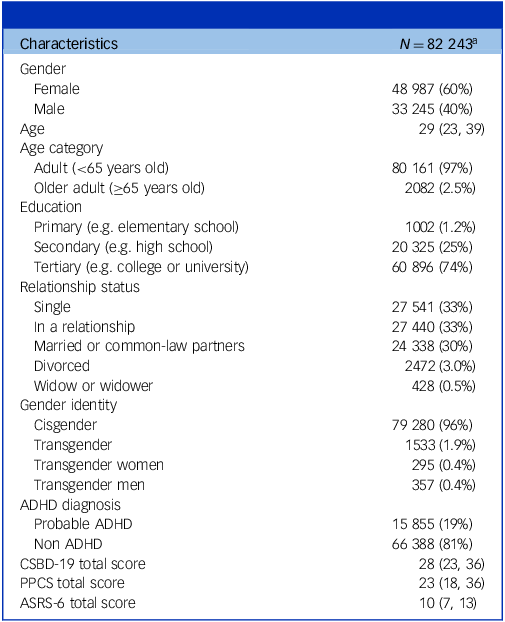
Characteristics of the 82 243 participants from the 42 countries are listed in Table 1. Supplementary Tables 1–5 report the sample’s characteristics by assigned sex at birth, gender identity and age categories. Probable ADHD diagnosis was unevenly distributed across multiple sociodemographic variables, with women, transgender individuals, transgender men and the general (versus older) adult population presenting a higher prevalence compared with their counterparts. Higher CSB and PPU scores were reported among men, transgender individuals (only PPU) and older adults (all ps < 0.001). All differences were weak-moderate in terms of effect sizes, except for CSB measures between men and women and ADHD measures related to gender identity, which showed large estimates (rank-biserial correlation / Cramér’s V > 0.5). A link to participants detailed sociodemographic characteristics by country of residence is available on Open Science Framework (https://osf.io/n3k2c/files/osfstorage/6352e69c6e71e8121a9cb66d).
Whole sample characteristics
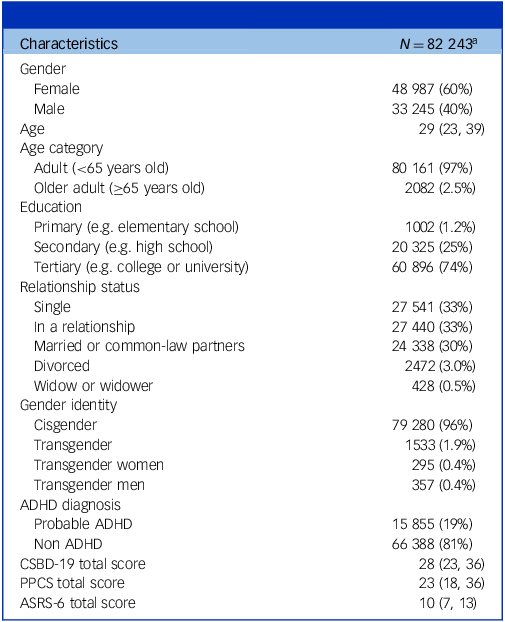
Table 1 Long description
The table presents characteristics of 82243 participants from 42 countries. It includes data on gender, age, education, relationship status, gender identity, and ADHD diagnosis. The table has 13 rows and 3 columns. The columns are labeled Characteristics, N, median, quartiles, absolute values and percentages. Key characteristics include gender with 48987 females (60 percent) and 33245 males (40 percent), age with a median of 29 years (interquartile range 23 to 39 years), and education levels with 1.2 percent having primary education, 25 percent secondary education, and 74 percent tertiary education. Relationship status includes 33 percent single, 33 percent in a relationship, 30 percent married or common-law partners, 3 percent divorced, and 0.5 percent widowed or widowers. Gender identity shows 96 percent cisgender, 1.9 percent transgender, 0.4 percent transgender women, and 0.4 percent transgender men. ADHD diagnosis indicates 19 percent probable ADHD and 81 percent non-ADHD. The table also includes scores for CSB-19 total score, PPCS total score, and ASRS-6 total score with their respective medians and interquartile ranges.
ADHD, attention-deficit/hyperactivity disorder; CSBD-19, Compulsive Sexual Behaviour Disorder Scale; PPCS, Problematic Pornography Consumption Scale; ASRS-6, Adult ADHD Self-Report Screening Scale.
a. Median (Q1, Q3) / N (%).
EGA
In 100% of the bootstrap iterations, the network structure was more stable and replicable than in the latent model. This suggests that direct interactions among variables provide a more accurate representation of the data than do underlying latent factors, supporting the use of network-based approaches in subsequent analyses.
Network of ADHD symptoms, hypersexuality and PPU
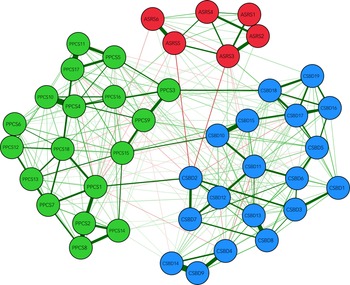
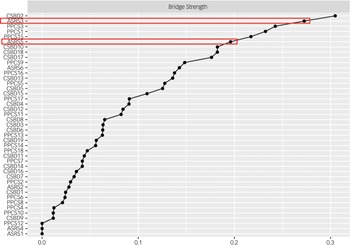
The network of ADHD symptoms and CSBs contained 564 edges (Fig. 1; see Supplementary Table 1 for node explanation). The network presented good stability indices (strength = 0.75). Stability indices help to understand how steady the network remains when nodes or edges are removed. The higher the index, the more stable the network configuration, with a generally accepted threshold of ≥0.25. Among the ADHD-related symptoms, the node with the highest bridge centrality was ASRS3 (‘When you have a task that requires a lot of thought, how often do you avoid or delay getting started?’; bridge strength = 0.233), pertaining to the inattention domain, and ASRS5 (‘How often do you fidget or squirm with your hands or your feet when you have to sit down for a long time?’; bridge strength = 0.198), pertaining to the hyperactivity–impulsivity domain (Fig. 2). Bridge centrality estimates indicate the capacity of a single node in a specific cluster (in this case, the ADHD cluster) to establish connections with other nodes in other clusters (i.e. CSB and PPU). The two nodes with the highest bridge connections were CSBD17 (‘I have been upset because of my sexual behaviours’; edge weight = 0.056 with ASRS3, and edge weight = 0.034 with ASRS5) in the hypersexuality cluster, and PPCS15 (‘I neglected other leisure activities as a result of watching pornography’; edge weight = 0.018, with ASRS3) as well as PPCS16 (‘I gradually watched more “extreme” pornography, because the pornography I watched before was less satisfying’; edge weight = 0.047, with ASRS5) in the PPU cluster. The term ‘extreme pornography’ reflects participants’ subjective perception of increasingly intense or deviant content, rather than a legally defined category. Reference Jones28
Network structure of the proposed Gaussian graphical model. The CSBD-19 is shown in blue, the PPCS is shown in green (black in print version), and the ASRS-6 is shown in red (grey in print version). Dark green edges (black in print version) indicate a positive correlation between nodes, whereas red edges (blue in print version) indicate a negative correlation; thicker lines indicate a stronger correlation. ASRS, six-item Adult ADHD Self-Report Screening Scale; CSBD, 19-item Compulsive Sexual Behaviour Disorder Scale; PPCS, Problematic Pornography Consumption Scale.
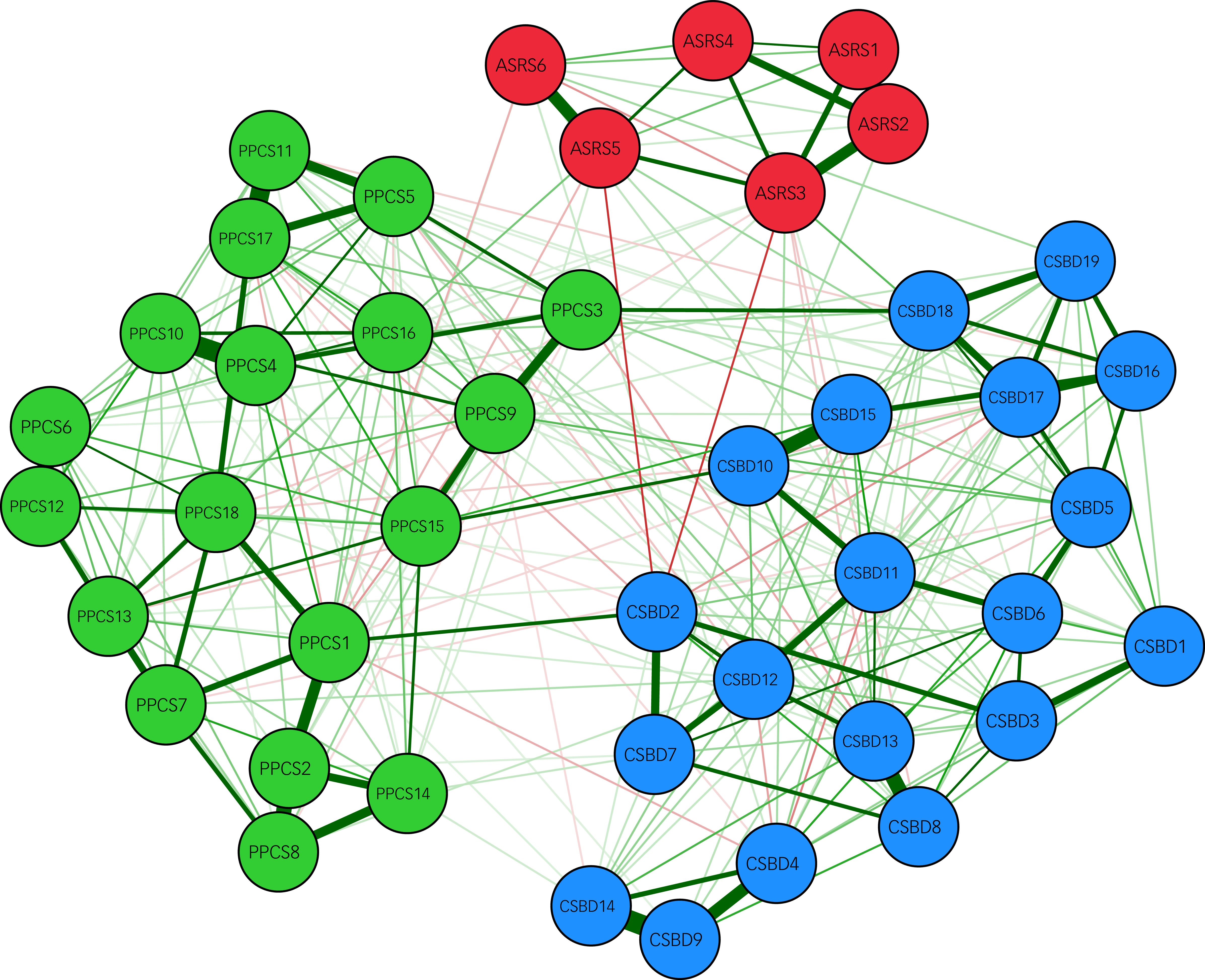
Fig. 1 Long description
A scatter plot showing network structure of the proposed Gaussian graphical model. The plot features nodes representing three scales: CSBD-19 in blue, PPCS in green, and ASRS-6 in red. Dark green edges indicate a positive correlation between nodes, while red edges indicate a negative correlation; thicker lines signify a stronger correlation. The plot includes multiple nodes and edges, with varying thicknesses and colors, illustrating the relationships between different variables. All values are approximated.
Bridge centrality indices for the proposed Gaussian graphical model. Red (blue in print version) rectangles indicate the highest ASRS nodes in bridge strength. ASRS, six-item Adult ADHD Self-Report Screening Scale; CSBD, 19-item Compulsive Sexual Behaviour Disorder Scale; PPCS, Problematic Pornography Consumption Scale.
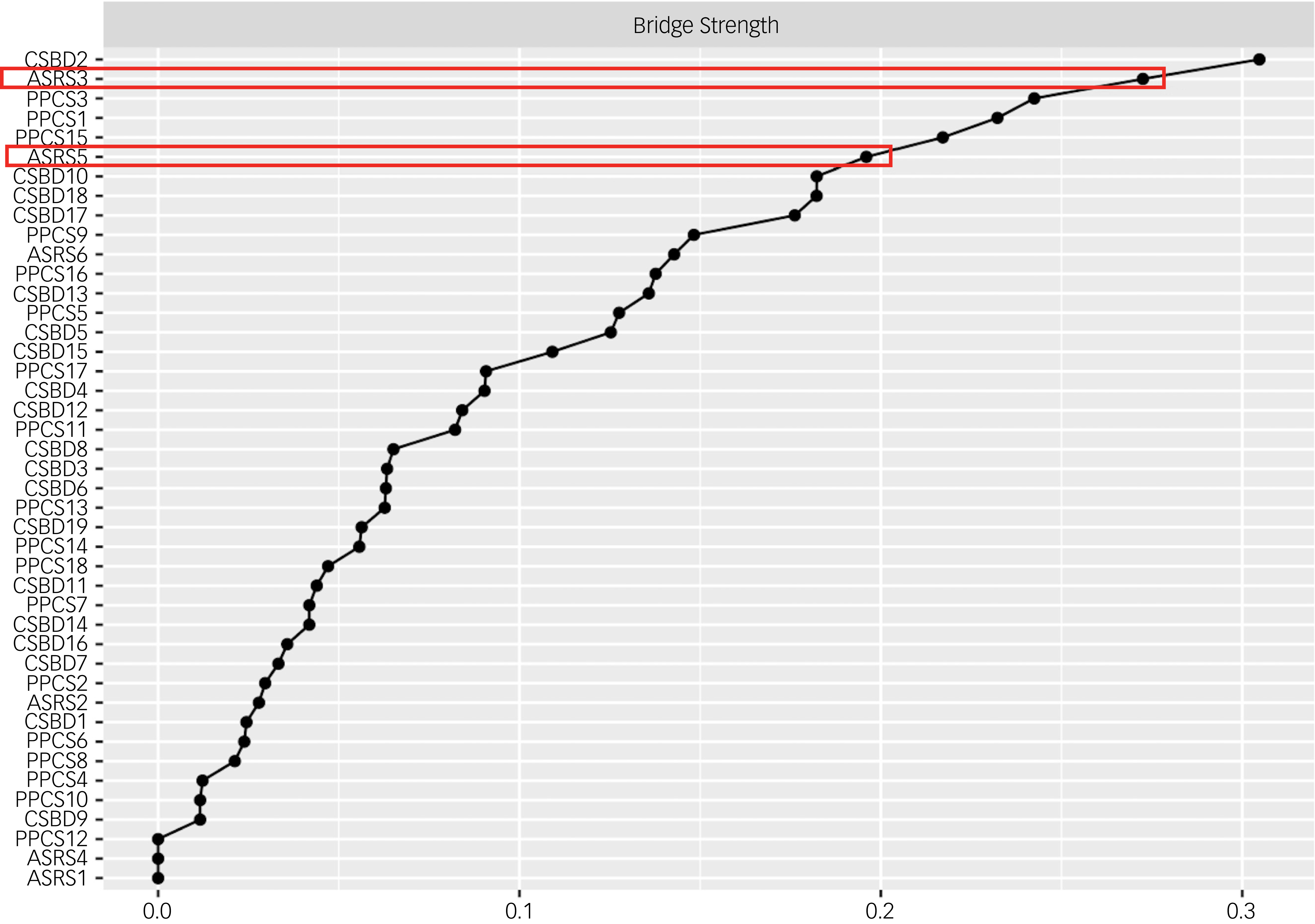
Fig. 2 Long description
The line graph illustrates bridge centrality indices for a proposed Gaussian graphical model. The x-axis represents different nodes, while the y-axis indicates the bridge strength values. Red rectangles highlight the highest ASRS nodes in bridge strength. The graph includes data points for various nodes labeled as ASRS, CSBD and PPCS. The bridge strength values range from 0 to approximately 0.3. The highest bridge strength values are marked by red rectangles, indicating significant nodes. The graph shows a gradual increase in bridge strength values from left to right, with some nodes showing higher values than others. All values are approximated.
Role of moderators
We then divided the whole population into subgroups considering demographic-specific variables (biological sex, gender identity and age) and, finally, compared the relative network structures. When considering possible moderators, analyses revealed stable networks across all sociodemographic characteristics (Supplementary Figs 1–8). The network invariance test in men versus women (n = 48 987 v. 33 245) revealed a significant difference in the overall network structure between groups (M = 0.076, p < 0.001). Furthermore, the global strength invariance test showed that the total connectivity of the network also differed significantly (S = 1.62, p < 0.001), with men displaying higher global strength (23.11) compared with women (21.49). The network invariance test comparing cisgender and transgender individuals (n = 79 280 v. 1533) revealed a statistically significant difference in network structure (M = 0.15, p = 0.022), as did the global strength invariance test (S = 1.96, p < 0.001), with the cisgender group showing higher overall connectivity (22.45 v. 20.49). In contrast, the comparison between transgender men and transgender women (n = 357 v. 295) did not yield significant differences either in network structure (M = 0.20, p = 0.82) or in global strength (S = 0.08, p = 0.84), suggesting a high degree of similarity between these subgroups.
When comparing general adults with older adults (n = 80 148 v. 2082), the network structure appeared stable across groups (M = 0.11, p = 0.13), but the global strength invariance test indicated significantly higher overall connectivity in the general adult group (S = 2.76, p = 0.017; 22.38 v. 19.62). Despite these structural and strength differences across subgroups, ADHD symptoms of inattention and hyperactivity–impulsivity (ASRS3 and ASRS5, respectively) consistently emerged as central nodes within all networks, although not always in the same order (Supplementary Figs 9–16). Men (bridge strength = 0.182), women (bridge strength = 0.197) and transgender individuals (bridge strength = 0.125,) as well as transgender men specifically (bridge strength = 0.418), reported the hyperactivity–impulsivity node as having the highest bridge centrality. Instead, cisgender individuals in general (bridge strength = 0.226), transgender women (bridge strength = 0.170) and adults younger 65 years (bridge strength = 0.251) reported the inattention item as the most central node. In contrast, ADHD symptoms showed negligible bridging capacity in older adults, highlighting a possible decoupling between ADHD features and sexual compulsivity in later adulthood.
Bayesian network analysis – DAGs
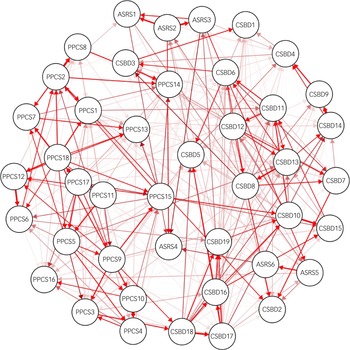
The procedure by Briganti et al identified 0.85 as the optimal significance threshold for strength. Reference Briganti, Scutari and McNally18 Thus, edges appearing in 85% or more of the bootstrapped networks were retained in the averaged DAG. In the DAG (Fig. 3), only those edges with an unequivocal minimum direction (50% or more iterations displaying the same direction) were plotted as directed.
Directed acyclic graph of attention-deficit hyperactivity disorder symptoms and compulsive sexual behaviours. ASRS, six-item Adult ADHD Self-Report Screening Scale; CSBD, 19-item Compulsive Sexual Behaviour Disorder Scale; PPCS, Problematic Pornography Consumption Scale.
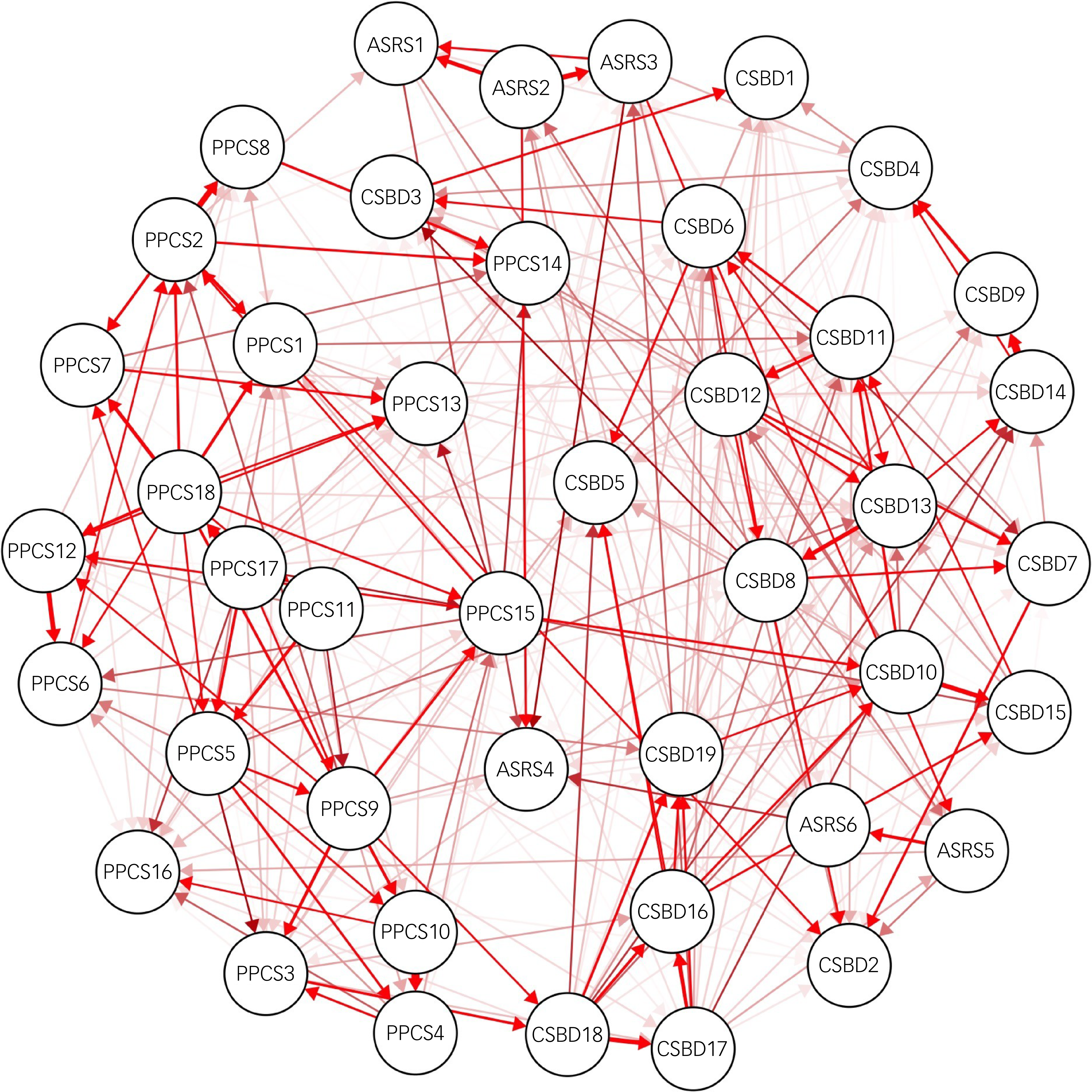
Fig. 3 Long description
A directed acyclic graph illustrating the relationships between attention-deficit hyperactivity disorder symptoms and compulsive sexual behaviors. The graph includes nodes labeled with ASRS, CSBD, and PPCS, representing the six-item Adult ADHD Self-Report Screening Scale, the 19-item Compulsive Sexual Behaviour Disorder Scale, and the Problematic Pornography Consumption Scale, respectively. The nodes are interconnected with arrows indicating directional relationships. The graph shows a complex network of interactions, with some nodes having multiple incoming and outgoing arrows, suggesting a high degree of interconnection between the symptoms and behaviors. The arrows are color-coded, with red arrows indicating stronger or more significant relationships. The graph aims to visualize how different symptoms and behaviors are interrelated in individuals with ADHD.
Results showed a highly dense DAG of the ADHD – CSB/PPU features (Supplementary Table 6). The ADHD items that mainly suggested a potentially causative relationship with nodes of other clusters were ASRS3 (inattention) and ASRS5 (hyperactivity–impulsivity). In particular, ASRS3 was significantly associated with items CSBD2 (‘Sex has been the most important thing in my life’; arc strength = –196.68) and CSBD4 (‘I had sex even when I did not enjoy it anymore’ arc strength’; −128.23). Similarly, ASRS5 was significantly associated with CSBD2 (arc strength = −241.57) and with PPCS16 (‘extreme’ pornography; arc strength = −146.03).
Discussion
Main findings
This study investigated for the first time the associations of ADHD symptoms with CSB and PPU using different network approaches, in a large global sample of over 80 000 participants.
Findings regarding the prevalence of a possible ADHD diagnosis revealed that higher ASRS scores were more common among women, transgender and younger individuals. Although the literature reports a higher ADHD prevalence among men, women often go undiagnosed because of less disruptive clinical presentations. Reference Martin29 Regarding gender identity, our findings are consistent with the previous literature, which posits a minority stress hypothesis as a possible explanation of higher ADHD levels among transgender individuals. Reference Ignatova, Balasubramanian, Raney, Ganson, Testa and He30
The present analyses revealed key findings regarding the structure and stability of symptom networks. Core ADHD symptoms of inattention and hyperactivity–impulsivity were central in the Gaussian network models. Both symptoms were indeed able to drive and sustain the relationship with other clusters of the network pertaining to CSB and PPU. Regarding the first of the two domains, boredom proneness, possibly deriving from difficulties in sustaining attention, may underlie the results. Reference Moynihan, Igou and van Tilburg31 Recent findings describe limited stimulation and boredom as potential risk factors for engaging in PPU among individuals with ADHD. Reference Grubbs, Wright, Braden, Wilt and Kraus32 Because of the daily challenges these individuals may face in maintaining attention during tasks and their susceptibility to distraction by external stimuli, pornography may represent a form of easily accessible, highly stimulating content that captures and sustains attention, offering immediate gratification. Reference Carroll, Padilla-Walker, Nelson, Olson, McNamara Barry and Madsen33
Results from the Gaussian graphical model are further endorsed by the Bayesian network analysis, which suggests that the inattention item may be potentially causally associated with CSB items CSBD2 (‘Sex has been the most important thing in my life’) and CSBD4 (‘I had sex even when I did not enjoy it anymore’). Psychologically, this finding aligns with models of behavioural escape and experiential avoidance. Reference Romano, St. Peter, Milyko, Mesches and Foreman34 When faced with tasks requiring sustained focus, individuals with inattentive ADHD may feel overwhelmed or demotivated. Reference Morsink, Sonuga-Barke, Van der Oord, Van Dessel, Lemiere and Danckaerts35 Individuals may thus seek more immediate, low-effort rewards like sexual gratification or gaming/gambling to soothe or distract themselves – even when those behaviours are no longer pleasurable. Reference Ghiaccio, Passaro, Stasolla, Martini, De Fortuna and De Luca Picione36
Similarly, hyperactivity–impulsivity and sensation-seeking behaviours may contribute to both PPU and CSB. Motoric impulsivity in ADHD may involve difficulties in delaying gratification of sexual urges. Reference Walton, Cantor and Lykins37 In this regard, ADHD has been proposed as a form of reward deficiency syndrome Reference Blum, Chen, Braverman, Comings, Chen and Arcuri38 that might explain sensation-directed conduct. Reward deficiency syndrome may involve neurotransmitter differences related to genetic or epigenetic factors. Reference Blum, McLaughlin, Bowirrat, Modestino, Baron and Gomez39 Thus and speculatively, specific neural circuits might predispose ADHD individuals to compulsive behaviours, such as CSB and PPU. Reference Niazof, Weizman and Weinstein3 Notably, Bayesian network analysis showed that the impulsivity item established a strong potentially causative relationship with the ‘extreme pornography’ node, linking ADHD-related impulsivity with risky sexual behaviours. Reference Sullivan and Barkley-Levenson40,Reference Sarver, McCart, Sheidow and Letourneau41
Implications and future research
The findings suggest clinical value in considering specific ADHD symptom dimensions – particularly inattention and impulsivity – when screening for, identifying and treating CSB/PPU. Interventions targeting executive dysfunction, boredom intolerance and impaired reward processing may offer more personalised and effective strategies for individuals with ADHD presenting with CSB/PPU. Reference Ramos-Galarza, Brito, Rodríguez, Guerrero, Cruz-Cárdenas and Bolaños-Pasquel42 Given the high centrality of inattention and hyperactivity–impulsivity across networks, cognitive–behavioural interventions focusing on task initiation, distress tolerance and impulse control may reduce reliance on maladaptive sexual coping mechanisms. Reference Jensen, Amdisen, Jørgensen and Arnfred43 To this end, certain approaches have yielded notable results, with image retraining and approach bias modification frameworks facilitating dampening of automatic responses to addictive cues (such as pornographic images). Reference Sklenarik, Potenza, Gola and Astur44–Reference Borgogna, Owen, Johnson and Kraus48 Additionally, medications commonly used in treating ADHD, including methylphenidate or dextroamphetamine, have shown promise in reducing potentially addictive or problematic behaviours, such as internet use, food shopping and compulsive/out-of-control sexual behaviours. Reference Grassi, Moradei and Cecchelli49,Reference Kafka and Hennen50 The existing literature has also suggested that combination therapies, such as selective serotonin reuptake inhibitors and cognitive–behavioural therapy, may reduce PPU short term. Reference Gola and Potenza51,Reference Henry, Donkin, Williams and Pedersen52 Moreover, practical tools, such as pornography blockers or other environmental restrictions, may support behavioural change when combined with therapeutic approaches, particularly in cases involving impulsivity, although empirical studies are warranted. Finally, demographic invariance across network structures underscores the transdiagnostic and cross-populational relevance of these associations, suggesting that targeted treatments can be broadly applied regardless of sex, gender identity or age.
Limitations
This study is not exempt from limitations (see general limitations of the ISS study at https://osf.io/6kscb). First, its cross-sectional design, besides carrying the possibility of social desirability bias because of self-reported data, precludes definitive conclusions about temporal or causal relationships. Although Bayesian network modelling suggests directionality, these estimates are probabilistic and require validation through longitudinal or experimental methods. Furthermore, the study population was composed of community samples and not clinical populations. In this regard, we acknowledge that the scale used to measure ADHD symptoms has only six items, thus not capturing the wider and more complex nature of ADHD, especially among adults. Reference Ginapp, Macdonald-Gagnon, Angarita, Bold and Potenza53 Other features, such as emotional dysregulation or oppositional symptoms, which are not captured by the ASRS-6, may drive and sustain hypersexual behaviour in people with ADHD. Reference Hertz, Turner, Barra, Biedermann, Retz-Junginger and Schöttle54 For these reasons, future studies including clinical populations and structured interviews are recommended to draw more nuanced conclusions. An additional limitation is the use of self-report measures. Although it facilitates large-scale international sampling, this approach introduces the possibility of response biases, including underreporting or overreporting of sensitive behaviours.
In conclusion, this study offers novel insights into ADHD symptoms connecting to CSB/PPU in a global sample. Understanding symptom-level interactions between ADHD and CSB and PPU is important and has clinical implications. Previous studies have largely treated ADHD, CSB and PPU as unitary constructs, Reference Niazof, Weizman and Weinstein3–Reference Bőthe, Koós, Tóth-Király, Orosz and Demetrovics5,Reference Doroldi, Jannini, Tafà, Del Casale and Ciocca10,Reference Bőthe, Jannini, François and Ciocca19 missing potential mechanisms at the symptom level. We identified inattention and hyperactivity–impulsivity as core bridging and potentially causative domains in the ADHD–CSB–PPU network, with stable patterns across demographic subgroups. These findings support conceptual models of behavioural escape and reward dysfunction, suggesting the importance of targeted, symptom-level interventions that address executive and motivational concerns in ADHD. By combining undirected and Bayesian network methodologies in a global sample, the current study aimed to inform precision psychiatry approaches in both ADHD and CSB/PPU treatment.
Supplementary material
The supplementary material is available online at https://doi.org/10.1192/bjp.2026.10691
Data availability
Data will be shared upon justified request due to the data-set’s sensitive nature. The R code used to model data will be shared upon reasonable request.
Acknowledgements
The authors would like to thank Anastasia Lucic and Natasha Zippan for their help with project administration and data collection, and Abu Bakkar Siddique, Anne-Marie Menard, Clara Mar- incowitz, Club Sexu, Critica, Digital Ethics Center (Skaitmenine_s etikos centras), Día a Día, Ed Carty, El Siglo, Jakia Akter, Jayma Jannat Juma, Kamrun Nahar Momo, Kevin Zavaleta, Laraine Murray, L’Avenir de l’Artois, La Estrella de Panamá, La Voix du Nord, Le Parisien, Lithuanian National Radio and Television (Lie- tuvos nacionalinis radijas ir televizija), Mahfuzul Islam, Marjia Khan Trisha, Md. Rabiul Islam, Md. Shahariar Emon, Miriam Goodridge, Most. Mariam Jamila, Nahida Bintee Mostofa, Nargees Akter, Niamh Connol, Rafael Goyoneche, Raiyaan Tabassum Imita, Raquel Savage, Ricardo Mendoza, Saima Fariha, SOS Orienta and Colegio de Psicólogos del Perú, Stephanie Kewley, Sumaiya Has- san, Susanne Bründl, Tamim Ikram, Telex.hu, Trisha Mallick, Tushar Ahmed Emon, Wéo and Yasmin Benoit for their help with recruitment and data collection. We finally wish to thank Prof. Giorgio Di Lorenzo for sharing his wisdom.
Author contributions
T.B.J. was responsible for conceptualisation, formal analysis, methodology and writing the original draft; G.C. contributed to investigation, supervision, data curation and writing – review and editing. T.G. contributed to writing – review and editing. L.N., M.K., S.W.K., M.N.P., Z.D. and B.B. contributed to supervision and writing – review and editing. B.B. also contributed to conceptual support of the study. Members of the International Sex Survey Consortium contributed to the development and implementation of the International Sex Survey, including study design, translation and validation of study materials, participant recruitment, data collection, project administration, acquisition of resources, and critical review and revision of the manuscript.
Funding
T.B.J. was supported by #NEXTGENERATIONEU (NGEU) and funded by the Ministry of University and Research (MUR), National Recovery and Resilience Plan (NRRP), project MNESYS (PE0000006) (DN. 1553 11.10.2022). T.G. was supported by European Union-Next GenerationEU, Mission 4 Component 2 CUP B53D23014210006. G.C. was partially supported by PRIN project 2022 (number 20224SX547) and European Union-Next GenerationEU, Mission 4 Component 1 CUP B53D23014210006).
Declaration of interest
M.N.P. discloses that he has consulted for and advised Neurofinity and Boehringer Ingelheim; been involved in a patent application with Yale University and Novartis; received research support from the Mohegan Sun Casino and the Connecticut Council on Problem Gambling; consulted for or advised legal, non-profit, healthcare and gambling entities on issues related to impulse control, internet use and addictive behaviours; performed grant reviews; edited journals/journal sections; given academic lectures in grand rounds, Continuing Medical Eduction events and other clinical/scientific venues; and generated books or chapters for publishers of mental health texts. The other authors have no disclosures to report.
International Sex Survey Consortium
Damla E. Aksen1, Rafael Ballester-Arnal2, Dominik Batthyány3, Sophie Bergeron4,5, Joël Billieux6, Peer Briken7, Julius Burkauskas8, Georgina Cárdenas-López9, Joana Carvalho10, Jesús Castro-Calvo11, Lijun Chen12, Ornella Corazza13,14, Rita I. Csako15, Andrea Czakó16,17, David P. Fernandez18, Elaine F. Fernandez19, Hironobu Fujiwara20,21,22, Johannes Fuss23, Roman Gabrhelík24,25, Ateret Gewirtz-Meydan26, Biljana Gjoneska27, Mateusz Gola28,29, Joshua B. Grubbs30,31, Hashim T. Hashim32,33,34, Md Saiful Islam35,36, Martha C. Jiménez-Martínez39,40, Tanja Jurin41, Ondrej Kalina42, Verena Klein43, András Költő44, Chih-Ting Lee45, Sang-Kyu Lee46,47, Karol Lewczuk16,48,49, Chung-Ying Lin50,51,52, Christine Lochner53, Silvia López-Alvarado54,55, Kateřina Lukavská24,56, Percy Mayta-Tristán57, Dan J. Miller58, Oľga Orosová42, Gábor Orosz59, Sungkyunkwan University’s research team*60, Fernando P. Ponce61, Gonzalo R. Quintana62, Gabriel C. Quintero Garzola63,64, Jano Ramos-Diaz65, Kévin Rigaud66, Ann Rousseau67, Marco De Tubino Scanavino68,69,70, Marion K. Schulmeyer71, Pratap Sharan72, Mami Shibata73, Sheikh Shoib74,75,76, Vera Sigre-Leirós6, Luke Sniewski77, Ognen Spasovski78, Vesta Steibliene79, Dan J. Stein80, Aleksandar Štulhofer81, Banu C. Ünsal82,83,17, Marie-Pier Vaillancourt-Morel84,5, Marie Claire Van Hout85 * The Sungkyunkwan University research team includes Dr Hyein Chang and Dr Kyeongwoo Park. 1Radiology and Biomedical Imaging, Yale School of Medicine, New Haven, Connecticut, 06510, USA, 2Departmento de Psicología Básica, Clínica y Psicobiología, University Jaume I of Castellón, Spain, 3Institute for Behavioural Addictions, Sigmund Freud University Vienna, Austria, 4Département de Psychologie, Université de Montréal, Montréal, Canada, 5Centre de recherche interdisciplinaire sur les problèmes conjugaux et les agressions sexuelles (CRIPCAS), 6Institute of Psychology, University of Lausanne, Lausanne, Switzerland, 7Institute for Sex Research, Sexual Medicine, and Forensic Psychiatry; University Medical Centre Hamburg-Eppendorf; Hamburg, Germany, 8Laboratory of Behavioral Medicine, Neuroscience Institute, Lithuanian University of Health Sciences, Palanga, Lithuania, 9Virtual Teaching and Cyberpsychology Laboratory, School of Psychology, National Autonomous University of Mexico, Mexico, 10William James Center for Research, Departamento de Educação e Psicologia, Universidade de Aveiro, Aveiro, Portugal, 11Department of Personality, Assessment, and Psychological Treatments, University of Valencia, Spain, 12Department of Psychology, College of Humanity and Social Science, Fuzhou University, China, 13Department of Clinical, Pharmaceutical and Biological Sciences, University of Hertfordshire, United Kingdom, 14Department of Psychology and Cognitive Science, University of Trento, Italy, 15Department of Psychology and Neuroscience, Auckland University of Technology, Auckland, New Zealand, 16Centre of Excellence in Responsible Gaming, University of Gibraltar, Gibraltar, 17Institute of Psychology, ELTE Eötvös Loránd University, Budapest, Hungary, 18Department of Psychology, Nottingham Trent University, United Kingdom, 19HELP University, Malaysia, 20Department of Psychiatry, Graduate School of Medicine, Kyoto University, Kyoto, Japan, 21Decentralized Big Data Team, RIKEN Center for Advanced Intelligence Project, Tokyo, Japan, 22The General Research Division, Osaka University Research Center on Ethical, Legal and Social Issues, Osaka, Japan, 23Institute of Forensic Psychiatry and Sex Research, Center for Translational Neuro- and Behavioral Sciences, University of Duisburg-Essen, Essen, Germany, 24Charles University, First Faculty of Medicine, Department of Addictology, Prague, Czech Republic, 25General University Hospital in Prague, Department of Addictology, Czech Republic, 26School of Social Work, Faculty of Social Welfare and Health Sciences, University of Haifa, Israel, 27Macedonian Academy of Sciences and Arts, Republic of North Macedonia, 28Institute of Psychology, Polish Academy of Sciences, Poland, 29Institute for Neural Computations, University of California San Diego, USA, 30Center on Alcohol, Substance use, And Addictions University of New Mexico, Albuquerque, USA, 31Department of Psychology, University of New Mexico, Albuquerque, USA, 32Vascular surgery department, Oregon Health and science university, Portland, Oregon, USA, 33University of Warith Al-Anbiyaa, College of Medicine, Karbala, Iraq, 34Al-Nassiryah teaching hospital, Nassiryah, Iraq, 35Department of Public Health and Informatics, Jahangirnagar University, Savar, Dhaka 1342, Bangladesh, 36Department of International Health, Johns Hopkins Bloomberg School of Public Health, Baltimore, Maryland 21205, USA, 37Tor Vergata University of Rome, 38Department of Experimental Medicine, 39Universidad Pedagógca y Tecnológica de Colombia, Colombia, 40Escuela de Psicologia, 41Department of Psychology, Humanities and Social Sciences, University of Zagreb, Croatia, 42Department of Educational Psychology and Psychology of Health, Pavol Jozef Safarik University in Kosice, Slovakia, 43School of Psychology, University of Southampton, United Kingdom, 44Health Promotion Research Centre, University of Galway, Ireland, 45Department of Family Medicine, National Cheng Kung University Hospital, College of Medicine, National Cheng Kung University, Tainan, Taiwan, 46Department of Psychiatry, Hallym University Chuncheon Sacred Heart Hospital, South Korea, 47Chuncheon Addiction Management Center, South Korea, 48Institute of Psychology, Cardinal Stefan Wyszynski University, Warsaw, Poland, 49Department of Psychology, University of Nevada, Las Vegas, Las Vegas, NV, USA, 50Institute of Allied Health Sciences, College of Medicine, National Cheng Kung University, Tainan, Taiwan, 51Biostatistics Consulting Center, National Cheng Kung University Hospital, College of Medicine, National Cheng Kung University, Tainan, Taiwan, 52School of Nursing, College of Nursing, Kaohsiung Medical University, 53SAMRC Unit on Risk & Resilience in Mental Disorders, Department of Psychiatry, Stellenbosch University, South Africa, 54Faculty of Psychology, University of Cuenca, Ecuador, 55Department of Education, University of Cuenca, Ecuador, 56Charles University, Faculty of Education, Department of Psychology, Prague, Czech Republic, 57Facultad de Medicina, Universidad Científica del Sur, Lima, Perú, 58College of Healthcare Sciences, James Cook University, Australia, 59Artois University, France, 60Department of Psychology, Sungkyunkwan University, South Korea, 61Departamento de Psicología, Universidad Católica del Maule, 62Departamento de Psicología, Facultad de Ciencias Sociales, Universidad de Chile, Santiago, Chile, 63Florida State University, Republic of Panama, 64Sistema Nacional de Investigación (SNI), SENACYT, Panama, 65Facultad de Ciencias de la Salud, Universidad Privada del Norte, Lima, Perú, 66Picardie Jules Verne University, France, 67Leuven School For Mass Communication, KU Leuven, Leuven, Belgium, 68Department of Psychiatry, Schulich School of Medicine & Dentistry, Western University, London Health Sciences Centre and St. Joseph’s Health Care London. London, ON, Canada. Lawson Research Institute and London Health Sciences Centre Research Institute, London, ON, Canada, 69Department of Psychiatry, Faculdade de Medicina, Universidade de São Paulo, Hospital das Clinicas, Instituto de Psiquiatria, Excessive Sexual Drive and Prevention of Negative Outcomes associated to Sexual Behavior Outpatient Unit (AISEP), Brazil, 70Experimental Pathophisiology Post Graduation Program, Faculdade de Medicina, Universidade de São Paulo, Brazil, 71Universidad Privada de Santa Cruz de la Sierra, Bolivia, 72Department of Psychiatry, All India Institute of Medical Sciences, New Delhi – 110029, India, 73Department of Neuropsychiatry, Graduate School of Medicine, Kyoto University, Kyoto, Japan, 74Department of Psychology, Shardha University, India, 75Department of Health Services, Srinagar, 190001 India, 76Psychosis Research Centre, University of Social Welfare and Rehabilitation Sciences, Tehran, Iran, 77Compassionate Inquiry, Canada, 78Faculty of Arts, University of Ss. Cyril and Methodius in Trnava, Slovakia, 79Laboratory of Behavioral Medicine, Neuroscience Institute, Lithuanian University of Health Sciences, Palanga, Lithuania, 80SAMRC Unit on Risk & Resilience in Mental Disorders, Department of Psychiatry & Neuroscience Institute, University of Cape Town, 81Department of Sociology, Faculty of Humanities and Social Sciences, University of Zagreb, Croatia, 82Amsterdam University Medical Centers, Center of Expertise on Gender Dysphoria, Amsterdam, The Netherlands, 83Doctoral School of Psychology, ELTE Eötvös Loránd University, Budapest, Hungary, 84Département de Psychologie, Université du Québec à Trois-Rivières, Trois-Rivières, Canada, 85Office of the VP Research, Innovation and Impact, South East Technological University, Ireland.




eLetters
No eLetters have been published for this article.