Functionally univentricular heart is one of the most frequently encountered life-threatening cardiac deformities present at birthReference Jaquiss and Imamura 1 and requires several surgical operations over two to three stages for definitive palliation; however, although advances in medical and surgical care have resulted in remarkably improved prognosis, the number of infants dying between the first two surgical stages has remained a concern with a mortality of up to 15%.Reference Barron, Kilby and Davies 2 – Reference Simsic, Bradley and Stroud 7 This has prompted the development of home monitoring programmes to encourage early recognition of infants who are at risk for developing potentially life-threatening events between the first and second surgical stages.Reference Ghanayem, Hoffman and Mussatto 6 , Reference Fenton, Pigula and Ghandi 8 – Reference Steury, Cross and Colyer 11
Although a reduction in inter-stage mortality has been demonstrated,Reference Ghanayem, Hoffman and Mussatto 6 , Reference Ghanayem, Cava and Jaquiss 9 , Reference Ghanayem, Tweddell and Hoffman 10 these programmes focus on obtaining clinical data such as pulse oximetry and weight gain.Reference Ghanayem, Hoffman and Mussatto 6 , Reference Ghanayem, Cava and Jaquiss 9 – Reference Steury, Cross and Colyer 11 Nevertheless, lack of resources, finances, staffing, and available time have had a negative impact on the implementation of such schemes uniformly across the United Kingdom. In addition to the implementation of home monitoring programmes by clinicians, parents also need to be adequately prepared for their infant’s discharge home;Reference Titler and Pettit 12 , Reference Weiss, Johnson, Malin, Jerofke, Lang and Sherburne 13 however, provision of the appropriate quantity and quality of information has been identified as a key area of dissatisfaction amongst parentsReference Kosta, Harms and Franich-Ray 14 Early detection of deterioration by parents is an integral element of monitoring these infants at home; however, this is only achievable if parents understand their child’s CHD and the important signs of clinical deterioration to be aware of.Reference Staveski, Zhelva and Paul 15
Existing evidence regarding parents relates to their psychosocial functioning;Reference Doherty, McCusker and Molloy 16 – Reference Spijkerboer, Helbing, Bogers, Van Domburg, Verhulst and Utens 19 anxiety, and stress;Reference Scrimin, Haynes, Altoe, Bornstein and Axia 20 surgery-related post-traumatic stress disorder;Reference Helfricht, Latal, Fischer, Tomaske and Landolt 21 stress and vulnerability;Reference Vrijmoet-Wiersma, Ottenkamp, van Roozendall, Groootenhuis and Koopman 22 and caregiver anxiety.Reference Fischer, Butz, Nicholson, Blankenship, Dyke and Cua 23 Nevertheless, despite the fragility of the situation at home for both the infant and their parents, there is limited published evidence regarding parental discharge support interventions. Rempel et al have recently proposed a theoretical framework based on their model of five “facets of parenting a child with hypoplastic left heart syndrome”Reference Rempel, Rogers, Ravindran and Magill-Evans 24 in addition to the phases of “parenting under pressure” identified through an earlier study;Reference Rempel, Ravindran, Rogers and Magill-Evans 25 one of these facets “expert parenting” relates to parents becoming more knowledgeable about hypoplastic left heart syndrome and more proficient regarding care. The framework Reference Rempel, Rogers, Ravindran and Magill-Evans 24 establishes guidance for professionals, enabling the development of parental knowledge and preparation for discharge across four “phases of parenting” suggested as follows: realising and adjusting to the unconceivable, growing increasingly attached, watching for and accommodating to the unexpected, and encountering new challenges.Reference Rempel, Rogers, Ravindran and Magill-Evans 24 Although these findings are novel and important, the study focusses on parents of infants with hypoplastic left heart syndrome, rather than all functionally univentricular defects, and was conducted in Canada. This UK study expands on this work and applies more broadly to both right- and left-sided functionally univentricular heart conditions.
The aim of the present study was to retrospectively explore parents’ preparedness relating to the information that they received when their infant was discharged home from the specialist heart hospital, after the first stage of surgery for a functionally univentricular heart. In addition, the aim was to find out more about the family to help gain an understanding of how they dealt with the transition, how they adapted to the new situation, and whether the information that they were given helped in that transition. The specific research question used was “Do parents perceive that the discharge strategy in their infant’s cardiac centre met their needs?”.
Sample and methods
A mixed method approach was adopted for the present study, using a fully mixed concurrent, dominant (QUALquant) status design (see glossary for definitions of research terminology) where a combination of methods were utilised to address the research objective during the data collection, analysis, and inference stages.Reference Clarke and Yaros 26 , Reference Leech and Onwuegbuzie 27 Both constructivist and constructionistReference Crotty 28 approaches were incorporated within this study. The constructivist – or interpretivist – approach aimed to understand the world in which these parents existed and how their reality was constructed socially, whereas the constructionist approach maintained that their knowledge emerged from social interactions. Therefore, the constructivist researcher relied upon the parents’ views of the situation and recognised the impact on the research of their own background and experiences and the constructionist interactions with the parents as participants. It was deemed necessary to involve parents from the research planning stage. Consequently, parents of infants with a functionally univentricular heart who had already undergone staged palliation (n=8 sets of both parents) and were members of a UK CHD charity were consulted in September, 2011 during a family event hosted by the charity. The aim was to inform the questionnaire development for a subsequent online survey, which was made available to parents in November, 2012.
These parents reported that, despite the time that had elapsed since their child’s first discharge, their memories regarding the positive and negative experiences of going home remained vivid. They clearly remembered being very worried about going home, being on their own, and the possibility of sudden deterioration of their infant. The parents’ discussion focussed predominantly on their educational concerns at the time of discharge – for example, they described how they did not have a full understanding of what was normal for their infant. Furthermore, in retrospect, they highlighted the importance of education in relation to the individuality of infants and their cardiac conditions. They identified how they would have benefitted from an understanding of “what was too much or too little” – for example, weight gain or loss – as well as having individual guidance regarding safe clinical parameters and how these parameters related to their infant’s particular condition. Individualised education was deemed especially important, as some parents felt that community healthcare professionals had little experience, and therefore expected the parents to know what was acceptable for their infant.
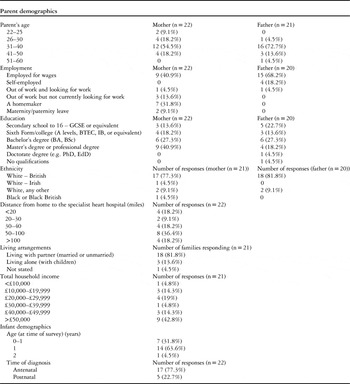
In order to generate a descriptive picture of parents’ discharge experiences, the information obtained from parent consultation informed the questionnaire, which was developed to obtain categorical data about parent demographics (see Table 1) and discharge information and support, including information about the healthcare professionals from whom support was received (see glossary for definition of professional roles). In addition, open-ended questions were embedded in order to gain an understanding of parents’ experiences at the time of going home, from their perspective.
Demographics at the time of online survey.

The questionnaire was piloted with three families – who were members of the Charity and had children aged between 0 and 3 years – and one parent representative – a statistician on the Charity’s Board with an older child with CHD – in May, 2012. Their feedback was acted upon before the final version of the questionnaire was made available in November, 2012.
The final version of the survey was made available to a convenience sample of parent members of the same charity with children aged 0–2 years (n=62 families) who had been discharged home from any UK specialist heart centre after first-stage surgery for a functionally univentricular heart condition.
Parents were contacted by the charity via email and given information about the study before being invited to participate and were provided with information about how to access the survey. Making the survey available online was deemed an economically viable method of data collection, enabling a relatively fast turnaround in obtaining responses.Reference Creswell and Plano-Clarke 29 The survey was initially made available for one month from November to December, 2012; however, this time period was extended until the end of March 2013, in an attempt to gain further participation following a reminder email.
Analysis of the data occurred after online access was closed. Descriptive statistics were used to calculate the percentage and frequency of categorical variables. The qualitative data collected from the open-ended questions were entered into the QRS NVivo 10 data management programme. A comprehensive process of data coding and identification of themes was undertaken using a deductive approach driven by the research question; this provided a less-rich description of the data overall; however, it enabled a more detailed analysis of this particular aspect of the data.Reference Creswell and Plano-Clarke 29 A six-phased, step-by-step approach was used to thematically analyse the data:Reference Braun and Clarke 30
-
∙ Familiarisation with the data
-
∙ Generating initial codes
-
∙ Searching for themes
-
∙ Reviewing themes
-
∙ Defining and naming themes
-
∙ Producing the report
Results
Online survey
A total of 22 responses were received (35% response rate) from six couples (27.3%), 15 mothers (68.2%), and one father (4.5%). Although it was mostly mothers who completed the questionnaire, the father’s demographic data were completed in 20 responses.
There was considerable variability in the sample in terms of parental age range, employment status, family income, distance from the specialist hospital, timing of diagnosis in terms of antenatal or postnatal, and age of their infant at the time of completing the questionnaire (see Table 1). The age of the infants at discharge (T0) varied from 3 days to 70 days; the mean age of infants at discharge was 28.95 days (standard deviation 17.38, median 26.5 days). In addition, T1 – the time of completing the questionnaire – was not a standard time point for all the families that participated; the mean infant age at T1 was 15.68 months (standard deviation 7.59, median 16 months). The infants’ diagnoses were variants of hypoplastic left heart syndrome in 14 patients (64%) and hypoplastic right heart syndrome in 8 patients (36%). The latter group included tricuspid atresia, pulmonary atresia with intact septum, and unbalanced forms of transposition with small right ventricle.
In total, three important themes emerged from the detailed parental responses to open-ended questions about their experiences and reflected those identified during the parental consultation. The descriptive statistics arising from the categorical survey data are included to support the three themes, which were as follows:
-
∙ mixed emotions about going home: fear versus excitement
-
∙ knowledge and preparedness
-
∙ support systems
Mixed emotions about going home: fear versus excitement
Parents described mixed emotions related to hospital discharge (see Box 1). Notably, the fears described by parents referred to the following: fear of being alone, not having monitors at home, night times, recognising deterioration, fear that the baby would stop breathing, the unknown, not knowing what to do, not knowing whom to contact, something happening, and the huge responsibility of going home for the first time.
Mixed emotions about going home

Novice parents were fearful of the responsibility of being a first-time parent in addition to being a parent of a baby with a cardiac problem; however, their excitement was related to “getting home to be a mum”, bonding with their infant, getting to know their baby, and adopting the parenting role. Conversely, experienced parents talked about their excitement of going home to their family and their other children.
Parents’ fears related closely to discharge preparation in terms of parents’ and healthcare professionals’ knowledge and preparedness.
Knowledge and preparedness
This theme was subdivided into knowledge and preparedness of parents and of the community and local hospital teams.
Knowledge and preparedness of parents
Parents were asked to rate their level of understanding of their infant’s heart condition at the time of discharge from the specialist hospital. Just over a quarter of mothers (n=6, 27.3%) felt that they “understood everything”, half (n=11, 50%) “understood most”, and just under a quarter (n=5, 22.7%) “understood some”. Only one father felt that he “understood everything”.
Parents described wanting to know more and felt unprepared for going home “We received some very vague statements when leaving, along the lines of ‘you are the parents you will know when there is a problem’”. Furthermore, some parents described elements that would have made their preparation more effective, including a better understanding of feeding and weight problems, how to administer medications, clinical deterioration and the signs thereof, and the risks of normal childhood illnesses and knowing whom to contact. Only one mother recalled being taught about the signs to look out for; however, despite knowing what the signs were, the signs were still missed.
Parents were also asked to rate the quality of discharge information from the specialist hospital (see Fig 1); approximately half of the responses rated the quality of discharge information from their specialist hospital as good or excellent; however, recognising the subjectivity of this question, most parents were satisfied with the quality of information that they received.
Quality of discharge information.

Knowledge and preparedness of community and local hospital teams
Parents lacked confidence in their community healthcare professionals as well as staff in local hospitals (see Box 2), because they felt as though they were being relied upon to know what was normal for their infant, when in fact their own lack of understanding was one of their greatest fears.
The need to prepare community staff

Parents highlighted the need to prepare community and local hospital teams effectively so that they understand the care required and are able to identify signs of deterioration without relying on parents’ knowledge. At this stage, parents classified themselves as novice in terms of their knowledge and preparedness. Going home with their fragile infant was a new experience for them, and therefore they felt unable to fully inform the community teams of their infant’s needs.
All parents (100%) perceived that their Cardiac Liaison Nurse fully understood their infant’s heart condition, whereas 87.5% of parents said that the ward nurses at the specialist heart hospital fully understood their infant’s heart condition. Just over half (55.6%) of the parents said that the doctor at the local hospital had full understanding, and just over a third (35.7%) said that their Community Children’s Nurse had full understanding of their infant’s heart condition. Less than a third said that their General Practitioner (26.7%), Health Visitor (25%), and local ward nurses (22.2%) had full understanding of their infant’s heart condition.
Parents generally felt that they would rather contact the specialist heart centre than their local teams, owing to the lack of knowledge that they perceived these professionals had of CHD and specifically about their infant’s condition.
Support systems
Parents were asked which professionals they contacted for support and how often. Community Children’s Nurses were most commonly contacted for advice at home (36.1%), followed by the Cardiac Liaison Nurses at the specialist hospital (22.7%), and Health Visitors in the community (18.2%). General Practitioners, doctors at the specialist hospital, and local doctors and nurses were contacted less frequently.
Parents’ support systems also included the written information that they were given; their needs focussed on having adequate verbal and written information at discharge but also once they were home. Some parents also wished to know who they should contact for advice about their infant’s cardiac condition. Conversely, some parents described how being given written information to take home and knowing that they could call the cardiac liaison nurse or ward at any time was helpful and supportive (see Box 3).
Helpful and supportive information

Implications for practice
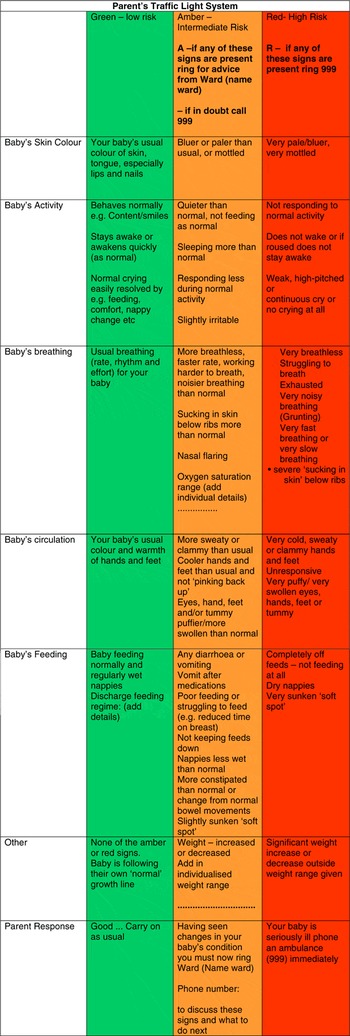
The survey findings were used to develop a tool that would address the issues raised from these parental concerns, focussing on the three main themes. This was designed for ease of use, to help parents recognise signs of deterioration, and incorporated a traffic light system to enable parents to assess the severity of their infant’s condition. The tool was called the Congenital Heart Assessment Tool (CHAT) and is shown in Table 2.
The tool can be individualised to each infant’s specific clinical signs by including preferred parameters as set by their Cardiologist; these are for use by parents in a home monitoring programme using relevant equipment and to inform community healthcare professionals when assessing the infants clinically. Instructions are provided to parents before discharge to ensure that they understand how to assess their infant and interpret the significance of the signs by using the CHAT. Parents are asked to use the CHAT daily to assess their infant’s condition, and record findings in a diary. In addition, the CHAT can be used at any other time if their infant’s condition has changed.
The CHAT is divided into three columns – green (low risk), amber (intermediate risk), and red (high risk). Parents are asked to assess their infant’s activity level, skin colour, breathing, circulation, feeding, and weight against the information in each of the three columns (see Table 2).
Congenital Heart Assessment Tool.

If the CHAT assessment is green, parents are directed to “carry on as normal”; amber triggers a phone call to the ward to discuss management; and a red response indicates the infant is seriously ill and parents are advised to phone for an ambulance (call 999 in the UK) immediately.
Discussion
The key finding of this study was that the parents felt unprepared either physically, emotionally, or educationally for their discharge home with their infant following the first stage of cardiac surgery for a functionally univentricular heart. The perceived advice received in terms of the teaching, and written information given to parents before discharge varied among respondents and among centres. Furthermore, when asked about elements of the teaching and written information, some families reported that they did not receive any preparation at all. However, the professed lack of consistency of written discharge information and the variation in terms of the amount and type of teaching received by parents participating in the survey could have been influenced by other factors.
Furthermore, for example, the length of their hospital stay could have impacted on the perceived quantity of information given at discharge, as some parents may have been receiving ongoing teaching during the post-surgery period. Normal daily conversations with nursing staff during a long hospital stay might have implicitly included guidance and advice without the parents considering it as discharge information; conversely, the nursing staff may have believed that they had been preparing families throughout the admission, development of knowledge perhaps being presumed through repeated interaction. In addition to this, parents may not have fully “heard” what was being explained to them in the pre-discharge period because of their anxieties and the stressfulness of the situation. Furthermore, the findings demonstrated a difference in the fears of the novice group of parents compared with the experienced parents; the “world” around these parents varied in terms of their previous experiences and social constructs and may have also been influenced by their educational and social backgrounds.
The survey had other limitations in terms of sample size and demographics of the participants, who were predominantly well-educated, white, British families. The time between the infant’s first surgery and parents completing the survey was varied, and therefore some parents’ recalls may have been more recent or better than the others; however, the parents’ responses to the open-ended questions all vividly demonstrated the mixed emotional impact of taking their infant home for the first time. In addition, it could be argued that those responding were the more proactive or outspoken parent members of the charity; therefore, the feedback is not necessarily representative of the whole population. Nonetheless, the responses were the experiences of families from different centres across the United Kingdom, suggesting that this is not an issue isolated to one centre. Furthermore, the findings begin to validate the experiences reported by parents to the charity. Specifically, the findings relating to the lack of provision of pre-discharge teaching or written information across the 11 centres demonstrate that nationally some parents are not being fully prepared about the key signs of clinical deterioration for this group of infants. Moreover, the findings contribute to the evidence base required to develop nationally recognised standardised discharge information as part of the standards for congenital cardiac services in the United Kingdom. 31
Studies specifically exploring parents’ experiences during the transition from hospital to home after the first stage of cardiac surgery for a functionally univentricular cardiac condition are not available in the published literature. On the other hand, other studies exploring parents’ readiness for discharge support the need for individualised support before discharge from hospital to home.Reference Titler and Pettit 12 , Reference Weiss, Johnson, Malin, Jerofke, Lang and Sherburne 13 Furthermore, a theoretical framework recently devised as a guiding principle for implementing multifaceted interventionsReference Rempel, Rogers, Ravindran and Magill-Evans 24 for parents of infants with hypoplastic left heart syndrome begins to address the needs of parents in terms of developing knowledge and understanding of their infant’s condition and principles of caring in hospital and at home. The conclusions drawn from this study support the contemporary evidence, while broadening the findings to include parents in another country and those with infants who have right-sided univentricular hearts.
Parents’ fears and anxieties about going home, as well as their need for effective preparation identified through this study, informed the development of a discharge education package and more specifically a parental early warning tool for phase 2 of the research. As described earlier, we wanted to develop a tool that would enable parents to recognise signs of deterioration and would give them information about what to do and whom to contact. We decided to call the tool the Congenital Heart Assessment Tool, as the acronym CHAT represented the two-way communication – “chat” – between parents and healthcare professionals. The content was written by the research team in association with parent representatives from the charity to ensure that the language used represented parents’ perceived needs, understanding, and interpretation of signs of deterioration. A traffic light system 32 was used in order to provide parents with structured information regarding signs of deteriorationReference Dedieu and Burch 33 in their infant, with the aim of enabling them to assess their infant more effectively at home.
Amber telephone conversations and the management advice given by ward staff were documented and regularly checked by the phase 2 research nurse. The number of calls received by ward staff and any emergency (red) re-admissions of infants in the study were also monitored.
Conclusion
The most important conclusion is that parents of these fragile infants were not adequately prepared for discharge and were not equipped with the necessary information to recognise deterioration. The findings demonstrated a range in parents’ perceived discharge preparedness across the 11 UK children’s cardiac centres, and this lack of preparation contributed to considerable anxiety before their infant’s discharge home. Notably, the clarity of parents’ recall about their experiences of going home clearly indicated the need for an effective discharge preparation strategy that could be implemented nationally.
Previous studies of fragile infants being discharged home between the first and the second stage cardiac surgery for complex CHD have focussed primarily on home monitoring programmes utilising clinical measurements of oxygen saturations and weights to determine early signs of clinical deterioration.Reference Fenton, Pigula and Ghandi 8 , Reference Ghanayem, Cava and Jaquiss 9 – Reference Steury, Cross and Colyer 11 In contrast, these findings informed the development of a simple tool to be used by parents, either alongside a home monitoring programme or on its own to assist in identifying signs of deterioration in their infant; the intention being to address the gap in parents’ knowledge and understanding of signs of deterioration, thereby enabling early recognition and potentially earlier management by clinicians.
Future plan
The feasibility of the CHAT was evaluated within phase 2 of the study, which commenced in August, 2013 and ended in September, 2015. The broader plan is to align additional physiological information into the CHAT so that it can be used by primary-care and pre-hospital healthcare professionals. Furthermore, this study is linked to the development of an online App for paramedics, enabling access to an educational tool while on the move via smart phone or tablet device.Reference Gregory 34
Acknowledgements
Suzie Hutchinson, CEO, Little Hearts Matter, provided support by hosting the Consultation Group and contributing to the development and dissemination of the online survey to members. Suzie Hutchinson; Amanda Daniels, Advanced Nurse Practitioner, Birmingham Children’s Hospital, and David Barron, Consultant Cardiac Surgeon, Birmingham Children’s Hospital contributed as members of the Research Team in 2013 and External Advisory Group during development of the CHAT. Professor Gill Furze and Dr Tim Kilner, Coventry University PhD Supervisory Team in 2013, contributed to the design of the feasibility study and preparation for ethics approval. They are aware of the decision to publish this paper but did not contribute to the content.
Financial Support
The Parent Consultation was funded by a Patient and Public Involvement Bursary from the National Institute of Health Research West Midlands Research Design Service. Coventry University is the sponsor for the research as the Principal Investigator, Kerry Gaskin, is a PhD Student at the University. All PhD tuition fees to date have been paid by the Faculty of Health and Life Sciences at Coventry University.
Conflicts of Interest
None.
Ethical Standards
Ethics approval for the study was obtained through Coventry University Research Ethics Committee.
Glossary of terms
Mixed Methods Research
This method incorporates a mixture of qualitative and quantitative approaches at one or more stages of the researchReference Gaskin 35
Fully mixed concurrent dominant (QUALquant) status design
Any study that combines both quantitative and qualitative methods either uses a fully or a partially mixed design, with the fully mixed designs reflecting the highest degree of integration both at paradigm and technical levels. Fully mixed methods engage quantitative and qualitative modes within one or more stages of the research process or across these stages, whereas in partially mixed studies the quantitative and qualitative elements are not mixed within or across stages. Alternatively, in partially mixed studies, both the quantitative and qualitative elements are completely implemented either concurrently or sequentially before mixing at the analysis stage.Reference Leech and Onwuegbuzie 36 The capital letters – for example, QUAL denote the dominant approach within the mixed method study.
Interpretivist
The interpretivist paradigm represents research where the data collected is more descriptive, but can include quantitative data, the emphasis being on exploration rather than experimentation.Reference Cryer 37
Constructionist
This approach implies that as humans we construct meaning as we connect with the world that we are interpreting and that meaning only materialises when consciousness engages with it; thus, the object that we see is shaped by our consciousness.Reference Crotty 28
Constructivist
Constructivism, being resistant of critical forces, focusses entirely on the way in which we independently make sense of situations and purports that this experience is exclusive to each of us. Conversely, constructionism encourages criticality, while considering the impact that our culture has on influencing the way in which we create and convey meaning.Reference Crotty 28
Community Children’s Nurse
The community children’s nurse is a registered children’s nurse, with specialist community nursing qualifications and experience. They generally work within a team to care for children in their own homes in a specific geographical region linked to a primary healthcare trust.
Cardiac Liaison Nurse
Cardiac Liaison Nurses, now referred to as children’s cardiac nurse specialistReference Gaskin, Smith and Broomfield 38 , work across a congenital cardiac network as a key advocate for children and young people, by ensuring the partnership they have with their family and healthcare and social-care professionals is central to, and focusses on, meeting their needs and expectations within care delivery. This includes working in a collaborative manner with all members of the multi-professional team.Reference Gaskin, Smith and Broomfield 38
Health Visitor Health Visitors are Registered Nurses with Specialist qualifications in Community Health, which includes child health, health promotion, and education. They work within the primary healthcare team 39
General Practitioner
General practitioners are qualified doctors with specific training who work within the primary-care setting and are the first point of contact for most patients. They provide primary and continuing medical care for patients in the community by referring patients to hospital clinics for further assessment or treatment 40
Paramedics
Paramedics are registered healthcare professionals who generally work in the pre-hospital setting. They are often the first healthcare professional to attend the scene of an accident or emergency, following an emergency (999) call to the ambulance service. Paramedics will assess the patient and give emergency treatment before transporting them to the most appropriate healthcare facility. 41