Puerto Rico currently faces a massive debt crisis. The US commonwealth carries $72 million in municipal-bond debt—eight times that of Detroit and more per capita than any of the 50 states (Corkery and Walsh Reference Corkery and Walsh2015). Puerto Rico’s situation is exacerbated by its inability to declare bankruptcy (as Detroit did)—a fact owed to a typographical error in a 1984 law that revised the US bankruptcy code (Schroeder Reference Schroeder2015).
In addition to the outcomes it produces, the legislative process serves as an important signal for courts, executive-branch agencies, interest groups, and other actors (Katzmann Reference Katzmann1989). Legislative history, floor debate, and specific language used assist other key policy actors and institutions in understanding, interpreting, and implementing a law. As Katzmann (Reference Katzmann1989, 294–5) noted, “various theories of judicial interpretation...are grounded in often conflicting assumptions about how the legislative process works, about the capacity of Congress as an institution to signal its meaning clearly and purposively.” Errors in the legislative process distort that signal and send conflicting information to policy advocates and implementers.
Understanding how legislative drafting errors arise can illuminate the sources of some of lawmaking’s unforeseen consequences, thereby providing a deeper and broader understanding of the policy process. In this article, I develop one indicator of congressional drafting error and find consistent support for two explanations for this type of error: (1) a lack of thorough scrutiny that results from unified partisan control of Congress and a new majority eager to make its legislative mark; and (2) committee workload; as well as contingent support for (3) legislative inexperience. The article proceeds in four sections. The first section further discusses legislative drafting error, its consequences, and its importance for understanding policy making on a larger scale. The second section introduces one systematic measure of error in the US Congress—star prints—which provides the basis for the subsequent analysis. In the third section, an analysis of star-printed US Senate committee reports from 1981 to 2012 reveals that increased drafting error is associated with higher percentages of freshman committee members and decreases in full-time committee staff members. I also find that divided-party control of the two congressional chambers mitigates committee star prints. The fourth section concludes.
THE LEGISLATIVE PROCESS AND DRAFTING ERROR
Writing legislation is a skill. Drafting legislation, large or small, involves translating complex policy ideas into language that is sufficiently understandable to be carried out by others. Thus, it requires the ability to assimilate and communicate information, whether substantive or political (Feldman Reference Feldman2000). Errors in the legislative-drafting process distort a law’s signal and send conflicting information throughout the policy process. Even something as simple as formatting items as a written paragraph rather than a bulleted list can render ambiguous a law’s scope, create conflicts with existing policy, and hinder uniform application across legal jurisdictions. This has been the fate of trademark policy since Congress enacted the Trademark Dilution Revision Act in 2006 (Lemper and Bruce Reference Lemper and Bruce2011). Footnote 1 Therefore, legislative drafting errors can produce far-reaching unforeseen consequences and are critical to understanding the policy process as a whole.
Finding systematic examples of legislative drafting error can be difficult. “Technical corrections” that address such error in the US Congress often are made through unanimous consent before a bill’s latest version is published, which means that the error remains unobserved. One congressional procedure—star printing—provides some trace evidence of error. The next section describes the star-printing process and provides descriptive data on its use since 1981.
Errors in the legislative-drafting process distort a law’s signal and send conflicting information throughout the policy process. Even something as simple as formatting items as a written paragraph rather than a bulleted list can render ambiguous a law’s scope, create conflicts with existing policy, and hinder uniform application across legal jurisdictions.
STAR PRINTS IN THE US CONGRESS
Star prints are corrected editions of congressional bills and committee reports, so called because their title page features small black stars. Star-printed bills or reports replace the original in its entirety even if only one word is corrected. They can be issued at any point in a bill’s journey through the legislative process; however, they most typically occur when a bill has reached one of the two chambers’ legislative calendars. Star prints may be used to fix clerical, technical, or substantive errors—even clerical errors, if undiscovered, can produce significant policy consequences. In 1914, a substitute amendment to a House bill that would transfer land in Salt Lake City County, Utah, described an area encompassing 319,000 acres—rather than the correct 0.319 acre—before being star-printed (Congressional Record 1914). Had the amendment been adopted as written, public-lands policy in the United States would have changed dramatically!
The Library of Congress began tracking star prints in its THOMAS database beginning with the 97th Congress (1981–1982). Legislative language can be subject to star-printing either on its own or as part of a committee report. Star prints are not the ultimate measure of legislative errors because they represent those that have been caught and corrected; neither the 1984 bankruptcy-code revision nor the 2006 trademark-dilution law appears in these data. Nevertheless, measuring congressional drafting error through star prints has the advantage of providing a clear, consistent measure that is traceable across time, committees, and issues. As such, they provide a good first step toward better understanding the role that legislative drafting error plays in the policy process.
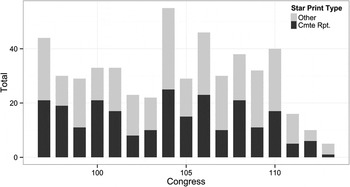
Star prints have varied significantly during the past several decades—even from one congress to the next. They peaked at 61 in the 104th Congress (1995–1996) and then declined in the next several decades to their lowest level since they were recorded, with only 5 in the 113th Congress (2013–2014). Because star prints can occur at any point in the legislative process, tracing responsibility for the original error—and therefore developing potential explanations for that error—can be difficult. The analysis in this article focuses on star-printed Senate committee reports for two reasons: (1) a star-printed committee report indicates that error arose during committee deliberation, which narrows the possible explanations; and (2) they comprise the bulk of the overall data pool. As an empirical matter, many more Senate bills and resolutions (i.e., 510) than House bills (i.e., 53) received the “star-print-ordered” action in THOMAS between 1981 and 2012, and all of the committee reports that received star-print actions came from the upper chamber. Committee reports represented 42% of all star-printed legislation during this period (i.e., 241 of 568 star prints); however, the percentage ranges between 20% and 60% of all star prints in a given congress since 1981.
Thus, Senate trends mirror the overall numbers (figure 1). In the Senate, star prints in the modern era hovered around 30 in the mid-to-late 1980s and declined to 22 in the 103rd Congress. They increased dramatically to 55 in the 104th Congress and gradually declined once more thereafter.
US Senate Star Prints, 1981–2012

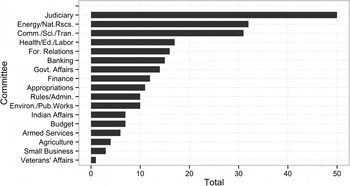
Star prints by committee also can be examined to determine which areas experience more or less drafting error (figure 2). Notably, every standing Senate committee operating from 1981 to 2012 star-printed at least one report. The Senate Judiciary Committee has the dubious honor of correcting the most star-printed reports (i.e., 50), followed by the Commerce, Science, and Transportation panel (i.e., 31) and Energy and Natural Resources panel (i.e., 31) since 1981. Committee star prints decline thereafter, with eight committees correcting from 10 to 20 reports each in the past three decades; six committees had even fewer.
Star-Printed Reports by Senate Committee, 1981–2012

That certain committees produce many more star prints than others, and that star prints vary over time, suggests that legislative drafting error can be explained systematically. Star prints do not account for every instance of drafting error, but they do provide a useful starting point in determining when and why such error occurs. The next section develops and tests hypotheses about why US Senate committees commit legislative drafting error.
The star-print data that inform the analysis in this article are organized by committee and congress, which allows the use of a time-series cross-section model to test explanations for legislative drafting error that are unique to each committee in a given congress and also vary over time but are common to committees in a given congress.
MODELING SENATE COMMITTEE DRAFTING ERROR
The star-print data that inform the analysis in this article are organized by committee and congress, which allows the use of a time-series cross-section model to test explanations for legislative drafting error that are unique to each committee in a given congress and also vary over time but are common to committees in a given congress. A hurdle Poisson model is appropriate because of the numerous zeroes present in the data (Zorn Reference Zorn1998). The model estimates, as separate processes, whether a committee even will issue a star-printed report as a binary outcome, along with the event count once the threshold of a star-printed report is reached. Footnote 2 Exponentiating the threshold-component estimates yields a committee’s odds ratio for experiencing a star-printed report, whereas exponentiating the count-component estimates yields a committee’s probability of experiencing additional star prints. Subtracting 1 from these values indicates either an increase or a decrease compared to the baseline. For example, an odds ratio of 1.25 corresponds to a 25% increase in odds, whereas a ratio of 0.75 indicates a 25% decrease.
Mayhew’s landmark 1991 lawmaking study, Divided We Govern, provides a helpful starting place to explain legislative drafting error. Although he found no significant difference in lawmaking between unified and divided control of government, he listed additional ways in which the difference might matter. “Unified party control can foster a pathological enactment logic all its own” that produces a “politics of haste” (Mayhew Reference Mayhew1991, 181). Although Mayhew related a hasty enactment process under unified government to an absence of enduring postenactment coalitions, it also may make legislative text subject to less scrutiny, thereby contributing to drafting error. This “politics of haste” also may be found among new majorities anxious to make their mark and fulfill their perceived electoral mandates. I test this explanation with three independent variables that vary across congresses but are static across committees within a given congress, as follows:
-
Divided Chambers: Coded 1 in congresses in which different political parties hold a majority of seats in the Senate and House of Representatives.
-
Divided Government: Coded 1 in congresses in which the presidential out-party holds a majority of Senate seats; 0 otherwise.
-
New Majority: Coded 1 in congresses with a different majority party from the previous congress; 0 otherwise.
Yet another possible explanation is a lack of expertise and experience in writing legislation. Legislative drafting errors represent inaccuracies in writing legislation, and expertise and experience are the means to reduce those inaccuracies. Training and repetition eventually make difficult tasks routine, thereby reducing error (Heimer Reference Heimer2008). If writing legislation is a skill transferable across contexts, then committees with less-experienced members and leaders should report more legislation with some type of drafting error. Indeed, two of the congresses with the largest number of star prints listed in figure 1 (i.e., the 97th and the 104th) followed what are considered “wave elections,” with 12 new senators elected in 1980 and nine new senators elected in 1994. I test this explanation with two independent variables that vary across both time and committees, as follows:
-
Freshman Percentage: The percentage of senators on a given committee in a given congress who are freshmen.
-
New Chair: Coded 1 if a committee chair had not served in that position (on that committee) prior to that congress; 0 otherwise.
A third explanation for legislative error is simply a matter of workload—committees that draft more legislation also will commit more errors. I include two independent variables to test whether workload affects drafting error. The first variable measures purely legislative workload; the second indicates which committees have larger or smaller overall workloads, as follows:
-
Total Reports: The total number of reports a committee issued in a given congress.
-
Total Committee Staff: The total number of full-time staff allocated to a committee in a given congress.
The Senate also has an Office of Legislative Counsel that helps in drafting legislation. Data on Legislative Counsel funding are not consistent in this period. Therefore, I include a separate regression model with the percentage change in average annual Legislative Counsel funding from one congress to the next for the period from 1991 to 2012 as a predictor. Finally, I include the lagged number of star-printed committee reports as an independent variable to account for possible serial correlation in the data.
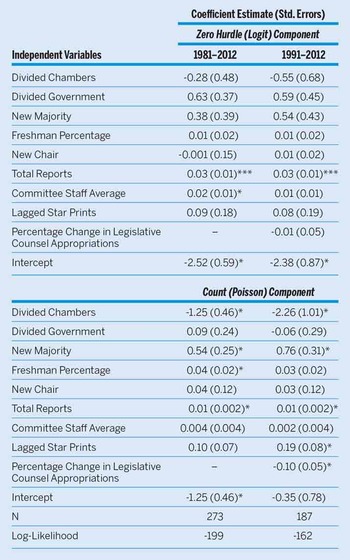
Looking first at the zero-hurdle-model component, committees with higher workloads experience higher odds of a star-printed report (table 1, top). The effect seen for total bills reported in both models translates to a 3% increase in odds for each additional bill reported by a given committee in a given congress. There also is a staff effect in the base model that translates to a 2% increase in odds for each additional staff member. However, this effect does not hold in the model that includes Senate Legislative Counsel funding.
Sources of US Senate Committee Star Prints

Turning to the count-model component (see table 1, bottom), divided control of Congress acts as a check against legislative error. The probability of multiple star-printed committee reports is 72% lower when the House and Senate are controlled by different political parties than under unified control of the two chambers. When Senate Legislative Counsel funding from 1991 to 2012 is incorporated, divided partisan control of the two chambers reduces that probability by 90%. Committees operating under new majority parties also are more likely to commit more errors. In the main model, this effect translates to a 72% increase in the probability of multiple star prints from committees under a new majority party. In the model that incorporates Senate Legislative Counsel funding, this effect translates to a 114% increase in the probability of multiple star-printed committee reports. Both models present clear evidence that the “politics of haste” that Mayhew (Reference Mayhew1991) described greatly contributes to legislative drafting error.
The count-model component also suggests that Senate inexperience contributes to drafting error. A greater percentage of freshman senators on a given committee is associated with an increased probability of multiple star-printed committee reports; however, this effect does not hold in the model that includes Senate Legislative Counsel funding. The base-model effect translates to a 4% increase in the probability of multiple star prints for each additional percentage point of inexperienced senators. This effect may not appear significant but committee assignment patterns vary erratically; therefore, committee susceptibility to error does as well. Finally, increasing Senate Legislative Counsel funding reduces legislative error in the count-model component. For each additional percentage point of increase in funding, the probability that Senate committees would star-print multiple reports decreases by approximately 1%.
CONCLUSION
The Patient Protection and Affordable Care Act (ACA) has been the subject of political posturing and bureaucratic uncertainty ever since enactment. The law’s implementation moves forward, but one issue recurs and occasionally threatens its survival: legislative drafting error.
The most recent example came in July 2015, when the US Supreme Court handed down its decision in the case known as King v. Burwell. The Obama administration argued that the law’s language pertaining to health-insurance tax credits was ambiguous as a result of simple drafting error, and several current and former congressional staff members who helped to write the law agreed with this claim. According to a former Senate Finance Committee staffer, “at the end of the day, this should never have happened, and is a product of the rushed way a law was passed” (Kliff Reference Kliff2014).
That such a high-profile case with an impact on all three branches of the federal government resulted from “inartful drafting,” as the majority opinion stated it (King v. Burwell 2015, 3), speaks to how embedded the act of writing legislation is within many other aspects of the policy process. The legislative process acts as an important signal for courts, executive-branch agencies, interest groups, and other actors (Katzmann Reference Katzmann1989). Law professor Abbe Gluck echoed this sentiment in an online symposium about King v. Burwell when she wrote, “King turns out to be a case about understanding Congress” (Gluck Reference Gluck2015). As Puerto Rico’s political leaders can attest, even seemingly minor mistakes distort the signal that the legislative process sends, and they create headaches for agency bureaucrats charged with implementing statutes and the judges charged with interpreting them.
In this article, I propose Senate star prints as one measure of such error, and I find that star prints can be explained systematically. This particular type of legislative drafting error arises in part from an absence of checks on the lawmaking process under unified partisan control of Congress and new majority parties eager to put their stamp on the US Code; from large committee workloads; and from a lack of resources devoted to and experience in writing legislation. All of these factors contribute to a “politics of haste” (Mayhew Reference Mayhew1991) that can lead legislators (and their staff) to accept and pass legislation that has not been fully vetted for error and produces unintended, substantive consequences. The Supreme Court’s decision in King v. Burwell (2015, 14) recognized as much when it noted that “the Act does not reflect the type of care and deliberation that one might expect of such significant legislation.”
As of this writing, two resolutions and the fiscal 2016 Energy and Water Development appropriations bill have been star-printed in the 114th Congress. The current Congress features unified partisan control along with a new Senate majority, both of which increase the probability of multiple star prints. Additionally, the fiscal 2015 general-appropriations bill funds the Senate Legislative Counsel at slightly more than $5.4 million, an 11% decrease from the average allocation in the previous congress. The analysis in this article suggests that federal bureaucrats and judges may come up against more drafting errors in the near future.
Whereas Senate star prints are only one of many potential legislative-error measures, the framework for understanding the sources of legislative error presented here also could be used to compare error across institutions and contexts. In summary, understanding more about why and when legislative error occurs can help us understand more about the policy process generally and the legislatures’ roles and capacities in that process.