Implications
The Akhal-Teke horse is a versatile breed used in various horse disciplines. There are only a few studies so far in which this breed is involved. From historical development, this breed has great endurance capability, but the breeding selection during the past 100 years has been strongly toward speed. We hypothesized that both the endurance and speed capacity of the Akhal-Teke horses are shown by the respective patterns of the myosin heavy chain isoform composition of their skeletal muscle.
Introduction
The history of the Akhal-Teke breed is found to be about 3000 years old. These horses were originally bred as war and riding horses (Hendricks, Reference Hendricks1995). Recorded pedigree data are available from the end of the 19th century. The Akhal-Teke breed is a pure breed. For some decades, toward the end of the 19th century and the beginning of the 20th century, the English Thoroughbred was allowed in the Akhal-Teke breeding program, but the Stud Book was closed in 1932 and no Thoroughbred horses have been allowed into pure Akhal-Teke breeding since then. The Akhal-Teke breed is small in number; at present, there are only 3 to 5000 animals of this breed and there is a great amount of inbreeding among this breed. Currently, there are 20 sirelines and 50 dam families in the Akhal-Teke breed according to the Stud Book (Ryabova, Reference Ryabova2005; Majarina, Reference Majarina2008). From historical development, this breed has great endurance ability, but the breeding selection during the past 100 years has been strongly toward speed. The versatility of these horses is in a class of its own as they are highly regarded for speed, stamina and trainability. The endurance capacity of the Akhal-Teke horses is high. For example, in 1935, these horses completed a 4300 km ride from Ashkabad to Moscow (Kuznecova, Reference Kuznecova2005).
Five muscle fiber types are shown to be present in equine skeletal muscle. Their different contractile properties and oxidative potential determine the speed, strength and endurance capability of the horses (Leisson et al., Reference Leisson, Jaakma and Seene2008; Kawai et al., Reference Kawai, Minami, Sayama, Kuwano, Hiraga and Miyata2009). It is known that horses with a better endurance performance had higher percentages and relative areas of type I and type IIA fibers in the gluteus medius muscle and subsequently higher relative content of myosin heavy chains (MyHCs) I and IIa, and lower content of MyHC IIx isoforms (Lopez-Rivero et al., Reference Lopez-Rivero, Morales-Lopez, Galisteo and Aguera1991; Rivero and Henckel, Reference Rivero and Henckel1996; Serrano et al., Reference Serrano, Quiroz-Rothe and Rivero2000). From the beginning of the 1990s, the distribution of equine muscle fiber types has been found to change during the life span of the horses (Roneus et al., Reference Roneus, Lindholm and Asheim1991; Rivero et al., Reference Rivero, Galisteo, Aguera and Miro1993a; Gunn, Reference Gunn1995). Later, it was shown that the muscle fiber composition of horses <20 years does not differ from that of young ones. In old horses, skeletal muscle was found to be significantly less in type I and type IIA fibers in comparison with younger ones (Lehnhard et al., Reference Lehnhard, McKeever, Kearns and Beekley2004; Kim et al., Reference Kim, Hinchcliff, Yamaguchi, Beard, Markert and Devor2005).
There are very few previous studies in which the Akhal-Teke breed has been used (Tikhonov et al., Reference Tikhonov, Cothran and Kniazev1998; Szontagh et al., Reference Szontagh, Ban, Bodo, Cothran, Hecker, Jozsa and Major2005; Priskin et al., Reference Priskin, Szabo, Tömöry, Bogacsi-Szabo, Csanyi, Eördögh, Downes and Rasko2010). Unfortunately, we did not find any studies in which the muscle fiber types and MyHC isoform pattern in the Akhal-Teke horses and its age-related changes were determined.
The purpose of this study was to determine the MyHC isoform pattern in the gluteus medius muscle of the Akhal-Teke horses and to assess whether aging induced changes in the relative content of MyHC.
Material and methods
Animals
Fifteen Akhal-Teke horses (four stallions and 11 mares) in Estonia were used in this study. Six horses were 1.5 to 4 years old, five were 9 to 13 and four were 18.5 to 23.5 years old. The mean age of 15 horses was 10.47 ± 2.08 years. The biopsies were obtained during the winter period. In this period, all the horses were kept outside on a 40-hectare pasture during the day and stabled in boxes at night. Hay and water were provided ad libitum. In addition, each horse received 2 kg oats as grain per day divided into two feedings (the morning and the evening) and 50 to 100 g vitamin and mineral mix per day.
The Akhal-Teke horses used in this study were originally from different birthplaces, that is, South Russia (Stavropol), Dagestan, Turkmenistan and Moscow. Only horses of 1.5 years old were born in Estonia, but they were just the first generation foals out of parents of non-Estonian origin. None of the horses had any training during biopsy collection. While horses aged 1.5 to 4 years had never been in any kind of training during their life, older horses had been in intensive short-distance race training for 1 to 2 years, but that was more than 6 years ago.
All procedures used in this study were approved by the Animal Experiment Committee of the Estonian Ministry of Agriculture, Tallinn, Estonia.
Muscle biopsies
Muscle biopsies were obtained from each horse at a depth of 60 mm from the left gluteus medius muscle approximately 15 cm caudodorsal to the tuber coxae, with the method described by Ledwith and McGowan (Reference Ledwith and McGowan2004). A total of 15 samples were collected, cooled in liquid nitrogen and preserved at −80°C until assayed.
MyHC isoform electrophoresis
Electrophoresis was run in a Bio-Rad Mini-Protean II Dual Slab Cell electrophoresis system utilizing a Bio-Rad 1000/500 power supply (Bio-Rad Laboratories, Hercules, CA, USA). Talmadge and Roy (Reference Talmadge and Roy1993) previously described a quantitative sodium dodecyl sulfate polyacrylamide gel electrophoresis (SDS-PAGE) protocol that clearly separates all four isoforms of MyHC (I, IIa, IIx and IIb) found in adult rat skeletal muscle using a Mini-Gel system. MyHC I isoform from the rat soleus muscle, and IIa, IIx and IIb isoforms from the extensor digitorum longus muscle were used.
This protocol was slightly modified to improve the separation of MyHC isoforms in the Mini-Gel system (Mini-Protean II Electrophoresis Cell, Bio-Rad Laboratories, Hercules, CA, USA) by addition of the reducing agent β-mercaptoethanol to the top running buffer (Kohn and Myburgh, Reference Kohn and Myburgh2006).
Preparation of samples for SDS-PAGE
Pre-weighed frozen muscle pieces (30 mg) were pulverized to a fine powder in liquid nitrogen. Samples were prepared by homogenizing muscle powder in ice-cold wash buffer: 20 mm NaCl, 5 mm Na2HPO4, 1 mM EGTA (pH = 6.5). The homogenate was centrifuged at 10 000 r.p.m. for 10 min at 4°C. The pellet was suspended in extraction buffer: 100 mM Na2P2O7, 5 mM EGTA, 1 mM dithiothreitol (pH = 8.5) for 1 h at 4°C. The samples were then centrifuged at 10 000 r.p.m. for 10 min at 4°C. Supernatant was mixed with an equal volume of glycerol and stored at −80°C (D'Albis et al., Reference D'Albis, Pantaloni and Bechet1979). The protein concentration was determined using a colorimetric assay (Bio-Rad) and standardized with sample buffer containing 5% β-mercaptoethanol, 2.5% SDS, 20% glycerol, 62.5 mM Tris (pH = 6.8) and 0.1% bromphenol blue to 0.1 mg/ml. Samples were boiled for 2 min before gel electrophoresis.
Stacking and separating gel
Preparation of separating gels and running buffers was performed as described previously by Talmadge and Roy (Reference Talmadge and Roy1993). The separating gel contained 30% glycerol, 8% acrylamide, 200 mM Tris-HCl (pH = 8.8), 100 mM glycine and 0.4% SDS; the stacking gel contained 30% glycerol, 4% acrylamide, 70 mM Tris-HCl (pH = 6.8), 4 mM EDTA and SDS. For both gels, polymerization was initiated by the addition of 0.05% TEMED and 0.1% ammonium persulfate.
Running buffer
The lower running buffer contained 50 mM Tris, 75 mM glycine and 0.05% SDS, and the top running buffer contained twice the concentrations mentioned above. A final concentration of 0.12% of β-mercaptoethanol was included in the top running buffer. The upper and lower buffers were cooled.
Electrophoresis conditions
Electrophoresis was performed at a constant voltage of 130 V for 26 h.
Staining and densitometry
The gels were fixed and silver-stained as described by Oakley et al. (Reference Oakley, Kirsch and Morris1980), and scanned and band densities were analyzed using a software package (GeneSnap, Genetools, Syngene, UK). Three bands that clearly separated in gels were identified as the MyHC I, MyHC IIa and MyHC IIb isoforms (Rivero et al., Reference Rivero, Talmadge and Edgerton1996a). Values are expressed as a percentage of the total number of all bands distinguishable for each sample.
Statistical analyses
Data were managed and analyzed using software packages MS Office Excel 2003 and SAS 9.1. A one-way ANOVA was used to test the statistical significance of differences between age groups. The effect of age on the MyHC isoform composition was assessed by linear regression analyses. Data are presented as mean ± s.e. Significance level was set at P ⩽ 0.05.
Results
The average content of the MyHC I isoform in the skeletal muscles of 15 Akhal-Teke horses (10.47 ± 2.08 years) was 11.72 ± 1.07% (variation between individual animals from 7.09% to 20.14%). The relative content of the MyHC IIa and IIx isoforms was subsequently 38.20 ± 1.46% (30.73% to 48.78%) and 50.07 ± 1.10% (43.8% to 56.78%) from the total MyHC. The MyHC I and IIa isoforms, which are the main isoform types in muscle fibers with high oxidative potential, form together approximately half (49.92%) of the MyHC isoforms.
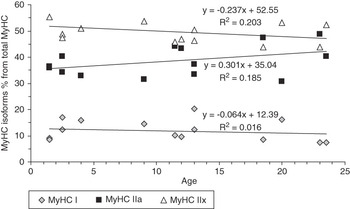
Plots of individual values of the MyHC I, IIa and IIx isoforms against age were illustrated subsequently in Figure 1. There were no statistically significant relationships between MyHC isoforms and age.
Linear regression line relating the MyHC I, IIa and IIx isoforms to age (The correlation was not significant).

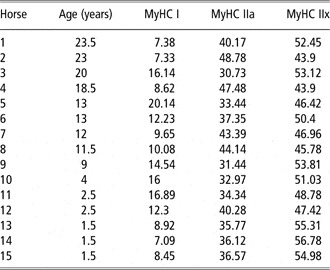
Table 1 shows the MyHC composition in individual animals.
The individual animals’ MyHC composition

MyHC = myosin heavy chain.
Discussion
The results of this study indicate that the MyHC I and IIa isoforms form about 50% of the skeletal muscle MyHC isoforms of the Akhal-Teke horses . As these two MyHC isoforms dominate in fibers with high oxidative potential (Rivero et al., Reference Rivero, Serrano, Henckel and Aguera1993b; Votion et al., Reference Votion, Navet, Lacombe, Sluse, Essen-Gustavsson, Hinchcliff, Rivero, Serteyn and Valberg2007; Leisson et al., Reference Leisson, Jaakma and Seene2008), this finding may approve the standpoint that the Akhal-Teke horses have exceptional endurance. An example of the stamina of these horses is the travel of 4300 km, from Ashkabad to Moscow (Kuznecova, Reference Kuznecova2005).
The statement that these horses possess great speed may be also explained by the relative content of MyHC isoforms in skeletal muscle. As half of the MyHC isoforms comprise IIx isoforms, which are typical for the glycolytic muscle fibers, known as the fibers with high glycolytic potential and contraction speed (Rivero, Reference Rivero2007; Votion et al., Reference Votion, Navet, Lacombe, Sluse, Essen-Gustavsson, Hinchcliff, Rivero, Serteyn and Valberg2007), this may be as proof of the great speed potential of the skeletal muscles of the Akhal-Teke horses.
The high percentage of the MyHC I and IIa isoform content in the skeletal muscles of the Akhal-Teke horses may indirectly explain the high resistance to muscle damage and fast repair of muscle damages of these horses. It has been previously shown that muscle fibers with high oxidative potential have higher resistance and capacity for regeneration during and after exercise (Votion et al., Reference Votion, Navet, Lacombe, Sluse, Essen-Gustavsson, Hinchcliff, Rivero, Serteyn and Valberg2007; Seene et al., Reference Seene, Umnova, Kaasik, Alev and Pehme2008 and Reference Seene, Kaasik and Umnova2009). Surveys have shown that age causes changes in muscle fiber types of MyHC isoform patterns and oxidative potential in horse skeletal muscle (Dingboom et al., Reference Dingboom, van Oudheusden, Eizema and Weijs2002; Lehnhard et al., Reference Lehnhard, McKeever, Kearns and Beekley2004). Horses older than 20 years had significantly less of type I and type IIA fibers in skeletal muscle and more of type IIx fibers than the young horses (Lehnhard et al., Reference Lehnhard, McKeever, Kearns and Beekley2004; Kim et al., Reference Kim, Hinchcliff, Yamaguchi, Beard, Markert and Devor2005).
This study did not reveal any significant changes in the relative content of MyHC isoforms in skeletal muscle between the three age groups.
Some earlier studies have compared the percentage of muscle fibers between horse breeds (Snow and Guy, Reference Snow and Guy1980). Though the percentages found in specific breeds differ among the studies, the highest amount of slow fibers are found to be represented in Arab horses (Rivero and Diz, Reference Rivero and Diz1992; Gondim et al., Reference Gondim, Modolo, Campos and Salgado2005). Studies with Standardbred horses (Roneus et al., Reference Roneus, Essen-Gustavsson, Lindholm and Persson1992; Roneus, Reference Roneus1993; Lehnhard et al., Reference Lehnhard, McKeever, Kearns and Beekley2004) have shown that this breed can have similar proportions of muscle fiber types compared to Arabs as well as to Thoroughbreds (Roneus et al., Reference Roneus, Lindholm and Asheim1991; Rivero and Diz, Reference Rivero and Diz1992; Rivero et al., Reference Rivero, Ruz, Marti-Korff, Estepa, Aguilera-Tejero, Werkmann, Sobotta and Lindner2007).
Most of the breeds are bred for certain physical abilities, either for heavy draft work, classical riding sports (show jumping, dressage), endurance or speed. Therefore, that is probably the reason why the pedigree influence to the muscle fiber types within a certain breed is not much investigated; only some earlier studies about it were found (Lopez et al., Reference Lopez, Galisteo, Serrano and Morales1993; Rivero et al., Reference Rivero, Valera, Serrano and Vinuesa1996b; Barrey et al., Reference Barrey, Valette, Jouglin, Blouin and Langlois1999; Rivero and Barrey, Reference Rivero and Barrey2001; Rietbroek et al., Reference Rietbroek, Dingboom and Everts2006). As the Akhal-Teke horses tend to show equal ability both for speed and endurance, they are not apparently bred only for one specific trait. Therefore, it would be a challenge to investigate whether the parentage influences the MyHC composition in this breed.
In conclusion, in the gluteus medius muscle of the Akhal-Teke horses (average age: 10.47 ± 2.08 years), the MyHC I and IIa isoforms form subsequently 11.72% and 38.20% and IIx isoforms 50.07%. Comparing the results of our study with other horse breeds, we can see that among the animals used in our study, the myosin isoform pattern varies among individuals, some of them showing a similar pattern of myosin content with Arab horses, and the others with Thoroughbreds. The relative content of MyHC isoforms shows that the contractile apparatus of the Akhal-Teke horses has both the capacity for endurance and speed.
Acknowledgements
We are grateful to Kaido Puusepp, the Director of Akhal-Teke EST for permission and help of collecting the samples of their Akhal-Teke horses. We also thank Maire Aru at the Department of Functional Morphology of the University of Tartu for helping to work with the muscle samples in the laboratory.