




No CrossRef data available.
Insider–Outsider Politics in Industrialized Democracies: The Challenge to Social Democratic Parties
Published online by Cambridge University Press: 04 April 2005
Abstract
In much of the political economy literature, social democratic governments are assumed to defend the interests of labor. The main thrust of this article is that labor is divided into those with secure employment (insiders) and those without (outsiders). I argue that the goals of social democratic parties are often best served by pursuing policies that benefit insiders while ignoring the interests of outsiders. I analyze Eurobarometer data and annual macrodata from 16 OECD countries from 1973 to 1995. I explore the question of whether strategies prevalent in the golden age of social democracy have been neglected and Left parties have abandoned the goal of providing equality and security to the most vulnerable sectors of the labor market. By combining research on political economy, institutions, and political behavior, my analysis demonstrates that insider–outsider politics are fundamental to a fuller explanation of government partisanship, policy-making, and social democracy since the 1970s.
Information
- Type
- ARTICLES
- Information
- Copyright
- © 2005 by the American Political Science Association
Comparative political economists generally agree that social democratic parties are the defenders of labor. The persistence of widespread unemployment witnessed under social democratic governments since the early 1970s, however, powerfully conflicts with this assumption. Moreover, the popular press has reported with increasing frequency that the distinctiveness of some of the economic policies once championed by social democratic and conservative parties has been lost. How can these seeming anomalies be explained? The answer, I argue, lies in challenging the notion that social democratic governments represent the interests of labor.
The traditional conception of social democratic policy-making rests on the assumption that labor is affected disproportionately by unemployment. But in the following pages I argue that labor is divided into two segments: those with secure employment (insiders) and those without (outsiders). Since the early 1970s, insiders have become insulated from unemployment. Not only do they enjoy high levels of protection, they also benefit from the fact that outsiders act as a buffer bearing the brunt of fluctuations in the business cycle. In response to the increasingly significant differences between insiders and outsiders, social democratic governments have transformed their policy goals. The anomalies mentioned above can be explained by considering that the objectives of social democratic governments are best served by pursuing policies that ignore the interests of outsiders.
Disaggregating labor into insiders and outsiders promotes the exploration of three topics of importance to the comparative political economy literature. The first one has to do with the transformation in party strategies resulting from new voter demands in industrialized democracies. While the relevance of other factors (like lower economic growth, demographic or production changes, the emergence of post-Fordism, increasing internationalization, and competition from industrializing countries) has been recognized for some time, my analysis makes clear the significance of insider–outsider preferences as a determinant of government policy. The second topic is related to the very nature of social democracy. Our assumptions about the strategies of leftist parties have not changed substantially since the golden age of social democracy (when equality, social protection, and economic growth were perceived as compatible). My analysis questions these assumptions and provides a fuller understanding of the limitations and opportunities faced by social democrats in the post–oil crises era. The final topic concerns what the goals of social democracy should be. This article demonstrates that, in the presence of conflict between different groups within labor, social democratic governments often do not promote the interests of the weakest members of society. The insider–outsider model opens the door to a debate about the desirability of this outcome.
THE INSIDER–OUTSIDER PARTISANSHIP MODEL
Like much of the literature that explores the relationship between partisan government and economic policy, I understand political parties to have electoral objectives as well as commitments to ideology and to historically meaningful groups of voters. As Powell (1982) has pointed out, the existence of a relationship between “strong, continuing expectations about parties and the interests of social groups not only creates easily identifiable choices for citizens, it also makes it easier for parties to seek out their probable supporters and mobilize them at election time” (116). History and ideology, however, are not enough. Elections inevitably revolve around issues (like employment protection or labor market policies) because issues give political meaning to partisan attachments and social divisions (Dalton 2002, 195).
Unlike most of the comparative political economy literature, I do not conceptualize labor as a homogeneous political actor. I share an interest in disaggregating labor with some recent works on the determinants of party strategies and individual policy preferences (e.g., Iversen and Soskice 2001 and Kitschelt 1994, 1999). My analysis is based on two propositions: that labor is divided into insiders and outsiders and that the interests of insiders and outsiders are fundamentally different.1
There are two frameworks that inspire the model that I propose: work on dual labor markets (such as Berger and Piore 1980 and Doeringer and Piore 1971) and the economic insider–outsider approach emphasizing the differences between the employed and the unemployed (see, for example, Blanchard and Summers 1986, Lindbeck and Snower 1988, and Saint-Paul 1996).
I define insiders as those workers with highly protected jobs. They are sufficiently protected not to feel greatly threatened by high levels of unemployment. Outsiders, on the other hand, are either unemployed or hold jobs characterized by low salaries and low levels of protection, employment rights, benefits, and social security privileges. The interests of these two groups are fundamentally different because insiders care about their own job security much more than about the unemployment of outsiders and outsiders care about unemployment and job precariousness much more than about the employment protection of insiders.
While dividing labor into insiders and outsiders has some precedents in both the economics and the political science literature, integrating this division into a coherent conception of partisanship and policy-making represents a completely new endeavor. It is my contention that social democratic parties have strong incentives to consider insiders their core constituency. There are historical and ideological reasons for this but there is also the fact that the other group within labor, outsiders, tends to be less politically active and electorally relevant (as well as less economically independent) than insiders. I further argue that social democratic governments will side with their core constituency when faced with the choice between insiders and outsiders. Insiders are benefited by higher levels of employment protection legislation while, inasmuch as lower protection facilitates hiring, outsiders are not. Consequently, the main policy objective of social democratic parties will be the continuation or increase of insider job security. Higher levels of labor market policy, on the other hand, benefit outsiders, but not insiders. Both active labor market policies (ALMPs) and passive labor market policies (PLMPs) have the potential to benefit insiders, but more directly, they mean higher taxes and low-wage competition (more on this below). The implication of my insider–outsider model therefore is that social democratic government is associated with higher levels of employment protection legislation but not of ALMPs or PLMPs.
Dividing labor into insiders and outsiders also has implications for the strategies of conservative governments. Like many other authors, I consider conservative parties to depend on a core constituency that consists of upscale groups (employers, the upper middle-class, and the business and financial community). Paradoxically, the insider–outsider model implies that, in some cases, conservative governments may be able to pursue labor market policies that are more attractive to outsiders than those promoted by social democrats. Having the upscale groups as their core constituency makes it difficult for conservative parties to promote the interests of insiders. But ignoring insiders allows conservatives to engage in some policies unavailable to social democrats. As mentioned above, outsiders favor lower levels of insider job protection legislation. By reducing insider job protection, conservative parties may attract some outsiders while reinforcing the support of their core constituency (upscale groups who want flexible hiring and firing). While lower employment protection is favored by both outsiders and members of the upscale groups, this is not the case regarding labor market policies. Higher levels of active and passive labor market policies represent higher taxes and a more intrusive role for government in the economy. Because of this, upscale groups (and therefore conservative governments) are not interested in the promotion of labor market policies.
My model predicts, then, the following partisan differences regarding economic policies: (1) partisanship will significantly affect pro-insider policies—I expect social democratic governments to be associated with higher levels (and conservative ones with lower levels) of employment protection; and (2) partisanship will not significantly affect pro-outsider labor market policies (neither social democratic nor conservative governments will promote ALMPs and PLMPs).
It is important to emphasize that the existence of two distinct groups within labor only affects the strategies of partisan governments when there is a conflict between insiders and outsiders. The coincidence of insider and outsider goals is possible in some policy areas. For instance, some parts of the welfare state (like health care or education) may benefit insiders and outsiders equally. Insofar as both insiders and outsiders need these welfare services, they will join in support of governments that promote them. In this respect, the insider–outsider model does not modify the conventional assessment of social democratic governments as prolabor (insiders plus outsiders). The arguments presented in this paper, however, integrate this conventional assessment into a more general and more accurate explanation of the political factors influencing partisan government. Put more boldly, although both frameworks predict similar outcomes for some social policies, only the insider–outsider model provides an explanation of the reasons why partisanship matters to some policies but not others.
INSIDERS, OUTSIDERS, AND THE TRADITIONAL VIEW OF PARTISANSHIP
The main approach to the relationship between political parties and policy in comparative political economy can be categorized as the traditional partisanship school. Its authors—Alt (1985) and Hibbs (1977) being the most cited examples—believe that social democratic governments will promote the interests of labor, while conservative ones will satisfy the demands of upscale groups. Labor is assumed to be disproportionately affected by unemployment, and as a consequence, social democratic governments are expected to design economic policies that promote employment. Inflation is assumed to disproportionately influence upscale groups so conservative governments are expected to promote policies that reduce price increases.
The model proposed in this article should be considered a transformation of the traditional partisan approach. I agree with the traditional partisanship authors in considering parties to have economic goals fundamentally related to those of their core constituencies. My insider–outsider analysis departs from their framework in its identification of the electorates that parties are interested in attracting. The difference results from a disagreement about how unemployment affects labor.
It is highly misleading to categorize all labor as vulnerable to unemployment. Since the early 1970s, two factors have substantially decreased unemployment's threat to labor. First, because of the growth and stability of the late 1960s as well as the social unrest and union activism that characterized the early 1970s, firms accepted highly restrictive tenure and severance pay arrangements (see Bentolila and Bertola 1990 and Blanchard et al. 1986). As a consequence, a considerable proportion of labor became significantly insulated from unemployment. Second, as “insiderness” emerged, so did “outsiderness.” The unemployment growth experienced by many OECD countries during the post–Oil Shock crises contributed to the increase in outsiders. But labor supply shocks caused by larger numbers of women entering the labor force and a general intensification of international competition and working time flexibility2
See, for example, Dore 1994.
To assume that unemployment disproportionately harms labor as a whole and that social democratic governments therefore need to focus on the problem of unemployment is clearly inaccurate when analyzing the post-1973 period.
INDIVIDUAL PREFERENCES IN THE INSIDER–OUTSIDER MODEL
My argument is fundamentally concerned with the relationship between government partisanship and policy, and consequently, this is the focus of the quantitative exploration I develop in the next section. First, however, I provide some survey data that preliminarily support my expectations about the preferences of insiders, outsiders, and upscale groups. I should emphasize the illustrative nature of this section's analysis. I am not presenting a systematic test but rather some initial evidence to demonstrate the plausibility of my model's assumptions about individual preferences.3
A more systematic analysis can be found in Rueda 2001 and Rueda, forthcoming and is the focus of ongoing research.
The importance of a permanent job in my definition of insiders (as opposed to fixed-term or temporary contracts) and the need for questions related both to policy preferences and to labor market status limit the data I use to one survey: Eurobarometer 44.3 (February–April 1996).4
The sample includes the following countries: Austria, Belgium, Denmark, Finland, France, West and East Germany, Great Britain, Greece, Ireland, Italy, Luxembourg, the Netherlands, Northern Ireland, Norway, Portugal, Spain, and Sweden.
I define insiders as employed full-time with a permanent job or as those with part-time or fixed-term jobs who do not want a full-time or permanent job. This group includes individuals with permanent contracts (defined as not having a time limit). Outsiders are then defined as those who are unemployed, employed full-time in fixed-term and temporary jobs (unless they do not want a permanent job), employed part time (unless they do not want a full-time job), and studying. Students are included in the outsider category both because they have no certainties about their future employment (even those who hope to become insiders or upscale managers can end up unemployed) and because in some cases they may have extended their education because of difficulties entering the labor market.5
In Rueda 2001, I analyze whether the preferences of groups within the three categories (insiders, outsiders, and upscale) are homogeneous. My results show that students share the preferences of outsiders.
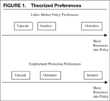
The insider–outsider partisanship approach rests on some assumptions about the preferences of insiders, outsiders, and upscale groups. These preferences are summarized in Figure 1.

Theorized Preferences
There are two dimensions represented in Figure 1: labor market policy and employment protection. I have placed the three groups on these dimensions according to the preferences specified in the model. On the first dimension, insiders (who enjoy a high degree of job protection) are considered to be less affected by unemployment and less interested in dedicating more resources to labor market policies. Outsiders are most vulnerable to unemployment and therefore more concerned about active and passive labor market policies. As for the upscale groups' preferences their position is justified by their desire to reduce the taxes that pay for these policies and a general inclination to limit the role of government in the economy.
There are reasons for insiders to favor higher levels of labor market policy. Insiders face some probability of losing their jobs (when companies become economically unviable, for example) and labor market policies can reduce the intensity of job searches by outsiders and therefore reduce competition for wages. But the reasons for insiders to oppose labor market policies are more powerful. An increase in the levels of active or passive labor market policies, after all, represents a higher tax burden for insiders. Additionally, some of these policies may, if successful, promote the entry into employment of individuals who can underbid insiders' wage demands.6
See Calmfors 1994 and Saint Paul 1998. For the relationship between the effects of active and passive labor market policies, see Calmfors 1993. For an analysis showing that the effects of ALMPs on labor market competition may be dependent on whether they target particular individuals, see Calmfors and Lang 1995. Regarding the latter point, the implication for my analysis is related to one of the starting assumptions: that ALMPs target outsiders.
It is clear that the emergence of employment protection described in the previous section amplifies insider–outsider differences. The higher the level of protection, the more important the insider–outsider conflict, as one group (insiders) increasingly pays the costs of ALMPs and PLMPs while the other (outsiders) increasingly benefits from them.
On the second dimension, insiders are expected to be strongly in favor of employment protection, while upscale groups and outsiders are expected to place themselves closer to the other side of the spectrum. It is clear that lowering employment protection legislation directly attacks the interests of insiders. The preferences of outsiders are justified by their belief that lower employment protection will facilitate their exit from unemployment and precarious employment. According to many, employment protection “is, in effect, a tax on work-force adjustments” (OECD 1999, 68), and as such it may inhibit firms from shedding labor in economic downturns but also from hiring in periods characterized by good performance. The upscale groups (especially employers and managers) clearly benefit from the flexibility of lower levels of employment protection.
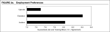
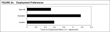
To test whether the preferences presented in Figure 1 are accurate I turn to the Eurobarometer survey. Figures 2a and 2b reflect the responses of insiders, outsiders, and upscale groups to two questions that address active labor market concerns. In the first question, respondents were asked whether they would tend to agree or disagree with the following statement: “The government should offer a guarantee of training, or a job, to all young people leaving school.” Responses that agreed were given a 10 and those that disagreed were given a 0. The x-axis in Figure 2a measures the mean response of the three groups. As theorized, outsiders are strong advocates of guaranteed training and jobs for young people, while both insiders and upscale groups believe this is a much lower priority. The expected preferences are also confirmed when the question moves away from the relatively abstract issue of job and training guarantees to a more concrete issue. Respondents were asked whether they would tend to agree or disagree with the following statement: “I would be ready to pay more tax if I were sure that it would be devoted to creating new jobs.” Again, agreements were given a 10 and disagreements a 0. The x-axis in Figure 2b measures the mean response of the three groups. Although this time the scores are lower, the relative positions of the groups are almost identical. As expected, outsiders are clearly in favor of employment promotion measures even if they imply increasing taxes, while insiders and upscale groups display much lower levels of support.

Employment Preferences

Employment Preferences
The numbers in Figures 2a and 2b are suggestive, but an initial assessment of their statistical significance can help confirm their meaningfulness. I estimate Pearson chi-square statistics to test whether a significant relationship exists between being an insider, outsider, or upscale individual and holding the specific opinions about employment promotion contained in the figure. The null hypothesis in this test is that there is no association. The results suggest (at better than a 99% level of confidence) that a relationship does exist between insider–outsider–upscale status and employment promotion preferences. This is the case for the numbers in both figures so the significance of the association does not depend on the question.8
For a more systematic test of the implications of the insider–outsider model for employment promotion preferences, see Rueda, forthcoming.
The numbers in Figures 2a and 2b are a good representation of ALMP preferences but they do not reflect concerns about the levels of passive labor market policies. This is because of the absence of any question in the survey addressing PLMPs. The questions asked are either too general (Is social welfare a necessity?) or related to areas excluded from PLMPs (Should health care or education be guaranteed?). We can turn, however, to the analysis of PLMP preferences in Boeri, Börsch-Supan, and Tabellini 2001, which shows that the preferences in my model are in fact reasonable. They find that the individuals I define as outsiders would be ready to accept higher costs (i.e., taxes) in return for more unemployment insurance. Insiders and upscale groups do not seem to share these preferences.
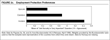
Turning now to the third dimension in my analysis, Figure 2c depicts the job security preferences of insiders, outsiders, and upscale groups. Respondents were asked the following question: “For you personally, how important do you think each of the following is in choosing a job?” Respondents were then given several characteristics that they could rate from very important to not important at all. Responses that considered a secure job very important were given a 10 and those that did not were given a 0. Again, the mean preferences of the three groups confirm the hypothesis in Figure 1. As expected, insiders are most concerned about job security, while outsiders and upscale groups are much less likely to consider job security very important. Whether an individual is an insider, an outsider, or a member of the upscale groups does prove to be a statistically significant determinant of his/her attitude toward job protection. A Pearson chi-square test shows that the association between these two variables is significant at better than the 99% level of confidence.

Employment Protection Preferences
THE EFFECTS OF PARTISANSHIP ON POLICY
The data presented in the previous section illustrate that my partisanship model's expectations about individual preferences are reasonable. In the next pages I explore whether parties do in fact develop policies in line with these preferences. I focus on two measures: labor market policies and employment protection legislation.
The Dependent Variables
Labor Market Policies
PLMPs provide unemployment compensation, whereas active ones are aimed at reducing unemployment by shaping the supply, demand, and mobility of labor. The OECD data used in my statistical analysis include unemployment benefits as the main component of PLMPs. The ALMP measure encompasses the following five areas: (1) public employment services and administration, (2) labor market training, (3) youth measures, (4) subsidized employment, and (5) measures for the disabled.
While PLMPs (as an important element of the welfare state) have received quite a lot of attention in the comparative political economy literature, the relationship between ALMPs and government partisanship has been underexamined. Economists have been concerned mostly about their effects on employment and have generally ignored the role of partisanship in promoting different levels of ALMP. In political science, some authors have explored the relationship between partisanship and ALMPs but some important questions have been left unanswered. The effects of divisions within labor, in particular, have not been analyzed in detail since the starting point for most political scientists is to consider ALMPs one more measure that social democratic parties will employ to benefit labor (see, e.g., Boix 1998 and Janoski 1994, 1990).
As explained in more detail in the previous section, outsiders are considered the main beneficiaries of labor market policies in the model proposed in this article. Before the widespread adoption of employment protection in the early 1970s, the interests of insiders and outsiders regarding labor market policy were closely aligned. Insider vulnerability to unemployment was higher and social democratic governments could promote labor market policies that favored outsiders. The emergence of employment protection causes the interests of insiders and outsiders to diverge. As ALMPs and PLMPs increasingly become policies that insiders pay the costs of while outsiders receive the benefits from, social democratic governments become less likely to promote them and partisanship becomes insignificant.
Employment Protection Legislation
Employment protection legislation affects “the rules governing unfair dismissal, lay-offs for economic reasons, severance payments, minimum notice periods, administrative authorization for dismissals and prior discussion with labor representatives” (OECD 1994, 69). The previous section made clear the reasons behind the preferences of insiders, outsiders, and upscale groups. Because insiders and upscale groups have opposing interests and they are the core constituencies of social democratic and conservative parties, the insider–outsider model implies the existence of marked partisan difference regarding job protection.
I use two different measures of employment protection legislation. The first one is the mean for the 1980s and the 1990s of the OECD's overall protection against dismissals index. The index is constructed by averaging the scores obtained by each country in three categories: “procedural inconveniences which the employer faces when trying to dismiss employees; notice and severance pay provisions; and prevailing standards of and penalties for unfair dismissal” (OECD 1999, 54). Conceptually, this index is ideal for testing my hypotheses. It suffers, however, from the important practical limitation of being available only as a summary value for the 1980s and the 1990s. I want to use yearly data that allow a significant increase in the number of observations and in the complexity of the estimated models. For this reason, I also use a measure of the number of months of severance pay a blue-collar worker with 10 years of service receives upon termination without cause.9
For an analysis of the close relationship between severance pay and overall employment protection, see OECD 1994.
The Explanatory Variable: Government Partisanship
The government partisanship measures used in my analysis attempt to capture the ideological position of governments in relation to a left–right continuum. Two variables are needed for the construction of these measures: one that reflects the presence of parties in government and another that measures their ideological characteristics. The operationalization of the first variable has been relatively straightforward in the comparative politics literature. But important questions surround the measurement of party ideological positions. Assessments of left–right party positions are based on two sources: expert opinions and party manifestos. These two measures imply a different set of complications. Expert opinions are produced from surveys that are administered rarely and that may be interpreted differently in different national contexts (Gabel and Huber 2000). Data extracted from party manifestos, on the other hand, can be criticized for being a reflection of what parties say to win elections, and not necessarily of what they will do once they have won them.
In this paper, I try to avoid some of these complications by using two measures of government partisanship. The main results reported below use partisan cabinet composition as measured by Tom Cusack (1997).10
Higher figures signify more conservative government. Cusack groups parties into five families, multiplies each family's share of cabinet portfolios by its weight, and sums the products. See Cusack 1997 for further details.
This variable relies on party programs for the codification of policy emphases and it was produced by the Comparative Manifestos Project. Source for all countries but Japan: McDonald and Mendes 2001. Data for Japan were created by the author. Sources: Comparative Manifestos Project left–right party index and Woldendorp, Keman, and Budge 2000. Given the variance of the ideology measure, the 1973–95 average is used in the analysis.
I would like to address a final point with reference to the government partisanship measures used in the analysis. As mentioned above, the variables calculate the ideological position of governments in relation to the partisan composition of cabinets. This means that parties other than the social democratic and conservative ones influence the weighted partisanship measure.12
Although I refer to social democratic and conservative parties in the Results, it would be more accurate to refer to the partisan options as left and right.
When considering Christian democratic parties (usually placed in the moderate right), the implication of my analysis is that these parties promote policies that can be placed in between social democracy and conservatism for the dimensions I focus on. This seems realistic. Liberal parties are placed either in the moderate right or between the Christian democrats and the conservatives. Considering the two policies emphasized in the previous pages, this seems uncontroversial. The free-market philosophy of liberals places them close to conservatives regarding employment policy and job protection.13
The differences between liberals and conservatives (in individual freedom issues such as abortion and divorce) pertain to policy dimensions not discussed in this paper.
Other Variables
Labor Market Institutions
Both because of their direct involvement in industrial relations (negotiations covering work regulations and wages being the most clear examples) and because of their capacity to influence political parties, the behavior of unions is a relevant factor in a government's decisions over policy. I emphasize two labor-related factors: the centralization/coordination of wage bargaining and union density.14
See Iversen 1999 for a complete specification of the centralization/coordination variable. To capture the inertia associated with institutional change, I use a moving average of the yearly values (present and previous four years). It should also be noted that values for the last two years in the time series were extrapolated. The union density measure used in the regressions represents employed union members as a percentage of the employed labor force. The pre-1990 figures were taken from Visser 1996; post-1990 figures were provided by Bernhard Ebbinghaus (Max-Planck Institute).
International and Financial Openness15 International openness is measured as imports plus exports as a percentage of the GDP. Source: OECD electronic database and OECD Historical Statistics 1960–95. Financial openness is measured as the sum of several indexes for financial restrictions. For details, see Armingeon, Beyeler, and Menegale 2002.
International openness is measured as imports plus exports as a percentage of the GDP. Source: OECD electronic database and OECD Historical Statistics 1960–95. Financial openness is measured as the sum of several indexes for financial restrictions. For details, see Armingeon, Beyeler, and Menegale 2002.
There are two contradictory accounts of the effects of internationalization on partisan politics. First, there is a large literature suggesting that growing levels of international openness and interdependence result in a blurring of partisan differences caused by the inability of social democratic parties to produce policies that do not conform to market forces (see, e.g., Iversen 1996 and Scharpf 1991). Then there are some authors who argue either that international forces do not affect some partisan differences (like Boix 1998 and Garrett and Lange 1991) or that they actually have strengthened the influence of partisanship on policies and economic outcomes (Garrett 1998). The results presented in the following pages do not address whether international dependence limits the autonomy of governments. Instead I look at the great variance of economic policy within the sample and try to assess the factors that are responsible for it. My hypothesis is that, once the influence of internationalization is controlled for, partisanship will account for this variance only in the case of employment protection policies.
Government Debt.16 Source: Franzese 1998. Given the possibility of endogeneity (higher levels of policy causing higher debt), I use a one-year lag for this variable.
Source: Franzese 1998. Given the possibility of endogeneity (higher levels of policy causing higher debt), I use a one-year lag for this variable.
I introduce government debt into the analysis as a measure of the availability of resources affecting a government's choices. One widely accepted interpretation of the policy changes of the early 1980s, for example, is that many governments had reached unsustainable levels of public debt (see Schwartz 1994). I use the level of consolidated central government debt as a percentage of GDP as the indicator and include it only in the regressions with ALMP and PLMP as the dependent variables (since any relationship between resource limitations and legislation affecting employment protection seems unlikely).
Unemployment17 The measure used is the standardized unemployment rate for all countries but Austria, Denmark, and Switzerland. For these three countries, I use regular unemployment rates. Sources: OECD Historical Statistics 1960–95 and 1960–97. Given the possibility of endogeneity, I use a one-year lag.
The measure used is the standardized unemployment rate for all countries but Austria, Denmark, and Switzerland. For these three countries, I use regular unemployment rates. Sources: OECD Historical Statistics 1960–95 and 1960–97. Given the possibility of endogeneity, I use a one-year lag.
Some authors have argued that policies simply result from increasing needs—whether demographic, economic, or other (see, e.g., Wilensky 1975). I engage these arguments by controlling for the effects of unemployment. It is important that my results are not affected by needs. I want to be able to conclude, for example, that social democratic governments do not promote high levels of ALMPs regardless of the size of unemployment. Unemployment also acts as a proxy for the number of outsiders in an economy. It is essential for this article's conclusions that the results control for the size of the outsider group, since the insider–outsider partisanship model maintains that social democratic governments will appeal to insiders even when outsiders are numerous.
GDP Growth18 GDP growth is measured as year-to-year percentage changes. Source: OECD electronic database and OECD Historical Statistics 1960–97.
GDP growth is measured as year-to-year percentage changes. Source: OECD electronic database and OECD Historical Statistics 1960–97.
Most analyses of economic policy include a measure of economic growth. This is particularly important here because of the need to control for the effects of growth on the behavior of governments.
METHODOLOGY
I use annual data from 16 countries from 1973 to 1995 and present ordinary least squares (OLS) results.19
The countries are Australia, Austria, Belgium, Canada, Denmark, Finland, France, Germany, Italy, Japan, the Netherlands, Norway, Sweden, Switzerland, the United Kingdom, and the United States.
The periods are 1973–79, 1980–84, 1985–89, and 1991–95. The excluded reference year is 1990.
Beck and Katz (1995, 1996) have proposed a method that produces consistent standard errors estimates in the presence of panel heteroscedastic errors. Since their recommendations have been widely followed in the recent comparative political economy literature, I estimate panel-corrected standard errors.
I therefore regress the dependent variables on a one-year lag of the dependent variable, independent variables, and period dummies. That is, I estimate the following equation:

where i refers to the cross-sectional units, t to the time units, k to the number of independent variables, τ to the time period intercepts, β to the slopes of the explanatory variables, yi,t−1 to the lagged dependent variable, and the x's are the independent variables.
The only regression not run according to these specifications is the one that uses two time averages of the protection index per country instead of yearly data. Given the small n, in this case I did not estimate panel-corrected standard errors and simply ran a bivariate OLS regression on the variable of interest.
RESULTS
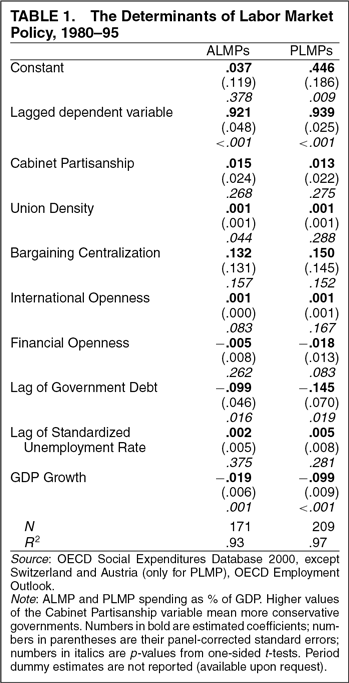
Table 1 provides the estimates for the determinants of labor market policies. Here, it is most important to point out that, as hypothesized, cabinet partisanship is not significant as an influence on the levels of ALMP or PLMP. The table clearly shows that whether a government is social democratic or conservative makes no difference to the levels of ALMPs promoted. It is also important to emphasize that these results contradict the conventional wisdom, and much of the existing literature, regarding the influence of partisanship on active policies (see, e.g., Boix 1998, Janoski 1990, 1994, and Swank and Martin 2001). This article represents a considerable improvement on most of those done in the past because of the number of cases and factors included in the analysis.21
Most existing analyses rely on a very limited number of observations—Boix's (1998) regressions, for example, range from 18 to 21 observations (75–79), and Janoski's (1994) from 36 to 38 (70–78). This severely limits the possibility of systematically testing alternative hypotheses while simultaneously controlling for other relevant factors (these regressions typically have no more than three variables), which in turn introduces great caveats into the significance of the results. Others do not systematically assess the validity of their claims across countries and through time, which limits the generalizability of their conclusions (see, for example, the country-specific analysis in Janoski 1990 and 1994).

Table 1 also reveals that government partisanship is an insignificant determinant of passive labor market policies. As hypothesized, social democratic government is not associated with greater levels of PLMP. These results reinforce the conclusions of the regression analyzing ALMPs: when insiders do not share the goals of outsiders, social democratic governments do not promote pro-outsider policies. Other authors have observed results similar to those presented in Table 1. In a very direct fashion, they are confirmed by the analysis in Moene and Wallerstein (2003).22
And also by the analysis of the United Kingdom in King 1995.
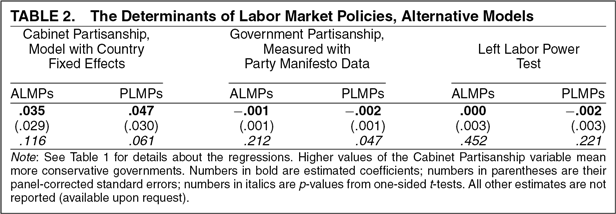
In Table 2, I estimate some alternative models to confirm the results presented in Table 1 (only the variable of interest is reported). The first column represents the same regressions used for the main results with the inclusion of country fixed effects. Following Hsiao (1986), I include country dummies to control for those influences that are country specific and that could affect the accurate estimation of the variables of interest (country-specific omitted variables).23
Dummies for all countries are present in the regressions with fixed effects. I ran these regressions without a constant.
Nickell (1981) demonstrates that, with short panel data, OLS estimation of models with lagged dependent variables and fixed effects produces biased coefficients. I therefore check these fixed-effects results by using a two-stage instrumental variable procedure similar to the one explained in Rueda and Pontusson 2000. The findings regarding ALMPs are confirmed but government partisanship loses significance as a determinant of PLMPs in the instrumental variable model (confirming the main results in Table 1).

A number of authors have argued that governments dominated by Christian democratic parties promote generous welfare state policies (see, e.g., Hicks and Swank 1992 and Huber and Stephens 2001). Since this could be the explanation for the results using cabinet partisanship, I run a regression following the same specifications but with Christian democratic share of cabinet seats instead of government partisanship.25
Results not reported but available from the author. Source for Christian democratic share of cabinet seats: Duane Swank, Political Science Department, Marquette University.
The second column in Table 2 substitutes the expert opinion–based measure of partisanship for one that uses party manifesto data. While the results in Table 1 are confirmed regarding ALMPs, the use of this alternative measure results in a significant partisanship effect on PLMPs. Although the sign of the coefficient indicates that more social democratic governments promote higher levels of passive labor market policies, the size of the coefficient (−.002) suggests that the substantial effect of this variable is extremely small.
Some authors have argued that strong labor movements allow leftist governments to promote low unemployment policies (see Alvarez, Garrett, and Lange 1991 and Garrett 1998). The lack of partisanship effects in Table 2 could result from misspecifying the relationship between labor market institutions and government partisanship. I therefore test the Left labor hypothesis in the third column in Table 2. I substitute cabinet partisanship for Garrett's (1998) variable capturing the interaction between social democratic government and the power of labor. Since Garrett's Left labor power index is not available after 1990 (or for Switzerland and Australia), I recreate the index by adding together social democratic government, the level of centralization/coordination of wage bargaining, and union density. This is a good proxy for Garrett's index since it is highly correlated to it (the correlation coefficient is .91). Following Garrett, interactions with international and financial openness are introduced, while union density and bargaining centralization are eliminated from the model. When analyzing both ALMPs and PLMPs, the Left labor power variable is insignificant (as expected). The openness interactions are also insignificant. It seems, therefore, that even when the influence of social democratic governments, wage bargaining, and union strength is put together, the main observations made about Table 1 stand.
The analysis presented in Tables 1 and 2 follows the standard procedures of recent comparative political economy work relying on pooled time series data. The models, however, ignore the question of whether the impact of social democratic government is subject to a lag. The results presented in the previous pages are therefore vulnerable to the criticism that they do not show a significant government partisanship effect simply because they do not capture social democratic influences only discernible after some time. To address this issue, I run the regressions in Table 1, substituting yearly cabinet partisanship for a 2-, 5-, and a 10-year average. The main results hold and government partisanship was found to be an insignificant determinant of ALMPs and PLMPs no matter the lag.
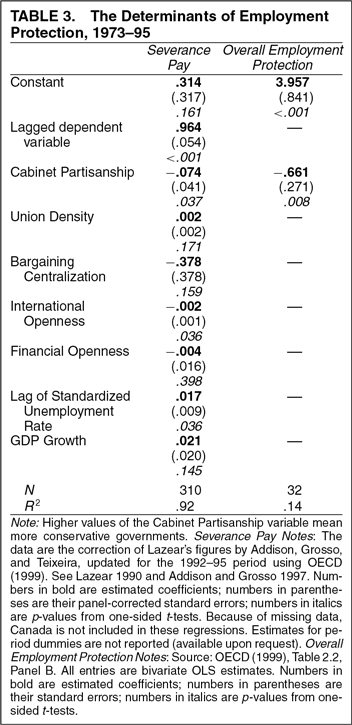
If the first two tables make clear the lack of a pro-outsider orientation in governments of the Left when examining the determinants of employment protection legislation, their pro-insider behavior seems equally obvious from the analysis in Table 3. Leaving aside the lagged dependent variable, only two factors are significant at better than the 95% level of significance: partisanship, international openness, and the previous year's unemployment rate. As expected, social democratic governments are significantly associated with higher severance pay. In other words, social democracy has promoted higher employment protection legislation (or protected insiders) during the period of time under analysis. This is all the more meaningful when we remember that in many OECD countries unemployment increased dramatically during this period.

The substantive significance of these findings is perhaps best illustrated by simulating the effects of a change in government partisanship while keeping the other variables constant. A change in the partisanship measure from a rightist government to a leftist one (from a 4 to a 2 in Cusack's index) would be associated with an immediate increase in employment protection equal to .148 of a month of severance pay. The long-term effect of this change in government partisanship would equal 4.111 months of severance pay.26
On the assumption that the effects of a one-unit change in a particular variable persist, the long-term effects of such a change can be computed by dividing the value of the coefficient for the variable of interest by one minus the coefficient for the lagged dependent variable.
I have complemented this analysis with a bivariate regression that takes the OECD's overall employment protection index as its dependent variable. Since only figures corresponding to the “late 1980s” and “late 1990s” exist, I regress overall employment protection on cabinet partisanship averages of the 1973–87 and 1988–95 periods. The goal, given the limitations in terms of both the number of observations and the nature of the regressor, is simply to confirm the previous severance pay findings. And the results do just that. As in the first severance pay regression, social democratic governments are strongly associated (surpassing the 99% significance level) with more protection for insiders.
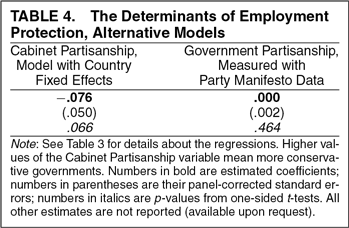
Table 4 tests the robustness of the employment protection conclusions by exploring some alternatives. The first column indicates that a model with country fixed effects produces similar results to those in Table 3. Government partisanship is a significant influence over employment protection legislation when we control for country-specific omitted variables.27
Government partisanship, however, becomes insignificant in the instrumental variable model.

Tests for robustness in the regression using the OECD's overall employment protection index are complicated, due to the small number of observations in the sample. In Table 3, it is assumed that the observations for each country in the 1990s are independent of those in the 1980s. To explore this issue, I test whether the results hold in a cross-sectional design (with only 16 observations). I regress employment protection in the 1990s on each country's cumulative measure of government partisanship from 1964 to 1995. Although the significance level of government partisanship diminishes, the results in Table 2 are confirmed in this analysis. Social democratic government is still found to be associated with more insider protection (in spite of the small number of observations, the variable is significant at better than the 90% level).28
Results available from the author.
As was the case with the labor market policy models, the analyses presented in Tables 3 and 4 do not address whether the influence of government partisanship is subject to a lag. To explore this issue, I follow the strategy described before. In this case, however, the objective is different. In the labor policy analysis, the exploration of different lags was meant to check whether the statistical insignificance found was the result of not giving government partisanship enough time to affect policy. In the employment protection case we know that government partisanship has a significant immediate effect but we want to see whether there is also a long-term one. I run the regressions in Table 3 substituting yearly cabinet partisanship for 2-, 5-, and 10-year averages. Government partisanship was found to be a significant determinant of employment protection with the 2-, and 5-year lags, but an insignificant one when the lag was longer. These results suggest that the effects of government partisanship on employment protection are strongest in the short term.
CONCLUSION
Going back to the initial questions that motivated this article's analysis, the previous pages have demonstrated that insider–outsider politics are fundamental to a fuller explanation of government partisanship, policy-making, and social democracy since the 1970s. It is also clear that recent social democratic governments have not promoted some of the policies we would expect. The strategies prevalent in the golden age of social democracy have been abandoned and the provision of equality and security to the most vulnerable sectors of the labor market has been sacrificed to satisfy other objectives. My evidence suggests that, in the presence of insider–outsider conflict, there is a strong temptation for social democratic governments to implement inegalitarian policies.
Herbert Kitschelt (1999) has accurately pointed out that the study of party strategies requires a “bridge across the familiar divide between students of comparative political economy and parties and elections” (318). The model I have presented attempts to do this by combining research on political economy, institutions, and political behavior. Political economists often assume that the preferences of parties are exogenous and stable and that they are mediated by institutional configurations that produce differentiated political and economic outcomes. The analysis in this article, however, focuses on the transformation in party strategies that results from new voter demands. I show that economic factors affect the preferences of particular electorates and, as a consequence, the strategies of partisan governments.
My analysis also provides a useful framework with which to analyze more recent partisanship debates. There is an ongoing discussion, in both academic and more general circles, about whether a “third way” has emerged as a comprehensive philosophy uniting social democratic parties around a coherent set of policy alternatives. According to some analysts, a third way does indeed exist and it is distinguished by an emphasis on employment promotion as a goal and by the use of active labor market policies (see, e.g., Giddens 1998). The arguments presented in this article emphasize the importance of taking into consideration insider–outsider distinctions to understand these policy developments. Taking this article's framework as our guide, we would speculate that a number of factors could make pro-outsider policies more attractive to social democratic governments. Among them an increase in the number of outsiders past a possible critical point, a weakening of unions, or even a decrease in the level of “insiderness” come to mind. In fact an argument could be made that in the United Kingdom, it was the influence of these last two factors that facilitated the emergence of Blair's third way. The moderation of unions in the late 1990s and the influence of Thatcherism are surely factors influencing the policies of New Labour. Thatcher, Giddens (1998) argues, “attacked established institutions and elites…. The Labour Party and its intellectual sympathizers first of all responded largely by reaffirming old left views. The electoral setbacks the party suffered by so doing, however, necessarily stimulated a new orientation” (ix).
This article's arguments shed some light on two additional partisan issues. First, a number of scholars have explored the reasons behind the decline in partisanship observed at the individual level in recent years (Dalton 2002). My analysis suggests that insider–outsider differences help explain why some people do not feel represented by mainstream political options. It is reasonable to assume that outsiders would be increasingly less likely to identify with parties that do not defend their interests. At the aggregate level, analysts have also perceived a progressive decline in the political prominence of social democracy (see, e.g., Pontusson 1995). My results suggest that this view may be inaccurate and that partisanship is still a powerful determinant of policy. We cannot observe these effects, however, if we do not look at the right policies. I argue that only by understanding insider–outsider differences will we perceive the true influence of partisanship on policy-making.
The second partisan issue relates to the costs of social democratic strategies. The model presented in this article opens the door to a debate about the implications of emphasizing the interests of insiders. Given some recent electoral setbacks in industrialized democracies, it is uncertain insider strategies are beneficial to social democratic parties. Perhaps more importantly, there is also the question of what outsiders can do when ignored by social democratic governments. Starting in the 1970s, most Western democracies have experienced the emergence of powerful antisystem parties (especially extreme right ones). This article's arguments suggest that the losers in the labor market arena (outsiders who are not the focus of traditional left or right parties) may have reasons to turn away from mainstream options.
Before closing, I would like to briefly explore three topics that may not have received enough attention in my analysis: the degree of security enjoyed by insiders, the perceived effectiveness of labor market policies, and the existence of other policy options. The importance of the first issue cannot be understated. This article's partisanship model, after all, is based on a fundamental difference in the way insiders and outsiders are vulnerable to unemployment. To the extent that insiders are protected from unemployment, their interests will be significantly different from those of outsiders. Factors that increase insiders' vulnerability to unemployment, however, will align their interests with those of outsiders. In Rueda (forthcoming) I explore this question in some detail. Using a case study and an analysis of surveys and macrodata, I show that the unemployment vulnerability of insiders is indeed a significant factor affecting the likelihood that social democratic governments will promote labor market policies. A hierarchical analysis of individual preferences shows that insiders are significantly more likely than outsiders or members of the upscale groups to have high preferences for employment protection (as shown here in a less systematic manner). Insiders, however, experience a drastic increase in their labor market policy preferences as soon as they feel vulnerable to unemployment. As implied by the insider–outsider model, the analysis of aggregate data also shows that social democratic governments are more likely to promote higher levels of labor market policies only when insiders become more vulnerable to unemployment.
As for the second topic, the economics literature provides us with some evidence that higher levels of ALMP promote lower levels of unemployment (OECD 1994; Jackman, Pissarides, and Savouri 1990). The existence of scholarly analyses demonstrating the beneficial effects of ALMPs, however, is not as relevant as the general acceptance by policy-makers of ALMP as a tool against unemployment. This acceptance has been widespread in recent years. Transferring public resources into active labor market policies has been an objective repeatedly endorsed by third way social democrats and OECD labor ministers. As Martin (1998) points out, it has also become part of the EU's official strategy to decrease unemployment since the Essen Summit in December 1994 (12). The degree to which the perceived effectiveness of ALMPs has influenced social democratic strategies should be the focus of further research. It is in any case clear that social democratic governments do promote labor market policies when insiders are threatened by unemployment (see Rueda, forthcoming).
Regarding the existence of other policy options, a commitment to full employment (a traditional Keynesian macroeconomic strategy for social democrats) surely poses less of a conflict between insider and outsider preferences. There is, however, an important literature showing the difficulties social democratic governments face when trying to develop Keynesian policies after the early 1970s. Up to that point, social democratic efforts to reduce the inequality and insecurity of the most vulnerable sectors of the labor market while more generally promoting growth and employment had been very successful. The challenges posed by rational expectations (Alesina 1989) and increasing levels of internationalization (Alt 1985) are often identified as the reasons for the end of the golden age of social democracy. Even accepting the relevance of these challenges, some options are still open to social democratic governments. Labor market policies (especially active ones) can be used by partisan governments to promote employment, growth, and equality in an environment that impedes demand management. I want to conclude this article by pointing out that it is precisely because of the importance of these policies that an accurate understanding of insider–outsider differences becomes crucial. My analysis emphasizes some of the considerable difficulties confronting social democratic policy-makers who are interested in equality. The acknowledgment of these difficulties may be the first step in finding truly solidaristic solutions.
Earlier versions of this article were presented at the 2000 International Conference of Europeanists, at the 2002 Annual Meeting of the MPSA, and at workshops in Yale University and Cornell University. I would like to thank Nancy Bermeo, Joseph Foudy, Geoffrey Garrett, Burcu Gezgor, Torben Iversen, Peter Katzenstein, Lane Kenworthy, Anirudh Krishna, Peter Lange, Michael McDonald, Herman Schwartz, Sidney Tarrow, Christopher Way, Michael Wallerstein, Bruce Western, and Heidi Young, as well as three anonymous reviewers, and Lee Sigelman for their comments and suggestions. I am especially grateful to Christopher Anderson, Walter Mebane, and Jonas Pontusson for their constructive criticism and encouragement. For their financial support of this project, I thank the Social Science Research Council, the Fondazione Luigi Einaudi, Cornell University, and SUNY Binghamton.
References
Addison John T., and
Jean-Luc Grosso.
1996.
“Job Security Provisions and Employment: Revised Estimates.”
Industrial Relations
35
(October):
585–
603.Google Scholar
Alesina Alberto.
1989.
“Politics and Business Cycles in Industrialized Democracies.”
Economic Policy
8
(April):
55–
98.Google Scholar
Alt James.
1985.
“Political Parties, World Demand, and Unemployment.”
American Political Science Review
79
(December):
1016–
40.Google Scholar
Alvarez Michael,
Geoffrey Garrett, and
Peter Lange.
1991.
“Government Partisanship, Labor Organization and Macro-Economic Performance.”
American Political Science Review
85
(June):
539–
56.Google Scholar
Armingeon Klaus,
Michelle Beyeler, and
Sarah Menegale.
2002.
Comparative Political Data Set 1960–2001.
Institute of Political Science, University of Berne.
Beck Nathaniel, and
Jonathan Katz.
1995.
“What to Do (and Not to Do) with Time-Series Cross-Section Data.”
American Political Science Review
89
(September):
634–
47.Google Scholar
Beck Nathaniel, and
Jonathan Katz.
1996.
“Nuisance vs. Substance.”
Political Analysis
6:
1–
36.Google Scholar
Bentolila Samuel, and
Giuseppe Bertola.
1990.
“Firing Costs and Labour Demand: How Bad Is Eurosclerosis?”
Review of Economic Studies
57
(July):
381–
402.Google Scholar
Berger Suzanne and
Michael Piore.
1980.
Dualism and Discontinuity in Industrial Societies.
New York:
Cambridge University Press.
Blanchard O. J., et al.
1986.
“Employment and Growth in Europe.”
In Restoring Europe's Prosperity,
ed. O. J. Blanchard.
Cambridge, MA:
MIT Press.
Blanchard O. and
L. Summers.
1986.
“Hysteresis and the European Unemployment Problem.”
In S. Fisher (ed.),
NBER Macroeconomic Annual.
Cambridge:
MIT Press.
Boeri Tito,
Axel Börsch-Supan, and
Guido Tabellini.
2001.
“Would You Like to Shrink the Welfare State? A Survey of European Citizens.”
Economic Policy
32
(April):
7–
50.Google Scholar
Boix Carles.
1998.
Political Parties, Growth and Equality.
New York:
Cambridge University Press.
Calmfors Lars.
1994.
“Active Labour Market Policy and Unemployment: A Framework for the Analysis of Crucial Design Features.”
OECD Working Papers.
Paris:
OECD.
Calmfors Lars.
1993.
“Lessons from the Macroeconomic Experience of Sweden,”
European Journal of Political Economy,
9
(March):
25–
72.Google Scholar
Calmfors Lars and
Harald Lang.
1995.
“Macroeconomic Effects of Active Labour Market Programmes in a Union Wage-Setting Model,”
The Economic Journal
105
(May):
601–
18.Google Scholar
Cusack Thomas.
1997.
“Partisan Politics and Public Finance.”
Public Choice
91
(March):
375–
395.Google Scholar
Dalton Russell.
2002.
Citizen Politics.
New York:
Chatham House.
Doeringer Peter B., and
Michael Piore.
1971.
Internal Labor Markets and Manpower Analysis.
Lexington, MA:
Heath.
Dore Ronald.
1994.
“Incomes Policy: Why Now?”
In The Return to Incomes Policy,
ed. Ronald Dore,
Robert Boyer, and
Zoë Mars.
London:
Pinter.
Europa Yearbook. Various years.
London:
Europa.
Franzese Robert.
1998.
“The Political Economy of Public Debt.”
Paper presented at the Wallis Conference on Political Economy.
Northwestern University,
November 1998.
Gabel Matthew, and
John Huber.
2000.
“Putting Parties in Their Place.”
American Journal of Political Science
44
(January):
94–
103.Google Scholar
Garrett Geoffrey.
1998.
Partisan Politics in the Global Economy.
New York:
Cambridge University Press.
Garrett Geoffrey, and
Peter Lange.
1991.
“Political Responses to Interdependence: What's ‘Left’ for the Left?”
International Organization
45
(Autumn):
539–
64.Google Scholar
Giddens Anthony.
1998.
The Third Way.
London:
Polity Press.
Hibbs Douglas.
1977.
“Political Parties and Macroeconomic Theory.”
American Political Science Review
71
(December):
1467–
87.Google Scholar
Hicks Alexander, and
Duane Swank.
1992.
“Politics, Institutions and Welfare Spending in Industrialized Democracies, 1960–82.”
American Political Science Review
86
(September):
658–
74.Google Scholar
Hsiao Cheng.
1986.
Analysis of Panel Data.
New York:
Cambridge University Press.
Huber Evelyne, and
John Stephens.
2001.
Development and Crisis of the Welfare State.
Chicago:
University of Chicago Press.
Iversen Torben.
1999.
Contested Economic Institutions.
New York:
Cambridge University Press.
Iversen Torben.
1996.
“Power, Flexibility and the Breakdown of Centralized Wage Bargaining.”
Comparative Politics
28
(July):
399–
436.Google Scholar
Iversen Torben, and
David Soskice.
2001.
“An Asset Theory of Social Preferences.”
American Political Science Review
95
(December):
875–
93.Google Scholar
Jackman Richard,
Christopher Pissarides, and
Savvas Savouri.
1990.
“Unemployment Policies.”
Economic Policy
5
(October):
449–
90.Google Scholar
Janoski Thomas.
1990.
The Political Economy of Unemployment.
Berkeley:
University of California Press.
Janoski Thomas.
1994.
“Direct State Intervention in the Labor Market.”
In The Comparative Political Economy of the Welfare State,
ed. Thomas Janoski and
Alexander Hicks.
New York:
Cambridge University Press.
King Desmond.
1995.
Actively Seeking Work?
Chicago:
The University of Chicago Press.
Kitschelt Herbert.
1994.
The Transformation of European Social Democracy.
New York:
Cambridge University Press.
Kitschelt Herbert.
1999.
“European Social Democracy Between Political Economy and Electoral Competition.”
In Continuity and Change in Contemporary Capitalism,
ed. Herbert Kitschelt,
Peter Lange,
Gary Marks, and
John Stephens.
New York.
Cambridge University Press.
Lazear Edward.
1990.
“Job Security Provisions and Employment.”
Quarterly Journal of Economics
105
(August):
699–
726.Google Scholar
Lindbeck Assar, and
Dennis Snower.
1988.
The Insider-Outsider Theory of Employment and Unemployment.
Cambridge, Mass.:
MIT Press.
Martin John.
1998.
“What Works among Active Labour Market Policies.”
OECD Labour Market and Social Policy Occasional Papers, No. 35.
Paris:
OECD.
McDonald Michael and
Silvia Mendes.
2001.
Parties in Parliaments and Governments, 1950–1995.
Political Science Department, Binghamton University—SUNY.
Moene Karl Ove, and
Michael Wallerstein.
2003.
“Earnings Inequality and Welfare Spending.”
World Politics
55
(July):
485–
516.Google Scholar
Nickell Stephen.
1981.
“Biases in Dynamic Models with Fixed Effects,”
Econometrica
49
(November):
1417–
26.Google Scholar
OECD.
1994.
The OECD Jobs Study.
Paris:
OECD.
OECD.
1999.
Employment Outlook.
Paris:
OECD.
Pontusson Jonas.
1995.
“Explaining the Decline of European Social Democracy.”
World Politics
47
(July):
495–
533.Google Scholar
Powell Bingham.
1982.
Contemporary Democracies.
Cambridge, MA:
Harvard University Press.
Powell Bingham.
2000.
Elections as Instruments of Democracy.
New Haven, CT:
Yale University Press.
Rueda David.
2001.
“Government Partisanship and Economic Policy: Insider–Outsider Politics in Industrialized Democracies.”
Ph.D. Diss.
Cornell University.
Rueda David. N.d.
“Social Democracy and Active Labor Market Policies: Insiders, Outsiders, and the Politics of Employment Promotion.”
British Journal of Political Science.
Forthcoming.
Rueda David, and
Jonas Pontusson.
2000.
“Wage Inequality and Varieties of Capitalism.”
World Politics
52
(April):
350–
83.Google Scholar
Saint-Paul Gilles.
1998.
“A Framework for Analysing the Political Support for Active Labor Market Policy.”
Journal of Public Economics
67
(February):
151–
65.Google Scholar
Saint-Paul Gilles.
1996.
“Exploring the Political Economy of Labour Market Institutions.”
Economic Policy,
23
(October):
264–
315.Google Scholar
Scharpf Fritz.
1991.
Crisis and Choice in European Social Democracy.
Ithaca, NY:
Cornell University Press.
Schwartz Herman.
1994.
“Small States in Big Trouble.”
World Politics
46
(July):
527–
55.Google Scholar
Swank Duane, and
Cathie Jo Martin.
2001.
“Employers and the Welfare State.”
Comparative Political Studies
34
(October):
889–
923.Google Scholar
Visser Jelle.
1996.
“Unionization Trends Revisited.”
Centre for Research of European Societies and Industrial Relations,
Amsterdam.
Wilensky Harold.
1975.
The Welfare State and Equality.
Berkeley:
University of California Press.
Woldendorp Jaap,
Hans Keman, and
In Budge.
2000.
Party Government in 48 Democracies (1945–1998).
Boston:
Kluwer Academic Publishers.
Theorized Preferences
Employment Preferences
Employment Preferences
Employment Protection Preferences
The Determinants of Labor Market Policy, 1980–95
The Determinants of Labor Market Policies, Alternative Models
The Determinants of Employment Protection, 1973–95
The Determinants of Employment Protection, Alternative Models
 You have
Access
- 474
- Cited by
Comments
No Comments have been published for this article.