Emergency medical services (EMS) provides a critical role in the prehospital setting in the rapid treatment, stabilization, and transfer of patients to advanced medical facilities. This necessitates timely initiation of treatment. Reference Nolan, Hazinski and Aickin1 Although EMS teams endeavor to shorten arrival times, several factors affect this goal: limited resources, traffic congestion, geographic distances, and current ongoing emergencies. Reference Rehn, Davies and Smith2
While awaiting the ambulance, timely bystander cardiopulmonary resuscitation (CPR), as well as crew witnessed resuscitation have proven effective in improving survival to hospital discharge. Reference Hollenberg, Herlitz and Lindqvist3,Reference Iwami, Kitamura and Kawamura4 To enhance the rate of bystander CPR, several interventions have been introduced: media education campaigns, volunteer notification systems, chest compression-only CPR, and behavior change activities. Reference Hasselqvist-Ax, Riva and Herlitz5–Reference Elsner, Schneiders, Haberstroh, Jeschke, Isenhardt, Hees and Henning9 In accordance with the American Heart Association’s recommendations, several states began a campaign to increase bystander CPR. Reference Sasson, Meischke and Abella10–Reference Yasunaga, Horiguchi and Tanabe12 This included teaching CPR to laypersons, implementing telephone-assisted CPR, and dispatching first-responder firefighters and police. Reference Hasselqvist-Ax, Riva and Herlitz5
Advanced telecommunication has a vital role in rapid response in the prehospital setting and in incorporating bystanders for immediate aid until EMS arrival. It has been demonstrated that the rate of bystander-initiated CPR can significantly be increased with the use of a mobile-phone positioning system that enables the ability to rapidly locate and dispatch laypersons that are trained in basic life support (BLS). Reference Ringh, Rosenqvist and Hollenberg13 A simple phone application known as the PulsePoint Respond mobile device has been implemented in more than 600 communities in the United States. This is able to locate registered personnel who are within 400 meters of a suspected cardiac arrest. It is also able to locate nearby automatic external defibrillators. Reference Brooks, Simmons and Worthington14,Reference Dainty, Vaid and Brooks15
Many countries, in addition to training laypersons in CPR, are incorporating volunteers in their EMS system who are activated by smartphone applications. England recently started a program using an app titled “GoodSAM,” which notifies the 3 closest responders within 300 meters of a cardiac arrest in the middle of London. Reference Smith, Wilson and Ghorbangholi16 Israel has developed a robust multitiered cadre of prehospital volunteers alongside multiple highly advanced and varied unique telecommunication strategies designed for the volunteers, as well as for the call centers. Unlike other countries, the volunteers’ infrastructure is on a national level and not merely regional. The objective of this article is to describe these methods, which were introduced to improve rapid response to life-threatening emergencies by on-call volunteer first responders (OCVFR). Besides cardiac arrest, this includes medical emergencies, trauma cases, and mass-casualty incidents (MCIs).
THE ISRAELI EMS SYSTEM
Magen David Adom (MDA) (translated as “Red Shield of David”) is the national EMS provider for Israel. It has been officially recognized by the International Committee of the Red Cross. The Israeli communication network has designated 1-0-1 as the universal medical emergency access number. Each call is dispatched to 1 of 8 regional centers. Reference Ellis and Sorene17 The case is then directed to 1 of 10 geographic areas where the emergency has occurred. Depending on the severity, 1 of 2 EMS levels will be notified: either BLS consisting of emergency medical technicians (EMTs) or advanced life support consisting of paramedics.
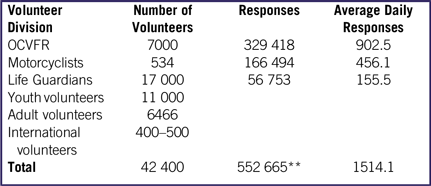
Numbers of Volunteers and Responses From January 1, 2018 through December 31, 2018*

* There may be multiple responses per call.
** The total number of calls (from routine to emergent) to the medical emergency access number (101) during this time was 988 885.
OCVFR = on-call volunteer first responders.
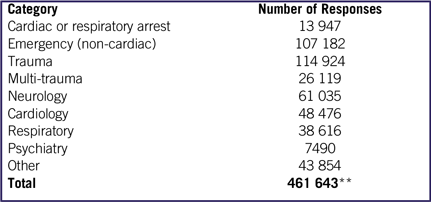
Volunteer Responses for a Total of 519 656 Urgent/Emergent Calls to MDA (of Which 320 956 Were at the Level Requiring a Paramedic-Staffed Ambulance) From January 1, 2018, Through December 31, 2018*

MDA VOLUNTEER INFRASTRUCTURE
Since its founding in June 1930, MDA has made volunteering its trademark and is currently the largest non-governmental volunteer organization in Israel. There are currently more than 40 000 volunteers affiliated with MDA (population of Israel in 2018; 8.4 million). The volunteer infrastructure is on a national level, is multitiered in design, and separated into several divisions Table 1. Reference Dadon, Alpert and Jaffe18
Divisions include a combination of volunteers who primarily serve as staff on ambulances and a variety of OCVFR. Reference Alpert, Lipsky and Elie19,Reference Jaffe, Alpert and Lipsky20 The ambulance-based volunteers include traditional adult volunteers at the level of EMTs, but also local high school students and college-age international volunteers. The OCVFR include those who respond from work or home with equipment stored in their car, as well as a special group of motorcycle-based volunteers. There is a new group of Life Guardian first responders who are usually health care workers who are specifically activated for cardiac arrests but can also be mobilized for an MCI. Reference Jaffe, Dadon and Alpert21 The volunteers are only called to the more emergent cases, which include cardiac arrests, respiratory difficulty, strokes, and trauma Table 2.
The volunteers’ contributions to the Israel EMS system is substantial with an average response time of 4.5 minutes for a motorcycle and slightly longer for an OCVFR, versus 8.7 minutes for that of an ambulance. This contribution may be attributed to the broad and cutting-edge telecommunication strategies currently being used for the volunteers’ activation and centralized command and control of the event.
TELECOMMUNICATION STRATEGIES
MDA uses several telecommunication strategies in order to activate the volunteers. Each device has its own unique advantage, and all act in concert for an efficient and rapid response. MDA employs a division of more than 50 individuals, including software programmers, a cybersecurity specialist, information technology experts, and support staff for overall technology development and maintenance.
One-Way Pager
The 1-way pager is a wireless telecommunications device (Beeper®, HOT Mobile) that receives and displays alphanumeric messages. It is a mass public alert and warning system, which is one of the fastest and the only mass alert offering on the market today that can send a single message to thousands of devices simultaneously in under 20 seconds. Each volunteer is equipped with a pager, manufactured by Motorola.
The 1-way pager’s main advantage is its wireless communication infrastructure based on satellite transmission systems enabling independence from terrestrial-based cellular networks. Other advantages of the pager are that it is lightweight, has a long-lasting battery, and is highly durable. During an MCI or a mass gathering, such as a sports event or concert, mobile phone networks may fail. MDA found this older technology reliable and cost-effective. 22 In restricted emergency events, only relevant local volunteer subgroups can be activated. Initially, 5000 beepers were given to all of the volunteers, although distribution stopped 2 years ago. There is a small number of volunteers who are at distant, isolated locations who have a beeper only. The beeper’s lack of Global Positioning System (GPS) and its 1-way feature are this device’s main disadvantages.
Push-to-Talk Over Cellular
Push-to-talk over cellular (PoC) is a wireless mobile phone infrastructure handheld transceiver with unlimited range and GPS technology usage. MDA acquired PoC devices based on the Integrated Digital Enhanced Network (iDEN). PoC’s main advantage is the ability for a single person to instantly reach a predefined talk group by pressing a single button to create a burst-in voice message. Another main use of the device is enroute to the emergency scene, as safety requires refraining from multimedia or text-based communication. The device’s decreasing popularity enables the use of this technology even in MCIs when other airwaves may be in heavy use. Contrary to the pager, PoC has a 2-way feature, and its GPS enables the ability of the call center to locate the device.
Starting in 2005, 4000 PoC devices were distributed to volunteers. It is the preferred technology among ultra-orthodox Jewish volunteers, who for religious reasons don’t own a smartphone. PoC’s future is questionable, and the technology will probably not exist in the coming years. They are currently not being repaired if they break or fail to work. MDA has developed an alternative PoC functionality as part of its smartphone application.
Smartphone-Based Software Application (App)
In October 2014, MDA published an “MDA Team Application” for both volunteers and employees. The GPS guided app (40.3 MB, version 1.8.4) can be downloaded for free from either the Google Play (Google; Mountain View, CA) or the Apple App Store (Apple; Cupertino, CA). Participation in the app and its activation is encouraged for all volunteers (as well as salaried employees) with a smartphone, although requires an official approval. Participation will be revoked and the volunteers won’t receive calls if they don’t maintain their certification in required courses, such as BLS.
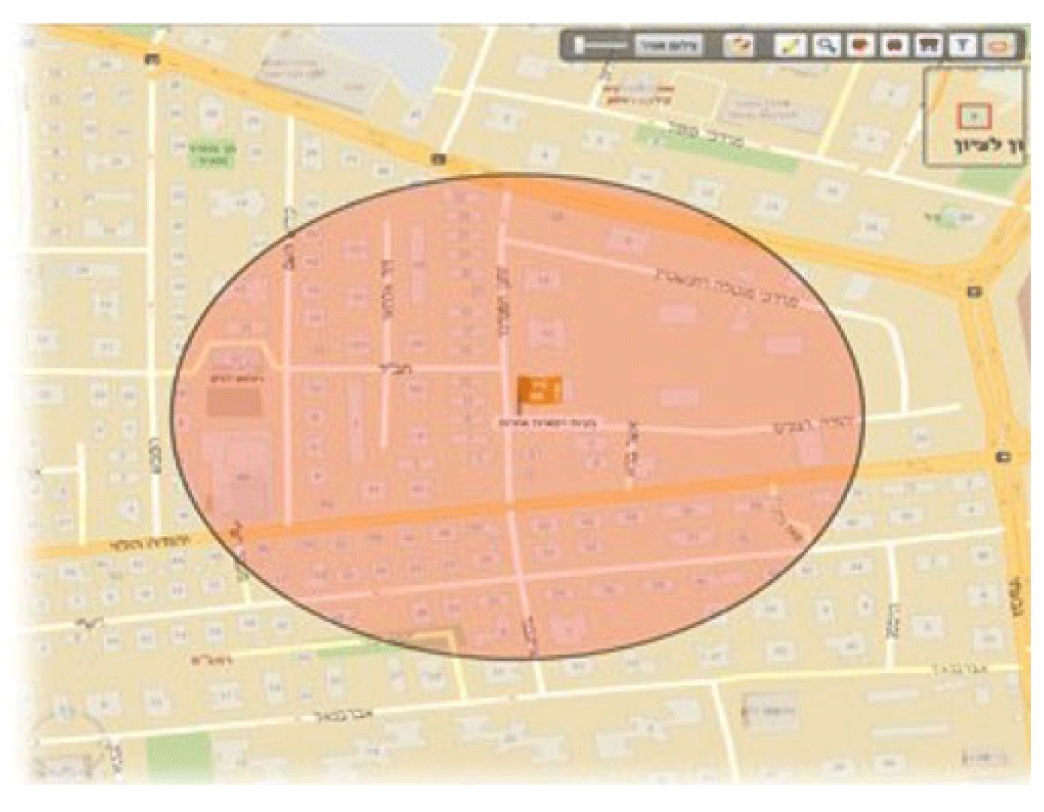
The app automatically identifies all volunteers who are in proximity and able to arrive at the scene within 5 minutes, as well as the 8 closest volunteers at a greater distance (Figure 1). The app activates the volunteers only in cases of an immediate life-threatening emergency, such as patients in cardiac arrest or victims of major trauma, but also those with chest pain, shortness of breath, or a possible stroke.
Five-Minute Radius From the Scene as Seen by the Control Center.

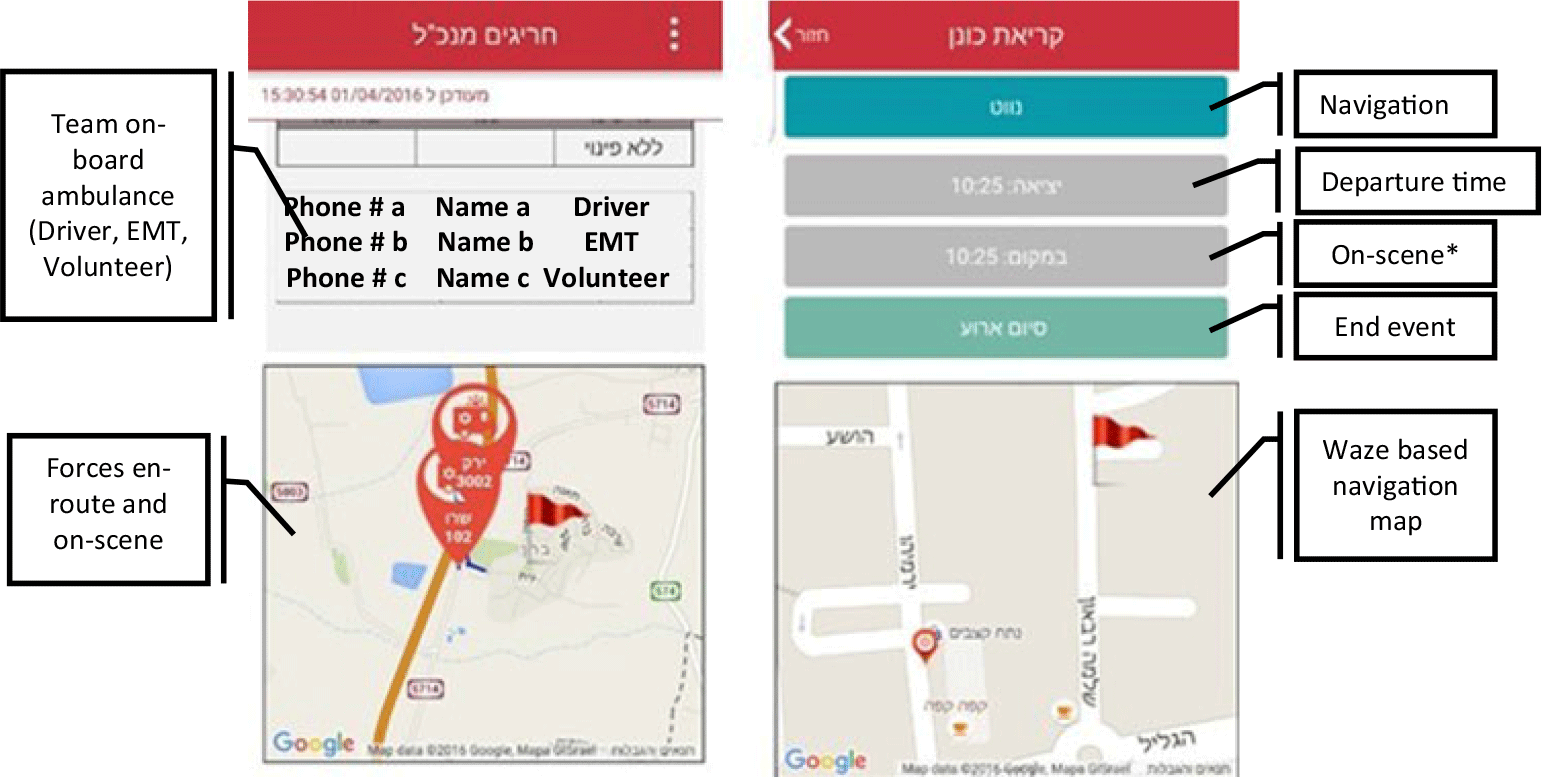
The users can access the event details, patient demographics, and address. Via a designated feature, by a single touch, GPS navigation software (Waze®, Google; Mountain View, CA) can be launched, which uses social media to facilitate the fastest route by vehicle to a given destination. The app also details the total available forces being dispatched to the event, those who approved the call, and the real-time location of the ambulances enroute, including staff personnel (Figure 2).
Smartphone-Based Software Application “MDA Team Application” as Seen by the Volunteer.

As new data are received, the app is continually updated. Using a designated link, an individual can call directly to the responsible chain of command. As mentioned previously, PoC functionality is being developed as an integral part of the app, including for individuals and specific predetermined groups. These can either be self-created or defined by MDA. The app was recently upgraded, enabling the dispatcher to also call the volunteers by voice. The trend is to move all OCVFR to the smartphone application. However, MDA is evaluating new technologies that can receive text and voice information, as well as allow the volunteers to communicate with one another or the control station.
CONTROL CENTER AND DATA PROCESSING
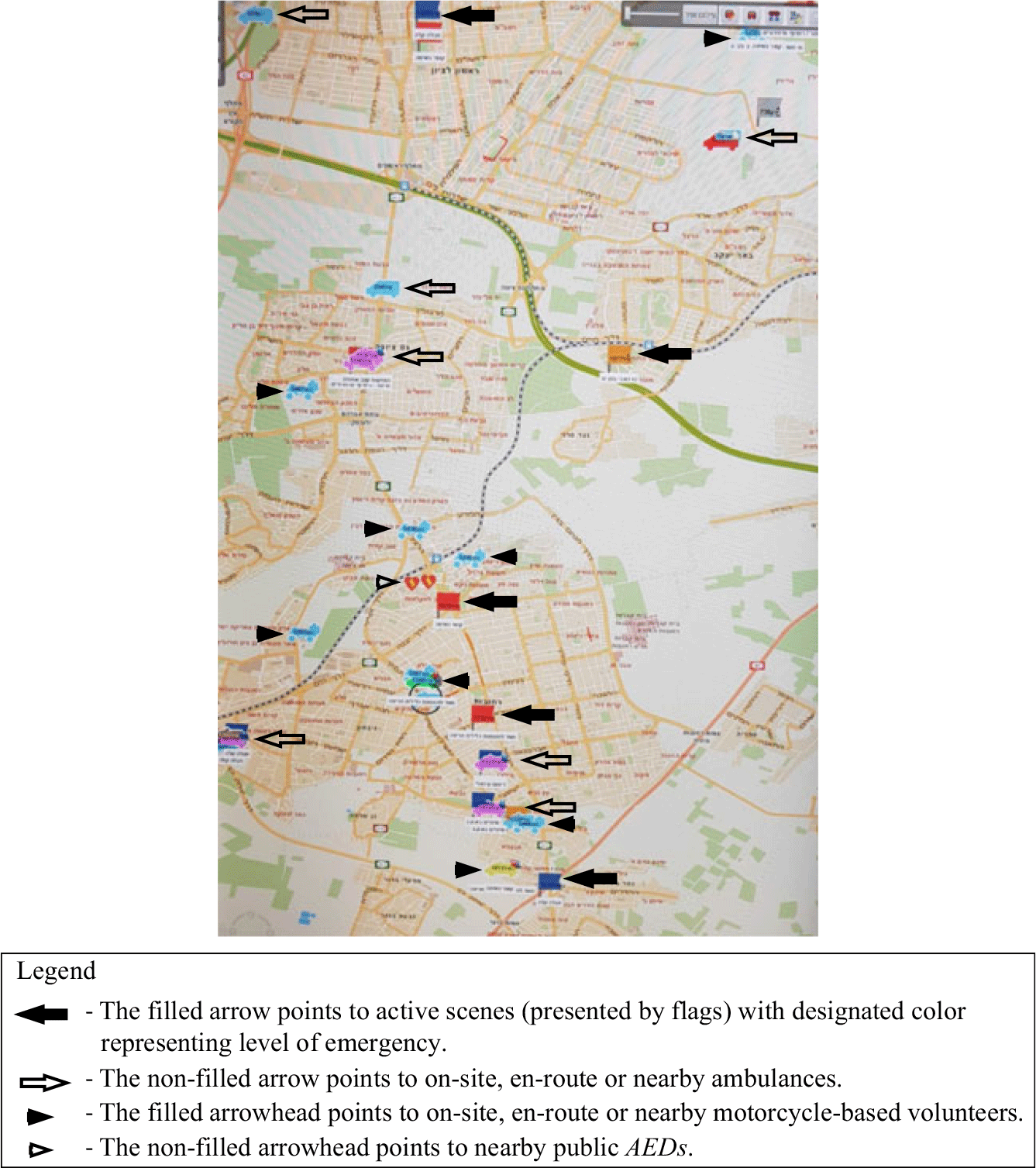
MDA has a control center in each of its main regions. In order to acquire the shortest wait time (target of fewer than 5 seconds) for a call to 1-0-1, each emergency call is dispatched to the first available control center irrelevant of its geographic location. All control centers are qualified to direct an emergent case within the entire country. However, usually, the relevant specific geographic control center activates EMS and manages the case. With incident processing, it is tracked in real-time on a GPS-based navigation map (Waze®-based) where individuals can view the entire available forces of MDA: on-call ambulances, volunteer ambulances, and motorcyclists. In addition, individuals can see the location of nearby police units and nearby public automatic external defibrillators. Each unit is marked with a designated color, indicating its current status: available, enroute, or on-scene (Figure 3).
MDA Control Center Real-Time GPS Based Navigation Map Revealing Ongoing Active Emergency Scenes, Available EMS Forces (Ambulances On-Call and Motorcycle-Based Volunteers), and Nearby Public Automatic External Defibrillators.

The main headquarters, located in the central city of Kiryat Ono, also houses a parallel national control center for the dispatched volunteers. In emergent cases, the MDA Team Application automatically activates the relevant volunteers. The dispatcher in charge of volunteers at the control center can override the application and cancel the call. The control center can communicate with the volunteers enroute, inform them of newly arrived data, and, most importantly, be updated on the incident status, number and degree of casualties, and exact location. Those holding a 1-way pager or PoC device can also be activated. In addition, MDA’s drivers are instructed to park facing the incident as each ambulance and motorcycle is equipped with a front and rear camera, thus sending real-time video of the scene to the control center. This information is critical for the control center’s decision-making.
MASS-CASUALTY INCIDENT
Preparation for an MCI is an integral part of the training of all MDA EMTs and paramedics, whether salaried or volunteer. This includes lectures and training on topics such as blast injury, trauma airway management, and tourniquet application (similar to that taught in the “STOP the Bleeding Campaign”). Reference Rossaint, Bouillon and Cerny23 All levels of volunteers with their appropriate equipment can be activated in the event of an MCI, using all of the different forms of telecommunication. An MCI includes a natural disaster, building collapse, or mega-terrorist attack. In the event of an MCI, the dispatcher in the control center presses a special predesignated button. This can activate all MDA volunteers who can respond within a defined time, for example, 15, 20, 30 minutes. The message from the dispatch appears as (translated into English) “Protocol MCI, do not block the road, do not call the dispatch center.” The volunteers are told to respond directly to the scene of the disaster. Everyone is trained in scene safety, including the mandate to refrain from entering if there is a high clinical suspicion of a secondary explosion or building collapse.
OCVFR were first mobilized to MCIs using simple beeper technology during a series of terrorist attacks that plagued Israel between 2001 and 2004. An analysis of 15 events during this time showed that the volunteers served a vital role, including performing bag-valve-mask ventilation, the application of tourniquets and bandages, and extricating and transporting the victims. Reference Alpert, Lipsky and Elie19
An example of an MCI where the OCVFR were notified by the PoC system occurred in 2014, as a response to a combined car-ramming and shooting terrorist attack on one of the Jerusalem Light Rail stations. At 5:49 PM, the national control center received a call about the incident. A call was sent out immediately to emergency vehicles and volunteers. At the same time, contact was made with the train service, which was able to transfer information received by the security cameras. Responders left for the scene within 2 minutes. The total number of responders activated included 10 ambulances, 3 motorcyclists, 6 paramedics, 30 EMTs, and 15 OCVFR. A total of 8 injured were transferred to the hospital with 3 designated as “emergent.”
With the new smartphone app, any administrators at the scene can view the (1) number of ambulances on-site, (2) number of ambulances enroute to the incident, (3) number of ambulances that are transporting victims, (4) total number of victims, (5) names of the receiving hospitals, and (6) method of transportation to each hospital. Each ambulance that responds to the MCI can also see this information. The system, so far, has worked well in everyday use, as well as during MCIs.
CONCLUSION
MDA directs a multitiered, robust group of thousands of volunteer EMS workers on a nationwide scale. They are alerted and directed by the most cutting-edge, sophisticated technology. This can be for the individual patient or in the event of an MCI. Although Israel is a small country, by presenting this information, other municipalities or EMS agencies can introduce similar concepts in order to improve outcomes in the prehospital setting. This would require starting with a needs assessment and designing an appropriate budget. As GPS and smartphone devices become more prevalent worldwide, variations on these technologies appear to be the current state-of-the-art.
Author Contributions
ZD and EAA contributed equally to this article.
Conflict of Interest Statement
The authors have no conflicts of interest to declare.