Introduction
Trait theories of personality propose lifelong, stable dimensions distributed as a continuum in the population. Current research suggests five high-level traits: neuroticism (N), extraversion (E), openness to experience (O), agreeableness (A) and conscientiousness (C) (Goldberg, Reference Goldberg1993; McCrae & Costa, Reference McCrae and Costa1997), which are found across all cultures (McCrae & Terracciano, Reference McCrae and Terracciano2005).
For some traits, extreme scores confer an increased likelihood of a psychiatric diagnosis. High neuroticism and low extraversion are associated with a range of disorders (Eysenck & Rachman, Reference Eysenck and Rachman1965), including social phobia and agoraphobia (Solyom et al. Reference Solyom, Ledwidge and Solyom1986; Trull & Sher, Reference Trull and Sher1994), psychosis (Van Os & Jones, Reference Van Os and Jones2001) and post-traumatic stress disorder (Cox et al. Reference Cox, MacPherson, Enns and McWilliams2004a). Elevated neuroticism scores are common among patients with major depressive disorder (MDD) (Hirschfeld & Klerman, Reference Hirschfeld and Klerman1979; Trull & Sher, Reference Trull and Sher1994; Enns & Cox, Reference Enns and Cox1997), including pre-morbidly (Rodgers, Reference Rodgers1990; Furukawa et al. Reference Furukawa, Hori, Yoshida, Tsuji, Nakanishi and Hamanaka1998), and among their healthy relatives (Maier et al. Reference Maier, Lichtermann, Minges and Heun1992; Modell et al. Reference Modell, Huber, Holsboer and Lauer2003), suggesting that neuroticism and depression may share genetic influences (e.g. Rietschel et al. Reference Rietschel, Beckmann, Strohmaier, Georgi, Karpushova, Schirmbeck, Boesshenz, Schmal, Burger, Jamra, Schumacher, Hofels, Kumsta, Entringer, Krug, Markov, Maier, Propping, Wust, Kircher, Nothen, Cichon and Schulze2008). Extraversion-related traits may differentiate bipolar and unipolar affective disorders (Akiskal et al. Reference Akiskal, Hirschfeld and Yerevanian1983, Reference Akiskal, Kilzieh, Maser, Clayton, Schettler, Traci Shea, Endicott, Scheftner, Hirschfeld and Keller2006). Comparisons of groups of individuals with common psychiatric diagnoses including mood and anxiety disorders confirm widespread, but often subtle, differences in personality profile (e.g. Rector et al. Reference Rector, Hood, Richter and Bagby2002). A recent study comparing personality across a range of internalizing disorders found that individuals with bipolar disorder (BD; n=87) scored significantly higher than a large sample of community controls in neuroticism, openness and conscientiousness, and in general had notably higher extraversion and openness scores than other diagnostic groups (Rector et al. Reference Rector, Hood, Richter and Bagby2002; Tackett et al. Reference Tackett, Quilty, Sellbom, Rector and Bagby2008). While these associations between normal personality and DSM-IV Axis I diagnoses may be of great theoretical and etiological importance, much of the present literature is based on studies assessing relatively few individuals (Young et al. Reference Young, Bagby, Cooke, Parker, Levitt and Joffe1995; Bagby et al. Reference Bagby, Bindseil, Schuller, Rector, Young, Cooke, Seeman, McCay and Joffe1997; Heerlein et al. Reference Heerlein, Richter, Gonzalez and Santander1998; Jain et al. Reference Jain, Blais, Otto, Hirshfeld and Sachs1999).
Associations between personality traits and psychiatric disorders may occur for several reasons, including ‘scarring’ of personality by mood episodes, shared genetic risk for personality and disorder, or methodological artifacts such as overlapping items in symptom and personality rating scales (Shea et al. Reference Shea, Leon, Mueller, Solomon, Warshaw and Keller1996; Duggan et al. Reference Duggan, Milton, Egan, McCarthy, Palmer and Lee2003; Foster & MacQueen, Reference Foster and MacQueen2008). The relationship between personality and symptoms is particularly complex in BD because personality scores can be affected by mood state (Kendell & DiScipio, Reference Kendell and DiScipio1968; Reich et al. Reference Reich, Noyes, Hirschfeld, Coryell and O'Gorman1987) and by residual symptoms present even during euthymic states (Katz & McGuffin, Reference Katz and McGuffin1987; Sauer et al. Reference Sauer, Richter, Czernik, Ludwig-Mayerhofer, Schochlin, Greil and von Zerssen1997). In addition, personality may modify the effects of psychiatric symptoms and affect the course of illness (Heerlein et al. Reference Heerlein, Richter, Gonzalez and Santander1998; Lozano & Johnson, Reference Lozano and Johnson2001).
BD is a condition in which hypotheses about personality and mental health present unique challenges. Separating the influences of mood-related state and underlying trait effects requires that personality be assessed during periods of active symptoms and euthymia. In this study, we assessed mood and personality repeatedly in large BD samples. We predicted that personality in BD would be characterized by higher neuroticism and extraversion than population means, and that individuals with BD and MDD would differ on some traits. Second, we predicted significant ‘state’ effects: mood at the time of assessment would explain significant variation in personality scores. Third, we predicted ‘trait’ effects of personality on illness course, i.e. enduring, biologically based individual differences that are not due to current symptoms and that differ between manic-prone and depression-prone individuals. We investigated the associations between personality and predominant polarity because of recent evidence that predominant polarity affects clinical features of BD, including delay before diagnosis, type of mood episode and age at illness onset, duration of illness and suicide attempts (Rosa et al. Reference Rosa, Andreazza, Kunz, Gomes, Santin, Sanchez-Moreno, Reinares, Colom, Vieta and Kapczinski2008).
Method
Subjects
The Systematic Treatment Enhancement Program for Bipolar Disorder (STEP-BD) study comprised a number of randomized controlled trials incorporated into a large, multi-site, naturalistic study of outcome in BD (Sachs et al. Reference Sachs, Thase, Otto, Bauer, Miklowitz, Wisniewski, Lavori, Lebowitz, Rudorfer, Frank, Nierenberg, Fava, Bowden, Ketter, Marangell, Calabrese, Kupfer and Rosenbaum2003). Patients eligible for STEP-BD were 15 years or over and met DSM-IV criteria for bipolar I or II disorders, cyclothymia, BD not otherwise specified (NOS), or schizo-affective disorder (manic or bipolar subtype). Written informed consent was obtained from patients aged 18 years or over and written assent and parent or guardian consent was obtained for patients aged 15–17 years. The study was approved by Institutional Review Boards of participating institutions.
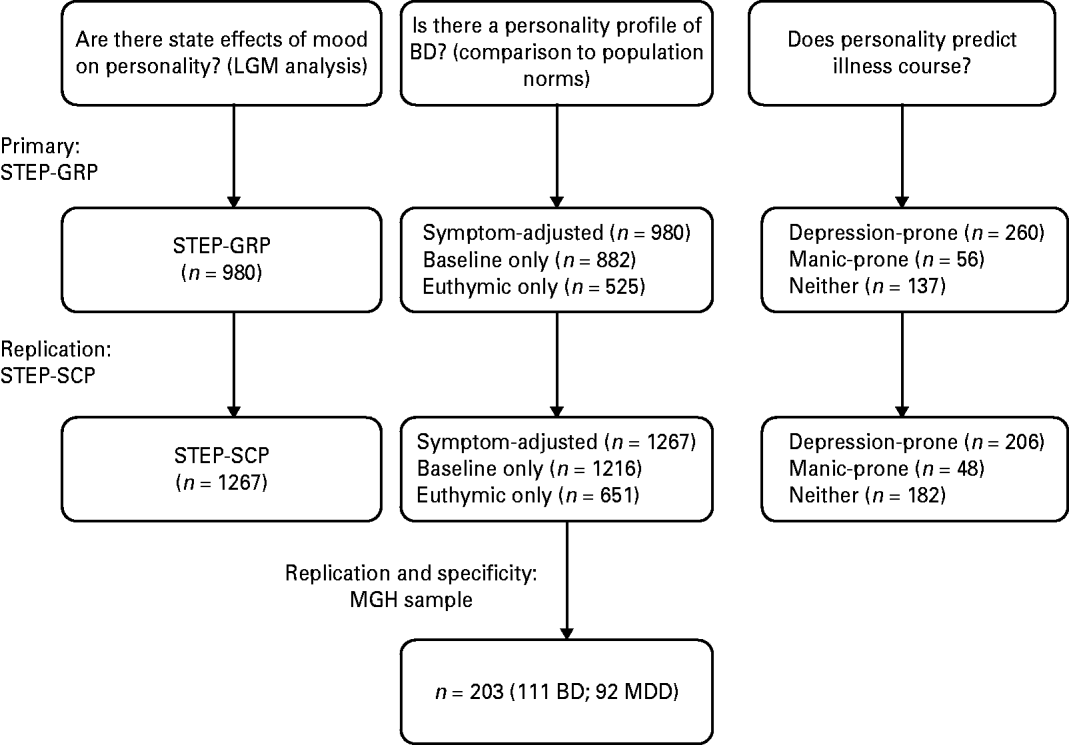
Initial analyses were conducted in a subset of individuals that participated in the STEP-genetic repository (STEP-GRP) and completed a personality assessment (n=980 of 2089). Replication of results from STEP-GRP was subsequently attempted in two further samples. The first comprised a non-overlapping STEP-BD sample (n=1267) with identical recruitment and inclusion criteria. These individuals took part in the STEP-BD standard care pathway (STEP-SCP) but not the STEP-GRP. The second group [the Massachusetts General Hospital (MGH) sample] was a convenience sample of 203 individuals aged 18 years or over who met DSM-IV criteria for MDD or BD I or II as previously described (Simon et al. Reference Simon, Smoller, Fava, Sachs, Racette, Perlis, Sonawalla and Rosenbaum2003) for whom NEO Five-Factor Inventory (NEO-FFI) personality scores were available. An overview of the three samples and the analysis framework is given in Fig. 1.
Analytic framework and samples used to investigate personality in bipolar disorder (BD). LGM, Latent growth model; STEP-GRP, Systematic Treatment Enhancement Program genetic repository; STEP-SCP, STEP standard care pathway; MGH, Massachusetts General Hospital; MDD, major depressive disorder.

Personality assessment: the revised NEO-FFI
Personality was assessed using the NEO-FFI (Costa & McCrae, Reference Costa and McCrae1992), a 60-item self-report with each item rated on a five-point scale. (The NEO-FFI was administered at the initiation of the STEP-BD study in both STEP-GRP and STEP-SCP cohorts, but was subsequently eliminated from the assessment package so is available for only a subset of each cohort.) Twelve items assess each of five personality dimensions: neuroticism (N), the tendency to experience negative affect; extraversion (E), a tendency towards energy, positive emotions, and stimulation-seeking; conscientiousness (C), a tendency towards self-discipline and dutiful behavior; openness to experience (O), sometimes described as intellectual curiosity; and agreeableness (A), a tendency to be co-operative and compassionate. Scores were converted to sex-adjusted t scores with a (normative) mean of 50 and a standard deviation of 10 using normative data provided in the professional manual (Costa & McCrae, Reference Costa and McCrae1992). NEO-FFI was completed at entry, and at 1 and 2 years. For all analyses, patients were included only if a clinical rating of mood was available within 30 days of personality assessment; where more than one was available, the temporally closest was used.
In the MGH sample, NEO-FFI scores were collected on a single occasion and again converted to t scores using adult normative data (Costa & McCrae, Reference Costa and McCrae1992).
Clinical assessments
STEP-BD included a comprehensive battery of clinician- and self-report assessments (Sachs et al. Reference Sachs, Thase, Otto, Bauer, Miklowitz, Wisniewski, Lavori, Lebowitz, Rudorfer, Frank, Nierenberg, Fava, Bowden, Ketter, Marangell, Calabrese, Kupfer and Rosenbaum2003). Clinicians completed the Affective Disorders Evaluation (Sachs, Reference Sachs1990) at study entry and the Young Mania Rating Scale (YMRS; Young et al. Reference Young, Biggs, Ziegler and Meyer1978) and Montgomery–Asberg Depression Rating Scale (MADRS; Montgomery & Asberg, Reference Montgomery and Asberg1979) at every clinical assessment. Current clinical state was determined at each contact throughout the trial using the Clinical Monitoring Form (CMF) for mood disorders (Sachs et al. Reference Sachs, Guille and McMurrich2002) which incorporates the Structured Clinical Interview for DSM-IV (SCID-IV; First et al. Reference First, Spitzer, Gibbon and Williams1996) current mood modules and rates frequency and intensity of mood states (Sachs et al. Reference Sachs, Guille and McMurrich2002). The CMF determines a categorical clinical status, defined as mania/hypomania if the patient is experiencing three or more symptoms of mood elevation, depression if they are experiencing five or more depressive symptoms, and euthymia if they are currently experiencing two or less symptoms (at no more than moderate levels). Observations where patients were in mixed or partially recovered states were excluded from these analyses (although the time spent in those states was included in measures of follow-up and mood state duration). Clinical state was used to determine the number of days spent depressed, manic/hypomanic and euthymic during the study. After initial assessment, whenever a patient was observed in the same mood state at two consecutive assessments, the number of days between those assessments was counted towards the ‘tally’ for that mood state. Where mood state changed between assessments, half of the days between were ascribed to one mood state and half to the other. Intervals between assessments were censored such that the maximum duration ascribed to a mood state prior to, or after, an assessment was 60 days. Individuals were defined as ‘depression-prone’ if they spent more days depressed than manic during the study period, as ‘manic-prone’ if they spent more days manic than depressed, and as ‘no predominant mood’ if they either spent an equal number of days depressed and manic, or if they were euthymic throughout the study period. A follow-up of >180 days between the first and last assessment was required in order to describe illness course; individuals with <180 days of follow-up were excluded from analyses concerning illness course.
In the MGH sample, diagnosis and current mood episode (no active episode, depressed, manic/hypomanic, or mixed) were established using the SCID-IV.
Statistical analysis
State effects of mood on personality
To establish the effects of varying mood states on repeated assessments of personality, we employed a latent growth model (LGM) approach. LGMs are rooted in a structural equation modeling framework (Meredith & Tisak, Reference Meredith and Tisak1990) and use latent growth factors to account for dependency among repeat observations. The model comprised MADRS and YMRS symptom scores and sex-adjusted t scores for each personality dimension at each time point. Symptom scores were treated as time-varying covariates and simultaneously regressed on each personality trait at that time point. Individual patterns of personality scores throughout the study were summarized by two parameters: an intercept, reflecting an individual-specific symptom-adjusted score, and a slope, reflecting the mean rate of change over time. We assumed that variation in personality scores in this study would be predominantly due to individual differences in underlying (trait) personality and to (state) mood effects. Since personality is relatively stable during adulthood (Ferguson, Reference Ferguson2010), we assumed that, relative to these other sources of variation, the effects of repeated self-report and of ageing would be small and would affect all individuals approximately equally; for these reasons, we fixed the slope term to be equal between individuals.
Model estimation was performed with Mplus 5.0 software (www.statmodel.com) and reported with maximum-likelihood parameter estimates and robust standard errors returned by the estimator=mlr option. Application of the Expectation-Maximization (EM) algorithm allowed inclusion of all available data, including patients with partially incomplete data assuming a missing at random mechanism (Rubin, Reference Rubin1987) which is robust to missingness contingent on variables (e.g. personality scores) contained within the model. Model fit was evaluated using the comparative fit index (CFI), Tucker–Lewis index (TLI) and Steiger's root mean square error of approximation (RMSEA). Recommended values are RMSEA<0.06, and CFI and TLI>0.95 (Hu & Bentler, Reference Hu and Bentler1999).
Determination of personality in BD
To determine whether there was a characteristic personality profile in BD, we compared personality t scores from the first assessment completed by STEP-GRP patients when in a euthymic state with norms for the adult US population (mean=50, s.d.=10) (Costa & McCrae, Reference Costa and McCrae1992), using one-sample t tests. We then attempted to replicate this using scores from the first euthymic assessment for patients in the STEP-SCP sample.
To assess the specificity of the personality profile to BD disorder, t tests were used to compare the BD and MDD groups from the MGH sample on each personality factor. To prevent concurrent mood from confounding associations between personality and diagnosis we assessed the effects of diagnosis only in individuals in depressed or euthymic episodes using analysis of variance (ANOVA) with two factors [diagnosis (BD, MDD) and current mood episode (euthymic, depressed)].
Associations between personality and illness course
We assessed associations between euthymic personality scores and groups defined by prospective illness course using one-way ANOVA. Where significant differences were found, post hoc pairwise t tests with Bonferroni corrections were employed. Even during defined periods of euthymia, some residual mood symptoms were present, potentially confounding associations between outcome and personality. Therefore, we used multinomial logistic regressions to test whether personality predicted illness course when residual mood symptoms (measured by the YMRS and MADRS) were included in the model as a continuous covariate. Analyses predicted manic-prone or depression-prone status as categorical outcomes with ‘no predominant polarity’ used as the reference category, with each personality factor (separately), YMRS and MADRS scores from the closest clinical assessment to the euthymic personality assessment as predictors. Initial analyses were completed in STEP-GRP and replication was attempted using identical methods in STEP-SCP.
Results
State effects of mood on personality
Personality assessment and clinical rating were available for 980 STEP-GRP participants: 641 (65%) with a diagnosis of bipolar I; 272 (28%) with bipolar II; 56 (6%) with bipolar NOS; and 11 (1%) with schizo-affective disorder, bipolar type. Compared with the remainder of the STEP-GRP cohort, this sample was older [mean age 44.5 (s.d.=12.6) versus 40.8 (s.d.=12.9) years, t=−6.65, degrees of freedom (df)=2087, p<0.001] and women were over-represented (61% v. 54%, χ2=10.4, df=1, p=0.001). The mean number of clinical state assessments available for each participant was 24.6 (s.d.=16.7, range 1–110), completed over a mean period of 1004 days (s.d.=445, range 0–2021 days).
These 980 individuals underwent 1529 personality assessments; 882 (90% of sample) at baseline, 428 (44%) at 12 months, and 219 (22%) at 24 months. The LGM showed a reasonable fit to the data (CFI=0.94, TLI=0.90, RMSEA=0.04) and explained the majority of variance in personality scores (r 2 between 0.61 and 0.83 for each trait at each time point). Of the five traits, only neuroticism showed evidence for significant change over time (mean change=−2.37 points per year, s.e.=0.41, p<0.001).
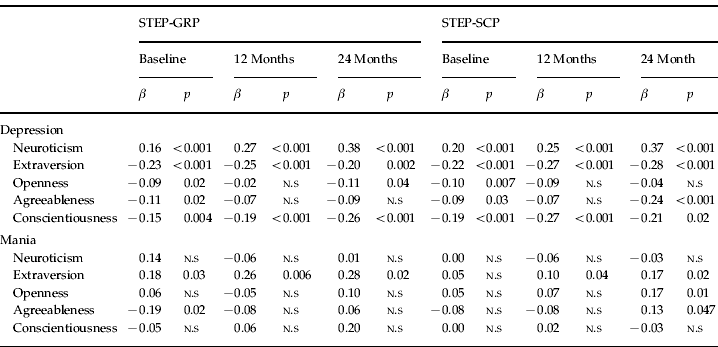
Estimated effects of mood state on personality were largely consistent across assessments (see Table 1) although some effects were significant only at the first time point, where minimal missing data maximized statistical power to detect the effect. Depression was associated with increased neuroticism, and decreased extraversion, and conscientiousness at all time points, and with decreased agreeableness and openness at some time points. Manic symptoms were associated with increased extraversion at each assessment and with decreased agreeableness at baseline only. Mania had no reliable effect on neuroticism, openness or conscientiousness (Table 1).
State effects of MADRS depression and YMRS mania scores on NEO-FFI personalityFootnote a

MADRS, Montgomery–Asberg Depression Rating Scale; YMRS, Young Mania Rating Scale; NEO-FFI, NEO Five-Factor Inventory; STEP-GRP, Systematic Treatment Enhancement Program genetic repository; STEP-SCP, STEP standard care pathway; n.s., non-significant.
a Regression coefficients (β) and p values reflect incremental change of one symptom point on personality factor scores.
In STEP-SCP participants, personality and clinical assessments were available for 1267 patients (41% male) with diagnoses of bipolar I (n=858, 68%), bipolar II (n=316, 25%), bipolar NOS (n=73, 6%) and schizo-affective disorder, bipolar type (n=18, 1%). These 1267 individuals underwent 1598 personality assessments; 1216 (96% of sample) at baseline, 272 (21%) at 12 months, and 110 (9%) at 24 months. As before, the LGM showed a reasonable fit to the STEP-SCP data (CFI=0.94, TLI=0.90, RMSEA=0.03) and explained the majority of variance in personality scores at each time point (r 2 between 0.62 and 0.85). Neuroticism again decreased over time (mean change=−2.49 points per year, s.e.=0.55, p<0.001), and, openness also decreased over time (mean change=−1.39 points per year, s.e.=0.55, p=0.01). State effects on personality scores in STEP-SCP participants were consistent with STEP-GRP results (Table 1). As before, depressed symptoms were associated with increased N and decreased E, O, A and C. Manic symptoms were generally not associated with personality scores, although there were moderately consistent associations with increased extraversion.
Personality scores of patients with BD
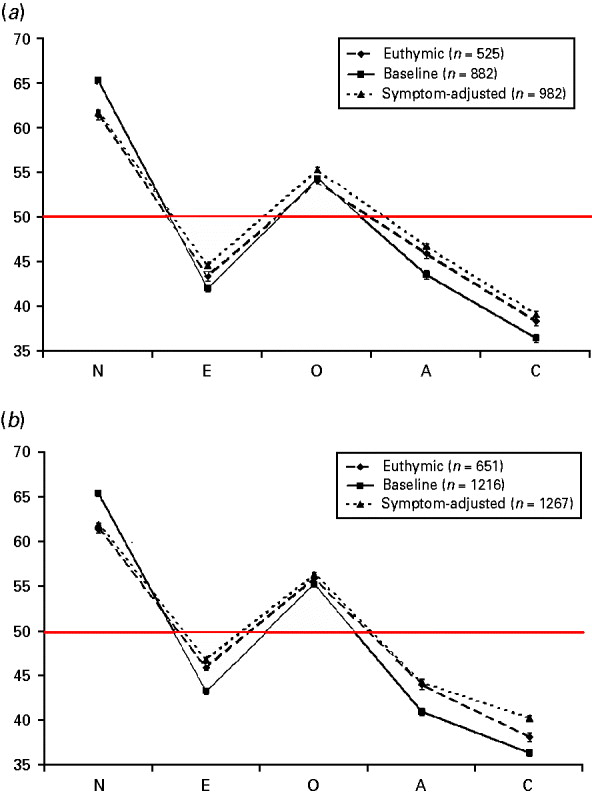
Baseline, symptom-adjusted and euthymic personality scores of STEP-GRP and STEP-SCP participants can be seen in Fig. 2.
The personality profile of bipolar disorder. (a) Systematic Treatment Enhancement Program genetic repository (STEP-GRP) participants (total n=982); (b) STEP standard care pathway (STEP-SCP) participants (total n=1267). Data are NEO Five-Factor Inventory (NEO-FFI) t scores where available from study entry (–▪–, n=882 and n=1216), assessment during euthymic state (- -◆- -, n=525 and n=651), and symptom-adjusted scores (· · ·▴· · ·, n=982 and n=1267) from structural equation models. Values are means, with standard errors represented by vertical bars. –––, Population mean=50 (s.d.=10) (Costa & McCrae, Reference Costa and McCrae1992). N, Neuroticism; E, extraversion; O, openness to experience; A, agreeableness; C, conscientiousness.

A personality assessment was completed during a euthymic state by 525 of 980 (54%) STEP-GRP patients. Compared with population norms (Costa & McCrae, Reference Costa and McCrae1992), the STEP-GRP euthymic state scores deviated on every factor, reporting higher neuroticism (mean t score 61.4, s.d.=11.6) and openness (mean t score 53.9, s.d.=11.0), and lower extraversion (mean t score 43.4, s.d.=11.6), agreeableness (mean t score 46.0, s.d.=12.3) and conscientiousness (mean t score 38.4, s.d.=13.0) (t tests at 524 df, all p<0.001).
In STEP-SCP participants, personality assessment was available during a euthymic state for 651 (51%) patients. The results replicated those found in STEP-GRP participants, with scores again differing from population norms on every trait and in the same direction as STEP-GRP (all p<0.001).
Specificity of the bipolar profile
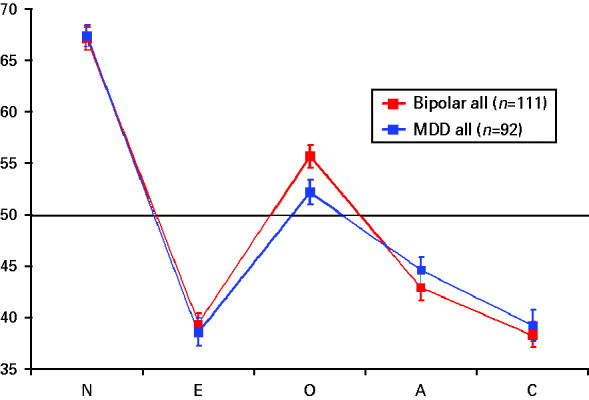
NEO-FFI scores were obtained in an independent group of patients with BD (n=111) and MDD (n=92), the MGH sample (Simon et al. Reference Simon, Smoller, Fava, Sachs, Racette, Perlis, Sonawalla and Rosenbaum2003). These two diagnostic groups did not differ in mean age [BD=40.2 (s.d.=12.2) years, MDD=41.2 (s.d.=12.3) years, t=−0.60, df=202, p=0.21] or in the proportion of females [BD 52 (50.5%), MDD 56 (50.5%), χ2=0.61, df 1, p=0.44]. t Tests showed that the BD and MDD groups did not differ on N, E, A or C but differed significantly on openness (t=−2.12, df=202, p=0.02, see Fig. 3). A two-factor ANOVA limited to individuals in depressed or euthymic mood states revealed an effect of diagnosis on openness (F=4.69, df=1, 169, p=0.03), and no significant effect of mood state (F=0.16, df=1, 169, p=0.68). In contrast, current mood state had significant effects on extraversion (F=21.2, df=1, 169, p<0.001), agreeableness (F=4.08, df=1, 169, p=0.045) and neuroticism (F=15.1, df=1, 169, p<0.001), while diagnosis did not. Conscientiousness was not significantly associated with either mood state or diagnosis.
NEO Five-Factor Inventory (NEO-FFI) personality scores (t scores) in an independent sample of 203 individuals with mood disorders: bipolar disorder ( , all n=111); major depressive disorder (–▪–, all n=92). Values are means, with standard errors represented by vertical bars. ——, Population mean=50 (s.d.=10) (Costa & McCrae, Reference Costa and McCrae1992). N, Neuroticism; E, extraversion; O, openness to experience; A, agreeableness; C, conscientiousness. Groups differ only in O (t=−2.12, df=202, p=0.02).

Associations between personality and illness course
The longitudinal nature of STEP-BD allowed us to examine whether euthymic personality predicted the prospective course of illness. A euthymic personality assessment was available for 453 STEP-GRP individuals whose illness course could be categorized. Of these, 56 (12%) were defined as manic-prone, 260 (57%) as depression-prone, and 137 (30%) patients showed no predominant mood (136 were euthymic throughout the study; one participant reported an equal number of days manic and depressed). The three groups differed significantly from each other in the proportion of days spent manic [manic-prone, mean 11 (s.d.=0.09) days; depression-prone, mean 0.01 (s.d.=0.03) days; no predominant mood, mean 0.00 (s.d.=0.00) days; F=162, df=2, 50, p<0.001], and the proportion of days spent depressed [manic-prone, mean 0.03 (s.d.=0.04) days; depression-prone, mean 0.14 (s.d.=0.12) days; no predominant mood, mean 0.00 (s.d.=0.00) days; F=116, df=2, 450, p<0.001].
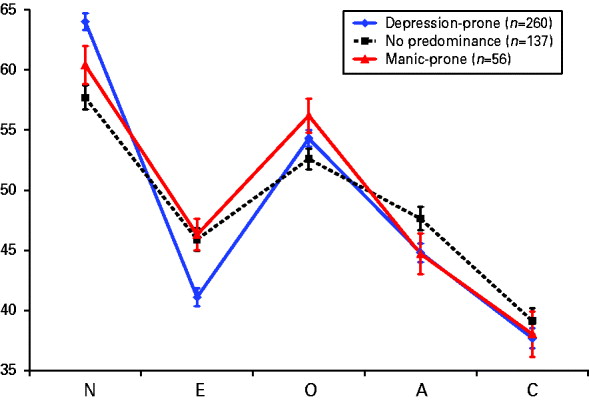
Sex-adjusted personality t scores were compared between depression-prone, manic-prone, and equal polarity groups, using one-way ANOVA (Fig. 4). Openness, conscientiousness and agreeableness did not differ between groups. Neuroticism and extraversion differed significantly (neuroticism, F=14.3, df=2, 450, p<0.001; extraversion, F=10.3, df=2, 450, p<0.001). Post-hoc t tests showed that higher extraversion scores were associated with a manic-prone course compared with a depression-prone course, and neuroticism scores were higher and extraversion scores lower in depression-prone individuals than those with no predominant mood.
NEO Five-Factor Inventory (NEO-FFI) personality scores (t scores) during euthymic state among 453 individuals with depression-prone (–◆–, n=260), manic-prone ( , n=56) or no predominant mood (- -▪- -, n=137) bipolar disorder (Systematic Treatment Enhancement Program genetic repository participants). Scores are unadjusted for residual symptoms. Values are means, with standard errors represented by vertical bars. N, Neuroticism; E, extraversion; O, openness to experience; A, agreeableness; C, conscientiousness. Significant differences exist between groups in N (F1=4.3, df=2, 450, p<0.0001) and E (F1=0.3, df=2, 450, p=0.0001).

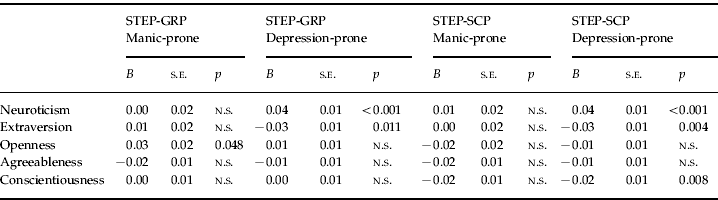
Because residual symptoms during euthymic states might confound associations between euthymic personality and illness course, we used multinomial logistic regression to control for residual manic and depressed symptoms. Compared with individuals with no predominant mood, elevated neuroticism and decreased extraversion predicted a depression-prone course, and increased openness a manic-prone course (see Appendix Table 1).
We attempted to replicate the associations between personality and illness course in STEP-SCP. A euthymic personality assessment and illness course categorization was available for 436 individuals. Of these, 48 (11%) were defined as manic-prone, 206 (47%) as depression-prone, and 182 (42%) patients were euthymic throughout their participation (n=181) or reported an equal number of days manic and depressed (n=1). As in STEP-GRP, elevated neuroticism and decreased extraversion predicted a depression-prone course. In addition, lower conscientiousness scores were associated with a depression-prone course. No personality factor significantly predicted a manic-prone course (Appendix Table 1).
Discussion
To our knowledge, this is the largest analysis of the relationship between personality and BD. The longitudinal nature of STEP-BD with repeated personality assessments allowed us to examine three key questions: (1) is there a distinct personality profile associated with BD; (2) are associations between personality and BD due to state mood effects; and (3) are there associations between personality and illness course?
BD was associated with a distinct personality profile comprising high neuroticism and openness, and low extraversion, conscientiousness and agreeableness. This profile was replicated in two independent samples, suggesting that this profile may reflect a liability for affective disorder. Furthermore, we saw no difference in scores on any trait between patients with bipolar I, bipolar II and bipolar NOS diagnoses.
Although we did not compare personality across a full range of psychiatric disorders, comparisons within the MGH sample demonstrated that patients with BD had higher NEO openness scores than patients with MDD. These findings suggest that openness is an enduring marker differentiating individuals at risk for mania or hypomania from those at risk for other affective disorders. Some (Bagby et al. Reference Bagby, Young, Schuller, Bindseil, Cooke, Dickens, Levitt and Joffe1996; Nowakowska et al. Reference Nowakowska, Strong, Santosa, Wang and Ketter2005) but not all (Bagby et al. Reference Bagby, Bindseil, Schuller, Rector, Young, Cooke, Seeman, McCay and Joffe1997; Jain et al. Reference Jain, Blais, Otto, Hirshfeld and Sachs1999) previous studies have reported elevated openness in BD.
Longitudinal assessment of mood and personality allowed us to quantify state effects of mood on personality. We found associations between depression and increased neuroticism and decreased extraversion, conscientiousness and openness, whereas mania was associated only with increased extraversion. These effects were largely consistent across time. The existence of such ‘state’ effects could be interpreted as reflecting the inherent limitations of the self-report method, or alternatively as reflecting genuine, though temporary, mood-driven fluctuations in personality (Reich et al. Reference Reich, Noyes, Hirschfeld, Coryell and O'Gorman1987; Santor et al. Reference Santor, Bagby and Joffe1997). It is interesting that decreases in neuroticism were paralleled by decreases in openness, suggesting that decreases in worry, negative affect, or pessimism do not bring about increases in openness or novelty seeking.
These state effects do not fully account for personality differences between bipolar patients and controls (Clark et al. Reference Clark, Vittengl, Kraft and Jarrett2003). Personality measures show high test–retest reliabilities in psychiatric populations, similar to those seen in healthy controls (Kleifield et al. Reference Kleifield, Sunday, Hurt and Halmi1994; Kentros et al. Reference Kentros, Smith, Hull, McKee, Terkelsen and Capalbo1997). Whereas personality differences are ameliorated by successful treatment of symptoms, personality scores during treatment trials show both absolute change and high test–retest correlations within individuals, such that changes in symptoms and personality correlate only modestly (Santor et al. Reference Santor, Bagby and Joffe1997). Moreover, these differences in bipolar and other affective disorders exist prior to illness onset (Rodgers, Reference Rodgers1990; Lauer et al. Reference Lauer, Bronisch, Kainz, Schreiber, Holsboer and Krieg1997) and the effects of prodromal (Fava & Kellner, Reference Fava and Kellner1991) or residual symptoms (Katz & McGuffin, Reference Katz and McGuffin1987; Sauer et al. Reference Sauer, Richter, Czernik, Ludwig-Mayerhofer, Schochlin, Greil and von Zerssen1997) cannot account for them. In keeping with other studies of patients in remission (Hirschfeld & Klerman, Reference Hirschfeld and Klerman1979; Cox et al. Reference Cox, McWilliams, Enns and Clara2004b), our samples differed widely from normative data on every trait during euthymia, particularly in neuroticism and conscientiousness, where mean difference was greater than one standard deviation. All three BD samples, as well as the depressed group, showed below-average extraversion scores, in contrast to previous studies which suggested elevated scores on extraversion-related traits in BD (Akiskal et al. Reference Akiskal, Hirschfeld and Yerevanian1983; Young et al. Reference Young, Bagby, Cooke, Parker, Levitt and Joffe1995). Results presented here suggest that while extraversion is elevated during mania it remains below average in BD patients during euthymic periods, perhaps due to ongoing experiences of depression or irritability.
Further evidence that the personality differences associated with BD are enduring traits was provided by differences in euthymic personality among patients who subsequently experienced manic-prone and depression-prone courses of illnesses. Some of these group differences may be attributable to residual symptoms present during apparently euthymic states. We controlled for these residual symptoms by covarying for depression and mania while analysing associations between personality and subsequent mood states. These covariance analyses do not reduce the significant associations between personality and patients' predominant mood states.
Our results fit with a body of research suggesting that neuroticism is a non-specific predictor of mental disorder (Middeldorp et al. Reference Middeldorp, Cath, Van Dyck and Boomsma2005). Since neuroticism is stable over the life course (Wray et al. Reference Wray, Birley, Sullivan, Visscher and Martin2007) while symptoms change markedly within individuals (Colman et al. Reference Colman, Ploubidis, Wadsworth, Jones and Croudace2007), neuroticism may be a better predictor of the lifetime vulnerability to depression than any single symptom measurement. Neuroticism captures aspects of personality that go beyond depression, such as worrying, which may be enduring characteristics that are separate from the experience of low mood (Duggan et al. Reference Duggan, Milton, Egan, McCarthy, Palmer and Lee2003). Moreover, our analyses follow much previous research in suggesting that N and E are the personality traits most associated with risk for psychopathology, and that openness may be the trait most related to mania. Conscientiousness and agreeableness, though also affected in BD, may ultimately be less relevant to ‘external’ clinical validators of illness course.
The study was limited by methodological assumptions including the accuracy of self-reported personality. The NEO-FFI may not capture all personality variation relevant to BD. However an informant-based measure would have been difficult to administer and perhaps also unnecessary: even during depressed states, patients' self-reports of personality do not differ widely from those of informants (Bagby et al. Reference Bagby, Rector, Bindseil, Dickens, Levitan and Kennedy1998). Second, we defined our illness-course groups by predominant mood episode, prospectively through clinical observations. While the accuracy of this allocation has limitations, there are advantages of the prospective design including reduced problems with recall accuracy. Third, for pragmatic reasons and to minimize missing data we included personality assessments that were conducted within 30 days of clinical assessments, although the usual delay was much shorter than this 30-day maximum. Nonetheless, this delay between assessments might introduce random error in the association between personality and symptoms among patients with rapid changes in mood state. For example, patients with high openness scores during euthymia could have switched to hypomania during the lag interval between the symptom and personality assessments. Fourth, we cannot rule out effects of treatment, selection for a specialty treatment program or co-morbid anxiety or personality disorders, which may conceivably affect personality profile. Fifth, many patients were missing from the later personality assessments. The EM model estimator used for the mplus analyses are robust against the influence of any missingness related to the five personality traits; nonetheless, we cannot exclude the possibility that other unmeasured factors may have influenced missingness and thus increased the error in the model. Despite these limitations, the consistency of results across three BD samples suggests that our results can be generalized. Finally, a significant limitation of the study is the reliance on normative data rather than a demographically matched healthy comparison group with which to directly compare scores. It is possible that a proportion of the difference in scores between our BD group and those polled for the normative data reflect cohort effects or regional differences.
Knowing that there are associations between BD and personality traits does not define their direction of causality. Attempts to experimentally manipulate mood and measure the corresponding effect on personality have largely failed to invoke personality changes (Masters & Furman, Reference Masters and Furman1976) but these studies suffer limitations of sample size and magnitude of mood effects. This study cannot differentiate between the possibility that BD and personality traits have shared genetic causes and the ‘scarring’ hypothesis, i.e. that prior illness episodes change personality. Testing this would require repeated assessment of personality and psychopathology in longitudinal designs, establishing baseline personality before onset of illness and following personality change in individuals who do and do not develop bipolar spectrum disorders (Rodgers, Reference Rodgers1990; Van Os & Jones, Reference Van Os and Jones2001). These studies have not been conducted in BD, in comparison with a substantial high-risk literature assessing personality and psychopathology in MDD (Mulder, Reference Mulder2002). An alternative approach would be to use genetic methods to examine the genetic correlation between personality profiles and BD. For example, twin studies have documented shared genetic determinants of personality traits (especially neuroticism and extraversion) with anxiety disorders and MDD (Hettema et al. Reference Hettema, Neale, Myers, Prescott and Kendler2006; Kendler et al. Reference Kendler, Gatz, Gardner and Pedersen2006; Bienvenu et al. Reference Bienvenu, Hettema, Neale, Prescott and Kendler2007; Kendler & Myers, Reference Kendler and Myers2010). The availability of genomewide association analysis (GWAS) also provides an opportunity to examine the shared genetic risk factors underlying personality and psychiatric disorder. For example, aggregate results from a GWAS analysis of schizophrenia were recently shown to account for a significant proportion of the polygenic contribution to BD (Purcell et al. Reference Purcell, Wray, Stone, Visscher, O'Donovan, Sullivan and Sklar2009). Similar cross-phenotype analyses between BD and personality profiles could be used to estimate the proportion of phenotypic overlap that is attributable to genetic predisposition (as opposed to scarring). To date, no such twin or molecular genetic analyses of BD and personality have been reported; our results suggest that such studies could be valuable for dissecting the etiology of the association between BD and personality reported here.
In sum, we demonstrated that patients with BD can be distinguished from population norms and from patients with MDD on select personality variables, notably openness and neuroticism. State effects of mood on personality are considerable but do not fully explain personality profiles in BD. Moreover, personality during euthymia is predictive of future mood course, suggesting that personality disturbances are enduring markers of the illness process. Future research should examine whether these profiles are a direct consequence of the underlying neurobiological (genetic, or environmental) causes of BD.
Associations between NEO-FFI personality scores [mean (s.e.) t scores] during euthymic state and depression-prone and manic-prone courses of bipolar disorder

Multinomial categorical regression coefficients (B) and standard errors (s.e.) reflect predictive effect of personality score on illness course, compared with individuals showing no predominant mood.
Acknowledgements
We are grateful to the following individuals: T. Croudace and G. Hammond for Mplus advice, and K. Todd-Brown for assistance in data handling. The STEP-BD project was funded in whole or in part with federal funds from the National Institute of Mental Health (NIMH), National Institutes of Health (NIH), under contract N01-MH-80001 to G. S. (principal investigator), M. E. Thase (co-principal investigator) and M. S. Bauer (co-principal investigator). Active STEP-BD sites and principal investigators included: Baylor College of Medicine (L. B. Marangell); Case University (J. R. Calabrese); Massachusetts General Hospital and Harvard Medical School (A. A. N.); Portland Veterans Affairs Medical Center (P. Hauser); Stanford University School of Medicine (T. A. Ketter); University of Colorado Health Sciences Center (M. Thomas); University of Massachusetts Medical Center (J. Patel); University of Oklahoma College of Medicine (M. D. Fossey); University of Pennsylvania Medical Center (L. Gyulai); University of Pittsburgh Western Psychiatric Institute and Clinic (M. E. Thase); University of Texas Health Science Center at San Antonio (C. L. Bowden). Collection of DNA from consenting participants in STEP-BD was supported by N01-MH-80001 (G. S., principal investigator). We thank B. Rosen-Sheidley and L. Silfies for their assistance with this effort.
Declaration of Interest
This work was also supported by NIH grants MH079799 and MH063445 (J. W. S.) and MH63420 (V. L. N.). Collection of data from the MGH sample was supported by a grant from Millennium Pharmaceuticals to J. W. S. and J. F. R.; J. H. B. was supported by the University of Cambridge Parke-Davis Exchange Fellowship.