


Introduction
Asthma is a heterogeneous chronic airway disease with an estimated prevalence of 262 million people globally in 2019, highlighting its emergence as a major public health issue (Collaborators, Reference Alanazi, Alqahtani, Alquaimi, Alotaibi, Algarni, Alonizi, Ismaeil, Gibson-Young and Jayawardene2023). Accumulating evidence indicates that asthma is closely linked to an increased burden of psychiatric morbidity (Yan et al., Reference Yan, Chen, Guo, Zhang, Ding, Ren, Mao, Bai and Ma2024; Guo and Yan, Reference Guo and Yan2025). In a meta-analysis pooling 19 studies with 106,813 participants, the prevalence of anxiety symptoms among individuals with asthma was estimated at 32% (95% confidence interval [CI], 22–43), corresponding to a pooled odds ratio (OR) of 1.89 (95% CI, 1.42–2.52) relative to those without asthma (Ye et al., Reference Ye, Baldwin and Hou2021). Similar patterns have been reported for depression. Using data from the World Health Survey encompassing 245,404 participants across 60 countries, Moussavi et al. documented a prevalence of comorbid depressive disorder of 18.1% (95% CI, 15.9–20.3) among patients with asthma (Moussavi et al., Reference Moussavi, Chatterji, Verdes, Tandon, Patel and Ustun2007). An analysis by Scott et al. revealed a predominance of alcohol use disorder over depression and anxiety disorders in terms of OR among asthma patients (Scott et al., Reference Scott, Von Korff, Ormel, Zhang, Bruffaerts, Alonso, Kessler, Tachimori, Karam, Levinson, Bromet, Posada-Villa, Gasquet, Angermeyer, Borges, de Girolamo, Herman and Haro2007). These findings should be interpreted in light of the Swedish social insurance context, where psychiatric disorders accounted for a substantial share of ongoing sickness or rehabilitation financial benefit cases in 2024. While these figures are not population prevalence estimates, they provide a useful benchmark for understanding the magnitude of the associations observed in our asthma cohort (Swedish Social Insurance Agency, 2025). However, much of the existing evidence is derived from cross-sectional surveys or case–control studies, limiting causal inference. Cohort-based evidence within a single population remains scarce, and the mechanisms underlying the observed associations are not fully understood.
Social determinants of health have increasingly been recognized as key upstream factors shaping disparities in both physical and mental health outcomes (Marmot et al., Reference Marmot, Friel, Bell, Houweling and Taylor2008). These upstream factors – rooted in the environments where people are born, live, work and age – exert a profound influence on disease risk. Neighbourhood conditions have emerged as a critical contextual factor, as residential segregation by socio-economic status and race/ethnicity can reinforce health inequalities (Zanobetti et al., Reference Zanobetti, Ryan, Coull, Brokamp, Datta, Blossom, Lothrop, Miller, Beamer, Visness, Andrews, Bacharier, Hartert, Johnson, Ownby, Khurana Hershey, Joseph, Yiqiang, Mendonça, Jackson, Luttmann-Gibson, Zoratti, Wright, Martinez, Seroogy, Gern and Gold2022; Logeswaran et al., Reference Logeswaran, Dykxhoorn, Dalman and Kirkbride2023). Within this framework, neighbourhood deprivation has been developed as a multidimensional construct that captures community-level material deprivation and related structural disadvantage, typically measured through indicators such as income, employment, education and housing (Winkleby et al., Reference Winkleby, Sundquist and Cubbin2007). It reflects the convergence of material scarcity, reduced social capital and heightened exposure to environmental stressors, rather than a single neighbourhood attribute.
Growing evidence links neighbourhood deprivation to diverse adverse health outcome. Importantly, as a measure of community-level material deprivation and related structural disadvantage, neighbourhood deprivation may influence mental health through interconnected stress-related and biological pathways. Persistent exposure to neighbourhood disadvantage can increase chronic psychosocial stress, perceived insecurity and social isolation, which in turn may dysregulate neuroendocrine stress systems, including the hypothalamic–pituitary–adrenal (HPA) axis and autonomic function. These stress processes may also promote sleep disturbance and chronic low-grade inflammation, thereby increasing vulnerability to psychiatric disorders. Yet it remains unclear whether such structural disadvantage further elevates psychiatric vulnerability among individuals with asthma – a population already vulnerable to environmental and psychosocial stressors and marked by an underlying inflammatory burden (Jansåker et al., Reference Jansåker, Nymberg, Sundquist, Okuyama, Hamano, Sundquist and Li2022, Reference Jansåker, Sundquist, Sundquist and Li2023; Wang et al., Reference Wang, Zhang, Sundquist, Sundquist, Yang and Li2025). Because residential location is not randomly assigned, associations between neighbourhood deprivation and psychiatric outcomes should also be interpreted in light of potential selective residential sorting and health-related mobility, which may influence who is exposed to disadvantaged neighbourhoods. Clarifying this relationship is essential, as neighbourhood deprivation may compound psychiatric vulnerability through both its material deprivation component and stress-related biological embedding. We hypothesize that, among adults with asthma, higher levels of neighbourhood deprivation are associated with an increased risk of incident psychiatric disorders, and that this association may differ by sex and by specific psychiatric disorder subtype. Therefore, this nationwide cohort study aims to examine the association between neighbourhood deprivation and the risk of incident psychiatric disorders among adult patients with asthma, providing evidence to inform integrated respiratory-psychiatric healthcare strategies and public health policies targeting health inequalities.
Methods
Study design and setting
This study is a nationwide cohort investigation focusing on asthma patients of all age groups, with a follow-up period extending from 1 January 1997 to 31 December 2018. Baseline was defined as the date of asthma diagnosis, starting in 1997. The primary outcome was the incidence of psychiatric disorders. The main exposure was neighbourhood deprivation, categorized into low, moderate and high levels, with patients residing in more affluent neighbourhoods serving as the reference group. The study protocol and reporting adhered to the STROBE guidelines to ensure methodological rigor and transparency. This study was conducted at the Center for Primary Health Care Research of Lund University.
Data sources
This retrospective cohort study was established using multiple nationwide registers in Sweden. The data sources comprised several population-based registries with near-complete national coverage: the National Patient Register, which includes inpatient diagnoses since 1964 and specialist outpatient diagnoses since 2001; the Total Population Register, providing demographic information such as education, marital status and migration; and nearly nationwide primary healthcare data, covering records from 20 of the 21 healthcare regions in Sweden since 1997. Record linkage across these sources was enabled through the unique civic registration number assigned to all Swedish residents at birth or upon immigration. For privacy protection, this identifier was replaced with pseudonymized serial numbers prior to analysis. Owing to the comprehensive nature of the Swedish registry system, the registers used in this study have near-complete national coverage and allow individual-level linkage through unique personal identity numbers, replaced by pseudonymized serial numbers, supporting continuous follow-up of the study population.
Study population
Between 1997 and 2018, individuals of all ages with a diagnosis of asthma were ascertained from the National Patient Register and primary healthcare databases, identified through the International Classification of Diseases, Ninth Revision (ICD-9) code 493 and Tenth Revision (ICD-10) codes J45 and J46. Each individual was included in the cohort at the time of their first recorded asthma diagnosis, which served as the unique baseline date; subsequent asthma diagnoses were not treated as separate observations.
In total, 1,100,752 individuals with asthma were identified. We then established exclusion criteria to ensure a valid cohort at risk for incident psychiatric disorders. First, 403,441 individuals outside the age range of 25–64 years were excluded. Second, to address left truncation and avoid misclassifying prevalent psychiatric cases as incident events, we applied a 3-year washout period spanning 1993–1996 before baseline. This duration was chosen to balance effective exclusion of prevalent cases and preservation of study sample size and statistical power, consistent with methodological guidelines for register-based psychiatric epidemiology (Plana-Ripoll et al., Reference Plana-Ripoll, Momen, Gallego-Alabanda, Chen, Hansen, Melis, Pedersen and Agerbo2025). A 3-year washout period is also widely used in population-based cohorts to reliably identify incident mental health outcomes (Myran et al., Reference Myran, Harrison, Pugliese, Tanuseputro, Gaudreault, Fiedorowicz and Solmi2024). Using this criterion, 10,380 individuals with a prior psychiatric diagnosis during the washout period were excluded. The final analytic cohort comprised 393,061 asthma patients (Supplementary Figure S1).
Outcome variables
In this study, the initial diagnosis of a psychiatric disorder was defined as the first recorded diagnosis in the National Patient Register. We assessed the incidence of the following relevant psychiatric disorders, identified by their ICD-10 codes: substance use disorders (F10–F19); schizophrenia (F20); any mood disorder, including bipolar disorder (F30–F39); any neurotic disorder, including anxiety disorders (F40–F48, F93); any eating disorder (F50); nonorganic sleep disorders (F51); emotionally unstable personality disorder (F60.3); developmental delay (F70–F79); pervasive developmental disorder (F84); and attention deficit hyperactivity disorder (ADHD) (F90). The corresponding ICD-9 and ICD-10 codes used to identify asthma, psychiatric disorders and comorbidities are provided in Supplementary Table S1.
Main predictor variable
The primary exposure in this study was the Neighbourhood Deprivation Index, a composite summary measure designed to quantify socio-economic disadvantage at the community level. All participants’ residential addresses were geocoded and linked to Small Area Market Statistics (SAMS), which are small geographic units defined by homogenous building types. Each SAMS represents an average population of 1,000–2,000 residents and has been widely adopted in previous research as a valid proxy for neighbourhood environments (Sundquist et al., Reference Sundquist, Malmström and Johansson2004). The index was constructed using nationwide register data and derived through principal component analysis (PCA) (Winkleby et al., Reference Winkleby, Sundquist and Cubbin2007). Four indicators of socio-economic deprivation were included: low educational attainment (fewer than 10 years of formal education), low income (total income from all sources below 50% of the national median), unemployment (excluding full-time students, individuals in compulsory military service and early retirees) and receipt of social welfare benefits. The first principal component explained 52% of the total variance, with factor loadings ranging from +0.47 to +0.53. For each SAMS, standardized Z-scores of these indicators were weighted by eigenvector coefficients and summed to generate the deprivation score. The deprivation index was assessed at baseline, defined as the calendar year of each participant’s first asthma diagnosis, using register data available for that year, and was treated as a fixed exposure throughout follow-up. For analytical purposes, the continuous index was categorized into three levels using absolute cut-points: low deprivation (<−1 SD), moderate deprivation (−1 to 1 SD) and high deprivation (>1 SD). Higher scores correspond to greater neighbourhood deprivation, reflecting poorer socio-economic conditions at the community level. The distribution of neighbourhoods, study participants and events across deprivation categories is presented in Supplementary Table S2.
Individual-level variables
All individual-level covariates were defined with reference to the calendar year of each participant’s first recorded asthma diagnosis, which served as the baseline year. These included age, educational attainment, family income, region of residence, marital status and migration status. Age was restricted to individuals aged ≥25 years and categorized into 10-year intervals. Educational attainment was categorized into three groups according to years of formal schooling: compulsory school or less (≤9 years), practical or partial theoretical secondary education (10–11 years) and full theoretical secondary and/or higher education (≥12 years). Family income was derived from data provided by Statistics Sweden, calculated as annual disposable family income adjusted for household size using a consumption-weighted equivalence scale, in which adults were assigned higher weights than children. Region of residence was grouped into large cities (Stockholm, Gothenburg, Malmö), southern Sweden and northern Sweden. Marital status was dichotomized into married/cohabiting and unmarried/divorced/widowed. Migration status was proxied by country of birth, classified as Sweden-born or foreign-born. These variables were included as baseline covariates to control for confounding in the association between neighbourhood deprivation and incident psychiatric disorders. In addition, we included comorbidities previously associated with both psychiatric disorders and neighbourhood deprivation as potential baseline confounders. These conditions were identified from the National Patient Register during the 12 months preceding cohort entry, including the baseline date, and were assessed using the following ICD-10 codes: obesity (E65–E68), coronary heart disease (I20–I25), hypertension (I10–I19), gastroesophageal reflux disease (K21) and sleep apnoea (G47.3).
Statistical analysis
Descriptive statistics were generated for the study population and all study variables. Follow-up commenced in 1997 and continued until the earliest of the following events: the end of the observation period, the study endpoint (31 December 2018) or the first diagnosis of any psychiatric disorder. To examine the association between neighbourhood deprivation and time to first diagnosis of psychiatric disorders among individuals with asthma, Cox proportional hazards models were used based on a Kaplan–Meier curve (Supplementary Figure S2).
Cox proportional hazards models were fitted with progressive adjustment for individual-level covariates. Three sequential models were constructed: Model 1 was adjusted for age only; Model 2 additionally accounted for individual-level socio-demographic characteristics; and Model 3 represented a fully adjusted model including all covariates. Furthermore, hazard ratios (HRs) and 95% CIs were estimated for specific categories of psychiatric disorders across different levels of neighbourhood deprivation. Sex-stratified analyses were also conducted to evaluate whether associations differed by sex.
In sensitivity analyses, we examined the association between neighbourhood deprivation and psychiatric disorders among asthma patients using alternative data sources, and additionally applied 1-year and 5-year washout periods.
All statistical analyses were performed using SAS software, version 9.4 (SAS Institute Inc., Cary, NC, USA).
Results
Overall incidence patterns among asthma patients
The baseline characteristics of the 393,061 individuals with asthma, together with the number of psychiatric disorder events and their cumulative incidence across neighbourhood deprivation levels, are summarized in Table 1. During the follow-up period, 68,327 men and 139,573 women developed psychiatric disorders; The mean age at diagnosis was 45.0 years (SD 12.7), and the mean follow-up time was 7.2 years. A clear gradient was observed, with the proportion of affected individuals increasing steadily with higher levels of neighbourhood deprivation. Age-stratified descriptive analyses further showed variation in the distribution of psychiatric disorder events across baseline age groups, with disorder-specific patterns differing by age strata (Supplementary Table S3). Figure 1 illustrates the HRs and 95% CIs for various categories of psychiatric disorders among individuals with asthma. The highest risks were observed for developmental delay (HR = 2.82) and pervasive developmental disorder (HR = 1.96), followed by schizophrenia (HR = 1.79) and substance use disorders (HR = 1.71). Elevated, though comparatively moderate, associations were also noted for mood, neurotic, eating, sleep, personality and ADHDs. Age-specific incidence rates are shown in Supplementary Figure S3.
Population and events of psychiatric disorders among asthma patients

Table 1 Long description
Table 1 describes the asthma cohort of 393,061 patients, of whom 207,900 developed a psychiatric disorder. Columns give population No. and %, psychiatric events No. and %, and event rates (%) in low, moderate and high neighborhood deprivation. Rows stratify by sex (males 159,321 / 40.5%, 68,327 events; females 233,740 / 59.5%, 139,573 events), age (25–34, 35–44, 45–54, 55–64), educational level (low, middle, high), family income (low, lower-middle, upper-middle, high), region (large cities, southern Sweden, northern Sweden), marital status (married, unmarried), immigrant status (Sweden, other countries), and comorbidities (obesity, coronary heart disease, hypertension, gastro-oesophageal reflux disease, sleep apnea). Event rates rise from low to moderate to high deprivation in nearly every subgroup (total: 48.0, 53.1, 58.9 per 100).
Hazard ratios for various categories of psychiatric disorders among individuals with asthma.

Figure 1 Long description
Figure 1 is a bar plot showing fully adjusted hazard ratios for incident psychiatric disorder subtypes in the total asthma population, comparing high with low neighborhood deprivation (reference HR = 1.00); whiskers indicate 95% confidence intervals. Substance use disorders HR 1.71; schizophrenia HR 1.79; any mood disorder including bipolar HR 1.25; any neurotic disorder including anxiety HR 1.16; any eating disorder HR 1.04; nonorganic sleep disorders HR 1.16; emotionally unstable personality disorder HR 1.00; developmental delay HR 2.82 (the largest estimate); pervasive developmental disorder HR 1.96; attention deficit hyperactivity disorder HR 1.12. Developmental delay and pervasive developmental disorder show the strongest elevated risk, whereas eating disorder, emotionally unstable personality disorder and ADHD have HRs close to or below 1.0.
Neighbourhood deprivation gradient and sex differences in asthma patients
Sex-specific analyses of HRs across different deprivation levels are presented in Table 2. Compared with men living in the least deprived neighbourhoods, those residing in moderately deprived neighbourhoods had a 15% higher hazard of psychiatric disorders (HR, 1.15; 95% CI, 1.12–1.18), whereas those in the most deprived neighbourhoods had a 46% higher hazard (HR, 1.46; 95% CI, 1.42–1.50). Similar patterns were observed in women, with HRs of 1.11 (95% CI, 1.09–1.13) for moderate deprivation and 1.30 (95% CI, 1.27–1.33) for high deprivation. After adjustment for individual-level covariates, the associations were attenuated but remained statistically significant in both sexes (men: HR, 1.11 [95% CI, 1.08–1.13] for moderate deprivation and 1.31 [95% CI, 1.27–1.35] for high deprivation; women: HR, 1.10 [95% CI, 1.08–1.13] and 1.22 [95% CI, 1.19–1.25], respectively). Supplementary Tables S4 and S5 present the corresponding adjusted models.
Overall and sex-stratified HRs for neighbourhood deprivation and incident total psychiatric disorders in asthma patients

Table 2 Long description
Table 2 reports adjusted hazard ratios and 95% confidence intervals for incident total psychiatric disorders, comparing moderate and high with low neighborhood deprivation, separately for men, women and all participants, under three models. Model 1 adjusts for age; Model 2 adds educational level, family income, region, marital status and immigrant status; Model 3 is fully adjusted (sex adjusted in the All row). In fully adjusted Model 3, high deprivation gives HR 1.31 (95% CI 1.27-1.35) in men, 1.22 (1.19-1.25) in women and 1.25 (1.23-1.27) overall; moderate deprivation gives HR 1.11 (1.08-1.13) in men, 1.10 (1.08-1.11) in women and 1.10 (1.08-1.11) overall. Risk rises with greater deprivation in every group, with stronger associations in men.
Model 1: Adjusted for age; Model 2: Adjusted for age, educational level, family income, region of residence, marital status and immigrant status; Model 3: Fully adjusted model.
a Sex was adjusted in Models 2 and 3.
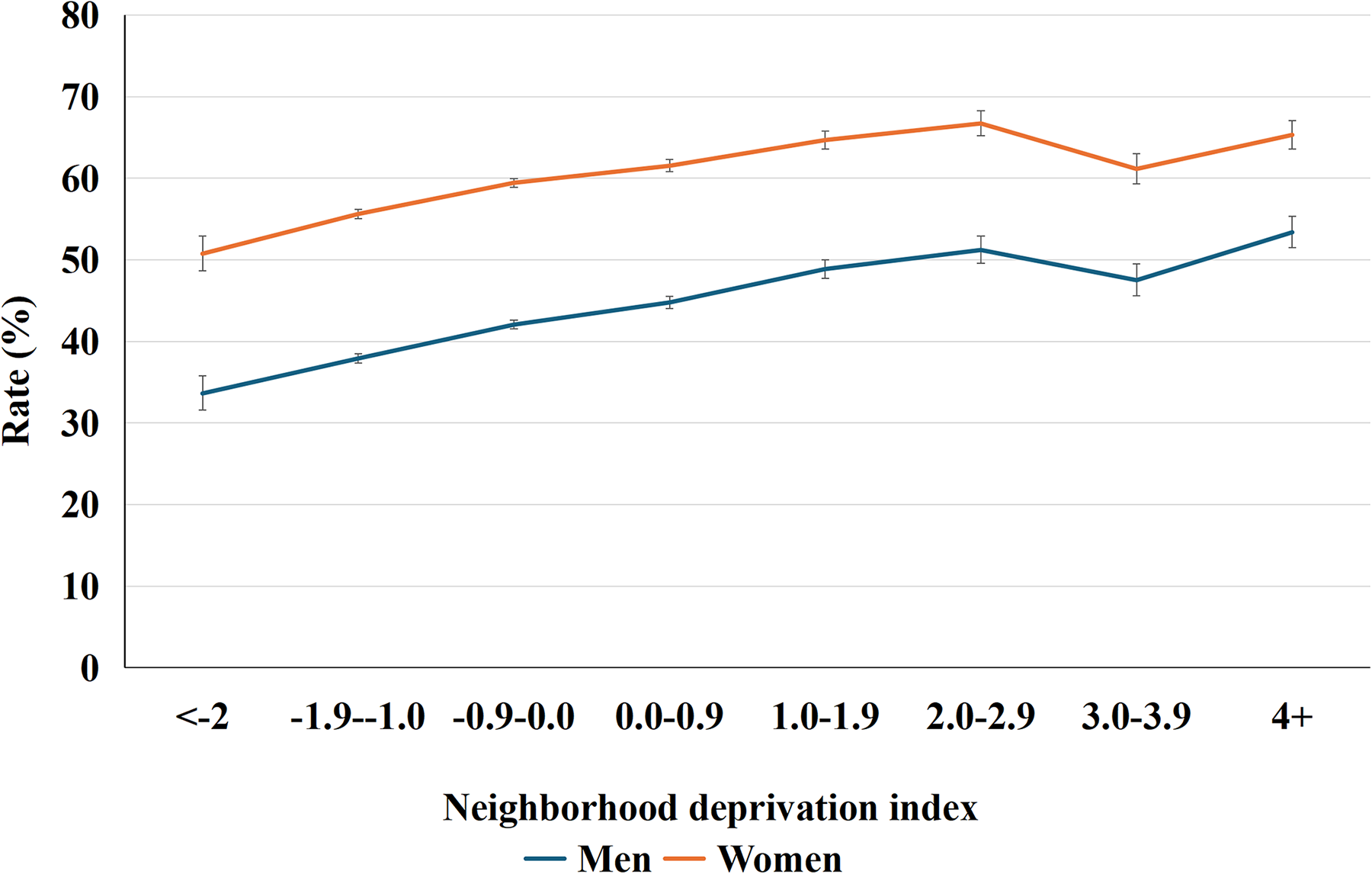
Figure 2 illustrates the cumulative incidence of psychiatric disorders in male and female asthma patients across neighbourhood deprivation categories. Overall, incidence increased with higher levels of deprivation. Women consistently exhibited higher rates than men across all deprivation categories. The incidence was highest in the 2.0–2.9 category, declined slightly in the 3.0–3.9 category and increased again in the most deprived category (≥4).
Cumulative incidence of psychiatric disorders in male and female asthma patient across neighborhood deprivation categories.

Figure 2 Long description
Figure 2 plots cumulative incidence of psychiatric disorders per 100 persons against eight ordered neighborhood deprivation index bins (<−2, −1.9 – −1.0, −0.9 – 0.0, 0.0 – 0.9, 1.0 – 1.9, 2.0 – 2.9, 3.0 – 3.9, 4+). Overall, incidence increased with higher levels of deprivation. Women consistently exhibited higher rates than men across all deprivation categories. The incidence was highest in the 2.0–2.9 category, declined slightly in the 3.0–3.9 category, and increased again in the most deprived category (≥4).
Disorder-specific risks and sex-stratified associations in highly deprived areas
As summarized in Table 3, neighbourhood deprivation showed a clear and consistent association with an increased risk of multiple psychiatric disorders among individuals with asthma. Within the overall cohort, patients residing in highly deprived neighbourhoods exhibited markedly elevated hazards across several psychiatric categories. Specifically, the HRs were 2.82 (95% CI, 2.10–3.78) for developmental delay, 1.96 (95% CI, 1.29–2.98) for pervasive developmental disorder, 1.79 (95% CI, 1.45–2.22) for schizophrenia and 1.71 (95% CI, 1.62–1.80) for substance use disorders. In contrast, the risks for mood and neurotic disorders were more modest, with HRs ranging from approximately 1.1 to 1.3. When analyses were stratified by sex, distinct patterns emerged. Among men, the most pronounced associations in high-deprivation areas were observed for developmental delay (HR = 3.80, 95% CI = 2.30–6.28) and pervasive developmental disorder (HR = 2.80, 95% CI = 1.54–5.09). Women displayed a broadly similar trend but with slightly attenuated effect sizes, showing particularly elevated risks for developmental delay (HR = 2.37, 95% CI = 1.64–3.41), schizophrenia (HR = 1.77, 95% CI = 1.35–2.34) and substance use disorders (HR = 1.77, 95% CI = 1.64–1.90). Additional age-specific analyses are presented in Supplementary Table S6. Sensitivity analyses examining the association between neighbourhood deprivation and psychiatric disorders among asthma patients using different data sources are presented in Supplementary Table S7, and analyses applying 1-year and 5-year washout periods are presented in Supplementary Table S8.
Overall and sex-stratified HRs for neighbourhood deprivation and incident psychiatric disorder subtypes in asthma patients

Table 3 Long description
Table 3 reports fully adjusted hazard ratios (HRa) with 95% CIs for ten psychiatric disorder subtypes, comparing moderate and high with low deprivation (reference 1.00), separately for men, women and all participants; sex is adjusted in the All row. Subtypes: substance use disorders, schizophrenia, any mood disorder including bipolar, any neurotic disorder including anxiety, any eating disorder, nonorganic sleep disorders, emotionally unstable personality disorder, developmental delay, pervasive developmental disorder, ADHD. In the total group, high-deprivation HRs are strongest for developmental delay (2.82), pervasive developmental disorder (1.96), schizophrenia (1.79) and substance use disorders (1.71); several CIs cross 1.00 (eating disorder, emotionally unstable personality disorder, ADHD). Estimates are sex-stratified; developmental delay is highest in men (3.80) and women (2.37) at high deprivation.
a Fully adjusted.
b Sex was adjusted.
Discussion
In this large, nationwide cohort of over 390,000 individuals with asthma, we found that the risk of developing psychiatric disorders increased significantly with higher levels of neighbourhood deprivation. This association persisted after adjusting for individual-level socio-economic, demographic and clinical factors. Both men and women with asthma residing in highly deprived areas were at greater risk of psychiatric morbidity, and the magnitude of association varied across specific psychiatric disorder subtypes, with the highest HRs observed for developmental delay, pervasive developmental disorder, schizophrenia and substance use disorders. These findings should be interpreted in light of the Swedish social insurance context, where psychiatric disorders accounted for a large proportion of ongoing sickness or rehabilitation financial benefit cases in 2024 (54% among women and 41% among men) (Swedish Social Insurance Agency, 2025). While these figures are not population prevalence estimates, they indicate that psychiatric morbidity constitutes an important national public health issue and provide a useful benchmark for understanding the magnitude of the associations observed in our asthma cohort.
Our findings reinforce growing evidence that asthma is not only a chronic inflammatory airway condition but also closely linked to psychological comorbidity (Sockrider and Fussner, Reference Sockrider and Fussner2020). Previous studies have reported higher rates of anxiety, depression and psychotic disorders among asthma patients compared with the general population (Cazzola et al., Reference Cazzola, Rogliani, Ora, Calzetta and Matera2022; Ji et al., Reference Ji, López-de-Andrés, Jiménez-García, Maestre-Miquel, Zamorano-León, Scarano-Pereira, Fuentes-Alonso, Girón-Matute and de Miguel-Díez2022; Minhas et al., Reference Minhas, Chandan, Knibb, Diwakar and Adderley2025). This comorbidity likely reflects a complex interplay between chronic systemic inflammation, stress–response dysregulation and shared neuroimmune pathways. Furthermore, the psychosocial burden of living with a lifelong respiratory condition – including activity limitations, sleep disturbances and fear of exacerbations – can further amplify mental distress, leading to bidirectional worsening of asthma and mental health outcomes (Liu et al., Reference Liu, Plana-Ripoll, McGrath, Petersen, Dharmage and Momen2023).
Neighbourhood deprivation emerged as a critical contextual determinant of psychiatric morbidity among individuals with asthma. Patients living in socio-economically disadvantaged areas exhibited markedly higher risks of developing psychiatric disorders, even after accounting for individual-level socio-economic, demographic and clinical factors. This suggests that neighbourhood deprivation operates through both structural and biopsychosocial pathways, amplifying the vulnerability of asthma patients to psychological comorbidities. Structurally, deprived neighbourhoods are often characterized by poor housing, higher pollution exposure, reduced healthcare access and limited social support (Alegría et al., Reference Alegría, Alvarez, Cheng and Falgas-Bague2023). These factors may exacerbate asthma severity through increased allergen exposure and stress-induced immune dysregulation, indirectly contributing to psychiatric morbidity. Psychosocially, chronic exposure to financial strain, insecurity and social fragmentation may induce maladaptive stress responses and impair emotional regulation, further heightening mental health risks (Liu et al., Reference Liu, Plana-Ripoll, McGrath, Petersen, Dharmage and Momen2023; Conway et al., Reference Conway, Verdi, Kartha, Maddukuri, Anagnostou, Abrams, Bansal, Bukstein, Nowak-Wegrzyn, Oppenheimer, Madan, Garnaat, Bernstein and Shaker2024).
Sex-stratified analyses identified some descriptive differences in the observed patterns. Men showed numerically larger relative increases in psychiatric disorder risk with increasing deprivation, while women consistently had higher observed absolute incidence rates across deprivation categories. Given that the CIs overlapped substantially, these findings do not support strong claims of sex differences and should be interpreted with caution. Potential sex-related factors, including differences in stress perception, coping behaviours, healthcare utilization and hormonal or neuroimmune responses, may be relevant to deprivation-related psychiatric disorder risk, and warrant further investigation in adequately powered future studies (Chowdhury et al., Reference Chowdhury, Guntur, Newcomb and Wechsler2021).
Although developmental delay and pervasive developmental disorder are typically characterized as childhood-onset conditions (de Lima et al., Reference de Lima, Zuanetti, Nunes and Hamad2023; Knott et al., Reference Knott, Mellahn, Tiego, Kallady, Brown, Coghill, Williams, Bellgrove and Johnson2024), the observed higher risks among adults aged 25–64 years in this study do not necessarily indicate true new-onset cases. Instead, these findings likely reflect delayed diagnosis, under-recognition, and the cumulative effects of neighbourhood deprivation (Brugha et al., Reference Brugha, McManus, Bankart, Scott, Purdon, Smith, Bebbington, Jenkins and Meltzer2011; Kentrou et al., Reference Kentrou, de Veld, Mataw and Begeer2019; Hosozawa et al., Reference Hosozawa, Sacker, Mandy, Midouhas, Flouri and Cable2020). Individuals living in deprived areas often face barriers to early detection and access to neurodevelopmental or mental health services, leading to late identification of pre-existing conditions in adulthood. Moreover, chronic stress, limited educational and social support and persistent healthcare inequities may exacerbate latent neurodevelopmental vulnerabilities, resulting in a higher likelihood of being diagnosed later in life. In contrast, the elevated risks of schizophrenia and substance use disorders among individuals with asthma may share common biological and psychosocial mechanisms. Both asthma and schizophrenia are associated with systemic inflammation, oxidative stress and HPA axis dysregulation (Tamayo et al., Reference Tamayo, Osman, Schwartzer and Ashwood2024). Meanwhile, the psychosocial burden of chronic illness, particularly under conditions of socio-economic deprivation, may foster maladaptive coping strategies such as substance misuse (Alanazi et al., Reference Alanazi, Alqahtani, Alquaimi, Alotaibi, Algarni, Alonizi, Ismaeil, Gibson-Young and Jayawardene2023). Taken together, these findings suggest that neighbourhood deprivation may amplify the risk of severe psychiatric disorders in individuals with asthma through multiple pathways, including delayed diagnosis, chronic stress exposure and overlapping inflammatory and neurobiological mechanisms.
Together, these results indicate that neighbourhood deprivation not only acts as a contextual correlate of psychiatric risk but also interacts dynamically with biological, behavioural and environmental pathways intrinsic to asthma. Addressing these intertwined mechanisms requires integrated interventions that target both the social determinants of health and the shared pathophysiological processes linking respiratory and psychiatric disorders.
Strengths and limitations
This study should be interpreted in light of several limitations and strengths. First, the study was designed to examine variation in psychiatric disorder incidence according to neighbourhood deprivation within a nationwide cohort of individuals with asthma, rather than to compare asthma patients with individuals without asthma. Therefore, the findings should not be interpreted as indicating whether the observed associations are specific to asthma or differ from those in the general population. Second, information on several potentially relevant factors was unavailable, including individual lifestyle characteristics such as smoking, diet and physical activity, as well as detailed measures of asthma severity or progression. Moreover, healthcare utilization and medication for asthma or psychiatric conditions may lie on the causal pathway from neighbourhood deprivation to psychiatric disorders, potentially acting as mediating factors. As mediation analysis was not within the scope of this study, the direct and indirect effects of deprivation could not be disentangled. Future studies are warranted to explore these potential mechanisms. Third, because neighbourhood deprivation was assessed only at baseline and treated as time-fixed exposure, changes in neighbourhood environment due to residential mobility during follow-up were not captured. Using a single baseline measurement as a proxy for long-term exposure may have introduced exposure misclassification, which would likely be nondifferential and thus bias the observed associations towards the null. Fourth, as with all retrospective register-based studies, misclassification of diagnoses is possible, although the nationwide registers used in this study have generally high coverage and validity (Ludvigsson et al., Reference Ludvigsson, Andersson, Ekbom, Feychting, Kim, Reuterwall, Heurgren and Olausson2011). These limitations should be balanced against several important strengths. The nationwide cohort included nearly all asthma patients residing in Sweden during the study period, which enhances generalizability. The use of linked administrative registers with virtually complete coverage reduced recall and selection bias and enabled reliable longitudinal follow-up through the unique personal identification number. In addition, the use of small-area SAMS units provided a detailed characterization of neighbourhood deprivation, allowing us to capture local contextual differences relevant to psychiatric health.
Conclusions
This nationwide study shows a clear and graded increase in psychiatric morbidity among individuals with asthma living in more deprived neighbourhoods. The particularly elevated risks of developmental delay, pervasive developmental disorders, schizophrenia and substance use disorders underscore the importance of viewing asthma–psychiatric comorbidity through a broader structural and social lens. These findings highlight the need for integrated approaches that align respiratory and mental healthcare with policies addressing neighbourhood disadvantage, including enhanced screening, community-based mental health support and improvements to local environmental and social conditions. Such efforts may help mitigate the compounded vulnerabilities experienced by socio-economically disadvantaged asthma populations.
Supplementary material
The supplementary material for this article can be found at https://doi.org/10.1017/S2045796026101139.
Availability of data and materials
This study made use of several national registers, and owing to ethical concerns, data cannot be made openly available, and we are not allowed to share our data. Further information regarding the health registries is available from the Swedish National Board of Health and Welfare: https://www.socialstyrelsen.se/en/statistics-and-data/registers/ and Kristina Sundquist, co-author of this study and the one who holds the ethical permission for this study.
Acknowledgements
We gratefully acknowledge the Swedish National Board of Health and Welfare and Statistics Sweden for providing access to the nationwide registers used in this study, including the National Patient Register, the Total Population Register and the primary healthcare data covering nearly all Swedish healthcare regions. We also thank colleagues at the Center for Primary Health Care Research, Department of Clinical Sciences, Lund University, Malmö, and the University Clinic Primary Care, Skåne University Hospital, Region Skåne, for their support and valuable discussions.
Author contributions
Design: J.L. and X.L. Acquisition of data: K.S. and J.S. Statistical analysis and interpretation: X.L. Manuscript writing: J.L. Revision: all authors. Approval of the final text: all authors.
Financial support
Financial support for this work was provided via grants to K.S.: the Swedish Research Council and ALF funding from Region Skåne, and to J.L.: the Full-time Introduction of High-level Talents to Start Scientific Research Projects of Ningxia Hui Autonomous Region (2023BSB03046). The funders had no role in any aspect of the study, including study design and conduct, data handling (collection, management, analysis, interpretation), manuscript preparation, review, approval or the decision to submit the manuscript for publication.
Competing interests
None declared.
Ethical standards
This research received ethical approval from the Regional Ethical Review Board affiliated with Lund University in Sweden (2012/795). All procedures throughout the study adhered to the principles outlined in the Helsinki Declaration, as well as the specific guidelines approved by the review board. Notably, an explicit note was made that the acquisition of informed consent was not required for this study. In terms of its nature, this is a nationwide register-based research project, which utilizes pseudonymization for analysis.




 Open access

