Introduction
Aedes aegypti is the most bothering insect among mosquito species due to the vector of serious and some fatal viruses and diseases including dengue virus, yellow fever, dengue hemorrhagic fever, zika virus, arbovirus, and chikungunya. Dengue fever is considered to be endemic in more than 100 countries and spreading rapidly around the world including South-East Asia as a major affected region. The vaccination is not possible in developing countries against dengue disease due to high production cost plus the prevalence of more than one dengue virus strains i.e. DEN-I, DEN-II, DEN-III, and DEN-IV (Alsheikh et al., Reference Alsheikh, Daffalla, Noureldin, Mohammed, Shrwani, Hobani and Assiri2017; Koo et al., Reference Koo, Nasir, Hapuarachchi, Lee, Hasan, Ng and Khan2013). The vaccine for single serotype cannot diminish the risk of being infected with the other serotypes. High scale production of vaccines against all the serotypes at commercial level is a big challenge for economically poor countries (Alsheikh et al., Reference Alsheikh, Daffalla, Noureldin, Mohammed, Shrwani, Hobani and Assiri2017). Therefore, it can only be eliminated through controlling its vector, Ae. aegypti.
Although, mosquito control conducted through chemicals remains as one of the major elements for dengue control. However, use of chemicals has very little impact for long-term control of dengue. The application of pesticides causes environmental pollution due to non-biodegradable nature of synthetic compounds, as well as harmful to human being and other living beneficial species. More importantly it develops resistance in mosquitoes (Cheng et al., Reference Cheng, Bu, Tan, Wu, Li, Zhou and Shan2018; Ranian et al., Reference Ranian, Zahoor, Zahoor, Jabeen, Majeed, Zulhussnain, Riaz and Attaullah2021). Of considering these drawbacks, many other alternative control measures have been practiced including biological, cultural, and genetic control. Biological control is very slow and sometimes inefficient; while cultural control in areas with inadequate sanitation measures and due to public non-compliance becomes difficult. Hence, the genetic control strategy among the emerging control programs only poses a good choice given that this is environment friendly and considered safe to the non-target species.
The clustered regularly interspaced short palindromic repeats/CRISPR-associated sequence 9 (CRISPR/Cas9) system is initially the part of a naturally occurring, adaptive microbial immune system for defense against invading phages and other mobile genetic elements, which has been discovered later as a more efficient, easy to use, and target-specific genome editing tool as compared to other gene modification approaches in use (Quétier, Reference Quétier2016). Therefore, CRISPR-Cas9 has been successfully performed as a genome editing tool against different insect pests (Gratz et al., Reference Gratz, Cummings, Nguyen, Hamm, Donohue, Harrison and O'connor-Giles2013; Zhang et al., Reference Zhang, Aslam, Liu, Li, Huang and Tan2015; Bi et al., Reference Bi, Xu, Tan and Huang2016). Loss of function and gain of function studies have been designed in functional genomics using CRISPR-Cas9 in different model organisms (Liu et al., Reference Liu, Ma, Wang, Chang, Gao, Shi and Xia2014; Wang et al., Reference Wang, Zhang, Wang, Zhao, Zuo, Yang and Wu2016). CRISPR-Cas9 has been extensively employed in Drosophila melanogaster to investigate the genes of sex determination pathway (Li and Scott, Reference Li and Scott2016). Fifty-eight percent of protein's coding genes in Ae. aegypti have orthologues in D. melanogaster (Zhang et al., Reference Zhang, Klein and Nei2014). Subsequently, CRISPR/Cas9 mediated genetic manipulation was also achieved in Ae. aegypti and the Nix gene of M locus was reported as responsible for male-specific differentiation in this species (Dong et al., Reference Dong, Lin, Held, Clem, Passarelli and Franz2015; Aryan et al., Reference Aryan, Anderson, Biedler, Qi, Overcash, Naumenko and Tu2020; Turner et al., Reference Turner, Krishna, Van't Hof, Sutton, Matzen and Darby2018). The presence of Nix converts the splicing of downstream genes from female-specific to male-specific splicing (Hall et al., Reference Hall, Basu, Jiang, Qi, Timoshevskiy, Biedler, Sharakhova, Elahi, Anderson, Chen, Sharakhov, Adelman and Tu2015). The knockout and knock-in experiments using CRISPR/Cas9 for Nix gene produced feminized male (having female antennae and genitals) and female (with male genitalia), respectively (Hall et al., Reference Hall, Basu, Jiang, Qi, Timoshevskiy, Biedler, Sharakhova, Elahi, Anderson, Chen, Sharakhov, Adelman and Tu2015). Another gene myo-sex is reported on M locus, and absence of this gene produces the flightless males. Therefore, the introduction of only Nix in female embryo is not sufficient to produce both fertile and flying males (Aryan et al., Reference Aryan, Anderson, Biedler, Qi, Overcash, Naumenko and Tu2020). So, there is a need to explore other genes of sex determination pathway in Ae. aegypti.
Doublesex (dsx) and fruitless (fru) genes are the downstream key regulators of sex differentiation reported in D. melanogaster and mosquitoes including Ae. aegypti. dsx is a double switch gene which is spliced to produce both male and female-specific isoforms in coordination with the other regulatory genes (Herpin and Schartl, Reference Herpin and Schartl2015). Exon 4 of dsx is reported as a female-specific exon in D. melanogaster, while in mosquito species Culex quinquefasciatus and Anopheles gambiae, female-specific exon 5 is homologous to exon 4 of D. melanogaster. In Ae. aegypti, female-specific exon 5 of dsx is split into 5a and 5b, which produces two isoforms, one contains both 5a and 5b, and other contains only 5b (Salvemini et al., Reference Salvemini, Mauro, Lombardo, Milano, Zazzaro, Arcà, Polito and Saccone2011). The female lethality due to knockout of female isoform of dsx at larval stage is reported in Ae. aegypti, which suggests the knockout of intermediate upstream genes of dsx to convert female into male mosquito (Whyard et al., Reference Whyard, Erdelyan, Partridge, Singh, Beebe and Capina2015). The female-specific splicing of dsx is under the control of its upstream genes TRA/TRA2 and Sxl in D. melanogaster. Embryo-specific exon (E) and exon 4 of Sxl are responsible for the production of SXL protein, which later skips the male-specific exon during female-specific splicing in D. melanogaster (Zhang et al., Reference Zhang, Klein and Nei2014). As the elements of sex determination cascade in D. melanogaster are present in Ae. aegypti and Sxl gene has also been reported in this species (Zhang et al., Reference Zhang, Klein and Nei2014). Loss of function mutation in Sxl causes female lethality in D. melanogaster due to possible mis-regulation in dosage compensation. While in Ae. aegypti dosage compensation is not expected, as primary signal is different from D. melanogaster wherein heteromorphic (XY) sex chromosome is present; whereas, M factor located on M locus is a regulator for sex determination in Ae. aegypti (Hall et al., Reference Hall, Basu, Jiang, Qi, Timoshevskiy, Biedler, Sharakhova, Elahi, Anderson, Chen, Sharakhov, Adelman and Tu2015; Lucchesi and Kuroda, Reference Lucchesi and Kuroda2015; Kiuchi et al., Reference Kiuchi, Koga, Kawamoto, Shoji, Sakai, Arai, Ishihara, Kawaoka, Sugano, Shimada, Suzuki, Suzuki and Katsuma2014; Salz and Erickson (Reference Salz and Erickson2010); Timoshevskiy et al., Reference Timoshevskiy, Kinney, Debruyn, Mao, Tu, Severson, Sharakhov and Sharakhova2014).
The knockout of dsx (female isoform) produced female lethality instead of producing a sex reversal in Ae. aegypti (Whyard et al., Reference Whyard, Erdelyan, Partridge, Singh, Beebe and Capina2015). The intermediate upstream gene of dsx, the Sxl which is lethal in D. melanogaster was focused for knockout in order to find out whether the knockout of Sxl would cause lethality or otherwise. In the current study, the CRISPR Cas9 technique was employed to target the Sxl and dsx (female isoforms) in Ae. aegypti, to investigate the efficient intermediate upstream of dsx with the underlying objective of suppression of Ae. aegypti mosquito population in future through replacing the Ae. aegypti females to males. CRISPR Cas9-based knockout is very quick, precise, and easy to use among all recently available genome editing tools which could make it able to prioritize for the control of vector-borne diseases in future.
Materials and methods
Rearing of Ae. aegypti
Ae. aegypti mosquitoes were reared in insect cage using the protocol optimized by Zulhussnain et al. (Reference Zulhussnain, Zahoor, Rizvi, Zahoor, Rasul, Ahmad, Ranian and Jabeen2020) with 12 h day/night cycle under standard conditions (60 ± 10% RH and 26 ± 1°C) in Entomology Lab, Department of Zoology, Government College University Faisalabad. Grounded fish food and Purina cat food were used to feed newly hatched larvae and 5–8 days old larvae, respectively. After the development of larvae into pupae, tray was transferred into insect cage. An albino rat covered by a cage was left overnight in the insect cage to feed female adults Ae. aegypti, while male adults were fed on 10% sugar solution soaked in cotton.
Microinjection of Ae. aegypti embryos
After four days of blood feeding, female Ae. aegypti were collected from the insect cage and transferred into a small (500 ml) translucent jar with a small piece of wet cotton (soaked in distilled water) covered with a blotting paper. Jar was placed under insectary conditions until mosquitoes laid eggs. Eggs were collected from blotting paper and arranged in an anterio-posterior manner on a double sided sticky tape. All injection mixes were prepared along with the commercially obtained recombinant Cas9 protein (CP01, PNA Bio) (333 ng μl−1) and sgRNAs (each at 100 ng μl−1) following the protocol as described by Jasinskiene et al. (Reference Jasinskiene, Juhn and James2007). Injection mixes were injected into the posterior end of eggs as described by Lobo et al. (Reference Lobo, Clayton, Fraser, Kafatos and Collins2006), and eggs were placed under insectary condition at 26 ± 1°C, 60 ± 10% RH for hatching. One eighty eggs were used in three groups including Control 1, Control 2 (injected with distilled water) and CRISPR Cas 9 injected group (injected with Cas9 and sgRNAs). Each group was divided into three replicates. sgRNAs used to target AaeSxl and Aaedsx (female isoforms) are listed in Supplementary table 2.
DNA extraction
DNA extraction was performed as described by Zulhussnain et al. (Reference Zulhussnain, Zahoor, Rizvi, Zahoor, Rasul, Ahmad, Ranian and Jabeen2020). Ae. aegypti samples were homogenized in 300 μl lysis buffer (2 mM EDTA, 0.4 M NaCl, and 10 mM Tris-HCL pH 8.0), 20% SDS (sodium dodecyl sulfate) and 100 μl Proteinase K (100 mg μl). Homogenate was incubated at 55°C for 1 h and vortexed for a few seconds after adding 300 μl of 5 M NaCl. After centrifugation for 10 min at 13,000 rpm, ice cold ethanol was added in supernatant in its equal volume and kept at −20°C for 1 h to precipitate the DNA. After centrifugation the supernatant was discarded and DNA pellet was air dried and resuspended in D3H2O (Zahoor et al., Reference Zahoor, Suhail, Zahoor, Iqbal and Awan2013; Bibi et al., Reference Bibi, Zahoor, Zahoor, Ashraf, Majeed, Nasir and Rasool2015; Ashraf et al., Reference Ashraf, Zahoor, Nasir, Majeed and Zahoor2016). By using spectrophotometer of HITACHI, Japan with 260 nm wavelength of UV light, optical absorbance for each DNA sample was measured and DNA concentration was calculated as:
DNA Conc. μg μl−1 = dilution fold × absorbance at 260 nm
PCR amplification
PCR was carried out using primers (Supplementary table 1) to amplify the AaeNix gene for the identification of the sample, whether it is genetically a male or female (Hall et al., Reference Hall, Basu, Jiang, Qi, Timoshevskiy, Biedler, Sharakhova, Elahi, Anderson, Chen, Sharakhov, Adelman and Tu2015). Other mutations in AaeSxl and Aaedsx genes were diagnosed by using primers (Supplementary table 1). To evaluate the expression level of targeted genes, quantitative PCR (qPCR) was performed (SYBR green method) by using primers listed in table S3 (Supplementary material). The percent expression was calculated from average 2−ΔΔCT of triplicate (Schmittgen and Livak, Reference Schmittgen and Livak2008).
Data analysis
The survival rate was noted in all developmental stages, and percentage survival was calculated out of total used and hatched eggs. Mortality percentage for different genetic groups, generated by knockout and detected by PCR, was also calculated to explore what knockout is responsible for higher mortality and low survival. Data for both survival and mortality were subjected to ANOVA using Statistica 13.0 for Windows to calculate the mean percent (Sultana et al., Reference Sultana, Zahoor, Sagheer, Nasir, Zahoor, Jabeen and Bushra2016). The means were separated using Tuckey's HSD (Honest Significant Difference) test at a significance level of 0.05.
Results
Mean percent survival of different developmental stages of Ae. aegypti
Mean percent survival (out of total eggs used) in each experimental group
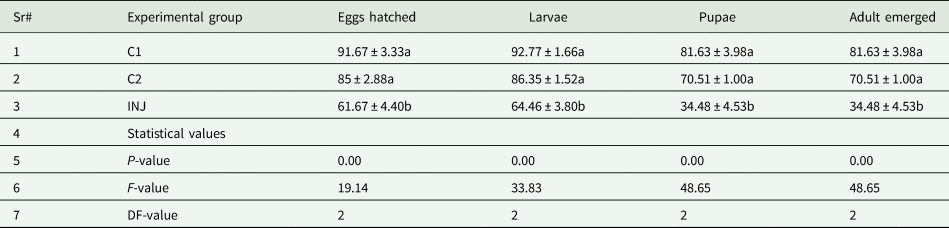
The injection mix (prepared for knockout of dsx and Sxl) was injected into the eggs of Ae. aegypti. The survival rate (for different stages of Ae. aegypti) was recorded and means percent survival was calculated along with the control groups, control 1 (C1) and control 2 (C2). The progression of one developmental stage into the next one was considered as a survival of previous stage; while the dead larvae or pupae were considered for mortality percentage and preserved for further genetic study. The mean of egg hatching percentage from CRISPR Cas9 injected group is shown in table 1. The egg hatching percentage was significantly low (61.67%) in CRISPR Cas9 injected group as compared to C1 (91.67%) and C2 (85%). The egg hatching percentage was statistically non-significant between both control groups C1 and C2 but significant to CRISPR Cas9 injected group (P-value 0.00). The mean percent survival of larvae hatched from CRISPR Cas9 injected group was 40%, significantly lower than C1 (85%) and C2 (73.33%). Pupae from CRISPR Cas9 injected group showed 21.66% survival rate against 75 and 60% in C1 and C2, respectively. The survival rate was decreased with the progression of one developmental stage into the next, while adult emergence rate was similar to the survival rate of pupae. The significant difference (P-value 0.00) was found in the survival rate of different developmental stages in CRISPR Cas9 injected group as compared to control groups (table 1).
Mean percent survival (out of total eggs used) in each experimental group

C1 (Control 1), C2 (Control 2), INJ (CRISPR Cas 9 + gRNAs injected group).
Mean percent survival (out of hatched eggs) in each experimental group
Egg hatching rate (out of hatched eggs in each group C1, C2, and CRISPR Cas 9 injected group) was calculated as 91.67, 85, and 61.67%, respectively. Percent survival of larvae, pupae, and adults (out of these hatched eggs) was calculated for each group separately. The mean percent survival of larvae in CRISPR Cas9 injected group was low (64.46%) as compared to C1 (92.77%) and C2 (86.35%). CRISPR Cas9 injected group showed significantly lower survival of pupae (34.48%) as compared to C1 (81.63%) and C2 (70.51%). Similar to mean percentage of survival (out of all eggs), significant difference was found in survival (out of hatched eggs) between CRISPR Cas 9 injected group and control groups with P-value (0.00). In addition, the decrease in survival rate from one developmental stage to the next was also recorded in both experimental and control groups (table 2).
Mean percent survival (out of hatched eggs) in each experimental group

C1 (Control 1), C2 (Control 2), INJ (CRISPR Cas 9 + gRNAs injected group).
Mean percent survival of different developmental stages of Ae. aegypti in different PCR-based genetic groups
Mean percent survival (out of total eggs used) in different PCR-based genetic groups
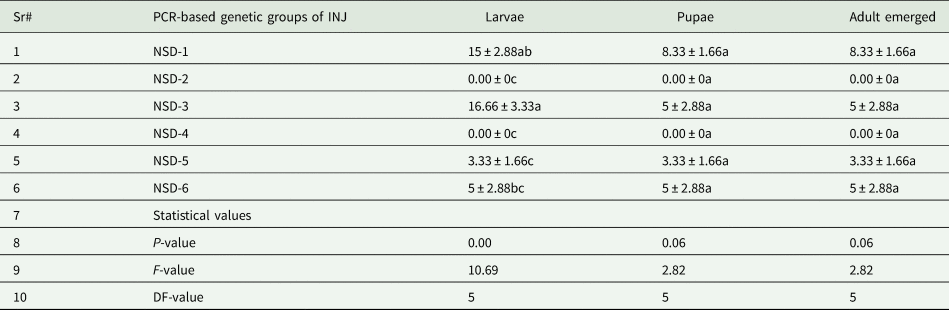
The adults were used for genetic analysis by PCR to investigate the targeted genes (fig. 1). The size of amplification was compared with control group. The smaller size due to deletion was dissimilar to control group (not shown in figure). During genetic analysis of different developmental stages, six different groups were obtained including NSD-1 (Nix + + Sxl + + dsx +), NSD-2 (Nix − + Sxl − + dsx −), NSD-3 (Nix − + Sxl + + dsx +), NSD-4 (Nix − + Sxl + + dsx −), NSD-5 (Nix + + Sxl− + dsx −), and NSD-6 (Nix + + Sxl + + dsx −). Positive and negative symbol on top right of the gene shows the presence (similar size to control) or absence (dissimilar smaller size to control) of that gene on PCR amplification after knockout. The survival rate (out of total eggs) of different developmental stages in different PCR-based genetic groups is shown in table 3. The highest adult emergence (8.33%) was shown by NSD-1 followed by NSD-3 (5%), NSD-5 (3.33%), and NSD-6 (5%). The non-significant survival rate was observed between different genetic groups (P-value 0.06). Pupae showed similar survival rate to adults in different genetic groups. The survival rate was significantly different between different genetic groups of larvae (P-value 0.00). The highest survival was shown by larvae of NSD-3 (16.66%) followed by NSD-1 (15%), NSD-6 (5%), and NSD-5 (3.33%), while 0.00% survival was observed in NSD-2 and NSD-4 (table 3).
PCR result showing the amplification of targeted genes and non-target AaeNix in adults emerged; smaller size (due to deletion) is cropped to avoid confusion in panel. WT = (wild-type); lane 1, 3, 4, 8, and 10 = (NSD-1); lane 5, 7, and 12 = (NSD-3); lane 2 and 11 = (NSD-5); lane 6, 9, and 13 = (NSD-6).

Mean percent survival (out of total eggs used) in different PCR-based genetic groups of different developmental stages

INJ (CRISPR Cas 9 + gRNAs injected group), NSD-1 (Nix + + Sxl + + dsx +), NSD-2(Nix − + Sxl − + dsx −), NSD-3 (Nix − + Sxl + + dsx +), NSD-4 (Nix − + Sxl + + dsx −), NSD-5(Nix + + Sxl − + dsx −), NSD-6(Nix + + Sxl + + dsx −).
Mean percent survival (out of hatched eggs) in different PCR-based genetic groups
The highest adult emergence (13.34%) was shown by NSD-1 followed by other PCR-based genetic groups NSD-3 (7.93%), NSD-5 (5.41%), and NSD-6 (7.79%), while adult emergence in NSD-2 and NSD-4 was (0.00%). Pupal survival rate was similar to adult emergence, and both developmental stages showed non-significant survival rate between different genetic groups (P-value 0.056). The highest survival (27.20%) was shown by NSD-3 larvae, statistically non-significant to NSD-1 (24.17%), while NSD-5 showed significantly low survival (5.16%) to both NSD-1 and NSD- 3, but non-significant to NSD-6 (7.93%). No surviving larva was found in NSD-2 and NSD-4 (table 4).
Mean percent survival (out of hatched eggs) in different PCR-based genetic groups of different developmental stages

INJ (CRISPR Cas 9 + gRNAs injected group), NSD-1 (Nix + + Sxl + + dsx +), NSD-2(Nix − + Sxl − + dsx −), NSD-3 (Nix − + Sxl + + dsx +), NSD-4 (Nix − + Sxl + + dsx −), NSD-5(Nix + + Sxl − + dsx −), NSD-6(Nix + + Sxl + + dsx −).
Mean percent mortality of different developmental stages of Ae. aegypti
Mean percent mortality (out of total eggs used) in each experimental group
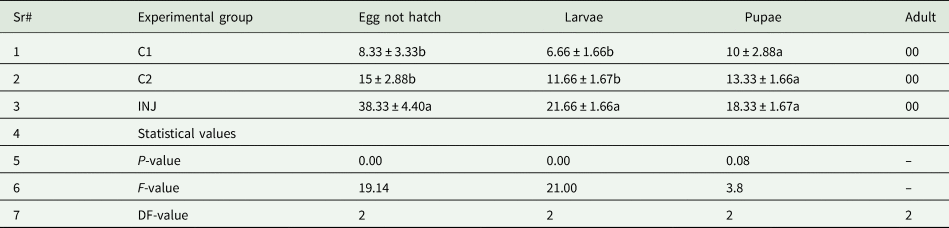
Mean percent mortality (out of total eggs used) in different stages of Ae. aegypti in control groups (C1 and C2) and CRISPR Cas9 injected group is shown in table 5. In CRISPR Cas9 injected group, significant percentage (38.33%) of eggs failed to hatch as compared to C1 (8.33%) and C2 (15%). Both control groups showed statistically non-significant mortality of eggs. The larval mortality was 21.66% in CRISPR Cas9 injected group followed by 6.66 and 11.66% in C1 and C2, respectively. The larval mortality was significantly higher in CRISPR Cas9 injected group as compared to control groups (P-value 0.00). The non-significant pupal mortality was observed in both control groups as well as in CRISPR Cas9 injected group with the mean percentage of 10, 13.33, and 18.33% in C1, C2, and CRISPR Cas9 injected group, respectively (table 5).
Mean percent mortality (out of total eggs used) in each experimental group

C1 (Control 1), C2 (Control 2), INJ (CRISPR Cas 9 + gRNAs injected group).
Mean percent mortality (out of hatched eggs) in each experimental group
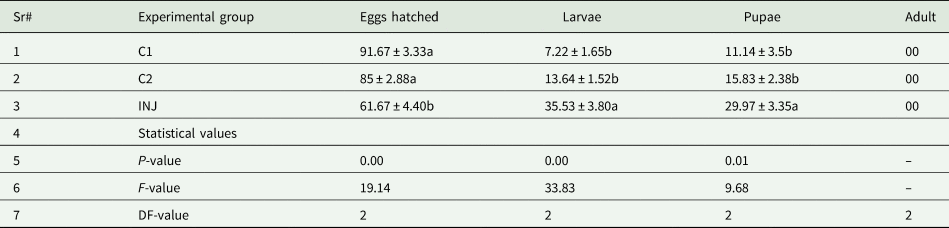
Mortality (out of hatched eggs) was also recorded and mean of percent mortality is given in table 6. The egg hatching percentage was 91.67, 85, and 61.67% in C1, C2, and CRISPR Cas9 injected group, respectively. Out of these hatched eggs, 35.53% larval mortality was observed in CRISPR Cas9 injected group as compared to C1 (7.22%) and C2 (13.64%). The highest pupal mortality (29.97%) was observed in CRISPR cas9 injected group followed by 11.14 and 15.83% in C1 and C2, respectively. The larval and pupal mortality was significantly higher in CRISPR cas9 injected group as compared to C1 and C2 with P-value 0.00 and 0.01, respectively (table 6).
Mean percent mortality (out of hatched eggs) in each experimental group

C1 (Control 1), C2 (Control 2), INJ (CRISPR Cas 9 + gRNAs injected group).
Mean percent mortality of different developmental stages of Ae. aegypti in different PCR-based genetic groups
Mean percent mortality (out of total eggs used) in different PCR-based genetic groups
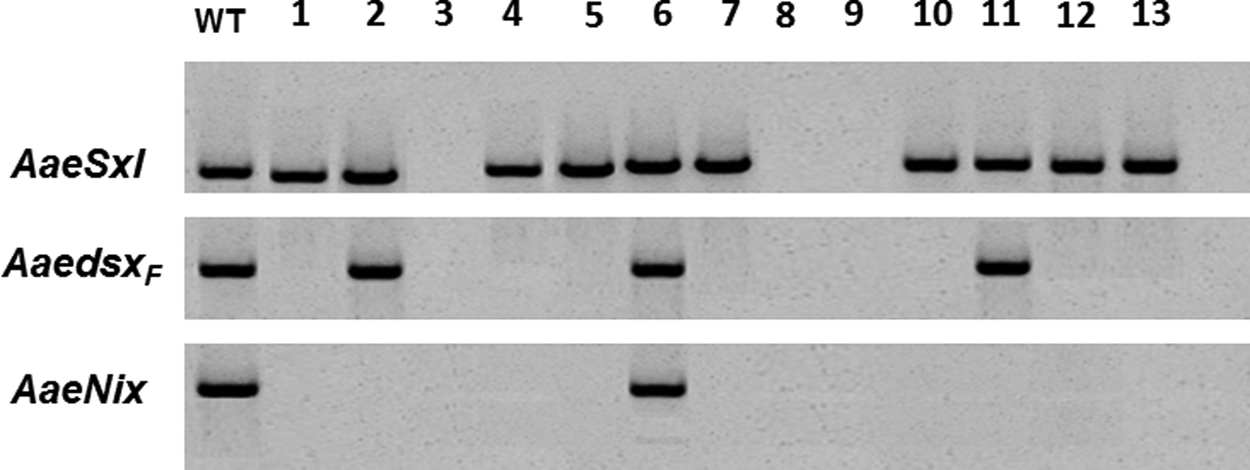
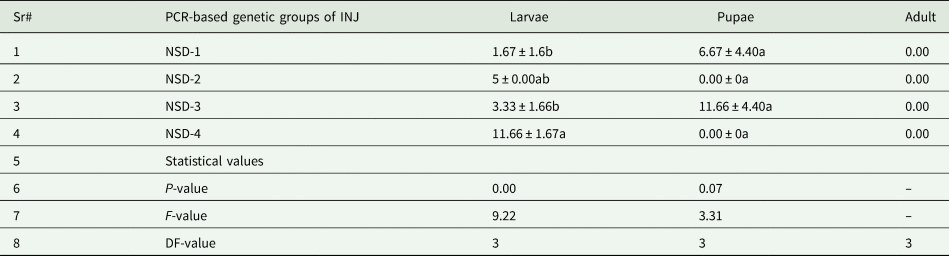
PCR was performed upon dead samples of larvae to detect the mutation in targeted genes (dsx and Sxl). PCR for the presence or absence of Nix was also performed to genetically identify the males and females at larval stage. As Nix is a key regulator for the development of male Ae. aegypti mosquito (Hall et al., Reference Hall, Basu, Jiang, Qi, Timoshevskiy, Biedler, Sharakhova, Elahi, Anderson, Chen, Sharakhov, Adelman and Tu2015). All the dead larvae were grouped on the basis of amplification of targeted genes (fig. 2 and table 7). Four types of dead larvae were observed including NSD-1 (Nix+ + Sxl+ + dsx+), NSD-2 (Nix− + Sxl− + dsx−), NSD-3 (Nix− + Sxl+ + dsx+), and NSD-4 (Nix− + Sxl+ + dsx−). The highest larval mortality (11.66%) was shown by NSD-4 followed by NSD-2 (5%), NSD-3 (3.33%), and NSD-1 (1.67%). The significant larval mortality was observed in NSD 4 (P-value 0.00) as compared to NSD-1 and NSD-3, while the statistically non-significant pupal mortality was shown by NSD-1 (6.67%) and NSD-3 (11.66%) (table 8).
PCR results showing the amplification of targeted genes and non-target AaeNix in dead larvae; smaller size (due to deletion) is cropped to avoid confusion in panel. WT = (wild-type); lane 6 = (NSD-1); lane 3, 8, and 9 = (NSD-2); lane 2, 11 = (NSD-3); 1, 4, 5, 7, 10, 12, 13 = (NSD-4).

Summary for pattern of PCR bands for amplification of different genes in dead larvae

*Amplified gene ( + ), non-amplified gene (−).
Mean percent mortality (out of total eggs used) in different PCR-based genetic groups of different developmental stages

INJ (CRISPR Cas 9 + gRNAs injected group), NSD-1 (Nix + + Sxl + + dsx +), NSD-2(Nix − + Sxl − + dsx −), NSD-3 (Nix − + Sxl + + dsx +), NSD-4 (Nix − + Sxl + + dsx −).
Mean percent mortality (out of hatched eggs) in different PCR-based genetic groups
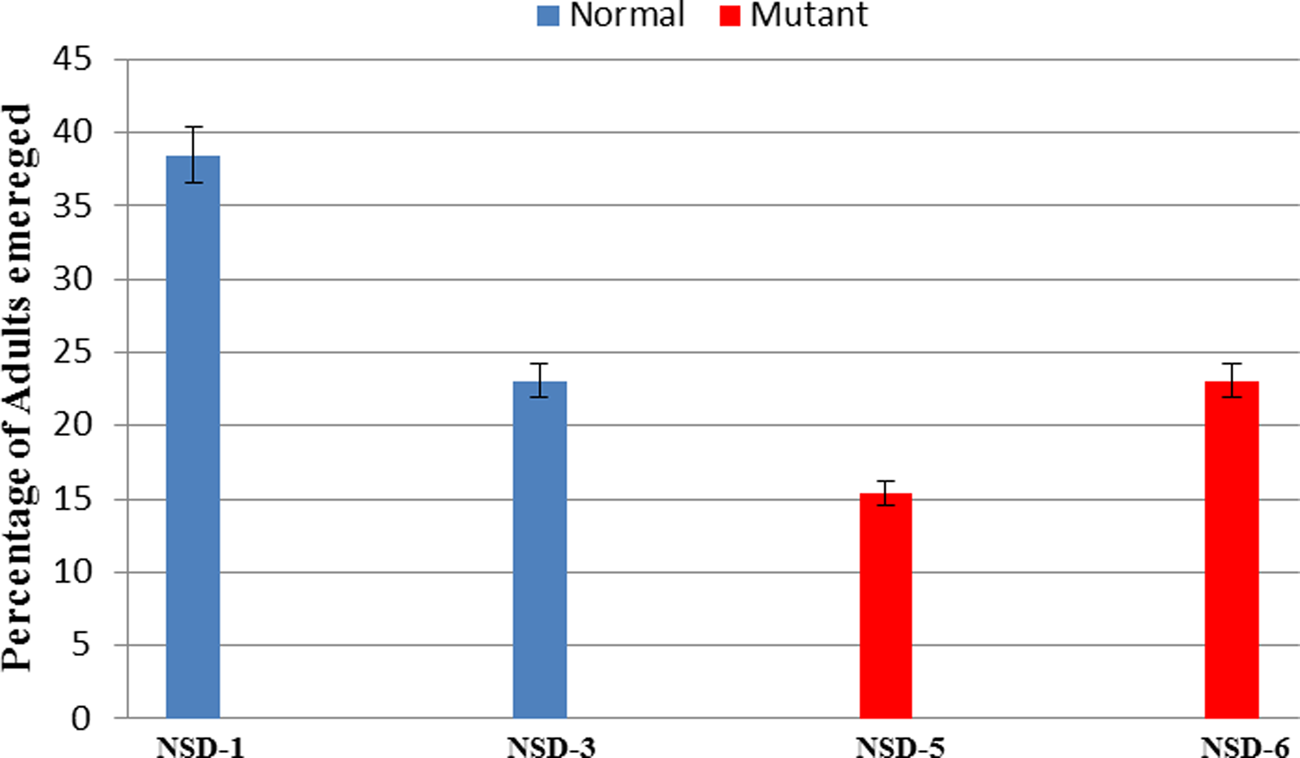
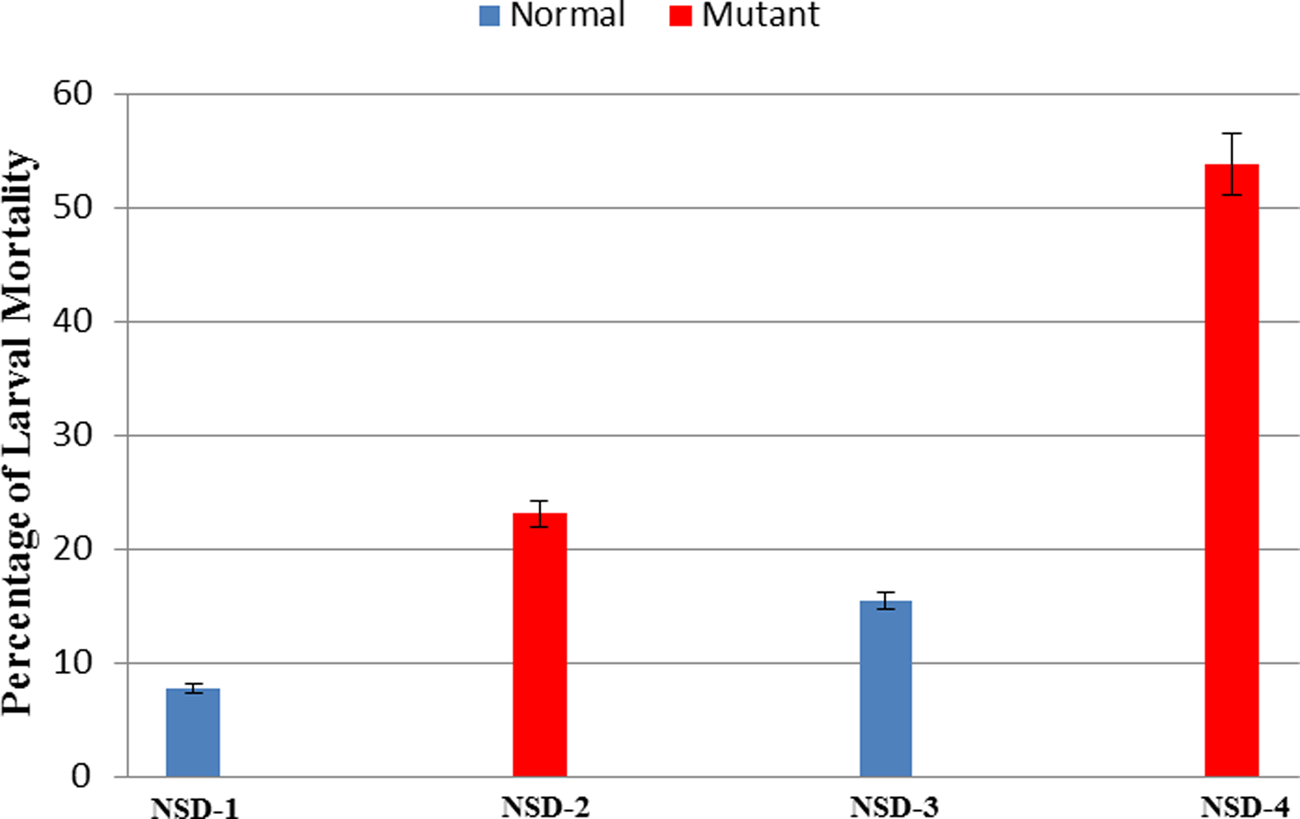
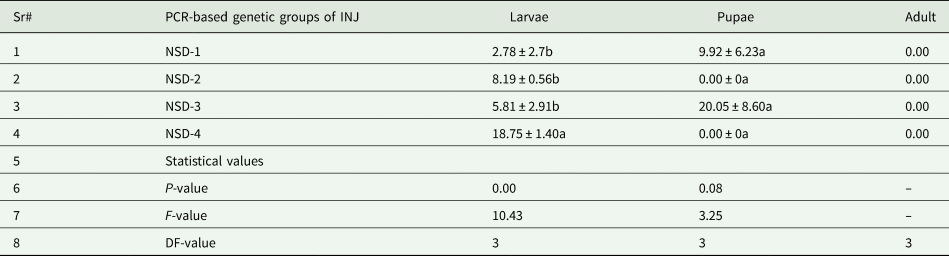
The percentage of larval and pupal mortality (out of hatched eggs) in four different PCR-based genetic groups was calculated and results are shown in table 9. The significant different results were observed between different PCR-based genetic groups of larvae, while the non-significant results were shown by pupae with P-value 0.00 and 0.08, respectively. The significantly highest larval mortality (18.75%) was shown by NSD-4 followed by NSD-2 (8.19%), NSD-3 (5.81%), and NSD-1 (2.78%) with P-value (0.00). The highest pupal mortality (20.05%) was observed in NSD-3 followed by NSD-1 (9.92%) with P-value (0.08) (table 9). Moreover, NSD-1 showed highest percentage of adult emergence (out of total adult emergence) and lowest larval mortality (out of total larval mortality) as compared to other groups (figs 3 and 4).
The percent adults emerged in each PCR-based genetic groups out of all adults emerged. NSD-1 (Nix + + Sxl + + dsx +), NSD-3 (Nix − + Sxl + + dsx +), NSD-5 (Nix + + Sxl − + dsx −), NSD-6 (Nix + + Sxl + + dsx −).

The percent larval mortality in each PCR-based genetic groups out of all dead larvae. NSD-1 (Nix + + Sxl + + dsx +), NSD-2(Nix − + Sxl − + dsx −), NSD-3 (Nix − + Sxl + + dsx +), NSD-4 (Nix − + Sxl + + dsx −).

Mean percent mortality (out of hatched eggs) in different PCR-based genetic groups of different developmental stage

INJ (CRISPR Cas 9 + gRNAs injected group), NSD-1 (Nix + + Sxl + + dsx +), NSD-2(Nix − + Sxl − + dsx −), NSD-3 (Nix − + Sxl + + dsx +), NSD-4 (Nix − + Sxl + + dsx −).
qPCR-based expression level of dsx and Sxl in mutant Ae. aegypti
qPCR was performed to evaluate the efficiency of CRISPR-Cas9 mediated mutation in Sxl and dsx by expression level of these targeted genes. Cycle threshold (Ct) values were measured and results were normalized to the housekeeping ribosomal protein S7 (RpS7). The highly significant reduction in the expression level of dsx (female isoforms F1 and F2) and Sxl was observed in mutants as compared to wild-type females (figs 5 and 6). These results showed efficiency of CRISPR-Cas9 and its target specificity driven through gRNAs directions.
The relative expression level of both female isoforms (F1 and F2) detected with qPCR for Aeadsx mutant as compared to the control (wild-type). Results are displayed as (mean ± SE); asterisks show (P-value 0.00).

A significant reduction of Sxl expression, detected with qPCR in mutant as compared to control (wild-type). Results are displayed as (mean ± SE); asterisks show (P-value 0.00).

Discussion
The present study was designed to knockout the genes involved in sex determination pathway and to investigate the effect of knockout on the survival of different developmental stages of Ae. aegypti. The eggs were injected with CRISPR Cas9 injection mix along with gRNAs, to target Sxl and dsx genes. Results showed that injection of CRISPR Cas9 injection mix with gRNAs decreased the survival rate of different developmental stages of Ae. aegypti. PCR was performed for genetic analysis and to investigate whether this low survival is due to the knockout of the target gene. Genetically different adults were obtained in four different PCR-based genetic groups viz., NSD-1 (Nix + + Sxl + + dsx +), NSD-3 (Nix − + Sxl + + dsx +), NSD-5(Nix + + Sxl − + dsx −), and NSD-6(Nix + + Sxl + + dsx −). Results showed statistically non-significant differences between the adults of deletion mutant groups (NSD-5 and NSD-6) and normal groups (NSD-1 and NSD-3). While no adult was found in NSD-2 and NSD-4; therefore, the data of larval and pupal mortality were used to analyze the difference in mortality rates between different experimental groups. In contrast to survival rate, highest larval (21.66%) and pupal mortality (18.33%) was observed in CRISPR Cas 9 injected group as compared to C1 and C2. In addition, 38.33% eggs did not hatch in CRISPR cas9 injected group, and this failure to hatching was significantly lower in C1 and C2. The mortality was significant in egg and larval stages but non-significant in the pupa stage between different experimental groups. Among all PCR-based genetic groups, the significant highest mortality (11.66%) was shown by NSD-4 larvae and 5% by NSD-2 larvae, unlike the survival rate which was lowest (0.00%) in these groups. The pupal mortality was statistically non-significant between different genetic groups with P-value 0.07, while 6.67 and 11.66% mortality was shown by NSD-1 and NSD-3 pupae, respectively. The pupae in NSD-1 and NSD-3 were genetically normal as both gave amplification of targeted genes Sxl and dsx. The non-significant difference of mortality between NSD-1 and NSD-3 pupae might have been due to some pleiotropic effect but the non-significant mean mortality between different experimental groups at pupal stage showed that this mortality could be induced by some other physical factors which have affected the control groups too. All the dead larvae of NSD-2 and NSD-4 did not show PCR band amplification for target sites (Sxl and dsx) and (only dsx), respectively, while Nix already been reported as the male determining factor was also absent in these larvae, which indicates their femaleness (Hall et al., Reference Hall, Basu, Jiang, Qi, Timoshevskiy, Biedler, Sharakhova, Elahi, Anderson, Chen, Sharakhov, Adelman and Tu2015; Turner et al., Reference Turner, Krishna, Van't Hof, Sutton, Matzen and Darby2018; Aryan et al., Reference Aryan, Anderson, Biedler, Qi, Overcash, Naumenko and Tu2020). Similarly, the lethality of female at larval stage due to knockout of dsx (female isoform) is also reported (Whyard et al., Reference Whyard, Erdelyan, Partridge, Singh, Beebe and Capina2015). Although PCR band for Sxl was absent along with dsx in dead larvae of NSD-2, this mortality was statistically non-significant to genetically normal groups NSD-1 and NSD-3 (showing amplification of target genes). The larval mortality in NSD-4 (with absence of band for dsx target site) was significantly higher as compared to other groups suggesting thereby that larval mortality in NSD-2 and NSD-4 would be due to dsx knockout, which is already supported by Whyard et al. (Reference Whyard, Erdelyan, Partridge, Singh, Beebe and Capina2015). However, among adults which emerged, 5% males of NSD-6 did not show bands for dsx only, which showed that the knockout of dsx (female isoform) does not cause male lethality (tables 3, 10 and fig. 1). The highest adult emergence and lowest larval mortality was found in NSD-1, while highest mortality in CRISPR Cas9 injected group was observed in larval stage as compared to other developmental stages, and highest larval mortality was observed in NSD-4 (knockout for dsx) among all PCR-based genetic groups. Furthermore, all the larvae in NSD-4 did not develop into pupae or adult female, which reveals that all females in this genetic group died in larval stage. This lethality might be due to the presence of TRA/TRA2 binding sites in Ae. aegypti reported at female-specific exon 5 of dsx homologous to the female-specific exon 4 of dsx in D. melanogaster (Salvemini et al., Reference Salvemini, Mauro, Lombardo, Milano, Zazzaro, Arcà, Polito and Saccone2011; Price et al., Reference Price, Egizi and Fonseca2015; Herpin and Schartl, Reference Herpin and Schartl2015). In NSD-5 group, 3.33% male adults did not show PCR bands for Sxl and dsx. In contrast to present study, lethality in D. melanogaster is reported due to loss of function mutation in sxl gene which in fact, regulates the dosage compensation in D. melanogaster (Villa et al., Reference Villa, Forné, Müller, Imhof, Straub and Becker2012; Lucchesi and Kuroda, Reference Lucchesi and Kuroda2015). While the dosage compensation is absent in Ae. Aegypti, the mutant adult emergence in NSD-5 in the current study was statistically non-significant to genetically normal adults. It shows that the knockout of Sxl using CRISPR Cas9 does not cause lethality in Ae. aegypti. Moreover, the low expression of mutant genes in present study confirms the efficiency of CRISPR Cas9. So, based on these results along with the support of previous studies, it is suggested that CRISPR Cas9 can be used to knockout Sxl as an intermediate upstream of dsx. However, further study is needed to explore the most efficient target site of Sxl for sex transformation in Ae. Aegypti in order to devise its population suppression programs in future.
Summary for pattern of PCR bands for amplification of different genes in adults emerged.

*Amplified gene ( + ), non-amplified gene (−).
Conclusions
Based on the current results and with the support of previous studies, it is concluded that the knockout of female isoform of dsx induced mortality of female Ae. aegypti at larval stage (Salvemini et al., Reference Salvemini, Mauro, Lombardo, Milano, Zazzaro, Arcà, Polito and Saccone2011; Whyard et al., Reference Whyard, Erdelyan, Partridge, Singh, Beebe and Capina2015). As the most downstream gene, dsx is an endpoint effector of the sex determination pathway; so it is suggested to knockout its upstream gene, Sxl which is found as an intermediate upstream gene of dsx in D. melanogaster and also reported in Ae. aegypti (Zhang et al., Reference Zhang, Klein and Nei2014). The target-specific knockout of most efficient target site of Sxl using CRISPR Cas 9 system can make it the most efficient and effective upstream gene to target for efficient suppression of mosquito population through sex transformation in Ae. aegypti in future.
Supplementary material
The supplementary material for this article can be found at https://doi.org/10.1017/S0007485322000505
Data
The following information was supplied regarding data availability: the tables within the manuscript contain all the relevant data.
Acknowledgements
The facilities provided by the Department of Zoology, Government College University Faisalabad (GCUF) and US-Pakistan Center for Advance Studies in Agriculture and Food Security (USPCAS-AFS), University of Agriculture Faisalabad, Pakistan are highly acknowledged to conduct this research work.
Author contributions
Muhammad Zulhussnain designed and performed the experiments, analyzed the data, and wrote the manuscript. Dr Muhammad Kashif Zahoor supervised and helped in designing the experiments, statistical analysis of data, and approved the final manuscript. Kanwal Ranian helped in performing the experiments, arrangement of data, and reviewed the manuscript. Dr Aftab Ahmad and Dr Farhat Jabeen helped in reviewing, analysis, and gave input in preparing the manuscript.
Financial support
The authors received no funding for this work
Conflict of interest
None.