INTRODUCTION
The celebrated diary study of Amahl (Smith, Reference Smith1973) yielded the classic ‘puzzle–puddle–pickle’ problem, which has been central to a wide range of issues in theories of phonology and development. As the problem was originally described, it involved two interacting processes, namely Velarization and Stopping. The Velarization process changed a coronal stop to a velar before the liquid consonant /l/, e.g. target ‘puddle’ words were realized as [pʌɡ ]. ‘Pickle’ words conformed to the requirements of Velarization and remained unchanged. Velarization essentially merged the lingual place distinction before a liquid consonant in ‘puddle’ and ‘pickle’ words. The Stopping process replaced fricatives with a stop, e.g. target ‘puzzle’ words were realized as [pʌd]. Importantly, while target ‘puddle’ words did undergo Velarization, these processes interacted with one another such that ‘puddle’ words derived from Stopping were blocked from undergoing Velarization. This blocking interaction was achieved by ordering Velarization before Stopping in a counterfeeding relation as shown in (1), resulting in a chain shift.
(1) Attested counterfeeding interaction (Smith, Reference Smith1973)
UR /pʌzl/ ‘puzzle’ /pʌdl/ ‘puddle’ /pIkl/ ‘pickle’
Velarization – pʌɡl –
Stopping pʌdl – –
PR [pʌd
 ] [pʌɡ] [pIk]
This problem (and the associated interaction of these error patterns) has generated a host of ongoing questions, including, among others, the nature of children's underlying representations, the relationship between perception and production, the cause of overgeneralization errors, the learnability of such generalizations, and the proper characterization of these interactions (e.g. Dinnsen, Reference Dinnsen, Dinnsen and Gierut2008b; Dinnsen, O'Connor & Gierut, Reference Dinnsen, O'Connor and Gierut2001; Fikkert, Reference Fikkert2006; Macken, Reference Macken1980; McCarthy, Reference McCarthy2002; Reference McCarthy2007). Surprisingly, however, an important aspect of this problem that has not yet been considered is whether these same two processes can interact in the other ways predicted by current theories of phonology. More specifically, these processes have the potential to interact in two ways other than a counterfeeding relation. One of the typologically predicted possibilities would be to reverse the order of the two rules to yield a feeding interaction as in (2). The prediction would be that ‘puzzle’ words would undergo Stopping and merge with ‘puddle’ words, causing both types of words to then undergo Velarization to yield ‘pickle’ words.
(2) Predicted feeding interaction (unattested)
UR /pʌzl/ ‘puzzle’ /pʌdl/ ‘puddle’ /pIkl/ ‘pickle’
Stopping pʌdl – –
Velarization pʌɡl pʌɡl –
PR [pʌɡ
] [pʌɡ] [pIk]
Interestingly, no evidence has ever been presented that Amahl or any other child exhibited a feeding interaction between these two processes. This is unexpected because feeding interactions are quite common in fully developed languages and are thought to reflect the relative unmarkedness characteristic of early phonological development (e.g. Smolensky, Reference Smolensky1996).
The other typological possibility is that these two processes might interact to yield what has been dubbed a ‘grandfather effect’ (McCarthy, Reference McCarthy2002). Such effects have been documented in fully developed languages and relate to a well-supported principle of Lexical Phonology (Kiparsky, Reference Kiparsky1982). The principle maintains that certain types of phonological processes apply exclusively to representations derived from other phonological or morphological processes. This would mean, in the case at hand, that we might expect ‘puzzle’ words that have undergone Stopping to be vulnerable to Velarization, yielding ‘pickle’ words as shown in (3). However, target ‘puddle’ words would be immune to Velarization because they would not have been derived from any other process and would, thus, be produced correctly. As with the other interaction types, ‘pickle’ words would also be produced correctly.
(3) Predicted grandfather effect (unattested)
UR /pʌzl/ ‘puzzle’ /pʌdl/ ‘puddle’ /pIkl/ ‘pickle’
Stopping pʌdl – –
Velarization pʌɡl – –
PR [pʌɡ
] [pʌd] [pIk]
Again, no evidence has been presented in the literature of a grandfather effect involving these two processes. This, too, is unexpected because grandfather effects for other processes have been documented in early phonological development (e.g. Dinnsen, Reference Dinnsen, Dinnsen and Gierut2008b, and references therein), and such effects are, without question, the backbone of fully developed languages (Kiparsky, Reference Kiparsky1982; McCarthy, Reference McCarthy2002).
The existence of the well-documented ‘puzzle–puddle–pickle’ counterfeeding interaction between Stopping and Velarization is anomalous in the absence of evidence of the other two typological possibilities. This is especially intriguing because both processes appear to be independent of one another and should be free to vary in their interactions to the full extent possible. The independence of Stopping is supported by its occurrence without Velarization, as demonstrated by those children who replace fricatives with stops but who also exclude velars from their phonetic inventories (e.g. Maxwell & Weismer, Reference Maxwell and Weismer1982). Similarly, Velarization can occur without Stopping, as evidenced by the fact that Velarization persisted in Amahl's grammar for nearly a year after Stopping was suppressed (Macken, Reference Macken1980). The fact that these error patterns do not seem to participate in a feeding interaction or a grandfather effect raises questions about whether this asymmetry is an accidental gap or a systematic peculiarity associated with these or other processes. This is an important typological issue because phonological theory must bring its predictions in line with the systematic occurrence and non-occurrence of such phenomena. Additionally, the available published studies of other interacting error patterns in early phonological development suggest that this observed anomaly may not be an isolated phenomenon limited to these error patterns or to chain shifts. In fact, we are not aware of a single developmental study that has attempted to document the full range of interactions for the same two error patterns. That is, while feeding interactions, counterfeeding interactions and grandfather effects have each been shown to occur for different pairs of error patterns in children's early phonological development, it has not yet been established, one way or the other, that those same pairs of error patterns participate in any of the other typologically predicted interactions.
This paper begins to address this issue by documenting the range of attested interactions for two additional independent and commonly occurring error patterns, namely Consonant Harmony and Deaffrication. These two error patterns were selected for consideration because they have the potential to interact in the three typologically expected ways described above, and because they share structural and functional similarities with the two error patterns of the ‘puzzle–puddle–pickle’ problem. The paper is organized as follows: after a brief description of the two error patterns of Consonant Harmony and Deaffrication, cross-sectional evidence will be presented establishing that this pair of error patterns interacted to the full extent possible. Those findings are then complemented by longitudinal evidence further instantiating the typology and revealing a characteristic trajectory of change from one interaction type to another leading to the suppression of one or both error patterns. The discussion considers the theoretical and clinical challenges posed by these facts and returns to the observed asymmetry of the ‘puzzle–puddle–pickle’ problem by suggesting a possible explanation for its anomalous behavior. The paper closes with a brief summary.
The error patterns of Consonant Harmony and Deaffrication
The error pattern of Consonant Harmony is commonly occurring in both typical and atypical phonological development (e.g. Bernhardt & Stemberger, Reference Bernhardt and Stemberger1998; Grunwell, Reference Grunwell1982; Ingram, Reference Ingram1989; Smith, Reference Smith1973; Vihman, Reference Vihman and Greenberg1978). In its most general form, this process results in non-adjacent consonants agreeing in place of articulation. Labial and/or velar consonants can trigger the spread of their place feature to preceding and/or following alveolar stops, resulting in place assimilation. For reasons that will become clear, we are limiting our attention to those cases of Consonant Harmony in which alveolar stops are replaced by a velar when followed later in the word by another velar (e.g. tiger realized as [kaIɡɚ]). We are excluding from consideration cases of Consonant Harmony which involve labial triggers or targets because the two types of assimilation can differ in their relative frequency of occurrence and their direction of assimilation, i.e. progressive versus regressive (e.g. Grunwell, Reference Grunwell1982; Pater & Werle, Reference Pater and Werle2003). The Consonant Harmony process of interest to us is similar to the Velarization process described above in that both involve regressive assimilation with a velar trigger and a coronal target.
The other error pattern of interest, namely Deaffrication, is also commonly occurring in both typical and atypical development (e.g. Bernhardt & Stemberger, Reference Bernhardt and Stemberger1998; Grunwell, Reference Grunwell1982; Ingram, Reference Ingram1989; Smit, Reference Smit1993; Smith, Reference Smith1973). This process replaces affricates with alveolar stops in one or more contexts (e.g. chew realized as [tu]). Deaffrication is similar to the Stopping process of the ‘puzzle–puddle–pickle’ problem in that it is a non-assimilatory neutralization process involving manner features. An informal schematization of these two processes is given in (4) in a rule-based format akin to that of Generative Phonology (e.g. Chomsky & Halle, Reference Chomsky and Halle1968). We have chosen to spell out the problem in rule-based terms simply for expository purposes; we will see, however, that the issues are relevant to other frameworks as well.
(4) Informal schematization of processes
Consonant Harmony:
(alveolar stops are realized as dorsals when followed by a non-adjacent velar consonant)Deaffrication:
(affricates are realized as alveolar stops in one or more environments)


These two error patterns have the potential to interact with one another in the three ways described above. This is most evident in the errored production of words that begin with an affricate and have a following non-adjacent velar (e.g. ‘chicken’ words). The three typologically expected interactions and their effects are illustrated in Table 1. As a result of a feeding interaction, the Deaffrication process might create alveolar stops which would then be subject to Consonant Harmony. This would, thereby, extend the Consonant Harmony seen in ‘tiger’ words (e.g. [kaIɡɚ]) to also affect a change in ‘chicken’ words (e.g. /ʧIkən/>[tIkən]>[kIkən]).
The other two potential types of interactions would have the opposite effect of limiting Consonant Harmony, but in different ways. The counterfeeding interaction would allow Deaffrication to affect both ‘chew’ words (e.g. [tu]) and ‘chicken’ words (e.g. [tIkən]), but Consonant Harmony would be prevented from operating on ‘chicken’ words. Consonant Harmony would instead be limited exclusively to ‘tiger’ words (e.g. [kaIɡɚ]). Importantly, alveolar stops derived from Deaffrication would be immune to Consonant Harmony. This would be comparable to the chain shift associated with the ‘puzzle–puddle–pickle’ problem.
Finally, if a grandfather effect were to occur, Consonant Harmony would affect a change in only those words that have undergone Deaffrication (e.g. ‘chicken’ words [kIkən]). The non-derived ‘tiger’ words (e.g. [taIɡɚ]) would be grandfathered, or protected, from undergoing Consonant Harmony and would, thus, be produced correctly. Naturally, if some other child were to produce ‘chicken’ words with an initial affricate, there would be no opportunity for these processes to interact. Similarly, if ‘chew’ words were produced with an initial affricate, there would be no evidence of an independent Deaffrication process, and ‘chicken’ words would thus be expected to be immune to Consonant Harmony.
Potential consequences of interactions: Deaffrication and Consonant Harmony

Given these two error patterns and their potential to interact in these three different ways, the task now is to determine whether the full range of interactions is attested. As we will see, one way to address this question is through a cross-sectional study of children who exhibit both error patterns.
Cross-sectional study
Participants and methods
The children who participated in this study were typically developing in all respects, except for evidence of a phonological delay. They scored within normal limits on all standardized tests of hearing, non-verbal intelligence, oral-motor structure and function, receptive vocabulary, and expressive and receptive language (for details, see Gierut, Reference Gierut, Dinnsen and Gierut2008b). However, all children also scored at or below the 5th percentile on the Goldman–Fristoe Test of Articulation (Goldman & Fristoe, Reference Goldman and Fristoe1986). This means that 95% of other children of the same age and gender as these participants had phonological systems that were more in keeping with the target phonology. Children with phonological delays were selected for study because they can offer a special window onto early phonological development. That is, the phonologies of children with phonological delays tend to resemble those of younger children with typical phonological development, and many of the research challenges that arise in working with younger children are avoided with the older children (Ferguson & Farwell, Reference Ferguson and Farwell1975). For example, because younger children have shorter attention spans and limited understanding of the structured elicitation tasks, it is often difficult to secure the type and amount of data needed to motivate phonological claims; older children with phonological delays do not present this problem.
The data were drawn from the Developmental Phonology Archive of the Learnability Project at Indiana University (Gierut, Reference Gierut, Dinnsen and Gierut2008b). The Archive includes an exhaustive compilation of data on the productive phonological development for 230 children. Moreover, the data were collected in a systematic, uniform manner, facilitating comparisons within and across children and over time. Claims about the children's phonologies were based on a comprehensive speech sample and standard phonological analysis procedures (Gierut, Reference Gierut, Dinnsen and Gierut2008b). The speech sample for each child was elicited in a spontaneous picture-naming task and was audio-recorded. The pictures related to a probe list of 544 words familiar to children of that age (Bird, Franklin & Howard, Reference Bird, Franklin and Howard2001; Gilhooly & Logie, Reference Gilhooly and Logie1980a; Reference Gilhooly and Logie1980b), which sampled the full range of English consonants in initial, medial and final positions in multiple exemplars. The recorded sessions were phonetically transcribed by a trained listener with 10% of all probes re-transcribed for reliability purposes by an independent judge. The overall transcription reliability measure was at or above 95% agreement for all phonologies utilized in this study, which is within the range of what is typically deemed acceptable (e.g. Shriberg & Lof, Reference Shriberg and Lof1991).
To establish a potential interaction between Deaffrication and Consonant Harmony, it was first necessary to identify those cases in which both processes co-occurred in a child's phonology. Our threshold criterion for claiming that a process was active was set at a minimum of 25% occurrence in relevant target words (e.g. McReynolds & Elbert, Reference McReynolds and Elbert1981; Pater & Werle, Reference Pater and Werle2003). If fewer than 25% of the relevant target words were affected by one of the two error patterns, that process was considered inactive (i.e. absent from the child's phonology). A value less than 25% would simply not generate enough words to be confident that a process was operative. In general, however, processes that were judged to be active in this particular study affected 82% or more of the relevant word types. Falling below the 25% occurrence criterion may, thus, more accurately reflect when the process became inactive or was lost from the grammar. Further requirements for identifying relevant cases for analysis were: (a) velar consonants had to occur in the phonetic inventory in order to provide a potential trigger for Consonant Harmony; (b) Deaffrication had to result in an alveolar stop; and (c) Consonant Harmony had to result in a velar consonant.
Based on the 544 probe items, it was possible to establish the proportion of ‘chew’, ‘tiger’ and ‘chicken’ words that were sampled and were relevant to the potential interactions of Deaffrication and Consonant Harmony. Specifically, the probe consisted of 35 ‘chew’ words (6%) relevant to Deaffrication alone, 20 ‘tiger’ words (4%) relevant to Consonant Harmony alone, and 9 ‘chicken’ words (2%) relevant to the applicability of both processes. Importantly, the distribution of word types that were sampled on this probe mirrored that of the target English language. This assessment was estimated on the basis of all 1,388 CVC words of the Hoosier Mental Lexicon (Nusbaum, Pisoni & Davis, Reference Nusbaum, Pisoni and Davis1984). Specifically, it was established that 67 items (5%) fit the description of ‘chew’ forms, 30 items (2%) fit the description of ‘tiger’ forms and 15 items (1%) fit the description of ‘chicken’ forms. Chi-square analysis revealed that the distribution of probe items by word type did not differ statistically from the distribution of those same word types as they occur in English (χ2(2)=0·48, p=0·79). Thus, the probe data examined herein reflected the lexically possible opportunities for error interactions in the input language, generally.
For the purposes of this study, the 230 phonologies from the Archive were examined to determine which met the operational definitions for inclusion of both processes. The requirement that a velar must occur in the phonetic inventory reduced the set of relevant cases to 151. From those, 12 presenting phonologies (approximately 8%) were found to exhibit both Deaffrication and Consonant Harmony. As might be expected, many other children exhibited one or the other of these two error patterns but not both, and some exhibited neither process, thereby attesting to the independence of these two particular processes. While the overall percentage might seem relatively small for the co-occurrence of these two error patterns, it should be kept in mind that our focus was intentionally narrow and specific to ensure that the error patterns were comparable and to avoid contamination from other potentially interacting processes. Ultimately, however, it was the typological characteristics of these cases that were of primary interest in this study. The actual percentage of relevant words affected by each active process was as follows: Consonant Harmony in ‘tiger’ words 82% and ‘chicken’ words 87%; Deaffrication in ‘chew’ words 88% and ‘chicken’ words 83%. It is important to note that those remaining words not affected by a process were not necessarily produced correctly, in fact, more often than not, those words were affected by other processes (e.g. Deletion, Debuccalization, Spirantization) not directly related to the two processes of interest in this study.
Results
On the basis of those 12 children who exhibited the co-occurrence of Deaffrication and Consonant Harmony, it was found that all three of the typologically expected interaction types were attested to varying degrees. The specifics follow for each interaction type.
Feeding interaction
A feeding interaction was evident in 8 of the 12 children's phonologies. The mean age of these children was 4 ; 2 (range 3 ; 0–5 ; 0). The forms in (5) from Child 142 (age 4 ; 4) exemplify the feeding interaction between Deaffrication and Consonant Harmony and are representative of the other children exhibiting this same interaction.
(5) Child 142 (4 ; 4): Presenting error patterns
a. Deaffrication
[tIn] ‘chin’ [dip] ‘jeep’
b. Consonant Harmony
[kaIɡoƱ] ‘tiger’ [ɡɔɡ] ‘dog’
c. Feeding interaction of Deaffrication and Consonant Harmony
[kIkIn] ‘chicken’ [kik] ‘cheek’
As the forms in (5a) show, this child replaced word-initial affricates with a simple alveolar stop in words in which Consonant Harmony was irrelevant. The other error pattern, Consonant Harmony, is exemplified in (5b) for words that are entirely independent of Deaffrication. These two independent error patterns also exhibited the feeding interaction in ‘chicken’ words, as shown in (5c).
There are several reasons for assuming that these two independent processes were both involved when affricates occurred in harmonizing contexts. The alternative assumption might have been that Consonant Harmony was a different, more general, process that directly targeted any coronal consonant when a velar consonant followed. The problem with such an assumption is that it must incorporate a Deaffrication process in the Consonant Harmony process, and it misses the generalization for these children that an independent Deaffrication process also occurred in the non-harmonizing context of ‘chew’ words. This point is reinforced by other cross-sectional studies which showed that, when Consonant Harmony appeared to target consonants that were more marked than alveolar stops (namely fricatives and/or affricates), those more marked sounds also tended to be vulnerable to error in other non-harmonizing contexts (e.g. Grunwell, Reference Grunwell1982; Ingram, Reference Ingram1989; Smith, Reference Smith1973; Vihman, Reference Vihman and Greenberg1978). These same studies have also shown that Deaffrication tends to persist in a child's grammar longer than Consonant Harmony. If our analysis is correct, we would predict that no child would exhibit Consonant Harmony in ‘chicken’ words without also evidencing Deaffrication in ‘chew’ words. This means, for example, that we would not expect to find a child who produced ‘chicken’ words as [kIkən] and ‘chew’ words as [ʧu]. It remains to be determined whether this prediction will continue to be borne out.
Counterfeeding interaction
The counterfeeding interaction between Deaffrication and Consonant Harmony was evident in the presenting phonologies of two children (mean age 4 ; 1, range 4 ; 0–4 ; 3). Representative data of the counterfeeding interaction are given in (6) from Child 5T. The forms in (6a) and (6b) establish that Deaffrication and Consonant Harmony were each independently occurring processes in this child's phonology. The counterfeeding interaction was evident in (6c) in that alveolar stops derived from Deaffrication did not undergo Consonant Harmony.
(6) Child 5T (4 ; 3): Presenting error patterns
a. Deaffrication
[dIp] ‘chip’ [du
] ‘juice’b. Consonant Harmony
[ɡʌk] ‘duck’ [ɡɔʷɡ] ‘dog’
c. Derived alveolar stops immune to Consonant Harmony
[dIkɨn] ‘chicken’ [dɔwk] ‘chalk’
 ] ‘juice’
Grandfather effect
The grandfather effect associated with the application of Deaffrication and Consonant Harmony was evident in 2 of the 12 pretreatment phonologies (mean age 3 ; 11, range 3 ; 8–4 ; 1).
The data in (7) from Child 162 (4 ; 1) illustrate the grandfather effect. More specifically, the forms in (7a) show that Deaffrication operated on words that could not be affected by Consonant Harmony. Comparing the forms in (7b) and (7c), we can see that Consonant Harmony affected only those words that were also vulnerable to Deaffrication; target alveolar stops were immune to Consonant Harmony (7c).
(7) Child 162 (4 ; 1): Presenting error patterns
a. Deaffrication
[dip] ‘jeep’ [doƱf] ‘juice’
b. Consonant Harmony in derived words
[kɔk] ‘chalk’ [kIkIn] ‘chicken’
c. Consonant Harmony blocked in non-derived words
[taIɡə] ‘tiger’ [dɔk] ‘dog’
Taken together, the above cases establish the typological fact that all three of the potential interaction types for Deaffrication and Consonant Harmony can and do occur. The nature of the evidence supporting this fact came from different children at a single point in time, namely prior to any clinical intervention. We cannot know from these facts alone how these interactions might have arisen or how they might change. The next section adds a longitudinal dimension to this study by analyzing the same children's phonologies based on subsequent speech samples gathered at multiple points in time over a period of several months. This longitudinal study should afford an opportunity to track changes, if any, in the interaction of these error patterns and discern whether there is a specifiable developmental trajectory.
LONGITUDINAL STUDY
Participants and methods
The children from the cross-sectional study also subsequently participated in one of several different clinical treatment experiments that were designed to modify their phonologies in particular ways. For a detailed description of general treatment procedures and experimental designs, see Gierut (Reference Gierut, Dinnsen and Gierut2008a; Reference Gierut, Dinnsen and Gierut2008b). The treatment that these children received and the subsequent monitoring of their individual phonologies afforded an opportunity to witness the changes, if any, in the interaction of these processes across multiple points in time. The intent of this longitudinal study was descriptive, aiming: (a) to document the trajectory of change associated with these error patterns for individual children, each of whom presented with one of the three interaction types; and (b) to extract observed commonalities, if any, in the children's phonological development. Because the nature of treatment and the selected treatment targets differed so widely across these children, it would not be possible to establish a cause–effect relationship between treatment and the children's learning patterns, at least as regards the error patterns of Deaffrication and Consonant Harmony. In fact, for all but two of the cases considered here (i.e. Child 142 and Child 195), treatment was designed to target error patterns other than Deaffrication and Consonant Harmony. The lack of a connection between these error patterns and the treatment targets in the larger set of studies should help to minimize any concerns that the learning patterns associated with these error patterns were related to the treatment. It could thus be argued that these cases offer an alternative view of what might represent a more naturalistic trajectory of change for these error patterns. However, even in the cases of Child 142 and Child 195, who presented with a feeding interaction and were treated on different aspects of Consonant Harmony, we will see that the resultant changes in their learning patterns were not appreciably different from those of the other children, at least as regards the error patterns of Deaffrication and Consonant Harmony.
The same methods, word lists and analysis procedures from the cross-sectional study were again employed for each sampling interval in the longitudinal study. The word lists were administered at five points in time: before treatment began, during treatment at the phase shift of instruction, immediately following treatment, at two or three weeks post-treatment, and finally at two months post-treatment. Again, our analyses were focused solely on the two error patterns of Deaffrication and Consonant Harmony, setting aside any other changes in the children's phonologies.
Results and general discussion
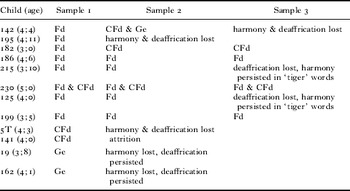
While all of the children in this longitudinal study shared the two processes of Deaffrication and Consonant Harmony prior to treatment, they differed in terms of how those processes interacted at that point in time. That is, they presented with at least one of the three possible interaction types (a feeding interaction, a counterfeeding interaction or a grandfather effect). A limited range of outcomes occurred from those interactions following the initiation of treatment. Table 2 summarizes the results from the longitudinal study by noting for each child the status of the error patterns and their interactions at three (of the five) sampling intervals. For completeness, Child 141 is also included in the table, but no information was available about his subsequent development because he attritioned from the study shortly after treatment began. The table also indicates the point at which one (or both) of the error patterns was lost, precluding an interaction. Blank cells indicate the absence of an interaction subsequent to the loss of one or both error patterns (or attrition in the case of Child 141). The first sampling interval represents the type of interaction observed in the cross-sectional study, prior to the initiation of any clinical manipulations. The second sampling interval refers to an intermediate point in time after treatment began, but not later than three weeks post-treatment. The particular intermediate interval represented in the table reports the first evidence of change, if any. If no change occurred during the intermediate interval, the status of the two processes was noted from the last post-treatment interval prior to the two-month post-treatment sampling point. The final sampling interval corresponds with the two-month post-treatment point in time.
Developmental trajectory of interactions
(Fd=Feeding, CFd=Counterfeeding, Ge=Grandfather effect)

Based on an inspection of Table 2, a number of general observations can be made about what did and did not occur longitudinally. One of the main points to be extracted from the table is that the changes that occurred were unidirectional and asymmetric. That is, counterfeeding interactions and grandfather effects emerge from some feeding interactions (Child 142 and Child 182). However, in no case did a feeding interaction emerge following the appearance of either a counterfeeding interaction or a grandfather effect. The feeding and counterfeeding interactions were the only interactions that persisted over time for any child (e.g. Child 186, feeding and Child 230, feeding and counterfeeding). On the other hand, children who exhibited a grandfather effect at any point generally lost one or both of the interacting error patterns at the next observation period (Child 19, Child 142 and Child 162).
As can also be seen in Table 2, some children exhibited the co-occurrence of two different interaction types at one or more points in time (Child 142 and Child 230). Variation associated with the co-occurrence of two different interactions is possible given that not all words of a particular type necessarily undergo a process, especially given the 25% criterion for judging a process to be active. The interaction types that co-occurred were limited to two of the three possibilities. That is, one of the attested options was for a counterfeeding interaction to co-occur with a grandfather effect, as seen in the case of Child 142 at the second sampling interval. Additionally, a feeding interaction and a counterfeeding interaction co-occurred in the case of Child 230 across the three sampling intervals. Importantly, however, a feeding interaction did not co-occur with a grandfather effect. The absence of this option is unexpected given that just 25% of both the ‘chicken’ words and the ‘tiger’ words would have had to exhibit Consonant Harmony with another 25% or more of the ‘tiger’ words being produced correctly.
Table 2 further shows that, after the first sampling interval, some children exhibited Consonant Harmony without Deaffrication (e.g. Child 125), and other children exhibited Deaffrication without Consonant Harmony (e.g. Child 162). These facts further support the independence of Deaffrication and Consonant Harmony. Finally, notice that some children lost both Consonant Harmony and Deaffrication at roughly the same time (e.g. Child 195).
Considering the occurrence/non-occurrence of the two error patterns and the various interaction types, there were at least six typological possibilities that could have been observed, all of which were attested at some point in the phonological development of these children. Those possibilities are summarized in (8).
(8) Attested typological possibilities
a. Neither Deaffrication nor Consonant Harmony occurred
(e.g. Child 5T, sample 2)
b. Deaffrication occurred without Consonant Harmony
(e.g. Child 19, sample 2)
c. Consonant Harmony occurred without Deaffrication
(e.g. Child 215, sample 3)
d. Deaffrication and Consonant Harmony co-occurred in a feeding interaction
(e.g. Child 142, sample 1)
e. Deaffrication and Consonant Harmony co-occurred in a counterfeeding interaction
(e.g. Child 5T, sample 1)
f. Deaffrication and Consonant Harmony co-occurred in a grandfather effect
(e.g. Child 162, sample 1)
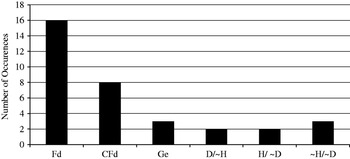
The markedness of these interactions might be discernable from the above facts if the prevalence of an interaction between two error patterns can be equated with its relative markedness. That is, the greater prevalence of an interaction would equal a less marked relationship. Figure 1 displays the number of each observed interaction type across the twelve children during the available intervals, following from Table 2. There were thirty-four possible sampling opportunities to make an observation about the occurrence of an interaction and its type (i.e. twelve children at three sampling intervals, minus the two samples lost to the attrition of Child 141). Of the set, feeding interactions were two times more prevalent than counterfeeding interactions, which, in turn, were two times more prevalent than grandfather effects. Figure 1 also reports the number of instances in which the interactions were lost due to the suppression of Deaffrication and/or Consonant Harmony (seven total instances).
Prevalence of interaction types and error patterns
From left to right: Fd=Feeding, CFd=Counterfeeding, Ge=Grandfather effect, D/~H=Deaffrication/No Harmony, H/~D=Harmony/No Deaffrication, ~H/~D=No Harmony/No Deaffrication.

On the basis of these observations, and especially the asymmetries, two viable alternative hypotheses emerge regarding a developmental trajectory of change for the interaction of these error patterns (and possibly others) as formulated in (9).
(9) Hypothesized developmental trajectories

The arrows in (9) indicate the path and direction of change from one interaction type to another, leading ultimately to the loss of one or both error patterns. The proposed trajectories overlap in several respects, but they also make some different empirical predictions. For example, the alternative in (9a) is supported over (9b) by the fact that the counterfeeding interactions were more prevalent (i.e. less marked) than the grandfather effects. However, it is acknowledged that no child was actually observed to have changed from the presumably less marked counterfeeding interaction to the putatively more marked grandfather effect. The prediction of (9a) is that a counterfeeding interaction should be able to change to a grandfather effect, but not the reverse. The alternative in (9b) predicts that counterfeeding interactions or grandfather effects are equally likely to emerge from a feeding interaction, and, more importantly, that a counterfeeding interaction will not change to a grandfather effect nor will a grandfather effect change to a counterfeeding interaction. One argument that could potentially favor the alternative in (9b) over (9a) is that the direct change from a feeding interaction to a grandfather effect would entail a unidirectional and exclusive change in the pronunciation of ‘tiger’ words (from incorrect to correct); whereas, under (9a), ‘chicken’ words associated with a feeding interaction would change from [kIkən] to [tIkən] due to a counterfeeding interaction and then back to [kIkən] due to the grandfather effect. Both of the hypotheses claim that, after one of the above-noted processes is lost from the child's grammar, neither that process nor the interaction will re-emerge. Additionally, both hypotheses maintain that feeding interactions represent an early stage of development and predict that adjacent stages of the trajectory may overlap in the co-occurrence of interactions, resulting in some variation between the two interaction types. However, only (9a) maintains that feeding interactions and grandfather effects are non-adjacent on the trajectory and, thus, cannot overlap. It would be too stringent for either hypothesis to claim that every child must exhibit each stage of the proposed trajectory, largely because of individual differences in the rate of learning and the difficulty of knowing when exactly to sample a child's speech to capture the emergent change. The two alternative trajectories in (9) are at least consistent with the facts presented here, but their different empirical predictions remain to be evaluated.
The findings from the cross-sectional and longitudinal studies, when taken together, establish several typological facts regarding the range of attested interactions among the error patterns of Deaffrication and Consonant Harmony, and they support a characteristic developmental trajectory of change. In the discussion to follow, we consider some of the limitations of these findings and the challenges they pose for contemporary theories of phonology. The clinical implications of these findings are also considered, primarily as a means for experimentally validating and testing the hypotheses that have been set forth here.
LIMITATIONS AND FUTURE DIRECTIONS
Theoretical implications
The interacting error patterns considered in this paper pose a number of problems for contemporary theories of phonology and learning. The problems relate to the theoretical characterization of interactions, to the explanation for the developmental trajectory of change among interactions, and to the connection of these interactions with other error patterns that also presumably interact.
The theoretical characterization of interactions
While feeding interactions of the sort considered here are generally not problematic for contemporary theories of phonology, the characterization of the other two types of interactions has been met with more difficulty within different frameworks. For example, it is well known that counterfeeding interactions and grandfather effects have proven challenging for the constraint-based approach of Optimality Theory (e.g. Prince & Smolensky, Reference Prince and Smolensky1993/Reference Prince, Tesar, Kager, Pater and Zonneveld2004). The output-oriented nature of this parallel theory makes it difficult to capture the non-surface-true generalizations associated with counterfeeding interactions and grandfather effects. To illustrate, a process such as Consonant Harmony expresses the generalization that alveolar stops cannot occur in words with a following velar consonant. Independent of the repair, this generalization is rendered opaque (i.e. not surface-true) when the process applies in some words but not others. Recall that the counterfeeding interaction had Consonant Harmony applying to ‘tiger’ words but blocked it from applying to deaffricated ‘chicken’ words. Conversely, the grandfather effect had Consonant Harmony applying to deaffricated ‘chicken’ words but blocked it from applying to ‘tiger’ words. Optimality Theory has had to incorporate a number of controversial alternative amendments to deal with these and other opaque generalizations, including, for example, Comparative Markedness (McCarthy, Reference McCarthy2002), Optimality Theory with Candidate Chains (McCarthy, Reference McCarthy2007) and Stratal Optimality Theory (Bermúdez-Otero, Reference Bermúdez-Otero and De Lacy2007). For a review of some of these proposals as they relate specifically to acquisition, see Dinnsen (Reference Dinnsen, Dinnsen and Gierut2008b) and Tihonova (Reference Tihonova2009) .
Rule-based Generative Phonology (Kiparsky, Reference Kiparsky1982) is not without its own difficulties in characterizing these interactions. For example, the principle of extrinsic rule ordering must be invoked to account for counterfeeding interactions with an unrelated principle from Lexical Phonology being employed to achieve the grandfather effect. While it may be unreasonable to demand of any theory that it provide a unified account of these phenomena, the more serious problem for rule-based theories is the existence of processes that must apply exclusively to morphologically and phonologically non-derived forms; this is just the opposite of what Lexical Phonology would predict. For example, a grandfather effect involving the processes of Deaffrication and Consonant Harmony would require Deaffrication to apply to the non-derived form of ‘chicken’ words so that a phonologically derived representation is created for the exclusive application of Consonant Harmony. Recall that a grandfather effect blocks Consonant Harmony from applying to ‘tiger’ words because they are considered non-derived. Consonant Harmony, in this instance, is clearly behaving as a lexical rule, but Deaffrication is acting like a postlexical rule given that it operates on a non-derived form. However, this ordering of the processes runs counter to the architecture of Lexical Phonology, which demands that lexical rules apply before all postlexical rules. For other relevant counter-examples from developing phonologies, see Dinnsen (Reference Dinnsen, Dinnsen and Gierut2008b) .
Explaining the developmental trajectory
Even if we were able to put aside the problem of characterizing the full typology of these interactions, current theories fall short of accounting for the developmental facts associated with the hypothesized trajectories in (9). Until now, we have had little basis for assessing the relative markedness of these interactions on developmental grounds. This is central to developmental claims that acquisition proceeds from an initial-state of unmarkedness to a final-state that is more marked (e.g. Smolensky, Reference Smolensky1996). Research in historical linguistics might offer some insight on this issue given the observation that diachronic sound changes generally involve grammar simplification in some domain, even if the grammar were to become more complex in some other domain (e.g. Bermúdez-Otero, Reference Bermúdez-Otero and De Lacy2007; Sapir, Reference Sapir1921). In one sense, then, historical sound change can be seen as working in the reverse of acquisition. For example, the early rule-ordering research argued that counterfeeding interactions were marked relative to feeding interactions (e.g. Kiparsky, Reference Kiparsky1965; Reference Kiparsky and Dingwall1971). The rationale behind this assumption was that grammar change from the former to the latter increased the utilization of the rules and converted opaque outputs into transparent outputs (i.e. surface-true generalizations). If, as is generally assumed, children's grammars start from a simple unmarked state and become more marked as they approach the target system (e.g. Bermúdez-Otero, Reference Bermúdez-Otero and De Lacy2007; Smolensky, Reference Smolensky1996), it might not be surprising that feeding interactions would have been placed at the unmarked end of the proposed developmental trajectory. It is also not surprising that the children's feeding interactions between Deaffrication and Consonant Harmony might have changed to a counterfeeding interaction or a grandfather effect, with Consonant Harmony becoming more restricted in its utilization in either case. Such a situation begins to mirror the life cycle of phonological constraint rankings as described by Bermúdez-Otero (Reference Bermúdez-Otero and De Lacy2007) . It is, however, less clear on theoretical grounds why one opacity effect rather than the other might emerge from a feeding interaction or why a counterfeeding interaction might change to a grandfather effect rather than the reverse. Either interaction would result in opacity and an equal decrease in the utilization of Consonant Harmony through its restriction to complementary (derived versus non-derived) classes of words. While current theories might have their shortcomings in their accounts of these facts, on intuitive grounds alone, the particular trajectory in (9a) gains plausibility because the proposed change from a feeding interaction to a counterfeeding interaction would at least introduce a new surface contrast (even though all relevant words would still be produced incorrectly), and a change from a counterfeeding interaction to a grandfather effect would build on that new phonologized contrast, yielding target-appropriate productions in a well-defined class of words. Finally, a grandfather effect would give way to the loss of either or both processes, resulting in target-appropriate productions of the remaining previously affected words.
In addition to the above issues, some current theories suffer the more serious learnability problem of not being able to explain why children might change their grammars to introduce generalizations that are not surface-true and that are not observable in the target language. The observed emergence of counterfeeding interactions and grandfather effects in the intermediate stages of development is what constitutes the learnability problem. Current learning algorithms (e.g. Boersma, Reference Boersma1998; Prince & Tesar, Reference Prince, Tesar, Kager, Pater and Zonneveld2004; Tesar & Smolensky, Reference Tesar and Smolensky1998) rely on the availability of positive evidence in the input to which children are exposed as the guide to changes in their grammars. While the phonotactics of English expose children to the fact that alveolars and velars contrast word-initially even when followed by a velar consonant (e.g. take versus cake), a child's implementation of that contrast due to a counterfeeding interaction would not correspond with the target words that exhibited the contrast. More specifically, a child who arrived at a counterfeeding interaction between Deaffrication and Consonant Harmony would manifest an apparent (superficial) contrast between /t/ and /k/ in ‘chicken’ and ‘tiger’ words, even though the child would never have heard those words pronounced with that error pattern by others. Current phonological theories and/or learning algorithms will thus need to be revised to provide for the apparently imperfect, partial learning associated with the emergence of counterfeeding interactions and grandfather effects. For some promising alternative approaches to the learnability problem, see Bermúdez-Otero (Reference Bermúdez-Otero and De Lacy2007) and Tihonova (Reference Tihonova2009) .
Comparison with other interacting error patterns
Our finding that Deaffrication and Consonant Harmony interacted to their full potential is clearly at odds with the more limited range of attested interactions associated with the ‘puzzle–puddle–pickle’ problem. This disparity may not be an isolated phenomenon. Consider, for example, the two common developmental error patterns of Labialization (/θ/>[f] thumb>[fʌm]) and Dentalization (/s/>[θ] some>[θʌm]), which have been shown to co-occur and interact in a classic counterfeeding chain shift for children with typical and atypical phonological development (e.g. Bernhardt & Stemberger, Reference Bernhardt and Stemberger1998; Dinnsen & Barlow, Reference Dinnsen and Barlow1998). This constitutes a counterfeeding interaction in that [θ]'s derived from /s/ are blocked from undergoing Labialization. In rule-based terms, this would be achieved by ordering the Labialization rule before the Dentalization rule. If the order of the rules were reversed, Dentalization would feed Labialization, resulting in the fell-swoop change of /s/ (and /θ/) going all the way to [f]. It might be argued that a good candidate for the fell-swoop scenario would be children who exclude coronal fricatives from their inventories and replace them with the labiodental fricative [f]. Admittedly, however, it would be difficult to independently motivate a separate process of Dentalization in such a case because the specific repair would occur only at an intermediate stage of the derivation and would never be observable at the phonetic level. The other typologically expected interaction, namely a grandfather effect, seems to be unattested for Dentalization and Labialization. That is, in order for these error patterns to participate in a grandfather effect, it would be necessary for [θ]'s derived from /s/'s to undergo Labialization (some>[θʌm]>[fʌm]), but target /θ/ would have to remain unchanged (thumb>[θʌm]). The apparent absence of a grandfather effect and the questionable character of a feeding interaction between these two error patterns of Labialization and Dentalization suggest that something else may be involved with this, and possibly other, well-documented chain shifts such as the ‘puzzle–puddle–pickle’ problem. Results from clinical treatment studies that have attempted to eradicate the chain shift involving Labialization and Dentalization error patterns offer some independent support for the unique character of this chain shift. In particular, it has been found that this chain shift (in contrast to other error patterns) often responded to conventional treatment by introducing new overgeneralization errors and required either multiple rounds of treatment or non-conventional treatment procedures (e.g. Dinnsen, Reference Dinnsen, Dinnsen and Gierut2008a; Morrisette & Gierut, Reference Morrisette, Gierut, Dinnsen and Gierut2008).
There are several factors that might contribute to the apparent disparity between error patterns that do and do not interact to their full potential. One point to consider is how different theories characterize error patterns. For example, the rules of Generative Phonology account for error patterns by restricting processes to operate on certain ill-formed sounds or sound sequences and by specifying the repair. The Dentalization process described above is a good example. Dentalization prohibits strident coronal fricatives and replaces them with interdental fricatives. Recall that it was the repair of the Dentalization process that made it questionable in the feeding interaction because it was not observable, occurring exclusively at a hypothetical intermediate stage in the derivation. If, instead, rules simply prohibited certain sounds without having to specify the repair, that part of the problem would be vitiated. Such an alternative begins to resemble Optimality Theory, with markedness constraints expressing the ban on certain sounds, leaving the repair to the language-specific ranking of constraints in the hierarchy. Optimality Theory would not be troubled by the existence of a feeding interaction between Dentalization and Labialization for children who might exclude coronal fricatives from their inventories and replace them with labiodental fricatives because the result would be perfectly transparent. However, it is not yet known if such cases are attested. The reason for the apparent absence of a grandfather effect associated with Dentalization and Labialization is more puzzling and remains an open question as well.
Another possible explanation for the disparity between error patterns that do and do not fully interact might reside in the existence of other conflicting error patterns that could obscure the interactions of interest. The plausibility of such a situation gains some support from optimality theoretic accounts that have been put forward for both the ‘puzzle–puddle–pickle’ problem (Dinnsen et al., Reference Dinnsen, O'Connor and Gierut2001) and the ‘s>θ>f’ chain shift (Dinnsen, Reference Dinnsen, Skarabela, Fish and Do2002). In both cases, it was argued on independent grounds that some universal markedness constraint banning certain structures needed to be interleaved in the hierarchy. Further, the universal markedness constraint also conflicted with at least one of the other constraints associated with the error patterns of interest. For example, in the case of the ‘puzzle–puddle–pickle’ problem, two conflicting markedness constraints were appealed to: one markedness constraint compelled Velarization by banning a sequence of a coronal stop before a liquid consonant (*dl), and the other markedness constraint banned adjacent velar consonants (*gl). Each constraint disfavored an output that was favored by the other constraint. Depending on the ranking of those constraints in the larger hierarchy, the observed chain shift could occur or not. However, when the chain shift does not occur, the feeding interaction and the grandfather effect would be precluded by the highly ranked constraint banning adjacent velar consonants (i.e. *gl). The validity of the conflicting *gl constraint was supported by the observed overgeneralization errors that occurred when Velarization was suppressed by the demotion of the *dl constraint below *gl. The reason, then, that the full range of interactions was attested for Deaffrication and Consonant Harmony might be that there is no markedness constraint in the universal constraint set that conflicted with those that yielded these error patterns. It remains to be determined whether such an approach to this problem will hold up as more typological investigations of interacting error patterns are undertaken. It is, nonetheless, significant on both empirical and theoretical grounds that some interacting error patterns may not be able to interact to the same full extent as other seemingly similar error patterns do.
Clinical implications
The typological and developmental findings from this study also have implications for the clinical diagnosis and treatment of children with phonological delays. For example, on the basis of the proposed developmental trajectory in (9a), it could be argued that a child who presents with a grandfather effect involving Deaffrication and Consonant Harmony might not require treatment on either error pattern because that type of interaction is developmentally more advanced and is closest to achieving the desired end-state. There is, thus, a likelihood that a grandfather effect could be resolved on its own. An alternative plan for dealing with a grandfather effect might instead focus treatment on Deaffrication alone. The rationale behind such a treatment plan would take advantage of the fact that Deaffrication provides the exclusive source for Consonant Harmony in ‘chicken’ words. The prediction would be that both error patterns would be eradicated, even though treatment would have been focused on just one of the error patterns. On the other hand, a child who presents with a feeding interaction between these error patterns would likely require intervention, and the selection of certain treatment targets might have an advantage over others in enhancing the learning prospects. To illustrate, consider the case of Child 195, who presented with a feeding interaction and was taught ‘chicken’ type words. Both error patterns were concurrently lost from the child's grammar by the second sampling interval (immediate post-treatment). The selection of ‘chicken’ type words as treatment stimuli may have had the consequence of targeting both error patterns at the same time and in the same word shapes. Moreover, in terms of diagnosis, knowing that a child exhibits Consonant Harmony in ‘chicken’ words should tell us that that same child will also have a more general problem with affricates in other words not affected by Consonant Harmony. Finally, as more research establishes the range of attested versus potential interactions among error patterns, we may gain insight into those error patterns that are resistant to change (cf. Dinnsen, Reference Dinnsen, Dinnsen and Gierut2008a; Morrisette & Gierut, Reference Morrisette, Gierut, Dinnsen and Gierut2008). These various clinical implications are also suggestive of some of the ways of experimentally validating and testing our predictions, which have, thus far, received only descriptive support.
CONCLUSION
This paper has attempted to answer a number of questions about children's interacting error patterns based upon cross-sectional and longitudinal evidence. At least regarding the two commonly occurring error patterns of Deaffrication and Consonant Harmony, it was found that the full range of typologically expected interactions was attested. The feeding interaction was, by far, the most common and was argued to represent the default initial state. The counterfeeding interaction was less common and appeared to develop from a feeding interaction, although the characterization of such interactions and their emergence pose challenges for current theories of phonology and learning. The grandfather effect was the least common and was argued to emerge from either a feeding or a counterfeeding interaction. This developmental step also poses similar problems for current theories. It is unclear whether certain other well-documented error patterns in a counterfeeding interaction (e.g. the ‘s>θ>f’ chain shift and the ‘puzzle–puddle–pickle’ problem) are free to interact to the same extent as Deaffrication and Consonant Harmony. On the applied side, our results also suggested that diagnosis and treatment might profitably be guided by first determining whether or how a child's error patterns interact. With that knowledge, we might then be able to select treatment stimuli that have the best chance of leading to the suppression of both error patterns. Much research remains ahead to determine the range of potential versus attested interactions among other error patterns. Such a research program holds promise for identifying the properties that distinguish those error patterns that can fully interact from those that cannot.