

There is an enhanced physiological and psychological burden on the caregivers and families of children with epilepsy. Reference Vanstraten and Ng1 In particular, caregivers of children with drug-resistant epilepsy, defined as failure of two adequately chosen and used anti-seizure medications to achieve seizure freedom, Reference Kwan, Arzimanoglou and Berg2 may experience increased financial, physical, social and psychological burdens. Reference Karakis, Cole, Montouris, San Luciano, Meador and Piperidou3,Reference Devinsky4 However, data are sparse regarding the influence of sociocultural variables on caregiver burden and whether specific factors enhance burden when caring for children with epilepsy. We studied caregivers of children with epilepsy and identified sociocultural and clinical variables associated with higher stress and burden.
This prospective single-center cross-sectional study was conducted in the neurology clinic of Montreal Children’s Hospital from August 2022 to May 2023. All primary caregivers of patients with epilepsy attending clinic visits were asked to complete two questionnaires. Inclusion criteria were (1) child has a clinical diagnosis of epilepsy, (2) patient age ≤ 18 years and (3) caregiver able to give informed written consent. We recruited caregivers of all eligible patients with clinic visits during the study period; recruitment was performed by a research coordinator, following the patient’s clinic visit.
The first questionnaire was the Carer’s Assessment of Difficulty Index (CADI), a 30-item instrument assessing the perception of difficulties associated with caregiving over a stress continuum. Reference Nolan, Grant and Keady5 Caregivers rate each statement (e.g., “I canʼt relax because of worrying”) on a Likert scale from 1 (never applies to me) to 3 (always applies to me). Additionally, they rate this aspect of caring as 1 (not stressful) to 3 (very stressful). From the CADI, a total score of burden (30–90) and of stress (30–90) is calculated. The second questionnaire was developed for this study, consisting of caregiver sociocultural characteristics that we hypothesized could contribute to caregiver stress and burden. These included relationship to child (mother/father/other), native language (the language(s) spoken from early infancy), languages spoken, immigration status (Canadian citizen/permanent resident/temporary resident/refugee), number of children, number of children with a chronic disease and sole caregiver (yes/no). As Montreal is a bilingual city, questionnaires were translated, and participants had the option to complete them in French or English. The clinical variables extracted from patient charts included the patient’s age and sex, drug-resistant epilepsy (yes/no; determined based on review of anti-seizure medication response from clinic notes), epilepsy duration (years), autism spectrum disorder (ASD) diagnosis (yes/no) and attention deficit hyperactivity disorder (ADHD) diagnosis (yes/no). All caregivers gave informed written consent. The study was approved by the Research Ethics Board of the McGill University Health Centre (2018–3937).
The principal statistical analysis was multiple linear regression adjusting for age and sex. In a first step, variables were tested with a univariate analysis using Mann-Whitney U (for two groups) or Kruskal-Wallis (for multiple groups) test. Effect sizes were reported using Cliff’s delta (two groups). Additional covariates were entered into the linear regression model for selected variables (p < 0.05 in univariate analysis). Figures were generated using R studio.
We recruited caregivers of 102 patients, all of whom agreed to participate (41 females, 61 males) (Fig. 1), with demographics in Table 1. The patient age range was 18 months to 18 years (mean ± standard deviation: 9.6 ± 4.3 years). For 75 patients, the mother completed the questionnaires; for 24, the father; and in 3 cases, both caregivers completed the questionnaires together. Epilepsy duration ranged from 4 months to 16 years, 10 months (mean 4.9 ± 4.0 years). Forty-four patients (43.1%) had drug-resistant epilepsy. Eight children (7.8%) had diagnoses of ASD and 12 (11.8%) had ADHD.
Flowchart of patient recruitment and inclusion.

Demographics and characteristics of patients and caregivers

ADHD = attention deficit hyperactivity disorder; y = years.
Seventy (68.6%) caregivers reported English, French or both as native language, and 32 (31.4%) reported a language other than English or French. The total number of languages spoken ranged from one to four (1.9 ± 0.75 languages). Ninety patients were Canadian citizens (88.2%), three (2.9%) had permanent residency, two (2.0%) had temporary residency, and seven (6.9%) had refugee status. Twelve patients (11.8%) were only children, 60 (58.8%) had 1 sibling, 20 (19.6%) had 2 siblings and 10 (9.8%) had 3 or more siblings. Eighty-seven caregivers (83.3%) reported having only 1 child with a chronic illness, while 17 (16.7%) had a second child with a chronic illness. Fifteen caregivers (14.7%) were sole caregivers, and 87 (85.3%) were not.
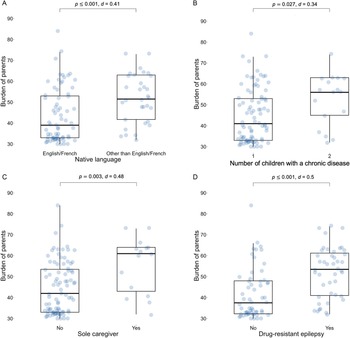
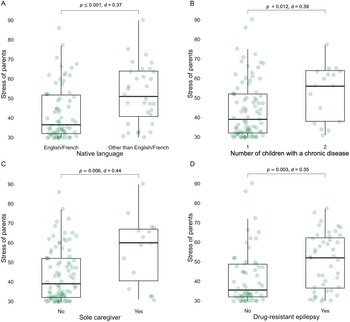
The CADI assesses two scales: the burden and stress of caregivers. The univariate analysis results are in Table 2. Based on the predetermined threshold (p < 0.05), native language, number of children with chronic disease, immigration status, sole caregiver and drug-resistant epilepsy were included in the multiple linear regression analysis for both burden and stress. Boxplots illustrating relationships for the relevant individual variables for burden and stress are in Figs. 2 and 3, respectively.
Boxplots showing the relationship of caregiver burden to (a) native language, (b) number of children with chronic disease, (c) sole caregiver status and (d) drug-resistant epilepsy.

Boxplots showing the relationship of caregiver stress to (a) native language, (b) number of children with chronic disease, (c) sole caregiver status and (d) drug-resistant epilepsy.

Results of univariate analysis

ADHD = attention deficit hyperactivity disorder.
The p-values in bold and italics denote the variables that were included in the multiple linear regression analysis.
Multiple linear regression analysis results for both burden and stress are in Table 3. Burden was significantly increased for caregivers with a second child with a chronic disease and sole caregivers and in cases of drug-resistant epilepsy. Stress was significantly increased for caregivers with a native language other than English or French, caregivers who had a second child with a chronic disease and sole caregivers.
Results of multiple linear regression analysis

CI = confidence interval.
Epilepsy treatment and management of children is already challenging for caregivers, Reference Vanstraten and Ng1,Reference Westphal-Guitti, Alonso and Migliorini6 but the results of this study demonstrate that stress and burden are increased when specific sociocultural and epilepsy factors are present. With respect to sociocultural factors, our data suggest that being a single caregiver increases both burden and stress for caregivers. This is not surprising as sole caregivers of children with chronic diseases have a higher burden in caregiving and show higher levels of caregiver stress, anxiety and low levels of well-being and resilience. Reference Toledano-Toledano and Luna7 In single mothers of children with autism, almost 77% were at risk for clinical depression which was positively correlated with caregiver burden. Reference Dyches, Christensen, Harper, Mandleco and Roper8
The number of children with a chronic disease in the family was also a significant factor in increasing both burden and stress of caregivers. Caring for a child with epilepsy can have a financial, physical, social and psychological impact on the family. Reference Karakis, Cole, Montouris, San Luciano, Meador and Piperidou3 Having more than one child with epilepsy or another chronic disease may enhance the burden on caregivers significantly. Due to shared genetics, the sibling might suffer from epilepsy as well or possibly from another chronic disease which can bring – depending on the case and severity – other challenges in care with it. In general, the impact of a chronic disease on the family is often underestimated, as multiple factors can be impacted such as financial situation, family relationships, education/work and social activities. Reference Golics, Basra, Finlay and Salek9
In contrast, the number of children in a family did not have an influence on stress or burden. Only the number of children with a chronic disease seems to play a role. More positively, families with a child with epilepsy have reported an increased feeling of closeness amongst family members and a stronger support for each other. Reference Thompson, Kerr, Glynn and Linehan10 Further, siblings might benefit from having a child with epilepsy in the family by developing closer family ties. Reference Thompson, Kerr, Glynn and Linehan10
Native language had an impact on the stress of caregivers of children with epilepsy. In Quebec, French and English are the two official languages and our data suggested that caregivers with a native language other than English or French experience a higher burden and stress. Canada has high rates of immigration, therefore it is not surprising that almost one-third reported a native language other than English or French, even though 88% were Canadian citizens. The relationship of language to caregiver stress is unsurprising given that a language barrier can threaten medical care, Reference van Rosse, de Bruijne, Suurmond, Essink-Bot and Wagner11 and epilepsy management is highly dependent on communication. Clinical decisions are largely based on history-taking, and epileptologists must counsel patients and caregivers on topics that are often emotional and complex, including sudden unexpected death in epilepsy, activity restrictions and acute seizure management. Caregiver stress may increase due to concerns that they have incompletely understood instructions or failed to accurately convey their clinical concerns.
In contrast to native language, the immigration status did not have an influence on stress burden of caregivers. Refugees showed a higher burden compared to Canadian citizens and permanent/temporary residents, but the factor was not significant in the regression model. This may relate to sample size issues, as only 7 of 102 patients in our cohort (6.9%) were refugees. Therefore, an increased sample size would be recommended for future studies.
Our findings should be considered with some caution, as there are some limitations. Our sample size may not have been sufficiently large to accurately assess certain variables such as immigration status, as mentioned. A potential bias is that caregivers may have been reluctant to admit a high burden or stress and rated the answers lower than they actually felt. Some caregivers might assume that indicating a higher burden might suggest they cannot handle the situation adequately. However, data were entered and analyzed anonymously, an aspect which was communicated to the caregivers to minimize fears of consequences following their ratings. Further, some variables which could have had an influence on the stress and burden on caregivers, such as help from other family members (grandparents, aunts, uncles or close friends, etc.) or financial situation, were not assessed. In future studies, variables such as the household income, caregiver employment stability, caregiver level of education and the exact type of chronic condition of siblings could be considered.
In summary, the burden and stress on caregivers should be an important consideration for pediatric neurologists as caregiver status contributes significantly to the disease management of their children. Our findings suggest that certain sociocultural factors may be helpful in identifying caregivers at greater need for social support. We suggest that clinical pediatric neurologists, as part of social history, routinely ask caregivers if there are other immediate family members with chronic diseases, if they have adequate support in caregiving, if they are comfortable communicating in the country’s first language and their immigration status. If the identified risk factors are present in families visiting the epilepsy clinic, a more detailed investigation of the caregivers’ individual needs should be performed with the help of social workers or resources available at the hospital, to tailor support where possible.
Author contributions
Katharina Schiller and Christelle Dassi contributed equally to this work.
KS designed the data collection instruments, carried out the initial analyses, prepared figures and drafted the initial version of the manuscript. CD assisted with the study design, collected the data and critically reviewed and revised the manuscript. SB assisted with the study design, collected the data and critically reviewed and revised the manuscript. BF critically reviewed and revised the manuscript. KAM conceptualized and designed the study and critically reviewed and revised the manuscript.
Funding statement
This project was supported by funding from the Fonds de Recherche du Québec – Santé (282228, 295639). KS is supported by a postdoctoral fellowship from the German Research Foundation (507037359).
Competing interests
BF has received support from a Canadian Institutes of Health Research project grant (PJT-175056), the Fonds de Recherche du Québec – Santé and the Natural Sciences and Engineering Research Council of Canada (RGPIN2020-04127 and RGPAS-2020-00021), as well as payments/honoraria from Paladin Labs, Eisai and UCB; she also sits on Data Safety and Monitoring Board (DSMB)/advisory boards for UNEEG, Paladin Labs, Eisai and UCB. KAM has received payments/honoraria for sitting on an advisory board for Jazz Pharmaceuticals.




 Open access

