Introduction
Islands, hereafter isolated areas, are any isolated system surrounded by a different habitat matrix. They usually harbour less species when compared to mainland areas due to isolation (MacArthur and Wilson, Reference MacArthur and Wilson1967). The smaller richness in such assemblages could lead to a fewer potential competitors, and consequently, lower interspecific competition (Ehrlich and Raven, Reference Ehrlich and Raven1964). Here, we define potential competitors as parasitic species that co-occur and compete for resources from a host (Poulin, Reference Poulin2007). Under this scenario of reduced competition, species could respond with higher abundance and/or niche breadth (Yoder et al., Reference Yoder, Clancey, Des Roches, Eastman, Gentry, Godsoe, Hagey, Jochimsen, Oswald and Robertson2010). This phenomenon was first described for bird assemblages inhabiting oceanic islands and was initially called density compensation (Crowell, Reference Crowell1962), since species respond to lack of competition by increasing their abundance. In addition, the absence of potential competitors in poorer assemblages may promote the reduction of specialization (Losos, Reference Losos, Vitt and Pianka1994), which may be reflected in an increase of niche breadth, with species occupying portions of the niche that in richer assemblages are usually occupied by other species; phenomenon described as niche expansion (Crowell, Reference Crowell1962; MacArthur et al., Reference MacArthur, Diamond and Karr1972; Pianka, Reference Pianka1994; Ricklefs and Miller, Reference Ricklefs and Miller1999). Together, density compensation and niche expansion are often referred to as ecological release (Pianka, Reference Pianka1994; Ricklefs and Miller, Reference Ricklefs and Miller1999). Besides that, the density compensation phenomenon may also help explain other models, such as the island syndrome hypothesis, in which it predicts that species populations on islands, besides presenting a higher population density, manifest changes in the reproduction pattern, presenting smaller number of offspring, but with larger body size (Smith and Fretwell, Reference Smith and Fretwell1974; Blondel, Reference Blondel2000; Pafilis et al., Reference Pafilis, Foufopoulos, Sagonas, Runemark, Svensson and Valakos2011; Novosolov et al., Reference Novosolov, Raia and Meiri2013).
According to Faeth (Reference Faeth, Strong, Simberloff, Abele and Thistle1984), although competition theory is the main proposition to explain the ecological variations of species on islands, factors such as climate tend to be more moderate on islands and may affect population size directly, by increasing the survival of individuals or indirectly (according to Competition Theory) by increasing or decreasing amounts of seasonal resource fluctuations (Case, Reference Case1975). On the other hand, restrictions on gene fluctuations between island populations and continents may result in increased levels of island species adaptation to local conditions and thus increase population density (Emlen, 1978; Emlen, Reference Emlen1979). In addition, the ‘Edge’ effect may also explain the increase in island population density (MacArthur et al., Reference MacArthur, Diamond and Karr1972; Emlen, Reference Emlen1979), probably originating from isolation barriers that block the emigration of individuals who could occupy marginal habitats on the continent.
Historically, among the vertebrate group, lizards have been the main model used to test the ecological release hypothesis (Yoder et al., Reference Yoder, Clancey, Des Roches, Eastman, Gentry, Godsoe, Hagey, Jochimsen, Oswald and Robertson2010). On one hand, Losos and Queiroz (Reference Losos and Queiroz1997) and Eaton et al. (Reference Eaton, Larimer, Howard, Powell and Parmerlee2002) failed to detect ecological release for Caribbean Anolis lizards; on the other, Mesquita et al. (Reference Mesquita, Colli and Vitt2007) found evidence of ecological release when verifying that Trupidurus lizards presented niche expansion in depleted assemblages, just as Des Roches et al. (Reference Des Roches, Robertson, Harmon and Rosenblum2011) observed that populations of lizards recently introduced in White Sands-New Mexico were under ecological release. Additionally, there are a few research studies on the effect of insularity on the abundance (Dobson et al., Reference Dobson, Pacala, Roughgarden, Carper and Harris1992) and niche breadth of vertebrate parasites (Bellocq et al., Reference Bellocq, Morand and Feliu2002). In the first case, Dobson and Pacala (Reference Dobson and Pacala1992) studied helminths that infect Caribbean Anolis lizards but they did not find relationships between parasite abundance and island size and no differences between island and mainland areas. More recently, Bellocq et al. (Reference Bellocq, Morand and Feliu2002) realized that host specificity (inverse of niche breadth) decreased in islands when studying helminth parasites from small mammals in Western Palearctic.
Parasites live inside or on the surface of another species (host) and present pre-adaptations for survival, feeding and reproduction on the host (Price, Reference Price1977). Generally, these pre-adaptations are host specific (Adamson and Caira, Reference Adamson and Caira1994) and reflect a small niche breadth (Poulin and Mouillot, Reference Poulin and Mouillot2003); parasites tend to inhabit phylogenetically related hosts, thereby avoiding the costs of by-passing the immune systems of less related hosts (Poulin, Reference Poulin2007). In addition to host specificity, interspecific interactions between parasites can affect their niche breadth (Holmes, Reference Holmes1973; Holmes and Price, Reference Holmes, Price, Anderson and Kikkawa1986). The effect of these interactions may be positive when a parasite species expands its niche breadth in the presence or absence of a potential competitor (Holmes, Reference Holmes1973; Bush and Holmes, Reference Bush and Holmes1986; Holmes and Price, Reference Holmes, Price, Anderson and Kikkawa1986; Adamson and Noble, Reference Adamson and Noble1992; Poulin, Reference Poulin2007) or negative when the presence of parasites affects the abundance, distribution or reproduction of others (Adamson and Caira, Reference Adamson and Caira1994; Poulin, Reference Poulin2007). Therefore, when a parasite colonizes a new host, it must ‘cross’ barriers to adapt to a set of new conditions; the strength of these barriers tends to correspond closely to the phylogenetic distance between the original and new host (Poulin and Mouillot, Reference Poulin and Mouillot2004).
Because of host specificity and the fact that infection patterns are often related to host richness (Hechinger and Lafferty, Reference Hechinger and Lafferty2005), parasitic assemblages associated with host populations on islands (i.e. isolated habitats, having fewer possible host species) should present lower parasite richness and increased niche breadth than do those in non-isolated habitats (Bellocq et al., Reference Bellocq, Morand and Feliu2002). In this study, we aimed to test whether endoparasites associated with lizards in the Pernambuco Center of Endemism (PCE), northeast of the Neotropical Region, are experiencing ecological release. The PCE, besides encompassing remnants of the coastal Atlantic Forest (non-isolated areas), presents various phytophysiognomies that distinguish it from other areas of the Brazilian Atlantic Forest (Muylaert et al., Reference Muylaert, Vancine, Bernardo, Oshima, Sobral-Souza, Tonetti, Niebuhr and Ribeiro2018). It also includes naturally isolated forest enclaves, locally called ‘Brejos de Altitude’, the origins of which are associated with the expansion of Atlantic Forest during the Pleistocene (the last 2 million to 10 000 years) into areas dominated by Caatinga (Andrade-Lima, Reference Andrade-Lima and Prance1982). This expansion resulted in isolated regions with favourable microclimate (Andrade-Lima, Reference Andrade-Lima1960) providing an opportunity to test the ecological release hypothesis. The hypothesis predicts that parasite niche breadth should be larger (i.e. lower host specificity) and that parasite abundance should be higher in isolated forest enclaves than in the non-isolated coastal Atlantic Forest. Alternatively, if the parasite assemblages in the PCE are not undergoing ecological release, we expect host specificity and parasite abundance in these assemblages to be similar to those of non-isolated areas.
Materials and methods
Study sites
Currently, the Atlantic Forest mostly occur on east coast, southeast and south of Brazil, east of Paraguay and Misiones province in Argentina (Santos et al., Reference Santos, Cavalcanti, Silva and Tabarelli2007). However, because of its large latitudinal variation, three centres of endemism can be identified in Brazil: Pernambuco Center, Bahia-Espírito Santo Center and Rio de Janeiro-São Paulo Center (Prance, Reference Prance, Whitmore and Prance1987; Cavalcanti and Tabarelli, Reference Cavalcanti, Tabarelli, Pôrto, Cabral and Tabarelli2004; Tabarelli and Santos, Reference Tabarelli, Santos, Pôrto, Cabral and Tabarelli2004; Santos et al., Reference Santos, Cavalcanti, Silva and Tabarelli2007). All forest areas located north of San Francisco River, including coastal forests and naturally isolated forest enclaves, within the semiarid Caatinga (Veloso et al., Reference Veloso, Rangel-Filho and Lima1991) are part of the Pernambuco Center of Endemism (Andrade-Lima, Reference Andrade-Lima and Prance1982). These isolated forest enclaves, locally called ‘Brejos de Altitude’, are composed of disjunctions of semideciduous montane seasonal forests. Their origin is hypothesized to be associated with climatic variations during the Pleistocene (in the last 2 million to 10 000 years) (Andrade-Lima, Reference Andrade-Lima and Prance1982). After interglacial periods, islands of the Atlantic Forest with favourable microclimate (Andrade-Lima, Reference Andrade-Lima and Prance1982) remained on mountains, plateaus and plains of 500–1100 m in elevation, generally located near the coast, receiving precipitation levels above 1200 mm year−1 through orographic rainfall (Andrade-Lima, Reference Andrade-Lima1960; Araújo et al., Reference Araújo, Gomes, Silveira, Figueiredo, Oliveira, Bruno, Lima-Verde, Silva, Otutumi, Ribeiro, Oliveira and Araújo2007).
Lizards were collected in three naturally isolated forest enclaves (correspond to isolated areas): (A) ARIE Mata de Goiamunduba – ARIEMG (06°45′03.78″S, 35°38′00.06″W), located in the Bananeiras municipality, in October 2016; and in (B) PE Mata do Pau Ferro – PEMPF (06°48′13.9″S, 35°05′07.3″W) and (C) Sítio Socorro – SS (06°59′37.6″S, 35°40′15″W), both located in the Areia municipality, between September and October 2017. In contrast, lizards were collected in three remnants of the coastal Atlantic rainforest (correspond to non-isolated areas): (D) REBIO Guaribas – SEMA III (06°48′14.9″S, 35°05′13.9″W) in the Rio Tinto municipality in December 2017; (E) RPPN Engenho Gargaú – RPPNEG (06°59′52″S, 34°57′30″W) in the Santa Rita municipality in September 2016 and (F) Benjamim Maranhão Botanical Garden – BMBG (07°08′08″S, 34°51′37″W), in the João Pessoa municipality in November 2016. All of the study sites are in Paraíba State, Brazil (Fig. 1). The average annual rainfall of the areas is 1490 mm, and the average annual temperature of 24.6°C.
Study sites. Three naturally isolated forest enclaves (A, B and C) and three remnants of the coastal Atlantic rainforest (D, E and F). (Final artwork created in QGis 2.14.0 Software).

The isolation in the ‘Brejos de Altitude’ is natural (Tabarelli and Santos, Reference Tabarelli, Santos, Pôrto, Cabral and Tabarelli2004). Therefore, the isolation caused by anthropic fragmentation in the coastal areas were not considered; areas affected by this fragmentation are recent relative to the naturally isolated enclaves (Carnaval and Bates, Reference Carnaval and Bates2007).
Lizard collection and parasite identification
All specimens were captured manually or using pitfall traps (25 traps per study site). The traps were constructed with four buckets (20 L) arranged in a ‘Y’ formation, with 100 buckets per area (Oliveira et al., Reference Oliveira, Teixeira, Queiroz, Araujo Filho, Teles, Brito and Mesquita2017). Lizards were collected during the same period of the year (dry season) to ensure that our data were not influenced by seasonality. The dry period was defined between September and December, based on historical rainfall data provided by AESA (Agência Executiva de Gestão das Águas do Estado da Paraíba).
Each study site was sampled for 20 days. The active search was standardized, being performed every day during each sampling period. The team consisted of three researchers, and search was conducted from 8:00 a.m. to 4:00 p.m., when it becomes dark in the forest. To test for significant differences in lizard richness between isolated and non-isolated areas, we performed a Student's t-test.
All lizards were sacrificed following all applicable international, national and/or institutional guidelines for the care and use of animals. The lizards were killed with lethal doses of 2% lidocaine, fixed with 10% formaldehyde, preserved in 70% alcohol and housed in the Coleção Herpetológica da Universidade Federal da Paraíba – CHUFPB. We dissected all lizards under a stereomicroscope and identified the sexes by inspecting their gonads. We inspected the respiratory and gastrointestinal tracts for endoparasites. When present, we counted the parasites, mounted them on slides with lactophenol, analysed them under a microscope and identified according to the following identification keys (Silva et al., Reference Silva, Ferreira and Strüssmann2007; Anderson et al., Reference Anderson, Chabaud and Willmott2009).
Parasite richness and abundance
We recorded the parasite richness (total number of parasite species per host specimen) and parasite abundance (total number of parasite, regardless of species, in a single infected host) according to Bush et al. (Reference Bush, Lafferty, Lotz and Shostak1997). If ecological release is occurring, the abundance of parasites in each sampling site should be higher in assemblages with lower parasite richness.
Index of host specificity (STD*)
The index of host specificity STD* was calculated as the taxonomic distance measured for all possible pairs of host species weighted by the product of the parasite prevalence in each pair of host species. The weighting factor varies from one (1) (maximum weight), when the prevalence is 100% in both host species, to zero (0), when the prevalence in host species is very low. We considered the five taxonomic classification levels above species, as follows (i.e. genus, family, order, class and phylum). The maximum value attainable by a parasite species is five, i.e. when it infects hosts belonging to more than one of all taxonomic classes, and the minimum value is one, i.e. when it infects hosts belonging to only one genus (Poulin and Mouillot, Reference Poulin and Mouillot2005).
In addition, because the type of parasite life cycle can influence the parasite's host range (Adamson and Caira, Reference Adamson and Caira1994), we calculated the index of host specificity STD* separately for parasites with monoxenous (without the use of intermediate hosts) and heteroxenous life cycles (with at least one intermediate host) to determine whether life cycle can alter the amplitude of hosts used in isolated and non-isolated areas. We obtained STD* values using the software TaxoBiodiv2 (Poulin and Mouillot, Reference Poulin and Mouillot2005).
Statistical analysis
To determine whether ecological release is occurring in parasite species from isolated forest enclaves, we used generalized linear mixed models (GLMMs). GLMMs were used because mixed models allow the insertion of random variables to correct the degrees of freedom and avoid the effects of pseudoreplication (Bates et al., Reference Bates, Mächler, Bolker and Walker2014). In the first model, parasite abundance was tested with a Poisson distribution and log link function (Wilson and Grenfell, Reference Wilson and Grenfell1997), with study site (nested within area) and lizard species (this category allowed us to remove the ontogenetic effect of each lizard species, as well as the effect of lizard abundance) included as random effects, as well as parasite richness and area (isolated and non-isolated) included as fixed effects. Next, parasite richness was analysed with a Poisson distribution and log link function (Wilson and Grenfell, Reference Wilson and Grenfell1997), with study site (nested within area) and lizard species included as random effects and area (isolated and non-isolated) included as a fixed effect. Finally, the index of host specificity STD* was modelled with a Gamma distribution and inverse link function (Bolker et al., Reference Bolker, Brooks, Clark, Geange, Poulsen, Stevens and White2009), with study site (nested within area) and parasite species being included as random effects and host specificity and area (isolated and non-isolated) being included as fixed effects. GLMMs were performed using the ‘lme4’ package (Bates et al., Reference Bates, Mächler, Bolker and Walker2014) of R software.
Results
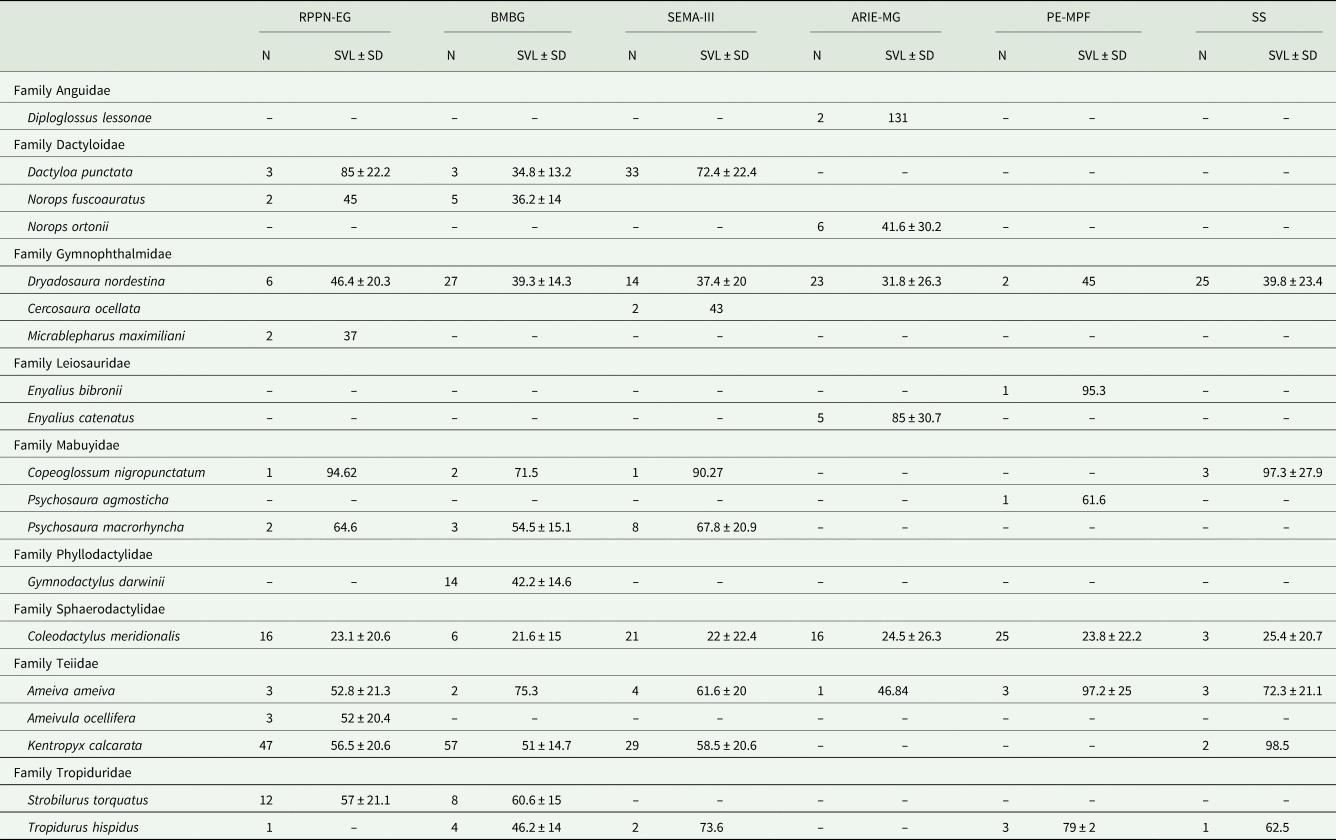
We collected 467 lizards representing 19 species and nine families (Table 1). In the coastal Atlantic rainforest, 13 lizard species from seven families were collected, whereas in the naturally isolated forest enclaves we found 11 lizard species from eight families. The remnants of the coastal Atlantic rainforest presented larger lizard richness (mean lizard richness in non-isolated areas = 10.6; range: 9–12) than did naturally isolated forest enclaves (six lizard species across all areas), (t-value = 5.2915; P value = 0.03).
Lizards collected at the sampling sites – non-isolated: RPPN-EG, BMBG, SEMA-III and isolated: ARIE-MG, PE-MPF, SS

SVL mean snout-vent length; s.d., standard deviation.
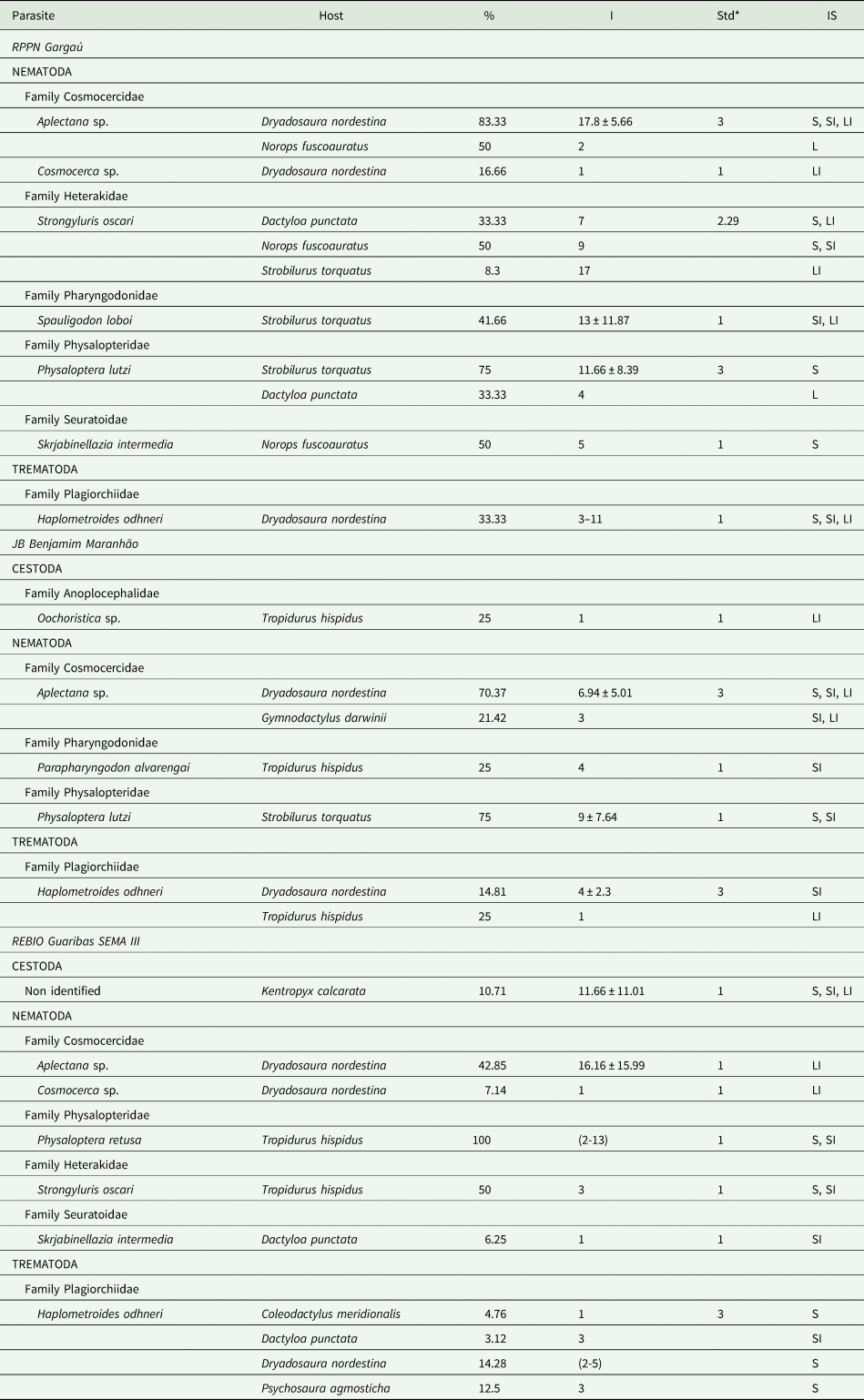
After dissecting the hosts, we found 1.338 endoparasites, 15 species corresponding to 11 species of nematodes (seven families and ten genera), one species of trematode (one family and one genus), two species of cestodes (one family and one genus) and one species of acanthocephalans (one family and one genus) (Tables 2 and 3). The parasite richness per specimen showed no difference between isolated (1.39 ± 0.55) and non-isolated (1.33 ± 0.53) areas, (R 2 = 0.0008; Z-value = 0.287; P value = 0.77).
Composition of helminths from remnants of coastal Atlantic rainforest and infected hosts, prevalence (%); mean intensity of infection (I); index of host specificity (Std*); infection sites (SI): stomach (S), small intestine (SI), large intestine (LI), lungs (L), celomatic cavity (CC)
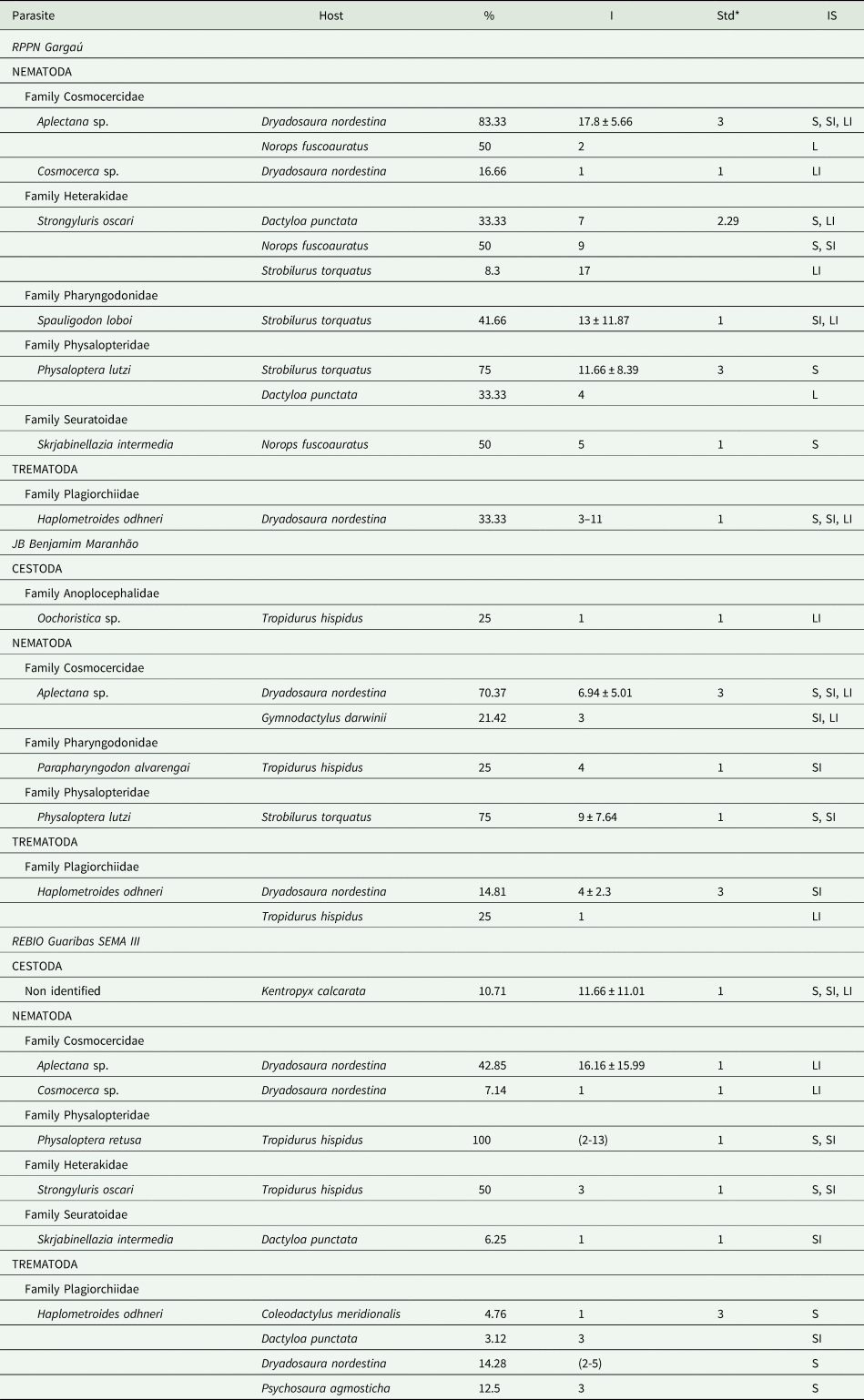
Composition of helminths from naturally isolated forest enclaves and infected hosts, prevalence (%); mean intensity of infection (I); index of host specificity (Std*); infection sites (SI): stomach (S), small intestine (SI), large intestine (LI), lungs (L), celomatic cavity (CC)

Parasite abundance did not differ between isolated and non-isolated areas (R 2 = 0.4549; Z-value = 0.316; P value = 0.75). However, parasite abundance showed a positive relationship with parasite richness (R 2 = 0.4549; Z-value = 4.633; P value < 0.0001) across all areas (isolated and non-isolated), the opposite of predicted by the hypothesis of density compensation.
The mean Std* value of the non-isolated areas was 1.6; on the other hand, the mean Std* value of the isolated areas was 1.8. The same was verified when we analysed separately monoxenous (mean Std* of non-isolated areas = 1.6 versus isolated areas = 1.7) and heteroxenous parasites (mean Std* of non-isolated areas = 1.5, against 1.9 of isolated areas). Host specificity was positively related to parasite richness (R 2 = 0.946; t value = 417; P value < 0.0001) across all areas (isolated and non-isolated), and this pattern was maintained when we analysed monoxenous (R 2 = 0.9446; t-value = 401; P value < 0.0001) and heteroxenous (R 2 = 0.0319; t-value = 2314; P value < 0.0001) parasites separately. Considering that host specificity is inversely proportional to the range of hosts infected by a parasite, our results indicate that in assemblages with greater parasite richness (more competitors), parasites tend to infect a smaller range of hosts than they do in simple assemblages (fewer competitors).
The values of prevalence, mean intensity of infection and index Std* for each parasite identified can be viewed in the Tables 2 and 3. The isolated area ‘SS’ presented the highest average prevalence value (46.26) among all the studied areas, whereas the non-isolated area ‘SEMA III’ had the lowest average prevalence value (25.16).
Discussion
Our results indicated that non-isolated coastal Atlantic rainforest areas presented higher lizard richness than did naturally isolated forest enclaves. However, there was no difference between areas regarding parasite richness. Furthermore, parasite abundance showed a positive relationship with parasite richness considering all areas (isolated and non-isolated). In addition, host specificity increases with parasite richness. This pattern was also observed when we considered monoxenous and heteroxenous parasites separately.
The isolated areas present a poorer richness of lizard fauna than did the non-isolated areas, similar to results presented in studies with fish communities in Australian desert springs (Kodric-Brown and Brown, Reference Kodric-Brown and Brown1993), bat assemblages of tropical caves in central Mexico (Brunet and Medellín, Reference Brunet and Medellín2001), Caribbean Anolis lizards (Losos and Queiroz, Reference Losos and Queiroz1997), lizard assemblages of Neotropical savannas (Mesquita et al., Reference Mesquita, Colli and Vitt2007) and vascular plants in the Stockholm Archipelago, Sweden (Löfgren and Jerling, Reference Löfgren and Jerling2002). According to MacArthur and Wilson (Reference MacArthur and Wilson1967), islands should fewer species than comparable continental areas due to their small size and reduced heterogeneity (which are associated with fewer microhabitat types, microclimates and refuges against predators). Analogously, when dealing with parasite assemblages, spatial heterogeneity corresponds to the sum of all potential hosts present in the same space/at the same time (Hechinger and Lafferty, Reference Hechinger and Lafferty2005; Kuris et al., Reference Kuris, Blaustein and Alio1980), since these hosts represent ‘habitats’, providing places to live, forage and reproduce (Krasnov et al., Reference Krasnov, Khokhlova, Oguzoglu and Burdelova2002). In addition to possessing lower host richness than non-isolated areas, islands can also present lower parasite richness (Wootten, Reference Wootten1973; Kennedy, Reference Kennedy, Esch, Bush and Aho1990). In this way, naturally isolated forest enclaves are suitable for testing whether parasitic assemblages associated with lizard populations are under ecological release in contrast to comparable areas from remnants of the coastal Atlantic rainforest.
Parasite richness did not differ significantly between isolated and non-isolated areas. Previous studies on the structure and composition of parasitic fauna in mainland regions and islands have obtained inconsistent results. Kennedy (Reference Kennedy1978) found no correlation between the parasite richness associated with the fish Salvelinus valpinus and island size or distance from the continent. In contrast, the number of parasites was higher in small and distant islands from the Arctic compared to the mainland. Nearly a decade later, Kennedy et al. (Reference Kennedy, Laffoley, Bishop, Jones and Taylor1986) found that parasite richness was much lower in freshwater fish from the Channel Islands than in those from comparable adjacent areas on the European continent. Subsequently, Dobson et al. (Reference Dobson, Pacala, Roughgarden, Carper and Harris1992) and Dobson and Pacala (Reference Dobson and Pacala1992) studied helminths that infect Anolis lizards in the Antilles and found that the parasite fauna assemblages of the small islands were depleted relative to those of the greater Caribbean islands and the mainland. Furthermore, Fromont et al. (Reference Fromont, Morvilliers, Artois and Pontier2001) found a greater parasite richness in feral cats from Lyon/France than in corresponding hosts from Kerguelen Islands. In addition, Rocha and Vrcibradic (Reference Rocha and Vrcibradic2003) studied the helminth parasite fauna of Mabuya lizards on islands along the eastern coast of Brazil found no variation in helminth richness with island size or distance to the mainland and no difference between isolated and mainland areas. According to Dobson and Pacala (Reference Dobson and Pacala1992) and Apanius et al. (Reference Apanius, Yorinks, Bermingham and Ricklefs2000), the way the parasite richness is manifested in islands may perhaps be justified by the influences of colonization and extinction processes, which could alter infracommunity composition in host populations.
Similarly, our results did not identify differences in parasite abundance between isolated and non-isolated areas, probably because parasite richness did not differ between these areas and because shifts in the presence/absence of competing species is necessary for density compensation to occur (Crowell, Reference Crowell1962; MacArthur et al., Reference MacArthur, Diamond and Karr1972; Faeth, Reference Faeth, Strong, Simberloff, Abele and Thistle1984; Fromont et al., Reference Fromont, Morvilliers, Artois and Pontier2001). Apparently, the smaller host availability in the isolated areas, does not act as a limiting resource for parasites. The theory of density compensation is based on the premise that in simpler assemblages, resources tend to be more abundant than in continental areas due to the lower number of competitors, which promotes population size increases (Crowell, Reference Crowell1962; MacArthur et al., Reference MacArthur, Diamond and Karr1972; Faeth, Reference Faeth, Strong, Simberloff, Abele and Thistle1984). This hypothesis has been corroborated by studies of helminth parasites of feral cats from Kerguelen Islands in France (Fromont et al., Reference Fromont, Morvilliers, Artois and Pontier2001) and King Islands in Australia (Gregory and Munday, Reference Gregory and Munday1976) and those of small mammals from Skomer Island in Wales (Lewis, Reference Lewis1968a, Reference Lewis1968b). In these studies, low helminth richness reduced interspecific competition, contributing to a higher intensity of infection among island hosts. On the other hand, studies of parasitic helminths from lizards found no relationships among parasite density, parasite abundance, infection rate and island size and no differences between island and mainland areas (Dobson et al., Reference Dobson, Pacala, Roughgarden, Carper and Harris1992; Rocha and Vrcibradic, Reference Rocha and Vrcibradic2003), similar to our results. An alternative explanation of the increased abundance of island parasites relative to that of mainland parasites has been widely described. According to Bellocq et al. (Reference Bellocq, Morand and Feliu2002), hosts inhabiting islands are subject to low parasitic pressure (low parasite diversity), which may lead to a lower allocation of resources to the development of the immune system than is exhibited by mainland, who experience higher parasitic pressure.
Our results revealed a significant positive relationship between parasite abundance and parasite richness; which is, as the number of parasites (competitors) increased in the studied areas (regardless of whether isolated or not), the number of parasites per individual host increased, apparently uninfluenced by competition (Holmes, Reference Holmes1973; Bush and Holmes, Reference Bush and Holmes1986; Holmes and Price, Reference Holmes, Price, Anderson and Kikkawa1986; Adamson and Noble, Reference Adamson and Noble1992), leading us to believe that the resources are not limiting factors in the structuring of the parasitic assemblages studied here (Poulin, Reference Poulin1997, Reference Poulin2007). These results can be explained by the facilitation process among parasite species, in which the occurrence of a particular parasite species enables the presence of others through the creation of conditions adequate for their survival (Hart and Marshall, Reference Hart and Marshall2013).
The niche expansion hypothesis was corroborated in our study, even when we evaluated parasites separately according to life cycle (monoxenous and heteroxenous). We found that host specificity decreased in sites with lower parasite richness. This result is consistent with Bellocq et al. (Reference Bellocq, Morand and Feliu2002)'s study of helminth parasites from small mammals in Western Palaearctic but is in contrast to Kennedy et al. (Reference Kennedy, Laffoley, Bishop, Jones and Taylor1986), who found no variation in host fish specificity from Channel Islands, even in the absence of potential competing parasites.
Niche expansion is a phenomenon that when coupled with density compensation composes the ecological release process (Pianka, Reference Pianka1994; Ricklefs and Miller, Reference Ricklefs and Miller1999). According to Kennedy et al. (Reference Kennedy, Laffoley, Bishop, Jones and Taylor1986), in insular assemblages, non-realized niches (hosts) are likely to exist such that parasite species can expand their niche breadth by infecting hosts that would probably be unavailable in comparable mainland areas. In this case, even parasites having co-evolved with their hosts (host specificity), it is possible for island parasites to expand their niche using the new resources (hosts) available in these locations (Adamson and Caira, Reference Adamson and Caira1994). However, with the increasing phylogenetic distance between historically infected hosts and new colonized hosts, most profitable should be these new infections (Poulin and Mouillot, Reference Poulin and Mouillot2004).
Non-isolated areas have higher lizard richness than isolated areas. However, this pattern was not observed when we analysed the parasite richness. In addition, the values of parasite abundance were positively related to those of parasite richness (competitors). This finding is in conflict with the predictions of the density compensation hypothesis and indicates a possible facilitation of infection in the presence of possible competitors. Moreover, our findings support the niche expansion hypothesis: in simpler assemblages, parasites tend to decrease their specificity (expand niche breadth) to infect hosts that are likely unavailable in areas with more parasite competitors, indicating that the absence of competition is one of the models that corroborates this hypothesis. In summary, our study partially supports the ecological release hypothesis: in assemblages with greater parasite richness, lizard parasites from Atlantic Forest present a greater parasite abundance (per host), possibly through facilitated infection; however, the amplitude of infected hosts only expands in poor assemblages (lower parasite richness). In addition, although ‘brejos’ have a natural isolation, eventual migrations of lizards/parasites from the surrounding semiarid matrix may occur. Thus, this influence may have led to the absence of some expected effects, such as higher parasite richness in non-isolated areas.
Acknowledgments
We would like to thank Silva RJ, Ávila RW and Silva CF for help in identifying nematodes and trematodes. We thank CAPES for research fellowships to AAMT (1557587/2015-10) and CNPq for research fellowships to DOM (306541/2017-3), WOA (PQ-302429/2015-8), JAAF (142310/2016-6) and DAT. We thank Santana DO for the final artwork. The authors are also grateful to the field support provided by Araujo HFP and França FGR. We are grateful to all members of the Laboratório de Vertebrados e Paleontologia-DCB (UFPB-Campus II), Núcleo de Ecologia de Serpentes-NES (UFPB-Campus IV) and the Curupira Republic Family. The help of the employees of RPNN-EG and BMBG is also acknowledged.
Financial support
This study was financed in part by the Coordenação de Aperfeiçoamento de Pessoal de Nível Superior – Brasil (CAPES) – Finance Code 001.
Conflict of interest
None.
Ethical standards
All applicable international, national and/or institutional guidelines for the care and use of animals were followed. Research was permitted by Sistema de Autorização e Informação em Biodiversidade do Instituto Brasileiro do Meio Ambiente e dos Recursos Naturais Renováveis (SISBIO-IBAMA) (no. 54378/3, authentication code 78752298; no. 56863-1, authentication code 47783645), Superintendência de Administração do Meio Ambiente – SUDEMA (no. 004/2016, process no. 5376/16) and Benjamim Maranhão Botanical Garden-BMBG (no. 003/2016/JBBM/SUDEMA).