

INTRODUCTION
Contemporary global warming has induced a rise of the global mean sea surface temperature (SST) by 0.67°C over the last hundred years (Trenberth et al., Reference Trenberth, Jones, Ambenje, Bojariu, Easterling, Klein Tank, Parker, Rahinzadeh, Renwick, Rusticucci, Soden, Zhai, Solomon, Qin, Manning, Marquis, Averyt, Tignor, Miller and Chen2007). However, more rapid changes were observed in semi-enclosed seas. The Black Sea is within this latter group, and with an SST increase of 0.96°C between 1982 and 2006, it experienced one of the strongest impacts (Belkin, Reference Belkin2009). Due to the peculiarities of its water column stratification and thin surface mixing layer, which is ~10 m in summer and ~80 m in winter (Ginzburg et al., Reference Ginzburg, Kostianoy and Sheremet2004), the Black Sea's SST readily responds to changes in global climate, suggesting quick and high-amplitude alterations in the near future.
There is a growing body of evidence that suggests SST elevation is correlated with the spread and success of alien marine species (Lambert & Lambert, Reference Lambert and Lambert1998; Thresher et al., Reference Thresher, Proctor, Ruiz, Gurney, MacKinnon, Walton, Rodriguez and Bax2003; Sorte et al., Reference Sorte, Williams and Zerebecki2010). Evidence of responses to the present warming in the shelf biota includes such indicators as shifts in the geographical range of species, and in the composition of benthic assemblages. Due to the relative simplicity of the intravital, as well as postmortal identification of the shell molluscs and their capability for rapid expansion by trochophore and veliger larvae, the molluscan benthic community provides a clear readout of both aforementioned indicators, allowing recognition of the global warming effects in a wide range of marine ecosystems (Sauriau, Reference Sauriau1991; Cintra-Buenrostro et al., Reference Cintra-Buenrostro, Foster and Meldahl2002; Warwick & Turk, Reference Warwick and Turk2002). Therefore, the monitoring of the molluscan fauna can potentially give important empirical clues related to the assessment and prediction of ecosystem changes in the Black Sea caused by global warming.
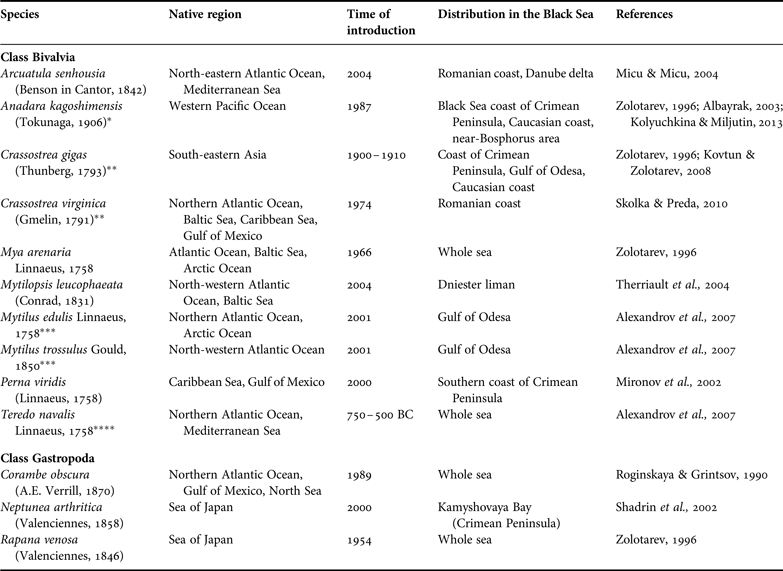
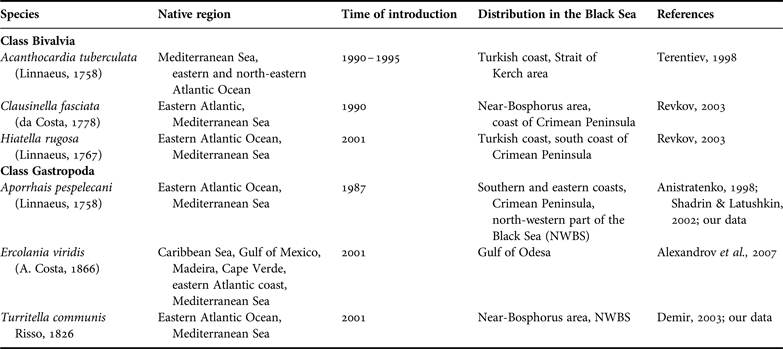
The Black Sea basin was isolated from the world's oceans due to the lowering of global sea levels during the last glacial phase. As sea levels rose during the early Holocene period, the Black Sea was once again connected to the eastern Mediterranean and had become an area of colonization for Mediterranean species (Buynevich et al., Reference Buynevich, Yanko-Hombach, Gilbert and Martin2011). As a result, the most part of the modern Black Sea molluscan fauna was made up by the species of Atlantic–Mediterranean origin with several Thetis relics (Mordukhai-Boltovskoi, Reference Mordukhai-Boltovskoi and Vodyanitsky1972). However, the arrival of new molluscan species still continues. These species can be divided into two major groups: Mediterranean and non-Mediterranean immigrants. Apparently the main factor for the appearance of the latter group in the Black Sea is the development of shipping; this is also in line with a rapid increase of the number of alien species discovered during the last several decades (Table 1). The arrival of new non-Mediterranean molluscs has had substantial ecological consequences; the most important changes in the Black Sea benthic biocenosis were induced by the introduction of two such species, Rapana venosa (Valenciennes, 1846) and Mya arenaria Linnaeus, 1758. In contrast, replenishment of the Black Sea molluscan fauna with Mediterranean species (Table 2) did not lead to the appreciable rearrangements in demersal communities.
Alien and cryptogenic molluscs in the Black Sea: species arrived due to human activity.

*, previous attribution of the Black Sea population to Anadara inaequivalvis (Bruguière, 1789) was later disproved (Lutaenko, Reference Lutaenko2006); **, oyster species Crassostrea gigas (Thunberg, 1739) and Crassostrea angulata (Lamarck, 1819) of the same native region have been shown to be closely related and able to produce fertile F1s (Leitão et al., Reference Leitão, Chaves, Santos, Guedes-Pinto and Boudry2007). Slight morphological differences are observed between these species as well as between them and Crassostrea virginica. The only reliable way to distinguish between the species is a DNA analysis (Huvet et al., Reference Huvet, Lapègue, Magoulas and Boudry2000). However, to the best of our knowledge, to date the detailed genetic analysis of the Black Sea Crassostrea population has not been performed; ***, the characteristic feature of Mytilus edulis species complex (M. edulis, Mytilus trossulus and Mytilus galloprovincialis native to the Black Sea) is a widely observed inter-species hybridization (Riginos & Cunningham, Reference Riginos and Cunningham2005). This suggests wariness when interpreting reports about findings of M. edulis and M. trossulus in the Black Sea; ****, cryptogenic species.
Newcomer molluscs in the Black Sea: species which have naturally spread from the Mediterranean Sea.

The north-western part of the Black Sea (NWBS) receives a large volume of freshwater run-off, with approximately 80% of the total outflow into the Black Sea discharged there. The River Danube accounts for about 75% of this outflow, or approximately 230 km3 per year, and the other large rivers, the Dnieper and the Dniester, discharging a further 53 km3 and 9.5 km3, respectively (Mee, Reference Mee1992). This makes the NWBS the least salinized region of the Black Sea, and apparently establishes a barrier against the expansion of Mediterranean faunas. Nevertheless, fish of Mediterranean origin were repeatedly detected in the NWBS and their presence was shown to correlate primarily with temperature and salinity values (Snigirov et al., Reference Snigirov, Goncharov and Sylantyev2012). Thus, the possible expansion of the molluscan species of Mediterranean origin into this water area should clarify the comparative importance of different hydrological factors for the stability of the Black Sea ecosystem.
Turritella communis Risso, 1826 is a Gastropoda mollusc that occurs in the eastern Atlantic from Norway to Morocco and in the Mediterranean Sea. It normally inhabits soft muddy bottoms (Fretter & Graham, Reference Fretter and Graham1981) but can also be found at rocks, gravel and sand (Van Straaten, Reference Van Straaten1960). The common bathymetric range for this species is 15–100 m (Fretter & Graham, Reference Fretter and Graham1981); however, sometimes the mollusc can be found at 0–10 m depths (Keegan & Mercer, Reference Keegan and Mercer1986). It commonly forms large colonies (Sartenaer, Reference Sartenaer1959) and feeds predominantly by ciliary suspension collecting (Graham, Reference Graham1938; Yonge, Reference Yonge1946). In Turritella communis sexes are separate. Some authors report sexual dimorphism with female individuals being slightly larger than males (Wright, Reference Wright1956); however, others do not confirm this observation (Fretter & Graham, Reference Fretter and Graham1981). Breeding was reported for different periods from April to July (Lebour, Reference Lebour1933; Wright, Reference Wright1956; Fretter & Manly, Reference Fretter and Manly1979). Egg masses are attached to substrate, larvae have relatively short planktonic life of 2–3 weeks (Lebour, Reference Lebour1933); protoconch is small, sharp, weakly sculptured and hardly distinguishable from teleoconch mainly by initiation of spiral relief at a latter one (Fretter & Manly, Reference Fretter and Manly1979).
Aporrhais pespelecani (Linnaeus, 1758) is another Gastropoda species with a geographical range from the Mediterranean to Iceland, north Norway and the western Kola Peninsula. It is a mainly sublittoral mollusc inhabiting mud, muddy sand and sand bottoms to depths of ~180 m where it lives wholly or partially buried (Yonge, Reference Yonge1937). This species is a detritus feeder, feeding mostly on plant fragments (Barnes & Bagenal, Reference Barnes and Bagenal1952). The sexes are separate without significant sexual dimorphism in shell shape and size. Breeding is reported to occur at different periods from January to September in different parts of its range. Eggs are attached to the substrate granules singly or in twos or threes (Lebour, Reference Lebour1933; Smidt, Reference Smidt1944), veliger larvae hatch out with a smooth shell of 1.5 whorls (Thiriot-Quiévreux, Reference Thiriot-Quiévreux1969) and occur in plankton during 8–9 months of the year (Thorson, Reference Thorson1950).
We hereby report for the first time the presence of these two species, Aporrhais pespelecani (Linnaeus, 1758) and Turritella communis Risso, 1826, in the NWBS and more than 500 km north from the edge of their native range.
MATERIALS AND METHODS
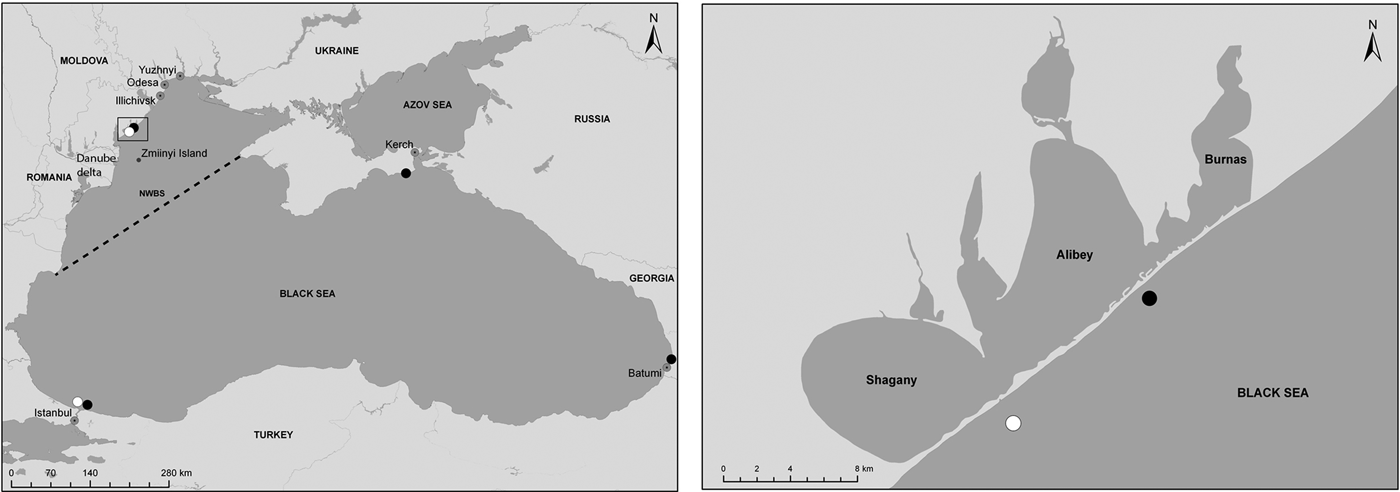
Molluscs were collected in March 2013, at two different localities during a series of fish samplings on the marine side of the sandbar separating the Tuzly group of limans (lagoons) from the Black Sea, ~300 m off the coastline (Figure 1). Sampling was performed using a 30 m long, 5 mm mesh dragnet pulled for 200 m parallel to the coastline at a depth of 5–7 m. Molluscan species' identifications were made in accordance with widely used species guides (Poppe & Goto, Reference Poppe and Goto1991; Appeltans et al., Reference Appeltans, Bouchet, Boxshall, De Broyer, de Voogd, Gordon, Hoeksema, Horton, Kennedy, Mees, Poore, Read, Stöhr, Walter and Costello2013). Shell measurements were completed to the nearest 0.01 mm with a Vernier digital caliper. After identification and measurement, specimens were lodged in a malacological collection in Odesa National Mechnikov University's Zoological Museum: Catalogue Numbers 360/3 for Aporrhais pespelecani (Linnaeus, 1758) and 331/3 for Turitella communis Risso, 1826.
Left: Black Sea map with finding locations of Aporrhais pespelecani (black circles) and Turritella communis (open circles) in 20th and 21st Centuries. Right: catchment area with our findings of A. pespelecani and T. communis (similar symbols).

To characterize long-term changes of aquatic environment in the NWBS we used hydrological data (water temperature, oxygen concentration and salinity) collected during the period 2006–2012 at Zmiinyi Island's marine research station (45°15′18″N 30°12′15″E), which was the closest observational point to the catchment site. Environmental data have been represented as a mean ± SEM. To elucidate the interannual dynamics of hydrological parameters we used regression coefficients obtained when the field-collected datasets were fitted with the linear regression method using the least squares approach. Numerical calculations were performed with Mathematica 9.0 software.
RESULTS
One live isolated specimen of Aporrhais pespelecani (Linnaeus, 1758) (found at 45°46′1.62″N 30°3′58.84″E) and one dead specimen (fresh dead with animal tissue clearly visible attached inside the shell) of Turritella communis Risso, 1826 (found at 45°41′57.13″N 29°57′5.77″E) had the following morphological characteristics:
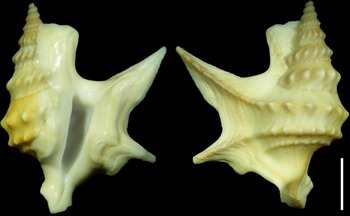
Aporrhais pespelecani (Linnaeus, 1758) measurements (mm): height, 36.41; breadth to tip of outer lip, 31.59; aperture from tip of lobe 1 (closest to the spire) to tip of lobe 4 (runs basally to the columella), 32.31; tip of the lobe 4 bent at 45–55° towards the aperture (Figure 2).
Apertural and abapertural views of Aporrhais pespelecani shell from the north-western part of the Black Sea. Scale bar: 1 cm.

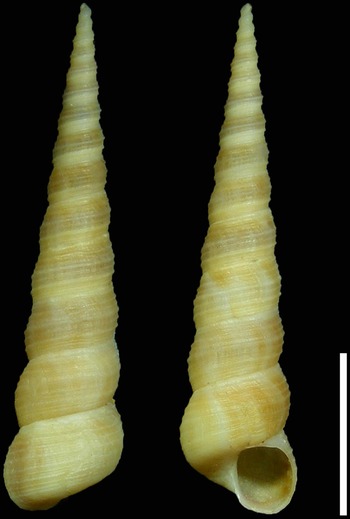
Turritella communis Risso, 1826 measurements (mm): height, 28.98; width, 6.48; aperture opening, 3.65 × 4.21; apical angle 12.8° (Figure 3).
Apertural and abapertural views of Turritella communis shell from the north-western part of the Black Sea. Scale bar: 1 cm.

Both measurement sets are in a range of characteristics reported for mature shells of these species (Gude, Reference Gude1981a, Reference Gudeb).
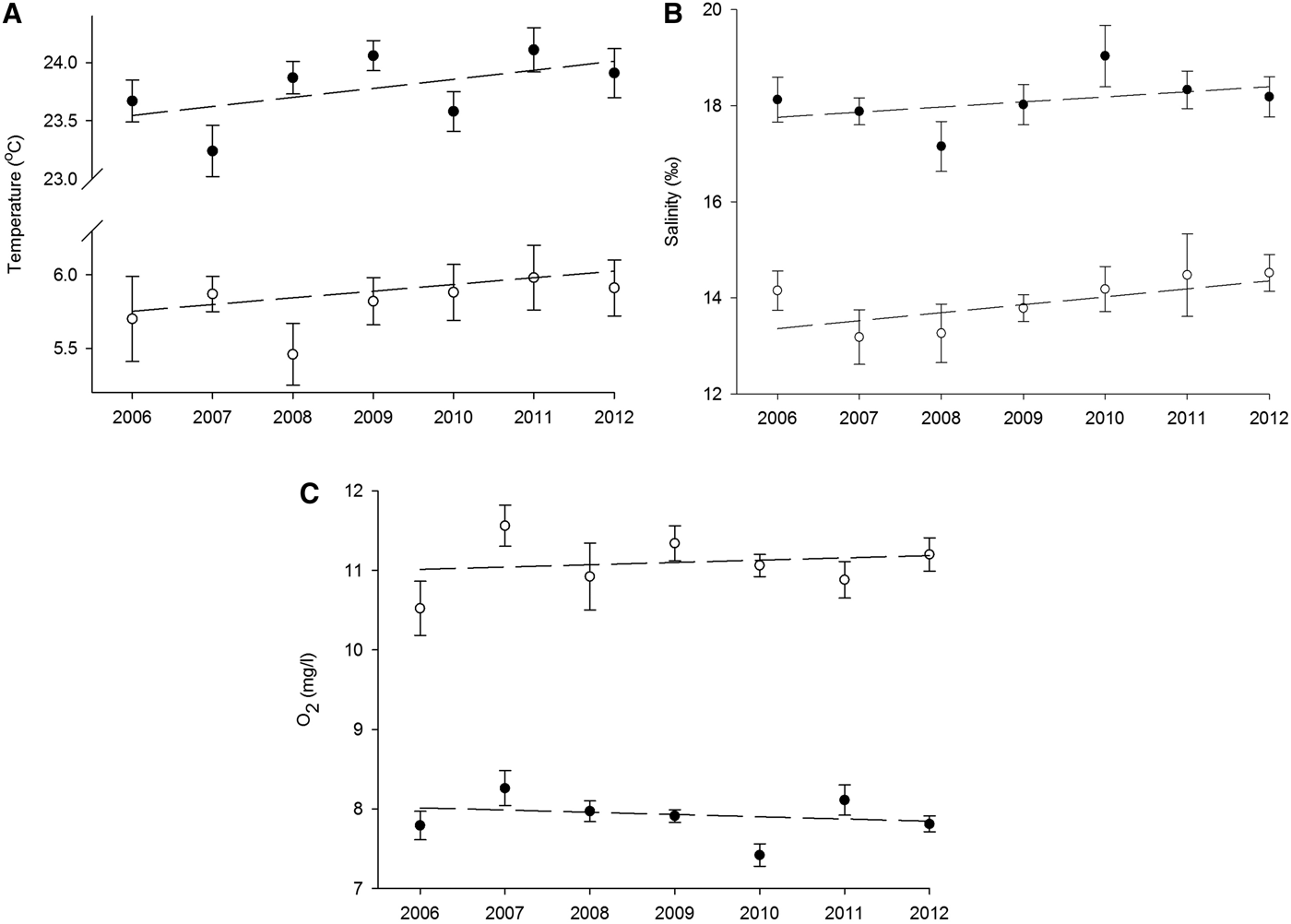
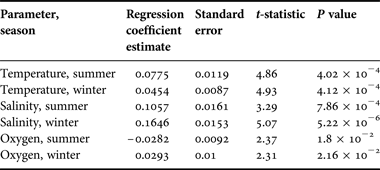
To clarify what environmental changes could facilitate the arrival and occurrence of new molluscan species in the extrinsic waters of the NWBS we analysed the dynamics of water temperature, salinity and oxygen concentration in this area over the period 2006–2012 (Figure 4). The linear regression analysis revealed positive regression coefficients (i.e. augmenting interannual dynamics) of water temperature and salinity. In turn, dissolved oxygen data fitting generated the regression coefficients of much smaller values and opposite signs in summer and in winter (Table 3).
Hydrological parameters of the north-western part of the Black Sea in the period 2006–2012 during winter (December–February, open circles) and summer (June–August, black circles): (A) temperature; (B) salinity; (C) oxygen concentration.

Results of the linear regression analysis of interannual dynamics of hydrological parameters in the collection area.

DISCUSSION
The discovery of two Mediterranean molluscan species raises questions about their current status and perspectives in the NWBS ecosystem.
Firstly, it is not clear whether the species we have found can be considered as an integral component of the local benthic community that have joined it due to the effects of global warming. Both species were registered for the Black Sea based on rare findings of solitary shells, mainly in the near-Bosphorus area (Dumont, Reference Dumont1999; Demir, Reference Demir2003), thus making doubtful a hypothesis about their existence as stable populations in other parts of the sea in previous decades. Indeed, it was repeatedly shown that SST warming as observed for the periods 1982–2006 (Belkin, Reference Belkin2009) and 2006–2012 (our data) can lead to a sufficient extension of the aquatic molluscs' habitat. However, the water temperature rise in the Norwegian and Barents Seas, being considerably smaller than that observed in the Black Sea (Belkin, Reference Belkin2009), has already ensured a substantial expansion of Aporrhais pespelecani (Linnaeus, 1758) areal in the Arctic, and the establishment of its new sustainable populations (Kantor et al., Reference Kantor, Rusyaev and Antokhina2008). Further to the three-decadal SST rise, the spacious sand and silt flats of the NWBS sea-floor are the typical habitat of both species (Yonge, Reference Yonge1946; Gude, Reference Gude1981a). Nevertheless, to the best of our knowledge we are the first to report the presence of Aporrhais pespelecani (Linnaeus, 1758) in the NWBS and Turritella communis Risso, 1826 in the Black Sea region other than the near-Bosphorus area. Thus, the molluscs are more likely to be recent colonizers rather than members of the long-established populations. If so, there are probably factors other than temperature (such as the recent increase of salinity values) that are facilitating the infiltration of these species into the NWBS.
Secondly, an important question is how the molluscs we have found arrived at the NWBS. There are several possible intrusion vectors into this water area: as planktonic larvae from outside of the Black Sea with a Mediterranean current travelling north and then north-west from the Bosporus Strait (Yüce, Reference Yüce1996); as spillover specimens as a result of net cleaning performed by fishing boats arrived from remote operational areas (Goud, Reference Goud1997) and/or with ship ballast waters; alternatively, collected animals could indicate the enlargement of the area of these species distribution in the Black Sea itself.
The surface rim water current circulates counter-clockwise in the western Black Sea basin, i.e. roughly from north-east to south-west along the coast in a catchment area (Shapiro, Reference Shapiro, Steele, Thorpe and Turekian2009) opposite to the tentative flow from the Bosphorus Strait. Since these water masses pass by a group of large commercial harbours (Odesa, Illichivsk and Yuzhnyi) located to north-east from the catchment area, this seems to support a hypothesis regarding larvae introduction with ballast waters. This also resonates with the fact that previous findings of both species occurred in close proximity to the ports of Istanbul (Demir, Reference Demir2003), Batumi (Dumont, Reference Dumont1999) and Kerch (Shadrin & Latushkin, Reference Shadrin and Latushkin2002) (Figure 1). However, if true, this hypothesis implies that the collected species should have invaded water areas other than NWBS, but to the best of our knowledge they are not among the common aquatic intruders. Short larval life of Turritella communis Risso, 1826 also prejudices such a hypothesis.
Since there are no fishing or commercial harbours at a sea coast between Illichivsk and the Danube delta the hypothesis about introduction as a result of net cleaning performed by remotely operated fishing trawlers also seems to be doubtful.
Therefore, it appears that to date our findings most probably indicate the natural expansion of the Black Sea areas of Aporrhais pespelecani (Linnaeus, 1758) and Turritella communis Risso, 1826 to the NWBS. Substantial water temperature augmentation due to the global warming and interannual increase of salinity are probably the factors facilitating their establishment in this water area. In turn, values of regression coefficients obtained for the oxygen concentration data set are sufficiently smaller than that generated by the temperature and salinity data fitting, and have different signs depending on the year season (Table 3). This dissuades us from considering the dissolved oxygen concentration as a factor promoting establishment of new species in NWBS.
The pivotal role of water temperature and salinity changes in (possible) colonization of NWBS by Aporrhais pespelecani (Linnaeus, 1758) and Turritella communis Risso, 1826 is in line with the earlier conclusion about these factors as main barriers to the mediterranization of the Black Sea fauna (Oğuz & Öztürk, Reference Oğuz and Öztürk2011). This places the found molluscan species into the general context of Mediterranean species infiltration into the Black Sea. Therefore, similar to the other Mediterranean newcomers, these species are unlikely to induce abrupt changes in demersal communities. However, due to the low level of competition characteristic of the Black Sea ecosystems the local populations of the molluscan newcomers, once established, are likely to sustain and develop in the NWBS.
Therefore, ongoing sampling and future monitoring of the presence of more live individuals or established colonies should be undertaken to verify if these two species can be considered as successful colonizers in the NWBS and, in case if they spread rapidly their range beyond the area of initial introduction, can be qualified as ‘invasive’. Otherwise they might represent isolated events as a result of fishing activity, larval settlement, range expansion due to global warming and salinization, etc.
ACKNOWLEDGEMENTS
Research was carried out under the framework of research activities funded by the Ministry of Education and Science of Ukraine and as a contribution to the European FP7 project No. 226740 EnviroGrids (Building Capacity for a Black Sea Catchment Observation and Assessment System Supporting Sustainable Development) and No. 287600 PERSEUS ‘Policy-oriented marine Environmental Research for the Southern European Seas’. We thank the staff of the Regional Centre for Integrated Environmental Monitoring and Ecological Studies of the Odesa National Mechnikov University for field sampling and observations at the marine research station ‘Zmiinyi Island’ and two anonymous referees for their valuable comments and suggestions.