Introduction
Free-range pig farming is common in Kenya and in the slums of some urban and peri-urban areas of major cities in the country. The growth of this system of pig production has been attributed to its low requirements in terms of inputs, space and labour. In spite of its importance, the system faces several constraints, the main one being diseases, particularly African swine fever and parasitic infections (Permin et al., Reference Permin, Yelifari, Bloch, Steehard, Hansen and Nansen1999; Mafojane et al., Reference Mafojane, Appleton, Krecek, Michael and Willingham2003; Penrith et al., Reference Penrith, Lopes Pereira, Lopes da Silva, Quembo, Nhamusso and Banze2007). This is probably due to the fact that free-range pigs have a higher propensity of exposure to these infections than indoor pigs.
The occurrence of cysticercosis, a disease caused by the larval stage of Taenia solium that infects both pigs and humans, is a major constraint to pig farming in sub-Saharan Africa and South America (Mafojane et al., Reference Mafojane, Appleton, Krecek, Michael and Willingham2003; Zoli et al., Reference Zoli, Shey-Njila, Assana, Nguekam, Dorny, Brandt and Geerts2003). Humans exposed to eggs of T. solium may develop neurocysticercosis when the cysts are localized in the brain. Approximately 50 million people worldwide carry adult T. solium, 20 million are infected with cysticerci and 50,000 deaths occur every year due to neurocycticercosis (Borneo & Garcia, Reference Borneo and Garcia2001). In areas without proper disposal of human faeces, pigs ingest the waste containing T. solium eggs, and the developing cysticerci may lodge anywhere in the pig but most commonly in muscles. Free-range pigs are mostly slaughtered when they are more than 1 year old, and this often creates sufficient time for exposure and development of the cyst. Porcine cysticercosis mainly causes losses due to condemnation of carcasses and restriction of trade, as pork processing companies will rarely buy pigs from cysticercosis-endemic areas (Mafojane et al., Reference Mafojane, Appleton, Krecek, Michael and Willingham2003). It has been estimated that annual losses due to porcine cysticercosis in Western and Central African countries amounts to 25 million euros (Zoli et al., Reference Zoli, Shey-Njila, Assana, Nguekam, Dorny, Brandt and Geerts2003) and the prevalence in these countries may reach 67% (Antia & Alonge, Reference Antia and Alonge1982).
In Kenya, cysticercosis has only been investigated using the lingual examination method, and the prevalence ranged between 7 and 14% (Githigia et al., Reference Githigia, Murekefu, Willingham and Otieno2006; Mutua et al., Reference Mutua, Randolf, Kitala, Githigia, Willingham and Njeruh2007). The lingual examination method has limitations: it requires high expertise, is of low sensitivity (21%) and only heavily infected pigs can be detected (Sciutto et al., 1998). On the contrary, antigen enzyme-linked immunosorbent assay (ELISA) has been shown to have a sensitivity and specificity of 85 and 97%, respectively (Nguekam et al., Reference Nguekam, Zoli, Vondou, Pouedet, Assana, Dorny, Brandt and Geerts2003). Information on the occurrence of risk factors and their association with the prevalence of porcine cysticercosis is important when implementing control strategies for this zoonosis. The objectives of the current study were to determine the risk factors and the seroprevalence of porcine cysticercosis in smallholder pig farms in Busia District, Kenya.
Materials and methods
Study area
The study was conducted in Busia District in Western Province of Kenya. The district is located approximately 500 km from Nairobi and lies between latitudes 0°136′ and 0°N and longitude 33°54′ and 34°25′E. The district covers an area of 1261.3 km2 and is made up of six administrative divisions, which are Budalangi, Funyula, Matayos, Township, Nambale and Butula. The district lies within the Lake Victoria Basin and the altitude ranges between 1130 and 1375 m above sea level. Most parts of Busia District receive 1270–1790 mm mean annual rainfall, which is bimodal. The temperature in the district ranges between 14 and 30°C.
The total human population of Busia District was estimated at 405,388, from 82,000 households, most of them being subsistence smallholder farmers (Government of Kenya, 2002). The district is one of the poorest in Kenya with an absolute poverty level of 66%, mean monthly household income of US$42 and human immunodeficiency virus (HIV/AIDS) prevalence of 33% (Government of Kenya, 2002). In 2001, the livestock population in the district was estimated at 74,818 cattle, 28,194 sheep, 50,141 goats and 21,280 pigs (Anonymous, 2001).
Study design
The sampling unit of interest was individual smallholder pig farms and all the pig farms in the area were regarded as being smallholder, with herd sizes of fewer than ten pigs. Two administrative villages per division (administered by village chairmen, Liguluu) were selected purposively, based on the presence of a high number of pigs. Since no previous census of livestock had been undertaken in the district, the study relied on advice from the veterinary officers in charge of divisions, to give a rough guide of villages having at least ten pig farmers. In Butula Division, where there were fewer pig farmers, the sampling frame consisted of villages with at least five pig farmers. At village level, households with pigs were determined using the snowballing method and sampling to redundancy method which have been used previously in studies on cysticercosis (Sikasunge et al., Reference Sikasunge, Phiri, Phiri, Dorny, Siziya and Willingham2006). The village chairman identified the first few pig farmers, who helped in identifying the others until all the farmers in the village were covered. All the farms were geo-referenced using the geographical positioning system (GPS) device.
An estimation of the sample size of the pigs required for the study was done using the formula n = Z 2P(Q/L 2) (Martin et al., Reference Martin, Meek and Willeberg1987), where n is the required number of individuals to be examined (sample size), Z is the normal deviate (1.96) at the 5% level of significance, P is a known or estimated prevalence, Q = (1 − P), and L is the allowable error (precision) of estimation. In the current study, the 95% confidence level (95% CI) with an allowable error of estimation of 0.05 was used. P was set at 0.14 and was based on the highest prevalence of cysticercosis reported in a preliminary study in Busia District (Githigia et al., Reference Githigia, Murekefu, Willingham and Otieno2006). Thus n = 1.962 × 0.14 × 0.86/0.052 = 185 pigs. A final sample size of 284 pigs was achieved using the snowballing method described above. During the survey, piglets and pregnant sows were not sampled.
Blood sampling and serology
Upon determining the sex and age of each sampled pig, a blood sample was collected by jugular venepuncture into plain blood-collecting tubes and allowed to clot. The clotted blood was centrifuged to obtain serum which was stored at − 20°C until analysis.
The serum samples were examined for the presence of T. solium cysticercal antigens using a monoclonal antigen-based double sandwich Ag-ELISA as described by Pouedet et al. (Reference Pouedet, Zoli, Nguekam, Vondou, Assana, Speybroeck, Berkvens, Dorny, Brandt and Geerts2002) and modified by Sikasunge et al. (Reference Sikasunge, Phiri, Phiri, Dorny, Siziya and Willingham2006). Briefly, two monoclonal antibodies (MoAb) used in the ELISA were B158C11A10 diluted in carbonate buffer (0.06 m, pH 9.6) for coating and a biotinylated MoAb B60H8A4 diluted in phosphate-buffered saline–Tween 20 (PBS–T20)+1% newborn calf serum (NBCS) as detector antibody. Streptavidin horseradish peroxidase (Jackson Immunoresearch Lab, Inc., Baltimore, Maryland, USA) diluted at 1/10,000 in PBS–T20/1% NBCS was added to act as conjugate. Sera from two known positive pigs were used as positive controls. The cut-off was determined by comparing the optical density of each serum sample with a series of eight reference negative serum samples at a probability level of 0.1% (Sikasunge et al., Reference Sikasunge, Phiri, Phiri, Dorny, Siziya and Willingham2006).
The risk factors
A semi-structured questionnaire with both closed and open-ended questions was administered to the head of the households to obtain data on the risk factors for occurrence of porcine cysticercosis. The questionnaire was written in English and administered by the investigators, with the assistance of animal health workers, through personal interviews. Where the person being interviewed could not understand English or Swahili, the local Luhya language was used. Information collected in the questionnaire included: the person's identity, village and division, pig management practices, presence or absence of latrines, consumption of pork, home slaughter of pigs, history of cysticercosis and taeniosis, and knowledge of taeniosis transmission.
Slaughter slab survey
To determine the prevalence of porcine cysticercosis in slaughtered pigs as well as the existence of risk factors for the disease, a small slaughter slab and butchery survey was conducted. All the slaughter slabs (n = 6) and pork butcheries (n = 16) in Funyula, Nambale, Matayos and Butula shopping centres were included in the study. These areas were chosen after discussion with the District Veterinary Officer (DVO), who indicated that they were the major markets for the local pigs.
After slaughtering a pig, the whole carcass was examined for C. cellulosae at the predilection sites, as described by Boa et al. (Reference Boa, Bøgh, Kassuku and Nansen1995). A blood sample was also collected from the pigs, serum prepared and analysed for T. solium cysticercal antigen, as described above. A structured questionnaire on the presence of risk factors and knowledge of zoonoses was administered to the butchers and included questions on: the person's identity, source of water for butchery, presence or absence of latrines, eating of pork, home slaughtering, history of cysticercosis and taeniosis, and knowledge of taeniosis transmission.
Data handling and analysis
Data were entered into Microsoft Excel (Microsoft Corporation, Redmond, Washington, USA) spreadsheets before being exported to a Statview® package (SAS Institute Inc., Cary, North Carolina, USA) where statistical analyses were performed. The association between the prevalence of porcine cysticercosis and categorical variables (sex and age of the pigs, divisions of origin, presence of latrines, pork consumption, slaughtering of pigs at home, taeniosis history, knowledge of transmission of taeniosis) was undertaken using the chi-square statistic, and risk factors that had P < 0.05 were considered significant.
A multivariate logistic regression using a backward stepwise analysis was subsequently undertaken on the significant factors. The significance of association between factors was considered at P < 0.05. The strength of association between independent and dependent variables was estimated by odds ratios (OR) which were derived directly from estimates of logistic regression.
Results
Prevalence of cysticercosis
A total of 37 pigs were slaughtered during the slaughter slab survey and all were negative for cysticercosis using both the organ inspection and Ag-ELISA. Out of the 284 pigs tested by Ag-ELISA in the farm survey, 11 were positive, resulting in a cysticercosis prevalence of 4% (95% CI: 1.9–6.2%). The sources of the infected pigs were: Township (n = 2), Nambale (n = 3), Matayos (n = 2), Budalangi (n = 2), Funyula (n = 1) and Butula (n = 1) divisions. The percentage of farms infected with cysticercosis was 9% (95% CI: 3.9–14.1%).
Risk factors for porcine cysticercosis
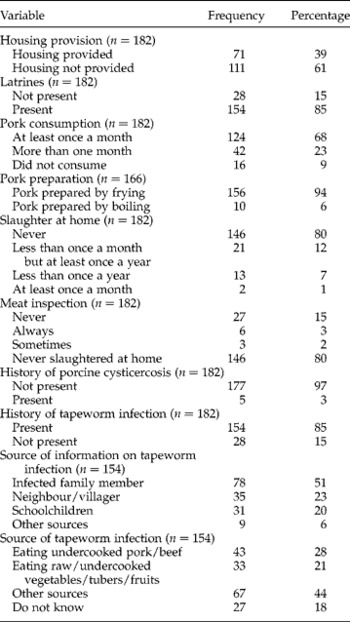
The risk factors for porcine cysticercosis and knowledge on tapeworm infection amongst pig farmers are shown in table 1. Results from the study showed that all the pigs had a history of being free range at one point. The pigs were tethered during the crop season, but during the dry season (after harvest) they were allowed to graze in the homesteads, road sides and garbage sites in the village. The majority of the farms had latrines that were mud walled and thatch roofed. Half (50%) of the latrines did not have doors, while 2% were shallow pits that pigs could access. The average age at which children started to use latrines was 3 years and prior to this age the children defecated within the home compound or in nearby bushes or gardens.
Occurrence of risk factors for cysticercosis and knowledge on tapeworm infection amongst pig farmers in Busia District, Kenya.

Pork consumption was common amongst the sampled farmers and was prepared by either frying or boiling. A substantial number of farmers slaughtered the pigs at home, with the majority of them not consulting a meat inspector. Only a few cases of porcine cysticercosis were recorded by farmers and these were either condemned or sold to consumers at either a lower or normal price. Most farmers (99%) had poor knowledge of transmission of cysticercosis, with only two farmers (1%) suggesting that porcine cysticercosis can originate from pigs consuming infected human waste. The majority of the farmers had noticed tapeworm infections in the previous 10 years, mainly from infected family members, schoolchildren and other villagers. The source of infection was mainly attributed to eating undercooked meat and undercooked/raw vegetables.
Results from the slaughter slab survey showed that all the butchers consumed fried pig meat at least every week and had toilets at their butcheries. In terms of meat inspection, all butchers indicated that they consulted meat inspectors whenever they slaughtered, and only one indicated having ever seen white nodules in the pork. All the butchers had poor knowledge on either the diagnosis of cysticercosis in a live pig or mode of infection. Eighty-one per cent (81%) of the respondents also indicated that they had heard or seen humans shedding tapeworm segments, mainly from schoolchildren (31%), a family member (25%) or within the village (3%). The butchers also indicated that the source of these infections could be from eating uncooked beef or pork (56%), not washing hands before eating (13%), eating spoilt food (13%), or did not know (31%).
Association between prevalence of cysticercosis and risk factors
The prevalence of cysticercosis was not significantly (χ2 = 1.4, P = 0.92) related to division of origin. The infected pigs included seven sows (8%), two growers (2%) and two finishers (4%), and there was no significant difference between the age categories (χ2 = 6.6, P = 0.16). The females and males infected with T. solium were 8 (4%), and 3 (3%) respectively, and there was no significant sex-related difference (χ2 = 0.1, P = 0.75). The farm variables, including housing, rearing method, pork eating, home slaughter and taeniosis knowledge, were not significantly (P>0.05) associated with occurrence of cysticercosis. The only significant (χ2 = 4.4, P = 0.034) risk factor was lack of latrines at household level, where 36% of the infected pigs originated from households without latrines. Multivariate analysis also showed that lack of latrines was the only significant variable associated with porcine cysticercosis. Pigs from farms that did not have a latrine were 3.8 times more likely (OR = 3.8; 95% CI, 1–14.8) to have been exposed to cysticercosis infection compared to pigs from farms that did have a latrine in the homestead.
Discussion
In the current study, porcine cysticercosis was only recorded in the farm survey and not in the slaughter slab survey. The failure to observe cysticercosis cases in slaughtered pigs could be due to the low number of pigs sampled. The seroprevalence of porcine cysticercosis reported in the farm survey was lower than that reported by Githigia et al. (Reference Githigia, Murekefu, Willingham and Otieno2006) and Mutua et al. (Reference Mutua, Randolf, Kitala, Githigia, Willingham and Njeruh2007) in two districts in Western Kenya, using lingual palpation. The antigen ELISA used in the current study has been shown to be more sensitive than lingual palpation (Nguekam et al., Reference Nguekam, Zoli, Vondou, Pouedet, Assana, Dorny, Brandt and Geerts2003; Sikasunge et al., Reference Sikasunge, Phiri, Phiri, Dorny, Siziya and Willingham2006) and thus the results of the current study may be more indicative of the true situation. In general, the prevalence of porcine cysticercosis reported in Western Kenya is relatively lower than that reported in other sub-Saharan countries, such as Tanzania (Ngowi et al., Reference Ngowi, Kassuku, Maeda, Boa and Willingham2004), Uganda (Mafojane et al., Reference Mafojane, Appleton, Krecek, Michael and Willingham2003) and Zambia (Sikasunge et al., Reference Sikasunge, Phiri, Phiri, Dorny, Siziya and Willingham2006). The differences could be due to higher levels of risk factors and higher numbers of free-ranging pigs in the other countries.
A relatively higher prevalence of porcine cysticercosis was observed in the sows when compared to other age categories. This is similar to the results of other studies, where the prevalence of the disease increases with age (Morales et al., Reference Morales, Velasco, Tovar, Rodarte, Sciutto and Larralde2002). Some of the proposed reasons include prolonged exposure of sows to the parasite, high frequency of human waste consumption by sows compared to other groups of pigs, and influence of pregnancy hormones (Morales et al., Reference Morales, Velasco, Tovar, Rodarte, Sciutto and Larralde2002; Copado et al., Reference Copado, de Aluja, Mayagoitia and Galindo2004). Indeed, it has been recommended that sows should be housed during the gestation period to reduce exposure to T. solium eggs (Morales et al., Reference Morales, Velasco, Tovar, Rodarte, Sciutto and Larralde2002).
The percentage of households lacking a latrine in the study areas was within the range reported in Western Kenya in previous studies (Githigia et al., Reference Githigia, Murekefu, Willingham and Otieno2006; Mutua et al., Reference Mutua, Randolf, Kitala, Githigia, Willingham and Njeruh2007). The reported environmental defecation, particularly by pre-school children, could act as a potential transmission route to the free-range pigs if the waste contained T. solium eggs. In this study, lack of latrines was the only significant risk factor associated with prevalence of porcine cysticercosis, and this is similar to that reported in other studies (Ngowi et al., Reference Ngowi, Kassuku, Maeda, Boa and Willingham2004; Mutua et al., Reference Mutua, Randolf, Kitala, Githigia, Willingham and Njeruh2007). It has been observed that defecation in areas where pigs can access the infected human faeces can lead to increased transmission of T. solium (Ngowi et al., Reference Ngowi, Kassuku, Maeda, Boa and Willingham2004; Sikasunge et al., Reference Sikasunge, Phiri, Phiri, Dorny, Siziya and Willingham2006).
Pork consumption was reported to be high in this study, possibly due to the fact that the people surveyed were involved in either pig rearing or trade. Pork was mainly fried and it is important to note that this method does not completely destroy C. cellulosae cysts (Mafojane et al., Reference Mafojane, Appleton, Krecek, Michael and Willingham2003). The proportion of farmers who undertook slaughter of pigs at home in the current study was higher than that reported by Wabacha (Reference Wabacha2001) in Kikuyu Division of Central Province, Kenya, where pigs are mainly bought by major pork processing companies. As reported by Ngowi et al. (Reference Ngowi, Kassuku, Maeda, Boa and Willingham2004) and Sikasunge et al. (Reference Sikasunge, Phiri, Phiri, Dorny, Siziya and Willingham2006), most farmers who undertook home slaughter of pigs did not seek meat inspection services as the meat was assumed to be ‘harmless’ (Ngowi et al., Reference Ngowi, Kassuku, Maeda, Boa and Willingham2004). The low prevalence of porcine cysticercosis may have led to the poor knowledge of the disease witnessed amongst the farmers and butchers. This can be contrasted to pig farmers in other sub-Saharan African countries, where cysticercosis is highly prevalent in pigs kept under traditional settings and thus pig farmers and traders are highly knowledgeable about the disease (Mafojane et al., Reference Mafojane, Appleton, Krecek, Michael and Willingham2003; Ngowi et al., Reference Ngowi, Kassuku, Maeda, Boa and Willingham2004). However, due to the cross-border pig trade between Kenya and other East African countries (Mafojane et al., Reference Mafojane, Appleton, Krecek, Michael and Willingham2003; Mutua et al., Reference Mutua, Randolf, Kitala, Githigia, Willingham and Njeruh2007) farmers in border districts need to be aware of cysticercosis.
In contrast to the low occurrence of cysticercosis, the majority of the farmers and butchers had seen tapeworm infections in people during the previous decade. The infection was mainly observed in an infected family member or schoolchildren. The observation of the proglottid segments in stools could indicate that the farmers and traders were indeed describing a tapeworm infection. The tapeworm infections could be either T. saginata or T. solium, since both of these are associated with shedding of proglottid segments. According to annual reports of the Ministry of Health in Kenya, the prevalence of human taeniosis in Busia District was estimated at between 4 and 10%, which was higher than the national average of 2% (Government of Kenya, 2001). However, it is important to note that hospital data have some limitations and higher figures are expected if a prospective epidemiological study is carried out.
In conclusion, this study describes the occurrence of cysticercosis in free-range pigs in Busia District, Kenya using a more sensitive serological method. According to this method, cysticercosis was widely distributed in pigs in the whole district. As expected, the occurrence of this disease was significantly associated with absence of latrines at the household level. Further studies should be conducted to determine the prevalence of human taeniosis and cysticercosis in the study area. Further, there is a need to formulate and implement appropriate strategies that can eliminate the disease in the area and prevent it from spreading to neighbouring districts. Such strategies may include education about public health and sanitation, and improvement of pig husbandry.
Acknowledgements
The study was funded by the World Bank through the Kenya Agricultural Productivity Program (KAPP). The authors are grateful for cooperation given by participating farmers and extension officers in Busia District, Kenya. The technical assistance and facilitation of ELISA analysis provided by C.K. Sikasunge of University of Zambia is acknowledged.