INTRODUCTION
The blackpot seabream, Pagellus bogaraveo (Brünnich, 1768) is a commercially important benthopelagic sparid fish that occurs in the north-east Atlantic as well as the Mediterranean Sea. Its parasitic fauna is insufficiently known, and there has never been a comprehensive study of its ectoparasites. There are some studies of specific parasite groups that report ectoparasite species detected in P. bogaraveo. The monogeneans Lamellodiscus virgula Euzet & Oliver, 1967, Encotyllabe pagelli van Beneden & Hesse, 1863, Choricotyle chrysophryi (van Beneden & Hesse, 1863) and Choricotyle pagelli Llewelyn, 1941 have been reported from blackspot seabream from north-east Atlantic waters (Llewellyn, Reference Llewellyn1941, Reference Llewellyn1956; Oliver, Reference Oliver1973; Hansson, Reference Hansson1998). Several copepod species have also been reported on P. bogaraveo, but mostly from the Mediterranean (Raibaut et al., Reference Raibaut, Combes and Benoit1998); in the north-east Atlantic only three copepods have been detected parasitizing this fish, namely Caligus centrodonti Baird, 1850, Hatschekia pagellibogneravei (Hesse, 1878), and Peniculus fistula von Nordmann, 1832 (Scott & Scott, Reference Scott and Scott1913; Gooding, Reference Gooding1957; Jones, Reference Jones1985). The cymothoid isopod Ceratothoa collaris Schiödte & Meinert, 1883 has also been detected on this fish (Bariche & Trilles, Reference Bariche and Trilles2008).
This study is the first attempt to describe the ectoparasite community of P. bogaraveo in the wild, and also to evaluate whether these parasites might become problematic in captivity, since this fish has recently started to be produced in aquaculture (Basurco et al., Reference Basurco, Lovatelli, García, Pavlidis and Mylonas2011), and seems to be an excellent alternative to other commonly cultured sparids, such as Sparus aurata, due to its higher market value (Peleteiro et al., Reference Peleteiro, Olmedo and Alvarez-Blázquez2000). Skin and gill parasites often have serious impact in cultured fish because, on the one hand, captive fish often experience higher stress levels than wild fish, rendering them more vulnerable to the negative effects of parasitism and, on the other hand, they are limited in the behavioural ways in which they might normally avoid the parasites that are present in the environment, or minimize their impact by seeking cleaner fish (Grutter, Reference Grutter2003). Skin parasites often cause lesions that might lead to secondary infections, especially of bacterial aetiology. Gill parasites, especially when present in large numbers, can cause severe damage to the gill and impair normal respiratory function, which may lead to the death of the host by hypoxia (Marino et al., Reference Marino, Giannetto, Paradiso, Bottari, De Vico and Macrì2004). In addition, many ectoparasites feed on blood, and high intensities of infection may lead to anaemia and poor growth rates.
Another important aim of this study was to assess the differences in the ectoparasite communities of P. bogaraveo from different locations in the Portuguese waters, especially between mainland Portugal and the Atlantic islands of Madeira and the Azores. The fact that different locations were analysed, and also that sampling was carried out throughout the year, may have helped to capture a wide range of parasites that might not have been detected had the study been carried out in a single location or during a specific time of the year, and might help to achieve a more comprehensive perspective of the ectoparasites of P. bogaraveo in Atlantic waters.
MATERIALS AND METHODS
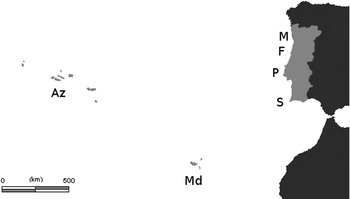
A total of 348 specimens of Pagellus bogaraveo caught in the Portuguese Exclusive Economic Zone were acquired from commercial catches between the years 2009 and 2011, from four mainland locations (42 from Matosinhos, 92 from Figueira da Foz, 42 from Peniche and 30 from Sagres) and the Atlantic islands of Madeira (56) and Azores (86) (Figure 1). Sampling was carried out during two seasonal periods (autumn/winter and spring/summer) in all locations except Sagres, where only spring/summer samples could be obtained. Fish were transported in ice to the laboratory and measured before being frozen in individual plastic bags. Fish mean length is presented in Table 1. After defrosting, each fish was analysed for the presence of ectoparasites. The tegument, mouth, nostrils and gill chambers were thoroughly observed. The gills were removed and placed in Petri dishes and each gill arch was separately observed under a stereomicroscope. All parasites were collected and preserved in 70% ethanol. Monogeneans were cleared and mounted in glycerol, observed in an optical microscope and identified according to the descriptions of Llewellyn (Reference Llewellyn1941), Dawes (Reference Dawes1947) and Oliver (Reference Oliver1973). Identification of copepods followed Kabata (Reference Kabata1979), Alexander (Reference Alexander1983) and Boxshall (Reference Boxshall1986). Isopods were identified according to Sars (1899), Richardson (Reference Richardson1905), Norman & Scott (Reference Norman and Scott1906) and Bruce (Reference Bruce2004).
Sampling locations on the Portuguese mainland coast: (M) Matosinhos; (F) Figueira da Foz; (P) Peniche; (S) Sagres; and Islands: (Md) Madeira; (Az) Azores.

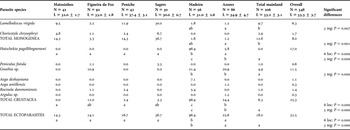
Prevalence (%) of parasite infection in Pagellus bogaraveo from locations on mainland Portugal (Matosinhos, Figueira da Foz, Peniche and Sagres) and Islands (Madeira and Azores). Number (N) and length (L) (mean ± standard deviation, in cm) of fish examined. Significant differences detected among locations and among regions (mainland, Madeira and Azores) by Chi-square test (similar letters indicate no significant differences).

P, probability level.
Prevalence and intensity of infection were determined according to Bush et al. (Reference Bush, Lafferty and Shostak1997). Statistical analyses were carried out using IBM SPSS statistics software. Whenever possible, prevalence and intensity of parasite infection were compared among all 6 locations, and also between three regions (mainland, Madeira and Azores), using a Chi-square test for prevalence, and the non-parametric Kruskal–Wallis test for intensities, followed by multiple comparisons whenever significant differences were detected. For all tests, statistical significance was accepted when P < 0.05.
RESULTS
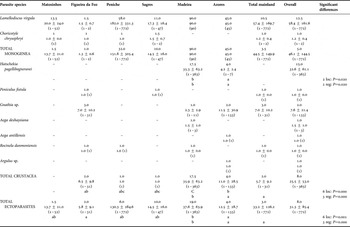
A total of nine ectoparasite species were detected in the 348 specimens of Pagellus bogaraveo examined: the monogeneans Lamellodiscus virgula and Choricotyle chrysophryi; the copepods Hatschekia pagellibogneravei and Peniculus fistula; the isopods Gnathia sp. Leach, 1814 (praniza larvae), Aega deshaysiana (Milne Edwards, 1840), Aega antillensis Schiöedte & Meinert, 1879 and Rocinela danmoniensis Leach, 1818; and the branchiuran Argulus sp. Müller, 1785. Prevalence and intensity of infection for each species is presented in Tables 1 and 2, respectively.
Intensity (median, mean ± standard deviation, (range)) of parasite infection in Pagellus bogaraveo from locations in mainland Portugal (Matosinhos, Figueira da Foz, Peniche and Sagres) and Islands (Madeira and Azores). Significant differences detected among locations and among regions (mainland, Madeira and Azores) by the Kruskal–Wallis test (similar letters indicate no significant differences).

P, probability level.
Only 113 fish (32%) of all the specimens observed were infected with at least one ectoparasite species. Of these, the majority (81%) harboured only one species, whereas 15% had two parasite species and 4% three. No more than three species were detected per host.
Monogeneans were located exclusively on the gills. Prevalence of monogeneans was significantly different in the three regions, being higher in mainland samples. Lamellodiscus virgula was the only parasite species that occurred in all sampling locations, with a maximum prevalence in Sagres (30.0%). Intensity of infection was highly variable, but no significant differences were detected between locations. A maximum of 772 individuals were observed on a single fish. The polyopisthocotylean C. chrysophryi was detected in all mainland locations, but not in the islands. Prevalence was again highest in Sagres, but reached only 6.7%. Intensity of infection was always very low; no more than two specimens were ever detected in a single host.
The copepod H. pagellibogneravei, another gill parasite, presented the highest prevalence detected in this study: 96.4% in Madeira waters. This species also occurred in the Azores, albeit with a much lower prevalence (5.8%), but was absent from mainland waters. Intensity of infection was also significantly higher in Madeira. The copepod P. fistula was found attached to the caudal fin of only two fish, producing a dark colour lesion in the attachment site.
Praniza larvae of Gnathia sp. were detected in the mouth, oesophagus, gills, gill chamber, and on the tegument and fins of several fish from the islands and from one mainland location. Prevalence of this isopod was significantly higher in the islands. Mean intensity was not particularly high, but occasionally a single fish hosted more than 100 Gnathia sp. Three aegid isopods were detected for the first time in P. bogaraveo: A. deshaysiana, A. antillensis and R. danmoniensis. These isopods were usually detected on the tegument, most often underneath the pectoral fins, with the exception of A. antillensis, which was located on the gills, and infection levels were always low. A single specimen of Argulus sp. was also detected under a pectoral fin on a fish from Azorean waters.
Globally no significant differences were detected between autumn/winter and spring/summer except in the prevalence of Gnathia sp. (autumn/winter = 17.6% and spring/summer = 6.3%) and H. pagellibogneravei (autumn/winter = 25.2% and spring/summer = 10.1%), and intensity of Gnathia sp (mean intensity autumn/winter = 2.2 and spring/summer = 20.2).
Although nine ectoparasite species were detected, species richness never exceeded 5 at any sampling location. Fish from both islands had an ectoparasite community composed of 4 crustaceans and one monogenean species; while in mainland waters the ectoparasite community was composed of 3 crustaceans and 2 monogeneans. Overall, monogenean prevalence was higher in the mainland, whereas prevalence of crustaceans was higher in the islands. Within the three studied regions, prevalence and intensity of crustaceans and ectoparasites were significantly higher in Madeira.
DISCUSSION
Parasite species detected
Until recently, two morphologically very similar species of diplectanid monogeneans were thought to occur in Pagellus bogaraveo, namely Lamellodiscus obeliae and Lamellodiscus virgula; however, analysis of their ribosomal DNA sequences has revealed differences of less than 1%, and they are therefore now considered a single species, L. virgula (Desdevises et al., Reference Desdevises, Jovelin, Jousson and Morand2000). This monogenean occurred in fish from all locations studied, but it was more common in the mainland. Prevalence values were usually lower than those observed by Oliver (Reference Oliver1973) on the Atlantic coast of France (30%) and by Kaouachi et al. (Reference Kaouachi, Boualleg, Bensouilah and Marchand2010) in the Mediterranean (12–33%), on the same host. Although less pathogenic than other diplectanid species such as Diplectanum spp., Lamellodiscus spp. have been shown to cause damage to the gills, especially epithelial hyperplasia and microhaemorrhages (Sánchez-García et al., Reference Sánchez-García, Padrós, Raga and Montero2011).
Choricotyle chrysophryi is a polyopisthocotylean that has previously been recorded in P. bogaraveo from both the north-east Atlantic (Llewellyn, Reference Llewellyn1941, Reference Llewellyn1956) and the Mediterranean (Kaouachi et al., Reference Kaouachi, Boualleg, Bensouilah and Marchand2010). It is a relatively large monogenean, whose attachment organs function as suckers, allowing the parasite to move freely on the surface of the gills (Llewellyn, Reference Llewellyn1956). Although polyopisthocotylean parasites of fish feed on blood, they generally tend to be harmless to their hosts in wild fish (Kearn, Reference Kearn2005). That is probably the case for this species, since intensity of infection seems to be usually very low. Llewellyn (Reference Llewellyn1941) detected no more than two parasites per host, as was also observed in the present study, whereas Kaouachi et al. (Reference Kaouachi, Boualleg, Bensouilah and Marchand2010) found no more than one. Nonetheless, it is likely that higher parasite loads could occur in captive conditions, and large numbers of blood feeding parasites could potentially cause anaemia.
Hatschekia pagellibogneravei is a relatively common copepod that parasitizes several species of sparid fish, including P. bogaraveo (Raibaut et al., Reference Raibaut, Combes and Benoit1998; Boualleg et al., Reference Boualleg, Seridi, Kaouachi, Quiliquini and Bensouillah2010b). It has often been reported from the Mediterranean (Raibaut et al., Reference Raibaut, Combes and Benoit1998; Ternengo et al., Reference Ternengo, Levron, Mouillot and Marchand2009; Boualleg et al., Reference Boualleg, Ferhati, Kaouachi, Bensouilah and Ternengo2010a, Reference Boualleg, Seridi, Kaouachi, Quiliquini and Bensouillah2010b), and occasionally also from the north-east Atlantic (Jones, Reference Jones1985). In this study it was only detected in the Atlantic islands, with a significantly higher prevalence in Madeira. Boualleg et al. Reference Boualleg, Ferhati, Kaouachi, Bensouilah and Ternengo(2010a) found a relatively high prevalence of this parasite on Diplodus annularis (L., 1758) from the Mediterranean (60%) but, to the best of our knowledge, a prevalence reaching almost 100% had never been detected on any host. Intensity of infection was also higher than the highest mean intensity previously reported, 11.4 on Diplodus cervinus (Lowe, 1838) (Boualleg et al., Reference Boualleg, Seridi, Kaouachi, Quiliquini and Bensouillah2010b). A mean abundance of 6.8 is the only parasitological index provided for H. pagellibogneravei on P. bogaraveo in the Mediterranean (Boualleg et al., Reference Boualleg, Seridi, Kaouachi, Quiliquini and Bensouillah2010b), so here we also determined this parameter and again, mean abundance of this species in Madeira was much higher (34.0 ± 62.4).
Gnathiid isopods are obligatory fish parasites during three juvenile stages of praniza larvae, feeding on fish blood, whereas the adult stages are free-living and do not feed (Hadfield et al., Reference Hadfield, Smit and Avenant-Oldewage2009). Most studies of wild fish populations found no significant pathology associated with Gnathia sp. infection (Heupel & Bennett, Reference Heupel and Bennett1999; Gene, Reference Gene2007); however they may transmit blood parasites such as Haemogregarina bigemina Laveran & Mesnil, 1901 (see Davies et al., Reference Davies, Smit, Hayes, Seddon and Wertheim2004). Many wild fish seek cleaner fish very frequently (up to more than 100 times per day), which may help to minimize the impact of gnathiids (Grutter, Reference Grutter2003). However, in captive fish, these isopods can cause not only anaemia (Jones & Grutter, Reference Jones and Grutter2005), but also severe mechanical damage to the skin and especially the gills, which may in extreme cases lead to death by hypoxia (Marino et al., Reference Marino, Giannetto, Paradiso, Bottari, De Vico and Macrì2004). Although the intensity detected in some fish in the present study was occasionally high (reaching 133 parasites in one host), mean intensity was generally moderate, and no lesions associated with this parasite were observed. It should however be noted that the stress imposed on fish by capture, as well as handling and transport, may influence the prevalence and intensity of infection by these parasites, as they can easily detach from the host. Praniza larvae of Gnathia sp. had never been detected in P. bogaraveo, but they have often been reported in various fish species captured in Portuguese waters (e.g. Davies et al., Reference Davies, Eiras and Austin1994; Marques et al., Reference Marques, Teixeira and Cabral2006; Sequeira et al., Reference Sequeira, Gordo, Neves, Paiva, Cabral and Marques2010). Not only do gnathiids have low host specificity, but they also seem to show no particular preference for any site of attachment (Hadfield et al., Reference Hadfield, Smit and Avenant-Oldewage2009). In this study they were detected in different locations on the skin and fins, as well as in the mouth, gill chamber, and on the gills, which coincides with findings by other authors (e.g. Grutter, Reference Grutter2003).
Aegidae are temporary parasites of fish (Bunkley-Williams & Williams, Reference Bunkley-Williams and Williams1998). Some authors refer to these temporary associations as ‘predation’ (e.g. Novotny & Mahnken, Reference Novotny and Mahnken1971; Bruce, Reference Bruce2004); however, aegids seem to be associated with fish for longer periods of time than strictly necessary for feeding (Bunkley-Williams & Williams, Reference Bunkley-Williams and Williams1998). Aegids can have a negative impact on fish by causing large wounds, stunting growth, and occasionally even killing young fish (Bunkley-Williams & Williams, Reference Bunkley-Williams and Williams1998). The temporary character of the association and the ease with which they can detach from the host (Rokicki, Reference Rokicki1985) can help to explain the low number of Aegidae detected. In fact, for most aegid species, very few hosts have been reported, yet it seems likely that they exhibit low specificity. Bruce (Reference Bruce2004) mentions two sharks as hosts of A. deshaysiana, and Ramdane & Trilles (Reference Ramdane and Trilles2008) have recently detected it on Sardina pilchardus (Walbaum, 1792). The only host reported for A. antillensis was a serranid fish (Bruce, Reference Bruce2004). For R. danmoniensis Sars (1899) mentions that it is generally found ‘clinging to the skin of fishes of various kinds’. Pagellus bogaraveo is reported here for the first time as a suitable host for these three aegid species. Both A. deshaysiana and R. danmoniensis have been detected in the north-east Atlantic (Sars, 1899; Bruce, Reference Bruce2004), including in Madeiran waters, in the case of A. deshaysiana. On the other hand, the Portuguese mainland and Madeira extend the range of R. danmoniensis further south than was previously known. In the case of A. antillensis, the only previous records were from the north-west Atlantic, especially the Caribbean Sea and Gulf of Mexico (Bruce, Reference Bruce2004). However, the same author notes that the species is probably more widespread, and the present work extends its range of occurrence to the Azores, the westernmost archipelago of the north-east Atlantic.
Only two specimens of P. fistula were detected, both firmly attached to the caudal fin of their hosts. This was also the site of attachment reported by Gooding (Reference Gooding1957). Only the post-metamorphose female is parasitic on fish, and exhibits a low host specificity (Boxshall, Reference Boxshall1986). Attachment of this parasite involves a deep penetration of the tegument, and it seems likely that the resulting lesions might have a negative impact on fish health, particularly with higher intensities of infection.
Argulus sp. is a worldwide occurring branchiuran, commonly called fish lice. Several species are known to be highly pathogenic to cultured fish and, although there have been as yet no reports of Argulus sp. infections in marine aquaculture facilities, several marine species occur in the north-east Atlantic, and they could potentially have a severe negative impact on cultured fish (Schram et al., Reference Schram, Iversen, Heuch and Sterud2005). There is currently some concern that Argulus sp. might start exhibiting higher growth rates in temperate regions due to climate warming (Hakalahti et al., Reference Hakalahti, Karvonen and Valtonen2006). Here the blackspot seabream is reported for the first time as a suitable host for this crustacean.
Ectoparasite community
Although nine species of ectoparasites were detected in this study, species richness in any one location never exceeded 5 species. This is comparable to what has been reported for other sparid fish, such as Boops boops (L., 1758), Dentex dentex (L., 1758), Diplodus vulgaris (Geoffrow Saint-Hilaire, 1817) (all 6 ectoparasite species), and Pagellus erythrinus (L., 1758) (7 species) (González et al., Reference González, Sánchez, Chirivella, Carbonell, Riera and Grau2004; Pérez-del-Olmo et al., Reference Pérez-del-Olmo, Raga, Kostadinova and Fernández2007; Ternengo et al., 2009). All of these species had only one or two monogeneans, as was also the case in the present study. Species richness of monogenean parasites of the genus Lamellodiscus is highly variable within the Sparidae, but in the larger species, such as Sparus aurata L., 1758, Pagrus pagrus (L., 1758) and P. bogaraveo, only one species usually occurs (Desdevises, Reference Desdevises2006).
Copepod species richness is also highly variable, even within the genus Pagellus, with Pagellus acarne (Risso, 1827) being host to only two species and P. erythrinus to 13. Pagellus bogaraveo is somewhere in the middle, as seven copepod species have been reported from this fish (Raibaut et al., Reference Raibaut, Combes and Benoit1998). In this study only two copepod species were detected, which is unexpectedly low, but one must bear in mind that most records of copepod parasites of P. bogaraveo that were not detected in the present study are from the Mediterranean Sea. However, these species (namely, Alella pagelli (Krøyer, 1863) and several Caligus spp.) are not unknown to occur in the north-east Atlantic (Kabata, Reference Kabata1992). No parasitological indices were found in the literature to assess whether these species are rare in the blackspot seabream, or whether they are more common in the Mediterranean than in the Atlantic.
In this study, monogeneans were more prevalent in Portuguese mainland waters. Several studies have shown that both monopisthocotylean and polyopisthocotylean monogeneans exhibit higher infection levels in polluted areas (see Pérez-del-Olmo et al., Reference Pérez-del-Olmo, Raga, Kostadinova and Fernández2007, and references therein). Since continental waters generally tend to be more polluted when compared to open oceanic waters, this seems a likely explanation for the higher prevalence of monogeneans in fish from Portuguese mainland waters.
Higher prevalence and intensity of ectoparasites, and crustaceans (i.e. all ectoparasites except monogeneans) in Madeira is a result that agrees with previous findings of increased abundance of ectoparasites of marine teleosts with decreased latitude (Rohde & Heap, Reference Rohde and Heap1998), and is related to differences in water temperature range. Rohde et al. (Reference Rohde, Hayward and Heap1995) found significant positive correlations between means of water temperature ranges (mean temperature during the coldest month to mean temperature during the warmest month) and intensity and abundance of ectoparasites, and abundance of copepods, specifically in benthopelagic fish. In this study, prevalence and intensity of ectoparasites, of crustaceans, and of the copepod H. pagellibogneravei were all significantly higher in Madeira, the southernmost location studied and the only one that is in a subtropical biogeographical region. In this area, the mean of the temperature range (data from the years 1981 to 2000) was 20.8°C, whereas in mainland Portugal it varied between 15.1°C in the northernmost location and 17.8°C on the southern coast, and in Angra do Heroísmo, Azores, it was 18°C (Carvalho & Soares, Reference Carvalho and Soares2001).
In conclusion, nine ectoparasite species were detected on blackspot seabream from Portuguese waters, including two monogeneans and seven crustaceans, which is comparable to the ectoparasite communities of other sparid fish. Gnathia sp., Aega deshaysiana, A. antillensis, Rocinela danmoniensis and Argulus sp. were detected on this host for the first time. The ectoparasite community of P. bogaraveo varied significantly among locations, with the mainland samples showing higher prevalence of monogeneans. Madeira had significantly higher infection levels of ectoparasites, crustaceans, and the copepod Hatschekia pagellibogneravei, which might be due to biogeographical differences, as abundance of ectoparasites and copepods tends to increase in lower latitudes, especially in the case of benthopelagic fish.
ACKNOWLEDGEMENTS
This work was supported by Fundação para a Ciência e Tecnologia (M.H., Grant SFRH/BD/47767/2008). The authors are grateful to Victor Prior from Instituto Nacional de Meteorologica for his helpful assistance in obtaining the water temperature data.