THE HISTORICAL AND NUMISMATIC BACKGROUND
This contribution proposes to disentangle and evaluate a particularly dense period of coin production in southern and central Greece around the start of the fourteenth century (1289–1313)Footnote 1 . The two decades under analysis are characterised by multiple, at times rival, mints emitting large and varied silver-based (billon) penny coinages of the same overall French type (‘deniers tournois’). Such coins were central to the accounting systems of the area and were deployed in a range of economic, administrative and military contexts. New archaeometric data, combined with numismatic information, and embedded in the historical sources, allow us now to attempt a year-by-year and blow-by-blow account of coin issuance of three major mints and polities. Our emphases are on the political and economic determining factors, and the fundamental pieces in this puzzle are the minting standard, that is to say the percentage of silver which each issue contains, and its accompanying trace elements. The first shows us whether an issuer was willing or able to sustain a good quality and to add responsibly to the monetary stock, or alternatively maintained or expanded the same while jeopardising stability. Comparative trace elements provide us with hints of common or diverse bullion supplies, shedding further light on the context and purpose of the individual coinages.
After more than a millennium, the region under discussion returned to minting coinage during the so-called Latin or Frankish occupation, which began as a result of the Fourth Crusade (1204) (on the coinages see Schlumberger Reference Schlumberger1878–82; Metcalf Reference Metcalf1960; Tzamalis Reference Tzamalis1981; Metcalf Reference Metcalf1995; Baker Reference Baker and Travaini2011a–Reference Baker and Travaini2011h; Baker Reference Baker, Tsougarakis and Lock2015; Tzamalis Reference Tzamalis2016). Through this and subsequent events, Greece was divided into a number of polities which existed under the umbrella of the Latin empire at Constantinople (for political histories: Longnon Reference Longnon1949 and Reference Longnon, Setton and Wolff1962; for the relevant acts: Hendrickx Reference Hendrickx1988). After an interlude of lesser quality coinages produced at the Corinth and Thebes mint in the 1240s and 1250s, the vast majority, if not all, of the new deniers tournois of Greece are to be dated after 1267. The decadence and eventual demise of the Latin empire caused the last reigning emperor, Baldwin II, to gradually pass the rights over parts of Greece to the principality of Achaia, and then in 1267 the suzerainty over all of Latin Romania to the powerful Anjou dynasty of Italy. From this point onwards Greece became politically orientated towards southern Italy (Dourou-Iliopoulou Reference Dourou-Iliopoulou1987 and Reference Dourou-Iliopoulou1993). From the second half of the thirteenth century the area also came to be ever more tightly integrated into international trading networks.Footnote 2 In a general context of demographic and economic expansion which resulted in the so-called commercial revolution (Spufford Reference Spufford1988, 109–263), Greece offered foodstuffs (grain in particular), livestock (horses) and some specialist luxury raw and semi-manufactured products (silks), and arguably enjoyed a positive balance of payments. Trade was increasingly centred on Venice: the republic was officially overlord of all areas of Latin Romania and its citizens enjoyed free access to markets there. In the face of external pressures which mounted in this period, Venice tightened its grip on its direct colonies and protected trade routes. Private Venetian activity in particular also increased commercial contacts between Greece and southern Italy, especially Puglia, as we can glean from some rare private documents (Lombardo Reference Lombardo1951). We rely on other more disparate sources such as ceramics (Skartsis Reference Skartsis2009; Vroom Reference Vroom2011), and in fact coins (Baker Reference Baker2001), to suggest that trading relations between the territories may also have been maintained by non-Venetians in diverse ways and along complex routes. In this context it is certainly of relevance that Achaia and other Greek locations had passed under Angevin rule. The symbiosis of political and commercial interests is powerfully symbolised by the new city of Clarentza in Elis, founded approximately at the time of the Angevin takeover, which developed into the main centre of trade of the principality of Achaia, and was the location of its denier tournois mint (Tzavara Reference Tzavara2008; Athanasoulis Reference Athanasoulis and Gerstel2013a).
From 1267, the princes of Achaia and the dukes of Athens (the title borne by the rulers of this polity after 1280), among a number of other Greek rulers, owed their allegiances and arguably their rights to mint to the kings of Sicily. Minting of the main medieval Greek silver denomination, the denier tournois, began at Clarentza (ancient and modern Kyllini) for Achaia around 1267, and at Thebes for Athens c.1285, followed by a number of smaller mints. The coins of the Athenian mint had, like those of Clarentza, both political and commercial dimensions. The trading history of Thebes for the years c.1285–1311 is not particularly well documented, but we may infer from diverse and circumstantial evidence – the rich notarial documentation for the first half of the thirteenth century (Morozzo della Rocca and Lombardo Reference Morozzo della Rocca and Lombardo1940 and Reference Morozzo della Rocca and Lombardo1953), and Pegolotti's handbook describing the situation after a decade or two of Catalan rule (Evans Reference Evans1936) – that it was the location of an important market, especially for silks, which Venetian and other traders could easily access from nearby Negroponte (on the trade of Thebes/Negroponte see Jacoby Reference Jacoby2000; Reference Jacoby, Maltezou and Schreiner2002; Reference Jacoby2010). The fact that the rulers, later dukes, of the de la Roche dynasty chose it as the location of their mint even though their place of residence remained Athens, and the size of the denier tournois coinage itself, are powerful pieces of evidence in this respect. The scanty archaeological record, especially ceramics, available to date for this period also suggests a city with important Greek and international connections, whose commercial centre may nevertheless no longer have been within the fortified hill known as the Kadmeia (Armstrong Reference Armstrong1993; Vroom Reference Vroom, Andrikou, Aravantinos, Godart, Sacconi and Vroom2006).
The first period of minting at Clarentza and Thebes, to 1289, has been addressed in a previous contribution on the basis of elemental analysis by inductively coupled plasma atomic emission spectroscopy (ICP-AES) (Baker and Ponting Reference Baker and Ponting2001). Therein, the date of first minting, the existence of multiple mints within single polities, the bullion supply and the minting standards were discussed. Achaia and Athens were found to have had only one mint each, Clarentza and Thebes, whereas other authors had suggested multiple mints. Significant differences for these two mints were postulated: in the period c.1267 to c.1285/9 Achaia minted at a standard of around 26% silver; after 1278/9, when Charles I of Anjou became prince of Achaia in addition to king of Sicily, there was a significant flow of bullion from Italy to the Clarentza mint. Athens, meanwhile, minted at a standard of only c.23% silver, and without direct provisioning from Italy, in the period 1285–9. These activities can be described and dated with some precision thanks to the typological classification system put forward by Metcalf (Reference Metcalf1995) and Tzamalis (Reference Tzamalis1990, Reference Tzamalis1994) which will also be relied upon in the present article. The early prolific Athenian issue is known as GR105. The same analyses also included, for the purpose of comparison, a later group from the Thebes mint (GR20B, dating to c.1305) which produced a standard of c.19%. This type will be further discussed below.
With these preconditions in mind, the present set of analyses targeted the subsequent years 1289–1313, that is to say the coinages which came chronologically after those of the previous analyses. Greek coinages in this period were conditioned by a number of political and economic considerations, which will be further elucidated in the main discussions. In a few steps after 1289, the Angevin King Charles II, son of Charles I, decentralised but simultaneously tightened his control over Greece: rule over Achaia was devolved to a succession of princes, who in turn sought to gain the allegiance of the dukes of Athens, which was occasionally pledged following Angevin coercion. During the Wars of the Sicilian Vespers (1282–1302) against the Aragonese, who had wrestled away this important island, Angevin activities in Greece formed part of a much broader struggle for supremacy in the central Mediterranean (Abulafia Reference Abulafia1997; Sakellariou Reference Sakellariou and Colesanti2014). Greece itself was also directly threatened by the Aragonese in this context, first in the 1290s (Airaldi Reference Airaldi1995). After 1300 the situation in Achaia itself took an unfavourable turn for the Angevins, who built up an alternative power-base on the other side of the Corinthian Gulf, around the town of Naupaktos (Lepanto), where a short-lived minting operation was launched. In the same period, in addition to Clarentza, Athens and Naupaktos, there was also, under Athenian initiative, minting at Neopatra, to the west of Lamia (Baker and Galani-Krikou Reference Baker and Galani-Krikou2004; Baker Reference Baker and Travaini2011e), and at Salona, ancient and modern Amphissa (Baker Reference Baker and Travaini2011f), which occurred in smaller quantities than at the three main mints. The island of Tinos, which owed allegiance directly to Achaia and whose Ghisi rulers were otherwise closely linked to the Angevin authorities, minted in precisely these years (Baker Reference Baker and Travaini2011h), whereas the direct Angevin minting initiative on the island of Corfu certainly pre-dates 1300 (Baker Reference Baker and Travaini2011b). From 1308 this situation unravelled: there was a problem of succession in Athens, and then the eastern part of central Greece came under severe threat from the Catalan Grand Company, which had previously devastated Thrace, Macedonia and Thessaly. Prior to the decisive battle at Halmyros in 1311, Athens, Achaia, perhaps Neopatra, and perhaps Tinos increased their coin production in preparation for the conflict, in order to make payments either to the Catalans or to their own combatants. The Catalans emerged victorious and became the rulers of eastern central Greece, in direct conflict with the Angevins. Thereafter, very little tournois mintage is attested in Greece: most mints were closed; the Achaian mint at Clarentza continued at a reduced rate under Prince Philip of Taranto during 1311–3 (see below), after which its operation ground to an almost complete halt for two to three years; and the Catalans themselves may have issued low-grade tournois imitations at Thebes which cannot easily be confused with the established Greek billon coins (Baker Reference Baker and Moschonas2003). Defeat by the Catalans caused a significant crisis, practical and moral, to Angevin ambitions in Greece and their political and economic involvement in the area was severely curbed. The year 1313, in which Philip of Taranto, son of King Charles II, ceased to be prince of Achaia is a logical point at which to stop the current enquiry.
THE ANALYSES
For the present analyses we sought to provide a good coverage of the main mints and issues of the period 1289–1313. The issues under analysis in this paper divide into three mints: Clarentza, Naupaktos and Athens. The first is represented by four princes of Achaia. The main units which we will refer to are therefore the following:
-
1. Achaia, Clarentza mint – Princes Florent of Hainaut (1289–97), Isabelle of Villehardouin (1297–1301), Philip of Savoy (1301–4/6), Philip of Taranto (1304/6–13).
-
2. Despot of Romania, Naupaktos mint, Philip of Taranto (1296/8–1314).
-
3. Athens, Thebes mint, Dukes Guy II de la Roche (1287–1308) or Walter of Brienne (1309–11), obv. legend GVI.DVX.
The issues under discussion can be attributed to mints and rulers with some confidence on the basis of their legends. Yet even here some problems can arise: for instance, at Thebes for Athens three successive dukes and an interregnum in 1308/9 cannot be completely matched to the two main legends G.DVX and GVI.DVX. In order to be entirely clear about attributions and datings of individual issues, this article has sought to revisit some of the political and dynastic history of Greece during the period; it has endeavoured to add some details to the established typologies, based on legends, the marks and stops which adorn them (and which may relate to the administration of the mints), the shapes and methods used to put the letters together, and some orthographical differences; and it has also taken into consideration some archaeological information, especially dated hoards (Metcalf Reference Metcalf1995, 241–346; Baker Reference Baker and Moschonas2003, 313–6 for eastern central Greece; Baker and Stahl Reference Baker, Stahl and Gerstel2013, 180 for the Peloponnese). In general terms, all established types are considered to be chronologically progressive, and we have dismissed any ideas brought forward by Metcalf and Tzamalis of multiple workshops or even different mints within Achaia/Athens, or other convoluted constellations, which have in recent years led enquiries into wrong directions (see, in addition to the works already cited, Tzamalis Reference Tzamalis2004). Apart from typological and archaeological consistency, any chronology is to be based on the standard at which a type was minted, with the implication that there was in medieval numismatics an almost natural tendency to debase billon currencies slightly, unless there were special circumstances which brought on more rapid debasement or even improvements in the standard, and finally on the aforementioned trace elements which link or separate types.
To date, a limited number of analyses had been carried out on medieval Greek coins of the same varieties (Baker and Ponting Reference Baker and Ponting2001, 211–12):
-
1. In the early years of the last century Chrestomanos conducted some destructive (wet chemical) analyses on coins of Achaia (Florent, Isabelle, Philip of Savoy, Philip of Taranto) and Athens (Chrestomanos Reference Chrestomanos1905).
-
2. In the 1970s Gordus analysed for Metcalf some Achaia and Naupaktos issues by an early form of neutron activation (Metcalf Reference Metcalf1971; Reference Metcalf1995, 261–5, 278).
-
3. In the 1990s Tzamalis also analysed specimens of all types listed above destructively (Tzamalis Reference Tzamalis1994).
-
4. As mentioned, Ponting analysed a specific Athenian issue by ICP-AES.
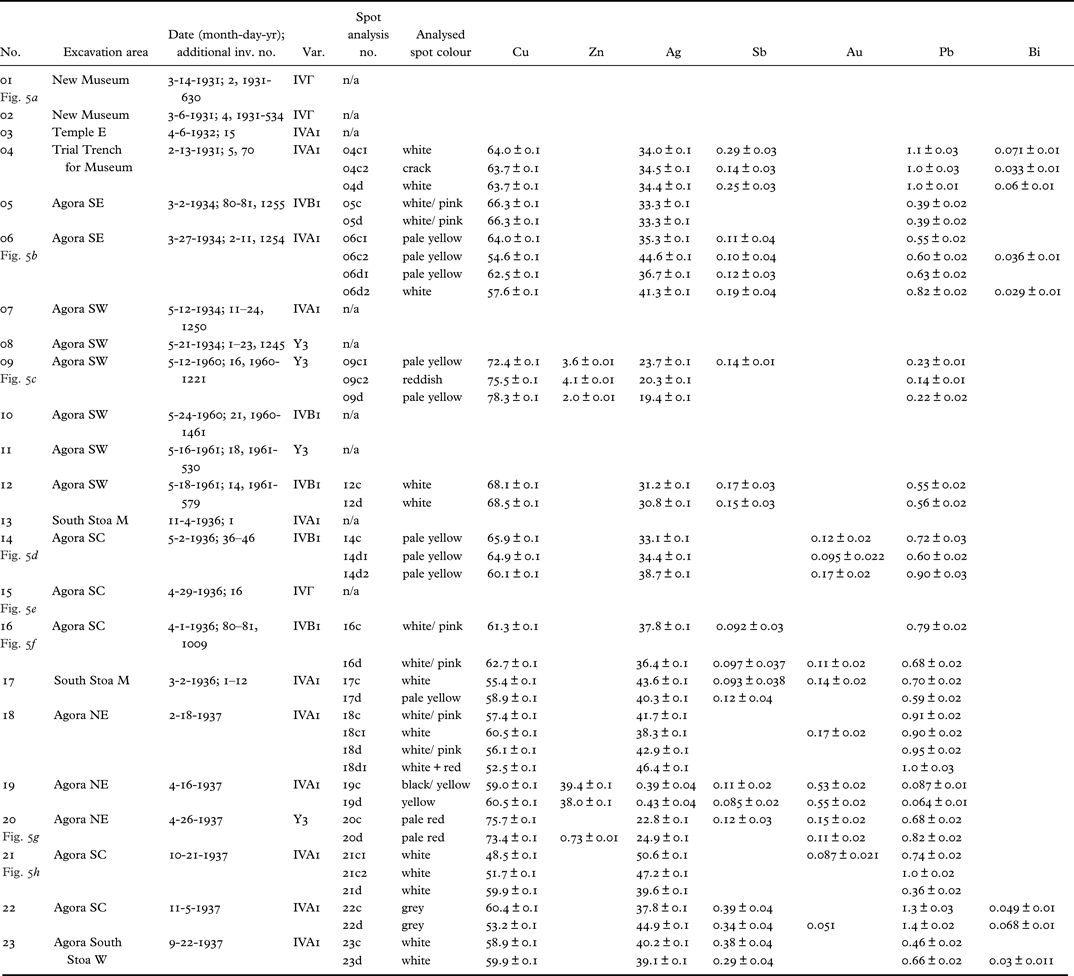
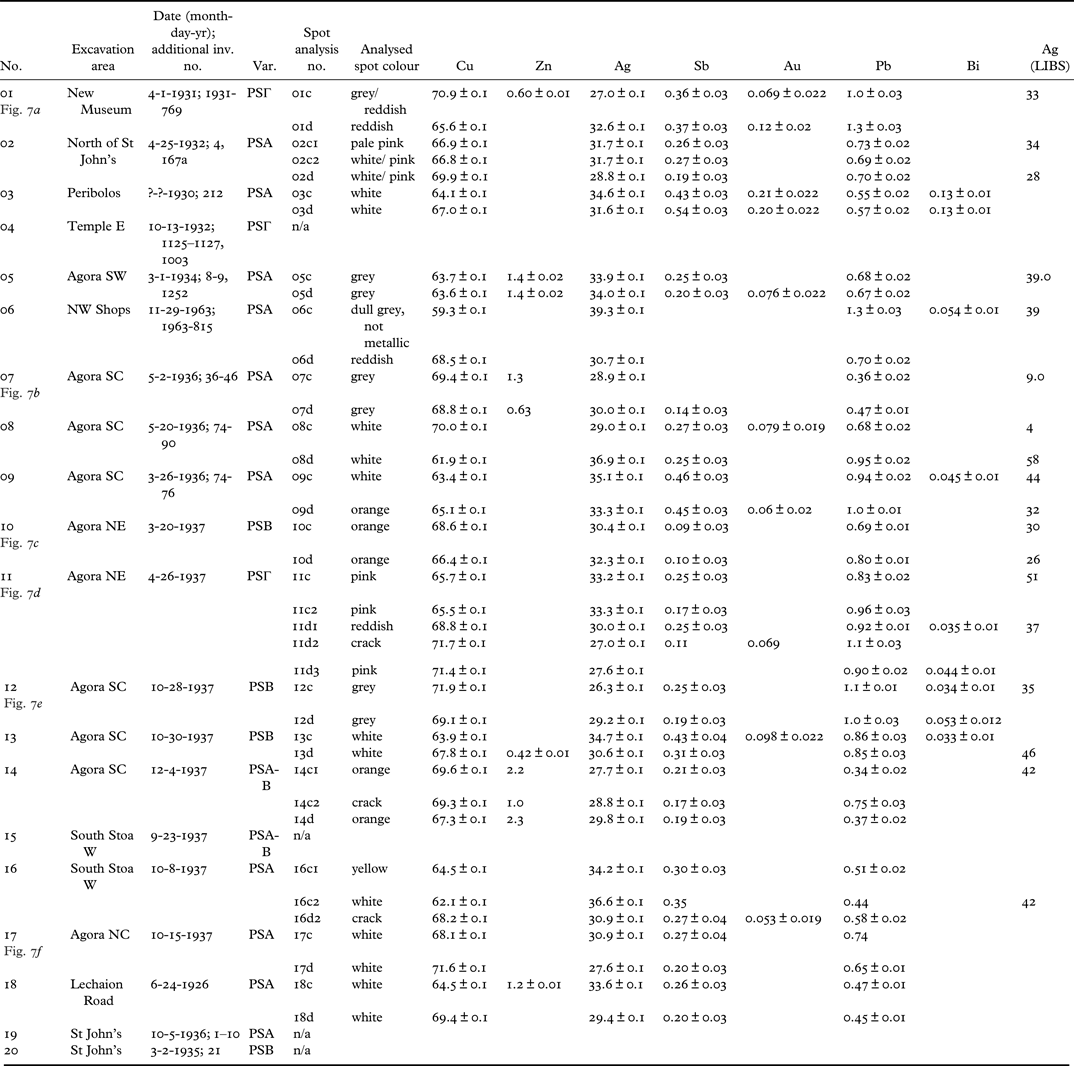
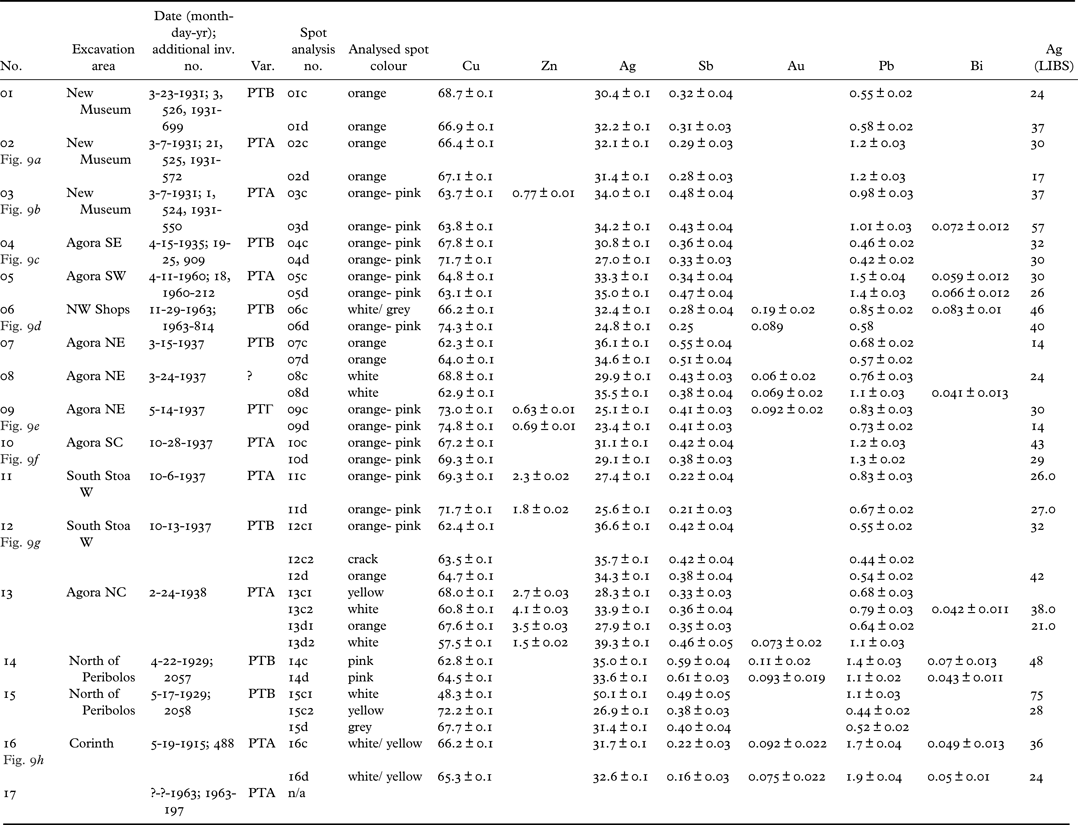
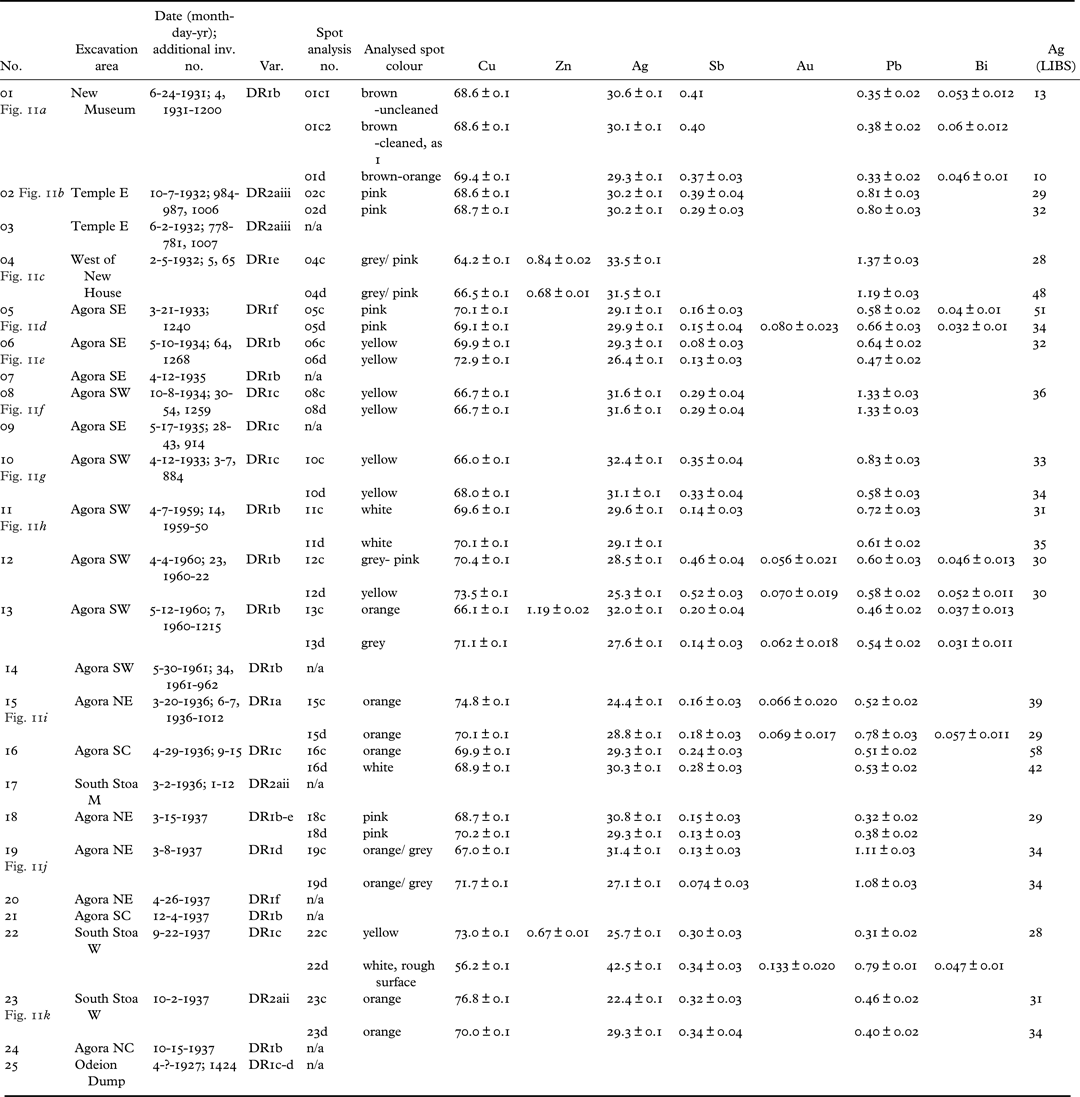
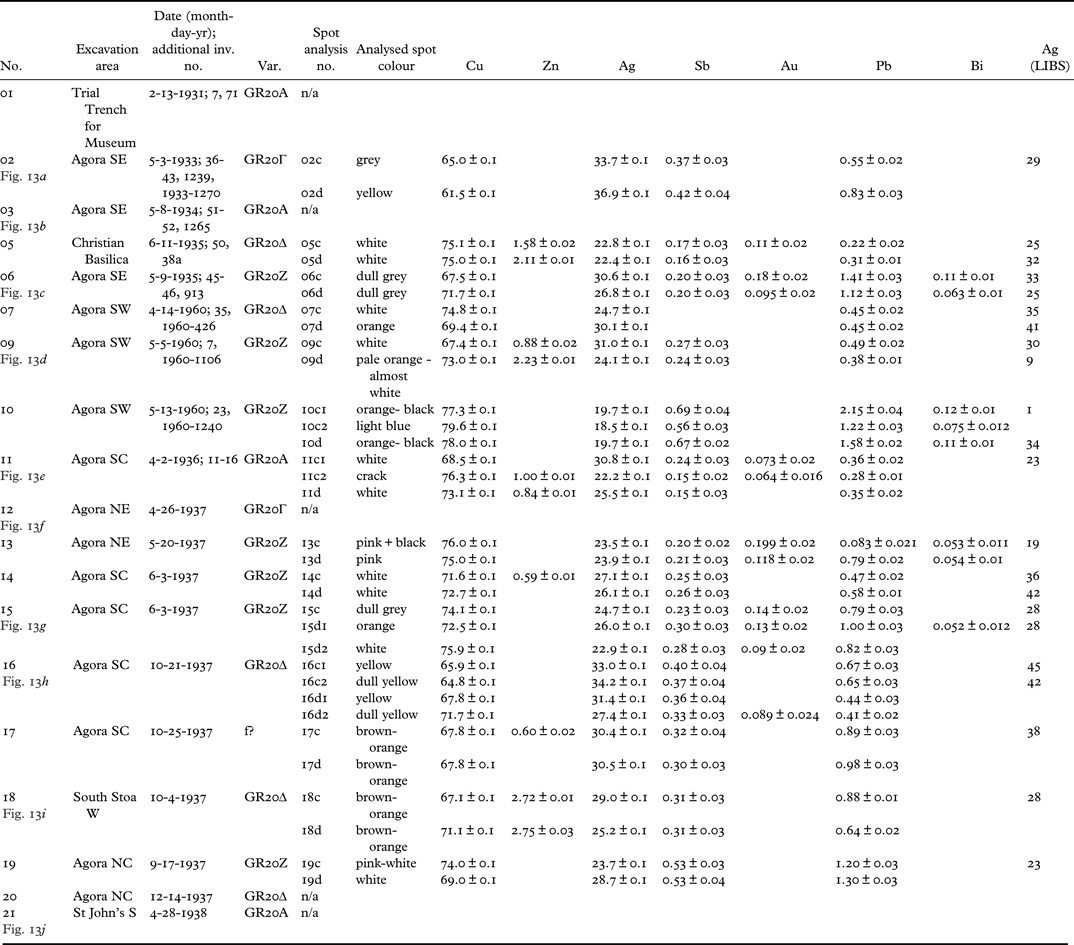
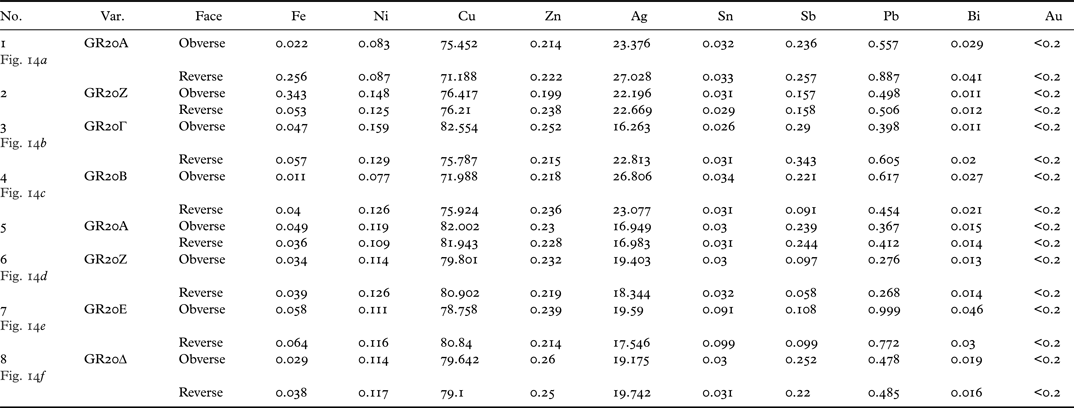
The new analyses divide into two sets of coins, from Ancient Corinth and from the UK coin trade respectively. 125 coins were sourced from the excavations at Ancient Corinth. Of this total, some coins were discounted because they proved to be typologically or archaeometrically unsuitable, so that the presented data rest on only 92 specimens. During middle Byzantine and early Frankish times Corinth was a very significant town (Athanasoulis Reference Athanasoulis, Albani and Chalkia2013b summarises the previous literature). This is amply testified by the American excavations in the area of the Roman forum in what would have been an extramural artisanal, commercial and monastic suburb to the main walled settlement lying to the east, in the position of the present-day village. These generally favourable demographic and economic developments either side of the Latin takeover after 1204, in this area and possibly in the town as a whole, were curbed by a Catalan raid in 1312. This had as a consequence also a strong reduction in coin usage and losses, which lasted for long stretches of the fourteenth century. For the period 1289–1312, however, there are literally hundreds of coins at Corinth, from which a selection could be made on the grounds of numismatic readability and scientific suitability. The data pertaining to these analyses is summarised in six tables, four for the Achaian princes and one each for Naupaktos and Athens (Appendix, Tables A1–A6).
The deniers tournois from Corinth were analysed in 2011 in a workroom at the archaeological site according to two methods, X-ray fluorescence spectrometry (XRF) and laser-induced breakdown spectroscopy (LIBS). The portable milli-XRF was developed at NCSR ‘Demokritos’ in Athens (Karydas Reference Karydas2007). XRF is a technique which detects elements, not compounds, and is used in archaeometry since it is non-destructive, detects a wide range of elements simultaneously and can provide quantitative results so long as the sample is homogeneous and unaffected by corrosion. The percentage concentrations of copper, silver, lead, zinc, gold, antimony and bismuth were determined. Each of the coins (some of which had been cleaned with alcohol, and others mechanically) was analysed in at least two positions. The appearances of the surface areas could be quite different, and were recorded.
Additional measurements were taken to determine the concentration of silver, using a portable LIBS spectrometer (LMNT-II) developed and constructed at IESL-FORTH, Herakleion, Crete (Westlake et al. Reference Westlake, Siozos, Philippidis, Apostolaki, Derham, Terlixi, Perdikatsis, Jones and Anglos2012). The LIBS technique provides elemental composition data by recording the optical emission of a microscopic plasma induced by a laser pulse focused on the coin surface. A few pulses (typically 3–6) irradiating the same point enable layer-by-layer analysis through consecutive ablation steps, with the depth/pulse being of the order of 2–3 microns. In the context of this study, LIBS can be considered mainly as a surface analysis method. Silver, copper, lead and occasionally zinc were detected on the coins along with calcium, aluminium, silicon and magnesium, the latter element signifying surface contamination that was found to decrease with the number of pulses. Quantitative analysis results, reported herein, focus on the content of silver (the values are included in Appendix Tables A1–A6) and were based on calibration curves constructed by using concentration values for copper and silver measured during the XRF analyses on selected coins used as reference samples. Those coins used for reference were among those having clear surfaces; XRF analysis of these surfaces gave secondary K and L shell X-ray emissions which had a ratio close to 80, signifying homogeneity of the alloy (Kantarelou et al. Reference Kantarelou, Ager, Eugenidou, Chaves, Andreou, Kontou, Katsikosta, Respaldiza, Serafin, Sokaras, Zarkadas, Polikreti and Karydas2011).
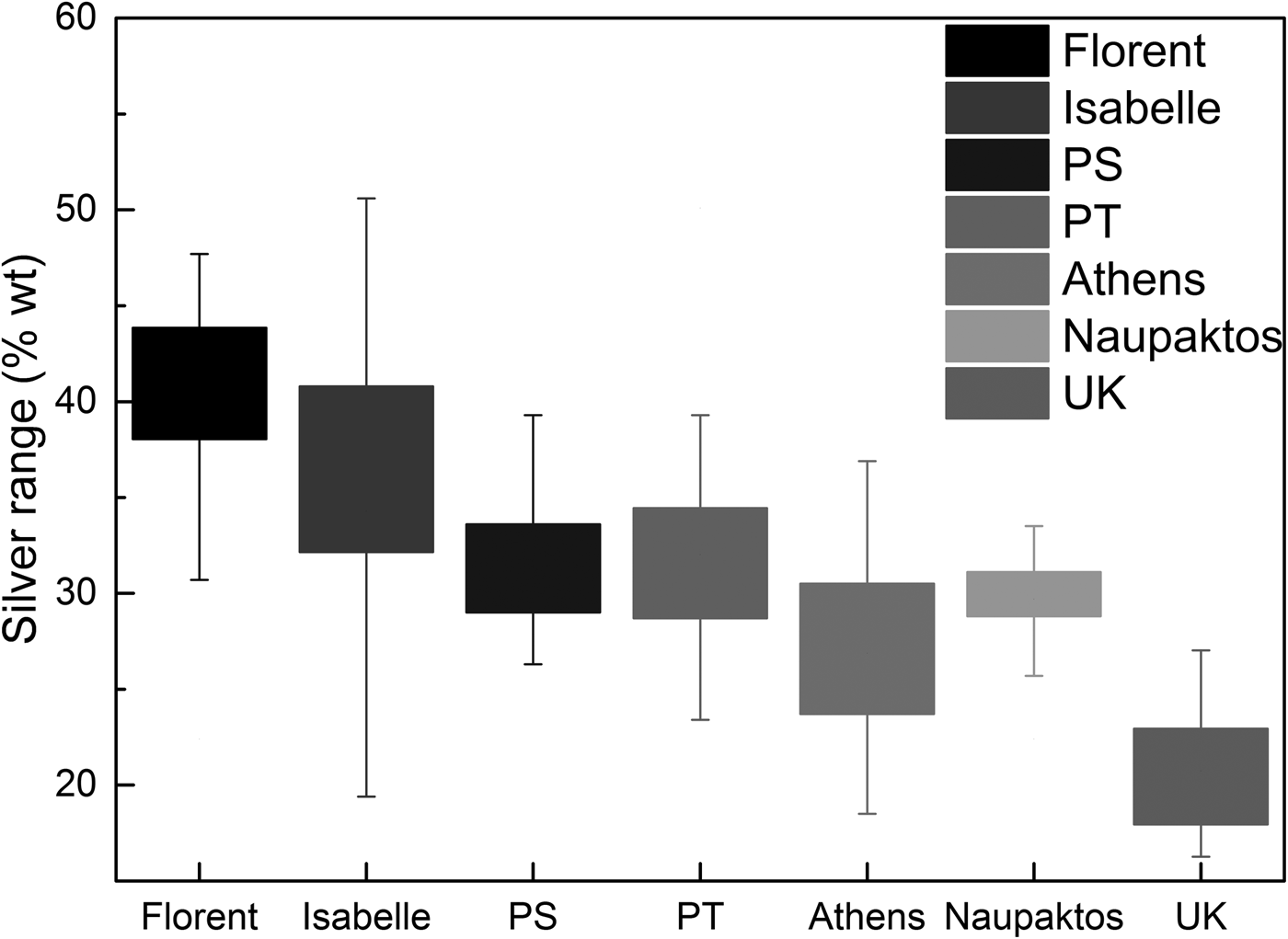
It soon became apparent that the silver contents for the main mints and varieties established by XRF were up to c.10% higher than those obtained in all the earlier analyses. For this reason we purchased in the UK coin trade eight Athenian coins of the same varieties. These were first analysed before and after (mechanical) cleaning by portable XRF at the University of Glasgow using a Niton XL3t 900 instrument (see Photos-Jones, Jones and Bateson Reference Photos-Jones, Jones and Batesonforthcoming), and then sent to Demokritos, where they underwent the same milli-XRF analyses that had been applied at Corinth (see Appendix Table A7). The results of the analyses of the Corinth and UK coins are given in Fig. 1. The fifth and the seventh box charts (Athens and UK respectively) represent the same issue from the two sources, confirming that the XRF analyses of the coins at Corinth did indeed determine silver contents which were too high.
Box chart of the silver contents for the main issues according to the XRF analyses of the Corinth and UK samples. The box represents the inner quartile ranges, and the whiskers the minimum and the maximum values.

For the UK coins we were additionally interested to see whether there was any noteworthy surface enrichment which might have had a bearing on the milli-XRF analyses. Micro-XRF area scans were taken on both sides of the coins and of the bulk, that is to say the section, since for this body of material we were in a position to halve the coins in order to achieve more rounded results. The micro-XRF spectrometer that was used is a customised design based on a Bruker Nano GmbH, ARTAX model. Its high resolution (100 microns @ Cu-Kα) combined with its ability to perform area and lines scans makes it suitable for detecting details on a surface of an artefact. In the case of silver coins micro-XRF analysis was already used to determine the scenario of silver enrichment (Kantarelou et al. Reference Kantarelou, Ager, Eugenidou, Chaves, Andreou, Kontou, Katsikosta, Respaldiza, Serafin, Sokaras, Zarkadas, Polikreti and Karydas2011). During this study area scans were performed at the cross section of the coins in an area that included the bulk and the surface of the coins. These showed, for different coins, a lack of homogeneity of the alloy, with the surface areas containing variously more or less silver. In fact it is not certain whether one can confidently speak of silver enrichment at all; even if there were enrichment, it would be marginal and unable to influence the outcome of the milli-XRF analyses as drastically as the Corinthian sample might suggest. Not only was the feature of silver heterogeneity also observed by Ponting (see SEM image in Baker and Ponting Reference Baker and Ponting2001, plate 44), but the silver contents in the UK samples determined by milli-XRF were similar to those he obtained by destructive analysis. As a methodological exercise, it was encouraging to find satisfactory agreement between the silver and copper determinations in the cleaned surface of the UK coins obtained by the two XRF systems; the R2 values for the two metals were 0.9 and 0.86 respectively.
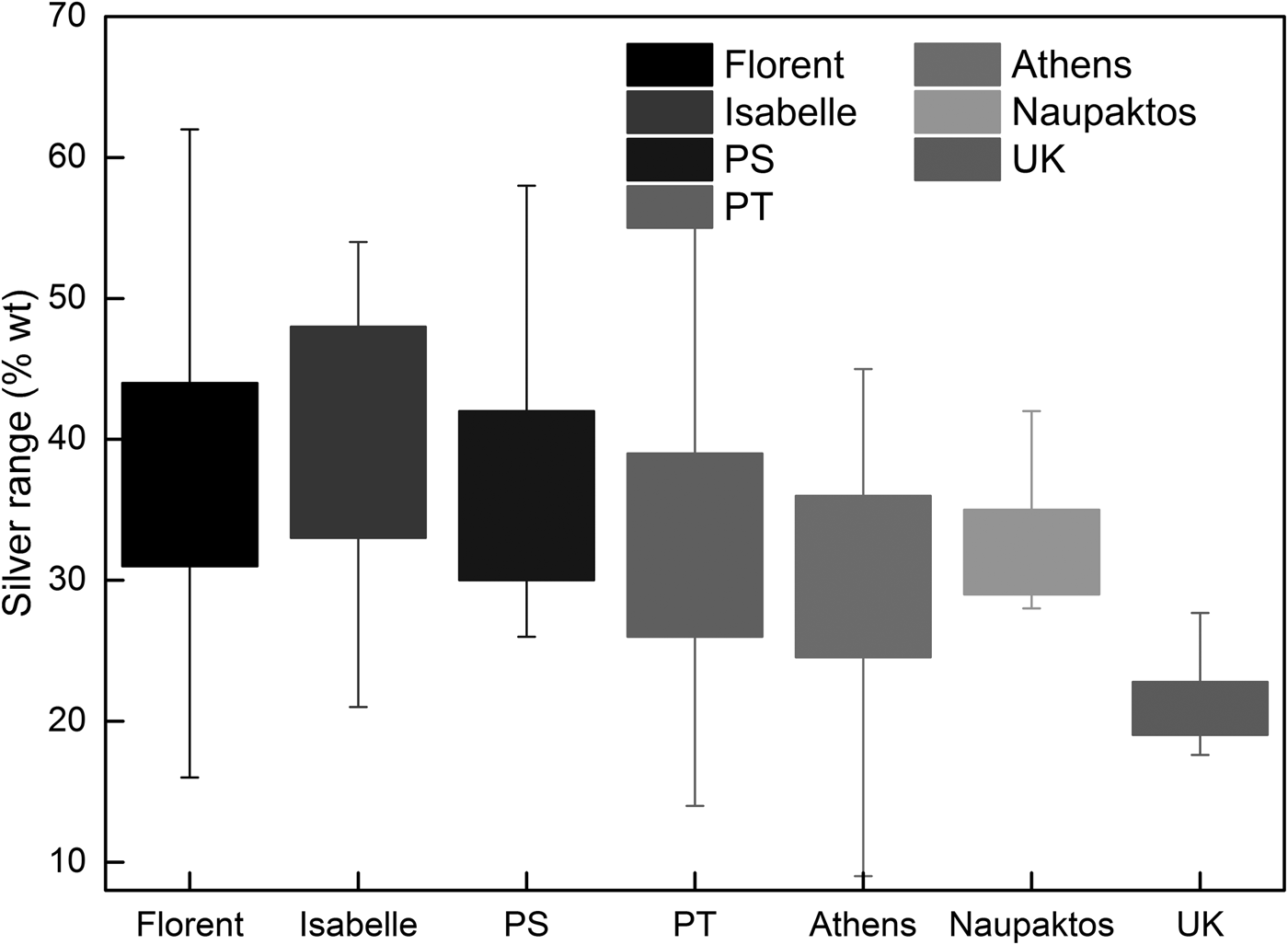
The silver contents determined by XRF of the Corinth coins were therefore exposed as anomalously high from more than one angle. A verification of this method of analysis therefore became important, and in fact LIBS readings obtained on the same Corinthian coins produced compatible results (Fig. 2). Furthermore, the same Athenian coins purchased in the UK were also analysed using the portable LIBS instrument, providing similar silver contents to those obtained by milli-XRF analysis. However, it is noted that the silver contents for the Corinth coins measured by LIBS show a wider distribution of values than those obtained by XRF. This observation can be attributed to the difference between XRF and LIBS with regard to the depth of analysis. In the case of LIBS, the layer probed is 2–3 microns thick and at about 10–15 microns deep from the coin surface. Thus LIBS analysis is expected to be more prone to surface roughness and heterogeneity effects in comparison to milli-XRF, in which the thickness probed is of the order of 40–50 microns (Kantarelou et al. Reference Kantarelou, Ager, Eugenidou, Chaves, Andreou, Kontou, Katsikosta, Respaldiza, Serafin, Sokaras, Zarkadas, Polikreti and Karydas2011). On the other hand, the coins from the UK were better preserved and appeared to be more homogeneous along the surface compared to the Corinth coins, producing more consistent and repeatable LIBS signals.
Silver contents for the main issues according to the LIBS analyses of the Corinth and UK samples. Presentation is as in Fig. 1.

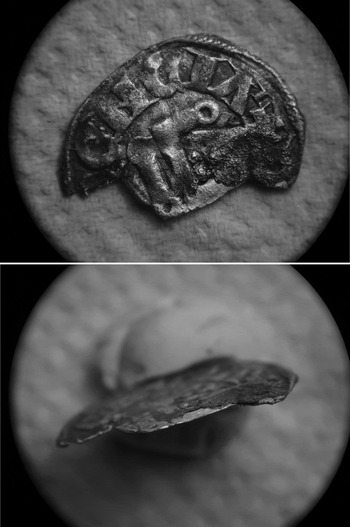
For all these reasons we suspect that at Corinth the heart of the problem was the sampled material rather than the method of analysis. The overall aspect of many of the analysed coins at Corinth was much more polished and silvery than the patinated Athenian specimens bought in the UK. Also striking were observations which could be made on certain specimens, that is to say a separation on the surface of coppery and silvery areas or even layers (Figs 3 and 4).
Close-up photographs of Florent no. 09.

Evidently at Corinth copper had the propensity to be drawn to the surface, and this layer was eventually eliminated, mostly through conservation, leaving more silver on the surface. During the minting process itself a similar process might have occurred, when the continuous kneading of the alloy caused copper to come to the fore, which was then taken off in the mint through a process called blanching. This form of silver enrichment was evidently practised to some extent with the coin issues under investigation (Baker and Ponting Reference Baker and Ponting2001, 212), but in the specific case of Corinth a combination of burial conditions and human intervention subsequent to excavation resulted in particularly silver-rich specimens.
Archaeometrists, archaeologists, and historians may wish to consider multiple bullion compositions: the original alloy, the alloy as manipulated through minting, the alloy as changed through burial in the soil and subsequent treatment, and even the alloy as perceived or purported by contemporary issuers and users. Additionally one must factor in the method of analysis and the lack of homogeneity of the alloy, as we have just seen. There are no readings which must in themselves be considered authoritative; however, a large sample of coins and multiple readings per sample provide the necessary conditions from which extrapolations can then be made. These were met at Ancient Corinth, and the results there were internally consistent. With respect to the minting standard, in the remainder of the contribution we have limited ourselves to relative silver percentages, and our discussions will not touch upon weight standards, which should be the subject of an extensive investigation in their own right, or absolute or official standards of value. Silver and copper sources reveal themselves through traces of gold and lead for silver, and arsenic, antimony, iron and nickel for copper (Baker and Ponting Reference Baker and Ponting2001, 215–16). With regard to copper, most of the relevant elements were below the detection level in the kinds of analyses which were conducted, so we confined ourselves to silver sources as revealed through gold traces.
The graphical presentation in the course of this paper consists of, first, the combined silver, gold and lead content (thus the bullion content), in individual coin issues, and, second, the silver-gold ratio plotted against the silver lead ratio. In the tables of compositions (see Appendix), the element contents are expressed as wt%; the detection limits are 0.5 (Zn), 0.07 (Sb), 0.06 (Au), 0.022 (Bi). s.d. standard deviation; n/a = not analysed.
THE COINAGE ISSUES AND THE CONTRIBUTION OF THE ANALYSES
Achaia, Clarentza mint, Florent of Hainaut (1289–97)
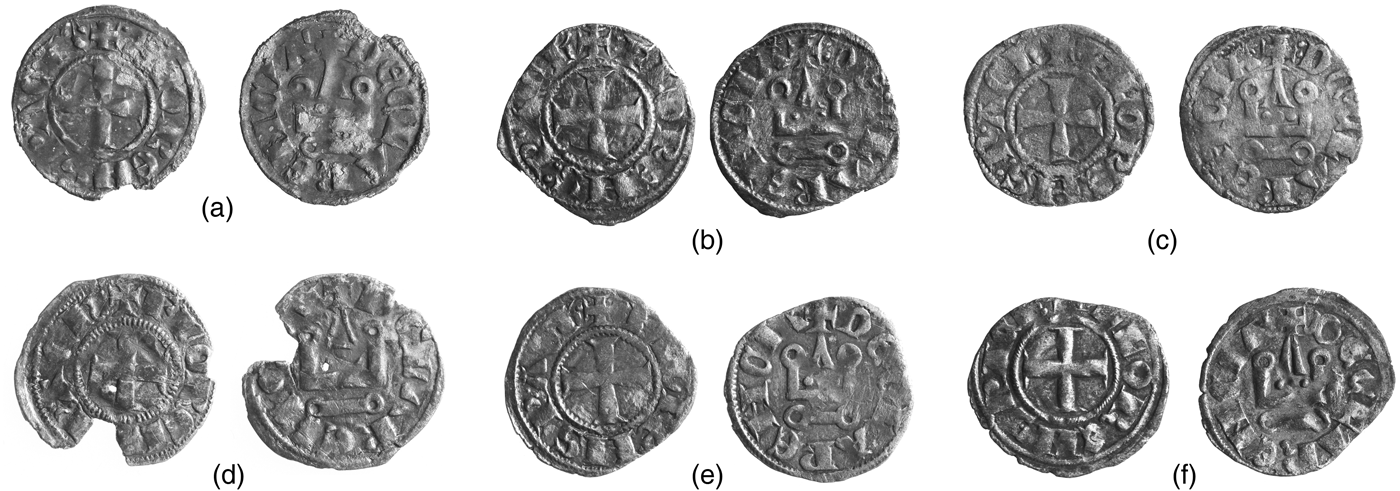
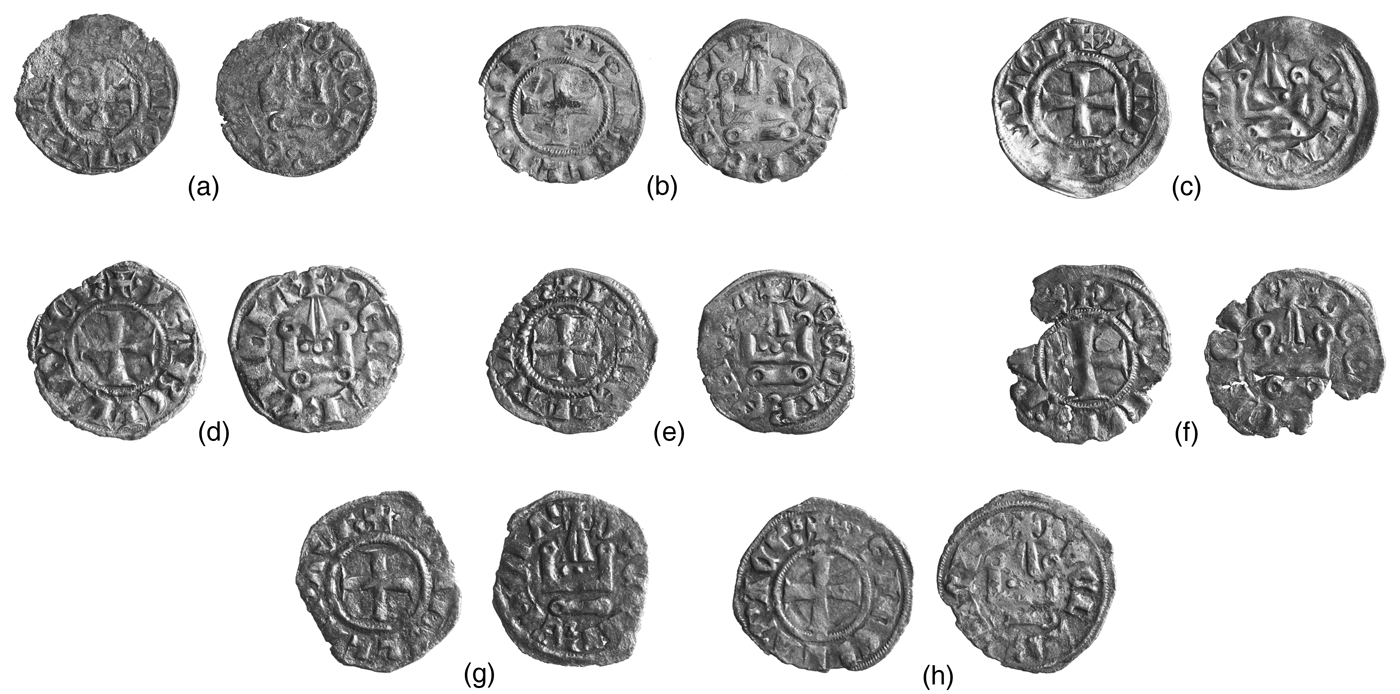
The denier tournois issues bearing the name of Florent of Hainaut – to judge by the hoards, and particularly by the evidence from the large southern Greek excavations (for Athens: Thompson Reference Thompson1954; for Corinth see the summary in Baker and Stahl Reference Baker, Stahl and Gerstel2013, 182–3) – were produced in smaller quantities than those of his predecessors and successors. For this reason, it has been proposed that these issues have to be distributed over only a part of the period of Florent's princeship (1289/90–7), or indeed that some of the plentiful issues of his wife Isabelle were minted already during Florent's lifetime (Tzamalis Reference Tzamalis2004). These possibilities will be considered below. Tzamalis and Metcalf, in combination, have created six main types for FlorentFootnote 3 : FHA1 and 2 (Figs 5a and f ) are characterised respectively by a flower, and by a lis and small B at the extremities of the legends. The closed round letters D, E, C and the swung foot of the Rs are typical. FHΓ (Figs 5b and c ) is similar in many respects, and also in the double dots which separate parts of the legends internally; only the foot of the R is significantly different. F5 (Fig. 5 e) is a simple and rare type, unnoticed by Tzamalis, which combines many of the previous features and is therefore difficult to place. The remaining FHB1 and 2 (Fig. 5d ) are by contrast very distinctive: the reverse legend is abbreviated D'CLARENCIA and the letters E and C are very open.
Selection of analysed coins of Florent of Hainaut from Corinth excavations.

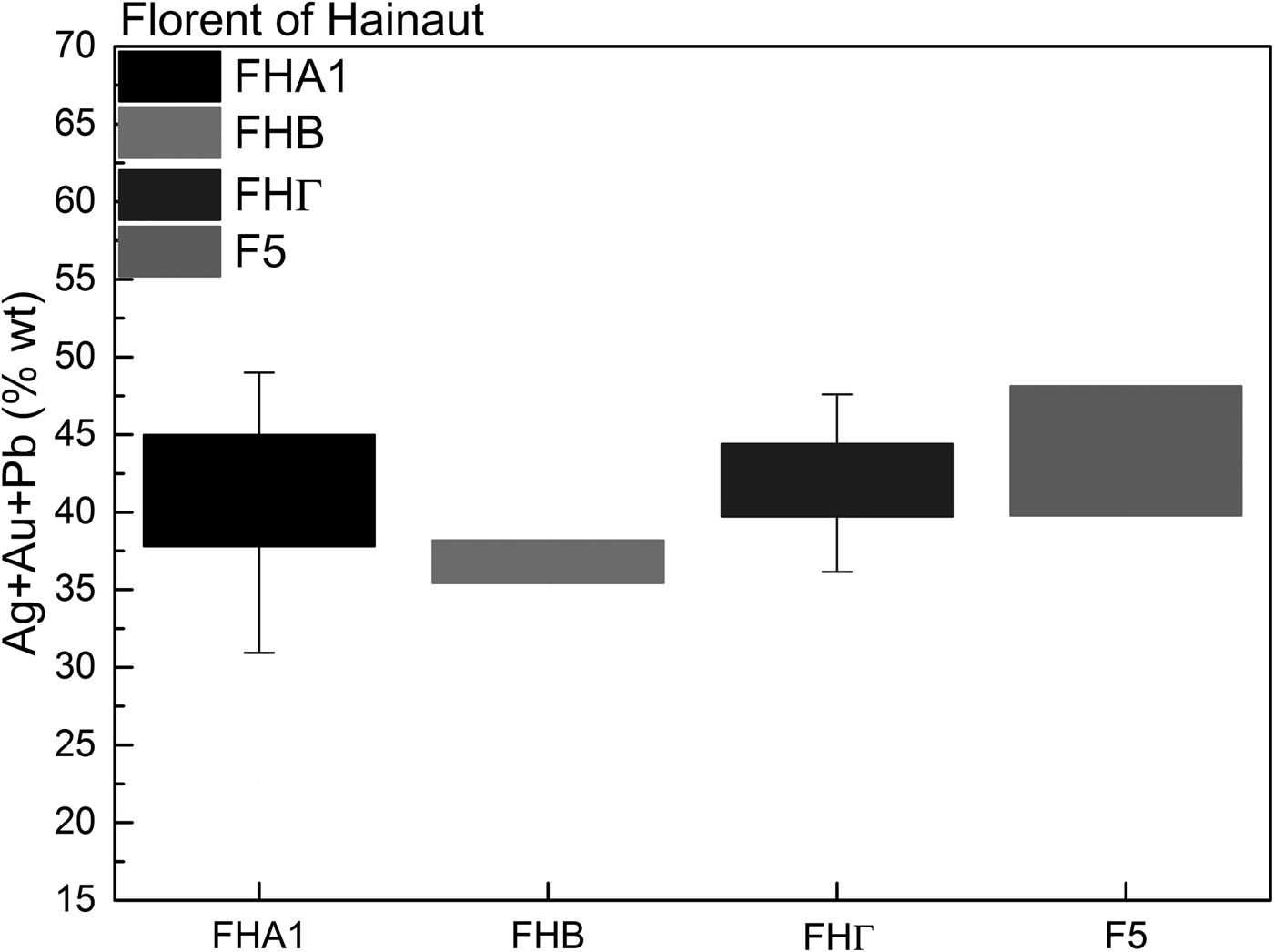
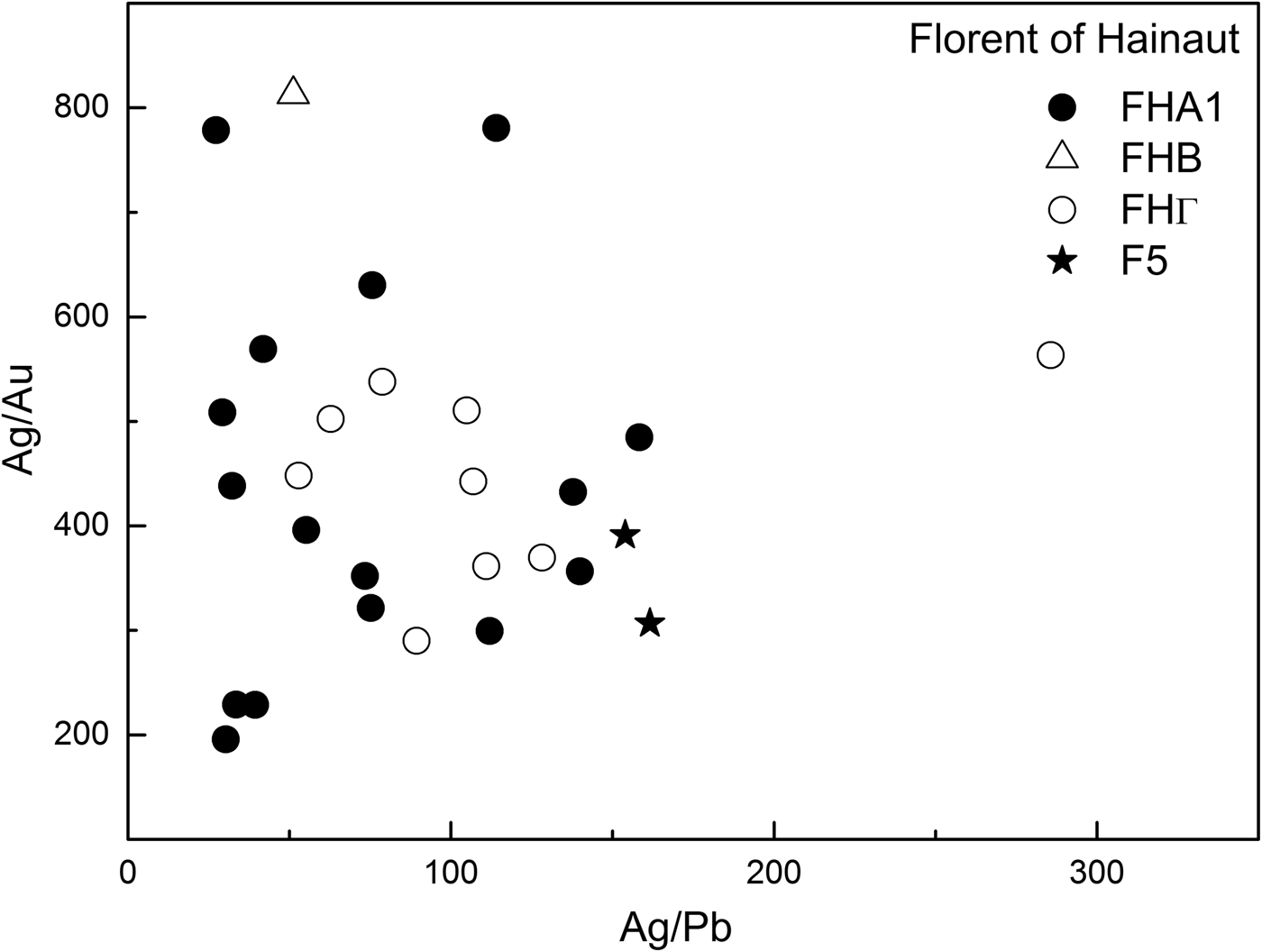
Stylistically speaking, one would wish to create a unified block, which is also numerically the strongest, consisting of FHA and FHΓ, around which to order the remaining types according to the available evidence. There are no published hoards which cut into the series in any significant manner; even the near-contemporary Agrinio 1973 hoard (Metcalf Reference Metcalf1995, 342) cannot shed any further light on the chronological ordering. Fig. 6 confirms the existence of this central block and places FHB at the end of the series in line with the established criteria. Gordus’ earlier results had suggested much the same. Our analyses would also indicate that F5 was in fact the earliest of the substantive types of Florent. To judge by Gordus’ figures, the types other than FHB might well have been minted on a similar standard to the issues of the Clarentza mint of the previous decade in the name of Charles.
Box chart of the sum of silver, gold and lead content for the types of Florent of Hainaut according to the XRF analyses of the Corinth sample. The box represents the inner quartile ranges, and the whiskers the minimum and the maximum values.

These general conclusions are also confirmed by the next figure (Fig. 7), especially the neat separation into different areas of FHB and F5, chronologically the furthest from one another.
Ratio scatter plot of silver bullion for Florent of Hainaut according to the XRF analyses of the Corinth sample.

Florent of Hainaut married Isabelle of Villehardouin, daughter of the late Prince William II, in September 1289, and he received the title himself on this occasion (Longnon Reference Longnon1949, 263). Charles II, recently released from Aragonese captivity, nevertheless continued to use the same title until the following year (Bon Reference Bon1969, 165; Dourou-Iliopoulou Reference Dourou-Iliopoulou1993, 48). The policies of the Angevin crown towards Greece in these years can be reconstructed with some confidence, since narratives documenting Greek history are still available for this period (Bon Reference Bon1969, 164ff.), and the diplomatic sources from the Angevin archives have been admirably edited by Perrat and Longnon (Reference Perrat and Longnon1967). The settlement of 1289/90 saw the establishment of a new prince with increased constitutional and political competences. Early on, he is commissioned to take over the reins of Angevin Corfu and Butrint from the Orisini family, although this endeavour was soon abandoned (Perrat and Longnon Reference Perrat and Longnon1967, no. 15, 18 April 1290 = Registri 35, 111, no. 275; see also Asonitis Reference Asonitis1999, 83). Much of Florent's princeship was dominated by the involvement of Philip of Taranto, son of Charles II, in Greek affairs. Florent helped organise Philip's marriage to Thamar of Epiros, daughter of Nikephoros (Perrat and Longnon Reference Perrat and Longnon1967: no. 21, 1 June 1291; no. 105, 24 July 1294 = Hopf Reference Hopf, Ersch and Gruber1867–8, 337, n. 96), as a result of which Philip received certain fiefs in Epiros and Aitoloakarnania, as well as from his father the overlordship over Achaia, Athens, Vlachia on the one hand, over Corfu, Butrint, Albania on the other (Longnon Reference Longnon1949, 268–9; 272–3; Nicol Reference Nicol1972, 193–4; Nicol Reference Nicol1984, 46ff.). The homage was henceforth due not to Charles but to Philip, who assumed the role which had been set out for his grandfather Charles I in the 1267 settlement (Perrat and Longnon Reference Perrat and Longnon1967, nos. 80–1, 12 May 1294). In this context the Angevins sought once more to clarify the relationship of Achaia and Athens in favour of a direct homage of the latter (and of the marquis of Bondonitza) to the former. As we shall see below, this was achieved in the final months of Florent's princeship. The political restructuring under way, and the numerous trading concessions which were made to individuals bringing goods to Greece (Dourou-Iliopoulou Reference Dourou-Iliopoulou1993, 51–3), recall the earlier efforts of Charles I in 1278–82 to strengthen the Greek holdings.
It is generally assumed that minting had ceased at Clarentza in Charles’ name sometime in the mid- to late 1280s. The Xirochori 1957 hoard, which was concealed in 1291 or soon thereafter, but does not contain issues of Florent, allows us to extend this inactivity into the early princeship of Florent (Metcalf Reference Metcalf1995, 341–2). The next hoard which is available to us is the aforementioned Agrinio 1973 hoard, concealed c.1300 but quite mature in Florent's series. This evidence, combined with the political history, might in fact suggest that issues in the name of Florent were produced at Clarentza for little more than two to three years before his death in January 1297 (Kiesewetter Reference Kiesewetter1996, 150). Moreover, Tzamalis (Reference Tzamalis2004, 72, n. 6) was inclined to date the beginnings of Florent's coinage from c.1293/4 onwards. The lowering of the Achaian standard for FHB may well have been inspired by the lower Athenian standard, as we shall see, and this type may well therefore date to the period from the autumn of 1296 to the first month of 1297, when the situation with Athens was clarified. In later hoards the other types of Florent vastly outnumber FHB, giving further credibility to our hypothetical model whereby F5, FHΓ, and FHA were successively minted from c.1294 to October 1296, followed by FHB. The rather brief period in which Florent's coins were effectively produced at Clarentza goes some way towards explaining their relative scarcity.
Achaia, Clarentza mint, Isabelle of Villehardouin (1297–1301)
Isabelle of Villehardouin became princess upon the death of her husband Florent. Her sole rule was short, and the period during which the Clarentza mint issued coins in her name was even shorter (see below), but her coinage is typologically complex: IVA1 and IVA2 (Figs 8b and h), IVΓ (Figs 8a and e ), and Y3 (Figs 8c and g ), all display similar and harmonious, closed lettering with swung feet for the R. The individual groups are largely differentiated by the marks at the extremities of the legends. IVB1 (Figs 8d and f ) has a very different system of lettering: Ss are constructed with a long central punch, the round letters are open, and the R is club-footed. The rare IVB2 sits typologically between IVB1 and the remainder of the groups.
Selection of analysed coins of Isabelle of Villehardouin from Corinth excavations.

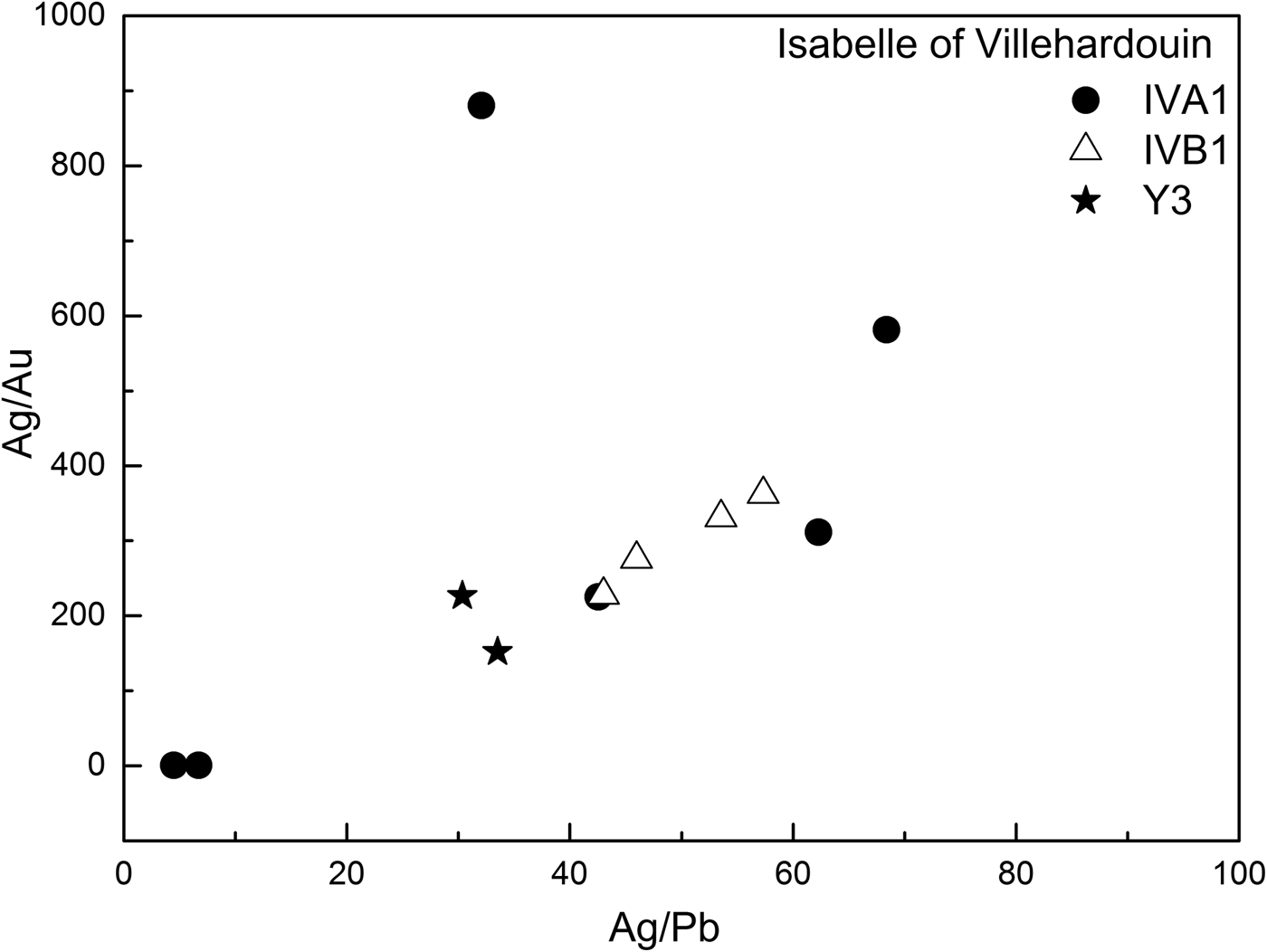
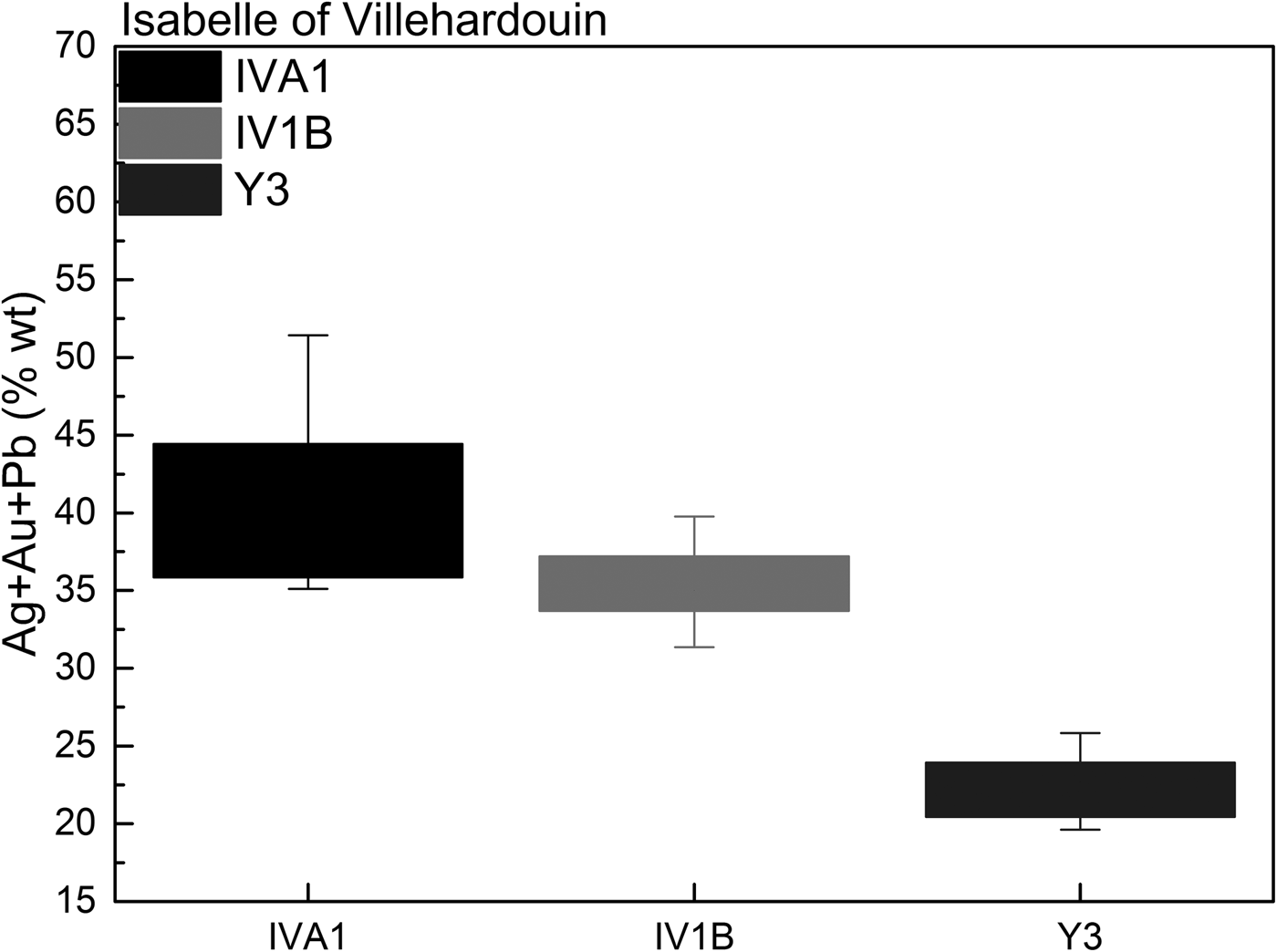
The Agrinio 1973 hoard cuts into Isabelle's series and lacks IVB altogether, identifying it as the last of the groups. The hoard also suggests that Y3 is rather early in Isabelle's series since it lacks IVA2. Fig. 9 identifies IVB1 as a concentrated coinage set apart from the rather wide scatter of the main type IVA1. Fig. 10, on the other hand, which depicts the silver content for the three main types (IVΓ was not sufficiently well analysed to be included), is rather more intriguing in that Y3 is considerably baser than the other two groups.
Ratio scatter plot of silver bullion for Isabelle of Villehardouin according to the XRF analyses of the Corinth sample.

Box chart of the sum of silver, gold and lead content for the types of Isabelle of Villehardouin according to the XRF analyses of the Corinth sample. The box represents the inner quartile ranges, and the whiskers the minimum and the maximum values.

This dichotomy played a role when in 2004 Tzamalis postulated that Isabelle's and Florent's coins were minted concurrently. Unfortunately, he failed to specify which types gave him readings as low as 12% silver, yet his analyses do confirm that our own figures for Y3 are perhaps more than just a freak occurrence. Tzamalis noted also the apparent likeness of IVA1 and FHA2, but the other evidence presented here precludes that these respective issues in the names of Isabelle and Florent are chronologically related. On the other hand, the described style of IVB1, and the stars which adorn the reverse legend, provides a direct link with the coinages of Isabelle's second husband Philip of Savoy. All of these considerations suggest in the strongest terms the sequence Y3 – IVA1 – IVA2 – IVΓ – IVB2 – IVB1.
The coinage in Isabelle's sole name begins therefore with the perhaps surprisingly base Y3. We are also informed by the Registri that this minting only began more than two years after Florent's death, at an unspecified point in 1299 (Hopf Reference Athanasoulis, Albani and Chalkia1867–8, 350, n. 37; Schlumberger Reference Schlumberger1878–82, 316, n. 1; Metcalf Reference Metcalf1995, 263). As we shall see, it was in this year that Isabelle made significant steps towards a normalisation between the principality and Athens. As with the previous Clarentzan type FHB, it is most likely that the explanation for the standard of the short-lived Y3 needs to be sought in the low quality of the Theban issues for the duchy. Thereafter, the Clarentza mint, and perhaps that of Thebes as well, adopted a higher standard. With respect to the surprise that has been voiced about Isabelle's apparently excessively large mint output, we may now offer other explanations, in addition to the rather shorter minting periods of her husbands Florent and Philip of Savoy than the traditional scholarship had suggested: perhaps the lowering of the Clarentzan standard caused more coinage to be reminted in the name of Isabelle. Next, it may also be supposed that market forces simply brought more bullion to this mint; and finally, Isabelle's key diplomatic initiatives may also have increased supplies from Angevin Italy: in fact, this is specifically attested on one occasion (Perrat and Longnon Reference Perrat and Longnon1967, no. 203 = Hopf Reference Hopf, Ersch and Gruber1867–8, 349, n. 21, 24 August 1298. See further Bon Reference Bon1969, 170–3). Despite the discussed events of 1294, much of the decision making was in the hands of King Charles II and not of his son Philip of Taranto (Kiesewetter Reference Kiesewetter2001, 64), a fact which could only have been exacerbated when the latter was taken prisoner in Sicily in 1299 (Nicol Reference Nicol1984, 50). Isabelle negotiated, with constant deference to the king, the marriage between her daughter and Guy II de la Roche of AthensFootnote 4 and a truce with Byzantine Emperor Andronikos II Palaiologos.Footnote 5
Achaia, Clarentza mint, Philip of Savoy (1301–4/6)
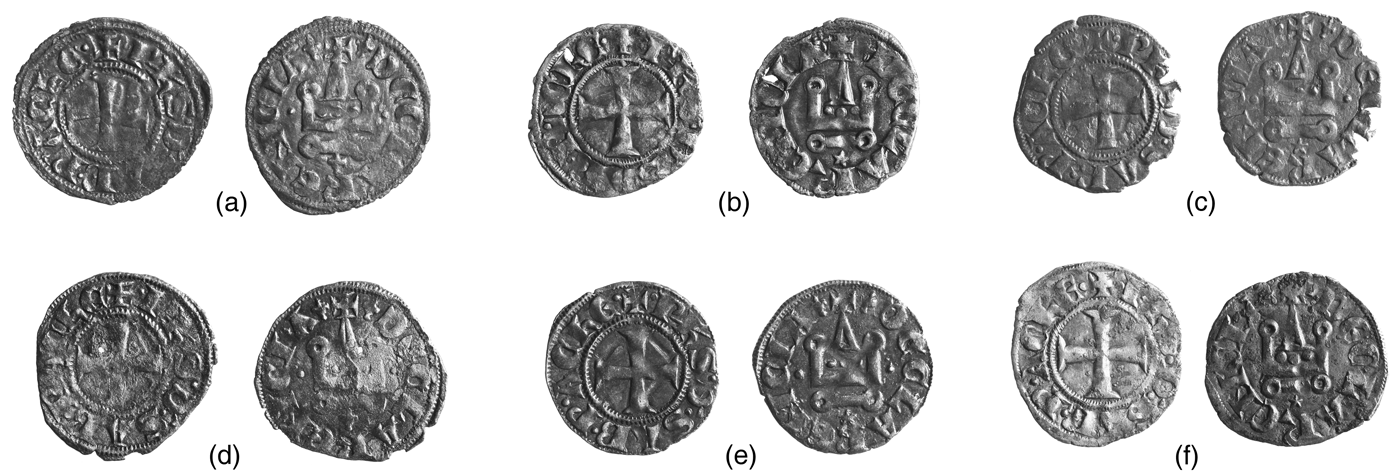
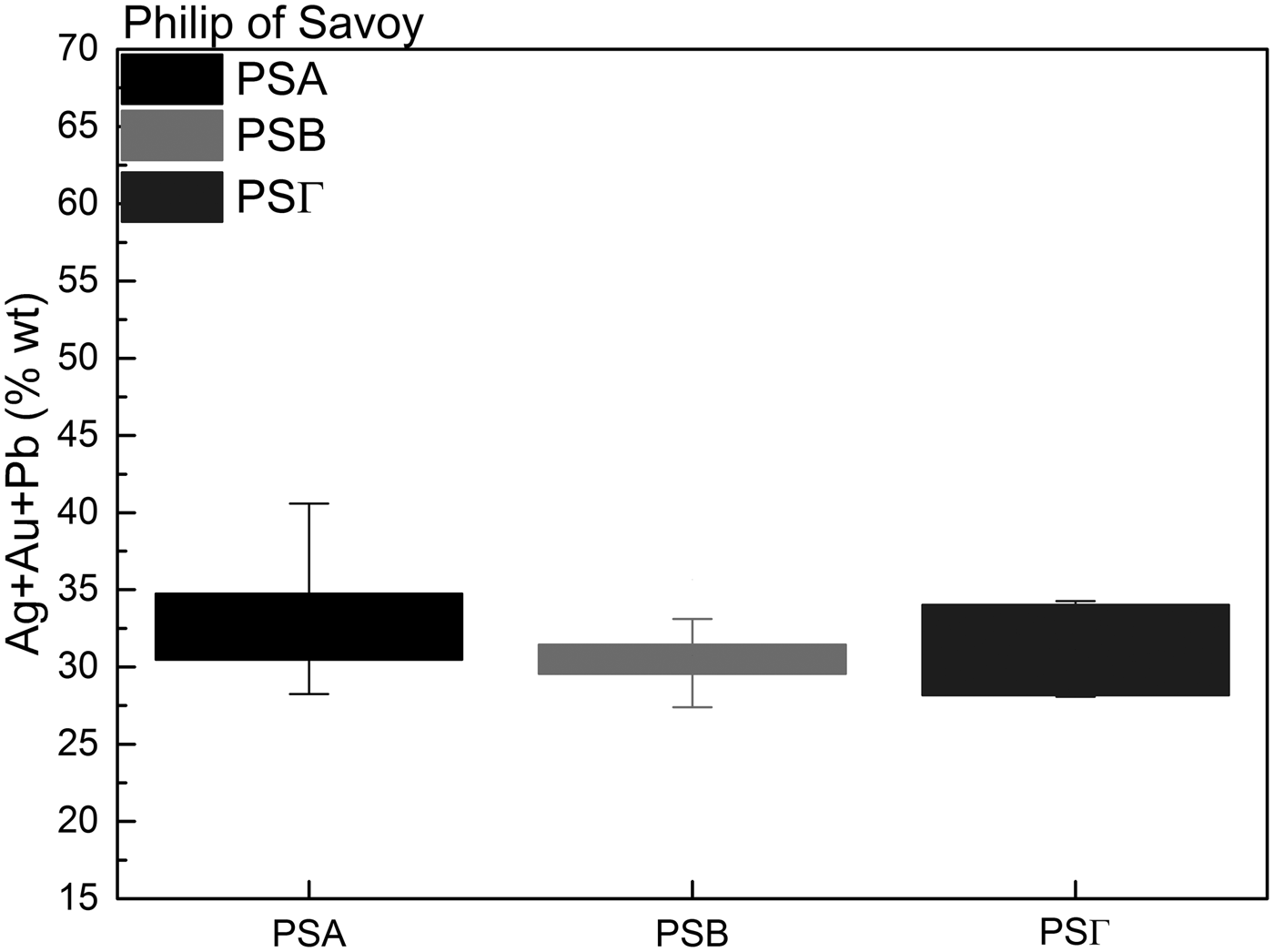
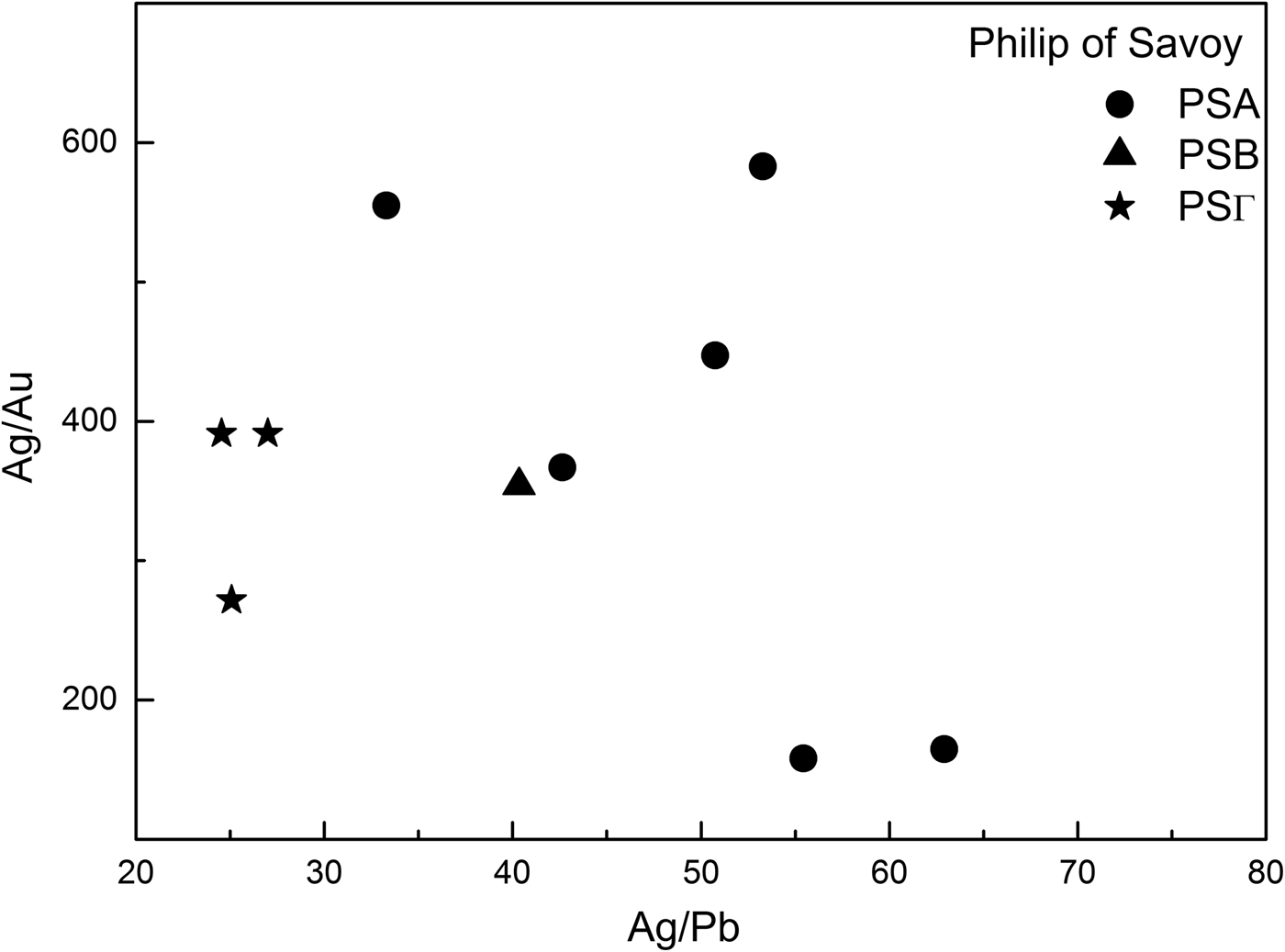
The three types identified for Isabelle's next husband, Philip of Savoy, all adhere to the same lettering that has already been described for Isabelle's IVB1. The distinguishing features for PSA (Figs 11b and f ), PSB (Figs 11c and e ), and PSΓ (Figs 11a and d ), are principally the symbols in the reverse field. Figs 12 and 13 underline the overall harmonious relationship of the types.
Selection of analysed coins of Philip of Savoy from Corinth excavations.

Box chart of the sum of silver, gold and lead content for the types of Philip of Savoy according to the XRF analyses of the Corinth sample. The box represents the inner quartile ranges, and the whiskers the minimum and the maximum values.

Ratio scatter plot of silver bullion for Philip of Savoy according to the XRF analyses of the Corinth sample.

PSΓ shares common typological features with Philip of Taranto's first Clarentzan issue PTB, which would situate it late within the series. Nevertheless, hoards closing in Philip of Savoy's issues would place it, with reservation, towards the beginning. This is especially the case for an unpublished parcel now at Birmingham, and Delphi 1933 (Metcalf Reference Metcalf1995, 343). The silver bullion sources for PTB are also rather different from those of PSΓ, as we shall see when we discuss the Clarentzan issues of Philip of Taranto. The sequence for the three types cannot at present be resolved with complete confidence, although provisionally we may state that PSΓ came first, followed either by PSA or PSB.
Despite previously paying great heed to her Angevin overlords, Isabelle of Villehardouin married Philip of Savoy against their expressed wishes. Philip was nevertheless proclaimed prince in February 1301 and arrived in Achaia more than a year later (December 1302) (Kiesewetter Reference Kiesewetter1996, 161). His rule in Achaia was characterised, in the eyes of contemporaries, by his eagerness to acquire large quantities of money by regular (the rigorous farming of taxes) and irregular means, the latter in the form of so-called donations from local administrative or feudal potentates (Bon Reference Bon1969, 175, n. 1; also discussed by Kiesewetter). We know indirectly from an Angevin act that the mint of Clarentza was producing in order to meet the military needs of the principality, particularly in relation to the Epirote campaign of 1303 (Hopf Reference Athanasoulis, Albani and Chalkia1867–8, 352, n. 64; Schlumberger Reference Schlumberger1878–82, 316, n. 2, see also below), and the somewhat earlier Skorta (Peloponnese) campaign (Kiesewetter Reference Kiesewetter1996, 174, for the dating). It is therefore to be expected that this gathered wealth, to which we might add the 6000 hyperpyra (NB: these are not actual coins but a money of account) which Philip received from Anna of Epiros as a kind of payoff or bribery (Kiesewetter Reference Kiesewetter1996, 166), was at least partially reminted at the Achaian mint. The grandiose Corinth parliament in spring 1304 was Philip's Achaian swansong (Longnon Reference Longnon1949, 287), soon after which he departed for Italy. It has been argued that Philip of Savoy was never officially deposed since his original receipt of the title was, as early as 1304, simply proclaimed as unlawful (Kiesewetter Reference Kiesewetter1996, 167, n. 104). With regard to the end of the minting in the name of Philip of Savoy, some dates are of obvious interest: Philip of Taranto's official investiture with the title of Prince of Achaia on 9 October 1304 (Kiesewetter Reference Kiesewetter2001, 76), and the departure of Philip of Savoy from Achaia in late 1304 (Kiesewetter Reference Kiesewetter1996, 185). The traditional date of 1306 for the end of Savoy's and the beginning of Taranto's minting is due to the facts that Charles II reissued the previous act of 1304 on 5 June 1306, and that Philip of Taranto arrived in Greece in the summer of 1306, and first used the Achaian title on 3 August 1306 (Bon Reference Bon1969, 185; Kiesewetter Reference Kiesewetter2001, 77).
The numismatic data go some way towards placing the end of Philip of Savoy's minting at Clarentza in 1304. The hoards dating to the period of the princeship of Philip of Savoy which have already been mentioned, and slightly later ones, make it quite clear that the Clarentzan issues of Philip of Savoy and the issues of Philip of Taranto at Naupaktos (see below) were largely contemporary: it should be noted, for instance, that the Birmingham parcel contains a specimen each of PSΓ and of the rare and early DR1a, while the Delphi hoard contains the Clarentzan series PSA–PSΓ, and DR1–2a from Naupaktos, in mature quantities. Only the Naupaktos issue DR2b, which bears the Achaian title of Philip of Taranto, and which first appears in the archaeological record in a Theban hoard (Thebes 1987: Galani-Krikou Reference Galani-Krikou1997, 138–9), was presumably minted after October 1304, when the mint of Clarentza had possibly already ceased to, or was about to, issue coins in the name of Philip of Savoy.
In spite of the adversity which Philip of Savoy faced during his princeship, and the fact that the mints of Thebes and latterly of Naupaktos, as we shall see, produced tournois in impressive quantities but lower qualities precisely in the early years after 1300, the new archaeometric data combined with the overall record of hoards and excavations suggests that the Clarentza mint nevertheless managed to maintain both the size and the quality of its production. This may indicate that it was either a genuinely commercial mint, supplied largely by bullion entering the Peloponnese for the purpose of acquiring local produce, or that Philip successfully maximised his revenue from the principality, which he then converted into new coinage. As in most cases, probably a combination of both of these factors applied, whereas it is much less likely that the mint would have been propped up by the Angevins during the same years.
Achaia, Clarentza mint, Philip of Taranto (1304/6–13)
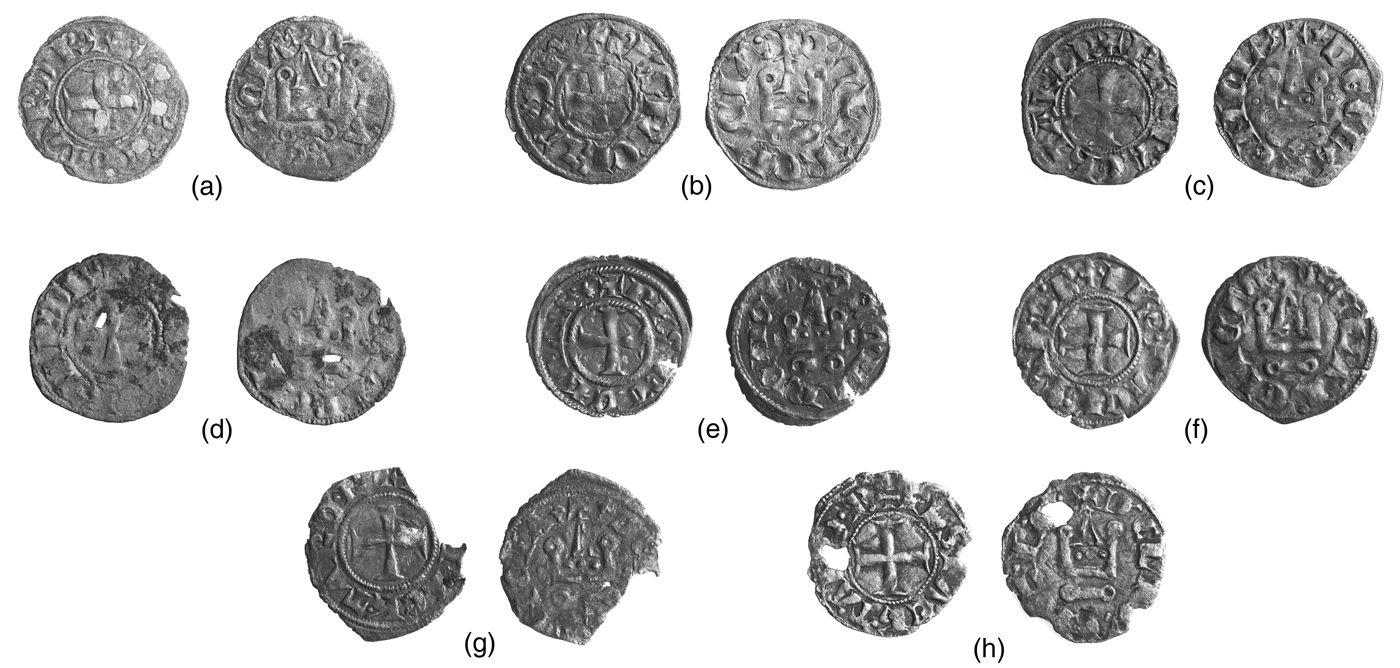
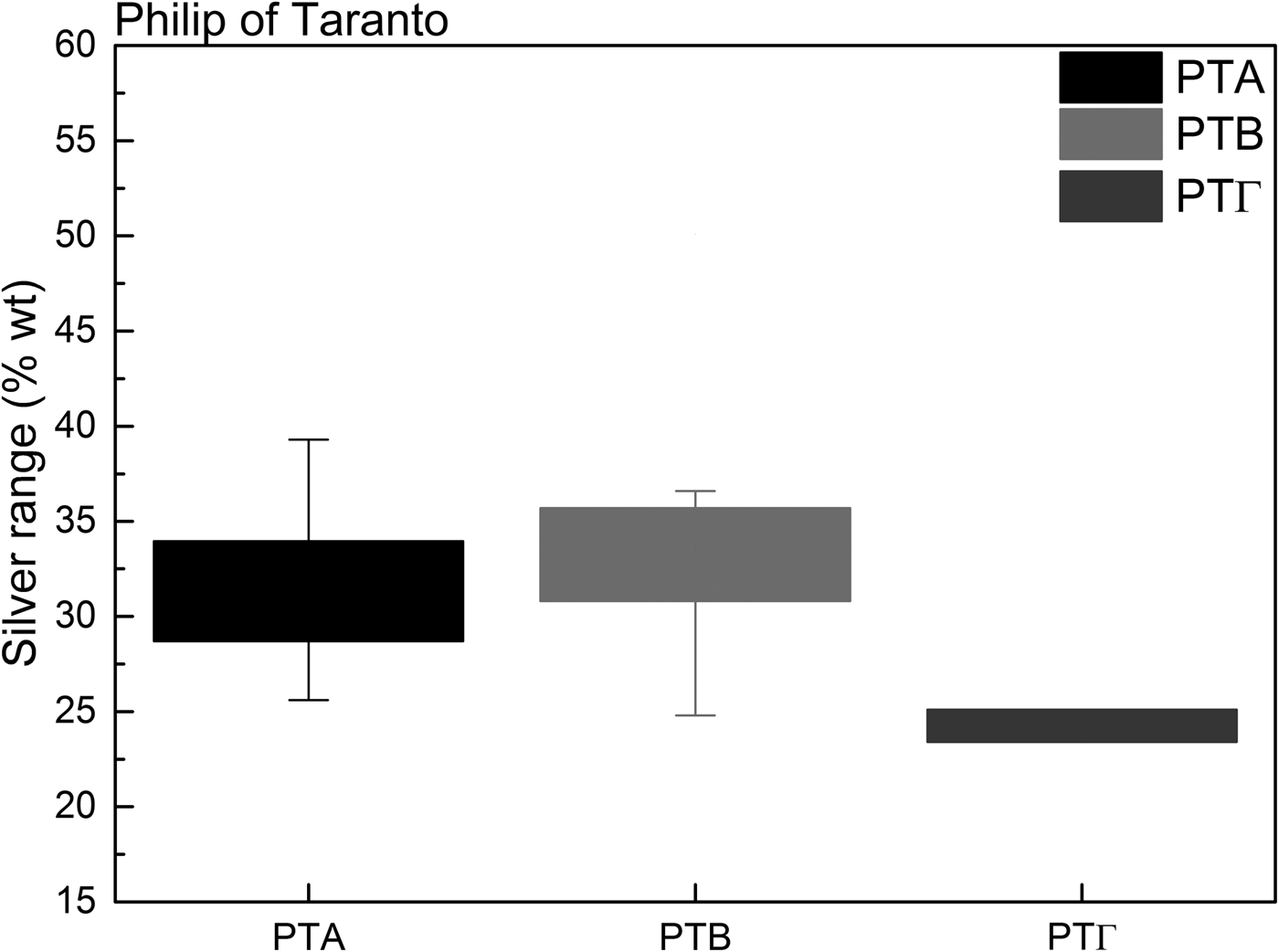
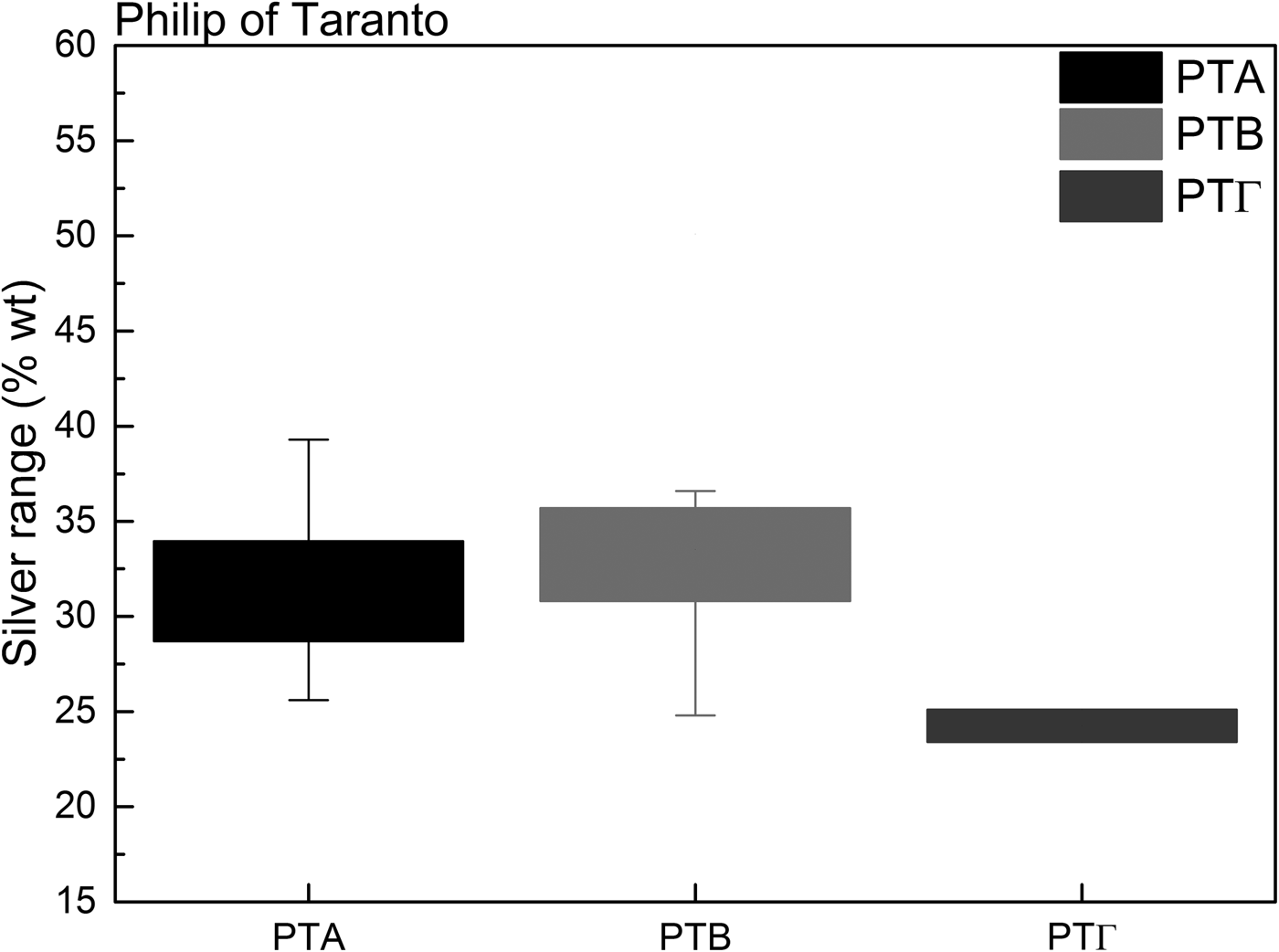
The typology for the Clarentzan issues of Philip of Taranto, who as we have seen was the son of King Charles II and overlord of Latin Romania, and additionally prince of Achaia since the ousting of Philip of Savoy, is again tripartite. PTB (Figs 14c, d, g ) is simple enough and minted in the tradition of that mint, with well-formed lettering and symbols in the reverse field. PTA (Figs 14a, b, f, h ), with the abbreviated reverse legend D'CLARENCIA, is by contrast very sloppy, with much of the lettering put together in an irregular fashion with badly constructed or missing components, apparently random stops throughout and occasional mistakes such as inverted letters. PTΓ (Fig. 14e ) is neat but different from PTB, with two Fs adorning the reverse, and the obverse legend reads PhSPAChTAR, omitting the DR (despot of Romania) which the other two types bear. There is not much doubt about the sequence of the types: the many hoards which date to c.1311 in line with the military events in eastern central Greece, and the slightly earlier and well-known hoard from Pylia (see Metcalf Reference Metcalf1971 and Graff Reference Graff1998, in addition to the other hoard lists which have already been cited), leave no doubt that PTB was followed by PTA and PTΓ. The silver content of the three main types (Fig. 15) would also support the suggested sequence. The beginning of the last of these types, which is also considerably baser, dates very closely to 1311 itself according to this hoard evidence, corroborated further by the rareness of this type at Corinth, a site whose life was, as we have said, severely curbed in 1312.
Selection of analysed coins of Philip of Taranto from Corinth excavations.

Box chart of the silver content for the types of Philip of Taranto according to the XRF analyses of the Corinth sample. The box represents the inner quartile ranges, and the whiskers the minimum and the maximum values.
This information obviously needs to be related to the political events. Philip already held the title of despot of Romania by the time that minting in his name started at Clarentza (see below), yet it is probable that he ceded it while this minting was still ongoing. The sequence of events which led Philip to gradually relinquish his claims in Greece is relatively well documented (Kiesewetter Reference Kiesewetter2001, 77–80; see also the earlier Kiesewetter Reference Kiesewetter1997, 718–20): in 1309 Philip's attempt to marry his firstborn son Charles to Mahaut of Hainaut, daughter of Isabelle of Villehardouin and Florent of Hainaut, widow of the Athenian Duke Guy II, failed. The Catalan invasion of 1311 and the defeat of the Achaian–Athenian alliance further undermined Philip's interest in the area and led to an attempt to sell his Greek and Albanian holdings to the Aragonese crown of Sicily (Abulafia Reference Abulafia1995). Next, in a double deal involving the houses of Anjou, Valois and Burgundy, Philip was to be betrothed to his second wife Catherine of Valois, and Mahaut of Hainaut was to marry Louis of Burgundy. The treaty was drawn up in April 1313 and ratified in July, and at the end of the same month the resulting weddings took place. With these, Philip became Latin emperor of Constantinople; in October Louis of Burgundy was finally able to use the title of prince of Achaia. A year later, in July 1314, Philip ceded his claims in Aitolia and Akarnania, and the title of despot of Romania, to his son Charles (Asonitis Reference Asonitis2005, 94, n. 164) and, following the death of the latter in August 1315, to his son Philip (II) (Kiesewetter Reference Kiesewetter2001, 71, n. 52).
The presented data are obviously problematic: on the early groups PTB and PTA, Philip of Taranto is given the titles of prince of Achaia and despot of Romania, whereas on PTΓ the latter title is omitted. According to the diplomatic information, however, he relinquished the principality before ceasing to be despot. Since PTΓ dates numismatically to 1311 or later, we also cannot assume that Philip dropped the title of despot of Romania on his coins as an immediate reaction to his 1309 divorce from his first wife Thamar, from whom he had received many of these claims, and through whom he had obtained the title of despot of Romania upon the death of her father (Nicol Reference Nicol1984, 61–2). We are left with two possibilities: either PTΓ was issued from a certain point after spring 1311 until October 1313, omitting the indicated title for reasons which cannot be reconstructed, or Clarentza continued minting in Prince Philip's name after October 1313 in the form of PTA, introducing PTΓ only in July 1314. One consideration which would favour the latter reconstruction is the fact that the Clarentzan issues in the names of Ferrand of Majorca and Louis of Burgundy probably date to 1316, or late 1315 at the earliest. On the other hand, the Corinth excavations have yielded at least three specimens of PTΓ, one of which was analysed in the present project, which suggests that they were in production by 1312, as does the hoard evidence. For the purpose of this article we assume that 1313 is the endpoint of minting in Philip's name at Clarentza.
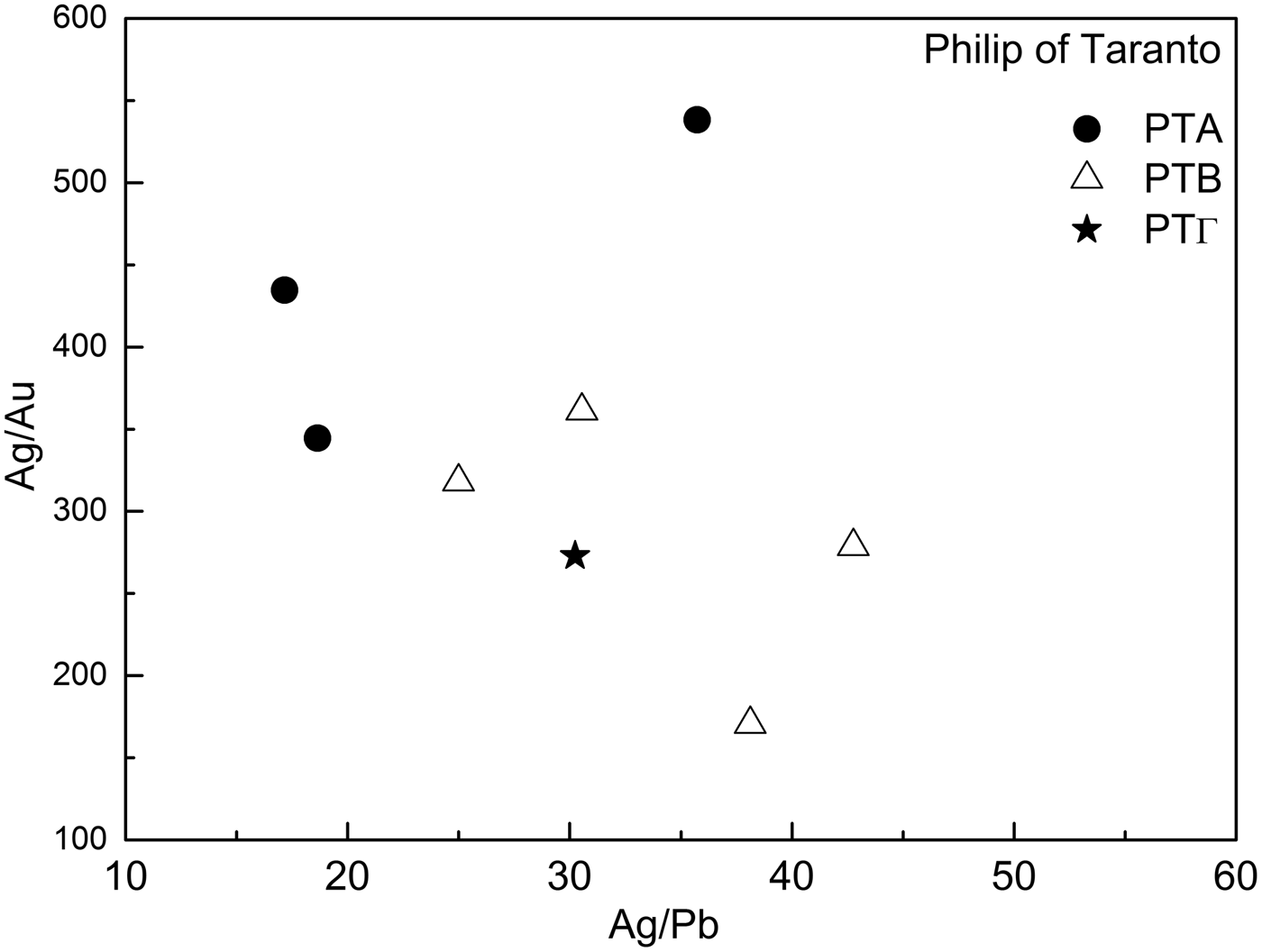
In considering the earlier history of the PT groups, we may now fall back on the three closely related hoards from the Argolis, which were discussed in 2011 at a conference in Argos (the hoards are Epidauros 1986; Epidauros 1891–2; Mygiò 2006: see Baker and Galani-Krikou; Baker and Tzekes, both forthcoming). The latest coin of Philip to be contained in these hoards is PTB, and Baker and Tsekes relate their concealment to a possible Byzantine incursion into the area after the empire's victory at the battle of ‘Gerina’ (perhaps Keryneia in Achaia), which took place in 1308/9. The Achaian preparations for the confrontation with the Catalans a couple of years later are insufficiently recorded (Bon Reference Bon1969, 187–8; Longnon Reference Longnon1949, 299–300). The hoard evidence suggests that PTA was begun at one point between c.1308 and 1311. This irregularly and rapidly struck group, which stands so much outside of the Achaian tradition in minting to that date, can only be considered in the context of the preparations for the campaign against the Catalans. The archaeological record demonstrates that production at Clarentza was significantly increased for a few years with PTA. According to the new archaeometric data, this did not significantly compromise the coinage's standard (Fig. 15), which may in some measure be the result of specific consignments of bullion that may be the explanation for the distinctive profile of PTA in Fig. 16. Typologically speaking, PTΓ must be viewed as an effort at restoring the coinage of Achaia in outwardly physical terms, even though this entailed a considerable compromise in the minting standard (Fig. 15).
Ratio scatter plot of silver bullion for Philip of Taranto according to the XRF analyses of the Corinth sample.

Despot of Romania, Naupaktos mint, Philip of Taranto (1296/8–1314)
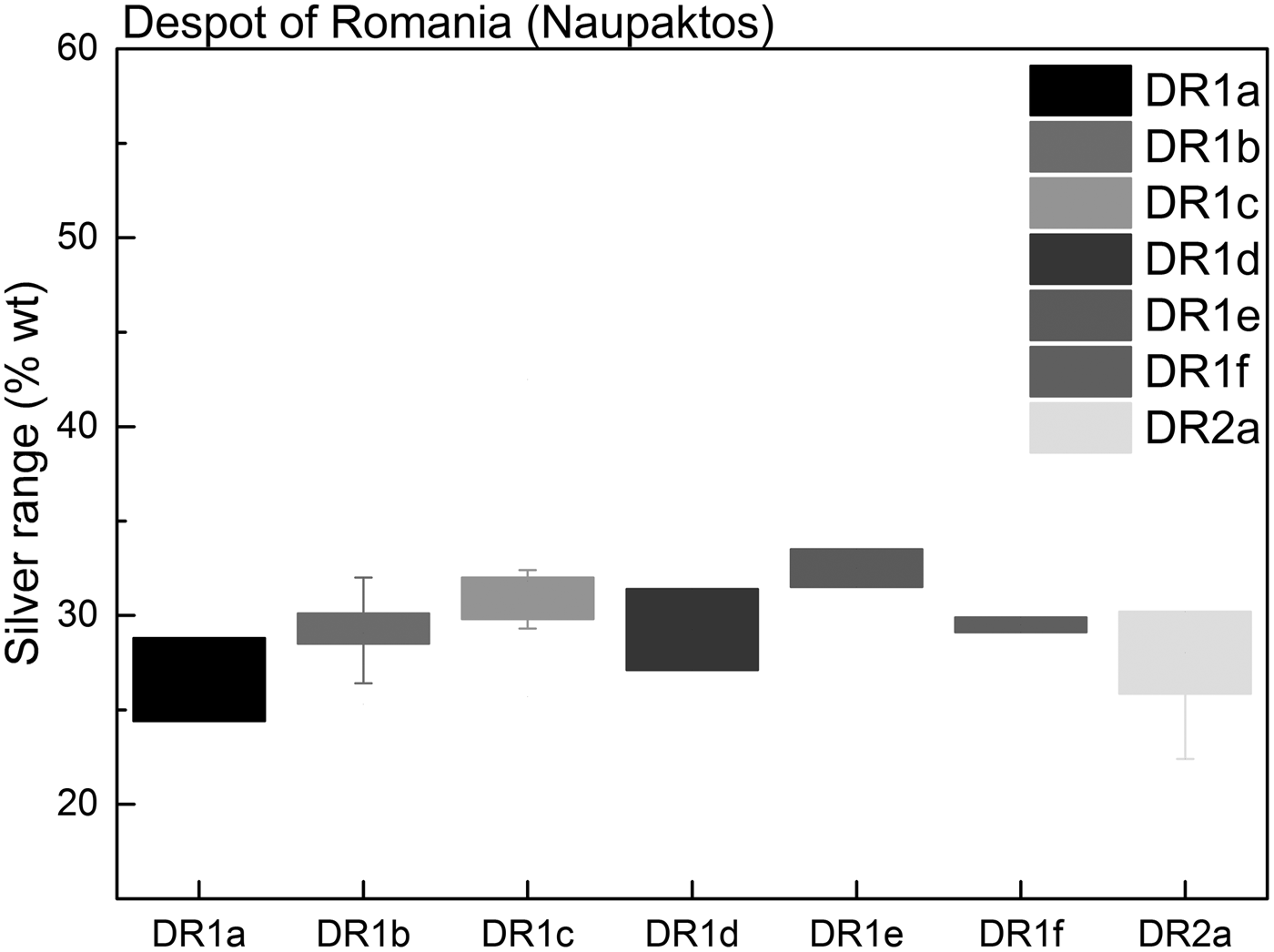
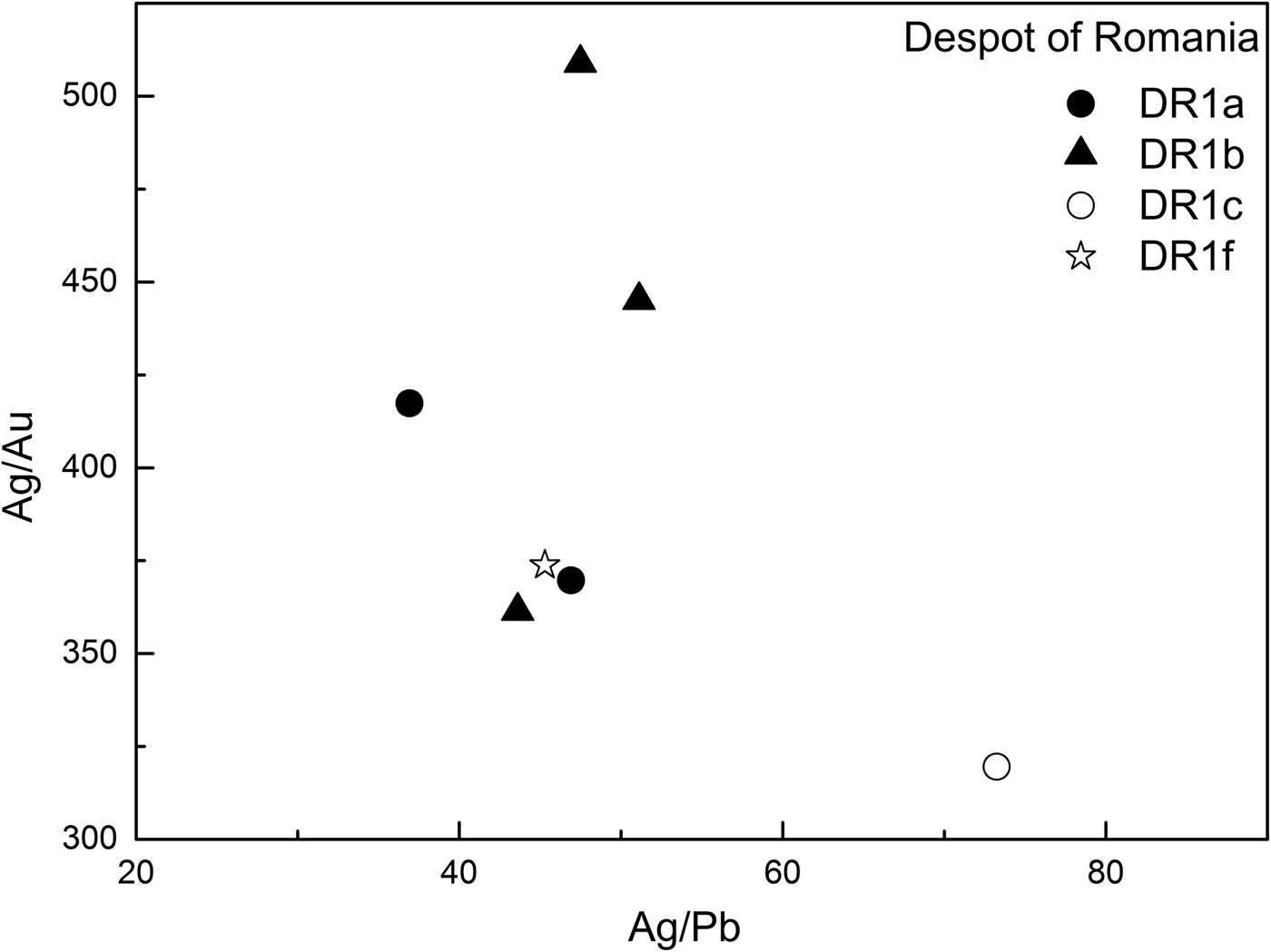
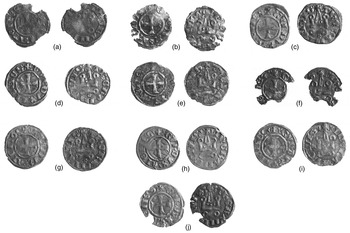
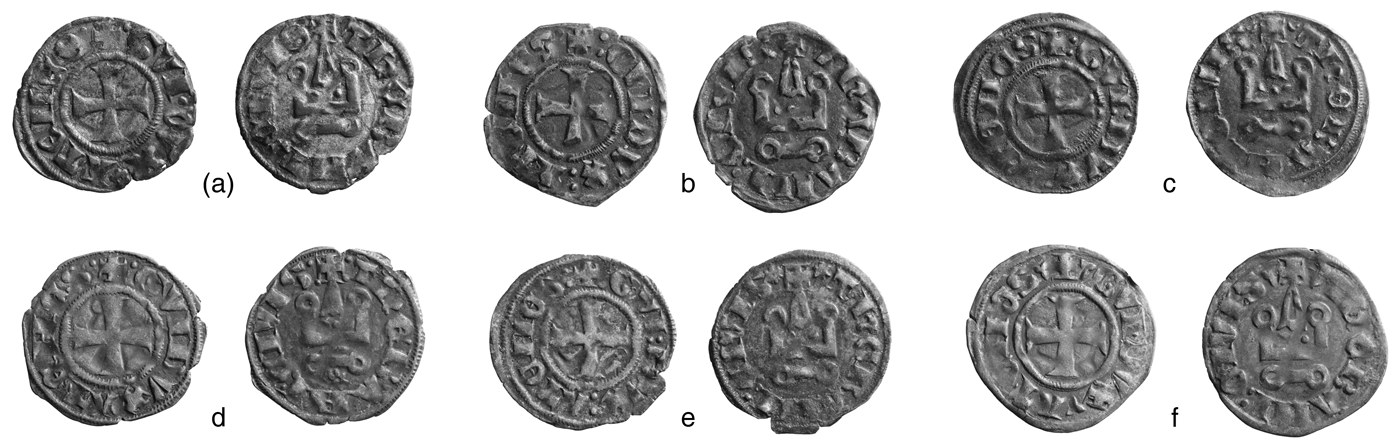
Returning now in time, the same Philip of Taranto minted coins in his name at Naupaktos, in western central Greece, at the northern entrance of the Gulf of Corinth. We owe the typology largely to Metcalf (Reference Metcalf1995, 278–9; completed in Baker Reference Baker2001, 249 and 273; see also Baker Reference Baker and Travaini2011d). There is an overall division into two groups (DR1 and DR2) based on stylistic grounds, while DR2 is further subdivided into DR2a and DR2b on epigraphic grounds. This new classification supersedes Schlumberger Reference Schlumberger1878–82, pl. XIII.20 (= DR1 and DR2a) and pl. XIII.26 (= DR2b). The last of these bears Philip's Achaian title, which creates a link with the last discussion. As we have already said, to judge by the evidence of the hoards there was a short period during which Philip of Taranto issued coins at Naupaktos (DR2b) and Clarentza (PTB) contemporaneously. Moreover, the stylistic affinities of the issues in question underline this, especially the open lettering and the club-footed R, and the decorations in the reverse field. Unfortunately, DR2b is excessively rare at Corinth excavations and no specimens of the type were included in our analyses. DR2b provides a chronological fixpoint in the Naupaktos series, being apparently first minted at one point between October 1304 and August 1306. At the other end of the chronological scale, the Birmingham hoard confirms that the rare DR1a (Fig. 17i ) was the earliest Naupaktos issue, approximately contemporary with Philip of Savoy's PSΓ, and therefore dated on numismatic grounds to c.1301. The singular construction style of the letter S for DR1a and the end of the obverse legend (DESPO) would also indicate that this was an early experimental piece. Many of the remaining DR1 varieties (DR1b: Figs 17a, e, h ; DR1c: Fig. 17f and g ; DR1d: Fig. 17j ; added to Metcalf's typology by Baker is DR1e: Fig. 17c ) share neat and common lettering and can only be distinguished by the symbols at the beginning and end of the obverse and reverse legends. Only DR1f (Fig. 17d ), a second type created by Baker to augment Metcalf's classification system, shares with DR1a the form of the S. The DR2a varieties (Fig. 17b and k ) have, by contrast, a very different style of lettering and symbols in the reverse field. To judge by some of the hoards studied to the right level of detail, DR1b was the largest, followed by DR1c and DR2aii and iii. Occasionally DR1e is also well represented. DR2b is much smaller than DR1–2a combined. These hoards do not, however, allow one to place the groups in a sensible chronological order. The following chronological order suggests itself according to the present state of knowledge, largely by typology: DR1a – DR1f – DR1b – DR1c – DR1d – DR1e – DR2aiii – DR2aii – DR2bi – DR2bii – DR2biii. This is also an arrangement which can be supported by Figs 18 and 19: we note, for instance, an affinity of DR1a and 1f on both counts. DR1a launched the series at a substantially lower standard than the contemporary Clarentzan PSΓ (Fig. 12), and, as we shall see, even lower than that of Thebes. The series from Clarentza and Naupaktos (compare Figs 13 and 19) may well have built on similar bullion sources during the period c.1301–4. From D1b to DR1e there was a steady increase in the standard of Naupaktos, although it always fell short of the Clarentzan one and dropped off again with DR2a towards the time when the mint of Clarentza transitioned from the rule of Philip of Savoy to that of Philip of Taranto. As we have said, figures for DR2b would be very desirable in this respect.
Selection of analysed coins of the despot of Romania from Corinth excavations.

Box chart of the silver content for the types of Naupaktos according to the XRF analyses of the Corinth sample. The box represents the inner quartile ranges, and the whiskers the minimum and the maximum values.

Ratio scatter plot of silver bullion for Naupaktos according to the XRF analyses of the Corinth sample.

With these considerations in mind, it will be necessary to analyse all the historical evidence afresh: according to the information presented above, Philip of Taranto married Thamar of Epiros in 1294. The Corfiot coinage demonstrates that for some time during his early Greek involvements Philip did not yet use the title of despot of Romania. This harmonises perfectly with the documentary sources: while Philip received in dowry from Thamar locations in western mainland Greece (Vonitsa, Angelokastron, Eulochos, Naupaktos) (Kiesewetter Reference Kiesewetter1994, 181–4; Kiesewetter Reference Kiesewetter2001, 63–4), he was required to await the death of his father-in-law Nikephoros to become overlord of the remainder of the territories governed by the Angelodoukai of Epiros, and to assume the title of despot of Romania. Nikephoros’ death can be dated, according to the extant Angevin documentation, between September 1296 and June 1298 (Nicol Reference Nicol1981). There is some evidence that during this period Naupaktos had slipped from Angevin control, or perhaps had never been successfully handed over in view of innate Greek resistance to the 1294 settlement: in July and October of 1295 King Charles II urged Prince Florent to move against the rulers of Neopatra in order to regain precisely that part of Aitolia (Asonitis Reference Asonitis2005, 79). Perhaps the town was only conquered in 1300/1 (Nicol Reference Nicol1984, 49 and 51). In 1300 the Greek bishop of Naupaktos appealed to the Angevin authorities in order to gain access to his see, which can be interpreted as meaning either that the Angevins had recently taken, or that they were about to take, the city (Asonitis Reference Asonitis2005, 240). We can surmise from an Angevin act that in December 1301 the Naupaktos mint was operational: Charles II gave Thomas III of Autrementcourt, lord of Salona, the right to produce issues in his name there, perhaps on the very occasion of the opening of this mint (Schlumberger Reference Schlumberger1878–82, 349–50; see also Baker Reference Baker and Travaini2011f). Earlier in the same year Clarentza had started striking in the name of Philip of Savoy, which may well have sparked the desire for a separate Angevin minting operation in western Greece, to capture the bullion which was reaching the area in great quantities. The aforementioned Agrinio 1973 hoard, devoid of coins of Naupaktos, demonstrates that such issues cannot have been minted earlier than 1300/1. The position of Naupaktos remained precarious also thereafter: Nikephoros’ widow and son, Anna and Thomas, were especially aggrieved by the direct or indirect integration of the despot's territories into the Angevin empire (Nicol Reference Nicol1984, 56–7; Kiesewetter Reference Kiesewetter1994, 188–90). After making overtures to the imperial Byzantine authorities, and being attacked by the joint forces of King Charles II of Anjou, Count John I of Orsini of Kephallonia and Zakynthos, and Prince Philip of Savoy in the early summer of 1304, they evidently managed to launch counter-attacks and to take Angevin positions. We know also that Naupaktos was in the hands of Thomas for a short time because in the summer of 1306, following a large-scale Angevin offensive, he agreed to relinquish it again (Nicol Reference Nicol1984, 67; Kiesewetter Reference Kiesewetter1994, 199–201; Asonitis Reference Asonitis2005, 91–2). It is difficult to judge when Naupaktos was taken from the Angevins: probably not before the summer of 1304, to judge by the content of the negotiations between the Angevins and Anna and Thomas in early 1305; possibly in the summer of 1305, when Thomas attacked again, leading to the treaty between Philip of Taranto and Orsini of October 1305 (Kiesewetter Reference Kiesewetter1994, 192.); but most likely in the spring or early summer of 1306. On 10 February 1306 Philip of Taranto confirmed a number of benefits to the Neapolitan banker Adoardo Bisca, among which was the profit from the Naupaktos mint, in return for a yearly loan of 31,000 hyperpyra (Hopf Reference Hopf, Ersch and Gruber1867–8, 359, n. 59; Schlumberger Reference Schlumberger1878–82, 388, n. 1; Asonitis Reference Asonitis2005, 91, n. 134). We might assume that Naupaktos was then still in Angevin hands and that its mint was still emitting tournois until the spring or summer. Alternatively, perhaps the town had been intermittently taken by Anna and Thomas, and then Angevin minting resumed for a short while in early 1306.
Whereas the back end of the Naupaktos series of tournois in the name of Philip of Taranto remains unclear with respect to chronology and metrological/archaeometric information, the early period from later 1301 to c.1304 has a very distinctive profile, and the complex typology can be arranged in a satisfactory sequence. The standard of these types was considerably lower than at contemporary Clarentza, and both mints built their issues on similar bullion sources. This suggests on the one hand that the Angevin authorities at Naupaktos were trying to offer (particularly to incoming merchants) a cheaper and, at least superficially, a more attractive product than the Clarentza mint (perhaps even more so than that of Thebes), while putting pressure on the rival Philip of Savoy, and on the other hand that both of these mints were substantially commercially orientated. This is corroborated by other pieces of information. In the December 1301 letter of Charles II to a certain Raymond, perhaps the mint master at Naupaktos, in which he instructs him to oversee the minting of coins on behalf of Thomas III of Autrementcourt, he states twice the participation of Clarentzan merchants in this minting operation (see above). This is a concrete example of how the flow of bullion might have been changed to favour Naupaktos. Maybe the Venetian concerns with inferior tournois in 1305 related also directly to the issues of this mint (on the relevant act: Schlumberger Reference Schlumberger1878–82, 476–7). It is possible that sometime into the minting at Naupaktos the profile of the mint changed somewhat: in August 1302, after the treaty of Caltabellotta, Philip of Taranto was released from Aragonese captivity and will have begun contemplating his succession to Despot Nikephoros. The threat to his territories from early 1303 by the new ruler John II at Neopatra, and then from Anna and Thomas of Epiros, added to the necessity to act. Consignments of bullion from the Regno are documented for the beginning of 1304 (Asonitis Reference Asonitis2005, 84–5). One can only speculate as to whether the improvement of the minting standard for DR1c–DR1e needs to be seen in connection with this military activity, and whether the subsequent downturn for DR2 can be linked to the difficult fate of the city during the period 1304–6. The same increase may also have brought the standards at Naupaktos and Thebes in line with one another, and may also have eased the pressure on the mint of Clarentza under Philip of Savoy, who was now actively supporting his overlords in the Epirote campaigns (see above), which may both have been considerations for the Angevin authorities.
Athens, Thebes mint, Guy II de la Roche (1287–1308) or Walter of Brienne (1309–11), obv. legend GVI.DVX
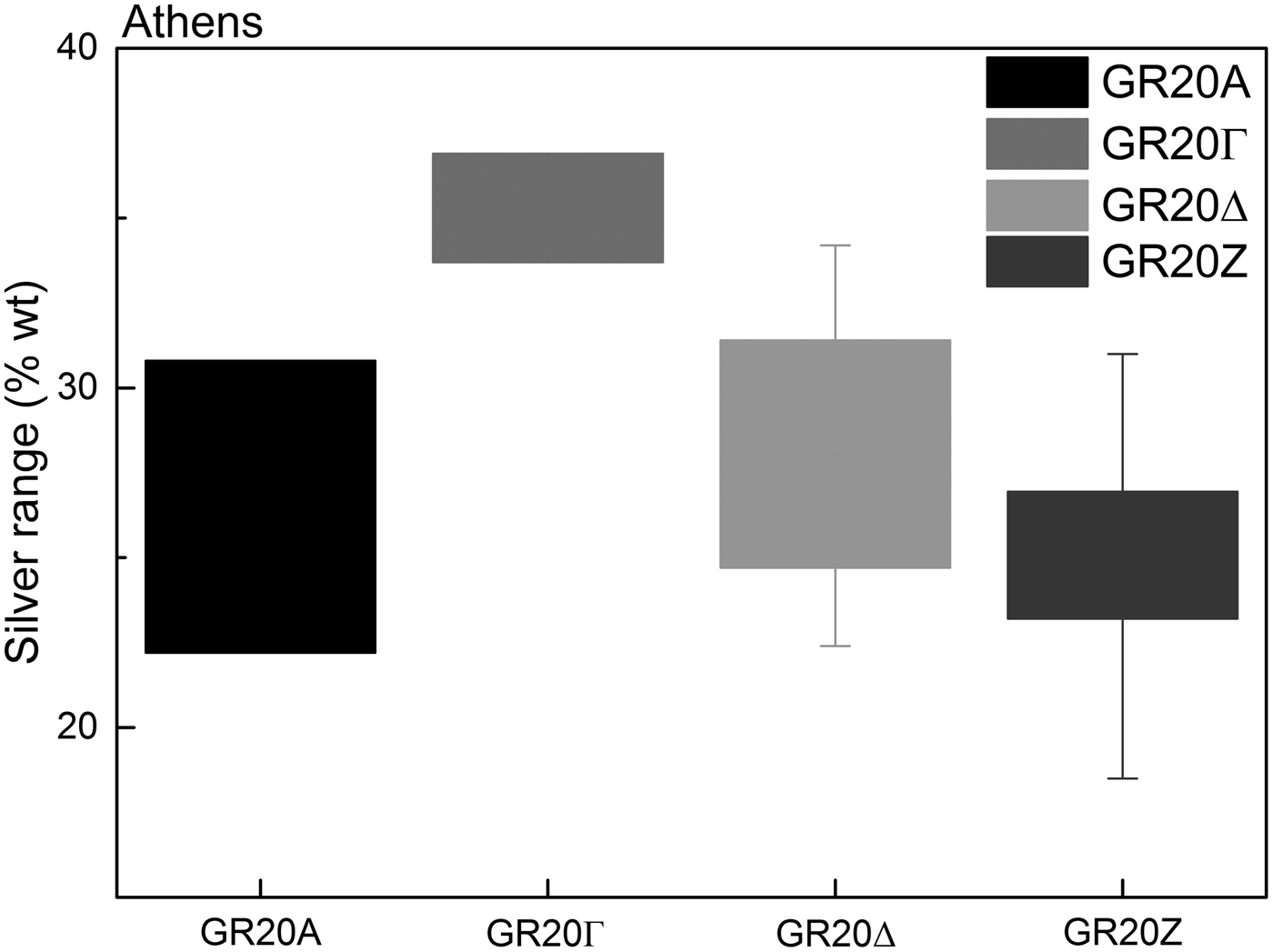
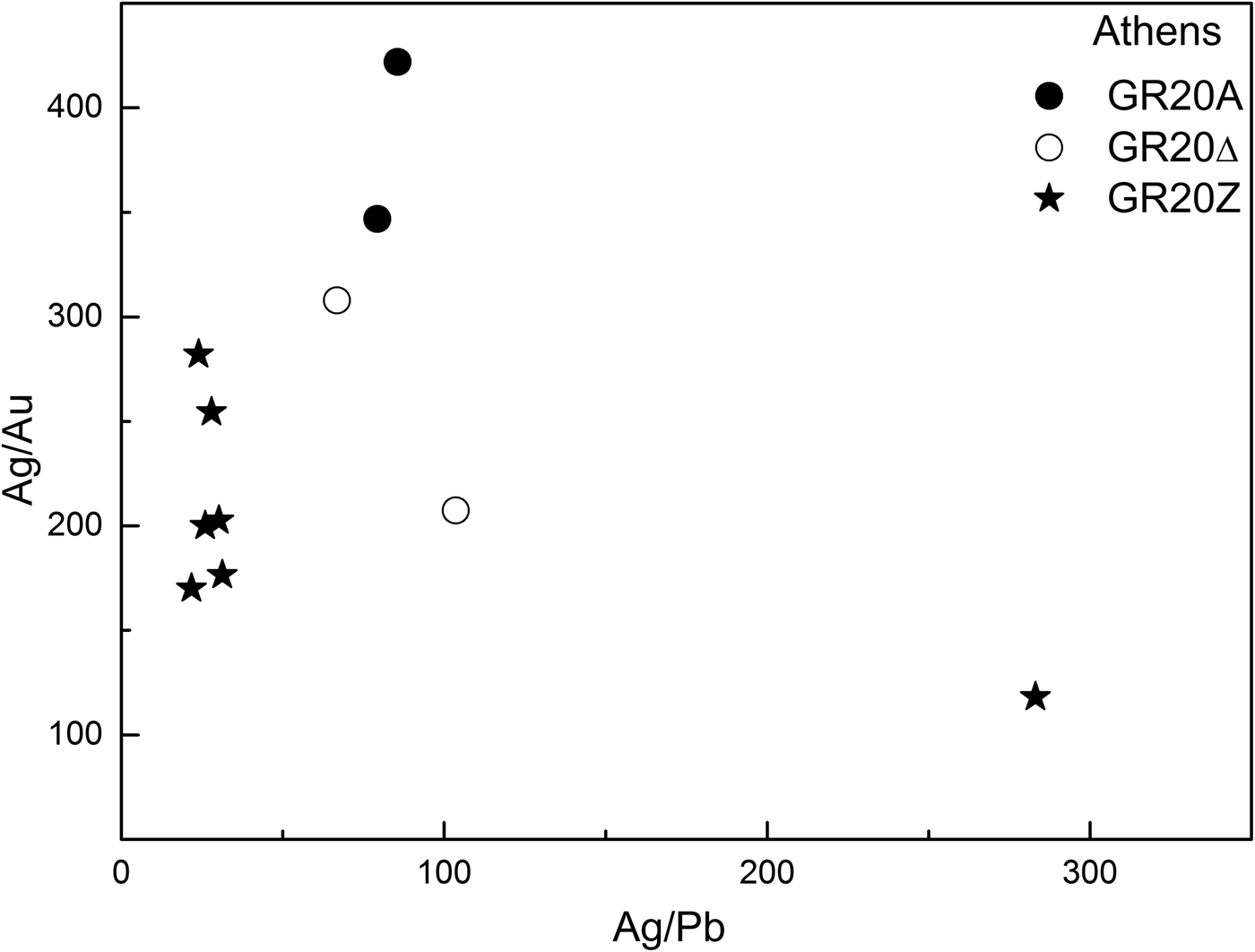
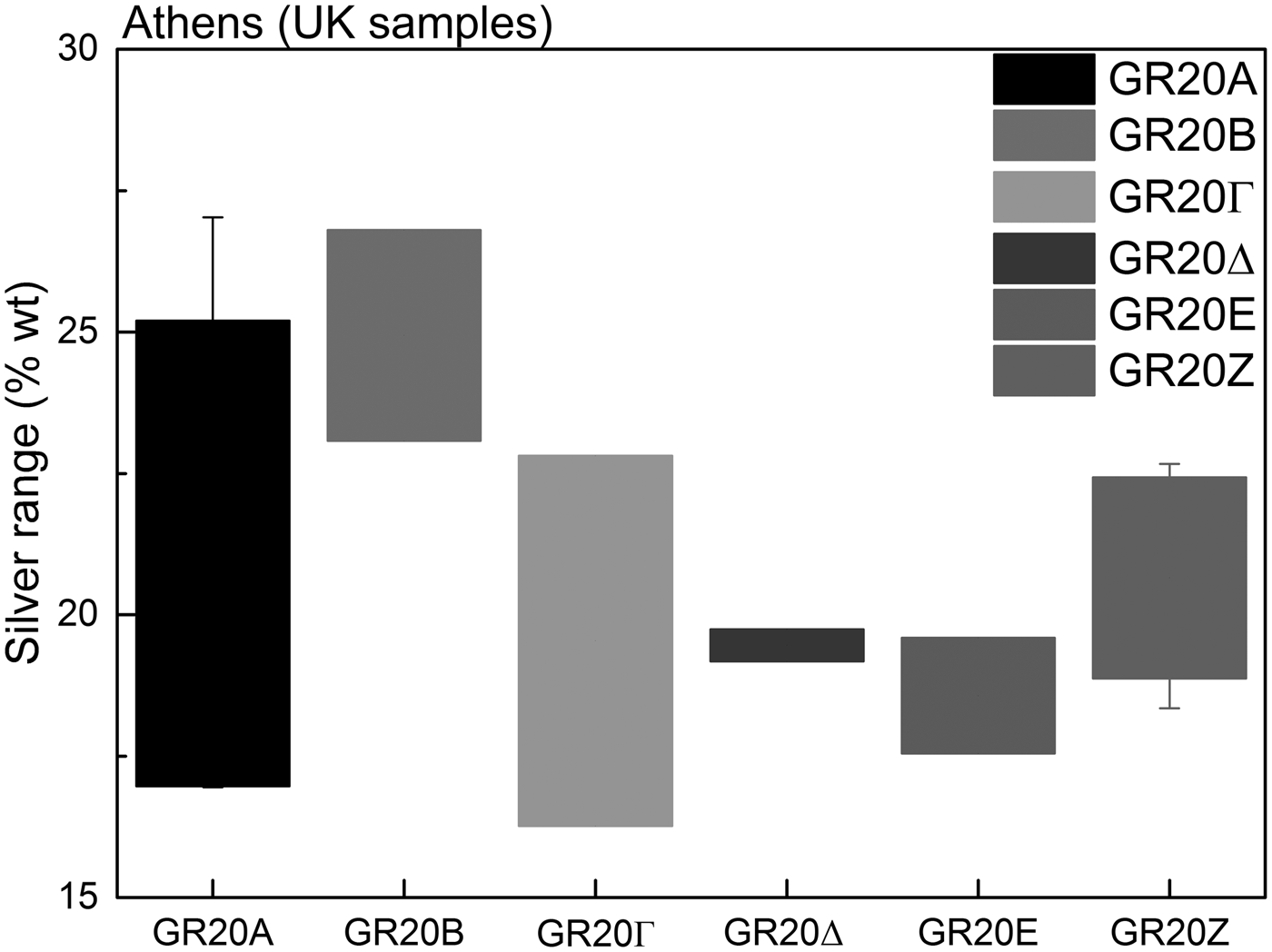
We have already seen that the typological advances made by Metcalf and Tzamalis have freed the Athenian tournois series minted at Thebes from the previously rigid attributions of the specimens reading G.DVX to William de la Roche (†1287), and GVI.DVX to his son Guy II (1287–1308). Nevertheless, the two main legends are chronologically progressive. Between the early G.DVX type GR105 which we have encountered, and the beginning of the GVI.DVX series, there are three substantive types of the G.DVX series (A3, A7, A8). Their ordering, and that of the subsequent types of the GVI.DVX series, relies on the same hoard evidence which has been discussed, specifically in this order: Xirochori 1957 – Agrinio 1973 – Birmingham – Delphi 1933 – Mygiò 2006 – Epidauros 1986 – Epidauros 1891–2 – Thebes 1987 – Pylia 1968/9, followed by multiple hoards concealed in c.1311. The problem with the initial part of this chronology lies in the fact that nearly a decade separates the earliest, Xirochori, hoard from the Agrinio hoard, which was concealed in c.1300 but was quite immature in the Athenian series, perhaps on account of its geographical origin. At the other end, the latest hoards underline that the regular Athenian series came to an end with the Catalan takeover of the city of Thebes in 1311. According to our present knowledge, the GVI.DVX series needs to be placed during the years c.1300–11, whereas A3, A7 and A8 of G.DVX would have spanned much of the 1290s and been therefore largely contemporaneous with the Clarentzan series in the names of Florent and Isabelle. Our assumption that the standards of these two princes was lowered to accommodate that of these Athenian types rests on the standard of the later GVI.DVX varieties, but is otherwise hypothetical. Clearly, the analysis of the A3, A7, A8 varieties remains a priority for any future enquiries. It is also possible, though still to be proved, that the amelioration of the minting standard for Isabelle's IVA1 might have paralleled the introduction of the GVI.DVX series at Thebes, both occurring in c.1300. Within the GVI.DVX group, it is obvious from the hoards that GR20Z (Fig. 20c, d, g , and Fig. 21d ) is the largest and latest of the substantive types, and that GR20B (Fig. 21c ) is also relatively late. Nevertheless, GR20Z was already in production in c.1307/8 according to the same evidence. GR20A (Fig. 20b, e, j , and Fig. 21a ) is early since it shares the style, and some reverses, with A8. GR20B and GR20Z share the same lettering, as does GR20E (Fig. 21e ), which is linked to the latter by the same spur rowel as GR20Z, and since it is small and late this type may well have been interrupted by the Catalan takeover. The intermittent types GR20Γ (Fig. 20a, f and Fig. 21b ) and GR20Δ (Fig. 20h, i and Fig. 21f ) are stylistically mixed; the second of these is perhaps the closer to the later varieties, and the sequence GR20A – GR20Γ – GR20Δ – GR20B – GR20Z – GR20E suggests itself. Figs 22, 23 and 24, which display the data from respective analyses of the Corinth and UK samples, are neither able to corroborate nor to contradict this arrangement.
Selection of analysed coins of Athens from Corinth excavations.

Selection of analysed coins of Athens from the UK coin trade.

Box chart of the silver content for the types of Athens according to the XRF analyses of the Corinth sample. The box represents the inner quartile ranges, and the whiskers the minimum and the maximum values.

Ratio scatter plot of silver bullion for Athens according to the XRF analyses of the Corinth sample.

Box chart of the silver content for the types of Athens according to the XRF analyses of the UK sample. The box represents the inner quartile ranges, and the whiskers the minimum and the maximum values.

Figs 22 and 24 are able to reveal that throughout much of the period c.1300–11 Athens maintained overall a consistent standard, lower than that of Clarentza but evidently not succumbing to the pressures of the newly established Naupaktos mint and its early and baser issue DR1a. In fact, as Naupaktos raised its own standard towards c.1304, the issues of these two mints may perhaps have become adjusted to one another. The most remarkable aspect of Fig. 23 is the very distinctive metallurgical concentration of the silver sources that went into the striking of GR20Z.
As we have seen, during the princeships of Florent and Isabelle the relations between Achaia and Athens normalised. Subsequently, Guy II paid homage to Prince Philip of Savoy in 1302/3, supported him in his military endeavours in Epiros and the Peloponnese, and attended his parliament at Corinth in 1304 (Longnon Reference Longnon1949, 283–7; Longnon Reference Longnon, Setton and Wolff1962, 266–7). Between May 1307 and October 1308, the date of his death, Guy II was also bailie of the principality for the new prince, Philip of Taranto (Longnon Reference Longnon1949, 293; Longnon Reference Longnon, Setton and Wolff1962, 268). His Theban types GR20B and, partially, GR20Z were minted contemporaneously with the Clarentzan PTB and then PTA. We can be fairly confident from our figures that Thebes would have minted at a lower standard than Clarentza despite Guy's new official role. Only in Fig. 24 is there a slight hint, in the shape of GR20B, that the two standards might have been rather closer to one another for the duration of that type (compare also the respective figures achieved by Ponting and Gordus of c.19% for GR20B and 18.3% for PTB). There was an interregnum during October 1308 – April 1309, after which Walter of Brienne was duke, until his death at the battle of Halmyros in March 1311. His reign was marked by the preparations for the encounter with the Catalans. There are no diplomatic sources illuminating the events leading up to the arrival in Thebes of Duke Walter of Brienne, the count of Lecce and the son of the late Hugh of Brienne, in April 1309 (Bon Reference Bon1969, 186 n. 2). His invitation of the Catalan Company into Boiotia brought the downfall of the duchy in 1311, prior to which he had paid the large army, according to Muntaner's account, ‘… quatre unçes lo mes per home a cauall armat, dos per cauyall alforrat et una unça per hom de peu’ (Muntaner, chapter 240 [Lanz Reference Lanz1844]; see Hendy Reference Hendy1985, 15, on these salaries). We know, furthermore, from Muntaner the length of the payment, namely two months, and we have a fair idea that an ounce might have been the equivalent of about 1000 tournois, since in 1299 there were 32 tournois to the tarì (Baker and Ponting Reference Baker and Ponting2001, 238), 42 in 1337/8 (Longnon and Topping Reference Longnon and Topping1969, doc. II [1337], 53, lns 6–10, 127), that is to say respectively 960 and 1260 tournois to the ounce (at 30 tarì to the ounce). While we ignore the size of the army, this still gives us a vivid picture of the extent of the payment. There is also evidence for a substantial loan which Walter received in 1310 from Sienese bankers (Jacoby Reference Jacoby, Laiou and Mottahedeh2001, 224).
There are a number of rare anonymous issues of Thebes which have been variously interpreted (Metcalf Reference Metcalf1995, 274). Tzamalis’ proposal that these are to be dated to the interregnum seems to be quite correct (Tzamalis Reference Tzamalis1990, 130), and these issues would therefore have to be inserted into the production of GR20Z, which pre-dates October 1308 as much as it post-dates April 1309. The sudden need for new dies following the death of Guy in October 1308 and the uncertain succession can account very well for the incongruous style of the anonymous issues, while their anonymity and perhaps their even lower finenesses according to Gordus’ figures reflect the political stalemate. There is every reason to believe, particularly in the light of the payments to the Catalans, that the duchy emitted tournois until the end of its existence. Such minting activity cannot be covered by the anonymous types, or by arguably the earliest of Walter's issues (G.DVX.ATENAR, Metcalf Reference Metcalf1995, 274), nor even by GR20E, which was quite possibly the last of the regular series. We can also witness in the hoards a final boost in GR20Z production until 1311. We must therefore assume that the decision was taken, by or on behalf of the new Duke Walter, to resume the traditional GVI.DVX series at one point between spring 1309 and spring 1311 in the form of GR20Z. This might have been inspired by the fine tradition established by groups GR20A–Z, and by the existence of dies for both GR20Z and GR20E, which had presumably been cut in good number by the time of Guy's death. The Thebes mint was never stretched for dies in the same way as the Clarentza mint, in the shape of PTA discussed above, in the run-up to the engagement with the Catalans. Both mints appear to have been able, though in different ways (direct consignments and loans, among others), to tap into extra-ordinary bullion resources in these times of crisis, and managed thereby to avoid compromising the quality of their outputs.
CONCLUSIONS
The period under analysis, 1289–1313, saw remarkably intense silver minting in southern and central Greece, notably at the three main mints of Clarentza, Thebes and Naupaktos. This was the middle phase of denier tournois production in Greece, which was preceded by an earlier phase from c.1267, and followed by another prolific but different kind of minting activity in the 1320s–40s, when coin production was largely confined to Clarentza and Arta for the rival Anjou and Orsini dynasties. This final flourish of Greek coin production is in many respects the least known and understood.
The intensity of the minting in the decade before and after 1300 mirrors that which took place at many other European silver mints in exactly the same period. Like many contemporary pennies, the Greek series bears a typological diversity which numismatists have gone some way towards describing and explaining, especially in chronological terms. Hoards are particularly useful in this process, as are narrative and diplomatic sources.
Our aim here was to introduce another potentially powerful source and to test it for internal consistency and applicability to the problems in hand. It became clear that the main method which we chose, X-Ray Fluorescence spectrometry, could provide us with useful data provided that it was undertaken within a controlled environment, and could be carried out on a large enough sample from the same source, with multiple readings per specimen. LIBS provided additional supporting data. The extrapolations made from the findings were clearly defined and relied on strong archaeological and historical contexts in order to give them meaning. However, once approached in such a circumspect manner the information which could be gathered was absolutely invaluable, in the sense that no other evidence could possibly have provided similar insights which allowed one to further define and explain the nature of the coinages in question. Because of the complexity of the typology of these coinages one would evidently, after this first attempt of its kind, wish to delve ever deeper into the series and to submit more specimens of the same types, and additional types (notably DR2b for Naupaktos; A3, A7, A8 for Thebes), to analysis. Since the chosen method is both non-destructive and relatively inexpensive, it would be realistic to roll out this enquiry to wider samples of ever more tightly defined sets of numismatic types, for instance in the context of the many and large hoards under the authority of the Hellenic Ministry of Culture. It may well be imagined that increasing our sample of 125 coins three- or fourfold could truly allow one to get to grips with the coinages of the chosen period 1289–1313. The weight system of the same coins should ideally also become a major point of enquiry. Meanwhile, the study of typology and hoards, as deployed in this paper, may well soon exhaust itself, and future scholars may wish to undertake die studies in order to understand matters of sequence, chronology, quantification and the like. At that point one may decide that XRF readings for specimens produced by a single pair of dies, for instance, might be desirable, although such possibilities remain in many respects far off.
As it stands, we have attempted to put the multiple groupings and their sub-varieties in relative and absolute orders. All of these were chronologically progressive. The silver sources at Clarentza, Naupaktos and Athens could at times be different, and there is various evidence that these were commercial mints which, in crucial periods, relied on extra-ordinary cash injections. These mints were largely reluctant to compromise the overall standard. They were always aware of one another, and lowering this standard could entail either a hostile position (initially of Naupaktos to Clarentza from c.1301), or an acknowledgement of realities and alliances (for instance Clarentza and Thebes around 1300; Naupaktos and Clarentza towards c.1304; Clarentza and Thebes c.1307). The issuance of coins was clearly an important and well thought-out matter for the main Greek protagonists during the years under consideration.
ACKNOWLEDGEMENTS
The authors are grateful to the Greek Archaeological Service for authorising the analyses on which this article is based. We thank in particular Demetrios Athanasoulis, the Ephor of Antiquities formerly responsible for Corinth, for supporting our enquiries. The American School of Classical Studies and its staff at Ancient Corinth, in particular Guy Sanders, are thanked for facilitating the analyses. We gratefully acknowledge the financial support of the Leverhulme Trust, which funded RJ and BD's International Network project ‘Towards non-destructive analysis in archaeological and conservation science’. Financial help was received from the History Faculty, University of Oxford, to acquire coins in the UK coin trade to support the analyses. JB is grateful to the Onassis Foundation, especially Frédérique Hadgiantoniou, the Hellenic National Research Foundation, especially Marina Koumanoudi and Charalambos Gasparis, and the British School at Athens, for making possible and supporting his stay in Athens in 2015. An earlier version of this article was delivered by the same at the XV International Numismatic Congress Taormina, September 21–5, 2015.
APPENDIX
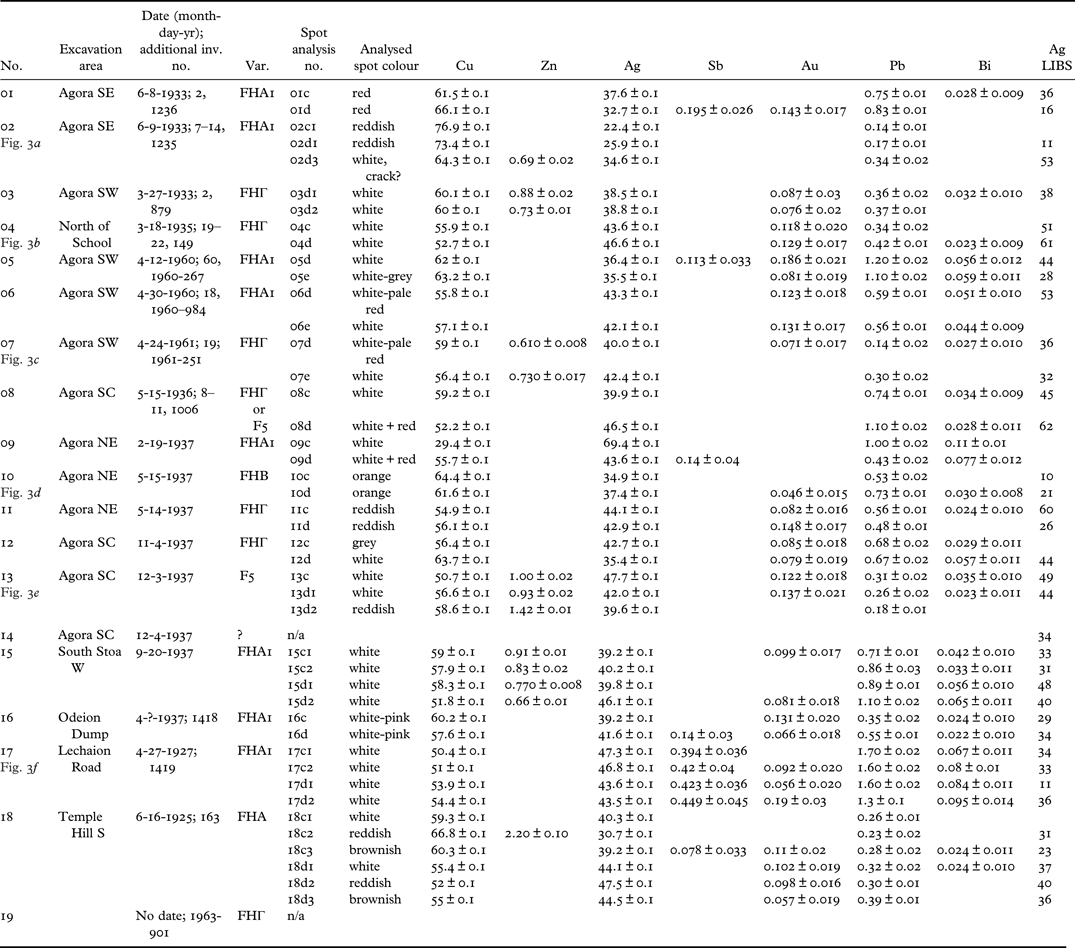
Analysed specimens of Achaia, Clarentza mint, Florent of Hainaut (1289–97) from Corinth excavations analysed by XRF and by LIBS (Ag, last column). The detection limits are 0.5 (Zn), 0.07 (Sb), 0.06 (Au), 0.022 (Bi). n/a = not analysed.

Analysed specimens of Achaia, Clarentza mint, Isabelle of Villehardouin (1297–1301) from Corinth excavations. The detection limits are 0.5 (Zn), 0.07 (Sb), 0.06 (Au), 0.022 (Bi). n/a = not analysed.

Analysed specimens of Achaia, Clarentza mint, Philip of Savoy (1301–4/6) from Corinth excavations. The detection limits are 0.5 (Zn), 0.07 (Sb), 0.06 (Au), 0.022 (Bi). n/a = not analysed.

Analysed specimens of Achaia, Clarentza mint, Philip of Taranto (1304/6–1313) from Corinth excavations. The detection limits are 0.5(Zn), 0.07 (Sb), 0.06 (Au), 0.022 (Bi). n/a = not analysed.

Analysed specimens of despot of Romania, Naupaktos mint, Philip of Taranto (1296/8–1314) from Corinth excavations. The detection limits are 0.5 (Zn), 0.07 (Sb), 0.06 (Au), 0.022 (Bi). n/a = not analysed.

Analysed specimens of Athens, Thebes mint, Guy II de la Roche (1287–1308) or Walter of Brienne (1309–11), obv. legend GVI.DVX from Corinth excavations. The detection limits are 0.5 (Zn), 0.07 (Sb), 0.06 (Au), 0.022 (Bi). n/a = not analysed. Nos. 04 and 08 were originally chosen, but were of the wrong types, and hence are not included in the table.

Analysed specimens of Athens, Thebes mint, Guy II de la Roche (1287–1308) or Walter of Brienne (1309–11), obv. legend GVI.DVX, from the UK coin trade. The detection limits are 0.5 (Zn), 0.07 (Sb), 0.06 (Au), 0.022 (Bi). n/a = not analysed.