Introduction
Reproductive biotechnologies are seen as potential solutions to the prevention of loss of biodiversity. One technology that, even today, provides a temporary expedient to alleviate the problem is cryopreservation. It has been shown that spermatozoa of different species are able to maintain their fertilizing ability even after decades of storage in liquid nitrogen (Leibo et al., Reference Leibo, Semple and Kroetsch1994; Feldschuh et al., Reference Feldschuh, Brassel, Durso and Levine2005), allowing an individual male to make a genetic contribution to a population long after death (Kouba et al., Reference Kouba, Lloyd, Houck, Silla, Calatayud, Trudeau, Clulow, Molonia, Langhorne, Vance, Arregui, Germano, Lermen and Della Togna2013). However, the latest studies provide evidence of ageing processes in frozen–thawed mammalian sperm following prolonged (9–13 years) cryostorage (Edelstein et al., Reference Edelstein, Yavetz, Kleiman, Hauser, Amnon, Paz and Yogev2008, Fraser et al., Reference Fraser, Strzeżek and Kordan2014).
There is also evidence that long periods of storage may result in a loss of sperm surface proteins associated with bull fertility (Lessard et al., Reference Lessard, Parent, Leclerc, Bailey and Sullivan2000). There has been a growing interest in the understanding of long-term storage effects on post-thaw survival of mammalian sperm (Yogev et al., Reference Yogev, Kleiman, Shabtai, Botchan, Paz, Ron Hauser, Lehavi, Yavetz and Ronni Gamzu2010; Fraser et al., Reference Fraser, Strzeżek and Kordan2014). The issue is of practical importance for the establishment of cryobanks and its operation. Therefore, sperm cryopreservation is a valuable conservation tool with applications in genome preservation, as well as wider practical uses in minimizing the potential risk of disease transmission and removing animal welfare concerns associated with transporting live animals between breeding facilities (Kouba et al., Reference Kouba, Lloyd, Houck, Silla, Calatayud, Trudeau, Clulow, Molonia, Langhorne, Vance, Arregui, Germano, Lermen and Della Togna2013).
Recently, a capacitation-like change (cryocapacitation) in the cryopreserved sperm has been reported as a major factor associated with the reduced survivability of cryopreserved sperm in female reproductive tract (Bailey et al., Reference Bailey, Bilodeau and Cormier2000; Cormier & Bailey, Reference Cormier and Bailey2003). In addition, a close link between cryocapacitation and early apoptosis-like changes (Kadirvel et al., Reference Kadirvel, Periasamy and Kumar2012) and between apoptosis and fertility were also reported (Cavalcanti et al., Reference Cavalcanti, Steilmann, Failing, Bergmanm, Weidner and Steger2011).
To our knowledge, no study has yet been reported about the effects of prolonged storage on post-thaw quality of Pinzgau bull sperm. Therefore, the aim of our study was to examine sperm viability of Pinzgau bull insemination doses following different periods of cryostorage. The viability characteristics, including sperm morphology, motility parameters, plasma membrane status, occurrence of dead/necrotic and apoptotic sperm and sperm fertilizing ability were analysed in post-thawed sperm samples.
Material and methods
Semen collection and cryopreservation
Cryopreserved semen used in this study was collected from sexually mature bulls that were of proven fertility and were undergoing regular semen collection for commercial artificial inseminations. Commercially available sperm insemination doses from 18 healthy Pinzgau bulls, used in this study, were supplied by the Slovak Biological Services Inc., Lužianky, Slovak Republic. Semen was collected with an artificial vagina. Only fresh semen with required quality (minimum 70% of motile sperm and concentration 0.7 × 10⁶ ml–1) was used for production of insemination doses. The semen samples were diluted in Triladyl, loaded onto 0.25 ml straws and slowly frozen using a programmable freezing device. The straws were plunged into containers with liquid nitrogen and stored for different periods as following: less than 8 years (four bulls), 8–13 years (seven bulls) and 14–18 years (seven bulls). The definition for long- and short-term storage was decided arbitrarily, by splitting the accessible specimens into three groups with a comparable number of individuals.
Assessments of sperm characteristics
Motility
Straws were thawed in a water bath at 37 ± 1°C for 1 min. For the assessment of sperm total motility and progressive movement, computer-assisted semen analysis (CASA; Sperm Vision™3.5) was used. Sperm samples were diluted in a saline. Spermatozoa were transferred into a Leja chamber by a pipette and at least seven view fields were counted. Each sample was analysed at the time intervals of 0, 0.5 h or 2 h following thawing and incubation at 37°C.
Sperm morphology
Assessment of pathological spermatozoa was provided by examining spermatozoa under a light microscope at a magnification of ×500, following sperm dilution/immobilization in distilled water. In each male a minimum of 400 spermatozoa were evaluated. The following changes in spermatozoa morphology were considered as pathological: separated tail (ST), knob twisted tail (KT), torso tail (TT), rounded tail (RT), retention of cytoplasmic drop (RCD), broken tail (BT), small head (SH), large head (LH), acrosomal changes (ACH), other forms (OF) of pathological spermatozoa (teratogenic changes, club bag tumour, tail ball, etc.).
Detection of apoptotic and necrotic sperm
For detection of apoptosis/necrosis the sperm were stained with a Yo-Pro-1 specific green fluorochrome (Molecular Probes, Lucerne, Switzerland) in combination with propidium iodide (PI) for the identification of dead sperm cells. Following washing in saline−FCS the sperm suspension was incubated in a staining solution: saline−FCS consisted of 5 μM Yo-Pro-1 and 5 μg/ml of PI. After 20 min staining at room temperature, the sperm samples were washed in a saline-FCS solution and 4 μl of sperm suspension were placed onto microslide, mixed with 4 μl of Vectashield with DAPI and the resulted drop was flattened with a coverslip. The preparations were immediately evaluated under a Leica fluorescence microscope with special filters for green, red and blue fluorescence.
Using Yo-Pro-1/PI/DAPI three populations of sperm cells were visible: the apoptotic sperm cells (green or yellow stained), the dead (necrotic) sperm cells (coloured red) and live intact spermatozoa (coloured dark-blue). Yo-Pro-1 stained entire the sperm head, whilst PI stained either whole the sperm head or only their post-acrosomal part.
Sperm fertilizing ability
For sperm fertilization test bovine pre-matured oocytes isolated from bovine ovaries were used. Selected for maturation oocytes were matured during a 24-h incubation in maturation medium 199 with glutaMAX (Gibco Invitrogen, Auckland, New Zealand) supplemented with gonadotropins (FSH/LH 1/1 I.U., Pluset, Lab. Calier, Barcelona, Spain), sodium pyruvate (Sigma, China), FCS (BioWhittaker, Verviers, Belgium) and gentamycin (Gibco, UK). Following the maturation period, the oocytes were stripped off the cumulus cells by vortexing and placed into fertilization drop (Fert-TALP medium with 25 μg ml–1 heparin) under mineral oil. The sperm suspension was washed out of Triladyl in Sperm-TALP medium, the motile fraction of sperm was separated by modified swim-up method. Sperm were then resuspended in a fresh Fert-TALP medium containing above mentioned additions and placed into a fertilization drop up to final concentration of 2 × 10⁶ sperm per ml. Fertilization was performed in the incubator at 38.5°C in a humidified atmosphere with 5% CO2 in air for 20 h. Subsequently, the presumptive zygotes were cleaned of the excessive sperm and the rest of cumulus cells by vortexing and mixed in a drop of Vectashield with DAPI, mounted between microslide and coverslip and inspected under a Leica fluorescence microscope with respective UV filter. The zygotes were evaluated as follows: penetrated eggs – at least one sperm under the zona pellucida was present; fertilized – at least two pronuclei were present; non-penetrated oocytes – with no spermatozoa inside. Fertilizing ability was calculated as a proportion of the sum of penetrated and fertilized oocytes to total number of ova.
Statistical analysis
Statistical analysis was performed using one-way ANOVA (Tukey test) for comparison of mean values using the SigmaPlot 11 software. (Wass, Reference Wass2009) Differences in distribution of oocytes into either the penetrated, fertilized (presence of pronuclei) or non-penetrated among the groups of different cryostorage period were analyzed by Pearson's chi-squared test of independence. Differences at P ≤ 0.05 were considered to be statistically significant.
Results
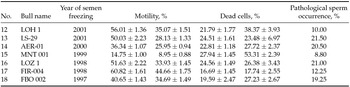
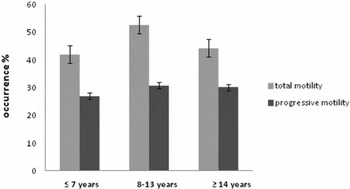
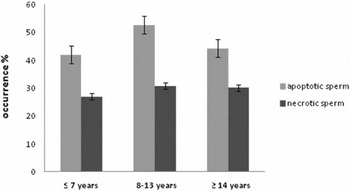
Parameters of sperm motility, occurrence of apoptotic, necrotic or sperm with malformed morphology for individual bulls are shown in Table 1. There is a strong variability among the bull in all presented parameters. When individual parameters were assigned in groups according to length of cryostorage, no significant influence of storage length on the sperm total motility and progressive movement of Pinzgau bulls was noted (Fig. 1). No significant influence of storage time on the occurrence of apoptotic or necrotic sperm was noted (Fig. 2).
Parameters of sperm motility and viability in individual bulls

Influence of storage length on sperm total motility (TM) and progressive movement (PM).

Influence of storage time on the occurrence of apoptotic or necrotic sperm.

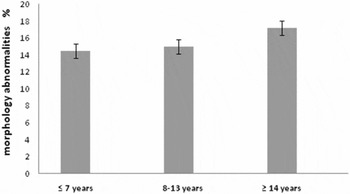
The percentage of morphological abnormalities did not differ among the groups of different cryostorage length, and all the groups exhibited pathological sperm presence in the range of commercial insemination dose standards (malformation rate ≤ 20%, Fig. 3).
Ratio of morphology abnormalities in sperm with different cryostorage length.

No significant difference in fertilizing ability among the experimental groups was found. The rates of penetrated plus fertilized eggs for groups 1, 2 and 3 were 79.3, 76.4 and 78.9%, respectively (Table 2). Significantly higher pronuclei formation rate was observed in the group 1, in which 72.9% of eggs had two visible pronuclei at 20 h following incubation with sperm compared to 67 and 54.5% in groups 2 and 3, respectively (Table 3).
Fertilizing ability of Pinzgau bull sperm after cryostorage

No significant differences (chi-squared test).
Formation of pronuclei 20 h after adding the sperm

Groups 1, 2 and 3 are differed significantly at P < 0.05 (chi-squared test).
Discussion
Long-term storage of cryopreserved sperm in LN2 is of high importance for livestock breeding programs, gene banks establishment and maintenance of genetic diversity (Saint Jalme et al., Reference Saint Jalme, Lecoq, Seigneurin, Blesbois and Plouzeau2003). Pinzgau cattle belong to the endangered breeds, due to radical decreasing of its population in Slovakia (Kadlecik et al., Reference Kadlecik, Kasarda and Hetényi2004). Cryopreservation and long-term storage of gametes is potential option of contribution to the preservation of Pinzgau breed genetic diversity. However, only scarce information about the effect of long-term storage (more than 10–15 years) in liquid nitrogen on bull sperm is available. Therefore, this study investigated the possible difference in post-thaw viability characteristics of Pinzgau bull sperm cryostored for different time periods.
Generally sperm cryopreservation and thawing process can lead to sperm membrane structure damages, motility deterioration (Bailey et al., Reference Bailey, Bilodeau and Cormier2000) and decline in forward progression in the female reproductive tract, that might reduce fertilization ability (Salamon and Maxwell, Reference Salamon and Maxwell2000). Usually, standardized percentage of motile sperm in frozen−thawed livestock semen is about 50% of those in the fresh counterparts (Barbas and Mascarenhas, Reference Barbas and Mascarenhas2009). All the samples of sperm, used in our study fulfilled the recommended criterion of at least 30% motility for the production of insemination doses. No difference in total sperm motility either immediately after thawing or after incubation at 37°C was found between the different periods of cryostorage. This finding is in accordance to the currently accepted cryobiological view, that there is no functional loss during proper storage at −196°C in liquid nitrogen for indefinite periods of time (Clarke et al., Reference Clarke, Liu and Baker2006). However, this argument might be discrepant with the results of Haugan et al. (Reference Haugan, Gröhn, Kommisurd, Ropstad and Reksen2007), that conception rates in dairy cows are negatively affected by prolonged semen cryostorage. It was also already reported that long-term storage is unfavourable for motility of human sperm, when compared with short-term storage (Edelstein et al., Reference Edelstein, Yavetz, Kleiman, Hauser, Amnon, Paz and Yogev2008), as well as for motility, mitochondrial function and plasma membrane integrity of cryopreserved boar sperm (Fraser et al., Reference Fraser, Strzeżek and Kordan2014).
Our results did not show any significant difference between sperm viability characteristics of bull sperm cryostored for different time lengths. The percentage of dead/necrotic sperm was similar between the groups. Similarly, Edelstein et al. (Reference Edelstein, Yavetz, Kleiman, Hauser, Amnon, Paz and Yogev2008) confirmed no difference in incidence of sperm with DNA damage between long- and short-term stored human sperm. In light of these contrary findings, there are still doubts about the effect of long-term storage at ultra-low temperatures on sperm viability and function. Our results demonstrate rather high inter-individual bull variability in motility and dead sperm occurrence. It was already stated that differences in the ability of bull sperm to withstand the stresses of standard cryopreservation protocols and sperm viability are markedly dependent on the effect of individual bulls (Kreysing et al., Reference Kreysing, Nagai and Niemann1997; Loomis and Graham, Reference Loomis and Graham2008).
In terms of morphological changes (malformations), most of the bulls demonstrated sperm morphology in accordance to the commercial insemination dose standards (≤ 20%). For two males the percentage was more than 20%. Deleterious effect of the freeze-thawing procedure on sperm morphology, especially malformation in the head and tail region, was confirmed by several authors in boars, ruminant and human (Hammadeh et al., Reference Hammadeh, Askari, Georg, Rosenbaum and Schmidt1999; Donnelly et al., Reference Donnelly, Steele, McClure and Lewis2001; O'Connell et al., Reference O'Connell, McClure and Lewis2002; Hidalgo et al., Reference Hidalgo, Rodríguez and Dorado2006; García-Herreros et al., Reference García-Herreros, Barón, Aparicio, Santos, García-Marín and Gil2008). Abnormal bull sperm represented one of the more significant effects on bull fertility (Freneau et al., Reference Freneau, Chenoweth, Ellis and Rupp2010). Such spermatozoa caused decrease in embryonic development when used for IVF (Walters et al., Reference Walters, Saacke, Pearson and Gwazdauskas2005). Therefore, morphometry measurements seem to be sensitive biomarkers related to sperm fertilization ability (Sailer et al., Reference Sailer, Jost and Evenson1996). In our study, abnormalities in long- and short-term stored sperm were mostly detected in the tail region and were represented by minor defects, such as knob-twisted tail, coiled and rounded tail, which were generally regarded as a tertiary (post-ejaculation) defects, which usually occur after osmotic changes. Tail defects after cryopreservation have been previously reported in human, and plasma membrane destruction in this region has been suggested as the probable reason for these defects (Ozkavukcu et al., Reference Ozkavukcu, Erdemli, Isik, Oztuna and Karahuseyinoglu2008). No effect of storage time on occurrence of sperm morphology abnormalities was observed in short-term and long-term groups, however high inter-male variability was observed. This might be related to season of semen collection or age of bulls (Söderquist et al., Reference Söderquist, Janson, Larsson and Einarsson1991; Brito et al., Reference Brito, Silva, Rodrigues, Vieira, Deragon and Kastelic2002).
Freezing−thawing enhances the maturation of sperm membranes and elevates the number of capacitated acrosome-reacted spermatozoa. These alterations may not affect motility, but reduce life span, the ability to interact with the female reproductive tract and sperm fertilizing ability (Medeiros et al., Reference Medeiros, Forell, Oliveira and Rodrigues2002). Our results showed no significant difference in fertilizing ability (rate of penetrated and fertilized eggs) among three different periods of cryostorage. Conversely, significant differences were found in the rate of pronuclei formation. Significantly higher pronuclear formation was observed in the sperm doses stored less than 8 years, where 72.9% of eggs had two visible pronuclei at 20 h after sperm addition compared to 67.0 and 54.5% in groups of 8–13 and 14–18 years of cryostorage, respectively (Table 2). Also, syngamy of both pronuclei was observed in about 4% of fertilized eggs in group 1, whilst no syngamy was observed in the other groups. This difference may be probably due to faster pronuclear formation in the group with shorter period of cryostorage. Slower decondensation of sperm heads occurred in groups 2 and 3 may be related to chromatin structure alteration, which was also described in cryostored human (Royere et al., Reference Royere, Hamamah, Nicolle and Lansac1991) and porcine (Hamamah et al., Reference Hamamah, Royère, Nicolle, Paquignon and Lansac1990) spermatozoa. In particular, Royere et al. (Reference Royere, Hamamah, Nicolle and Lansac1991) concluded that the freezing−thawing procedure may alter the DNA/nuclear protein relationships and impair the fertilizing ability of human sperm. Similarly, Hamamah et al. (Reference Hamamah, Royère, Nicolle, Paquignon and Lansac1990), based on their results, hypothesized that sperm chromatin after freezing−thawing may be overcondensed; this overcondensation may be associated with the lower conception rates obtained using human and porcine semen after cryostorage.
In conclusion, our results showed no significant differences in the effect of storage time on the Pinzgau bull spermatozoa characteristics. Conversely, we have recorded the high inter-male variability in the characteristics of bull sperm following cryostorage. Although our study was performed on a limited number of animals, it can be suggested that inter-individual differences are an important factor that should be considered when semen from individual bulls is intended for storage for a long time as a genetic resource.
Acknowledgements
The study was supported from the grant KEGA 011UPJŠ-4/2014, VEGA 1/0611/15, APVV-14–0043. The research leading to these results has received funding from the European Community under project no 26220220180: Building Research Centre ‘AgroBioTech’.