In March 2020, the coronavirus disease (COVID-19) pandemic emerged as a rapidly evolving national and international problem. In Saudi Arabia, the government responded in several different ways. The media provided daily information about COVID-19, especially regarding where the disease had been diagnosed and along which route the disease was spreading. In addition to this, the Ministry of Health (MOH) in Saudi Arabia attempted to determine the characteristics and symptoms of COVID-19 as well as the requirements for early treatment.
COVID-19 is a serious problem, not just for Saudi Arabia but also for countries around the world. The COVID-19 infection transmits easily from human to human when people are physically close to each other; therefore, people in crowded areas are at more risk of being infected due to possible contamination. The World Health Organization (WHO) states it is very important that individuals protect themselves and others from infection by washing their hands or using an alcohol-based rub frequently and not touching their face, as well as wearing a mask when in public and employing safe physical distancing. 1
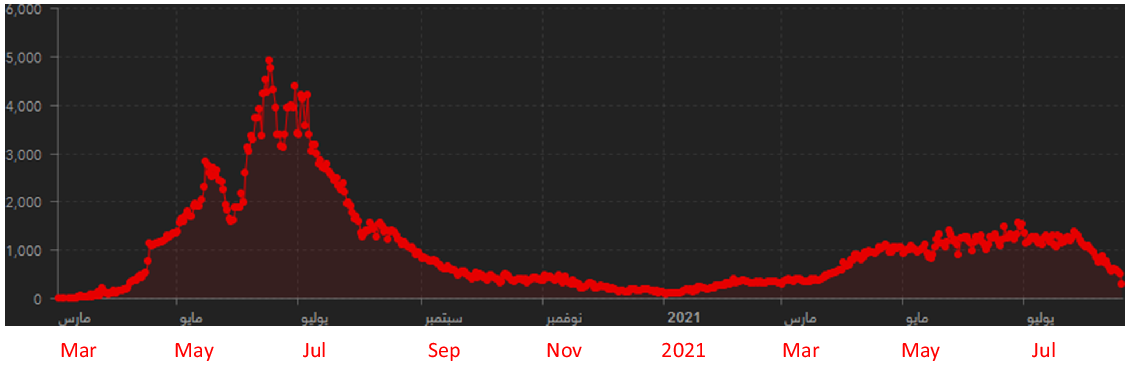
COVID-19 cases first appeared in Saudi Arabia on March 2, 2020, 2 and the COVID-19 pandemic has had an ongoing impact in the Middle East. As illustrated in Figure 1, from March 2, 2020, to July 15, 2021, a total of 504 960 positive COVID-19 cases were detected in the country. Of these, 486 011 people recovered and 8020 died. 3 At the end of 2020, there was a dramatic increase in the number of detected COVID-19 cases, following the pattern seen in China and some European countries.
Time distribution of cumulative incidence of COVID-19 in Saudi Arabia from March 2020 to July 2021.

Objectives
This paper describes major events and findings from the Saudi response to COVID-19 from March 2020 to July 2021. Research and statistics show that COVID-19 has many negative consequences. These negative consequences are a risk not only for elderly people, who are highly vulnerable to the disease, but also for the community more broadly, especially low-income families and the poor, who are disproportionally affected. It is very important to consider that individuals infected with COVID-19 might experience illness and even death, while the closure of schools and businesses to prevent the spread of the disease can result in limited education and increased unemployment. Reference Egede and Walker4 Governments around the world therefore need to pay special attention to COVID-19. Reference Wexler and Oberlander5 In order to prevent the spread of the disease in Saudi Arabia, public officials have taken necessary precautions by determining the proper governance tools to create effective and efficient policies. Reference Bresnahan, Brynjolfsson and Hitt6 A tool is an identifiable method through which collective action is structured to address a public problem. Reference Kettl7 In light of the new governance approach, this paper will identify the 3 tools used to address the COVID-19 problem in Saudi Arabia and discuss why these tools have been selected as well as how these tools can be utilized to get the most effective results. The selected tools are social regulation, interorganizational collaboration, and public information. These tools are suitable options to confront a national issue such as COVID-19.
Methods
Identifying the Three Tools of Governance
A public information tool is very useful for providing awareness about a current problem and for giving accurate information on an issue about which the public needs to be informed. Policy-makers use public information as a policy tool to increase public awareness and to educate people about a policy issue and therefore increase the outcomes of the policy. Reference Weiss and Salamon8 The simple rationale behind this tool is that people are rational and are responsive to relevant information. The information may be about COVID-19, such as providing detailed information about the disease and its initial symptoms for early recognition as well as what happens if a person contracts COVID-19. For example, since COVID-19 can be transmitted through physical contact, it is very important for individuals to keep clean by washing hands and using sanitizer. The public information tool can be utilized to achieve awareness of this in the public.
On March 19, 2020, Saudi Arabia’s government noted that the full cooperation of the people is necessary for the success of the government’s efforts to stem the spread of the novel coronavirus. Moreover, the MOH said that Saudi Arabia continues to take all possible preventive measures to combat the new coronavirus. However, in order to prevent the spread of the disease, public awareness and the dissemination of information about the disease need to be focused. Therefore, to draw the public’s attention to the danger of COVID-19, the public information tool was utilized to address the problem in Saudi Arabia. Saudi Arabia’s MOH asked all citizens and residents to stay at home as much as possible and maintain social distance. The MOH reiterated the importance of wearing face masks and keeping a safe distance as based on a risk-based approach recommended by the WHO. The Saudi Government made it mandatory to wear masks in all public and retail venues, and those who failed to comply were subject to a fine of 10 000 Saudi riyals. 9
The Saudi Government designed an information campaign to inform citizens and residents about how to protect themselves against infection. This information was distributed using social media, TV advertisements, mobile applications, flyers, radio announcements, and public agencies’ websites. Preventive measures in workplaces, communities, houses, mosques, restaurants, and public transportation were also implemented, along with guidelines on how to look after mental and social health.
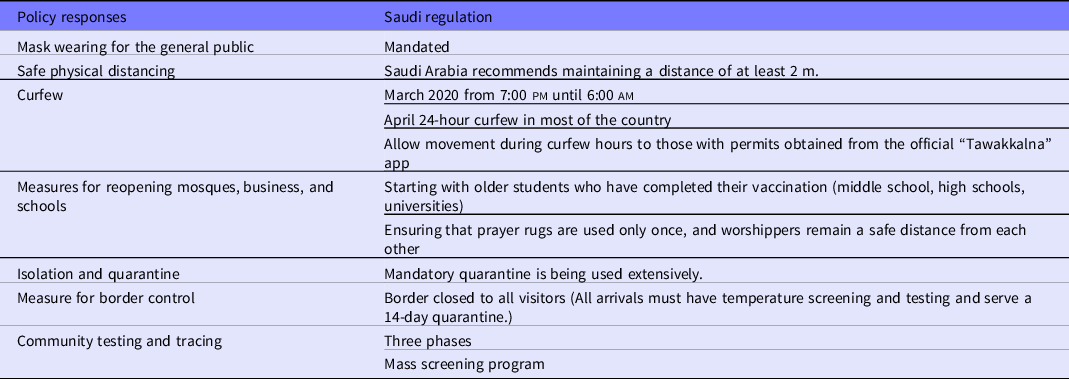
The MOH reiterated the importance of mass screening programs based on a risk-based approach recommended by the WHO. As the Saudi Government applied this strategy, the MOH began testing all citizens and residents with suspected infections, tracing their close contacts and isolating people with a confirmed infection as well as supporting them in isolation. As testing capacity in Saudi Arabia expanded, the MOH started to pilot areas with community-wide testing. Between early April and the end of June 2020, over 1.5 million polymerase chain reaction (PCR) tests were conducted. Individual sectors were performing nearly 1000 tests a day, with approximately 95 000 tests being performed daily in total across the country. According to the MOH, Saudi Arabia was one of the first countries in the world to secure laboratory testing for the diagnosis of the novel coronavirus. 10 In the first phase of expanded testing, the rate of spread of the novel coronavirus inside homes or when authorities visited residences in Saudi Arabia was evaluated. The second phase was conducted on May 4, 2020, and involved citizens and residents who had scheduled COVID-19 tests through the application Mawid. 11 This application was provided by the MOH to enable patients to make, reschedule, or cancel their appointments. The third phase was conducted through several outlets, including centers that were set up in several cities to test people inside their cars and testing in primary health care centers. Citizens and residents were also able to make appointments to collect their own test samples through an online application (Table 1).
Overview of approaches to easing COVID-19 restrictions in Saudi Arabia (March 2020–July 2021)

On March 23, 2020, the Saudi Government ordered a curfew from 7:00 pm until 6:00 am for a period of 21 days to limit the spread of COVID-19 in the Kingdom. On April 6, Saudi Arabia implemented a 24-hour curfew in most of the country, enforced the lockdown and isolation of several suburbs and districts in major cities, and started mass and extensive testing in the community. 12 The Ministry of Interior called on all citizens and residents to use express delivery services through smart device applications and to have food, necessary medicine, and other excluded goods and services delivered to their homes.
In the case of COVID-19, the public information tool can be utilized to achieve awareness in the public. Saudi Arabia decided to use technological solutions to track the spread of COVID-19. The Saudi Government launched the Tawakkalna application to limit the spread of the novel coronavirus. The Saudi Press Agency stated, “The Tawakkalna application is a major participant in the Kingdom’s success in managing the coronavirus crisis and limiting its spread, which makes downloading and activating it an urgent necessity.” 13 The public information tool is easy to apply for and be accepted. It is very important to consider that new technologies, especially the application of Tawakkalna, will make credit programs easier to manage.
Information is a tool for eliciting a desired policy outcome. Using information as a tool is based on the assumption that people respond to information. From the government’s perspective, the government wants to perform its function as a public health provider and needs to obtain information about infected people so it can both provide health services and prevent the spread of the disease. Public information can also be explained by the open system theory, where the government as the policy center in the system takes the required steps to produce better outputs. In this system, the undesired outputs are the infected people. Since the citizens are the important part of this system, the government provides information to the citizens to prevent them from being infected. After this intervention, it is expected that the number of infected people will be reduced.
Social regulations tools are rules issued by government agencies to restrict individual or organizational behaviors that directly threaten public health, social well-being, and public safety. Reference Salamon and Salamon14,Reference Bassett, Giannozzi, Pop and Ringold15 If the number of COVID-19 cases in Saudi Arabia had continued to increase, it would have been a severe threat to public health. The Saudi Government issued a regulation that required all public agencies, private health institutions, and other agencies to report any suspicious COVID-19 cases to the MOH. Since COVID-19 is transmitted human to human via physical contact and aerosol spread, people in crowded places are at a high risk of being infected. Through implementing this regulation, the MOH was able to detect infections in people early and start treatment. This also allowed the government to intervene early and prevent the virus from being transmitted to more people.
On March 4, 2020, the Saudi Arabian Government announced a temporary suspension of the Umrah pilgrimage and visits to the Prophet’s Mosque for Saudis and residents as a precautionary measure to stop the spread of COVID-19. Additionally, as a further precautionary measure, Saudi Arabia closed all cinema theaters until further notice on March 11. Many schools had already been closed, and some public activities, such as conferences and sports activities, were canceled after COVID-19 cases were detected in certain areas. These are important actions because if government intervention had not targeted this problem, the costs associated with the COVID-19 pandemic would have seriously affected the country. This disease has various adverse effects. First, a lack of intervention means the number of deaths caused by COVID-19 would have increased and lead to public distress and outrage. Second, the costs of treatment for infected people would be a huge financial burden for the government. While the costs of canceling many programs and shutting down schools are also a serious problem, the negative effect of this disease is not limited to these costs. The overall economy is negatively impacted by the decrease in international trade and decreased revenue from tourism. Moreover, there is an economic impact for local businesses that have closed or laid off staff due to reduced demand.
The Saudi Government issued a regulation that use of the Tawakkalna app was mandatory to access public places. This application was updated to include vaccination information, including an individual’s status as vaccinated or infected.
The interorganizational collaboration and network tool is used to address complicated problems that the MOH cannot solve by itself. Different aspects of these problems necessitate collaboration between different government agencies, nonprofit organizations, universities, and the private sector. Collaboration allows organizations to save their limited resources and increase their ability to solve complicated problems. Reference Brass, Galaskiewicz, Greve and Tsai16 The concept of the network has been used to describe the connections between the variety of actors and stakeholders involved in the delivery of services and the structures in which multiple organizations engage in partnerships to address complex problems, such as the COVID-19 pandemic, that a single organization cannot cope with alone. This engagement includes sharing information, resources, and expertise. Reference Agranoff and McGuire17
Establishing an interorganizational network can be explained by open system theory. This theory was originally developed by Ludwig Von Bertalanffy (1956) and has since been applied to other disciplines. Reference Von Bertalanffy18 System theory suggests that systems consist of elements or subsystems that are interrelated and interdependent. The failure of any individual element of the system affects the others, since the output of 1 subsystem may be the input of another. If policy-makers see the policy area of preventing COVID-19 as a system, they can consider the MOH and other government agencies as subsystems of the larger system.
On March 14, 2020, Saudi Arabia suspended international flights for 2 weeks as part of the effort to prevent the spread of the novel coronavirus in the Kingdom. Since 1 source of the disease is infected people arriving from other countries, it was essential to identify any cases of COVID-19 before the infected people entered Saudi Arabia. Given the possible effects of the problem, government intervention was needed to stop the spread of COVID-19 in the country. It was therefore very important that screening processes in airports, seaports, and land ports were reconsidered and redesigned to include considerations of the COVID-19 infection. These departments are interdependent, so if, for example, the airport authority failed to detect COVID-19 cases before they entered the country, the MOH would have to spend more resources and effort to detect and treat the people who are infected. Therefore, the organizations that were involved in this policy area needed to cooperatively exhibit behaviors to succeed in preventing the spread of COVID-19 and avoiding more serious consequences.
Establishing an information-sharing network that linked the MOH and airport authorities allowed for more effective detection and screening of any infected people coming from abroad. Additionally, Saudi Arabia implemented strict border control measures. All arrivals entering Saudi Arabia were subject to mandatory COVID-19 testing and 14 days of quarantine at specific hotels that received payments from the Saudi Government. Furthermore, from May 2021, all arrivals who are vaccinated do not have to quarantine, but they have to provide proof of being fully vaccinated before and after arrival by registering their data on the government’s website.
Conclusions
Equity and social justice are the most important ethical concepts that the government needs to consider. It is important to make sure that the majority of people have access to information. When delivering information regarding preventive measures for citizens and residents, the government should make sure that all citizens and residents from different geographical regions and with different social status and ethnic backgrounds receive the information. As this information is shared, the government needs to ensure that the information is highly secured. Reference Lambert, Soskolne and Bergum19 If the Saudi Government provides information via the Internet only, then people who do not have Internet access will not receive the information. Similarly, if the Saudi Government uses a specific program, such as the Tawakkalna application or any program that relates to technology, the Saudi Government should not select programs that broadcast to only limited parts of the country. Otherwise, many citizens and residents will be excluded from the program, which is a serious equity concern. In the case of COVID-19, not all citizens and residents were able to have or use the Tawakkalna application, especially those with a limited income. Consequently, the government needed to use multiple channels to provide information. Providing information in different languages also increases the accessibility of information. It is very important to understand that less well-educated citizens and residents make the greatest gains from information provided by the government, especially when public policy uses channels and messages that are well suited to the needs of these populations or disadvantaged groups.
For interorganizational networks, which department will manage the network may be a concern since some positions within the network give more power to occupying organizations, which may be an equity concern. Using social regulations, the Saudi Government was able to identify many unknown cases and the MOH could detect infected people early and start treatment. This allowed the government to intervene early to prevent the virus from transmitting to more people. From a consequential ethical perspective, this is acceptable because this tool produced the desired policy outputs. However, during the detection process, the possibility that some citizens and residents were mistakenly reported as infected may be an important ethical concern for the deontologist ethical approach, as people may be negatively affected by these mistakes, which may result in unpredictable costs to the people. Another ethical issue is that people may perceive this policy as a violation of their confidentiality, since personal information pertaining to individuals’ health status was recorded and shared.
In interorganizational networks, the government has to spend money to establish an information-sharing system and database. In addition to this, coordinating and managing the network increase the cost. However, since this system allowed the Saudi Government to detect infected people before they entered the country, the benefit of the strategy was preventing more people from being infected. Reference Daly20
In conclusion, tools of governance can offer solutions. Following the outbreak of the COVID-19 pandemic, the Saudi Government implemented additional measures to control COVID-19, including curfews; community testing and tracing; mask-wearing for the general public; safe physical distancing; border control measures; measures for reopening schools, business, and mosques; and requiring proof of receiving the full vaccine dose. Through using tools of governance, the measures implemented have been largely successful in keeping numbers of cases of COVID-19 to a minimal level. By far, the most common tool in use for preventing the spread of disease is public information. However, the way public information is administered can differ widely. In addition to this, the collaborative efforts of both public and private entities in Saudi Arabia show that, through using the tool of interorganizational networking, public organizations can reduce possible risk and cost by working with other stakeholders and combining resources. Reference Goldsmith and Eggers21 The use of governance tools to implement policy is the trend of the future. Reference Marche and McNiven22
This paper has discussed social regulations, interorganizational collaboration, and public information. Public–private partnerships and strategic alliances are also possible options to confront national issues such as the COVID-19 pandemic. For the greatest chance of success, policy-makers need to define clearly and specifically what they are trying to accomplish.
Acknowledgments
The author would like to thank the University of Jeddah for research support.
Author contributions
Abdullah Ghaleb Alshareef designed the study and was involved in analyzing data and writing the manuscript.