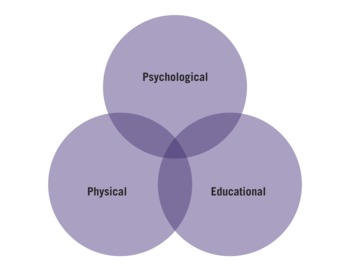
Children, who constitute nearly 25% of the US population, may experience psychological, physical, and educational vulnerability as the result of a disaster.Reference Peek1 Psychological vulnerability, which has received the most attention in the disaster literature, occurs when children experience posttraumatic stress disorder (PTSD), depression, anxiety, emotional distress, sleep disruptions, somatic complaints, or behavioral problems.Reference La Greca, Silverman, Vernberg and Roberts2Reference Norris, Friedman, Watson, Byrne, Diaz and Kaniasty3 Physical vulnerability refers to children's risk for illness, disease, injury, abuse, or death as the result of a disaster.Reference Bartlett4Reference Kanter5 Educational vulnerability encompasses a number of negative postdisaster outcomes, such as missed school, poor academic performance, delayed progress, and failure to complete a program of study.Reference Robinson and Brown6
Several overarching risk factors determine children's levels of psychological, physical, and educational vulnerability, including intensity of exposure to the traumatic event,Reference La Greca, Silverman, Vernberg and Prinstein7 individual characteristics of the child,Reference Silverman and La Greca8 characteristics of the pre- and postdisaster social environment,Reference Rosenfeld, Lahad and Cohen9Reference Lauten and Lietz10 coping skills of the child,Reference Prinstein, La Greca, Vernberg and Silverman11 and intervening stressful life events.Reference Rosenfeld, Caye, Ayalon and Lahad12 Children who are considered to be the most vulnerable often comprise those who functioned poorly before the disaster,Reference La Greca, Silverman and Wasserstein13 experienced direct exposure and personal or communal loss in the event,Reference Vernberg, Silverman, La Greca and Prinstein14 and have the fewest resourcesReference Peek15 and least emotional, financial, and social support after the disaster.Reference Abramson, Stehling-Ariza, Garfield and Redlener16 To recover from disaster, these children may require sustained mental, physical, and educational interventions.17
Psychological, physical, and educational vulnerability are interconnected and overlapping (Figure). Although the aforementioned risk factors cut across all 3 types of vulnerability, children may also experience unique risks associated with each vulnerability type. For example, children who exhibit negative personal coping skills tend to be more psychologically vulnerable,Reference Prinstein, La Greca, Vernberg and Silverman11 and children from low-income households who live in substandard structures are the most at risk for injury or death in a disaster.Reference Hewitt18 Of the 3 vulnerability types, educational vulnerability has received the most limited scholarly attention. Given this knowledge gap, this article focuses on the educational vulnerability and self-reported recovery needs of displaced children in the aftermath of Hurricane Katrina.
Types of vulnerability.

Children may face serious academic problems after natural disasters, technological accidents, and terrorist attacks.Reference La Greca, Silverman, Vernberg and Roberts2Reference Rosenfeld, Caye, Ayalon and Lahad12 Indeed, disasters, which often destroy school buildings and displace students and teachers, have the potential to disrupt children's academic progress and diminish their long-term educational outcomes.
Children who are displaced after a disaster regularly have to attend schools located in unfamiliar and sometimes unwelcoming environments. Being displaced without forewarning and then being forced to transition to multiple different schools can negatively affect children's overall educational attainment. Picou and Marshall refer to this phenomenon as serial relocation.Reference Picou and Marshall19 Although it is often difficult for children to change schools, doing so in the context of a conventional move is much less disruptive and stressful than being unexpectedly and suddenly displaced, as was the case with evacuees from Hurricane Katrina.Reference Sacerdote20
Early estimates suggested that approximately 372 000 school-age children were displaced from Hurricane Katrina.Reference Hunter21 More recent data indicate that closer to 163 000 children between the ages of 0 and 19 years were displaced.Reference Abramson, Redlener, Stehling-Ariza and Fuller22 A majority of affected families relocated to Texas, Georgia, and other parts of Louisiana; however, displaced children ultimately attended schools in every state across the nation except Hawaii.Reference Freeman23
Several studies have shown that displaced students experienced a significant decrease in academic achievement in the first year after the disaster. Some displaced students within Louisiana had problems such as nonenrollment or poor attendance, mental health or behavioral difficulties, and academic setbacks.Reference Pane, McCaffrey, Kalra and Zhou24 These issues were most pronounced among students who changed schools as a result of the hurricane and did not return to their original school for the duration of the 2005–2006 academic year. Louisiana public school students who were forced to switch schools experienced sharp declines in standardized math test scores in the first year, although these students' scores improved by the second and third years following the hurricane.Reference Sacerdote20 In his analysis of the spring 2006 Texas Assessment of Knowledge and Skills data, Casserly found that although 89% of the Texas students passed the reading portion of the test, only 58% of the Katrina evacuees passed.Reference Casserly25 State and local officials in Texas attributed the evacuees' poor performance to a lack of academic readiness and to the trauma of the storm. Displaced children living in Colorado experienced a decline in their grades, ostensibly because of the higher academic expectations in their new schools.Reference Reich and Wadsworth26
Many children who were displaced after Katrina had to adjust to demographically dissimilar schools in their new communities. African American children were especially likely to end up in schools in which they were the numerical minority (as opposed to in New Orleans, where African American youth made up more than 95% of all students in the public schools).Reference Casserly25 African American children reportedly experienced harassment in their new schools, due in part to negative stereotyping of Katrina evacuees.Reference Pina, Villalta, Ortiz, Gottschall, Costa and Weems27
Living conditions also affected children's educational progress after Katrina. Many evacuees moved temporarily into unsafe and overcrowded Federal Emergency Management Agency trailer encampmentsReference Abramson and Garfield28 or into the homes of friends or relatives.Reference Fothergill and Peek29 One study found that after Katrina, children who were displaced to Texas and lived in households with more than 5 people showed lower satisfaction with their health, higher stress levels, and lower academic performance.Reference Barrett, Ausbrooks and Martinez-Cosio30 Other issues such as financial instability, insufficient transportation, and lost educational records caused delayed enrollment and missed school days among evacuee children in Alabama.Reference Picou and Marshall19
Children's education after a disaster may be further jeopardized by a lack of emotional and social support. When parents, teachers, and close friends are similarly affected by disaster, they may not be able to offer the help that children need during such a stressful time. Individuals and groups from outside the community that provide postdisaster aid, such as the Red Cross or volunteers from neighboring communities, leave quickly and thus are typically unavailable to assist in the long term.Reference Ronan, Crellin, Johnston, Finnis, Paton and Becker31
METHODS
This research is rooted in a commitment to eliciting children's voices and creating “opportunities for [children] to contribute to discussions and interventions that affect their lives.”Reference Camfield, Crivello and Woodhead32 Before the 1980s, children were primarily perceived to be empty vessels, waiting to be filled with the norms, values, and practices of society.Reference James, Jenks and Prout33 This assumption resulted in children being objectified, “written about but rarely consulted.”Reference Irwin, Waugh and Bonner34 The sociology of childhood aims to correct this view by conceptualizing children as constructive members of society who both shape and are shaped by their social circumstances.Reference Boocock and Scott35 This perspective recognizes that the voices of children need to be listened to and responded to, but first, children must be encouraged to speak.Reference Lloyd-Smith and Tarr36
Although the sociological study of children has experienced a major paradigm shift over the past 3 decades, much of the research on children and disaster continues to rely on parents’, teachers’, or clinicians' reports of children's well-being.Reference Peek1 There is obviously value in these approaches to studying children in postdisaster contexts; however, there are as many reasons to be skeptical of adults' answers to survey questions about children's behaviors, attitudes, and overall health as there are to be of children's own answers.Reference Handel, Cahill and Elkin37 In particular, how children act in the presence of their parents, teachers, or doctors may be different than how they act when they are not under the supervision of adults. Children also may tell adults what they think they want to hear, rather than what they actually feel or believe. Moreover, adults' reports of children's behaviors are seldom rooted in systematic observation, but more often are based on vague impressions or generalized characterizations.Reference Handel, Cahill and Elkin37 These shortcomings of adult-centric research on children help explain, in part, why adults consistently underreport children's levels of postdisaster distressReference McFarlane38 and underestimate children's needs.Reference Babugura39
This research adopts the basic premise that “the most direct way to learn about children is to learn from children.”Reference Boocock and Scott35 Therefore, this project relies on qualitative, child-centered research methods. Qualitative approaches are highly appropriate for doing research with children,Reference Greig, Taylor and MacKay40 especially when the goal is to understand children's own concerns and desires.Reference Corsaro41 This project draws on open-ended interviews and systematic observations with a sample of children who were displaced to Colorado after Hurricane Katrina.
In the months following Hurricane Katrina, more than 4500 Gulf Coast families (approximately 14 000 individuals) relocated to Colorado.Reference Sterett, Reich and Wadsworth42 At one point, evacuees were in all 64 counties in the state, although most moved to the 2 largest cities—Denver (~ 6500 evacuees) and Colorado Springs (~ 4000 evacuees). The present research focuses on evacuee children in the Denver metropolitan area.
Finding Katrina evacuees in Denver proved to be exceedingly difficult. The federal government never established a central database for identifying and tracking evacuees' whereabouts, and the aid agencies in Denver that had access to evacuee names and addresses refused to share the information due to privacy and confidentiality concerns. Given this context, we solicited participation in the study through several different means, including distributing fliers at a Denver-based aid distribution center; posting a call for participants on an evacuee Web site; attending church services, holiday parties, and other events organized to honor Katrina evacuees; contacting local schools that received Katrina evacuees; following up on news media feature stories of evacuee families; searching for evacuees through online social networking sites; and relying on referrals from evacuees to help us find other evacuees in the area.
After attaining institutional review board approval for this research, we began conducting interviews and recording observations in October 2005. Data collection continued through August 2008. In accordance with institutional review board protocol, within each evacuee family we interviewed at least 1 parent first. After completing a parent interview, we asked permission to interview all of the children in the household who were between the ages of 5 and 18 years. In all but 1 case, the parents agreed to allow us to interview their children. (The 1 child whom we were not allowed to interview had recently been diagnosed as having posttraumatic stress disorder. Her mother was concerned that talking about Hurricane Katrina would upset or otherwise harm her daughter.) After receiving permission from a parent, we asked for verbal assent from the children. Although sometimes shy at first, most of the children seemed pleased to participate in the study, and none of the children whom we approached declined to be interviewed.
The present article draws on the child data from the larger research project. The sample represented here consists of interviews with 40 African American children who ranged in age from 7 to 18 years at the time of their interview. The sample includes 15 boys and 25 girls. All of the children lived in New Orleans before Katrina made landfall. Almost all (n = 39) of the children were enrolled in elementary, middle, or high school in Colorado when we interviewed them. One teenage boy in the sample had recently dropped out of a public high school in Denver; however, since he had attended school in Colorado for nearly 2 years after the storm, we included him.
We began the child interviews by gathering basic demographic information (age, year in school, family composition). The interviews, which followed a semistructured interview guide, proceeded through a series of open-ended questions related to life and schooling pre-Katrina, the disaster and evacuation experience, educational effects of the disaster, and the resettlement and recovery experience in Colorado, with a specific focus on household and educational recovery. The child interviews lasted between 30 minutes and 1.5 hours (the younger the child, typically the shorter the interview). All of the interviews were recorded and transcribed verbatim. In addition, we wrote extensive field notes soon after each interview, which, among other things, described familial interactions, the apartment or house in which the child lived, and the neighborhood surrounding the home.
From the outset of this project, we were aware that our age, status, and dominant racial identities would heighten the inherent power imbalance between us as researchers and our child research respondents. With this in mind, we attempted to reduce the power differentials through interviewing the children in groups, when possible.Reference Eder and Fingerson43 We also used Mayall's “research conversation” approach in the interviews, as we encouraged the children to help control the pace and direction of the interview.Reference Mayall44 Most important, we solicited the research assistance of “Brianna,” a 17-year-old African American Katrina evacuee from New Orleans. (To ensure anonymity, the names and some identifying characteristics of the participants have been changed. Pseudonyms are used throughout the article.) Brianna introduced us to several of her friends and acquaintances, traveled with us to more than half of the interviews, and actively participated in the interviews by asking questions and prompting her peers to speak. We often observed that children were more relaxed and even more open when Brianna was present during the interviews. Involving children in “research partnerships” has become more common in sociological studies of children and childhood because adult researchers have increasingly acknowledged that children can help them to explore aspects of the social world that may otherwise be inaccessible.Reference Greig, Taylor and MacKay40
RESULTS AND COMMENT
The children in this study, like many of the youngest survivors of Hurricane Katrina, faced extraordinary challenges in the aftermath of the storm. The majority of the children “lost everything” or “left everything behind” in Katrina. Some arrived in Colorado with only a few changes of clothes and, if they were fortunate, a favorite toy or other treasured possession. Although 35 of the children evacuated with all of their immediate family members, 5 were separated from 1 or both of their parents for several weeks after the storm. Every child in the study reported that he or she had “lost contact” with some extended family members, friends, and former classmates as a result of the disaster.
A small number (n = 3) of the children in the sample had visited or lived in Colorado before Hurricane Katrina. The remaining children (n = 37) had never been to Colorado (in fact, 26 of the 37 children indicated that they had never traveled outside Louisiana). Colorado is not only geographically distant from Louisiana; it is also culturally, climatically, and demographically dissimilar, which amplified the shock of the displacement for the children.
Only 6 of the children evacuated with their families directly from Louisiana to Colorado. The remaining children lived and attended schools in other states, including Texas, Alabama, Georgia, Louisiana, Mississippi, and Arkansas, after Katrina. Specifically, 14 children attended 1 other school after Katrina and before their arrival in Colorado, 9 children attended 2 other schools, 7 children attended 3 other schools, and 4 children attended 4 other schools.
When considering the levels of loss and disruption that these children experienced, it is not surprising that more than 75% (n = 32) reported a marked decline in their grades in the first year following Hurricane Katrina. The following comments were typical:
My grades dropped. Just because of the pressure, the stress. The pressure, because I am like, “Alright I’m in 11th grade. Twelfth grade is right around the corner. I have to get on my stuff real quick.” Then the stress because I couldn't get in touch with any of my friends at first. And I couldn't get in touch with my 2 sisters, my brother, and my 3 nephews. I couldn't get in touch with some of my daddy's side of the family. And there was a lot of people I couldn't get in touch with. So it was the stress of that. It was just crazy.
Before I came to Colorado, I was on the honor roll. That's how I got into the magnet schools [in New Orleans]. So my grades were good when I was down there. But when I got up here [to Colorado], they weren't good. I don't know, I guess I didn't care when I first got up here . . . Cause I was like, I’ve done been to too many schools. I’m tired of caring. I had already been to 2 schools [after Katrina] . . . Once I got here, I passed, but not with the grades I know I could have got. So I just barely made it.
Given this difficult context, our study sought to explore 2 primary research questions: What types of educational support did children say that they needed after Katrina? Who or what facilitated children's educational recovery? The data presented below offer children's perspectives on the value of teachers, the importance of peer support, and the merits of strong schools and extracurricular activities.
Teachers
The participants in this study identified 4 critical actions that teachers in Colorado took after Katrina that helped them begin the process of recovery. First, the teachers who offered a special introduction to the new evacuee students in their classrooms made these children feel more welcome and “at home.” Because Hurricane Katrina made landfall after the start of the 2005–2006 academic year, all of the students in the sample, particularly those who were displaced multiple times, were latecomers to their new classrooms in Colorado. As such, the evacuee children said they initially felt like “outsiders” or “loners” when they entered their already-established classrooms. When the teachers introduced the children in front of the class and gently explained why they had come to Colorado, it helped ease the transition. One 12-year-old girl expressed it this way:
[The introduction] just made you feel more comfortable in the classroom. It made you feel like you’ve been there.
Second, some of the teachers assigned another student to act as a “guide” or a “helper” for the evacuee children. These guides showed the evacuees around their new schools and introduced them to their peers. One student, Taneisha, was enrolled in a middle school with a formal program in which eighth graders were paired up with sixth graders. Even though Taneisha was already in eighth grade, because she was new to the school, her teacher assigned her a guide (or, “eagle,” as they were called in this school):
This girl, Becca, she was, like, my eagle. She wasn't my eagle, exactly, because I was in eighth grade. But they had eagles, the eighth graders were eagles, some of ‘em, to, like, help the sixth graders get around. And my teacher had this girl, Becca, be my eagle, even though she was in eighth grade and I was in eighth grade. Becca showed me around and introduced me to everyone in the school.
Third, teachers who dedicated extra time and offered additional support to the evacuees improved the students' academic motivation and overall desire to achieve. All 40 of the children identified at least 1 teacher, coach, or counselor in Colorado who had “made a difference” in their post-Katrina schooling experience. The participants reported that these adults offered them “extra help” in the subjects with which they were struggling, “extra notes” to help make up for the lessons they missed, and the opportunity to “come in after class” or to “stay after school” to receive additional tutoring or help with homework.
The children were particularly pleased when the teachers showed some awareness of—and respect for—New Orleans culture. It made the students feel “special” when their teachers would ask about Mardi Gras or other traditions associated with New Orleans, including the music and food. A high school student expressed this sentiment: “Mr Downy, he was sweet. He wanted to ask about food every time I would see him. ‘You bring me some food? Where's the jambalaya at?’” Some of the teachers and counselors offered the students a chance to talk about their experiences since the displacement, which aided the children's adjustment:
When I first came up here, there was this school counselor that we had. On a daily basis, she’d take me into her office and we’d talk about [Katrina] until I just became comfortable about the whole situation. And she would have a rating chart from 1 to 10 where you think you are now; 10 being the best, 1 being the worst. We’d just do that every day, and we’d talk about the cool things, the good things that happened, like getting to see mountains and having new friends. And then we’d talk more about what we miss and stuff like that, and it just really helped.
Almost all of the children described their teachers in Colorado as “more strict” and “harder” than their teachers back home. They acknowledged, however, how crucial high teacher expectations were in helping them to achieve. The following comment was representative:
I liked my teachers. I liked the fact that they were more stern about their teaching. More seriously involved. It made me want to be more seriously involved because I knew that my teachers weren't playing. They're not gonna sugarcoat if for you. They're not gonna, “Oh, I’ll give you 2 weeks to get it done but you should have had it done last week.” It's kinda like either you get it done or you get an F. I appreciated that because it gave me more of a motivation and drive to get what I had to get done, done.
Another child credited his teachers with helping him to get his “knowledge back” after Katrina:
They taught me some stuff that I forgot after the hurricane, and I got my knowledge back. Yeah, the stuff that I lost, I’m getting my knowledge back. People are helping me. The teachers come get me from my classroom and test me out of books and everything.
Mekana, who was 16 years old when she arrived in Colorado, had an especially difficult time adapting to her new life. She desperately missed her father, her boyfriend, her cousins, and her best friends, all of whom were still in Louisiana. As she became more depressed, she started skipping more classes. She attributed the fact that she finished her junior school year to 1 particular teacher:
Around the end of the school year, I wasn't going to class. I didn't want to do nothing. When I would go to school, I would see Mr Piper in the hallway, and he would be like, “Don't talk to me! You weren't in my class today.” But I knew he was always joking. So he brought me into his office and he got me to sign this little contract that I have to come to class every day until the end of the school year to pass his class. So he really helped me.
Fourth, most of the teachers encouraged the evacuees to draw (for the younger students) or to write (for the older students) about their evacuation and resettlement experiences. At the outset, the children tended to resist the idea of sharing with their teachers or the class because they “didn't want to talk about Katrina anymore.” More than half of the children ultimately did draw or write about Katrina, and those children uniformly reported that it “helped.” The process afforded the children an important and much needed outlet for expressing their emotions. Moreover, when teachers would discuss the essays with the student or in front of the class, it would make the child feel validated and recognized:
There were a few classes that required essays and some of them could be about anything you wanted, or something devastating that happened to you, so I would write concerning Katrina. The teachers liked to talk about those essays in class or whatever. One of my teachers, she spent the entire class talking about what I wrote [about Katrina]. I was glad to let people up here know about the situation in New Orleans.
Peers
In addition to their new teachers, the participants identified their peers as playing a critical role in the postdisaster educational recovery process. The students indicated that the children they met in Colorado classrooms assisted them, both directly and indirectly, with their academic pursuits. One of the primary ways that Colorado children offered direct academic support to the evacuees was through providing tutoring assistance in and out of the classroom. Adrian, like many of the evacuee children, explained how friends in Colorado helped her to “catch up” after Katrina:
They're smart, too. I get a lot of help from them when I don't understand stuff. Like, in the beginning of the school year, you know we started school late because of the hurricane and I had to catch up on a lot of stuff. I had a friend that was from here [Colorado] who used to help me. It was a lot of friends who actually helped me to catch up.
The New Orleans children also received positive reinforcement and encouragement from their peers. Lucas, who was only 8 years old when Katrina happened, struggled emotionally and academically after the storm. Within 2 years, however, he made the honor roll at his school (his mother proudly displayed the certificates on the living room wall in their apartment). Lucas credited his overall improvement to his closest friend in Denver:
My best friend, he was like, “You need to get better so you can graduate when I graduate,” and all this. He gets A's and B’s. If I would get a D, he would try real hard to help me pick it back up.
The New Orleans children spoke frequently about how much time their Denver classmates spent “studying” and “doing homework,” rather than “hanging out” or “messing around” after school. Observing their peers working hard at school made the evacuee children want to try harder as well:
Yeah. Watching them and seeing how hard they work, that makes me want to work even harder.
Several of the participants also stated that the children in Colorado just seemed to “care more” about school.
Colorado peers influenced the actual amount of time that evacuee children spent studying and doing homework, although the change was gradual and was dependent upon the more general adjustment of the evacuees. Specifically, in the first year following Katrina, more than 75% of the children in our sample reported that they were studying “much less” than they had before the storm. Several factors help explain this trend, including the length of time that students were not enrolled in school after Katrina (within our sample, students reported that they missed between 2 weeks and 6 months of classes during the 2005–2006 academic year), the number of moves that the children made before arriving in Colorado, and a general inability to concentrate on school because of the trauma of the storm and/or disruption within the household. A child put it this way:
After Katrina, I didn't know where some of my family was, where my friends were, there was no way I could be thinkin’ about my homework.
Two years after Katrina, half of the children said they had started spending “more time” studying than they had before the storm. When asked what “more time” equated to, the children's answers ranged from 1 to 10 additional hours spent studying each week. A few of the children attributed their increased study time to the fact that they still “didn't know that many people” in Colorado, so there was “not much else to do.” More frequently, the children said that it was their friends who made the difference in their study habits. The following quote illustrates the role that peers can play in academic achievement and postdisaster educational recovery:
After Katrina and moving to Denver, I was able to have friends that I would go to the library and do my homework with and different things like that. Or when you have classes with your best friend, then you would go to their house and do homework with them. So that's how it was. And it was fun for me ‘cause at 1 point when I started to understand more stuff, I was able to help them as opposed to them helping me. We would help each other. I kinda felt good ’cause I was learning and I was now excelling above what they were. I think that my friends played a big role because it's easier to listen to your friends sometimes than to listen to your teachers and your parents.
Merits of Strong Institutions
The majority (36 of 40) of the students in this study were enrolled in the New Orleans public school system before Hurricane Katrina (the remaining 4 students attended private schools). Before the disaster, the public schools in the city were widely viewed as some of the worst in the nation. Indeed, as Casserly argued, the children of New Orleans were “isolated racially, economically, academically, and politically in public schools that were financed inadequately, maintained poorly, and governed ineptly.”Reference Casserly25
Even though they were aware that the schools in New Orleans were viewed as underperforming, or just “bad,” the children in this study were quick to defend their old schools. They talked often and animatedly about all of the things they missed—their teachers, classmates, food, dances, and other traditions unique to the schools and city of New Orleans. Yet, upon their arrival in Colorado, the children could see the differences between their new and old schools, and they mostly believed that the schools were indeed “better” in Colorado:
The schools in New Orleans, they're good, but it's just not structured. I enjoyed my school before the hurricane. But when I got to see something better . . . it kinda made me realize, “Oh, this is probably what I want.” It made me realize if we had some of the materials they was using, some of the money to invest in our schools like they do out here, then we would probably be on top of them. You can only work with what you have.
What did “better” mean to the children? As implied by the quote above, children were highly aware of the quality of materials and resources available in their Colorado schools:
The schools here are better. We had books. We weren't working on worksheets as much. They had more computers. The school board was supporting [the schools] more.
The children also described their Colorado schools as “clean” and “safe.”
You know, it was just a better environment. Wasn't as many fights and stuff like that. It was just better.
Smaller class sizes also made a difference in the children's educational experience. Michael reported that most of his classes in New Orleans had about “twice as many” students as in Denver:
It's easier to get attention from the teacher and to get help when I needed it. There aren’t, like, 16 people raisin’ their hands up at once.
Thirty-four of the children indicated that they were involved in at least 1 extracurricular activity offered through their school, and most of these young people were involved in more than 1 activity. The children we interviewed played sports, including basketball, football, volleyball, track and field, and cheerleading; participated in math club and science club; and joined the Black Student Alliance and other cultural clubs.
A little more than two thirds of the students indicated that they had become “more involved” in extracurricular activities since moving to Colorado, whereas about one third said their involvement levels had not changed from before the hurricane. Teachers, coaches, and peers were the ones who most often encouraged the New Orleans children to “get involved” in their new schools. Sometimes it was the students who made the decision to join, often with the support of their parent or parents.
Regardless of the motivation for getting involved, students reported many benefits of their participation. In particular, being active allowed the students to make new friends and to “connect” with their peers. It also helped some to stop thinking about Katrina and the displacement. For example, Alissa, who was diagnosed with PTSD after the storm, said that because she “did so much” it helped her to “manage the PTSD pretty well.” Other students cited their extracurricular involvement as motivating them to keep their grades up:
Yeah, I knew to be eligible to play basketball, I had to keep my grades up. I had to pass every class. I wanted to play, this was important to me, so I was working hard at my studies, spending a lot of time on my homework.
The opportunities that children encountered in Colorado schools translated into higher educational aspirations for several of the children. Although the majority of the students struggled with their grades in the first year after the storm, as the children began to adjust to life in Colorado, many began to strive to go to college. For instance, Jahmil, who was 10 years old when he and his family relocated after Katrina, understood that his life experiences may have hindered him from going to college. However, after 2 years of living in Colorado, he expressed how his perceptions had changed:
When I was in Louisiana I didn't think, like I didn't know about . . . You know how people say it's proven that most African Americans don't finish college, and even if they do, it's mostly the women? So, I didn't know about that when I was in Louisiana, because they didn't mention it that much. But when I got to Colorado I was like, I’m gonna be . . . I’m going to finish college, no matter how long it takes me.
CONCLUSIONS
Our findings support and extend prior research on displaced children's educational recovery experiences in the aftermath of Katrina. The children we interviewed in Colorado experienced a decline in their grades in the first year following the disaster. The preexisting vulnerability of the population, the shock of the storm, the extent of losses incurred, and the ongoing disruptions caused by the displacement help explain why children struggled academically after Katrina.
In the second and third years after Katrina, the children in our sample reported greater satisfaction with their schools and overall educational experience. In this study, we sought to understand what or who facilitated children's educational recovery. Our findings suggest that teachers played a central role in helping children by offering sensitive introductions of newly arrived evacuee students, asking other children to assist the evacuees, providing additional academic and personal support, and encouraging children to draw and write about Katrina. Other children, especially the classmates and new friends of the evacuees, also provided direct support and indirect positive role modeling behavior. This finding illustrates the potential and power of children helping children in postdisaster contexts. Children also identified particular aspects of the schools they attended after Katrina—including the strength of the academic curriculum, the high quality of the facilities, the amount of materials and resources available, and the extracurricular activities offered—that fostered their educational recovery.
Policy Implications
In 2007, federal legislation established the National Commission on Children and Disasters. The commission was created to “conduct a comprehensive study that examines and assesses the needs of children as they relate to preparation for, response to, and recovery from all hazards, including major disasters and emergencies” and to “submit a report to the President and Congress on the Commission's specific findings, conclusions, and recommendations.”17
On October 14, 2009, the commission released its Interim Report on Children and Disasters. The report, which drew on more than 700 source documents, offered recommendations to incorporate children's unique mental health, physical health, educational, child care, and juvenile justice needs into all phases of the disaster life cycle. The commission concluded that “in order to achieve a more knowledgeable and integrated consideration of children in disaster planning and management across our nation, a significant shift in philosophy, culture, and attitude must occur, one which elevates the needs of children to an immediate priority.”17
The commission report represents the most wide-ranging and influential policy document available on children and disasters; however, children's voices are notably absent from the discussion. In fact, the almost 100-page report contains only 1 quote from a child—a 15-year-old boy who was trapped in Orleans Parish prison during Hurricane Katrina offers insight into the unspeakable conditions that the youngest survivors endured.
Although adults will be the ones who decide whether and how to implement the commission's various recommendations, it will be children who are most directly affected by the policies and practices that emerge. As such, efforts to include children's perspectives should be considered as a central means to not only elevate but also to fully understand the needs of children in all aspects of disaster management.
Authors' Disclosures: The author reports no conflicts of interest.