





Introduction
Central line-associated bloodstream infection (CLABSI) is the most common healthcare-associated infection (HAI) in neonatal intensive care units (NICUs). Reference Al Bizri, Hanna Wakim and Obeid1 CLABSI increases morbidity and mortality, especially in very preterm (<32 weeks gestation) and very low-birth-weight (VLBW; <1,500 g) neonates. Reference Zipursky, Yoon and Emberley2 The incidence rate of CLABSI varies across countries, ranging from 2.01 to 13.41 per 1,000 central line days, with higher rates observed in lower-middle-income countries. Reference Nielsen, Zachariassen and Holm3,Reference Geldenhuys, Dramowski, Jenkins and Bekker4 In 2018, the CLABSI incidence in the NICU at Cipto Mangunkusumo Hospital was 3.7 per 1,000 central line days. Reference Sugiarto5
Central lines are essential for neonatal care, particularly in very preterm or VLBW neonates. They allow the administration of large volumes of irritating solutions, such as parenteral nutrition, intravenous fluids, and hypertonic or locally toxic medications. Reference Westergaard, Classen and Walther-Larsen6,Reference Li, Cao, Shi, Xiong and Li7 However, central lines pose a high risk of bloodstream infections. Reference Nielsen, Zachariassen and Holm3
Closed-system needleless connectors have become increasingly preferred due to their potential to reduce CLABSI rates. Reference O’Grady, Alexander and Burns8 Various designs of closed-system needleless connectors have been introduced. A previous study in adult patients suggested that split septum designs are more effective than mechanical valve designs at preventing CLABSI. Reference Jarvis, Murphy and Hall9 Split septum connectors have a simpler internal structure, which facilitates complete flushing and reduced fluid turbulence, thereby lowering the risk of microbial colonization. In contrast, mechanical valves, with their complex internal structures, can create areas of flow disruption and turbulence, thereby promoting bacterial adherence and biofilm formation. Reference Ryder, deLancey-Pulcini, Parker and James10–Reference Field, McFarlane and Cheng12 This study aims to assess whether the design of needleless connectors (split septum vs mechanical valve) influences the incidence of CLABSI in neonates.
Methods
Study design
This study was an open-label, parallel, randomized controlled trial assessing the efficacy of different needleless connector designs in preventing CLABSI in very preterm or VLBW neonates. Participants were randomly assigned in a 1:1 ratio to either the split septum group (intervention) or the mechanical valve group (control). The trial was prospectively registered at ClinicalTrials.gov (NCT06414174) before participant enrollment and conducted in the level III NICU of a tertiary hospital (Cipto Mangunkusumo Hospital) in Jakarta, Indonesia, from August 2024 to January 2025. The study received ethical approval from the Ethics Committee of the Faculty of Medicine, Universitas Indonesia—Cipto Mangunkusumo Hospital (approval No. KET-285/UN2.F1/ETIK/PPM.00.02/2024) and was conducted in accordance with the Declaration of Helsinki.
Participants
Very preterm infants (<32 weeks gestation) or VLBW infants (<1500 g) who required central access with either a peripherally inserted central catheter (PICC) or an umbilical vein catheter were eligible for inclusion. Informed consent was obtained from the parents or legal guardians before randomization. Neonates were excluded if parents or guardians declined participation, a proven focal infection or CLABSI occurred before randomization, or if they had life-threatening congenital abnormalities. All participating infants were cared for in the single NICU dedicated to very preterm or VLBW. Central line handling was performed in accordance with hospital standard protocols for insertion and maintenance. Bed placement and nurse assignment were determined according to routine clinical workflow and staffing, with a 1:2 nurse-to-patient ratio, independent of study allocation. Infants in the intervention and control groups were not cohorted or separated, and all received care from the same pool of nurses and physicians throughout the study period.
Interventions
The intervention group received a split septum needleless connector with split septum access and an open-flow path–negative fluid displacement design (Surplug ADTM, Terumo Corporation, Japan), while the control group used a mechanical valve needleless connector, which was the standard of care at Cipto Mangunkusumo Hospital during the study period. Central line insertions in both groups were performed in accordance with hospital protocols and CDC 2011 guidelines, and all procedures were performed in the NICU. To standardize practice and minimize bias, all NICU nurses underwent refresher training on both connector types before the trial, covering handling, disinfection, and CLABSI prevention measures. Training was applied equally, and bed assignment, nurse allocation, sterilization techniques, and equipment use followed routine practice. Although these steps reduced the risk of bias, the open-label design means it cannot be entirely excluded.
Outcomes
The primary outcomes were CLABSI incidence rate and the hazard ratio of CLABSI between the two groups. Incidence rate was measured as the number of CLABSI events divided by the total number of central line days in each group, reported as CLABSI per 1,000 catheter days. The hazard ratio of CLABSI was estimated from the time of central line insertion to CLABSI, central line removal, or death. CLABSI was defined as a laboratory-confirmed bloodstream infection occurring within 48 hours of central line access, not secondary to another site of infection, with positive cultures from both central and peripheral blood samples.
One milliliter of blood per culture was collected simultaneously from both central and peripheral sites at two time points: first, on the day of delivery for all patients, and second, when patients exhibited at least one clinical sign suggestive of CLABSI, including fever (>38.5°C), hypothermia (<36.0°C), apnea, or bradycardia. The blood sample was collected in BACT/ALERT® PF Plus (bioMérieux, Inc., Durham, NC 27712, USA) and incubated in a BACTEC™ machine. This blood culture method is superior to conventional methods for detecting pathogens, even at low bacterial loads, providing blood culture results 12–16 hours earlier. Reference Ansari, Saher and Afzal13 Sysmex SN 3000 was used in our laboratory for complete blood count analysis. The attending neonatologist determined the final diagnosis of CLABSI, and only the first CLABSI case was counted for each participant. A quantitative C-reactive protein (CRP) level was obtained within 24 hours of birth to exclude preexisting infection before central line placement.
Secondary outcomes included all-cause mortality, CLABSI-related mortality, length of stay (in surviving patients), number of central line days, and total hospitalization cost. In both the intervention and control groups, central line access was maintained for up to 14 days. Participants were followed up to 48 hours after central line removal to evaluate primary outcome and until hospital discharge or death to evaluate the secondary outcomes.
Randomization, group allocation, and blinding
Participants were randomized using block randomization (block size of 4), with the allocation sequence prepared by the research team to assign participants to intervention and control groups in a 1:1 ratio. Assignments were kept in serially numbered, opaque, sealed envelopes. The researcher conducted the eligibility assessment, while the decision to place a central catheter was made independently by the attending neonatologist based on clinical judgment. Once consent was obtained, group allocation was revealed by NICU nurses not involved in the study. Devices were used according to group allocation. Due to the nature of the intervention, blinding of researchers, neonatologists, and parents/guardians was not possible; however, only objective outcomes were evaluated.
Statistical analysis
Statistical analysis was performed using IBM SPSS Statistics version 24. An intention-to-treat approach was used for all outcomes. Categorical data were presented as percentages, while numerical data were expressed as mean ± SD or median (IQR), depending on the distribution. Comparisons between two groups were made using Fisher’s exact or χ2 tests for categorical variables, and independent t tests or Mann–Whitney tests for continuous variables. The proportional hazards assumption was evaluated using Kaplan–Meier survival plots and Schoenfeld residuals. When the assumption was met, the HR and 95% confidence interval (CI) for the primary outcome were estimated using Cox proportional hazards regression analysis.
Results
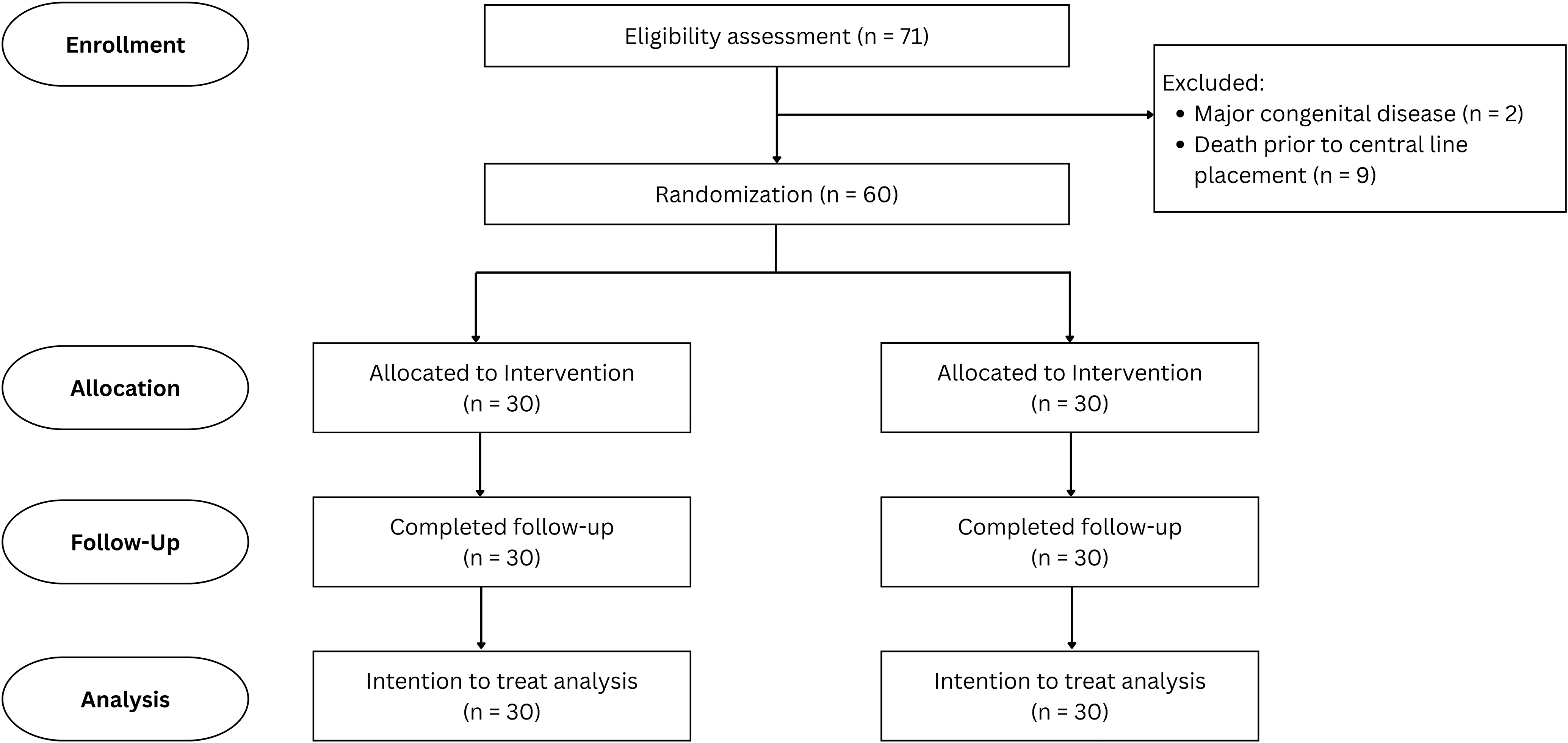
A total of 71 very premature or VLBW infants were born during the sample recruitment period (September–December 2024), with 60 infants fulfilling the inclusion criteria and proceeding to randomization. All the participants received the intended treatment and were analyzed for the primary and secondary outcomes (Figure 1).
CONSORT diagram of the study.

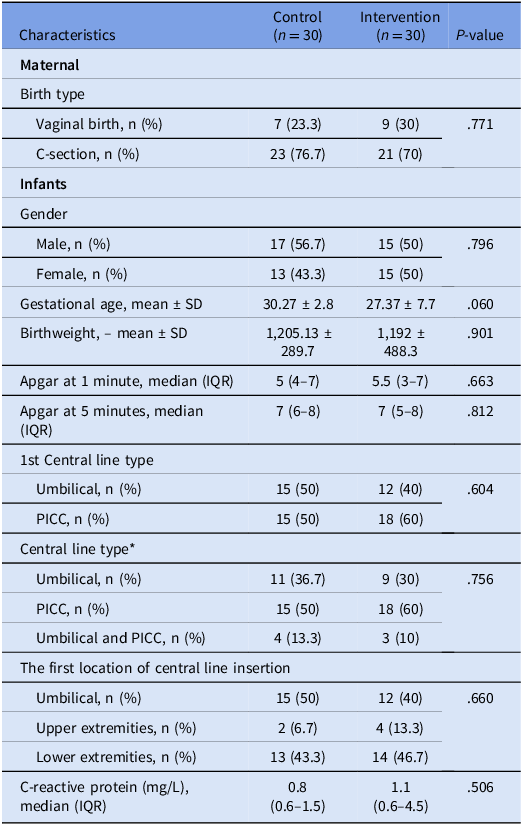
The intervention group (mean ± SD gestational age, 27.37 ± 7.7 weeks; 15 [50%] male) and the control group (mean ± SD gestational age, 30.27 ± 2.8 weeks; 17 [56.7%] male) each included 30 infants. Seven infants (four in control group and three in intervention group) required central line changes from umbilical to PICC due to the development of gastrointestinal symptoms (gastrointestinal bleeding or abdominal distension). None of the baseline maternal and infant characteristics differed significantly between the two groups (Table 1).
Baseline characteristics of study subjects

* Central line type used during central line placement (up to 14 days).
One infant (3.3%) in the intervention group and six infants (20%) in the control group developed CLABSI. The total number of central line days was 371 in the control group (IR 16.2 per 1,000 catheter days) and 332 in the intervention group (IR 3.0 per 1,000 catheter days). During the observation period, the Kaplan–Meier curve for time to CLABSI showed no significant difference between the two groups (log-rank test, P = .079; Figure 2). In the Cox proportional hazards analysis, the adjusted hazard ratio for the split septum connector compared with the mechanical valve was not statistically significant (aHR 0.153, 95% CI 0.02–1.52; P = .109) (Table 2).
Kaplan–Meier curve showing CLABSI-free survival in the split septum and mechanical valve groups. CLABSI, central line-associated bloodstream infection.

Primary outcome

† aHR= Hazard ratio adjusted for GA, birthweight, and central line type.
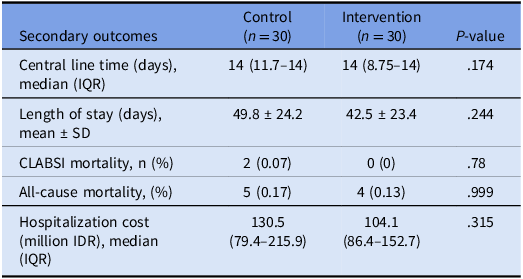
Although there was no significant difference in secondary outcomes between the study groups, the control group had a longer length of stay (49.8 ± 24.2 vs 42.34 ± 23.8) and higher hospital costs (130.5 [IQR 79.4–215.9] vs 104.1 [IQR 86.4–152.7]). There were 2 CLABSI-related deaths in the control group (7%), whereas none occurred in the intervention group (Table 3).
Central line time, length of stay, in-hospital mortality, and hospitalization cost

Analysis of organisms from the study subjects showed that CLABSI incidence in our hospital was caused mainly by multiple-drug-resistant microorganisms (MDRO) (86%), which consisted of extended-spectrum β-lactamase (ESBL) Klebsiella pneumoniae (43%), carbapenem-resistant Klebsiella pneumoniae (14%), and methicillin-resistant Staphylococcus epidermidis (MRSE) (29%). ESBL-producing Klebsiella pneumoniae was the most common organism associated with CLABSI incidence.
Discussion
The overall CLABSI rate in our study was 9.96 per 1,000 catheter days, which lies at the higher end of rates reported in other NICU settings, ranging from 2.91 to 16.14 per 1,000 catheter days. Reference Ayala, Almendral and García14,Reference Jansen, Broer and Hemels15 A previous study conducted at our institution, in 2018, reported a CLABSI rate of 3.7 per 1,000 central line–days. The higher incidence observed in the present study might be due to differences in study populations. Whereas the earlier investigation included infants of all gestational ages, our cohort was limited to preterm infants, who are particularly susceptible to CLABSI. Currently, the CLABSI target in the NICU setting has not been established. Prior studies from high-income countries have reported CLABSI rates varied between 1.56 and 5.59 per 1,000 catheter days in VLBW neonates. Reference Ayala, Almendral and García14,Reference Muller, Bryant and Espinosa16–Reference Ting, Goh and Osiovich18 In contrast, data from low- and middle-income countries indicate higher incidence rates, with one study reporting 11.9 per 1,000 catheter days. Reference Kartikeswar, Parikh and Randive19 Variations in CLABSI incidence might be accounted for by differences in NICU level, varying levels of compliance with infection control protocols, central line time, insertion site, and subject characteristics across studies. Reference Folgori, Bielicki and Sharland20
This study demonstrated a higher incidence rate of CLABSI among neonates using a mechanical valve needleless connector (16.2 per 1,000 catheter days) compared to the split septum design (3.0 per 1,000 catheter days; incidence rate difference 13.2, 95% CI −1.1 to 27.4). The Kaplan–Meier curve demonstrated no significant difference of infection-free survival between groups (log-rank P = .079). However, the adjusted Cox proportional hazards model did not reach statistical significance (aHR = 0.153, 95% CI 0.02–1.52; P = .109). These findings demonstrated a trend toward a clinical advantage of split septum connectors in reducing CLABSI rates among this high-risk neonatal population.
Although baseline maternal and infant characteristics were statistically comparable between groups, the intervention group had a mean gestational age 3 weeks lower than the control group (27.37 ± 7.7 weeks vs 30.27 ± 2.8 weeks; P = .060). As gestational age is a well-recognized risk factor for CLABSI, this difference may have introduced confounding despite randomization. We performed sensitivity analyses with adjustment for gestational age, birth weight, and central line type. After adjustment, the observed association between split septum connector use and lower CLABSI risk remained consistent (Table 2).
The proportion of infants with PICC in our study was higher in the intervention group (60%) than in the control group (50%), although the difference was not statistically significant. Previous studies have reported inconsistent findings regarding the association between central line type and CLABSI incidence; some have demonstrated higher rates in infants with umbilical catheters compared with PICCs, Reference Catho, Rosa Mangeret and Sauvan21 whereas others have reported higher rates in PICCs. Reference Sandinirwan, Leo, Muslim and Karina22,Reference Rabie, Mostafa, Abdel Halim and Ezzat23 Seven infants in our study required changes to central lines and were therefore subjected to twice the catheter insertion procedure. A previous study reported no significant difference in CLABSI between single-line insertion and sequential insertion (UVC on days 1–4, then changed to PICC). Reference Shalabi, Adel, Yoon, Aziz, Lee and Shah24
The current, recently updated CDC CLABSI prevention guidelines continue to emphasize strict adherence to central line insertion and maintenance bundles, including hand hygiene, hub disinfection, minimizing line access, and careful selection of needleless connector devices. Reference Rosenthal, Memish, Shweta, Bearman and Lutwick25 This reduction in CLABSI incidence is consistent with the prior evidence from adult populations, in which the use of mechanical valve needleless connectors was associated with a higher risk of CLABSI (RR 1.54, 95% CI 1.3–1.74, P < .001). Reference Zipursky, Yoon and Emberley2 A retrospective study performed in pediatric oncology patients also showed a lower incidence rate of CLABSI in the split septum group compared to the mechanical valve group (1.8 vs 12.3 per 1,000 catheter days). Reference Kodama, Tokuda and Nakagawa26
Several needleless connector designs have been developed and used worldwide. However, the reduction in CLABSI incidence after needleless connector use varied across designs. Positive fluid displacement mechanical valves have been reported to increase CLABSI rates in adults, prompting recommendations against their use in clinical settings. Reference Geldenhuys, Dramowski, Jenkins and Bekker4–Reference O’Grady, Alexander and Burns8 Negative fluid displacement mechanical valves demonstrated poorer performance in preventing CLABSI in adult populations compared to split septum connectors, with an incidence rate difference of 3.7 per 1,000 catheter days in adults and 10.5 per 1,000 catheter days in pediatric populations. Reference Nielsen, Zachariassen and Holm3,Reference Kodama, Tokuda and Nakagawa26 To date, no studies have directly compared CLABSI rates between mechanical valve and split septum connectors in the NICU setting. Prior reports have described CLABSI rates of 4.12 and 1.41 per 1,000 central line days for negative-displacement and positive-displacement mechanical valves, respectively. Reference Tabak, Jarvis, Sun, Crosby and Johannes27 More recent surveillance data, however, report adult ICU CLABSI incidence ranging from 2.9 to 16.1 per 1,000 central line days (mean), while NICU incidence has been pooled at 6.5 per 1,000 catheter days in neonates. Reference Jansen, Broer and Hemels15,Reference Manzoni, Kaufman, Niklas, Giuffrè, Ramelet and De Luca28 This may be explained by the pathophysiological mechanism of the split septum design, as supported by previous studies. A recent in vitro study assessing bacterial transfer and biofilm formation in needleless connectors showed that split septum connectors with an internal cannula demonstrated significantly lower bacterial transfer and biofilm formation than other designs. Earlier studies have suggested that complex internal structures, such as those in mechanical valve connectors, may disrupt the flow path, create high velocity and turbulence, and thereby promote biofilm formation. Reference Jarvis, Murphy and Hall9
In developing countries, particularly those with government insurance systems, mechanical valves are more commonly used due to their lower cost. Although the price of the split septum design is slightly higher, our findings indicate that this difference in pricing was not significantly associated with overall hospitalization expenses. The control group in our study—who received mechanical valves—demonstrated higher total costs, likely attributable to a more extended hospital stay of approximately 1 week compared with the intervention group. Linear regression analysis showed that hospitalization cost was significantly associated with length of stay (R 2 = 0.5, P < .001). Additionally, CLABSI-related mortality was 7% in the control group, while none was found in the intervention group. These findings highlight the importance of balancing the device costs against potential improvements, length of stay, and mortality reduction.
Klebsiella pneumoniae producing ESBL (50%) was the most frequently isolated pathogen in the control group, whereas Klebsiella oxytoca was identified in the intervention group. Overall, Klebsiella pneumoniae predominated among CLABSI cases, with 75% ESBL-producing and 25% carbapenem-resistant (CRE). This distribution is in line with reports from other NICU settings. Gram-negative bacterial infections are relatively common in developing countries. In neonates receiving long-term parenteral nutrition, factors such as impaired bowel wall function, mucosal pathology, gastrointestinal surgery, or the absence of enteral nutrition have been associated with increased bacterial translocation from the gastrointestinal tract. Reference Cho and Cho29
This study has several limitations: the sample size was determined by the number of eligible neonates available during the study period, and no power or sample size calculation was performed. As a result, the study may not have been sufficiently powered to detect slight differences in CLABSI incidence. In addition, although the CLABSI diagnosis was based on objective blood culture results, the protocol required a second blood collection only if the infant exhibited clinical signs of infection. Clinicians were aware of the assigned needleless connector type due to the unblinded nature of the trial, which may have influenced their clinical judgment about when to obtain additional blood cultures. Differential thresholds for initiating diagnostic evaluation between study arms cannot be excluded, introducing vulnerability to detection bias and differential outcome ascertainment. This limitation is particularly relevant in very preterm or VLBW neonates, in whom clinical signs of infection are often subtle and nonspecific. Therefore, differences in observed CLABSI rates may partly reflect variation in diagnostic intensity rather than actual differences in infection incidence and should be interpreted with caution.
Despite these limitations, this study’s novelty is a key strength, as it is the first randomized clinical trial to compare split septum and mechanical valve needleless connectors in very preterm or VLBW neonates. This group is often underrepresented in interventional studies. The randomized design, standardized protocols, and use of culture-confirmed outcomes were applied to limit bias introduced by the unblinded intervention.
The use of split septum connectors was associated with a trend toward lower CLABSI incidence and shorter length of stay, although the differences did not reach statistical significance. Given the small sample size and low event rate, these findings should be interpreted cautiously and considered hypothesis-generating. Although the split septum device was slightly more expensive, this price difference was not significantly associated with overall hospitalization expenses. Larger, adequately powered studies are needed to confirm whether connector design influences CLABSI risk in neonatal intensive care settings.
Acknowledgments
The authors would like to thank the doctors, nurses, laboratory staff, and all team members at the Neonatal Unit of Cipto Mangunkusumo Hospital, Jakarta for their participation in this study.
Author contributions
PMTM and MARS: conceptualization, methodology, validation, format analysis, investigation, writing – original draft, writing – review, supervision, and editing. PMTM and MARS contributed equally; NFW and JSO: methodology, validation, writing – original draft, and format analysis; RDR, RATPI, DS, AK, and RR: investigation and supervision.
Financial support
This study was supported by a grant from Terumo Corporation (Indonesia Branch), which provided the funding and split septum devices.
Competing interests
All authors declare no conflict of interest regarding the publication of this article. Although this study received a grant from PT. Terumo Indonesia, the authors are independent researchers affiliated with the Neonatal Unit of Cipto Mangunkusumo Hospital and have no financial or professional ties to the company beyond this study.
Trial registration
This study was prospectively registered in ClinicalTrials.gov (https://clinicaltrials.gov), registration number NCT06414174.
Role of the funder/sponsor
The sponsor had no role in the design and conduct of the study, collection, management, analysis, and interpretation of the data; preparation, review, or approval of the manuscript; and decision to submit the manuscript for publication.



 Open access

