Introduction
There is extensive research on the bi-directional relationship between depression and heart disease and the possible mechanisms involved (Ormel & de Jonge, Reference Ormel and de Jonge2011), and it is now widely acknowledged that depression is a risk factor for recurrent cardiac events and cardiac-related deaths in patients with heart disease (Freedland & Carney, Reference Freedland and Carney2013; Meijer et al., Reference Meijer, Conradi, Bos, Thombs, van Melle and de Jonge2011).
Regarding specific depressive symptoms, a recent meta-analysis suggested that the somatic rather than the cognitive symptom dimension of depression was predictive of recurrent cardiovascular events in at-risk patients (de Miranda Azevedo, Roest, Hoen, & de Jonge, Reference de Miranda Azevedo, Roest, Hoen and de Jonge2014). For instance, in a study of 2347 acute myocardial infarction (MI) patients, the Patient Health Questionnaire-9 (PHQ-9) somatic symptom dimension only was independently associated with 1-year rehospitalisation and to a lesser extent 4-year mortality (Smolderen et al., Reference Smolderen, Spertus, Reid, Buchanan, Krumholz, Denollet and Chan2009). In keeping with this, in a cohort of 1019 stable coronary heart disease (CHD) patients, a 14% greater risk of cardiovascular events over 6 years was reported for the PHQ-9 somatic dimension and, more specifically, for fatigue and appetite problems (Hoen et al., Reference Hoen, Whooley, Martens, Na, van Melle and de Jonge2010b). Several other studies also found somatic symptoms only to be associated with cardiac health status, cardiac prognosis and mortality in MI patients (de Jonge et al., Reference de Jonge, Ormel, van den Brink, van Melle, Spijkerman, Kuijper and Schene2006; Martens, Hoen, Mittelhaeuser, de Jonge, & Denollet, Reference Martens, Hoen, Mittelhaeuser, de Jonge and Denollet2010; Roest et al., Reference Roest, Thombs, Grace, Stewart, Abbey and de Jonge2011). In contrast, some studies identified as potential risk factors for a recurrent event either both dimensions (Denollet, Freedland, Carney, de Jonge, & Roest, Reference Denollet, Freedland, Carney, de Jonge and Roest2013; Hoen, Conradi, Denollet, Martens, & de Jonge, Reference Hoen, Conradi, Denollet, Martens and de Jonge2010a) or the cognitive dimension only when depressive symptoms were evaluated postoperatively in coronary bypass patients (Connerney, Sloan, Shapiro, Bagiella, & Seckman, Reference Connerney, Sloan, Shapiro, Bagiella and Seckman2010; Tully, Winefield, Baker, Turnbull, & de Jonge, Reference Tully, Winefield, Baker, Turnbull and de Jonge2011). However, the diversity of assessment scales and depressive symptom classifications makes study comparison difficult (Carney & Freedland, Reference Carney and Freedland2012b).
There are various explanations for the widespread evidence in favour of somatic symptoms as risk factors for cardiac events. Firstly, somatic symptoms tend to be more common in depressed patients with heart disease compared to other depressed patients (Martens et al., Reference Martens, Denollet, Pedersen, Scherders, Griez, Widdershoven and Appels2006). They are more likely to overlap with cardiac disease, not only because some symptoms such as fatigue are shared by both conditions, but also because depressed at-risk patients may focus more on their somatic symptoms which they can attribute to their underlying heart condition (Carney & Freedland, Reference Carney and Freedland2012a). Secondly, somatic depressive symptoms are likely to be overestimated by self-report questionnaires on which findings almost exclusively rely. This is because no weighing of symptoms is performed as with structured diagnostic interviews. In the only study assessing depression using a diagnostic interview, both somatic and cognitive symptoms were predictive of cardiovascular prognosis in the multi-adjusted analysis (Hoen et al., Reference Hoen, Conradi, Denollet, Martens and de Jonge2010a). Thirdly, studies performed so far have not addressed the time-frame of the exposure-event matrix. In most studies, depressive symptomatology was assessed at a fixed time-point with considerable variability in the duration of time between assessment and cardiac onset (Connerney et al., Reference Connerney, Sloan, Shapiro, Bagiella and Seckman2010; Hoen et al., Reference Hoen, Whooley, Martens, Na, van Melle and de Jonge2010b). The absence of a cardiac event-free time-window between depression assessment and outcome could lead to a greater reporting of somatic symptoms, as markers of cardiac disease severity (Meijer, Zuidersma, & de Jonge, Reference Meijer, Zuidersma and de Jonge2013).
Depressive symptoms have been shown to fluctuate in the elderly, especially over the long-term, and persistent high or increasing symptom trajectories have been linked to adverse health outcomes, such as dementia (Kaup et al., Reference Kaup, Byers, Falvey, Simonsick, Satterfield, Ayonayon and Yaffe2016) and mortality (Andreescu, Chang, Mulsant, & Ganguli, Reference Andreescu, Chang, Mulsant and Ganguli2008). However, irrespective of symptom change, symptom levels per se can exhibit time-varying effects; this has been shown, for example, for all-cause and non-cardiovascular disease-specific mortality over a 7-year follow-up (Moise et al., Reference Moise, Khodneva, Jannat-Khah, Richman, Davidson, Kronish and Safford2018). A time-dependent approach allows the assessment of risk within a defined time-window, standardising the length of time between exposure assessment and the outcome. The potential time-varying effect of the exposure is thereby taken into account. Studies analysing depression as a time-dependent risk factor are scarce (Li et al., Reference Li, Van Halm-Lutterodt, Zheng, Liu, Guo, Feng and Guo2018; Pequignot et al., Reference Pequignot, Dufouil, Prugger, Peres, Artero, Tzourio and Empana2016). Over a 12-year follow-up, Li et al. found that contrary to baseline depressive symptoms, time-dependent symptoms increased the risk of all-cause and cardiovascular mortality (Li et al., Reference Li, Van Halm-Lutterodt, Zheng, Liu, Guo, Feng and Guo2018). However, no studies so far have examined the different symptom dimensions as recurrent cardiac event risk factors using this approach.
The aim of the current study was to examine PHQ-9 somatic and cognitive symptom dimensions, measured 12–18 months prior to the event, as short-term predictors of cardiac-related events and mortality, drawing on data from the UPBEAT-UK cohort of heart disease patients followed up at 6-monthly intervals over 3 years. Individual symptoms and symptom change were also investigated.
Methods
Study design and sample
This study draws on data from the UPBEAT-UK cohort. Participants were identified and recruited from CHD registers kept by the 16 participating general practices in South East London (Tylee et al., Reference Tylee, Ashworth, Barley, Brown, Chambers, Farmer and Walters2011). CHD registers are part of the Quality Outcomes Framework (QOF) in the National Health Service (NHS) in England and were created with the intent to support the delivery of good quality care. Services are rewarded for keeping registers of all patients with specific conditions, and in the case of CHD, making sure the majority of patients are taking an anti-coagulant, keeping blood pressure at stable levels and receiving immunisation for influenza (NHS England, 2019). At the time of the original UPBEAT-UK trial, screening for depression was also part of the QOF, but this has since been dropped. All CHD register patients (n = 2938) were invited to participate by their local GP; 917 agreed to be contacted, of which 803 (87.6%) participated. Each participant had an initial baseline interview and was followed up for 3 years, undergoing assessments every 6 months. Recruitment and assessments ran from 2008 to 2011. Written informed consent was obtained from all participants before the initial assessment. Ethics approval was granted through the Bexley and Greenwich Research Ethics Committee (REC reference number: 07/H0809/38).
The present analysis was performed on 595 patients. From the initial 803 participants, we excluded 83 with a new cardiac event (NCE) recorded at cohort inclusion or at the 6- or 12-month follow-ups; a further 71 with outcome data missing at all four follow-ups (18, 24, 30 and 36 months), a further 25 with a delay between CHD register entry (corresponding approximately to the first major cardiac event) and recruitment into the cohort ⩽6 months, and a further 29 participants with missing data for any of the main covariates.
Measures
Socio-demographic and lifestyle characteristics, including relationship status, smoking, alcohol consumption and body mass index, were collected at baseline only. The Clinical Interview Schedule Revised (CIS-R) (Lewis, Pelosi, Araya, & Dunn, Reference Lewis, Pelosi, Araya and Dunn1992) was administered to establish the International Classification of Diseases-10 (ICD-10) diagnoses of depression at baseline. Each participant was attributed an Index of Multiple Deprivation (IMD) score according to their postcode (National Statistics, 2015).
At baseline and each follow-up, the severity of chest pain was measured using the Rose Angina Questionnaire (Rose, Reference Rose1962) and was classified as follows: no angina; chest pain when walking uphill only; chest pain when walking on the level and uphill. Anxiety scores were derived from the anxiety module of the Hospital Anxiety and Depression Scale (HADS-A) (Zigmond & Snaith, Reference Zigmond and Snaith1983). Time-dependent quality of life scores were obtained using the EuroQol EQ-5D scale, excluding the pain/discomfort and depression/anxiety subscales (Rabin & de Charro, Reference Rabin and de Charro2001), and social problems from the Social Problems Questionnaire (SPQ) (Corney & Clare, Reference Corney and Clare1985).
Outcome variable: NCE
This was a composite of any cardiac event encompassing: any visit to the rapid access chest pain clinic, A&E (Accident and Emergencies) or emergency hospital admittance, where cardiac-related chest pain was the diagnosis; bypass graft or angioplasty; MI and any cardiovascular cause of death. Events were coded and dated by a medical doctor on the team after examination of GP notes. Mortality data were gathered from case notes and other publically available sources. Cause and date of death were obtained from the practice manager at the different GP surgeries. For the purpose of the analysis, we refer to the first cardiac event noted at the 18-, 24-, 30- and 36-month follow-ups, which occurred any time during the 6 months preceding the follow-up.
Exposure variable: somatic and cognitive depression dimensions
These were derived from the PHQ-9, a screener measuring nine depressive symptoms over the past 2 weeks, each scored from 0 (not at all) to 3 (nearly every day) (Kroenke, Spitzer, & Williams, Reference Kroenke, Spitzer and Williams2001). Four questions refer to the somatic dimension (trouble with sleep, feeling tired, poor appetite/overeating, slowness/restlessness) with scores ranging from 0 to 12. Five questions refer to the cognitive dimension (little interest in doing things, feeling depressed/hopeless, like a failure, trouble concentrating, thoughts of death), ranging from 0 to 15. Scores were obtained by summing the individual items for each dimension.
Statistical analysis
All statistical tests were performed using Cox proportional hazard models with a delayed entry corresponding to age at baseline, with age as the basic time scale and birth as the time origin. This method enables a better adjustment for age and is preferred, especially for elderly samples, over the standard model with time since inclusion as the time scale (Lamarca, Alonso, Gomez, & Munoz, Reference Lamarca, Alonso, Gomez and Munoz1998). The assumptions of proportional hazards over time for baseline variables and the linearity of all continuous variables were verified. Results are expressed as hazard ratios (HR) with 95% confidence intervals (CI). For the depression dimensions, HRs represent the increased risk per one-point increase in score on an ordinal scale of 0–12 and 0–15, for the somatic and cognitive dimensions, respectively. For each individual symptom, this corresponds to a one-point increase on the 0–3 scale.
Somatic and cognitive dimensions, along with individual symptom items, were analysed separately both as baseline and time-dependent variables. We excluded participants with an NCE at the baseline, 6- and 12-month follow-ups. This ensured a gap of at least 12 months between baseline depression assessment and date of outcome. In the time-dependent analysis, depressive symptom scores and available covariates were taken at the N-3 follow-up, allowing for this 12-month NCE-free gap. The median time between time-dependent measures and event was 14.1 months [inter-quartile range (IQR): 3.5]. Covariates measured at follow-up were: chronic diseases, chest pain, social problems, quality of life and anxiety. All other variables were available at baseline only. For the multivariate models, we selected all baseline or time-dependent covariates associated with NCE with p values ⩽0.25 or considered as well-established risk factors in the literature (see online Supplementary Table S1). Interactions with sex and chest pain were tested and not significant. Bonferroni correction was used to account for multiple comparisons when considering the individual symptoms on each depression dimension (p < 0.0125 and p < 0.01 for the somatic and cognitive dimensions, respectively).
In addition, we studied the time-dependent change in somatic and cognitive dimension scores since the previous follow-up using the same risk factor to the event-time framework. For each subject, we calculated the relative change in score (score at time ‘t’ minus score at time ‘t−1’ divided by score at ‘t−1’) on each dimension. We then compared the two extreme categories of the quartiles of the score distribution, with a >25% decrease (i) or increase in score (ii), to the middle category representing the interquartile range (iii). Significance was set at p < 0.05. Statistical analyses were performed using SAS Enterprise Guide Version 7.15 (SAS Institute, Inc. Cary, North Carolina, USA).
Results
Sample description
The characteristics of the cohort have been described in detail elsewhere (Walters, Barley, Mann, Phillips, & Tylee, Reference Walters, Barley, Mann, Phillips and Tylee2014). We compared the study sample of 595 participants to the 208 participants excluded from the analysis. There were no differences for the main socio-demographic, lifestyle and health variables except for quality of life (p = 0.01), anxiety (p = 0.006) and the cognitive depression dimension (p = 0.0006), with higher severity scores for those excluded from the analysis.
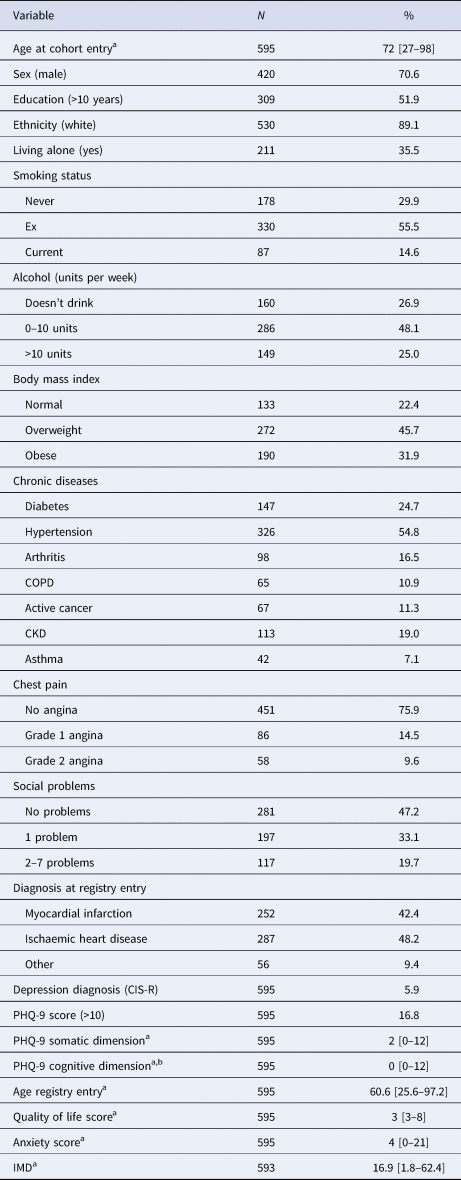
The study sample was mainly male (70.6%), with a median age of 72 years, ranging from 27 to 98. Chest pain (Grade 1 or 2 angina) was reported at baseline by 24.1% of the sample. Depression was diagnosed in 5.9% of participants and 16.8% had a PHQ-9 score >10. The median (min–max) scores on the somatic and cognitive dimensions were 2 (0–12) and 0 (0–12), respectively (Table 1).
Sample description at baseline (N = 595)

COPD, chronic obstructive pulmonary disease; CKD, chronic kidney disease; IMD, Index of Multiple Deprivation.
a Median [min–max].
b Standardised to a scale of 0–12 for comparative purposes.
Of the sample, 42.4% entered the CHD register with a diagnosis of MI, 48.2% with ischaemic heart disease, 6.9% with angina and 2.5% with one of the following indications: heart failure, chest pain not otherwise specified, arrhythmias or other vascular problems. Median time between CHD register entry and baseline was 8.3 years, ranging from 0.6 (by design, as participants with a delay between CHD register entry and cohort entry ⩽6 months were excluded) to 42.8 years. Over the four follow-ups where outcomes were considered in the analysis, there were 95 NCE, 31 at the 18-month, 23 at the 24-month, 12 at the 30-month and 29 at the 36-month follow-up. Median time from baseline to event was 22.3 months (IQR: 13.4, min–max: 12.1–36.2). The most frequent event was a visit to the rapid access chest pain clinic, A&E or emergency hospital admittance (47.4%), followed by cardio-cerebrovascular cause of death (26.3%), bypass graft or angioplasty (24.2%) and MI (2.1%).
Somatic and cognitive symptom dimensions as NCE risk factors
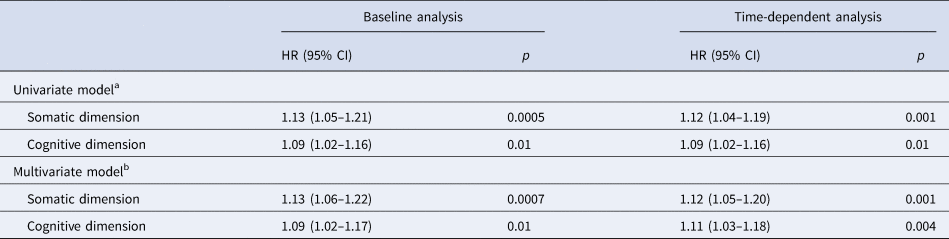
In the multivariate models, both the somatic and cognitive dimensions were significantly associated with an NCE whether measured as time-dependent variables or at baseline (Table 2). All analyses became non-significant when further adjusting for quality of life and anxiety, except for the somatic dimension at baseline (p = 0.04) (not shown).
Associations between baseline and time-dependent depressive symptom dimensions and new cardiac event at follow-up (95 events/595)

a Adjusted for sex.
b Further adjusted for diagnosis at entry (MI no/yes), smoking, and time-dependent chest pain, hypertension, COPD, active cancer.
Individual symptom items as NCE risk factors
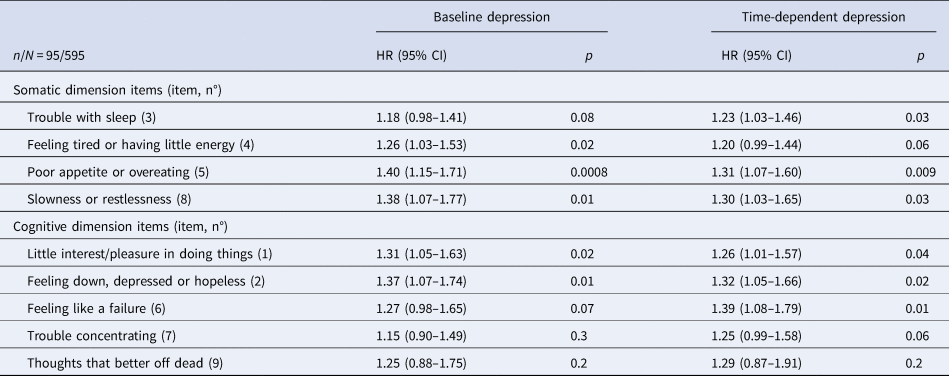
Combining the baseline and time-dependent approaches, all individual somatic symptoms were significantly associated with the onset of an NCE in the multivariate models (Table 3). However, when applying Bonferroni correction, only poor appetite/overeating remained significant. Of the cognitive items, feeling down at baseline and feeling like a failure for the time-dependent approach were significant multiple-comparison corrected predictors.
Association between baseline and time-dependent PHQ-9 items and NCE (multivariate Cox modela)

a Adjusted for sex, diagnosis at entry (MI no/yes), smoking, and time-dependent chest pain, hypertension, COPD, active cancer.
Time-dependent change in dimension scores as NCE risk factors
For both dimensions, variability in scores over follow-up was low and not significant (F-value = 0.32, p = 0.93 for the somatic dimension; F-value = 1.34, p = 0.24 for the cognitive dimension). Approximately one-third of participants for the somatic dimension and half for the cognitive dimension presented no change in score between two successive follow-ups (online Supplementary Figs S1 and S2). Time-dependent change in somatic and cognitive scores was not associated with the risk of an NCE.
Discussion
To the best of our knowledge, this is the first study to examine somatic and cognitive dimensions of depression as time-dependent risk factors for recurrent cardiac events. Conversely to findings from elsewhere, our findings suggest that both dimensions could be important short-term predictors of recurrent cardiac events when measured 12–18 months prior to the event, in particular somatic symptom appetite/overeating and cognitive symptoms feeling low and feeling like a failure.
Cognitive and somatic symptom dimensions
Our findings from the baseline and time-dependent analysis suggest both the somatic and cognitive depression dimensions to be predictors of an NCE, whereas most other studies find an effect for the somatic dimension only (de Miranda Azevedo et al., Reference de Miranda Azevedo, Roest, Hoen and de Jonge2014). We adjusted, as elsewhere (Hoen et al., Reference Hoen, Whooley, Martens, Na, van Melle and de Jonge2010b; Linke et al., Reference Linke, Rutledge, Johnson, Vaccarino, Bittner, Cornell and Bairey Merz2009; Martens et al., Reference Martens, Hoen, Mittelhaeuser, de Jonge and Denollet2010), for the history of heart disease taking diagnosis at entry into the CHD register as a proxy, along with the main chronic diseases, smoking and chest pain. However, the associations became largely non-significant when further adjusting for quality of life and anxiety. Despite removing the pain/discomfort and anxiety/depression scales from the EQ-5D, they could be over-adjusted given the strong associations between chronic diseases and quality of life and the overlap in symptoms between subthreshold depression and anxiety (Braam et al., Reference Braam, Copeland, Delespaul, Beekman, Como, Dewey and Skoog2014). In fact, to our knowledge, no other study adjusted for these covariates in their multivariate models.
The findings for the time-dependent analysis are very similar to those using the baseline data. This is not actually surprising given that both analyses examined depressive symptoms as short-term risk factors for an NCE. The main difference between the two approaches is the variability in time-to-event [median (IQR): 22.3 (13.4) in the baseline analysis, and 14.1 (3.5) for the time-dependent analysis]. Furthermore, we allowed for an event-free time-window between exposure and event in both approaches, in order to avoid the concomitant onset of the two, with depressive symptoms acting more like a cardiac disease marker than a short-term risk factor.
The association between time-dependent depression and cardiac prognosis has seldom been investigated (Li et al., Reference Li, Van Halm-Lutterodt, Zheng, Liu, Guo, Feng and Guo2018; Pequignot et al., Reference Pequignot, Dufouil, Prugger, Peres, Artero, Tzourio and Empana2016). In a Chinese cohort of 1999 subjects aged 55 years and above, the time-dependent depressive symptom score increased the risk of all-cause and cardiovascular mortality over a 12-year follow-up, whereas no association was found with symptom score at baseline (Li et al., Reference Li, Van Halm-Lutterodt, Zheng, Liu, Guo, Feng and Guo2018). The difference could be explained by the longer follow-up period than in our study, with a greater difference in inter-subject variability in time-to-event. In the Three-City Study including 9294 persons aged 65 years and above followed up for over 10 years, time-dependent number of visits with a high level of depressive symptoms was associated with cardiovascular disease mortality risk, which increased 1.28-fold for each additional visit (Pequignot et al., Reference Pequignot, Dufouil, Prugger, Peres, Artero, Tzourio and Empana2016). However, neither of these studies using the Centre for Epidemiologic Studies-Depression Scale considered somatic and cognitive symptom dimensions separately.
Many behavioural and biological mechanisms have been suggested to explain the link between depressive symptomatology and recurrent cardiac events. Inflammation is thought to play a key role, in particular in somatic and late-onset depressive symptoms (Meijer et al., Reference Meijer, Zuidersma and de Jonge2013). Ormel and de Jonge suggested a differential effect on acute coronary syndromes in CHD patients, depending on the type of symptoms (Ormel & de Jonge, Reference Ormel and de Jonge2011). Their integrative model rests on three core hypotheses. The first is that depression in CHD patients consists of a mix of two types of depression, cognitive/affective and somatic depression, each having a characteristic symptom expression and aetiology. The second is that the effects on CHD depend on the type and duration of depression. The third hypothesis is that the most plausible pathways mediating these effects are behavioural. They argue that for both cognitive-affective and somatic depressive dimensions, persistent (chronic or recurrent) symptoms would be expected to be associated with recurrent cardiac events, but not brief symptom episodes (remission within 6 months) that are likely to be confounded by the severity of underlying cardiac symptoms and associated physiological abnormalities. Moreover, they suggest a different pathway for each symptom dimension, with behavioural factors alone mediating the cognitive pathway, whereas both behavioural and other factors such as inflammation would mediate the somatic symptom pathway.
Greater fluctuations over time of behavioural factors (e.g. lifestyle, medication adherence) compared to biological factors could explain why studies considering depressive symptoms at a fixed time-point find no association for the cognitive dimension. The latter present considerable variability, both between and within studies, in the duration of time between baseline depression assessment and outcome. In the present study, the median time to event was relatively short [22.3 months (IQR: 13.7)]. Other studies report average times to event ranging from 2.5 years (s.d. = 0.9) (de Jonge et al., Reference de Jonge, Ormel, van den Brink, van Melle, Spijkerman, Kuijper and Schene2006) to 6.1 years (s.d. = 2.0) (Hoen et al., Reference Hoen, Whooley, Martens, Na, van Melle and de Jonge2010b).
Of the few studies reporting an association for the cognitive dimension measured at a fixed time-point, Hoen et al. reported that both the somatic and cognitive dimensions were associated with cardiovascular prognosis in a study of 468 MI patients with a relatively short mean follow-up of 2.5 years (s.d. = 0.8) (Hoen et al., Reference Hoen, Conradi, Denollet, Martens and de Jonge2010a). The authors attributed this to a more thorough assessment of symptoms thanks to the use of a structured diagnostic interview. This suggests that an overestimation of somatic symptoms with self-report instruments coupled with longer and varying times-to-event could account for previous negative findings for the cognitive dimension. Another study showed a link between the cognitive-affective dimension of the BDI administered at baseline and recurrent MI and mortality in 1823 patients with a mean follow-up of 2.1 years (s.d. = 1.1); this was found for the under 70 age group only in a sample of patients with post-MI depression (Denollet et al., Reference Denollet, Freedland, Carney, de Jonge and Roest2013). This highlights the complexity of the relationship between NCE and depressive symptoms that could be modulated by both an age- and depression-level threshold effect.
Time-dependent symptom change over time
We also examined for each dimension, the association between time-dependent symptom change and the risk of an NCE. Neither of the associations was significant. Of the few studies investigating change over time (Roest et al., Reference Roest, Carney, Freedland, Martens, Denollet and de Jonge2013; Scafato et al., Reference Scafato, Galluzzo, Ghirini, Gandin, Rossi, Solfrizzi and Group2012), only Roest et al. with the ENRICHD study examined separate symptom dimensions. They reported that over 6 months, improvement in somatic symptoms but not cognitive symptoms was associated with a reduced risk of recurrent MI and mortality; however, change was not considered as a time-dependent variable allowing for considerable variability in time-to-event over the 2.4-year [standard deviation (s.d.) = 2.9] follow-up period (Roest et al., Reference Roest, Carney, Freedland, Martens, Denollet and de Jonge2013).
We chose to express a change in terms of the relative change in score but this may have biased our findings as nearly half of subjects were in the ‘no change’ category, in particular for the cognitive dimension due to a clustering of scores at 0 for approximately 50% of participants at each follow-up. Furthermore, the ‘no change’ category included the middle quartiles with both persistently high and low scores. This low level of change has previously been reported for this cohort (Palacios, Khondoker, Achilla, Tylee, & Hotopf, Reference Palacios, Khondoker, Achilla, Tylee and Hotopf2016). A more sophisticated approach to change taking into account trajectories over the entire follow-up (Palacios, Khondoker, Mann, Tylee, & Hotopf, Reference Palacios, Khondoker, Mann, Tylee and Hotopf2018) was not possible given the time-dependent approach used in the analysis.
Individual depressive symptoms
To our knowledge, this is the first time individual depressive symptom items are examined as time-dependent variables. Of the somatic symptoms, poor appetite/overeating was the most robust predictor of an NCE. Hoen et al. in a study of 1019 patients with stable CHD over a relatively long follow-up period [mean 6.1 years (s.d. = 2.0)] found that only two of PHQ-9 symptoms – namely somatic items, appetite problems and fatigue – measured as continuous variables at a fixed time-point were associated with recurrent cardiovascular events (Hoen et al., Reference Hoen, Whooley, Martens, Na, van Melle and de Jonge2010b). When using a structured diagnostic interview, the same authors reported that all baseline somatic symptoms except for sleeping difficulties were predictors of cardiovascular prognosis, along with the cognitive symptoms, lack of interest and suicidal ideation (Hoen et al., Reference Hoen, Conradi, Denollet, Martens and de Jonge2010a). Denollet et al. (Reference Denollet, Freedland, Carney, de Jonge and Roest2013) examined individual cognitive symptoms and found that only hopelessness remained significantly associated with recurrent MI and mortality (Denollet et al., Reference Denollet, Freedland, Carney, de Jonge and Roest2013). This is in keeping with our findings regarding cognitive items feeling down and feeling like a failure.
Limitations
There are several limitations to our study. Firstly, we used a self-report instrument to measure depressive symptoms which may have led to an overestimation of somatic symptoms (Hoen et al., Reference Hoen, Conradi, Denollet, Martens and de Jonge2010a). On the other hand, the PHQ-9 has been suggested as a useful screening tool in cardiac patients, as it covers a wide range of symptoms with a clear and validated distinction between the somatic and cognitive dimensions (Carney & Freedland, Reference Carney and Freedland2012a; de Jonge, Mangano, & Whooley, Reference de Jonge, Mangano and Whooley2007). It has also been shown to have a superior diagnostic accuracy to the HADS-D in CHD patients (Haddad et al., Reference Haddad, Walters, Phillips, Tsakok, Williams, Mann and Tylee2013). Secondly, although we were able to adjust for a wide range of variables, we did not have data on medication use and could not adjust for antidepressant or cardiac-related medication and treatment compliance. A further limitation is the heterogeneity of cardiac events both at entry into the CHD register and as an outcome variable (Freedland & Carney, Reference Freedland and Carney2013). Indeed NCE included events ranging from rapid access chest pain clinic for cardiac-related chest pain to cardio-cerebrovascular cause of death. The exclusion of events at the first three time-points and the limited number of events per category of NCE did not allow us to investigate each type of event separately. Finally, we were not able to show any effect of change in scores between follow-ups, mainly because symptom scores fluctuated very little over the follow-up. This in turn can be explained by the clustering of scores at the lower end of the distribution due to the selection of a healthy sub-sample, as well as the short duration of follow-up (36 months).
Strengths
The main strength of our study is the design regarding the delay between depression assessment and the NCE. The time-dependent approach allowed us to standardise for time-to-event, which is crucial when examining symptoms that are known to fluctuate considerably over time. Furthermore, in order to distinguish ‘depression’ as a short-term risk factor for an NCE from ‘depression as a non-causal variable risk marker’ (Meijer et al., Reference Meijer, Zuidersma and de Jonge2013), we chose to leave an event-free period of 12 months between symptom assessment and the cardiac onset period. This reduced the likelihood of over-reporting somatic symptoms as a marker of cardiac disease.
We also removed patients who entered the register in the 6 months preceding baseline, in an attempt to measure depressive symptomatology as a risk factor for an NCE rather than the opposite, although we cannot fully rule out that baseline symptoms could be the consequence of past cardiac events or worsening of symptoms. Finally, our study was based on a relatively large sample of patients from CHD registers with regular 6-monthly follow-ups over 3 years, with full datasets. NCE cases were certified by an expert clinical review of all patient records with exact dates for events.
Conclusion
We showed that both the somatic and cognitive depressive symptom dimensions measured 12–18 months earlier were significantly and positively associated with a greater risk of an NCE. Thus, cognitive symptoms should not be disregarded as short-term risk factors for recurrent cardiac events as suggested by most previous research. More regular assessment of depressive symptoms, with a special attention given to specific symptoms such as eating problems and feeling hopeless or like a failure, could help predict and prevent future cardiac events.
Supplementary material
The supplementary material for this article can be found at https://doi.org/10.1017/S0033291719004082.
Acknowledgements
The authors are grateful to the Primary Care Research Network-greater London for their support and assistance in recruiting practices to the UPBEAT-UK study and to the 16 practices who provided assistance. They are also grateful for the work of the UPBEAT research team for setting up the study and collecting the data.
Financial support
This article represents independent research commissioned by the National Institute for Health Research (NIHR) under its Programme Grants for Applied Research scheme (RP-PG-0606-1048). It also represents independent research part-funded by the National Institute for Health Research (NIHR) Biomedical Research Centre at South London and Maudsley NHS Foundation Trust and King's College London. The views expressed are those of the authors and not necessarily those of the NHS, the NIHR or the Department of Health.
Conflict of interest
None.