The human and financial costs of disasters are increasing. Globally and in the United States, 2017 was the most expensive year for disasters ever recorded. Worldwide, total economic losses were US $337 billion from natural catastrophes and large man-made disasters.1 In the United States, the federal government alone provided US $89.3 billion in emergency supplemental funding to help states, communities, businesses, and individuals respond and recover from recent hurricanes, wildfires, and other disasters.2
In 2011, Presidential Policy Directive 8 (PPD-8) recognized disaster hazards as a potential threat to the health and national security of the United States. PPD-8 mandated development of a national preparedness system that identifies the core capabilities necessary for preparedness and a national preparedness system to guide activities that will achieve the goal. The system allows the nation to track the progress of our ability to build and improve the capabilities necessary to prevent, protect against, mitigate the effects of, respond to, and recover from those threats that pose the greatest risk.3
As part of this mandate, the Centers for Disease Control and Prevention (CDC) developed 15 Public Health Emergency Preparedness and Response Capabilities to serve as standards for public health agency core capabilities (supplementary Appendix).4 Since 2011, the CDC has funded the development of these Public Health Emergency Preparedness and Response Capabilities at the state and local levels through Public Health Emergency Preparedness (PHEP) cooperative agreements. The PHEP has provided more than US $11 billion to public health departments across the nation since 2002, including US $6.3 billion in cooperative agreement funding during the period of this study.5
The objective of this study is to determine the level of federal funding allocated for research related to Public Health Emergency Preparedness and Response Capabilities during 2008 to 2017.
METHODS
An online search was performed at the federal government website, http://www.USAspending.gov, to identify federal funding of awards, grants, contracts from 2008–2017 related to research spending for the 15 Public Health Emergency Preparedness and Response Capabilities. This is the official US government database collecting data on all federal contracts, grants, loans, insurance, and other financial assistance (excluding subawards).
Search terms were selected based upon the CDC’s Public Health Preparedness Capabilities: National Standards for State and Local Planning.4 Two compound capabilities of “Emergency public information and Emergency warning” and “Public health surveillance and Epidemiological investigation” were divided into 4 search terms for accuracy. The following 17 search terms were used:
1. Community preparedness
2. Community recovery
3. Emergency operations coordination
4. Emergency public information
5. Emergency warning
6. Epidemiological investigation
7. Fatality management
8. Information sharing
9. Mass care
10. Medical countermeasure
11. Medical material management and distribution
12. Medical surge
13. Non-pharmaceutical interventions
14. Public health laboratory testing
15. Public health surveillance
16. Responder safety and health
17. Volunteer management
The results of these 17 keyword searches were aggregated into a single Microsoft Excel™ spreadsheet database. All duplicates were deleted. Entries were included if they were identifiable as disaster-related research performed in the United States and specifically referred to any of the Public Health Emergency Preparedness and Response Capabilities. Specific criteria for inclusion included the following:
Identifiable as “research” and defined as follows:
Performance of scientific investigations or study
Conference related to research
Specific population health assessments (eg, not including routine surveillance systems)
And
Identifiable as “disaster-related” and defined as follows:
Entry containing the word disaster or emergency management
Referring to any disaster-related activity or entity (eg, mass casualty care, emergency operations center, warning systems)
Referring to any phase of emergency management (eg, prevention, preparedness, mitigation, response, recovery)
Referring to any disaster hazard (ie, drought, flood, hurricane, man-made hazard, earthquake, and so on)
Referring to infectious diseases of epidemic potential
And
Identifiable as work performed in the United States
And
Including only fixed costs (eg, infrastructure) directly associated with a study
Including only variable costs (eg, contracts and salaries) directly associated with a study
And
Remaining inclusions reviewed for specific reference to 15 Public Health Emergency Preparedness and Response Capabilities according to their associated standard definitions and functions described in Appendix 1
Exclusion criteria included the following:
Transaction amounts that were negative (representing funds returned to the US government) or net zero (representing no net transfer of funds)
Fixed costs (eg, rent, infrastructure) not directly associated with a research study
Variable costs (eg, contracts and salaries) not directly associated with a research study
Routine health surveillance systems not associated with diseases of epidemic potential (eg, lead, hepatitis, birth defects)
Assignments of the inclusion criteria were performed by 2 separate, blind reviewers (MK and AL) using the standardized definitions. Any entries that did not agree were then reviewed and assigned by a third blind reviewer (TK). All reviewers then discussed any discrepancies and reached consensus for all final assignments of inclusion and exclusion criteria.
Simple calculations of descriptive statistics were performed using Microsoft Excel™ software. All dollar entries were adjusted for inflation (Consumer Price Index for All Urban Consumers: All Items Less Food and Energy) according to 2017 dollars, using a 1982–1984 base period.
RESULTS
General Findings
A total of 15 278 governmental transaction entries were identified during the key word search. Of these, 3530 entries were excluded because they involved negative or zero-dollar values and 274 because they were funds related to activities outside of the United States. This left 11 474 funding entries (representing US $29.2 billion in Federal spending) for inclusion in the structured review.
Applying the inclusion criteria for “research” eliminated 10 329 entries. Of the remaining 1145 research-related entries, 1014 did not meet the criteria as “disaster-related,” leaving 131 (1.14%) entries categorized as “disaster-related research.” These 131 remaining entries were reviewed for specific reference to 15 Public Health Emergency Preparedness and Response Capabilities according to their associated standard definitions and functions, identifying 93 (0.8% out of 11 474 funding entries) that were specifically related to the Public Health Emergency Preparedness and Response Capabilities.
For the 10 years from 2008–2017, these 93 separately funded projects totaled US $27 831 361 in US governmental spending, with a mean annual funding of US $2 783 136 and a median of US $2 394 514. These funds were distributed by contracts (57%), grants (36%), and cooperative agreements (7%).
US Federal Funding According to Year
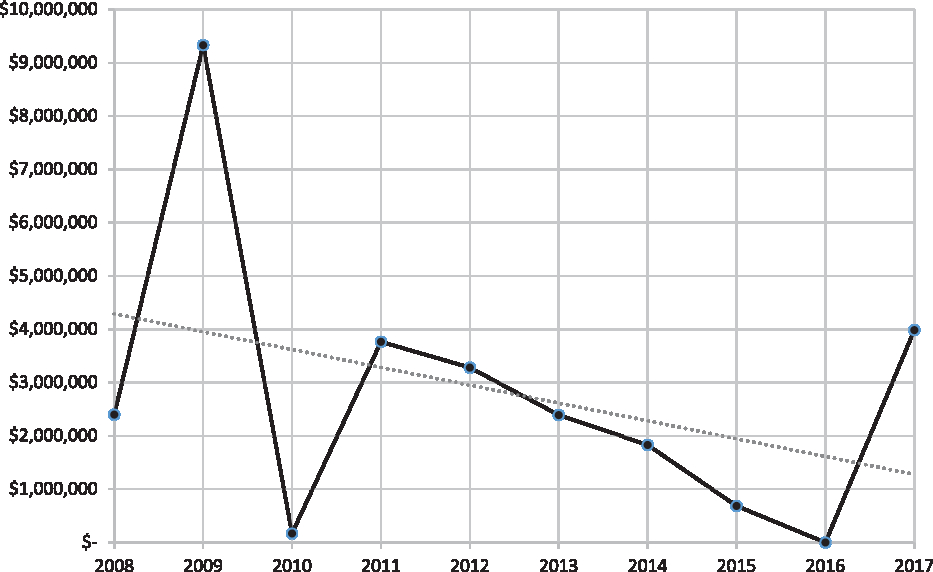
Funding varied greatly per year. Figure 1 reveals a downward trend in annual funding with notable drops to zero (US $0.00) and near zero (US $169 685) in 2016 and 2010, respectively.
Total Annual US Governmental Funding for Disaster-Related Research Related to 15 CDC Public Health Preparedness Capabilities, 2008–2017.

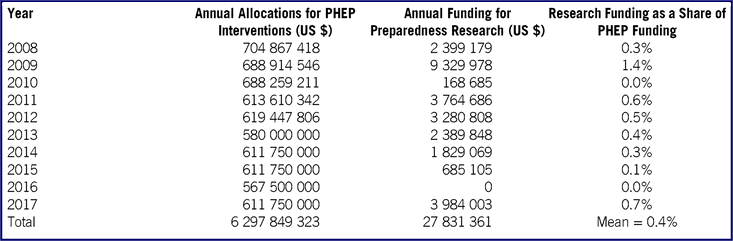
In comparison, Table 1 reveals that annual US governmental allocations for CDC PHEP interventions related to building 15 Public Health Emergency Preparedness and Response Capabilities during 2008–2017 remained quite stable, ranging from a low of US $567.5 million to a high of US $705 million.
A Comparison of US Governmental Allocations for Public Health Preparedness Interventions as Compared to Research, With Respect to the 15 CDC Public Health Preparedness Capabilities (2008–2017)

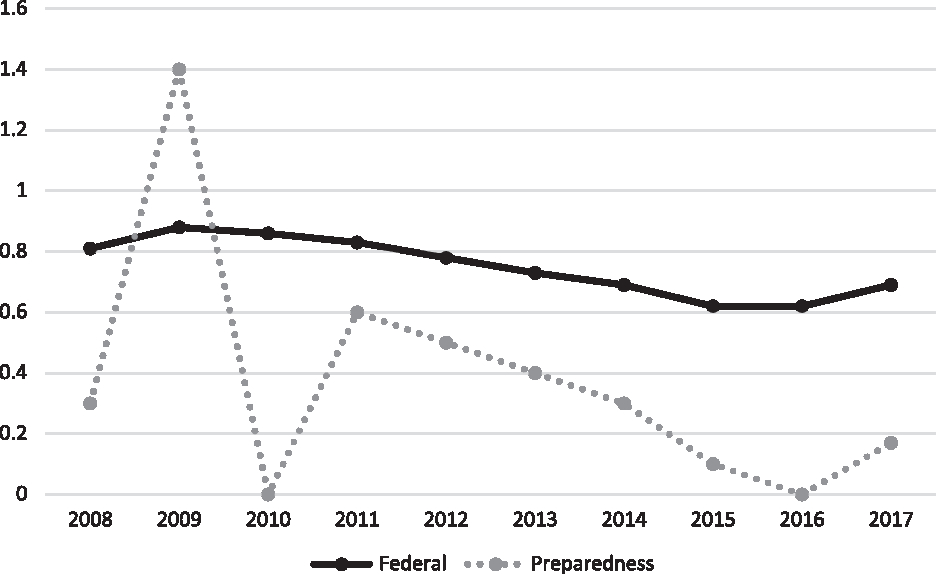
When compared with annual US governmental funding for research related to Public Health Emergency Preparedness and Response Capabilities, the percentage of annual expenditures for research related to public health preparedness capabilities ranged from 0.1% to 1.4% (mean = 0.4%) of the annual expenditure for implementation of the CDC PHEP cooperative agreement associated with these same capabilities (see Table 1). In other words, the mean allocation for research and development (R&D) for Public Health Emergency Preparedness and Response Capabilities during 2008–2017 was equal to 0.4% of PHEP funding for the implementation of these same capabilities.
US Governmental Funding According to Public Health Preparedness Capability
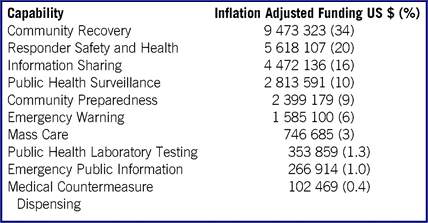
The search returned entries for only 10 of the 17 key words associated with Public Health Emergency Preparedness and Response Capabilities. Total 10-year funding levels for individual capabilities ranged from US $102 468 to US $9 399 179, with a mean annual funding of US $2 783 136 and a median of US $1 992 139 (Table 2). Capabilities not funded included Emergency Operations Coordination, Epidemiological Investigation, Fatality Management, Medical Material Management and Distribution, Medical Surge, Non-pharmaceutical Interventions, and Volunteer Management.
US Governmental Funding for Public Health Preparedness According to Capability (2008–2017)

The capability of “community recovery” comprised approximately 1/3 of all funding allocated for research involving Public Health Emergency Preparedness and Response Capabilities. As indicated in Table 2, 80% of all funding was allocated to 4 (24%) of the 17 Public Health Emergency Preparedness and Response Capabilities key words: “Community Recovery” (34%); “Responder Safety and Health” (20%); “Information Sharing” (16%); and “Public Health Surveillance” (10%).
US Governmental Funding of Individual Public Health Preparedness and Response Capabilities According to Year
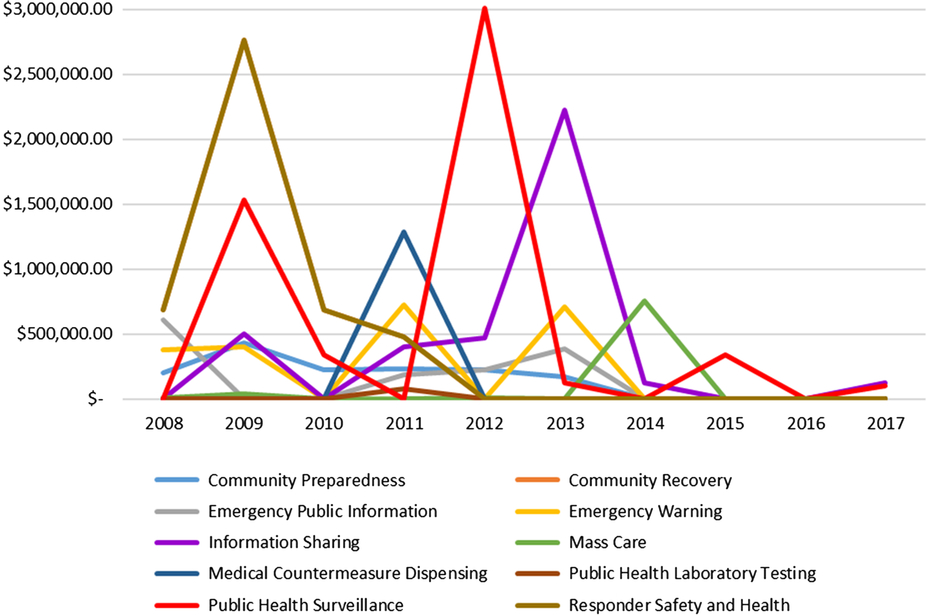
Figure 2 reveals a series of repetitive sharp peaks and troughs consistent with a very high degree of variability in funding over the entire 10-year span. It is also notable that, after 2015, funding ceased entirely for all Public Health Emergency Preparedness and Response Capabilities, except for information sharing and public health surveillance.
US Governmental Funding for Individual Public Health Emergency Preparedness and Response Capabilities According to Year (2008–2017).

US Governmental Funding According to Federal Institution
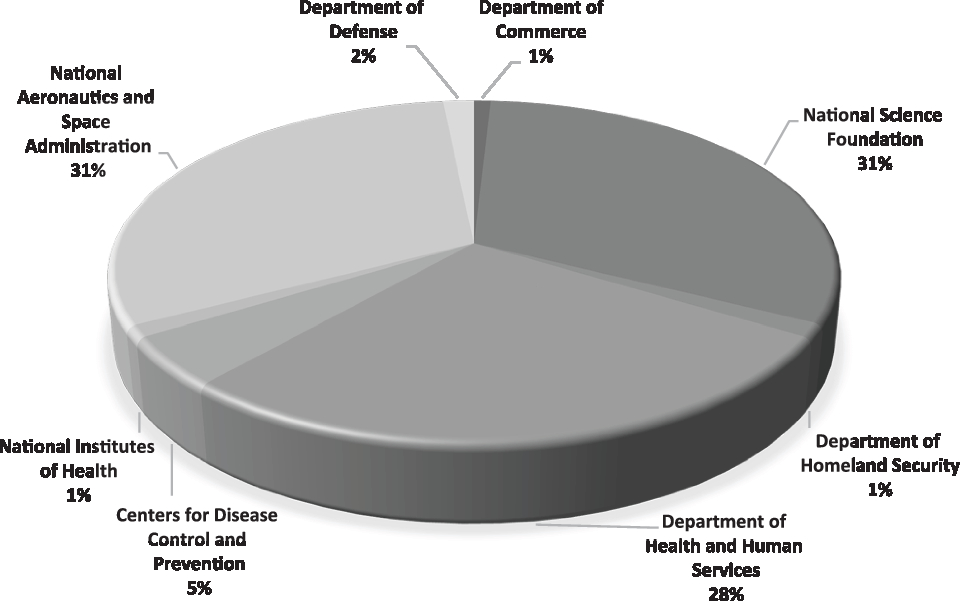
Eight federal institutions provided funding: Department of Commerce; National Science Foundation (NSF); Department of Homeland Security; Department of Health and Human Services; CDC; National Institutes of Health (NIH); National Aeronautics and Space Administration (NASA); and Department of Defense. Funding amounts according to agency ranged from US $299 924 (Department of Commerce) to US $11 202 965 (NSF). The mean institution contribution was US $4 431 104 during the 10 years. Three agencies (NSF, NASA, and Department of Health and Human Services) disbursed 90% of all allocations during the decade (Figure 3).
US Governmental Funding for Public Health Preparedness Capabilities According to Funding Agency (2008–2017).

US Governmental Funding According to Recipient
Forty-seven organizations received funding during the 10-year period studied. All but 8 awards were under US $1 million each. Sixteen (34%) of the 47 recipients received 80% of all funding.
DISCUSSION
This study identified a number of issues related to funding for research related to Public Health Emergency Preparedness and Response Capabilities. During the decade of this study, disasters in the United States affected 100 million people, caused US $367 billion in damages, and 3466 deaths.6 Compared to these costs, the overall research funding related to Public Health Emergency Preparedness and Response Capabilities was very low, averaging US $2.8 million annually. This represents only 0.4% of the CDC PHEP funding for implementation of these same capabilities.(see Figure 4) On a larger scale, the funding allocations for R&D related to Public Health Emergency Preparedness and Response Capabilities were half of that for all federal R&D as a share of gross domestic product (GDP), which averaged 0.8% during that same decade.7
A Comparison of US Federal Expenditures for Preparedness-Related R&D as a Share of Total Funding for the PHEP Cooperative Agreement, and National US Federal Expenditures for R&D as a Share of GDP (2008–2017).

Funding allocations for Public Health Emergency Preparedness and Response Capabilities-related research are remarkably discontinuous; over half of the Public Health Emergency Preparedness and Response Capabilities received no or very limited funding; funding varied widely, ranging from zero dollars identified in 2016 to US $9.4 million in 2009; and 80% of this funding focused on 4 capabilities only. As Figure 2 reveals, funding for individual Public Health Emergency Preparedness and Response Capabilities over time is characterized as a series of sharp peaks and troughs where funding was repeatedly stopped and re-started. There is no indication of a trend or developmental strategy that would build national capacity in a logical and sustainable manner.
Whereas overall federal expenditures for R&D remained stable, federal funding for Public Health Emergency Preparedness and Response Capabilities-related research appears to vary widely and trend downward. This chronically low level of support, along with a high degree of variability in allocations, appears inconsistent with the mandate of the National Preparedness Goal and PDD-8.
These findings reveal the lack of a coordinated US research strategy that would guide effective stakeholder involvement and bring a whole government approach to this important national goal. There has been a robust discussion in the past about the importance of a national disaster research strategy.Reference Lurie, Manolio and Patterson8, Reference Shultz and Galea9, 10 In 2011, the Federal National Biodefense Science Board issued a Call to Action to improve disaster research that emphasized the need for a national strategy, the inclusion of scientific research in the National Response Framework, and the creation and funding of an Interdepartmental Center for Scientific Investigations During Disaster Response.11
In comparison, there has been a more coordinated R&D strategy for medical preparedness (as compared with public health preparedness). The Biomedical Advanced Research and Development Authority (BARDA) was created to fund the research, development, and stockpiling of vaccines and treatments for public health emergencies such as chemical, biological, radiological, or nuclear attacks.12 BARDA is a key strategic and coordinating authority of the Federal biosecurity effort with funding of US $13.7 billion in 2017. Approximately US $3.8 billion of that funding was for biosecurity research, with the preponderance for NIH-funded infectious disease studies.Reference Watson, Watson and Sell13 A 2012 study by Shelton et al. assessed all federal research funding for health security.Reference Shelton, Connor and Uscher-Pines14 The study found that between 2003 and 2010, 66% of all federal health security research grants were directed toward biological threats and bioterrorism.Reference Shelton, Connor and Uscher-Pines14 Public Health Emergency Preparedness and Response Capabilities-related research represents less than 1/1000 of the funding for biosecurity research, demonstrating a dramatic skew to (low probability, high impact) biothreats as compared with (high probability, high impact), despite the fact that natural disasters are responsible for 95% of all US disaster deaths over the past century.6
There is evidence for the effectiveness of targeted funding for disaster public health science. One 2017 study concluded that the quality of the research has improved over time, but that research gaps remain in all areas.Reference Savoia, Lin and Bernard15 Given the widespread economic and health burdens of disasters on our population, it is important for public stewards to ensure effective disaster-related interventions by sustaining the scientific basis for decision-making.
Limitations
USAspending.gov is the official government database for all federal contracts, grants, loans, insurance, and other financial assistance. The website enables searching of federal funding awards and subawards from fiscal year 2008 to the present.Reference Gerli16
However, because of ongoing data quality problems identified by the Congressional Research Service (CRS), search results may be incomplete or have inaccuracies. According to the CRS report, data on contracts appeared to be more accurate than data on grants and other awards.Reference Gerli16 This is applicable to this study because 67% of the items included here are grants and 33% are contracts.
It may be possible through a mixed approach of database searches, institutional interviews, Freedom of Information Act requests, and so on, to validate the USAspending.gov database for accuracy and validity, but this was beyond the scope of our study. The authors assume that the multiplicity of such searches, interviews, and requests may diminish reproducibility and increase the potential for a higher degree of second order uncertainty. Therefore, we believe that the data from a single source (albeit prone to systemic bias) is preferable to data aggregated from multiple sources according to multiple methodologies.
There is also the potential for introduction of selection bias given that individual decisions were made for inclusion and exclusion, as well as for assigning research and disaster-related associations using only descriptive information from each study. We used a standard method of a blind expert panel review to reduce such bias.
The use of a relatively small number of 17 key word phrases based on the Public Health Emergency Preparedness and Response Capabilities probably affected the completeness of the funding identified. Undoubtedly, some grants or contracts were missed. However, our search identified 11 474 funding entries representing US $29.2 billion in Federal spending. If we had expanded the search to include a greater number of search terms, there may expectedly be a larger number of entries returned. However, it is difficult to imagine a remarkably different outcome given the widespread, routine use of these same key word terms to describe nationally accepted standards now implemented by public health agencies.
Finally, this inventory of spending focused only on data involving extramural research that is publicly available. Intramural research from federal agencies (including the CDC) is not included.
CONCLUSION
Disasters impart an extraordinary cost in terms of money, misery, and lives each year in the United States, much of which is related to the public health impacts outlined by the CDC National Public Health Preparedness and Response Capabilities. Unfortunately, the funding for research in public health preparedness and response is inconsistent, poorly focused, and very limited. US federal investments in R&D related to the Public Health Emergency Preparedness and Response Capabilities have not been efficiently allocated over the past decade. There are notable gaps in funding, content, continuity, and scope of participation. There is a need for a national strategy to improve disaster-related research. The approach used by BARDA is a good example of a coordinated research strategy.
Funding information
This work was performed under a contract with the Henry Jackson Foundation funded by the National Center for Disaster Medicine and Public Health.
Supplementary material
To view supplementary material for this article, please visit https://doi.org/10.1017/dmp.2019.66