This essay looks at Carlyle's interest in visual and literary portraiture, as the basis for a reassessment of his practice as a biographer in relation to the wider biographical culture of Victorian Britain. Carlyle's fascination with portraits manifested itself in a number of ways. Despite his professed reluctance as a sitter, his face was one of the most visible of his day – painted, sketched, sculpted, photographed, and reproduced for public circulation in engravings and cartes de visite.Footnote 1 He collected portraits of his family, friends, and heroes, and was a public champion of the art, most famously through his influential role in the founding of the English National Portrait Gallery.Footnote 2 He was also valued by his contemporaries as a portraitist in words, a writer whose graphic style included a striking ability to picture people.Footnote 3 Yet only partial answers have been offered to the question of how these activities related to each other and what their significance might be in terms of his career. Paul Barlow has explored Carlyle's concept of the authentic, historical portrait in relation to his proposals for a National Portrait Gallery (“Facing the Past” and “The Imagined Hero”), and John Rosenberg has discussed his pictorial style as a means by which he sought to make history into a secular scripture by “endowing the past with extraordinary ‘presence’” (24). Richard Salmon has given some consideration to Carlyle's engagement with contemporary “portrait gallery” publications as part of his discussion of his ambivalent response to idolatry and literary “lionism” (Salmon Reference Salmon2002). I am indebted to these discussions but I differ from them in arguing that we need to see Carlyle's interest in portraiture, both visual and verbal, as integral to his conception and practice of biography. The fact that he, famously, enmeshes history and biography, in theory and practice, does not invalidate this point. It is with biography and the biographical basis of historical narrative, that he associates the portrait and portraiture. This distinction matters because it shifts us away from the emphasis on Carlyle as an historian that has sometimes occluded his links with his contemporary biographical culture.Footnote 4 By restoring these links we can understand more fully the significance both of the portrait within his work, and of his innovative contribution to a broader climate of experimentation with the conjunction of visual and verbal portraiture in life writing at the period.
Critical interest in what Kate Flint has called the “drive towards specularity” in Victorian culture has tended to alight on poetry and fiction rather than life-writing, but the strengthening of the long-standing relationship between visual and verbal portraiture and biography at the time suggests this as another rich area for investigation (21). Developments in the technology of production and reproduction of visual images in the first half of the nineteenth century, including, from the 1840s, photography, meant that the reading public could expect portraits of the subject to be contained not only within expensive biographical publications but, increasingly, in cheaper forms, including magazine serials. Biographical portrait galleries proliferated – collections of brief lives of eminent men and women, sometimes with visual images attached.Footnote 5 Whether or not such images were present, nineteenth-century biography increasingly paid attention to living subjects and to eye-witness descriptions of them. A lively tradition of verbal portraiture in literary memoirs emerged from the 1820s onwards in the work of Leigh Hunt, Edward Trelawny, Thomas Jefferson Hogg, Peter Patmore, Samuel Carter and Anna Maria Hall, Edmund Gosse and others.Footnote 6 It was a tradition of pictured presence that drew on the techniques of fictional representation, but was also in fundamental ways, distinct.
In her study of the interactions between photography, fiction, and realism in Victorian Britain, Nancy Armstrong has argued that fiction participated in a visual culture, continuous with our own, in which the priority of the object represented over the representing image was knowingly and decisively reversed. Just as cartes de visite photographs were understood “not in relation to the body and by virtue of their resemblance to actual persons, places, and things, but strictly within a system of images,” so, from mid century, although fiction promised “to put readers in touch with the world itself,” it referred to “an immense shadow archive, or visual order of things” within which individual identities could be formed (Armstrong 22, 7, 19). Daniel Novak goes further, making an analogy between realist fiction and the composite bodies of Victorian photography, to argue that photographic realism in the novel worked to distort and disrupt individual identity, rather than to mirror it. In both views, later Victorian photographic and fictional representations of the human face and body were already recognised as irredeemably mediated. The techniques of Victorian biography intersected in many ways with those of realist fiction and photography, and biography, too, existed within the shadowy “archive” of images that Armstrong describes. Nevertheless we are brought up against the fact that, unlike fiction, biography was understood to refer to a pre-existing historical subject. The poststructuralist critique of this understanding of auto/biography, as exemplified by Paul De Man's essay “Autobiography as De-facement,” has freed us to look at the subject as a textual construction, and consequently to appreciate auto/biography as a complex literary form. But to view the biographical subject purely as a textual effect is to miss what was most prized by many writers and readers of biography in the Victorian period (and, arguably, still is): the experience of recovered presence. I would suggest that Victorian biography, unlike fiction, was characterised by its quest to restore the pre-representational presence of the subject, through the visualisation of face and body. We can acknowledge, like De Man, the impossibility of this quest, the circularities of representation that prevent the auto/biographer from accessing the immediacy of the subject, without losing sight of the desire for presence, the techniques by which it is recreated and the extent to which, with all the provisos offered by De Man, a sense of presence maybe generated by biographical narrative.
In order to explore the ways in which this is true for Carlyle's work as a biographer, the following discussion will start by considering the philosophical and emotional significance that portraits held for him, and relate this to his conception and practice of biography. It will then look at his interactions with the wider culture of biographical portraiture, in his work for Fraser's Magazine, in the 1830s, and his Life of John Sterling (1851), which is read in relation to literary portraits of Shelley. The discussion will finish with a consideration of his proposals for a National Portrait Gallery (1853–54), as the culmination of his biographical quest to materialise heroic presence. In each of these examples we can see Carlyle experimenting with his approach to biographical portraiture and positing different relationships between the public and the biographical subject in his search for a form that will match his desire to restore that subject to life.
*
As Paul Barlow has shown, Carlyle's understanding of portrait painting was remarkable for its exclusion of the aesthetic. He valued the genre over mythological or historical painting – and implicitly over all other forms of visual art – because he saw it as, in Barlow's words, an “anti-art,” a form that aspired, above all, to authenticity (Barlow “Facing the Past,” 524). The authentic portrait was defined by Carlyle as a likeness, taken from life, by an artist with the insight to see his subject truly and then convey to the onlooker that “Face and Figure, which he saw with his eyes, and which I can never see with mine” (CLO TC to David Laing, 3 May 1854). As this implies, physiognomy was understood by Carlyle as a fully legible expression of the person, so that, in truly representing a face, the portraitist necessarily revealed the inner man. Thus, looking at a portrait of Jean Paul, Carlyle observes that he is “[a] huge, irregular man, both in mind and person (for his Portrait is quite a Physiognomical study)”; or “Luther's face is to me expressive of him; in Kranach's best portraits I find the true Luther” (CME 1: 7; Heroes 121). The portrait was one manifestation of Carlyle's belief in the symbolic nature of all things: that the infinite was concealed and revealed in all perceptible phenomena, and that we experienced worship only by means of “eidola, or things seen” (Heroes 104). By allowing the onlooker to see the authentic face and figure, the portraitist could bring the sitter back to him as incarnated spirit.
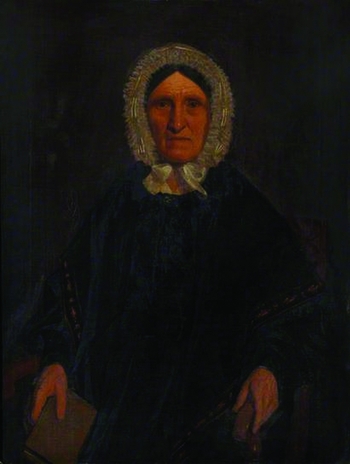
For Carlyle this capacity in portraiture went some way beyond the familiar idea encapsulated in Cowper's description of it as “the Art that can immortalize.”Footnote 7 His energetic collection and circulation of images of his loved ones and heroes, was driven by an unusually strong conviction that if only the true portrait could be found, the subject could be re-experienced. Receiving a portrait of his mother by Maxwell of Dumfries (Figure 1) from his sister, he described the image, delighting in the authenticity and completeness of the impression:
Maxwell of Dumfries, “Margaret Aitken, Mrs James Carlyle.” (1842). Reproduced by permission of the National Trust.

. . . my good old Mother exactly as she looks; with her air of embarrassed blateness [bashfulness], yet of energy, intelligence and true affection; my good old Mother! . . . I know the very hands, the portrait of the shawl &c: thanks to you, to the brave Painter and you! (CLO TC to Jean Carlyle Aitken, 17 Oct. 1842)
Carlyle's reaction exemplifies his understanding of the way in which a portrait evokes presence as a reciprocal relationship between the subject's external appearance and inner life, and between the subject and the onlooker. Presence is communicated visually, but the artist's act of outward seeing entails and provokes insight and response. His mother's barely definable facial expression or “air” suggests to Carlyle her energy (another quality that is both physical and intangible), her intelligence, her capacity for love and the love she inspires in others. His eye then moves back to her hands, in a powerful moment of recognition. His mother is observed, understood and then felt by her son – emotionally and, almost, in the implicit touch of the hands, physically. The portrait in this way genuinely restores his absent mother to him, as a complex of sensory, intellectual, and emotional impressions, so that when, after her death, he commented of the same painting that there was enough resemblance in it “to recal to us vividly what is gone away not to return,” the words implied more than a commonplace piety (CLO TC to James Carlyle, 8 April 1855).
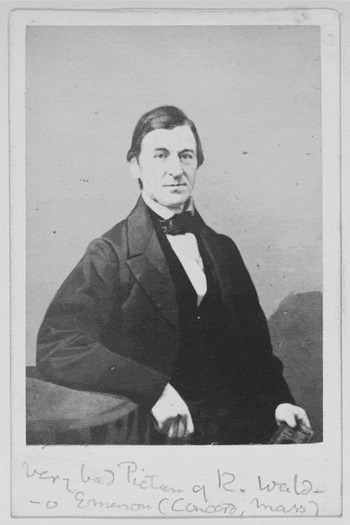
Both Thomas and Jane Carlyle were prone to experiencing this power of visible recall in portraits with a physical, and sometimes comical intensity. Jane fleetingly mistook a crayon sketch of her husband by Samuel Laurence for the real thing: “I saw it, all of a heap, in the mirror of my work-box, looking over my shoulder as it were – whereupon I gave a loud scream” (CLO JWC to TC, 18 Sept. 1838). More disturbingly, waking up to see another portrait of himself by Laurence at his mother's house, Carlyle made the same mistake: “[it] is staringly like . . . made me start every morning, when I saw it first, for a while” (CLO TC to JWC 6 Oct. 1847).Footnote 8 The degree of Carlyle's emotional and spiritual investment in portraiture's capacity to bring the sitter to life was far from unique amongst his contemporaries, but it was remarkable for its wilful attempt to bury scepticism. His essay on “The Portraits of John Knox” (1876), with its furious roll call of “inauthentic” images, and its preference for a dubious alternative, based on a purely circular physiognomical argument, demonstrates the capacity of his need for an accurate visualisation of the hero's face to override reason and evidence.Footnote 9 It also, of course, suggests the degree to which his faith in the consolatory power of the authentic portrait was dogged by awareness of the impossibility of portraiture as an unmediated form, and thus the impossibility of the resurrection that it promises. This sensitivity underlies the many instances in his letters of disproportionate responses to portraits of himself and of family and friends that are not considered good likenesses: “Scandalous blotch of a Portrait (so-called). . . . No more abominable blotch, without one feature of mind, was ever called by the name of a rational man.”Footnote 10 When he received a poor quality photograph of Emerson (Figure 2) it was not just a matter for disappointment, but for hyperbolic mourning:
Photograph of Ralph Waldo Emerson. From the Carlyle album no. 4. Annotated: “Very bad picture of R. Waldo Emerson (Concord, Mass.).” By permission of Columbia University Libraries.

This Image is altogether unsatisfactory, illusive, and even in some measure tragical to me! . . . Here is a genial, smiling energetic face, full of sunny strength, intelligence, integrity, good humour; but it lies imprisoned in baleful shades, as of the valley of Death; seems smiling on me as if in mockery, ‘Dost thou know me friend? I am dead, thou seest, and distant, and forever hidden from thee; – I belong already to the Eternities, and thou recognisest me not!’
Carlyle then begs Emerson to send instead “some living pictorial sketch, chalk drawing or the like, from a trustworthy hand.” In the meantime his observation of the “genial, smiling, energetic face,” and his use of prosopeia, reanimate his friend in a textual sketch that compensates for the photograph's deathly failure (CLO TC to Emerson 17 July 1846).Footnote 11
Carlyle's intense emotional, spiritual, and philosophic investment in portraiture, and the rebound between image and text that it entailed, were integral to his work as a biographer and biographical historian. Following common practice, several of his biographies were published with frontispiece portraits, but, whether or not this was so, the search for portraits was an important part of his preparation for writing.Footnote 12 As he wrote in his letter to Laing, proposing a Scottish National Portrait Gallery, “in all my poor Historical investigations it has been, and always is, one of the most primary wants to procure a bodily likeness of the personage inquired after; a good Portrait if such exists” (CLO TC to David Laing, 3 May 1854). His most treasured sources for Frederick the Great, for example, were not texts, but paintings of Frederick by Pesne and Graff (CLO TC to C. K. J. Bunsen, 3 Feb. 1853). His biographical writing contains detailed descriptions of the portraits he used as source material. It also includes Carlyle's own, eye-witness, word portraits of those he had personally known, most famously of Coleridge in his The Life of John Sterling, but also of Charles Lamb, Leigh Hunt, Edward Irving, members of his own family and many others (Sterling 52–62; Reminiscences 84–85, 138, 204, 211–12). His word portraits have long been singled out for admiration as virtuoso set-pieces, but these descriptive passages were not merely incidental features of his biographical method.Footnote 13 They were central to Carlyle's conception and practice of biography as, itself, a form of portraiture.
In his most important discussion of biography, the two-part essay, later entitled “Biography” and “Boswell's Life of Johnson” (1832), Carlyle defined it in a way that transcended narrow conceptions of literary genre.Footnote 14 Biography was “almost the one thing needful” in all the arts (CME 3: 45). It was that in culture which sought to know and sympathise with another human subject. As such, it was both a manifestation of human empathy (the biographer's capacity for an “open loving heart”) and an affirmation of the infinite and everlasting “Reality” of even the least significant human life (57, 56). It was, in fact, no less than the art of resurrection – a writing back into life.Footnote 15 At the root of this was the biographer's capacity to see another human subject and to convey that vision to others in words. Biography derived from the desire “not only to see into [another person]. . .but even to see out of him, to view the world altogether as he views it,” and it issued, at its best, in an “intense pictorial power,” a faculty of “vividly uttering-forth” . . . or “being ‘graphic’” (44, 57). The greatest of all biographies – Boswell's Life of Johnson – was so because it was an authentic, revivifying portrait:
. . . a picture by one of Nature's own Artists; the best possible resemblance of a Reality; like the very image thereof in a clear mirror . . . a more free, perfect, sunlit and spirit-speaking likeness than for many centuries had been drawn by man of man! . . . A full-length image of his Existence. (75, 85–86)
“Biography” both conceptualised and demonstrated biographical portraiture. In its second part Carlyle set out, himself, to recreate the presence of Boswell (“that cocked nose . . . those bag-cheeks, hanging like half-filled wine-skins, still able to contain more”) and Johnson (“[t]he purfly, sand-blind lubber and blubber, with his open mouth, and face of bruised honeycomb; yet already dominant, imperial, irresistible!”) (69–70, 93). However, the most fully-realised demonstration of Carlyle's argument in “Biography” was not in the essay itself, but in a closely-related text written concurrently in 1832: his remarkable private memoir of his recently deceased father, James Carlyle.Footnote 16 Here Carlyle describes his father as, like Boswell, a man with heroic powers of insight which are displayed in the pictorial power of his words: “[his words] conveyed the most perfect picture, definite, clear. . . . Nothing did I ever hear him undertake to render visible, which did not become almost ocularly so” (Reminiscences 6). Carlyle's memoir tries to resurrect his father by emulating his pictorial style. It is in diary form and creates a portrait of poignant immediacy, driven by the memory of his father's face and the desire to make that face visible again: “the thought of that pale earnest face which even now lies stiffened into Death in that bed at Scotsbrig . . . will certainly impel me” (6). Carlyle sketches and analyses his father's physiognomy, the upper part of the head noble, like Goethe’s, the mouth unrefined, “betokening depth, passionateness, force, all in an element not of languor, yet of toil and patient perennial Endurance” (17). But the portrait is not merely located in this emblematic image of a paradoxically heroic obscurity, it is the memoir as a whole, which seeks to recreate a complete, sensory and emotional impression of his father's physical “traces,” akin to that produced by the painting of his mother, not just seen outwardly and inwardly, but felt, like the tender pressure of his father's handshake at parting (5). In doing so, Carlyle is attempting, like Boswell, to see “into” and “out of” his subject. The memoir is patterned with imagery of reciprocal acts of seeing. He remembers giving his father a pair of spectacles and muses that he “no doubt sometimes thought of me in using them” (37). He strives to see his father again in his mind's eye so intensely that the impossible will be effected, and his father will be reborn in him: “I love to figure him . . . I have a dim picture of him. . . . I might almost say his spirit seems to have entered into me (so clearly do I discern and love him) . . .” (11, 28, 38).
Carlyle's essay on “Biography,” and even his memoir of his father, might be read as an Oedipal homage to Boswell, but, if there is authorial jostling here, it is relatively subtle. Elsewhere, Carlyle openly pitted his writing against the work of other biographers and biographical historians in order to assert his superior, pictorial power. His reminiscences of Jane Welsh Carlyle (1866) were written partly as a corrective to Geraldine Jewsbury's memoir which he found had “little of portraiture in it that satisfies me. On the whole, all tends to be mythical” (Reminiscences 66). He began both Cromwell (1845) and Frederick the Great (1858–66) by contrasting the true portraiture he aimed at to the existing Dryasdust history and biography that drowned the life of the subject in a voluminous chaos of textual record. Carlyle's aim in Cromwell was, instead, “to behold, if but in glimpses, the faces of our vanished Fathers,” and through his letters and speech, to see the authentic Cromwell “darkly face to face” (Cromwell 1: 3, 19). Frederick the Great was a riposte to earlier biographers, principally Voltaire, who partook of the falsity of their era. Not one of them, Carlyle claims, saw their subject face to face, or was able to produce the picture of him that Carlyle (in his persona as Sauerteig) calls for: an “actual natural Likeness, true as the face itself, nay truer, in a sense” (Frederick 1: 18). Carlyle was representing himself here as a biographical innovator, striving unaided to push the textual into another, visual dimension, to portray the physiognomy of a life, and in so doing, as fighting against the tide of previous biography and biographical history. In fact, the evidence suggests that, from an early stage, his work was deeply implicated in a contemporary culture of experimentation with the visualisation of presence in literary biography.
*
Carlyle's essay on “Biography” was written for Fraser's Magazine, where it ran alongside the “Gallery of Illustrious, Literary Characters” (1830–38), a series of eighty-one brief character sketches of famous, living literary men and women, mostly by William Maginn, each accompanied by, and commenting on, a portrait drawn by Daniel Maclise. Carlyle contributed an essay on Goethe to the series in March 1832, and in June 1833 he, himself, became a subject/sitter in the “Gallery.”Footnote 17 The identity of Fraser's Magazine was founded on its interest in literary celebrity and its creation of a coterie atmosphere in which, as Patrick Leary argues, readers were encouraged to form a “vicarious informal fellowship with some of the leading writers of the day” (Leary 112). Fraser’s “Gallery” has been described by David Higgins as an example of the transformation of “authorship into celebrity through a process of what might be termed ‘spectacularisation’” in the periodical press, whereby “[v]erbal and visual representations of certain writers as private individuals . . . helped to mark them out within a massively competitive literary marketplace and provided their readers with a sense of intimate connection” (Higgins, Abstract). It was part of a broader culture of literary biography which grew up, especially in the wake of Byron, where visual and verbal portraiture interacted to produce what Andrew Elfenbein has called a “simulacrum of intimacy” (Elfenbein 53).Footnote 18 In Fraser’s “Gallery” the sense of intimacy was encouraged by the informal, often domestic, poses of Maclise's line drawings, usually taken – as the text made clear – from life, by an artist who knew his sitters personally. (The images of Goethe and Carlyle, for instance, show both in outdoor dress, holding their hats, as if accosted in passing. Carlyle, his hair dishevelled and leaning his arm casually against a wall, locks eyes directly with the onlooker).Footnote 19 Maginn's text typically took the portrait as a starting-point from which to comment on the personality, life and (sometimes) the works of the writer. The tone was frequently facetious, with in-jokes, cross-referring to other articles in the series and elsewhere in the pages of Fraser’s, to produce the illusion of a close, literary community into which the reader was invited.
The thinly-veiled marketing of authors and the gossipy, often iconoclastic tone of the “Gallery” is the antithesis to Carlyle's philosophically rich and emotionally freighted conceptualisation and practice of biographical portraiture. Yet there is an affinity between the conception of authorship-as-personality that underpins the “Gallery” and his argument in “Biography” that an author's life is his greatest work. Maginn's creation of a dialogue between visual and verbal portraiture in his effort to produce each of his subjects as a fully visualised presence, also bears comparison with Carlyle's own techniques as a biographer. Maginn's characteristic starting-point is to exhort the reader to “look,” “behold” or “see” the subject who is positioned, as if in person, on the facing page: “On the opposite page sits William Jerdan, the Editor of the Literary Gazette, reduced from six feet high to as many inches – but still the very man. We defy pencil or engraver to produce a more wonderful likeness.” ([Maginn] Fraser’s 1.5 (June 1830): 605). The tone is satirical but the effort to create a sense of authentic presence through specific detail and thereby to draw the reader into the literary circle is concerted. These men are shown “as they actually look and talk and congregate into groups, at three-quarters past eight of the clock upon the evenings of Thursday on each week” ([Maginn], Fraser’s 5.27 (April 1832): 475). Maginn clearly admires biography that, with or without visual illustrations, delineates the subject exactly – his article on Lady Blessington praises her “Conversations” as “the mirror-reflection of Byron” ([Maginn], Fraser’s 3.39 (March 1833) : 267). Carlyle's insistence, in “Biography,” on the “Reality” of biography – “Do but consider that it is true; that it did in very deed occur!” – is both the product of a level of philosophical thinking quite alien to the “Gallery” and fully in keeping with its practice and praise of biography that visualises the subject (CME 3: 56).
Carlyle's own contribution to the “Gallery,” his essay on Goethe, demonstrates this ambiguity from its opening sentence: “Reader! Thou here beholdest the Eidolon of Johann Wolfgang Goethe” ([Carlyle] Fraser’s 5.26 (March 1832) : 206). Carlyle here follows the formula established by Maginn, exhorting the reader to look at Goethe's portrait as if it were the actual man, reduced in size and standing on the facing page. But the term “Eidolon” is clearly in a different register to the language of the other essays in the “Gallery,” and, as Richard Salmon points out, Carlyle invites the reader, in a move that is, again, not characteristic of the series, to find in the portrait, and in his description of Goethe's physiognomy, a visible symbol of Goethe's inner life (6). In his head, Carlyle tells us, “the whole world lies mirrored, in such clear, ethereal harmony, as it has done in none since Shakespeare left us” (Fraser’s 5.26 (March 1832): 206). This leads to a comparison between Goethe and Napoleon as the two great men of the age, one the agent of destruction, the other of light and creativity; and admonitions to the readers to follow the light, read their Goethe, and become “like a star, unhasting yet unresting” (206). Carlyle's creation of Goethe as a symbol of his age and a beacon to the reading public clearly expands on the usual scope of the “Gallery.” His determination to inspire reverence for his subject, rather than to provoke judgement, again, marks a difference from the majority of the character sketches in the series, which tend to invite the public to take a critical stance.Footnote 20 Indeed, Goethe's inclusion in this gallery of celebrity portraits is, immediately marked as anomalous at the essay's opening, where Carlyle, referring to the image on the facing page, imagines his subject's puzzlement (and implicitly his own) at finding himself in this company: “from Fraser's Gallery he looks forth here, wondering, doubtless, how he came into a ‘Lichtstrasse, lightstreet,’ or galaxy; yet with kind recognition of all neighbours, even as the moon looks kindly on lesser lights” (206). Yet, even as he questions the appropriateness of Goethe's presence here, Carlyle joins in the Fraser’s joke of imagining his subject bodily transplanted onto the page, and does so with a touch of humour that is fully in keeping with the series’ style.
The fact that Carlyle agreed to contribute his essay on Goethe and even, the following year, to appear, himself, as one of the “stars” in the Gallery, suggests that he was not averse to adapting the forms by which celebrity was created and disseminated, in order to redirect the public appetite for intimacy with celebrity towards a deeper communion with heroic presence. His decision to sit for Maclise initiated a lifelong pattern of conceding to requests for portraits of himself, despite repeated dissatisfaction with the results, and the possibility that his desire for a good portrait might be construed (as it was by some) as a sign of personal vanity.Footnote 21 He took the risk in return for the potential of celebrity portraiture to produce a visualised life-narrative that might recreate his own, heroic presence for the public and for posterity – as he wrote in his first proposal for an English National Portrait Gallery, “[s]uch Historical Men as have no credible Portraits left are, in many cases, themselves gone irretrievably inconceivable” (Wilson 40).
*
Carlyle's involvement with Fraser’s “Gallery” in the early 1830s, shows him working both against and within the emergent celebrity culture of his times, participating in a biographical experiment in the creation of a three-dimensional sense of presence through the interaction of image and text. In the early 1850s, we see him returning to an engagement with contemporary biographical portraiture, but this time in the form of a purely textual recreation of presence. Although this has not, as far as I am aware, been recognised, some of Carlyle's most important sources for his major published biography, The Life of John Sterling (1851) may have been literary portraits of Shelley produced in the 1820s and 30s by Mary Shelley in her editions of Shelley's Posthumous Poems (1824) and Poetical Works (1839), Hazlitt, in his essay “On Paradox and Common-place” (1821), and, to a lesser extent, Thomas Jefferson Hogg, in his essays on “Percy Bysshe Shelley at Oxford,” first published in the New Monthly Magazine (1832–33). Carlyle adapted these accounts of Shelley both in the way in which he framed his biography as an encounter with Sterling's presence, and in the language with which he evoked that presence. These literary portraits of Shelley were important to him in meeting a new biographical challenge: to create a public hero out of a personal friend. The Life of Sterling was conceived from the first as a portrait with a difference. It was, Carlyle wrote in a letter, “a very slight Book . . . a light Portrait, the truest I could easily sketch, of an unimportant but very beautiful, pathetic and rather significant Human Life in our Century: I found it a new kind of task” (CLO TC to Joseph Neuberg 25 July 1851). His words suggest an anxious anticipation that his book would be criticised as a lightweight biography of an obscure subject. John Sterling (1806–1844) was active in the literary world as a poet, critic, novelist, magazine editor and religious thinker. After his death he had achieved some notoriety for religious heterodoxy as a result of the biographical edition of his works produced by his former teacher and Julius Hare – the book to which Carlyle's memoir acted as a corrective. However, rather than attempting to make a case for the importance of Sterling's public achievements, his story, as told by Carlyle was one of repeated public failure – of a continually frustrated quest to find a career adequate to his “noble” character and aspirations – whether it was in radical politics, the Church, or poetry. In fact, Carlyle's Sterling, just like the Shelley depicted by Hazlitt, Mary Shelley, and Thomas Jefferson Hogg, was presented as a religiously controversial, political and poetic idealist, whose genius failed to issue in effectual action; a man who died young, his brilliant, child-like soul, too full of ardour and energy to be contained for long in a fragile body.Footnote 22 Carlyle's problem was, as Mary Shelley's and Hogg's had been, how to justify such a life to his public.
In his introduction Carlyle began this justification with another analogy between biography and portraiture:
I have remarked that a true delineation of the smallest man, and his scene of pilgrimage through life, is capable of interesting the greatest man; that all men are to an unspeakable degree brothers, each man's life a strange emblem of every man’s; and that Human Portraits, faithfully drawn, are of all pictures the welcomest on human walls. (Sterling 7)Footnote 23
The image of “Human Portraits . . . on human walls” compares biography to a private, domestic interior, hung with pictures of family and friends. The subjects of these pictures are obscure to all but their loved ones, but the power exerted by the portraits, as human life-stories, is universal. This domestic and egalitarian vision of heroism harks back to the sentiments in the memoir of his father, and defends Sterling on grounds that make his worldly successes or failures, in effect, an irrelevance. His heroism is inherent neither in his achievements nor in his lack of achievement, but simply in his presence as remembered by those who loved him. Carlyle develops this theme explicitly in his response to Hare's memoir, which, he argues, has falsified Sterling's life by focusing on his repudiation of the Church:
. . . nobody that had known Sterling would recognise a feature of him here. . . . A pale sickly shadow in torn surplice is presented to us here . . . who in this miserable figure would recognise the brilliant, beautiful and cheerful John Sterling, with his ever-flowing wealth of ideas, fancies, imaginations; with his frank affections, inexhaustible hopes, audacities, activities, and general radiant vivacity of heart and intelligence, which made the presence of him an illumination and inspiration wherever he went? (3)
The claim is that, in reading this biography, unlike Hare’s, we will be able, paradoxically, to recognise a man we have never met. Carlyle's literary portrait will produce an experience of Sterling's “presence” so genuine and so attractive that the controversies aroused by Hare's Life will be eclipsed by charm.Footnote 24
Carlyle's approach here may have been modelled on that taken by Mary Shelley in shaping the afterlife of her husband.Footnote 25 As I have argued elsewhere, Mary Shelley, motivated by personal loss and a desire to market Shelley's work posthumously, produced biographical prefaces and notes to her editions of her husband's work, that set out to “make him beloved” to a public hitherto alienated by his reputation as an atheist, sexual libertine, and political radical (North Reference North2010). She attempted to compensate for the perceived abstractions of his poetry and ineffectualness of his politics by reconstituting him biographically, assuring her readers that “to see him was to love him” (PP iv). Specific verbal echoes suggest that Mary Shelley's belief in what we might call “justification by presence” held a particular significance for Carlyle as an answer to the challenge of creating a heroic narrative out of an “unimportant” life. Mary Shelley's principal evidence for Shelley's stature in her 1824 edition, and again in 1839, was his uniquely powerful effect on those who knew him. To his friends he was
. . . as a bright vision, whose radiant track, left behind in the memory, is worth all the realities that society can afford. Before the critics contradict me, let them appeal to any one who had ever known him. To see him was to love him; and his presence, like Ithuriel's spear, was alone sufficient to disclose the falsehood of the tale which his enemies whispered in the ear of the ignorant world. (PP iv)
He died, and his place among those who knew him intimately, has never been filled up. He walked beside them like a spirit of good to comfort and benefit – to enlighten the darkness of life with irradiations of genius, to cheer it with his sympathy and love. (PW)
Mary Shelley's references here to radiance and to “presence” are reprised both in Carlyle's retort to Hare, quoted above, and in the moving, final paragraph of The Life of Sterling. Here, having argued for the emblematic and exemplary significance of his subject's life, Carlyle ends by justifying the memoir, as he had done at its opening, simply as the communication of a man's “human presence,” by someone who saw, knew, and loved him. Perhaps picking up on Mary Shelley's claim that “to see him was to love him” and on her image of friends who walked bedside Shelley, he writes:
Nay, what of men or of the world? Here, visible to myself, for some while, was a brilliant human presence, distinguishable, honourable and lovable. . . . among the million little beautiful, once more a beautiful human soul: whom I, among others, recognised and lovingly walked with, while the years and the hours were. (Sterling 268)
The echoes suggest that Carlyle may have taken the lesson from Mary Shelley's memoirs of her husband that any life, no matter how controversial or “unimportant” could be valued as a personal experience of a beloved human presence, and that to make this the basis of a biography was to create a defence that critics and the public as a whole would ultimately find unanswerable.Footnote 26
Yet, if the biography is framed as a life justified by presence, then the main body of the text presents a more complex and ambivalent portrait. The reading experience is quite different from that created in “James Carlyle.” In The Life of Sterling what Carlyle called the “Spiritual Portraiture” that constituted the biography as a whole was often not precisely visualised (Sterling 263). There were some verbal “sketches” of Sterling's appearance – including a description of a portrait of him as a child, Carlyle's first sighting of his friend as an adult, and, in the pattern established by Johnson and Boswell, a concluding chapter giving a lengthy account of Sterling's face, body, movements, and speech (28, 105–06, 262–63). But, for Carlyle, Sterling's presence is not easily to be captured in external description or in visual portraiture. He found all the visual portraits in some measure wanting. The medallion portrait chosen by Hare for his frontispiece, presented only a “superficial” likeness. Two, informal pencil sketches, one by his friend James Spedding, and the other (Figure 3) by the Irish artist and writer John Baynim, were truer to the original, “but these also I must suppress as inadequate for strangers” (263). Carlyle prefers to recreate Sterling's presence in an impressionistic language that dissolves the boundaries between visible and invisible physiognomy and mimics its subject's exhilarating, yet ineffectual, energy, through insistently repeated kinetic and elemental metaphors. He was a “volatile, swift and airy . . . being” (26)
John Baynim, “John Sterling.” Steel plate engraving after a painting by Benjamin Delacour (1830). The engraving may be of a salt print made by Sterling's father, Anthony Sterling, and is now in the English National Portrait Gallery. Reproduced by permission of the National Trust of Scotland.

. . . strange alacrity, rapidity and joyous eagerness looking out of his eyes, and of all his ways and movements. . . . the chief expression of his eyes and physiognomy was what I might call alacrity, cheerful rapidity. You could see, here looked forth a soul which was winged. (28)
Again, the imagery invokes literary portraits of Shelley. Both Hogg and Hazlitt described Shelley's idealism through similar tropes of movement and energy that, like Carlyle’s, suggested varying measures of sympathy and critique. Hogg's recollections of Shelley at Oxford were a sustained attempt at a “breathing, moving, speaking portrait” that vividly delineated the subject's face, voice, body and, especially his frenetic physical movements, to suggest a presence and a philosophy at once inspirational and exasperating.Footnote 27 While it is very likely that Carlyle had read Hogg's essays and had them partly in mind whilst composing his Life of Sterling, the evidence suggests that Hazlitt's much more critical essay was his immediate model.Footnote 28 In “On Paradox and Common-place” Hazlitt had represented Shelley as having wasted his energies in a ceaseless, exhausting, contrarianism: he was a man with “a hectic flutter in his speech . . . shrill-voiced . . . there is a slenderness of constitutional stamina, which renders the flesh no match for the spirit” (Hazlitt, Works 8: 148). Carlyle alluded to this when, in one of his letters, he described Shelley as a “weak . . . a poor thin, spasmodic, hectic, shrill and pallid being” – a ghost-like figure whose “inner world” was beautiful but void (CLO TC to Robert Browning, 8 March 1852). He echoed Hazlitt's words again in his description of Sterling, as a man whose soul was “imprisoned in a fragile hectic body” (Sterling 43). Carlyle's Sterling, like Hazlitt's Shelley, was surrounded by imagery of volatility, airy evanescence and, above all, restless physical and intellectual energy.Footnote 29 Where Hazlitt characterises Shelley as a type of the idealistic poet or reformer who “cannot stand still, he cannot rest upon any conclusion,” and whose experiments in morals and philosophy are “the coruscations of an Aurora Borealis, that ‘play round the head, but do not reach the heart’” (Hazlitt, Works 8: 148–49), Carlyle writes of Sterling that he was a far-darting restlessly coruscating soul” (43), who projected himself “in aerial pulses like an aurora borealis,” and that he was “fatally incapable of sitting still. Rapidity, as of pulsing auroras, as of dancing lightnings; rapidity in all forms characterised him” (Sterling 123, 155). Carlyle associates this dazzling quality with Sterling's optimism, and his ability to spread cheerfulness, even when he, himself was suffering. But the imagery of light and restlessness also suggests, as it does it Hazlitt's essay, the insubstantiality of his achievement.
Through its insistent imagery of futile motion and wasted energies, Hazlitt's essay linked a critique of Shelley, his poetry and politics, to a broader critique of the spirit of the age. Carlyle's method in the Life of Sterling was also to expand his portrait of an “unimportant” life through a network of metaphor that projected Sterling's face on a panoramic scale, and in so doing to question the idealism that both defined and damaged Sterling and his times. In a way that bears similarities to the language and approach of The French Revolution, but refocused on a single life, Carlyle's imagery, of light, water, air, and rapid, fluctuating motion radiates reciprocally, from and to Sterling's body and his world to create, in the portrait of an individual, the portrait of an age. Thus the “volatile, swift and airy” Sterling has a schooling typified by “excessive fluctuation” (26), as his father, “Captain Whirlwind” (11), seeks new directions in his career. Coleridge, his early mentor and the presiding evil genius of the biography, is differentiated from Sterling by the flabby stagnation of his body and mind, but also connected to his disciple through imagery of watery weakness and indecisive movement.Footnote 30 On a broader scale, the physical and mental fluctuations of Sterling, his family and his circle, are reflected in the political and social movements of their times, whether Napoleon's escape from Elba – an event which sets “all the populations of the world in motion” (26) – or in the 1820s when “The Reform bill already hung in the wind” (51). The airy rapidity of Sterling's physical body and inner life are also writ large in the unsettled weather of the landscapes he inhabits, climactically in the hurricane on his sugar estate at St Vincent, where he hears of the catastrophic conclusion of his radical idealism in the death of his democrat friends in Spain – news which internalises the literal tempest he has just lived through in “one grand whirlwind of repentance” (90). Whilst Carlyle is never as attacking of Sterling as Hazlitt is of Shelley, Hazlitt's Shelley hovers in the tropes of light, wind, and fluctuating motion with which he and his environment are linked, as an implicit example of the damaging potential of idealism, matching the lowering presence of Coleridge.
Arguably, Carlyle's engagement with Mary Shelley on the one hand, and Hazlitt on the other, in his Life of Sterling, contributed importantly to the substance of his portrait of Sterling and the language in which his presence was evoked. They were also significant factors in creating an unresolved tension between the way in which the biography was framed and the way in which it unfolded. The frame, possibly following Mary Shelley, promised a wholly sympathetic experience of presence akin to that encouraged by “James Carlyle” or the essay on Goethe, while the presence of Sterling restored in the body of the text, like the descriptions of Shelley by Hogg and Hazlitt, invited the public to temper sympathy with judgement.Footnote 31 This was a comparatively rare moment in Carlyle's career as a biographer, when, albeit in a qualified sense, he solicited a critical response to heroic presence. It was a position he moved quickly away from in his next venture into biographical portraiture.
*
The years immediately following the publication of The Life of Sterling saw something of a crisis in Carlyle's biographical practice, but one that resulted in his most ambitious and influential project in biographical portraiture: his proposals for a National Portrait Gallery. The first proposal, for an English gallery, was addressed to Lord Ashburton in September 1853.Footnote 32 This remained private, but, in May 1854, he reshaped it as a proposal for a similar, Scottish institution, in a letter sent to the Scottish Antiquarian, David Laing, and written for publication (CLO TC to David Laing, 3 May 1854).Footnote 33 In 1856, following a report of the letter's contents in the Athenaeum, Lord Stanhope read extracts from it in the House of Lords, in support of his Motion for the establishment of a National Portrait Gallery in London (“Historical Portraits”; Hansard 4 March 1856). The founding principles of the Gallery, which opened in 1859, closely followed the blueprint of Carlyle, who was also invited to sit on the Board of Trustees. Carlyle's influence on the Gallery is well-known, but there has been little attention to the strong links between his proposals and his work as a biographical portraitist. In this final section I want to argue that we should see his proposals as a materialisation of his practice of biographical portraiture and his career-long interest in portrait gallery publications. However, the proposals also embody a new sense of tension between text and image in Carlyle's biographical work and, with the ascendancy of the image, a reaction against the complexity of public response to the portrait of the hero encouraged by his Life of Sterling.
The English National Portrait Gallery was an institution rooted in a textual culture of biographical history. Marcia Pointon and Eilean Hooper-Greenhill rightly see publications such as Granger's Biographical History of England (1769–74) and William Jerdan's National Portrait Gallery of Illustrated and Eminent Personages of the Nineteenth Century (1830–34), as important forerunners (Pointon 228; Hooper-Greenhill 30).Footnote 34 Hooper-Greenhill argues that “these two-dimensional portrait galleries of national heroes and local notables and worthies opened a space of semiosis that would be more fully developed in a three-dimensional way by the National Portrait Gallery and its collections” (30). Carlyle's proposals provide more specific evidence of the connections between literary and material cultures of biographical portraiture in the founding of the Gallery, and of the move from two to three dimensions. We have seen his early interest in the attempt to reconstitute literary celebrities as three-dimensional presences on the pages of Fraser’s textual “Gallery,” and we can see his debts to historical as well as literary biographical portrait gallery publications emerging in his larger project as a biographical portraitist. Richard Salmon conjectures that the lectures “On Heroes and Hero Worship” might be considered “Carlyle's own metaphorical portrait gallery . . . perhaps written in response to the meretricious illumination and ‘vulgar iconoclasm’ of Fraser’s ‘Gallery’” (Salmon 8–9).Footnote 35 But it seems likely that Carlyle had the portrait gallery genre more generally in mind as a model for his lectures. Publications such as Granger's and Jerdan's were far from Carlyle's biographical style in many respects – their narratives typically stiff, conventional and uninterested in the inner lives of their subjects. They also tended to avoid commenting on the portraits and were, in this respect, more alien to Carlyle's own biographical practice than the Fraser’s “Gallery.”Footnote 36 Nevertheless, such publications seem to have influenced him, from an early stage in his career, as popular examples of national history conceived not only as “the essence of innumerable biographies,” but as a collection of visual and verbal “portraits” that, as Hooper-Greenhill argues of the London Gallery itself, worked to “legitimate” the nation as an “imagined community” of the portrayed and the viewing public (28).Footnote 37 As originally conceived, in the 1820s, Carlyle's edition of Cromwell's letters was to be a portrait gallery of Civil War history, although, already adapted to a more psychologically rich form of portraiture: “to exhibit if I can some features of the national character as it was then displayed, supporting my remarks by mental portraits, drawn with my best ability, of Cromwell, Laud, Geo: Fox, Milton, Hyde &c.” (CLO TC to Alexander Carlyle, 27 April 1822). In “On Heroes” Carlyle takes the basic premise of the form and expands it – to form a collective biographical history that transcends the usual national, social, and temporal boundaries. Although the lectures, as first published, contained no images, the text celebrated the visual sense as the primary means to insight: the defining heroic quality of seeing through the appearances of the world – and especially of men – to the divine idea, of which those appearances were emblematic: “it is in what I called Portrait-painting, delineating of men and things, especially of men, that Shakespeare is great. . . . The thing he looks at reveals not this or that face of it, but its inmost heart, and generic secret” (Heroes 147).
Because, for Carlyle, worship occurs through “things seen,” the lectures themselves become an act of worship through a shared experience of looking (104). He repeatedly invites his audience to “look” upon the men he himself is looking at, and sometimes pauses to demonstrate his own “Portrait-painting” powers in descriptions of heroic physiognomy. The verbal sketches he produces of Luther, Johnson, Rousseau, and especially of Dante (based on the Giotto portrait) suggest the affiliations between the lectures and other portrait gallery publications, but within a transfigured understanding of the genre in which, by looking at great men, the public will gain insight into the invisible “heart of things,” for “[c]ould we see them well we should get some glimpses of the very marrow of the world's history” (302, 2).Footnote 38
The proposals for a National Portrait Gallery were the clearest embodiment of Carlyle's interest in portrait gallery publications. He had written to Laing in 1841 with a proposal for a textual portrait gallery of “Scottish Heads,” “better” than Lodge's popular Portraits of Illustrious Personages of Great Britain (CLO TC to David Laing, 2 April 1841). By 1853–54 his idea had evolved into an institution that would materialise his own conception and practice of history as collective biography, through which the reader made human contact with the past. The Gallery would contain only genuine portraits, contemporary with the sitter, giving “the actual likeness of the man” (CLO TC to David Laing 3rd May 1854). It would eschew the dangers of celebrity by only containing portraits of those who had been dead for at least twenty-five years, and whose fame had thus stood the test of time. By looking at such images of the national heroes, he argued, the public would feel them, as “Historical realities,” and thus find a genuine sense of community with their national history (CLO TC to David Laing, 3 May 1854). In his earliest version of the proposal, the public response to the portraits is also described in terms borrowed from his “Lectures on Heroes and Hero Worship” as a “kind of real Pantheon . . . or Home of all the National Divinities, for these our Historic Heroes are, where unconsciously but very veritably, the better parts of the soul of all might worship” (Wilson 41). This vision of the National Portrait Gallery as a secular church of heroes lends support to the argument that Carlyle's lectures were conceived as a version of the biographical portrait gallery genre, which is here, conceptually, projected back into a third dimension (a “real Pantheon”) so that the metaphorical space of reading becomes a physical space through which the public can wander, and within which they can pay homage. Yet the “real Pantheon” also suggests the comparative inauthenticity of textual portraiture. This is a concern that pervades and drives the proposals. It derives from Carlyle's immediate source of inspiration for his National Portrait Gallery project: his troubled experience as a biographical historian, researching Frederick the Great. Footnote 39
In all versions of the National Portrait Gallery proposals, Carlyle traces his idea to the time in Berlin in 1852 spent looking for, and failing to find, authentic portraits of Frederick, as a way of getting started on his biographical history.Footnote 40 His point is that London, like Berlin, needs a national portrait gallery, both as a resource for biographers and historians such as himself and, more importantly, for the general public, who need to see their national heroes in order truly to know them. But the proposals also express Carlyle's deeper frustration with Frederick the Great, as a project which had brought home to him not just the problems involved in gaining intimate knowledge of his particular hero, but the more general difficulty of textual access to authentic human presence. His Life of Sterling was written on the basis of direct, personal knowledge of the subject, easily and pleasurably, in a matter of weeks. Frederick the Great, by contrast, required Carlyle to wade through thousands of pages of German history in a seemingly never-ending quest to form an image of a subject who would always remain remote. He had barely begun writing his book in the months leading up to his first proposal for a National Portrait Gallery, but his letters are full of complaints, not only about the problem of finding genuine portraits of Frederick, but about the life-sapping experience of his literary researches in Dryasdust German sources. As he wrote to his brother in . . . he had lost faith in Frederick the Great not just because it seemed a subject with no boundaries, but, more seriously, because he did not “love” Frederick as he should (CLO TC to John A. Carlyle, 20 May 1853). The contrast with the relationship to the subject of his Life of Sterling could not be plainer.
Pesne's portrait of Frederick as a child, “The Little Drummer,” showing, as Carlyle saw it, a “face and eyes full of beautiful vivacity and child's enthusiasm,” became of seminal importance to him as “one of the very few visualities or definite certainties we can lay hold of . . . and bring conclusively home to our imagination, out of the waste Prussian dust-clouds of uninstructive garrulity which pretend to record them for us” (Frederick 1: 372, 374). His own struggle in the book was to emulate Pesne and rescue Frederick and his court from the deathly sediment of the written record in a biography that would be “the physiognomy of Friedrich and his life,” and to invoke this last of kings as the “Reality” that Carlyle maintains he was – a man who stood out from the prevailing falsity of his age in his heroic sincerity (15, 14). In what became the most famous and influential passage from the letter to Laing, after it had been quoted by Stanhope in the House of Lords, Carlyle alluded to the shortcomings of the German source material for Frederick the Great, and, perhaps, to his fears of where he himself might fail as Frederick's biographer, when he wrote that
Often I have found a Portrait superior in real instruction to half-a-dozen written ‘Biographies,’ as Biographies are written; – or rather, let me say, I have found that the Portrait was as a small lighted candle by which the Biographies could for the first time be read, and some human interpretation be made of them; the Biographied Personage no longer an empty impossible Phantasm, or distracting Aggregate of inconsistent rumours – (in which state, alas his usual one, he is worth nothing to anybody, except it be as a dried thistle for Pedants to thrash, and for men to fly out of the way of),–but yielding at last some features which one could admit to be human. (CLO TC to David Laing, 3 May 1854)
The passage shows Carlyle's dissatisfaction with the limitations of biographical portraiture as a means of human encounter, and leads to a statement of faith in the superior authenticity of the visual medium. Here the textual portrait does not produce the body of the subject, but a deathly vacuity: “an empty impossible Phantasm, or distracting Aggregate of inconsistent rumours.” The equation in this sentence between loss of presence and historical controversy is telling. It is a sleight of hand that becomes more fully exposed in the letter to Lord Ashburton, in a passage where he ventriloquises the thoughts of an imaginary visitor to the Hampton Court Gallery, contemplating a Holbein portrait of Henry VIII:
Well! And this again is big Hal, that murdered all his wives? This prosperous massive-looking bright-eyed squire, done in little by Holbein, here in the Hampton Court Gallery? What, this? Why, this seems a gallant royal-looking fellow, and I am mistaken is there not a jolly ringing laugh in him; and on the whole a good deal of fire, insight, generosity, and other kingly strength and worth in the inner man of this one; – and perhaps the great Dr. Dryasdust has a little misled me as to the record of this one? – Perhaps! (Wilson 41)
Here the veracity of text is in conflict with the authenticity of the image. Of course Henry VIII did not in “fact” murder all his wives – this is a false memory, which Carlyle introduces as a testimony to the failure of the Dryasdust historians to disseminate the truth. But even the actual fact that Henry murdered two of them, is no longer relevant, once the public has experienced a direct, visual encounter with the king's portrait. Despite Carlyle's qualifiers (“seems,” “perhaps”), the feeling produced in the gallery visitor by Henry's magnetic, heroic masculinity shifts the focus from his crimes to the “kingly strength and worth” testified to by his physiognomy – and Carlyle reinforces the potency of presence by animating the portrait, imagining it issuing forth in a “jolly ringing laugh.” Thus the public experience of meeting (as it were) the king, overrides what is here represented as the unfeeling and untrustworthy historian/biographer, who judges him on his actions, as set down in textual record. It is a passage that humorously exposes the dangers of hero-worship, but which nevertheless falls victim to its seductions. Carlyle's Life of Sterling is also framed as an unanswerable experience of human presence, but the reader of this biography, unlike the gallery visitor imagined by Carlyle, is offered a portrait that entails critical perspective. Where both The Life of Sterling and “James Carlyle” embody an egalitarian model of “Human Portraits” on “Human Walls,” pulling the reader into an emotional fellow-feeling with the heroism of obscure lives, the imagined encounter with Henry VIII celebrates the capacity of pictured presence to forestall and silence dissent from the embodied power of Church and State. Carlyle envisaged the English National Portrait Gallery as an aristocratic institution, based exclusively on country house collections, and with Prince Albert at its head (Wilson 43, 45). It was not merely an institution that would, as Eilean Hooper-Greenhill has argued of the Gallery itself, embody an “articulation of the right to power” (29), but veered further away from the ideal of a publicly-accountable foundation than the Gallery itself, in practice, ever did. Even though his public letter to Laing, reflecting the Scottish context, proposed a gallery hung with portraits of whoever lived in the memories of the Scottish people, rather than chosen by the ruling classes – it still assumed a mysterious consensus as to who those heroes would be and an unproblematic experience of communal veneration in the visitors (CLO TC to David Laing, 3 May 1854). His imagined encounter between the visitor and the Holbein portrait may be taken as indicative of his conception of the portrait, in this context, as an ultimately unanswerable instrument of power.
In his proposals for a National Portrait Gallery, Carlyle was happy to substitute the relative certainty of the iconic image for the complex experience of presence that had unfolded in the narrative of The Life of Sterling. Yet, despite Carlyle's stated preference, in 1854, for portraits over biography or biographical history, he, of course, continued to produce biographical portraits, not only in the fragmentary visualisations that punctuate Frederick the Great, but in his private “Reminiscences” of Jane Carlyle (1866) and Edward Irving (1866–67), in which he rediscovered his capacity for luminous visual description. It is telling that, with all his invective against Dryasdust history, he could not imagine his National Portrait Galleries as text-free – although he wanted the catalogue biographies boiled down to the “uttermost very marrow,” they should still be there to accompany the pictures (as they were when the Gallery opened in London) (CLO TC to David Laing, 2 May 1854). The draft of the famous passage read out by Stanhope also shows some uncertainty about the hierarchy of the visual over the textual, as Carlyle moves from biography to painting, to autograph in his search for an ever more intimate human contact: “Next to a Portrait of the Person are perhaps autograph genuine and with Autograph Letters whh are a stamp or impress of the: the directest impressions one can hope to get of the man” (CLO TC to David Laing, 2 May 1854). The broken sentence strives after what Carlyle seeks throughout his career as a biographer: the “stamp,” the “impress” the “directest impressions” of the man. The metaphors suggest a text that has become material and received the shape of a body – in this case the body that writes. It is a sense of immediacy that, Carlyle argues here, biography has failed in, but neither is it fully present in a painted image, or he would not have to seek out the autograph hand. Rather than finding the “impress” of the subject in either visual or biographical portraiture, Carlyle here demonstrates an intuition displayed in different ways within “James Carlyle,” The Life of Sterling, and in his various adaptations of the portrait gallery genre: that the nearest he will come to experiencing authentic, unmediated presence is in the attempt to bring textual and visual forms of mediation into dialogue with each other.