Introduction
Awasthi (Reference Awasthi1984, Reference Awasthi1988) published the first comprehensive treatments of Hypogymnia in India, but the genus has since received only sporadic attention in India and Nepal. Elix & Jenkins (Reference Elix and Jenkins1989) provided chemical and morphological data for several species from the region. Singh (Reference Singh, Mukerji, Chamola, Upreti and Upadhyay1999) reported six species from the eastern Himalayan region, including three from Sikkim, two from Nagaland, one from Manipur, and one from Darjeeling. Sinha (Reference Sinha, Mukerji, Chamola, Upreti and Upadhyay1999) listed four species from Sikkim. Sinha & Elix (Reference Sinha and Elix2003) described H. sikkimensis from one site in Sikkim. Upreti & Divakar (Reference Upreti and Divakar2008) reported H. hengduanensis as new to India, the first of the Chinese species with rimmed holes (McCune et al. Reference McCune, Martin and Wang2002) to be reported south or east of China. McCune (Reference McCune2012) corrected the concepts of H. delavayi and H. alpina, based on examination of the types, such that H. delavayi is no longer accepted for India or Nepal.
Recent compendia of Indian lichens have included 13 species of Hypogymnia (Awasthi Reference Awasthi2000), and then 14 species (Awasthi Reference Awasthi2007). In the latest checklist for India, Singh & Sinha (Reference Singh and Sinha2010) reported 15 species, while Aptroot & Feijen (Reference Aptroot and Feijen2002) reported seven species from Bhutan, and Baniya et al. (Reference Baniya, Solhøy, Gauslaa and Palmer2010) reported three species from Nepal.
Our understanding of Hypogymnia in northern India and Nepal suffers from patchy collections. Although we still lack sufficient information to present a thorough treatment, we take this opportunity to resolve a few taxonomic problems in the genus, report species new to the region, and provide a key to species known from the area.
Methods
We applied standard microscopy and chemical spot test methods. Many specimens were subjected to thin-layer chromatography (TLC), using the standard methods of Culberson (Reference Culberson1972) and reference tables of Chicita Culberson (1996, unpublished). Fragments of specimens were extracted in acetone at room temperature, spotted on aluminum-backed silica gel plates (Merck 5554/7 Silica gel 60 F254), run in solvent systems A and C of Culberson (Reference Culberson1972), lightly brushed with 10% H2SO4, and charred in an oven at 100°C. No attempt was made to distinguish chloroatranorin from atranorin.
Key to Species of Hypogymnia in India and Nepal
Species not yet known from northern India and Nepal, but known from adjoining regions in Asia, are indicated by square brackets […].
-
1 Lobes solid; soredia absent ... H. mundata
Lobes hollow; soredia absent or present ... 2
-
2(1) Thallus isidiate, the isidia sometimes degrading into soredia ... Group 1
Thallus lacking isidia, sorediate or not ... 3
-
3(2) Thallus yellowish green (containing usnic acid, always lacking atranorin); lobes broad, mostly >2 mm wide ... Group 2
Thallus colour various (with or without usnic acid, always with atranorin), lobes broad or narrow, but if lobes >2 mm broad then not yellowish ... 4
-
4(3) Thallus sorediate ... Group 3
Thallus lacking soredia, isidia, and laminal lobules, though sometimes with lateral bud-like branches that resemble lobules ... Group 4
Group 1—Isidiate
-
1 Holes (perforations) in lower surface with a raised rim; isidia cylindrical, clavate, or pear-shaped; diffractaic acid present, physodic acid lacking (KC−) ... H. hengduanensis
Holes in lower surface with an even rim, not or only slightly raised ... 2
-
2(1) Thallus containing usnic acid in addition to atranorin, physodic acid lacking (medulla KC−) ... H. sikkimensis
Thallus lacking usnic acid, containing atranorin and physodic acid (medulla (KC+ orange or red); isidia roundish to bursting (pustular) or cylindrical, often compound or branched; physodic acid present; lobes nearly contiguous to separate; isidia laminal and marginal; branching typically frondose with dense, narrow, perpendicular side lobes. Corticolous; reported from Sri Lanka, southern India, Papua New Guinea, Java, North Borneo, Phillipines, but not known from the Himalayan region ... [H. pectinatula and H. zeylanica]
Group 2—Thallus large and yellowish, containing usnic acid
-
1 Soredia absent ... H. flavida
Soredia present, often on the edges of detaching corticate flakes (schizidia) ... H. hypotrypa
Group 3 — Sorediate
-
1 Soredia lining burst lobe tips ... 2
Soredia laminal or terminal, but not lining burst lobe tips ... 4
-
2(1) Lower surface entire, lacking roundish holes; lobes usually without perpendicular adventitious side branches; solarized thalli blackish or greyish rather than brownish-melanized. Apparently rare in India ... H. physodes
Lower surface and lobe tips with roundish holes; lobes sometimes with perpendicular adventitious side branches; solarized thalli with brownish to dark brown upper surface ... 3
-
3(2) Medulla P+ orange; lobes typically short and broad (internodes c. 2–5(9) mm long; lobes (0·7)1·5–3(4) mm broad) ... H. subarticulata
Medulla P−; lobes generally elongate and slender, rarely >2 mm broad ... H. vittata
-
4(1) Soredia initially developing along edges of flakes of cortex on the upper surface, becoming schizidiate, the upper cortex plus algal layer detaching as flakes, often with sorediose edges; 3-hydroxyphysodic acid present (medulla K+ reddish brown) ... H. pseudobitteriana
Soredia otherwise, not derived from cortical flakes, derived from erupting isidia-like warts or the cortex dissolving into a mass of powdery or granular soredia; 3-hydroxyphysodic acid present or not (medulla K+ reddish brown or K−) ... 5
-
5(4) Lobes becoming separated, suberect or erect; branching mainly isotomic dichotomous; upper surface pale mineral grey or pale greenish grey, lobe tips sometimes slightly browned before soredia emerge ... H. tubulosa
Lobes contiguous, appressed; branching anisotomic in part; upper surface pale greenish grey to more often pale to dark brown ... 6
-
6(5) Soralia partly or wholly terminal, often on small upturned side lobes, sometimes on the main lobes; lobe tips often sparsely perforate ... H. bitteri
Soralia mainly laminal, sometimes on the tips of main lobes, but not terminal on small side lobes, coarsely granular to powdery; lobe tips imperforate except where eaten by herbivores or otherwise damaged ... H. austerodes
Group 4—Isidia and soredia absent
-
1 Disc usually pruinose; lobe tips and axils with rimmed holes; thallus with hypoprotocetraric acid, zeorin, usnic acid, and atranorin ... H. crystallina
Disc epruinose; lobe tips and axils with holes that do not have a differentiated raised rim ... 2
-
2(1) Upper cortex readily solarized to dark brown or blackish, only very shaded individuals pale greenish grey; substratum commonly soil, rock, alpine sod, wood, and bark; medulla P+ orange-red (physodalic acid) or P− ... H. alpina
Upper cortex usually pale greenish grey, rarely solarized to dark brown or blackish under extreme exposure; substratum usually bark or wood; medulla always P− (physodalic acid lacking) ... 3
-
3(2) Upper surface becoming distinctly verrucose; adventitious buds abundant; lobes strongly pinched-and-swollen (i.e. with alternating constrictions and swellings) ... H. wattiana
Upper surface smooth to slightly rugose ... 4
-
4(3) Lower surface and axils with sparse, large holes; lobes commonly >2 mm broad, though slender lobes may be present; perpendicular adventitious branches sparse or lacking ... H. thomsoniana
Lower surface and axils with frequent holes that are small or large; lobes mostly slender (<2 mm broad); perpendicular adventitious branches frequent ... 5
-
5(4) Holes in lower surface frequently offset from the midline of the lobe, sometimes lateral, and sometimes forming a staggered series near the lobe tips; soredia absent; apothecia and pycnidia frequent ... H. irregularis
Holes in lower surface±centred on the midline of the lobe, usually just a single hole centred on the lobe tip or axil with few or no holes in the internodes; soredia usually present with careful searching; apothecia and pycnidia typically absent ... H. vittata
The Species
In the following synopses, more detail is given for species whose concepts are being revised here. Type specimens are listed only for Asian species.
Hypogymnia alpina D. D. Awasthi
Kavaka 12(2): 1. (1984); type: India, Uttar Pradesh, Uttarkashi District, Gomukh area, 6th moraine, 3750 m, on twigs of scandent shrubs, Awasthi & Singh 8567B (LWG!).
Synopsis. Thallus loosely appressed, with separate, rarely contiguous lobes; brown to dark brown, uniformly blackening or blackish mottled, holes in lobe tips occasional to frequent, appressed to suberect, cavity white above and dark below or tan to grey above and below; isidia and soredia absent.
Chemistry. Atranorin and physodic acids, usually (75% of 40) with physodalic and protocetraric acids, with accessory 3-hydroxyphysodic acid (55%); medulla K− or K+ slow reddish brown, KC+ orange-red, usually P+ orange, sometimes P−.
Substratum. Commonly on soil and rock, also on bark and wood; subalpine and alpine.
Distribution. Northern India, Nepal, Sichuan, Tibet, and Yunnan. The species apparently occurs along the whole length of the Himalayas, from the western Himalayas through Nepal to the eastern Himalayas, and extending into the Hengduan Mountains of Sichuan and Yunnan.
Discussion. Previously confused with H. delavayi, but H. alpina is morphologically unrelated to that species (McCune Reference McCune2012).
Selected specimens examined. See McCune (Reference McCune2012).
Hypogymnia austerodes (Nyl.) Räsänen
Ann. Bot. Soc. Zool.-Bot. Fenn. Vanamo 18(1): 13 (1943).—Parmelia austerodes Nyl., Flora 64(33): 537 (1881).
Synopsis. Thallus forming rosettes, with appressed, contiguous lobes, readily solarizing to brown, with laminal granular to isidiose soredia; lobes imperforate.
Chemistry. Atranorin, physodic acid, and accessory 3-hydroxyphyodic acid; medulla K+ slow red-brown or K−, KC+ orange-red, P−.
Substratum. On bark, wood, tundra sod, or mosses or detritus over rock.
Distribution. Widespread in the Northern Hemisphere, tundra to boreal and montane; rare in SW China and Himalayas. The report from Sikkim, India (Divakar 3849, Upreti & Divakar Reference Upreti and Divakar2008) is redetermined here as H. bitteri.
Discussion. The propagules of H. austerodes are quite variable, most often corticate granules that gradually degrade into soralia. Sometimes expanded laminal lobules or finger-like isidia are formed. All tend to have the cortex disintegrating eventually, but some specimens may have persistently corticate lobules. In H. austerodes, broken or abraded marginal lobules or isidia simulate H. bitteri, but there are no true terminal soralia in H. austerodes, except where laminal buds develop terminal soredia. A problematic form has laminal and marginal isidia and lobules that develop sorediate tips. Specimens of this form that have sparse holes in the lobe tips are H. bitteri, while imperforate forms may be best assigned to H. austerodes. See Hansen & McCune (Reference Hansen and McCune2010) for further comparisons of H. austerodes and H. bitteri.
Selected specimens examined. India: Uttaranchal: 16 km SE of Gangotri, Tabovan, 30°54′N 79°6′W, on rocks, Tibell 22033 (UPS).
Hypogymnia bitteri (Lynge) Ahti
Ann. Bot. Fenn. 1: 20 (1964).—Parmelia bitteri Lynge, Stud. Lich. Flora Norway, p. 138 (1921).
Synopsis. Thallus forming rosettes; lobes contiguous, appressed solarizing to brown, with terminal and laminal soralia; similar to H. austerodes but with soralia on short, narrow upturned lateral lobes and often with small holes in the lobe tips.
Chemistry. Medulla K+ slow red-brown or K−, KC+ orange-red, P−; typically containing atranorin, physodic acid, and accessory 3-hydroxyphsodic, 2′-O-methylphysodic, and vittatolic acids. Upreti & Divakar (Reference Upreti and Divakar2008) reported vittatolic acid as a submajor compound in a specimen from India (as H. austerodes), but did not report 3-hydroxyphysodic acid.
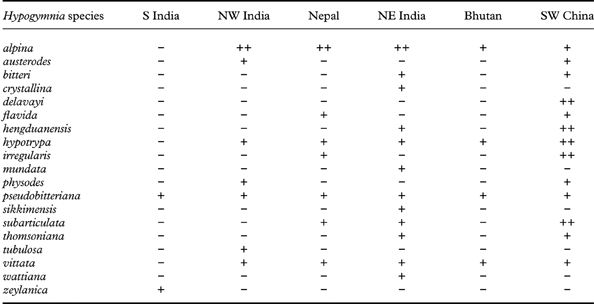
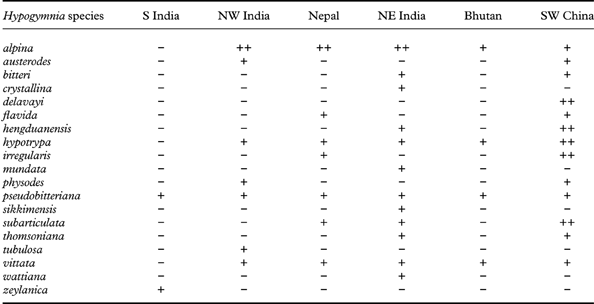
Hypogymnia species in India and Nepal and their occurrences from west to east along the Himalayas to the Hengduan Mountains of China; “+” indicates presence; “++” indicates common occurrence and the area of peak frequency within its range. Records from Bhutan are partly based on Aptroot & Feijen (Reference Aptroot and Feijen2002), the specimens not seen by us. Species other than H. delavayi that occur in the Hengduan Mountains of China, but not in India or Nepal are not shown
Substratum. On alpine sod or soil, bark, and wood; the sole known specimen from India (Divakar 3849) was on soil.
Distribution. Widespread but rare in the high mountains of southern Asia, more common northward in Asia, Europe and North America.
Discussion. The best diagnostic character for H. bitteri is the presence of short, narrow, upturned lateral lobes tipped with small soralia. These occur with or without larger terminal soralia or laminal soralia. In contrast, H. austerodes typically has only laminal soralia. Occasionally, however, H. austerodes has terminal soralia, but usually these are restricted to the larger lobe tips and they are accompanied by extensive laminal soredia.
Selected specimens examined. India: North Sikkim: Kalep, before Thanngu, 2004, 3900 m, Divakar & Upreti 04-003849 (LWG, duplicate in MAF).
Hypogymnia crystallina McCune, Divakar & Upreti sp. nov.
MycoBank No: MB 564553
Thallus with congested apothecia and short lobes with rimmed holes in axils and lobe tips and frequent budding; discs often whitish pruinose; epithecium with superficial POL+ crystals.
Type: India, Arunachal Pradesh, West Kameng District, 7 km before Sela, on Cedrus deodora twigs, 12 November 2008, D. K. Upreti 08-009390A, with U. Dubey, R. Khare & G. Mishra (LWG—holotype). [Although coordinates are not given on the packet label, the approximate location is 27·505°N, 92·109°E. As Sela Pass is at 4200 m, this location must be at a somewhat lower elevation.]
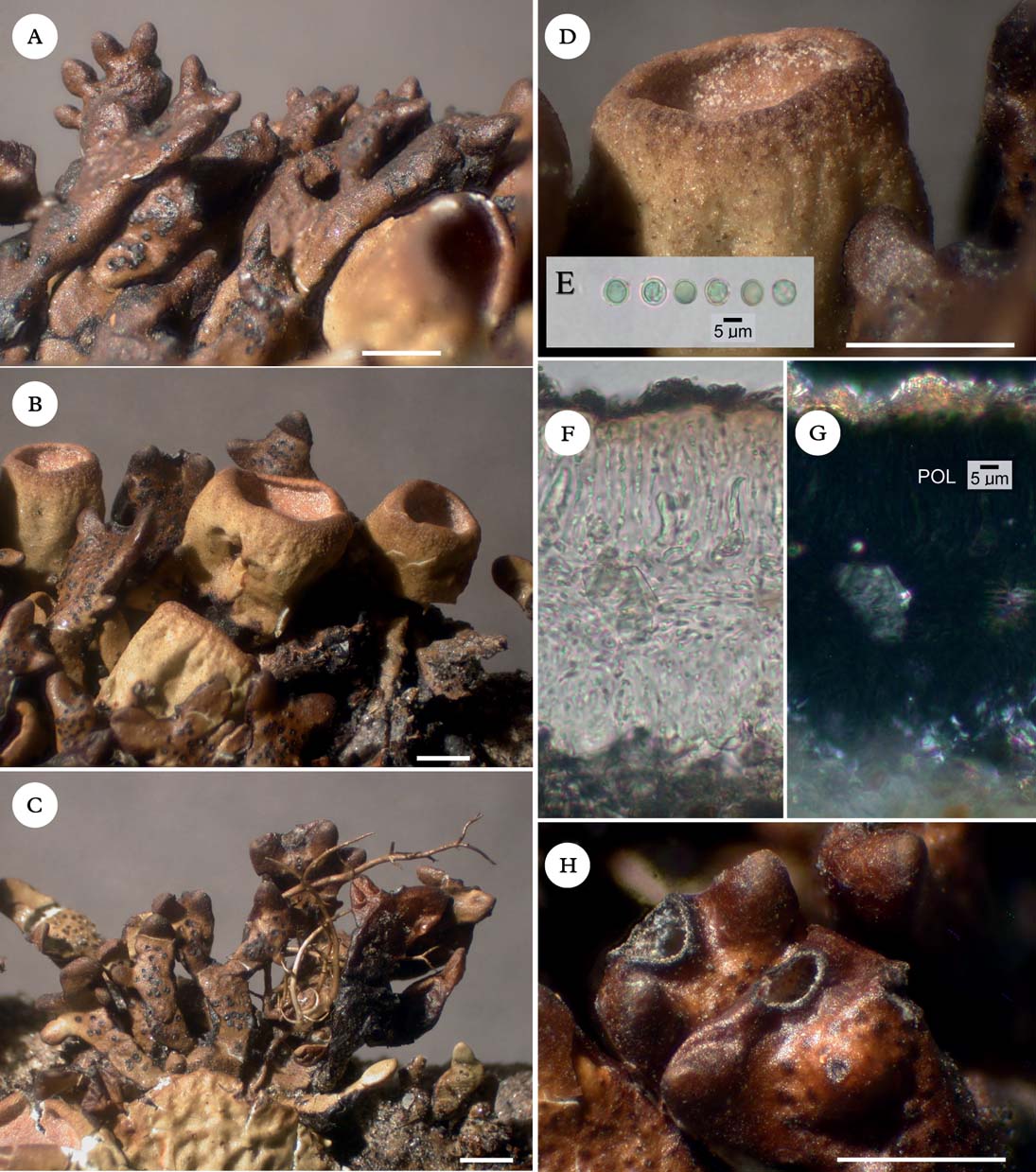
(Fig. 1)
Hypogymnia crystallina, holotype. A, lobes showing adventitious bud-like side lobes; B, apothecia crowded among emergent lobes; C, relatively elongate marginal lobes (and a sprig of Bryoria); D, apothecium showing pruinose disc; E, ascospores; F, apothecial section in water; G, same as F but in polarized light; H, rimmed holes in lobe tips and axils. Scales=1 mm except as labelled. In colour online.
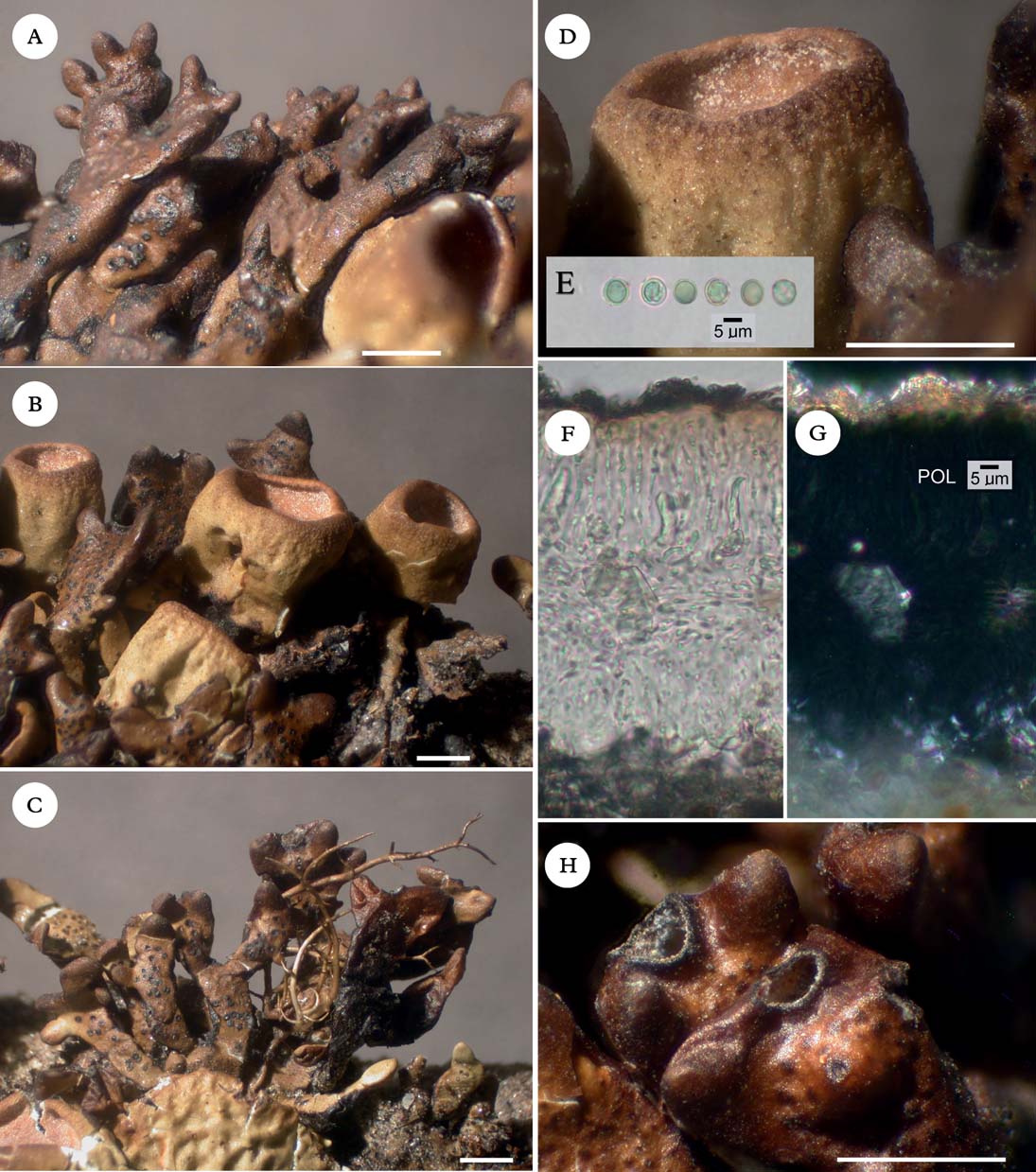
Thallus appressed to suberect, to 3 cm broad; texture cartilaginous; branching variable, budding present (Fig. 1A); upper surface brown to brownish grey, epruinose, dark mottles present, black border sometimes present, smooth to weakly rugose; lobes centrally contiguous to separate, 0·6–1·8(–2) mm wide; lobe profile even to ± pinched and swollen; lobe width / height ratio 0·7–2·0; lobe tips and axils often perforate, the holes with a differentiated, raised rim (Fig. 1H). Medulla hollow, ceiling and floor of cavity dark; soredia, isidia, and lobules lacking.
Apothecia abundant, substipitate, to 5(–8) mm diam.; receptacle urn or funnel shaped, stipe hollow; disc brown to reddish brown, whitish pruinose (Fig. 1D); epithecium often with thin superficial granular layer that is POL+, 2–5 µm thick (Fig. 1F, G); hymenium 37 µm thick, including the epithecium, POL− except for epithecium; subhymenium of horizontal hyphae, 12–14 µm thick, hypothecium 25–35 µm thick, hyaline, POL−; ascospores 8 per ascus, subglobose, 7·3–8·5×5·5–7·8 µm (Fig. 1E).
Pycnidia common but spermatia not seen.
Chemistry. Spot tests: cortex K+ yellow, KC+ stronger yellow, P+ pale yellow; medulla K−, C−, KC−, P−. TLC: atranorin, usnic acid, hypoprotocetraric acid, and zeorin.
Etymology. The epithet ‘crystallina’ refers to the epihymenium having a superficial layer of small crystals.
Substratum. On Cedrus deodora.
Distribution. So far known only from two sites near Sela Pass in India.
Discussion. Although only two small specimens of this species are currently known, it is readily distinguished both morphologically and chemically from all other Hypogymnia species. Morphologically, H. crystallina most closely resembles H. bulbosa and H. congesta from south-west China in having rimmed holes and short, congested lobes, densely arrayed apothecia (Fig. 1B), and similar-sized spores. In contrast to other species with rimmed holes, H. macrospora has much larger spores, while H. pseudocyphellata has open branching and apothecia are still unknown. The disc of H. crystallina, however, differs from that of all other species in this group in being whitish pruinose (Fig. 1D). Under polarized light in a compound microscope, H. crystallina displays a thin, superficial, birefringent (POL+) layer of crystals in the epihymenium (Fig. 1G), a rare character state among Hypogymnia species. The composition of these crystals is unknown.
Although the spores of H. crystallina are somewhat larger than many Hypogymnia species, they are much smaller than those of H. macrospora, and proportionately broader than spores of H. bulbosa and H. congesta.
Zeorin is previously unknown as a major substance in Hypogymnia, and is presently unique to H. crystallina. Hypoprotocetraric acid occurs as a major substance in only one other Hypogymnia species, H. rugosa (G. Merrill) L. Pike, from western North America. Usnic acid occurs as a major substance in only three other Hypogymnia species, the two large-lobed species H. flavida and H. hypotrypa, and the smaller, isidiate species, H. sikkimensis. Neither zeorin nor hypoprotocetraric acid occurs in the other species of Hypogymnia with rimmed holes: H. bulbosa (physodic ±physodalic acid), H. congesta (physodic and virensic acid), H. diffractaica (diffractaic acid), H. hengduanensis (diffractaic acid), H. laxa (physodic and physodalic acids), H. macrospora (norbarbatic acid), or H. pseudocyphellata (see below).
In the initial description, the secondary chemistry of H. pseudocyphellata was not fully resolved, but described as containing atranorin, barbatic acid, and five unknowns (McCune et al. Reference McCune, Martin and Wang2002). Since then, J. A. Elix has determined by TLC and HPLC that this species contains atranorin (minor), chloroatranorin (minor), usnic acid (minor), barbatic acid (minor), elatinic acid (minor), baeomycesic acid (trace), squamatic acid (major), 1′-methyl hypothamnolate (major), and hypothamnolic acid (submajor). We independently detected all of these substances by TLC except for usnic acid.
Additional specimen examined. India: Arunachal Pradesh: West Kameng District, near Sela Pass, on Cedrus deodora, 2008, D. K. Upreti 08-009390B, with U. Dubey, R. Khare & G. Mishra (OSC).
Hypogymnia flavida McCune & Obermayer
Mycotaxon 79: 24 (2001); type: China, Yunnan Province, Luquan Co., 3700 m, McCune 25622 (OSC, CANB, GZU, M, NY, UPS).
H. hypotrypa (Nyl.) Rass. sensu Asahina and sensu Awasthi (2007); non H. hypotrypa s. str.
Synopsis. Lobes large, neatly dichotomous, with yellowish tinge and no soredia or isidia.
Chemistry. Usnic, physodalic, and protocetraric acids (all constant); medulla K−, KC−, P+ orange-red.
Substratum. On bark and wood, rarely on rock.
Distribution. Mountains of southern and eastern Asia, including India, Nepal, China (many provinces) and Taiwan, but as yet unknown from Russia and Japan.
Discussion. Apparently a rare species in the Himalayas; see notes under H. hypotrypa. Hypogymnia flavida is apparently less common and more narrowly distributed than its sorediate counterpart, H. hypotrypa. This follows the general pattern of more broadly distributed sorediate species in Hypogymnia (Miądlikowska et al. Reference Miądlikowska, Schoch, Kageyama, Molnar, Lutzoni and McCune2011). The species is expected to occur in the eastern Himalayas of India.
Selected specimens examined. Nepal: Mewa Khola, path near Topke Thola, Norkett 9318 (BM).
Hypogymnia hengduanensis J. C. Wei
Acta Mycol. Sin. 3: 214 (1984); type: China, Sichuan Province, Kangding region, Yulinkong, Gomba La, on Betula trunk, 3700 m, Smith 14078 (holotype UPS!, isotype HMAS-L!).
Synopsis. True isidia present, cylindrical to globose; lobes erect to more often trailing, with rimmed holes in the lower surface.
Chemistry. Atranorin and diffractaic acid (both constant); medulla K−, KC−, P−.
Substratum. On bark and wood.
Distribution. Occasional in SW China with rare disjuncts in Taiwan and Japan (McCune Reference McCune2009) and India (Upreti & Divakar Reference Upreti and Divakar2008); so far known in India from a single specimen.
Discussion. This species belongs to the group of Hypogymnia species with a raised, differentiated rim forming around holes in the lower surface (McCune et al. Reference McCune, Martin and Wang2002). It is the only isidiate member of that group. Only one other member of this group, H. crystallina, is so far known from India or Nepal.
Specimens examined. India: North Sikkim: near Yumthang, 3800 m, Divakar & Upreti 04-004167 (LWG, duplicate in MAF).—China: numerous specimens.
Hypogymnia hypotrypa (Nyl.) Rass.
Novosti sistematiki nizshikh rasteniui 1967: 297. (Notul. System. e Sect. Cryptog. Inst. Bot. nomine V. L. Komarovii Acad. Sci. URSS) (1967); type: India, Sikkim, Lachen, 3600 m, J. D. Hooker 2016 (BM!), lectotype by Awasthi (1984).
H. hypotrypella (Asah.) Rass., Bot. Mater. Otd. Spor. Rast. 13: 23 (1960).
Synopsis. Thallus large and appressed, with broad lobes, neatly dichotomous branching, and yellowish tinge (usnic acid), with sparse to abundant soredia that form along the edges of flakes in the upper cortex.
Chemistry. Usnic, physodalic, and protocetraric acids (all constant); medulla K−, KC−, P+ orange-red.
Substratum. On bark and wood, rarely on rock.
Distribution. Mountains of southern and eastern Asia, including India, Nepal, China (many provinces), Taiwan, Russia, Korea, and Japan.
Discussion. The historical application of H. hypotrypa to esorediate material is incorrect (McCune & Obermayer Reference McCune and Obermayer2001). Fertile, esorediate material should be referred to H. flavida, while H. hypotrypa is sorediate.
Selected specimens examined. India: Arunachal Pradesh: 7 km before Sela Pass, 3835 m Upreti, Dubey, Kahre & Mishra 08-009356/A (LWG). Sikkim: Lachen, alpine region, J. D. Hooker 2016 (BM, lectotype). North Sikkim: near Yumthang, 3800 m, Upreti, Chatterjee & Divakar 04-004209 (LWG).
Hypogymnia irregularis McCune
Mycotaxon 115: 485 (2011); type: China, Yunnan Province, 3700 m, McCune 25576 (holotype: KUN, isotypes: H, HMAS-l, OSC, UPS, US).
Synopsis. Lobes free, short or long, often arcuate-tipped; long, slender, adventitious lobes often abundant; lobes 0·5–4·0 mm broad and internodes often 1–2 cm long; lobes somewhat pinched and swollen or smooth in profile; ceiling of cavity greyish brown to black; floor brownish black; similar to H. vittata but soredia lacking and holes on lower surface irregularly arranged or staggered.
Chemistry. Containing atranorin and physodic acid, usually with 3-hydroxyphysodic and vittatolic acids; cortex K+ yellow; medulla K− or K+ slow red-brown, KC+ orange-red, P−.
Substratum. On bark or wood, rarely on rock.
Distribution. Mainly in south-west China; also in Taiwan, Tibet, and Nepal.
Discussion. This recently described species appears to be the sexual counterpart of the sorediate H. vittata (McCune Reference McCune2011). Hypogymnia irregularis has a much smaller range than H. vittata and is apparently a relatively rare species in the Himalayas of India and Nepal. It is, however, one of the most common Hypogymnia species in the Hengduan Mountains of south-west China between 3000 and 4400 m in elevation, in Abies–Rhododendron forests, above the zone of hardwood dominance (McCune Reference McCune2011).
Selected specimens examined. See McCune (Reference McCune2011).
Hypogymnia mundata (Nyl.) Oxner ex Rass.
Bot. Mater. Gerb. Bot. Inst. Komarova Akad. Nauk SSSR 11: 11 (1956).—Parmelia mundata (Nyl.) Cromb., J. Linn. Soc., Bot. 17: 395 (1879); type: Tasmania, ad cortices, Verreaux (H-NYL 1814!). A specimen at BM marked as ‘Type. Herb. Stirt’ is labelled ‘Parmelia mundata Nyl. N. S. Wales, Mountains: Miss F. M. Campbell.’ But this is not the type cited by Nylander.
Parmelia physodes subsp. mundata Nyl., Syn. Meth. Lich. 1(2): 401 (1860).
Parmelia campbellii C. Knight, Proc. Roy. Soc. Queensland 1: 114 (1884).
Synopsis. Lobes solid, appressed to suberect and becoming separate; isidia and soredia absent.
Chemistry. Containing atranorin, physodic, 3-hydroxyphysodic, and 2′-O-methylphysodic acids, with accessory physodalic and protocetraric acids; cortex K+ yellow; medulla K+ slow red-brown, KC+ orange-red, P+ orange-red, or P−. Most Australasian specimens of H. mundata lack physodalic and protocetraric acids.
Substratum. On bark or wood, less often on rock.
Distribution. Australasia and Asia.
Discussion. The combination Hypogymnia mundata has been used for decades, but appeared to be threatened by the discovery that Parmelia campbellii was used earlier at the species level. Professor T. Ahti (pers. comm., 2011), however, pointed out Crombie's (1879) overlooked combination Parmelia mundata. This places the name mundata at the species level, so that the correct name is still H. mundata, rather than H. campbellii.
Although H. mundata has been widely reported in Asia and Australasia, the reports outside of Australasia should be referred to H. pulverata [=Hypogymnia mundata f. sorediosa (Bitter) Rass.]. Because the Indian specimen is the only one we have seen of H. mundata s. str. outside of Australia and New Zealand, and since the specimen is small and rather battered, its identity should be considered tentative at this time. On the other hand, the specimen clearly has solid lobes (unknown in all other Indian Hypogymnia species), is fertile, lacks soredia, and matches H. mundata in chemistry.
Specimen examined. India: Arunachal Pradesh: West Kameng District, Tawang, on twigs, 20 v 2008, Rout s.n. (LWG).
Hypogymnia physodes (L.) Nyl.
Lich. Envir. Paris 39 (1896).—Lichen physodes L., Spec. Plant. p. 1144 (1753).
Synopsis. Lobes appressed to imbricate; lip shaped soralia present beneath the tips of imbricate lobes, lobes imperforate except for incipient soralia.
Chemistry. Containing atranorin and physodic, 3-hydroxyphysodic, physodalic, and protocetraric acids; cortex K+ yellow; medulla K+ slow red-brown, KC+ orange-red, P+ orange-red.
Substratum. On bark or wood, less often on rock or alpine sod.
Distribution. Circumpolar in the Northern Hemisphere, in Arctic to temperate regions.
Discussion. Although abundant in northern Asia and elsewhere in the Northern Hemisphere, this species becomes infrequent to rare in the Himalayan and Hengduan Mountain regions.
Selected specimens examined. India: NW Himalaya, Pangi, Stoliczka 454 (BM); Himalayas, Sach Village, 9000 ft (2743 m), Watt s.n. (BM).
Hypogymnia pseudobitteriana (D. D. Awasthi) D. D. Awasthi
Geophytology 1: 101 (1971).—Parmelia pseudobitteriana Awasthi, Curr. Sci. 26: 123 (1957); type: India, Tamil Nadu, Kodaikanal, 2100 m, A. Höeg 2515 (hb. Awasthii).
Synopsis. Thallus small to medium sized with a soft texture and laminal soredia, often with adventitious budding or pinnate branching; lobe cavity with white ceiling and dark floor.
Chemistry. Containing atranorin and physodic and 3-hydroxyphysodic acids; cortex K+ yellow, medulla K+ slow reddish brown, KC+ orange-red, P−.
Substratum. On bark or wood.
Distribution. Widespread in eastern and southern Asia, including China, India, Papua New Guinea, Philippines, Taiwan and Thailand; only in temperate mountain climates, absent from tropical and subtropical climates. Also reported from Australia (Elix & Streimann Reference Elix and Streimann1999).
Discussion. This species is the most common sorediate Hypogymnia in the higher mountains of SE Asia, outside of the Himalayan and Hengduan regions. Although rather variable in form, it is readily distinguished from other sorediate species in the region. It is, however, similar in morphology and chemistry to H. pseudophysodes of Far East Russia, Japan, and China. In both species the soredia tend to intergrade with schizidia. Hypogymnia pseudobitteriana has a white ceiling and dark floor of the lobe cavity, whereas H. pseudophysodes has a dark ceiling and floor. Furthermore, H. pseudobitteriana tends to produce lateral budding and adventitious lobes, often developing a somewhat pinnate pattern, while branching in H. pseudophysodes is more isotomic dichotomous to irregular.
Selected specimens examined. Bhutan: Thimphu District, Thimphu Valley below Tango Gonpa, temperate oak forest with Rhododendron, on dead wood, Søchting 8404 (C, THIM).—India: many locations in southern India, plus: North Sikkim: near Yumthang, on Rhododendron, Divakar & Upreti 04-004168 (LWG, duplicate in MAF).—Nepal: Langtang Himal, valley of Langtang Khola, Weber 87518 (COLO).
Hypogymnia sikkimensis G. P. Sinha & Elix
Mycotaxon 87: 81 (2003); type: India, Sikkim, East Sikkim, surroundings of Mei-menchu Lake, 3200–3500 m, on moss-covered tree, G. P. Sinha 1477A, 18 September 1998 (holotype BSHC; isotype CANB; types not seen – not available for study).
Synopsis. Thallus yellowish green to grey, isidiate, with adventitious budding; large holes in the lower surface (similar to H. flavida and H. hypotrypa).
Chemistry. One of two Hypogymnia species worldwide that contain both atranorin and usnic acids, in this case with atranorin (minor) and usnic and isousnic acids (major), but not containing other major lichen substances. Sinha & Elix (Reference Sinha and Elix2003) also reported traces of placodiolic and pseudoplacodiolic acid by HPLC, but these were not observed by us with TLC of one specimen. Placodiolic acid is known as a major substance in Hypogymnia from a single specimen of H. imshaugii from western North America (McCune et al. Reference McCune, Schoch, Root, Kageyama and Miądlikowska2011).
Substratum. On bark, including Rhododendron.
Distribution. So far known only from two locations in the eastern Himalayas, the type locality in East Sikkim, India, plus one locality in North Sikkim.
Discussion. According to Sinha & Elix (Reference Sinha and Elix2003), “H. sikkimensis can be separated from H. zeylanica by the linear-elongate lobes (sublinear to sublinear-elongate in H. zeylanica), the scattered, globose then short-cylindrical isidia which may become ultimately procumbent, flattened and lobulate (in contrast to the fragile, cylindrical isidia of H. zeylanica which may become coralloid-branched and/or ultimately granular and subsorediate)…”. The morphology of the lobes and holes, as well as the presence of usnic acid, indicate an affinity to H. hypotrypa and H. flavida.
Specimen examined. India: North Sikkim: above Lachen, on Cedrus deodora, 12 viii 2004, Divakar & Upreti 04-004097 (LWG, duplicate in MAF).
Hypogymnia subarticulata (J. D. Zhao, et al.) J. C. Wei & Y. M. Jiang
Lichens of Xizang, p. 37 (1986).—Parmelia vittata var. subarticulata J. D. Zhao et al., Acta Phytotax. Sin. 16: 96 (1978); type: China, Yunnan Province, Lijiang, 3000 m, Zhao & Chen 4414, (HMAS-L!).
Synopsis. Lobes short, broad, brownish to dark brown, with apical labriform soralia; large holes present below the tips of esorediate lobes; medulla P+ orange-red.
Chemistry. Containing atranorin, physodalic, and protocetraric acids, rarely with 2′-O-methylphysodic acid.
Substratum. On bark and wood of both conifers and hardwoods, rarely on rock.
Distribution. In India known only from a single, unspecified locality in Sikkim.
Discussion. Originally described from Tibet (Xizang), this species has proven to be relatively widespread. It is most common in the mountains of south-west China, but also occurs in Taiwan (McCune Reference McCune2009) and now the eastern Himalayas of India.
Selected specimens examined. India: Sikkim: alpine region, 12 000 ft (3657 m) Hooker 2012 (BM); numerous specimens from SW China.
Hypogymnia thomsoniana (Müll. Arg.) D. D. Awasthi
Kavaka 12(2): 94 (1984).—Parmelia thomsoniana Müll. Arg., Flora 74: 379 (1891); type: India, Sikkim, no precise locality, T. Thomson 277, holotype (G) photograph in Awasthi (1984); isotypes (H-NYL!, BM!).
Parmelia pseudohypotrypa Asahina ex Nuno, J. Jap. Bot. 39: 99 (1964).
Hypogymnia pseudohypotrypa (Asahina) A. Singh Lichenol. Ind. Subcontinent 1966–1977. Eco. Bot. Inform. Serv. Nat. Bot. Res. Inst. Lucknow 2 (1980). [Superfluous combination later made by Wei, Enum. Lich. China p. 117 (1991).]
Synopsis. Lobes broad, short to elongate, with frequent large holes below; lobe cavity with dark ceiling and floor; perpendicular bud-like side lobes infrequent or absent; thallus to 10 cm or more broad; spores 9–10×7·0–7·5 µm; thallus similar to H. flavida except containing atranorin instead of usnic acid and lacking physodalic acid.
Chemistry. Of 11 specimens with TLC data, atranorin and physodic acid were found to be constant, with accessory 3-hydroxyphysodic acid, vittatolic acid (each of these in about half of the specimens) and infrequently with 2′-O-methylphysodic acid; medulla K− or K+ slow red-brown, KC+ orange-red, P−. A prominent unknown was found in one specimen (China: Sichuan Province, Xuan Yu 4264, KUN), Culberson Rf classes A7, C7+, long-wave UV+ peach.
Substratum. On bark and wood.
Distribution. Sikkim, India, and south-west China.
Discussion. Hypogymnia thomsoniana has the general appearance of H. flavida, but differs in chemistry and colour. The pale greenish grey colour of H. thomsoniana differs from the pale yellowish green of H. flavida. Hypogymnia flavida always contains physodalic acid, with accessory physodic acid, while H. thomsoniana never contains physodalic acid, but physodic acid is constant.
Hypogymnia pseudohypotrypa is synonymized here with H. thomsoniana, the earlier name, but previously reported from only the type locality (Awasthi Reference Awasthi2007). Like H. flavida (H. hypotrypa sensu Asahina), the growth form of H. thomsoniana varies from having short, broad lobes and a compact growth form (H. pseudohypotrypa) to relative lax and elongate lobes and an open growth form (e.g. the type of H. thomsoniana).
We found no substantial difference in the chemistry of short-lobed and elongate-lobed forms. Elix annotated the type of H. pseudohypotrypa in TNS as containing physodic (major), 3-hydroxyphysodic (trace), 2′-O-methylphysodic (minor), and vittatolic (trace) acids, along with atranorin and a trace of chloroatranorin by HPLC. We found an apparent isotype in H-NYL (Sikkim: Thomson 277) to contain physodic and vittatolic acids and atranorin by TLC.
Selected specimens examined. India: Sikkim: Jangri – Gamotang, Botanical Expedition to Eastern India, 26 v 1960, Hara et al. s. n. [TNS; holotype of H. pseudohypotrypa; Asahina annotation says PD-; Elix (1990) annotation: physodic acid (major), atranorin, 2′-O-methylphysodic acid (minor) and traces of chloratranorin, 3-hydroxyphysodic acid, vittatolic acid, by HPLC and TLC; second specimen has same results].—Nepal: East Nepal: Mewakhola Valley, on branches of Rhododendron, 1953, Awasthi 2302 (UPS); Topgegola near Saduporthari, on ground and twigs of shrubs, 1953, Awasthi 2339 (UPS); Ganja La, N flank, N-facing rock ledges, on mossy ground, 1986, Miehe 5171 [GZU; Elix HPLC: atranorin, chloroatranorin, physodic acid (major), 3-hydroxyphysodic acid, 2′-O-methylphysodic acid; det. as H. delavayi by Elix]. Khumbu: Langmoche, Ogawa 38 (TNS, sub H. pseudohypotrypa).
Hypogymnia tubulosa (Schaer.) Hav.
Bergens Mus. Aarbog, Hefte 1, Naturvidensk. Raekke 1917–18 (2): 31 (1918).—Parmelia ceratophylla var. tubulosa Schaer. Lich. Helvet. Spicil. 10: 459 (1840).
Synopsis. Suberect to erect lobes with powdery soredia coating the tips, lobes entire to sparsely perforate, with cavity white or dark; medulla K+ slow reddish brown, KC+ orange red, P−.
Chemistry. Containing atranorin and physodic, 3-hydroxyphysodic, and 2′-O-methylphysodic acids; cortex K+ yellow; medulla K+ slow red-brown, KC+ orange-red, P−.
Substratum. On bark and wood, rarely on rock.
Distribution. Europe, North America, Africa and Asia.
Discussion. Although H. tubulosa is a broadly distributed species in the Northern Hemisphere, it appears to be rare in the Himalayas. The only specimen from India, Nepal, or Bhutan that we were able to confirm was reported by Bitter (Reference Bitter1901, p. 213) from India. This specimen (Scoliczka 454) was partly the basis of reports in Awasthi (Reference Awasthi1984, Reference Awasthi2007), and Singh & Sinha (Reference Singh and Sinha2010). We confirmed that the chemistry of this specimen is typical of H. tubulosa. The morphology of this specimen is also nearly typical, having large terminal capitate, powdery soralia. It is unusual only in the presence of black mottles on the thallus.
A specimen reported as H. tubulosa from Himachal Pradesh, India, by Awasthi (Reference Awasthi1984) contains, as they reported, protocetraric and physodalic acids, substances unknown in H. tubulosa. This specimen has the chemistry and morphology of H. physodes, except that the lobe tips are sparsely perforate and the lobe cavities have dark ceilings. We have seen no other such specimens.
Specimen examined. India: NW Himalaya, Pangi. [Himachal Pradesh, Chamba, Pangi Valley], Scoliczka 454. Lichenes Himalayenses 454 (W, originally in hb. Lojkanum).
Hypogymnia vittata (Ach.) Parrique
Act. Soc. Linn. Bordeaux 53: 66 (1898); listed as (Ach.) Gasilien in Awasthi (Reference Awasthi1984) and some other authors. Note that Parrique and Gasilien are the same person but ‘Parrique’ is currently accepted.—Parmelia physodes var. vittata Ach., Meth. Lich. 250 (1803).
Synopsis. Open branching with occasional to abundant adventitious lobes; lobe cavity with a dark ceiling and floor, lower surface and lobe tips conspicuously perforate with large holes, soralia sparse to abundant, labriform beneath the lobe tips.
Chemistry. Containing atranorin and physodic acid and usually with 3-hydroxyphysodic and vittatolic acids, the latter two detected by TLC in about 85% of specimens; medulla K− or more often K+ slow reddish brown, KC+ orange-red, P−.
Substratum. Bark or wood, less often on rock or alpine sod.
Distribution. Cool temperate regions of the Northern Hemisphere.
Discussion. See McCune (Reference McCune2011) for a detailed comparison of H. vittata, H. irregularis, and H. stricta (Hillmann) K. Yoshida.
Selected specimens examined. Bhutan: Thimphu Distr., below Cheri Gonpa, by end of road from Thimphu, Søchting 8343 (C, THIM).—India: North Sikkim: Shinghba Rhododendron Sanctuary, near Yumthang, Divakar & Upreti 04-004097 (LWG, duplicate in MAF); W. Himalayas, Himachal Pradesh, Kullu district, Greater Himalayan National Park, Dhela, 3737 m, Srivastava 04-003346 (LWG).—Nepal: Between Coprang and Shin Gompa, Sharma et al. L7.2 (E); East Nepal, Mewakhola valley, Awasthi 2302 (LWG-AWAS). See also McCune (Reference McCune2011).
Hypogymnia wattiana (Müll. Arg.) D. D. Awasthi
Kavaka 12(2): 95 (1984).—Parmelia wattiana Müll. Arg., Flora 74: 379 (1891); type: India, Manipur, G. Watt, s. n. (BM! plus fragment in UPS). Photograph of holotype in Awasthi (Reference Awasthi1984).
Synopsis. Lobes pinched and swollen with lots of budding; upper surface verrucose; lower surface with holes; lobe cavities with cark ceilings and floors.
Chemistry. Containing atranorin, physodic, 2′-O-methylphysodic, and 3-hydroxyphysodic (major) acids; also an unknown substance in solvent C. Awasthi (Reference Awasthi1984), however, reported physodic, hypoprotocetraric, and protocetraric acid (?); medulla K+ slow reddish brown, KC+ orange-red, P−.
Substratum. Unknown.
Distribution. India; apparently known only from the type locality, the details of which are unknown.
Discussion. This poorly known species is currently known only from the paltry type specimen in BM, plus a fragment of the type, a single forked lobe, in UPS. Only one well-developed apothecium is present on the type specimen. This has immature spores according to Awasthi (Reference Awasthi1984) and we did not re-examine it. Hypogymnia wattiana was listed as a species of temperate climates by Singh (Reference Singh, Mukerji, Chamola, Upreti and Upadhyay1999).
The verrucose upper surface, frequent budding, secondary substances, and more temperate habitats of H. wattiana are similar to H. delavayi. The latter species, however, has a mostly pale greyish brown to white ceiling of the lobe cavity, while lobes of the type of H. wattiana have dark ceilings. Likely habitats in Manipur should be searched for additional material. Fresh material is needed to better understand the variability in this species and to clarify the relationship between H. wattiana and H. delavayi.
Specimens examined. Only the type specimen seen.
Excluded or doubtful species from India and Nepal
Hypogymnia delavayi (Hue) Rass.
Bot. Mater. Gerb. Bot. Inst. V. A. Komarova 11: 5 (1956).—Parmelia delavayi Hue, Bull. Soc. Bot. France 34: 21 (1887).
H. yunnanensis Y. M. Jiang & J. C. Wei, Acta Mycol. Sin. 9: 293 (1990).
Hypogymnia alpina, the common saxicolous and terricolous species present in Tibet, Nepal, India, and SW China was previously confused with H. delavayi (e.g. Awasthi Reference Awasthi1984; Elix & Jenkins Reference Elix and Jenkins1989) but the two differ in both chemistry and morphology (McCune Reference McCune2012).
Hypogymnia enteromorpha (Ach.) Nyl.
Acta Soc. Scient. Fenn. 26: 7 (1900). Lectotypified by Pike & Hale (Reference Pike and Hale1982).—Parmelia enteromorpha Ach., Method. Lich. 252 (1803).
For description and photographs see McCune & Geiser (Reference McCune and Geiser2009). This species has been reported from Asia by various authors, including from India (Singh Reference Singh, Mukerji, Chamola, Upreti and Upadhyay1999). This species is, however, a North American endemic. Phylogenetic reconstructions show that H. enteromorpha belongs to a group of strictly North American species (Miądlikowska et al. Reference Miądlikowska, Schoch, Kageyama, Molnar, Lutzoni and McCune2011). Of the Asian species, H. enteromorpha most closely resembles H. thomsoniana.
Hypogymnia fragillima (Hillmann) Rass.
Bot. Materialy (Notul. System. e Sect. Cryptog. Inst. Bot. nomine V. L. Komarovii Acad. Sci. URSS) 11: 8 (1956).—Parmelia fragillima Hillmann, Fedde Repert. 45: 172 (1938).
This species has been reported from India by Awasthi & Singh (Reference Awasthi and Singh1978), Awasthi (Reference Awasthi1984, Reference Awasthi2007) and Singh & Sinha (Reference Singh and Sinha2010). Awasthi (Reference Awasthi2007) reported it from the “upper temperate region (alt. 3480–3780 m) of Uttaranchal, Gomukh area,” of India. We have not, however, seen any material of this distinctive species from southern Asia. A specimen from Uttaranchal (Awasthi 8505, LWG) determined as H. fragillima by Awasthi is a P− chemotype of H. alpina and contains physodic, 3-hydroxyphysodic and vittatolic acids. To our knowledge, H. fragillima is restricted to Pacific coastal areas of northern Asia.
Hypogymnia zeylanica (R. Sant.) D. D. Awasthi & Kr. P. Singh
Geophytology 1: 100. 1971 (1972).—Parmelia zeylanica R. Sant., Bot. Not. 1942: 325 (1941). Type: S!
This species is possibly a synonym of H. pectinatula (Zahlbr.) Elix. The type specimen of H. pectinatula (W!) has granular soredia which are isidiose in part, originating along the edges of wavy cracks (like skull sutures) in the upper cortex. The presence of soredia and sorediose isidia on the type of H. pectinatula has apparently not been mentioned previously in the literature. Because H. zeylanica is morphologically and chemically very similar to H. pectinatula, differentiation of H. zeylanica from H. pectinatula needs more careful study. Both species contain atranorin, physodic and 3-hydroxyphysodic acids, and accessory 2′-O-methylphysodic acid. Furthermore, the status of esorediate, non-isidiate specimens from Indonesia, Java, Borneo and the Phillipines requires further study. They could represent a separate, unnamed species or simply an esorediate form of H. pectinatula.
We thank the curators of BM, C, CANL, COLO, E, GZU, H, H-NYL, HMAS-L, KUN, MAF, NY, OSC, PC, S, UPS, US and W, who kindly cooperated with loans and visits, as well as Ulrik Søchting and Louise Olley for sharing their collections, Teuvo Ahti for nomenclatural advice, and the late Dr Awasthi for his correspondence and pioneering work on Hypogymnia in India. Special thanks to Jack Elix for determining our unknown substances in H. pseudocyphellata. We greatly appreciate Wang Li-Song sharing his voluminous collections from south-west China. Jessica Allen, Elisa Alphandary, Lalita Calabria, Corinne Duncan, Erin Martin and Christina Wesseler ably assisted with TLC. PKD thanks the Ministry of Science and Technology, Spain, for Ramon y Cajal start up grant (RYC02007-01576).