

Cenozoic spiders are best known from the amber deposits of the Baltic region of Europe and the Dominican Republic, for example, but fossils preserved in strata with an aqueous sedimentary origin can also yield high-quality morphological information. The Insect Bed of the Isle of Wight has already produced a number of spider fossils which have been informative for studies on spider phylogeny and palaeoecology (Selden Reference Selden2001, Reference Selden2002). There are two formally described Insect Bed spiders: Eoatypus woodwardii McCook, Reference Mccook1888 and Vectaraneus yulei Selden, Reference Selden2001. Eoatypus was described by McCook (Reference Mccook1888) as a mygalomorph spider, but the restudy by Selden (Reference Selden2001) showed that this was unlikely and he placed it in Opisthothelae incertae sedis. Vectaraneus was placed by Selden (Reference Selden2001) in Araneomorphae: Cybaeidae, Argyronetinae, as part of the stem connecting the European Water spider Argyroneta aquatica (Clerck Reference Clerck1757) to the remainder of the family. (Note that the family name Argyronetidae has been shown to have priority over Cybaeidae by Grothendieck & Kraus (Reference Grothendieck and Kraus1994), although its usage has not been accepted by Platnick (Reference Platnick2009)). Between Eocene Vectaraneus and Recent Argyroneta is another fossil spider described by Bertkau (Reference Bertkau1878) from the Miocene Brown Coal of Rott, Germany.
Here, the araneofauna from the Insect Bed is reviewed, and new specimens are described belonging to the families Segestriidae Simon, Reference Simon1893, Araneidae Latreille, Reference Latreille1806 and Salticidae Blackwall, Reference Blackwall1841. Segestriidae have a reasonable fossil record. They occur in Dominican, Baltic and Bitterfeld ambers (Wunderlich Reference Wunderlich2004a), and also Cretaceous ambers from Lebanon (Wunderlich & Milki Reference Wunderlich and Milki2004), New Jersey (Penney Reference Penney2004) and possibly Siberia (Eskov & Wunderlich Reference Eskov and Wunderlich1995). They are also known from some Cenozoic rock matrix deposits, such as Florissant, Colorado (Scudder Reference Scudder1890; Petrunkevitch Reference Petrunkevitch1922). Araneids have a similar record, being known from most Cenozoic ambers (Wunderlich Reference Wunderlich2004b), and it is mostly juveniles which have been reported from Cretaceous ambers, e.g. Lebanon (Wunderlich Reference Wunderlich2004c), Canada (McAlpine & Martin Reference Mcalpine and Martin1969), Siberia (Eskov & Wunderlich Reference Eskov and Wunderlich1995) and New Jersey (Penney Reference Penney2004). Araneidae are also known from some Cenozoic rock matrix localities such as Aix-en-Provence (Gourret Reference Gourret1886), Florissant (Scudder Reference Scudder1890; Petrunkevitch Reference Petrunkevitch1922), Messel, Germany (Wunderlich Reference Wunderlich1986a), Öhningen, Switzerland (Heer, Reference Heer1865, Reference Heer1872, Reference Heer and Heywood1876) and Shanwang, China (Zhang et al. Reference Zhang, Sun and Zhang1994). Wunderlich (Reference Wunderlich1986b) suggested that the fossil described by Eskov (Reference Eskov1984) as Juraraneus in the extinct family Juraraneidae from Transbaikalia, Siberia may actually belong in the Araneidae, which would extend the known range of the family back to the Jurassic; however, this synonymy has not yet been formally established (Penney Reference Penney2004). Salticids have an interesting fossil record. Because they are the most diverse extant spider family, they would be expected to turn up frequently as fossils and, indeed, they are common in Cenozoic ambers (Wunderlich Reference Wunderlich2004d). They are also known from rock matrix deposits of the Cenozoic, such as Aix-en-Provence (Gourret Reference Gourret1886), Florissant, Colorado (Scudder Reference Scudder1890), Randecker Maar, Germany (Schawaller & Ono Reference Schawaller and Ono1979), Willershausen, Germany (Schawaller Reference Schawaller1982), British Columbia, Canada (Selden & Penney Reference Selden, Penney, Kropf and Horak2009) and Shanwang, China (Zhang et al. Reference Zhang, Sun and Zhang1994). No salticid is known from the Mesozoic, which is surprising if they were indeed present then. Quite possibly, they originated or radiated in the Cenozoic, and their absence as fossils in Mesozoic strata is real.
The fossil spiders described most likely come from a variety of habitats which, together with the preponderance of juveniles, suggests that extraordinary events, rather than continuous attrition, led to the preservation of the spiders on the Insect Bed.
1. Locality and stratigraphy
Specimens from the Smith, Brodie and Hooley collections in the Natural History Museum are labelled ‘Gurnard Bay’ or ‘Gurnet Bay’ (an old name for Gurnard Bay). However, Smith collected specimens all the way from West Cowes to Newtown River on the northwest side of the Isle of Wight (Jarzembowski Reference Jarzembowski1980). Most of the specimens probably came from Thorness Bay (Jarzembowski Reference Jarzembowski1976). The specimens come from concretions or tabular bands of very fine-grained micrite, known as Insect Limestone. The unit in which these concretions/bands occur is known as the Insect Bed, which lies towards the base of the Bembridge Marls Member (Solent Group: Bouldnor Formation). The Bembridge Marls were considered to be early Oligocene by Gale et al. (Reference Gale, Huggett, Pälike, Laurie, Hailwood and Hardenbol2006), but later work by Hooker et al. (Reference Hooker, Collinson, Grimes, Sille and Mattey2007, Reference Hooker, Grimes, Mattey, Collinson and Sheldon2009) place them as latest Eocene (Priabonian) in age.
2. Material and methods
Specimens studied for the INTAS project came from the Natural History Museum, London (NHMUK), the Sedgwick Museum of Earth Sciences, Cambridge (CAMSM), the Isle of Wight Museum of Geology, Sandown, Isle of Wight (MIWG) and the Booth Museum of Natural History, Brighton, Sussex (BMB). Specimens I.8442, I.8704 and In.17177, described in detail here, are in the Natural History Museum, London. Most of the NHMUK specimens belong to the A'Court Smith (purchased 1877, 1883), P. B. Brodie (purchased 1898) and R. W. Hooley (purchased 1924) collections; and specimens collected over the last two decades by Mr Andrew Yule have also been deposited in the NHMUK and MIWG, and thus made available for study. Several dozens (but <100) of arachnid specimens from the museums mentioned above have been studied; there are 53 currently in the Natural History Museum collections alone (see Appendix I). All are spiders; to date, no other arachnids have been identified in the Insect Bed collections. The vast majority of specimens are juveniles, several of which can be referred to Vectaraneus on account of their general habitus and features such as sternum shape. Others appear to be araneoids, but firm identification to family is generally impossible in immatures.
The most remarkable aspect of the Bembridge spiders is the extremely fine preservation of internal anatomical structure. Some organic matter is preserved, mainly thin laths of cuticle lining the external mould cavities of the chelicerae, and setae within the rock which can be seen when the specimens are observed under alcohol. Within the moulds of the chelicerae, labium and coxae, fine fibres of cream-coloured calcite can be seen. Presumably, these represent muscle fibres replaced by calcite during diagenesis, as described for the Bembridge Marls insects by McCobb et al. (Reference Mccobb, Duncan, Jarzembowski, Stankiewicz, Wills and Briggs1998). The holotype of Vectaraneus yulei, BMB 021960/1, is a good example of the preservation of the Insect Bed spiders (Selden Reference Selden2001). Much of the opisthosoma of BMB 021960/1 is filled with cream-coloured calcite, which strikingly preserves the large tracheae as tubes running forward from the wide spiracle near the middle of the opisthosoma. The inner surfaces of these tubes bear reinforcements preserved in the same cream calcite. Book-lung lamellae are preserved in buff-coloured calcite, and the book-lung atria anterior to the lamellae are lined with tiny, buff, drusy calcite crystals. Before its removal to reveal the nature of the spinnerets, the posterior part of the opisthosoma of BMB 021960/1 was filled with calcite showing a spheroidal structure in places. This could represent silk glands or ova, or could be botryoidal mineral growth inside a cavity. Because of the preservation of internal anatomy, their three-dimensional nature, and their completeness (e.g. carapaces are intact, not detached) most of the fossils probably represent dead animals rather than moults.
The specimens were photographed with a Leica digital camera, and drawn using a camera lucida attachment, on Leica MZ16 stereomicroscopes. Specimens were scanned on a Metris X-Tek HMX-ST scanner (Natural History Museum, London) with a tungsten reflection target at 200mA and 225kv, 0·17–1 second exposure times for 3142 projections, and a 1 mm copper filter. The 4MP (2000×2000) Perkin Elmer detector panel provided a voxel-size (resolution) of ∼20 microns. Analysis, reconstruction, manual preparation and colour coding of the three-dimensional model from tomographic slices was performed using the custom SPIERS software suite (Sutton 2009, unpublished), implementing the methods described by Sutton et al. (Reference Sutton, Briggs, Siveter and Siveter2001, Reference Sutton, Briggs, Siveter, Siveter and Orr2002). Visualisations are screen captures from the SPIERSview renderer. Drawings and photographs were prepared for publication using the Adobe Creative Suite software. All measurements are in mm.
3. Systematic palaeontology
Order Araneae Clerck, Reference Clerck1757
Superfamily Dysderoidea C. L. Koch, Reference Koch1837
Family Segestriidae Simon, Reference Simon1893
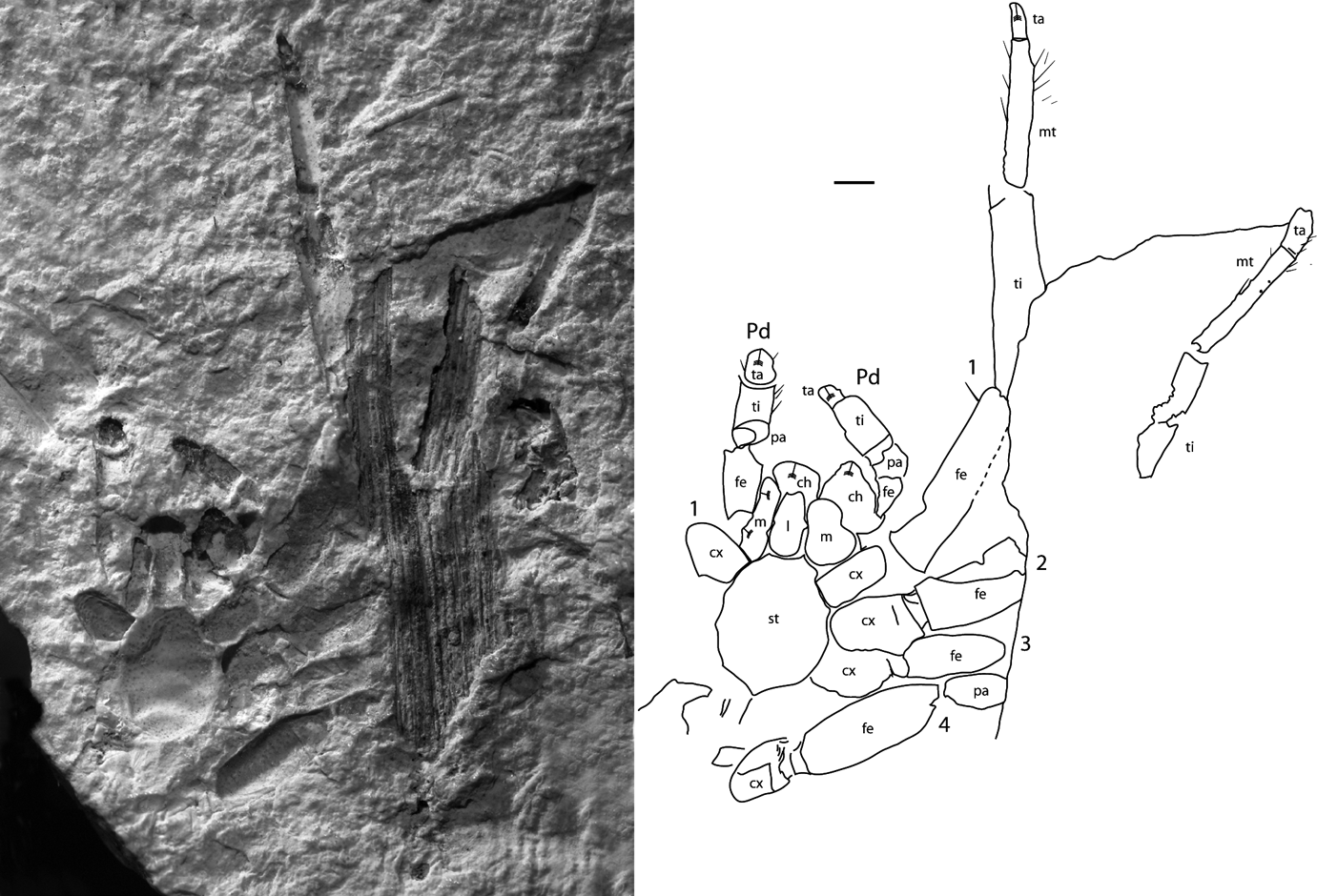
Remarks. Specimen NHMUK I.8442 can be assigned to this family on the following combination of characters: medium-sized; suboval sternum, projected between coxae (but not as dramatically as in dysderids); large, elongate palpal endites; elongate labium (if notched apically then only slightly); chelicerae not obviously fused basally; coxae subequal in length (in Dysderidae C. L. Koch, Reference Koch1837 coxae 1 and 2 are nearly twice as long as coxae 3 and 4 (Almquist Reference Almquist2005)); legs 1 and 2 with spines (only legs 3 and 4 have spines in Dysderidae: Ubick (Reference Ubick, Ubick, Paquin, Cushing and Roth2005a). The punctate ornament on all body parts is rather more reminiscent of dysderids than segestriids.
Genus Segestria Latreille, Reference Latreille1804
Remarks. There are three genera of Segestriidae: Ariadna Audouin, Reference Audouin and Savigny1826, Gippsicola Hogg, Reference Hogg1900 and Segestria Latreille, Reference Latreille1804 (Platnick Reference Platnick2009). Gippsicola is known from a single species in Victoria, Australia. Ariadna and Segestria are cosmopolitan and each has numerous species. The former has relatively short legs, whilst those of the latter genus are longer (Ubick Reference Ubick, Ubick, Paquin, Cushing and Roth2005b). The leg lengths of the fossil specimen are closer to those of Segestria than Ariadna, so the fossil is referred to that genus. There are insufficient additional features to place the species or to create a new species name for the fossil.
Segestria sp.
Segestria sp., NHMUK I.8442, Insect Bed, Bembridge Marls Member, Bouldnor Formation (Solent Group), Thorness Bay, Isle of Wight: (A) photograph×80; (B) explanatory camera lucida drawing. Scale bar=0·5 mm. Abbreviations: 1–4=leg numbers; ch=chelicera; cx=coxa; fe=femur; l=labium; m=maxilla (endite of pedipalp coxa); mt=metatarsus; pa=patella; Pd=pedipalp; st=sternum; ta=tarsus; ti=tibia.

Material. NHMUK I.8442 in the Natural History Museum, London, Brodie Collection; female or immature; Insect Bed of the Bembridge Marls Member of the Bouldnor Formation (Solent Group), latest Eocene (Priabonian), of Thorness Bay, Isle of Wight, England.
Description. Integument regularly punctate. Carapace not preserved. Sternum suboval, projected between coxae and labium; length 1·83, width 1·52. Labium twice as long as wide (length 0·84, width 0·42), if notched apically then not strongly, small projections laterally at mid-length. Pedipalp coxa length 1·13, broad posteriorly, narrowing to endite as long as labium. Pedipalps short: left femur length 0·95, right patella length 0·41. Right leg 1 podomere lengths: coxa 0·95; femur 2·47; tibia 2·53; metatarsus 1·95. Right leg 2 podomere lengths: coxa 1·05; tibia ≥1·75; metatarsus 1·73. Right leg 3 coxa length 0·91. Right leg 4 podomere lengths: coxa 0·89; femur 2·07; patella 0·81. All other podomeres not fully preserved to measure lengths. Spines present at least on pedipalp tibia and tarsus, leg 1 femur (distal prolateral), leg 1 tiba (distal prolateral), legs 1 and 2 metarsi (pro- a retrolateral from 1/3 length to distal). Opisthosoma not preserved.
Superfamily Araneoidea Latreille, Reference Latreille1806
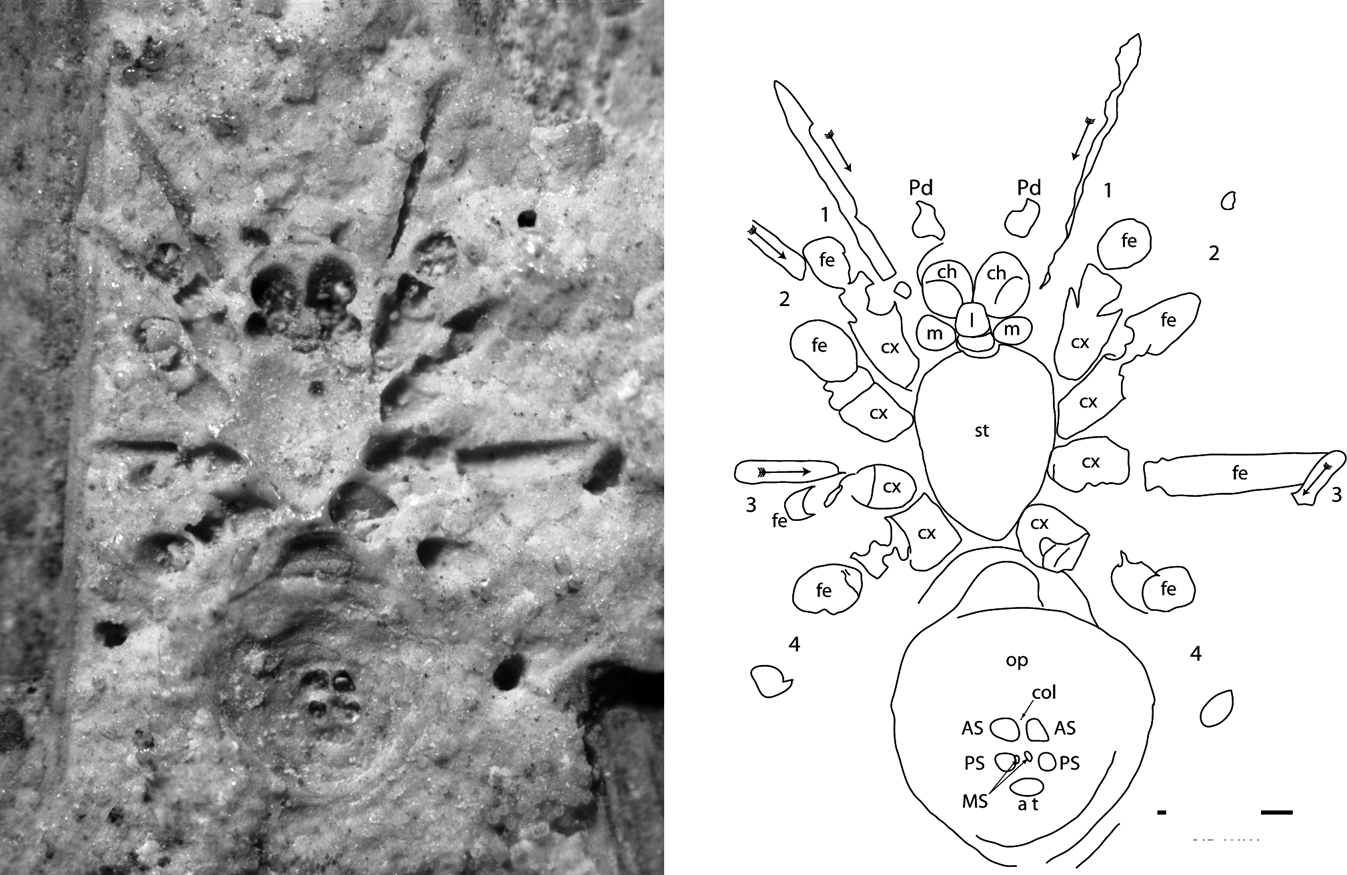
Remarks. Specimen NHMUK In.17177 is chosen as an example of one of the small, three-dimensionally-preserved immature spiders which are common in the Insect Bed. It can be referred to Araneoidea on the following characters. The legs are long and slender, particularly the first; the opisthosoma is subcircular and the spinnerets are grouped towards the centre of the venter. There are no noticeable specialities, so the spider is almost certainly an orbicularian (orb-web weaver). The lack of a cribellum (which would be present in immatures of Deinopoidea C. L. Koch, Reference Koch1850, the sister-group of Araneoidea) places it in Araneoidea.
Family Araneidae Latreille, Reference Latreille1806
Remarks. Specimen NHMUK In.17177 can be placed in this family on account of the rebordered labium, sternum pointed posteriorly (it is truncated in Theridiosomatidae: Coddington (Reference Coddington, Ubick, Paquin, Cushing and Roth2005), Levi (Reference Levi, Ubick, Paquin, Cushing and Roth2005), and short palpal endites.
Araneidae incertae sedis
Araneidae incertae sedis, NHMUK In.17177, Insect Bed, Bembridge Marls Member, Bouldnor Formation (Solent Group), Thorness Bay, Isle of Wight.: (A) photograph×25; (B) explanatory camera lucida drawing. Scale bar=0·5 mm. Abbreviations: 1–4=leg numbers; a t=anal tubercle; AS=anterior spinneret; ch=chelicera; col=colulus; cx=coxa; fe=femur; l=labium; m=maxilla (endite of pedipalp coxa); MS=median spinneret; op=opisthosoma; Pd=pedipalp; PS=posterior spinneret.

Material. NHMUK In.17177 in the Natural History Museum, London, Smith Collection; immature; Insect Bed of the Bembridge Marls Member of the Bouldnor Formation (Solent Group), latest Eocene (Priabonian), of Thorness Bay, Isle of Wight, England.
Description. Carapace not preserved. Sternum longer than wide (length 0·73, width 0·52), widest near anterior margin, procurved at labium, pointed posteriorly between coxae 4. Labium length 0·19, width 0·12, rebordered. Leg podomeres difficult to measure, but leg 1 at least 2·5 long (distal podomeres patella–tarsus ≥1·1). Podomere lengths: leg 1 coxa 0·31; leg 2 coxa 0·30; leg 3 coxa 0·28; leg 3 femur 0·72; leg 4 coxa 0·26. Opisthosoma longer than wide (length 1·22, width 0·99), spinnerets located just posterior to centre of venter; anterior spinneret (AS) and pasterior spinneret (PS) similar in size, median spinneret (MS) very small; tiny colulus present; anal tubercle about same size as AS/PS.
Superfamily Dictynoidea Simon, Reference Simon1874
Family Argyronetidae Thorell, Reference Thorell1870
Genus Vectaraneus Selden, Reference Selden2001
Vectaraneus yulei Selden, Reference Selden2001
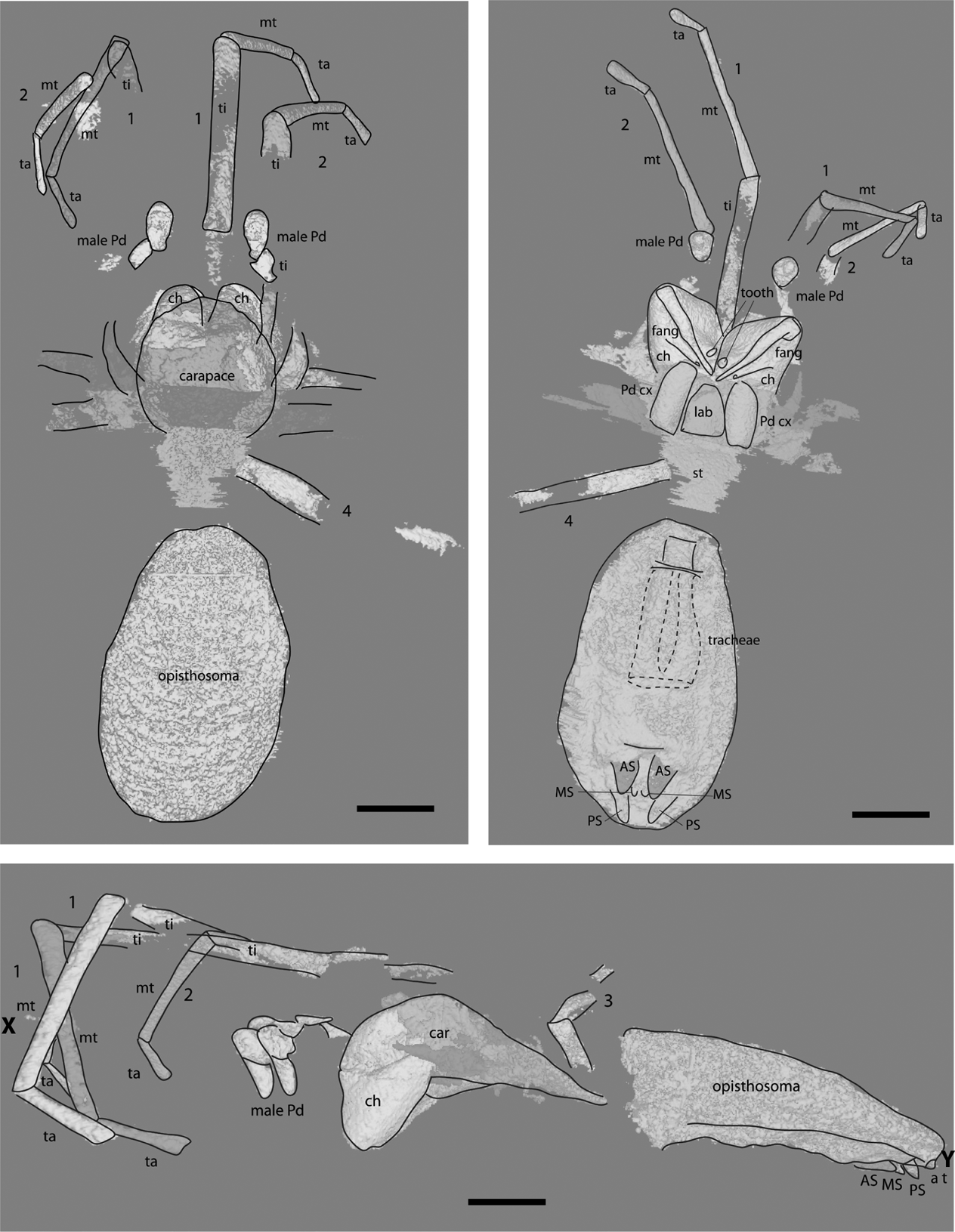
Vectaraneus yulei Selden, Reference Selden2001, BMB 021960 (part) and 021961 (counterpart), Insect Bed, Bembridge Marls Member, Bouldnor Formation (Solent Group), Thorness Bay, Isle of Wight. Combined XMT scans of part and counterpart: (A) dorsal view; (B) ventral view; (C) lateral view. Note that the dorsal and ventral views are not from the same angle, hence legs appear in different orientations. X–Y in C shows approximate line of join of part and counterpart. Scale bars=1 mm. Abbreviations: 1–4=leg numbers; a t=anal tubercle; AS=anterior spinneret; car=carapace; ch=chelicera; cx=coxa; lab=labium; MS=median spinneret; mt=metatarsus; Pd=pedipalp; PS=posterior spinneret; st=sternum; ta=tarsus; ti=tibia.

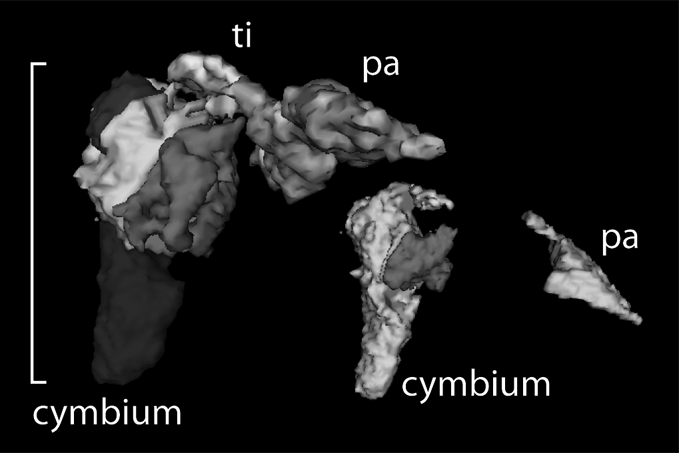
Vectaraneus yulei Selden, Reference Selden2001, BMB 021960 (part) and 021961 (counterpart), Insect Bed, Bembridge Marls Member, Bouldnor Formation (Solent Group), Thorness Bay, Isle of Wight. Combined XMT scans of part and counterpart showing detail of male pedipalps. See Figure 3 for scale. Abbreviations: pa=patella; ti=tibia.

Material. BMB 021960 part and BMB 021961 counterpart (ventral and dorsal) respectively, in the Booth Museum of Natural History, Brighton, England, Jarzembowski Collection; adult male; Insect Bed of the Bembridge Marls Member of the Bouldnor Formation (Solent Group), latest Eocene (Priabonian), of Thorness Bay, Isle of Wight, England.
Remarks. The holotype specimen was described by Selden (Reference Selden2001) as questionably a mature female, on basis of lack of evidence of male characters. Since then, Timothy Chalk, in an undergraduate research project in the Department of Earth Science & Engineering, Imperial College, London, under the supervision of Mark Sutton, has produced some x-ray computer tomography (XMT) scans of the holotype which shows modified male palps (Figs 3B, 4), thus proving that the specimen is, in fact, an adult male. The elongate cymbium is typical of Argyronetidae (and also present in other, related families). The XMT scans (Figs 3, 4) also show some parts of the anterior legs and mouthparts which are not visible using light microscopy on the rock specimens. The long, tapering fang and large, bifid tooth on the distal end of the promargin of the chelicera, and the spatulate shape of the labium, are confirmed.
Additional description of holotype BMB 021960/1. Adult male. Adult male palp (Fig. 4) with elongate cymbium, length 0·92. Legs 1 and 2 thin, elongate; approximate (minimum) podomere lengths: leg 1 tibia 3·4; metatarsus 2·5; tarsus 1·2; leg 2 metatarsus 1·9; tarsus 0·8.
Superfamily Salticoidea Blackwall, Reference Blackwall1841
Family Salticidae Blackwall, Reference Blackwall1841
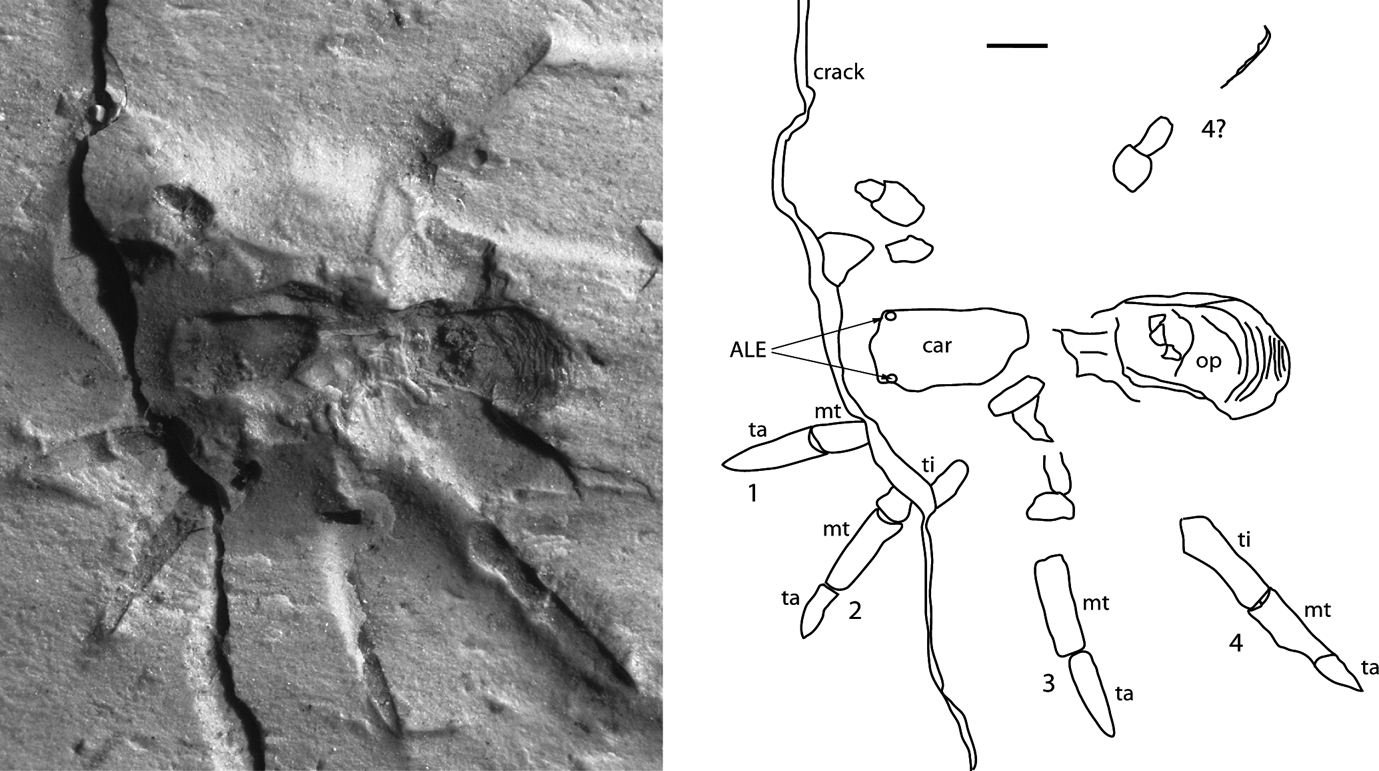
Remarks. Specimen NHMUK I.8704 shows characteristics of this unmistakeable spider family: parallel-sided carapace with prominent anterior lateral eyes; long pedicel connecting prosoma and opisthosoma; and relatively short legs. The only other extant family to which NHMUK I.8704 could be referred would be Corinnidae Karsch, Reference Karsch1880, but the prominent anterior lateral eyes and relatively short legs lend no support for this placement. Prominent ?anterior lateral eyes are also present in the extinct family Lagonomegopidae Eskov & Wunderlich, Reference Eskov and Wunderlich1995; however, apart from this family being unknown outside of the Mesozoic (Penney Reference Penney2005, Reference Penney2006), lagonomegopids have longer legs and an inconspicuous pedicel, thus giving these spiders a quite different appearance to the fossil described here.
Salticidae is the most diverse spider family today, with 5202 species in 563 genera at the last count (Platnick Reference Platnick2009). Most are small and commonly brightly coloured, diurnal predators, using visual clues for prey capture and mating. Salticidae are jumping spiders which use the unique aranean hydrostatic muscle extensor system for saltation. Consequently, the prosoma of many salticids is high, to accommodate the pump required to produce a burst of haemolymph pressure to the rather short legs and initiate a jump. In many salticids, the carapace is not short and tall, but elongated, as in the fossil described here. Such salticids may be more commonly found running on the ground and many mimic ants and other ground-living biting insects. Lower systematics of salticids is not related to gross morphology, so it is not possible to determine to which subfamily or genus the fossil is related, hence it is referred to Salticidae incertae sedis.
Salticidae incertae sedis
Salticidae incertae sedis, NHMUK I.8704, Insect Bed, Bembridge Marls Member, Bouldnor Formation (Solent Group), Thorness Bay, Isle of Wight: (A) photograph×50; (B) explanatory camera lucida drawing. Scale bar=0·5 mm. Abbreviations: 1–4=leg numbers; ALE=anterior lateral eye; car=carapace; mt=metatarsus; op=opisthosoma; ta=tarsus; ti=tibia.

Material. NHMUK I.8704, Brodie Collection; sex and maturity not known; Insect Bed of the Bembridge Marls Member of the Bouldnor Formation (Solent Group), latest Eocene (Priabonian), of Thorness Bay, Isle of Wight, England.
Description. Carapace about twice as long as wide (length 1·36, width 0·72), subrectangular, anterior border straight, parallel-sided. Presumed anterior lateral eyes present at anterolateral corners of carapace. Legs relatively short, stout, approximately equal in length. Podomere lengths: leg 1 tarsus 0·82; leg 2 metatarsus 0·75; tarsus ≥0·49; leg 3 metatarsus 0·87; tarsus 0·80; leg 4 tibia 0·98; metatarsus 0·73; tarsus ≥0·41. Opisthosoma connected to prosoma by long pedicel. Opisthosoma about twice as long as wide (length 1·95, width 1·09), wrinkled posteriorly.
4. Discussion
The spiders found in the Insect Bed come from a number of extant families, each with different habits and from a variety of habitats. Vectaraneus yulei is an argyronetid water-spider, and is likely to have spent some of its time under water, as evidenced by the enlarged tracheal system. Its mode of life within the Insect Bed ecosystem is clearly linked with the aquatic habitat. Araneidae and other orb-web weavers could have made their prey-capture webs in reeds and other emergent aquatic vegetation; indeed, orb-weavers are common in such habitats today. Such spiders are generally fairly adept at avoiding falling into the water and, if they did, would then remain at the surface due to surface tension. This, together with the large number of juveniles in the collection, suggest that it was unusual events which led to their entombment in the lime mud, rather than chance natural attrition of the living population. Segestriids live in silken tubes in cracks in bark or under stones; ‘trip-lines’ radiating from the tube entrance provide information to the spider when possible prey passes close by. Segestriids generally respond actively to prey at night. Their presence in the Insect Bed suggests the presence of trees with creviced bark, rocky outcrops or stony debris in the vicinity of the centre of deposition, although it is possible that they could make tube webs in dead reed stems. Again, their presence in the thanatocoenosis is unlikely to have been a normal chance occurrence. Unlike segestriids, Salticidae are diurnal spiders which have shunned the prey-capture web in favour of active hunting. They could occur in any habitat, but prefer sunny sites where insects constantly land (e.g. flies) or are in abundance (e.g. ants). The salticid described here has the morphology of an active ground-dweller, and so is suggestive of an emerged dry habitat, but could also occur in a reed swamp, jumping from plant to plant. Catastrophic events are more likely to knock such an agile hunter into the water than normal mortality.
In conclusion, the spider fossils in the Insect Bed suggest unusual preservation events; storms perhaps, which collected together specimens form a variety of disparate habitats.
5. Acknowledgements
This paper is a contribution to INTAS Project No. 03-51-4367, who are thanked for their support. I thank Paulyn Cartwright and Annalise Nawrocki (Ecology and Evolutionary Biology, University of Kansas) for their help with microscopy, and Timothy Chalk and Mark Sutton, Imperial College, London, for XMT scans of the holotype of Vectaraneus.
6. Appendix I. List of specimens labelled as Araneae in the collections of the Natural History Museum, London (NHMUK)