I. Introduction to Thamudic D
The term “Thamudic” is a modern label applied to the pre-Islamic inscriptions carved in variants of the Ancient North Arabian family of scripts across the deserts of Arabia, spanning the northern Yemeni frontier to the southern Levant.Footnote 1 Macdonald has described it as a “pending pigeon hole into which one can put everything that does not fit into one of the better defined categories”.Footnote 2 The corpus remains poorly understood and its chronological boundaries are undefined.Footnote 3
The first Thamudic inscriptions were copied by European explorers in the early nineteenth centuryFootnote 4 and the corpus of texts grew steadily over the following decades. By the beginning of the twentieth century, two “decipherments” were published, but neither could be considered entirely successful.Footnote 5 While the phoneme identifications allowed for some Thamudic texts to be read with ease, they often produced little more than garbled nonsense when applied to the entire corpus. As Macdonald explained, the main shortcoming of these early attempts is that they assumed that all the material classified under the provisional “Thamudic” label was produced by a single people and reflected idiosyncratic or chronological variation within a single script.Footnote 6
In 1937, the field witnessed a considerable advance in the form of F.V. Winnett's A Study of the Liḥyanite and Thamudic Inscriptions.Footnote 7 He, having recognized that the variation in Thamudic could not be explained from the assumption of a single script, pioneered a new approach that attempted to classify the Thamudic material according to patterns in letter shapes. This effort produced five provisional sub-categories, A–E.Footnote 8 Since Winnett's study, two of the provisional categories of Thamudic – A and E – have been sufficiently understood to warrant their removal from the Thamudic rubric. The former is concentrated around the oasis of Taymāʔ and is known today as Taymanitic.Footnote 9 The largest number of Thamudic E inscriptions is found in the Ḥismā desert of northwest Arabia and so this script type became known as Hismaic.Footnote 10
Thamudic B, C and D remain tentative categories requiring much further study.Footnote 11 While Winnett's classifications are mainly based on letter shapes, his study identified another important diagnostic feature: writing formulae. One immediately recognizes that certain vocabulary and expressions correlate with specific scripts. For example, invocations of the type vocative + divine name + request occur exclusively in the Thamudic B category.Footnote 12 The formula name + wdd f + name is characteristic of Thamudic C. Thamudic D inscriptions often begin with introductory particle zn, according to Winnett's understanding of the script. So consistent is the use of these formulae that it is possible to identify the type of Thamudic through transcriptions alone.
Of these, Thamudic B appears to be the best understood, but at the same time the most broadly defined grouping. This script category exhibits significant graphic variation, but their phonemic values are for the most part clear.Footnote 13 Thamudic C likewise includes a good deal of variation and its subdivisions are only beginning to be understood. Unlike Thamudic B, the phonemic values assigned to its glyphs remain in some cases tentative, and its language, at least in the inscriptions we do understand, appears to be quite distinct from Arabic.Footnote 14 But perhaps the least understood of the Thamudics is Thamudic D. A glance at Macdonald's 2000 script chart reveals several lacunae in the alphabet and half a dozen uncertain identifications.
Yet Thamudic D – despite uncertainties in the phonemic value of its glyphs – is the only Thamudic script that can be dated in absolute terms. The Thamudic D text, JTham 1, accompanies the famous tomb inscription of Raqōś, daughter of ʕAbdmanōto, dated to 267 ce. This partial bilingual text provided the first keys to its decipherment.Footnote 15 Thamudic D texts make up the smallest category of the Thamudics, with perhaps around 300 published texts, mostly written in columns but occasionally horizontally, both sinistrograde and dextrograde. The inscriptions are mainly found in north and west Arabia, extending from Tabūk to Mecca. A significant part of the corpus comes from the area between Al-ʕUlā and Tabūk. Texts can also be found around Taymāʔ and in the desert between Taymāʔ and al-ʕUlā. Recently a sizeable number of inscriptions have been published online from the rocky desert in the region of Medina – Bādiyat al-Madīnah.Footnote 16
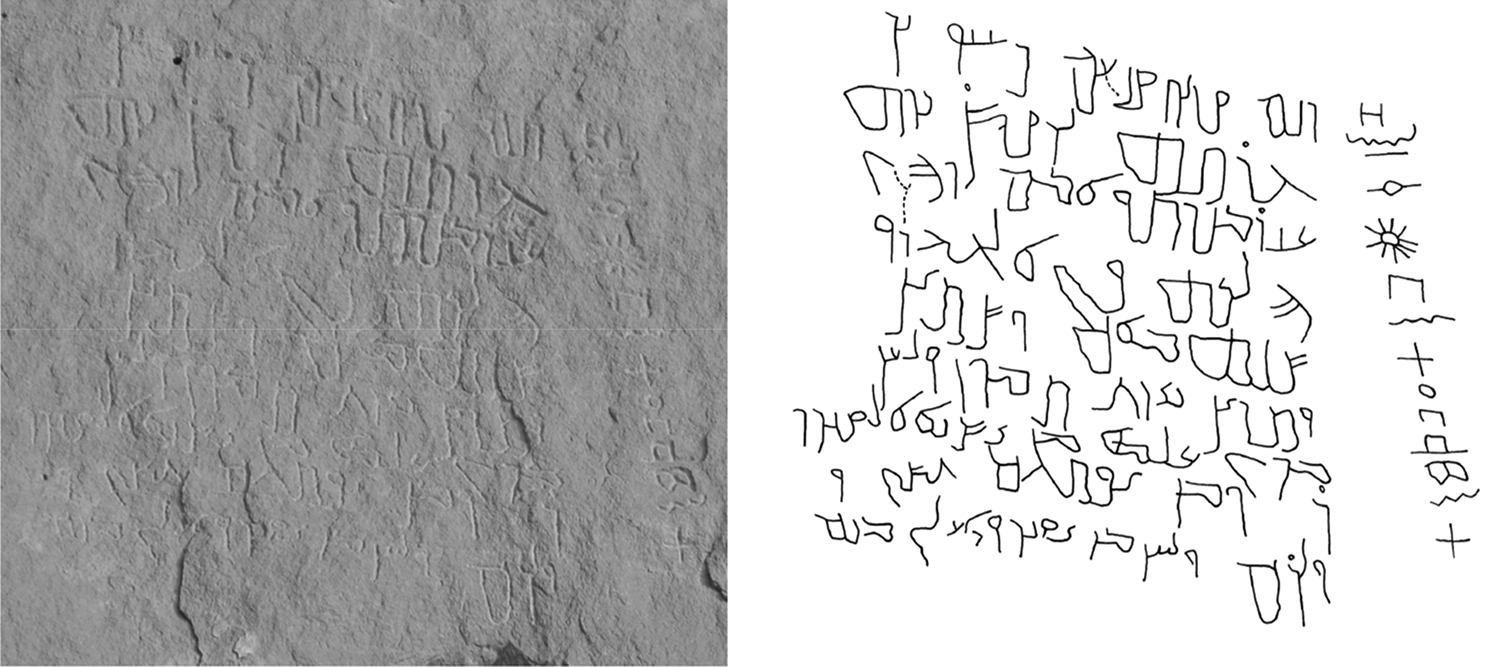
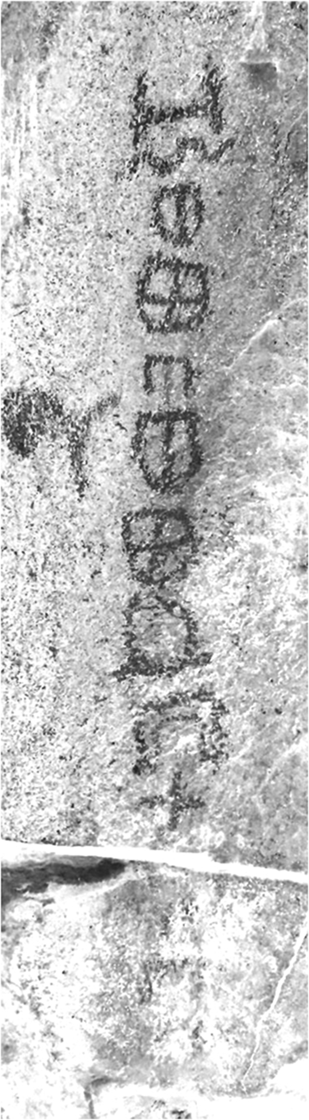
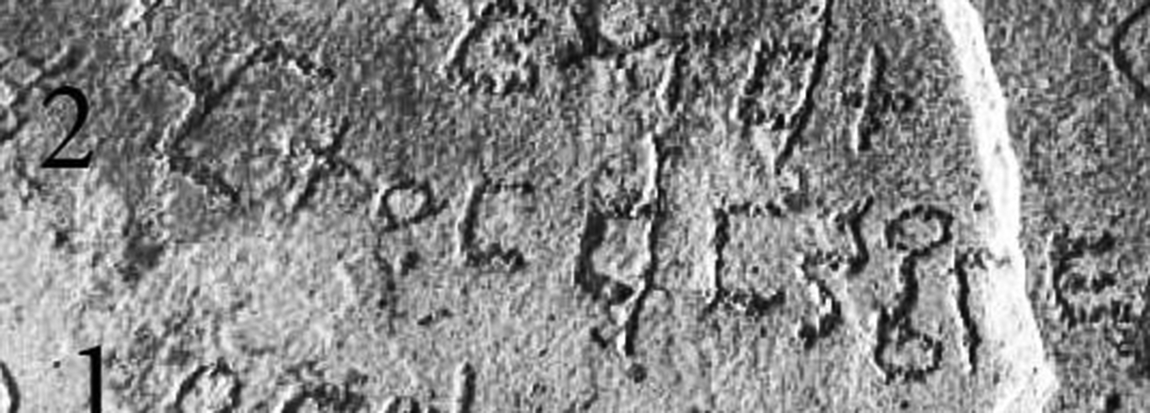
The Thamudic column, known as JSTham 1 (Figure 1), was read by the original editors as:Footnote 17
zn rqś bnt ʕbdmnt
“this is Raqōś daughter of ʕAbd-Manōto”
JSNab 17 and JSTham 1. Photo and tracing from Nehmé (Reference Nehmé and Macdonald2010).

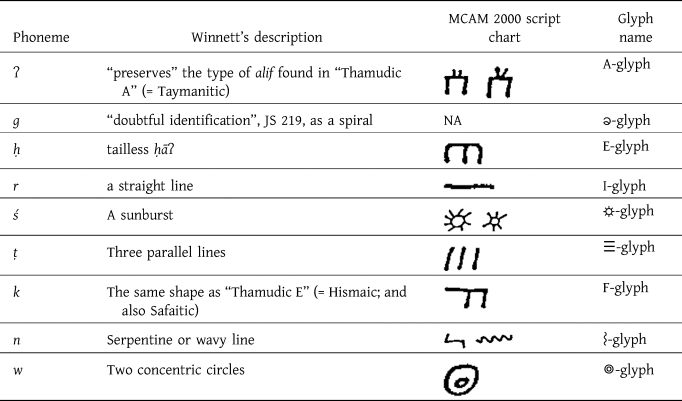
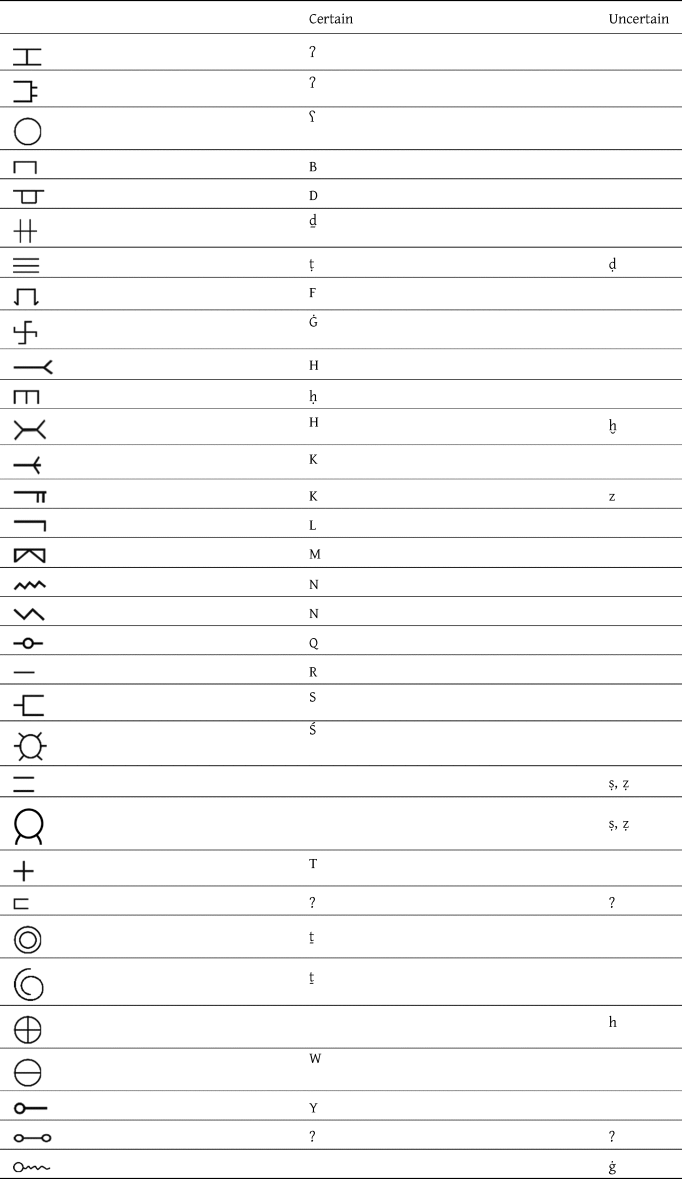
The correspondence between the names in this alphabet and the Nabataean text revealed two peculiarities of this variety of Thamudic. The straight line had the phonemic value of *r, the sunburst of *ś and the *n was serpentine. Winnett (Reference Winnett1937) went on to identify what he regarded as the characteristic features of this alphabet (Table 1).Footnote 18
Thamudic D glyphs identified by Winnett (Reference Winnett1937).

Winnett additionally identified a few writing formulae typical of the Thamudic D inscriptions:
1. The most common is the introductory sequence < H ⌇> followed by what appear to be personal names.
2. This formula can be further augmented by a phrase expressing affection for another individual, usually mḥb or ʕśq, both “lover of”, followed by a personal name.
To this I would add the following associated formulae (section 3 below describes additional formulae not discussed by Winnett):
3. Formula 1 can be followed by the conjunction w and another personal name often modified by ḥbb “friend”, “beloved”.
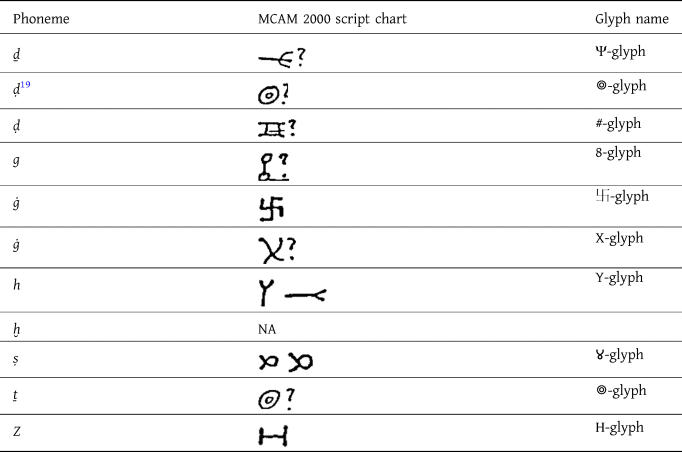
The Thamudic D alphabet was refined in Macdonald's 2000 script chart, informed in part by the modifications to the category presented in Winnett and Reed (Reference Winnett and Reed1970), where it is called Ḥijazi Thamudic. The identifications are presented in Table 2, with uncertain values followed by a ?.
Thamudic D glyphs as identified in Macdonald (Reference Macdonald2000b).

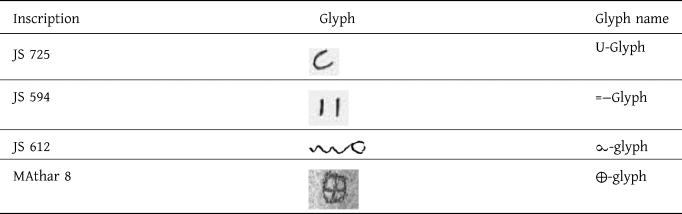
There are four glyph shapes found in the Thamudic D inscriptions (Table 3) that are not listed in any script charts or discussed by previous scholars.
Thamudic D glyphs not identified in the main script charts. The remaining shapes have their normal South Semitic values (see Table 4).

The Thamudic D glyphs and their phonemic values.

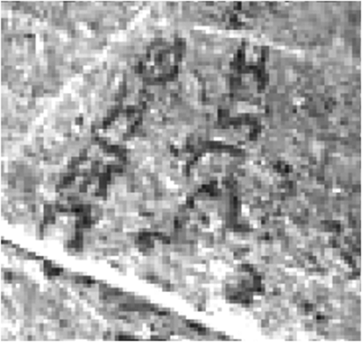
Most Thamudic D texts are rather short, containing fewer than ten glyphs. As such, there are not many opportunities to test the phonemic values assigned to its glyphs and many identifications are based on similarity in shape to glyphs of better-known scripts. There are good reasons to doubt the veracity of many of these identifications. For one, the traditional values often yield strange consonant combinations, producing from the perspective of Semitic root constraints, unattested or impossible personal names.
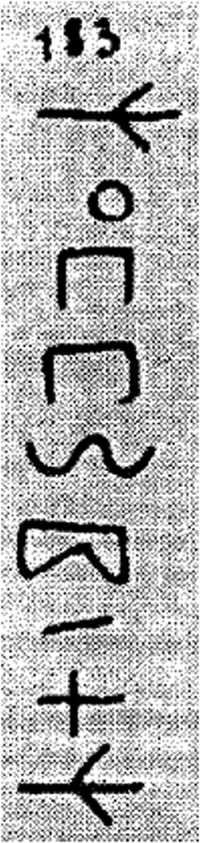
According to Winnett's latest script chart (Reference Winnett and Reed1970), Figure 2 should be understood as ḥʕb bn mrtḥ. The first name seems impossible, as roots with contiguous pharyngeals are not permitted in Semitic. If we take the value of ḏ for the Ψ-glyph, we produce a permissible ḏʕb but mrtḏ is unattested in the Arabian onomastica. Moreover, as we shall see, the value of ḏ is already securely accounted for in Thamudic D, which rules out such a reading.
JSTham 183.

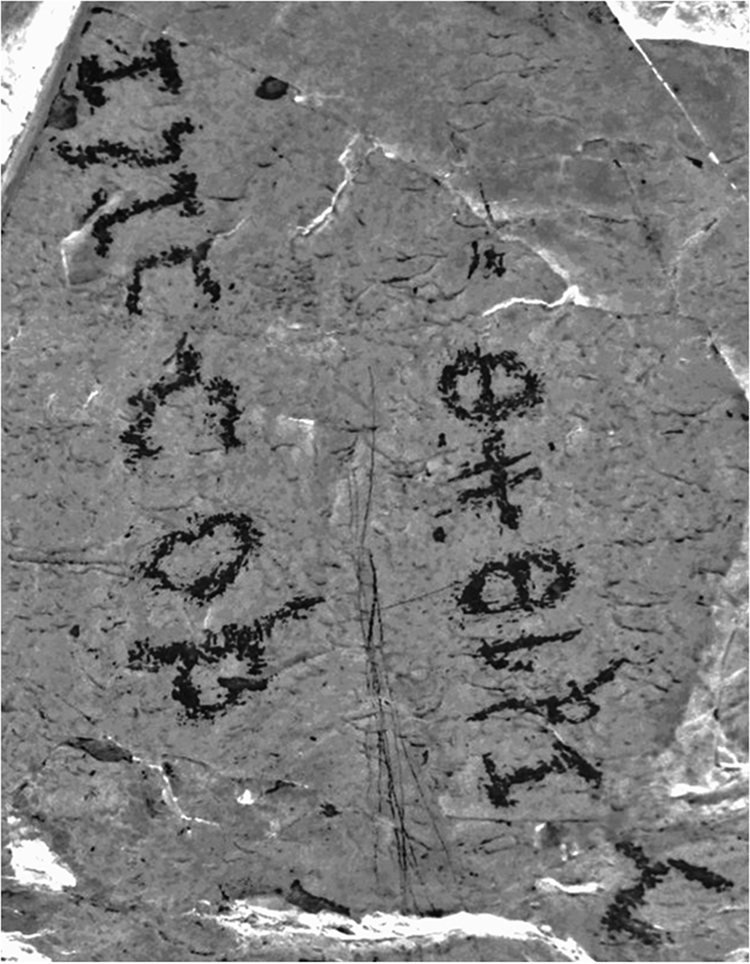
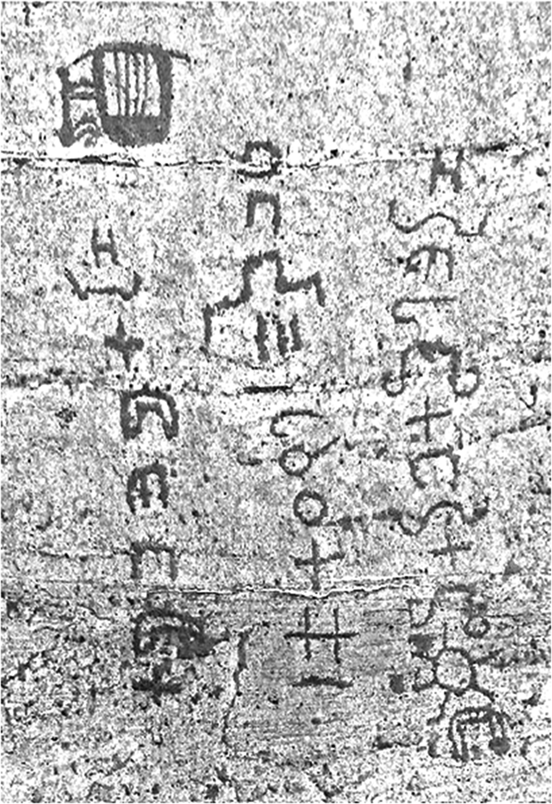
The traditional reading of the text in Figure 3 would be zn zbsʕd “this is Zb-Sʕd”, an unlikely name. The right column would read – according to Winnett (Reference Winnett and Reed1970) – wḍwldzs, which does not yield anything meaningful. These two examples, I believe, provide sufficient motivation to revisit the values of the Thamudic D glyphs and attempt a new decipherment of the script.
M93Athar 1.

2. The Thamudic D glyphs and their phonemic values
In the following pages, I will propose new phonemic values for several of the Thamudic D glyphs and try to identify the values of some of the previously neglected glyphs in an attempt to remedy some of the issues discussed above. It should be noted that the current state of documentation is far too fragmentary to define clear, regional subtypes of the Thamudic D script, but their existence will become clear in the course of our discussion. Several of the identifications that I shall propose will be tentative as said glyphs are only attested in a handful of inscriptions, which do not provide enough context to be certain about their phonemic values.
2.1 Glyphs identified with certainty
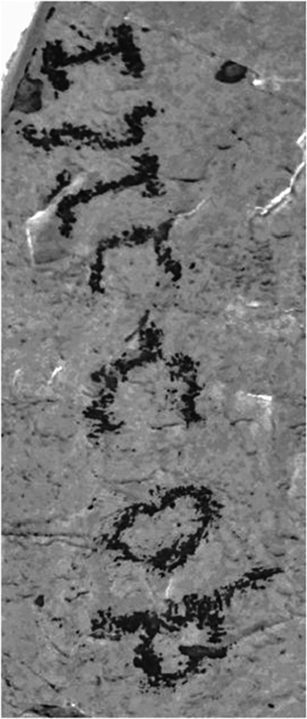
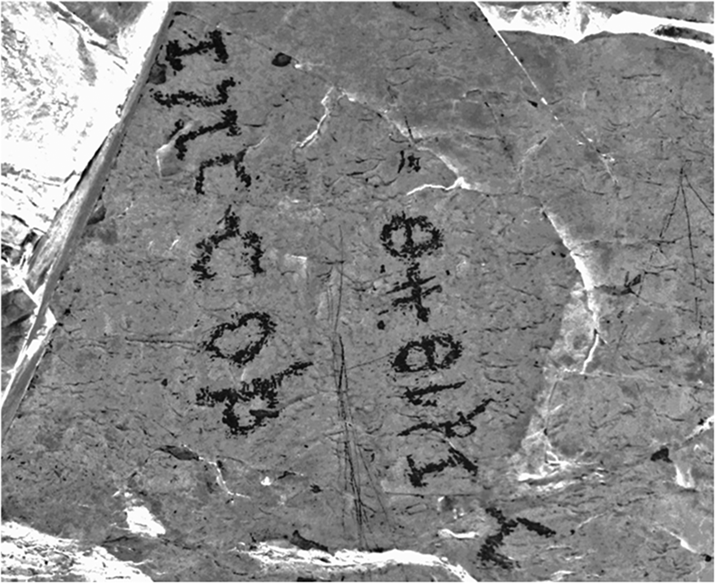
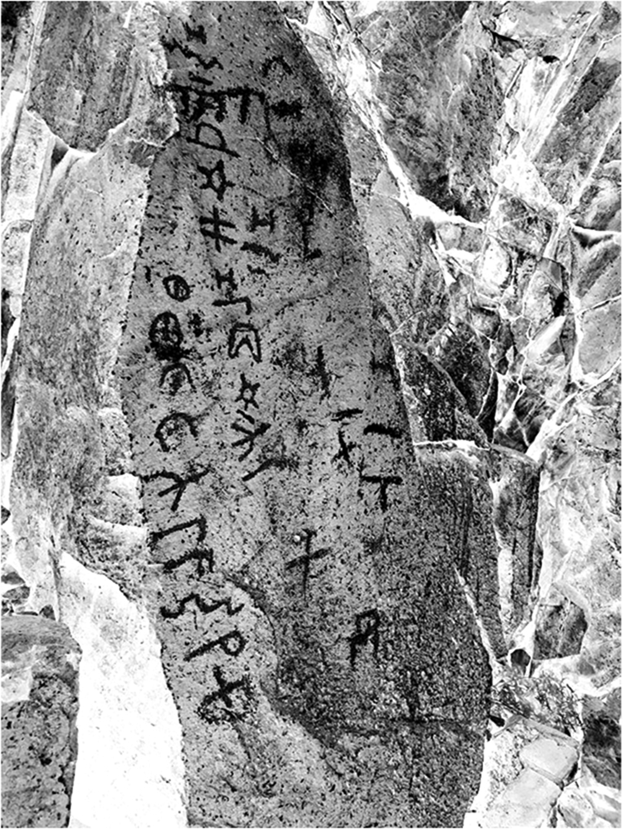
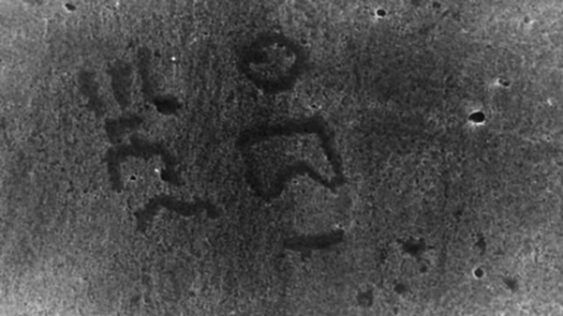
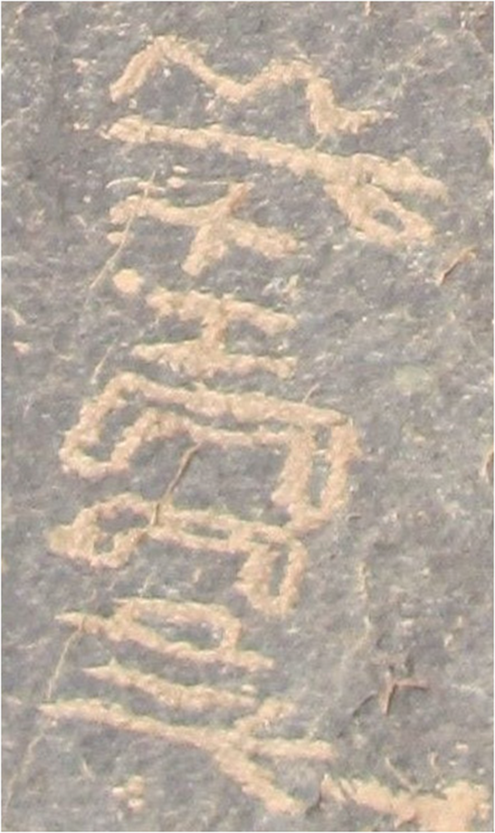
The H-glyph. The reading of this symbol as a z and sometimes as a ḏ was uncontroversial, even though it often produced meaningless phrases. Indeed, the H-glyph is the most common opening letter of the Thamudic D texts. Littmann, however, suggested the interpretation of ʔ in his Entzifferung,Footnote 20 although he was not working within the framework of script type. Most script charts list the H-glyph as a variant of the ʔ in Thamudic C. Macdonald systematically applied Littmann's value to his treatment of the Thamudic D inscriptions from Darb al-Bakrah.Footnote 21 As such, he re-read the opening “demonstrative” zn as ʔn, most likely “I”. This reading can be confirmed in the M93Athar 1 text (Figure 4).
M93Athar (left column). Traditional: znzbsʕd Revised: ʔn ʔbsʕd “I am ʔAbū-Saʕd”.

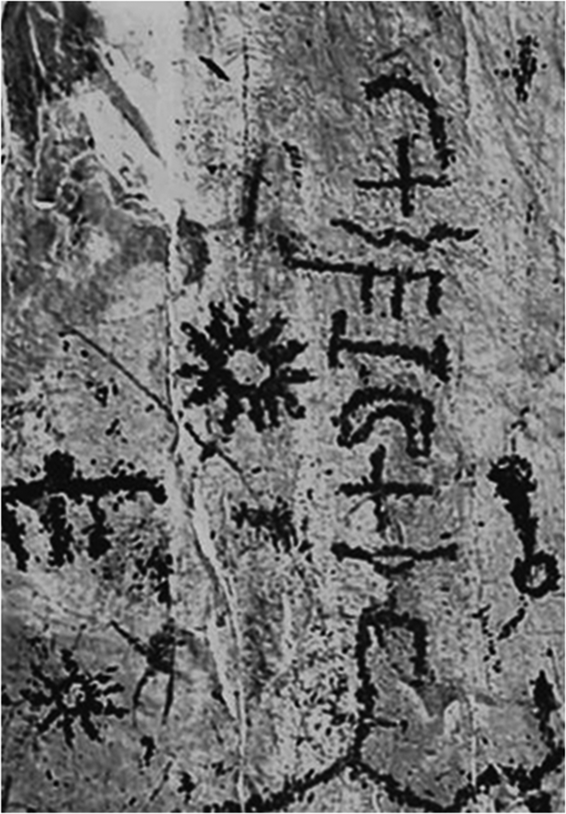
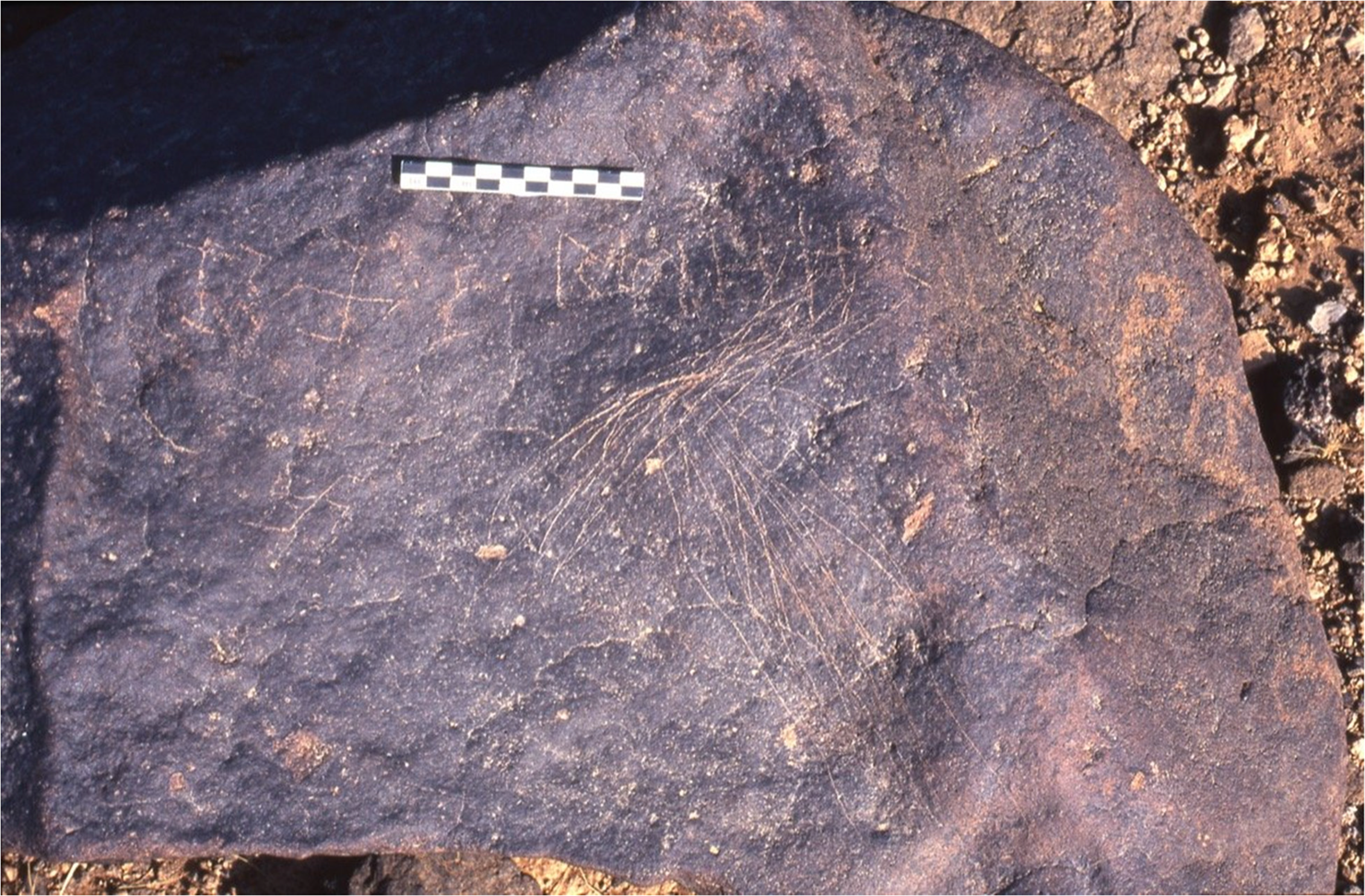
The 艹 glyph: The straight line with two crossbars was read by Winnett as ḍ in WRTham 65. Its occurrence in the two inscriptions here (Figures 5 and 6), however, prove the value of ḏ.Footnote 22
M93Athar 1 ʔn ʔbsʕd “I am Abū-Saʕd” w ḏ wldʔs
“and this is Walad-ʔAws”.

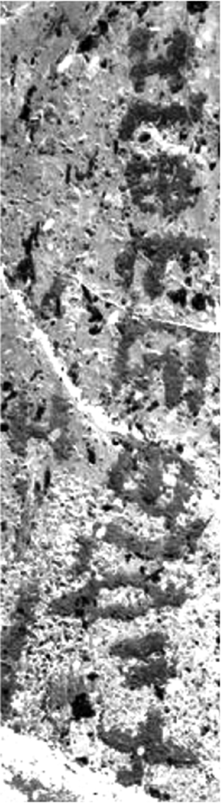
Gayloubi 1 (L). ʔn {☰}dś ḏ ʔl mśkr “I am ☰dś of the lineage of Mśkr”.

The Ψ-glyph: Winnett reads this glyph as a ḥ in WRTham 60, but on this very panel and indeed throughout the Thamudic D corpus, the ḥ value is represented by the E-glyph (Figures 7 and 8). The ḥ identification is further disqualified once we expand our treatment to other Thamudic D texts.
Esk 47.

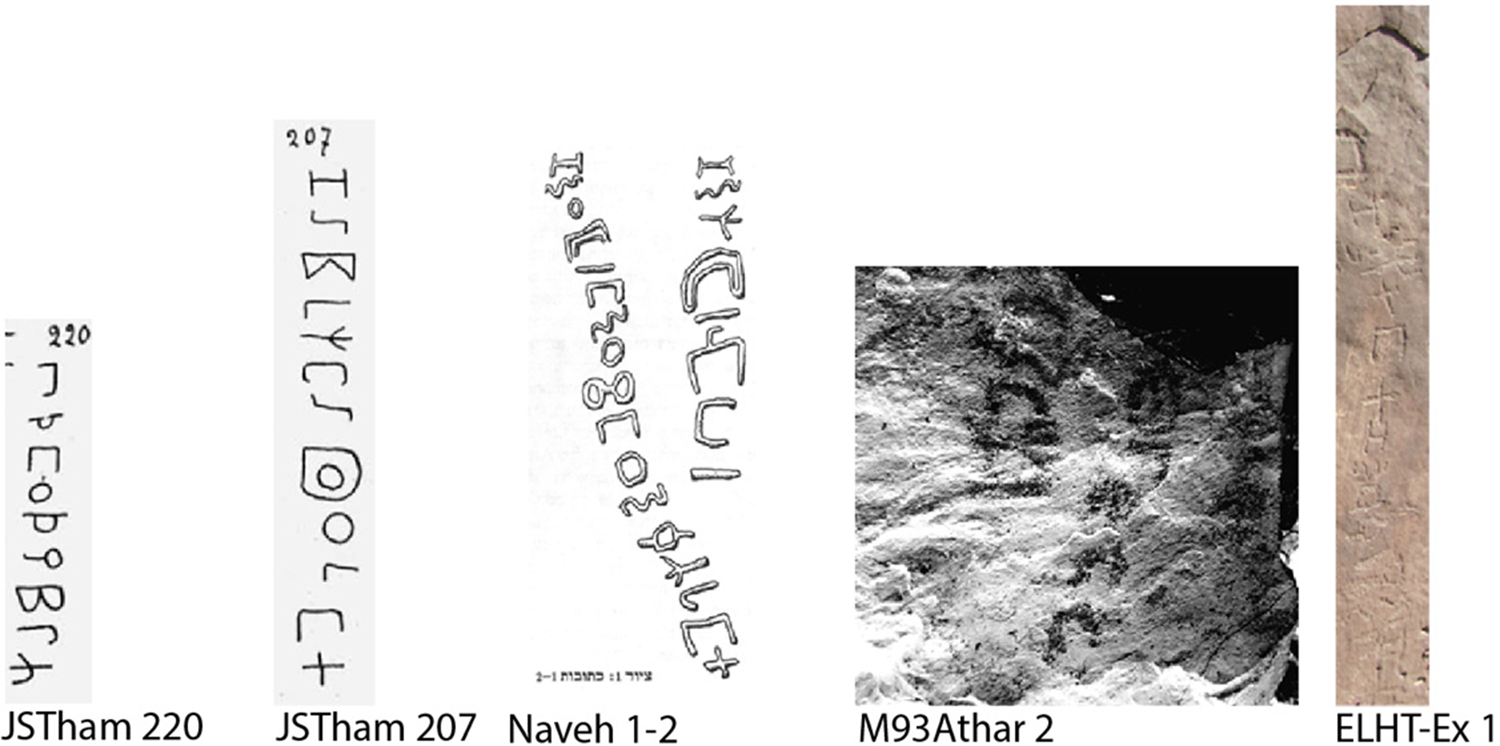
The Ψ-glyph in five Thamudic D inscriptions. Esk 47: ʾn Ψʿb ʿś[q] ʾs; JSTham 220: Ud bʕd ymlΨ JSTham 207: ʔn mlΨ bn ⌾ʕlbt; Naveh 1: ʔn Ψmr sUr; Naveh 2: ʔn ʕmr ʕ8b ʕnq Ψlbt; M93Athar 2: ʔn bΨr; ELHT-Ex 1: ʔn Ψtbt.

Only one phoneme can account for all of these names without irregularities and that is k. If we posit this value for Ψ, then we produce a series of Arabic names that are very common in the Nabataean and Ancient North Arabian onomasticon:
-
Esk 47: kʿb = Nabataean kʕbw;Footnote 23 Safaitic kʕb;Footnote 24 Greek Χαβος;Footnote 25 Classical Arabic kaʕb.
-
JSTham 220: ymlk = Nabataean ymlk;Footnote 26 Ancient North Arabian ymlk;Footnote 27 Greek Ιαμλιχος.Footnote 28
-
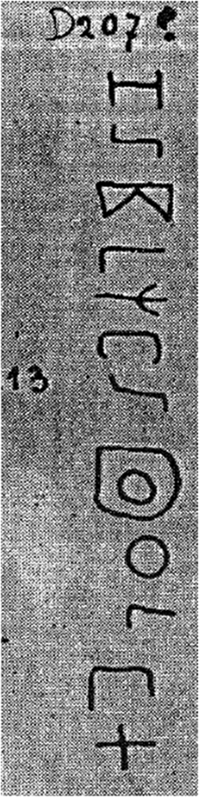
JSTham 207: mlk = Nabataean mlk;Footnote 29 Ancient North Arabian mlk;Footnote 30 Greek Μαλχος/Μαλιχος.Footnote 31
-
Naveh 1: kmr = Ancient North Arabian kmr.Footnote 32
-
Nabeh 2: klbt = Nabataen klybt;Footnote 33 Ancient North Arabian klbt;Footnote 34 Classical Arabic kulaybah.
-
M93Athar 2: bkr = Nabataean bkrw;Footnote 35 Ancient North Arabian bkr;Footnote 36 Classical Arabic bakr.
-
ELHT-Ex 1: ktbt = Ancient North Arabian ktbt;Footnote 37 Classical Arabic kutaybah.
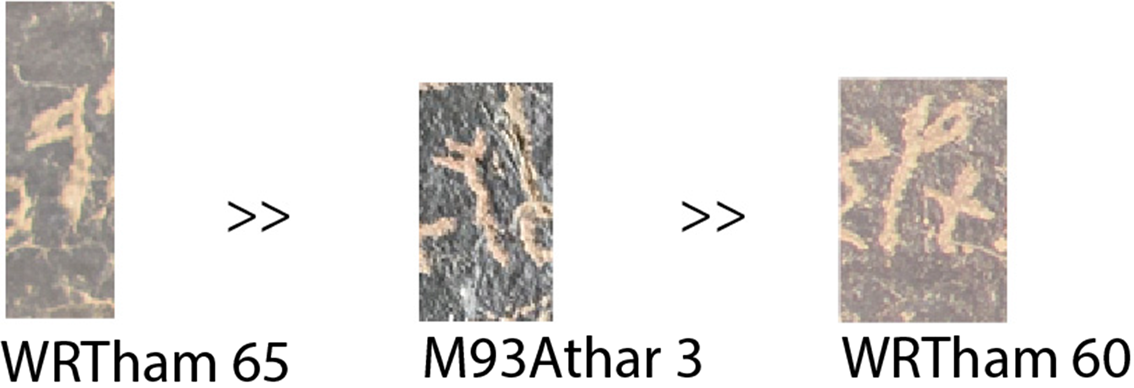
The Ψ-glyph, however, is quite odd for the k and seems to be unparalleled in other Ancient North Arabian alphabets (Figure 9). I believe that its shape can be accounted for by assuming an original F-glyph for k. The two arms of this glyph would have been written slightly below one extreme of the shaft, a shape we indeed find in WRTham 65 (=HU 511). The extension of the shaft past the second arm could have been interpreted as a third arm. This transitional shape also seems to be attested in M93Athar 3. Once this happens, the glyph was then reinterpreted as a trident.
Evolution of k.Footnote 38

F-glyph: It is important, however, to note that the original F-glyph does survive in inscriptions classified as Thamudic D (Figure 10). In some cases, it has the clear value of k.
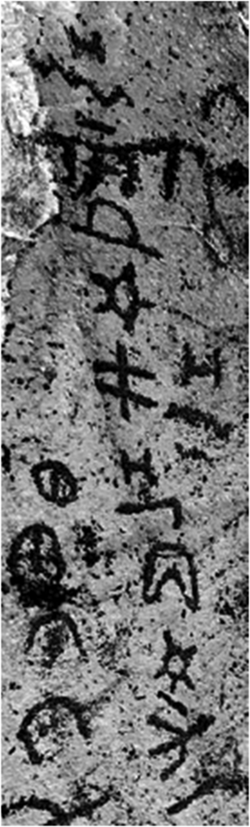
M93Athar 3. Left: nyk tm rwḥt “Taym copulated with Rwḥt”;Footnote 40 Middle: qly ḥkk “Ḥkk is detested”;Footnote 41 Right> ʔn k⌾mt “I am Kṯmt”.Footnote 42

It seems that yet another variant of Ψ is attested with the three arms emerging perpendicular to the shaft (Figure 11). Given the n(y)k formula, its reading as a k is secure. It is also possible to interpret this text as a prohibition, namely, l tnk ʾmt-qys “Do not copulate with ʾAmat-Qays.”
M93Athar 4. lt nk ʔmt-qs “Lt copulated with ʔAmat-Qays”.Footnote 43

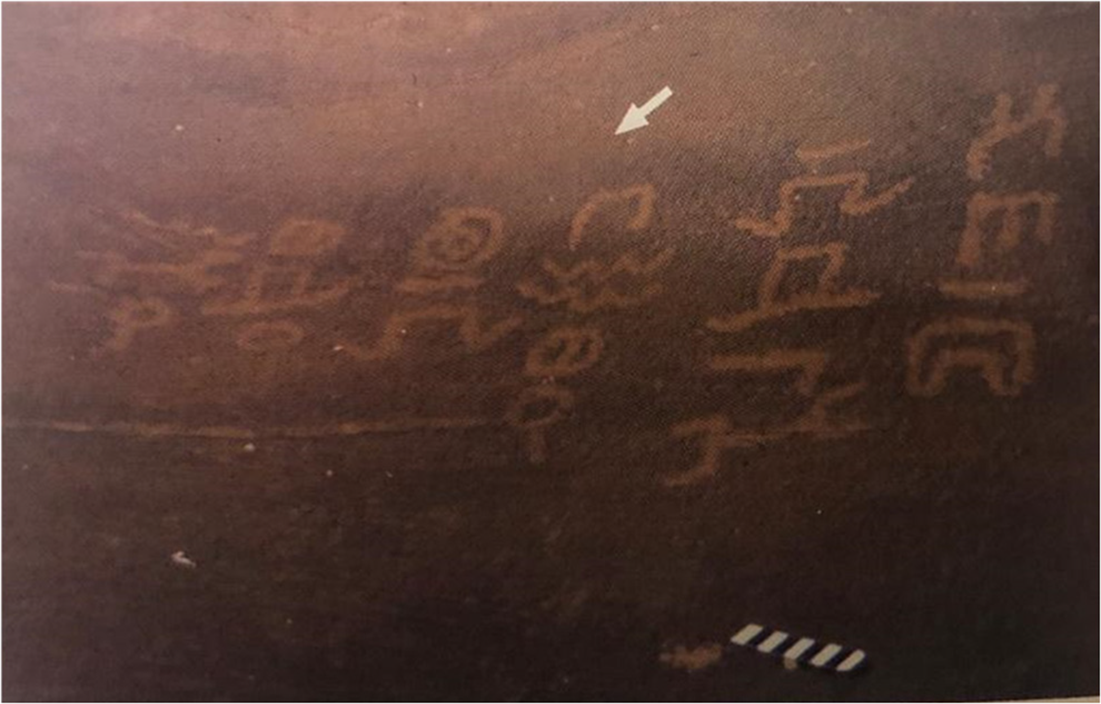
There is one text from the Bādiyat al-Madīnah where both the Ψ-glyph and the F-glyph co-occur (Figure 12). Here, considering the strong evidence for understanding Ψ as k, I would suggest that we take the F-glyph as having some other value.
Gayloubi 1. Right: ʔn ☰dś ḏ ʔl mśkr Left: w {ḥ}bb kl Fnyt.

We will return to the reading of the first name later. The reading of Ψ as k seems supported in this inscription as well, given the common word kl “all, every”.Footnote 39 In light of the gaps in the script chart and possible combinations, the F-glyph could have the value of z, producing “and he loved every fornicatress”.Footnote 44 The sentence is perfectly grammatical and is thematically congruent with the n(y)k theme attested in other Thamudic D and Ancient North Arabian inscriptions.
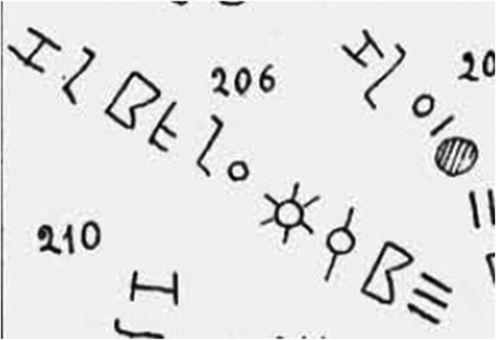
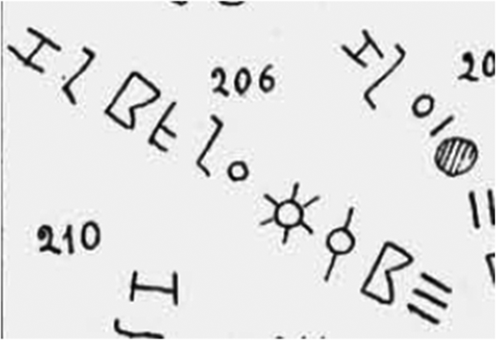
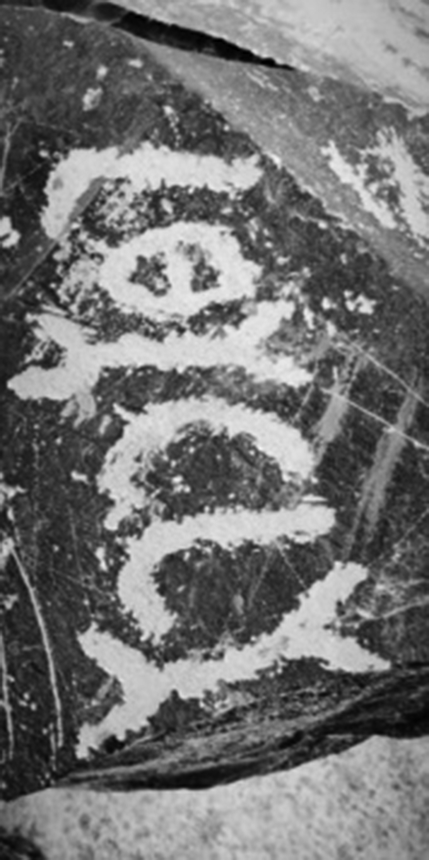
The F-glyph also occurs in the name mFn (JSTham 206) (Figure 13), which can be read as both mzn and mkn.
JSTham 206.

The ⌾-glyph: We can confirm the identification of the ⌾ as reflecting etymological ṯ, a value already suggested in Winnett (Reference Winnett1937), but its phonetic realization remains uncertain.
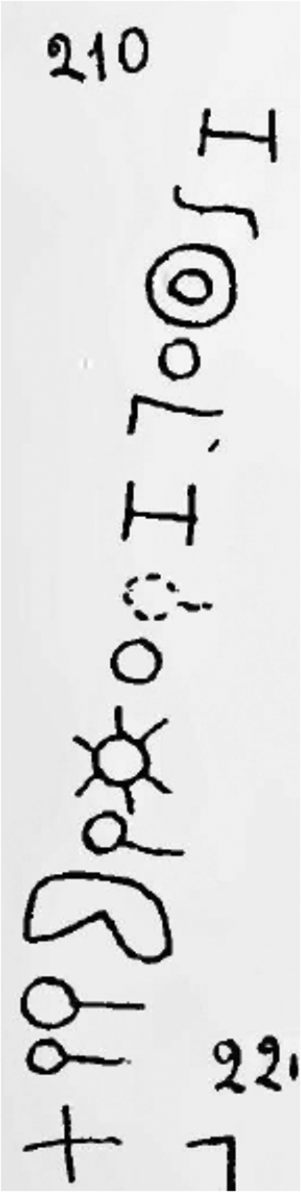
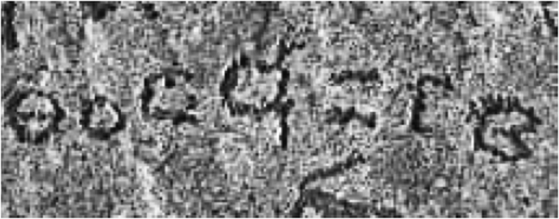
The second name is very likely ṯʕlbt, a popular and well attested name in the region (Figure 14).Footnote 45 Likewise, it is possible to read JS 210 in the same way.
JS207. ʔn mlk bn ṯʕlbt “I am Mlk son of Ṯʕlbt”.

The name ṯʕl “jackal” is a known alternative of the more common ṯʕlbt (Figure 15). What comes after requires some restoration. The H-glyph (ʔ) is probably the performative prefix of a prefix conjugated verb from ʕśq, which we usually find as a participle. It seems the author erred in carving a ʕ and erased the letter. What was copied as a y after the ś could be restored as a q, as the copyist may have omitted one of the bars. The name myyt is unique, probably a diminutive of myt, which is attested in Safaitic.Footnote 46
JS 210. ʔn ṯʕl ʔ<<>>ʕś{q} myyt Footnote 47 “I am Ṯʕl lover of Myyt”.

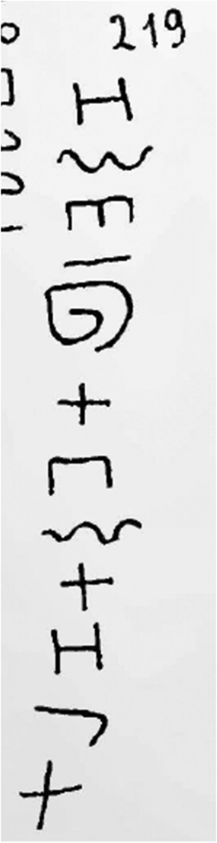
The ခ-glyph: I would go on to suggest that the spiral glyph, which Winnett tentatively identified as a g, is nothing but a simplified form of the ⌾-glyph, producing the following reading of JS 219 (Figure 16).
JS 219. ʔn ḥrṯt bn tʔlt “I am Ḥāriṯat son of Tʔlt”.Footnote 48

This concludes the securely identified glyphs. We now turn to those that are attested, but not with enough frequency to determine their phonemic identity with absolute certainty.
2.2 Uncertain glyphs
The ☰ -glyph: Winnett suggested the value of ṭ, which has been conventionally accepted in all subsequent script charts. If this hypothesis is correct, it would mean the shape developed from a Safaitic or Thamudic B type ṭ, through the loss of the intersecting line. A new text from the Medina area seems to attest this glyph in a common name (Figure 17).
M93Athar 5. Left: close up; right: panel view. ʔn ṭb “I am Ṭīb”.

The texts copied by Jaussen and Savingnac do not provide any examples that help us to determine its phonemic value securely, but the second set of texts in DAU 1 gives us an opportunity to form a hypothesis (Figure 18).
DAU 1.

The reading of the middle text is clear; however, the identification of the phonemic value of the ☰ -glyph remains uncertain. ☰:
-
Middle text {b-}Footnote 49rb f☰l yʕtḏr “?”
The parsing of the words of line two is secure. The final five glyphs form a Gt-stem prefix conjugated verb of the root ʕḏr. Thus, f☰l must be a single word preceded by b-rb. There is no root fṭl in Arabic. In fact, the only outstanding phoneme that would fit this slot is ḍ, producing the word fḍl, “favour”. This value provides us with the following reading and interpretation: b-rb fḍl yʕtḏr “in the lord of favour he seeks forgiveness”.
Thus, line 2 attests a short prayer, similar, I would suggest, to the istiġfār formula known from Islamic times.Footnote 50 If the reading of ☰ as etymological ḍ here is correct, then it may speak to a merger of these two sounds in the dialect of this particular writer.
The ☰-glyph also occurs in a short text from the Tabūk area (Figure 19). It seems to either form the name ḍ/ṭrbn or perhaps ḍ/ṭr bn ʕmr, if taken with the column to its right. These two likely identifications find support in the occurrences of this phoneme in JS's texts (Figures 20 and 21).
Falah 1.

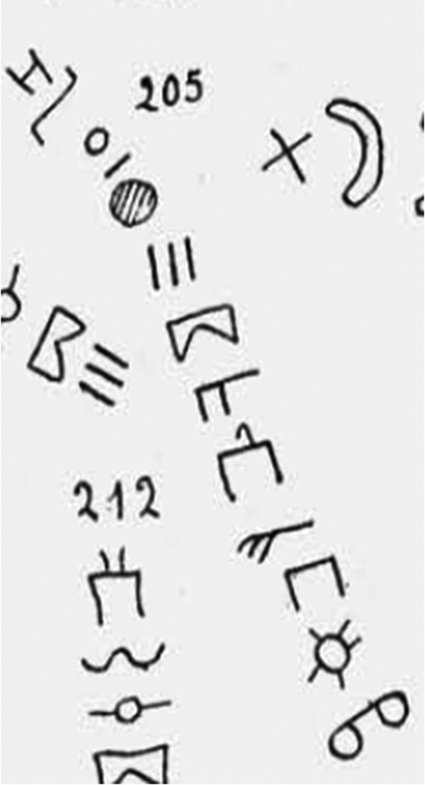
JSTham 206. ʔn mFn ʕśq mḍ/ṭ Footnote 52 “I am Mz?n lover of Mḍ/ṭ”.

JS 205. ʔn ʕr<<>>ḍ/ṭ m{F}b kbś8 “I am ʕr<<>>ḍ/ṭ {lover of ?} kbś8”.

The circle between the r and the ☰-glyph could be a mistake, erased by the writer, or perhaps it is related to the circle mentioned in HU 517, the meaning of which is unclear. If indeed we are dealing with continuous text, as it seems, the letter following ʔn would appear to form the name ʕrḍ “honour”. The names ʕrḍ and ʕrḍt are attested in Safaitic, but so is ʿrṭ.Footnote 51 The word mḥb is restored based on its formulaic context. The glyph following the m is clearly the F-glyph on the copy, but this does not yield a meaningful word. It is possible that the author/copyist omitted one of the bars of the E-glpyh, producing the attested word mḥb “lover”. The following name is unique.
Thus, the value ṭ is possible in all cases but DAU 1, where the context favours reading it, at least etymologically, as ḍ, perhaps speaking to a merger of the two phonemes in the dialect of the inscription. These readings remain very hypothetical.
The =−glyph: The two parallel lines have not yet been identified as an independent glyph. It is rare in the inscriptions known so far. The possible value of ṣ or ẓ can be suggested, based on its appearance in a theophoric name in DB 3 (Figure 22).
DB 3. w ʕbdṣlm “and ʕabd-Ṣalm”.

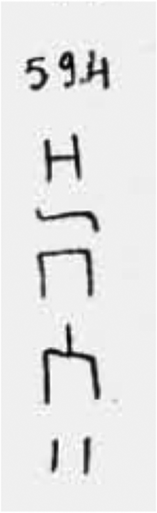
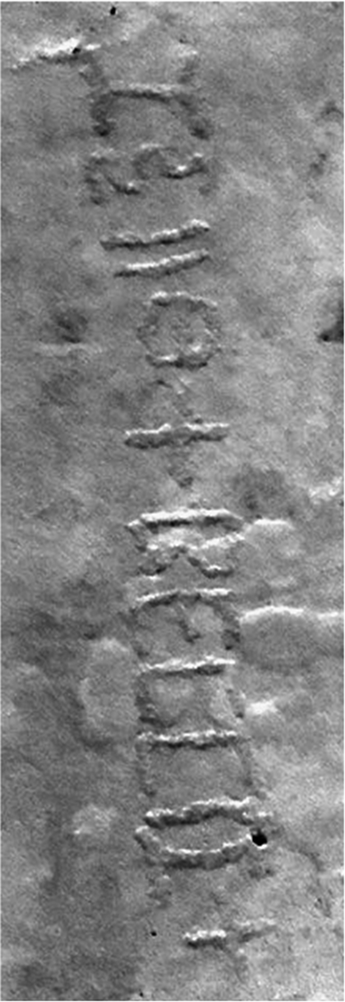
The first element of this personal name, ʕbd “servant”, makes it likely that we are dealing with a theophoric name. The deity Ṣalm – the tutelary deity of Taymāʔ – fits well, suggesting that the value of the =−glyph is ṣ.Footnote 53 But the name ʿbdẓlm is also possible, although it has not yet been attested. The value ṣ is compatible with the two other attestations of this glyph (Figures 23 and 24).
JSTham 594. ʔn bsṣ “I am bsṣ”.

Falah 2. ʔn ṣʕt mḥb b{r}ʔt “I am Ṣʕt lover of {Brʔt}.

While the name in JSTham 594 may seem odd if read according to the values suggested above, it can be explained in two ways. The first is a connection with the Arabian name bṣṣ, attested in TaymaniticFootnote 54 and Ḥismaic.Footnote 55 In this case, we would have to argue for the dissimilation of one of the ṣ's to s. The second option is to equate this name with Greek Βασσος,Footnote 56 attested in the Greek epigraphy from southern Syria. Greek sigma is represented by both s and ṣ in Arabian transcription and so it is possible that the o-vowel of the nominative ending may have caused an emphatic interpretation of the final sibilant, if ṣ were pharyngealized.Footnote 57
The only comparable name in ANA comparable to the ṣˁt suggested for Falah 2 is ṣʕy, of which ṣˁt would be a feminine form.Footnote 58 The root ṣyʕ, which signifies “commotion”, could be the source of this name, as could a derivation from ṣʕw “to have a small head”.Footnote 59 The name ẓʿt is attested once in Hismaic.Footnote 60
The final name should be taken as nqṣt (Figure 25) in M93Athar 7, from the common root nqṣ “to lack”, which gives rise to the name nqṣ in Safaitic.Footnote 61 The present form may be a diminutive, nuqayṣat.
M93Athar 7. ʔn ⊕Fm w nq=t “I am Hz(?)m, with Nqṣt”.

The ⊕-glyph: In the texts from Bādiyat al-Madīnah, another circle-based glyph is encountered – a quartered circle. The attested examples suggest that it could have the value of h (Figures 25 and 26).
M93Athar 8. ʔn w⊕b w ⊕dmt {ḥ}{b}{b} “I am Wh?b, with H?dmt, a friend”.

The traditional reading of the glyph as a variant of the w can be ruled out as the normal w – with a single bisecting line – is attested just two glyphs later.Footnote 62 It would seem very unlikely that an author used both variants in a single text. If we take ⊕ as h, and read F as z, then we produce the attested name hzm.Footnote 63
M93Athar 8 (Figure 26) demonstrates the impossibility of reading the ⊕ -glyph as w, as the first name would have to be read as wwb, an unknown name and an unattested root. The h reading produces the very common name Whb and the attested Hdmt.
The bifork: With the identification of the H-glyph as ʔ, it is extremely unlikely that the bifork  also signifies this value. It occurs alongside a relatively more archaic form of the alif, one closer to the Thamudic B shape, ሸ. The following text, documented by Eskoubi, indicates that it must have the value of h (Figure 27).
Esk 36. Right column to left: 1 ʔḥrm 2 rfdlh 3 bn nwy 4 ⌾ rf Footnote 64 5 w-dʕ 6 nhy “Rfdlh son of Nwy has gone into a state of ḥrm ? ⌾rf and he called upon Nhy”.

The inscription DB 2 (Figure 28) provides yet another positive identification of the bifork as h; this text comes from a site about 150 km north of Al-Ulā.
DB 2. l whblh “By Wahballāh”.

The occurrence of the bifork h with the archaic A-glyph for ʔ suggests a different subgrouping of Thamudic D. For this reason, it is not possible to identify with certainty the value of the ⌾-glyph in Esk 36.
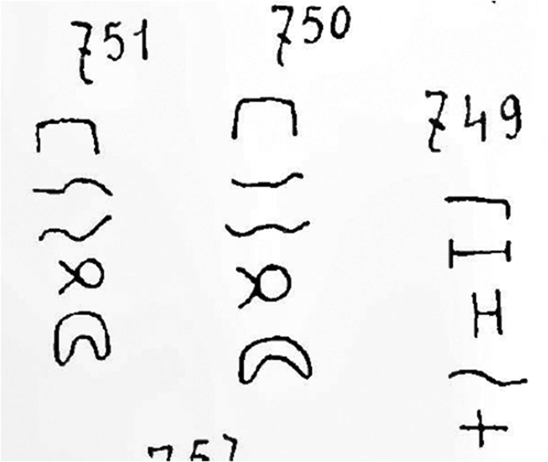
The ४-glyph: This glyph (Figure 29) is close in shape to the ṣ in other Ancient North Arabian scripts, namely Dumaitic, Taymanitic and Thamudic C. It appears in JSTham 750 and 751, which most likely form a single text with JSTham 749.
The ४-glyph.
749: l ʾḏnt 750: bn n४m 751: bn n४m.

If we identify the glyph as a ṣ, then it would produce the rare name nṣm, attested only twice in Safaitic.Footnote 65 On the other hand, the value of ẓ would produce the very common name nẓm, attested 80 times according to the OCIANA corpus.
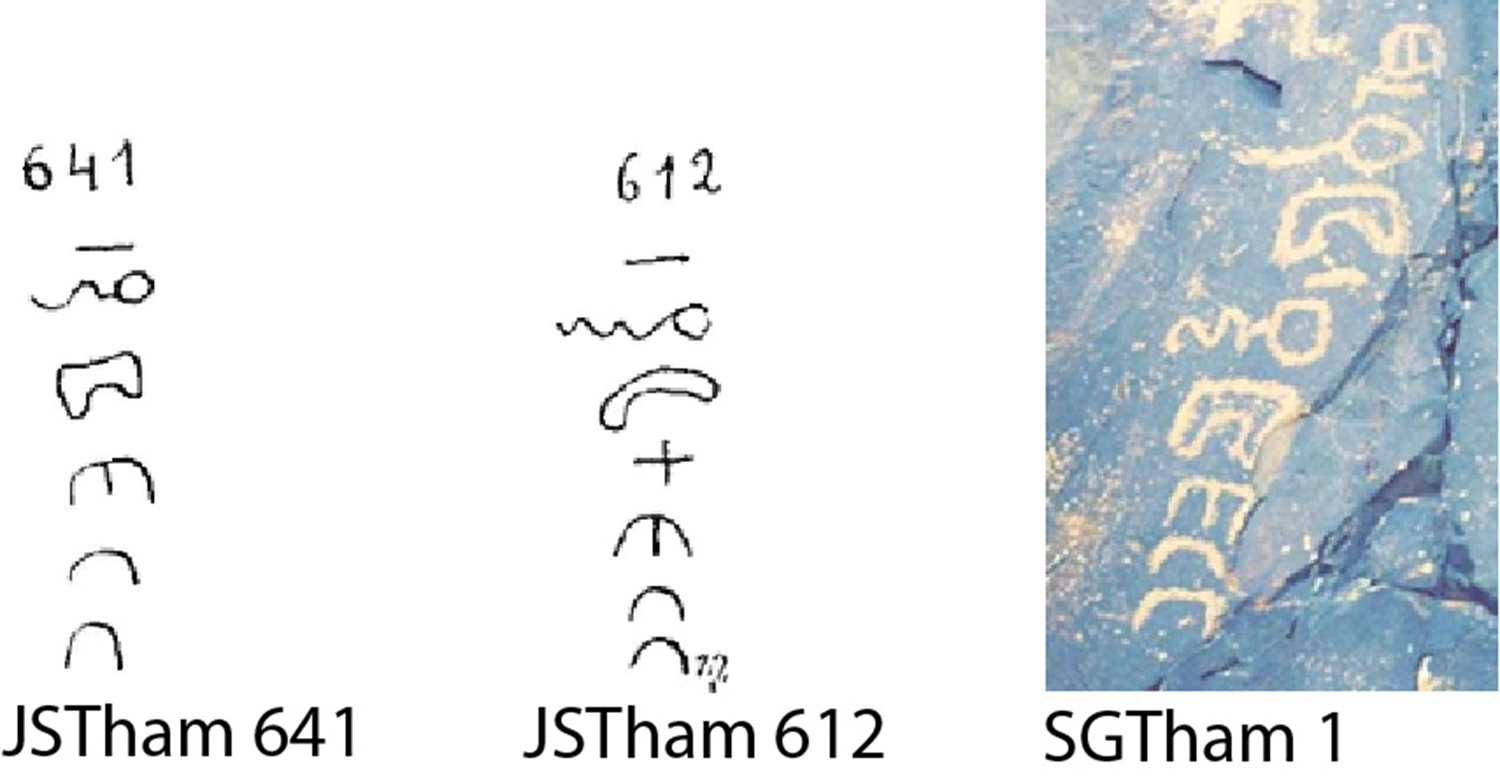
The ⧜- glyph: This glyph (Figure 30) has not previously been identified as a separate letter shape, but in a new inscription published online (SGTham 1), it appears next to the normal y, thus it should be treated independently. It is found twice in the reoccurring phrase r⧜m(t) ḥbb, which is also attested in the Thamudic F inscriptions as rġm ḥbb and recalls the Safaitic use of rġm “struck down” to refer to the deceased. It is therefore possible that it has the phonemic value of ġ.
Occurrences of the ⧜ glyph. JSTham 641: rġm ḥbb “a beloved was struck down” JSTham 612: rġmt ḥbb “striking down of a beloved”? SG 1: w lym rġm ḥbb “and Lym (or: he was blameworthy), a beloved, was struck down”?.

Two further glyphs are attested in Thamudic D but context does not yet permit their secure identification. These are the barbell, 8-glyph and the open rectangle, U-glyph (both attested in Naveh 1–2). The available phonemes are ḍ, ẓ, g, s 3 and possibly ṭ. The reader will notice that some phonemes correspond to several different glyph shapes. This most likely suggests the existence of several sub-script types but there is currently not enough data to identify with certainty which alloglyphs co-occur consistently and form a sub-script. We see, for example, in Esk 26 that the archaic A-glyph (ʔ) co-occurs with the bifork h. This pair would seem to form a different script type than Is.H 340, which employs the H-glyph for ʔ and the Y-glyph for h. Moreover, inscriptions that employ the quartered circle for h also make use of the H-glyph for ʔ. Likewise, if the identification of the ⧜-glyph as ġ is correct, then it implies that this script type did not employ the卐-glyph for that purpose. Was that glyph simply lost or was it repurposed? These questions cannot be answered based on the available data. From these distributions, one may tentatively posit up to three Thamudic D sub-scripts based on the shapes of the /ʔ/ and /h/ phonemes, but at the moment it remains unclear if this variation is perfectly consistent, what other letter shapes correlate with these glyphs and whether it has a chronological and/or geographic dimension.
-
Thamudic D.1 = H-glyph (ʔ), Y-glyph (h)
-
Thamudic D.2 = A-glyph (ʔ), bifork (h)
-
Thamudic D.3 = H-glyph (ʔ), ⊕-glyph (h)
Thus, the script chart in Table 4 gives a very low-resolution image of the Thamudic D repertoire of glyphs; future discoveries will help sharpen this image and isolate sub-script types.
3. New writing formula
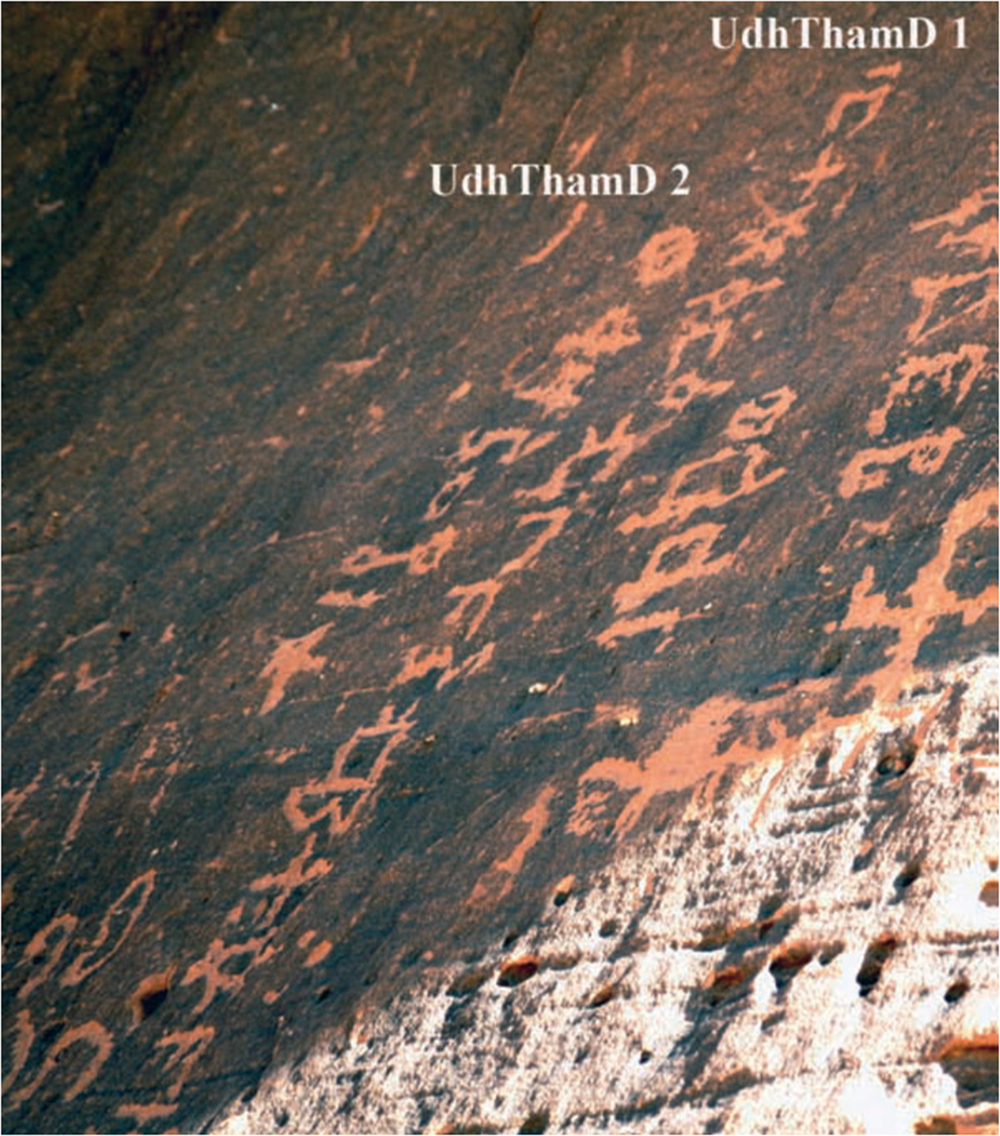
In addition to the formulae identified by Winnett (Reference Winnett1937), there appear to be four more relatively common inscriptional genres, two of which are shared with Hismaic. The first is the longing formula śq (by) “there is longing (in me)”, often preceded by the adverb rb and rbt (Figure 31). Compare UdhThamD 1 from Darb al-Bakrah with the following Hismaic examples.
- UdhThamD 1:Footnote 66
rbt śq by Footnote 67 ʔl-kn ʔmt śkrn
- = JSTham 213
“there is much longing in me for Kn, the slave girl of Śkrn”
- KJC 347:
l ṯʕt w rb sqm b-h
Figure 31.UdhThamD 1 (Nehmé Reference Norris2018: pl. 53b).

“By Ṯʕt; and there is much sickness in him”
- KJB 136:
rbt sq[m] w śq b-dʕm w dʕt lt fḍg w gḥfl w dʕm ḫṭṭ
“There is much sickness and longing in Dʕm so may Allāt call Fḍg and Gḥfl, and Dʕm is the scribe”
- KJA 323:
rbt sqm b-kml ḥd
“there is much sickness in Kml Ḥd”

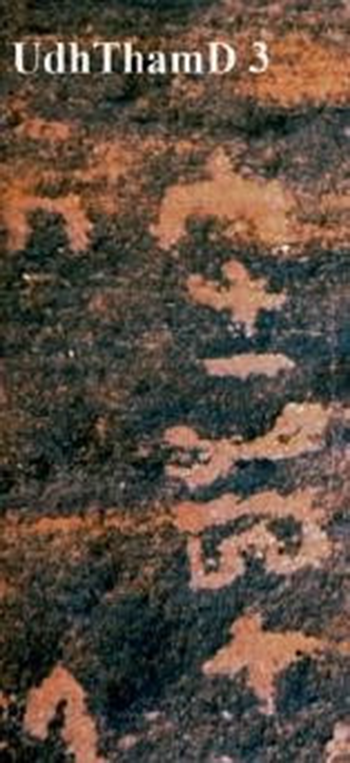
The second formula begins with the etymon st followed by a personal name (Figure 32). Previous scholars have taken this to mean “lady” but in DB 2 it precedes what is clearly a masculine name (Figure 33).
UdhThamD 3. UdhThamD 3: st rḫmt “memorial of Rḫmt”.

DB 2: st ʕbd bn 8lḥ “the memorial of ʕAbd son of 8lḥ”.

While the secure reading of the final name is pending the secure identification of the barbell glyph, the first name ʕbd is clearly identified as masculine as it is followed by the word “son”. I would suggest therefore that st should be connected to Aramaic swtʔ “stele”, “monument”, which is attested in the Aramaic of Taymāʔ.Footnote 68 While the inscription here is carved on a natural rock face rather than a man-made monument, it is possible that we are dealing with a semantic shift from “memorial” to “memorial inscription”. The text may therefore refer to a dead person.
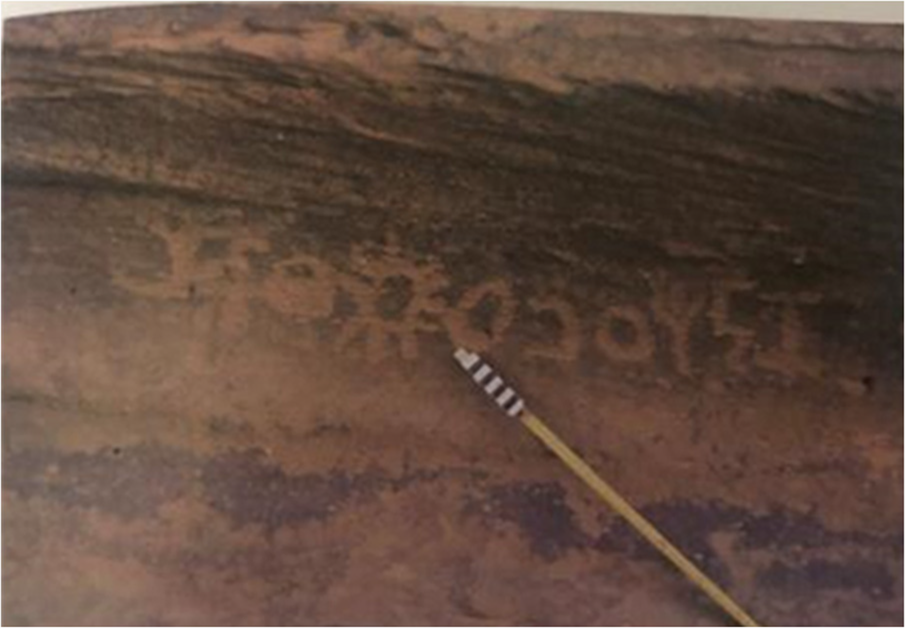
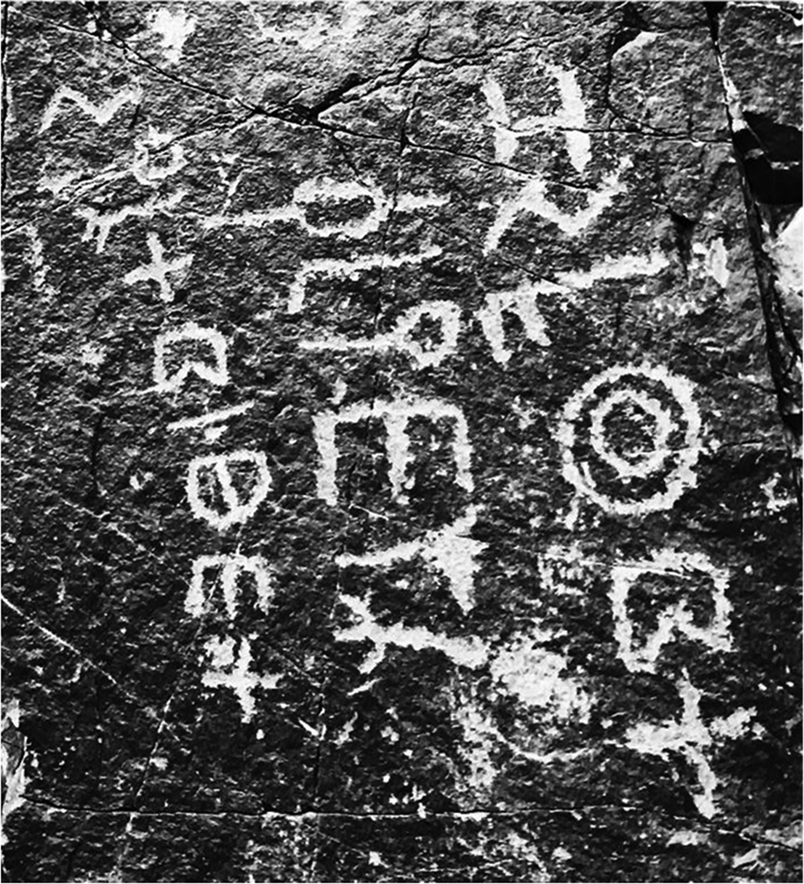
The third new, reoccurring formula makes use of the verb n(y)k “to copulate” (Figure 34). This is attested in M93Athar 3, M93Athar 4 and WRTham 60.
WRTham 60 (= HU 521). Photo courtesy of M.C.A. Macdonald. WRTham 60: nk tʾm mdrk “Tʾm copulated with Mdrk”.

This formula is also attested several times in Hismaic:
- KJA 8:
nk rhsn bnʔl
“Rhsn copulated with Bnʔl”
- KJB 179:
nk qrfz wʔl bn sʕdlh
“Qrfz copulated with Wʔl son of Sʕdlh”
- CH.R 466:
nyk ḥlk ʔmṭr
“Ḥlk copulated with ʔmṭr”
4. On the language of the Thamudic D inscriptions
The laconic Thamudic D inscriptions prevent us from learning much about the language of this script, and it remains unclear how it relates to the language of the other Thamudic corpora and Arabic. The following observations can be made about the corpus at present.
The demonstratives: It was believed that the demonstratives in Thamudic D were zn and zt, but this was based on a misreading of the H-glyph. M93Athar 1 attests the masculine singular demonstrative ḏ, which is the common form in the pre-Islamic Arabic-script inscriptions, Safaitic and Hismaic. A similar inscription was discovered at al-ʿIsāwī, Syria and published without a reading or interpretation on OCIANA (Figures 35 and 36).
Is.H 340.

Tracing of Is.H 340.

I suggest the following reading and translation:
ʔn ġnm w-hḏ ḏn
“I am Ġānim and this is Ḏn”
This text supplies us with a new form of the demonstrative, hḏ, cf. Arabic hāḏā. Forms with the prefixed h appear for the first time in Arabic in the Quranic Consonantal Text and are thus far unknown in the corpus of Pre-Islamic Arabic-script inscriptions. It is unclear if such a form reflects a distinct dialect written in Thamudic D or if the addition of the hā prefix was simply optional in Thamudic D, as it is in many Peninsular dialects of Arabic today.
Relative pronoun: Gayloubi 1 attests ḏ as a masculine singular relative pronoun.
Definite article: The definite article is still unattested in the prose section of our texts, although it has appeared in personal names. In an unpublished inscription, we find the name ʕbdlqs, suggesting the use of the ʔal-article, although personal names do not need to reflect the vernacular dialect of their bearers. This would be further suggested by JSNab 17, which is written in Arabic, most likely the vernacular of the deceased.
Triphthongs: The realization of the Proto-Semitic triphthongs is unclear. The third masculine singular verb dʕ in ESK 36 seems to have collapsed the awa triphthong to a long vowel, as in Hismaic, as opposed to Safaitic dʕy.Footnote 69
Conclusion and future directions
The phonemic values of the U-glyph and the 8-glyph remain unknown and there remains some doubt about the identification of the = and ☰ glyphs. From the identification of the glyphs presented here we can conclude the following:
1. The Thamudic D onomasticon is very similar to early Arabic, Hismaic and Safaitic, with names such as mlk, kʿb, ktbt, etc.
2. The grammatical profile is similar to Hismaic and Safaitic.
3. The writing formulae overlap with Hismaic, including the use of the adverb rb/rbt and the nyk formula. The use of rġm, if our understanding of the ⧜-glyph is correct, then connects it – or at least the sub-script which employs this glyph – with Thamudic F and more distantly Safaitic.
Acknowledgements
I owe a great debt to Jérôme Norris for the many fruitful discussions on the Thamudic inscriptions, checking the occurrences of letter shapes for me in his Thamudic database, and sharing PDFs of articles while I was unable to access my library because of the Covid-19 phenomenon. I thank Michael C.A. Macdonald for sharing photographs of some of the Thamudic D texts from the Taymāʾ area with me, as well as for his comments on a preliminary draft of this article. I also thank Mohammad Al-Mighdhawī, Abdallāh al-Balwī, Falāḥ al-ʿAnze and Ghālī al-Yūbī for their work in documenting Thamudic inscriptions.
Sigla
- AbaNS
Safaitic inscriptions in Ababneh (Reference Ababneh2005).
- BES
Safaitic inscriptions from the Badia Surveys published on OCIANA
- C
Safaitic inscriptions in Ryckmans (Reference Ryckmans1950–1)
- CH.R
Hismaic inscriptions in Corbett (Reference Corbett2010)
- DAU
Inscriptions published on the @DiscoverAlUla Twitter page
- DB
Thamudic inscriptions discovered and documented by Mr Abdallah al-Balwī in the region of Diyār Balī KSA and published on his Twitter page @R73tY5y3x%o%wvU
- DNWSI
Hoftijzer and Jongeling (Reference Hoftijzer and Jongeling2004)
- ELHT-Ex
New Thamudic D texts recorded by ELHT at Ghār al-Ḥamām
- Falah
Thamudic inscriptions discovered and documented by Mr Falāḥ Al-ʿAnze from the Tabūk region, published on his Twitter page @falah1alnze
- Gayloubi
Thamudic inscriptions discovered and documented by Ghāli al-Yūbī from the Medina province, KSA, published on his Twitter page @galyoubi
- GSP
Safaitic inscriptions from Jebel Says published on OCIANA
- KJB and KJC
Hismaic inscriptions in King (Reference King1990).
- KRS
Safaitic inscriptions edited by G. King and published on OCIANA
- JSNab
Nabataean inscriptions in Jaussen and Savignac (Reference Jaussen and Savignac1909)
- JSTham
Thamudic inscriptions in Jaussen and Savignac (Reference Jaussen and Savignac1909)
- Lane
Lane (Reference Lane1863)
- LAU
Hismaic inscriptions published on OCIANA
- LP
Safaitic inscriptions in Littmann (Reference Littmann1943)
- M93Athar
Thamudic inscriptions discovered and documented by Mohammad al-Mughadhdhawī from Bādiyat al-Madīnah, KSA, published on his Twitter page @mohammed93athar
- Naveh
Thamudic D inscriptions published in Naveh (Reference Naveh1975)
- OCIANA
Online Corpus of the Inscriptions of Ancient North Arabia, http://ociana.osu.edu [Accessed 2 July 2024]
- SGTham
Thamudic inscriptions published online by the Twitter account @sgr_____s
- WH
Safaitic inscriptions in Winnett and Harding (Reference Winnett and Harding1978)
- WRTham
Thamudic inscriptions in Winnett and Reed (Reference Winnett and Reed1970)