INTRODUCTION
The relationship between biodiversity conservation and poverty is complex and varies according to the site and scale of analysis (Agrawal & Redford Reference Agrawal and Redford2006; Adams & Hutton Reference Adams and Hutton2007; Barrett et al. Reference Barrett, Travis and Dasgupta2011). Most experts view severe poverty as a long-term threat to local biodiversity (Fisher & Christopher Reference Fisher and Christopher2007). Others are concerned that conservation may itself impoverish local citizens if they lose access to vital resources (Brockington & Schmidt-Soltau Reference Brockington and Schmidt-Soltau2004). Integrated conservation and development projects (ICDPs) represent one broad strategy for connecting poverty alleviation with biodiversity conservation indirectly. ICDPs typically aim to improve community involvement in conservation through shared decision-making authority, employment, revenue-sharing, limited harvesting of resources, or provision of community facilities such as schools or hospitals (Newmark & Hough Reference Newmark and Hough2000). ICDPs promise to reverse top-down, centre-driven conservation and build the local support essential to long-term biodiversity protection (Schwartzman et al. Reference Schwartzman, Moreira and Nepstad2000). However, such projects have had mixed success (Robinson & Redford Reference Robinson, Redford, McShane and Wells2004). ICDPs seldom significantly raise incomes (Agrawal & Redford Reference Agrawal and Redford2006), and when they have, it is rarely clear how this benefited biodiversity conservation (Wells et al. Reference Wells, McShane, Dublin, O'Connor, Redford, McShane and Wells2006). Some have criticized the approaches used by ICDPs as being paternalistic, such as promoting collective activities where there is no tradition of such (Campbell & Vainio-Mattila Reference Campbell and Vainio-Mattila2003).
Many conservationists have since turned to direct incentive-based approaches, such as payments for ecosystem services (PES; Ferraro & Simpson Reference Ferraro and Simpson2002; Wunder Reference Wunder2007; Swallow et al. Reference Swallow, Kallesoe, Iftikhar, van Noordwijk, Bracer, Scherr, Raju, Poats, Duraiappah and Ochieng2009). Direct approaches promise to more effectively and efficiently yield conservation by tying tangible benefits for local citizens to conservation outcomes (Niesten & Rice Reference Niesten and Rice2004; Milne & Niesten Reference Milne and Niesten2009). Some proponents suggest that direct payments are fairer and less paternalistic than ICDPs, since local communities can decide how best to use the income (see Child Reference Child1996). Critics counter that direct payments provide only short-term solutions that fail to adequately incorporate local social processes (Romero & Andrade Reference Romero and Andrade2004). Furthermore, direct incentives may not distribute benefits equitably within communities and poorer marginalized households lose out (Spiteri & Nepal Reference Spiteri and Nepal2006). Although direct payments may be efficient as a short-term solution when a habitat or species is immediately threatened, they potentially create dependency on cash flow from outside the local community and vulnerability when rewards are withdrawn. Ultimately, the polarized debate surrounding indirect versus direct approaches has limited utility for field practitioners, who recognize that conservation approaches must be flexible and tailored to local context.
Education is often featured in ICDPs as part of a long-term process of local empowerment, whether in the form of programmes to improve local awareness of the value of ecosystems or via actual construction of schools. For one, positive attitudes toward conservation among local residents are often associated with higher levels of schooling, due to either increased awareness and/or a shift in livelihood (Fiallo & Jacobson Reference Fiallo and Jacobson1995; McClanahan et al. Reference McClanahan, Davies and Maina2005; Wang et al. Reference Wang, Lassoie and Curtis2006). Indeed, several studies argue that ICDPs should focus on education so as to reduce individuals’ dependence on natural resources (Gunatilake Reference Gunatilake1998; Hedge & Enters Reference Hegde and Enters2000; Gubbi et al. Reference Gubbi, Linkie and Leader-Williams2008). Education is now also appearing in direct incentive programmes, where rewards are predicated on immediate conservation outcomes. For example, free or subsidized education is provided to the children of parents who engage in conservation activities in Haiti (Nature Canada 2011) and the Solomon Islands (TDA [Tetepare Descendants’ Association] 2011). Tethering the provision of education to compliance with conservation, however, presents ethical dilemmas that differ from those associated with cash payments because children are the direct recipients and secondary education would ideally be accessible to any citizen.
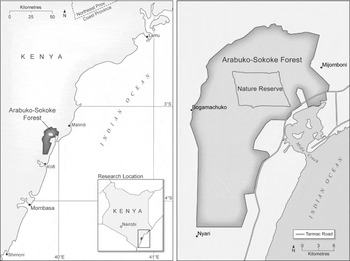
Here, we offer an assessment of a novel education-oriented approach to conservation around Arabuko-Sokoke Forest (ASF), a biodiversity hotspot on the Kenyan coast (Fig. 1). By paying secondary school fees contingent on recipients’ support for forest conservation and engaging local residents in collective tree-planting initiatives, Arabuko-Sokoke Schools and Ecotourism Scheme (ASSETS) incorporates the performance-responsive aspect of direct payments while also addressing long-term development needs via education, support for community organizations and alternative livelihoods. Initiated in 2001 by A Rocha Kenya, the goal of ASSETS is to increase environmental awareness, reward conservation behaviour and develop skills for youth to find non-forest-dependent livelihoods (ASSETS 2011).
Location of Arabuko-Sokoke Forest and the communities studied.

To be eligible for an ASSETS bursary, a student must live within 3 km of ASF, have attended an ASSETS-targeted primary school for at least three years, score at least 300/500 (slightly above passing) on their Kenya Certificate of Primary Education (KCPE) exam, and have obtained an admissions letter from a public secondary school. In addition, the student's parents must sign a written agreement stating that they will (1) maintain a woodlot at their home, (2) protect ASF and Mida Creek (a nearby mangrove ecosystem) by not cutting down trees or harming wild animals, (3) be actively involved in conservation initiatives (such as tree planting or wildlife clubs), and (4) contribute Ksh 300 (c. US$3.50 per school term) (Appendix 1, see supplementary material at Journals.cambridge.org/enc). The size of an ASSETS bursary ranges from 25–60% of secondary school tuition. As of 2010, 378 students from eight primary schools had received ASSETS bursaries to attend secondary school and 74 of those had graduated from secondary school (S. Baya, personal communication 2011).
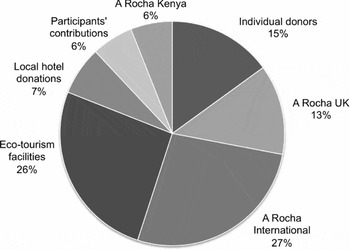
Along with administering the bursaries, ASSETS established tree nurseries at each of the beneficiary primary schools, and over 16 500 trees of both indigenous and exotic species had been planted as of 2008 (A Rocha Kenya Reference Kenya2008). An association of ASSETS beneficiary parents was formed in 2006 and registered as a formal community-based organization with the Kenya Department of Social Services, with optional membership. ASSETS also constructed ecotourism facilities, including a small visitor centre, a suspended mangrove walkway (which generated Ksh 394 330/US$ 4744 in 2008), and two tree platforms (which generated Ksh 52 920/US$ 637 in 2008). Tourism revenue from these facilities contributes a modest portion of bursary funding (Fig. 2).
Sources of ASSETS revenue in 2008.

Although the bursary award is explicitly contingent on recipients’ formal agreement not to harm the forest or its wildlife, this is not systematically enforced. Rather forest use is monitored on an ad-hoc basis according to the availability of funding and volunteers (VandeGriend Reference VandeGriend2007, Ngala Reference Ngala2010). In this study we did not measure extraction due to both ethical and practical issues; rather, we assessed attitudes as a proxy signal of public support.
We appraise the impact of this project, along with independent socioeconomic factors, on local citizens’ attitudes and perceptions toward ASF in three forest-adjacent communities using 113 household surveys (Appendix 2 provides socioeconomic details of the study communities, see supplementary material at Journals.cambridge.org/enc). Understanding residents’ attitudes can be helpful for guiding park policy and management decisions (Fiallo & Jacobson Reference Fiallo and Jacobson1995; Browne-Nunez & Jonker Reference Browne-Nunez and Jonker2008). We also use qualitative interviews with local citizens and project leaders regarding the problems and merits of this ‘eco-bursary’ approach. Specifically, we explore the feasibility and dilemmas inherent in rewarding local citizens with education contingent on specific behaviours.
METHODS
Study area
Arabuko-Sokoke Forest (ASF) was originally declared Crown Forest in 1932 and was gazetted as a forest reserve in 1943. At 42 000 ha, ASF is the largest single block of indigenous coastal forest remaining in East Africa (ASFMT [ASF Management Team] 2002), a habitat reduced by > 90% from its original size (Myers et al. Reference Myers, Mittermeier, Mittermeier, da Fonseca and Kent2000) and now found primarily in isolated parks and reserves amidst an agricultural landscape (Fig. 1; Newmark Reference Newmark2008). Today, ASF is managed jointly by four government departments, including the Forest Department (FD), Kenya Forestry Research Institute (KEFRI), Kenya Wildlife Service (KWS) and National Museums of Kenya (NMK) (ASFMT 2002).
Within 5 km of ASF lie 52 villages, home to roughly 110 000 people, mainly of the Giriama tribe (ASFMT 2002). Forest-adjacent farmers suffer from low crop yields due to sandy soil and crop damage by wildlife, amounting to 26–82% in some cases (Maundu Reference Maundu1993). Despite a permanent ban on timber harvesting in Kenyan forest reserves (in effect since 2000; only one head-bundle of dead firewood is allowed per day, along with wild fruit and water for subsistence), many residents risk arrest or pay bribes to forest guards in order to cut trees for firewood, building poles and wood carving, and hunt wildlife for consumption or sale (Fitzgibbon et al. Reference Fitzgibbon, Mogaka and Fanshawe1995; Gordon & Ayiemba Reference Gordon and Ayiemba2003). Research involving extensive surveys of forest damage (counts of snares, cut stems and footpaths into the forest from villages) indicates that these activities pose the most immediate threat to the forest (Mogaka et al. Reference Mogaka, Simons, Turpie, Emerton and Karanja2001; Ngala Reference Ngala2010).
Legal restrictions on forest access and crop loss to wildlife have led to hostile attitudes among local residents towards forest authorities, and even campaigns for de-gazettement (Maundu Reference Maundu1993; Gordon & Ayiemba Reference Gordon and Ayiemba2003). Mogaka (Reference Mogaka1991) reported that 96% of farmers were ‘unhappy with the forest’, and 54% wanted it completely cleared for settlement (n = 32). A follow-up survey (Maundu Reference Maundu1993) found that 59% (n = 142) of local residents wanted the entire forest cleared for agriculture.
Household surveys and interviews
Michelle Jackson conducted 113 oral household surveys in June–August 2007. Roughly equal numbers of ASSETS beneficiary and non-beneficiary households were sampled in each of three communities neighbouring ASF: Bogamachuko (hereafter ‘Boga’; n = 40), Mijomboni (n = 33) and Nyari (n = 39; Fig. 1). ASSETS beneficiary households were selected from a list of all beneficiary homes and visited in order of their proximity to the primary schools, with effort made to capture variation in key conditions (such as distance to the forest edge or home community). For each targeted beneficiary, a nearby (< 0.5 km) counterpart non-beneficiary home was selected so as to minimize variation among respondents related to geography and proximity to the forest. At least half of all current ASSETS beneficiary households were sampled from each community. In ASSETS beneficiary households, the parent who normally attended the weekly ASSETS parent meetings was interviewed if possible. Otherwise, the adult in the household most willing to be interviewed was chosen. We acknowledge the potential bias in this approach; unwillingness to be interviewed might correspond to negative attitudes toward forest conservation or engagement in illegal resource extraction. Furthermore, it is possible that ASSETS beneficiaries might answer questions according to what they thought their sponsors would want to hear. To minimize these biases, the interviewer was introduced in each home as a student with no affiliation to any organization, governmental or otherwise. Furthermore, all interviews were conducted with the help of Mishi Mwilo, a 23-year old Giriama woman from the area (though not from one of the study communities) who was fluent in Swahili, Giriama and English, and served as a translator along with making initial introductions at the start of the interview. She was not affiliated with ASSETS and likely helped respondents to feel comfortable expressing themselves. The interviews were conducted either in Swahili or Giriama, according to the respondent's preference. Each interview lasted approximately 45–60 minutes.
The interview included questions about socioeconomic conditions (Appendix 2, see supplementary material at Journals.cambridge.org/enc) and attitudes/perceptions about ASF. One measure of forest attitudes came from asking the person simply whether or not s/he ‘liked the forest’ and/or wanted the forest to be cleared. The follow-up question, ‘Who owns the forest?’ provided further insight regarding a respondent's knowledge about forest management and his/her sense of ownership or responsibility for the forest. Broader insight on local perceptions about the forest came from asking the respondent open-ended questions about why they liked or disliked the forest, why they wanted or did not want the forest to be cleared, and what benefits and problems they associated with the forest. Forest perceptions were later sorted into major categories that were created inductively after recording responses, as per Allendorf et al. (Reference Allendorf, Swe, Oo, Htut, Aung, Allendorf, Hayek, Leimgruber and Wemmer2006). Finally, we asked respondents to describe the goal of ASSETS to assess whether they saw a connection between forest conservation and the bursaries. Semi-structured interviews were also conducted with 16 key informants in the communities, including primary school headmasters and teachers, influential community members, staff from the Kenya Wildlife Service, Nature Kenya, the Kipepeo Project and A Rocha. We use comments made by respondents and key informants in the discussion to better interpret the results from household surveys.
Attitudes and perceptions are defined in this study using the theory of reasoned action (Ajzen et al. Reference Ajzen, Fishbein and Heilbroner1980) and its application for park attitude research from Allendorf et al. (Reference Allendorf, Swe, Oo, Htut, Aung, Allendorf, Hayek, Leimgruber and Wemmer2006). Attitude is defined as a human psychological tendency that is expressed by evaluating a particular entity, called an attitude object, with some degree of favour or disfavour. Attitudes consist of beliefs, which are the associations people establish between the attitude object and various attributes. For example, in the phrase, ‘I like the forest because it protects wildlife’, liking the forest is considered a positive attitude about the forest, and the protection of wildlife is considered a belief about the forest's role. Here we use the term perception in place of belief (Allendorf et al. Reference Allendorf, Swe, Oo, Htut, Aung, Allendorf, Hayek, Leimgruber and Wemmer2006; Browne-Nunez & Jonker Reference Browne-Nunez and Jonker2008).
Data analysis
Survey responses were first analysed using Pearson's chi-square tests and ANOVA to look for correlations among socioeconomic variables. We then developed logistic regression models with stepwise AIC (Akaike Information Criterion) model selection to select the best explanatory variables for predicting favourable attitudes toward forest clearing, as well as each perception category that was mentioned by at least 10% of respondents. Attitudes were assigned a value of 0 if a respondent did not want the forest to be cleared and 1 if s/he wanted the forest cleared or if his/her answer was contingent on the purpose of forest clearing (for example, the respondent would approve of clearing for agriculture). The first predictor (independent) variables considered were socioeconomic, including individual attributes (sex, age, number of children, years of formal education, religion, level of wildlife conflict [scored according to reported amount of crop loss and crop-raiding species], and whether or not the respondent reported extracting forest resources), wealth indicators (such as type of roof, whether thatch or iron, and main source of income if any, such as subsistence farming, sale of farm products or wage labour), geographic attributes (community and distance in km from the respondent's home to the forest edge) and ASSETS participation (either yes or no). We then developed a logistic regression model to predict attitude using only perception categories (benefits and problems associated with the forest) as predictor variables, in order to assess whether approval of forest clearing was associated with certain beliefs about the forest. We considered the best model to be the one in which ∆AIC < 2 and all variables were significant (p < 0.05). All statistical analyses were carried out in R (R Development Core Team 2008).
RESULTS
Socioeconomic characteristics of respondents
Approximately half of the 113 interviewees were parents of an ASSETS beneficiary (n = 60), and 48% had no formal education (Appendix 2 provides correlations among socioeconomic variables, see supplementary material at Journals.cambridge.org/enc). ASSETS beneficiaries tended to be slightly older (F = 4.50, p = 0.04), have more children (F = 9.09, p < 0.01), and live further from the forest (F = 6.29, p = 0.01) than non-beneficiaries.
Attitudes and perceptions toward ASF
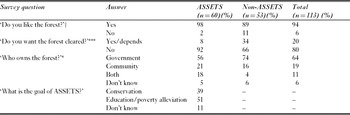
Most respondents indicated positive attitudes toward ASF (Table 1). Only 6% of respondents said that they did not like the forest, and 80% did not want the forest to be cleared. ASSETS beneficiaries were significantly more likely to object to forest clearing (p < 0.001) and to state that the forest was owned by the community alone or in partnership with the government (p = 0.03). Yet only 39% of ASSETS participants mentioned forest conservation when asked to describe the programme goals. Fifty-one per cent said that the goal was education and/or poverty alleviation, and 11% could not identify any goal of ASSETS (Table 1).
Answers to four survey questions grouped by ASSETS participation. The second question, ‘Do you want the forest to be cleared?’, was used as an indicator of respondents’ attitudes toward Arabuko-Sokoke Forest in the logistic regression analysis. †Significance of this variable could not be reliably determined because at least one cell in the chi-square test had expected values of < 5. *, ***Significance of p < 0.05 and p < 0.001, respectively, with a Pearson's chi-square test. – indicates not applicable

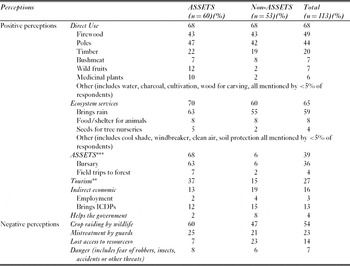
Perceptions were grouped into categories of specific benefits and problems that respondents associated with ASF (Table 2). Five positive perception categories emerged: direct use, ecosystem services, ASSETS, tourism, indirect economic benefits and governmental benefits. The most frequently mentioned positive perception category was direct use (68%), which most often included firewood, poles and timber, respectively. Ecosystem services was the second-most cited (65%), with the most common benefit from the forest being rain, followed by providing food and shelter for animals and providing seeds for tree nurseries. The most frequently mentioned negative perception category was wildlife crop-raiding (67%), of which elephants (Loxodonta africana) were the most commonly reported problem species. Other crop raiding animals mentioned by > 5% of respondents included bushpigs (Potamochoerus larvatus), baboons (Papio cynocephalus), Syke's monkeys (Cercopithecus albogularis) and duikers (Cephalophus sp.). Twenty-three per cent of respondents complained of mistreatment by KWS forest guards, including beatings, arrests and corruption. Four per cent of respondents did not mention any benefits associated with the forest, and 22% did not mention any problems.
Positive and negative perceptions of Arabuko-Sokoke Forest mentioned by ASSETS and non-ASSETS respondents. Perception categories are in bold; these were created inductively after recording specific answers to the open-ended question, ‘what benefits and problems do you associate with the forest?’. *, **, ***Significance of < 0.05, < 0.01, and < 0.001 respectively, with a Pearson's chi-square test.

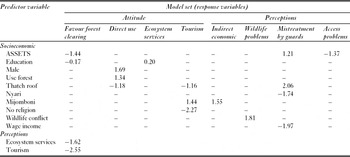
According to the best logistic regression model using only socioeconomic variables as predictors, those most likely to approve forest clearing were non-ASSETS beneficiaries and those who were less educated (Table 3). When perceptions of the forest (categories of benefits and problems) were instead used as predictor variables, those respondents who approved forest clearing were least likely to identify ecosystem services and tourism as benefits of the forest.
Model coefficients from the best logistic regression models for residents’ attitude (as indicated by the question, ‘Do you want the forest to be cleared?’) and perceptions toward Arabuko-Sokoke Forest. For predicting respondents’ attitude, one model included only socioeconomic predictors and one model included only perceptions as predictors. Dashed lines indicate variables that were included in the model selection but were not significant in the best model. For predicting respondents’ perceptions, only socioeconomic predictors were included in the model selection.

Further analysis revealed distinct patterns between socioeconomic variables and perceived benefits and problems of the forest (Table 3). Males and those who reported forest use were more likely and those with a thatched roof (i.e. less wealthy) less likely to value the forest as a source of resources. Meanwhile those with more formal education were more likely to identify ecosystem services as a forest benefit.
DISCUSSION
Predictors of pro-conservation perceptions
Across the three communities, the majority of respondents’ attitudes toward the forest (ASF) were positive, an encouraging result given previous local opposition (Mogaka Reference Mogaka1991; Maundu et al. Reference Maundu, Sojah and Klili1997). The fact that respondents most commonly valued ASF as a source of fuelwood, timber and poles presents a paradox considering that any wood extraction beyond a single headload of fuelwood per household per day is illegal. Apparently, although many local citizens voice general support for ASF, they do not necessarily agree with strict preservation measures, a common situation around tropical reserves (see for example Petheram & Campbell Reference Petheram and Campbell2010). However, many other respondents cited the forest's ability to bring rainfall as a reason for protection. According to one woman, ‘[If the forest were cleared], this area would be very dry’. This response indicates local awareness of indirect benefits from conservation, even though the actual relationship between forest cover and rainfall at ASF has not been conclusively documented.
Wealthier respondents were more likely to identify tourism as a forest benefit, as were residents of Mijomboni, the community closest to hotels and tourist attractions (Fig 1). As at many tropical forest sites (Archabald & Naughton-Treves Reference Archabald and Naughton-Treves2001; Karanth & DeFries Reference Karanth and DeFries2011), tourism activities are locally concentrated and seldom benefit the very poor.
Respondents’ negative perceptions of ASF centred primarily on wildlife crop-raiding, a commonly reported problem around African reserves surrounded by agriculture (O'Connell-Rodwell, et al. Reference O'Connell-Rodwell, Rodwell, Rice and Hart2000). Non-beneficiaries were more likely to resent restricted forest access; for instance, one man reported, ‘How would I like something that's closed to me?’ By contrast, most ASSETS beneficiaries voiced support for restricted access; one man stated, ‘We are at war with whoever destroys the forest; we will find other ways of living rather than depending on the forest’. Similarly more ASSETS beneficiaries felt a sense of co-ownership of the forest in partnership with the government. As one beneficiary said, ‘In the old days [the forest] was for the government but currently it's for the community because we are the ones to protect it so we can benefit’. Non-beneficiaries were more likely to describe a sense of alienation and to report ‘[The forest] is owned by the government and white people’.
Although our results signal improved local attitudes toward conservation, we cannot assume that ASF is better conserved. Neither positive attitudes towards parks nor environmental awareness necessarily lead to conservation-oriented behaviour (Infield & Namara Reference Infield and Namara2001; but see Gubbi et al. Reference Gubbi, Linkie and Leader-Williams2008). Local farmers may approve a park's mission to protect wildlife yet still set snares (Naughton-Treves Reference Naughton-Treves1997) or demand greater access to park resources (Petheram & Campbell Reference Petheram and Campbell2010). Testing the attitude-behaviour link is both a vital next step for park-people research and a core challenge for performance-based educational support.
A hybrid approach
Conservationists often debate the effectiveness of indirect ICDPs versus direct approaches such as payments for ecosystem services (Ferraro & Simpson Reference Ferraro and Simpson2002; Agrawal & Redford Reference Agrawal and Redford2006). Our results suggest that in practice, conservationists need to draw from both strategies, particularly if they are working in a site of high conflict and/or high poverty (see Petheram & Campbell Reference Petheram and Campbell2010). The ASSETS programme at ASF features ICDP strategies; for example the eco-bursary idea was born during early discussions with community leaders prior to the project's inception (S. Baya, personal communication 2008), and continues to promote voluntary community-building activities such as tree-planting. The contractual nature of the eco-bursary arrangement resonates more with performance-based direct incentive approaches. While this ‘hybrid’ approach appears to have significantly improved local attitudes toward the forest, persistent challenges also surfaced in our analysis.
ICDPs have been criticized for failing to connect livelihood benefits with conservation (Wells et al. Reference Wells, McShane, Dublin, O'Connor, Redford, McShane and Wells2006), and ASSETS is not immune to this critique. Although a majority (70%) of beneficiaries cited the bursary as a forest benefit, when asked, ‘What is the goal of ASSETS?’, only 39% mentioned conservation. PES schemes aim to clarify this link by paying local residents directly to protect natural resources (Ferraro & Kiss Reference Ferraro and Kiss2002). ASSETS incorporates an element of the PES approach by obliging beneficiary parents to sign a contract agreeing not to harm the forest. However, to date no bursary has been revoked due to illegal resource extraction (S. Baya, personal communication 2011). Tracing illicit forest use to individuals is difficult and costly (Gavin et al. Reference Gavin, Solomon and Blank2010). More fundamentally, dropping beneficiaries from the scheme for illicit forest use might create resentment among community members. This situation reveals that the PES emphasis on efficiency and strict conditionality may not be socially acceptable in sites of long-standing antagonism between conservation and local communities.
While ASSETS does not conform to a standard PES strategy with regard to conditionality (Wunder Reference Wunder2007), the contracts are part of a broader set of outreach activities more akin to ICDP strategies aimed at creating a sense of collective responsibility toward forest protection. ASSETS staff regularly visit the sponsored communities to discuss conservation goals, and ‘beneficiary days’ are held each year during which eco-bursary students attend a three-day environmental education camp. Further, weekly meetings of the parents association at the tree nurseries help to forge and strengthen relationships between neighbours. One revealed, ‘I even leave my work to go to the parent meetings, I like them so much’. Sinclair et al. (Reference Sinclair, Collins and Spaling2011) found that participation in ASSETS led to multiple transformative learning outcomes, including new information about ASF, new skills (such as tree planting) and improved ability to share ideas in public meetings. Thus, the conditionality imposed by the contract may serve to provide some (if symbolic) accountability, which is strengthened by the collective responsibility formed through educational outreach.
Conversely, in targeting specific individuals for benefits, ASSETS runs counter to conventional ICDP approaches and risks creating resentment and division within communities. Some respondents indicated a fear of being reported to the authorities by ASSETS beneficiaries if they illegally extracted resources from ASF; for example, as one respondent said, ‘There was a time when I saw people going [to cut trees] in the forest; I had to tell them not to because I benefit through the bursary. They stopped because they knew me, but you never know, maybe they went in through another route. Those people avoid the ASSETS parents’. Although this sort of community-based vigilance ‘may help some PES schemes reduce long-term monitoring and enforcement costs’ (Jack et al. Reference Jack, Kousky and Sims2008, p. 9468), it risks dividing the community. The issue is particularly sensitive given that some respondents believed that extremely poor, forest-adjacent households are overlooked by ASSETS. In fact, beneficiaries were not significantly wealthier than non-beneficiaries, but they were less likely to live directly on the forest border. ASSETS only requires that a student live <3 km from the forest and attain satisfactory marks on primary school exams. The performance criterion was a sore point for one non-beneficiary: ‘People who border the forest don't even go to school. Maybe they have spent the whole day chasing animals to deter them from destroying their crops. Someone who sleeps at night will get a lot of marks [on their primary school exams] but someone who lives next to the forest, he won't get to sleep because he will fear the elephants, so in the end he won't perform well in school’. At ASF, as elsewhere in East Africa, forest-adjacent households generally suffer more from wildlife crop raiding (Naughton-Treves Reference Naughton-Treves1998). Naughton-Treves & Treves (Reference Naughton-Treves, Treves, Woodroffe, Thirgood and Rabinowitz2005) found that guarding fields from wildlife can compromise educational opportunities, especially if farmers are too poor to hire field guards or erect barriers and instead keep their children home to guard crops. Extremely poor groups often lack the capital to join a project in the first place (Peluso Reference Peluso1992), yet are usually those who suffer the most from restricted access to protected areas (Adams et al. Reference Adams, Aveling, Brockington, Dickson, Elliott, Hutton, Roe, Vira and Wolmer2004) and depend most upon forest products (Byron & Arnold Reference Byron and Arnold1999). Although inequality of opportunity is a concern, most ASSETS parents could not have paid for secondary school without the eco-bursary (see also Sinclair et al. Reference Sinclair, Collins and Spaling2011). Furthermore, other projects surrounding ASF specifically target forest-adjacent households, such as the Kipepeo Project (Gordon & Ayiemba Reference Gordon and Ayiemba2003). Nonetheless, the difficulty inherent in targeting the poorest, most forest-dependent groups is commonly acknowledged in PES projects (Grieg-Gran et al. Reference Grieg-Gran, Porras and Wunder2005; Petheram & Campbell Reference Petheram and Campbell2010). To overcome these obstacles to participation, some scholars recommend activities common to ICDPs, including strengthening community organizations and capacity to negotiate (Corbera et al. Reference Corbera, Kosoy and Tuna2007).
Finally, securing a steady income flow is challenging for both ICDPs (Wells et al. Reference Wells, McShane, Dublin, O'Connor, Redford, McShane and Wells2006) and PES (Wunder Reference Wunder2007). Although ASSETS strives to fund bursaries from ecotourism revenue, the project currently relies primarily on external donor funding. In 2008, an additional 7% of ASSETS income was generated through a local hotel and 15% came from individual donors, many of whom learned about ASSETS while vacationing on the Kenyan coast. So while the ASSETS-sponsored ecotourism facilities themselves may not generate profits sufficient to sustain eco-bursaries, they have inspired many tourists to donate towards ASSETS. The hybrid approach espoused by ASSETS may be more sustainable than a PES model alone (see Petheram & Campbell Reference Petheram and Campbell2010) because the programme is not solely focused on direct payments to individuals.
CONCLUSIONS
Our results indicate a significant positive shift in attitudes toward conservation among communities neighbouring ASF, particularly among those households participating in the ASSETS programme. ASSETS features a unique emphasis on ‘eco-bursaries’ and couples a direct incentive (school fees) contingent on forest protection with awareness raising and community-oriented activities (such as tree planting), in a sense combining the approaches used by PES programmes and ICDPs. Secondary education is highly valued but unaffordable in many forest-adjacent communities; the provision of this benefit serves as a unique and effective bridge between direct incentives and long-term development goals. Our interviews with community members and key informants also revealed persistent challenges, especially monitoring compliance with forest protection, facilitating participation by the poorest forest-adjacent households and securing long-term funding.
ACKNOWLEDGEMENTS
M. Jackson conducted all field work, wrote the majority of text and analysed data. L. Naughton assisted with study design, analysis, literature review and writing. This research was funded by a National Geographic Young Explorers Grant and the Scott-Kloeck Jenson International Internship Grant from the University of Wisconsin-Madison. USAID Translinks Agreement #EPP-A-00-06-00014-00 provided partial support for manuscript preparation. We thank the people in Boga, Mijomboni, and Nyari who participated in this study, Mishi Mwilo for her generous assistance in the field, and the staff and volunteers with A Rocha Kenya for their support and guidance. Teri Allendorf and Rick Chenoweth provided substantial guidance on the methods. We also thank Diane Adams and two anonymous reviewers for their valuable comments on the manuscript.