Introduction
‘It more and more seems to me that, on an institutional level, the European Council is not only unnecessary but, to a certain extent, harmful’.Footnote 1 Less than two years after the decision to regularise European Economic Community (EEC) heads of government meetings this is how Pierre Gueben, civil servant in charge of organising European Council meetings at the General Secretariat of the EEC's Council of Ministers, criticised the emergence of the new institution. Some forty years later, reading such a statement is quite surprising, now that part of the European Union (EU)’s everyday life is made of repeated EU summit emergency meetings, ad nauseam media coverage of those and spicy details on the latest bon mot of a European leader. But in the 1970s, when a European Council meeting was unable to reach an agreement, the very practice of regular meetings at heads of government level was easily called into question. Gueben made his recrimination against the European Council in July 1976, shortly after an unsuccessful April meeting in Luxembourg. Yet the centrality of the European Council in today's EU should not be allowed to obscure that the European Council's evolution into a prominent institution of the EU's governance was not, with the benefit of hindsight, as predetermined as it could seem.
When the heads of government of the EEC agreed, on 10 December 1974 in Paris, to hold regular and frequent meetings between themselves, this decision was something of an experiment.Footnote 2 Legally, this new type of meeting was based on an uncodified and non-binding decision, that is, the communiqué of the 1974 Paris summit. Long-standing critiques of the decision-making system of the EEC and a growing frustration with the lack of leadership in the Community as a whole encouraged the French government to push for the institutionalisation of meetings at heads of government level. The French government – joined in this by the bigger member states – considered that the existing different kinds of Council of Ministers’ meetings needed some form of pulling together at the top. After a few months of negotiations in late 1974, the heads of government agreed at the Paris summit of December of that same year to create the European Council. The uncodified nature of the European Council was, Britain apart, largely foreign to the EEC member states’ constitutional traditions and did little to clarify the (legal) debate over its role and functions. Reminiscences of the Gaullist period fed the ‘smaller’ EEC member states’ scepticism towards the European Council: regular summitry was seen as endangering the Community (supranational) method. Any unsuccessful meeting – such as the April 1976 session in Luxembourg that partly motivated Gueben's berating of the European Council – could vindicate misgivings about the value of holding summit meetings on such a regular and frequent basis.
Twelve years later, however, any remaining doubts and criticisms against the European Council had by and large vanished. First of all, a number of landmarks seemed to confirm the usefulness of top-level leaders’ meetings. The very first meeting of the European Council in Dublin in March 1975 contributed to solve the British renegotiation issue; the triptych of European Council summits during 1978, in Copenhagen, Bremen and Brussels, significantly shaped the creation of the European Monetary System (EMS); the Fontainebleau meeting in 1984 was instrumental in solving the British budgetary question and the Milan meeting in 1985 paved the way for the future Treaty revision. The 1986 Single European Act (SEA) marked the first formal appearance of the European Council in an EEC treaty, albeit in a minimalistic fashion with only three sentences (Article 2, Title I) and no detail about its functions. Numerous European policy makers, regardless of what political party, institution or member state they came from, acknowledged the usefulness of the European Council in the EEC's institutional set-up – without being blinded, of course, by its limits. Overall, therefore, thanks to its important role in the above-mentioned landmarks as well as on other occasions, the European Council quickly placed itself at the centre of Europe's governance, as a forum for both top-level deliberation and decision making.
How can one explain this tension between a relatively uneasy creation and the European Council's rapidly acquired stability and centrality in the life of the EEC polity? This article argues that four intertwined factors account for this rapid and smooth emergence, in spite of some early misgivings about heads of government meetings. First, the rise of globalisation, in all its guises – economic, environmental, financial, monetary and social – rendered regular and frequent meetings at heads of government level a necessary feature of European and international politics, despite all the frustrations to which such meetings could also give rise. Second, the new-found institutional balance in the EEC after the creation of the European Council proved satisfactory to the multiple actors involved in EEC policy-making, and thereby alleviated doubts about the exact role and functions of summit meetings. Third, the public impact of the European Council's gatherings, especially in terms of media coverage and involvement of civil society/societal actors, contributed to make these meetings central and imperative to the EEC's political life. Fourth, the perennial debates over legitimacy in the EEC offered a window of opportunity for heads of government to attempt to re-politicise European debates – a situation which, in spite of its ambiguities, allowed institutionalised heads of government meetings to quickly become vital. All four factors made the European Council an indispensable actor in European governance, and indeed enabled it to become a proper institution in the minds of the many actors involved in European policy-making well before its formal successive treaty consecrations in 1986 (SEA), 1992 (Maastricht) and 2007 (Lisbon).
This article deliberately moves the focus away from the key individuals that took part in European Council meetings to look instead at the structural forces that explain the European Council's rise in the EEC's institutional set-up. This is not meant to imply an opposition of the two – individual vs. systemic forces – but instead to try to overcome a tendency of the literature on summits to fall into the trap of case-by-case studies of the doings of purportedly visionary leaders. This article is not concerned with personal inclinations, but with root causes and systemic analysis. The argument is based throughout on a large multilingual, multi-archival research spanning five countries (Britain, France, Germany, Ireland and Italy) and is the first article to use the archives of the European Council itself. This article covers thirty-five European Councils over a twelve-year period, from its inception in 1974 until the Single European Act in 1986.Footnote 3
In spite of the importance the European Council quickly developed in the life of the EEC, the historical literature on the early years of the European Council is still very limited. Recent historiography on European integration has made significant contributions to the understanding of the evolution of the EEC as an incipient polity, building on earlier political science literature. But it has also tended to downplay intergovernmental bargaining, focusing instead on non-governmental actors, as if the intergovernmental and non-governmental trends have to be seen in opposition, or even in isolation.Footnote 4 This article reintroduces more firmly the role of national governments in the analytical framework and demonstrates that these different strands – supranational, intergovernmental and transnational – often mutually reinforced each other. Non-governmental connections with the European Council reinforced heads of government meetings as an incipient institution of the EEC polity, the supranational European Commission took an active part in European Council meetings and the European Council's ever-widening agenda led it to deal with an ever larger set of transnational and global issues that went beyond the EEC's remit. In that sense, the rise of the European Council in the EEC institutional set-up represents a typical example of the ever greater embeddedness of European integration and cooperation in global dynamics.Footnote 5 This article argues that the dynamics of the European Council cannot be properly understood without reference to the supranational Community dimension (including the role of the EEC Commission and the European Parliament in particular) and to the mutual influence of transnational actors (such as trade unions, business groups and consumer organisations). A large literature from political science,Footnote 6 lawFootnote 7 and European Council observersFootnote 8 analyses the emergence of regular EEC/EU summit meetings and especially their role in today's governance.Footnote 9 These works provide many important insights, but all use a different methodology and most importantly a different set of guiding questions from this article. Early research on the European Council improved our understanding of the role and functions of regular EEC summit meetings, while more recent studies look into the contemporary evolution of the European Council in EU policy-making. By adopting a historical approach, this article aims, by contrast, to shed new light on the reasons why the European Council lasted, bringing to the fore new evidence drawn from previously unused European Council archives.
Europe in a Globalising World
The rise of globalisation at the turn of the 1970s is the first element that explains why the European Council emerged as a key actor in the EEC's (economic) governance.Footnote 10 Faced with multiple international crises, EEC leaders realised that their coordination at EEC level was poor and decided to meet on a regular and frequent basis in order to try to coordinate their response to those international challenges. Among the various problems facing the EEC from the mid-1970s, macroeconomic issues ranked very high, including European monetary instability, inflation, the development of the common/single market and international trade. Since these policy issues had implications beyond the traditional remit of individual ministries, the EEC needed a greater degree of coordination at heads of government level, if not some kind of collective leadership, in order to try to tackle these problems. Even in the absence of concrete results, the ability to present a united EEC front at the international level was something much sought after by heads of government.Footnote 11 The European Council offered the ideal institutional setting in which these issues could be discussed. The two sentences constituting part of the uncodified constitution of the European Council, namely the December 1974 Paris summit communiqué, made plain the centrality of this globalisation dynamic in the holding of meetings at heads of government level:
Recognizing the need for an overall approach to the internal problems involved in achieving European unity and the external problems facing Europe, the Heads of Government consider it essential to ensure progress and overall consistency in the activities of the Communities and in the work on political co-operation. The Heads of Government have therefore decided to meet, accompanied by the Ministers of Foreign Affairs, three times a year and, whenever necessary, in the Council of the Communities and in the context of political co-operation.Footnote 12
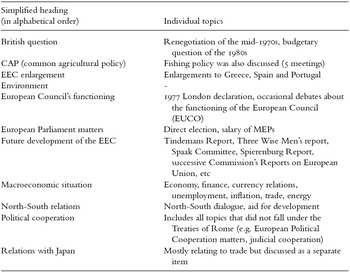
A detailed analysis of the deliberations and agendas of the European Council highlights the predominance of macroeconomic issues during heads of government meetings. Rather than looking at the European Council's conclusions and then deducing from those the European Council's agenda, as recent political science studies have done, I have instead looked at the actual discussions as reported in the various records of the meetings.Footnote 13 Focusing only on the conclusions overlooks the fact that deliberation was at the centre of the European Council's activity from the very start – and that this deliberation was not necessarily recorded in the conclusions. Quite regularly, the discussion about the macroeconomic situation did not automatically lead to clear-cut conclusions that heads of government considered worthy of recording. But having the opportunity to actually discuss them represented one raison d’être of the European Council, namely, providing the opportunity for EEC leaders to freely exchange their views in a regular European institutional framework. I have arranged the topics heads of governments tackled in eleven wider themes, as shown in Table 1.
European Council's Main Topics of Discussion, 1975–1986

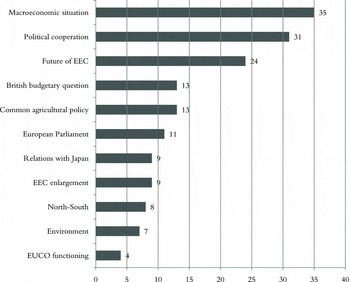
All thirty-five meetings tackled the macroeconomic situation (Figure 1), and indeed most of them started off with an often lengthy and detailed discussion of the multi-faceted policy dimensions of this macroeconomic situation (including economic and social situation, currency relations, inflation and unemployment). The European Council provided a key forum in which to (attempt to) coordinate macroeconomic policies in an EEC context. In fact, the European Council was the central forum in which heads of government exchanged their views on how the EEC's economies could and should work in a European/global context. This was plain in the run-up to the EMS and in the early 1980s, when the course of the French government's economic policy was under pressure.Footnote 14 Heads of government deliberations did not necessarily lead to policy results, but the mere ability to deliberate in an EEC-wide forum about international macroeconomic issues represented a significant evolution in the EEC institutional set-up. Most often, all different aspects of macroeconomic policy-making were taken together. Energy was perhaps the only exception, since at the time of the oil shocks it was treated as a separate item, although always linked back to its overall economic implications, such as inflation. Some sessions also began with a report from the president on recent discussions with the European Trade Unions Confederation (ETUC), as I will develop in the third section, and then immediately moved on to macroeconomic matters. The EEC's integration in a globalising world also concerned other policy areas, although still heavily related to economic issues. Japan's trade relations with the EEC occupied an important place in European Councils’ agendas (9), as well as North-South relations/aid for development (8), the British question (13) and the CAP/fishing policy (13/5). As the second topic most discussed in European Council meetings, political cooperation comes up close behind macroeconomic issues, with thirty-one sessions out of the thirty-five meetings analysed in this article. This is no cause for surprise and highlights the genuinely hybrid nature of the European Council, covering both Community affairs and political cooperation (that is, the policy areas that were not covered by the EEC legal framework). The issues tackled were extremely varied and did not necessarily lead to clear-cut conclusions, including for East-West relations, the Middle East, Africa and terrorism and judicial cooperation, to name but a few. Only four meetings did not really tackle political cooperation topics. The EMS and the so-called concurrent studies about greater EEC resource transfers that ran in parallel, the remuneration of the members of the European Parliament, CAP and fishing policy exclusively dominated the discussions of the Brussels European Council session held in December 1978. And internal Community issues (chiefly the British budgetary question) largely sidestepped any political cooperation discussions during three consecutive summits (Athens in December 1983, Brussels in March 1984 and Fontainebleau in June 1984).
Topics Discussed in the European Council, 1975–1986

The European Council's role as the ‘predominant player in economic governance’ is therefore hardly a new feature of the post-Maastricht period, contrary to Uwe Puetter's recent contention.Footnote 15 From the European Council's inception, macroeconomic issues gave (and still giveFootnote 16) birth to long interpretative discussions about the causes, consequences and possible remedies of the multifaceted economic crises. If the Essen European Council of 1994 focused on the employment situation, the rise of unemployment was equally central to European Council discussions in the 1970s and 1980s. From the mid-1970s to the early 1980s, and in addition to the rise of unemployment, EEC prime ministers talked at length in European Council meetings to share their views about how to deal with international monetary instability and the oil shocks, to name but a few issues. These discussions were often long simply because heads of governments did not agree on the root causes of the situation, or even more simply did not understand them. The various records of European Council sessions until 1986 reflect the heads of government's striking lucidity about the difficulty in making sense of the crises of the 1970s to early 1980s. British prime minister Jim Callaghan was reported as having made this point at a European Council meeting in Brussels in 1976: ‘at this stage, Mr Callaghan would just like to note that the world today is experiencing the most profound socio-economic evolution of peoples since the beginning of the twentieth century and most governments if not all seem largely incapable of mastering this whole phenomenon’.Footnote 17 In spite of such occasional frustrations, however, the European Council's emergence did fill a void in the EEC's institutional set-up, as the next section will show.
A New and Satisfactory Institutional Balance
Within twelve years, European Council meetings found their place in the EEC institutional balance. This did not occur without problems; but the fact that the newfound equilibrium in the EEC polity was satisfactory to all the actors involved in EEC policy-making allowed for the European Council to become a central actor in Europe's governance. The European Council's stabilisation in the EEC institutional landscape can be best observed in two ways, one related to the European Council's functions, the other to the EEC's overall constitutional order.
The functions of the European Council were not described in the 1986 Single European Act, which merely mentioned the European Council's existence.Footnote 18 Only the 1992 Maastricht treaty added a little more detail.Footnote 19 The absence of any codified constitution represented a very British approach – having an unwritten constitution was largely foreign, until then, to the EEC legal tradition.Footnote 20 The British Foreign Office most aptly summarised this state of affairs in a brief to British prime minister Margaret Thatcher in preparing the very first European Council meeting she attended, in Strasbourg in June 1979: ‘the European Council is not an institution set up by the Treaties and its formal status is nowhere very clearly defined – partly in order to preserve its informality of procedures’.Footnote 21 This also partly explains why interpreting the European Council's institutional nature came to be one of the very first contentious issues.Footnote 22 Regular heads of government meetings could be interpreted as a part of a confederal scheme, since their existence prioritised intergovernmental cooperation. But such regular meetings also institutionalised the participation of heads of government in a process of supranational cooperation (the European Commission participated from the outset in 1974) – this was the version considering the European Council as an excrescence or a variant of the Council of Ministers.Footnote 23 These ambiguities prevented the European Council from being viewed exclusively as one of these two options, and opened the way for a third one: that of a sui generis institution.Footnote 24 The European Council came to be seen as a new institution, functioning in the Community framework, but distinct from the Council of Ministers. In that sense, the European Council could be both intergovernmental and communautaire. The practice progressively blurred the intergovernmental/communautaire distinction, as will be shown below. The European Council allowed EEC heads of government to discuss topics of common interest, overriding administrative (and increasingly artificial) distinctions between EEC and non-EEC matters.
The institutional practice that developed over time witnessed the clear emergence of the European Council's two main functions – orientation and arbitration – already after only a few years of operation.Footnote 25 Heads of government developed a custom that their successors mostly continued. The ability of the European Council to orient the future EEC endeavours had, for instance, clearly appeared well before it was enshrined in the Maastricht Treaty's Title I, Article D. In the course of the 1970s and 1980s, the European Council often talked about the future of European integration (in twenty-four meetings, see Figure 1) and commissioned reports about it as well, including the Tindemans report and the Three Wise Men's report, to name but two obvious examples.Footnote 26 The capacity of the European Council to concentrate discussions on the future of European integration allowed summit meetings to partly appropriate for themselves the prospective dimension of integration.
A second important function was that of arbitration. The European Council was, whenever possible, acting as an EEC referee, that is, choosing between the different options available on the negotiation table. Summit meetings offered an opportunity to try to agree on issues that had not been settled elsewhere. In the press conference that took place after the European Council meeting in Brussels in December 1977, president of the Commission Roy Jenkins lauded the European Council's ‘ability to cut through disagreements where necessary and to give a renewed momentum to the process of integration’.Footnote 27 The EMS negotiations provide a good, and early, example of this in the history of the European Council. In the specialised committees (Monetary Committee and Committee of Governors), the EEC member states’ delegations found themselves unable to agree on the role to be given to the so-called divergence indicator that the EMS was supposed to include. The divergence indicator was a technical device that would be used to pinpoint the currency that was diverging from the EEC currencies’ average. But what action would the identification of the divergent currency trigger? Two options were envisaged during the negotiations: automatic interventions by the central banks to support a currency, or mere consultations among them. During the European Council meeting of December 1978 in Brussels, the EEC heads of government decided to reject the option of automatic interventions, thereby removing an obstacle to the eventual inception of the EMS.Footnote 28
The clarification of the European Council's functions removed a degree of uncertainty that may have remained about the purpose and usefulness of such meetings. Regular heads of government meetings established a new administrative and diplomatic practice; all actors involved in EEC policy-making processes understood the European Council's potential as an institutional tool, even societal actors, as the next section will show. Such a clarification of the European Council's functions constitutes the first aspect that contributed to stabilising the European Council in the EEC polity.
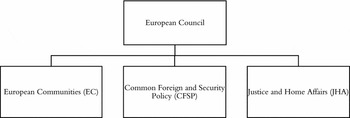
The ability to map the European Council in the EEC constitutional landscape represented the second element that contributed to stabilise, and render central, the European Council. The three-pillar structure created by the Maastricht Treaty was certainly the most striking constitutional evolution of the early 1990s. The newly created EU was composed of three elements: the European Communities (EC), the Common Foreign and Security Policy (CFSP) and Justice and Home Affairs (JHA). As Figure 2 shows, the first pillar represented the ‘Community method’ while the second and third pillars were ‘intergovernmental’ in nature. The European Council was, in such an institutional set-up, the ‘federating power of the three pillars’, as it was described in a background note to French president François Mitterrand at the time of the Maastricht Treaty negotiations.Footnote 29
The European Council's Place in the Maastricht Treaty's Three Pillars Structure

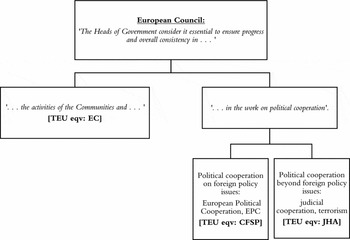
Yet this structure was in fact a mere formalisation of the set-up that had been in place since the mid-1970s.Footnote 30 As mentioned above, the European Council did possess a constitution, but it was an uncodified one: it was composed of the Paris summit communiqué of December 1974 and the London declaration of June 1977.Footnote 31 In setting out the reasons explaining the creation of the European Council, the 1974 final communiqué mentioned above explicitly stated that heads of government would ‘ensure progress and overall consistency in the activities of the Communities and in the work on political co-operation’. The communiqué put an end to the long-standing French opposition to having simultaneous meetings of foreign ministers in the EEC and European Political Cooperation (EPC) contexts: ‘in order to ensure consistency in Community activities and continuity of work, the Ministers of Foreign Affairs, meeting in the Council of the Community, will act as initiators and co-ordinators. They may hold political cooperation meetings at the same time’. Finally, it is worth noting that the 1974 communiqué duly stated that it respected the ‘constitutional bloc’ of both the EEC and EPC: ‘these arrangements do not in any way affect the rules and procedures laid down in the Treaties or the provisions on political co-operation in the Luxembourg and Copenhagen Reports. At the various meetings referred to in the preceding paragraphs the Commission will exercise the powers vested in it and play the part assigned to it by the above texts.’
The 1977 London declaration foreshadowed, mutatis mutandis, the ‘rules of procedure’ adopted by the European Council in December 2009, shortly after the Lisbon Treaty.Footnote 32 The latter are of course more detailed, but the goal of the 1977 London declaration was similar: to clarify in writing the internal functioning of the European Council. After about two years of activity, EEC heads of government felt the need to set out in some detail the way in which the European Council should function. Giscard, upon leaving the November 1976 European Council meeting in The Hague, declared that he was unhappy with the way in which the European Council worked and announced that he would soon send propositions on how to improve it.Footnote 33 This initiated a correspondence between heads of government about how European Council meetings should function. Overall, this exchange of letters highlighted that all heads of government had found in the European Council a useful instrument.Footnote 34 The outcome of this correspondence, the 1977 London declaration, focused on the organisation of the meetings in five areas: the type of discussions, the preparation of the agenda, the issuing of statements, the recording of conclusions and the attendance of officials.Footnote 35 One of the most important features of the declaration was to distinguish between ‘informal discussions’, which did not necessarily lead to decisions, and ‘formal decisions’. This very distinction highlights the growing importance that the European Council took in EEC policy-making. It moved beyond the ‘fire-side chat’ that Giscard and Schmidt wanted to make regular in 1974 and further progressed towards becoming a full-fledged institution.
A close examination of the EEC structure as modified after the European Council's creation in 1974 highlights that the Maastricht Treaty's three-pillar structure was a mere codification of the three-fold structure which had been emerging over the years. The three pillars were already sketched out in the mid-1970s: most obviously, the ‘Community affairs’ described in the 1974 communiqué became ‘the Communities’ in the Maastricht Treaty, EPC turned into CFSP and the Trevi meetings were forerunners of the JHA pillar.Footnote 36 The overall picture, if slightly different from that of the Maastricht Treaty, bears, however, a striking resemblance to it, in particular with respect to the European Council's place at the apex of the construction. Based on the description of the 1974 Paris communiqué, the EEC institutional set-up from 1974 until 1992 is presented in Figure 3.
The European Council's Institutional Place in the EEC, 1974–1991

The European Council allowed for the pulling together of various policy areas at the top, especially in cases where some form of European cooperation was needed but could not necessarily take place in the existing legal apparatus of the EEC.Footnote 37 This institutional flexibility allowed for the development of a number of new policies that belonged to political cooperation but not to EPC, and that would subsequently be put under the umbrella of the Maastricht Treaty's JHA pillar. The 1970 Luxembourg report had indeed circumscribed ‘political unification’ to EPC, although some topics did not relate exclusively to foreign affairs.Footnote 38 Such topics belonged to what Simon Nuttall dubbed the ‘Grey Area’ and concerned two important dimensions, judicial cooperation and terrorism.Footnote 39 The European Council played a significant role in the development of both areas.Footnote 40 The 1981 London Report on EPC confirmed this institutional set-up, placing the European Council at the apex of the EPC hierarchy.Footnote 41
This newfound institutional balance can also be witnessed in the European Council's relationship with the other EEC (full-fledged) institutions. In fact, Gueben's criticism of the European Council, referred to at the beginning of this article, related precisely to EEC inter-institutional relations:
the regularity of the sessions (three per year) leads necessarily the European Council to deal with questions that fall under the competence of ‘classic’ institutions. These institutions, therefore, experience a natural tendency to ‘wash their hands of it’, voluntarily or not, as in the end the final decision escapes them. . . . Concerning final decisions, it seems that, more and more, those are taken outside the institutional or para-institutional system of the Community. This is a formula of the type directoire aménagé that is applied, in the sense that the consensus is looked for, and often established, by bilateral relations between the three big of the Community.Footnote 42
Gueben's note reflected regular concerns about the European Council's place in the EEC institutional set-up. But if these inter-institutional relations were mostly uncodified, they have, however, been progressively clarified in practice. The first institution that may have called into question the European Council's existence was the European Commission. It must be recalled that the Commission has always been present, and very actively involved, at European Council meetings from the very start, unlike in the G7.Footnote 43 In terms of diplomatic protocol, the president of the Commission was treated like a head of government.Footnote 44 The Commission's successive presidents – François-Xavier Ortoli, Roy Jenkins, Gaston Thorn and Jacques Delors – all supported the institution.Footnote 45 Reporting to the European Parliament on the results of the first European Council held in Dublin in March 1975, Ortoli described the meeting as having confirmed that regular heads of government meetings were very useful. He further asserted that the role of the Commission had been duly respected.Footnote 46 Jenkins’ appreciation of the European Council is more famous. It is still worth noting that he welcomed in 1977 the fact that ‘the European Council agrees with the Commission that the broader issues [about EMU] are to be carried into the other Community institutions, Parliament, Economic and Social Committee, Tripartite Conference’ – in short, that the European Council respected each EEC institution's place and role.Footnote 47 Gaston Thorn, Luxembourg prime minister (1974–1979) when the European Council was created, and already supportive of the institution at the time, was unlikely to suddenly turn into an opponent once appointed president of the European Commission (1981–1985), especially as he succeeded two other presidents who had been sympathetic to the idea of regular heads of government meetings. Finally, Jacques Delors, president of the European Commission from 1985 to 1995, was perhaps the most famous at skilfully using such routine heads of government's meetings.Footnote 48
Relations with the European Parliament, if in general limited, also existed from the very beginning. Garrett Fitzgerald, Irish foreign minister, and Ortoli began reporting on the results of the summit to the European Parliament as early as after the very first European Council meeting held in Dublin in March 1975.Footnote 49 The practice of having the presidency's foreign minister and the president of the Commission informing the European Parliament after each European Council session was subsequently maintained. The Irish foreign minister attended the inaugural session of the directly-elected European Parliament in 1979.Footnote 50 In June 1984 the French foreign ministry even considered inviting the president of the European Parliament to one of the meals of the European Council for an informal discussion with heads of government – although it does not seem that this suggestion was taken any further.Footnote 51 It was only on 16 December 1981 that for the first time a head of government herself, Margaret Thatcher, reported to the European Parliament on the last European Council session held in London in November.Footnote 52 The tradition was maintained and formalised after the 1983 Stuttgart Solemn Declaration which set out that ‘the European Council will address a report to the European Parliament after each of its meetings. This report will be presented at least once during each Presidency by the President of the European Council’ – that is, a head of government, instead of the foreign minister. German chancellor Helmut Kohl did so after the Stuttgart meeting itself on 30 June 1983, and insisted on ‘the need for a dialogue between the European Parliament and the President of the European Council’.Footnote 53
Multiple reports acknowledged the importance of the European Council in the EEC institutional set-up. The so-called Three Wise Men's report released in 1979 even read that ‘The European Council has existed under the name for less than five years. It is now agreed that it has become indispensable in the overall operation of the Community’.Footnote 54 Both the November 1981 German-Italian initiative for a Draft European Act and the subsequent 1983 Solemn Declaration on European Union confirmed the centrality of the European Council. The two documents placed the European Council at the centre of the EEC polity in terms of its orientation and decision-making abilities. Perhaps more importantly, the European Council was clearly presented as the key institution likely to give coherence to the development of EEC matters and political cooperation – in order to avoid seeing them evolve into two separate and isolated areas.Footnote 55
All this is certainly not to suggest that inter-institutional relations in the EEC were undergoing some sort of honeymoon throughout the 1975–1986 period. Rather it is to highlight that in spite of inevitable ups and downs, the fact that the European Council's relations with other EEC institutions did not go through major tensions and crises contributed to its emergence in the EEC institutional landscape as a stable, and indispensable, institution. The European Council's public impact in terms of media coverage and connections with civil society only further reinforced this trend.
Societal Actors and an Ever-Increasing Public Impact
The third factor that needs to be taken into account in explaining why the European Council emerged as a central and stable actor in the EEC polity is its public impact. First of all, the EEC leaders’ political legitimacy – or even lack thereof – gave much public impact to their meetings. Praised or criticised, the gathering of EEC heads of government needed to be covered by the press, for it appeared to be the clearest moment in the complex EEC machinery when a decision could actually be reached. To be sure, many agreements reached on the occasion of European Councils were, and still are, to a large extent, the fruit of negotiations carried out elsewhere. Even in the cases where the European Council achieved its most famous breakthroughs – the British budgetary question, monetary cooperation – other fora have been central in paving the way to the final agreement (Council of Ministers, Committee of Governors, Monetary Committee, COREPER, etc.). But what the public and the press were able to perceive could certainly lead to a different narrative. Gossip about heads of government discussions represented the perfect ingredient for easy journalistic story-telling, unlike technical issues discussed in an abstruse fashion during obscure Committee meetings.
Second, and reinforcing the first trend, the leaders themselves perceived the public impact of their meetings as an important reason to hold them in the first place; the European Council's public impact quickly became a critical factor that heads of government wanted to take into account during their meetings. In opening the first European Council meeting in Dublin in March 1975, Irish prime minister Liam Cosgrave announced that ‘there should be no formal communiqué issued after the meeting. At the same time participants will be aware that there is a certain anxiety on the part of some that formal declarations be made on certain issues arising at the meeting.’Footnote 56 Aware of the importance for public opinion of the choice of topics for debate between heads of government, Giscard was thus reported to have said in a European Council meeting in Luxembourg in April 1976 ‘that it would amaze public opinion if heads of Government were not to exchange views about the economic situation’.Footnote 57 European Council meetings, in a way that is familiar to us today and very similar to the G7 meetings, became key opportunities for leaders to project their presence on the international scene often for domestic political purposes. The discussions among heads of governments that led to the 1977 declaration stressed this. In mentioning the need for the European Council to be able to discuss confidentially and informally some issues of importance, Italian prime minister Giulio Andreotti insisted that this very function of the European Council would need to be explained to public opinion so as to avoid disillusionment.Footnote 58 Giscard insisted that the European Council should help to make Europe's voice heard in the Nine's public opinions.Footnote 59 Gaston Thorn, then Luxembourg prime minister, explained that a prise de position of the European Council was necessary if ‘there was an expectation from the public’;Footnote 60 and about six years later, in opening the Brussels meeting in March 1983, Thorn declared that ‘we should send a clear message to the public that our meeting today is dominated by our determination to concentrate all our efforts to securing a steady recovery of the economy and a reversal of the trend in unemployment. This overall view should be behind our conclusions [final communiqué] concerning the economic and social situation’.Footnote 61 The difficulty of balancing public expectations and summit meetings’ achievements represented an important challenge to heads of governments. In 1977 Danish prime minister Anker Jorgensen wished for ‘a more balanced and more realistic attitude in public opinion as to the mission of the [European] Council’.Footnote 62 This was an opinion mirrored by Jenkins, also in 1977, when he declared before the European Parliament that ‘either too much or too little is generally expected of European Councils. There is rarely a balanced public expectation of the results that might be achieved.’Footnote 63 It is also noticeable that in Jenkins's strategy to relaunch the public debate about European monetary integration in late 1977, the Commission president very consciously used the European Council as a trigger to launch a wider public debate in Europe on this issue.Footnote 65
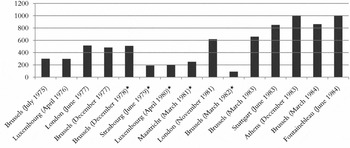
Third, press coverage of European Council meetings was more important than for any other EEC institution, and indeed increased over time. In his investigation of transnational communication in European integration, Jan-Henrik Meyer explains that ‘if there was European public communication in the media in the 1970s and 1980s at all, it was most likely to be found around the European summits’ rather than in any other EEC meeting including those of the Commission, Council or specialised committees. European Council meetings had indeed become central media events in Europe.Footnote 66 The recording of journalists’ accreditations in the European Council's archives is unfortunately inconsistent over time. The data available however provides a number of insights (Figure 4). It shows a clear increase in the numbers in the journalists accredited, from 300 at the Brussels meeting in March 1975Footnote 67 to 1000 in Fontainebleau in June 1984. In comparison, a regular Council of Ministers meeting attracted between 100 and 150 journalists in the mid-1970s.Footnote 68 When a European Council meeting was expected to reach a significant decision, or constituted a landmark, it predictably attracted more journalists than those European Council meetings that had a more ordinary agenda. The meetings in Brussels in December 1978 (EMS), in Stuttgart in June 1983 (Solemn Declaration), in Athens in December 1983 (first European Council meeting in Greece) and in Fontainebleau in June 1984 (British budgetary question) thus attracted more journalists than the average, with 509, 850 and 1000 both for Athens and Fontainebleau. In comparison, the meetings in Strasbourg in June 1979, Luxembourg in April 1980, Maastricht in March 1981 and Brussels in March 1982 did not seem to have captivated the media with respectively 190, 196, 250 and 91 accreditations. Domestic interests also heavily influenced the number of journalists accredited: Greek journalists represented almost a third (73) of the 250 press accreditations for the Maastricht meeting in March 1981, as it was the first European Council meeting that the Greek government attended as a new EEC member state.Footnote 69
Number of Journalists Accredited at Some European Council Meetings, 1975–1984Footnote 64

Fourth, transnational civil society directed its attention and lobbying efforts more and more towards the European Council and thereby contributed to reinforce heads of government meetings’ public impact. Trade unions, business groups, consumer associations and even European federalists turned their attention to the European Council as a new major actor in the EEC machinery that they could not afford to overlook. It suffices to consult the European Commission's online audiovisual library to witness the many demonstrations that were aimed at head of government meetings ever since the European Council's inception.Footnote 70
The European Trade Union Confederation (ETUC) seems to have been the fastest non-governmental actor to grasp the importance of European Council meetings. From 1975 onwards the ETUC president has succeeded in organising a meeting with the then president of the European Council – that is, the head of government of the member state then presiding the EEC – right before the holding of a European Council meeting. The meeting has usually taken place in the morning preceding the first afternoon session. It has quite often been the first element reported by the president of the European Council in opening the European Council session. The first meeting between the president of the European Council and the ETUC on the occasion of a European Council meeting took place in July 1975 in Brussels. On 6 July, Theo Rasschaert, secretary general of the ETUC, wrote to Aldo Moro in his capacity as president of the European Council to ask ‘the European Council to receive a delegation of the European Confederation of Trade Unions on the occasion of its meeting on 16 and 17 July 1975 . . . in order to outline the common apprehensions and demands formulated in the name of the 37 million of workers that the ETUC represents in Europe’.Footnote 71 In considering its reply, the European Council administration contacted the permanent representatives and wondered who exactly would receive the delegation – the European Council as a whole, or only its president.Footnote 72 The ETUC request was finally accepted on 15 July, when it was agreed that the presidents of the European Council and the European Commission would receive a delegation of ETUC representatives on 17 July at 9 am.Footnote 73 This became a custom, as the ETUC itself noted in July 1976.Footnote 74 The president of the European Council would report about this meeting in opening the forthcoming European Council session, as did Callaghan, for instance, in March 1977 in Rome.Footnote 75
Business organisations and economic associations were no less reactive. The Union of Industrial and Employers’ Confederations (known by its acronym UNICE after the French name Union des industries de la Communauté européenne, now BusinessEurope), the leading business lobby group, also regularly sent opinion papers to the European Council ahead of its meetings. This started as early as 11 July 1975, when UNICE sent a brief on raw materials; it later took position on the Tindemans Report, for instance.Footnote 76 The European League for Economic Cooperation (ELEC) also turned its attention to summit meetings. In November 1976, for instance, it issued a resolution ‘in view of the European Council of 29 and 30 November 1976’ that set out its policy positions, in November 1981 one about the ‘European revival’ and again in November 1983 one focusing on the Community's own resources.Footnote 77
Consumer associations also targeted the European Council. In November 1978, Anna Fransen, president of the The European Consumer Organisation (Bureau Européen des Unions de Consommateurs; BEUC), a consortium of consumer organisations of the EEC member states, wrote to German Chancellor Helmut Schmidt in his capacity as ‘President of the European Council’.Footnote 78 She wrote that the BEUC ‘call[ed] on the Heads of Government to promote a Council meeting at ministerial level charged with discussing the guidelines for the Community's future consumer policy, and the promotion of directives which really benefit consumers’. The rest of the letter detailed some measures in specific policy areas, agriculture and import controls/protectionism. But its most interesting aspect was the acknowledgement by the BEUC of the European Council's capacity to steer policy change in the EEC.
Even the Union of European Federalists (UEF) – which could hardly be counted among the first supporters of the intergovernmental method – took the European Council very seriously. In 1976 the UEF organised a demonstration at the entrance of the Centre Européen Kirchberg in Luxembourg where the European Council meeting took place on 1 April 1976.Footnote 79 The UEF wanted to show its support of the decision to elect by direct universal suffrage the members of the European Parliament. In 1977 the UEF decided to organise a petition criticising EEC governments’ inaction, and calling on them to renew efforts towards European integration, especially in the EMU field. The UEF explicitly addressed the text to the European Council and sent it to Leo Tindemans, in his capacity as ‘President of the European Council’.Footnote 80
Evaluating the results of such contacts would require delving into much more narrowly-confined case studies that go beyond the scope of this article. The point stands, however, that if these organisations increasingly turned their attention towards the European Council in such a systematic fashion, this means that they considered regular EEC summits as meetings of prime importance. In return, this further highlights the centrality that the European Council acquired in the EEC institutional machinery. European Council members themselves attached much importance to these connections with societal actors. In the press conference at the end of the December 1977 European Council held in Brussels, Tindemans reported that he had met the ETUC and the UNICE before the beginning of the European Council and stressed the importance of such contacts with representatives of social organisations.Footnote 81 The public impact was therefore a self-nurturing process: European Council meetings attracted media attention because of the presence of heads of government, this attracted in turn more public scrutiny and interest groups’ attention, which necessarily attracted even more media attention, and so on. This inevitably gave birth to creative endeavours, like that of the organisation Sail for Europe. This association ‘of Europeans who wish to promote the Community-idea through sailing’ wrote to the European Council in March 1977. The association was seeking encouragement from heads of government for its next project, namely, the organisation of a ‘“European” entry in the next “around the world” sailing race’.Footnote 82 The name of the boat was Treaty of Rome, and it was meant to symbolise ‘a European Community which is on the move’. Setting aside an indisputable talent for picking the perfectly uncontrollable metaphor, this episode further highlighted the importance the European Council had taken in the wider public's imagery as the EEC institution most capable of representing European integration. But the European Council not only contributed to the representation of the process of European integration, it also gave substantial input in the democratic legitimacy debate in European integration, as the next section will show.
Legitimising European Integration
The issue of democratic legitimacy in the EEC provided a window of opportunity for the European Council to become a central institution in Europe's governance. The legitimacy issue in European integration has given rise to a wide debate in political science.Footnote 83 The Lisbon Treaty, the onset of the global financial crisis in 2008 and the subsequent Eurozone crisis in 2009 induced multiple reforms at EU level that further revived this debate.Footnote 84 The 2014 European Parliament elections, the appointment process of the new Commission's president and the question of the European Central Bank's (ECB) accountability are chief examples of this.Footnote 85 In analysing the EU's democratic legitimacy, Peter Lindseth argues that there is a ‘seeming disconnect between supranational regulatory power on the one hand, and national democratic and constitutional legitimacy on the other’.Footnote 86 Lindseth explains that a number of mechanisms attempt at bridging this gap. Although Lindseth does not extensively develop this point, the European Council arguably represents one such ‘gap bridger’. The European Council accomplished this in two different ways. First, the European Council was an attempt to bring some coherence to the two dimensions of European integration, that is, Community and intergovernmental affairs; second, the European Council's two central functions – arbitration and orientation – were not necessarily about actually controlling supranational developments but about legitimising them.
As mentioned above, the European Council was a hybrid institution active in two areas: Community affairs (the Treaties of Rome) and intergovernmental affairs (political cooperation, including EPC). The European Council represented an attempt to make European cooperation processes more coherent, as the 1974 Paris summit communiqué made plain. This is indeed a reason why many actors who could have been opponents of the European Council in fact supported this institution, including the European Commission and the smaller member states.Footnote 87 Because of the European Council's capacity to launch new projects, European Council members saw themselves as part of a potential European government. This point was very clearly articulated by Giscard, Schmidt and Wilson as early as in July 1975.Footnote 88 Finally, if we consider that the European Council was part of an attempt at making the overall EEC/EU institutional structure more understandable to European citizens, it could also be argued that it contributed to an improvement of the democratic legitimacy of the whole system.Footnote 89
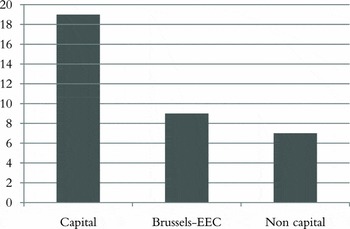
Beyond being part of an attempt to improve the coherence between the various strands of European cooperation, European Council meetings also represented an effort, although in a modest fashion, to bring European governance closer to European citizens – or at least to increase public scrutiny over European governance. After a few years of functioning, some leaders noted that the meetings always took place in the capitals, and therefore endeavoured to gather outside of these classic venues. At the end of the European Council meeting held in Brussels in December 1977, ‘all the heads of government had agreed that . . . [they] should not meet in capitals, but in secluded venues, with no teams of officials present’.Footnote 90 True, part of the motivation of this move was to try to return to the informal fireside chat that these meetings were originally meant to be. The European Council meeting held in Fontainebleau in 1984 clearly falls into that category, which recalls the Rambouillet G7 1975 template. But it was also a way for the EEC heads of government meetings to avoid being perceived only as a top-level gathering not interested in economic realities beyond official capitals. And indeed the meetings that were not held in capitals were not held – Fontainebleau, with its forest surroundings and mere 15,000 inhabitants, apart – in what could be described as ‘secluded venues’: Bremen (1978), Strasbourg (1979), Venice (1980), Maastricht (1981), Stuttgart (1983), Milan (1985) and The Hague (1976, 1986). The effectiveness of such a strategy may be open to debate, but the effort was clear, and not negligible overall, as Figure 5 shows.
Number of European Council Meetings Held in Capitals, Non-Capitals and in Brussels, 1975–1986Footnote 91

Finally, as the previous section made clear, the European Council contributed to trigger greater media attention and greater involvement of civil society in the integration process. In that sense, the fact that the European Council predominantly talked about macroeconomic issues played a major role, since it was a way to legitimise coordination at a European level in order to overcome various economic difficulties. The European Council contributed to the existence and liveliness of debates about economic convergence and monetary stability, to name but a few, by putting regular discussions on these matters on the agenda. This was an important move, as it was instrumental in increasing the politicisation of the integration process and in balancing the power of independent institutions such as the European Commission and the European Court of Justice.Footnote 92 In short, the media salience of the European Council increased the level of scrutiny directed at the European level of decision making.
In discussing the disconnect between supranational integration and constitutional/democratic legitimacy, Lindseth makes an important distinction between control – a power to influence a specific policy direction – and legitimation – an oversight mechanism, a democratic connection.Footnote 93 Interestingly, the two key functions of the European Council, orientation and arbitration, were more about legitimation than control. The European Council provided an oversight mechanism run by EEC heads of government, as opposed to direct control exercised by member states’ chief executives. The European Council's arbitration function refers to its capacity to act as an EEC referee, able to settle a dispute which could not be resolved at another institutional level. The British renegotiation settled at the European Council in Dublin in March 1975, the 1978 EMS negotiations and the British budgetary dispute at the European Council in Fontainebleau in 1984 count among the most prominent examples. Admittedly, part of the arbitration function was indeed about controlling the eventual outcome of the last stages in a given negotiation. But it was also believed that the highest political authorities could more effectively – and more legitimately – settle disputes which had not been resolved elsewhere.Footnote 94 Heads of government were perhaps less inclined than individual ministers to be dominated by sectorial interests. Agriculture or finance ministers were and are frequently accused of being influenced by various lobbies. Again, this is not to say that heads of government were perfectly neutral; rather, it is to highlight that their involvement was seen, from the mid-1970s on, as a useful improvement to the EEC decision-making process since prime ministers could take a more global, comprehensive view of specific issues. This was even more the case given that foreign ministers, who had previously been expected to perform this generalist role through the Council, could no longer do so effectively because of the ever higher technicality of the issues at stake in Brussels. The EMS negotiations highlighted this point very well, since both the general affairs Council and the finance council had been unable to reach an agreement. Heads of government were able, to a certain extent, to hold in balance different national concerns and interests in a way that sectoral ministers could not.
The European Council's orientation function, as explained in more detail above, refers to its capacity to provide overall guidance to the endeavours of the EEC. One of the factors explaining the creation of the European Council was the widespread perception of a lack of leadership in the EEC – a ‘leaderless Europe’ as Hayward put it much laterFootnote 95 – and more importantly the lack of a long-term political view. Chief executives would be able to bring this general guidance, instead of leaving this only and solely in the hands of the Commission. This function could already be seen at The Hague (ad hoc) summit of 1969, for instance, which advanced the idea of ‘widening, deepening and enlargement’, and identified a number of new policy areas to be developed. The creation of the European Council showed the willingness of the EEC's chief executives to regularise this state of affairs.
These attempts at bridging the ‘democratic disconnect’ did not prevent the European Council from attracting severe criticism. Were a summit to reach a significant result, the decision taken could be criticised as undemocratic/illegitimate. This was, for instance, a criticism voiced after the creation of the EMS in 1978. During the Brussels European Council, Callaghan began his intervention by carefully noting that, in order to respect the powers of the British Parliament, he would ask to replace the sentence ‘the European Council decided’ by ‘agreed as follows’.Footnote 96 An earlier Cabinet meeting, on 26 October, had raised similar questions about the role of the European Council:
the procedure by which the EMS proposal had been developed also deserved discussion. It had originated in a Franco/German initiative and there seemed to have been a commitment in principle at the European Council. This raised questions both of collective Cabinet responsibility and of the role of the European Council under the Rome Treaty. The constitutional implications of any limitation on the Government's freedom to decide its exchange rate policy would also need to be considered.Footnote 97
The legitimacy and the democratic character of the European Council's procedures were thus called into question. Conversely, were a summit not to reach any particular decision, it would be seen as a failure. The absence of decision taken would then nurture the feeling of an impotence of political leaders, thereby calling into question the legitimacy, if not the usefulness, of their regular meetings. Overall, therefore, both decisions and the absence of decisions could call into question the legitimacy of the European Council's efforts – and nurture the argument about the EEC's democratic deficit.
The French Constitutional Council (Conseil constitutionnel) provided interesting reflections on the European Council's role in the EEC polity. In 1978 a number of French MPs argued that a treaty signed without having respected the French Fifth Republic's constitution had instituted the EMS. In a decision on 29 December, the French Constitutional Council stated that the European Council does not take ‘decisions’ but reaches political agreements. The Conseil constitutionnel explained that:
by a resolution on 5 December 1978, the European Council has planned for the creation of the European monetary system . . . and has outlined its broad orientations; this resolution constitutes a declaration of a political character and not . . . a treaty of an international agreement having by itself legal effect. . . . following this resolution it is the responsibility of the European Economic Community and, should the case arise, the national authorities to take the necessary measures to the establishment of a new European monetary system within the framework of their respective competencies and according to the appropriate rules.Footnote 98
In other words, the European Council took only an orientation, not a decision. The decision legally fell under the responsibility of other institutions, in that case, the Council of Ministers and the Committee of Governors.
The European Council's activity was hence not so much about actually controlling supranational developments. It was rather an attempt at using the heads of government's legitimacy in order to act as a referee (arbitration) and to provide overall guidance to the development of European integration (orientation). European Council meetings not only contributed to an increase in the level of public interest in the European integration process; they also represented an attempt at reconciling supranational integration and the intergovernmental method.
Conclusion
The emergence of the European Council from 1975 to 1986 is a good illustration of how increasingly complex policy-making in the EEC polity had become. Not only had a new central institutional actor emerged, but also the traditional dichotomies – intergovernmental vs. transnational/supranational; Community vs. political cooperation – became increasingly blurred.Footnote 99 The European Council's lack of a formal codified constitution, in the continental European sense, proved a source of strength for its institutional development in this context. It allowed the European Council to smoothly and rapidly establish itself as an indispensable EEC institution, well before its formal consecration by the Lisbon Treaty in 2007. Being a hybrid institution, the European Council contributed to overcoming the classic – but largely artificial – dichotomy between supranational integration and intergovernmental bargaining. The European Council embodied the increasing interconnections between Community and intergovernmental affairs. Luuk van Middelaar called this the ‘intermediate sphere’ in his recent history of European integration.Footnote 100 In a 2010 speech, German chancellor Angela Merkel referred to the intertwining of the supranational and intergovernmental method as the ‘Union method’.Footnote 101 This method, according to the German Chancellor, is ‘a combination of the community method and coordinated action by member states’, that is, an intergovernmental method. In ‘consider[ing] it essential to ensure progress and overall consistency in the activities of the Communities and in the work on political co-operation’, the EEC heads of government gathered in Paris in December 1974 called for something very similar. Being situated at the crossroads of Community affairs and political cooperation, the European Council did (does) not fit so easily into the intergovernmental box, as it had complex interconnections, and influences, over the supranational integration process and transnational non-governmental actors, as this article has shown.
This certainly poses a challenge to the international historian. It further confirms the need for multilingual, multi-archival research. Methodologically, it calls for a greater consideration of macroeconomic issues.Footnote 102 The European Council, like the G7 for the West, represented an attempt at coordinating macroeconomic policies in the EEC, and this international political economy dimension deserves to be scrutinised more closely, not least due to its longer-term economic, political and societal impact. Finally, it stresses the need for a reconciled, qualified historical interpretation not only of the role of the European Council itself in European integration, but also of the interplay between intergovernmental, supranational and transnational actors at work in European cooperation processes, rather than their isolated, compartmentalised, study.