I. INTRODUCTION
Soft magnetic nanocrystalline alloys prepared with Fe-based amorphous precursor are well known to have high saturation magnetization (M s), low saturation magnetostriction (λs), and high initial permeability (µi). Reference Lashgari, Chua, Xie, Sun, Ferry and Li1,Reference Leary, Ohodnicki and McHenry2 The excellent soft magnetic properties of the alloys are attributed to the special microstructure consisted of fine ferromagnetic phases with typical size of ∼25 nm and residual amorphous matrix. Reference Yoshizawa, Oguma and Yamauchi3–Reference Kulik5 Randomly dispersed nanoscaled ferromagnetic phases can reduce the effective magnetocrystalline anisotropy of the amorphous alloy, consequently resulting ultrasoft magnetic characteristics. Reference Herzer6
Recently, developments of soft magnetic nanocrystalline alloys with amorphous precursor having high M s, and low material cost have attracted great attention owing to increasing industrial demand for functional soft magnetic materials. In the past few years, lots of Fe-based amorphous alloys and bulk metallic glasses (BMGs) have been widely studied to synthesize Fe-nanocrystalline alloys. Reference Ohta and Yoshizawa7–Reference Shi, Li, Wang, Liu, Luo and Zhang14 Optimizing the composition and microstructure, the alloys having high M s and excellent magnetic softness have been newly developed in various Fe–metalloid–Cu alloy systems: Fe85.2Si1B9P4Cu0.8, Reference Takenaka, Nishijima and Makino11 (Fe0.5Co0.5)73.5Si13.5B9Nb3Cu1, Reference Gheiratmand, Madaah Hosseini, Davami, Gjoka, Loizos and Aashuri12 Fe83P13Si3Cu1, Reference Chen and Wang13 and (Fe0.8P0.09C0.09B0.2)99.3Cu0.7. Reference Shi, Li, Wang, Liu, Luo and Zhang14 However, for extensive industrial application of the materials, good combination of low material cost, high productivity, and excellent functional properties is required. In previous studies, Yi and Jung Reference Jung and Yi15 reported successful development of Fe-based BMGs with cheap raw materials of commercial cast-iron (CI) and industrial ferro-alloys. Because the alloys have high glass-forming ability (GFA) as well as good mechanical, electrical, and soft magnetic properties, they have been considered to have high industrial potential. Recently, it was further revealed that the soft magnetic properties of the CI based BMGs with an alloy composition of Fe76.0C6.0Si3.3B5.5P8.7Cu0.5 (at.%) can be further enhanced by optimum nanocrystallization of α-Fe phase. Reference Jung and Yi16 Thus, the investigation on the synthesis of the nanocrystalline alloy based on these CI based BMG is drawing further attention.
Crystallization products as well as crystallization kinetics of the soft magnetic Fe-based nanocrystalline alloys are strongly related to composition. Reference Kulik5 Thus, there have been many studies about the effect of a minor element addition/substitution on the crystallization behavior and soft magnetic properties. Reference Hono, Ping, Ohnuma and Onodera17–Reference Chen, Sakai, Inoue, Wang, Watanabe and Sakurai24 Among them, there are reports showing that small Al addition can be also beneficial to enhance the soft magnetic properties of Fe-based nanocrystalline alloys. Reference Lim, Pi, Noh, Kim and Kang21–Reference Chen, Sakai, Inoue, Wang, Watanabe and Sakurai24 As for example, in the case of FINEMET-type alloy, it was reported that the 1.0 at.% Al addition enhances the μi at 1 kHz. Lim et al. Reference Lim, Pi, Noh, Kim and Kang21 insisted that the minor Al addition reduces the grain size of α-FeSi phase and decreases the intrinsic magnetocrystalline anisotropy K 1 . On the other hand, Chen et al. Reference Chen, Sakai, Inoue, Wang, Watanabe and Sakurai24 reported that minor addition of Al or Si enhances the µ of Fe–Zr–B alloys by changing their λs from a negative value to near zero. In addition, because the metalloids such as B, C, Si, Al, and Ga have negative heat when mixing with Fe, the addition of these elements enhances the GFA of the amorphous alloys. Reference Takeuchi and Inoue25 On the other hand, Al or Ga does not form their own compounds in amorphous matrix, but is only properly soluble in α-Fe or other metalloid-compounds. Reference Gook, Lee, Yoon and Choi26 Thus, the minor Al addition in Fe-based amorphous alloys can be expected to be beneficial for GFA as well as to promote the soft magnetic nanocrystallization.
Because there has been no investigation on the minor Al addition on the nanocrystallization behavior of the CI-based BMGs, the present study aims to investigate the effect of the 1 at.% Al addition on GFA, soft magnetic properties, and nanocrystallization behavior of the Fe75.5C6.0Si3.3B5.5P8.7Cu1.0 (at.%) CI based BMG.
II. MATERIAL AND METHODS
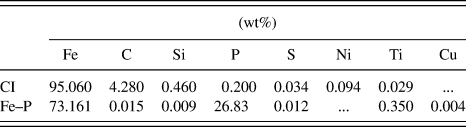
Master alloys with nominal compositions of Fe75.5−x C6.0Si3.3B5.5P8.7Cu1.0Al x (x = 0, 1 at.%) were prepared under a Ti-gettered argon atmosphere by arc melting of CI; industrial Fe–P alloy; and pure elements of Fe (99.7% purity), Si (99.99% purity), B (99.5% purity), Al (99% purity), and Cu (99.98%, purity). The composition of industrial raw materials (CI and Fe–P) is listed in Table I. Ribbons with about 35 μm thickness and 2 mm wide were prepared by single roll melt spinning. Cylindrical specimens having a length of 55 mm and a diameter of 1, 2, and 3 mm were prepared by suction casting. The structure of the as-prepared and annealed specimens was characterized using x-ray diffraction (XRD, Panalytical X'pert Pro, Almelo, Netherlands) with Co radiation (λ = 0.179 nm). Thermal analysis was performed by differential scanning calorimetry (DSC, PYRIS Diamond, Perkin Elmer Instruments, Norwalk, CT) and differential thermal analysis (DTA, S-1600, Sinco, Seoul, South Korea). The as-cast specimens were annealed in DSC to achieve partial crystallization of amorphous phase. Magnetic properties were determined using an alternating gradient magnetometer under maximum applied magnetic field of 2 kOe.
Chemical composition of CI and ferro-phosphorus alloy.

III. RESULTS AND DISCUSSION
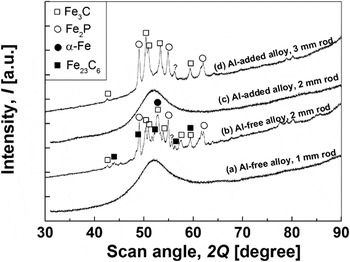
The structural analysis of the as-cast Fe75.5C6.0Si3.3B5.5P8.7Cu1.0 and Fe74.5C6.0Si3.3B5.5P8.7Cu1.0Al1.0 (at.%) rods with a diameter of 1, 2, and 3 mm was performed by XRD patterns presented in Fig. 1. In the case of Al-free alloy, the suction cast rod having a diameter of 1 mm shows a broad halo pattern characteristic for an amorphous phase, while the rod with 2 mm diameter exhibits sharp diffraction peaks of Fe3C, Fe2P, α-Fe, and Fe23C6 phases. On the other hand, the alloy containing 1 at.% Al shows the formation of an amorphous rod with a diameter of 2 mm. Thus, the critical diameter (d max) of the Al-free alloy and Al-added alloy for amorphization is 1 and 2 mm, respectively.
XRD patterns of the as-cast Fe75.5C6.0Si3.3B5.5P8.7Cu1.0 and Fe74.5C6.0Si3.3B5.5P8.7Cu1.0Al1.0 (at.%) rods with different diameters (1, 2, and 3 mm).

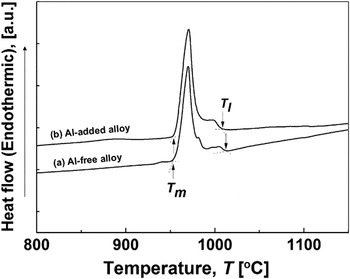
Figure 2 shows DTA melting curves of the as-cast Fe75.5C6.0Si3.3B5.5P8.7Cu1.0 and Fe74.5C6.0Si3.3B5.5P8.7Cu1.0Al1.0 amorphous rods with 1 mm diameter. It is observed that the substitution of Al for 1 at.% Fe has insignificant influence on the melting behavior. Both alloys have highly overlapped endothermic peaks, indicating that the composition of the alloys is located near eutectic point. On the other hand, the Al addition slightly decreases the liquidus temperature (T l) of the alloy from 1016 to 1008 °C. The instrumental error of temperature in these measurements is typically ±0.5 to 1.0 °C. It is well known that the amorphous alloy having the composition near eutectic composition and low T l tend to have high GFA. Reference Chen, Martin, Luzgyune-Luygin and Inoue27 With a consideration of increased d max of the alloy, one can conclude that the 1 at.% Al addition enhances GFA of the Fe–C–Si–B–P–Cu BMG by stabilizing the undercooled liquid. Reference Lin and Johnson28
Melting curves of the as-cast Fe75.5C6.0Si3.3B5.5P8.7Cu1.0 and Fe74.5C6.0Si3.3B5.5P8.7Cu1.0Al1.0 rods having a diameter of 1 mm.

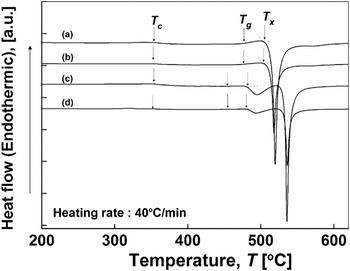
Figure 3 shows DSC heating curves of the as-cast Fe75.5C6.0Si3.3B5.5P8.7Cu1.0 and Fe74.5C6.0Si3.3B5.5P8.7Cu1.0Al1.0 (at.%) rods having a diameter of 1 mm. For comparison, the DSC curves of the as-spun ribbon are also shown in Fig. 3. The as-spun ribbon and rod of both alloys have no appreciable difference in DSC curve, which might be attributed to similar crystallization behavior of the specimens. During continuous heating of amorphous rod with a heating rate of 40 °C/min, both alloys show clear Curie temperature (T C) of about 360 ± 0.5 °C and distinct glass transition followed by a wide supercooled liquid region. These results indicate that the alloys formed amorphous phase having high thermal stability and strong ferromagnetic characteristics. On the other hand, it is observed that the 1 at.% Al addition decreases glass transition temperature (T g) and onset crystallization temperature (T x ) of the alloy from 472 ± 1.0 °C and 500 ± 0.5 °C to 450 ± 1.0 °C and 476 ± 0.5 °C, respectively. It is notable that T g and T x of the Al-added alloy are dramatically reduced by 1 at.% Al addition, suggesting that Al addition decreases the barrier to crystallization from the as-cast state.
Continuous DSC heating curves of (a) as-cast Fe75.5C6.0Si3.3B5.5P8.7Cu1.0 rod (Φ = 1 mm), (b) as-spun Fe75.5C6.0Si3.3B5.5P8.7Cu1.0 ribbon, (c) as-cast Fe74.5C6.0Si3.3B5.5P8.7Cu1.0Al1.0 rod (Φ = 1 mm), and (d) as-spun Fe74.5C6.0Si3.3B5.5P8.7Cu1.0Al1.0 ribbon.

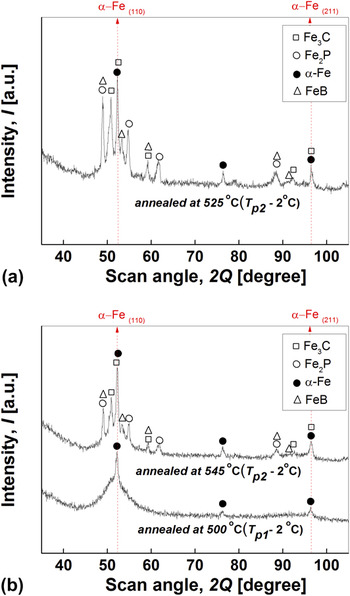
To investigate the crystallization product(s) of each crystallization stage of the alloys shown in Fig. 3, the specimens were heated up to the peak temperature of crystallization curve (T p = 2 °C). Figure 4 shows XRD patterns of the partially crystallized Fe75.5C6.0Si3.3B5.5P8.7Cu1.0 and Fe74.5C6.0Si3.3B5.5P8.7Cu1.0Al1.0 (at.%) rods having a diameter of 1 mm. The Al-free alloy having single crystallization stage shows the XRD pattern consisted of a mixture of Fe3C, α-Fe, Fe2P, and FeB phases. This indicates that the Al-free alloy has almost simultaneous crystallization of various stable and metastable phases. On the other hand, it is observed that the primary crystallization peak of the Al-containing alloy is related to the formation of α-Fe phase. After that the Al-added alloy also forms various Fe–metalloid compounds, i.e., Fe3C, Fe2P, and FeB phases in its secondary crystallization step. Therefore, it is clear that the 1 at.% Al addition changes the crystallization behavior of the alloy from eutectic-type crystallization to primary-type crystallization. Also, it is revealed that the decreased thermal stability of supercooled liquid of Al-added alloy is directly related to the enhanced crystallization tendency of primary α-Fe phase.
XRD patterns of the (a) Fe75.5C6.0Si3.3B5.5P8.7Cu1.0 and (b) Fe74.5C6.0Si3.3B5.5P8.7Cu1.0Al1.0 rods annealed at primary or secondary crystallization stage.

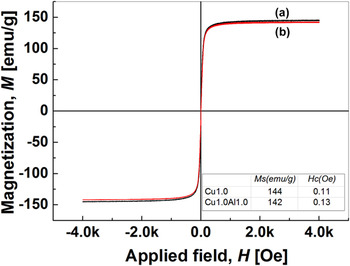
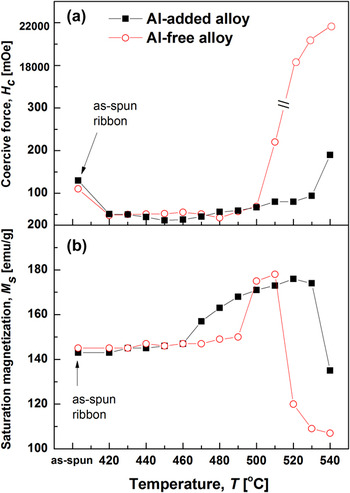
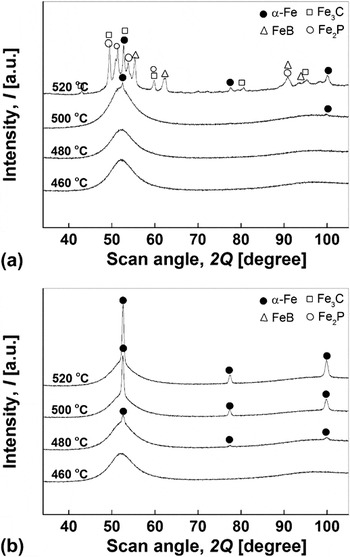
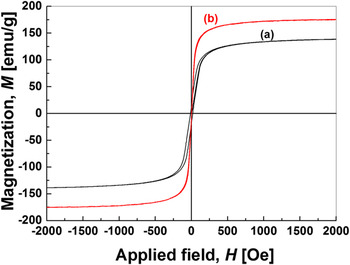
To minimize demagnetizing effect and magnetic anisotropy caused by geometrical characteristics of the specimens, Reference Cullity and Graham29 the influence of the 1 at.% Al addition on soft magnetic properties of the amorphous alloys was examined upon hysteresis M-H loops of the as-spun ribbon (Fig. 5). Both alloys exhibit narrow M-H hysteresis loop, indicating good magnetic softness of the alloys. The 1 at.% Al addition leads to minor reduction of M s from 144 ± 3 emu g−1 to 142 ± 3 emu g−1, and enlargement of H c from 0.11 to 0.13 Oe. As a function of annealing temperature (T a), the variation in M s and H c of the alloys was further investigated with short-term isothermal annealing for 60 s with a heating rate of 40 °C/min (Fig. 6). It is notable that both alloys annealed up to T a of 450 °C have decreased H c with almost constant M s. However, the Al-added alloy starts to show an increase of M s with T a of 470 °C. The alloy has a decrease of M s with T a of 540 °C. On the other hand, the Al-free alloy shows an enhancement of M s only with T a of 490 and 500 °C. After that the Al-free alloy has a significant decrease of M s and increase of H c with annealing at T a of 520 °C. Figure 7 shows XRD patterns of the ribbons annealed at the temperature of 460, 480, 500, and 520 °C. It is revealed that the enhancement of M s of the alloys is attributed to the formation of α-Fe as a primary phase. The Al-free alloy annealed at 520 °C has sequential formation of various Fe–metalloid compounds of Fe3C, Fe2P, and FeB phases, which causes the deterioration of magnetic softness of the alloy. Figure 8 compares the hysteresis M-H loops of the Al-free and Al-added alloys annealed at 520 °C. While the Al-added alloy has narrow hysteresis M-H loop with low H c of 86 mOe and high M s of 176 emu g−1, it is notable that the Al-free alloy annealed at 520 °C shows significant deterioration of magnetic softness, showing high H c of 18 Oe and decreased M s of 138 emu g−1. Considering that the Al-added alloy also shows deterioration of magnetic softness at annealing temperature of 540 °C, we can conclude that the temperature range for nanocrystallization of α-Fe phase of Al-free alloy is from 500 °C to below 510 °C, and that of Al containing alloy is from 470 to 530 °C. Referring to Fig. 3, the valid temperature range for nanocrystallization of the Al-free alloys is located only in the narrow temperature range of supercooled liquid region, while the Al-added alloy can have it from the temperature around T g to the offset temperature of primary crystallization peak. Thus, it is clear that the minor Al addition significantly influences the thermal stability of the precursor and residual amorphous matrix of the alloys. While the minor alloying of 1 at.% Al has insignificant influence on the general soft magnetic properties of the alloy in the as-spun state, it changes the thermal stability of the amorphous structure, and thus the soft magnetic properties of nanocrystallized specimen were strongly influenced by Al addition.
M-H hysteresis loop of as-spun (a) Fe75.5C6.0Si3.3B5.5P8.7Cu1.0 and (b) Fe74.5C6.0Si3.3B5.5P8.7Cu1.0Al1.0 ribbon.

Variation of (a) saturation magnetization (M s) and (b) coercive force (H c) of Fe75.5C6.0Si3.3B5.5P8.7Cu1.0 and Fe74.5C6.0Si3.3B5.5P8.7Cu1.0Al1.0 ribbon as a function of annealing temperature.

XRD patterns of the (a) Fe75.5C6.0Si3.3B5.5P8.7Cu1.0 and (b) Fe74.5C6.0Si3.3B5.5P8.7Cu1.0Al1.0 ribbon as a function of annealing temperature.

M-H hysteresis loop of (a) Fe75.5C6.0Si3.3B5.5P8.7Cu1.0 and (b) Fe74.5C6.0Si3.3B5.5P8.7Cu1.0Al1.0 ribbon annealed for 60 s at 520 °C.

The above results demonstrate that the Al-added alloy has wider temperature range for the formation of nanoscaled α-Fe phase. The minor Al addition enhances the crystallization tendency of α-Fe phase in amorphous phase, but rather suppresses further crystallization of the residual amorphous phase. That is, the Al-addition promotes the primary crystallization of α-Fe phase, and stabilizes the residual amorphous matrix.
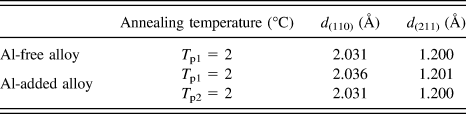
It is well known that the thermal stability of supercooled liquid is primarily related to the initial crystallization rate of the primary phase. According to Ohnuma et al., Reference Ohnuma, Hono, Linderoth, Pedersen, Yoshizawa and Onodera30 the kinetics of Cu-clustering in amorphous phase is strongly related to the Cu contents. Due to the same Cu contents of the present Al-free and Al-added alloys, one can expect that the Al addition does not significantly influence the kinetics of Cu-clustering in amorphous phase. Thus, it is reasonable that the initial crystallization rate of α-Fe phase can be affected by the heterogeneous nucleation rate. In Fig. 4, we investigated the crystallization behavior of the Al-free alloy and Al-added alloy. Table II lists the interplanar spacing d (hkl) of (110) and (211) planes of the α-Fe phase formed in Al-free and Al-containing alloys. Considering details of α-Fe phase of the alloys, one can note that the lattice parameter of α-Fe phase (a α-Fe) of Al-added alloy is continuously changing as crystallization proceeds. The d (110) of α-Fe phase during primary crystallization stage and secondary crystallization stage is 2.036 ± 0.001 Å and 2.031 ± 0.001 Å, respectively. Thus, the α-Fe phase initially formed during primary crystallization of the Al-added alloy has larger a α-Fe than α-Fe phase in the later crystallization stage of the alloy. Ohkubo et al. Reference Ohkubo, Kai, Ping, Hono and Hirotsu18 investigated heterogeneous nucleation of α-Fe phase on Cu clusters. They revealed that the special orientational matching between (110) plane of α-Fe phase and (111) plane of Cu clusters having fcc structure reduces interface energy, resulting enlarged nucleation rate of primary α-Fe phase. In the case of present Al-added alloy, it can be known that the (110) plane of α-Fe phase of the alloy containing Al has better matching with (111) plane of free-Cu clusters (d (111) = 2.087 Å). Reference Otte31 Thus, it is expectable that the high solubility of Al during the initial crystallization of α-Fe phase promoted heterogeneous nucleation rate, and thus the thermal stability of amorphous phase was decreased due to the enhanced crystallization tendency to form α-Fe phase.
Interplanar spacing of the (110) and (211) planes of α-Fe phase formed in Al-free and Al-containing alloys.

Alternatively, regarding the enhanced thermal stability of residual amorphous phase of the Al-added alloy after primary crystallization, it was shown that the Al atoms are diffused out to the residual amorphous matrix. In the case of Al-added Nanoperm-alloy, Reference Chen, Sakai, Inoue, Wang, Watanabe and Sakurai24 it was also revealed that the Al atoms are preferably placed at the boundary of primary phase. As shown in Fig. 4, Al in the present alloy does not form any compounds during secondary crystallization of residual amorphous phase. Thus, in the present alloy, the existence of Al around α-Fe grains may delay the atomic rearrangement and thus the crystallization of residual amorphous phase can be suppressed.
In the previous study, Reference Jung, Stoica, Yi, Kim and Eckert32 the present authors investigated the optimum Cu contents for the nanocrystallization of α-Fe phase in Fe–C–Si–B–P–Cu BMGs. Analyzing the crystallization behavior of the Fe76.5−x C6.0Si3.3B5.5P8.7Cu x (x = 0, 0.5, and 1.0 at.%) alloy, we concluded that the Cu 1.0 at.% addition is not an optimum Cu content for the nanocrystallization of single α-Fe phase in Fe–C–Si–B–P–Cu BMGs, because it provides excess heterogeneous nucleation site not only to primary α-Fe phase, but also to the other Fe–metalloid compounds. However, in the present study, it has been revealed that the alloy with Cu 1.0 at.% can modify the initial crystallization behavior through the minor 1.0 at.% Al addition. As the Al addition promotes the crystallization of primary α-Fe phase but stabilizes the residual amorphous matrix, the alloy could have further enhanced nanocrystallization behavior of the α-Fe phase. Moreover, it was also seen that the Al addition improves the GFA of the alloy. Thus, one can conclude that the Al addition is beneficial to make the alloy good amorphous precursor of soft magnetic nanocrystalline BMGs.
IV. CONCLUSIONS
We have studied the GFA, soft magnetic properties, and nanocrystallization behavior of the Fe75.5C6.0Si3.3B5.5P8.7Cu1.0 and Fe74.5C6.0Si3.3B5.5P8.7Cu1.0Al1.0 (at.%) alloys. Substitution for Fe by 1 at.% Al enhanced GFA as well as changed crystallization behavior of the alloy. It was found that the minor Al addition can improve the GFA of the alloy with increase of d max for glass formation. The reduced T x and ΔT x of the Al-added alloy demonstrates the decreased thermal stability of the amorphous phase with enhanced crystallization tendency to form α-Fe phase. While the Al-free alloy has almost simultaneous formation of various phases, but the minor Al addition leads to primary crystallization of α-Fe phase with temperature of about 80 °C. In spite of minor effect of Al addition on the M s, H c, and T C of the amorphous alloy, the 1 at.% Al addition enhanced magnetic softness as well as M s of the alloy with formation of nanosized α-Fe phase. Because the present Fe–C–Si–B–P–Cu–Al BMG has high GFA and good soft magnetic properties with high M s of 176 emu g−1, the alloy can be one of the good candidates as an amorphous precursor of soft magnetic nanocrystalline BMGs having high industrial potential.
ACKNOWLEDGMENTS
This work was supported by the Global Research Laboratory Program of the Korea Ministry of Science and Technology. The support of the German Science Foundation (DFG) through the grants STO 873/2-1 and STO 873/2-2 is also acknowledged.