Introduction
Schizophrenia is one of the top 10 leading causes of disability worldwide (Vos et al., Reference Vos2016). The burden of disease is associated with early onset and a persistent course without cure (American Psychiatric Association, 2013). Schizophrenia is associated with significant economic burden both within the United States (i.e. approx. 60 billion dollars per year) and worldwide making up between 1.6% and 2.6% of total healthcare expenditures (Brundtland, Reference Brundtland2000; Chong et al., Reference Chong, Teoh, Wu, Kotirum, Chiou and Chaiyakunapruk2016). Individuals with schizophrenia have higher rates of medical comorbidities compared to controls, such as respiratory illnesses (Martens et al., Reference Martens, Chochinov and Prior2013), obesity, diabetes, and cardiovascular diseases (De Hert et al., Reference De Hert, Dekker, Wood, Kahl, Holt and Moller2009), and higher rates of mortality from infection and stroke (Irwin et al., Reference Irwin, Henderson, Knight and Pirl2014; Martens et al., Reference Martens, Chochinov and Prior2013; Tokuda et al., Reference Tokuda, Obara, Nakazato and Stein2008), end-stage renal disease (Cohen et al., Reference Cohen, Le, Fedechko and Elvevag2017; Hsu et al., Reference Hsu, Cheng, Ouyang, Lin, Huang and Hsu2015; Irwin et al., Reference Irwin, Henderson, Knight and Pirl2014; Martens et al., Reference Martens, Chochinov and Prior2013), and cancer (Chochinov et al., Reference Chochinov, Martens, Prior and Kredentser2012; Irwin et al., Reference Irwin, Henderson, Knight and Pirl2014). Despite the overwhelming impact of schizophrenia and associated disability, individuals with schizophrenia lack access to appropriate healthcare (Gervaix et al., Reference Gervaix, Haour, Michel and Chevreul2019; Saxena and Maj, Reference Saxena and Maj2017), with reduced access to primary care, specialist care, health maintenance screenings, and diagnostic evaluations (Cai et al., Reference Cai, Cram and Li2011; Chochinov et al., Reference Chochinov, Martens, Prior and Kredentser2012; Irwin et al., Reference Irwin, Henderson, Knight and Pirl2014).
Individuals with schizophrenia have a reduced life expectancy of 10–20 years compared to the general population (Laursen et al., Reference Laursen, Nordentoft and Mortensen2014). However, in the presence of advanced or life-limiting illnesses, individuals with schizophrenia often do not receive appropriate palliative care and pain management (Cai et al., Reference Cai, Cram and Li2011; Chochinov et al., Reference Chochinov, Martens, Prior and Kredentser2012; Cohen et al., Reference Cohen, Le, Fedechko and Elvevag2017; Irwin et al., Reference Irwin, Henderson, Knight and Pirl2014) or may continue to undergo invasive and potentially painful procedures at the end of life (Cai et al., Reference Cai, Cram and Li2011; Chochinov et al., Reference Chochinov, Martens, Prior and Kredentser2012; Cohen et al., Reference Cohen, Le, Fedechko and Elvevag2017; Irwin et al., Reference Irwin, Henderson, Knight and Pirl2014). Individuals with schizophrenia are more likely to die in nursing homes compared to individuals without schizophrenia (Martens et al., Reference Martens, Chochinov and Prior2013) and, in Sweden, are often not discovered until several days following death (Martens et al., Reference Martens, Chochinov and Prior2013; Nilsson and Logdberg, Reference Nilsson and Logdberg2008).
The objective of this systematic review is to examine disparities in end-of-life care in schizophrenia and identify factors that can be targeted to enhance end-of-life care in this vulnerable population.
Methods
A comprehensive search was conducted using the Ovid MEDLINE(R) and Epub Ahead of Print, In-Process & Other Non-Indexed Citations, and Daily, Ovid EMBASE, Ovid PsycINFO, Ovid Cochrane Central Register of Controlled Trials, Ovid Cochrane Database of Systematic Reviews, and Scopus from 2008 to 2018. Keywords included schizophrenia, palliative, end-of-life, hospice, and other associated terms. The search was limited to English language. Inclusion criteria consisted of any clinical trial, prospective studies, literature reviews, retrospective reviews, and case reports or series. Articles that were excluded included opinions, personal perspectives, communications, or any article not within scope of end-of-life care in schizophrenia. The electronic search strategy was designed and conducted by an expert medical librarian with input from the study investigators, available as a supplemental material (Appendix A). Two authors (J.M.B., M.I.L.) independently reviewed titles and abstracts to select relevant studies that met inclusion criteria. Disagreements were resolved by consensus.
Results
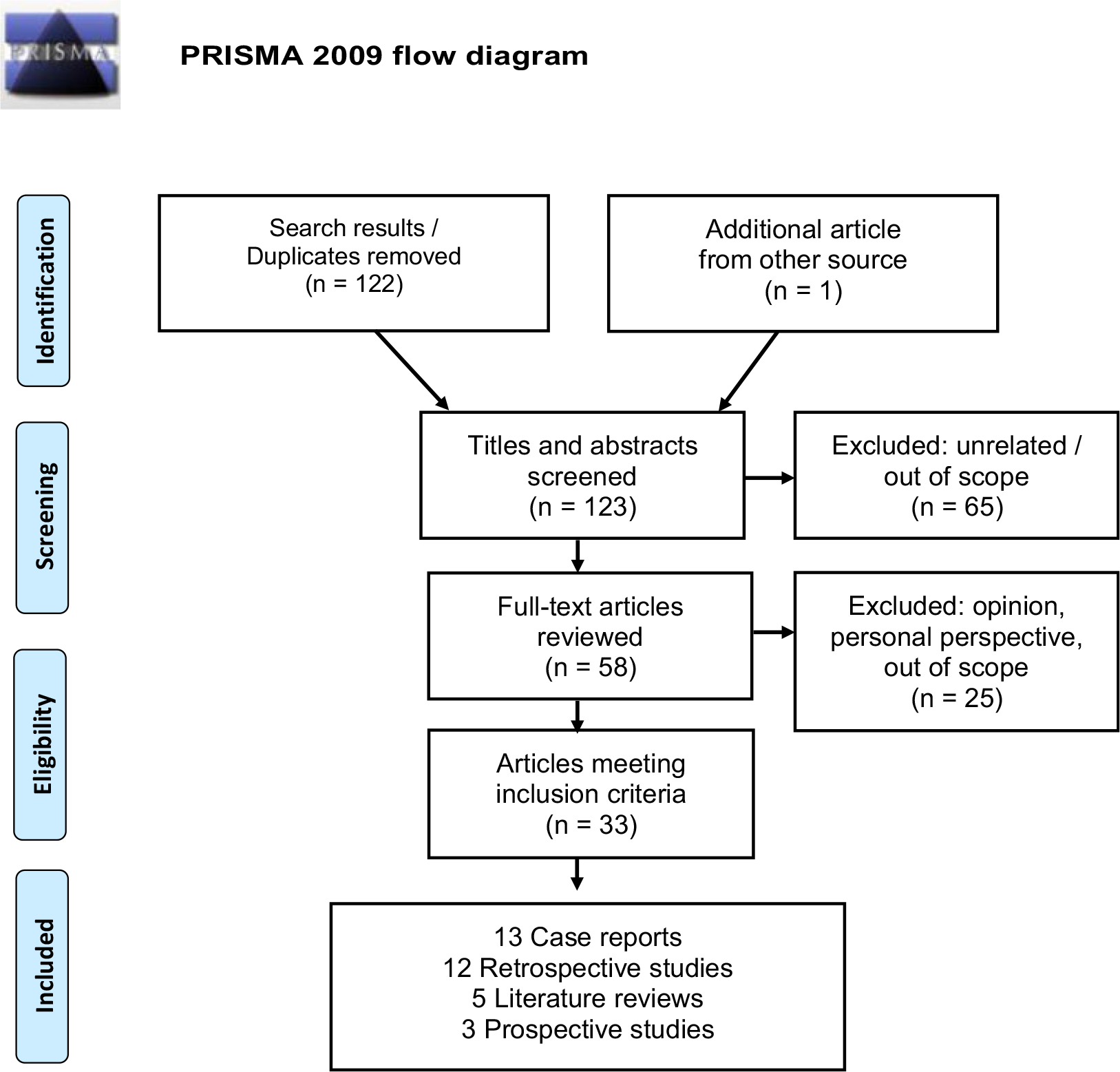
A total of 123 articles were identified from the search, reported in the PRISMA (Preferred Reporting Items for Systematic Reviews and Meta-Analyses) flow diagram (Figure 1) (Moher et al., Reference Moher, Liberati, Tetzlaff and Altman2009). Out of the 123 titles and abstracts screened, 65 did not meet criteria and were excluded based on being distinctly unrelated to end-of-life care in schizophrenia. The remaining 58 full-text articles were reviewed, and 25 were excluded based on being out-of-scope, opinion, or personal perspectives. There were 33 articles that met inclusion criteria for this qualitative synthesis, including 13 case reports, 12 retrospective studies, 5 literature reviews, and 3 prospective studies.
PRISMA 2009 flow diagram.

Table 1 summarizes the articles by author, country, description of the study population, aims and description of the article, and findings and discussion. All 13 case reports from 6 countries (8 from USA; 1 each from Austria, Canada, France, the Netherlands, Poland) were single cases of individuals with schizophrenia mostly with medical comorbidities, although some had psychiatric comorbidities. The 12 retrospective studies from 7 countries (3 from USA; 2 each from Belgium, Canada, and Taiwan; 1 each from England, Japan, and Sweden) included outcome studies in cohorts with schizophrenia with comparison to control groups in some studies. The five narrative literature reviews from Australia, Canada, England, and USA covered a broad range of topics such as review of palliative models of care for treatment-resistant psychiatric disorders, the intersection of cancer and mental health, suboptimal end-of-life care, and decision-making processes in people with life-threatening illnesses and severe mental disorders. The three prospective studies from Australia, Japan, and the USA were designed as follows: a psychological autopsy approach by interviewing the closest bereaved of suicide completers, a retrospective review followed by prospective interviews of community residents with heart failure, and a semi-structured interview of healthcare professionals who care for people with schizophrenia.
Summary of case reports, retrospective studies, literature reviews, and prospective studies on end-of-life care in schizophrenia

While there is significant thematic overlap among the articles, the three main themes identified are healthcare disparities, ethical considerations, and palliative care. The discussion of the findings is organized by these themes and presented in the following sections.
Discussion
Healthcare disparities
Many dimensions of healthcare disparity exist in people with schizophrenia at the end of life. These disparities are especially evident in literature related to schizophrenia and comorbid cancer and are underscored further in articles related to mortality. A total of eight retrospective studies, two review articles, and one prospective study illustrate aspects of healthcare disparity, and interestingly one retrospective study reported lack of disparity.
A retrospective study from England that compared the stage of cancer at the time of diagnosis and all-cause mortality after cancer diagnosis (Chang et al., Reference Chang2014) in 28,477 individuals with cancer found that individuals with schizophrenia had significantly worse survival after a cancer diagnosis compared to controls, despite the lack of significant difference in cancer stage at the time of diagnosis (Chang et al., Reference Chang2014). Cancer-specific mortality in individuals with schizophrenia is discussed further in a narrative review highlighting an increased likelihood of dying of cancer despite the same risk of developing cancer, attributed to multiple factors related to individuals, providers, and healthcare systems as well as the stigma of mental illness (Irwin et al., Reference Irwin, Henderson, Knight and Pirl2014).
Another retrospective study in the United States found that 32,037 veterans with both substance use disorders (SUDs) and cancer, compared to veterans who either had cancer with no SUD (N=450,651) or SUD without cancer (N=434,689), had more comorbid medical and psychiatric disorders including schizophrenia, increased risk of liver disease and opioid use, a greater risk of homelessness, and greater use of health services (Ho and Rosenheck, Reference Ho and Rosenheck2018). In Taiwan, a retrospective study used the National Health Insurance Research Database to compare end-of-life care in people with newly diagnosed colorectal, liver, lung, breast, oral, or prostate cancer with schizophrenia (N=1,911) and without schizophrenia (N=7,644) and confirms disparities (Huang et al., Reference Huang, Wang, Hsieh and Hsieh2018). Within 1–3 months prior to death, cancer patients with schizophrenia received higher intensive care unit (ICU) level care, and more invasive interventions such as cardiopulmonary resuscitation, although they received less chemotherapy and advanced diagnostic examinations than those without schizophrenia (Huang et al., Reference Huang, Wang, Hsieh and Hsieh2018). However, no statistically significant differences in length of hospital stay or frequency of hospice care were found (Huang et al., Reference Huang, Wang, Hsieh and Hsieh2018).
Despite the published literature on healthcare disparities of people with schizophrenia and cancer, a review of 1,463 articles from the Web of Science over a 10-year period revealed a very small percentage of total research (<1%) on the intersecting topics of cancer and mental health (Purushotham et al., Reference Purushotham, Bains, Lewison, Szmukler and Sullivan2013). The most commonly studied mental health conditions were unipolar depression and post-traumatic stress disorder, and the most commonly studied cancer was breast cancer. Interestingly, a large proportion of the available research (80%) addressed effects of cancer on mental health, but not the reverse, which highlights the gap in research that is needed to overcome healthcare disparities (Purushotham et al., Reference Purushotham, Bains, Lewison, Szmukler and Sullivan2013).
In contrast to the other studies that highlight healthcare disparities, there is 1 study that showed 60 veterans with schizophrenia who died of cancer received comparable or better end-of-life care than their 196 veteran counterparts who had no mental illness (Ganzini et al., Reference Ganzini, Socherman, Duckart and Shores2010). This retrospective study assessed the quality of end-of-life care in veterans who died of cancer comparing those with schizophrenia to those with no major mental illness, using data from the US Department of Veterans Affairs (VA) Northwest Health Network. Results show that veterans with schizophrenia received better end-of-life care based on longer hospice stays and a higher rate of documented Physician’s Orders for Life-Sustaining Treatment. While not better, other measures of the quality of end-of-life care were comparable between groups with and without schizophrenia, such as advance directives, opioid prescriptions prior to hospice enrollment, and physician order to forgo cardiopulmonary resuscitation (Ganzini et al., Reference Ganzini, Socherman, Duckart and Shores2010). This is the only study not consistent with other published studies on healthcare disparities in individuals with schizophrenia, although the sample size was smaller and less generalizable.
Healthcare disparities are also reflected in excess mortality in schizophrenia. A Canadian study from the Manitoba Centre for Health Policy evaluated the rates of healthcare services, such as palliative care, in 3,943 individuals with schizophrenia during their last 6–24 months of life compared to 11,827 matched controls (Chochinov et al., Reference Chochinov, Martens, Prior and Kredentser2012). Results suggested lack of access and quality end-of-life care for decedents with schizophrenia based on their higher use of long-term institutional care, such as nursing homes before death, lower rates of use of specialists, acute care hospitals and home care services, and less likelihood of receiving opioids or palliative care (Chochinov et al., Reference Chochinov, Martens, Prior and Kredentser2012). In the ICU setting, a Taiwanese study found that those with schizophrenia had a significantly higher rate of hospital mortality and a greater risk of acute organ dysfunction (i.e. respiratory, renal, neurological) compared to controls (Shen et al., Reference Shen, Lu and Yang2011). Similarly, a retrospective review from Japan showed patients with schizophrenia admitted to an acute care hospital had a nearly significant trend of increased hospital mortality with the leading causes of death being suicide, malignant lymphoma or leukemia, stroke, and sepsis (Tokuda et al., Reference Tokuda, Obara, Nakazato and Stein2008). A prospective study of individuals with heart failure and comorbid schizophrenia revealed a higher risk of mortality compared to those without schizophrenia (Manemann et al., Reference Manemann2018).
In contrast, there are factors that have been shown to improve end-of-life healthcare outcomes in patients with schizophrenia. A large retrospective study from Sweden revealed a reduction in mortality (i.e. 40%) among individuals with schizophrenia during time periods when adherent with antipsychotic medications (Taipale et al., Reference Taipale2018). In fact, long-acting injectable medications were associated with a 30% lower risk of death compared to oral use of the same medication (Taipale et al., Reference Taipale2018).
In summary, there is consistent evidence of disparities of end-of-life care in people with schizophrenia, predominantly examined in those with cancer. Dimensions of healthcare disparity at the end of life in people with schizophrenia and cancer include worse survival after a cancer diagnosis, worse medical, psychiatric, and social outcomes if with concurrent SUD, and more unnecessary aggressive and invasive interventions. Other dimensions of disparity described in decedents with schizophrenia are lack of access to quality end-of-life care. There is clearly a gap in research on end-of-life care disparities in people with schizophrenia that requires more research in order to improve end-of-life care for this population.
Ethical considerations
Caring for patients at the end of life frequently gives rise to many ethical challenges and requires physicians and other healthcare providers to be knowledgeable in strategies to resolve ethical dilemmas. The chronic and debilitating nature of schizophrenia adds to the vulnerability of this population particularly at the end of life. Of the 33 articles in this review, ethical themes were highlighted in 8 case reports, 1 retrospective study, and 2 narrative reviews. The ethical themes include decisional capacity, refusal of care, involuntary treatment, medical futility, withdrawal of life support, and stigma. These themes are discussed below under the ethical principles of autonomy, beneficence, and justice.
Autonomy
Autonomy or respect for persons refers to the right of an individual to freely and voluntarily make their own medical decisions without undue influence and provide informed consent (Beauchamp and Childress, Reference Beauchamp and Childress2001). When an individual lacks decisional capacity, informed consent is sought from a surrogate decision-maker whose role is to protect the person’s autonomy by proxy. While schizophrenia is a condition that can affect medical decision-making capacity, a diagnosis of schizophrenia or psychosis does not automatically render a person to lack decisional capacity. In complex cases involving decision-making capacity, utilizing a multidisciplinary team including the proxy decision-maker can be very helpful.
In the case of a 53-year-old woman with schizophrenia and chronic kidney disease who was known to be non-adherent to treatment, her renal function deteriorated to the extent that required dialysis, although she was uremic and deemed incapable of informed consent. Her brother with power of attorney provided consent to proceed with dialysis; however, the patient refused and resisted physically by pulling out the dialysis catheter which caused bleeding and presented risk of exsanguination. Following several meetings by a multidisciplinary team, the decision was made by the patient’s brother to discontinue dialysis, while supportive care and medical therapy continued (Kadri et al., Reference Kadri, Blackmer and Ibrahim2014). In this case, despite consent for dialysis that was appropriately provided by a substitute decision-maker, the ethical dilemmas that confronted the healthcare team are the patient’s refusal of dialysis, and the risk of physical and emotional harm from resisting dialysis. In a similar case of a 58-year-old male veteran with schizophrenia and dialysis-dependent renal disease, the ethical dilemma also involved refusal of dialysis, although in the context of active psychotic symptoms that rendered him incapable of making medical decisions. He was extremely delusional and refusing all cares including dialysis. His sister and surrogate decision-maker upheld the decision not to force dialysis, and he was treated emergently by forced administration of medications, which caused the patient to attempt suicide leading to involuntary psychiatric hospitalization. Interestingly, he improved with psychiatric treatment with resolution of psychotic symptoms and improvement of renal function and eventually no longer needed dialysis (Rice et al., Reference Rice, Dobry, Novakovic and Appel2012). This case emphasized the importance of building a therapeutic and supportive alliance with patient and surrogate decision-maker and providing guidance in cases of uncertain surrogates.
In another case, a 63-year-old homeless woman with schizoaffective disorder was brought to the emergency room by law enforcement and found to have ulcerated and infected facial lesions determined to be advanced basal cell carcinoma (Taylor et al., Reference Taylor, Golas, Martel and Martel2013). Because she was actively psychotic and refusing treatment, a temporary legal conservatorship allowed diagnostic evaluations to be completed. Due to the advanced stage of cancer and rapid disease progression, she was determined not to be a candidate for surgical treatment and instead received palliative care, pain management, and proper wound care (Taylor et al., Reference Taylor, Golas, Martel and Martel2013). Obtaining temporary conservatorship in this situation was appropriate and led to establishing a diagnosis and prognosis which informed the subsequent treatment plan. In the case of a 30-year-old individual with refractory schizophrenia who required ongoing critical care for multiple self-inflicted stab wounds and postoperative complications (Taylor et al., Reference Taylor, Fertal and Liao2018), an ethics committee considered whether refractory schizophrenia can be associated with such limited quality of life to justify withdrawal of life-sustaining measures following a suicide attempt. The surrogate decision-makers requested withdrawal of life support, and with the consensus of the ethics committee, the individual was allowed to pass away peacefully (Taylor et al., Reference Taylor, Fertal and Liao2018).
It should be emphasized that schizophrenia does not equate with lack of mental competence. However, severe mental illness can have profound effects on a person’s ability to maintain adequate self-care and engage in treatment. This is illustrated by a 40-year old female with schizophrenia who was found homeless, lying in the street, with a massive, fungating, malodorous breast mass consistent with stage IV breast cancer with metastasis to the lung (Moini and Levenson, Reference Moini and Levenson2009). She was seen a year earlier but was lost to follow-up until she reappeared with stage IV breast cancer (Moini and Levenson, Reference Moini and Levenson2009). She reportedly demonstrated a full understanding of her diagnosis, treatment options, and poor prognosis. However, she remained unconcerned, disinterested, and did not ask questions. She received radiation therapy but eloped from the hospital before palliative chemotherapy could be initiated (Moini and Levenson, Reference Moini and Levenson2009). The ethical issue in caring for individuals with schizophrenia who have intact cognition and capacity to make medical decisions is how to provide the care they need when they actively avoid seeking medical care or oppose treatments.
Consistent with these single case reports, a small retrospective study that investigated the clinical course of 17 individuals with schizophrenia following diagnosis of metastatic breast cancer described them as often treatment non-adherent, refuse palliative care, and more likely to have a poor understanding of their illness (Meyer et al., Reference Meyer2013). To address some of the ethical issues encountered in caring for people with schizophrenia at the end of life, two narrative reviews provide suggestions. One emphasized the risk for suboptimal care that does not adequately address psychiatric and social needs in terminally ill individuals with schizophrenia who do not completely lack capacity for decision-making and informed consent; this article highlights the importance of a multidisciplinary team, including psychiatrists, social workers, outpatient providers, and bioethicists to ensure needs are met at the end of life (Shalev et al., Reference Shalev, Brewster and Levenson2017). Another review article placed emphasis on maintaining an ethically appropriate decision-making process when individuals with schizophrenia lack capacity and points out that individuals should not be allowed to die based on an inability to make informed medical decisions or adhere to recommended treatment (Young and Everett, Reference Young and Everett2015).
Beneficence
The ethical principle of beneficence refers to the obligation of physicians to act in the best interest of the patient, and its corollary non-maleficence refers to freedom from harm or injury (Beauchamp and Childress, Reference Beauchamp and Childress2001). Individuals with schizophrenia are vulnerable to harm, whether from treatment or negligence, from which they must be protected.
In the case of a 61-year-old male with paranoid schizophrenia who had a legal guardian in place and had paranoid delusions and auditory hallucinations at baseline, he experienced sudden onset of hypotension and left-sided weakness which led to a diagnosis of bladder carcinoma with multiple brain metastasis (Terpstra et al., Reference Terpstra, Williamson and Terpstra2014). He received brain irradiation but developed complications of pulmonary emboli and deep vein thrombosis and required a lengthy hospitalization (Terpstra et al., Reference Terpstra, Williamson and Terpstra2014). Despite having a legal guardian in place and access to healthcare, the ethical issue in this case relates to the individual’s lack of ability to report pain and other symptoms due to disorganized thought process or negativism of schizophrenia, which delayed the diagnosis of cancer until the advanced stage. The case highlights the symptomatology of schizophrenia as factors that can directly impair decisional capacities that prevent effective care and increase the risk for suboptimal care (Terpstra et al., Reference Terpstra, Williamson and Terpstra2014).
In another case, a 42-year-old male with catatonic schizophrenia and intellectual disability had no improvement of catatonia despite aggressive interventions, including intubation, mechanical ventilation, tracheostomy, and feeding tube placement (Baldinger-Melich et al., Reference Baldinger-Melich2016). The potential futility of aggressive interventions in a treatment refractory psychiatric condition and the lack of existing prognostic criteria and management guidelines in this case contributed to ethical dilemmas (Baldinger-Melich et al., Reference Baldinger-Melich2016).
Justice
Justice is an ethical principle that refers to the equal distribution of healthcare resources to all individuals entitled to such care based on medical need (Beauchamp and Childress, Reference Beauchamp and Childress2001). For individuals with serious and persistent mental illness, such as schizophrenia, stigmatization can adversely affect access to care. This is illustrated in the case of a 55-year-old woman with chronic paranoid schizophrenia who has a legal guardian and was found to have cervical carcinoma on routine gynecologic screening (Tylec et al., Reference Tylec, Dubas-Slemp, Wojcicka, Drop and Kucharska2018). She had delusions at baseline and was considered stable by her psychiatrists. However, the unique ethical problem involved the gynecologic provider’s refusal to conduct diagnostic tests and hospitalize the patient in the gynecological ward for treatment consistent with clinical standards “due to the patient’s mental condition – paranoid schizophrenia, and the type of the ward, the patient’s presence poses a huge risk to other patients treated at the ward” (Tylec et al., Reference Tylec, Dubas-Slemp, Wojcicka, Drop and Kucharska2018). This case describes the ethical problem of withholding care due to stigmatization of a person whose condition can be treated and can be potentially fatal if left untreated (Tylec et al., Reference Tylec, Dubas-Slemp, Wojcicka, Drop and Kucharska2018). In addition, despite an increased rate of medical comorbidity in individuals with schizophrenia (i.e. liver disease, stroke, emphysema, renal failure, and diabetes), providers can be reluctant to perform physical exams or may inappropriately attribute physical symptoms to the mental illness (Terpstra et al., Reference Terpstra, Williamson and Terpstra2014).
Palliative care
Another major theme in the literature regarding end-of-life care in people with schizophrenia is palliative care. The World Health Organization defines palliative care as “an approach that improves the quality of life of patients and their families facing the problem associated with life-threatening illness, through the prevention and relief of suffering by means of early identification and impeccable assessment and treatment of pain and other problems, physical, psychosocial and spiritual” (World Health, Reference World Health2018). Similar to physical illnesses, psychiatric illnesses like schizophrenia can have profound negative effects on quality of life and cause suffering in the context of life-limiting illnesses or at the end of life.
A total of 13 case reports, 7 retrospective studies, 3 reviews, and 2 prospective studies describe challenges in end-of-life management for individuals with schizophrenia and underscore the importance of palliative approaches to enhance their quality of life as well as the quality of care they receive at the end of life. Palliative care can help substitute decision-makers and healthcare providers by assisting with making critical decisions about treatment, which is illustrated in the aforementioned cases of individuals with chronic kidney disease and comorbid schizophrenia requiring dialysis (Kadri et al., Reference Kadri, Blackmer and Ibrahim2014; Rice et al., Reference Rice, Dobry, Novakovic and Appel2012). Furthermore, the utility of palliative approaches is highlighted in the several case reports about individuals with schizophrenia and comorbid cancer (Moini and Levenson, Reference Moini and Levenson2009; Riquin et al., Reference Riquin, Hubault, Baize, Lhuillier and Duverger2017; Taylor et al., Reference Taylor, Golas, Martel and Martel2013; Terpstra et al., Reference Terpstra, Williamson and Terpstra2014; Tylec et al., Reference Tylec, Dubas-Slemp, Wojcicka, Drop and Kucharska2018; Weiner, Reference Weiner2011; Weir, Reference Weir2014; Wright et al., Reference Wright, Brown, McCagg and Richmond2013). A common theme is the diagnosis of cancer at late stages with limited treatment options complicated by active psychotic symptoms and impaired decisional capacities with treatment refusal and aggressive interventions at the end of life. Palliative care can be introduced early in the disease course with other life-prolonging therapies such as chemotherapy or radiation therapy and can lead to improved quality of life, extended survival, and reduced costs (Temel et al., Reference Temel2010). As illustrated in cases of clozapine-related cardiomyopathy (Nederlof et al., Reference Nederlof, Benschop, de Vries Feyens and Heerdink2017), catatonia (Baldinger-Melich et al., Reference Baldinger-Melich2016), and attempted suicide (Taylor et al., Reference Taylor, Fertal and Liao2018), the palliative themes relate to lack of prognostic criteria, unclear indications for withholding or withdrawing life-sustaining treatments, and need for management guidelines in untreatable psychiatric illnesses. Palliative care principles like focusing on quality of life, reducing symptom burden, and setting attainable goals can be beneficial when integrated into end-of-life care pathways (Berk et al., Reference Berk2012).
Also, the physician–patient relationship can be an important aspect of palliative care at the end of life when caring for people with schizophrenia. In the case of a patient with metastatic lung cancer, the psychiatrist was able to visit him prior to death to comfort and remind him of the positive ways in which the patient affected the physician’s life; the physician also helped the patient gain a greater sense of control when reminded of the bed controls and call button (Weiner, Reference Weiner2011). In another case of a patient with schizophrenia and terminal hepatocellular carcinoma, a physician helps the patient by reflecting on compassion, personal vulnerability, and mindfulness (Weir, Reference Weir2014). It has been shown individuals with schizophrenia share similar priorities as the general population at the end of life by placing value on quality of life, minimizing fear, and having companionship (Sweers et al., Reference Sweers, Dierckx de Casterle, Detraux and De Hert2013).
Palliative care can preserve a person’s overall quality of life through the recognition of declining health, effective communication, advanced planning, and capacity building (Baldinger-Melich et al., Reference Baldinger-Melich2016). Individuals with schizophrenia may communicate in non-traditional ways (Terpstra et al., Reference Terpstra, Williamson and Terpstra2014) or not fully understand or appreciate the disease process (McNamara et al., Reference McNamara, Same, Rosenwax and Kelly2018; Meyer et al., Reference Meyer2013). This is particularly relevant in cases where patients refuse life-saving treatments or have unpredictable disease courses (Rice et al., Reference Rice, Dobry, Novakovic and Appel2012). A multidisciplinary team can assist with weighing risks and benefits associated with certain treatments (McNamara et al., Reference McNamara, Same, Rosenwax and Kelly2018; Nederlof et al., Reference Nederlof, Benschop, de Vries Feyens and Heerdink2017) and provide assistance in more complex cases like when psychiatric safety concerns are present (Hirokawa et al., Reference Hirokawa2012) or there is expressed interest in physician-assisted suicide. In fact, in a Belgian study evaluating euthanasia requests among patients with psychiatric disease, 14% of the requests were from individuals with schizophrenia (Thienpont et al., Reference Thienpont, Verhofstadt, Van Loon, Distelmans, Audenaert and De Deyn2015).
In summary, this systematic review illustrates a pattern of disparity and unmet needs for individuals with schizophrenia at the end of life. There is reduced access to important interventions and treatments, higher rates of medical comorbidity, and higher mortality rates in an already vulnerable population (Chang et al., Reference Chang2014; Hirokawa et al., Reference Hirokawa2012; Ho and Rosenheck, Reference Ho and Rosenheck2018; Huang et al., Reference Huang, Wang, Hsieh and Hsieh2018; Manemann et al., Reference Manemann2018; Shen et al., Reference Shen, Lu and Yang2011; Tokuda et al., Reference Tokuda, Obara, Nakazato and Stein2008). At the end of life, there is reduced access to palliative care resources and appropriate pain management (Chochinov et al., Reference Chochinov, Martens, Prior and Kredentser2012; Huang et al., Reference Huang, Wang, Hsieh and Hsieh2018). Interestingly, people with schizophrenia are no different than the general population in their values, priorities, and personal need for comfort and companionship at the end of life (Sweers et al., Reference Sweers, Dierckx de Casterle, Detraux and De Hert2013).
One limitation is the inclusion of other review articles within this systematic review. However, there were only five review articles identified, and none of these were systematic reviews. Given the general lack of attention paid to this important topic, it was necessary to include all published relevant literature.
Conclusions
Schizophrenia is not a terminal condition; however, individuals with schizophrenia die 10–20 years younger than the general population. Individuals with schizophrenia are at risk of unmet needs at the end of life. They are disadvantaged and face barriers to palliative care, including stigma, lack of knowledge of their disease, impairments in communication, and late diagnosis of terminal conditions. An increased awareness of the potential healthcare disparity in this population, creative approaches in multidisciplinary care, and provision of adequate palliative services and resources can advance end-of-life care in schizophrenia.