Introduction
Rock paintings in Finland are richly decorated with colourful red figures and symbols, including moose, reindeer, birds, snakes, human beings, human shape-shifters, boats, animal spirits and human-like spirits, which bear the hallmark of a multitude of aspects from a culture that has historical links with the Sámi, the indigenous peoples of northern Fennoscandia and northwest Russia – a large area that today is called Sápmi.
The methods used to create rock paintings and drum symbolism would have varied but,
[. . .] the red paint used to draw the figures confirms that decorated rock painting panels [. . .] drew on a combination of materials: iron oxide, red dye from the alder tree (leppä), animal fat and blood have provided both the traditional texture and colour for painting and the means of strengthening and weather-proofing the pictures (Joy Reference Joy2007: 78–79).
The extent and shade of the drum symbolism is observed via the red colour of the alder dye used to decorate the drum, which also had religious significance for hunting through the deity,
Leaibealmmái–the alder tree man [who] was the God of Hunting. The alder tree was regarded as a sacred tree. With dyes made from the bark, the people painted figures on the goavddis – drum. Leaibealmmái had control over the wild animals of the woods (Solbakk Reference Solbakk and Solbakk2007: 34–35).
According to Luukkonen (private correspondence):
There are 98 prehistoric paintings with identifiable figures plus three cases that have figures, but that can be earlier (=101). 19 prehistoric paintings without identifiable figures plus 9 cases with controversial dating (=28). One naturally destroyed site had an identifiable figure, it is not included above. This gives the number of prehistoric paintings is 118 plus 12 cases with controversial dating (=130). In addition, there are 13 sites with red colour that can be man-made or natural. Thus the total number is somewhere between 118 and 143.
The iconography of rock paintings can be placed within the spiritual spheres of an early cosmology, which is representative of religious activities related to hunting, fishing and trapping practices. Many of the sites portray figures that may have formed part of a series of complex multileveled world views, which are, according to academic study by Lahelma (Reference Lahelma2008a; Reference Lahelma and Lahelma2008b) and Siikala (Reference Siikala1981), substantially characterised by shamanism and animal ceremonialism.
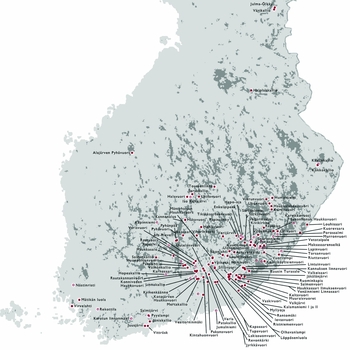
The majority of the illustrations were painted on flat vertical stone surfaces close to water. These locations (shown in Fig. 1) are mainly in southern Finland around the Saimaa and Päijänne Lake waterways, but they also extend to central and western Finland, as well as northern Karelia in the east.
A map showing sites of rock paintings in Finland. The red dots show the locations of the paintings below the Arctic Circle, in northern Karelia in the east and in central/southern Finland, where the majority of the paintings are found. Despite there being two rock painting sites recorded in Sápmi these have not been included on the map, possibly for political reasons. Copyright: Luukkonen (1994–2016, http://www.ismoluukkonen.net/kalliotaide/suomi/, accessed 29 March 2014).

Currently, and in terms of the line of descent, the rock paintings in Finland are not listed as part of Sámi cultural heritage. Instead, the paintings are considered to be part of Finnish cultural heritage, suggesting Finnish origin.
Today, Sámi prehistory or cultural heritage is not recognised below the Arctic Circle in Finland. All of the painting sites, with the exception of two, are located below the Arctic Circle in present-day Finland.
Whether the paintings belong to Sámi or Finnish culture is difficult to ascertain because the concepts of identity, culture and ethnicity are relatively modern. However, it is important to understand, according to academic discourse concerning ethnicity and Sámi history in Finland by scholars such as Aikio and Aikio (Reference Aikio, Aikio and Pesonen2003) and Itkonen (Reference Itkonen1948) that ‘historical sources mention ‘Lapps’ still living in parts of central and eastern Finland in the 16th century ad and both oral tradition and occurrence of hundreds of Sámi place names in southern and central Finland strengthen the hypothesis that Sámi groups have populated Finnish rock art regions until fairly recently’ (Lahelma Reference Lahelma and Lahelma2008b: 138).
Furthermore, across Finland there are sacred places that the Sámi call Sieidi (in Finnish, these sites are called Seita). Sieidi typically consist of large boulder formations, hills, peninsulas or shore stacks. Many Sieidi sites are located close to water, but are also encountered in the forests, hills and tundra. Some are characterised by human, animal and anthropomorphic facial profiles and bodily features. According to both Finnish and Sámi traditions, such locations are thought to have supernatural powers and to host guardian spirits. These sites figure prominently in Sámi religious experiences (Schefferus 1674; Laestadius Reference Laestadius2002).
At some Sieidi sites in central and southern Finland there are prehistoric rock paintings of human-like figures with horn-like features and triangular shaped heads that are remarkably similar to spirit figures painted on the skins of Sámi noaidi (shaman) divination drums. (Note that the terms noaidi and shaman are interchangeable; ‘shaman’ is a cross-cultural concept originating from Siberia and ‘noaidi’ is the original name given to drum diviners and persons who performed sacrificial and magical acts in Sámi society.)
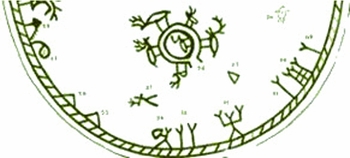
The decorated drums originally came from Norwegian, Swedish and Finnish Sápmi. They were taken by missionaries and clergymen between the seventeenth and eighteenth centuries during the colonialism campaign against the Sámi, spearheaded by the Lutheran and Orthodox churches. The oval-shaped noaidi drums were typically built from birch and pine with a reindeer skin membrane covering the frame, upon which symbols and figures were painted, depicting aspects of both the spiritual and material cultures, as a kind of cosmological map of the universe.
The drumheads were typically divided into three zones or borders portraying an upper celestial world where higher spirits resided, a middle world or physical reality where the spirits of the elemental powers of nature and hunting are portrayed, and a lower world divided into two levels. The first was a mythical underworld called Sáiva, where the Sámi noaidi undertook out-of-body journeys to establish contact with his helping spirits and ancestors from whom he was taught his craft. The second level, often considered as the underworld below the world of Sáiva, is associated with the realm of the dead. However, some drums display as many as five zones.
Such instruments were used for a multitude of purposes including divination in relation to hunting and trapping of animals, as well as fishing. The drum was also used as a tool for seeking directions when herding reindeer, guidance for hunting bears and wild reindeer, and sacrificial offerings in worship. In a spiritual context, the instruments were used for healing, to help induce trance states and out-of-body journeys into the spiritual worlds, and for fortune telling and prophesying.
The Sámi noaidi, being the ritual specialist and artist in Sámi society, also used a unique form of singing and chanting called Joiking when using the drum. Joiking is another way the noaidi induced a state of trance in order to change his perception of reality from the mundane to the spiritual, and to summon his spiritual helpers.
There are currently 71 drums that are considered to be authentic preserved in museums throughout Europe (Christoffersson Reference Christoffersson2010: 265). The drums are decorated with intricate figures, metaphors and symbolism, and ‘the thousands of pictures refer to the circa 3,100 figures drawn on the drumheads’ (Christoffersson Reference Christoffersson2010: 260).
Aim of this research
There has been a series of publications describing the relationships between rock paintings and Sámi noaidi drum symbolism. The main focus of this study is to examine these publications and the terminology used to contextualise the rock paintings in Finland as Finnish, and consequently, what this means for Sámi history and cultural heritage in Finland.
There has been extensive research of the rock paintings in Finland with a focus on shamanism and hunting magic as the main paradigms for interpretation of the cultural context.
This investigation will focus on cosmology and explore the correlations between prehistoric rock paintings in Finland and landscapes pertaining to Sámi cosmology from noaidi drumheads.
The data is presented through a series of photographs and illustrations with the importance placed on the recognition of relationships between figures with horn-like features and triangular shaped heads. The figures may represent social norms and possible cultural markers in relation to identity and systems of embedded knowledge that are homogenous within Sámi cosmology from the seventeenth and eighteenth centuries, despite the temporal distance between the two sources of art. The parallels between the visual material supports the need for a much broader investigation, bringing to light similarities between the figures that are unexplainable given the time scales between the prehistoric paintings and drum figures.
The similarities between the figures justifies a challenge of potentially biased claims in previous reports of Sámi cultural history in Finland within Finnish academic research in relation to rock art and the impression of ownership and cultural heritage. This is despite the illustration of how religious activities and practices identified in rock paintings have been associated with Sámi shamanism by, for example, Lahelma (Reference Lahelma2008a; Reference Lahelma and Lahelma2008b), Núñez (Reference Núñez1995) and Autio (Reference Autio, Ahlbäck and Bergman1991; Reference Autio1995).
This paper seeks to add another dimension to rock painting research in Finland with reference to theories about Sámi history. Moreover, the investigation brings forth new evidence that has emerged from within the study of the prehistoric art in relation to ‘cosmological landscapes’, in addition to shamanistic phenomena. Thereby, presenting additional links with Sámi religion. We will discuss potential theories concerning the identities of particular figures in the rock paintings, as well as provide a broad overview of the history of Sámi culture and religion in Finland, and how such landscapes from prehistory relate to Sámi cosmology from the seventeenth and eighteenth centuries.
Methods
Both descriptive and comparative methods will be employed for the contextualisation of the analysis and its direction. These methods are applied to photographs, illustrations and literature that discuss prehistoric rock paintings in Finland and Sámi religion from the seventeenth and eighteenth centuries throughout Sápmi.
The aim of the analysis is to broadly assess and interpret the photographs and illustrations of the art, and to determine if there is a line of descent across millennia from the rock paintings as accumulated and embedded forms of traditional knowledge to Sámi religion and cosmology depicted in the seventeenth and eighteenth centuries.
Lahelma's material is used extensively in this paper because it provides the most up to date and comprehensive synthesis of research material pertaining to rock art research published in English. An anthropological study by Siikala (Reference Siikala1981) and art history studies by Kare (Reference Kare and Kare2000) are also used to a large extent. According to these academic discourses, the ethnic origins of rock paintings in Finland remain presently unknown.
Presentation of the problem
There are two central problems within research concerning the study and contextualisation of horned and triangular headed figures in rock art in Finland. The first pertains to how there has been a trend in data analysis regarding the material, which has linked these types of figures with shamans in ritual costumes. One example of the shamanistic paradigm and subsequent attitude and interpretation of these figures at rock painting sites is described by Siikala (Reference Siikala1981: 94) who states how ‘the human bearing horns or what look like owl masks in the Finnish rock paintings can in fact be interpreted as people shamanizing (see Sarvas-Taavitsainen 1976: 43)’.
The main reason for linking the figures with shamans may be the relationship between the Finns and Finno-Ugric cultures, which has been discussed extensively in relation to Siberian shamanism and Kalevala mythology by, for example, Siikala (Reference Siikala1981), Kare (Reference Kare and Kare2000), Kivikäs (Reference Kivikäs2001) and Lahelma (Reference Lahelma2001; Reference Lahelma2005; Reference Lahelma2007; Reference Lahelma2008a; Reference Lahelma and Lahelma2008b).
Despite various interpretations within Finnish scholarly research, shamanism has tended to be the dominate paradigm.
Interpretations given to ritualistic scenes in the [rock] art include hunting magic (Sarvas Reference Sarvas1969), totemism (Autio Reference Autio1995) and shamanism (for example, Siikala Reference Siikala1981, Lahelma Reference Lahelma2001, Reference Lahelma2005). Of these, shamanism is commonly favored today (for example, Miettinen Reference Miettinen2000 calls it a ‘canonical interpretation’), even though alternative interpretations still persist alongside the shamanistic one (Lahelma Reference Lahelma and Lahelma2008b: 123).
Furthermore,
[. . .] these paintings are generally thought to reflect the religious beliefs and rituals of the Subneolothic Comb Ware cultures that populated the Finnish Lake regions between 5100–1500 bc (for example, Edgren Reference Edgren and Norrback1993: 84–6); Huurre Reference Huurre1998: 269–87) (Lahelma Reference Lahelma and Lahelma2008b: 123).
By referring to the horned and triangular headed figures as shaman figures in costumes in terms of Finnish prehistory in relation to their identities given the geographical location in Finland, the traditions of Sámi, Siberian and Finnish shamanism as well as Kalevala mythology appear to have been mixed together in order to draw such conclusions. Horned figures have been found in rock paintings in Astuvansalmi, Ristiina; Hossa-Värikallio; and Uittamonsalmi, Mikkeli, where the majority of figures are found. There are also human figures present who are not wearing or portrayed with triangular shaped heads or horns, thus suggesting a distinction between the two types of figures by the artists.
The second problem concerning the study of the material is that there is a general lack of understanding regarding an explanation of the reasons why the figures have been made distinctive through the notable traits of horns and triangular shaped heads in the rock paintings, for example, which might be representative of identity markers, relating to spirits rather than shamans and what this means, if anything, with reference to cultural markers that are indicative of both homogeneity and heritage? Figures with horns and triangular shaped heads are well established as being associated with Sámi spirits from the seventeenth and eighteenth centuries, as seen in Manker's (Reference Manker1938; Reference Manker1950) systematic study of Sámi religion and cosmology, as well as in Laestadius (Reference Laestadius2002). As a result of such analogies, a further investigation into the history of Sámi culture and cosmology, and rock painting research in Finland, as well as a discussion of ethnicity and cultural heritage, is needed.
It is important to note that amidst rock painting research, with regard to analysis into Sámi shamanism, the cosmological perspective in relation to spirits has been mainly elaborated on with regard to the Sáiva spirits that reside in the earth, from whom the Sámi noaidi learns his craft and with whom he establishes a working relationship. Meaning that the focus has mainly been placed on the narratives associated with the Sámi noaidi's out-of-body journey and other types of phenomena, such as zoomorphic animals, related to trances, scenes, ecstasy, metamorphosis and the journey down into the earth below the water.
A focus as such tends to narrow the material to the extent that the feasibility of important homogenous cultural markers presented in the manner of spirits depicted in human form within the rock paintings have not really been given the consideration they deserve as a way of interpreting additional narrative scenes and myths in relation to Sámi cosmology and the powers of the middle and upper worlds of the cosmos. Instead, there are a number of other interesting theories that have been put forward concerning cosmology by, for example, Lahelma (Reference Lahelma2008a: 9) that have been placed on ‘[. . .] traditional Finnish-Karelian epic poetry’, thus linking the paintings with Finnish nationalism and mythology. One could ask the question as to whether or not an emphasis as such with regard to the probable depiction of Sámi myths in the rock art in Finland has to some extent reduced the prospects of additional interpretations?
Other examples of suspected reductionism include ‘there are no narratives known in Finnish paintings [. . .]’ (Seitsonen Reference Seitsonen2005a: 5) and ‘the art contains little in terms of narrative scenes and as such offers only vague clues concerning the intended meanings’ (Lahelma Reference Lahelma2008a: 10). I could argue how this might be the case within the Finnish context, but what about Sámi narratives in relation to cosmology?
These claims bring into focus not only questions concerning the contexts of the art, but also highlight why in terms of identifying any possible ethnic origins, through attitudes as those noted above, any prospective cultural context of the paintings remain purposefully ambiguous.
Assessments from data provided within the field of archaeology, which has been conducted using the Shoreline Displacement Chronology, suggest that the dating process is made difficult by large variations in the dating of the paintings in different areas and sites. Furthermore, a second and more complicated theory is that the origins of the rock paintings may not belong to either the Finns or Sámi, but to unknown cultures. Presently, these are the dates that have been recorded:
‘According to current understanding, the paintings of the large Lake Saimaa region date from approximately 5000–1500 cal. bc (Jussila Reference Jussila1999; Seitsonen Reference Seitsonen2005a), and similar dating's have been suggested for other areas as well (for example, Seitsonen Reference Seitsonen2005b). This locates the paintings mainly within the period of the Subneolothic Comb Wares cultures, which practiced a hunting-gathering-fishing economy. However, the rock painting tradition appears to continue to the early part of the Early Metal Period (1900 cal. bc – 300 cal. ad)’ (Lahelma Reference Lahelma2005: 29).
Archaeological, ethnological and linguistic study, which are the main fields that have engaged directly with the study of prehistory in Finland with regard to Sámi and Finnish cultures and their origins, suggests prehistoric rock art pre-dates Finnish and Sámi cultures by several thousand years.
In an attempt to establish further insight and understanding of the complexity that surrounds Sámi and Finnish cultural history in Finland and to highlight these points further I contacted Ante Aikio and Pekka Sammallahti who, in 2013, were both Sámi professors of linguistics at the University of Oulu, Finland. My questions were concerned with the existence of Sámi place names in areas where rock paintings are located and what their theories are on this matter in relation to Finnish culture, and what relevance this has in terms of ethnicity and the discussion concerning the origins of the rock paintings?
Concerning the ethnic connections of rock paintings in Finland, it seems quite clear to me that for the most part they cannot be either Finnish or Saami. The reason is that rock paintings are mostly too old to be connected with any modern or historical ethnic groups. Ethnicities such as Saami and Finnish are products of ethnogenetic processes that have taken place during the last 1500 years or so, whereas rock paintings in Finland are usually thousands of years older. Labels such as Finnish and Saami shouldn't really be used on the level of remote prehistoric periods when the rock paintings were made, because Finnish and Saami languages and ethnicities (or, indeed, any modern languages and ethnicities) cannot possibly have existed back then. So I think you are absolutely right when you say that the rock paintings predate Finnish culture? But they also predate Saami culture (Aikio and Sammallahti, personal communication 2013).
It seems apparent that there has been a trend in academic discourse in Finland, despite the theories concerning the creation of rock paintings by unknown cultures, to place the cultural context of Sámi shamanism within the realms of Finnish prehistory and culture.
To follow are a selection of published papers and quotes from within Finnish academic discourse that show how the rock paintings have been assimilated into Finnish culture and history.
-
• Reflections on Finnish rock art and ethnohistorical data (Núñez Reference Núñez1995);
-
• Finnish rock art and [. . .] rock painting tradition (Siikala Reference Siikala1981: 81–82);
-
• Finnish rock art, animal ceremonialism and shamanism (Siikala Reference Siikala1981);
-
• Communicating with stone persons: anthropomorphism, Saami religion and Finnish rock art (Lahelma: Reference Lahelma and Lahelma2008b: 121);
-
• Politics, ethnography and prehistory: in search of an informed approach to Finnish and Karelian Stone Age rock art (Lahelma Reference Lahelma, Smith and Helskog2012);
-
• How rock art has inspired a ‘[. . .] return to Finnish roots [. . .]’ Kare (Reference Kare and Kare2000: 100);
-
• Reflections in Finnish rock art and ethnohistorical data (Núñez Reference Núñez1995). Núñez also introduces the theory of links with the historical culture of the Sámi, but in relation to sacrificial and sacred places.
Of course, it has to be understood that the Finns have the right to consider the paintings as part of their heritage, but as there are many scenes that are consistent with Sámi shamanism and cosmology from the seventeenth and eighteenth centuries it seems evident that these publications create a bias concerning the historical record of rock paintings.
Rock art research and Sámi history in Finland
Therefore, the central argument in this paper is concerned with how these designations allow the impression that Finnish and Karelian cultures are somewhat distinct from Sámi culture or that Sámi culture/religion fits inside Finnish culture. This might be because the Karelian and Sámi languages are similar, or because the Finns, Sámi and Karelians are part of the Finno-Ugric language group. However, in my opinion, it still does not justify such terminology.
One explanation for positioning Sámi culture inside Finnish culture when discussing rock painting is that Karelia is where many of the poems for the Finnish National Epic, The Kalevala, were sourced ‘[. . .] compiled and published by Elias Lönnrot in 1835 and 1848’ (Anttonen Reference Anttonen, Raudvere and Schjødt2012: 195). Another possible theory, which supports my proposed enquiry regarding the dominant stance in rock painting research in Finland by the Finns, is that by assimilating Sámi culture and avoiding the use of titles such as: ‘Rock paintings in Finland’ or ‘Sámi rock paintings’ or ‘Finnish and Sámi rock paintings’, this practice is indicative of how an absence as such, provides a further platform for the acculturation of the art into Finnish history perhaps for the purposes of what Ben-Amos (Reference Ben-Amos and Pentikäinen1999: xi) describes as helping to ‘[. . .] transform the Kalevala from a ‘National Epic’ into shamanistic poetry [which] enriches its symbolism and establishes the poem for a new position in world literature’?
Given the fact that Finnish archaeologists and anthropologists have carried out most of the research into rock art, these are indeed controversies that need to be brought to light and investigated with regard to establishing whether possible political or scientific motives for making such claims are justified? In other words, how labels, such as Finnish rock paintings/rock art, have created a potentially biased representation.
Despite numerous references to Sámi religion in rock painting literature from Finland. Many claims are representative of the colonial practices and mentalities against the Sámi that are well established in Finland, and in Sweden and Norway, which threatens to further assimilate the Sámi and their cultural history into Finnish society.
One could argue that the rhetoric might be an attempt to fill in some of the gaps in Finnish prehistory, but at the expense of Sámi religion and cultural history.
As a way to elaborate further on the problem of ethnicity and origin in relation to rock painting research in Finland and to be able to identify further motives for claims of exclusiveness regarding a cultural context for the paintings by the Finns, Sámi historian Lehtola (Reference Lehtola2002: 11) states:
The Sámi language belongs to the Finno-Ugrian language family. That means that Sámi is related to Finnish, not to the Scandinavian languages and not to Russian or any Indo-European language. The current thinking is that Sámi and Finnish forefathers spoke a common language 3000–4000 years ago.
Another way of providing additional views and theories in relation to the nature of the controversy regarding Sámi culture and possible links to the rock painting tradition in Finland is explained in detail:
[. . .] Finns, Karelians and Saami can all be seen as descendent communities (to borrow a term used by Cunningham, Reference Cunningham2003) of Subneolithic Comb Ware populations is today considered probably the most by archaeologists, geneticists and linguists alike (for example, various authors in Fogelberg Reference Fogelberg1999 and Pesonen and Westermarck Reference Pesonen and Westermarck2003). This view of Finnish prehistory, which because the dominant paradigm in the course of the 1980s, replaced an earlier theory that posited a relatively late (Early Iron Age) migration of Finnish speakers that would have replaced an indigenous Saami population (for example, Kivikoski Reference Kivikoski1967). Some critical voices have been raised against the continuity theory, as it is known in Finnish archaeology. For example, Fewster (Reference Fewster and Hurre1999) a political motivation behind the post-World War II shift from migration theories towards a notion of eternal Finnishness, and as Ante and Aslak Aikio (Reference Aikio and Aikio2001) point out that the archaeological continuity does not necessitate a linguistic or cultural continuity as far back as the Subneolithic. [. . .] But it should be noted that even its critics tend to agree that in the light of the present knowledge the notion of continuity remains the most likely option (for example, Aikio and Aikio Reference Aikio and Aikio2001: 14) (Lahelma Reference Lahelma2007: 121).
Further elaborated by,
[O]n one hand, it is perfectly possible that a single culture has produced different kinds of rock art for different purposes. Even though the Finnish rock paintings appear rather homogenous in terms of style, location and subject matter, it may be unrealistic to expect that all of them could be fitted into a single, all-encompassing interpretation. However, on the other hand, I do not wish to downplay the otherness of the Stone Age past. There is no reason to believe that the religious practices recorded in the historical period have remained largely unchanged for millennia. Even if there is an evident continuity, changes have probably occurred (Lahelma Reference Lahelma2008a: 49).
In addition to discussions concerning linguistic and archaeological research in relation to Sámi cosmology and mythical landscapes, questions have also been raised in academic discourse regarding the origins and development of the Sámi language, which may have also influenced how the titles of scholarly research papers have been created because of the ways myths and cosmology are intricately related to language. Once again, Lahelma states:
There certainly exists a close relationship between myth, cosmology and language (Cook Reference Cook1980) – a relationship that is plainly brought about by comparative studies and reconstructions of Indo-European and Finno-Ugric mythologies for example (Dumézil Reference Dumézil1958, Siikala Reference Siikala and Siikala2002b). Although the Finnish/Karelian and Saami pre-Christian traditions differ considerably, there is a core of shared cosmological concepts, myths, beliefs – such as those associated with water-birds, bear ceremonialism and especially shamanism – that point towards a common origin (Holmberg Reference Holmberg1927; Napolskikh Reference Napolskikh, Hoppál and Pentikäinen1992, Siikala Reference Siikala2002a, Reference Siikala and Siikala2002b) (Lahelma Reference Lahelma2007: 121–122).
Even though a comprehensive understanding of the origins of Sámi and Finnish religions and cosmologies is lacking, the Sámi perspective in rock painting research in Finland is missing, despite proposals for a common origin. Does this mean that all the religious practices were also similar or even identical to each other? To elaborate further, cosmology is often linked with creation myths, and because of this, Sámi ethnicity and culture remain poorly represented in rock art research. Instead of placing more emphasis on cosmology, shamanism and modes of travel we would have to ask whether or not investigation into the shamanistic paradigm has influenced the way researchers have sought the roots or ethnic origins of their own culture? The shamanistic precedent must be understood to be only one dimension of the study of Sámi religion as Lahelma explains:
Perhaps the single strongest argument that associates the art with shamanism of the kind practiced by the Sámi are scenes that depict falling, diving and shape-changing humans in Finnish rock art anthropomorphs. The falling humans are usually accompanied by an elk, fish or a snake. . . these scenes are an almost perfect match with Sámi shamanism (Lahelma Reference Lahelma2008a: 52).
According to Lehtola and Äikäs (Reference Lehtola and Äikäs2009), one of the most problematic approaches used in the study of Sámi history has been that:
[T]he Sámi have always been divided into different cultural groups that have adapted to different surroundings in different periods of time. . . Questions concerning the roots of the Sámi cannot be responded to by a single answer, and it is not possible to pinpoint an exact moment when the ethnic group called the Sámi would have come into existence. It is perhaps better to consider the development as a set of diverse processes that are connected to the problems of ethnicity but that may not necessarily be simultaneous or parallel. Ethnicity changes all the time at different levels. Some, possibly defining, features may remain intact century after another (Lehtola and Äikäs Reference Lehtola and Äikäs2009: 10).
If it is the case that there might be ‘some, possibly defining, features’ (Lehtola and Äikäs Reference Lehtola and Äikäs2009: 10) or that rock paintings may not belong to either Finnish or Sámi cultures, further questions are raised. Can we categorically say that all the research into Sámi history in relation to rock art has been made or represented adequately? Furthermore, if studies within rock art have lacked broader investigation into the traces of Sámi cosmology within academic discourse, then are there outstanding problems which need to be addressed? Could it be that perhaps one of the reasons why broader studies have not been carried out regarding discourse into Sámi cosmology within rock painting research is because to do so might reveal certain historical truths that would challenge the established views with regard to the cultural context of the rock paintings and their ethnic background or the value that rock art research may have within this study?
It is possible that similar styles of painting depicting figures with triangular shaped heads have remained over such a long period because the rock paintings are in such remote places.
The aim of the analysis presented in this paper is to demonstrate how, in light of discussions concerning ethnicity and heritage, the artwork provides some basis for the long history of these traditions, their continuity and the underlying value that the figures seem to have had in terms of identity and cultural memory and as systems of embedded knowledge.
Materials
To expand on the theories concerning the significance of horned and triangular headed figures in Sámi history and traditions from rock paintings in Finland and on noaidi drums from Norwegian and Swedish Sápmi, and the similarities between them being representations of spirits not shamans, 12 illustrations are presented to bring the figures into focus for comparison.
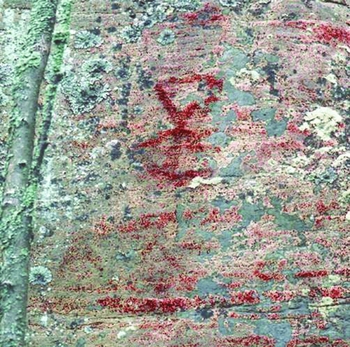
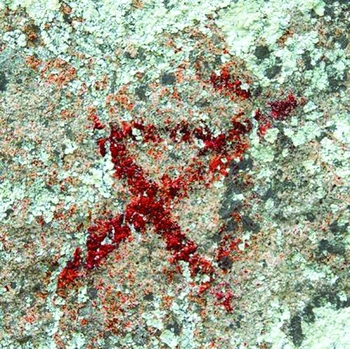
A study of the images shown in Figs 2 and 3 suggests that there particular shape and design may have been carefully chosen.
A photograph of a painting of a figure with a triangular shaped head and two arms at Sourunniemi, Puumala in southern Finland. Photograph copyright: Ismo Luukkonen (1994–2016, http://www.ismoluukkonen.net/kalliotaide/suomi/, accessed 29 March 2014).

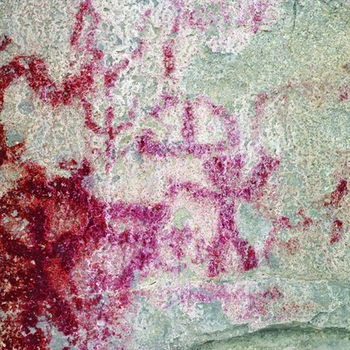
A photograph of a figure with a triangular shaped body painted on a panel at Virvelahti, Naantali, on the southwest coast of Finland. Photograph copyright: Ismo Luukkonen (1994–2016, http://www.ismoluukkonen.net/kalliotaide/suomi/, accessed 29 March 2014).

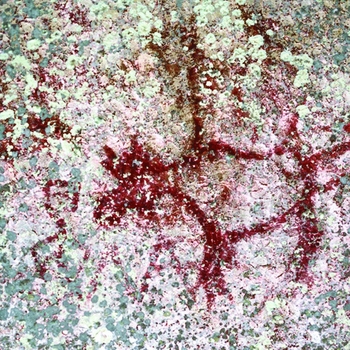
The pictures shown in Figs 4 and 5 as well as the figure from a noaidi drum (Fig. 6), and have similar features with reference to triangular shaped heads, and therefore, have significance and value for the study.
A digitally retouched photograph depicting a stick figure with a triangular shaped head interacting with a moose from a rock painting in Verla, Kouvola. Photograph copyright: Ismo Luukkonen (1994–2016, http://www.ismoluukkonen.net/kalliotaide/suomi/, accessed 29 March 2014).

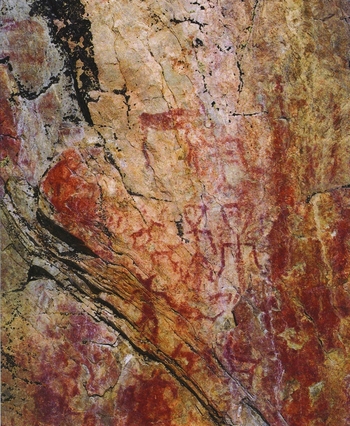
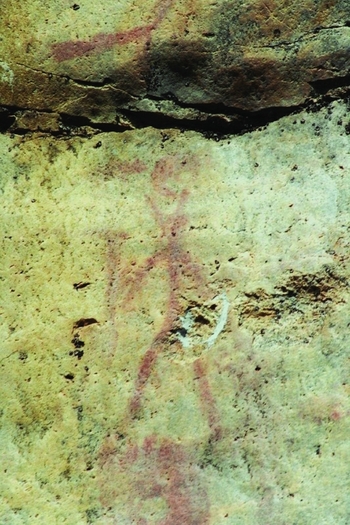
A photograph of the upper section of a painted panel at Hossa-Värikallio, northern Karelia. Copyright: Kivikäs Reference Kivikäs1997.

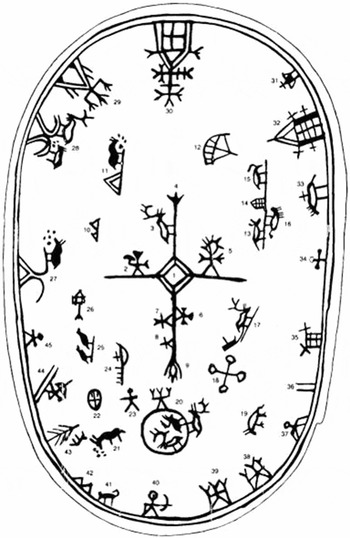
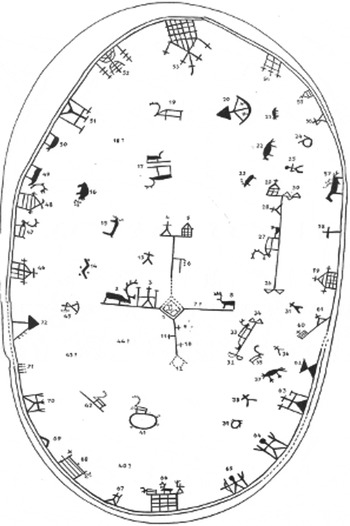
An illustration of a noaidi drum (number 30) from Norway. Copyright: Manker Reference Manker1950.

The image shown in Fig. 7 is not like the other stick figure images with triangular heads; nevertheless it helps to provide additional evidence of the symbolic features of such attributes, which have been seen on similar figures located on divination drums.
An image of a figure with a triangular shaped head and raised arms as if dancing, from the Hahlavuori rock paintings, Hirvensalmi. Photograph copyright: Ismo Luukkonen (1994–2016, http://www.ismoluukkonen.net/kalliotaide/suomi/, accessed 29 March 2014).

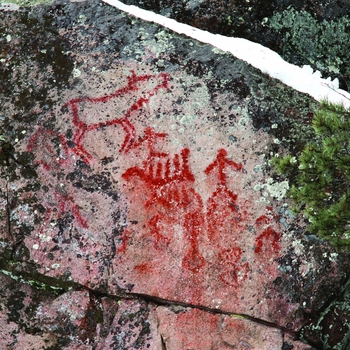
It is important to recognise in the painting shown in Fig. 8 is that human figures have normal characteristics where their heads are round, in contrast to the two figures with triangular and horned attributes. The differences indicate that certain figures were given specific features to distinguish them from ordinary humans.
A reindeer, boat and three or four human figures appear in the painted section of a rock terrace at Uittamonsalmi, Ristiina. The figure in the bottom right of the image has a triangular shaped head with two horns that are faint and also has facial features of eyes and a nose, as well as a triangular shaped upper body. Below the boat image is a second figure that has a triangular shaped head. Photograph copyright: Ismo Luukkonen (1994–2016, http://www.ismoluukkonen.net/kalliotaide/suomi/, accessed 29 March 2014).

At the top of the panel in Fig. 5, an illustration shows the body of either a large moose or reindeer without a head. Both the size and position of the figure have relevance when comparing with a number of reindeer figures on Sámi noaidi drums. Many drumheads exhibit a sacred or celestial reindeer or moose that is usually located either above, or in close proximity to, the vertical axis, which has the Sun at its centre that points north. This figure and its position may be a portrait of a cosmological structure, which may be found elsewhere in Sámi culture. A reindeer in such a position may represent a typical portrait of a mythical being linked with the structure of a cosmological picture that represents a celestial destination in the sky between the star constellation of Perseus and Cassiopeia, which is located on the Milky Way. The reindeer is one of the most sacred animals to the Sámi. Below the headless reindeer/moose image, there are two painted stick figures that have triangular shaped heads that are reminiscent of spirits painted on noaidi drums.
In contrast, on Sámi noaidi drums, mainly around the middle and lower rays of the Sun that point east, south and west, we can find a number of spirit figures with triangular shaped heads and horn-like features. In some cases, the figures are just stick figures personified as the natural forces related to the upper and middle worlds. In the images there are different types of composition with distinctive features that separate them from each other, for example within the landscape at Hossa (Fig. 5), such as humans, animals, figures with triangular shaped heads and a dancing figure that resembles a werewolf or spirit character with thick horns that look like ears, which may be a symbol of authority. It is important to observe how the artist has purposefully portrayed the differences in each of these characters.
In Fig. 6, positioned on the centre of the Sun cross, that represents the World Tree or pillar, in the middle of the drum, on the western section of the rhomb symbol that runs horizontally is ‘Horagallis’ (number 2), the thunder god, who is seen holding what looks like a hammer with a short handle in his right hand (Haetta Reference Haetta1995: 17). The triangular shaped head in this portrait is indicative of a holy or spirit figure.
There are two further figures with triangular shaped heads. The first, located on the vertical axis that runs south (number 6), is another god figure, namely ‘Mudden-olmai’ (Haetta Reference Haetta1995: 17). The second figure (number 7) is ‘Ailikes-olmal’ (Haetta Reference Haetta1995: 17) located on the left of the southern vertical line. The figure holding a bow at the bottom of the drum (number 40) is ‘Jukasakka’ (Haetta Reference Haetta1995: 17), known to the Sámi as the ‘Bow-woman, teacher of hunting’ (Helander-Renvall Reference Helander-Renvall2005: 38). There is also a human figure (number 44) holding a bow who has a triangular shaped head, described by Haetta (Reference Haetta1995: 17) as a ‘Sámi on a bear hunt’.
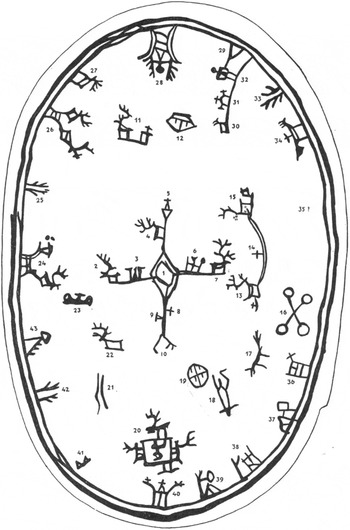
At the centre of the drum shown in Fig. 9, we see Horagalles again holding large hammers in each hand (Manker Reference Manker1950: 243). Horagalles is pictured in the same location on both drums (Figs 6 and 9). Below the central axis of the drum, facing south, there are three spirits in the same position as seen on the drum from Norway who do not have triangular shaped heads. The image of the rock painting from Astuvansalmi shown in Fig. 10 is important because the figures holding the large hammer is similar to the ones featured on the drumheads, because of the timescales involved these links may seem tenuous, but this is still a point of interest.
A second illustration of a noaidi drum (number 8) from Lycksele Lappmark, Sweden. Copyright: Manker Reference Manker1938: 492.

A painted panel from Astuvansalmi, eastern Finland, showing a male figure that appears to be engaged in a ritualistic gesture because of the way his arms are raised. He also has a triangular shaped head and has horn-like features, which may represent a human figure in a ritual costume (Siikala Reference Siikala1981; Kare Reference Kare and Kare2000). Photograph copyright Joy (Reference Schefferus2014).

In the image shown in Fig. 11, on the right side pointing east a figure with a triangular shaped head is evident (number 6). The figure is described by Manker (Reference Manker1950: 250) as ‘Bieggolmai der Windmann’, the god who rules over the wind. There is a reindeer on the left of the central axis, which is positioned above the spirits, and also one to the left facing west.
A third illustration of a noaidi drum (number 10), from Lappmark, Sweden, shows the central axis in the Sámi world picture. Copyright: Manker Reference Manker1950: 250.

Around the central axis of the drum in Fig. 12 there is a range of Sámi spirit figures that have triangular shaped heads and what in some instances look like one eye, as well as the figure that is inside the rhomb symbol representing the Sun, in the centre of the drum. ‘Horagalles’ (number 3) and ‘Bieggolmai’ (number 7) are also depicted (Manker Reference Manker1950: 270). Two reindeer are illustrated above Horagalles and Bieggolmai.
Drum (number 17) from Lappmark, Sweden (Manker Reference Manker1950: 270).

Above the central pillar on the two ridges or borderlines are seven Sieidi structures, which have facial features. These have triangular shaped heads and bodies. Thus demonstrating how sacred places and spirits can have the same attributes and characteristics, as identity markers, and Sieidi places may also have these features because of how spirits take up residence in them during sacrificial offerings and worship.
These portraits demonstrate that the same figures can be found in different positions within the mythical landscapes with regard to cosmology and the structure of the universe. Furthermore, the triangular structures of the figures on the drums are similar to the figures in the rock paintings at Virvelahti, Naantali (Fig. 3), demonstrating links between these types of paintings.
The painting in Fig. 10 depicts a male figure that appears to be engaged in a ritualistic gesture because of the way his arms are raised. He also has a triangular shaped head and has horn-like features, which may represent a human figure in a ritual costume (Siikala Reference Siikala1981; Kare Reference Kare and Kare2000). This image is important because its attributes and design appear to show a remarkable similarity with Sámi spirits found on the drumheads from the seventeenth centuries from Swedish and Norwegian Sápmi. Could the horned figure at Astuvansalmi be a type of transfiguration of the figures with the triangular shaped heads?
The portrait of a figure with pointed features on his head carrying what looks like an axe or a hammer in his left hand is reminiscent of the Sámi god Horagalles as depicted on the drums. Could the fact that the figure is wearing what look like horns indicate his status and authority as a deity in a primitive form? On closer examination of the shape of the head illustrated on drum number 30 (Fig. 6), it is characterised by horn-like features reminiscent of the horns seen on the shown in Fig. 10. The paintings at Astuvansalmi are dated at ca.7000–5700 (Pentikäinen Reference Pentikäinen2007: 2e).
According to Haetta (Reference Haetta1995: 13), Horagalles (also called Dierpmis) was associated with storms, lightning and thunder, and the life giving rain that followed in their wake.
[Horagalles had] power over the health and well-being of people, their life and death. The Sámi, therefore, feared thunder – and offered sacrifices. Horagalles was frequently worshipped. He was depicted as a person carrying a hammer or an axe. Haetta (Reference Haetta1995: 13)
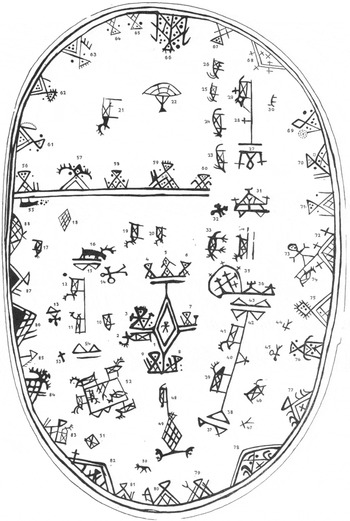
The figures on the lower section of the drumhead in Fig. 13 (numbered from 49–54), all have attributes that could be identified as horn-type structures or markers designating authority and power. What makes these figures of special interest and adds another dimension to this debate is these are described by Manker (Reference Manker1950: 320) as the Sámi Goddesses of ‘the Akka group; Uksakka, Sarakka and Juxakka and Maderakka’, who are linked with the earthly realm of the cosmos. The illustrations and their designs are crucial to recognise within the rock painting research because they clearly demonstrate that both male and female spirits are assigned horned and triangular attributes on their heads in Sámi cosmology, embedded systems of knowledge and could therefore, be termed as being associated with self-identification.
The lower section of drum number 32 from Åsle Lappmark in Swedish Sápmi (Manker Reference Manker1950: 319).

The use of the drawings of the figures from the drumheads by Manker is important because they demonstrate how horns do not appear to be attributes designated to noaidi's in Sámi society. In the assessment of figures with horns in Manker (Reference Manker1950), there is one noaidi figure that has horns holding a drum, painted on drum number 22 (figure 44) from Swedish Lapland. The image is so faint on the original drum that it is not possible to see whether or not there are horns on the figure. The figure could be the spirit of a deceased noaidi holding a drum, because dead noaidi figure prominently within Sámi myths and traditional stories.
The evidence clearly shows how figures with horns and triangular shaped heads can be found on the Radien and Akka groups of figures within cosmological landscapes, alongside the spirits representing the weather and elements, who reside on the central pillar in the middle world picture. Typically, the Radien group resides in the celestial or heavenly realm of the cosmos, as depicted on many drums. Horn-like structures are also found on paintings in sacred places, such as Sieidi sites.
In some cases, spirit figures with horns and triangular shaped heads are also positioned away from the central axis on the drum heads, for example, the Akka Goddesses in Fig. 13, signifying that they were dynamic not static, indicating that the religious traditions were animated and varied.
The comparative study of the figures found in rock paintings in Finland and on drums has helped to demonstrate how the features of horns and triangular shaped heads are interchangeable and can be modified within each illustration, for example, the same spirit figures can have either feature or both. Furthermore, there are many depictions of the same spirit figures that have matchstick heads and bodies, as well as being portrayed as large Sieidi structures on other drumheads, thus again, showing variations representing Sámi spirits within the cosmological picture of the universe.
Comparison of the groups and solitary figures with each other clearly shows that despite not knowing what the relationship between the figures in the rock paintings and noaidi drums are, evidence suggests there are many similarities between the two sources of art, which appears to be centred on an expression of religious identity, systems of embedded knowledge and structures within the culture, in terms of religious practices and the Sámi picture of the world. Thereby, demonstrating a type of inter-connectedness between these two types of figures found within the cosmology of the Sámi, which extends back to prehistory.
The horned figures on the painting at Astuvansalmi (Fig. 10) and those on the drum heads from Swedish and Norwegian Sápmi that are holding a hammer (Figs 6 and 9) may represent the god of thunder.
[A]mong the south Sámi the god of thunder was worshipped for the sake of the reindeer and sacrifices to him could be very large. A big wooden hammer (two fathoms long) sprinkled with blood was dedicated to him (Rydving Reference Rydving and Kvist1992: 26).
The variations between the figures on the drumheads are important because despite the fact they originate from different areas of Sweden and Norway there is clear evidence they have similar designs and attributes to the figures in the rock paintings in Finland.
To add further support to possible links between the figures from rock paintings in Finland and noaidi drums from Norwegian and Swedish Sápmi, rock carvings from Norwegian sites also depict images of drums carved in stone. In prehistoric rock carvings at Alta, Finnmark in Norwegian Sápmi, there are similar horned figures, which resemble the figures painted at Hossa, Värikallio, in northern Finland (Fig. 5).
The earliest indications of the use of drums stems from the rock carvings in Alta [. . .]. First there is the figure of a person beating a drum while walking behind a group of hunters, dated to between 4200 and 3600 BC. Then there are two persons holding a circular object, which may be a drum, among 12 dancers on a boat dated to approximately 500 BC. [. . .] Outside Finnmark there is human figure at Skavberget in Troms (Simonsen Reference Simonsen1955, Reference Simonsen1958) holding a circular object while in a movement together with another person [. . .]. The circular object can be interpreted as a drum. [. . .] Although the evidence is circumstantial, both rock carvings and rock paintings seem to point towards a long tradition in the use of drums, and shamanism (Helskog Reference Helskog and Hodder1987: 28).
Results
The photographic material presented demonstrates that the figures with horn-like features and triangular shaped heads are significant in prehistoric religious practices and cosmology.
Perhaps the most important point that needs to be taken into consideration is that on the drumheads both horned and triangular headed figures appear mainly in groups in close proximity to each other, which it could be argued differ from the ones at rock painting sites where they tend to be solitary figures or two figures together. However, for arguing in favour of these figures representing spiritual beings, rather than noaidi's; attributes as such do, in both sources of data, help to strengthen the theory of the associations between the figures.
The nature of these figures imply that for purposes of identity and homogeny, and as a way of portraying the value system of the culture in terms of historical memory, the horned and triangular headed features and their designs in the rock paintings in Finland seem to reflect the divine attributes associated with spiritual figures on the drums, thus helping to construct the cosmos and portray a view of the world that is very similar to that of the Sámi, which sets them apart from the human realm in terms of noaidi figures. I believe this is what these figures have in common despite the temporal differences.
Given the occurrence of horned and triangular headed figures, such parallels have to be considered as a possibility for evidence of Sámi knowledge systems in the outcome of the research, because for example, the noaidi is the person who communicates with the spirit worlds. Furthermore, the use of horned figures to represent gods/spirits/divine beings is reiterated throughout the literature pertaining to Sámi cosmology compiled by Manker (Reference Manker1938; Reference Manker1950). For unknown reasons, this has not been given the attention it deserves in academic research into rock painting history in Finland with regard to the study of Sámi religion and cosmology.
With further deliberation, it might explain why there are so many striking parallels in overall groups of artistic phenomena in rock paintings, and why prehistoric rock art is located in areas where Sámi groups live or where they have travelled previously.
Concluding remarks
The primary aim of this paper was to demonstrate how, through the careful comparison, description and interpretation of cosmological features and structures found within Sámi noaidi drum figures from the seventeenth and eighteenth centuries and prehistoric rock paintings in Finland, a series of striking parallels between two aspects of cultural representation are recognisable. At the present time, there is no other data that has produced these types of results; therefore, the research demonstrates that this is a field of enquiry, which has not been investigated comprehensively. The results broaden our understanding of the links between rock paintings and drum symbolism, not in terms of shamanism but cosmology and an inherent value system within a longstanding history.
To say that we have absolute proof that in terms of ethnicity, the culture that created the rock paintings is the same culture that we know today as the Sámi might not be totally reliable, but given the ways Sámi religion and cultural history has been treated through the mechanisms of colonialism the facts presented here cannot be ignored and deserve further investigation.
There are patterns of design behaviour as well as consistencies that are apparent that convincingly show how people have related and interacted with the world around them, and this has been documented through a unique type of artistic vocabulary, which has been constructed in such a way that it has transferred across what could be the same culture.
The theories surrounding the cultural heritage of the rock paintings in Finland and their relationship to noaidi drums are ambiguous. The aim of this study was to question the established views on rock art in Finland, which links the paintings primarily with shamanism, hunting magic and Finnish culture. The cultural context of the rock paintings in Finland remains ambiguous and needs to be further challenged because there might be a conflict of interest regarding prehistory in southern and central Finland when it comes to Sámi history.
Criticism in the paper has been aimed at how the established views in Finland are consequential for the Sámi, due to the fact that early research into the history of the culture tends to have focused on forming some kind of shamanistic identity with the past and Kalevala mythology, which may have been beneficial for Finnish culture and the development of the mythology such as the National Epic. Questions of ethnicity in terms of linguistic research and the facts outlined above help to strengthen the argument concerning how both the study and value of art may also be a determining factor in helping to understand the ambiguous nature of ethnicity in Finland in relation to religious identity, homogeny and the value art may have in this process.
Questions still remain concerning whether the rock paintings influenced the symbols found on the surviving drums from Sápmi or whether they were borrowed. The conclusion is that transmission seems more likely, but in the sense of the symbolism inherited through traditions and cultural practices that have been a series of internal developments, which have helped to sustain hunting, fishing and trapping practices and the crucial roles that spirits play within these activities in relation to worship and sacrifice.
Both the decoration of boulders and drum skins are mechanisms for systems of embedded knowledge regarding the transmission of culture and memory, and this mentality has been well documented throughout Sámi culture for at least 1,000 years to the present. Therefore, these findings present a further challenge concerning the meaning of a historical link between the paintings, and what, if any, are the consequences for interpreting ancient history?
In conclusion, this paper adds further evidence to the study of Sámi religion as portrayed through ancient art history and cultural practices by demonstrating how recognition of the association between the figures may have helped advance Sámi research and taken a step towards understanding the remaining aspects of an ancient civilisation that spans thousands of years.
By giving consideration to Sámi traditional knowledge, hunting and artistic practices, the established links between the rock paintings and noaidi drum symbolism, which despite temporal distances do show one of the central aspects relating to the continuity of culture, and how the figures appear to be intricately related to each other in what could be called an indigenous value system and markers of identity.
Recognition of these figures and their links with each other as a group or groups, highlights how combined interdisciplinary research can make a valuable contribution towards understanding how the study of Sámi shamanism alone is, in terms of Sámi religion and cultural history, insufficient in matters concerning the ethnicity of culture and cultural heritage in Finland.
Figures with horns and triangular shaped heads
From an inventory of all the known rock painting sites in Finland, as of 2016, there are at least 15 locations where figures with horns or triangular shaped heads are evident. In addition to the sites discussed in this paper, there are paintings that feature figures with triangular shaped heads at: Uittamonsalmi, Ristiina; Haukkalahdenvuori I, Enonkoski (close to the Astuvansalmi rock paintings); Vierunvuori in the municipality of Heinävesi; Humalniemi, Heinävesi; Kolmiköytisienvuori, Ruokalahti; Pyhänpää, Kuhmoinen; Ruominkapia, Lemi; Hahlavuori, Hirvensalmi; Uittovuori, Laukaa; Kalamaniemi II, Luumäki; Sarakallio I, Jyväskylä; and Halsvuori, Jyväskylä.
Of the 71 drums documented by Manker (Reference Manker1950) that are painted with figures, there are a total of 27 that feature male or female spirit figures with horns and/or triangular shaped heads (catalogue numbers: 5, 10, 14, 17, 22, 26, 30, 31, 32, 33, 34, 38, 39, 40, 43, 44, 47, 50, 53, 54, 57, 58, 61, 62, 63, 68, 70).